A Hybrid System for Incremental
Contextual-Learning and Prudence Analysis
by
Richard Peter Dazeley (BComp Hons)
A Dissertation submitted to the School of Computing in fulfilment of the requirements for the Degree of
Doctor of Philosophy
Declaration
This thesis contains no material, which has been accepted for the award of any other degree or diploma in any tertiary institution, and that, to my knowledge and belief, this thesis contains no material previously published or written by another person except where due reference is made in the text of the thesis
Signed________________________________
This thesis may be made available for loan and limited copying in accordance with the CopyrightAct1968
Abstract
Increasingly, researchers and developers of knowledge based systems (KBS) have been attempting to incorporate the notion of context. For instance, Repertory Grids, Formal Concept Analysis (FCA) and Ripple-Down Rules (RDR) all integrate either implicit or explicit contextual information. However, these methodologies treat context as a static entity, neglecting many connectionists’ work in learning hidden
and dynamic contexts. This thesis argues that the omission of these higher forms of
context, which allow connectionist systems to generalise effectively, is one of the fundamental problems in the application and interpretation of symbolic knowledge.
This thesis tackles the problems of KBSs by addressing these contextual inadequacies over a three stage approach: philosophically, methodologically and through the application of prudence analysis. Firstly, it challenges existing notions of knowledge by introducing a new philosophical view referred to as Intermediate
Situation Cognition. This new position builds on the existing SC premise, that
knowledge and memory is re-constructed at the moment required, by allowing for the inclusion of hidden and dynamic contexts in symbolic reasoning.
This philosophical position has been incorporated into the development of a hybridised methodology, combining Multiple Classification Ripple-Down Rules (MCRDR) with a function-fitting technique. This approach, referred to as Rated MCRDR (RM), retains a symbolic core acting as a contextually static memory, while using a connection based approach to learn a deeper understanding of the knowledge captured. This analysis of the knowledge map is performed dynamically, providing constant online information. Results indicate that the method developed can learn the information that experts have difficulty providing. This supplies the information required to allow for generalisation of the knowledge captured.
In order to show that hidden and dynamic contextual information can improve the robustness of a KBS, RM must reduce brittleness. Brittleness, which is widely recognised as the primary impediment in KBS performance, is caused by a system’s inability to realise when its knowledge base is inadequate for a particular situation. RM partly addresses this through providing better generalisation; however, brittleness can be more directly addressed by detecting when such inadequacies occur. This process is commonly referred to as prudence analysis. The final part of this thesis proves the methods philosophical and methodological approach by illustrating how RM’s use of hidden and dynamic contextual information, allows the system to perform this analysis. Results show how experts can confidently leave the verification of cases when not warned, reducing brittleness and the knowledge acquisition effort.
Acknowledgements
The long, sometimes exciting, occasionally dull, fulfilling road of developing a large solid body of research is at completion. To have the privilege of studying for a PhD is an honour, few find themselves, and even fewer find themselves at the other end holding a completed thesis dissertation. To have reached this stage a student must have strong and dedicated support from those around them and this is my opportunity to say thank you to those that put up with me over these past three years. This was especially a major challenge for them over the last six months when it has been impossible to hold a conversation with me for more than a minute before I would turn it to my PhD progress. This is one personality trait I am hoping to lose soon.
I would very much like to thank my supervisor Dr Byeong Ho-Kang. Byeong made himself available whenever I knocked, offering encouragement and insight. Byeong was a great supervisor as he was able to aid me most in those areas I needed the most help while giving me the freedom to roam when required. I would also like to thank my associate supervisors Dr Ray Williams and Professor Young Choi for their help, support and encouragement when required.
Three years is a long time to go without food, so I’d very much like to thank the Smart Internet Technology Co-operative Research Centre (SITCRC) for their very generous financial support. The SITCRC provided a regular income allowing my family and I to live, secure in the knowledge that we were provided for, while I embarked on my mad adventures. I would also like to thank the SITCRC for their non-financial support, providing research collaboration seminars, conferences and training sessions on everything from business management to ways for dealing with the press.
Over the last stage of producing this final thesis I would like to thank my readers Dr Peter Vamplew and Dr Ray Williams. This occurred at a time of year when both were becoming overloaded with work and in Peter’s case was moving house interstate.
I would also like to thank David Herbert, Luke Fletcher, Terry Bigwood and Tony Gray for their technical support throughout this three year process. It’s always good to know that there is someone around that can recover my Thesis.doc file when needed.
I would very much like to say thank you to Sung Sik Park, not only for putting up with me in the shared office for three years (a mighty effort on its own – especially when my kids come in and switch his server off), but also for the many discussions on the nuances of MCRDR. Also, I’d like to thank him for the use and help in using his MonClassifier database. This was an invaluable aid to the testing of the methodology developed in this thesis, in a real world environment.
Working on a PhD does not stop when you go home at the end of the day, it’s an all day, life encompassing task. Therefore, it is not just those at the university that need to be thanked. I would very much like to thank my mother, father and grandmother (affectionately known as SuperNan by my children) for their love and support, both over the last three years and all the years prior. I’d especially like to thank my mother for always being around to hear me waffle on and on about my thesis and to take the time to read it when completed.
I would especially like to say thank you to the three most beautiful and loving people I have ever had the pleasure to know, Uisce (6), Akalia-Shen (4) and Jayva-Kwan (1). Uisce regularly asked me how my thesis was going, Akalia-Shen liked to hear bits of it read to her as a bed time story (I guess because it put her to sleep), and Jayva liked to draw on it. Thank you, to the three of you, for your understanding, patience and never ending affection.
To
Uisce
,
Akalia-Shen
and
Jayva-Kwan
Chapter Overview
1 Introduction... 1
Part 1: Philosophy and Literature
2 Knowledge Based Systems: Philosophy and Systems... 17
3 Ripple Down Rules... 41
4 Artificial Neural Networks ... 71
Part 2: Methodology and Initial Results
5 Rated MCRDR (RM): Methodology ... 91
6 Classification and Prediction ... 121
Part 3: Prudence Analysis
7 Discovering the Knowledge Frontier... 191
8 MonClassifierRM: Venturing into the Real World... 223
Contents
1 Introduction... 1
1.1 Conceptual Overview ... 2
1.1.1 Process of Practise...3
1.1.2 Context...4
1.1.3 Hidden Contexts ...5
1.2 Thesis Objectives ... 6
1.3 Thesis Hypothesis ... 8
1.4 Thesis Overview ... 9
1.4.1 Methodology ...9
1.4.2 Classification and Prediction ... 10
1.4.3 Prudence Analysis ... 11
1.5 Thesis Organisation ... 12
1.6 Summary... 14
_________________________________________________________________ 2 Knowledge Based Systems: Philosophy and Systems... 17
2.1 Philosophy of Knowledge applied to Artificial Intelligence ... 19
2.1.1 Knowledge Acquisition... 19
2.1.2 Knowledge Representation ... 21
2.1.3 Knowledge Maintenance... 22
2.1.4 Knowledge Based Systems ... 23
2.2 Situated Cognition applied to Artificial Intelligence ... 29
2.2.1 Knowledge Acquisition in Context... 32
2.2.2 Representing Knowledge in Context ... 32
2.2.3 Maintaining Knowledge in Context... 32
2.2.4 Contextual Knowledge-Based Systems ... 33
2.3 Hidden and Dynamic Context... 36
2.3.1 Implications for Knowledge Engineering and Maintenance... 39
2.4 Summary... 40
_________________________________________________________________ 3 Ripple-Down Rules ... 41
3.1 Ripple-Down Rules Background ... 42
3.1.1 GARVAN-ES1: A Maintenance Case-Study ... 42
3.1.2 Implications ... 44
3.2 Ripple-Down Rules Methodology ... 45
3.2.1 Structure and Inference ... 46
3.2.2 Learning... 48
3.2.3 Comparison of RDR with Other KBS Methodologies... 50
3.2.4 Problems with RDR ... 52
3.3 Multiple Classification Ripple-Down Rules Methodology ... 53
3.3.1 Structure and Inference ... 53
3.3.2 Learning... 55
3.4 Refinements and Extensions ... 60
3.4.1 MCRDR/FCA... 61
3.4.2 GENICA ... 62
3.4.3 Other RDR Research... 63
4 Artificial Neural Networks ... 71
4.1 Neural Biology... 72
4.2 History ... 73
4.3 Backpropagation ... 74
4.3.1 Perceptron... 76
4.3.2 Mathematics for Backpropagation... 77
4.3.3 Classification, Generalisation and Fault Tolerance... 79
4.3.4 Problems ... 80
4.4 Radial Basis Function ... 81
4.4.1 Mathematics for RBFs ... 82
4.5 Growth Algorithms ... 83
4.5.1 Upstart Algorithm ... 83
4.5.2 Divide and Conquer ... 84
4.5.3 Tiling Algorithm ... 84
4.5.4 Cascade Correlation (CC) ... 85
4.5.5 Resource Allocating Network (RAN)... 85
4.6 ANNs Finding Missing Variables... 87
4.7 Other Classifiers ... 88
4.8 Summary... 88
_________________________________________________________________ 5 Rated MCRDR (RM): Methodology ... 91
5.1 Overview... 92
5.1.1 Problem with MCRDR... 93
5.1.2 Philosophy of Knowledge Revisited... 93
5.1.3 Proposed Solution ... 94
5.1.4 RM Possibilities ... 95
5.2 Implementation Overview ... 95
5.2.1 System Design ... 95
5.2.2 MCRDR Component... 98
5.2.3 Artificial Neural Network Component ... 98
5.2.4 Component Integration... 101
5.3 RMw: Weighted Technique ... 104
5.3.1 Implementation... 105
5.3.2 Discussion... 106
5.4 RMl(ε): Basic Linear Technique ... 106
5.4.1 Implementation... 106
5.4.2 Discussion... 107
5.5 RMl(∆): Advanced Linear Technique... 107
5.5.1 Implementation... 107
5.5.2 Discussion... 110
5.6 RMbp(ε): Basic Non-Linear Technique ... 110
5.6.1 Implementation... 111
5.6.2 Discussion... 111
5.7 RMbp(∆): Advanced Non-Linear Technique... 112
5.7.1 Implementation... 112
5.7.2 Discussion... 115
5.8 RMrbf: Basic Radial Basis Function Technique ... 116
5.8.1 Implementation... 116
5.8.2 Discussion... 117
5.9 RMrbf+: Advanced Radial Basis Function Technique ... 117
5.9.1 Implementation... 117
5.9.2 Discussion... 119
5.10 Other Network Types and Function Fitting Methods ... 119
6 Classification and Prediction ... 121
6.1 Experimental Method ... 122
6.1.1 Simulated Expertise... 122
6.1.2 Generalisation Experiment... 131
6.1.3 Online Learning Experiment... 132
6.1.4 Datasets... 133
6.2 Comparison of Proposed Methods... 135
6.2.1 Classification ... 135
6.2.2 Prediction... 162
6.2.3 Further Discussion... 168
6.3 Comparing RM against MCRDR and ANNs... 169
6.3.1 Overview of ANN used... 169
6.3.2 Classification ... 170
6.3.3 Prediction... 183
6.3.4 Further Discussion... 185
6.4 Summary... 186
_________________________________________________________________ 7 Discovering the Knowledge Frontier... 191
7.1 Review ... 192
7.1.1 Brittleness ... 192
7.1.2 Verification and Validation... 193
7.1.3 Prudence Analysis ... 194
7.1.4 RDR Prudence Systems ... 195
7.2 RMp: Prudence Methodology ... 196
7.2.1 RMp(p): Prediction Method ... 197
7.2.2 RMp(c): Classification Method... 200
7.3 Experimental Method ... 203
7.3.1 Overview ... 203
7.3.2 Simulated Experts ... 205
7.3.3 Datasets... 205
7.4 Prudence Results... 206
7.4.1 Accuracy... 207
7.4.2 Number of Warnings... 208
7.4.3 Total Error ... 210
7.4.4 Versatility of RM ... 210
7.4.5 Learning Speed... 213
7.4.6 Error Distribution ... 214
7.5 Using Prudence Warnings ... 215
7.5.1 Rule Creation Comparison... 216
7.5.2 Classification Accuracy ... 218
7.5.3 Non-Perfect Humans ... 219
8 MonClassifierRM: Venturing into the Real World... 223
8.1 The MonClassifier Application... 224
8.1.1 PWIMS ... 225
8.1.2 MonClassifier Overview ... 226
8.1.3 Weakness of MonClassifier ... 227
8.1.4 MonClassifier Knowledge Representation ... 228
8.2 Experimental Method ... 229
8.2.1 Tests Overview... 229
8.2.2 Expertise ... 229
8.2.3 Dataset ... 231
8.3 Results... 232
8.3.1 Versatility in eHealth ... 233
8.3.2 Parameter Tuning ... 234
8.4 Using Prudence Warnings ... 235
8.5 Summary... 236
_________________________________________________________________ 9 Conclusion ... 237
9.1 Methodology and Results Summary ... 239
9.2 Discussion... 244
9.2.1 Building upon Existing Knowledge... 245
9.2.2 Incrementing Network Classifications Online ... 246
9.2.3 Problems ... 246
9.3 Future Work... 247
9.3.1 Algorithm Additions ... 248
9.3.2 Possible Applications ... 249
9.4 A Final Word ... 250
_________________________________________________________________ References... 251
Appendix A: Chapter Quotes... 265
Appendix B: Notation... 267
Appendix C: Acronyms ... 273
Table of Figures
Figure 1-1: Conceptual framework for human psychology, sociology,
action and knowledge. ... 2
Figure 3-1: Shows the change in rule 22310.01 over a three year period. ... 43
Figure 3-2: Example of the RDR binary tree structure. ... 47
Figure 3-3: Example of creating and incorporating new knowledge in RDR. ... 49
Figure 3-4: Example of the MCRDR n-ary tree structure.. ... 54
Figure 3-5: MCRDR tree showing the nodes that cornerstone cases should be taken ... 58
Figure 3-6: Comparison of two rule selection methods ... 59
Figure 4-1: Schematic diagram of a single neuron... 72
Figure 4-2: Example topologies for feed forward networks... 75
Figure 4-3: ARFN: A neuron for implementing a Guassian-like response function. ... 86
Figure 5-1: Pseudo code algorithm for RM... 96
Figure 5-2: RM illustrated diagrammatically. ... 96
Figure 5-3: Example of the single-step-∆-initialisation-rule shown diagramatically. ... 110
Figure 5-4: Network structure of RMbp(∆)... 113
Figure 5-5: Process used for adding new input and hidden nodes in RMbp(∆). ... 114
Figure 6-1: Example of a possible energy pattern used in the Multi-Class-Prediction simulated expert. ... 130
Figure 6-2: Step-by-step description of the generalisation experiment... 131
Figure 6-3: Step-by-step description of the online learning experiment. ... 132
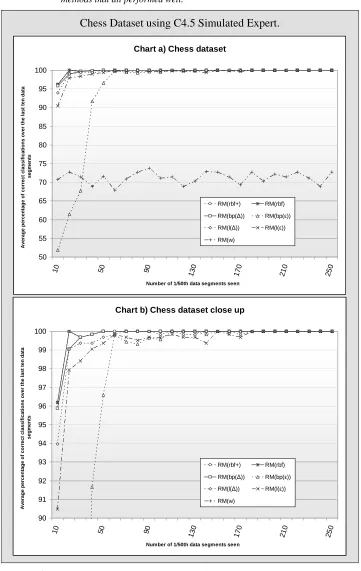
Figure 6-4 Two charts comparing how each of the seven proposed methods perform on the Multi-Class dataset using the Linear Multi-Class simulated expert. ... 136
Figure 6-5 Two charts comparing how each of the seven proposed methods perform on the Multi-Class dataset using the Non-Linear Multi-Class simulated expert. ... 137
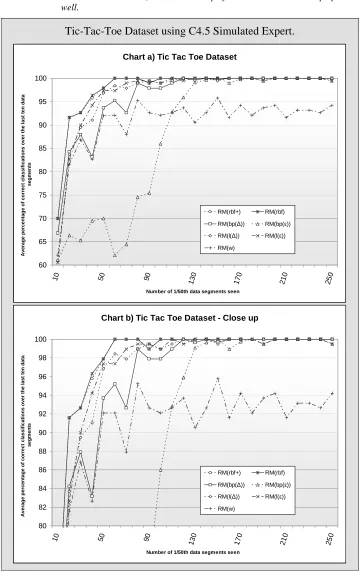
Figure 6-7: Two charts comparing how each of the seven proposed methods perform on the Tic-Tac-Toe dataset using the
C4.5 simulated expert. ... 139
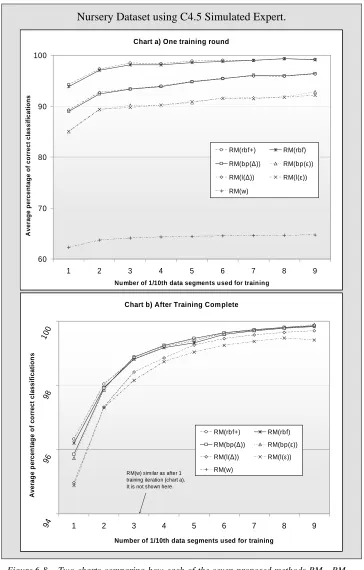
Figure 6-8 Two charts comparing how each of the seven proposed methods perform on the Nursery dataset using the C4.5
simulated expert... 140
Figure 6-9 Two charts comparing how each of the seven proposed methods perform on the Nursery dataset using the C4.5
simulated expert... 141
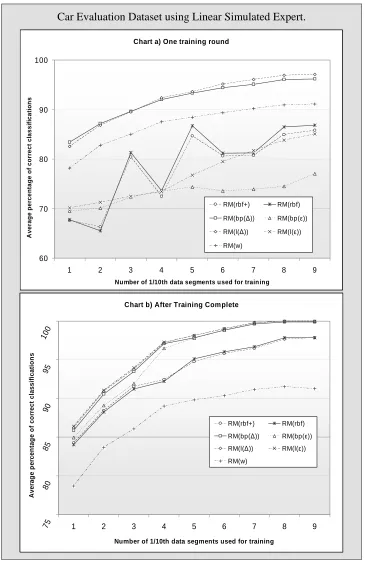
Figure 6-10 Two charts comparing how each of the seven proposed methods perform on the Car Evaluation dataset using the
C4.5 simulated expert. ... 142
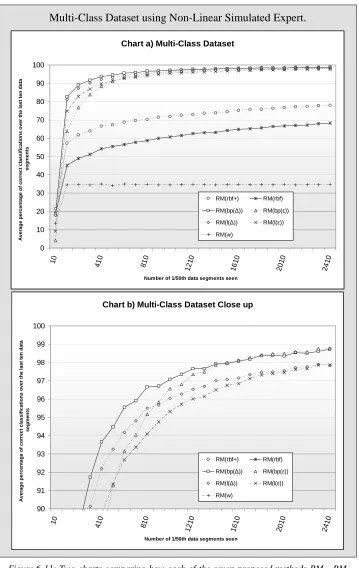
Figure 6-11: Two charts comparing how each of the seven proposed methods perform on the Multi-Class dataset using the
non-linear simulated expert. ... 155
Figure 6-12: Two charts comparing how each of the seven proposed methods perform on the Chess dataset using the C4.5
simulated expert... 156
Figure 6-13: Two charts comparing how each of the seven proposed methods perform on the TTT dataset using the C4.5
simulated expert... 157
Figure 6-14: Two charts comparing how each of the seven proposed methods perform on the Nursery dataset using the C4.5
simulated expert... 158
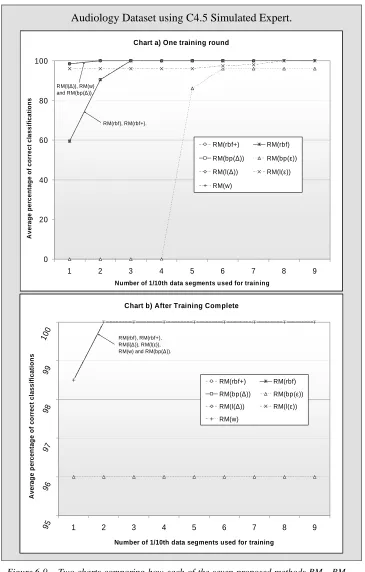
Figure 6-15: Two charts comparing how each of the seven proposed methods perform on the Audiology dataset using the C4.5
simulated expert... 159
Figure 6-16: Two charts comparing how each of the seven proposed methods perform on the Car Evaluation dataset using the
C4.5 simulated expert. ... 160
Figure 6-17 Two charts comparing how each of the seven proposed methods perform on the Multi-Class-Prediction dataset
using the Multi-Class-Prediction simulated expert. ... 163
Figure 6-18: Comparison of RMbp(∆) and RMbp(ε) after training was
completed on the Multi-Class-Prediction test... 165
Figure 6-19 Two charts comparing how each of the seven proposed methods perform on the multi-class dataset using the
multi-class-prediction simulated expert... 167
Figure 6-20 Two charts comparing how each method RMbp(∆), ANN(bp)
and MCRDR, perform on the Multi-Class dataset using
the Linear Multi-Class simulated expert... 171
Figure 6-21 Two charts comparing how each method RMbp(∆), ANN(bp)
Figure 6-22 Two charts comparing how each method RMbp(∆), ANN(bp)
and MCRDR, perform on the Chess dataset using the
C4.5 simulated expert. ... 173
Figure 6-23 Two charts comparing how each method RMbp(∆), ANN(bp)
and MCRDR, perform on the Tic-Tac-Toe dataset using
the C4.5 simulated expert. ... 174
Figure 6-24 Two charts comparing how each method RMbp(∆), ANN(bp)
and MCRDR, perform on the Nursery dataset using the
C4.5 simulated expert. ... 175
Figure 6-25 Two charts comparing how each method RMbp(∆), ANN(bp)
and MCRDR, perform on the Audiology dataset using the
C4.5 simulated expert. ... 176
Figure 6-26 Two charts comparing how each method RMbp(∆), ANN(bp)
and MCRDR, perform on the Car Evaluation dataset
using the C4.5 simulated expert. ... 177
Figure 6-27: Chart comparing RMbp(∆) against MCRDR and an ANN
using backpropagation on the multi-class dataset using the
non-linear simulated expert. ... 179
Figure 6-28: Chart comparing RMbp(∆) against MCRDR and an ANN
using backpropagation on the chess dataset using the C4.5
simulated expert... 179
Figure 6-29: Chart comparing RMbp(∆) against MCRDR and an ANN
using backpropagation on the tic-tac-toe dataset using the
C4.5 simulated expert. ... 180
Figure 6-30: Chart comparing RMbp(∆) against MCRDR and an ANN
using backpropagation on the nursery dataset using the
C4.5 simulated expert. ... 180
Figure 6-31: Chart comparing RMbp(∆) against MCRDR and an ANN
using backpropagation on the audiology dataset using the
C4.5 simulated expert. ... 181
Figure 6-32: Chart comparing RMbp(∆) against MCRDR and an ANN
using backpropagation on the car evaluation dataset using
the C4.5 simulated expert. ... 181
Figure 6-30 Two charts comparing how each method RMbp(∆), and
ANN(bp), perform on the Multi-Class-Prediction dataset
using the Multi-Class-Prediction simulated expert. ... 183
Figure 6-31 This chart compares how RMbp(∆), and NN(bp), perform on
the Prediction dataset using the
Multi-Class-Prediction simulated expert. ... 184
Figure 7-1: Conceptual diagram of knowledge distribution within a
particular domain. ... 193
Figure 7-3: Chart comparing the accuracy of the two systems developed in this thesis: RMp(p) and RMp(c) against
Compton et al’s (1996) results for each of the four
datasets... 207
Figure 7-4: Chart comparing the percentage of true negatives of the two systems developed in this thesis: RMp(p) and RMp(c),
against Compton et al’s (1996) results for each of the four
datasets tested. ... 208
Figure 7-5: Comparison of results from a range of tests using
different threshold adjustment values... 212
Figure 7-6: Comparison of the average percentage of cases that produced each of the four types of results over ten
randomly generated trials. ... 214
Figure 7-7: Four stacked area charts showing whether there is any
compounding effect on a KB when rules are missed. ... 217
Figure 7-8: Compares the full and trusting experts’ knowledge bases
after training... 218
Figure 8-1: PWIMS Architecture ... 225
Figure 8-2: Main view of the MonClassifier application. ... 226
Figure 8-3: Comparison of the rule structures used in traditional
MCRDR and that used in MonClassifier... 228
Figure 8-4: Comparison of results from a range of tests using
different parameter settings. ... 234
Figure 8-5: Stacked area chart showing the average number of rules created when trusting the prudence system for the eHealth
Table of Tables
Table 3-1: Three ways for adding new rules when correcting an
MCRDR KB ... 56
Table 6-1: Example of a randomly generated table used by the linear multi-class simulated expert. ... 125
Table 6-2: Two example cases being evaluated by the linear multi-class simulated expert. ... 126
Table 6-3: Example of a randomly generated table of attribute pairs. ... 127
Table 6-4: Two example cases being evaluated by the non-linear multi-class simulated expert. ... 127
Table 6-5: Compares the linear versions of RM (RMl(ε) and RMl(∆)) ... 145
Table 6-6: Compares the non-linear versions of RM (RMbp(ε) and RMbp(∆))... 146
Table 6-7: Compares RMl(∆) and RMbp(∆)... 148
Table 6-8: Compares RMrbf and RMrbf+... 151
Table 6-9: Compares RMbp(∆) and RMrbf+... 153
Table 7-1: Comparison of the averages between the two prudence analysis systems developed. ... 206
1
1
1
I
I
n
n
t
t
r
r
o
o
d
d
u
u
c
c
t
t
i
i
o
o
n
n
It’s a funny thought that, if Bears were Bees, They’d build their nests at the bottom of trees. And that being so (if the Bees were Bears),
We shouldn’t have to climb up all these stairs. (Milne 1926, p6)
Since the advent of the computer, people have been searching for ways to make
these machines think, learn and acquire knowledge. There have been a number
of methods applied to such tasks with varying degrees of success across many
problem domains. For instance, artificial neural networks (ANNs) and other
function fitting methods have shown great ability at being able to learn
generalised solutions to problems. These systems can provide reasonable results
to situations never previously seen. However, they generally require extensive
and repeated training or calculation to form the required function.
Another highly successful approach to AI is through encoding human
knowledge directly, generally referred to as Knowledge Based Systems (KBS)
or Expert Systems (ES)1. Systems using such knowledge can provide extremely
accurate classification. Additionally, once knowledge has been added to them it
can be used immediately without needing repeated training. However, unlike
ANNs, KBSs generally fail completely when faced with previously unseen
situations, especially when they require knowledge from outside the system’s
domain. Moreover, unless a human expert is checking each conclusion there is
no way for such a system to realise when it is arriving at incorrect conclusions.
The differences between these dichotomous approaches were further
investigated by Gaines (2000). He looked at where within the overall framework
for human activity, each group of methods have been applied with the greatest
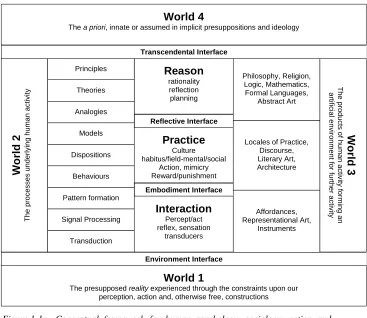
success. Figure 1-1 shows a reproduction of Gaines’s (2000) Levels and Worlds
of Being diagram, which attempts to capture the entire conceptual framework for
human psychology, sociology, action and knowledge. The central region of this
Practice Culture habitus/field-mental/social Action, mimicry Reward/punishment Principles Reflective Interface Embodiment Interface Reason rationality reflection planning Interaction Percept/act reflex, sensation transducers Theories Analogies Models Dispositions Behaviours Pattern formation Signal Processing Transduction Philosophy, Religion, Logic, Mathematics, Formal Languages, Abstract Art Affordances, Representational Art, Instruments Locales of Practice,
Discourse, Literary Art, Architecture Wo rld 3 T h e p ro d uc ts of h u m a n a c ti vi ty f o rm in g a n a rtificial e n vironme n t f o r furth e r ac tivity Wo rld 2 T h e pr o c esse s under lyin g h u m a n a c tivity Transcendental Interface Environment Interface World 1
The presupposed reality experienced through the constraints upon our perception, action and, otherwise free, constructions
World 4
[image:18.612.144.511.64.382.2]The a priori, innate or assumed in implicit presuppositions and ideology
Figure 1-1: Conceptual framework for human psychology, sociology, action and knowledge. The central region shows a three-layer model of human entities. The four outer worlds set human entities within the context of Popper’s (1968) worlds. The boxes on the left of the central core identify various models of knowledge transfer in relation to the three layers. The boxes to the right of the central core relate the three layers to various products of human entities. This model is a replication of the levels of worlds of being model (Gaines 2000, p 115).
diagram presents a three layer model of human entities, such as people,
companies or governments. Gaines (2000) claims that connectionist approaches
have emulated the interaction level with increasing effectiveness, while digital
computation has done similarly well with the top brain functions of reasoning.
1.1 Conceptual Overview
Gaines’s (2000) investigation into these different approaches found that the
central area concerning the processes of practice is relatively untouched.
Conceptually this thesis is interested in finding an approach that goes some way
to filling this gap. This section will investigate the process of practise and how it
relates to deeper forms of contextual representations of knowledge. This directly
1.1.1 Process
of
Practise
In human psychology and sociology the process of practice is where the
behaviour of people or organisations’ is not governed by logic or a reflexive
response to an event. Rather, they are ruled by their cultural, mental or social
state at the time. For instance, a person’s habitus, or predisposition to be
effected by something (WordNet 2003), can significantly alter their response to
a particular set of facts (Gaines 2000). One type of habitus, where behaviour is
induced by normative rules, such as government codes or through business
operations, has been successfully modelled by KBSs. However, these can still
be problematic as normative rule sets are generally incomplete and require
significant interpretation (Op cit). Gaines (2000) claims that the failure to
adequately model the remaining process of practice is the “…greatest
impediment to the development of expert systems” (Gaines 2000, p 115).
Currently there are two approaches whittling away at the region of practice.
Firstly, connectionist researchers have been investigating the emulation of
higher brain functions. Generally, connectionist work has struggled to develop
systems that model higher brain functions as they tend to be mostly reactive
(Gaines 2000). Machine learning methods like temporal difference learning can
be integrated with connectionist approaches providing the ability to spread
rewards over temporally separated events in a generalised form (Sutton and
Barto 1998). This offers the ability to learn some simple actions (Op cit).
However, these systems struggle to learn the amount of knowledge required for
complex higher brain functions, thereby, limiting their effectiveness.
Simultaneously, approaches such as Lenat’s (1995) Cyc project, have attempted
to extend the application of reason downward through the codification of
general knowledge in a KBS. This approach is attempting to gain the
connectionists’ ability to generalise through brute force.
The most promising method for modelling the central region of practice
though, as claimed by Gaines (2000), is through a system using multiple rule
sets based on exceptions within a prioritized hierarchy. Furthermore, Gaines
(2000) claims that Multiple Classification Ripple-Down Rules (MCRDR) (Kang
and Compton 1992; 1994; Kang et al. 1995) goes some way to providing such a
outcome, which permits the resolution of conflicting constraints by providing a
number of alternate possibilities. However, such a system still only provides
specific alternate classifications rather than a general constraint, as Gaines
(2000) claims is needed. Thus, a more general system of selecting admissible
actions that satisfy the identified constraints, but are otherwise indeterminate, is
more capable of realistically modelling human practice (Gaines 2000).
1.1.2 Context
The strength of Ripple-Down Rule (RDR) based methods in partially addressing
the problem of modelling habitus, is based on their incremental nature,
exception based knowledge structure and the ability to capture static contexts.
Context can be thought of as the starting state or assumptions prior to
inferencing. In the case of RDR, context is determined during inferencing. This
allows simple maintenance within the context determined, through rule
exceptions. This contextual based maintenance allows RDR based
methodologies to capture more transient and tacit knowledge (Richards and
Busch 2000; 2001). This is without the need to globalise knowledge to a general
context, where no prior knowledge or assumptions are required before codifying,
unlike many other KBS methodologies, such as KADS.
This failure of most methodologies to consider context has significantly
hampered their knowledge acquisition process. However, methods, including
RDR based techniques, that do incorporate either implicit or explicit context,
assume that it is a priori, and therefore, deductive. This assumption leads to
static representations of contextual based knowledge. However, context in
certain situations could be considered a posteriori, and therefore, inductive
(Brezillon 1999). For instance, during a conversation the context or assumptions
of the people involved is constantly altered as the interaction meanders through
different topics. Each new topic requires a different set of assumptions.
Situations such as this require a dynamic and changeable representation.
Dynamic contexts require the ability to have multiple start states that result in
the same or similar contexts. Alternatively, a number of similar starting
1.1.3 Hidden
Contexts
Brezillon (1999) suggests that dynamic context can only be modelled during the
solving of a problem or through interaction, and thus not directly coded in a
static structure. A number of authors, such as Widmer and Kubat (1996) go
further, suggesting that these new contexts are often differentiated by variables
or facts that are hidden, even to those altering their contextual position. Such
contexts are sometimes referred to as hidden contexts.
In this thesis the idea of a hidden context is a one that is only identifiable
through influences on a system that can not be captured, such as human emotion
or intuition. These situations arise where aspects of a contextual situation are
hidden from the current state and the path taken to reach that position. A hidden
context differs from a dynamic context due to the reason for the contextual
position is unknown, whereas dynamic contexts are changing over time.
Furthermore, the cause of a dynamically changing context can potentially be due
to the influence of a hidden context.
The dynamic, and generally hidden, contextual nature of habitus, potentially
prevents contextually static approaches from being able to encroach further into
the central region of practice. It is common knowledge that different people
react differently to particular events. Furthermore, the same person may react
differently to the same event at different times. For instance, people will often
wait to tell someone some news because they are ‘waiting for the right time’.
This hidden and dynamic context of habitus means facts about a situation will be
interpreted differently, resulting in a different response. Thus, the contextually
static system’s inability to incorporate this contextual information hinders their
ability to accurately model the process of practice.
While proving the existence of such types of contexts is not the core of this
thesis, the idea of these forms of contexts is one of the driving influences in the
methodological design and in bridging the gap of the process of practise. The
methodology developed in this thesis is designed at capturing these hidden
contexts and goes some way to learning dynamic contexts. As shown in chapter
6, the success of the system to improve on the performance of a static
methodology in many domains, goes some way to justifying that some form of
1.2 Thesis Objectives
This thesis has been inspired philosophically, by the idea of finding a potential
solution to the modelling of human practice by filling in the gap between the
two opposing streams of research: ANNs and KBSs. Such a system would need
to be able to handle hidden and dynamic contexts, as well as be able to
generalise to some degree. This requires similar behaviour to the traditional
strengths of connection based approaches. Yet in order to meet the higher brain
function requirements of habitus, the system should also be able to acquire and
retain knowledge quickly. This requires similar behaviour to the traditional
symbolic approaches. In order to achieve such opposing goals, the core of this
thesis is interested in developing a system capable of discovering hidden context
and constantly adjusting for their dynamically shifting nature in a primarily
symbolic based system.
These ideas inspired the aim of this thesis to extend an RDR based method’s
ability to represent knowledge in context, to also find relationships between
those contexts. Such relationships represent a form of hidden context. If these
relationships could be represented in a generalised form, which allowed for
simple alterations then the methodology would also be capable of learning and
adjusting these contextual relationships dynamically. The combination of these
abilities would provide a form of a posteriori analysis that could provide
reasonable classification when dealing with unique situations.
This inspiration and the derived aims led to the notion of combining a KBS
with an ANN. The KBS selected for use in this thesis was MCRDR, as this is
currently one of the methodologies most capable of modelling the process of
practice (Gaines 2000). If such an amalgamation is possible then this could
incorporate the continuous learning and generalisation ability of the ANN, on
top of the immediate incremental knowledge acquisition of MCRDR. Such a
system would be trainable in any task for which both a reward structure could be
developed and a source of expert knowledge was available.
The second area of interest to this thesis considers the idea that if an
algorithm could be developed that met the above criteria then:
While this is far too broad a question to be fully addressed by this thesis,
potentially systems that incorporated higher forms of context could open up new
and interesting areas for future research. For instance, a symbolic approach with
a dynamic context based representation could be significantly more proactive
during knowledge acquisition and develop its own meta-knowledge.
Additionally, it could also be applied in application domains not normally
associated with symbolic systems, such as knowledge discovery and
reinforcement learning.
In this work the aim is to address one major possibility in relation to how the
project’s proposed algorithm could be applied. It aims to investigate how
extracted hidden and dynamic contextual based knowledge could be used by a
KBS for self analysis. By using this derived information, is it possible to detect
the limits of its own knowledge? If the frontier of a rule base’s knowledge can
be detected, then it would be possible to identify situations where knowledge,
beyond what is currently known, is needed to correctly classify a particular case
or situation.
While not directly studied in this project, other areas of interest in the
application of the proposed method is how its hidden and dynamic contextual
information can aid in traditional domains, such as Information Filtering (IF),
Knowledge Discovery in Databases (KDD), as well as interesting new avenues
such as incremental induction. A second view of this work is how such an
amalgamation could facilitate the use of expert knowledge within a neural
network. Traditionally, such networks do not allow for an expert in the field to
provide assistance to the network’s ability to learn. This could be significantly
useful in a number of areas where there is some existing expert knowledge
already and the network is required to build on that knowledge rather than to
start learning from scratch. This would provide a much faster learning system
than traditional networks, without losing generalisation.
It should be noted, that while this thesis is inspired by developing a method
capable of being applied to the process of practice, it is not feasible to directly
prove the developed algorithm is suitable. This could only be determined
through years of future development of applications requiring process of
1.3 Thesis Hypothesis
The above aims can be summarised into two hypotheses that this thesis will
answer in relation to the hybrid system developed.
Can careful hybridisation of two existing learning techniques, utilise the advantages of both by producing an improved learning system that is greater than the sum of its parts?
This first hypothesis essentially addresses the methodology’s proof of
concept. As previously discussed, fundamentally the advantages and
disadvantages of ANNs and KBSs are essentially dichotomous. The advantage
of ANNs is that they are good at generalisation corresponding to KBSs’ greatest
weakness. Likewise, a KBS learns immediately upon a new rule being added to
the system2, whereas ANNs require numerous viewings of the same or similar
cases to successfully learn. The above hypothesis asks whether the combination
of these techniques result in a methodology that is capable of immediate
learning of a KBS, while also being able to generalise like traditional ANNs.
In the general field of classification, and even in prediction tasks, such a
capability is certainly of great value. Faster learning with maintained
generalisation while incorporating expert knowledge into the training of a neural
network, by itself, could be applied successfully in many potential applications.
However, rather than exploring that avenue, this thesis will concentrate on the
implications for KBS applications by addressing the second hypothesis:
Does the discovery of hidden and dynamic relationships between multiple contexts within MCRDR offer significant and useful information?
This second hypothesis asks whether the resulting methodology’s discovered
meta-knowledge can be utilised to provide useful information. While the
possibilities are really up to the imagination of those utilising it, this thesis will
concentrate on the single application area of prudence analysis. The hypothesis
is correct if the system can use the information learned to accurately produce
warnings when further knowledge is required.
2
1.4 Thesis Overview
The methodology developed in this thesis, builds upon an observed weakness in
the Multiple Classification Ripple-Down Rules (MCRDR) methodology. The
MCRDR inferencing process determines individual classifications, which are all
uniquely derived without any consideration for what other paths may also have
been followed. This represents a significant lack of cohesion between the
multiple classifications found. This dissertation takes the position that because a
case was classified in a particular set of classes, there must be either a conscious
or subconscious relationship between those classes in the expert’s mind. This
relationship essentially identifies a higher level of contextual meaning and could
be considered to be a hidden context.
1.4.1 Methodology
The algorithm developed in this thesis, referred to as Rated MCRDR (RM),
seeks to identify these hidden relationships. This involves online analysis of the
actual MCRDR knowledge map during the inferencing and acquisition
processes. The extraction of information about the structure of the knowledge
stored in an MCRDR knowledge base (KB) is not unique. For instance, a
significant body of work by Richards (1998a) investigated using Formal
Concept Analysis (FCA) to find hidden concepts in a KB structure. However,
this was a once off static analysis and was more useful as a user’s tool for
knowledge reuse, rather than for actively improving learning or for handling
dynamic contexts (3.4) (Op cit).
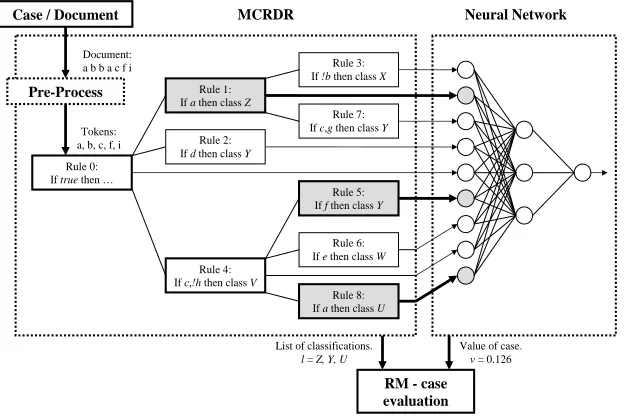
Rated MCRDR, described in its simplest form (see chapter 5 for a full
description), combines MCRDR with an artificial neural network. These
methods are hybridised in such a way that the network is able to learn patterns
of conclusions found from inferencing through the knowledge base. The
position of rules within the MCRDR structure represents the context of the
knowledge (Compton and Jansen 1988; Kang 1996) while the network’s ability
to adjust its function over time provides a means of learning dynamically
changing contextual patterns.
use the output from the tree structure as an input for an ANN. The difficulty
arises from the MCRDR structure being an incrementally growing rule base.
Thus, if we wish to attach a network to this growing structure then the network
must also increase its input space in parallel with the tree. However, nowhere in
the neural network literature, or any other function-fitting literature, has
anybody attempted to use such a system in an environment where the input
space is constantly growing. Therefore, there are no existing techniques that can
be used to accomplish this task.
Rather than inventing a new function-fitting algorithm from scratch, this
project has looked at a range of methods and attempted to find ones that hold
some form of extendable nature. Many very powerful techniques, however, had
to be discounted, due to an inability to find a way of extending their input space
successfully. The methods found with some form of growth potential, were then
altered significantly allowing for their use in RM. As a result a number of
techniques were developed for learning the output patterns.
1.4.2 Classification and Prediction
Each of the methods developed were tested in both classification and prediction
based problem domains. In this thesis a classification task is one that tests a
systems ability to identify individual groupings from a finite collection for each
case. A prediction task, on the other hand, involves identifying a precise value or
rating from an infinite range for each case.
In this project two types of tests were conducted in both classification and
prediction. The first experiment investigated the ability of the different methods
at generalisation. This involved providing different amounts of training data and
observing how accurately the methods were then able to classify or rate
previously unseen cases. The second experiment investigated the ability of the
various methods in an online domain. This involved showing cases in series
without previous training. The level of accuracy in classification and rating were
then recorded over time. These tests were designed to test the different methods’
performances so they could be compared against each other finding which the
best performers were.
The best performing method was then further compared against the neural
were carried out on the same tasks and datasets. The results from these
experiments showed that the hybridisation performed in RM provided a vast
improvement over the original individual methods, which answered the first of
the dissertation’s hypotheses.
1.4.3 Prudence
Analysis
While this hybridised technique shows great promise in improving learning
and generalisation, the possibility of using the information in more elaborate
ways was further explored. This exploration was through its application in the
field of prudence analysis. Prudence analysis is the process of self verification
of the active knowledge base during inferencing. It involves the KBS
determining whether the classification concluded is correct. When it believes it
may be wrong it warns the expert allowing them to check its validity.
Through careful application of RM, the method is shown to be a powerful
predictor of the knowledge base’s accuracy. Results show an improved
performance, with much greater versatility, over previous attempts at prudence
checking. Prudence analysis is potentially a very powerful tool. Primarily it
frees an expert from the need to manually check every classified case, which
previously has been a major problem with RDR based methodologies. It also is
more useful than standard verification and validation techniques as they only
indicate the completeness of a knowledge base with hypothetical, machine
generated cases.
The true power of RM is further shown by its ability to use prudence
analysis in a real world environment, using human knowledge. RM is used in
conjunction with the MonClassifier (Park et al. 2003; 2004a) utility.
MonClassifier is a monitoring tool for the World Wide Web (WWW). After
being assigned a number of sites to be monitored, such as news sites, it will
categorise every new addition into its database. This categorisation has been
traditionally performed through MCRDR. The system has been highly effective,
however, like all RDR based systems the expert must check each new article to
ensure it has been correctly classified. This task is time consuming and limits
the power of having such a classification tool. RM has been used to analyse the
1.5 Thesis Organisation
This thesis is presented in a simple and straight forward structure. At the
highest level it has been broken up into three distinct parts. Each part is broken
up further into a number of chapters, making a simple progression through the
thesis. Finally, after the three parts chapter 9 provides a conclusion to the thesis.
Following is a brief description of each part and chapter:
Part 1: Philosophy and Literature
The first part discusses the philosophical considerations, along with a detailed
review of literature and background material, relevant to this thesis.
Chapter 2: Knowledge Based Systems: Philosophy and Systems
This chapter initially reviews current philosophically based ideas on ‘what is
knowledge’ and how they apply to the field of symbolic learning. It explores
both the historical perspectives and why new philosophies have been sought
over the years. This chapter also discusses the more recent notions of situated
cognition, along with this dissertation’s extension to these ideas. The aim of
this chapter is to place the research carried out in this thesis within the
contemporary philosophical thinking and to discuss how RM addresses some
of these issues.
Chapter 3: Ripple-Down Rules
This chapter provides a review of the existing RDR based methodologies.
Initially, it explains the base methodologies of RDR and MCRDR in detail
and follows this with a very brief overview of some of the techniques
developed beyond these original methods. Additionally, it will discuss in
more detail other work that has previously been developed for finding hidden
context through analysing KB structure.
Chapter 4: Artificial Neural Networks
The final literature review chapter is essentially provided to ensure the reader
is sufficiently familiar with artificial neural network technology, in order to
follow the later discussions on the development of RM. It briefly covers both
the historical progression of ANNs, as well as an overview of the main
methods considered in this thesis. Finally, the chapter also briefly discusses
Part 2: Methodology and Initial Results
The second part fully details the various possible implementations and presents
the initial results. These results justify the implementation decisions made in
developing the methodologies, along with addressing the first hypothesis.
Chapter 5: Rated MCRDR (RM) Methodology
This chapter describes the RM methodology in detail. There are seven
variations of RM developed, each providing different abilities and
weaknesses. This chapter explains why each variation was believed to have
merit to warrant its implementation and why particular design decisions
were made. Additionally, it formulates the mathematical equations used in
various components. Finally, it also elaborates on why some function fitting
methods could not be applied to RM.
Chapter 6: Rated MCRDR (RM) Initial Results
This initial results chapter has two main purposes. The first is to fully test
each method developed in a small number of differing tasks and to use the
results to identify which algorithms operated most successfully. The second
is to compare the most successful techniques with MCRDR and the ANN
method used in RM. These tests aim to both justify the methodology
developed and to answer the first hypothesis.
Part 3: Prudence Analysis
Finally, the third part provides two chapters investigating the application of RM
in the prudence analysis domain. This part of the thesis is aimed at showing how
RM addresses the second hypothesis.
Chapter 7: Discovering the Knowledge Frontier
This is the first of this dissertation’s two prudence analysis chapters. It
illustrates one area of great potential for RM in significantly improving
knowledge acquisition. This chapter details two ways the algorithm can be
easily used for prudence analysis and compares their effectiveness.
Secondly, it identifies how the RM warning system compares to previous
work in prudence checking and how the results can be altered to cater for
different situations. Finally, it looks at how effective the system is when the
Chapter 8: MonClassifierRM: Venturing into the Real World
This second chapter on prudence analysis provides some key results
identifying the methodology’s true power, by using it in a real world
application. This chapter is built around the addition of RM to the
MonClassifier utility developed by Sung Sik Park. It highlights how the
algorithm performs extremely well when used with human expertise on a
real knowledge acquisition task. This chapter also investigates the effect of
using the warnings in a real world environment.
Chapter 9: Conclusion
The final chapter provides a review of the thesis as a whole, highlighting the
important results and how they answer the two hypotheses. As this thesis
develops a new methodology that has potential to be applied in numerous
problem domains, this chapter will also discuss a number of other possible
applications.
1.6 Summary
This introductory chapter has broadly discussed the underlying philosophical
inspirations underpinning this thesis. Primarily, this revolves around finding a
method for modelling the process of practice, through finding dynamic
relationships between static contexts in an MCRDR knowledge base. This
chapter also identified and discussed the two hypotheses that this thesis aims to
address. Finally, this chapter very broadly described the algorithm developed in
this project and the areas it may be applied, such as classification, prediction and
Part 1:
2
2
2
K
K
n
n
o
o
w
w
l
l
e
e
d
d
g
g
e
e
B
B
a
a
s
s
e
e
d
d
S
S
y
y
s
s
t
t
e
e
m
m
s
s
:
:
P
P
h
h
i
i
l
l
o
o
s
s
o
o
p
p
h
h
y
y
a
a
n
n
d
d
S
S
y
y
s
s
t
t
e
e
m
m
s
s
‘It’s like this,’ he [Pooh] said, ‘When you go after honey with a balloon, the great thing is not to let the bees know you’re coming. Now, if you have a green balloon, they might think you were only part of the tree, and not notice you, and if you have a blue balloon, they might think you were only part of the sky, and not notice you, and the question is: Which is most likely?’
(Milne 1926, p11)
A basic axiom of software development is that any completed system will need
to be changed and updated throughout its life span. This is particularly important
for knowledge based systems, as Buchanan and Smith (1989) outlines that one
of the five desirable attributes of such systems is that they retain flexibility.
Conceptually, these systems are designed for adding new knowledge easily, due
to being made up of many individual atomic pieces of knowledge or symbols.
However, generally each piece is finely woven together with many of the other
pieces, making a complex structure of relationships that is, more often than not,
impossible to add new components to without introducing errors.
Difficulties can also arise during a system’s construction due to the major
bottleneck in the deployment of expert systems, knowledge engineering
(Feigenbaum 1977). Knowledge must be elicited from an expert and
transformed into a form that is suitable for insertion into the knowledge base
(KB), such that it adds to the overall knowledge and does not create
contradictions. However, conflicting knowledge from different experts or even
from only one expert renders this highly problematic. For instance, Shaw (1988)
reports that experimental results show that two experts, at best, only agree on
33.3% of the knowledge base constructed and, at worst, merely 8.3%.
Additionally, communication problems between the experts and the knowledge
engineers cause the knowledge engineers to have to transform the supplied
One solution to these engineering and maintenance issues has been through
using ideas from situation cognition (SC). SC rejects the notion, that knowledge
is a static entity and once captured remains correct. Instead, it claims that
knowledge is dependent on the context of its use and that knowledge is
generated or, more accurately, reinterpreted at that point. There have been many
methodologies developed that attempt to incorporate the context of knowledge.
One such group of methodologies, which uses knowledge in context and directly
targets the issues of KBS maintenance, is the Ripple-Down Rules (RDR) family
of techniques, which are described fully in chapter 3.
This work, however, has only latched onto ideas from weak SC, where
context is viewed as static, and has chosen to ignore the concerns posed by
advocates for strong SC. Strong SC researchers claim that the effect of context is
so strong that any symbolic based representation is fundamentally flawed and
such a system can never achieve any true understanding of the environment that
it operates within (Menzies 1998). However, strong SC advocates do not
recognise the symbolic approach’s success. Nor do they adequately define
context and why it renders symbolic reasoning futile.
This chapter will look at the philosophical and theoretical basis of
Knowledge Based Systems (KBSs) from three perspectives: knowledge
acquisition (KA), knowledge representation (KR) and knowledge maintenance
(KM). It will also, briefly look at some of the important expert system (ES)
methodologies and tools: Knowledge Acquisition and Design Structuring
(KADS), Protégé, Cyc, Case Based Reasoning (CBR), and Data Mining. The
second section will review the relatively new field of applying the ideas from
situated cognition and briefly examining the effects they have had on knowledge
engineering. This will be followed by a brief description of two utilities for
aiding the KA of context-based knowledge, Formal Concept Analysis (FCA)
and Repertory Grids. Finally, the last section will discuss the differences
between weak and strong situation cognition and propose a reinterpretation of
SC. Fundamentally, this new interpretation allows for the incorporation of
hidden and dynamic contexts into the artificial intelligence interpretation of SC.
This new perspective will be discussed along with its implications for symbolic
2.1 Philosophy of Knowledge applied to Artificial Intelligence
It has long been recognised that the two biggest problems in developing
knowledge based systems is the knowledge engineering (KE) process and later
the system’s knowledge maintenance (KM). The knowledge engineering process
consisting of two primary components: knowledge acquisition (KA), and
knowledge representation (KR). This section will look at the philosophical and
theoretical basis of KBSs development from these three perspectives:
Knowledge Acquisition, Knowledge Representation and Knowledge
Maintenance. Additionally, it will briefly review four high profile
methodologies and tools.
2.1.1 Knowledge
Acquisition
Firstly, before the process of acquiring knowledge can be examined, the
question of ‘what is knowledge?’ should be addressed. This section will look at
the traditional view of knowledge (Newell and Simon 1976) and what effects it
had on knowledge acquisition theory. These topics are extensively covered by
other authors (Newell and Simon 1976; Russell and Norvig 1995); therefore,
this section will only discuss it broadly, in order to sufficiently place the work in
this thesis.
The traditional expert systems’ view of knowledge was founded on the
physical symbol hypothesis (Newell and Simon 1976), which takes the view that
knowledge is comprised of symbols, and the connections between those symbols,
representing pieces of reality. Furthermore, that intelligence comes from the
appropriate manipulation of these symbols and relationships. This AI
perspective of knowledge is not new and closely draws from the philosophies of
Wittgenstein, Descartes, and ultimately Plato’s archetypes (Compton 1992;
Compton and Jansen 1990).
Expert System researchers, therefore, assumed that such symbols and
relationships should be extractible and, thus, usable without the further need of
the expert. This was fundamentally a reductionist strategy, the logical extension
of which led to the knowledge principle (Feigenbaum 1977; Lenat and
Feigenbaum 1988; 1991), essentially suggesting that the success of an expert
relationships in the knowledge base and not the inferencing or reasoning
strategy employed. Therefore, when difficulties arose, the common
misconception was that this came about from ineffective knowledge acquisition,
and furthermore, that experts do not “…communicate the underlying knowledge
very well” (Compton and Jansen 1990, p 242). A closer investigation of these
problems, however, reveals three primary areas of difficulty:
• Knowledge base consistency.
Each new piece of knowledge extracted from an expert, must be integrated
so that no conclusions are changed that render other knowledge in the
system invalid. Tools have been developed for validating and verifying
KBSs that can provide some assistance in a few systems. However, once
flagged, an inconsistency still must be corrected and hand tailored by the
KE without changing the essence of what the expert claimed in their
justification (Compton and Jansen 1988).
• Inconsistent use of symbols by experts.
Shaw (1988) identified that experts often disagree on ‘what is correct
knowledge’ when presented with it in the form of a knowledge base.
However, generally these same experts have no problem discussing ideas
with each other, even though they apparently have conflicting views on the
individual pieces (Compton and Jansen 1988). This disagreement, however,
can significantly hamper knowledge acquisition.
• Experts’ justifications can be affected by the knowledge engineer and the tool used.
People, thus also experts, tend to explain concepts based on the listener’s
level of knowledge. Additionally, Compton et al. (1991)suggests that not
only do experts provide contextual knowledge instead of global knowledge,
but the context often depends on the framework of the questioner. Thus, a
KE may ask a question with certain expectations, such as they may expect
the knowledge being provided to be casual. The anticipation of a relaxed
and unstructured response is subtly conveyed to the expert and the expert
The last two points challenge the original physical symbol hypothesis idea of
knowledge as being a static entity that can be extracted. These two points
suggest that the individual symbols can vary in meaning between experts and
the connections between those symbols vary according to the context in which
the knowledge is being used. This shows that any form of static extraction of
symbols and connections ultimately is doomed to fail in all but the most rigid of
knowledge domains. The problems in knowledge acquisition originate not so
much from the extraction of the knowledge from the expert, but from the KE’s
attempts to twist and warp the acquired knowledge into a form suitable for the
KBS in which they were attempting to fit the knowledge.
For example, an expert shows a knowledge based system a dog, which it
mistakenly classifies as a bird. The expert will then offer a reason why the KBS
is wrong. They do not explain from first principles why it is a dog, which is the
form the KE requires to codify a rule set; instead, they simply offer an
explanation that separates the dog from the suggested conclusion of a bird. For
instance, the expert may simply claim it is a dog because it has four legs. The
expert’s context assumes we are not talking about a table with four legs.
Therefore, the knowledge provided is dependant on this context. Thus, when the
KE must integrate the newly acquired knowledge into the existing KB they must
transform it into a globalised form. Globalised knowledge assumes no prior
assumptions. Therefore, apart from the new rule claiming a dog has four legs
they must also provide facts that identify it as a domesticated carnivorous
mammal from the genus Canis.
2.1.2 Knowledge
Representation
Given that acquired knowledge is context dependent; there have been numerous
methodologies developed attempting to either acquire already globalised
knowledge or of representing knowledge so that it facilitates the easier inclusion
of the gathered knowledge. These methods are primarily from what has been
referred to as second-generation ES. Second-generation ES moved away from
the more ad hoc KB structuring used in the earlier shell based systems, called
knowledge transfer (Newell and Simon 1976), towards a knowledge-level
modelling (Newell 1982) approach. These new model-based ES approaches
of capturing deeper and different types of knowledge, such as tacit knowledge
(Richards 2001).
The majority of these methodologies, however, still view knowledge as
static, which once captured remains correct. They are in fact just new
approaches to facilitating the conversion of experts’ knowledge into a form that
can be stored in the knowledge base. They generally do this by forcing the
expert to provide their knowledge to the engineer in a more structured approach,
causing them to globalise their knowledge at the point of extraction. This
reduces the need for the engineer to extensively convert the knowledge. While
this is a significant improvement over the ad hoc approach, the fundamental
problem is that it transfers part of the difficulty of knowledge acquisition from
the engineer to the expert, rather than actually solving the root issue of
knowledge representation. It would be preferable to simply store the knowledge
in the contextual form naturally gathered than requiring anyone having to
globalise it first.
2.1.3 Knowledge
Maintenance
While knowledge maintenance is presented here separately from KA and KR it
is in fact a microcosm of the same issues already described. It requires both the
ability to acquire new knowledge, as well as being able to insert it into the
existing KB. However, it usually presents as a much more difficult problem for
ES developers. There are three primary reasons for this added difficulty. First,
the KE usually only wants to make the minimal amount of changes when
performing maintenance and does not wish to restructure the entire KB. Second,
often the original experts and engineers are no longer as intimately involved
with the project, making updating problematic. Finally, the ES’s domain can
often shift, including new areas not covered by the existing system, after its
deployment. Without a complete redevelopment this can significantly increase
maintenance problems, as found in the Xcon system (Bachant and McDermott
1984). However, as the previous section briefly argued, KA, KR and KM are not
necessarily separate tasks and if a more holistic approach is used then the