Phytochemistry of
Eu5alyptus
spp.
and Its Role
in Insect-Host-Tree Selection
A thesis
submitted in fulfilment of the requirements for the degree of
Doctor of Philosophy
University of Tasmania May, 1993
-
CONTENTS
STATMENTABSTRACT
ACKNOLEDGEMENTS
TABLE OF CONTENTS OF SECTION 1 AND 2
SECTION 1 1 - 2 9 3
Chapter 1 I n t r o d u c t i o n 1-5
Chapter 2 Literature Review 6-80
Chapter 3 SpecieslProvenance Trial and Seasonal and 81-130
Developmental Variations i n Leaf Oils o f Eucalyptus spp.
Chapter 4 Leaf oils of Tasmanian Eucalyptus spp. 131-195
Chapter 5 Leaf Waxes o f Tasmanian Eucalyptus spp. 196-269
Chapter 6 General Classification and Discussion of Eucalypt 270-293 Leaf Oils and Waxes
SECTION 2 2 9 4 - 4 3 3
Chapter 7 Feeding and Oviposition Response o f Chrysopharta 294--318
spp. Adults o n Leaves of Different Eucalyptus spp.
Chapter 8 The Acceptance and Feeding Response o f 321 -358
Chrysopharta spp. Larvae t o Leaves o f Different Eucalyptus s p p.
Chapter 9 Induced Effects of Leaf Oils and Some of Their Major 359-381 Constituents o n C, bimaculata and C. agricola Larvae
Chapter 10 Inheritance o f Feeding Resistance i n Interspecific 382-396 F1 Hybrids of Eucalyptus
Chapter 11 A Survey for Leaf Oils and Waxes of E. nitens 397-426 Chapter 12 General Discussion and Conclusions
BIBLIOGRAPHY
STATMENT
This thesis contains no material which has been accepted for the award of any other higher degree or graduate diploma in any tertiary institution, and to the best of my knowledge and belief, the thesis contains no material previously published or written by another person, except when due reference is made in the text of the thesis.
ABSTRACT
Leaf oils and waxes of 29 native Tasmanian Eucalyptus species were studied from primarily a taxonomic aspect and their effects on insect-plant selection were evaluated. E. nitens, an important introduced pulpwood species that is not indigenous to Tasmania was also investigated in detail.
The chemical compositions of leaf oils and waxes of both juvenile and adult leaf samples of each species were examined by GC-MS. Results indicated that the distribution of both oil and wax components within Tasmanian eucalypts and their relative proportions between subgenera and species have taxonomic importance. A
chemotaxonomic classification based on these data was constructed and this classification more functionally describes insect-host-tree relationships as opposed to the classification based on morphological differences.
The results of this study indicated that differences in leaf oils of eucalypt species are correlated to genetic divergence in the biosynthesis of terpenoid compounds and that biochemically related terpenoid compounds provide sensitive taxonomic characteristics f o r the identification of eucalypt species. A study, using material from species/provenance trials, indicated that seasonal variation in leaf oil chemicals was influenced by time, ontogenetic and physiological aging effects. The variation pattern of leaf oils between different species was found to be under strong genetic control and environmental factors tended to affect leaf oils quantitatively but not qualitatively.
For the first time the chemical composition of eucalypt leaf waxes of trees from a large number of species localities has been determined by the direct analysis of crude wax. In a representative number of species localities, wax morphology was examined by scanning electron microscopy (SEM). Two general wax categories, amorphous and structured were found, the latter including three types. The results indicated that wax structure was correlated with chemical composition and that the distribution and variation ,-
in both wax chemicals and wax types has relevance at all levels of the taxonomic hierarchy.
composition of leaf oils and waxes of E. nitens was similar to most Symphyomyrtus species but that oil yields from all E. nitens populations were significantly lower.
Commercially important eucalypt species are attacked by two paropsine defoliating beetles: Chrysophtharta bimaculata and C. agricola (Coleoptera: Chrysomelidae, Paropsini). The feeding and oviposition preferences of these beetles and the feeding response of their larvae to eucalypt leaves were examined in laboratory bioassay in which the effects of leaf oils and waxes were evaluated. The results indicated that leaf acceptance or rejection by C. bimaculata and C. agricola was correlated to differences in leaf oils and waxes which were chemotaxonomically correlated among Tasmanian eucalypt species. The toxic effects of 1,8-cineole and related chemicals on C. bimuculata
beetles were confirmed by leaf extract and chemical bioassay. It was found that the leaves of E. nitens were successfully attacked by C. bimuculata through the lack of chemical defence, notably low levels of 1,8-cineole. The wax bloom on juvenile foliage acts also as a physical defence against adult C. bimaculata beetles. Results also indicated that leaf preference of C. agricola was related more to variation in the triterpenoid class of wax chemicals.
ACKNOLEDGEMENTS
I express sincere thanks to may supervisor, Dr. John L. Madden, Department of Agricultural Science, University of Tasmania for his supervision, guidance and enthusiasm throughout this study and for his constructive criticism in interpreting this work and in the writing this thesis, and also his great help for my family during my study.
I express sincere thanks to Dr. Brad Potts, Department of Plant Science, University of Tasmania for his assistance with the identifications and sampling of the eucalypt species and also for general taxonomic advice, constructive criticism of aspects of this work and help in many other ways.
I am indebted to the APPM Forest Products for the award of Postgraduate Research Scholarship and financial support to this project. I wish to thank Dr. David de Little, Manager in Forest Research of APPM, for his support and assistance with this work and also help from Dr. Wayne Tibbits and Mr Greg Holz.
My thanks are also extended to Mr. N.W. Davies, Mr. E. Peacock and Mr. W. Jablonski of the Central Science Laboratory, University of Tasmania, for assistance with the determination of mass spectra, resonance spectroscopy and the use of the scanning electron microscope, respectively.
I wish to thank Mr. Bill. Peterson, Mr. D. Bradford and Mrs. Sally Jones, at the Department of Agricultural Science for their assistance
in this research and
mythanks
are also extended to other staff, for their friendly help.I wish to thank to Mr Charles Turnbull, Dr. Chris Beadle and Ms Carolyn Raymond of CSIRO Division of Forestry and other CSIRO workers for their assistance in this work.
I wish also to express my thanks to Ms Robin Bowden of Australian International Development Assistance Bureau, for her help to me and my family during my study.
to all my fellow students and friends in Tasmania, for their encouragement and help in many ways.
CONTENTS
OF SECTION 1
Page
Chapter 1 Introduction
1
Chapter 2 Literature Review
2.1. Introduction to Tasmanian Eucalyptus spp. 6
2.1 .l. Taxonomic affinity 6
2.1.2. Distribution and ecology 11
2.1.3. Genetic variation and clinal variation 15
2.1.4. Hybridisation 1 6
2.2. The Eucalyptus-defoliating paropsine beetles and host specificity 1 8 2.2.1. The major insect defoliators of Eucalyptus and their effects 1 8 2.2.2. Host specificity among insects which graze on Eucalyptus
2.2.3. Factors influencing host-plant selection in Eucalyptus 2.2.4. The Eucalyptus -defoliating paropsine beetles
2.3. The principles of host-plant selection by insects 2.3.1. Factors involved in herbivory in forested ecosystems 2.3.2. Definition of plant chemicals involved in host-plant selection 2.3.3. Mechanisms of chemical defenses involved in insect host-plant
selection
2.3.4. The role of phytochernistry in host specificity 2.4. lntroduction to chemotaxonomy
2.4.1. Secondary plant products as chemical characters for chemotaxonomy 2.4.2. Observable variation in secondary plant products and data collection
for chemotaxonomic studies 2.5. Essential oils
-
a background2.5.1. Definition of essential Oils
2.5.2. Chemistry and biosynthesis of terpenoid compounds 2.5.3. Function and ecological significances of leaf oil to insects 2.5.4. Distribution and chemotaxonomy of the essential oils
2.5.5. Chemotaxonomic studies using essential oils in gymnosperms 2.5.6. Chemotaxonomic studies using essential oils in angiosperms,
especially Eucalyptus 2.6. Leaf waxes
-
a background2.6.1. Definition of plant waxes 2.6.2. Functions
2.6.3. Wax chemistry, morphology and their genetic control
2.6.4. Epicuticular waxes and plant taxonomy, and their use in eucalypt taxonomy
Chapter 3 SpeciesIProvenance Trial a n d Seasonal and developmental variations in leaf oils of Eucalyptus SPP.
3.1. Introduction 8 1
3.2. General materials and methods 3.2.1. Site location and plant material 3.2.2. Leaf sampling and preparation 3.2.3. Oil analysis
3.2.4. Data analysis 3.3. Experiment 1:
Variation between species and provenances within site 8 5
3.3.1. Materials and methods 3.3.2. Results
3.3.3. Discussion 3.4. Experiment 2:
Variation i n leaf oils between sites 3.4.1. Materials and methods
3.4.2. Results 3.4.3. Discussion 3.5. Experiment 3:
Seasonal, ontogenetic and physiological age variation 9 9
3.5.1. Material and methods 99
3.5.2. Results 1 04
3.5.3. Discussion 124
3.6. Concluding remarks 1 3 0
Chapter 4 Chemotaxonomy of Tasmanian E u c a l y p t u s spp. based on Leaf Oils
4.1. Introduction 1 3 1
4.2. Materials and methods 4.2.1. Survey
4.2.2. Leaf samples
4.2.3. Extraction and analysis
4.2.4. Standard procedure of numerical analysis 4.3. Results and general survey
4.3.1. Oil yield
4.4. Biochemical relationships of terpenoid components of Tasmanian 1 6 1 eucalypt leaf oils
4.4.1. The correlation of terpenoid compounds of eucalypt leaf oils 162 4.4.2. Proposed biosynthesis and biogenesis of terpenoid components 165
in eucalypt leaf oils.
4.4.3. Summary 172
4.5. The chemotaxonomy of Tasmanian Eucalyptus species based on 1 7 3 essential oil data
4.5.1. The principal biochemical trends and population classification 173 4.5.2. The species classification of Tasmanian Eucalyptus
4.6. Discussion
Chapter 5 Leaf Waxes of Tasmanian Eucalyptus spp.
5.1. Introduction 1 9 6
5.2. Wax chemicals 1 9 6
5.2.1. Materials and methods 196
5.2.2. Results and general survey 197
5.2.3. Data analysis and discussion 208
5.2.4. The chemotaxonomy of Tasmanian Eucalyptus species based on 222 the leaf wax data
5.3. Wax morphology 2 4 2
5.3.1. Materials and methods 242
5.3.2. Results 243
5.3.3. Discussion 254
5.4. General discussion and concluding remarks 5.4.1. Wax chemistry and morphology
5.4.2. A taxonomic evaluation 5.4.3. Concluding remarks
Chapter 6 General Classification and Discussion of Eucalypt Leaf Oils and Waxes
6.1. The chemotaxonomic structure of Tasmanian Eucalyptus spp. 2 7 0 based on leaf oils and waxes
6.1 .l. Population classification 270
6.1.2. Species classification 283
6.2. A taxonomic evaluation 2 8 7
6.3. Variation i n leaf oils and waxes related to ecological formation 2 8 9
CONTENTS OF SECTION 2
Chapter 7 Feeding and Oviposition Response of Chrysopharta
spp. Adults on Leaves of Different Eucalyptus spp.
7.1. Introduction 2 9 4
7.2. General materials and methods 2 9 4
7.2.1
.
Beetle material 2947.2.2. Test foliage samples
7.2.3. Measurements of foliage consumption and egg production 7.2.4. Data analysis
7.3. Selection and oviposition behaviour o f C. bimaculata o n foliage
from Monocalyptus and Symphyomyrtus species
7.3.1
.
Materials and method 7.3.2. Results7.4. Response of C. bimaculata t o juvenile and adult foliage o f E. nitens and E. globulus
7.4.1
.
Materials and met hod 7.4.2. Results7.4.3. Discussion
7.5. Comparison of responses of C. bimaculata and C. agricola o n
E. nitens and preferred and non-preferred hosts 7.5.1. Materials and method
7.5.2. Results 7.5.3. Discussion 7.6. General discussion
Chapter 8 The Acceptance and Feeding Response of
Chrysopharta spp. Larvae to Leaves
of
DifferentEucalyptus s p p.
8.1. lntroduction
8.2. Materials and methods 8.2.1. Experimental design
8.2.2. The estabilishment and maintenance of test larvae 8.2.3. Test foliage samples
8.2.4. Test methods
8.2.5. Measurements of leaf consumption and frass/excretion production 8.2.6. Data analysis
8.3. Results 3 2 7 8.3.1
.
The response of C. bimaculata b foliages from Monocalyptus and 327Symphyomyrtus species
8.3.2. The feeding response of C. bimaculata larvae to juvenile and adult 334
foliage of E. delegatensis, E. obliqua and E. regnans
8.3.3. Larval feeding test on E. delegatensis foliage from four localities 339 8.3.4. Larval feeding on foliage of E. nitens and E. denticulata 34 1 8.3.5. Comparison of C. bimaculata larval feeding response on all foliages 343
under investigation
8.3.6. The response of C. agricola larvae to foliage of 10 eucalypt species 349
from Monocalyptus and Symphyomyrtus subgenera
8.4. Discussion 3 5 3
Chapter 9 Induced Effects of Leaf Oils and Some of Their Major
Constituents on C. bimaculata and C. agricola
Larvae 9.1. lntroduction
9.2. Materials and methods
9.3. Results
9.3.1. The response of C. bimaculata larvae
9.3.2. The response of C. agricola larvae
9.4. Discussion
Chapter 10 Inheritance of Feeding Resistance in Interspecific F1 Hybrids of Eucalyptus
10.1. Introduction 3 8 2
10.2. Materials and methods 3 8 2
10.3. Data analysis and results 3 8 4
10.3.1. The inheritance of oil chemicals in F1 hybrids of E. globulus and 384 E. ovata
10.3.2. The inheritance of beetle feeding deterrence in F1 hybrids of 389 E. globulus and E. ovata
10.4. Discussion 396
Chapter 11 A Survey for Leaf Oils and Waxes of E. nitens
11 .l. lntroduction
11.2. Materials and methods
11.2.1. Leaf samples
11.3. Results 4 0 2 11.3.1. Variation in the leaf oils of E. nitens from 20 localities
11.3.2. Comparison of the leaf oils of 10 E. nitens families between sites
11.3.3. lnheritance of leaf oil in interspecific F1 hybrids of E. nitens and
E. globulus
1 1.3.4. The leaf waxes of E. nitens
11.4. Discussion
11.4.1. The description of the chemotypes in leaf oils of E. nitens
11.4.2. The variation between adult and juvenile leaves
11 A.3. Pattern of variation in leaf oils compared to morphological patterns
11.4.4. Relationships between oil characteristics and phylogenetic history
11.4.5. Comparison in the leaf oils and waxes of E. nitens, E. denticulata
and Symphyomyrtus species in Tasmania
11.4.6. lnheritance of leaf oils of E. nitens with respect to site
11.4.7. Inheritance of leaf oil in interspecific F1 hybrids of E. nitens and
E. globulus.
Chapter 1 2 General Discussion and Conclusions 12.1. Chemical basis of beetle host-selection strategies
C h a p t e r
1
Introduction
The genus Eucalyptus, which belongs to the family Myrtaceae, is one of the largest and most complex genera of woody plants in the world and is the dominant feature of the Australian vegetation except in drier desert areas and the closed rainforests. The genus contains 513 accepted species (Chippendale 1988) while many species contain either hybrids, clinal or other forms. Eucalypts are used mainly for pulpwood, poles, fuelwood, charcoal .. . and sawn timber with minor forest products such as floral nectar for
honey, bark for tannin, besides being extensively planted in certain areas for harvesting of their essential oil for pharmaceutical and industrial purposes.
Since the taxonomic history of eucalypts began in 1788 with Charles
L'
Heritier, it has been the subject of study by many botanists. Description of the large genus Eucalyptus has long been regarded as taxonomically difficult and, the delimiting of species within this genus is wrought with difficulties, many of which are inherent in the genus itself. The most recent treatment of Eucalyptus and angophoras in the 'Flora of Australia' series (Chippendale 1988) bring together all currently accepted species and presents a formal classification at the series level. However, in the past 20 years taxonomic research into the genus has been concerned mainly with the structure of the genus and inter-specific relationships. 'A classification of the Eucalyptus' by Pryor and Johnson (1971) recognised seven subgenera within the genus Eucalyptus. Moreover, some consideration has been given to re-organising Eucalyptus into eight genera, by raising the subgeneric groups to generic level (Johnson and Briggs 1983), although, a detailed revision along these lines awaits publication, and there may be resistance, for morphological or practical reasons, to its widespread acceptance (McAlpine 1986). Whereas such studies for eucalypt taxonomy are based on the premise that species, as currently accepted, are valid biological taxonomic groups. Many species of eucalypts are poorly defined and knowledge of their biology is limited. This is apparent when one considers that over 1200 names have been applied to species (including binomials applied to hybrids) of Eucalyptus (Chippendale 1976).considerable complexity. The patterns of variation in many cases have been defined to mainly comprise hybridisation between species with systematic (i.e. taxonomic) affinities and the clinal variation that can occur within individual species and between closely related species. However, there is a limitation in the range of available characteristics and a lack of knowledge regarding their variability under natural conditions. Where variation has been described, it represents only a small proportion of the total genus.
Eucalyptus trees are widely distributed throughout Tasmania. Members of the genus
occupy virtually
all
habitats from the sub-alpine environments on very poor soils found in south-west Tasmania with an annual rainfall in excess of 2,500 mm, through to the tall wet sclerophyll forests where tree heights may exceed loom, and to the dry sclerophyll woodlands with an annual rainfall of less than500mm
per annum @avidson et al. 1981).There are twenty nine species of eucalypts native to Tasmania, of which seventeen are considered to be endemic. According to the classification of Pryor and Johnson (1971), the genus Eucalyptus is divided into eight subgenera, only two of which have been
recorded to occur in Tasmania. They are the subgenera Monocalyptus and Symphyomyrtus. The Monocalyptus species in Tasmania
all
fall into the two series of theObliquae (commonly known as the ashes) and the Piperitae (commonly known as the
peppermints). The Symphyomyrtus species also come from only two series of the
subgenus, the Ovatae and the Viminales, and are commonly known as the gums. The 29
Tasmanian eucalypt species comprise only five per cent of the number of Eucalyptus
species occurring in Australia (Duncan 1989). However, variation in some morphological characteristics of eucalypts is possibly more pronounced in Tasmania than elsewhere. While most of the ashes exhibit less pronounced clinal variation and less intergradation between species allowing individual species to be readily identified in almost all situations, extreme variation occurs in the peppermint and gum groups in which many clinal intergradations and hybridisations between species have been found. These variations in morphological characteristics do not completely match with those of species described or illustrated in texts (e.g. Chippendale 1988). Difficulty is often experienced, therefore, in positively identifying trees in the peppermint and gum groups.
Eucalypts support many insect species, and many of these depend completely on one or more subgenera for their survival. In Tasmania, eucalypt species from both subgenera
Monocalyptus and Symphyomyrtus are attacked by species of leaf feeding paropsine
beetles of the family Chrysomelidae. Chrysopharta bimaculata, the major pest of eucalypt
forestry in the state, is associated predominantly with the 'ash' group and some species of the 'peppermint' group of Monocalyptus. The Symphyomyrtus species are commonly
defoliated by another major pest, C. agricola, among others. However, E. nitens (of the
extensively attacked by both paropsine species. C. agricola preferentially attacks the juvenile foliage and C. bimaculata the adult foliage. Although food preferences of C. bimaculata and C. agricola have been documented, the factors influencing host plant selection by them have not been examined. C. bimaculata is reported to favour eucalypts of the ash group but in recent times extensive defoliation of E. nitens of the 'gum' group has raised a question as to the general host plant specificity of C. bimaculata. Furthermore, the utilisation of E. nitens as a host by C. bimaculata has resulted in a reassessment of its economic impact. Because E. nitens is a potentially important introduced pulpwood species in the forest industry of the state and is the subject of intensive tissue culturing and breeding (crossing with E. globulus etc), an appreciation of the factors involved in host selection has relevance.
This thesis describes a study of the essential oils and leaf surface waxes of eucalypts and their influence on the host plant relationships of C. bimaculata and C. agricola. This study includes two major parts:
(1) A chemotaxonornic study of Eucalyptus based on analysis of leaf oils and surface waxes.
a. The first step of this study was to investigate the genetic differentiation and the seasonal, developmental and environmental variation in leaf essential oils of several important eucalypt species in Tasmania. This provided a basic profile of sources of variation in oil and wax characteristics in eucalypts and information which was useful for further analysis of chemotaxonomy in Tasmanian eucalypts and the study of host plant
-
insect relationships.c. Examination of leaf oils and waxes among an extensive range of mainland provenances
of E. nitens. Samples from E. nitens provenance mals in Tasmania were used. The oil
and wax characteristics of the E. nitens were compared with Tasmanian eucalypts.
d. Investigation into the heritability of oil and wax traits in hybrids. Samples from natural stands and hybrid trials were used. Oil and wax characteristics in eucalypts appear to be strongly inherited. The heritability of oil and wax characteristics provide information that is useful for the identification of hybrids. Moreover, the possibility is discussed that substantial increases in total oil yield and yield of individual compounds could be realised by establishing plantations using genetically improved trees.
(2) Study of the chemical ecology of eucalypt oils and leaf waxes involved in host-plant selection by insects (beetles).
Based on a comparison of chemical differentiation between eucalypt species, further
~
research was undertaken to investigate the possible role of these chemicals in host-plantI selection by C. bimacdata and C . agricola beetles. In this study, a twofold approach was
adopted: (i) the effects of essential oils and waxes in various Eucalyptus species from
different subgenera related to host-plant relationships was investigated by laboratory bioassay, while (ii) in several series of feeding tests the effects on beetles of the major components of different essential oils were evaluated by use of pure terpene compounds.
In general, the aims of this thesis are further the to understanding of the distribution of essential oils and leaf waxes in Tasmanian eucalypts and their effects on insect-plant selection and, furthermore, to provide information for chemotaxonomic study of
Eucalyptus and to guide selection in future breeding program towards species,
provenances or trees less preferred by major pests.
The body of the thesis is divided into twelve chapters:
Chapter 1 is the introduction.
Chapter 2 reviews the literature relevant to the thesis. The Tasmanian eucalypts and their major pests are described. The philosophies underlying chemotaxonomy based on essential oils and leaf waxes and the principles of insect-plant selection are discussed.
Chapter 3 describes the sources of variation in oil characteristics that may occur in
Eucalyptus. The oil characteristics of two provenances of each of four commercially
Chapter 4 describes the variation in leaf oils within and between Tasmanian eucalypt species and the taxonomic significance of the patterns observed.
Chapter 5 describes the variation in leaf wax chemistry and morphology and their
taxonomic significance.
Chapter 6 is a general discussion of leaf oils and waxes. A chemotaxonomic structure
based on both oil and wax data was constructed. The relationships between leaf chemicals and current taxonomy of Eucalyptus were discussed.
Chapter 7 evaluates the feeding and oviposition preference of C. bimaculata and C .
agricola adult beetles to Eucalyptus leaves in laboratory bioassay in which both chemical and physical effects of leaf oils and waxes were evaluated.
Chapter 8 evaluates the feeding response of C. bimaculata and C . agricola larvae to
Eucalyptus leaves in laboratory bioassay where effects of leaf oils and waxes were evaluated.
Chapter 9 describes bioassays of C. bimaculata and C . agricola larvae in which the
effects of the principal components of leaf oils were evaluated.
Chapter 10 describes the inheritance of feeding resistance in interspecific
F1
hybrids of Eucalyptus.Chapter 11 describes the variation in oil and wax characteristics among a wide range of
provenances of E. nitens.
C h a p t e r
2
Literature Review
2.1.
Introduction to Tasmanian Eucalyptus spp.
2.1
.l.
Taxonomic affinity
The genus Eucalyptus belongs in the family Myrtaceae and the infra-familial classification is:
family: Myrtaceae
subfamily: Leptospermoidene tribe: Leptospereae
subtribe: Eucalyptinae
genus: Eucalyptus
Eucalyptus is mainly endemic to Australia, but several species occur in parts of Indonesia, New Guinea, and the Philippines. According to Chippendale (1988), there are approximately 550 species and many varieties of Eucalyptus recognised but the relationship and status of many of these taxa are still undergoing change.
Species within the genus Eucalyptus were grouped into seven subgenera by Pryor and Johnson (1971) and then into eight by Johnson (1972, 1975), and some consideration has been given to re-organising the eucalypts into eight genera, by raising the subgeneric groups to generic level (Johnson 1975; Johnson and Briggs 1983). However, McAlpine (1986) considered that a detailed revision along these lines awaits publication, and there may be resistance, for morphological or practical reason, to its widespread acceptance. In the most recent treatment of eucalypts in the 'Flora of Australia' series, Chippendale (1988) maintains the status quo, and Eucalyptus remains the genus status. He brought together all currently accepted species and presented a formal classification at the series level where eucalypt species in Australia are divided into 92 series although the relationships of these series were not defined.
considered informal as they did not presented an account of characters upon which they based their classification.
In this thesis, the informal classification of Pryor and Johnson (1971) was used in conjunction with the classification of Chippendale (1988) which does not include grouping above the series level. The scientific names and authorities follow Chippendale (1988).
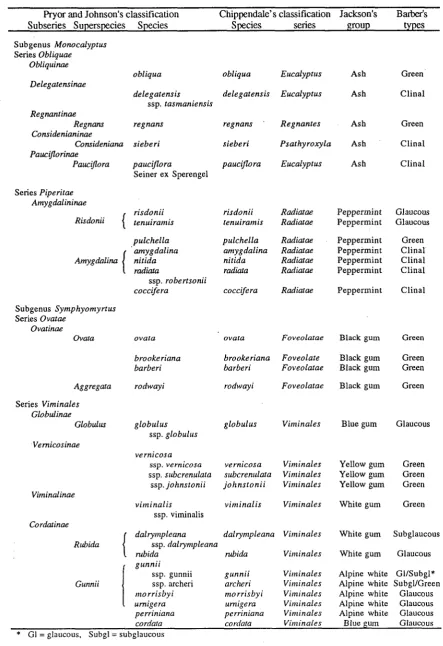
Eucalyptus species from two of the seven subgenera described by Pryor and Johnson (1971) occur in Tasmania. They are the two largest subgenera, Monocalyptus and Symphyomyrtus (Table 2.1). These two subgenera differ in many respects such as reproduction, physiology, morphology and their response to environmental stress (Florence 198 1, 1982; Noble 1989). The Tasmanian Monocalyptus species all fall into the two series, the Obliquae (commonly known as the ashes) and the Piperitae (commonly known as the peppermints) (Table 2.1). The Symphyomyrtus species also come from only two series of the subgenus, the Ovatae and the Viminales, and are collectively known as the 'gums'. Within Symphyomyrtus, species were divided into five subgroups by Jackson (1965). All four species from the series Ovatae corresponded to the 'black gum' subgroup and species of the series Viminales were divided into four subgroups: 'white gum', 'yellow gum', 'blue gum' and 'alpine white gum'.
In all, twenty nine species of eucalypts have been recognised to naturally occur in Tasmania (Chippendale 1988), 12 from the subgenus Monocalyptus and 17 from Symphyomyrtus. Sixteen of these species are endemic to Tasmania (Duncan 1989, Fig. 2.1). All five 'ash' species are not endemic, although the Tasmanian form of E. delegatensis is recognised as being sufficiently distinct from its mainland counterpart to be designated as E. delegatensis var. tasmaniensis (Boland 1985). All seven Piperitae and ten of the seventeen Symphyomyrtus species are endemic (Fig. 2.1).
Table 2.1. The classification of Tasmanian Eucalyptus by Pryor and Johnson (1971) and Chippendale (1988), the species groups of Jackson (1965) and the glaucousness phenotype proposed by Barber (1955).
Pryor and Johnson's classification Chippendale's classification Jackson's Barber's
subseries Superspcies Species
s
kcies series group typesSubgenus Monocalyprus
Series Obliquae Obliquinae
obliqua obliqua Eucalyptus Ash Green
Delegatensinae
delegatensis delegatensis Eucalyptus Ash Clinal ssp. tasmaniensis
R e g m t i n a e
Regnans regnans regnans Regnanres Ash Green
Considenianinae
Considenianu sieberi sieberi Psathyroxyla Ash Clinal
Pauctjlorinae
PauciJlora . pauciflora . pauciflora Eucalyptus Ash Clinal Seiner ex Sperengel
Series Piperitae Amygdalininae
risdonii risdonii Radiatae Peppermint Glaucous
Risdonii
(
tenuiramis tenuiramis Radiatae Peppermint Glaucouspulchella pulchella Radiatae Peppermint Green
' amygdalina amygdalina Radiatae Peppermint Clinal nitida Radiatae Peppermint Clinal
radiata Radiatae Peppermint Clinal ssp. robertsonii
coccifera coccifera Radiatae Peppermint Clinal Subgenus Symphyomyrtus
Series Ovatae Ovatinae
Ovata ovata ovata Foveolatae Black gum Green
brookeriana brookeriana Foveolate Black gum Green
barberi barberi Foveolatae Black gum Green
Aggregata rodwayi rodwayi Foveolatae Black gum Green Series Viminales
Globulinae
Globullcr
Vemicosinue
Vitninalinae
Grtnnii
globulus globulus Viminales
ssp. globulus
vernicosa
ssp. vernicosa vernicosa Viminales
ssp. srbcrenulata subcrenltlata Viminales
ssp. johnstonii johnstonii Viminales
virninalis viminalis Viminales
ssp. virninalis
dalryrrtpleana dalrympleana Viminales
ssp. dalryn~pleana
rubida rubida Vinlinales
I
gunniissp. gunnii gunnii Virninales
ssp. archeri archeri Vitttinales
Blue gum Glaucous
Yellow gum Green Yellow gum Green Yellow gum Green
White gum Green
White gum Subglaucous
White gum Glaucous
Alpine white GlISubgl* Alpine white SubglIGreen
I
tnorrisby i nlorrisbyi Viminales Alpine white Glaucousumigera umigera Virllinales Alpine white Glaucous
perriniana perriniana Viminales Alpine white Glaucous
corduia corclafa Virninales Blue gum Glaucous
[image:22.549.73.517.96.743.2]Figure 2.1. Species of Eucalyptus native to Tasmania, showing those species forming clines and hybrids.
*For each species, follow the horizontal and vertical axes. For example, Eucalyptus barberi is known to hybridise with E. ovata and E. brookeriana (horizontal axis) and possibly hybridises with E. gunnii and
E. cordata (vertical axis). (from Duncan 1989).
A series of studies aimed at phylogenetic reconstruction and biogeography analysis of the informal subgenus Monocalyptus of Pryor and Johnson (197 1) have been undertaken by Ladiges and co-workers (Ladiges and Humphries 1983, 1986; Ladiges et al. 1983,
1984,1987, 1989). They suggest that the subgenus Monocalyptus is a monophyletic group, and that the subgenera Idiogenes and Gaubaea are its sister taxa (Ladiges and Humphries 1983). They also suggest that the Western Australian species of
Monocalyptus are a paraphyletic group and have revised the informal classification of
Pryor and Johnson (1971) recognising three sections, five subsections, five infrasections, five superseries, five series and two subseries (Ladiges et al. 1987). Their cladistic analysis suggested that the 'ash' group of Monocalyptus are not monophyletic and that they probably consist of two groups, 'green ashes' and 'blue ashes' (Ladiges et
al. 1987). The major differentiating characters upon which they based their classification
[image:23.552.77.501.56.338.2]Ladiges et al. (1989) classified the green ashes as a superseries Eucalyptus (Table 2.2). The major differences between the series Obliquae of Pryor and Johnson (197 1) and their superseries Eucalyptus is that the latter consists of only 'green ashes' but the former includes both blue and green ash species. In the superseries Eucalyptus, E. regnans and E. obliqua were classified into the series Regnaninae and series Eucalyptus respectively, with E. regnans and E. fastigata as sister species. In Chippendale's classification (1988), the five Tasmanian ashes were classified into three series: the green ash E. regnans in series 30, Regnantes, the green ash E. obliqua and the blue ashes E. delegatensis and E. paucijlora in series 32, Eucalyptus, and the blue ash E. sieberi in series 33, Psathyroxyla (Table 2.1). However, Ladiges et al. (1989) pointed out that the three series of Chippendale (series 30,32 and 34), which includes the green ashes, are not arranged in a phyletic sequence and the classification, if it is intended to reflect phylogenetic relationships, is misleading because the green and blue ashes are mixed up.
Table 2.2. Informal classification of the green ashes by Ladiges et al. (1989)
1 Superseries Eucalyptus
1.1 series Regnaninae
E. regnans E. fastigata
1.2 series Eucalyptus
E. obliqua
1.3 series Sm'ctinae
1.3.1 subseries Dendromorphitae
E. dendromorpha
1.3.2 subseries Strictitae
E. mjlora
E. strica
spp. strica
spp. obtusiflora E. burgessiana
E. kybeanensis
E. paliflormis E. approximans
spp. approximans
spp. codonocarpa E. rupicola
E. apiculata
1.3.3 subseries Approximanitae
Tasmanian peppermints in their revised classification is that the superspecies Amygdalina of Pryor and Johnson (1971), which linked E. amygdalina, E. nitida and E . radiara, is not a natural group. E. nitida, E. coccifera, E. risdonii and E. tenuiramis were grouped into a subseries Cocciferinae while E. pulchella, E. amygdalina and E. radiata were
classified into subseries Pulchellinae, Arnygdalininae and Radiatinae respectively.
Table 2.3. Revised classification of the Amygdalininae of Pryor and Johnson (1971)
by Ladiges et al. (1983).
Subgenus Monocalyprus Series Amygdalinae
Subseries Pulchellinae
Subseries Amygdalininae
Subseries Cocciferinae
Superspecies Risdonii
Subseries Radiatinae Supe-ies R&a
pulchella
amygdalina
risdonii tenuiramis
M&a
spp. radiata
spp. robertsonii elata
Superspecies Dives
willisii
dives
Ladiges et al. (1984) have investigated the relationships among members of series Ovatae of Symphyomyrtus (Pryor and Johnson 1971). Although the sister group to the Ovatae for polarisation of characters and establishment of monophyly were not identified
readily, they suggested that this series is not monophyletic and needs taxonomic revision. Based on seedling characters, they found that the ovata subgroup (includes species E.
ovata, E. barberi and E. brookeriana) identified is monophyletic in the subseries Ovatinae
of Pryor and Johnson (1971), except that they included E. aromaphloia (classified by
Pryor and Johnson in the subseries Manniferinae) and excluded E. rodwayi (classified by
Pryor and Johnson in the subspecies Aggregata of the Ovatinae).
2.1.2.
Distribution and ecology
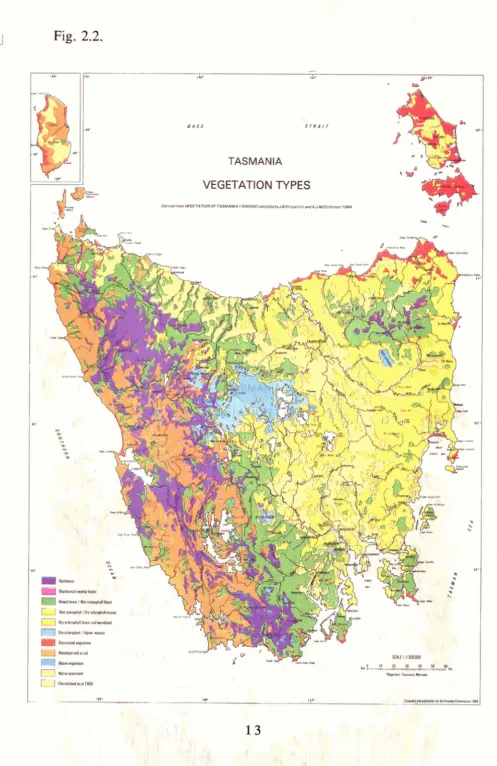
The relationships between vegetation and Tasmanian's environment have been discussed and described at a general level and for specific vegetation types or areas (e.g. Gilbert 1959; Jackson 1968, 1973; Kirkpatrick 1977, 1981; Brown and Podger 1982; Ellis 1985). The natural distribution of Tasmanian eucalypts was provided by Jackson (1965),
Boland et al. (1984) and Kirkpatrick and Backhouse (1985, 1989). The distribution of
major vegetation types in Tasmania was mapped by Kirkpatrick and Dickinson (1984) (Fig. 2.2) and the distribution of endemic eucalypt species is indicated on a 10 Km x 10 Km grid by Brown et al. (1983).
In spite of a temperate oceanic climate, the natural vegetation of Tasmania is varied due to the mixing of Australian and Southern Oceanic ('Antarctic') components, and a wide diversity of habitats. Jackson (1965) classified the natural vegetation that developed in Tasmania into three main ecological formations of austral-montane, temperate rain forest, and sclerophyll forest with the sclerophyll forest being completely dominated by eucalypt trees. However, the dismbution of eucalypt species in the dominant sclerophyll forest in Tasmania is broadly determined by the climate with a steep rainfall gradient from west to east across the state producing a range of environments from wet to semi-arid, while Tasmanian's latitude (41-430 south) provides a cool temperate climate resulting in an extensive subalpine environment (Jackson 1965). Imposed upon the climatic influence in Tasmanian forest is the effect of fire. Jackson (1968) considered that fire is an important factor in maintaining eucalypt or mixed (eucalypts plus rainforest) forest in higher rainfall areas which would be expected to support, climatically, a temperate rainforest. For example, stands of E. regnans tend to be killed by intense wild fires resulting in extensive seedling regeneration. This does not, however, appear to be the case for other species which tend to be more fire resistant and vegetatively regenerate from either lignotubers or epicormic shoots following wildfire (e.g. E. risdonii, Potts 1986; E . delegatensis,
Bowman and Kirkpatrick 1986) and seedling recruitment tends to be much more continuous, although still fire dependent. Davidson et al. (1981) suggested that climate
and fire frequency, therefore, play a major role in determining the geographical region that the genus Eucalyptus can occupy.
According to Davidson et al. (1981), the eucalypt forests of Tasmania tend to be divided
into three categories as determined by water availability (e.g. rainfall) and temperature gradients to give dry sclerophyll, wet sclerophyll and subalpine forests (Table 2.4 and Fig. 2.2). Species of the subgenus Monocalyptus series Obliquae (the ashes) tend to
dominate wet sclerophyll forests and species of the subgenus Monocalyptus series
Piperitae (the peppermints) tend to dominate dry sclerophyll forests and woodlands. The
species from the subgenus Symphyomyrtus (the gums) tend to occur as subdominant or
Fig. 2.2.
TASMANIA
Table 2.4. The preferred habitat of each eucalypt species occurring in Tasmania. (following Davidson et al.: 198 1).
Dry Sclerophyll Preferred Habitat
E. sieberi dry infertile soils normally over granite in the north-east
E. a m y g d a l i ~ widely distributed on dry sandy podsolic soils in the north and east
E. pulchella dry soils developed on dolerite in the south-east
E. tenuiramis dry soils developed mainly on mudstone and dolerite in the south-east
E. risdonii restricted on very dry, skeletal soils developed on mudstone to the east of the River Derwent
E. radiata very restricted distribution on Ordovician gravels in the Mersey and Forth River valleys
E. viminalis widespread in coastal and riverine corridors in dry habitats, often subdominant
E. rubida replaces E. viminalb on very dry, wld sites at intermediate altitude, frequently on muds tone
E. ovata sites prone to occasional waterlogging at low to intermediate altitude
E. morrisbyi
Wet Sclerophyll E. regnuns
E. obliqua
E. globulus
E. cordata
E. d a l r y m p l e a ~
E. b r o o k e r i a ~
E. rodwayi
E. delegatensis
Subalpine E. coccifera
E. nitida
E. pauciflora
E. vernicosa
E. johnstonii E. urnigera
E. gunnii
E. archeri
mallee scrub on dry, rocky dolerite hills in the Eastern Tiers
restricted distribution on poorly drained, infertile shallow soils derived from Permian sandstone in frosty sites at intermediate altitude
endangered species on poor wastal soils in the Clarence municipality
sites of low fire frequency. on moist, deep, well-drained soils to 700m
widespread, replacing E. regnuns on slightly drier sites with a higher f i e frequency through to dry coastal areas
relatively moist coastal sites and in well-drained frost free valleys to 500m
local in the south-east, mainly on dolerite extending from dry coastal cliffs to poorly drained sub-alpine sites to 600m
replaces E. viminalis in colder, wetter sites to 1050m
well drained rocky soils or alluvial deposits adjacent to streams
replaces E. ovata on poorly drained soils at intermediated altitudes
replaces E. obliqua and E. regnuns on well-drained sites at higher altitudes about 600m
cold well-drained sites, forms treeline on most dolerite capped mountains in the centre and south-east
infertile skeletal soils or peaks in high rainfall areas of west and south-west, wide altitudinal range
well-drained sites in cold habitats in centre and east, wide altitudinal range
replaces E. vernicosa on less exposed sites and on waterlogged sites towards the south- east
replaces sub-alpine E. subcrenulata at lower altitudes towards the south-east
cold sites on well-drained dolerite soil mainly in the south-east
cold. waterlogged sites, generally on dolerite or basalt in central regions
2.1.3.
Genetic variation and clinal variation
It has been pointed out by Pryor and Johnson (1971) that a common characteristic of most eucalypts is the close adaptive response of the population to the environment where a large amount of genetic variability is often found within and between species. In cases where species are widely distributed, clinal variation commonly occurs, either continuously or more often in a stepped series (Pryor and Johnson 1971). Such clinal variation occurs when morphological and physiological differences within a species are correlated with particular changes in the physical environment (Pryor 1976) such as altitude (as a surrogate for temperature or rainfall), latitude (as a surrogate for temperature or day length) or environmental stress (such as moisture availability or frost susceptibility).
Numerous examples of clinal variation have been reported within and between the Tasmanian eucalypts and between disjunct populations and in cases appears to be maintained by selection despite considerable gene flow in some cases (e.g. Barber and Jackson 1957; Davidson et al. 1981). Within species, clinal patterns of variation have been reported both within continuous populations and between disjunct populations. For example, a continuous clinal variations in frequency of glaucous phenotypes have been reported along altitudinal gradients within E. urnigera (Barber and Jackson 1957; Thomas and Barber 1974a,b) and E. gunnii (Potts and Reid 1985a,b). Clines have also been reported in E. regnans (Ashton 1975, 198 I), E. delegatensis (Boland and Dunn 1985), E. globulus (Kirkpamck 1975) and between disjunct populations of E. cordata (Potts
1989) and E. perriniana (Wiltshire and Reid 1987).
In addition to the marked amount of differentiation which occurs within species, many of the 29 species have been reported to intergrade in various combinations (Figure 2.1). However, clinal variation between species tends to only involve species which are relatively closely related. For example, species within the series Piperitae, and the subgroup of the series Viminales tend to intergrade within each group but not between groups (Figure 2.1). In contrast, no interspecific clinal variations have been reported in the series Obliqua and the series Ovatae, although hybridisation does occur.
(Phillips and Reid 1980) and the alpine white gums, E. gunnii and E. archeri (Potts and
Reid 1985a,b).
Within the Tasmanian Piperitae, a complex variation pattern occurs among species which
are markedly different at the morphological level. The species intergrade in virtually
all
possible combinations, but also variation is common within species. Clinal variation occurs between E. amygdalina and E. pulchella (Davidson et al. 198 1; Kirkpatrick and
Potts 1987) and between E. tenuiramis and E. risdonii (Davidson et al. 1981; Wiltshire
1991, 1992). E. amygdalina also intergrades into E. nitida which in turn intergrades into
E. coccifera (Davidson et al. 1981; Shaw et al. 1984).
Clinal variation between species in some cases may involve changes in the pattern of ontogenetic variation as in the case between E. risdonii and E. tenuiramis (Wiltshire et al.
1991, 1992). When differences in ontogenetic pattern were removed the clinal variation in morphological variation is also continuous and the morphological variation between E.
risdonii and E. tenuiramis populations in the same geographical region is much smaller than that within E. tenuiramis. It has been suggested that E. risdonii may be the product of relatively recent changes in developmental timing (heterochrony) from E. tenuiramis
(Wiltshire et al. 1992).
In contrast to the peppermints and some gum species in which extreme variation and intergradation has been reported, some species, such as the ash species, E. regnans, E.
obliqua and E. delegatensis and the gum E. globulus, which occupy wet environments
over an extensive geographic range, exhibit less pronounced clinal variation within species and less intergradation between species. Davidson et al. (1981) considered that
the habitats where these species occur are buffered against environmental fluctuations, and therefore, selective pressures change less rapidly than that for the peppermints.
2.1.4.
Hybridisation
In the genus Eucalyptus, hybridisation does not occur between the subgenera Monocalyptus and Symphyomyrtus, but hybridisation between species, even from
different series within the same subgenus, may be extensive (Griffin et al. 1988).
Hybridisation can be induced artificially in eucalypt breeding programs when barriers to natural hybridisation between species are circumvented.
The patterns of natural hybridisation between the Tasmanian eucalypt species have been reviewed by Duncan (1989, see Figure 2.1). He compared the frequency of hybrids amongst the Tasmanian species with the Australian wide results presented by Griffin et al. (1988). The Tasmanian figure ranged from 34 percent (using verified hybrids only) to
combinations among Tasmanian eucalypt species in the subgenus Monocalyptus. A similar figure was also recorded in Symphyomyrtus. In- contrast, the figures of potential hybrid combinations within the genus Eucalyptus in Australia have been found to be only about 11 per cent in the subgenus Monocalyptus and six percent in Symphyomyrtus species. Duncan (1989) considered that these higher figures of potential hybrid combinations in Tasmania were not only due to the extent of the botanical survey and collection but the environmental heterogeneity that occurs over relatively short distances in Tasmania. The large environmental heterogeneity arising through the rugged topography results in species with substantially different ecological requirements often occurring close to each other.
It appears that the presence of hybrid individuals in Tasmanian eucalypts is common between species within series, such as the hybrid swarms of E. amygdalina x E. risdonii
(Potts and Reid 1985c, 1988) in the series Piperitae and the hybrids between species within the series Ovatae or Viminalei of gum (Duncan 1989; see Fig. 2.1).
Numerous interseries hybrids in Tasmanian eucalypts have been also reported, such as E.
delegatensis x E. coccifera and E. delegatensis x pulchella (Davidson et al. 1987), E.
obliqua x E. pulchella (Potts and Reid 1983) and E. globulus x E. ovata (McAulay
1938). These do not, however, tend to be as common as hybrids between species within series.
In addition to the natural hybrids, artificial hybrids have been produced amongst many of the Tasmanian Symphyomyrtus species, such as the interspecific hybrids of E. globulus (Potts and Savva 1988), E. gunnii (Potts et al. 1987) and E. nitens (Tibbits 1988, 1989). A major post mating barrier has been identified which is unilateral and associated with the flower size (Gore et al. 1990). Large flowered species are unable to act as female parents as pollen tubes of smaller flowered species cannot grow the full length of the style of the larger flowered species such as E. globulus.
intergradation between species is a result of introgression (advanced generation hybridisation) or primary differentiation (Potts and Jackson 1986; Potts and Reid 1985 b).
2.2.
The Eucalyptus-defoliating paropsine beetles and host
specificity
2.2.1.
The major insect defoliators of Eucalyptus and their effects
The major defoliating insects in Australian eucalypt forests have been reviewed by several authors (Greaves 1961, 1966; Newman and Marks 1976; Carne and Taylor 1978; Ohmart 1990, Ohmart and Edwards 1991). These reviews have considered that three eruptive insect groups, which cause severe damage or tree death, are represented by three leaf feeding insect orders, notably Phasmatodea, Coleoptera, and Lepidoptera.
The phasmatids (Phasmatodea: Phasmatidae) have been reported mainly in south eastern Australia where the three species, Didymuria violescens (Keach), Podocanthus
wilkinsoni (Macleay) and Ctenomorphodes tessulata (Greg) represent insects that cause
serious defoliation to a range of eucalypt species, especially to ash species i.e. E. regnans
and E. delegatensis (Hadlington and Hoschke 1959; Campbell 1960, 1961, 1964; Readshaw 1965; Mazanec 1966, 1967, 1968; Browne 1968; Readshaw and Mazanec
1969; Neumann et al. 1977).
The serious lepidopteran defoliators of eucalypts consist of the jarrah leaf miner, Perthida
glyphopa (Lepidoptera: Incurvariidae) in jarrah forests (i.e. E. marginata) in Western
Australia (Wallace 1970; Mazanec 1974,1978, 1985, 1987; Casotti and Bradley 1991; Bennett et al. , 1992), the gum leaf skeletonizer, Uraba lugens (Walker) (Lepidoptera: Nolidae), on a wide range of eucalypt species in many parts of Australia (Brimblecombe 1962; Campbell 1962, Harris 1974; Morgan and Cobbinah 1977; Cobbinah 1985), and the autumn gum moth, Mnesampela privata (Guen.) (Lepidoptera: Geometridae), on Tasmania eucalypts (Anon 1977; Elliott and Bashford 1978, 1983; Elliott et al. 1980).
which may cause occasional death of woodland eucalypts (Carne 1966; Tanton and Epila 1984; Larsson and Ohmart 1988; Edwards and Wanjura 1990). Christmas beetles (Coleoptera: Scarabaeidae) are also severe defoliators in eastern Australia (Carne 1957, 1981; Allsopp and Came 1986; Came et al. 1981)
Eucalypt defoliating insects in Tasmania have been reviewed by Elliott and de Little (1985). They concluded that leaf beetles (chrysomelids), gum leaf Skeletonizer Moth, Autumn Gum Moth, Termites, and the Fireblight Beetle, Pyrgoides orphara, and the
Chrysophtharta bimaculata (Olivier), were major pests of Tasmanian eucalypt plantations
and mature native forest. Severe defoliation of plantation and naturally regenerating eucalypts by C . bimaculata has caused reduced growth rates and poor form and is considered the major limiting factor to growth of fast-growing eucalypt species.
C . bimaculata severely defoliates regeneration and mature forest of E. regnans, E. obliqua and E. delegatensis (Greaves 1966; Kile 1974; de Little and Madden 1976; Elliott
and de Little 1985) resulting in a noticeable effect on height growth. In areas with a high population of C . bimaculata, trees protected from defoliation by continual spraying with insecticide during a season were compared with unprotected trees (Kle 1974). The mean height increments of trees which were sprayed were approximately twice as great as those of unsprayed control trees. Moreover, paropsine defoliation may predispose eucalypts to attack by other organisms by contributing towards a condition of stress in the host trees. More recently, C . bimaculata has also been reported to heavily defoliate the potentially important pulp wood species, E. nitens.
2.2.2.
Host specificity among insects which graze on Eucalyptus
The major tree genera Acacia and Eucalyptus in Australia, support very many species of insects, and many of these species depend completely on one or other plant genus for their survival. The species of phytophagous insects found on Eucalyptus, though, are almost entirely separate from those found on Acacia. Moreover, surveys on specialisation in the community of eucalypts and their herbivorous insects have shown that host specificity on eucalypts by grazing insect pests occurs at somewhat different levels of differentiation in which different insects exhibit different specificities to different species even in different populations of a species (Moore 1970; Came 1965; Morrow 1977a,b).
Noble (1989) suggested that differences in herbivores and parasite damage to leaves is one of the major difference in ecological traits between Monocalyptus and
Symphyomyrtus. He hypothesised that the Monocalyptus species carry a lower diversity
of leaf herbivores and pathogens and suffer less leaf loss and damage by them than
eucalypts reveals some host specificity of insects among the two major subgenera. Thus, some insect groups are specific to particular eucalypt subgenera (Noble 1989). For example, surveys of insect defoliation on two major subgenera Monocalyptus and
Symphyomyrtus of eucalypts in south eastern Australia (Burdon and Chivers 1974)
indicated that of seventeen species of insects, including both grazers and sap-suckers, four species showed a preference for Symphyomyrtus, and three species showed a preference for Monocalyptus. Morrow (1977b) showed that of insect population association on two Morwcalyptus and one Symphyomyrtus species, 62 per cent of the collected insects (grazers and sap-suckers) attacked only one eucalypt species, 30 per cent attacked two species, and only 8 per cent fed on all three species. These results indicated that insect species varied in their host preference among Eucalyptus species.
Among the major stick insects which are associated with eucalypts in south eastern Australia, the polyphagous Cterwmolphodies tessulatus (Gray) feeds on a wide range of species among the different genera of Eucalyptus plus Syncalpia, Acacia and Casuarina species (Hadlington and Hoschke 1959), however, Didymuria violescens feeds on a range of both Monocalyphs and Symphyomyrtus species of the genus Eucalyptus but not on species of the other genera (Readshaw 1965). de Little (1979) found that among the leaf beetles of Chrysomelidae in Tasmania, Chrysophtharta nobilitata, Paropsis
aegrota and P. porosa defoliated species over the full taxonomic range of eucalypts,
however, Chrysophtharta bimaculata, C. agricola and Paropsis charybdis usually occurred only on eucalypts within a distinct sub-genera.
Some studies indicated that the host specificity could differ between species, between provenances within eucalypt species or between trees in some localities of a species. Strauss and Morrow (1988) reported that the distributions of Chrysophtharta hecnca on the two host plant species, E. stellulata and E. paucijlora from the series Obliquae, were generally clumped which was partially due to their preference for E. stellulata over E.
pauciflora. Steven (1973) assessed the performance of larvae of Paropsis charybdis in the
laboratory on foliage from three localities of E. obliqua and also on foliage of some other
species. Steven found that one source of E. obliqua foliage ranked second in palatability
compared to the other species whereas the other two sources of E. obliqua were the least palatable of all foliage tested. Mazanec (1985) found that although the jarrah leafminer,
Perthida glyphopa, occurred at chronically high levels on E. rnarginata, three different
levels of tree susceptibility to P. glyphopa were identified. One type of tree was found to be totally resistant, another one resistant by preventing egg hatch or causing larvae to die but was still fed on by adult females, while the third was attacked and susceptible to P.
Studies into host specificity of insects on eucalypts have shown that host specificity could also differ between different growth stages of a defoliating insect species, hence, larval feeding preferences did not necessarily reflect adult feeding or oviposition preferences. For example, 150 tree species were acceptable for oviposition by the gum leaf skeletonizer, Uraba lugens female, but larvae could be successfully reared to the fourth
instar on only seven species (Morgan and Cobbinah 1977). In contrast, the females of autumn gum moth, Mnesampela privata (Guen.), prefer to oviposit on the glaucous
juvenile-form foliage of the blue gum group of eucalypts, but larvae can feed on a wide range of other'eucalypts species (Elliott and Bashford 1978). In laboratory trials, larvae of leaf beetles of Paropsis atomaria performed best on E. macrorhyncha foliage which is
a species that P. atomaria females do not oviposit on in the field (Carne 1966).
The host specificity of individual insect species may also differ with the different growth stages of a eucalypt trees. For example, C. bimaculata did not defoliate juvenile foliage of
E. nitens but defoliated and oviposited on the non waxy adult-form foliage (deLittle
1989).
2.2.3.
Factors influencing host-plant selection in Eucalyptus
Noble (1989) reviewed the differences between the two largest subgenera,
Symphyomyrtus and Monocalyptus, and suggested that these can be summarised as \
differences in leaf chemistry, in root morphology, chemistry and activity, and in early growth rates. Noble (1989) considered that variation in concentrations of secondary compounds may provide a basis for understanding the variation in herbivory levels.
Eucalyptus leaves usually have high levels of secondary compounds, including essential
oils, phenolics, tannins and surface waxes which vary between species and subgenera (Hillis 1966a,b, 1967a,b,c,d; Pryor 1976, Hallam and Chambers 1970; Boland et al.
1991). Many of these secondary compounds occurring in eucalypt foliage have been demonstrated to significantly influence insect-plant relationships. However, their actual effects in insect-eucalypt interactions have not yet been demonstrated. Investigations into the effects of secondary compounds in eucalypt defoliators are few and show only a small effect on insect herbivory.
five eucalypt species which were growing in monospecific stands and found that the high oil yielding trees of E. dives and E. viminalis showed a significant negative correlation between oil content and insect damage, although the other three species had no effect on patterns of herbivory. Nevertheless, these authors have suggested that some insects overcome the oil defences of eucalypt leaves by toleration, passing it through the gut without change or by sequestering it in special body structures (Morrow et al. 1976; Morrow and Fox 1980), or by detoxifying it (Ohmart and Larsson 1989). It has been
suggested that a threshold level of oil is needed to influence attack by adapted insect herbivores (Morrow and Fox 1980).
Some reports have claimed that tannin and phenolic compounds in eucalypt foliage also appear to have little influence on patterns and amounts of defoliation. Such an investigation by Fox and Macauley (1977) indicated that the variation in tannin and phenol contents of 11 eucalypt species did not appear to affect the growth of Paropsis atomaria and these compounds did not interfere with the efficiency of nitrogen utilisation of this insect species.
However, most publications appear to be concerned with the effects of N content of the leaves rather than that of secondary compounds or oils (Fox and Macauley 1977; Morrow and Fox 1980; Ohmart et al. 1985). Fox et al. (1977) investigated the insect response to variation in eucalypt leaf nitrogen and found that the nitrogen appears to affect the growth of eucalypt defoliators. She suggested that the growth and development of eucalypt defoliators depends upon obtaining sufficient nitrogen, which, however, is low in the foliage; therefore they must consume large amounts of foliage. Edwards and Wanjura (1990) demonstrated that P. charybdis is more efficient at converting nitrogen in E. viminalis foliage. Moreover, the nitrogen level of E. blakelyi foliage has been demonstrated to directly affect the growth of Paropsis atomaria larvae, the growth of which proceeds at an optimum rate regardless of the level of nitrogen ingested (Ohmart et al. 1985). Furthermore, variation in nitrogen level of foliage has been found to be an important factor which causes dieback in E. blakelyi (Landsberg 1990a,b,c). Thus, foliage of mature E. blakelyi trees suffering from dieback was more heavily grazed than that of neighbouring healthy trees, because the foliage of dieback trees was younger and higher in nitrogen content, even when corrected for leaf age with the healthy trees. However, these findings only indicated that insect growth and development may relate to the nitrogen percentage, but have not shown evidence of a systematic difference between the subgenera in leaf N contents and their relationship with host specify.