UNIVERSITI TEKNIKAL MALAYSIA MELAKA
Development of Vertical Milling Machine Educational Kit Using
Various 3D Printing Methods to Assess Rapid Prototyping Process
Capability
This report is submitted in accordance with the requirement of the Universiti Teknikal Malaysia Melaka (UTeM) for the Bachelor Degree of Manufacturing
Engineering Technology (Product Design) with Honours.
by
ZURAIDA BINTI MOHD NOOR B071410821
930430-04-5200
UNIVERSITI TEKNIKAL MALAYSIA MELAKA
BORANG PENGESAHAN STATUS LAPORAN PROJEK SARJANA MUDA
TAJUK: Development Of Vertical Milling Machine Educational Kit Using Various 3D Printing Methods To Assess Rapid Prototyping Process Capability.
SESI PENGAJIAN: 2016/17 Semester 2
Saya ZURAIDA BINTI MOHD NOOR
mengaku membenarkan Laporan PSM ini disimpan di Perpustakaan Universiti Teknikal Malaysia Melaka (UTeM) dengan syarat-syarat kegunaan seperti berikut:
1. Laporan PSM adalah hak milik Universiti Teknikal Malaysia Melaka dan penulis.
2. Perpustakaan Universiti Teknikal Malaysia Melaka dibenarkan membuat salinan untuk tujuan pengajian sahaja dengan izin penulis.
3. Perpustakaan dibenarkan membuat salinan laporan PSM ini sebagai bahan pertukaran antara institusi pengajian tinggi.
4. **Sila tandakan ( )
SULIT
TERHAD
TIDAK TERHAD
(Mengandungi maklumat yang berdarjah keselamatan atau kepentingan Malaysia sebagaimana yang termaktub dalam AKTA RAHSIA RASMI 1972)
(Mengandungi maklumat TERHAD yang telah ditentukan oleh organisasi/badan di mana penyelidikan dijalankan)
Alamat Tetap:
NO. 2, Jalan 22,
Taman Saujana Jaya,
34000 Taiping, Perak.
Tarikh: ________________________
Disahkan oleh:
Cop Rasmi:
Tarikh: _______________________
DECLARATION
I hereby, declared this report entitled “Development of Vertical Milling Machine Educational Kit Using Various 3D Printing Methods to Assess Rapid Prototyping Process Capability.” is the results of my own research except as cited in references.
Signature : ……….
Author’s Name : ……….
APPROVAL
This report is submitted to the Faculty of Engineering Technology of UTeM as a partial fulfillment of the requirements for the degree of Bachelor Degree of Manufacturing Engineering Technology (Product Design) with Honours. The
member of the supervisory is as follow:
……… MR. MOHD RAZALI BIN MD YUNOS
i
ABSTRACT
ii
ABSTRAK
iii
DEDICATION
To my beloved parents,
MR. MOHD NOOR BIN ABDULLAH MRS. UMI HAFIZAH BINTI HJ. MASRI To my respectful supervisor and co-supervisor,
MR. MOHD RAZALI BIN MD YUNOS MR. MOHD NAZRI BIN AHMAD
iv
ACKNOWLEDGEMENT
First of all, praises to Allah god almighty for His guidance and bless. I would like to express my gratitude upon every individual who helped me in developing this project. I would like to thank my highest appreciation to my supportive academic supervisor, Mr. Mohd Razali Bin Md Yunos who has guided me and give me a lot of knowledge along this whole semester. The supervision and supports from him is truly helping in the progress of my project.
v
TABLE OF CONTENT
Abstract i
Abstrak ii
Dedication iii
Acknowledgement iv
Table Of Content v - x
List of Tables xi
List of Figures xii - xvii
List of Symbols and Abbreviations xviii
CHAPTER 1 : INTRODUCTION 1
1.1 Background 1 – 2
1.2 Problem Statement 2 – 3
1.3 Objectives 3
1.4 Scope 3 – 4
1.5 Expected Result 4
CHAPTER 2 : LITERATURE REVIEW 5
2.1 Introduction 5
2.2 Product Development 5 – 6
2.3 An Overview ofRapid Prototyping 6 – 7
vi 2.5 Advantages and Disadvantages of Rapid Prototyping
Technology
9
2.6 Classification of Rapid Prototyping Technology 10 2.6.1 Liquid-Based Technologies 10 2.6.1.1 Stereolithography (SLA) 10 – 11 2.6.1.2 Process of Stereolithography (SLA) 11 – 12 2.6.1.3 Principle of Stereolithography 13 2.6.2 Solid-Based Technologies 14 2.6.2.1 Laminated Object Manufacturing (LOM) 14 2.6.2.2 Process of Laminated Object
Manufacturing
14 – 15
2.6.2.3 Fused Deposition Modelling (FDM) 16 2.6.2.4 Process of Fused Deposition Modelling 16 – 17 2.6.2.5 Principle of FDM 17 2.6.3 Powder-Based Technologies 18 2.6.3.1 Selective Laser Sintering (SLS) 18 2.6.3.2 Process of Selective Laser Sintering 18 – 19 2.6.3.3 Principle of Selective Laser Sintering 19 2.6.3.4 3D Printer (3DP) 20 2.6.3.5 Process of 3D Printer 20 2.7 Rapid Prototyping Process Evaluated 21 – 22
2.8 SLA (Projet™ 1000 machine) 22 – 23
2.9 SLA (Projet HD 3500 machine) 24 – 25
vii 2.11 FDM (Up Plus 3D printer machine) 26 – 27
2.12 Surface Finish 28
2.13 Measurement 28
2.14 Comparison between Different Rapid Prototyping Technologies 29 – 32
CHAPTER 3 : METHODOLOGY 33
3.1 Introduction 33 – 34
3.2 Identifying problems 35
3.3 Gather the information about 3D printing 35
3.4 Design Concept 35
3.4.1 Design Concept 1 36
3.4.2 Design Concept 2 36
3.4.3 Design Concept 3 37
3.5 Best Design for Milling Machine 37
3.5.1 Pugh’s Methods 37 – 39
3.6 Detail Design 40
3.6.1 Vertical Milling Machine Part Design 40 – 42 3.6.2 Vertical Milling Machine Final Assembly 43
3.7 Methods and Material Selection 44
3.8 Machine and Equipment Used 45
3.8.1 Oven 45
3.8.2 Projet™ Curing System 45 – 46
viii
3.8.4 Sandpaper 46 – 47
3.8.5 Ruler 47
3.8.6 Measuring tape 47
3.8.7 Vernier caliper 48
3.9 Fabrication Process Selection 48
3.9.1 Process of Building the Vertical Milling Machine 49 – 50 3.9.2 Process Flow of SLA (Projet™ 1000) 50
3.9.2.1 Pre-Processing a parts (main slide) 51 – 52 3.9.2.2 Post Processing a parts (main slide) 52 – 54 3.9.3 Process Flow of SLA (Projet HD 3500) 54
3.9.3.1 Pre-Processing a part 55 – 56 3.9.3.2 Post Processing a part 56 – 57 3.9.4 Process Flow of FDM (Up Plus 3D Printer) 58
3.9.4.1 Pre-Processing a part 58 – 60 3.9.4.2 Post Processing a part 60 – 61 3.9.5 Process Flow of 3DP (Projet 460 plus) 61
3.9.5.1 Pre-Processing a part 61 – 62 3.9.5.2 Post Processing a part 62 – 64
3.10 Checking the Capability of parts 64
3.10.1 Standard of Procedure (SOP) of Surface Roughness Tester
64 – 65
3.10.2 Dimension Accuracy 65 – 66
ix
CHAPTER 4 : RESULTS AND DISCUSSIONS 70
4.1 Analysis about the Selection Methods 70
4.1.1 SLA Methods ( Projet 460 Plus) 70
4.1.2 SLS Methods (Projet 1000) 71
4.1.3 SLS Methods (Projet HD 3500) 72
4.1.4 FDM (Up Plus 3D Printer) 73 – 74
4.1.5 Purchased Item 75
4.1.6 Milling Machine Final Assembly 76
4.3 Analysis Result 77
4.3.1 Surface Finish Analysis 77 – 79
4.3.2 Comparison Between Different Methods of RP due to Surface Finish
79 – 80
4.3.3 Measurement Analysis 80
4.3.4 FDM (Up Plus 3D Printer) 81
4.3.5 SLA (Projet™ 1000) 82
4.3.6 SLA (Projet HD 3500) 83
4.3.7 3DP (Projet 460 plus) 84
4.3.8 Comparison Between Different Methods of RP Due to Dimension Accuracy
85
CHAPTER 5 : CONCLUSION 86
5.1 Conclusion 86
x
REFERENCES 88 – 90
xi
LIST OF TABLES
2.5 Advantages and Disadvantages of Rapid Prototyping Technology
9
2.6 Classification of Rapid Prototyping Technology 10
2.4 Visual Model 21
2.8 Functional model in a polymer 22
2.6 Specification of Projet™ 1000 23
3.7 Specification of Projet HD 3500 25
2.8 Specification of Projet 460 plus 26
2.9 Specification of Up Plus 3D printer 27
2.10 Comparison between Different Rapid Prototyping Technologies
29 – 32
3.1 Pugh selection method of vertical milling machine 29
3.2 Methods and Material Selection 44
xii
LIST OF FIGURES
2.1 Rapid Prototyping Principle 7
2.2 Rapid Prototyping Process 8
2.3 Process of Stereolithography (SLA) 12
2.4 Principle of stereolithography 13
2.5 Process of Laminated Object Manufacturing 15
2.6 Process of Fused Deposition Modelling 17
2.7 Process of Selective Laser Sintering 19
2.8 Process of 3D Printing 20
2.9 SLA (Projet™ 1000 machine) 23
2.10 Projet HD 3500 machine 24
2.11 3D Printer (Projet 460 plus machine) 25
2.12 Up Plus 3D printer machine 27
3.1 Methodology Flow Chart 34
3.2 Design Concept 1 36
3.3 Design Concept 2 36
3.4 Design Concept 3 37
3.5 Base 1 40
3.6 Base 2 40
xiii
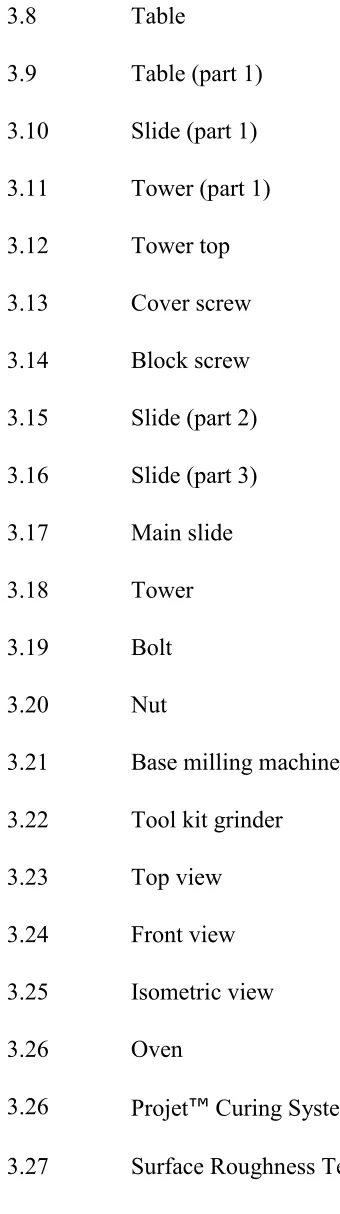
3.8 Table 40
3.9 Table (part 1) 41
3.10 Slide (part 1) 41
3.11 Tower (part 1) 41
3.12 Tower top 41
3.13 Cover screw 41
3.14 Block screw 41
3.15 Slide (part 2) 41
3.16 Slide (part 3) 41
3.17 Main slide 42
3.18 Tower 42
3.19 Bolt 42
3.20 Nut 42
3.21 Base milling machine 42
3.22 Tool kit grinder 42
3.23 Top view 43
3.24 Front view 43
3.25 Isometric view 43
3.26 Oven 45
3.26 Projet™ Curing System 46
3.27 Surface Roughness Tester Machine 46
[image:17.612.110.280.70.677.2]xiv
3.29 Ruler 47
3.30 Measuring tape 47
3.31 Vernier caliper 48
3.32 Assembly in Solidworks software 49
3.33 Save STL file 49
3.34 Projet™ 1000 50
3.35 Projet HD 3500 50
3.36 Projet 460 Plus 50
3.37 Up plus 3D Printer 50
3.38 Projet™ Client software 51
3.39 Import part to software 51
3.40 Support structure are high-lighted red 52
3.41 Approximate build time for main slide 52
3.42 Part are finished print 53
3.43 Remove part from platform 53
3.44 Cut the support plates 53
3.45 Clean process 54
3.46 Drying process 54
3.47 Client Manager Software 55
3.48 STL file imported 55
3.49 Approximate build time 56
xv
3.51 Melted process 57
3.52 Part produced 57
3.53 Up Plus 3D Printer software 58
3.54 Tower part 58
3.55 Nozzle height detect 59
3.56 Insert value of nozzle height detect 59
3.57 Layer resolutions 60
3.58 Printing process 60
3.59 Printing are finished 60
3.60 Removed part 61
3.61 Printing are finished 61
3.62 Tower top 62
3.63 Printing layer by layer 62
3.64 Removed part 63
3.65 Vacuum process 63
3.66 ColorBond 63
3.67 Part produced 64
3.68 Surface roughness tester 64
3.69 Measure surface for base 1 65
3.70 Result for base 1 65
3.71 Process measured the dimension of base 1 66
xvi
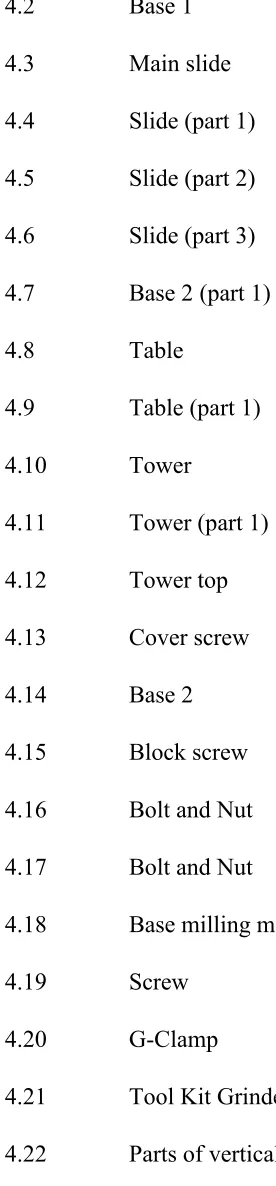
4.2 Base 1 73
4.3 Main slide 73
4.4 Slide (part 1) 74
4.5 Slide (part 2) 74
4.6 Slide (part 3) 74
4.7 Base 2 (part 1) 75
4.8 Table 75
4.9 Table (part 1) 75
4.10 Tower 75
4.11 Tower (part 1) 76
4.12 Tower top 76
4.13 Cover screw 76
4.14 Base 2 76
4.15 Block screw 76
4.16 Bolt and Nut 77
4.17 Bolt and Nut 77
4.18 Base milling machine 77
4.19 Screw 77
4.20 G-Clamp 77
4.21 Tool Kit Grinder 77
4.22 Parts of vertical milling machine 78
[image:20.612.111.249.75.668.2]xvii 4.24 Sample (table part) surface area to be measured 79
4.25 Sample graph for table part 80
4.26 Graph of comparison between different methods due to surface finish
81
4.27 Measurement using vernier caliper 82
4.28 Sample measurement for table part 83
4.29 Sample of Base 1 84
4.30 Sample of Slide (part 2) 85
4.31 Sample of Tower Top 86
4.32 Comparison Between Different Methods of RP Due to Dimension accuracy
xviii
LIST OF ABBREVIATIONS, SYMBOLS AND
NOMENCLATURE
AM - Additive Manufacturing
ABS - Acrylonitrile Butadiene Styrene
CLIP - Continuous Liquid Interface Production CAD - Computer Aided Design
FDM - Fused Deposition Modelling LOM - Laminated Object Manufacturing PLA - Polylactic acid
RP - Rapid Prototyping
Ra - Arithmetical mean roughness SLA - Stereolithography
SLS - Selective Laser Sintering STL - Stereolithography
3D - Three Dimensional
1
CHAPTER 1
INTRODUCTION
Basically, this chapter will give a brief explanation about this project, starting with the background of the project title “Development of Vertical Milling Machine Educational Kit Using Various 3D Printing Methods to Assess Rapid Prototyping Process Capability”. This chapter will also discuss about the problem statement, the objectives, and the scope of this project.
1.1 Background
Rapid prototyping (RP) is a group of techniques used to fabricate a scale model of a physical parts or assembly using three-dimensional computer aided design (CAD) data. Construction of the part or assembly is usually done using additive manufacturing technology. Besides, Rapid prototyping technologies allow the manufacture of prototypes the product that can be used as concept or functional of the models. So that’s, it means the prototypes will be support for new products development in future. Rapid Manufacturing is also an additive process that creates directly the actual product by 3D printing without any production tools needed.
2 data from a 3D model such as an Additive Manufacturing File. There are large number of additive processes are now available in the market.
The main differences between processes are in the way layers are deposited to create parts and in the materials that are used. Some methods melt or soften the material to produce the layers, such as Selective Laser Sintering (SLS), Fused Deposition Modelling (FDM), while others cure liquid materials using different technologies, such as Stereolithography (SLA). With Laminated Object Manufacturing (LOM), thin layers are cut to shape and joined together. But, it is a common thing that each of the method they has its own advantages and disadvantages. With development and mature of 3D printing technology, it has been widely used in various fields. With the great wealth of life, the product wants to occupied more market share, so it is necessary to meet the needs of users as much as possible. The main considerations in choosing a machine are generally speed, costs of the 3D printer, printed prototype, choice and cost of the materials, and colour capabilities.
So, this project is about to design and produce vertical milling machine educational kit using 3D printing methods. The selection methods before produce the milling machine must be selected with a suitable materials. Then, this project will continue with capabilities evaluation of 3D printing methods for each part of vertical milling machine.
1.2 Problem Statement