Orchestral Conducting Pedagogy:
A case study of participants' perceptions of teaching and
learning in the Symphony Australia conductor development
programme.
By
Darren Anthony Postema. B.Ed., M.Mus.
UNIV'E
OFT
s
1
Submitted in fulfilment of the requirements for the degree of Doctor of Education.
University of Tasmania
Authority of Access/Copyright
This thesis contains no material which has been accepted for a degree or diploma by the University or any other institution, except by way of background information and duly acknowledged in this thesis and to the best of my knowledge and belief no material previously published or written by another person except where due acknowledgement is made in the text of the thesis, nor does the thesis contain any material that infringes copyright.
Signed:
Copynght © Darren Anthony Postema 2008
The nght of Darren Postema to be identified as the author of this work has been asserted under the Copyright
Amendment (Moral Rights) Act 2000
This work is copyright Apart from any use as permitted under the Copyright Act of 1968, no part may be reproduced, copied, scanned, stored m a retneval system, recorded or transmitted, m any form of by any means, without pnor permission of the publisher and author. The Umvers1ty of Tasmania 1s granted full authonty of access and permission to publish this dissertation and the Library 1s also granted permission to copy the final thesis and make available the work for reproduct10n
Moldova Philharmonic Orchestra in rehearsal - Chishinau - 2005
Abstract
The purpose of this study was to examine the phenomenon of orchestral
conducting pedagogy through a case study investigation of one module of
Symphony Australia's year-long conducting development programme. Much
has been written about the characteristics of conducting practice and the role
of the conductor with significant research into gesture, leadership and the
relationship between conductor and orchestra. However, research that
investigates the ways in which orchestral conducting is taught, particularly
within the context of a conducting master-class workshop, is scarce. For this
reason, two questions were formulated to underpin this case study
investigation;
1.
2.
What does orchestral conducting pedagogy
look like?
How does teaching and learning occur within a
conducting master-class workshop
environment?
The study investigated orchestral conducting pedagogy by exploring
workshop participants' perceptions of teaching and learning through
interview and intensive observations. The participants included student
conductors (6), auditors (2), ensemble mus1c1ans, (3) the artistic
administrator (1) and the maestro (1 ). The aspiring young experienced
student conductors were required to rehearse specific repertoire with a live
semi-professional ensemble over five consecutive days in preparation for a
public performance with the Melbourne Symphony Orchestra. Interview and
observation data were generated with participants throughout the period of
the workshop.
This study found that orchestral conducting pedagogy (within this workshop
environment) is a highly intense activity that placed enormous stress upon
participants' (musicians, auditors, student conductors and maestro)
emotional, physical and musical capabilities. The workshop environment
fostered numerous opportunities for student conductors to participate as
instrumentalists with the accompanying instrumental ensemble, review each
other's performances, implement advice from the maestro, experience
independence in making musical decisions, rectify performance mistakes,
make demands upon musicians, refine rehearsal skills, ask appropriate
questions, and develop a disposition that could tolerate personal criticism.
Mentoring was the dominant intentional teaching approach used in the
workshop although coaching was used frequently through the critical
feedback and demonstrations given by the maestro during the rehearsals. A
key teaching strategy adopted by this maestro was to create an intense
environment that simulated a professional performance experience and
compelled a style of participation, which placed responsibility and
decision-making, predominately in the hands and voice of the student. Although most
participants expressed the view that their expectations about the value of the
learning experiences within the workshop had been satisfied, disparities
were evident between student participants' perceptions and those of the
maestro. The latter expressed disappointment that students were not
sufficiently self-regulated and independent to take advantage of the
rehearsal opportunities.
Orchestral conducting is a complex role requmng competence in both
musical and non-musical skills. The practical performance experience
offered by such workshops forms a highly relevant component of
pedagogical practice and offers significant opportunities for students to
increase their knowledge of the orchestral repertoire, refine technique, and
develop leadership and communication skills. This study recommends
further investigation into the process of acquiring expertise through such
master-class workshops and apprenticeships. This study also recommends
additional research into the implications for pedagogy of having greater
discussion and analysis of theoretical/musical issues relating to the
repertoire and the process of learning to conduct, within the conducting
Acknowledgements
For five years, this study has taken over most of my free time and encroached upon other musical interests and hobbies. Whilst writing this thesis has been a demanding journey I consider this journey an important step in my personal and professional development. This study was undertaken at the Faculty of Education at the University of Tasmania on the Launceston campus between the years 2001-2007. However, my preparation, research and writing took place whilst I lived and worked in three different countries (Australia, Finland, and Qatar) where I was supported by numerous people. I express my deepest gratitude to my supervisor, Professor Margaret Barrett for her guidance and encouragement during the course of my studies. Her interest in my topic area and desire for me to succeed was evidenced in her thorough feedback of draft chapters and our regular telephone conversations and emails. I also wish to express my sincere thanks to Professor Jorma Panula, who gave much of his personal time providing individual conducting tuition and creating opportunities for me to conduct and observe his workshops at the Sibelius Academy in Helsinki, Finland. Symphony Australia's cooperation in allowing me access to all the workshops is also kindly acknowledged and appreciated. Finally, I would like to thank the senior management team at Dukhan English School, Qatar, for their understanding of the constraints this degree placed upon my time during the course of my employment there as a music teacher.
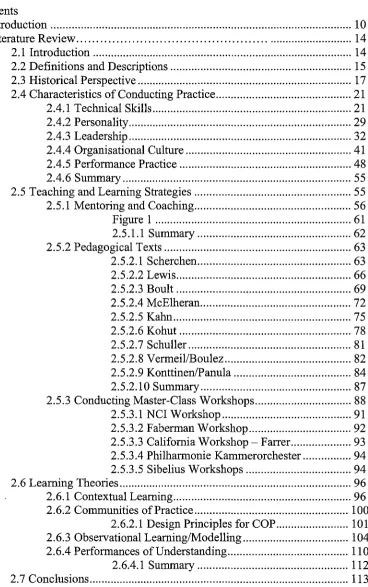
Table of Contents
Title Page Declarations Copyright information Photo Abstract Acknowledgements Contents1. Introduction ... 10
2. Literature Review ... 14
2.1 Introduction ... 14
2.2 Definitions and Descriptions ... 15
2.3 Historical Perspective ... 17
2.4 Characteristics of Conducting Practice ... 21
2.4.1 Technical Skills ... 21
2.4.2 Personality ... 29
2.4.3 Leadership ... 32
2.4.4 Organisational Culture ... 41
2.4.5 Performance Practice ... 48
2.4.6 Summary ... 55
2.5 Teaching and Leaming Strategies ... 55
[image:7.564.137.506.190.778.2]2.5.l Mentoring and Coaching ... 56
Figure 1 ... 61
2.5.1.1 Summary ... 62
2.5.2 Pedagogical Texts ... 63
2.5.2.1 Scherchen ... 63
2.5.2.2 Lewis ... 66
2.5.2.3 Boult ... 69
2.5.2.4 McElheran ... 72
2.5.2.5 Kahn ... 75
2.5.2.6 Kohut ... 78
2.5 .2. 7 Schuller ... 81
2.5.2.8 Vermeil/Boulez ... 82
2.5.2.9 Konttinen/Panula ... 84
2.5.2.10 Summary ... 87
2.5.3 Conducting Master-Class Workshops ... 88
2.5.3.1 NCI Workshop ... 91
2.5.3.2 Faberman Workshop ... 92
2.5.3.3 California Workshop- Farrer ... 93
2.5.3.4 Philharmonie Kammerorchester ... 94
2.5.3.5 Sibelius Workshops ... 94
2.6 Leaming Theories ... 96
2.6.1 Contextual Leaming ... 96
2.6.2 Communities of Practice ... 100
2.6.2.1 Design Principles for COP ... 101
2.6.3 Observational Leaming/Modelling ... 104
2.6.4 Performances of Understanding ... 110
2.6.4.1 Summary ... 112
3. Methodology ... 116
3 .1 Purpose/ Aim of the Research ... 116
3.2 Theoretical Framework ... 117
3.3 Case Study ... 118
3 .4 Research Questions ... 120
3.5 Methods and Techniques ... 122
3.5.1 Observation ... 122
3.5.2 Interview ... 124
3.5.3 Narrative Inquiry ... 126
3.6 The Case: An Overview ... 128
3.6.1 Background Information ... 128
3.6.2 Case Study Module ... 129
3.6.3 Participants ... 131
3.6.4 Participant Groupings ... 132
3.6.5 Rehearsal Schedule ... 132
3.6.6 Researcher's Role ... 133
3.6.7 Data Generation ... 134
3.7 Research Design: Processes and Implementation ... 135
3.7.1 Research Design Phases (Appendix 6) ... 135
3.7.2 Ethical Consent.. ... 136
3.7.3 Pilot. ... 136
3.7.4 Interviewing Techniques - Module 10 ... 139
3.7.5 Reflexivity ... 140
3.7.6 Recording oflnterviews ... 142
3.7.7 Recording Observations ... 143
3.8 Trustworthiness ... 144
3.9 Representation ... 145
3 .10 Credibility ... 146
3.11 Triangulation ... 147
3.12 Analysis of Observation and Interview Data ... 148
3 .13 Ad hoe Meaning Generation ... 148
3 .14 Phenomenological Reflection ... 149
3.15 Narrative Synthesis ... 150
3.16 Narrative Accounts ... 152
3 .17 Naturalistic Generalisation ... 153
3.18 Conclusion ... , ... 153
4. Narrative Accounts ... 156
4.1 Petri ... 157
4.1.1 Petri's Rehearsal schedule ... 160
4.2 Katri ... 175
4.2.1 Katri's Rehearsal Schedule ... 181
4.3 Riku ... 187
4.3.1 Riku's Rehearsal Schedule ... 188
4.4 Matti ... 200
4.4.1 Matti's Rehearsal Schedule ... 201
4.5 Oksanen ... 213
4.5.1 Oksanen's Rehearsal Schedule ... 214
4.6 Sakari ... 226
4.6.1 Sakari 's Rehearsal Schedule ... 227
5. A Discussion and Interpretation of the Findings ... 245
5 .1 First Day of Rehearsal.. ... 245
5.2 Second Day of Rehearsal ... 251
5.3 Third Day of Rehearsal.. ... 256
5.4 Fourth Day of Rehearsal ... 259
5 .5 Fifth Day of Rehearsal.. ... 262
5.6 Research Questions ... 263
5.6.1 Research Question 1 ... 263
5.6.2 Research Question 2 ... 267
5.7 Literature Review: Relevant Issues ... 275
5.8 Summary ... 282
6. Final Conclusions ... 287
6.1 Recommendations ... 290
References ... 292
Appendices Appendix 1 - Conductor Chronology ... 310
Appendix 2 - Advice/Observations-Practitioners ... 311
Appendix 3 -Beat Pattern Gestures ... 312
Appendix 4 - Advice Based on Experience ... 313
Appendix 5 - Pedagogical Texts ... 314
Appendix 6 - Phases of research Design ... 315
Appendix 7 - Conducting Workshop Modules ... 316
Appendix 8 - Interview Schedule ... 317
Appendix 9 - Interview Questions ... 318
Appendix 10-Consent Documents ... 320
Appendix 11 -Diary Observation Worksheets ... 322
Appendix 12-Pilot Questions ... 323
CHAPTER!
Introduction
This study investigates the phenomenon of orchestral conducting pedagogy
through the lens of an Australian conducting muster-class workshop
targeting young experienced musicians with professional ambitions. The
mysterious and specialised nature of the conducting profession (Lebrecht,
2001; Schuller, 1998; Stanislavsky, 1989) makes this phenomenon an
interesting and unique focus of inquiry. Numerous views exist concerning
the ways in which the musical and non-musical skills necessary for
orchestral conductors can be incorporated into a programme of learning that
leads to the competent direction of a symphony orchestra including accounts
of specific approaches to performance practice (Hazeldine, 2006; Kohut,
1992; Pollack, 1991; Willetts, 2000). However, research in music education
into the phenomenon of conducting pedagogy and the teaching and learning
practices of conducting has been limited.
Pedagogy has been described as the art or science of teaching including the
strategies and content of instruction. Some educators use the term to
describe how teachers manage classroom instruction that helps students
learn the subject material (Heck & Crawford, 2004). Others have explained
pedagogy by arguing that it is a process of "developing clearly defined,
measurable outcomes for teaching and an evaluation plan that provides
supportive and summative feedback" (Banilower et. al, 2006, p. 1 ). Another
understanding (that suits professional development and provides a basis for
analysing orchestral conducting pedagogy) is one that advocates a process
where specific activities and tasks are designed to impart knowledge and
provide unique and relevant experiences (Webb, 2003, pp. 6 - 7). Various
aspects of pedagogy have also been researched and categorised using terms
such as "establishing rapport", "focus", "task'', "action'', "checking",
"mediation" and "transferring" (Robertson, Fluck, Webb & Loechel, 2004).
The process of how a teacher chooses to present material, ask questions,
way are important issues in the pedagogy of orchestral conducting and will
be discussed in this research.
The roots of this study go back to my first experiences of conducting
pedagogy as an undergraduate music education student in 1987. Two years
into the course, students were provided with the opportunity to undertake a
one-semester unit of study in conducting with the then musical director of
the Canberra Symphony Orchestra in Australia. The maestro provided
weekly instruction to a class of five novice conductors in front of a large
mirror. The instruction involved learning to conduct beat patterns, change
tempo and show dynamics through a study of excerpts from Beethoven's first symphony in C major, Opus 21 and Stravinsky's ballet music,
Petrouchka. The final examination included a 10-minute rehearsal with two pianos of these two works. This first experience of conducting pedagogy
began my long-term interest in conducting as a discipline that could be
studied and practised. The maestro encouraged my participation through
comments that suggested I had potential to succeed as a conductor and I saw
the course as both useful and relevant to my role as an assistant conductor of
the University's brass ensemble and my future career as a High School
music educator responsible for leading bands and choirs.
I became further acquainted with the complex and demanding role of the
orchestral conductor through my professional association as a trumpeter
with numerous symphony orchestras in Australia, South Africa and Europe.
Whilst this experience taught me about the qualities of leadership,
communication through gesture, rehearsal efficiency and developed an
understanding of the interpretation of specific repertoire, I was perplexed as
to why instrumentalists and music educators were not given more training
and education in developing skills that they were likely to need and
demonstrate to some degree during their professional musical careers.
Initially, I chose to explore the concept of musical gesture, as non-verbal
communication forms an important part of conducting technique and the
research literature outlines a range of methods for helping develop and
Roshong, 1980). However, after attending a number of conducting
workshops and competitions sponsored by the organisation, Symphony Australia, 1 between 1999 and 2001, I became enthusiastic about exploring a particular style of teaching that placed the student in a central leadership
role with professional musicians and allowed them to receive feedback from
multiple perspectives. What differentiated these workshops from other
master-classes that I had attended was the emphasis on professional level
performance and students being given opportunities to discover their own
strengths and weaknesses. After discussing my observations with various
colleagues, it was decided that this study would focus on one of the
Symphony Australia workshops and would investigate research questions
that connect teaching and learning strategies with the expertise of the
maestro and the unique workshop approach. Accordingly, the study
investigates the following questions;
1.
2.
What does orchestral conducting pedagogy look like?
How does teaching and learning occur within a conducting
master-class workshop environment?
The following subsidiary research questions interrogate these questions:
(1.i) How is orchestral conducting pedagogy structured and
organised?
(I.ii) What are the characteristic features of the teaching and
learning environment of orchestral conducting?
(2.i) What knowledge and skills did participants seek to develop
by attending these workshops?
(2.ii) What teaching strategies were employed to facilitate
learning?
(2.iii) How did student conductors respond to the teaching
strategies being used?
1
Symphony Australia is the organisation which sponsored the national conducting master-class workshops and granted their permission and cooperation with this research.
12
f.D
.,._ ___ J
L.'--0 ::,>-
~--en
nc::
LU
2:
z
(2.iv) What were the participants' perceptions of the role of the
conductor and the process of becoming a professional?
These questions have been addressed through a case study approach using
observations and interviews with key participants as the data generation
methods. I have chosen teaching and learning strategies as a central theme
as this facilitates a discussion about the theoretical and practical orientation
of orchestral conducting pedagogy.
This study also holds a strong personal and practical focus in the
methodology. My stance as a researcher was that of a 'researching
orchestral student conductor and auditor'. Through this study, I wanted to
deepen my understanding of how conducting is taught and whether this type
of workshop offers possibilities to inform our understandings of the nature
of conducting pedagogy. The accounts by the students of their conducting
experiences provided me with the opportunity to reflect on my journey and
development in the process of learning to conduct.
In Chapter two, I provide a review of the relevant literature in the field of
conducting pedagogy, the context in which it has developed, the current
research in the area, teaching and learning strategies, and relevant theories
and models that provide a rationale and explanation for orchestral
conducting pedagogy. In Chapter three, I discuss theoretical and
methodological issues pertaining to the conduct of the research. I provide a
description of the case and the methods and techniques employed to
investigate the phenomenon of orchestral conducting pedagogy and the
process of data analysis. Chapter four contains narrative accounts of the
experiences and perceptions of six student conductors and an eminent
maestro. These narratives are accounts developed from multiple
perspectives and incorporate observational and interview data obtained from
the workshop activities and rehearsals. Chapter five gathers together and
discusses an interpretation of the findings. I finish the study (Chapter six)
with a concluding discussion including a reflection on the implications of
the study for the practice of orchestral conducting pedagogy and
CHAPTER2
Literature Review
2.1 Introduction
This research study explores the phenomenon of orchestral conducting pedagogy through a case study investigation of a semi-professional conducting master-class workshop environment. The research attempts to broaden our understanding and appreciation of orchestral conducting pedagogy and its purpose in performance practice. This will be achieved by examining how an eminent maestro and aspiring student conductors engage and operate within a highly specialised learning environment. It will also examine individual perspectives from workshop participants about this unique practical method of learning to conduct. The following literature review is undertaken to provide a theoretical framework for investigating conducting pedagogy and the teaching and learning practices that are evidenced in conducting master-class workshop environments. The review will examine what is already known about conducting pedagogy, including its characteristics and identify those aspects that require further investigation.
I will commence with a discussion of definitions of conducting pedagogy as a way of demonstrating the phenomenon's complexity. Next I will provide an historical perspective on the development of conducting as a profession in order to provide a context in which to analyse the numerous components and characteristics of its pedagogy. This section will also incorporate a summary of current research of each characteristic as a means of illustrating those issues researchers consider important and which require additional study. Specific teaching and learning approaches of conducting will then be analysed and discussed from the perspectives of mentoring, coaching, pedagogical texts and conducting workshops. The analysis of these conducting texts forms a major component of the literature review and, as they cover a large period of time, it is possible through this analysis to obtain an historical perspective of the priorities associated with learning to conduct. Finally, the examination of the literature about communities of
practice (Lave & Wagner, 1991), observation, modelling, self-efficacy and
self-regulation (Bandura, 1977, 1994, 1995, 2001; Huitt, 2004; Ormond,
1999) and performances of understanding (Wiske, 1998) provides a
theoretical framework through which the phenomenon of orchestral
conducting pedagogy can be investigated.
2.2
Definitions and DescriptionsOrchestral conducting pedagogy involves much more than the "grammar" or
"practical study of modem baton technique" (Rudolf, 1994, p. xi). It aims to
develop the enormous range of skills and knowledge needed to competently
direct a musical performance (Kohut & Grant, 1990, p. ix-xi). Orchestral
conducting pedagogy assumes that the "teacher's duty involves being as
knowledgeable as possible regarding what is taught (content) and the proper
way to present it" (methodology) (Kohut & Grant, 1990, p. ix). There are
however, differing views on the emphasis between what to teach and how to
teach. Schuller argues that the major pedagogical emphasis of conducting
should be on providing students with a thorough theoretical basis for
making decisions that affect musical interpretation (1997, p. 19). Konttinen
however, views the pedagogy of conducting as an entirely practical
discipline that must focus on practice in front of an orchestra (2003, p. 93).
This approach emphasises the learning responsibilities and experiences of
the student more than the instructional style and knowledge of the teacher
(p. 158). Both these views hold implications for the role of the conductor,
specifically that "a conductor has to know the music and how to
communicate knowledge in rehearsal and performance" (Durrant, 1994, p.
60). The view that conducting requires skills and training in non-verbal
communication (Durrant, 1994; Durrant, 2005; Grashel, 1991; Kohut, 1992)
is not shared by all practitioners. Conductor and composer Pierre Boulez is
sceptical of whether conducting can be taught because "gestures are entirely
personal" (Vermeil, 1996, p. 66). This understanding of conducting
pedagogy is reinforced by the perception that conducting "tends to be
considered as something one does rather than something that can be taught"
(Durrant, 1994). The contentious view that a decline in both the standard
talent" (Lebrecht, 2001, p. 5) further reinforces the suggestion that
conducting is a mystical phenomenon that is difficult if not impossible to
teach.
Other definitions of conducting focus on purpose. The view that the
orchestral conductor is there only to reinforce and remind others about what
already exists on the printed musical page limits pedagogy to musicology
and excludes the study of technique (Schuller, 1998, p. 13). A definition that
describes the job of a conductor as someone, who diligently learns to read
the orchestral score (Holoman, 1992, p. 53), implies that the teaching and
learning process is to a large extent, a theoretical and cognitive process. A
more radical understanding of the role is suggested by Lebrecht (2001):
The conductor exists because mankind demands a visible leader or, at the very least, an identifiable figurehead. His musical raison d'etre is altogether secondary to that function. (p. 2)
Lebrecht argues that conducting has become more about the person than
musical talent and skills, thereby diminishing the importance of pedagogical
training. Eminent conducting practitioner, Daniel Barenboim states that,
"Orchestral conducting as a full-time occupation is an invention-a
sociological not an artistic one of the 201h Century" (Lebrecht, 2001, p. 1)
whilst violinist Carl Flesch suggests that, "there is no profession which an
impostor could enter more easily" (Flesch, 1958, pp. 271-272). These views
imply that a conductor's growing power and authority have somehow
overtaken the priorities of musical direction and interpretation.
Leaming to conduct, according to one pedagogue and clinician, involves
fostering "non-musical talents" such as leadership and the ability to
influence people (Rudolf, 1994, p. 418). Rudolf describes these "talents" as
invaluable assets although not all teachers consider strategies for promoting
them (p. 418). He continues his argument suggesting that;
Rudolf infers that for a student conductor, skills and understanding in
musicianship must be supported by the study of conveying musical intention
through gesture (p. xv). This pedagogical argument originates from a
specific view of the role of the conductor and audience expectation. Rudolf
claims that although non-musicians are usually impressed primarily by a
conductor's podium image, including their potential as box office
attractions, experienced musicians expect more.
They want to be directed by a musician who conveys musical intentions clearly and with authority, uses rehearsal time efficiently and deserves to be respected as a person and as a leader. (Rudolf, 1994, p. 418)
In summary, the numerous definitions and descriptions of conducting and its
pedagogy reflect different understandings of the orchestral conductor's role
and purpose. There is however an overlap in the definitions and descriptions
concerning the interplay of musical and non-musical skills. This suggests
that the phenomenon is complex and multidimensional.
2.3 Historical Perspective
Understanding the pedagogy of musical direction requires an awareness that
the modem conductor is a relatively recent role in the evolution of western
musical practice. A brief review of the history of conducting demonstrates
that skill acquisition in early conducting practice was initially accidental,
intuitive, experiential and informal. It also reveals how important
personality, political connections and leadership abilities were if one wanted
to be successful as a conductor. Another important aspect is the
musicianship and musical apprenticeship that assisted the individual to
make the transition from student to professional.
Musical direction in the form of 'time beating' existed in the Sistine Chapel
in the 15th century to enable meaningful and effective singing and earlier, in
the music cultures of the ancient Sumerians (c. 2270 BC), the Egyptians (c.
Robinson & Winold, 1976). Early examples of prototype conductors include
renaissance and baroque composers such as Lully, Bach, Vivaldi and
Handel. Their sole function seemed to involve 'beating time' and directing
from either the keyboard or violin. This leadership role was considered a
natural extension of their skills as performing musicians and composers
(Holoman, 1992, p. 665; Lebrecht, 2001, p. 13). The birth of modem
conducting may be indirectly attributed to the tragic figure of Beethoven
and his direction of the 9th Symphony, in D minor, Opus 12 5 whilst deaf. It
may have been from this point that musicians realised that they needed an
objective non-player to create order amid mounting chaos and the realisation
that the composer was not necessarily the natural leader. With the increasing
complexity of orchestral music from the late classical period, it also became
more difficult for the musician leader to undertake the dual role of
performer and director. With the arrival of large-scale oratorios and the
nineteenth century romantic movement, conductors became interpreters
rather than 'time-beaters' (Durrant, 2005, p. 88). As the music became more
complex and the size of the orchestra increased, so did the functional and
aesthetic requirements of conducting: someone was required to act as both
"guardian" and "organiser" (Britten, 1950, p. 247).
Despite the historic demise of the composer conductor (Lebrecht, 2001. p.
14), many composers still dominated the podium for much of the nineteenth
century including Berlioz, Schumann, Mendelssohn and Tchaikovsky.
Richard Wagner stands out as an individual who viewed conducting as a
specialist occupation, separate from the act of creation. Widely regarded as
the "supreme conductor of his time" (Slonimsky, 1994, pp. 1086-1092;
Lebrecht, 2001, p. 16; Wagner, 1911), his style was characterised by a deep
romantic attitude, which focused on generating emotional sensations and
musical gesture rather than just beating time. His manifesto, On Conducting
(Wagner, 1911) however, seems to focus more on attacking Felix
Mendelssohn's personality and success than developing specific ideas about
conducting technique (Mahler, 1968).
Our present understanding of conducting (one which views the conductor as
and not necessarily the composer or sectional leader) dates from the mid
191
h ceutmy, (Sadie, 1994, p. 179). Prior to this:
There were few if any proper conductors before the early part of the 191h century, since music of the classical era tended
merely to require, for the performing standards of those days, clear-cut exposition rather than incandescent interpretation. (Sanders, 1994, Vol. 1, p.7)
As the role of the conductor has evolved, the traditional focus on gesture or
baton technique has expanded to encompass issues of rehearsal technique
(Price & Byo, 2002, p. 335).
Historically, master-apprenticeships were an essential part of instrumental
training (Tarr, 1974, p. 116). Trumpeters for example, learnt their art by
living and studying with their master over many years. The famous
trumpeter Altenburg in 1795 published a book (Tarr, 1974) dedicated to
demonstrating this special apprenticeship, and outlined the strict rules,
rituals and guild practices that were to be observed before participants
eventually earned legal title to practise their art independently.
Apprenticeships were also practical and offered numerous performance
opportunities. Similar trends were observed with conductors and their
transition to professionals. The starting point of the modem conductor
according to Lebrecht (2001) seems to have begun with two main figures,
Von Billow and Nikish, who began their practical apprenticeships with the
Munich Court Opera and the Leipzig Opera respectively. The table in
Appendix 1 illustrates in part, a chronology of famous maestros who
developed their skills and credibility through their association with different
orchestras. In addition to their association with a orchestra/orchestras, the
life-stories and accounts of these conductors also reflect their connection
with each other as mentors, colleagues and rivals (Lebrecht, 2001).
One important source of information about the education and reputations of
various 'pioneer conductors' is a two-part video documentary on the art of
conducting (Sanders, 1994). The documentary surveys the period between
conductors. In this historical footage and associated interviews, certain
experiences and reflections stand out as having impo1tant pedagogical and
educational significance. The video documentaries suggest that a necessary
background for learning to become a conductor involved: an intimate and
thorough knowledge of the music; a serious. study of a musical instrument
(often the piano); and training in composition. For example, of the
twenty-six pioneer conductors commentated upon, (refer to Appendix 1) eight were
string players and the remaining eighteen were pianists. All had developed a
reputation as instrumentalists before turning to conducting and twelve were
recognised as composers and arrangers. Significant musical ability seems to
be an important quality for becoming a conductor. This was illustrated
further in the case of Hans Richter, (1843-1916) who was both admired and
respected by players and audiences because of his musical abilities. Being
one of a handful of conductors who was not a keyboard or string player, he
gained the respect of the musicians by playing the passages on the horn
during rehearsals (Slonimsky, 1994, p. 824; Lebrect, 2001, p. 37).
In a famous discourse on music, Aristotle, said;
It is difficult, if not impossible, for those who do not perform to be good judges of the performance of others. (Adler, 1989, p. 3)
Whilst this view 1s m reference to soloists, it can also be applied to
conductors in that credibility appeared to be dependent upon one's
reputation as an instrumentalist. This is evidenced further when viewing the
life sketches and musical biographies of eminent pioneer conductors.
Leaming to be a conductor seemed therefore to be related to learning an
instrument and possessing comprehensive skills in musicianship. Not all
eminent conductors have been solely prolific composers and/or highly
regarded instrumentalists, (Mvravinsky, Beecham): some, for example Solti,
also received outside recognition for their artistic contributions (Slonimsky,
1994, p. 956) whilst others for example, Toscanini, openly conversed on
social philosophy and political issues (p. 1041 ). As such, both musical and
non-musical skills were considered important characteristics required by a
conductor.
This brief historical perspective demonstrates that the role of the conductor
has evolved from that of 'keeping time' to providing specific and unique
interpretations. This evolution underlines the need to develop leadership,
technical and performance skills and suggests that conducting is a specialist
field of musical expertise requiring specialist training.
2.4 Characteristics of Conducting Practice
In this section I will examine the characteristics of conducting practice
specifically, the issues of technical skills, personality, leadership,
organisational culture and performance practice. This section will also
incorporate a critical discussion of the relevant research literature.
2.4.1 Technical Skills
From a conducting perspective, technical skills refer to postures, gestures
and beating that affect mood, tempo and dynamics (Decker & Kirk, 1988;
Kohut, 1990; Rudolf, 1994). The German pedagogue, Max Rudolf,
described conducting as the relationship between gesture and response
(Rudolf, 1994) and in so doing, also outlined the basic elements of what is
meant by the term technique. The synchronisation of these elements
articulates the individual style and this to some extent is a reflection of
personality. The challenge in learning to become a conductor lies in the
simultaneous acquisition of technical skills and the development of a
personal style. There are a number of contemporary texts (Kahn, 1965;
Rudolf, 1994; Willetts, 1993; Willetts, 2000) which provide specific
instructions on technique and gesture and it appears that the pioneer
conductors learnt their technical skills through copying life models, through
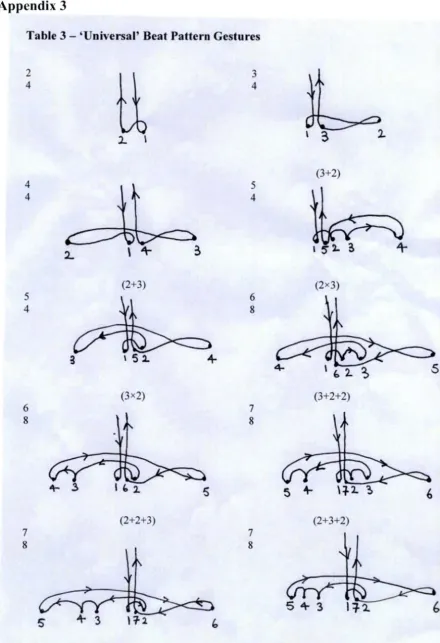
Whilst the literature identifies explicit and generally accepted conducting
beat patterns (see Appendix 3), the origins of these gestures is less clear.
Rudolf makes reference in his text to the first edition of the Grammar of
Conducting introduced by George Szell (1897-1970) and published in 1950. Rudolf describes Szell's text as an "unprecedented and brilliantly successful
attempt to describe and explain the complex technique of conducting in a
methodical and yet lively manner" (Rudolf, 1989, front cover). However,
these same beat patterns were clearly being employed in the very earliest
motion recordings of Arthur Nikish (1855-1922) (Sanders, 1994, vol. 1).
Both Emile Jaques Dalcroze (1865-1950) and Rudolph Laban (1870-1958)
promoted theories on the teaching of music based upon eukinetics which
involved gesture, rhythm, body awareness and kinetic exercises as a method
of interacting with and responding to sound (Dale, 1998; Hoch, 1982, p. 2;
Hodgson & Dunlop, 1990, p. 48).
Dalcroze was convinced that through the responsiveness of the entire body,
a true feeling of the music could be taught (Dalcroze, 1920, 1921). Dalcroze
discovered that although some young students were unable to tap or keep a
steady beat when listening to and playing music, they were able to run and
walk in tempo. Dalcroze's pedagogical method harnessed this 'natural'
movement response to musical stimulus in order to develop skills in
musicianship. Today, there are a number of North American music
institutions that feature the employment of Dalcroze methods in their choral
and orchestral conducting courses (University of Washington, University of
St Thomas-Minnesota, Longy School of Music-Cambridge, Mass); however
the pedagogical texts examined in this review (see section 2.5.2) make no
direct reference to the work of Dalcroze.
There is evidence to suggest that physical expression and personalised
gesture can be improved and taught. One American conducting practitioner
highlighted the limited nature of conducting texts in dealing with teaching
gesture, commenting that:
texts on conducting dealt only with spatial reproduction of patterns ... some recognise the difference in style of beat but
none provide tangible methods for developing these differences. (Poch, 1982, p. 21)
The Hungarian born Rudolph Laban, (1879-1958) is considered the pioneer of modem dance theory and notation technique. For Laban, all movement is initiated from within; a view that is shared by some conducting theorists in relation to a conductor's gesture and interpretation (Poch, 1982, p. 21). The implication for conductor education and training is that controlled and uncontrolled movements communicate different ideas and intentions. Both music performers and listeners often feel the need to move as they experience music and an understanding of how and why we move may prove useful for teachers and students in making baton technique more effective.
Gesture has also been explored and researched from the perspective of
choral conducting and coded into five types (Durrant, 2003, p. 147).
1.
2.
3.
4.
5.
Connotative - which express character and nuance.
Literal -which indicate pulse.
helpful - which help performers in a musical, technical and vocal way.
inappropriate - which contradict musical, technical or vocal related expectation.
singing gesture - which enable the performers to better understand musical, technical and
vocal issues undertaken by the whole choir.
Although choral conducting is a different phenomenon to that of orchestral
conducting, this classification is useful in providing a basis for the
evaluation of technique during performance and establishing some
fundamentals of conducting practice. Literal gestures that focus on
maintaining the forward momentum of the music would appear to be the
first priority for a student conductor leading to connotative gestures that
focus on interpretive aspects. The identification of inappropriate gestures
suggests that the freedom to develop an individual style must also be
balanced by the need to ensure that specific intentions are communicated
clearly and effectively to the orchestra.
Nikish (1855-1922) is remembered as the father of modem conducting and was said to be a magician with the baton displaying virtuosity and musical
inspiration (Slonimsky, 1994, p. 714; Sanders, 1994). The literature does not
mention what procedure and practice routine facilitated the perfection of
such technique except that it was highly personal and intuitive. Nikish for
example once advised a British conductor, Henry Wood, to make all his
performances a grand improvisation suggesting that if the critics didn't like
it, they could get a metronome to conduct (Wood, 1938, p. 211). Nikish
demonstrated in his practice an important principle of technique that is still
hand beats time and the left hand makes the music" (Lebrecht, 2001, p. 31).
This same critic also observed the technique of beating ahead of the required
tempo so it would not drag. Whilst there is little account of how Nikish
developed such a style, the literature seems to suggest intuition. Nikish once
said:
When I conduct a work, it is the thrilling power of the music that sweeps me on. I follow no hard and fast rules of interpretation, nor do I sit and work it all out in advance. (Lebrecht, 2001. p. 31)
Other eminent conductors noted for the clarity, mastery and perfection of
their technique include father and son, Erich Kleiber and Carlos Kleiber
(Sanders, 1994; Slonimsky, 1994, p. 501). The conducting of Carlos
Kleiber1, demonstrates a seemingly effortless technique that is both
comfortable, relaxed and expressive. Combined with highly communicative
body language and facial gestures, the beating appears to resemble painting
and moulding. Kleiber's technique is visually entertaining and as such could
prove a valuable resource for conducting students. Turning to the technique
and style of Charles Mi.inch, (1891-1968) one is able to observe a method
for conducting French repertoire of the nineteenth and twentieth centuries
such as that of Debussy, Berlioz and Milhaud, where there is the constant
challenge of beating clearly and visibly to show changing meters and
complex rhythms. Mi.inch's dynamic interpretations are advocated as
important learning resources for understanding how to initiate spontaneity
and elegance (Sanders, 1994, Vol. 2; Slonimsky, 1994, p. 698; Sadie, 1994,
p. 544).
A key point to make about technique is that its development and perfection
requires regular and sustained practice and experience conducting
orchestras. Examples of eminent conductors who perfected their technique
through apprenticeships at various Opera houses include Klemperer, Mahler
and Reiner (Slonimsky, 1994, pp. 506, 608, 817). Even so, conducting is
1
still a highly personalised and improvised form of expression. A rising
contemporary female star, Emmanuelle Baim comments in an interview that
she never learnt the practice of conducting and that her style and approach
was a natural expression of her hyperactive and musical personality. "Kurz
entschlossen band die enervierte Padagogin die hyperactive Emmanuelle am
Stuhl fest und verschloss ihr sicher ist sicher" (Kronsbein, 2004, p. 133).
For Baim, "vorschriften" (rules) were never something she found appealing
and that same principle characterises her conducting style and technique.
For her, gesture was about the whole body because sound has birth in the
body. Her "wiet ausholenden" (wide arm movements) (p. 133) may be
criticised as excessive but are an expression of individuality and musical
intent. Baim was convinced by friends to build her own ensemble and that
was where her conductor training really started (Kronsbein, 2004, p. 133).2
The research literature (as distinct from historical and/or pedagogical
literature) on conducting technique has focused largely on the identification
and analysis of effective gesture, primarily through the use of computer
aided software (CBCGR).3 One such study (Lee, Wolf & Borchers, 2005)
compared how conductors and non-conductors placed their beats when
conducting to a fixed recording of Radetsky March, Opus 228 by Johann
Strauss (sr.) and found significant differences between these two groups. The study found that non-conductors had a far higher beat placement
variation (the differences in the space used to physically show their beat)
than conductors with experience. Differences were also found in how users
conceptually mapped their gestures to the music, such as conducting to the
musical rhythm rather than the beat. This research illustrates that
experienced conductors use gesture more economically and precisely than
inexperienced conductors. This highlights the importance of learning how to
be both efficient and accurate when beating and gesturing rhythms.
2
My translation and paraphrase.
3
Another important study pioneered research into the development of an
HMM4 based procedure that could be applied to the classification of conducting gestures for both the right and left hands (Kolesnik &
Wanderley, 2004). Although research and experimentation with
micro-based computer systems for gesture recognition has been taking place since
the 1980s (Buxton et. al, 1980), this particular research developed a uniform
process that could be applied towards the analysis of indicative (right-hand)
and expressive (left hand) gestures in real time. The study found that the
system was able to correctly identify conducting gestures during real time
with a 94.6% recognition rate (Kolesnik & Wanderely, 2004, p. 2). Such
technology is useful for both pedagogues and students if one views
conducting as "controlling performance of multiple instruments with one's
physical gestures but without direct contact with the instruments
themselves" (Kolesnik & Wanderely, 2004, p. 1).
An additional pedagogical aspect considered in research using CBCGR was the development of immediate auditory feedback. The purpose of this
research was to design and implement the first responsive interactive system
for conducting and conducting pedagogy (Kun & Hill, 2004). Conducting
students practise baton technique in a live performance setting where their
movements are tracked, recording changes in trajectory, velocity, size of
gesture, and angles. As the conductor moves through the score, the sound
follows the movements and the computer gives immediate auditory
feedback in relation to beat points, tempo, dynamics and articulation.
Simultaneous visual feedback is also possible and projected on a screen in
front of the conductor. Practice sessions can be recorded and rendered for
post-session analysis and evaluation of the conductor's performance from
any angle in three-dimensional space. Through these recordings, the viewer
may isolate the baton, certain parts of the body, or the entire body, in order
to focus the analysis and evaluation (Kun & Hill, 2004).
With such a comprehensive tool to analyse and evaluate conducting
gestures, further research 1s needed to pilot this type of interactive
4
programme with student conductors and teachers to assess their reaction to
its effectiveness, usability and usefulness in improving technique. Whilst
this approach to the investigation of conducting is growing (Lien, 1998;
Marrin, 2000; Murphy et. al, 2003; Orion & Dechelle, 2001) the perspective
assumes that conducting pedagogy is primarily focused on the development
and refinement of gesture. Other views of conducting and conducting
pedagogy would suggest that conducting is more than getting the gesture
correct; it involves other dimensions such as that of the conductor's
personality.
2.4.2 Personality
The personality of a conductor is important in conductor training because it
contributes to how students establish their presence and authority and
demonstrate their confidence. However, it is often difficult to pinpoint what
specific aspects of the 'physical self (gesture, posture, tone of voice, facial
expression) and personality (patience, passion, enthusiasm, responsiveness
or humour) enhance or disturb the conducting performance.
The experience of conductor and pianist Alan Hazeldine, (a former student
of Sergiu Celibidache ), illustrates that the teaching of conducting is not
necessarily about changing personality or training a student to act in a
different way: rather it is concerned with working with individual attributes
and developing suitable and acceptable techniques which work for both
orchestra and conductor;
All too often, when one hears an eminent conducting pedagogue teaching, what is being said boils down to, 'do as I do, my boy, and you will be fine'. Well, this is very often not the case. What that teacher has missed is the fact that what works for him is a combination of what he actually does, (his gesture), and what he is, (his personality) and what his experience has turned him into. The young conductor has not yet had the opportunity to acquire this experience so what the teacher is actually expounding, when combined with the charisma of the student is often comical and ineffective. I remember watching a student of the late Sir George Solti conducting the introduction to Beethoven's first symphony. The problems started right with the first chord, when the wind enter with a sustained note that is combined with a pizzicato note on the strings. Solti used to do that with a quick flick of the arm preceded by a short, sort of catatonic pause in mid air. This worked for him, combined, as it was, with his giant personality. However, although I remember this incident from nearly twenty years ago I doubt if that young conductor has made it work yet! He simply did not have that huge personality. He, in fact had something even better from his point of view; he had his own personality, which, if combined with his own gesture, based upon sound principles of conducting, would have worked much better than a borrowed, idiosyncratic one. (Hazeldine, 2006, p.1)
The interaction between who you are, what you feel, what you want and
how to get it as a conductor is complex and is reflective of individual
personality. Further, the matter of bringing a performance into being is not
only a solitary mental mission; it also requires an interaction with a
responsive and skilled orchestra.
There is no point in a conductor developing profound and deeply internalised interpretations and expressing these kinaesthetically if all the gestures are not understood by the orchestra and choir. (Kemp, 1996, p. 179)
The research on temperament types by Anthony Kemp (1996) provides a
perspective on one of the factors that play a part in the development of a
conductor. Kemp claims that "introversion" seems to be a critical part of a
musician's personality (Kemp, 1996, p. 43) and refers to Eysenck's two
dimensional model of personality, (Eysenck, 1965, p. 54) as a means of
comparing conducting personalities. Whilst introversion and instability are
stereotyped understandings of a conductor's personality and behaviour (due
to factors such as concentration and internal vision), the extroversion and
stability domains are important requirements to carry out the functional
aspect of leadership, communication and direction (p. 54). Conductors
however, often seem to display extroversion as an expression of their
charisma, power and leadership (Sanders, 1994). Kemp makes the point that
although conductors appear to be more extroverted, adventurous and
adjusted in comparison with non-conducting musicians, conducting
musicians could also be described as "ambivert", displaying introverted
aloofness that keep their evaluating and critical processing internal and
thereby running the risk of not giving sufficient feedback to the players
(Kemp, 1996, p. 18).
The ability or willingness of a conductor to verbalise their thought processes
and intentions to the orchestra is another component of personality which
influences performance practice. The thought processes of conductors in
being able to achieve their musical objectives as leaders, has been the focus
of a recent investigation (Bergee, 2005). This study explored the thought
processes of conductors with different levels of experience comparing
novice, intermediate (graduate-student) and expert orchestral conductors.
Two novice conductors, one graduate stu<lent in orchestral conducting, and
one expert conductor led a university symphony orchestra in part of the first
movement of Brahms's Symphony No. 2, Opus 73. Wired for sound,
conductors attempted to verbalise their thought processes while conducting
and these episodes were video-taped for later viewing during one-on-one
interviews. Analysis of the data indicated that the novices focused attention
on surface aspects, especially rhythm and cueing and experienced difficulty
performing multiple tasks. The intermediate conductor demonstrated a
better command of fundamental conducting processes but did not verbalise.
The expert conductor made few comments relating to surface aspects,
focusing instead on establishing concepts of balance and style. Interviews
suggested a self-directed orientation for the novices and an
ensemble-directed orientation for the intermediate and expert conductors. The
implication of this study for conducting pedagogy is that students have
different performance priorities and ways of thinking about them according
to their skill level. At a more experienced level the mental focus 1s on
ensemble and interpretation rather than basic technique.
Some assert that the aspect of personality is overrated as part of a
conductor's training. Schuller (1998) suggests that there is no clear
correlation between a conductor's personality/behaviour and their technical
and musical skills. He suggests that both introverts and extroverts have been
greater or lesser conductors with some displaying inflated egos whilst others
displayed selfless egos (Schuller, 1998, p. 51 ). Schuller continues by saying
that even if "benign autocratic attitude" is present, it is somehow
counterbalanced by the collective attitude of the orchestra which may
likewise run between a spectrum from docility to hostility and belligerence
(p. 51).
Although the history of conducting reveals how all extremes of personality
are both tolerated and admired, pedagogues have the important and yet
complicated task of working with the human side of presentation. As an
example of the force of personality upon performance practice, former
musicians would change their sound upon seeing Maestro Fiirtwangler enter
a room or practice session (Sanders, 1994). Evidently, the conductor's
presence alone was sufficient to influence the performance quality of the
orchestra (Sanders, 1994).
This discussion on personality reveals that character traits of both
introversion and extroversion are evident in the role of conductor. Although
there is little research linking a conductor's personality to their performance
abilities and how this affects the teaching of conducting, the ability to lead
and communicate effectively is to some extent a reflection of personality as
is the degree to which conductors find themselves comfortable in such a
public role. Personality and communication are important components of a
conductor's role (Pollack, 1991). The learning objective of this role may
also include allowing students to find their own sense of personal autonomy,
to communicate on their own terms and so ensure that their 'art' remains
totally within their control (Storr, 1976).
2.4.3 Leadership
Another characteristic of conducting practice 1s the demonstration of
leadership. Leadership in relation to conducting may be defined as an
aggregate sense of preparedness, confidence and organised in a range of
ways including the following:
Leadership over human beings is exercised when persons with a certain purpose, mobilise, in competition or conflict with others, institutional, psychological and other resources so as to arouse, engage and satisfy the motives of the followers. (Telford, 1996, p. 7)
In the context of orchestral conducting, leadership has focused primarily on
the conductor rather than the musicians with whom they work. Much of the
research has defined and measured the effects of leadership on "subordinate
performance" (ie: the degree to which employees achieve the goals and
tasks allocated by their bosses) and failed to acknowledge the two-way
(Atik, 1994, p. 24). Atik (1994) drew on these contemporary leadership
theories in order to analyse and interpret the ways in which leadership is
evidenced in the orchestral setting.
Transactional leadership occurs when a leader approaches their followers
with the intention of mutual exchange (Atik, 1994, p. 24): in other words, a
reward initiating structure ( eg: a clear concise direction in exchange for a
high quality performance). This type of leadership is related to the principles
of "followership" (Heller & Van Til, 1982) and is more directive than
collaborative in nature. Transactional leadership assumes however, that both
leaders and followers have access to a source of power and influence and
both need each other in different ways (Kennie et. al, 2000).
Transformational leadership on the other hand, describes an exchange
between people seeking common aims who are united to go beyond their
separate interests in pursuit of higher goals (Telford, 1996, p. 7). The focus
is on the collective rather than the individual and involves a special
engagement that motivates and energises others to capture a vision and
produce a higher order of exchange (Kennie et. al, 2000). This 'higher
order' is described as occurring when both parties are able to work out a
"mutually acceptable set of expectations and are both task orientated in
achieving what is required of them" (Atik, 1994, p. 24). In reference to the
orchestral conductor, transformational leadership is evidenced in greater
flexibility in the working relationship, a role for the players beyond the
traditional hierarchy, and, a working environment that is characterised by a
significant amount of positive reinforcement (Atik, p. 26).
Another view of transformational leadership is that of "superlative
improvisation", where a shared sense of mutual trust and knowledge is built
up "off-line" in moments that are not critical (Kennie et. al, 2000) for
example, through social interaction outside the rehearsal hall. The
implication of superlative improvisation for conducting pedagogy is that
achievement of a shared vision and cooperation can happen when both
teacher and student respect each other's differing levels of expertise and
There is a general consensus, supported by the research literature that
transfom1ational leadership increases success in groups and organisations
(De Dreu & Weingart, 2002; Fuller et. al, 1996; Lowe et. al, 1996).
Although it is a desired form of leadership, the process of how it happens
within the orchestral setting requires a trust relationship developed during
the transactional stage. "Mutual trust is present in the sense that the
musicians feel comfortable in their total reliance on the conductor" (Atik,
1994, p. 27).
In Atik' s investigation, open ended interviews were undertaken with
nineteen players, eight administrators and eleven conductors from three
major orchestras to examine the leader-follower relationship and the effects
of contrasting conducting styles (ranging from highly directive to more
collaborative) on players. Conductors were also interviewed about their
perceptions of leadership and conducting style in order to gain greater
insight into leadership themes (p. 24). The researcher considered the
orchestral setting a useful and purposeful place to examine leadership styles
because work is carried out in public and subordinates are regularly exposed
to a succession of new bosses (guest conductors) (p. 24). Atik outlines three
stages in the conductor/ensemble relationship, those of the testing phase, the
working phase, and, the transformational/inspirational stage. The testing
phase in the conductor/ensemble relationship occurs when players explore
the boundaries of the relationship and the conductor's professional
competence (pp. 24, 26). This phase is followed by a working phase, a
phase that is more transactional in nature in that players demand concise
direction and efficiency. A popular expression that emerged in the
interviews was an appreciation for a leader who "did not waste our time" (p.
24). The final transformational/inspirational stage is characterised by less
fixed hierarchical boundaries, as the conductor gains the consent of the
players and relinquishes control (trusting the players to perform artistically)
(p. 26). Whilst acknowledging the benefits of transactional leadership,
transformational leadership is viewed as "adding value" and leading the
performance beyond expectations (p. 23). One concert-master expressed the
view that the very best conductors he had worked with became part of the