Creating the Reasonable Adventurer: The Co-evolution of Student and
Learning Environment
Colin Jones
University of Tasmania Private Bag 16
Hobart 7001 Australia
Phone: +61 3 6226 2826 Fax: +61 3 6226 2808
Creating the Reasonable Adventurer: The Co-evolution of Student and
Learning Environment
Abstract
Purpose: This paper seeks to address the issue of how are graduate skills developed. The focus is not on which skills, but rather what type of learning environments is required within Higher Education to support the development of skills valued and demanded by SMEs within Australia.
Approach: This paper takes a step back to consider the underlying issue of how an individual student’s habits of thought are altered. In doing so, the past works of Morgan, Dewey, Whitehead, and Tyler are synthesized with the modern work of Baxter Magolda, Heath, and Biggs.
Findings: It is argued that that without the development of a student-centred learning environment, most graduates will not develop the types of skills demanded by SMEs in a meaningfully way. That the failure to treat knowledge and skills as equal drivers of curriculum design will result in an imbalance that relegates skill development to a secondary learning outcome.
Practical Implications: By removing the distraction of what skills should be developed, a clearer focus is possible regarding how educators should assist students to develop a broad array of generic graduate skills. From this perspective, skills can be viewed as an essential element of the educational process, rather than a new element that must be squeezed in between content.
Value of Paper: This paper extends recent discussion of skills development through the use of an evolutionary perspective. Viewed as a process of creating social change, education becomes increasingly connected to a world that lays beyond institutional boundaries, thus promoting the notion of developing graduates for the world that awaits them.
Keywords: Graduate Skills; Self-Development; Australian SMEs, Niche Construction
Introduction
The every increasing importance of SMEs to all global economies and the increasing
responsibility of Universities to ensure the availability of skilled graduates to SMEs are universally acknowledged. What is less accepted is the ability of the higher education sector
to effectively assist students develop lifelong skills (Matlay & Mitra, 2002). Rather than add
how any such determined skills could (and should) be developed. In doing so, this paper returns a focus to some specific educational issues that receive less discussion (perhaps) due
to the existing confusion of what skills should be developed. However, the position of the
author is that many SME specific skills will be developed on the job, and what is important is
that graduates have a capacity for learning additional skills beyond a broad base of skills
applicable to all types of employment. This view is based on recent past development of the
National Employability Skills Framework (NESF) in Australia, which was founded on the
findings that large, medium and small firms all increasingly demand graduates with a similar
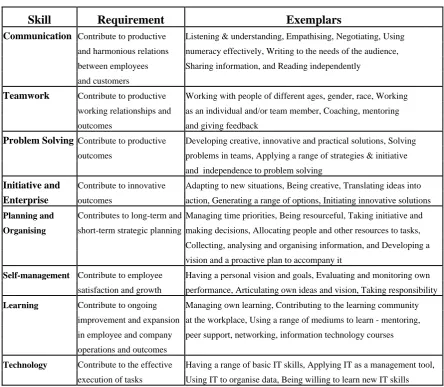
skill set. These skills are illustrated in Table 1 below.
Insert Table 1 Here
While the NESF provides for a general, but transferable skills set, it also provides a focus on the nature of the requirements that students must satisfy in order to claim mastery of each skill.
Therefore, there is a clear onus on higher education institutions guided by such frameworks to
employ authentic assessment (Wiggins, 1989) procedures to determine student developmental
outcomes. A particularly salient point given the increasing level of activity across Australian
universities to embed graduate attributes across all courses. This paper is structured as follows.
First, the notion of a reasonable adventurer (Heath, 1964) is considered and proposed to be a
universally attractive type of graduate student. Then, related self-developmental issues are
considered, allowing a more fine-grained focus on how students must change to incorporate
new habits of thought (Veblen, 1925). Following this is a discussion of the process niche
construction (Olding-Smee, Laland and Feldman (2003), through which the co-evolution of
synthesis of the concepts discussed drawing out implications for educators involved in the
development of skills in the higher education area.
Towards the development of students capable of independence
Rather than separate skills into personal or business (McLarty, 2005) or any other array of
categories (e.g. transferable, core, etc), this paper begins with a different issue. A question not
related to what skills, but rather a question driven by a curiosity in how skills are developed.
How is it that some students are capable (more so than others) of coping with change,
identifying and exploiting opportunities and being able to reconcile the known with the
unknown? This is a question not distracted by the potentially never-ending list of SME related
skills. This question returns a focus to the generative mechanisms through which future
graduate interaction in a SME world is determined. Whilst there are many competing
definitions of generative mechanisms, Mahoney’s (2003, p 4) extensive review of generative
mechanisms views “causal mechanism[s] as an unobserved entity, process, or structure that
acts as an ultimate cause in generating outcomes”. Within the context of this paper therefore,
generative mechanisms are the students’ habits of thought, which are plastic enough to be
self-altered through frequent reflection.
In his study of Princeton undergraduates, Heath (1964) identified six specific attributes
through which a student’s ability to create their opportunities for satisfaction were enhanced.
Let us consider each briefly to outline the nature of how each might relate to skills
frameworks, such as the NESF. The first attribute is intellectectuality, the ability to alternate between being a believer and a sceptic. An ability to remain curious whilst determining what
matters through making connections between the object under consideration and the reality of
individuality of others. The realisation that they have shared feelings with others and that
prior perceptions have been altered due to these friendships. The third attribute is
independence in value judgements, or the ability to rely upon personal experience rather than known external authorities. This increased reliance upon one’s judgement provides an avenue
towards self-reflection that may be travelled with much vigour and enthusiasm. The fourth
attribute is a tolerance of ambiguity, or the ability to view life as a series of interruptions and recoveries (Dewey, 1922), to be able to suspend judgements until sufficient information is
obtained to make the right decision. The fifth attribute is the breadth of interest demonstrated. Heath (1964, p 34) calls this an “uncommon interest in the commonplace”. So depth replaces
breadth to enable the sustained pursuit of specific problems. The last attribute is a balanced
sense of humour. A benign, but lively sense of humour that distinguishes the reasonable adventurer, making he or she good company, and capable of being sensitive towards others
across conflicting circumstances.
So Heath (1964) promotes the idea of a fully functioning graduate, one that is capable of
using his or her individuality in ways that are beyond their pre-existing mental endowments.
The key is the fact that he or she is tethered to the reality of their world, yet capable of finding
deep satisfaction from the ingredients of their raw life. This outline of the reasonable
adventurer forms the author’s ideal minimal outcome for any graduate, be they destined to
employment in a large firm, a SME, or self-employment. It is the contention of this paper that
the reasonable adventurer concept is the chassis around which other features (i.e. skills) can
be fashioned, and is the primary structure upon which the journey into the future is possible. It
represents a state of development without which, all other attempts at skill development will
The challenge of facilitating the development of the reasonable adventurer is not limited to
program design. It is unlikely that any program that works in one university would deliver
identical results in another due to resource and personnel differences. So, the focus proposed
here is upon the underlying processes related to how any such self-development is possible. Be that towards the reasonable adventurer concept by itself or with an extended focus to
include specific SME skills. As noted by Jones (2005), enabling students to experience the
type of learning environment required for such educational outcomes also provides the
opportunity for the development of a skill set that is increasingly demanded by Australian
SME (and larger) employers. Described “as the ‘third leg’ of the university sector, alongside
teaching and research” (Hartshorn, 2002, p 150), the development of enterprise skills is a
genuine outcome in its own right. Whilst it may be unrealistic (and not possible) for
universities to guarantee (Clanchy and Ballard, 1995) that all students will graduate with a
specific skill set, this however does not prevent universities from guaranteeing that
undergraduates will have the opportunity to attempt such self development (Crebert, Bates,
Bell, Patrick and Cragnolini, 2004). Therefore, this paper aims to throw some light on the
underlying processes through which any such graduate development is possible.
The challenge of self-development
Free from the constraints of what skills should be developed, we now have created sufficient
space to consider the process of self-development required to support the acquisition of any
particular skill set. In work that presents similarities to Heath’s (1964) research, Baxter
Magolda (2004) promotes the self-development concept of self-authorship. Through her work,
a journey of self-discovery is outlined through three specific dimensions, the epistemological,
intrapersonal, and interpersonal. Baxter Magolda defines self-authorship as “the ability to
judgements” (1998, p 143). Whilst the connection between self-authorship and the reasonable
adventurer concept should soon become self-evident, the discussion will now deliberately
wander further away from skills development, to go deeper into the nature of the cogs and
wheels of the generative mechanisms that will eventually determine the nature and longevity
of acquired skills. The value of this digression while emerge once the concept of niche
construction is also considered.
Before we proceed further, a brief recap of the main points discussed so far. What has been
claimed thus far is that an over emphasis on what graduate skills are relevant to SMEs appears to have prevented a more explicit focus on how any such skills can be developed in the higher education sector. It has been suggested that if we go back further, we can focus on what
process of self-development is required to provide a sufficient base upon which specific SME
skills can be more profitably developed. To this end, Heath’s (1964) concept of the reasonable
adventurer has been introduced to highlight a degree of attainment suggested to increase the
successful acquisition of any specific skill set. The paper will now proceed with an overview
of Baxter Magolda’s (2004) proposed concept of self-authorship. In doing so, this section
aims to highlight several specific personal development issues that cannot be ignored and
must be factored into the design of any educational program designed to develop SME skills.
Let it be stated that the author concurs with Tyler’s (1949, pp 5-6) assertion that “education is
a process of changing the behavior patterns of people. This is using behavior in the broad
sense to include thinking and feeling as well as overt action”. Clearly these three forms of
altered behavior can accommodate aspects of critical thinking, self-reflection and skill
development. The first aspect of this approach relates to the way in which our students know
students typically are required to move in order to develop a capacity for self-authorship. She
proposes the need to move “from absolute knowing (in which knowledge is assumed to be
certain), through transitional knowing (in which some knowledge is believed to be uncertain),
to independent knowing (in which knowledge is assumed to be largely uncertain)” to
“contextual knowing (in which knowledge claims are made based upon relevant evidence
within a context)”. Building on Perry’s (1970) theory of evolving adult epistemological
structures, the central driver is personal reflection from which meaning of experience is
developed. Essentially, developing the ability to construct one’s own knowledge rather than
merely taking in the knowledge of others (Belenky, Clinchy, Goldberger, and Tarule, 1986).
However, the challenge that confronts all educators is dealing with different rates of learning
and development across individual students (Weimer, 2002). Given that students develop
incrementally, it would seem logical that learning activities designed to aid such development
should also work through sequential design. While this idea has intuitive appeal, Weimer
notes that little research has been conducted to support such a notion. Nevertheless, holding
this thought a little longer provides the cue to introduce the concept of niche construction. The
concept of niche construction provides an interesting lens through which to consider student
developmental issues. Specifically, it provides clues as to how each students’ habits of
thought (i.e. the generative mechanisms) may be self-altered.
Niche construction
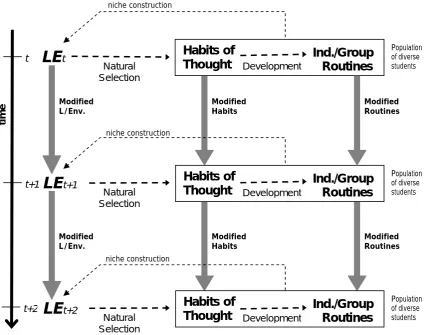
The process illustrated in Figure 1 below is an adaptation of Olding-Smee, Laland and
Feldman’s (2003) niche construction process. These authors in championing the neglected
process of niche construction bring to life the previous work of Lewontin (1983). Lewontin
problems it encounters in its environment, and that the environment then efficiently rewards
or punishes those solutions that prove beneficial or injurious to the organism. For Lewontin,
any explanation of the process of adaptive change must cater for the ongoing reciprocal
interaction between the organism, its generative mechanism and the environment. He asserted
that organisms determine relevance, alter their external world, and transduce physical signals
from their external environment. Essentially, rather than merely being on the receiving end of
natural selection, organisms both make and are made as a consequence of interaction with
their environment.
Insert Figure 1 Here
Developing this line of thinking, Olding-Smee, Laland and Feldman (2003) again cast doubt
on the conventional view that organisms adapt to their environment, but environments do not
adapt to their organisms. From an educational perspective (as observed by the author), this
conventional view would assume that student interaction within a particular learning
environment would result in the sorting of students by specific (learning or skill) traits as
ordered by the assessment procedures they encounter. That, while some students may improve
throughout the process, the learning environment would remain unaltered through such
interaction. It is highly likely that such a process could occur through the application of a
lecturer-centred approach complete with reliance upon norm-reference assessment
procedures. However, within this paper the process of teaching and learning is considered
from a learner-centred perspective.
In Figure 1, it is assumed that change internal to the student (i.e. habits of thought) and its
learning environment (LE). The illustrated process begins with the interaction between a
student as an individual and as a group member within the learning environment (Et). During
this first period of time, each student and his or her group will engage in various learning
activities, which will be assessed using both summative and formative feedback. During the
process of assessment, the fitness of the routines used individually by each student and by his
or her group will be assessed. Such routines represent the activity systems responsible for
phenotypic expression (e.g. the content and context of the student’s/group’s performance and
associated identity projected for consumption).
As a consequence, the habits of thought of each student are subject to differential selection
(for or against) on the basis of their contribution to the phenotypic expression of the
individual and/or group. A combination of freedom (Whitehead, 1929) and reflection (Tyler,
1949) then provide the means through which the group, and therefore individuals, may alter
behaviours via a shift in their collective and separate habits of thought. This process of group
and individual change is facilitated in the first instance by the summative information
received (i.e. a grading) and then by the formative information that relates to both negative
and positive aspects of the group’s/individual’s performance. Therefore, the various
assessment procedures used act as selection mechanisms.
This process of generating both summative and formative assessment performs two important
functions. First, the summative feedback provides an indication of the immediate fitness of
the group’s/individual’s performance vis-à-vis the performance criteria at a particular moment
in time. Second, the formative feedback provides feedback through which future change is
possible. So the “difference between them is that at some point the judgement has to be final”
elements is that of the internally held perceptions within the group that may be altered to
produce many different outcomes. So, three forms of inheritance are possible and likely
throughout this process.
First, the students’ habits of thought (derived from their habits of life) are subject to revision
as they determine what mental capabilities will best assist their progress. Altered habits of
thought are then inherited (or transferred) from one learning environment to the next (i.e. LEt
to LEt+1) either via individual student behaviour or through their contribution to their group.
Second, those aspects of the modified phenotypic expression (deemed to be favourable) and
related to any changed habits of thought, are inherited by the groups from one learning
environment to the next (i.e. LEt to LEt+1). Third, and perhaps most importantly, the
behaviours of the individuals and the groups has the potential to alter the nature of future
interaction between the learning environment and all entities to be assessed. This is the central
thesis of the niche construction concept; it provides a process through which students can alter
their learning environment within their time and space and/or at least place pressure on the
learning environment within their time and space.
Based on the author’s observations, students can indeed be the continuous co-architects of
ever-changing learning environments. In its simplest form, such changes have been
determined through the changing perceptions of individuals that impact upon the process of
peer assessment operating on and within group performances. As groups collectively alter
their judgements as to what satisfies the stated learning objectives contained within the
process of criterion-based assessment that alters the process of natural selection operating on
both individuals and groups. Also, as students make profitable alterations to their habits of
solutions to the problems present in their learning environment. Many of the solutions they
devise place substantial pressure on the learning activities used. This creates the need to
adjust learning activities to continually stretch the students’ capabilities. As such, the students
have the ability to inherit a modified learning environment due to their direct and indirect
influence.
Discussion
So far, the discussion has not attempted to unite the concepts of the reasonable adventurer,
self-development and niche construction. The process of synthesizing these concepts, binding
them with the thoughts of those associated with educational excellence now forms the
challenge of this paper. The aim is to demonstrate that without a well designed
learner-centred approach; the aim of developing skills (be they for SMEs or otherwise) may well fall
short of the mark. The ideas introduced represent the resurrection of much pedagogical
brilliance that all too frequently is ignored due to the pursuit of efficient teaching practices in higher education.
From the outset, let it be stated that the potential evolution of any student’s habits of thought
is cast as a phylogenetic process, not just an ontogenetic process (i.e. based on a fixed set of
instructions). This is because it is a process determined by much more than the mere
inheritance of genetic ability. It is also determined by the interaction of the student with other
students and the learning environment within which they congregate. Therefore it is also
phylogenetic evolution (Hodgson, 1993), allowing for the total and ongoing evolution of a
group of students. It has been proposed that generative mechanisms (i.e. habits of thought)
determine structural change (the capacity for actual behaviour), and that these mechanisms
That said, it is argued that the focus of the students’ learning experince should be related “to
the interaction between learner and the external conditions in the environment” to which they
react (Tyler, 1949, p 63). Tyler felt strongly that the learning process “takes place through the
active behavior of the student; it is what he [or she] does that he [or she] learns, not what the teacher does”. This suggests the need to provide much freedom (Whitehead, 1929) to allow
students to react to their environment. To allow their learning to occur in the here and now, in
true Whiteheadian spirit. The dulling boredom of involvement with an imitation subject
(Sawyer, 1943) can be removed through the provision of freedom to apply formal ideas to the
problems that lay beyond the classroom, into the world of the (individual) student.
Exactly just how such interaction occurs between student and learning environment is an
issue open to many possible explanations. The use of an evolutionary approach provides a
useful way of considering this process whilst still remaining aware of identifying any specific
causal factors. Many early psychologists, for example, Lloyd Morgan and John Dewey, have
discussed such issues. For Morgan (1896), congenital impulses are adapted through the
grafting of acquired dispositions through individual experince with altered environments. This
being especially so during the period of youthful plasticity, when individual intelligence has
the most influence upon the modification of habit. Essentially, an evolutionary process is at
play with intelligent selection (or choice) determining which profitable experiences should be
retained and which unprofitable experiences dispensed with. In a similar vain, Dewey (1922,
p 93), notes that is not through the growth of customs (in terms of instincts) that development
occurs. He suggests rather, that it is through the acquisition of new (and profitable) habits.
Dewey states that it is through personal impulses that “the re-organization of activities turn,
quality”. Clearly, Whitehead’s (1929) concept of educational freedom is essential throughout
this process. Through the provision of freedom, student impulses may interact with the
learning environment in such as a manner as to assist in the development of independent
action and new skills. In this sense, Dewey states that habits are not a native predisposition,
but rather, they are organized activities that have been acquired through a secondary process.
The above discussion suggests that the needs of students desirous of skills development
extend beyond traditional lecturer-student process, towards a learner-centred approach
skewed towards experiential learning, self-exploration, freedom, and continual reflection. An
approach where students can frequently interact with challenging learning activities assessed
on the basis of the grades of intelligence demonstrated (Morgan, 1896). Too often students are
required to perform isolated tasks (in the guise of skills development) that amount to little
more than an opportunity for an internal stock take of existing skills, but contribute little to
serious skills development. At best, any developed association of impulse and experince is
likely to be consigned to memory only. Alternatively, under circumstances where the
interaction between impulse and experince is reoccurring, congenital impulses have a greater
opportunity for genuine conformation, or modification through which acquired impulsive
tendencies are developed. That is, conscious selection is replaced by sub-conscious
automation. Morgan attributes the sources of impulsive tendencies on one hand based to the
inheritance of ability, but also due to the individual acquisition of ability.
The above discussion relates nicely to the work of both Heath (1964) and Baxter Magolda
(2004). Skill development in the sense discussed by Morgan and Dewey is reliant on students
using their individuality to extend their future abilities beyond their initial mental
impulses interact, to modify their habits so as to ensure progress. In this sense, they are
following the path that Heath argues will lead them towards becoming a reasonable
adventurer. Clearly this is not a passive educational process within which students are
subdued. The self-development process will not proceed if students accept received
knowledge as absolute, they must be capable of pressing forward to challenge their individual
epistemological assumptions and find meaning in their knowing vis-à-vis the contextual
situations they encounter. In this respect, the concept of niche construction provides a process
through which to consider how skill development could occur within a learner-centred
environment. Most importantly, it demonstrates a process through which students actively
change the structure and meaning of their world. It does not represent a static challenge within
which student outcomes are determined through a ranking process (i.e. norn-referenced
assessment), but rather an endless staircase of possibility. A process that offers the
opportunity to all students to continually test the fitness of their impulses, a process that
makes possible the acquisition of valuable skills. Skills that relate directly to the NESF and
therefore, skills that are in demand by SMEs. Finally, a process that accommodates the
varying levels of learning skills and self-awareness of individual students (Weimer, 2002).
Alfred Whitehead’s (1929) brilliant protest against dead knowledge also offers much wisdom
that transfers directly to the development of skills. For Whitehead (1929, p 93), the aim of any
business school is to produce students with a zest for business that have an ability to apply
their acquired wisdom to all future tasks with intellectual imagination. Further, Whitehead
maintained the role of the university is to preserve “the connection between knowledge and
the zest of life”. It is the development of an urge within our students towards new creative
knowledge is used, and specifically the time and place within which it is contextualised. He
states that:
The mind is never passive; it is a perpetual activity, delicate, receptive, responsive to
stimulus. You cannot postpone its life until after you have sharpened it. Whatever
interest attaches to your subject-matter must be evoked here and now; whatever powers you are strengthening in the pupil, must be exercised here and now; whatever possibilities of mental life your teaching should impart, must be exhibited here and now. That is the golden rule of education, and a very difficult one to follow (1929, p 6, my
emphasis).
Operationalizing the ideas of Whitehead leads to in a dynamic learning environment in which
understanding is not only evoked in the students’ here and now, but also exercised and exhibited in their here and now. Through freedom, students are granted the responsibility to generalize how the development of their mental abilities and habits of thought provide fitness
in their world. They are afforded the opportunity to re-organize their activities through the
means of positive deviance (Sparks, 2001), thus potentially improving upon existing habits.
They are given the opportunity to construct the niche within which their development is
occurring; precisely the task required of them post graduation. This is a highly significant fact,
that students are not working to perfect a specific task (i.e. appreciation of a specific strategy
for a specific situation), but rather learning how to make sense of their personal abilities
within an ever-changing learning environment (i.e. they are learning to strategize). The
development of this skill set is argued to provide a far more important skill that is likely to be
As illustrated in Figure 1, the process of niche construction occurs over several time periods.
Within and across time periods, the specific (learning) traits selected for or against and in
combination, place upward pressure on the selection pressures associated with assessment
procedures. Returning to the specific skills highlighted by the NESF, it is not hard to imagine
how students will be continually required to improve their communication skills to operate
within their group, and to assist the group operate in a competitive learning environment.
Much teamwork is required to coordinate their activities within and across workshops and
semesters. Understanding how best to approach different tasks vis-à-vis the nature of different
assessment procedures requires the ongoing engagement of problem solving skills. Students
are not merely complying with the rules and regulations of a learning environment, they are
also using their initiative, planning and organizing skills to shape the nature of their learning
environment. In undertaking such tasks, those students that develop most do so through the
use of self-discipline and the development of contextual knowledge. Finally, the endless
freedom afforded the students encourages them to experiment and gain proficiency across a
range of technologies. Throughout such a process, each student’s habits of thought are subject
to change with the opportunity to lock in favourable new capabilities that increase their fitness
across the various learning environments they encounter.
Conclusion
That graduates need to develop better skills to assist the competitiveness of Australian SMEs
is not a proposition questioned within this paper. The focus has been on considering how skills may effectively be developed. The general argument made is that skills cannot be added
on through requiring students to engage in isolated activities that are not specifically linked to
other learning activities. Worse still, that the common practice of having students deliver the
any useful skills. It has been claimed that without specific (and ever-present) assessment
processes; the necessary selection pressures are absent, thereby preventing the possibility of
an evolutionary process. Assessment therefore should be conducted in an authentic manner,
designed to “test those capacities and habits we think are essential, and test them in context”
(Wiggins, 1989, p 41). As a result, assessment outcomes for students relate to the symbiotic
relationship between their simultaneously developing knowledge and skills.
Viewing assessment as something other than a sorting mechanism that ranks students from
best to worst introduces many new responsibilities to the educator. Both summative and
formative feedback should be provided to the students from which they can reflect on their
performance. “They must talk about what they are learning, write about it, relate it to past
experiences, apply it to their daily lives” (Chickering and Gamson 1987, p 3). As previously
stated, this process of generating both summative and formative assessment performs two
important functions. First, the summative feedback provides an indication of the immediate
fitness of the student and/or his or her group’s performance vis-à-vis their fellow students at
that particular moment in time. Second, the formative feedback provides feedback through
which future change is possible. With the “difference between them is that at some point the
judgement has to be final” (Biggs 2003, p 142).
This suggests the needs to ensure students have the support and guidance of the educator
regardless of how many mistakes are encountered on their journeys. A useful way of
supporting the process of niche construction is to gather regular informal and formal
feedback. This process can serve as both an invitation and a means of legitimising both the
role of students as change agents and any new habits of thought under consideration. A simple
learning environment to aid their learning. This process can provide very rich and insightful
feedback that can guide modifications to the learning environment with greater surety.
Finally, the need to allow students to self-develop in a guided manner has been suggested to
be the primary purpose of education. Adopting the position that the primary purpose of
education is to bring about changes in the student behavior (Tyler, 1949), we can move
towards a more inclusive curriculum within which skills are not the poor cousin of knowledge.
They are in fact elevated to the same status and receive equal focus with regards the
development of desirable learning outcomes. To many traditional educators this may lessen
the role of higher education, but as Whitehead so forcefully asserted, “the proper function of a
university is the imaginative acquisition of knowledge … a university is imaginative or it is
nothing-at least nothing useful” (1929, p 96). The self-development needs of Baxter Magolda
(2004) and Heath (1964) require the presence of excitement, curiosity, self-confidence and
reflective capacity. Skill development cannot be added on to a process designed to gift
knowledge. Skills are a way of knowing, they are inseparable from knowledge and must be
treated so.
References
Baxter Magolda, M. (1998), “Developing self-authorship in young adult life”, Journal of College Student Development, Vol. 39 No. 2, pp 143-156.
Baxter Magolda, M. (2004), Making There Own Way, Stylus, Virginia.
Belenky, M., Clinchy, B., Goldberger, N., and Tarule, J. (1986), Women’s Ways of Knowing: The Development of Self, Voice, and Mind, Basic Books, New York.
Biggs, J 2003, Teaching for Quality Learning at University: What the Student Does, 2nd Ed, Open University Press, London.
Chickering, A.W., and Gamson, Z.F. (1987), “Seven principles for good practice in
Clanchy, J., and Ballard, B. (1995), “Generic skills in the context of higher education”, Higher Education Research & Development, Vol. 14 No. 2, pp 155-166.
Crebert, G., Bates. M., Bell. B., Patrick, C., and Cragnolini, V. (2004), “Developing generic skills at university, during work placement and in employment: Graduate perceptions”, Higher Education Research & Development, Vol. 23 No. 2, pp 147-166.
Dewey, J. (1922), Human Nature and Conduct: An Introduction to Social Psychology, Henry Holt and Company, New York.
Hartshorn, C. (2002), “Understanding notions of enterprise in the higher education sector”, Industry & Higher Education, Vol. 16 No. 3, pp 149-158.
Heath, R. (1964), The Reasonable Adventurer, University of Pittsburgh Press, Pittsburgh. Hodgson, G. M. (1993), Economics and Evolution: Bringing Life Back into Economics, Polity Press, Cambridge, UK.
Jones, C. (2005), “Creating employability skills: Modification through interaction”, Industry & Higher Education, Vol. 19 No. 1, pp 25-34.
Lewontin, R.C. (1983), ‘Gene, Organism, and Environment’, in Bendall, D.S., eds, Evolution from Molecules to Men,Cambridge University Press, Cambridge, UK.
Matlay, H., and Mitra, J. (2002), “Entrepreneurship and learning the double act in the triple helix”, The International Journal of Entrepreneurship and Innovation, Vol. 3 No. 1, pp 7-16.
Mahoney, J. (2003), “Tentative answers to questions about causal mechanisms”. Proceedings of the 99th American Political Science Association Conference, Philadelphia.
McLarty, R. (2005), “The dimensions of graduate skills following SME employment experience”, Industry & Higher Education, Vol. 19 No. 1, pp 35-44.
Morgan, C.L. (1896), Habit and Instinct, Edward Arnold, London.
Olding-Smee, F.J., Laland, K.N., and Feldman, M.W. (2003), Niche Construction: The Neglected Process in Evolution, Princetown University Press, Oxford.
Perry, W.G. (1970), Forms of Intellectual and Ethical Development in the College Years: A Scheme, Holt, Rinehart & Winston, Troy, MO.
Sawyer, W.W. (1943), Mathematician’s Delight, Penguin, Harmondsworth.
Sparks, D. (2001), “Change: It’s a matter of life or slow death”, Journal of Staff Development, Vol. 22 No. 4.
Veblen, T. (1925), The Theory of the Leisure Class, George Allen & Unwin, London.
Weimer, M. (2002), Learner-Centered Teaching: Five Key Changes to Practice, Jossey-Bass: San Francisco.
Wiggins, G. (1989), “Teaching to the (authentic) test: Testing can once serve teaching and learning if tests clarify and set intellectual standards”, Educational Leadership, Vol. 46 No. 7, pp 41-47.
Table 1 - National Employability Skills Framework
Skill Requirement Exemplars
Communication Contribute to productive Listening & understanding, Empathising, Negotiating, Using
and harmonious relations numeracy effectively, Writing to the needs of the audience,
between employees Sharing information, and Reading independently
and customers
Teamwork Contribute to productive Working with people of different ages, gender, race, Working
working relationships and as an individual and/or team member, Coaching, mentoring
outcomes and giving feedback
Problem Solving Contribute to productive Developing creative, innovative and practical solutions, Solving
outcomes problems in teams, Applying a range of strategies & initiative
and independence to problem solving
Initiative and Contribute to innovative Adapting to new situations, Being creative, Translating ideas into Enterprise outcomes action, Generating a range of options, Initiating innovative solutions
Planning and Contributes to long-term and Managing time priorities, Being resourceful, Taking initiative and
Organising short-term strategic planning making decisions, Allocating people and other resources to tasks,
Collecting, analysing and organising information, and Developing a
vision and a proactive plan to accompany it
Self-management Contribute to employee Having a personal vision and goals, Evaluating and monitoring own
satisfaction and growth performance, Articulating own ideas and vision, Taking responsibility
Learning Contribute to ongoing Managing own learning, Contributing to the learning community
improvement and expansion at the workplace, Using a range of mediums to learn - mentoring,
in employee and company peer support, networking, information technology courses
operations and outcomes
Technology Contribute to the effective Having a range of basic IT skills, Applying IT as a management tool,
Figure 1: The Proposed Causal Pathways of Niche Construction
Habits of
Thought Development Ind./Group Routines
Population of diverse students t t+1 t im e
LE
t Natural Selection Habits ofThought Development Ind./Group Routines
Population of diverse students
LE
t+1 Natural Selection Habits ofThought Development Ind./Group Routines
Population of diverse students
LE
t+2 Natural Selection t+2 ModifiedHabits Modified Routines