Reducing teacher
workload
Research report into shared planning
March 2018
Contents
Table of figures 4
1. Research Topic 5
1.1 The importance of shared planning 5
1.2 Principal fieldwork centre 6
1.3 Clarification of terms 6
1.4 Study aims 7
2. Approaches to Reducing Workload 8
2.1 Overall strategies 8
2.2 Investigative method employed 8
3. Research Projects 10
3.1 The individual shared planning projects 10
3.2 The research methodology and methods 10
3.3 The sample 11
3.4 Data analysis and findings 12
3.5 Limitations in the data and study 15
4. School Culture 16
4.1 Cultural barriers 16
4.2 Other adverse issues 16
5. Conclusion 18
5.1 The overall merits and effectiveness of shared planning 18
5.2 Costs and resources 18
5.3 Specific recommendations 19
References 20
Appendices 22
Appendix 1: Discussion of the need for a greater shared planning emphasis at
Whitley Bay High School 22
Appendix 2: Lesson Planning Diary Proforma 23
Appendix 3: Detailed discussion of the research methods 26
Appendix 4: Participants 30
Appendix 5: Findings of the Baseline Survey 35
Appendix 7: Summary of responses to post-project questionnaire yes/no questions 42 Appendix 8: Key to Departmental Abbreviations Used in Identifiers 43 Appendix 9: Discussion of qualitative data from the post-project questionnaires and
focus group meetings 44
Appendix 10: Limitations in the data and study 54
Table of figures
Table 1: Characteristics of action research within the study 9 Table 2: Summary of responses to post-project questionnaire yes/no questions 13 Table 3: Breakdown of high school diary contributors according to teaching
experience 30
Table 4: Breakdown of high school diary contributors according to their time at the
organisation 30
Table 5: Subjects taught by high school diary contributors 32 Table 6: Breakdown of high school post-project questionnaire respondents according
to teaching experience 32
Table 7: Subject specialisms of the high school post-project questionnaire
respondents 33
Table 8: Breakdown of high school focus group participants 33 Table 9: Breakdown of middle school diary contributors according to teaching
experience 34
Table 10: Breakdown of middle school diary contributors according to their time at
the organisation 34
Table 11: Breakdown of primary school diary contributors according to teaching
experience 34
Table 12: Breakdown of primary school diary contributors according to their time at
the organisation 34
Table 13: Time spent on planning overall 35
Table 14: Time spent on planning in relation to teaching experience 35 Table 15: Total time spent on planning in relation to Key Stage 36 Table 16: Time spent on different forms of planning 36 Table 17: Time spent on planning during different days of the week 37
1. Research Topic
1.1 The importance of shared planning
In March last year, a report prepared by the Independent Teacher Workload Review Group (2016) proposed a series of principles aimed at eliminating unnecessary workload associated with planning and the preparation of resources. The document attracted much publicity and the issues raised have recently been discussed in articles appearing in such magazines as the NAHT’s Leadership Focus (Bowen, 2017) and SecEd (O’Connell, 2017). Collaborative planning features prominently in the Review Group’s report, and O’Connell recognises that the provision of
opportunities for work of this kind forms one of the key means of addressing the workload challenge.
After a successful application for funding had been made to the National College for Teaching and Leadership (NCTL), Whitley Bay High School and its collaborating schools and academic partners (i.e. Professor Christine Merrell, of Durham University’s Centre for Evaluation and Monitoring, and independent research consultant Dr. Andrew K. Shenton) investigated the area of shared planning, with specific reference to the capacity of the practice to reduce the time teachers spend on planning whilst maintaining high standards of student attainment and
engagement.
Shared planning was chosen as a focus for Whitley Bay High’s Workload Challenge Study for two main reasons. Firstly, the report of the Teacher Workload Review Group (2016) specifically recommended that “teachers should engage in
collaborative planning” (p. 12). Secondly, a degree of shared planning had already taken place at Whitley Bay High and the school’s senior leaders had prior, anecdotal knowledge of its potential to lessen workload and raise the standard of teaching and learning. The practice was not, however, school policy and had not hitherto been applied consistently throughout the organisation. The study presented an opportunity to embed shared planning and apply it across the school in order to raise standards of teaching and learning in all curriculum areas.
The Workload Challenge Study that is reported here addressed two research
1.2 Principal fieldwork centre
Situated in a small coastal town in north-east England, Whitley Bay High School is a large, Local Authority Maintained Foundation School with a Trust in North Tyneside. The majority of the school’s students come from four local feeder middle schools. With 1619 students at the time of writing, Whitley Bay High caters for learners between the ages of thirteen and eighteen. The school has demonstrated a
longstanding support for CPD and research: for fourteen years one timetabled hour per week has been allocated for whole staff training. This has been fundamental to the creation of the school’s ethos - a highly motivated, expertly trained teaching staff provide stimulating, challenging and exciting learning opportunities for the students. It was one of the first 100 schools nationally to be designated a Teaching School in July 2011 and is the lead school in the Whitley Bay Teaching Schools Alliance. In 2015, it was recognised by the Government as one of the 100 highest performing secondary schools in the country.The most recent inspection report (Ofsted, 2013) saw the school graded Outstanding in every area. Whitley Bay High School regularly deploys its twenty-one designated Specialist Leaders in Education (SLE) to a variety of school support programmes locally.
With around 550 students currently enrolled, Whitley Bay High’s Sixth Form is larger than average. In 2016, approximately 99% of Year Thirteen students went on to Further Education, Higher Education, training or employment.
In 2017, 80% of all grades across all subjects were A* - C or the equivalent new 9 – 4 grading in English and Maths. The validated Progress 8 score for 2016 and the
unvalidated score for 2017 are significantly positive.
1.3 Clarification of terms
It is important from the outset to explain the distinction between “joint planning” and “shared planning”. From our previous experience, we believe the latter to be of greater benefit with respect to planning, reducing workload and maintaining high academic standards. Shared planning differs from joint planning in that
• joint planning usually involves only a small number of people planning on a short term basis, together simultaneously – it does not save time;
• shared planning involves a middle leader strategically facilitating a team of teachers in the planning of a module of lessons; the process involves the delegation of planning and is overseen and accountable;
We believe the joint planning/shared planning distinction to be of considerable
importance in ensuring that time spent planning is reduced without existing standards deteriorating.
1.4 Study aims
Our aims, as outlined in our initial research bid, were • to investigate the time teachers spend planning;
• to facilitate, in project teams, the development of initiatives intended to reduce workload whilst ensuring high standards are maintained, in accordance with the recommendations of the Teacher Workload Review Group (2016); • to be able to provide consultation on a good practice framework which can
2. Approaches to Reducing Workload
2.1 Overall strategies
Broadly, Whitley Bay High has pioneered the following practical approaches to the reduction of workload in planning and developing resources:
• Designated departmental time has been made available for shared planning, with subject-specific foci. Work might include, for example, planning a new scheme of work or a department-wide approach to revision.
• Cross-curricular “experts” have been given opportunities to prepare content within their own areas of planning expertise, train others and share planning. Expertise areas are those of “starters”, “questioning”, “developing thinking”, and “creative resources”.
• Time has been allocated for staff to develop effective systems for sharing and storing the results of shared planning, such as via a VLE or another online platform.
• Shared planning interventions and initiatives have been introduced alongside CPD, with regular opportunities for teachers to plan together.
For a discussion of the need for a greater shared planning emphasis in Whitley Bay High School, see Appendix 1.
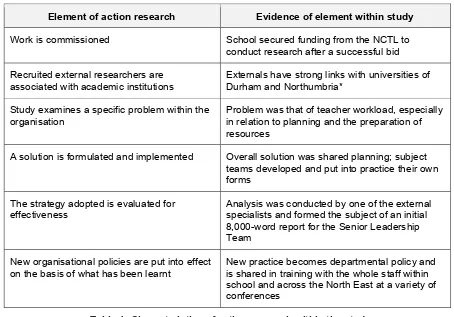
2.2 Investigative method employed
Element of action research Evidence of element within study
Work is commissioned School secured funding from the NCTL to conduct research after a successful bid Recruited external researchers are
associated with academic institutions Externals have strong links with universities of Durham and Northumbria* Study examines a specific problem within the
organisation Problem was that of teacher workload, especially in relation to planning and the preparation of resources
A solution is formulated and implemented Overall solution was shared planning; subject teams developed and put into practice their own forms
The strategy adopted is evaluated for
effectiveness Analysis was conducted by one of the external specialists and formed the subject of an initial 8,000-word report for the Senior Leadership Team
New organisational policies are put into effect
[image:9.595.67.521.67.384.2]on the basis of what has been learnt New practice becomes departmental policy and is shared in training with the whole staff within school and across the North East at a variety of conferences
Table 1: Characteristics of action research within the study
3. Research Projects
3.1 The individual shared planning projects
With the overall strategies outlined in Section 2.1 in place at Whitley Bay High School, teachers within the school were invited to work in their subject departments in order to develop initiatives that would reduce staff workload whilst maintaining the organisation’s existing high standards.
Many of the shared planning projects were very specific, relating to a certain area, topic or unit, and were intended to cater for a particular year group. Some reflected the stage of the school year when the project was carried out. In several initiatives, there was an emphasis on revision, for example. Overall, foci included the creation of a scheme of work, the preparation of individual lessons and the construction of new resources, such as PowerPoint slides, homework booklets, worksheets or other assessment materials.
Typically, the projects began with the content in question broken down into some form of manageable chunks, each of which could be tackled by a separate member of staff who specialised in that area. Rules or principles were then frequently agreed in order to establish a set format or template so as to ensure a degree of consistency of practice within the department. Nevertheless, not every project involved shared planning with a view to creating the materials outlined above. There were also cases where teachers concentrated on building up their own knowledge in preparation for the introduction of new courses, on the re-use of existing resources or on joining virtual groups/forums. Other staff worked on instituting a central repository (via Padlet) for storing resources and lesson plans, and promoted it as a reference area for student revision.
3.2 The research methodology and methods
Three schools within the same Local Authority were involved in the study. The principal fieldwork centre was Whitley Bay High School – the organisation that was responsible for the inquiry overall – whilst the additional centres were a middle school located in the same town and a primary school situated only a few miles away. For a more thorough discussion of the research methods employed, please see Appendix 3.
3.3 The sample
3.3.1 The participants, data collection phase one
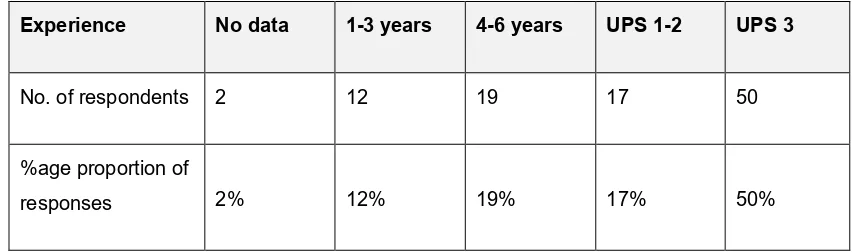
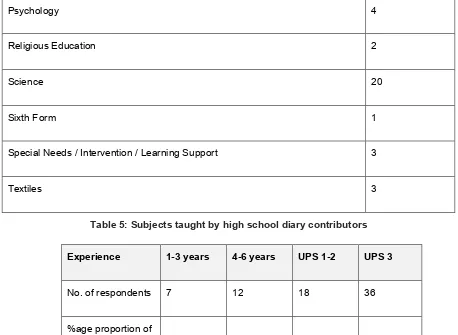
The first stage of data collection involved staff making diary entries to record their planning during the week beginning Monday, 16th January 2017. A breakdown of those who submitted these data is given in Appendix 4. Appendices 4(a) and 4(b) show the composition of this sample according to the degree of teaching experience and the number of years staff have spent at the school respectively, whilst Appendix 4(c) indicates the subjects that were taught by the contributors during the week in question.
3.3.2 The participants, data collection phase two
The second stage of data collection involved staff completing post-project
questionnaires. A breakdown of those who returned these documents is given in Appendix 4. Appendix 4(d) shows the composition of this sample according to the degree of teaching experience, whilst Appendix 4(e) indicates the particular subject specialisms of the staff involved.
3.3.3 The participants, data collection phase three
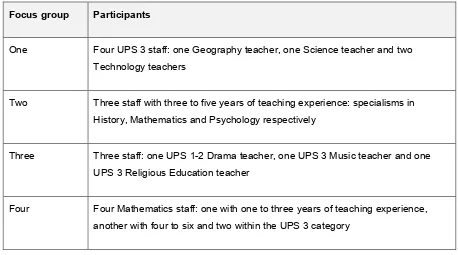
The third and final stage of data collection involved fourteen staff attending focus group meetings. A breakdown of those who participated is given in Appendix 4(f). 3.3.4 Contributors of the diaries
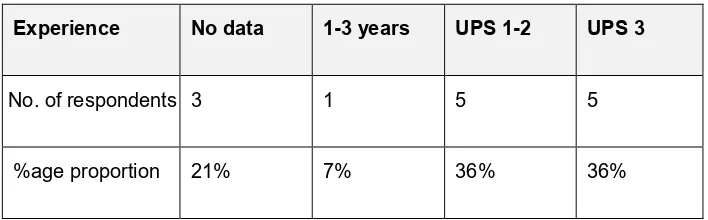
A breakdown of the diary contributors in the middle school is shown in Appendix 4. Appendices 4(g) and 4(h) show, respectively, the composition of this sample
3.4 Data analysis and findings
3.4.1 The baseline survey
During the week in question, the time spent by teachers on planning was seen to vary depending on experience and stage in career, but when all the time taken in relation to all the different elements of planning is totaled for all the three schools, planning time outweighs the time spent on marking. Other key discoveries may be summarised thus:
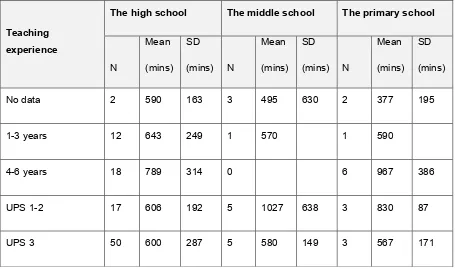
• In the principal fieldwork centre, teachers with four to six years of experience spent most time on planning, whilst their counterparts in the UPS 3 category spent least.
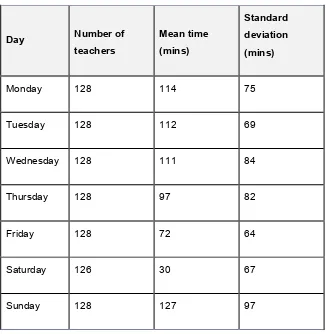
• On average, a teacher spent nearly thirty-eight minutes planning each lesson. • Teachers did the majority of their planning on a Sunday, with day-to-day
planning declining in allocated time as the week progressed from this point onwards.
• For a teacher in the first three years of their career, 602 minutes per week were spent on planning. This equated to a daily average of eighty-six minutes. • The difference between time spent planning and time spent marking increased
as the Key Stage progressed, with planning time at Key Stage Five almost twice as high as marking time.
Overall, what was learnt from the baseline data reinforced the research team’s belief that a more rigorous and systematic approach to shared planning was required. The tables that present the findings of the baseline survey in detail can be found in Appendix 5.
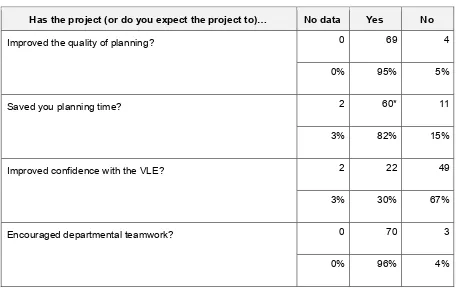
3.4.2 Quantitative data from the post-project questionnaires
Has the project (or do you expect the project to)… No data Yes No
[image:13.595.70.526.64.358.2]Improved the quality of planning? 0 69 4 0% 95% 5% Saved you planning time? 2 60* 11 3% 82% 15% Improved confidence with the VLE? 2 22 49 3% 30% 67% Encouraged departmental teamwork? 0 70 3 0% 96% 4%
Table 2: Summary of responses to post-project questionnaire yes/no questions
* Five (i.e. 8%) of those in the “Yes” category indicated that either their project would save them time next year/eventually or it had the potential to do so.
In 2017 the school improved its Progress 8 score to what it expects to be significantly above national average. There is an acceptance from the senior leadership that the departments that were most successful in shared planning contributed most
significantly to the school's results.
See Appendix 7 for a discussion of the data presented in this table.
3.4.3 Qualitative data from the post-project questionnaires and
focus group meetings
3.4.3.1 Positive aspects of shared planning
In relation to the study, the intended benefit as a whole, namely that staff workload should be reduced without negatively impacting on quality, was often evident in the data pertaining to individual projects characterised by shared planning. Staff
evaluated positive benefits in the following areas:
• There was seen to be greater consistency in the appearance of the materials produced.
• There were improvements in levels of communication, collaboration, discussion or teamwork within a department.
• The projects have opened up a non-threatening professional dialogue where staff critique plans and offer each other suggestions for improvement.
• In many departments, the project was noticed to have increased the impetus for colleagues to share ideas for other year groups.
• Greater levels of enjoyment, enthusiasm or motivation was noticed in students and some fed back to staff on improved enjoyment of lessons and greater understanding of the topics covered.
• Shared planning projects encouraged various forms of reflection in the planning process.
• A more “joined up” approach developed across many departments. Examples included a more uniform approach to differentiation and range of activities. • Departments had a more honest appraisal of the effectiveness of existing
practices.
• Teachers embraced the concept of shared planning as they enjoyed contributing to the greater good, but also had allocated time within CPD to plan the best lessons they could. The importance of even such fundamentals as the time and opportunity that the projects offered to tackle work which departmental teams already knew had to be undertaken should not be underestimated.
• Given the nature of the departments in which some of the respondents worked, shared planning was impossible. Still, these “soloists” were at least able to take action that resulted – or could result – in a significant benefit. • Some in small departments viewed their workload projects as opportunities to
cushion the effects on others of forthcoming changes to GCSE or A Level specification.
• Even one-person departments were open to the possibility of shared planning with the possibility of working with other local schools being suggested as a possible strategy moving forward.
3.4.3.2 Negative aspects of shared planning
• Some staff were of the opinion that the project allowed shared planning only in some of their classes and not all, meaning it could have no more than minor beneficial effects.
• Many staff talked of their expectation that the planning burden may be eased next year or in 2018/19 as their project was based on lessons during this academic period.
• Some staff mentioned difficulties in almost over-planning to ensure staff had all potential levels covered within their lesson, as “every class is different so you have to differentiate massively”.
• A few members of staff appreciated that shared planning had indeed saved them time in planning, but this had been offset by the amount of time they now spent marking.
• Occasional comments highlighted the difficulty in following the original
planner’s thinking and lesson transitional processes. This reduced confidence in delivery.
• A small minority were concerned about the time that was taken up by “tweaking”.
• Shared or joint planning was found to be difficult, or even impossible, in small departments or situations where a certain area is taught by only one member of staff.
• The practicalities of dividing up areas fairly when they differ in the degree of content and number of units was also discovered to be problematic on a few occasions.
• Caution was expressed in one department who suggested any arrangement under which teachers prepared individual lessons singly was unwise, insisting, “it should be a sequence”.
• All teachers of the same subject must be equally highly committed to the initiative.
A more detailed and comprehensive analysis of the post-project questionnaire and focus group data is available in Appendix 9.
3.5 Limitations in the data and study
The research team were aware of a number of limitations in the data for this study, many identified in conjunction with participants.
4. School Culture
4.1 Cultural barriers
It is important from the outset to appreciate that in the school which served as the principal fieldwork centre, different “sub-cultures” exist in the various departments. In some, an atmosphere of sharing and collaboration was already well established, whilst in others there was much greater evidence of “solo” work.
In terms of cross-school barriers, however, perhaps the most obvious danger is that the kinds of shared planning that have been put into practice in the principal fieldwork centre may be impractical in especially small organisations, such as, for example, first schools where there may be only one class in each year group. In theory, it could be possible to counter some of the challenges associated with size by creating teams based on Key Stages rather than subjects, although greater investigation would be needed to assess the viability of this option.
Even in high schools, there may be particular “local” circumstances that are difficult to overcome. In particular, school leaders should be aware of the difficulties that may exist in applying a whole school approach to shared planning if the staff body
includes a high proportion of newly-qualified teachers or many experienced staff who have spent much of their working lives doing their own planning.
Certainly if shared planning is to be effective long term in reducing teacher workload, it is essential that the school’s Senior Leadership Team provides designated planning time within a wider context of continuing professional development, offers
opportunities to share good practice, develops effective systems for storing and sharing lesson plans and other associated documentation, and models what high quality planning might look like. SLTs must, therefore, appreciate the initial time investment at the onset of the intervention in order to see benefits in the future. Furthermore, schools where shared planning already exists to a degree should not discount revisiting the process from a more strategic and systematic perspective, offering definitions of what shared planning is (within their own context) to avoid confusion amongst staff, especially with regard to the differences between “shared planning” and “joint planning”. The aim must be to maximise the potential of the concept and maintain a school-wide standard.
4.2 Other adverse issues
• Based on the findings reported in Section 3.4.3.2, it may be summarised that shared planning was weakened, less effective or even impossible in the circumstances when
• individual members of staff taught their own modules, units or lessons and no-one else in the department had the expertise necessary to prepare content on the areas involved;
• recipients of shared planning considered it unnatural to work from materials that had been prepared by someone else;
• certain processes proved especially time consuming in terms of
o the departmental staff involved reaching a preliminary consensus with regard to the work to follow;
o what needed to be done in order to prepare lessons that had to
incorporate sufficient differentiation to cater for students of every level of ability;
o the adjustments that had to be made by a teacher to customise a planned lesson in order to serve their purposes;
• ICT systems that were to play a crucial role in making available the outcomes of shared planning failed to meet teachers’ expectations;
• interpersonal differences arose between individual members of staff,
5. Conclusion
5.1 The overall merits and effectiveness of shared planning
The most significant pluses may be listed as follows:
• In many instances, workload was seen to be reduced as staff did not have to plan lessons from scratch.
• Shared planning enabled teachers to exploit their skills in particular areas. • Teachers who were not experts in the subject of the planned lesson benefited
from the specialist knowledge of the colleague who had prepared it.
• The quality of planning frequently increased as teachers within a department endeavoured to prepare materials that were of a similar standard to that of their colleagues.
• More uniformity was evident in the materials that were produced. • Dialogue and teamwork within many departments improved.
• The lessons that had resulted from shared planning were well received by students.
• Teachers reported how the projects in which they had been involved led them to reflect more actively on their own skills, practice and previous work, and gave them a greater awareness of strategies employed by their colleagues. On many occasions this led individual teachers to offer students a greater diversity of activities.
5.2 Costs and resources
Much of the ability to establish a whole school commitment to shared planning is dependent on senior leaders being willing to assign time within the working week to allow shared planning to take place. Of course, this time could be used for other purposes so opportunity loss needs to be considered.
If shared planning is going to involve staff elsewhere (as could happen with a one-person department, for example), teachers in other schools need to be similarly committed and prepared to give up their time. Shared planning also creates demands in terms of the time required for liaison between staff and meetings, which can be problematic if the teachers involved are separated geographically or are part-time and work on different days.
evaluation of the study is to take part in the future, it may well be the case that either same or comparable specialists will need to be engaged again, thereby incurring further expenses.
5.3 Specific recommendations
The following ten points are a summary of our recommendations based on the research outlined within this study. For a more detailed discussion of them, see Appendix 11.
1. Set time aside for shared planning.
2. Divide the work in such a way as to exploit teachers’ specialisms. 3. Agree from the outset on the fundamentals, whilst remaining flexible to
individual predispositions.
4. Encourage continuity and progression in the students’ experiences. 5. Be prepared to make significant investment of time in the early stages. 6. Build on the existing team spirit within subject departments.
7. Make sure that everyone is on board and understands the aims. 8. Accept that shared planned is no panacea.
9. Ensure that the ICT infrastructure can support the demands that will be made of it.
References
Bowen, J. (2017) Taking on the workload challenge. Leadership Focus, February, pp. 21-24.
Dervin, B. (1983) An overview of sense-making research: concepts, methods, and results to date. Paper presented at the annual meeting of the International
Communication Association, Dallas, Texas, May. URL:
http://faculty.washington.edu/wpratt/MEBI598/Methods/An%20Overview%20of%20S ense-Making%20Research%201983a.htm (accessed: 7/8/2017)
Erlandson, D.A., Harris, E.L., Skipper, B.L. and Allen, S.D. (1993) Doing naturalistic inquiry: a guide to methods. Thousand Oaks: Sage.
Firestone, W.A. (1993) Alternative arguments for generalizing from data as applied to qualitative research. Educational Researcher, 22 (4), pp. 16-23.
Glaser, B.G. and Strauss, A.L. (1967) The discovery of grounded theory: strategies for qualitative research. Chicago: Aldine de Gruyter.
Guba, E.G. and Lincoln, Y.S. (1989) Fourth generation evaluation. Newbury Park: Sage.
Independent Teacher Workload Review Group (2016) Eliminating unnecessary workload around planning and teaching resources. URL:
https://www.gov.uk/government/uploads/system/uploads/attachment_data/file/51125 7/Eliminating-unnecessary-workload-around-planning-and-teaching-resources.pdf (accessed: 8/8/2017).
Johannsen, H. and Page, G.T. (1975) International dictionary of management. London: Kogan Page.
Krueger, R.A. (1994) Focus groups: a practical guide for applied research, 2nd ed. Thousand Oaks: Sage.
Lincoln, Y.S. and Guba, E.G. (1985) Naturalistic inquiry. Newbury Park: Sage. Maykut, P. and Morehouse R. (1994) Beginning qualitative research: a philosophic and practical guide. London: Falmer Press.
Ofsted (2013) School report: Whitley Bay High School. URL: https://reports.ofsted.gov.uk/inspection-reports/find-inspection-report/provider/ELS/108638 (accessed: 10/8/2017).
Page, G.T., Thomas, J.B. and Marshall, A.R. (1977) International dictionary of education. London: Kogan Page.
Patton, M.Q. (1990) Qualitative evaluation and research methods, 2nd ed. Newbury Park: Sage.
Pickard, A.J. (2013) Research methods in information, 2nd ed. London: Facet. Rossman, G.B. and Wilson, B.L. (1985) Numbers and words: combining quantitative and qualitative methods in a single large-scale evaluation study. Evaluation Review, 9 (5), pp. 627-43.
Shenton, A.K. (2004) Strategies for ensuring trustworthiness in qualitative research projects. Education for Information, 22 (2), pp. 63-75.
Appendices
Appendix 1: Discussion of the need for greater shared
planning at Whitley Bay High School
As stated, a degree of shared planning had already taken place at Whitley Bay High in advance of the Workload Challenge Study. Where shared planning existed, however, it had not been formalised and the extent varied according to the subject, Key Stage and year group. At the outset of the study, key Raising Achievement Leaders were asked to audit their shared planning activity in the areas for which they were responsible. Some recorded significant levels of shared planning:
• “In terms of Key Stage Four, [we’re] working together [and] very structured due to the nature of the exam. Everyone [is] doing the same thing.” (Head of Art) • “GCSE schemes are good quality and shared. Everyone [is] tweaking their
own and storing locally. All on VLE.” (Head of Chemistry)
• “Key Stage Three scheme of work is contributed by a member of staff for whole department use. Co-ordinated centrally and well communicated. Homeworks planned, calendared and common assessments.” (Head of Year Thirteen)
Other departments, though, reported less engagement with shared planning: • “VLE is now in use, but in its infancy. Difficult to get together: two part-time
[teachers in department]. Not everybody likes it.” (Head of Modern Foreign Languages)
• “Everyone plans their own lesson at A Level, therefore different classes will be delivered differently.” (Head of Physical Education)
• “No shared planning as only one member of department so no-one to share planning with.” (Head of Music)
Appendix 2: Lesson Planning Diary Proforma
Teaching experience (circle one):
1-3 years 4-6 years UPS 1-2 UPS 3
How many years have you taught at Whitley Bay High School (including this year)?
What is your subject/s?
How many Key Stage 3 lessons do you teach each week? How many Key Stage 4 lessons do you teach each week? How many Key Stage 5 lessons do you teach each week?
Monday 16th January
Key S tage M onday tot al les sons Ti m e s pent pl ann ing O rig in al pl ann ing t im e Adapt in g ow n ex is ting les son Adapt in g les son f rom el sew her e U si ng de pt pl ann ed les son Re vie win g know ledge Ti m e s pent M ar ki ng 3 4 5
Tuesday 17th January
Wednesday 18th January Key S tage W ednes da y tot al les son s Ti m e s pent pl ann ing O rig in al pl ann ing t im e Adapt in g ow n ex is ting les son Adapt in g les son f rom el sew her e U si ng de pt pl ann ed les son Re vie win g know ledge Ti m e s pent M ar ki ng 3 4 5
Thursday 19th January
Key S tage Thur sday tot al les son s Ti m e s pent pl ann ing O rig in al pl ann ing t im e Adapt in g ow n ex is ting les son Adapt in g les son f rom el sew her e U si ng de pt pl ann ed les son Re vie win g know ledge Ti m e s pent M ar ki ng 3 4 5
Friday 20th January
Saturday 21st January Key S tage Ti m e s pent pl ann ing O rig in al pl ann ing t im e Adapt in g ow n ex is ting les son Adapt in g les son f rom el sew her e Us in g de pt pl ann ed les son Re vie win g know ledge Ti m e s pent M ar ki ng 3 4 5
Sunday 22nd January
Key S tage Ti m e s pent pl ann ing O rig in al pl ann ing t im e Adapt in g ow n ex is ting les son Adapt in g les son f rom el sew her e U si ng de pt pl ann ed les son Re vie win g know ledge Ti m e s pent M ar ki ng 3 4 5
Monday Tuesday Wednesday Thursday Friday Saturday Sunday Time spent
Appendix 3: Detailed discussion of the research methods
In accordance with the advice of Pickard (2013), the research instrument employed to gather the diary data was pilot tested at the principal fieldwork centre in advance of its use with the main body of teachers.
In order to elicit baseline data with regard to the time spent on planning and the preparation of resources by teachers in each of the schools, all staff were asked to maintain a diary over a period of a week (see Appendix 2 for a clean copy). All diary entries were made during a week in January 2017 that was not abnormal in any of the schools. Thanks to high levels of commitment from staff and reminders from senior leadership, ninety-nine diaries were submitted in the principal fieldwork centre, thereby providing a return rate of 90%. In the primary school, the response was also excellent, with all fifteen of the teachers issued with diary proformas returning them completed, although in the middle school only fourteen of the twenty-four teachers did so. In sum, 128 diaries were received, with a return rate of 86%. The data collected were analysed via SPSS by the Durham University-based research
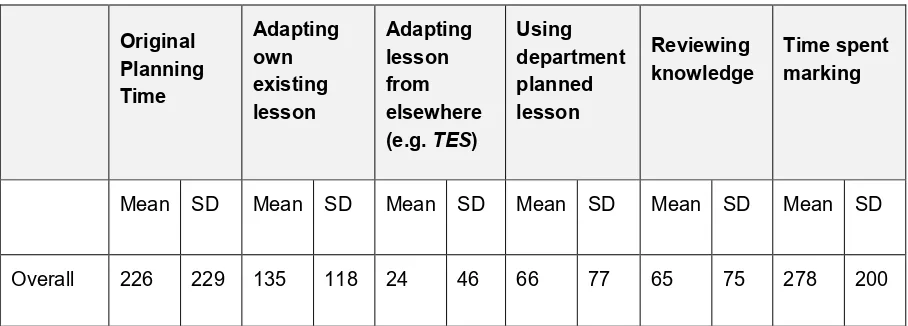
consultant. The statistics that she provided included totals, frequencies, percentages, means and standard deviations. These covered such areas as the overall amount of time spent planning in each school, how much time was spent planning according to the teaching experience of the teachers, the time spent planning in relation to each Key Stage, the time spent on different forms of planning and the time spent planning on the individual days of the week in question.
Teachers at the principal fieldwork centre were then asked to work in subject-based teams on their particular initiatives to reduce planning time whilst still maintaining existing standards associated with teaching and learning. These projects took place between January and June 2017.
When the deadline for the completion of the departmental initiatives was reached, all available teachers at the principal fieldwork centre were invited to complete post-project questionnaires. These were distributed during a whole school training event on 20th June. The questionnaires encouraged the teachers to reflect on the
effectiveness of their projects and elicited data that were then subjected to qualitative and quantitative analyses. A copy of the questionnaire is provided in Appendix 6. All the qualitative material submitted via the seventy-three completed questionnaires was analysed by the consultant associated with Northumbria University, who advised the school throughout the study on good research practice. When examining the questionnaire data, he employed the classic constant comparative method pioneered by Glaser and Strauss (1967), which has now been in use for fifty years. This
“name” it. When the next concept was encountered, either later in the same teacher’s words or in the response of a different individual, this was compared with previous concept so that it could be categorised and coded in the same way as the like concept that had already been noted. If there was no such similar concept, a new category, represented by a new term, was formed. This procedure continued until all the text offered by the last respondent in the last large answer space of their
questionnaire had been scrutinised. Ultimately, all data sharing the same term were united and understanding of each concept addressed by the data was developed from the totality. The yes/no responses given by the participants to the final four questions were examined separately, through the use of frequency counts and percentages generated via Microsoft Excel.
On 11th July 2017, four focus groups met. Broadly, the purpose of the focus group interviews lay in gathering qualitative data in order to identify, via exploration of the participants’ personal situations, the reasons for the quantitative findings that had already emerged. This is a well-accepted strategy in hybrid research (Shenton and Dixon, 2004). When determining the composition of the groups, the research team ensured that all the participants in each would share a high degree of commonality (Krueger, 1994). To this end, a rigorous form of “criterion sampling” as outlined by Patton (1990, p. 176) was applied, with “information-rich cases” selected. Patton explains how these are “cases from which one can learn a great deal about matters of importance. They are cases worthy of in-depth study.” (p. 181) The make-up of the first two focus groups was informed by what had been learnt from the data submitted in the diaries. One group consisted of staff who had been spent more time planning during the week in question than their colleagues, whilst the second sampled those who had spent least. These focus group meetings were largely devoted to
ascertaining the reasons why. Two teachers took part in these focus group meetings without having completed post-project questionnaires. Two more focus groups were based on the data collected via the post-project questionnaires. One consisted solely of teachers who had indicated that their initiative had not achieved the intended aim of reducing time spent planning. The other focus group concentrated on members of one particular subject department, i.e. Maths, and whose experiences in the
Workload Challenge Study had, in contrast, been overwhelmingly positive. Again, the focus groups explored the possible causes. In total, fourteen staff took part in the focus group meetings, each of which lasted around half an hour. A semi-structured approach was taken, with the moderator working from a schedule but diverging from it when the contributions of the participants were deemed worthy of follow-up
Guba and Lincoln (1989) to be the single most important strategy for bolstering the credibility of qualitative research. Within the Workload Challenge Study, member checking involved issuing, after the event, each focus group participant with a copy of the record of the conversation to which they had contributed and requesting that they highlight any situations in which they felt that the document presented in some way an inaccurate picture of what they had said. Several staff suggested alterations and the appropriate amendments were then made to the records. All focus group data were analysed by the research consultant associated with Northumbria University, who again applied the constant comparative technique.
In September 2017, once the research team had formed their recommendations and constructed the good practice framework, the Deputy Head of Whitley Bay High returned to the middle and first schools in order to ask staff in these organisations to validate the creations and outline their utility in their own situation.
Maykut and Morehouse (1994) refer to the importance of using “debriefers” during the course of a study. Debriefing sessions took place on several occasions. For example, after writing a draft version of his report on findings that had emerged from the post-project questionnaire data, the research consultant from Northumbria University discussed the results with the school’s Deputy Head. Later, immediately after moderating the last focus group meeting, the research consultant compared his ideas on the sessions with those of the school’s Research Development Officer, who, through extensive note-making, had compiled a record of the conversations as they took place. The research consultant and the Research Development Officer then reported to the Deputy Head and tested their ideas against his experiences. The fact that two researchers were involved in running the focus group meetings helped to reduce the problem of investigator bias, which often emerges when only one person is responsible for an inquiry (Maykut and Morehouse, 1994).
Overall, the study incorporated both forms of triangulation identified by Pickard (2013). Triangulation via data source was ensured by approaching a wide range of staff for participation. All teachers in each of the schools were invited to complete a structured diary in the early stages; some five months afterwards, all available teachers in the principal fieldwork centre completed post-project questionnaires. Then, again in the high school, the focus groups drew on staff of different ages, levels of seniority, degrees of teaching experience and subject specialisms. Triangulation by technique was thus ensured by utilising three different means of data gathering: structured participant diaries, post-project questionnaires and focus group meetings, before draft outcomes were tested with the Senior Leadership Teams of the middle and primary schools.
thinking and see how the conclusions they have been drawn arise from the data (p. 319). With regard to the latter, the conventions applied when reporting the study findings are crucial. Where reference is made to the ideas or specific words of a particular teacher, a three-part alpha-numeric identifier is cited. The individual elements indicate the person’s subject department, the extent of their teaching experience and details that direct the reader to one of the documents in which the appropriate data can be found, thereby enabling interested scrutineers to see the actual material for themselves and learn more about the context in which the
individual made their observation. If the data came from a questionnaire, the number of this questionnaire is cited as part of the final element of the identifier and, if the same individual also took part in a focus group, the number of their group is shown at the end, in square brackets. If, however, the data were contributed in a focus group meeting, information about the person’s subject department and the degree of their teaching experience is followed by the number of the focus group in which they offered their data, and the questionnaire reference is given last, again in square brackets. Thus, the overall code not only serves to “name” the respondent; it also gives the reader brief background information about the nature of the contributor and provides a scrutineer with the insight they need in order to trace the data involved and make a proper assessment of the study’s evidential base. A key to the
Appendix 4: Participants
The following tables give an overview of the participants in the project.
Experience No data 1-3 years 4-6 years UPS 1-2 UPS 3
No. of respondents 2 12 19 17 50 %age proportion of
[image:30.595.99.525.133.259.2]responses 2% 12% 19% 17% 50%
Table 3: Breakdown of high school diary contributors according to teaching experience
WBHS experience
No
data
1-3
years
4-6
years
7-9
years
10-12
years
13-15
years
16+
years
[image:30.595.48.567.290.424.2]No. of respondents 1 21 14 16 15 15 17 %age proportion 1% 22% 14% 16% 15% 15% 17%
Table 4: Breakdown of high school diary contributors according to their time at the organisation
Subject No. of teachers
Applied Studies 3
Art and Design 4
Business Studies 6
Certificate of Personal Effectiveness 1 Child Development 1 Design Technology 3
Economics 3
English 11
Enrichment 1
Extended Project Qualification 3 Financial Planning 1
Food Technology 5
General Studies 4
Geography 6
Health and Social Care 3
History 8
Information and Communication Technology / Computer Science 4
Mathematics 12
Media / Film Studies 4 Modern Foreign Languages 5
Music 1
Personal, Social and Health Education 4 Philosophy and Ethics 2
Psychology 4 Religious Education 2
Science 20
Sixth Form 1
Special Needs / Intervention / Learning Support 3
[image:32.595.69.527.73.408.2]Textiles 3
Table 5: Subjects taught by high school diary contributors
Experience 1-3 years 4-6 years UPS 1-2 UPS 3
No. of respondents 7 12 18 36 %age proportion of
[image:32.595.69.526.488.741.2]responses 10% 16% 25% 49%
Table 6: Breakdown of high school post-project questionnaire respondents according to teaching experience
Subject No. of teachers
Art and Design 4
Business Studies 3
Drama 1
English 11
Geography 5
Mathematics 9 Modern Foreign Languages 3
Music 1
Physical Education / Sport 4
Psychology 2
Religious Education 2
Science 11
[image:33.595.69.527.65.358.2]Technology 9
Table 7: Subject specialisms of the high school post-project questionnaire respondents
Three teachers did not indicate their subject.
Focus group Participants
One Four UPS 3 staff: one Geography teacher, one Science teacher and two Technology teachers
Two Three staff with three to five years of teaching experience: specialisms in History, Mathematics and Psychology respectively
Three Three staff: one UPS 1-2 Drama teacher, one UPS 3 Music teacher and one UPS 3 Religious Education teacher
Four Four Mathematics staff: one with one to three years of teaching experience, another with four to six and two within the UPS 3 category
[image:33.595.68.526.409.664.2]Experience No data 1-3 years UPS 1-2 UPS 3
[image:34.595.132.486.69.179.2]No. of respondents 3 1 5 5 %age proportion 21% 7% 36% 36%
Table 9: Breakdown of middle school diary contributors according to teaching experience
Middle school experience
No data 1-3
years
4-6
years
7-9
years
10-12
years
13-15
years
16+
years
[image:34.595.50.564.237.370.2]No. of respondents 1 4 2 1 1 4 1 %age proportion 7% 29% 14% 7% 7% 29% 7%
Table 10: Breakdown of middle school diary contributors according to their time at the organisation
Experience No data 1-3 years 4-6 years UPS 1-2 UPS 3
[image:34.595.86.527.416.522.2]No. of respondents 2 1 6 3 3 %age proportion 13% 7% 40% 20% 20%
Table 11: Breakdown of primary school diary contributors according to teaching experience
Primary school experience
No
data
1-3
years
4-6
years
7-9
years
10-12
years
13-15
years
16+
years
No. of respondents 1 3 3 2 0 1 5 %age proportion 7% 20% 20% 13% 0% 7% 33%
Appendix 5: Findings of the Baseline Survey
School No. of teachers Mean time (mins) Standard deviation (mins)
[image:35.595.107.500.106.217.2]The high school 99 641 277 The middle school 14 720 501 The primary school 15 756 334
Table 13: Time spent on planning overall
Teaching experience
The high school The middle school The primary school
N
Mean (mins)
SD
(mins) N
Mean (mins)
SD
(mins) N
Mean (mins)
SD (mins) No data 2 590 163 3 495 630 2 377 195 1-3 years 12 643 249 1 570 1 590
4-6 years 18 789 314 0 6 967 386 UPS 1-2 17 606 192 5 1027 638 3 830 87 UPS 3 50 600 287 5 580 149 3 567 171
Table 14: Time spent on planning in relation to teaching experience
[image:35.595.71.526.275.544.2]Educational stage Mean (mins) Standard deviation (mins)
[image:36.595.119.491.68.254.2]Foundation Stage 798 187 Key Stage One 579 176 Key Stage Two 798 450 Key Stage Three 672 318 Key Stage Four 642 274 Key Stage Five 650 278
Table 15: Total time spent on planning in relation to Key Stage
Original Planning Time
Adapting own existing lesson
Adapting lesson from elsewhere (e.g. TES)
Using department planned lesson
Reviewing
knowledge Time spent marking
Mean SD Mean SD Mean SD Mean SD Mean SD Mean SD Overall 226 229 135 118 24 46 66 77 65 75 278 200
Table 16: Time spent on different forms of planning
[image:36.595.71.525.310.473.2]Day Number of teachers
Mean time (mins)
Standard deviation (mins)
[image:37.595.148.474.66.400.2]Monday 128 114 75 Tuesday 128 112 69 Wednesday 128 111 84 Thursday 128 97 82 Friday 128 72 64 Saturday 126 30 67 Sunday 128 127 97
Appendix 6: Post-project Questionnaire
Department:
Teaching experience (circle one):
1-3 years 4-6 years UPS 1-2 UPS 3
We would greatly appreciate your feedback on the following:
An overview of your project and a summary of the work you did.
Has this, or do you expect this to:
a. improve your own practice? b. improve your work life balance?
Anything you felt didn’t work well, or that teachers should avoid?
YES NO
Has the project, or do you expect the project to:
Improve the quality of planning?
Saved you planning time?
Improved confidence with using the VLE ?
Appendix 7: Summary of responses to post-project
questionnaire yes/no questions
Given that the statistics presented in Figure 2 are so positive with regard to the projects improving the quality of teachers’ planning, saving staff planning time and encouraging teamwork within departments, the low percentage of respondents who said that their confidence in using the VLE had not increased may seem
disappointing. Two significant explanations may be offered for this result. In particular, many of the most ICT-literate staff may have felt entirely comfortable because they were already using it regularly. Indeed, TEC/UPS3/Q12, ENG/UPS1-2/Q47 and HIS/UPS3/Q71 commented to this effect. For others, such as
Appendix 8: Key to Departmental Abbreviations Used in
Identifiers
NODEPT No department indicated by respondent BUS Business Studies
DRA Drama ENG English GEO Geography HIS History MAT Mathematics
MFL Modern Foreign Languages MUS Music
PE Physical Education PSY Psychology
RE Religious Education SCI Science
Appendix 9: Discussion of post-project qualitative data
Teacher workloads before the shared planning projects
One of the major discoveries emerging from the data collected in the “diary” phase of the study was that, during the week when the record was maintained, staff in the UPS 3 teaching experience category spent less time planning on average than their colleagues in other groups. When this issue was explored with UPS 3 teachers in the first focus group, various reasons emerged. SCI/UPS3/FG1[Q61] felt they now had a sound knowledge of the curriculum and what it required of students. The same teacher was also well aware of areas where students typically struggle, and
TEC/UPS3/FG1[Q13] found their experience of how students generally respond to be an aid to their planning. TEC/UPS3/FG1[Q13] and SCI/UPS3/FG1[Q61] noted that over time they had assembled a considerable collection of resources. The former pointed out that they had developed a familiarity with a range of “interactive activities and strategies” from years of attending Tuesday afternoon training sessions, and TEC/UPS3/FG1 added that they had benefited from the long term sharing of
resources. UPS 3 teachers also exploited the experience they had gained of drawing on resources created in other departments over a prolonged period.
TEC/UPS3/FG1[Q13] accessed these via a “shared area”, whilst TEC/UPS3/FG1, who supported students with special needs as well as working in Food Technology and Textiles, found it useful from a planning perspective to “dip into departments across the school”. Experience led to psychological advantages, too. TEC/UPS3/FG1 referred to their ability to go into a classroom feeling confident and without having to “plan it all out on paper in advance”, and SCI/UPS3/FG1[Q61] had come to
appreciate that “planning and writing to the nth degree doesn’t always translate to the classroom”. Teachers reduced their planning time as a result of necessity, as well; GEO/UPS3/FG1[Q30] and TEC/UPS3/FG1[Q13] commented that experienced staff take on extra responsibilities and there is a consequent reduction in the time
available for existing tasks, such as planning.
Data submitted as part of the study’s “diary” phase revealed that, during the week in which staff logged their planning workload, individuals with four to six years’
experience of teaching spent more time planning on average than their colleagues. When this discovery was investigated in a focus group made up of teachers in this category, again, several factors emerged. HIS/4-6/FG2[Q68] knew that, unlike their more senior fellow professionals, they had not yet compiled a substantial bank of lessons and resources. HIS/4-6/FG2[Q68] admitted, too, that their mind was frequently occupied trying to “plan lessons ‘the Whitley Bay way’”, so as to ensure that their lessons were consistent with the school’s ethos. PSY/4-6/FG2 contrasted their current situation with that in their first few years in teaching. At the very
and ideas “but at the level we are [now] you want to make it all your own and do things your own way”. PSY/4-6/FG2 felt a certain pressure to ensure that their lessons were enjoyable to students but recognised that this desire came from within themselves, rather than from the expectations of senior leaders. HIS/4-6/FG2[Q68] knew that whilst they had benefited from some practices within the school, they had suffered in other respects. They believed, for example, that they saved time from not having to formulate lesson objectives; yet the saved time was spent elsewhere. HIS/4-6/FG2[Q68] found the task of creating resources especially time consuming. In a previous focus group, the experienced TEC/UPS3/FG1 had made a similar
admission, saying, “getting the resources done is a big task”. Nevertheless, it would be unwise to assume that this was a huge challenge across every subject.
Commenting in response to HIS/4-6/FG2[Q68]’s situation, MAT/4-6/FG2[Q52] explained, “in Maths, it’s not the resources [that are time consuming]”. For HIS/4-6/FG2[Q68], the problems were especially marked where new specifications were involved in text book purchases. The same teacher pointed to the costs that arise when using TES materials, and highlighted the expenses that they would incur if they wanted to include them in their planning. In their subject, PSY/4-6/FG2 had been impressed by a Web site that offered high quality resources free of charge but these had to be modified to meet their needs. PSY/4-6/FG2 and HIS/4-6/FG2[Q68] agreed that background reading on areas to be taught demanded much time. Whilst the former found that a useful strategy to guide their own reading around a topic lay in devising “a list of questions that I think students will ask me”, HIS/4-6/FG2[Q68] had explored “a suggested reading group from AQA” but there was “nothing that’s
completely relevant”. They recalled, “I’ve spent nights trying to find information”.
Positive aspects of shared planning
The intended benefit of the study as a whole, namely that staff workload should be reduced, was often evident in the data pertaining to individual projects characterised by shared planning. As SCI/UPS3/Q5 explained succinctly, you “give one, get six!” MAT/4-6/Q10 spoke for a lot of staff when commenting that workload had been lessened because many lessons did not have to be planned from scratch.
ENG/UPS3/Q46 summarised the situation neatly: “Original lesson planning is very time consuming but adapting planned lessons is quick and efficient.”
saving was considerable day to day, but this doesn’t include time spent together.” Departmental colleague MAT/1-3/FG4[Q55] offered their perspective in the same focus group: “It felt like I was planning one lesson a week, rather than three a week, so for me it was initially cut by a third, but you still had to spend time looking at others’ work and tweaking, so therefore I’d say maybe it cut [planning time] by about a half.”
Shared planning was seen to benefit various dimensions of teaching life beyond reducing the time taken planning. SCI/UPS3/Q58 noted its potential for training staff and developing the skills of others, for example. More frequently, however, the advantages of allowing staff with certain specialisms to design lessons that were closely aligned to their strengths were highlighted. Not only did this exploit the expertise of individual teachers; it also often led their colleagues to acquire a fresh personal perspective. MFL/UPS3/Q40 wrote, “it’s good to get ideas about how you can teach things differently”. In particular, the eyes of TEC/UPS3/Q15 were opened to the different teaching styles and the experiences of fellow staff. For
GEO/UPS3/Q29, shared planning ensured that there was now a greater range in their teaching and learning ideas. MAT/UPS3/FG4[Q56] explained that, in their situation, variety had resulted from becoming “aware others might do things
differently”. MAT/UPS3/Q56[FG4] reported how insights from colleagues led to what were, for them, innovations in the classroom itself: “Using ideas and expertise of others has meant I’ve tried new approaches.” A greater repertoire of tasks or
activities that would readily be available for use with students was commonly cited as another plus. SCI/UPS1-2/Q66, who was involved in a project to create a central store of materials, felt reassured “knowing that whatever topic is going to be taught, there will be lessons and resources ready”.
Some teachers relished the opportunity to apply their specialisms for the benefit of their professional colleagues. TEC/UPS3/FG1 enjoyed how “what I’d done got people thinking”, and SCI/UPS3/FG1[Q61] appreciated the novelty of the situation,
reflecting, “you demonstrate to students a lot but rarely to staff and peers so it was really good to be able to do this”. It would seem, however, that some subjects are better suited to exploiting teachers’ specialisms than others. MAT/UPS3/FG4[Q57] reported that, in Maths, the division of work to be planned was not at all influenced by this consideration. A much more important factor for staff in this department was planning the material on the basis their students’ weaknesses.
There was seen to be greater consistency in the appearance of the materials produced. Several teachers, such as RE/UPS3/Q18, GEO/UPS3/Q31 and
BUS/UPS3/Q36, GEO/UPS3/FG1[Q30]). For RE/UPS3/Q18, the corporate approach “helps me stick to the point and not wander off on tangents” and even made them “more organised”. The quality of the resources produced as a result of the projects, and indeed the calibre of lessons themselves, were widely praised as well.
There were improvements in levels of communication, collaboration, discussion or teamwork within a department (SCI/UPS3/Q5, TEC/UPS3/Q35, BUS/UPS3/Q37, ENG/UPS3/Q45, MAT/UPS1-2/Q54, MAT/1-3/Q55[FG4], MAT/UPS3/Q57[FG4], TEC/UPS3/FG1[Q13]). For MAT/UPS3/FG4[Q57], the collaborative process started at the outset of the project with the talks that led to achieving a consensus with regard to a planning format “that was right for everyone”. In the words of MAT/4-6/FG4[Q6], “it was important for us all to agree on what we wanted at the end”. The same teacher recounted how the process took place: “We had an open discussion about what we all needed. We went with the popular opinion and went with structure of what everyone needed at that early stage.” Undoubtedly the Maths workload project exploited the existing team spirit within the department. MAT/UPS3/FG4[Q57] summed it up this way: “Our ethos is very ‘showy offy’ – we want to share what we’ve done and encourage others to use it. We don’t just care about the kids in our
classroom, we care about the team. If we have something we think others would like we share it with them.”
Later in the projects, SCI/UPS3/FG1[Q61] had found that “people are more willing to discuss where their planning has gone wrong or where it needs clarification, so people are less offended with suggestions. This project has opened avenues.” For GEO/1-3/Q28, the enhanced communication helped to ensure that all members of the department “are on track”. GEO/UPS3/Q29, a colleague teaching the same subject, said shared planning encouraged individual teachers to raise their game, commenting that they felt required to prepare work “to the same (high) standard as everyone else”. A similar view was expressed by HIS/UPS3/Q71. MAT/1-3/Q55[FG4] acknowledged that “planning for more than you made me put more thought into what I was creating”. MAT/1-3/FG4[Q55] felt it encouraged people “to show off your best”, when if they were planning only for themselves it was easy to think, “I’m happy with that”. For TEC/UPS3/FG1[Q13], the project led to “quality assurance”.
MAT/UPS3/FG4[Q56] believed that the workload project encouraged individuals to be more adventurous, too, acknowledging that they looked to ensure “plenty of variety and include things you may not put in automatically”.
open to others’ views”. ENG/UPS3/Q45 admitted that they felt “awkward when criticising the success of other teachers’ lessons”.
Analysis of the qualitative data led the research team to identify numerous benefits already felt by the learners. These included greater levels of enjoyment, enthusiasm or motivation (ART/UPS3/Q8, ART/UPS3/Q25, ART/UPS1-2/Q26, ART/UPS3/Q27, SCI/UPS3/Q65). More specifically, MAT/4-6/Q7 and RE/UPS3/Q18 reported
receiving positive student feedback on the style of recently introduced worksheets and the structure of the new format for PowerPoint slides respectively.
RE/UPS3/Q17[FG3], meanwhile, reported that their Year Ten class “seem to like the more uniform feel” apparent in the resources. Some staff had detected improved student outcomes, such as greater understanding of the topics covered
(SCI/UPS3/Q58, SCI/1-3/Q60). Another teacher commented broadly that “all the students benefited from doing ‘the same’” (ART/UPS3/Q27). This can be equated with the “equality of provision” that SCI/UPS3/Q5 and SCI/UPS3/Q59 felt were significant advantages of shared planning. PE/UPS1-2/Q20 believed that if “all
students receive the same or similar lessons, they usually have similar strengths and weaknesses [in relation] to content and this can identify areas for improvement the next time round”.
Shared planning projects definitely encouraged various forms of reflection. For
GEO/UPS3/Q29, it “makes you consider all attributes of a lesson and make sure that they are in”. Another member of staff in the same department referred to how they reassessed their own practice which led them to “keep the good information and remove the less good” (GEO/UPS3/Q30[FG1]). The streamlining of the planning process prompted a few teachers to concentrate on what they recognised to be the essentials. As lesson plans were being prepared as much for colleagues as for the creator personally, there was also, though, the challenge of ensuring that the tacit knowledge that the individual brought to bear was rendered explicit for the wider readership involved. This will be considered in greater detail subsequently.
A more “joined up” approach developed in places, with RE/UPS3/Q18 recounting how they had linked lessons to textbook chapters, thereby making it easier for students to access additional information. This also helped learners who had fallen behind to catch up (RE/UPS3/Q17[FG3]). Some projects alerted staff to thinking about how differentiation may be achieved (PE/1-3/Q21). SCI/4-6/Q62 saw distinct advantages of shared planning in this area, saying that the practice was “brilliant for differentiation”. MAT/UPS3/FG4[Q56] explained how differentiation became
effort could be invested in differentiation “so each student got a high quality of support”. MAT/4-6/Q6[FG4] cited another area where the time saved in planning could be used – the provision of improved feedback to students.
An English project led to an honest appraisal of the effectiveness of existing practices (ENG/UPS3/Q44), as well as a reduction in duplicated effort (ENG/UPS1-2/Q42). One teacher in this department believed that the project had “encouraged me to reflect on my skills and has driven me/allowed me to aspire. Everyone has unique strengths and it is fantastic to see them in action” (ENG/UPS3/Q51). Several staff commented that their project had reminded them of activities they had almost forgotten but which they could use more frequently (e.g. SC/UPS3/Q65, HIS/4-6/Q68[FG2], HIS/UPS1-2/Q70, TEC/UPS3/FG1, TEC/UPS3/FG1[Q13]). The way in which the study provided a means of learning about the work of other departments could also reveal to a teacher limitations in their own knowledge. SCI/UPS1-2/Q67 indicated that, as a result of what they now knew, “I’ll be taking a look at Padlet”. The mere process of explaining their teaching and learning ideas to other staff made MFL/UPS3/Q39 “more aware of where the pitfalls may occur”.
The importance of even such fundamentals as the time and opportunity that the projects offered to tackle work which departmental teams already knew had to be undertaken should not be underestimated. SCI/UPS1-2/Q67 welcomed the way the project afforded the chance to plan a module that the department had previously identified needed designing. In the words of MUS/UPS3/FG3[Q9], “it gave me time to actually do some planning”. MAT/UPS3/FG4[Q56] explained, “designated time really, really helped: this is planning time and this is when you do your planning”. For
MAT/UPS3/FG4[Q57], the fact that the planning sessions took place during the school day, rather than after it, meant “everyone was on board. Now’s the time to do it.” SCI/UPS3/FG1[Q61], meanwhile, noted how their department’s initiative had given people “the focus in the training time to do something practical”. Some
teachers anticipated that the way in which their department’s work had changed as a consequence of the projects would have long term beneficial effects.
SCI/UPS3/FG1[Q61] recalled, “in the past, the teacher in charge [of the subject] produced booklets which others used in different ways but now this will alter. It’ll be more suited to the curriculum”.