
The FE college and its communities
64
0
0
Full text
(2) CollComm txt 22—02—2000 08—46pm Page ii. Published by FEDA Feedback and orders should be sent to FEDA publications Citadel Place, Tinworth Street, London SE11 5EH Tel: 020 7840 5302/4 Fax: 020 7840 5401 e-mail: [email protected] Registered with the Charity Commissioners Editor: Jeremy Pinel Designers: Dave Shaw and Pat Kahn Printed by: Blackmore Ltd, Shaftesbury, Dorset ISBN 1 85338 533 6 © 2000 FEDA All rights are reserved. No part of this publication may be reproduced, stored in a retrieval system, or transmitted, in any form or by any means, electronic, electrical, chemical, optical, photocopying, recording or otherwise, without the prior written permission of the copyright holder. FEDA on the Internet – www.feda.ac.uk.
(3) CollComm txt 22—02—2000 08—46pm Page iii. Contents. Preface and acknowledgements Introduction 1. The FE college and its communities: past and present 2. Motivations and barriers to learning 3. Experiencing further education as a community 4. Policy implications References. 1 3 9 23 33 45 51. Appendices. Appendix 1a. FE staff researching FE – the processes and issues Appendix 1b. Undertaking collaborative research in further education: reflections and observations: a case study at Evesham Fergus McKay Appendix 1c. The FEDA perspective: ways of researching further education Andrew Morris Appendix 2. Further reading. 53 55 56 60.
(4) CollComtxt. 23—02—2000. 11—46am. Page iv.
(5) CollComm txt. 22—02—2000. 08—46pm. Page 1. 1. Preface and acknowledgements. his book is derived from an innovative and complex research project, commissioned by FEDA in 1996.1 The project was ambitious in two ways. Firstly, it addressed the fundamental role of colleges, which is to serve their local communities effectively. Secondly, it engaged pioneering research methods. The research aimed to provide information and analysis to help colleges better understand their changing interaction with the community over an extended period: a period which also coincided with radical changes to the structure and curriculum delivery patterns in further education. The main focus was the changing relationships with communities during the l990s following incorporation. Inevitably, the pace of change has outstripped the research. Now, in 2000, the context is changing again, with the creation of the Learning and Skills sector. The strong emphasis in the new planned structure on ‘bottom up’ as well as ‘top down’ planning, the importance of including users in decision making, and locality as an essential focus for providers all reassert the importance of community. The emphasis, as in our research, is also on the complex nature of communities and their learning needs. There are many different interest groups and constituencies jostling in any small locality. Colleges must respond to them all. This research therefore has some important messages for the future. Over the last five years, FEDA has actively promoted the engagement of FE practitioners in research. This is part of our commitment to ensuring that research, through close links to its users, can be used to develop better provision – specifically to improve the experience and achievements of learners. This project was the first major structured opportunity for higher and further education to work in partnership. We have begun to build an active and equal relationship between FE and HE partners, moving beyond the concept of researcher (HE) and researched (FE). FEDA, the colleges and Warwick University were all in active partnership for the duration of the project. College lecturers, supported by the university, undertook the research. Research skills training was provided. The project was steered by a group whose composition reflected the focus and methodology. I do not want to paint an overly rosy picture. Creating something new and innovative often involves mistakes, hitches and frustration. This project has had its share of them all. However, the lessons learned have been highly valuable. We will build them into future work. Research in post-16 learning has come a long way since this project started. There is a much stronger commitment at policy level and in higher education to making partnership work, and to ensuring a robust and workable link between research and practice. The Government has committed greater resources to research for two key reasons, both of which reinforce our approach. One, to strengthen evidence-based policy and two, to ensure that the outcomes of publicly funded. T. The FE college and its communities.
(6) CollComm txt. 22—02—2000. 08—46pm. Page 2. 2. research are geared to enabling change. There is also a growing research culture in further education reflected in FEDA’s FE Research Network with its annual conference and the journal College research. Further education increasingly wishes to participate in a research culture. A particular debt is owed to Peter Scott, now Vice Chancellor of Kingston University, for his challenge to the research community to embrace new ways of conducting research and new relationships with practitioners.2 This work was an inspiration to FEDA to grasp the nettle and invest in this project. The nine colleges in the West Midlands were pioneers and we are very grateful for the time, skill, and support that they offered to the project. In particular, we thank the following researchers in colleges who worked on the project throughout: Paul Allen, Colin Dyer, Phil Whitehead, Fergus McKay, Chris Smith, Iris Flaum, Brian Starbuck, Stephanie Saunders, Andy Newark and Andy Young. Ursula Howard Director, Research and Development, FEDA Notes. Further reports from the research are available from FEDA and the Continuing Education Department at the University of Warwick. 2 Gibbons M, Limoges C, Nowotny H, Shartzman S, Scott P, Trow M. The new production of knowledge. Sage, 1994. 1. The FE college and its communities.
(7) CollComm txt. 22—02—2000. 08—46pm. Page 3. 3. Introduction. ince the 1980s, further education has been in a state of transition. While this was accelerated by the Further and Higher Education Act 1992, the processes of change were already well under way by then. Further changes are taking place. Following the publication of a major public inquiry into further education, led by Helena Kennedy QC, the Government announced a series of new initiatives to promote lifelong learning, and undertook a systematic review of post-16 education and training, with further education occupying a central place. Inevitably, this process of change has helped reshape colleges’ relationships with their communities. Already by the early 1980s, colleges were increasingly catering for new groups of young people, and by the late 1980s they had become the main providers of educational opportunities for adult learners. At the same time, colleges were adapting to a more competitive market place. Vocational training was being provided not only in colleges but also by an ever-wider range of commercial agencies. Schools were competing for the A-level market. Colleges had to diversify into new programme areas to attract other and new groups of students in their local communities, and were creating new relationships with their communities long before the legal changes brought about by the 1992 Act. This process created a fast-changing, responsive and highly differentiated FE system. When Helena Kennedy reviewed the future of further education, it was already clear that the colleges represented a major force for building a new culture of lifelong learning in Britain. The central role of further education was confirmed by Bob Fryer’s report into lifelong learning (1997), and was clearly recognised in the Government’s 1998 Green Paper, The learning age, which argued that colleges should be ‘beacons of learning’ in their local communities. This clarion call was warmly welcomed by all the bodies representing the interests of further education in Britain. Yet, while colleges have moved on, our research reveals that many people still view further education as the ‘local tech’. Kennedy notes that further education often tends to be undervalued and unrecognised:. S. … despite the formidable role played by further education, it is the least understood and celebrated part of the learning tapestry … there is also an appalling ignorance amongst decision-makers about what goes on in further education. Kennedy, 1997, p1 How much does it matter that public attitudes and perceptions are lagging behind reality? In this report, we review the evidence of a gap between perceptions and reality, and show that this may be holding colleges back in their efforts to serve the wide range of community interests that have a stake – actual or potential – in what further education has to offer. Our study’s central aim was to gather evidence of the ways different stakeholders in the community viewed further education. It was born at a time when the changes. The FE college and its communities.
(8) CollComm txt. 22—02—2000. 08—46pm. Page 4. 4. brought about by the Further and Higher Education Act 1992 were starting to take effect, further diversifying the range of FE provision for 16–19-year-olds and adult students. The 1992 Act also extended further education’s network and partnership potential to HE institutions, TECs and employers; and it changed FE colleges’ relationship with local education authorities (LEAs) and schools, as colleges took control of their own finances and policies. If colleges are to play an important role in the community and economy, it is important to identify the groups further education currently serves and the groups that are being socially excluded from further education, by analysing the perceptions of both participants and non-participants. Moreover, as well as having external communities, the FE college is itself a community which needs to be examined and understood. The project began in 1996. It was well under way by the time Kennedy, Tomlinson, Dearing, Fryer and the Green Paper were published, and in many ways it anticipated many of the issues in the emerging policy debate. In particular it focused upon such central issues as participation and access, strategic partnerships, local capacitybuilding in the community and, above all, lifelong learning. Further education is central to the new debate over lifelong learning. Colleges – potentially, at least – offer a tremendous resource to underpin any broadening of participation in lifelong learning. FE colleges already attract more adult learners than any other type of provider, and it is easy to see why: few people in Britain live or work more than a few minutes from one. College teaching encompasses a broad range, from basic skills courses through to higher education. Colleges usually enjoy a high level of brand recognition from local people, even if this is often based on a limited and dated perception of what is on offer. There is growing flexibility and innovation in the sector, which has shown a strong interest in developing and supporting open learning, summer schools, weekend college ventures, credit-based accreditation, franchising and new approaches to progression. Further education’s central place in the new lifelong learning agenda has also raised the importance of research into the sector. University academics have become increasingly interested in researching post-compulsory education. However, as Ainley and Bailey point out, ‘there is some sensitivity in further education today about academic researchers “coming down from on high” to investigate a sector of education in which they have previously had little interest’ (1997, pvii). College staff and managers themselves increasingly want to develop a research culture that will encourage greater valuing of research and will promote research by lecturers and others in their own sector – a development that FEDA has been keen to foster and encourage. Training FE college staff so that they had the skills and confidence to undertake research was an important element of this project. What approach to research should the FE sector take? FEDA has particularly focused on strategic research in encouraging colleges – individually, regionally and nationally – to develop a research culture. Strategic research is designed to influence policy and hence improve practice; it influences institutional practice over a longer timescale than does action research. Strategic research sits somewhere between basic (‘blue skies’) and applied (‘practical’) research. Daniel suggests that ‘the appropriate starting point is assessments of key problems that are likely to emerge in the medium-term future to which … research can make a contribution’ (1993, p6). Its purpose is to enable practitioners and researchers to collaborate in undertaking both research and dissemination. Wide dissemination of the research findings and good practice are important elements of strategic research.. Aims and objectives Colleges have long enjoyed diverse relationships with their communities. Even when their main business lay in day release for apprentices, they had to develop relationships with employers, awarding bodies and regulatory agencies such as the training boards, as well as with their LEAs. In recent decades, this pattern has given. The FE college and its communities.
(9) CollComm txt. 22—02—2000. 08—46pm. Page 5. 5. way to a more complex, varied and often diffuse set of relationships with a wider range of stakeholders. The 1992 Act pushed their development to a new level, not least by reducing LEAs’ importance in determining priorities and planning, and by encouraging greater experimentation and diversity in the FE system. Indeed, colleges themselves have become important stakeholders in their local communities, and are increasingly recognised as such. This process has had far-reaching consequences, noted by the Further Education Funding Council (FEFC): Since colleges have become self-governing they have devised broad mission statements which aim to respond to the education and training needs of individuals, businesses and the wider community. Colleges provide a wide range of vocational and general education courses which successfully meet the needs of school leavers, adults and employers and contribute to the achievement of the national targets for education and training … Colleges are increasing participation in further education by delivering courses in community centres and other locations separate and sometimes remote from their main sites. They have also been active in widening access to further education by introducing more flexible methods of delivering the curriculum. FEFC, 1996, summary Colleges therefore tend to interact with a wider range of external partners than they used to; they do so in increasingly varied ways; and they are of greater importance to a broader section of stakeholders in the local community. Yet relatively little is known, in any systematic way, about the implications of these important developments. The FE college and its communities project sought to explore the changing relationships between colleges and the communities they serve, including the relationships between and within colleges. A key purpose of the research was thereby to inform our understanding of further education’s national significance.. Our approach to the research The nine Midlands colleges involved in this project all have long-established links with the University of Warwick (for instance, through its 2+2 degree programme, the Community University Board and a formally constituted Further Education Research Consortium). Collaboration in research between the university (represented by the Department of Continuing Education) and its nine local FE partners, with FEDA as an active participant, was itself novel and experimental. FEDA extended the project to another group of three colleges, located in rural and urban areas and with student populations differentiated by age, gender, social class and programme of study. The project aims were to impact upon policy and practice by: ●. ● ● ●. Investigating the changing nature of relationships between FE colleges, the communities they serve and the local organisations with which they interact, seeking to identify the value further education is adding to the area Developing further a philosophy of further education Strengthening FE colleges’ ongoing capacity to relate to their communities Examining ways in which strategic research partnerships can be developed in the FE sector and identifying a model for partnership research.. Underpinning these aims is a set of questions that shaped the research methodology. For example, how do colleges perceive and define their local community? How far do the attitudes of the public, private and voluntary sectors influence the education and training of FE colleges? The recent changes in further education are stimulating interest in researching the post-compulsory sector of education. This project was distinctive in that the research was undertaken largely by college staff rather than by university researchers working in isolation. Research training and support was provided by the university’s Department of Continuing Education. The project was organised into discrete. The FE college and its communities.
(10) CollComm txt. 22—02—2000. 08—46pm. Page 6. 6. work packages based on specific tasks. A variety of research methods were employed, such as a questionnaire survey, in-depth interviews, documentary evidence and policy analysis. A contact group, consisting of the college researchers, met regularly to discuss research strategies and issues. All the colleges participated in the first set of work packages, consisting of: ● ● ● ●. A review of the situation 10 years ago A contemporary review of the college context A survey of student data A questionnaire survey of community groups and employers’ views on further education.. Coordinating these early work packages was not easy, and a process of selection was used in order to involve fewer colleges at the subsequent interview stage of the research. In addition, a literature review of research on further education was undertaken by two university staff. An expert seminar was organised to help clarify conceptual understanding and prompt debate; four papers were presented for discussion, looking at a changing further education, the connotations of community, communities and economic regeneration, and community and citizenship. Interested staff in each college were identified to undertake the research. The questionnaire (using open and closed questions) was designed by five staff from different colleges; for most, this was their first experience of questionnaire design. Several meetings were spent discussing the framework and refining the questions; reaching a consensus on the wording of questions was not always straightforward. A pilot survey was undertaken to test the questionnaire’s validity. Questionnaires were sent to local employers, voluntary and community groups, and local government organisations. Care was taken to prevent duplication by the three participating Coventry colleges. The questionnaire aimed to identify local attitudes to and perceptions of further education in general; some respondents referred to specific college experiences rather than to further education as a whole. In total 566 responses were received, with response rates varying between colleges. The questionnaire was used to identify a sample for interviewing – respondents were asked to specify whether they were willing to be interviewed. Several groups of people were interviewed for the qualitative stage of the research: members of community/voluntary organisations, employers, local government organisations, TECs and trade unionists, FE students and lecturers. The sample included a wide range of students taking a variety of courses (part-time and full-time), including 16–19-year-olds, adult students (including outreach) and special needs students. The issues raised by the questionnaire were followed up in depth by the interviews, which were taped, transcribed and analysed. Interviewing is a skilled process and many of the college staff were initially nervous, but this feeling eased after their first one or two interviews. Interviews were semi-structured, normally lasting between 40 and 90 minutes; 100 interviews were completed. To obtain a fuller picture of further education’s context both past and present, other research approaches were used. Using the sample colleges as case studies, one college lecturer constructed a profile of each college by analysing its management information systems data on students and programmes. This, however, was problematic in relation to some aspects of the data, as colleges use different classifications. Using documentary evidence and interviews, each college also undertook an outline of itself 10 years ago and now, to identify the changes that have taken and are taking place. These have now been published in various formats as research reports. Inviting college staff to undertake the research helped to promote a research culture in some colleges. All the staff enjoyed researching in their colleges, and some are now keen to pursue their research skills, although they did not find it easy; most were given inadequate time by the colleges to carry out the research. Compared with traditional approaches using a team of researchers from a research institution, it was a time-consuming and costly process. In the long term, however, there are. The FE college and its communities.
(11) CollComm txt. 22—02—2000. 08—46pm. Page 7. 7. spin-offs for the individuals and colleges involved. Documenting the process of research was an important aspect of the project. College staff identified several key themes and findings from the questionnaire and interview data, which have implications for policy and practice. These were: ● ● ● ● ●. Perceptions of further education Motivations to learn Barriers and critical conditions in learning Experiences of further education Inequality and equal opportunities.. Although the research was confined to a particular regional area, we feel that the inclusion of urban/rural and large/small colleges offering a range of adult, academic and vocational programmes provides findings that are relevant to further education nationally. Analysis of the data revealed the complexities of colleges’ interactions with their communities. Relationships with local community groups, both externally and within the college, are multi-layered and constantly shifting as policy and financial prerequisites change. Further education continually has to respond to the different demands of a heterogeneous community. Identifying the diverse community groups is the first step in identifying a potential constituency. Our research looks at how different colleges are managing to provide and enhance the lifelong learning opportunities of a range of individuals and groups.. Structure of the report This book has two objectives: to report the research findings and to document the processes of college staff undertaking research in their own institutions. The changes experienced in further education over the past 10 years are outlined at the beginning of Chapter 1 to put the research into context. The term ‘community’ is frequently used but rarely defined; the chapter attempts to deconstruct and conceptualise it within the context of this project. By drawing on the survey and interview data, the communities served by further education are identified. Different communities have differing needs and perceptions of further education. The most significant contrast is between community and industrial organisations. However, all groups had incomplete and often outdated views of further education. These are explored at the end of the chapter. Chapter 2 examines why both 16–19-year-olds and adults choose to study at FE colleges. Many in the study were influenced by the positive experiences of family members in further education, or by word of mouth from friends or colleagues. Motivations for learning varied by age in particular. Many adults mentioned ‘getting on’ in work or changing career; several mature women students stressed the importance of personal development. Young people were less positive about their choice; for some, choosing further education was a means of avoiding a boring job. Many of the barriers to learning experienced and/or perceived by participants were practical ones, some of which were external to further education. In rural areas, for example, transport was a key issue. For those on low incomes, the cost of courses was critical; community organisations made a plea for free or low-cost courses. Participants from minority ethnic groups said that racism in colleges discouraged them from learning. In relation to learning, potential students need to be able to see further education as part of a wider process of taking control of their lives and making progress along a path of career and personal development. Students’ reflections on their experiences of further education are contained in Chapter 3. Adults’ experiences of returning to learn in a large institution were similar to those of adults in higher education (Bourgeois et al., 1999; Merrill, 1999). Several were daunted and nervous at the start of their course, not knowing what to expect. While support from staff was viewed as important, many were critical of induction programmes. Employers had specific needs in terms of courses and. The FE college and its communities.
(12) CollComm txt. 22—02—2000. 08—46pm. Page 8. 8. training provided by further education. Occasionally, as a study of a short course for a specific group of employers in one of the colleges illustrated, there was a mismatch between employers’ expectations and those of lecturers designing and providing a course. In contrast, the needs of community organisations are wider than just learning; for them, access to and the sharing of resources and rooms in FE colleges was viewed almost as a ‘right’ if colleges are to be part of the local community. The message from these organisations is that further education does not always listen to community needs. Should colleges do more to engage with local communities? The Government appears to regard this as an important part of the FE mission, as shown by recent official reports (Tomlinson, Kennedy, Dearing, Fryer and the Green Paper) on widening access and lifelong learning. It is also clear in the Government’s emphasis on partnership, and in the FEFC’s stress upon meeting the needs of local constituencies. Some of these wider policy implications are discussed in Chapter 4 within the context of lifelong learning. Further education is unique in providing education at all levels for both young people and adults in its local communities; its overall ethos has changed, and is likely to evolve further in the light of evidence that the FE college is becoming more of an adult institution than it used to be. Further education is, therefore, multifunctional, striving to obtain many goals to meet the needs of its diverse communities. To achieve this a multi-agency approach is required, with adequate funding and resources. This presents obvious difficulties. Some participants felt that further education was trying to do too much, and that different colleges should focus on particular courses and groups. Others believed that market forces were fuelling competition rather than collaboration between colleges. Many staff were concerned that incorporation, the concern to be profitable and the funding mechanism had led to a decline of courses for socially disadvantaged groups and those traditionally excluded from education. Nevertheless, the potential benefits of partnership appear substantial, and there is clearly a reservoir of goodwill that can be tapped for the future. Further education has a key role to play in the post-compulsory sector. However, this requires a stronger sense of the college’s community, and how the college can build lasting relationships with it. As Kennedy points out: If further education is to fulfil its potential in terms of social cohesion and economic prosperity, all stakeholders need to ensure wide involvement on the part of employers and members of the community. Kennedy, 1997, p42 In this study, community and industrial organisations called for a partnership model with further education as a way forward to achieve and meet the needs of a wide variety of community groups. The Appendix outlines the experiences and processes of college staff undertaking research in their own institutions. A small core of lecturers involved in the project have become hooked on doing research, particularly qualitative approaches and interviewing. The collaborative process used in this project was at times difficult, frustrating and time-consuming, but it was rewarding in a number of ways. It was a learning experience for the university, FEDA and the colleges. A series of college events disseminated the outcomes at college level. The project has led two lecturers to undertake masters’ research degrees and another to work with a colleague at Warwick and the University of Birmingham on FE-related projects. Others are keen to continue to use their research skills in their colleges. In these colleges a research culture has been established, but this has important resource implications. Busy staff may have the goodwill to undertake rigorous investigations, but they need the active support and commitment of college management. With this support, our experience suggests that colleges do indeed have the capacity to undertake a range of effective institutional research, which in turn provides an important element in the broader attempt to turn colleges into reflexive, learning organisations.. The FE college and its communities.
(13) CollComm txt. 22—02—2000. 08—46pm. Page 9. 9. 1. The FE college and its communities: past and present. The FE college 10 years ago and now FE colleges began increasingly to vary in their nature and purpose during the 1980s. This trend continues today. Defining the philosophy and practice of further education is, therefore, a hazardous business. As one college principal has said: FE colleges are not standard, bureaucratically defined institutions but rather each is a product of its own history, the policies of its previous governing bodies and local education authority, and the local demand from employers and communities. Hall, 1994, p9 Ainley and Bailey have gone so far as to claim that ‘there is, therefore, no such thing as a typical college’ (1997, p8). The Further and Higher Education Act 1992 and subsequent incorporation brought about great changes to further education, including a higher profile. FE colleges had previously played a significant but unassuming role in tertiary education. The popular image of the FE college in the 1980s was the ‘local tech’ – a place to learn a trade, especially for young, working class men (Ainley and Bailey, 1997), or to attend a night-school class for leisure, sport or a qualification. Even by the 1980s, this was out of date. Colleges had faced the responsibility of training tens of thousands of unemployed young men and women since the late 1970s, and by the 1980s they were increasingly attracting adult returners as well. The first access to HE courses, for instance, opened in the late 1970s; by the late 1980s, more adult learners were attending colleges than were studying in LEA centres and the Workers’ Educational Association combined. Nevertheless, a dated perception of the college as a place for apprenticeship training persisted. This was combined with a vague statutory definition of further education. As Kennedy points out, ‘further education is everything that does not happen in schools or universities’ (1997, p1). While legal imprecision may matter little for practical purposes, it reflects a wider uncertainty among policy-makers and the general public over the finer details of further education’s role and contribution. Yet that contribution is both substantial and distinctive. As one senior manager has pointed out, by the 1980s ‘colleges formed part of a broader system of local education, capable of coordination and rationalisation to provide a comprehensive service sensitive to local requirements’ (Reeves, 1995, p99). The British FE system is unique in Europe. No other European country has an integrated institution for post-compulsory education that provides such a wide range of academic, vocational and leisure programmes, from basic to HE level, for both young people and adults. In Germany, for example, day-release training for young people remains the primary responsibility of Berufschulen (trade schools) while more general education and training for adults, including younger adults, belongs to an extensive national network of Volkshochschulen (people’s universities).. The FE college and its communities.
(14) CollComm txt. 22—02—2000. 08—46pm. Page 10. 10. Further education has not always had its current broad functions. Some FE colleges date back to the 19th century, with their roots in technical education for working class men. While some developed out of the self-help tradition of the mechanics’ institutes, others were funded from duty raised on beers and spirits (the Whisky Tax) and managed by local councils. The Education Act 1944 placed on LEAs the duty of providing commercial, technical and arts education. It defined further education as ‘full-time and part-time education and leisure-time involvement in organised cultural training and recreative activities for persons over compulsory school age’ (Frankel and Reeves, 1996, p7). Confusion about the meaning of further education is not new. In the 1960s, the balance between advanced and non-advanced work was used as a basis for distinguishing between and within FE colleges. In the 1970s Bristow described the sector as: … not entirely technical education, nor are further education colleges only ‘technical’ colleges. Further Education embraces colleges, schools and departments of art as well as the technical and technological aspects of education. It may also include diverse aspects of education and training such as nursery, training centres, sea training schools and agricultural colleges. Bristow, 1976, p10 A few years later Gleeson and Mardle pointed out: The paradox is that in practice the term further education has come to denote the nebulous but gaping middle ground which exists between school and higher education. Therefore, although the term may officially embrace Polytechnic and Teacher Education, it does so in name only. It is perhaps for such reasons that the provision for the 16–19 age group has come to be referred to as the ‘Cinderella’ area of the education system. Thus, any definitive attempt to explain the nature of further education becomes, at the institutional level, one FE college is not necessarily like any other: its students, staff, curricula, administration, finance and so forth are dependent upon a variety of regional factors … Gleeson and Mardle, 1980, pp8–9 By severing colleges’ links with LEAs, the Further and Higher Education Act 1992 gave institutions and their governors new financial, management and administrative responsibilities. As a result, further education has evolved considerably, yet its role and function remain ambiguous compared with schools and higher education: Neither have the FE colleges been recognised as part of the mainstream education system. Further education is therefore still described negatively as neither schooling on the one hand nor higher education on the other; or – still more dismissively and inaccurately – as ‘non-academic’, being concerned solely with vocational training rather than general education. The result of this history of neglect and marginalisation is that there has never been any agreed and generally understood assertion of the value of further education in its own right … further education remained a local affair at most until very recently. Its achievements went unsung and were disconnected from developments in the national system of schools and higher education. Ainley and Bailey, 1997, p4 In some quarters the dislocation and transformation since 1992 has produced a sense of crisis and threat. Shortly after the Act came into force, David Robertson argued: The crisis of the further education sector has been a symptom of the crisis of national educational priorities. Since colleges have generally defined their purpose as vocationally focused, ‘second-chance’ institutions, they have not enjoyed the status bestowed upon academically focused sixth forms or. The FE college and its communities.
(15) CollComm txt. 22—02—2000. 08—46pm. Page 11. 11. universities. They have come to symbolise the rift between academic and vocational learning, between education and training, that has defined post-secondary education. This rift has, in turn, retarded our national ability to reform our provision for the benefit of the majority of the citizens. Robertson, 1994 For our sample colleges, participation in this project offered an opportunity to reflect upon their own changing purposes and philosophy over the past decade. The project focused on the academic year 1986/87, but information from the colleges revealed that, on the whole, FE colleges were relatively stable institutions before the Education Reform Act 1988. There were some signs of curricular changes, together with some organisational changes, but further education was still firmly under the auspices of LEAs. Several had just undergone an HMI inspection. The picture is drastically different in the mid-1990s. Changes within further education have been rapid and pervasive. Further education has been affected by the general drive in society towards a market economy. A significant change has been the achievement of a higher profile within the national education system, as ‘government and business are in agreement that the FE curriculum must play a key role in improving productivity and occupational skills to a level comparable with those of other advanced industrial countries’ (Reeves, 1995, p23). How did mid-1980s colleges differ from those of today? What were the communities they served? This was before the era of mission statements; none of the colleges reported having had one. Colleges either had their own informal aims and objectives or drew on guidelines from the LEA and the Department for Education and Science. As one college researcher reported, ‘the LEA was very much in control of strategic planning and development’. A few had their own college development plan by the end of the 1980s. Evesham College, for example, launched its first policy statement in June 1989: Evesham College is a rural community college committed to serving the needs of the local population for further education and lifelong learning. The college seeks to provide educational leadership while responding to the needs of the community by providing quality educational programmes that are accessible to all who can benefit from them. The statement is general, like others of its era, but there is an implicit emphasis on community, access and hence equal opportunities and education for learning. Interestingly it refers to lifelong learning, a popular concept in the mid-1990s. Based in an inner-city area with increasing unemployment, Coventry Technical College produced a statement with a different tone, emphasising employment: Coventry is facing up to this new challenge [unemployment]. It is looking to create opportunities to build a new economic base, to maintain and develop services. In all of this the role of training, retraining and further education is crucial. The changes within the college are a vigorous and fundamental response to the challenges facing it and the city it serves. Policy statements became mission statements in the 1990s. The FEFC asked all colleges to produce a planning framework, to include a mission statement, a threeyear strategic overview and a needs analysis (FEFC Circulars 92 /11 and 92 /18). Colleges were asked to take into account the educational needs of their local communities. A change in status created the need for strategic planning and a mission statement reflecting individual colleges’ principles and ethos. The mission statements of the 1990s reflect the new language of incorporation: cost-effectiveness, training and customers. As colleges became corporate entities encompassing a national framework of goals, the discourse converged (Reeves, 1995). Three colleges in this study begin their current mission statement with the same sentence: ‘to provide high quality, cost-effective education and training that. The FE college and its communities.
(16) CollComm txt. 22—02—2000. 08—46pm. Page 12. 12. satisfies individual and corporate needs’. However, one of the three ends its statement with a reference to serving ‘all sections of the community through lifelong learning’; another promises ‘ensuring equal access to all sections of the community’. The access discourse of the 1990s is apparent in another college’s mission statement: These statements of principle are intended to inform and guide the strategic planning process and deal with lifelong learning; college responsiveness; inclusion and removal of barriers to access; development of capability in learners; … maximisation of accessibility … Several colleges described the management structure of 10 years ago as traditional, formal and hierarchical. One college explained that ‘the hierarchical nature of the management structure allowed strict demarcation of budgets, areas of responsibility and centralised control’. Colleges were highly departmentalised with heads of departments playing an active role in the curriculum decision-making process. In contrast to the situation today, ‘there was little integration between departments – it was empire building’ (college lecturer). Incorporation and the Further and Higher Education Act 1992 produced new management styles and structures. Managers now had to be more businesslike to survive the realities of a market economy. One college explained: ‘The greater range of responsibilities of management in the college now has changed the nature of management away from primarily that of curriculum and academic leadership towards the managing of quality and funding mechanisms, responding to outside pressures.’ There was a general feeling that there is now more to manage. Further education’s diverse curriculum reflects the sector’s multifaceted role in serving different communities. College staff looked back on the curriculum of the 1980s as rigid, prescriptive and traditional in structure. Most students attended full-time or block-release courses. Part-time programmes were uncommon, except at one Coventry college where the students were overwhelmingly part-time. The majority in the other colleges were 16–19-year-olds or young adults. The delivery of apprenticeship programmes to largely male, working class youths has been undermined by wider economic changes, but new opportunities have given rise to greater diversification and work with new communities. The National Institute of Adult Continuing Education (NIACE), in its formal response to the post-16 review, pays tribute to ‘the major increase in participation secured since the incorporation of colleges in 1992’ (Tuckett and Sargant, 1999, p8). The recruitment of adults was not solely a result of the 1992 Act, though; further education has a history of adult provision. Most colleges have links with HE institutions. Warwick has a curriculum link through the 2+2 degree with the Midlands colleges in this study. The colleges also have links with several other universities, some of them outside the Midlands region. Solihull, for example, has an association with seven HE institutions. Over 1850 students are currently on degree, higher national or advanced profession programmes at Solihull. The nature of the curriculum in the 1990s is more strongly shaped by funding sources than it was in the 1980s; this has led to a substantial increase in vocational programmes. College staff in this study felt that funding constraints and the need to be profitable made it more difficult to offer programmes for low-income groups and the socially disadvantaged. However, three colleges are developing outreach centres in the community, one of which is aimed at local unemployed people. Two other colleges have expanded their geographical community as they have merged with other local colleges. Greater flexibility in the curriculum has led to more lifelong learning opportunities for adults, particularly those in part- or full-time employment. Incorporation has prompted significant changes in staffing structures. For example, one college now has 600 part-time staff and 200 full-time staff. This can cause communication problems, as one college explained: ‘this enables greater flexibility for the college and reduces its fixed costs but we need a good relationship. The FE college and its communities.
(17) CollComm txt. 22—02—2000. 08—46pm. Page 13. 13. with [the part-time staff]’. New college contracts introduced in 1994 were divisive, with some lecturers refusing to sign them. Lecturers’ work role has increased and broadened. ‘Ten years ago the main duties of a lecturer grade 1 were teaching, taking registers, marking and preparation’ (college lecturer), and promotion was viewed as automatic. Some principals stated that the biggest problem was inadequate funding from their LEA. Recalling college life 10 years ago, four staff at one college related that ‘there was a greater buzz around the place, stress was not in people’s vocabulary, there were fewer student problems and student retention was not perceived to be a problem’. Policies were few and far between 10 years ago, being mostly ‘fairly nebulous statements of good intent’ (college lecturer). Incorporation has greatly increased governors’ power and influence, and hence the nature of a college’s formal links with its community: The governing body plays a crucial role in the overall management and direction of a college of further education or sixth form college … Now that colleges have become autonomous corporations, the board of governors now resembles the board of directors of a company rather than a large consultative forum of the past dominated by local councillors. Hall, 1994, p130 One college compared its governing body with that of 10 years ago: The governing body acts as a kind of steering group for the college now. They have far greater responsibility and power, and check on finance, policy and a wide range of other matters. They are now there to prevent the college going ‘off the rails’. The relationship with the college is now less cosy than before. Compared to pre-1992, community representation on governing bodies is now dominated by industrialists. A factor that has remained static is gender imbalance; in some colleges in multicultural areas, there is also ethnicity imbalance. One participating college has 14 governors; three are women, and one is Asian. Apart from the governing body, colleges’ key external links are now with industry, TECs and other education institutions, particularly schools and higher education. To a lesser extent, colleges also have links with local community/ voluntary organisations and international contacts. Ties with LEAs have largely been severed, or are channelled through economic development units rather than education departments. A market economy can make it harder to promote collaboration with community groups. One college suggests that ‘there is a problem with community links – there is little or no money in it’. Links with industry are a two-way process. Colleges supply training and consultancy while businesses offer work placements and experience for FE students and staff. One college declared that its relationship with employers had improved in recent years: In general there is a sense of a greater variety and number of links with outside organisations now than before. The quality of the contacts we have with employers is better now. There is more understanding between employers and the college. We are more responsive even though circumstances are more difficult for all. We are doing more for small companies – they are more important in the economy but working with them is more complicated and time-consuming. Relationships with schools and other FE colleges are dual and contradictory, being both competitive and collaborative. However, working with partners, including other FE colleges, was viewed as essential, particularly on a regional basis: We may well need to pool our resources with other colleges, businesses and universities as there may be too many under-resourced providers chasing too few students.. The FE college and its communities.
(18) CollComm txt. 22—02—2000. 08—46pm. Page 14. 14. The impact of policy changes on the FE sector over the past decade has been substantial and deep-rooted, forcing a restructuring of the colleges’ internal community and a reassessment and realignment with its external communities. One college lecturer reflected: There was still a feeling, although under challenge, that the college could be instrumental in righting wrongs and would continue to work against inequalities. We never thought much about how we might have to compete really hard. Despite the changes of the last 10 years, some issues remain the same. For example, concern about the importance of and link between education/training and a vibrant economy was (and still is) a priority. In the 1970s and 1980s, as today, education was viewed as essential for economic survival: In recent years politicians, industrialists and educationalists have expressed considerable anxiety about the failure of Britain’s educational system to produce an adequately trained supply of technical personnel. In a proliferation of official exhortations, white, green and yellow, much has been said about the economic success of Britain’s European partners who, it is held, have made economic progress because of their systematic investment in the training of craftsmen, technicians and technologists. Gleeson and Mardle, 1980, p2. Defining ‘community’ In the 1980s the notion of community was overshadowed by the rise of individualism and concerns with competitiveness. Community is, however, now reappearing on the political and academic agendas. Moreover, changing labour markets are raising new questions of social exclusion and inclusion. Government has repeatedly stressed its view that lifelong learning must engage ‘the many, not the few’. Education is valued as a key to economic success, but the Secretary of State’s foreword to The learning age also spoke passionately of learning for learning’s sake and for social, civic and personal development. Defining the meaning of ‘community’ for further education within the context of this project was an essential starting point. Differences in interpretation emerged at an early stage between individuals and colleges involved in the project. In particular, there was some tension between an active citizenship/social-purpose view and a more economic perspective. To take this discussion forward, a seminar was arranged with academics giving four papers (now published as a FEDA report) that outlined differing perspectives on community: ● ● ● ●. Changes in FE: 10 years of turbulence Bob Fryer, then Principal of Northern College Connotations of ‘community’: implications for practice Ian Martin, University of Edinburgh Further education, its communities and economic regeneration Glyn Owen, Sheffield Hallam University For citizenship and the remaking of civil society Stewart Ranson, University of Birmingham.. Clearly, defining community is problematic. Interpretations of community are influenced by ideological, political and sociological perspectives. Hillery (1955), for example, counted 94 different definitions of the term. Community does, however, imply some collective identity, and social and geographical factors are particularly important in determining that; people develop a common sense of identity by virtue of living as neighbours, in the same locality. But there are other, sometimes competing sources of identify: social class, ethnicity, values, position in the labour market, housing and income, and increasingly lifestyle and consumer choices. To have any meaning in people’s lives:. The FE college and its communities.
(19) CollComm txt. 22—02—2000. 08—46pm. Page 15. 15. The strength of community within any given group is determined by the degree to which its members experience both a sense of solidarity and a sense of significance within it. Clark, 1987, p57 In his seminar paper Martin, discussing the concept of community in relation to community education, argues: Communities in this sense, therefore are collectivities of people – often people united in struggle or resistance – in which they collectively experience the contradiction between the possibilities of freedom (agency) and the realities of constraint (structure). The distinctive role of the ‘community educator’ is the dialectics of community. Martin, 1999, p12 To enable those who are currently excluded to access further education, colleges need to ‘teach out’ and extend proactively into their local communities (Wymer, 1996, Martin, 1999). In practice this means outreach projects, interagency collaboration and partnership. ‘Perhaps the key point to make about this is that some of the college’s communities will be highly visible and, indeed, vocal whereas others may well be relatively invisible and silent’ (Martin, 1999, p8). Martin emphasises the context of popular education, drawing on the pioneering work of Tom Lovett: … in a rapidly changing and uncertain world ‘community educators’ are well placed to engage with the increasingly fragmented and dislocated realities of people’s individual and collective experience. The real challenge … is to forge out of this engagement more genuinely popular and democratic forms of education and, in the process, to reconnect the political culture that simultaneously respects diversity and solidarity. Martin, 1996, pp140–141 From this social-purpose perspective the FE curriculum will: … come out of, not the expertise of the teacher or the demands of the discipline, but the concrete experience and material interests of people in communities. Its pedagogy is collective, focused primarily on group/collective as distinct from individual learning and development, and it attempts, wherever possible, to forge a direct connection between education and social action. Martin, 1999, p12 In contrast, Owen’s seminar paper is located within an economic discourse, examining the role of colleges in economic regeneration. Owen argues that the FE sector faces pressures and unfair competition owing to inequalities in funding, guidance given by schools, quality of training provision and selective recruitment of students by other educational providers. Such competition and declining funding may prevent colleges from assuming a role within the wider community. However, for Owen there are ‘business opportunities in economic regeneration’ as well as a ‘moral onus on colleges to contribute to the economic well-being of the communities they serve’ (Owen, 1999, p17). He outlines three ways in which colleges can contribute to economic regeneration: ● ● ●. Through their mainstream activities, including their contribution to government-funded training, business development and student guidance Through contributing to the process of economic regeneration, including strategic planning Through their economic impact as major organisations in their own right.. Through partnerships, colleges can play a more dominating role rather than as ‘a second tier of consultees’. The transition to a Labour Government, according to Owen, enhances these prospects. Participating in economic regeneration will both improve a college’s financial position and benefit local communities, economically and socially.. The FE college and its communities.
(20) CollComm txt. 22—02—2000. 08—46pm. Page 16. 16. Ranson’s paper offers another perspective on further education and communities by discussing further education’s role in relation to citizenship and the remaking of society. For Ranson the structural changes of the postmodern era have led to upheavals and disruptions in the lives of many people through unemployment. The fragmentation of a postmodern society, therefore, undermines the effect of communities and collective action. The central task now facing society is to remake itself through cultural renewal and communities. A learning society needs to advocate agency to enable citizens to remake the communities in which they live: If the task for the time is to recreate a public domain that can support society through an historic transition then the challenge will be to learn, re-learn two indispensable capacities for cooperative action; the capacity for action, for agency. Ranson, 1999, p30 Institutions such as further education are potentially powerful in shaping human nature through community education. Further education’s task is to instil agency in learners through active learning and pedagogy. To do this colleges need to become learning organisations: The purpose of further education is to develop the capacities of citizens to engage in the remaking of their societies in a postmodern world of difference … The challenge for further education where this does not already do so is to reach out to constitute difference (social, cultural, ethnic, class, multiple [dis]abilities, ages, etc.) in the form of the institution. Ranson, 1999, p35 Ranson therefore adopts a more liberal and postmodern approach to using citizenship, education and community as a means to create a participative democratic society within further education. His framework is pluralistic and postmodern, embracing cultural diversity and difference but with the goal of achieving political consensus within the community. The different uses of ‘community’ by Martin, Owen and Ranson illustrate the problems involved in defining community; interpretations of community are ideologically and socially constructed (Martin, 1996). However, all three are optimistic about the positive role that FE colleges can and should play in their local communities. What is apparent is that further education serves a diverse range of communities. This is a difficult role to play, as colleges have to balance community interests both within and outside themselves. They can only meet the needs of different sectors (employers, community groups, women, unemployed, minority groups, etc.) in partnership with those groups. Kennedy stresses the need for mechanisms to ensure further education’s involvement in providing for local community needs: If further education is to fulfil its potential in terms of social cohesion and economic prosperity, all stakeholders need to ensure wide involvement on the part of employers and members of the community … Formal arrangements are necessary to ensure that it can respond more effectively to the needs of the wider community. Kennedy, 1997, p42. The communities served by further education: who are they? This project focused on both the external and internal communities of further education. The researchers identified broad categories of external communities: industrial organisations, community/voluntary organisations, local government organisations and other educational providers. There is a wide range of differences – in terms of size and functions, for example – within these categories. Internally, the researchers included students and all levels of staff, both teaching and non-teaching. Of respondents to the questionnaire from external communities, 59·5% were female and 38·9% male with 1·6% not identified by gender; 93·5% were white. The FE college and its communities.
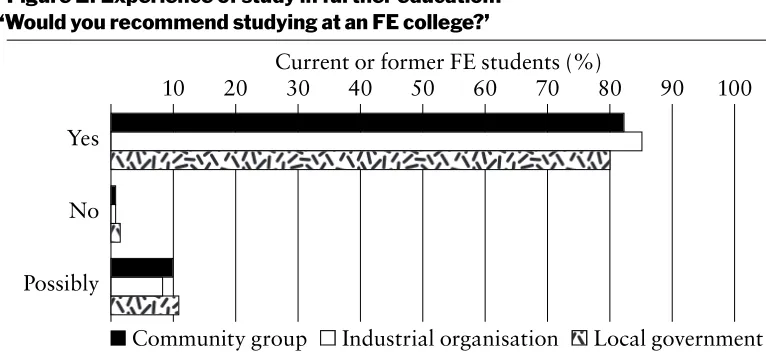
(21) CollComm txt. 22—02—2000. 08—46pm. Page 17. y ; ; y y;y ;y;y;y;y;y;y; ; y y; y; 17. and 6·5% were of Afro-Caribbean, Asian or Chinese origin. In terms of organisations and groups, 224 replies were received from industrial organisations (both small and large), 229 from community/voluntary organisations and 107 from local government organisations and schools. Six respondents did not identify their organisations. Figure 1 Age of questionnaire respondents from colleges’ external communities. 60+ years 9%. unknown 4% under 19 years 1%. 40–59 years 53%. 20–39 years 33%. The nine colleges in the project serve diverse communities in terms of geography, social structures and economies. Some of the colleges engage wholly or partially with rural areas and others with urban areas, from inner-city communities to the wealthier suburbs. Some of the catchment areas have undergone economic decline and a rise in unemployment. While Coventry has seen a loss of apprenticeships and skilled manual workers as manufacturing industries have declined, the region surrounding North Warwickshire and Hinckley College has experienced the collapse of the local coal mining industry. The community of unemployed men is, therefore, a group that all the Coventry and North Warwickshire colleges have to address. Rural colleges such as Evesham have to face the problems of rural poverty. The Midlands is enriched by a diverse ethnic minority community who have particular educational needs. As a whole, the Midlands are characterised by a low participation rate in postcompulsory education. Encouraging those who lack cultural capital to participate in education is, therefore, a large task for the nine colleges. Some of the student participants had overcome barriers to learn in terms of class, gender, ethnicity, age and disability.. Perceptions of further education by community groups Information in this section is drawn from the survey and interview data. Participants’ perceptions of further education were largely based on personal experience rather than the perspective of the organisation they represented, although some employers’ responses proved an exception to this. On the whole, participants shared a narrow view of further education: it was understood and experienced in terms of the course/programme they studied. Overall there was a positive response to studying in further education. Questionnaire data revealed that 98% of those who had studied in further education had found their course useful. In addition, 87% stated that they would recommend studying at an FE college to a friend or family member. There were no significant differences in response by organisation, gender or age. Very few participants had attended a short course of less than a week, although 60% of men compared to 46% of women attended a course lasting longer than a year whereas women were more likely to have attended a course which lasted up to a year (60% compared to 28% male).. The FE college and its communities.
(22) CollComm txt. 22—02—2000. 08—46pm. Page 18. 18. Figure 2. Experience of study in further education: ‘Would you recommend studying at an FE college?’. 10. 20. Current or former FE students (%) 30 40 50 60 70 80. 90. 100. Yes No Possibly ■ Community group ■ Industrial organisation ■ Local government Figure 3. Experience of study in further education: duration of course attended. 10. 20. Current or former FE students (%) 30 40 50 60 70 80. 90. 100. Less than a week Up to one year Over one year ■ Female ■ Male Several participants’ comments illustrated a mismatch between what colleges are providing and what industrial organisations, community groups and local government bodies perceive further education to be doing. Colleges are changing faster than perceptions of them. This is almost certainly unavoidable, though there is much that colleges can do to raise awareness of their new role and functions. Some people still see further education as a place for young people making a transition from school or on block release from local companies: I think probably what would put people off … I think FE colleges have got an image of being for people of the 16+ age group. It takes a bit of bottle for an older person to go in if you have not done anything for years. I tried to get my next door neighbour to go – she’s housebound. She is not totally disabled and could easily go but won’t … She thinks the college is not for her. Employee of an industrial organisation In the main, further education colleges carry on from where schools left off if youngsters have the feeling that they want to go on – if they are going to do A-levels. The second aspect of a technical college is where you have youngsters who are sent on day release from companies and that sort of thing. Travel company employee I would not have thought that it would have been meeting the needs of the middle aged – the people of the estate. My perception of it is that it is a place for kids to go to after they have finished school and to do their further education, be it A-levels or whatever. Member of a playgroup association The last of the above participants also stressed that local parents on the estate regard further education as ‘just a place for young kids to go to’.. The FE college and its communities.
(23) CollComm txt. 22—02—2000. 08—46pm. Page 19. 19. One woman commented, ‘I never really saw it as a place for the likes of me,’ while a man in his 50s thought that further education was attended by ‘the lower age group’. A 16-year-old male described further education as the place you go to ‘if you cannot find a job and you did not do very well at school’. Others were not aware of the move towards flexible delivery of programmes, as shown by the following comments from employers and trade unionists: ● ● ● ●. More courses for foremen/supervisors in the evenings as they work all day. Relevant specialist courses to run either during evenings or as distance learning. Easy access to further education timetabled to suit working people as well as those not in full-time employment. A more flexible working timetable so as to fit in with working mothers or mothers without supporting partners or families.. One lecturer was aware of these misconceptions: I think there’s a lack of awareness in the local community and at the societal level. Getting the message to the local community is a big problem and I’m not quite sure how you should do it and whether there is a secret solution to get the message through … Local people don’t even know where the college is, which is amazing. Younger participants compared their perceptions of school and further education. Escape from the rules and authoritarianism of school to the freedom of further education was valued. Moving to further education was a rite of passage marking the transition from childhood to adulthood: As a young person leaving school and going on to college, my understanding of the transformation from school to college life had been that at school your teachers are there and they tell you what to do. At college you have lecturers and they guide you – your development. It is left to you, the individual, and you develop. You attend your lectures if you want to. Basically you are an adult so you decide. The lecturers are there to help and support you. Training Officer, Afro-Caribbean Women’s Centre At the old school you did not work because you were doing it for the teachers … like the teachers say you have got to do this work. Here they just say, ‘If you do not do the work then that is your problem’. A-level FE student These attitudes reflect those found by Bloomer and Hodkinson (1997) in their study of young learners in further education. Differences were highlighted not only between schools and colleges but between parental and students’ perceptions: The pupil or youth really wants to get away from school whereas it is the parents who want them to stay on. The parents are afraid that they will get into bad company. I know smoking is high, drinking is high, drugs are high, crime is high, anti-social behaviour is high. It is not the fault of the college. The college is there for everybody. Not surprisingly, community/voluntary groups’ perceptions of further education contrasted greatly with those of business organisations. The latter viewed the purposes of further education to be largely instrumental and vocational, while community groups expressed a more collective and social-purpose view. Many employers advocated using further education for training and qualifications. There was also a feeling that there is greater interaction, negotiation and partnership between FE colleges and firms than there used to be: Further education has changed very much from where it was 20 years ago – tremendously changed. In fact now much more looking to what business wants rather than laying on courses and say ‘here they are, this is what we are offering’. Employer. The FE college and its communities.
(24) CollComm txt. 22—02—2000. 08—46pm. Page 20. 20. I think that it is important that they are prepared to listen to what local businesses require. I deal with certain people at further education colleges quite closely and they have been prepared to listen to what we wanted and what we need in terms of students coming to us to work and what sort of things they can do to help prepare the students better for the workplace. There is a college that I do a work experience paper for – a GNVQ student. The organisers of the course came to speak to me and discussed what sort of person I was looking for and what sort of requirements I would need. We actually developed a relationship in that I went to the college and talked to them and I talked to the students about the career path I had taken and that was great because it was a representative from an industry that they were interested in. Hotel manager Most employers in the sample pointed out the need for further education to provide courses leading to vocational qualifications, relevant to the needs of local industries: Serve local employment needs in respect of qualifications – internal examination. Provide national recognised qualifications based on examination – external examination. Mental Health NHS Trust Smaller businesses held different views of further education, largely because, unlike the larger firms, they cannot afford training costs: One of the problems with small, local businesses is that you are spending so much of your time trying to make the business work. It is very difficult to look over your shoulder and say, ‘Right, we’ll chuck half or one-fifth of your time away to worry about re-educating yourself and the people who work for you.’ The expenditure is the problem. You have got to increase your turnover to cover the loss because it is a dead loss as far as your investment goes. OK you might get investment back in the first throw after they have had the education – to make them better employees, more useful employees. The only way you can do that is if you get grants for the industries concerned where they will get some type of pay back for taking on further training. Industrial services business manager Similar economic problems are experienced by community organisations: We have a high regard for the college but have not really made use of it – mainly because we are underfunded and therefore wary of costs involved in sending staff on training, but also we only have three paid staff and therefore find it difficult to find the time. From my perception the college has made remarkable progress in recent years and many of my volunteers have benefited from its courses (particularly women returners). The college, including the excellent Access Centre, already offers the local community a great deal. Vale of Evesham Volunteer Centre Employers had mixed opinions of further education’s usefulness in providing relevant training for local industry and the economy. Some expressed this in terms of a continual cultural gap between them and FE colleges, resulting in their needs not being met. Other reasons given for not using further education included poor communication and interaction between colleges and employers: [Colleges should] actually involve themselves in talking to local business and [discovering] their needs to match training and job prospects to what is actually available after college, and create courses around improvement of the businesses they are involved with. I know that if there are courses at X college connected, for instance, even slightly with what we are doing, we never get contacted to see if we have got anybody [who we might want to attend those courses] so I think that it is a bit lacking. The FE college and its communities.
Figure

Outline
Barriers and critical conditions: who is excluded?
Views from staff
Life in further education: the student perspective
Policy implications
FE staff researching FE – the processes and issues
The FEDA perspective: ways of researching further education Traditionally, research into learning and institutions has been undertaken by dedicated
Related documents