Part Time Study Distorts Student Attrition Rates in
Engineering Programs
Peter Gibbings
University of Southern Queensland, Toowoomba, Australia [email protected]
Elizabeth Godfrey
University of Technology Sydney, [email protected]
Robin King
University of Technology Sydney, [email protected]
Weide Wandel
University of Southern Queensland, [email protected]
Abstract: Standard four-year full-time engineering degrees commonly take eight years when studied part-time by distance education and this can distort apparent retention and attrition rates. Recent publications indicate the national part-time annual retention rate for engineering degrees at regional universities is 62.85%. Extending this over eight years, only 2.4% of part time students who enter the program could be expected to graduate. Whilst most would agree that this graduation rate is quite ridiculous, what would be a reasonable graduation rate? This paper presents empirical data to determine the actual graduation rates achieved with a
predominantly part time cohort of students at a regional university. The results highlight the inappropriateness of generic retention and degree completion models when comparing small regional universities where the majority of students are of mature age and study part time, with large urban universities where the majority of students are school leavers and are studying full time. If retention and completion rates are to be introduced as performance indicators in the higher education sector, the findings of this study have the potential to contribute to the development of appropriate models. It was reassuring that the retention and completion rates achieved at this university are significantly better than the quoted national averages.
Introduction
Following the recommendations of the national review of Higher Education (Bradley, Noonan, Nugent and Scales, 2008), the Australian government has set policy to increase the proportion of 25 to 34 year olds with bachelor-level degree qualifications from 29% now to 40% by 2025. The review and the government have also indicated that the current average graduation rate across all first degree programs of around 70% is lower than desirable. At the same time, the engineering profession (Taylor, 2008) has declared that Australia needs many more graduate engineers in the workforce to satisfy the needs of industry and infrastructure development. To significantly increase the number of engineering graduates, more students will have to enter engineering programs, and as many as possible of these will need to graduate.
The current apparent graduation rate data quoted by King (2008), aggregated from data reported to the Department of Education, Employment and Workplace Relations (DEEWR), indicates that the mean graduation rate during the period 2001 to 2006 for Australian (i.e. not including international
The figure of 54% as an average national completion rate for engineering degrees was derived from commencing enrolment and subsequent graduations data in the scoping project (King, 2008). This completion rate (number of students graduating from a program as a percentage of those who entered the program) was broadly compatible with the mean national annual retention rate of 85.45%, as computed from institution data returns to DEEWR. When the national data was disaggregated for internal communication to the Australian Council of Engineering Deans (ACED), the national annual retention rate for part-time students was found to be 68.62% and for regional universities 62.85%. Applying these annual rates over four years would indicate that only about 16% (62.85% ^ 4) of commencing students are likely to graduate. Moreover, using a power of eight in the assumption that part-time students will take twice as long to graduate, about 2.4% of students entering an engineering program would be expected to graduate. Whilst agreeing that these retention and graduation figures are of concern, it was the opinion of the authors that they do not present an accurate picture,
particularly for their own regional institution which has a high proportion of part-time students.
The University of Southern Queensland (USQ) has been in operation since 1967 and has developed an international reputation for offering quality academic programs in both the on-campus and off-campus (distance or external) modes. The Faculty of Engineering and Surveying (FoES) at USQ offers a suite of articulated undergraduate programs including a two-year Associate Degree in Engineering (AD), a three-year Bachelor of Engineering Technology (BTech), a four-year Bachelor of Engineering (BEng) and three dual degrees: Bachelor of Engineering and Bachelor of Business (BEngBBus); Bachelor of Engineering and Bachelor of Information Technology (BEngBIT); and Bachelor of Engineering and Bachelor of Science (BEngBSc). Each program offers several study majors and all programs are accredited for offer in both the on-campus and the distance modes. Approximately 80% of FoES students study part-time by distance mode. Offering programs by distance provides these students with the flexibility they need to study and work at the same time. This consequently opens up opportunities for many students to enter the profession who would otherwise not be able to consider this career path. It also helps in addressing the national priority of widening access to, and
participation in, higher education identified by Bradley, et al (2008).
As part of the annual course and program quality audit and review cycle, FoES staff are involved in detailed discussions surrounding the understanding of success rates, retention/attrition rates, and ultimately graduation rates of students. FoES is always interested in improving student success in key individual courses, improving students’ overall learning experience, enhancing students’ academic skills, and improving retention and graduation rates.
At least at the superficial or anecdotal level, some relationships are known between aspirations, applications, offers, acceptances, and enrolments/commencements into engineering programs. It is also recognised that post-graduation, not all graduates will enter professional employment. Some will undertake further studies, while others may be lost to the profession. There is a leakage of students throughout the system, but this paper is focused on what happens from when students enrol and commence study to when they ultimately graduate or leave the program for some other reason. At the institutional level, findings will allow informed decisions to be made about the acceptability of the levels of attrition and graduation given the student demographics, and provide insights into strategies for increased retention.
Aim of this paper
and ultimately how many graduate. This analysis was used essentially to look at the dynamics of attrition and to identify patterns of retention and graduation.
A report was obtained from the university statistician on all domestic students entering the BEng or dual degree programs in 1999 and 2003. Of primary concern was the 1999 cohort since commonly a four-year degree taken in external study mode at USQ equates to eight years’ part-time study. To allow for gap years and some students taking less than a full external study load, most of the students commencing in 1999 should have graduated by the end of 2009 when the data were collected and this cohort should provide an overall picture of the full cycle through to graduation. The 2003 cohort was chosen to allow comparisons with other institutions to be reported separately in this conference.
Some issues were identified during the data capture process that might provide some insights into potential problems with officially reported information. It was discovered, through manually checking several hundred individual transcripts, that some of the students included in the reports from the university statistician did not belong in the reports as they commenced engineering at USQ for the first time in a different year from that being studied. Others had not attempted any courses at all and should not have been included. Some of the students in the 1999 report were not in the student enquiry system so it was not possible to verify their commencement term or entry credit points. This led to a large number of students being dropped from the data that were originally supplied. Having discovered a number of students in the reports should not have been included, it was of concern that there may have been students who should have been included in the reports but were not.
Of the 1999 cohort of 226 domestic students, 64.6% studied externally, 24.7% studied on-campus and 10.6% studied multi-modally – 60.6% of the students studied part-time and 39.3% full-time at
commencement.
The data were analysed in spreadsheets to establish the retention and graduation rates reported in the next section. Students who commenced their engineering studies in a year other than those being studied were excluded from the data, as were students who never attempted any courses. Students who articulated from the BEng back to the BTech or AD were included in the data since this
articulation did mean they were lost to the profession. The analysis spreadsheets allowed for sorting and filtering on attributes such as date of birth, gender, mode of study (on-campus, external or multi-modal), entry credit, semester of first enrolment and studying full-time or part-time. The spreadsheets were coded each year (1999 onwards and 2003 onwards) for each student to indicate their: continued enrolment in any of the engineering programs at USQ, taking a gap, switching to a non-engineering program at USQ, graduating from an engineering program at USQ, or not enrolled at USQ.
Results
Figure 1 shows the retention pattern for all domestic students (both on-campus and external) entering the four-year BEng or one of the dual degree programs in 2003. It is recognised that the lines between full-time and part-time are very blurry these days: many on-campus students do not study a full-time load; and many external students may study some on-campus courses. Since, in general, the minimum time for completion of the BEng program is four years, a large number of students began to graduate in 2007. The majority of students who graduated before 2007 entered with advanced standing or articulated from the Associate Degree or Bachelor of Engineering Technology programs. FoES’s high proportion of part-time students explains the continuing graduations five and six years from
!"#$% &'( ) ')%'( * '# !"#$
Figure 1: Retention pattern for the 2003 BEng/Dual Degree Cohort
Although it is beyond the scope of this paper, these retention/attrition and graduation rates were found to be similar in the other undergraduate programs in FoES.
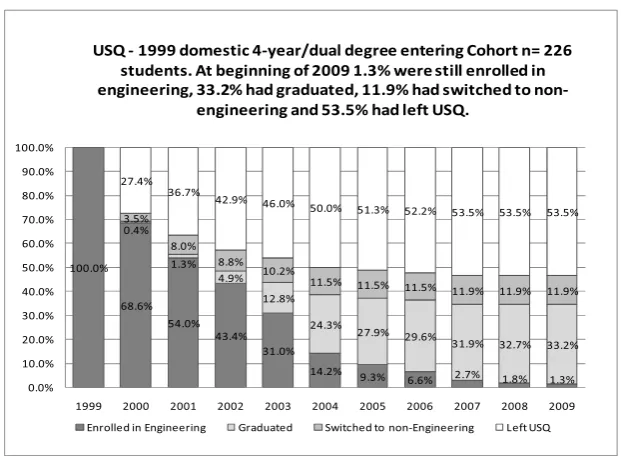
It is evident that, due to the large number of external and part-time students, the trends in Figure 1 will continue for some years. These years need to be added to the study to ensure the whole picture is provided. To this end, the cohort of students entering FoES programs in 1999 was also investigated. This year was chosen since most of this cohort should have completed study by the start of 2009. Results shown in Figure 2 represent domestic students entering the four-year BEng program or one of the dual degree programs in 1999. This Figure is similar to Figure 1 but now the longer term trends can be seen.
$$$&
!"#$ '( ) ') $'(
* *'#
!"#$
Figure 2: Retention pattern for the 1999 BEng/Dual Degree Cohort
The worst retention rate is in first year (69.0%) but this is still better than the stated national part-time annual retention rate for regional universities of 62.85%.
[image:4.595.142.453.412.640.2]is one of the major problems when comparing retention and graduation rates of full-time students with part-time cohorts – if four years were used in the previous calculation it would seem that the average retention rate would appear to be only 76.3%.
The general trends in Figures 1 and 2 are similar. Somewhat better overall retention rates and
graduation rates are apparent for the 2003 cohort in Figure 1, perhaps reflecting efforts by the Faculty in recent years to improve these rates. Comparing Figures 1 and 2, it appears that the retention and graduation rates have improved slightly between 1999 and 2003 and therefore the graduation rate from the 2003 cohort will ultimately be substantially above the national average and well above what might be expected from a regional university with a large part-time cohort (the stated national part-time annual retention rate for regional universities of 62.85%). Using the 2003 figures, graduating 35.3%, assuming half the remaining 8.6% actually go on to graduate, and assuming an average time to graduate of eight years, equates to a retention rate of 87.8%, which again is well above the national average.
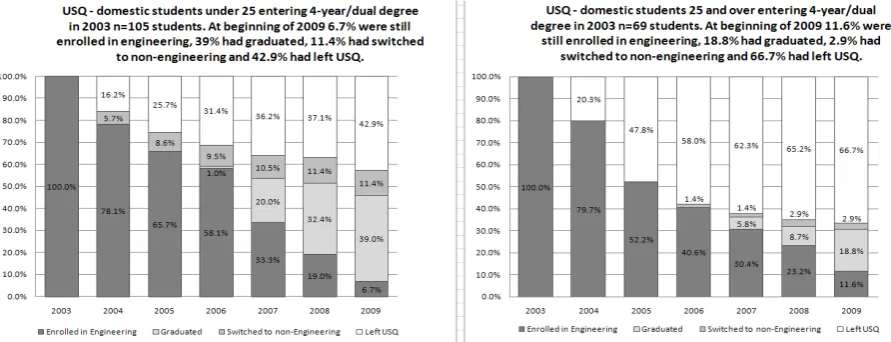
[image:5.595.75.521.329.500.2]It was thought that part-time students have higher attrition rates (consistent with the national averages quoted earlier in this paper from King, 2008) because they are generally older and therefore have to juggle study with other life pressures. This is particularly important for FoES since nearly 40% of the BEng/dual degree students are 25 years of age or older. To investigate this further, the 2003 cohort entering the four-year degree or one of the dual degrees was divided into two age groups: students 25 years of age and above; and students below 25 years of age. Results are shown in Figure 3.
Figure 3: 2003 BEng/Dual Degree Cohort Retention pattern by age
Figures 3 shows that very few students aged 25 and over at the time they commenced their programs switched to other programs at USQ. The older students were probably more certain that they wanted to study engineering. However, the older students were much more likely to leave USQ altogether and of particular concern was the jump in attrition for the older students after two years of study. This could be explained by older students having more work and family commitments than younger students, or that it is much longer since they previously studied. The implication is that university study is more demanding for older students and any intervention strategy must recognise that older students (most of whom study externally) are at particular risk of attrition in their first two years of study.
Table 1 summarises the attrition and graduation rates for the 1999 and 2003 cohorts and may assist readers in making comparisons.
Table 1: Summary of retention and graduation rates 1999 and 2003 domestic student cohorts
% &' (')* +,
+, +,-
(')* +,
+,
+,- (." &'
*./ "0 1"
** #$%/
It was possible to differentiate attrition by the mode of study and Table 2 demonstrates clearly that students studying externally have a higher risk of dropping out of the program.
Table 2. Attrition after n+1, n+2 and n+6 years of study where n = 2003, the year of entry for this cohort of students.
!#
+ , - - -&
2
3
4 )
It should be recognized that some of the students may be studying externally at this institution because of personal or employment circumstances and ‘drop out’ may mean they have been able to shift to on-campus study at a different institution. In such circumstances they are not lost to engineering or to higher education, but current data does not provide information about the destination of students who leave.
Conclusion
(King 2008) reported that approximately 46% of students who commence study in BEng programs do not graduate from them. This loss was seen as excessive in terms of professionally qualified
Engineers and also, in the case of domestic students, a loss of public investment in these students’ education.
Unfortunately, graduation rates that are commonly quoted and used to compare universities can give a misleading picture. A university with a large external/distance student cohort, most of whom are over 25 years of age, can expect a less flattering graduation rate than counterparts that have student cohorts largely under 25 and studying full-time.
One of the great benefits of the USQ suite of programs is it provides an enormously valuable service by providing an opportunity for a large number of students who would not otherwise have that access to undertake engineering education. This is made possible due to the external offering of courses as well as articulation pathways from Associate Degree and Bachelor of Engineering Technology for those who show academic aptitude. Naturally, graduation rates can be improved by tightening entry requirements and not providing external study opportunities, however, ultimately it is considered better for the profession to graduate 40% of 3,000 students than it is to graduate 85% of only 200 students simply because of tightened entry requirements and mandated on-campus study.
[image:6.595.175.421.311.393.2]accurate estimates are to be made about the impact of retention in engineering programs on the engineering workforce. Perhaps the most valuable result of this study of a largely part-time cohort, predominantly studying externally, is that it demonstrates the problematic nature of generic funding models based on retention and completion rates – an average annual retention rate of 85.7% over four years full time leads to a 54% graduation rate, whereas the same retention rate over eight years part time leads to a 29% graduation rate!
References
Australian Learning and Teaching Council (2010) Accessible at <http://www.altc.edu.au/resources>.
Bradley, D., Noonan, P., Nugent, H. & Scales, B. (2008) Review of Australian Higher Education Report: Final Report. Available at <
http://www.deewr.gov.au/HigherEducation/Review/Pages/ReviewofAustralianHigherEducationReport.aspx> King, R. (2008) Engineers for the Future: addressing the supply and quality of Australian engineering graduates for
the 21st century, Australian Council of Engineering Deans (Support for the original work was provided by The Australian Learning and Teaching Council, an initiative of the Australian Government Department of
Education, Employment and Workplace Relations). Available at <http://www.altc.edu.au/resource-addressing-supply-quality-engineering-graduates-uts-2008>
Knight, D.W., Lawrence, E.C. & Sullivan, J.F. (2007) Improving Engineering Student Retention through Hands-On, Team Based, First-Year Design Projects, American Society for Engineering Education Annual Conference and Exposition. Honolulu, HI.
Taylor, P. (2008) Fixing Australia's engineering skills shortage is an urgent and shared responsibility, Engineers Australia media release, 29th January. Available at
<http://www.engineersaustralia.org.au/da/index/getfile/id/5792>