Rochester Institute of Technology
RIT Scholar Works
Theses
7-2019
Exploring the Effectiveness of Privacy Preserving
Classification in Convolutional Neural Networks
Prathibha Rama
Follow this and additional works at:https://scholarworks.rit.edu/theses
This Thesis is brought to you for free and open access by RIT Scholar Works. It has been accepted for inclusion in Theses by an authorized administrator of RIT Scholar Works. For more information, please [email protected].
Recommended Citation
Exploring the Effectiveness of Privacy Preserving
Classification in Convolutional Neural Networks
Exploring the Effectiveness of Privacy Preserving
Classification in Convolutional Neural Networks
Prathibha Rama July 2019
A Thesis Submitted in Partial Fulfillment
of the Requirements for the Degree of Master of Science
in
Computer Engineering
Exploring the Effectiveness of Privacy Preserving
Classification in Convolutional Neural Networks
Prathibha Rama
Committee Approval:
Dr. Marcin Lukowiak Advisor Date Department of Computer Engineering
Dr. Stanis law Radziszowski Date Department of Computer Science
Dr. Cory Merkel Date
Acknowledgments
They say it takes a village to raise a child, but what they did not say is that it also
takes a village to defend a Master0s thesis. I am lucky to have so many people in my
life that have been there for me throughout this journey.
Thank you to my fellow researchers, both past and present, from the Applied
Cryptography and Information Security Lab: Michael Foster, Daniel Stafford, Cody
Tinker, Stephanie Soldavani, Andrew Ramsey, Jason Blocklove, and Eric Scheler.
Not only have you been so supportive, you have also kept me company when I needed
it the most. Also a special shout-out to Cody, Kevin and Yash for responding to my
last-minute questions even when I could have answered them myself.
Thank you to everyone at the RIT research cluster for providing me with the
resources necessary to gather results. A month before meeting you, I honestly did
not think I was going to finish in time. Sidney, Jen, and Andrew, I would have no
results without you and for that I am eternally grateful.
Thank you to my committee members for taking the time to sit in on my defense
and, more importantly, for providing me with the necessary guidance to succeed.
Thank you Dr. Merkel for being the Deep Learning expert in a group of
cryptog-raphers; you answered the simplest questions without judgment, making it easy to
ask no matter the task. Thank you Dr. Radziszowski for being the inspiring
math-ematician that you are and for showing me the ropes in Foundations of
Cryptog-raphy/Advanced Cryptography; I am still in awe at the vast amount of knowledge
you have and I look forward to emailing you with my future security queries. To Dr.
Lukowiak, I cannot thank you enough for all that you have done to guide me
through-out this process; you helped me when I needed it the most and always provided a
path to solve the problems I did not think I could solve.
Thank you to my friends who supported me in person or via phone. Neha and
cryp-tography, but you did, and it meant a lot.
Last, but certainly not least, I want to give a special thanks to my family. We
have had an interesting run these past 7 years and while there were times I wanted to
wallow in self-pity, you all found a way to bring me out and cheer me up. Thank you
Apoorva for understanding the stress of graduate school; sometimes I just wanted to
vent and you were a phone call away. Thank you Dad for providing sound and stable
advice; you are a calm voice of reason in an otherwise noisy environment. Finally,
thank you Mom for just being there; you have put up with my unpredictable stress,
you have stood by my side during my darkest moments, and ultimately I am proud
Abstract
A front-runner in modern technological advancement, machine learning relies heavily
on the use of personal data. It follows that, when assessing the scope of
confiden-tiality for machine learning models, understanding the potential role of encryption is
critical. Convolutional Neural Networks (CNN) are a subset of artificial feed-forward
neural networks tailored specifically for image recognition and classification. As the
popularity of CNN increases, so too does the need for privacy preserving
classifica-tion. Homomorphic Encryption (HE) refers to a cryptographic system that allows
for computation on encrypted data to obtain an encrypted result such that, when
decrypted, the result is the same value that would have been obtained if the
op-erations were performed on the original unencrypted data. The objective of this
research was to explore the application of HE alongside CNN with the creation of
privacy-preserving CNN layers that have the ability to operate on encrypted images.
This was accomplished through (1) researching the underlying structure of preexisting
privacy-preserving CNN classifiers, (2) creating privacy-preserving convolution,
pool-ing, and fully-connected layers by mapping the computations found within each layer
to a space of homomorphic computations, (3) developing a polynomial-approximated
activation function and creating a privacy-preserving activation layer based on this
approximation, (4) testing and profiling the designed application to asses efficiency,
Contents
Signature Sheet i
Acknowledgments ii
Abstract iv
Table of Contents v
Acronyms viii
1 Introduction 1
1.1 Motivation and Problem . . . 1
1.2 Homomorphic Encryption . . . 3
1.3 This Work . . . 3
2 Background 5 2.1 Privacy Preservation Techniques . . . 5
2.1.1 Secure Hardware: Intel SGX . . . 5
2.1.2 Secure Multi-party Computing . . . 6
2.1.3 Homomorphic Encryption . . . 6
2.2 Types of Homomorphic Cryptosystems . . . 7
2.3 High Level Fully Homomorphic Encryption (FHE) . . . 8
2.3.1 FHE Blueprint . . . 9
2.3.2 Noise Growth . . . 9
2.4 Convolutional Neural Networks . . . 10
3 Related Work 12 3.1 Privacy Preserving Deep Computation Model on Cloud for Big Data Feature Learning . . . 13
3.2 CryptoNets: Applying Neural Networks to Encrypted Data with High Throughput and Accuracy . . . 14
3.3 Privacy Preserving Classification on Deep Neural Network . . . 14
CONTENTS
4 Mathematics of Homomorphic Encryption 17
4.1 Mathematic Structures . . . 17
4.1.1 Lattices . . . 17
4.1.2 Rings . . . 19
4.2 Hard Problems . . . 20
4.2.1 Shortest Vector Problem . . . 20
4.2.2 Learning With Errors . . . 20
4.2.3 Ring Learning With Errors . . . 22
5 Fully Homomorphic Encryption 24 5.1 Practical FHE . . . 24
5.2 FHE Functions . . . 24
5.2.1 Homomorphic Addition . . . 25
5.2.2 Homomorphic Multiplication . . . 25
5.3 Popular FHE Cryptosystems . . . 25
5.3.1 FV Cryptosystem . . . 26
5.3.2 BGV Cryptosystem . . . 28
5.4 HElib vs. Microsoft SEAL . . . 30
6 HElib Functions, Security and Parameter Selection 35 6.1 Math Notation . . . 35
6.2 Functions . . . 36
6.2.1 ContextGen . . . 36
6.2.2 Key Generation . . . 36
6.2.3 Encryption . . . 37
6.2.4 Decryption . . . 37
6.2.5 Addition and Multiplication . . . 37
6.2.6 Modulus Switching . . . 38
6.2.7 Bootstrapping . . . 38
6.3 Security . . . 38
6.4 Parameter Selection . . . 39
6.4.1 Parameters for Security . . . 39
6.4.2 Parameters for Functionality . . . 40
7 Design 43 7.1 CNN Layers . . . 43
CONTENTS
7.1.2 Convolution . . . 44
7.1.3 Activation . . . 45
7.1.4 Pooling . . . 46
7.2 Layer Design . . . 47
7.2.1 HElib Encoding and Functions . . . 47
7.2.2 Fully Connected Design . . . 48
7.2.3 Convolution Design . . . 49
7.2.4 Activation Design . . . 50
7.2.5 Pooling Design . . . 53
8 Privacy Preserving Logic Gates 55 8.1 Logic Gates . . . 55
8.2 Network . . . 56
8.3 Test Environment . . . 56
8.4 Results . . . 57
9 Privacy Preserving CNN 60 9.1 Dataset . . . 60
9.2 Network . . . 61
9.2.1 Training . . . 62
9.2.2 Testing . . . 63
9.3 Test Environment . . . 63
10 Profiling Results 65 10.1 Timing . . . 65
10.2 Scale Variation . . . 69
10.3 Security Parameter Variation . . . 73
10.4 Level Variation . . . 76
10.5 Column Variation . . . 79
10.6 Thread Variation . . . 81
10.7 Fast Configuration . . . 83
11 Conclusion and Future Work 84
Acronyms
ANN Artificial feed-forward Neural Networks
ASVP Approxmate Shortest Vector Problem
BGV Brakerski-Gentry-Vaikuntanathan
CIFAR10 Canadian Institute for Advanced Research
CNN Convolutional Neural Networks
FHE Fully Homomorphic Encryption
FV Fan and Vercauteren
HE Homomorphic Encryption
Intel SGX Intel Software Guard Instructions
LWE Learning with Errors
MNIST Modified National Institute of Standards and Technology
MPC Secure Multi Party Computing
OWF One Way Function
PHE Partially Homomorphic Encryption
PKE Public Key Encryption
PRNG Pseudo Random Number Generator
Acronyms
RLWE Ring Learning with Errors
RSA Rivest Shamir Adleman
SIS Short Integer Solution
SIVP Shortest Independent Vectors Problem
SRC Secure Remote Computation
SVP Shortest Vector Problem
SWHE Somewhat Homomorphic Encryption
SYY Sander Young Yung
UNUM Universal Number
uSVP Unique Shortest Vector Problem
Chapter 1
Introduction
1.1
Motivation and Problem
The rise of information technology in the everyday human experience brings forth a
new form of currency: privacy of the individual. A search for restaurants near me,
while seemingly cost-free, is only possible when the individual searching discloses their
current location. Personal data is traded daily and it is only upon close inspection
that the potential vulnerability of sharing such information becomes obvious. As a
front-runner in technological advancement, that plays a lead role in many modern
innovations, machine learning relies heavily on the use of personal data. In
ma-chine learning, analytic models are utilized to make informed predictions on provided
datasets. Because input datasets can vary from public images of handwritten digits
to more sensitive information such as personal medical history, the rise in machine
learning naturally leads to an urgency for privacy within specific applications. In
addition, many machine learning models need significant computing power to process
large amounts of data in an efficient manner. A solution to this conundrum is to take
advantage of cloud resources. From a security perspective, a cloud based solution
opens the door for a myriad of vulnerabilities. But what if it were possible to have
the best of both worlds? Is there potential for taking advantage of cloud resources,
CHAPTER 1. INTRODUCTION
already trained model is hosted on the cloud, can an individual encrypt their data,
send the encrypted data to the cloud, process the encrypted data through the model,
and receive an encrypted result that only the individual can decrypt? This exact
scenario has been proven possible via privacy preserving classification.
Understand-ing the use of encryption within privacy-preservUnderstand-ing classification is therefore essential
when assessing the confidentiality and efficiency of a system. The privacy-preserving
classification problem is concerned with the idea of making encrypted predictions
on an encrypted dataset. In machine learning, there are three datasets involved in
the creation and execution of a predictive model: training, validation, and testing.
During the learning phase, a training dataset is utilized to determine the weights
that make up the predictive model. Throughout the learning phase these weights are
updated until either a minimum error threshold has been met or a maximum
num-ber of iterations has been achieved. A validation dataset is used during the learning
phase to fine-tune the architecture and meta-parameters of the model and query the
models performance on unseen data. This fine-tuning helps minimize the potential
for over-fitting. Following the learning phase, a testing dataset is used to confirm the
predictive power of the final model. This portion is called the classification phase.
In the context of privacy-preserving classification, the learning phase works with
un-encrypted datasets while the inference phase works with un-encrypted datasets. This
scenario assumes a client-server model where the server has already trained the
pre-dictive model, but would now like to modify the model to classify encrypted inputs.
The learning phase follows the same procedure of updating weights and fine-tuning
model architecture using unencrypted training and validation datasets. The
differ-ence in process can be observed during the classification phase, where the testing
dataset is encrypted with a secret key before it is fed through the model that
out-puts an encrypted prediction. This output prediction can then be decrypted by the
CHAPTER 1. INTRODUCTION
the privacy-preserving classification problem are based on various approaches that
include Secure Multi Party Computing (MPC), Secure Remote Computation (SRC),
and Homomorphic Encryption (HE). Although each approach theoretically provides a
viable solution, those that take advantage of HE have been successfully implemented
and documented. The focus of this study is to take a closer look at an approach based
on HE and observe the intersection of security and ease of use.
1.2
Homomorphic Encryption
Derived from the Greek words for same form, homomorphism is a structure-preserving
transformation of one algebraic set into another. In the field of cryptography, HE
describes a cryptosystem where the transformation from the plaintext space to the
ciphertext space preserves relationships between elements. This property allows for
meaningful computation on ciphertexts. Such computations generate an encrypted
result that, when decrypted produce the same value that would have resulted from
the plaintext computation.
1.3
This Work
Several solutions to the privacy-preserving classification problem are based on HE
[1] [2] [3] [4]. While these solutions boast accuracy and efficiency, they are largely
unverified and understudied. In fact, with limited documentation and unavailable
source code, finding even a simple case-study proves difficult. This research focuses
on a more in depth exploration of using HE alongside Convolutional Neural Networks
(CNN).
In this study, HElib, an open source cryptographic library based on the
Brakerski-Gentry-Vaikuntanathan (BGV) scheme [5], was integrated with CNN. Although it
CHAPTER 1. INTRODUCTION
focus of this study was to explore the feasibility of encrypted classification and the
intricacies involved with HElib.
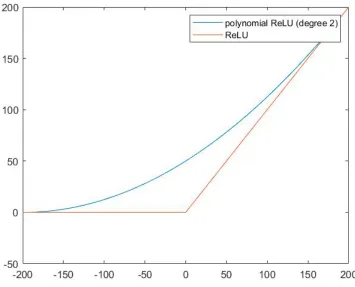
To work with HE functions, low degree polynomial-approximations of both the
Rectified Linear Unit (ReLU) and Sigmoid activation functions were designed.
Train-ing of the CNN was done with the original activation functions on unencrypted data
and classification was done with the polynomial-approximated activation functions on
data encrypted by HELib. In addition to the activation layers, a privacy-preserving
convolution layer, privacy-preserving pooling layer, and privacy-preserving fully
con-nected layer were created. To verify the correctness of these privacy-preserving layers,
initial tests were done utilizing a simple three-layer network. This was used to
pre-dict the output of a specified logic gate based on an encrypted input vector and an
unencrypted weights file produced during the training phase. This network was then
tested to illustrate that classification on encrypted data is indeed possible and to
highlight some basic metrics regarding smaller privacy-preserving classifiers.
Following initial results, a larger eight-layer network was created to perform
en-crypted classification on the Modified National Institute of Standards and Technology
(MNIST) handwritten digit dataset. This application was profiled and tested for
ac-curacy, efficiency, performance, and overall practicality. The results of this experiment
illustrate the potential role of HE in many modern information systems, specifically
those that utilize CNN.
To analyze the behavior of privacy-preserving classification from a security/cryptographic
perspective, the HE parameters were varied to observe the effects of parameter size
on efficiency and of noise on accuracy. To analyze the behavior of privacy-preserving
classification from a Deep Learning perspective, the effects of varied scaling were
noted, specifically the relationship between the number of fixed bits used to represent
the weights/biases and overall classification accuracy. How many bits are needed for
Chapter 2
Background
2.1
Privacy Preservation Techniques
A primary focus for this study is the method of privacy preservation used to secure
CNN; not only should the chosen method allow for secure computation, it must also
provide a robust level of security. Three popular privacy preservation techniques that
were explored in the interest of protecting CNN are SRC, MPC, and HE.
2.1.1 Secure Hardware: Intel SGX
The SRC problem is defined by an individual0s ability to execute software on a remote
computer while maintaining a level of security [6]. The SRC problem assumes that
the remote computer is hosted by a non-trustworthy party and therefore emphasizes
the necessity for both data confidentiality and data integrity.
Introduced as a solution to the SRC problem, Intel Software Guard Instructions
(Intel SGX) aims to secure user-level code with the use of enclaves or protected regions
of memory. Equipped with a special set of CPU instructions, a user can upload data
into a secure container where private computations may be executed. Unlike other
secure hardware platforms, which use attestation for a considerable amount of code,
Intel SGX uses attestation to vouch specifically for the enclave and its contents. On
CHAPTER 2. BACKGROUND
but recent studies have shown that this platform has certain drawbacks. In fact, it
has been demonstrated that the Intel Intel SGX is particularly vulnerable against
cache timing attacks [7]. In addition, according to sources the Intel SGX security
claims do not hold for cloud environments [6] [7]. For example, there is a potential
scenario where there is co-location between a logical processor running Intel SGX and
a logical processor running malicious code. Because the motivation for this study is
to increase security in the cloud, secure hardware was ruled out [6].
2.1.2 Secure Multi-party Computing
MPC refers to a protocol that grants the ability to calculate functions in a distributed
manner. The idea behind MPC is to create a method that allows for several parties
to perform computations with one another while maintaining the privacy of each
party’s input data i.e. collaborative computation without disclosing private data
[8]. With MPC, participating parties each provide their input data. This is divided
into distinct pieces, each of which are masked with a random value and sent out to
various servers. This process ensures the privacy of each individuals personal input
data, while allowing for joint computation [9].
2.1.3 Homomorphic Encryption
A form of encryption that allows computation on ciphertexts, HE has many potential
applications. In a broad sense, HE cryptosystems function like many other Public
Key Encryption (PKE) cryptosystems, where data is encrypted with a public key
and decrypted with a private key. Unlike other cryptosystems, once the data is
encrypted with the public key, HE allows for valid arithmetic operations on encrypted
data. For example if an operation, say homomorphic addition, is performed between
two encrypted values, the output will be the encrypted result of the unencrypted
CHAPTER 2. BACKGROUND
[image:19.612.165.481.109.393.2]operations done in the plaintext space. This can be observed in figure 2.1.
Figure 2.1: High Level Diagram of Homomorphic Encryption
Of the three privacy-preserving techniques mentioned, solutions based on Fully
Homomorphic Encryption (FHE) have been successfully implemented and documented.
For the purpose of this study, the BGV encryption scheme was chosen as it is the most
effective FHE scheme for polynomial evaluations [10]. An open source implementation
of BGV, HELib was integrated alongside a CNN.
2.2
Types of Homomorphic Cryptosystems
There are three types of HE: Partially Homomorphic Encryption (PHE), Somewhat
Homomorphic Encryption (SWHE), and FHE.
PHE is a cryptosystem that allows for one type of operation on encrypted data.
cipher-CHAPTER 2. BACKGROUND
text space. Famous examples of PHE cryptosystems include Rivest Shamir Adleman
(RSA), which allows for unlimited multiplication, El-Gamal, which allows for
unlim-ited multiplication, and Pallier, which allows for unlimunlim-ited addition [11]. Practical
uses for PHE have manifested in the form of electronic voting, where votes are
homo-morphically added, and Private Information Retrieval, where values are
homomor-phically compared [11].
SWHE is a cryptosystem that allows for a limited number of operations on
en-crypted data. These operations can only be performed a limited number of times
within the ciphertext space. Examples of SWHE include BGN, which allows for
un-limited addition and one multiplication, Polly Cracker, which allows for arbitrary
additions/multiplication, and Sander Young Yung (SYY), which allows for unlimited
ANDs and one OR/NOT [11]. Practical uses for SWHE are generally seen when the
depth of the evaluation operation is constant [11].
FHE is a cryptosystem that allows for an unlimited number of operations on
encrypted data. These operations can be performed an unlimited number of times
within the ciphertext space. Examples of FHE include Gentrys FHE scheme and
BGV, both of which allow for unlimited addition and unlimited multiplication.
Be-cause FHE cryptosystems allow for an unlimited number of operations an unlimited
number of times, they can theoretically be used for any application [11].
2.3
High Level FHE
FHE is a type of HE that allows for an unlimited number of operations on encrypted
data. The first FHE scheme was introduced in 2009 by Craig Gentry [12]. Based
on the mathematics of ideal lattices, Gentrys FHE scheme is comprised of two steps.
The first step is to start with a Somewhat HE scheme (SWHE). SWHE is a type of
HE that allows for both homomorphic addition and homomorphic multiplication a
CHAPTER 2. BACKGROUND
of how SWHE schemes are constructed. Built on the Learning with Errors (LWE)
problem, each ciphertext has some noise that hides the original message. The
pri-mary limitation with this construction is the inevitable noise growth that results from
arithmetic operations; once the noise reaches a certain threshold, the original message
is irretrievable. The second step is to add a Bootstrapping mechanism to the SWHE
scheme to refresh the ciphertext. Bootstrapping essentially consists of
homomorphi-cally evaluating the decryption circuit for noise reduction. Although this method is
both secure as well as functionally correct, it is not considered practical. This lack
of practically is largely because of high computation cost and high memory cost.
Following Gentrys 2009 scheme, several other FHE schemes have been developed.
These include schemes based on ideal lattices (Gentrys scheme)[12], schemes based
on (Ring) LWE (BGV)[5], and schemes based on integers (Van Dijks scheme)[13].
2.3.1 FHE Blueprint
PKE schemes contain the following three functions: KeyGen, Encrypt, and Decrypt.
KeyGen is used to generate both the secret key and the public key, Encrypt is used
to encrypt the plaintext data into a ciphertext, and Decrypt is used to decrypt the
ciphertext data into a plaintext. FHE schemes contain the following four functions:
KeyGen, Encrypt, Decrypt, and Evaluate. KeyGen, Encrypt, and Decrypt are the
same as any other PKE scheme, but the addition of an Evaluation function allows for
computations on ciphertexts. Evaluation performs some function with a set of
cipher-texts as inputs and outputs a ciphertext that corresponds to a functional plaintext.
For FHE schemes, the evaluate function will consist of Addition and Multiplication.
2.3.2 Noise Growth
The base construction of practical FHE schemes focuses on the concept of noisy
CHAPTER 2. BACKGROUND
is like hidden error correcting codes, where the intended message is the codeword,
but the sent message is the codeword with some error. If the noise is small, then the
receiver can use the knowledge of a hidden code to remove the noise. However, if the
noise is large, decryption is impossible for the receiver.
When performing any mathematical operation on noisy ciphertexts, noise growth
is inevitable. Thus, both addition and multiplication will increase noise. While
addition adds the noise vectors, multiplication multiplies the noise vectors, making
the noise growth extremely large. Recall that for a cryptosystem to be considered
fully homomorphic, the operations must have the ability to be performed an unlimited
number of times. If noise growth renders the ciphertext meaningless after only a few
multiplications, the cryptosystem is not fully homomorphic. This implies that for
multiplication to be considered meaningful for an unlimited number of times, noise
growth must be managed.
2.4
Convolutional Neural Networks
Neural networks or Artificial feed-forward Neural Networks (ANN) refer to computer
systems that are inspired by the human brain. Comprised of multiple layers, the
nodes found within neural networks are interconnected like neurons found within the
brain. Neural networks constitute three types of layers: input layer, hidden layers,
and output layer. The input layer takes in the various features of an input data point
and relays these features to the hidden layer. The hidden layer then computes a
function over values gained from the previous layer and passes the calculated values
to the next layer. The output layer then performs the final computation on values
gained from the hidden layer [14]. CNN are a type of Neural Network used specifically
for image recognition. Like ANN, CNN consist of an input layer, hidden layer, and
output layer. In addition to the common types of layers observed in ANN, CNN
CHAPTER 2. BACKGROUND
convolutional filtering in mind and therefore facilitates image processing. At a
high-level CNN take an input image and then, through a series of layers, transforms this
data into an output of label scores. Layers within CNN are ordered one after another,
where each one is linked to a layer before and a layer after. In this case, the output
of a function applied to the neurons of the current layer will be the input neurons to
Chapter 3
Related Work
Although privacy preserving deep learning is a relatively new area of research, recent
studies have proven successful with the integration of cryptography and deep learning.
The primary metric for success in most of these studies is the ability to preserve the
accuracy of the original Neural Network even after the introduction of HE.
It should also be noted that there is a distinction between encrypted training and
encrypted classification. Like CNN, designing a privacy preserving CNN involves both
a training phase and a classification phase. In the context of encrypted data, this
means the privacy preserving CNN can be trained on encrypted data and classified on
unencrypted data, trained on unencrypted data and classified on encrypted data, or
trained on encrypted data and classified on encrypted data. The motivation behind
encrypted training is to avoid model leakage; if the model is trained on encrypted data,
it is difficult to infer anything about the data even with heavy statistical analysis.
The motivation behind privacy preserving classification is to ensure individual privacy
while maximizing the efficiency of cloud computing; if a server is hosting an already
trained model can it be modified so that the client can secure their data before sending
it for classification?
Prior to privacy preserving deep learning, efforts were made to integrate HE with
basic machine learning classifiers. In a 2015 study, Bost et. al created three private
CHAPTER 3. RELATED WORK
private classifier proved both robust and efficient when tested on relevant datasets.
This study provided the necessary groundwork for future attempts at incorporating
HE with Machine Learning.
3.1
Privacy Preserving Deep Computation Model on Cloud
for Big Data Feature Learning
In a study done by Chen et. al [1] privacy preserving deep computation is explored
during the training phase. The goal of this experiment is to improve the efficiency of
training by offloading expensive operations to the cloud. Input data is encrypted using
the BGV encryption scheme and then uploaded to the cloud where the high-order
back propagation can be performed. Because HE does not support exponentiation,
the primary modification introduced is the Taylor series approximation of the Sigmoid
Activation function. Timing and accuracy results were gathered for both the original
high-order back propagation algorithm outlined in the paper and the modified privacy
preserving back propagation algorithm which incorporated the computing power of
the cloud. Results of this experiment clearly show an improvement in efficiency,
with the privacy preserving scheme being two times more efficient, with regards to
timing, than the non privacy preserving scheme. This comparison was done . At
the same time, the privacy preserving scheme introduces a 2% accuracy degradation
when compared to the conventional scheme. Although this experiment does not focus
specifically on privacy preserving CNN, it does examine how to integrate HE with a
deep learning model by using a Taylor Series representation of the Sigmoid activation
CHAPTER 3. RELATED WORK
3.2
CryptoNets: Applying Neural Networks to Encrypted
Data with High Throughput and Accuracy
One of the first commercial examples of integrating HE with Neural Networks, Microsoft0s
CryptoNets [2] presents a method for converting learned neural networks to neural
networks that can be applied to encrypted data. The goal of this experiment is to
improve the efficiency of Neural Network classification using the cloud. Input data
is encrypted using the Yet Another Somewhat Homomorphic Encryption Scheme
(YASHE) encryption scheme and then uploaded to the cloud, where the privacy
preserving neural network classifies the encrypted data. Because HE only supports
addition and multiplication, the primary modification introduced is the replacement
of the non-linear layers. The ReLU activation layer is replaced with the square
func-tion and the Max Pooling layer is replaced with Sum Pooling. Using the modified
privacy-preserving Neural Network, classification accuracy on the MNIST dataset is
98.95%, where as state of the art accuracy is 99.77%. This experiment is tested on a
small CNN that has a total of 9 layers with two activation layers. This study shows
how to implement a small-scale privacy preserving CNN with the modification of
non-linear layers.
3.3
Privacy Preserving Classification on Deep Neural
Network
It is important to note that because the square activation function has an unbounded
derivative, too many of these activation layers will lead to unstable training. This
means CryptoNets becomes largely ineffective for large CNN where there are many
ac-tivation layers or non-linear layers in general. To overcome this drawback, Chabanne
CHAPTER 3. RELATED WORK
of batch normalization (Ioffe and Szegedy) to both the training and classification
phase. During the training phase, the original ReLU function is used, max pooling is
replaced with sum pooling, and a batch normalization level is added before each
acti-vation layer. During the privacy-preserving classification phase, the ReLU function is
replaced with a low-degree polynomial approximation, max pooling is replaced with
sum pooling, and a batch normalization level is added before each activation layer.
Initial accuracy result show that this approach while successful on a light CNN (9
total layers, 2 activation layers) shows a fair amount of accuracy degradation on a
deep CNN (24 total layers, 6 activation layers). Following initial accuracy analysis,
improvements are made by building new polynomial approximations learned form a
distribution close to output distribution of batch normalization. Results show that
non-private classification accuracy (ReLU) is 99.59% while private classification
ac-curacy is 99.30%. This study highlights how batch normalization and low degree
polynomial approximation of the ReLU activation function can be used to improve
the accuracy of privacy preserving CNN.
3.4
CryptoDL: Deep Neural Networks over Encrypted Data
A study done by Hesamifard et. al [4] takes into consideration the aforementioned
pit-falls and attempts to improve the accuracy of privacy preserving CNN by studying the
behavior of approximated activation functions. The methods for approximating the
ReLU function include: numerical analysis, Taylor series, standard Chebyshev
poly-nomials, modified Chebyshev polypoly-nomials, and their approach based on the derivative
of the ReLU function. Using the best method of approximation, ReLU derivative, a
privacy preserving CNN was implemented and tested on both the MNIST and
Cana-dian Institute for Advanced Research (CIFAR10) datasets. The model achieved a
classification accuracy of 99.52% for the MNIST dataset. Because the approximation
CHAPTER 3. RELATED WORK
Chapter 4
Mathematics of Homomorphic Encryption
The foundation of all FHE schemes relies on the mathematics of lattices. Because the
mathematics of lattices contain various hard problems, it lends itself to the field of
cryptography. Two popular hard problems include the Short Integer Solution (SIS),
used to create One Way Function (OWF) and collision resistant hashing, and LWE,
used to create Pseudo Random Number Generator (PRNG) and PKE [17]. Based on
these hardness assumptions as well as others, existing FHE schemes can be divided
into four categories: Ideal Lattice-Based, Integer-Based, (Ring) LWE, and
NTRU-Based. Currently, Ring Learning with Errors (RLWE)-Based cryptosystems are the
primary focus of FHE.
4.1
Mathematic Structures
4.1.1 Lattices
An abstract structure in mathematics, an n-dimensional lattice is all integer linear
combinations of n basis vectors b1, b2, ..., bn. Depending on the basis, the same lattice
can be generated in multiple different ways. An n-dimensional lattice can be observed
in figure 4.1.
Generally speaking, short vectors are considered good basis while long vectors are
CHAPTER 4. MATHEMATICS OF HOMOMORPHIC ENCRYPTION
Figure 4.1: n-dimensional Lattice [17]
[image:30.612.210.437.72.229.2]lattice can be observed in figure 4.2.
Figure 4.2: Good basis vs Bad basis for the same Lattice [17]
In simple terms lattices are partially ordered sets where each pair of elements has
a unique combination comprised of an upper bound and a lower bound. A popular
example of a lattice is the natural numbers where the lower bound between two
elements is the greatest common divisor and the upper bound between two numbers
is the least common multiple. The order relation in this example would be divisibility
CHAPTER 4. MATHEMATICS OF HOMOMORPHIC ENCRYPTION
Figure 4.3: Lattice based on natural numbers with divisibility as the order relation: GCD, LCM [19]
4.1.2 Rings
A ring R is defined as a set of elements with two operations: addition and
multipli-cation. Therefore, if two elements are added/multiplied within a ring, it will produce
another element in the ring. A ring is an abelian group under addition: addition is
both associative and commutative and there exists and additive identity and additive
inverses. This property of a ring makes subtraction possible. A ring is a monoid
un-der multiplication: multiplication is associate, but not commutative and there usually
exists a multiplicative identity, although it is not required. This property of a ring
makes division impossible. In a ring, multiplication is distributive with respect to
addition [20]. To summarize, a ring is a set of elements that contains addition,
sub-traction, and non-commutative multiplication, but does not contain division. rings
are useful for generalizing structures such as matrices. For example, the 2X2 matrices
CHAPTER 4. MATHEMATICS OF HOMOMORPHIC ENCRYPTION
4.2
Hard Problems
In cryptography the computation hardness assumption refers to the hypothesis that a
practical size problem cannot be solved in polynomial time, making it impractical for
a computer to solve. The mathematics of lattices contains many such hard problems.
4.2.1 Shortest Vector Problem
The Shortest Vector Problem (SVP) is one of the most commonly known hardness
problems. This problem states that given a basis, find a shortest non-zero vector,
where λ1 is the length of the shortest non-zero vector. An example of the SVP in
1-Dimensional space is finding the greatest common denominator between two elements.
On a small scale, this problem seems easy, but as many cryptosystems have shown this
problem can prove difficult to solve. From SVP stems two permutations: Approxmate
Shortest Vector Problem (ASVP) and Shortest Independent Vectors Problem (SIVP)
[22].
The ASVP states that given a basis, findα-approximate shortest vector. In other
words, find a non-zero vector of length at most αx1. This permutation suggests that
the goal is not to find the exact shortest vector, but vector that is relatively close to
the shortest [23].
The SIVP states that given a basis, find n vectors of length at most λn, where
λn = min { r: there are n linearly independent lattice vectors of length ≤ r} [23]
4.2.2 Learning With Errors
The hard problem used in PKE is LWE. LWE takes the easy problem of solving a
system of linear equations and transforms it into the hard problem of solving a system
CHAPTER 4. MATHEMATICS OF HOMOMORPHIC ENCRYPTION Original: ~ s∗
5 1 3
6 2 1
=
11 3 9
→F ind ~s
Modified:
~s∗
5 1 3
6 2 1
+
e1 e2 e3 =
11 3 9
→F ind ~s
where e1, e2, e3 are small values.
The slight perturbation caused by the error vector is what makes this problem
computationally difficult to solve. At a high-level, LWE states that given many noisy
equations on a secret s, it is impossible to find s. Formally, LWE can be defined as:
(A, sTA+eT)→F ind ~s (4.1)
where AZmxn
q , ~sZqn, e is a ”small” error vector.
A variant of the LWE problem, that is as hard as LWE, is the decisional-LWE
problem. At a high-level, decisional-LWE states that given many noisy equations on
a secret s, it is impossible to distinguish them from random values [23]. Formally,
decisional-LWE can be defined as:
(A, sTA+eT) = (A, b) (4.2)
where AZmxn
q , ~sZqn, e is a ”small” error vector, b is uniformly random.
CHAPTER 4. MATHEMATICS OF HOMOMORPHIC ENCRYPTION
a PRNG. Given the function:
gA(s, e) = (sTA+eT) (4.3)
If LWE is assumed, then gA is an OWF and if decisional-LWE is assumed, then
gA is a PRNG.
4.2.3 Ring Learning With Errors
Another example of a ring are the polynomials with integer coefficients. In this case,
addition, subtraction and multiplication will successfully produce another polynomial
with integer coefficients, while division will not.
Polynomial Ring K[X] in X over a field K: a0+a1x+...mod aiK
Quotient RingK[X]/[b0+b1x+...+bnxn]: a0+a1x+...mod b0+b1x+...+bnxn
RLWE is an extension of LWE that utilizes ring elements:
(A, sTA+eT)→F ind ~s (4.4)
where eT is a ”small” error vector.
RLWE is used over LWE because it is more efficient to compute and store ring
elements. The following example illustrates addition and multiplication with ring
elements on Zq[x]/xn+ 1:
Say that q= 17 and n = 4 then:
a := 15 + 2x+ 4x2+ 7x3Z
CHAPTER 4. MATHEMATICS OF HOMOMORPHIC ENCRYPTION
b := 8 + 9x+ 3x2+ 4x3Z
17[x]/(x4+ 1)
Addition:
a+b = ((15 + 2x+ 4x2+ 7x3) + (8 + 9x+ 3x2+ 4x3)) mod (17, x4+ 1)
= 23 + 11x+ 7x2+ 11x3 mod (17, x4+ 1)
= 6 + 11x+ 7x2+ 11x3 mod (17, x4+ 1)
Observe that the coefficients of the polynomial are bounded by 17 while the
poly-nomial itself is bounded by x4 + 1. This is the reason why 23 becomes 6 in the final
two lines as 23 mod 17 = 6.
Multiplication:
a∗b = ((15 + 2x+ 4x2+ 7x3)∗(8 + 9x+ 3x2+ 4x3)) mod (17, x4+ 1)
= (120 + 151x+ 95x2+ 158x3+ 83x4+ 37x5+ 28x6) mod (17, x4+ 1)
= (120 + 151x+ 95x2+ 158x3+ 83(−1) + 37(−x) + 28(−x2) mod (17, x4+ 1)
= (37 + 114x+ 67x2 + 158x3) mod (17, x4+ 1)
= (3 + 12x+ 16x2+ 5x3) mod (17, x4+ 1)
Similar to the addition example, the coefficients of the polynomial are bounded by
17 while the polynomial itself is bounded byx4+ 1. Becausex4 =−1 mod (x4+ 1),
Chapter 5
Fully Homomorphic Encryption
5.1
Practical FHE
Considered the Holy Grail of HE, FHE is a cryptosystem that allows for an
unlim-ited number of operations an unlimunlim-ited number of times within the ciphertext space.
While theoretically suitable for any application, practically FHE faces certain
limita-tions. To understand these limitations, the underlying structure of well-known FHE
schemes must first be explored.
5.2
FHE Functions
From a high-level perspective, most HE schemes are constructed as follows [24]:
1. Let m be a Plaintext message
2. Let a shared public key be a random odd integer p
3. Choose a random large integer q, small r, |r| ≤ p/2
4. Ciphertext c=pq+ 2r+m (Ciphertext c is close to multiple of p)
5. Perform homomorphic addition/multiplication as required
6. Decrypt m = (c modp) mod 2
FHE schemes contain the following four functions: KeyGen, Encrypt, Decrypt,
and Evaluate. KeyGen, Encrypt, and Decrypt are the same as any other PKE scheme,
CHAPTER 5. FULLY HOMOMORPHIC ENCRYPTION
Evaluation performs some function with a set of ciphertexts as inputs and outputs a
ciphertext that corresponds to a functional plaintext. In PHE schemes the evaluation
function allows for either homomorphic addition or homomorphic multiplication, in
FHE schemes, the evaluation function allows for both homomorphic addition and
homomorphic multiplication.
Using the same high-level example, the corresponding homomorphic addition and
homomorphic multiplication operations can be seen below [24]:
5.2.1 Homomorphic Addition
c1 =q1∗p+ 2∗r1+m1
c2 =q2∗p+ 2∗r2+m2
c1+c2 = (q1+q2)∗p+ 2∗(r1 +r2) + (m1+m2)
5.2.2 Homomorphic Multiplication
c1 =q1∗p+ 2∗r1+m1
c2 =q2∗p+ 2∗r2+m2
c1∗c2 = ((c1∗q2) +q1∗c2∗q1∗q2)∗p+ 2(2∗r1∗r2+r1∗m2+m1∗r2) +m1∗m2
5.3
Popular FHE Cryptosystems
Two popular FHE cryptosystems are Fan and Vercauteren (FV), and BGV. Both FV
and BGV are built on the RLWE hardness assumption. As a result the plaintext
and ciphertext spaces are defined with regard to some ring R. In this case, the ring
is defined as the polynomials with integer coefficients where addition, subtraction
and multiplication successfully produce another polynomial with integer coefficients.
Formally, R is defined as Z[x]/φd(x), where the polynomial degree is less than n =
φ(d). Generally these polynomials can be represented as a vector of coefficients.
CHAPTER 5. FULLY HOMOMORPHIC ENCRYPTION
where [.]q represents the modulus operation itself and Rq represents ring elements
with coefficients modulo q. Plaintext coefficients are reduced modulo t, wheret < q.
Additional notation seen in these cryptosystems includes lw,q, where w is an integer
used in a radix-wsystem and lw,q = [logw(q)] + 1 [25].
The following two functions can be seen in one or both of the cryptosystems:
PowersOf: This serves as a mapping function, where ring elements are converted
to a vector of lw,q elements. Each mapped ring element has coefficients scaled by the
radix integer. In this case the radix integer is iteratively exponentiated based on the
value states after PowersOf, i.e Powersof2 [25].
WordDecomp: This serves as a mapping function, where ring elements are
con-verted to a vector of lw,q elements. Each mapped ring element has coefficients that
are the word decomposition of the original coefficients [25].
5.3.1 FV Cryptosystem
The FV cryptosystem is a FHE scheme that allows for both addition and
multi-plication. Like most FHE schemes, FV encryption is based on noisy ciphertexts,
where each ciphertext has noise that hides the message. A modification of
Braker-ski’s scale-invariant FHE scheme, the FV scheme operates under the RLWE hardness
assumption [26]. A generalized version of the FV scheme, detailed in a study done
by Lepoint et al., can be seen in the example below:
5.3.1.1 Parameter Generation
FV.ParamsGen(λ): Given the security parameter λ, fix a positive integer d that
determines R, moduli q and t with 1 < t < q, distributions χkey, χerr on R and an
CHAPTER 5. FULLY HOMOMORPHIC ENCRYPTION
5.3.1.2 Key Generation
FV.KeyGen(d, q, t, χkey,χerr,w): Samples ←χkey,a←Rquniformly at random, and
e←χerr and compute b= [−(as+e)]q. Samplea ←R lw,q
q uniformly at random,e←
χlw,q
err, compute ((P owersOfw,q(s2)−(e+a∗s))q, a)Rlw,q and output (pk, sk, evk) = ((b, a), s, γ) [25].
5.3.1.3 Encrypt
FV.Encrypt((b, a), m): This message space is R/tR. For a message m+tR, sample
u←χkey,e1, e2 ←χerr, and output the the ciphertextc= ([δ[m]t+bu+e1]q,[au+e2]q)
R2 [25].
5.3.1.4 Decrypt
FV.Decrypt(s, c): Decrypt a ciphertext c= (c0, c1) by m= [[t/q∗[c0+c1∗s]q]]t R
[25].
5.3.1.5 Add
FV.Add(c1, c2): Given ciphertexts c1 = (c1,0, c1,1) and c2 = (c2,0, c2,1), output cadd =
([c1,0, c2,0]q+ [c1,1, c2,1]q) [25].
5.3.1.6 ReLin
FV.ReLin(cmult, evk)): Let (b, a) = evk and let cmult = (c0, c1, c2). Output the
ci-phertext [25]
[c0+< W ordDecompw,q(c2), b >]q,[c1+< W ordDecompw,q(c2), a >]q
5.3.1.7 Mult
FV.Mult(c1, c2, evk)): Output the ciphertext cmult = F V.ReLin(cmult, evk), where
CHAPTER 5. FULLY HOMOMORPHIC ENCRYPTION
cmult = (c0, c1, c2) = ([[t/q∗c1,0∗c2,0]]q,[[t/q∗(c1,0∗c2,1+c1,1∗c2,0)]]q,[[t/q∗c1,1∗c2,1]]q)
5.3.2 BGV Cryptosystem
The BGV cryptosystem is a FHE scheme that allows for both addition and
multi-plication. Like most FHE schemes, BGV encryption is based on noisy ciphertexts,
where each ciphertext has noise that hides the message. A generalized version of the
BGV scheme, detailed in a study done by Lepoint et. al, can be seen in the example
below [25]:
5.3.2.1 Parameter Generation
BGV.ParamsGen(λ,L): Given the security parameter λ, fix a positive integerd that
determines R and a distributionχ onR. For j =Ldown to 0, generate a decreasing
ladder of moduli qi. Outputd, qi, χ[25].
5.3.2.2 Key Generation
BGV.KeyGend, qi, χ: For j = L down to 0, sample si0 ← χ and set s1 = (1, s0i).
Sample a0i ←Rqi and an element ei ← χ and setbi =a0is0i+ 2ei. Setai = (bi,−a0i)T.
Set s0j =sjxsjRqj(2/2). Setbi =ai+P owersof2(si) (Add P owersof2(s1)Rq[logi 2(qi)] to
a’s first column). Set τs0
j+1→sj =bi except for when j =L. Set the secret keysk to a
vector of si and the public key pk a vector of ai and a vector of τs0
j+1→sj is a public
parameter [25].
5.3.2.3 Encrypt
BGV.Encryptpk, m: To encrypt a message mR2, set m= (m,0)R22. Sample r←χ
and e←χ2 output the ciphertext [25]
c=m+ 2∗e+aT
CHAPTER 5. FULLY HOMOMORPHIC ENCRYPTION
5.3.2.4 Decrypt
BGV.Decryptsk, c: Suppose the ciphertext c is encrypted under sj. To decrypt c,
compute [25]
m = [[< c, sj >]qj]2
5.3.2.5 Switch Key
BGV.SwitchKeyτs0
j+1→sj, c, qj: Output the new ciphertext [25]
c1 =BitDecomp(c)T ∗bj
5.3.2.6 Refresh
BGV.Refreshτs0
j+1→sj, c, qj: Suppose the ciphertext is encrypted under s 0
j. Do the
following [25]:
1. Switch Keys: Set c1 ← BGV.SwitchKeyτs0
j+1→sj, c, qj for modulus qj.
2. Switch Moduli: Set c2 ← BGV.Scalec1, qj, qj−1,2, a ciphertext under sj−1 for
modulus qj−1.
5.3.2.7 Add
BGV.Addpk, c1, c2: Takes two ciphertexts encrypted under the same keysj [25].
c3 =c1+c2 cadd =Ref resh(c3, τs0
j→sj−1, qj, qj−1)
5.3.2.8 Mult
BGV.Multpk, c1, c2: Takes two ciphertexts encrypted under the same key sj [25].
CHAPTER 5. FULLY HOMOMORPHIC ENCRYPTION
5.4
HElib vs. Microsoft SEAL
To date, there are few practical implementations of FHE cryptosystems. A popular
implementation of the FV scheme is the Microsoft SEAL library. SEAL supports
Python and C++ development and can be used for a myriad of applications. A
popular implementation of the BGV scheme is HELib. Like the Microsoft SEAL
library, HElib is also suitable for Python and C++. Both libraries have similar
capabilities, so when selecting which library to utilize the comparison below was
considered [27] [28].
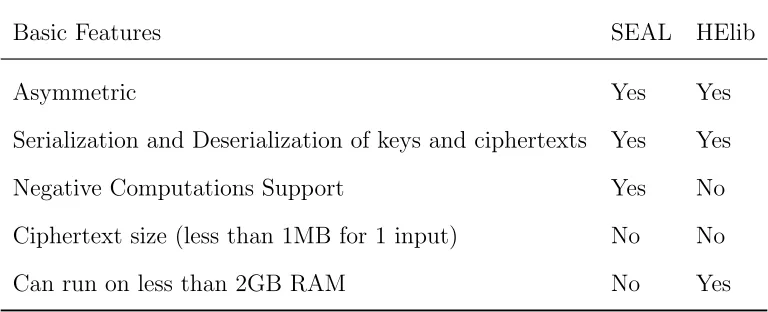
Initial comparison was done on the basic features that each library provides.
These features include asymmetry, serialization/deserializationn, negative
computa-tions, and encryption parameter/ciphertext size [24]. This can be observed in table
[image:42.612.132.516.407.563.2]5.1.
Table 5.1: Basic Features
Basic Features SEAL HElib
Asymmetric Yes Yes
Serialization and Deserialization of keys and ciphertexts Yes Yes
Negative Computations Support Yes No
Ciphertext size (less than 1MB for 1 input) No No
Can run on less than 2GB RAM No Yes
Microsoft SEAL and HElib provide asymmetry or implement a PKE scheme.
Re-call that PKE cryptosystems have both a public key, that is used to encrypt the
plaintext data, and a private key, that is used to decrypt the ciphertext data. The
public key can be shared with various users while the private key remains a secret
CHAPTER 5. FULLY HOMOMORPHIC ENCRYPTION
This means the developer does not have to implement an API for local storage and
re-trieval when it comes to input/output for the encryption schemes. The first difference
between Microsoft SEAL and HElib can be observed with Negative computations. In
integer arithmetic, certain operations can result in a negative value. One such
opera-tion is subtracopera-tion, where the second operand is greater than the first operand. While
HElib does not have the ability to encode for negative values, Microsoft SEAL
pro-vides an Integer Encoder or Fractional Encoder that supports negative computation.
Both libraries have a ciphertext size of a least 1MB for 1 input. This size is primarily
due to choice of input encryption parameters. These parameters include the plain
modulus, coefficient modulus, polynomial modulus, etc. Size of these parameters not
only affects ciphtertext size, but RAM requirements as well. Although HElib can still
effectively run on less than 2GB of RAM, Microsoft SEAL cannot.
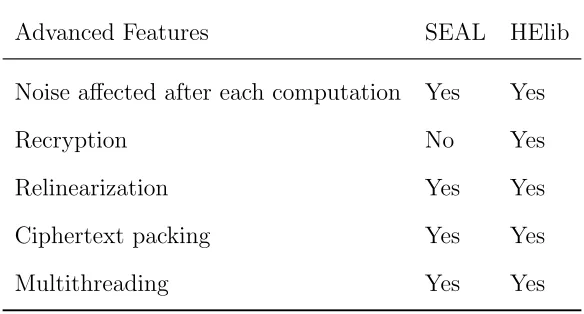
Following the basic feature comparison, the advanced features of both libraries
were considered. These features include noise budget, recryption, cipthertext packing,
[image:43.612.178.470.458.615.2]relinearization, and multithreading [24]. This can be observed in table 5.2.
Table 5.2: Advanced Features
Advanced Features SEAL HElib
Noise affected after each computation Yes Yes
Recryption No Yes
Relinearization Yes Yes
Ciphertext packing Yes Yes
Multithreading Yes Yes
Because Microsoft SEAL and HElib are built upon RLWE cryptosystems, they
are both noise affected after each computation. Recall that LWE, in this case RLWE,
cryptosystems work by hiding the plaintext with noise and that, after a certain
CHAPTER 5. FULLY HOMOMORPHIC ENCRYPTION
ciphertexts are operated upon, the noise grows. With addition/subtraction, noise
growth is fairly manageable, but with multiplication, noise growth can become
ex-tremely large. One way to manage such noise growth is recryption. The process of
recryption converts bounded depth homomorphism to unbounded depth
homomor-phism, resetting the ciphertext noise. HElib allows for recryption, while Microsoft
SEAL does not. In addition to recryption, relinearization can be used to manage
noise growth. Relinearization focuses on reducing the size of the output ciphertext of
the multiplication operation. Microsoft SEAL and HElib both provide a method for
relinearlization.
For the purpose of speed-up Microsoft SEAL and HElib have a ciphertext packing
feature. This technique takes advantage of the Chinese Remainder Theorem and
packs multiple plaintext values into a single ciphertext vector. Operations can then
be performed on the entire vector resulting in faster computation. This process
is called Single Instruction Multiple Data or SIMD. For additional speedup, both
libraries have multithreading capabilities. Microsoft SEAL contains many functions
that are thread-safe by default, whereas HElib can be made thread-safe by setting a
few flags.
CHAPTER 5. FULLY HOMOMORPHIC ENCRYPTION
Table 5.3: Operations
Operations SEAL HElib
Addition/Subtraction Yes Yes
Multiplication Yes Yes
Comparison No No
Division No No
Boolean Op. No No
Bitwise Op. Yes Yes
Matrix Op. Yes Yes
Exponentiation Yes Yes
Square Yes Yes
Negation Yes Yes
Addition/Subtraction/Multiplication Plain Yes No
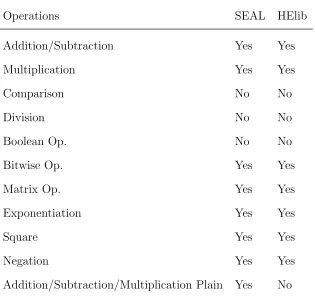
Microsoft SEAL and HElib allow for basic addition, subtraction, and
multiplica-tion between ciphertexts. Neither library allows for comparison, division, or boolean
operations between ciphertexts. Both libraries also provide the capability of bitwise
operations, matrix operations, exponentiation, square, and negation of ciphertexts.
The only difference between the two libraries with regards to operations is that
Mi-crosoft SEAL supports addition, subtraction, and multiplication between a ciphertext
and a plaintext.
Looking at the comparison between Microsoft SEAL and HElib, both libraries
provide similar functionality and operations. The primary difference between the
two libraries is that Microsoft SEAL has negative computation support and
explic-itly defined functions for addition/subtraction/multiplication between plaintexts and
ciphertexts while HElib can run on less than 2GB RAM and provides recryption
CHAPTER 5. FULLY HOMOMORPHIC ENCRYPTION
to differentiate between negative and positive values. Take the plaintext modulus,
p, any value less than p/2 is considered positive and any value greater than p/2 is
considered negative. HElib also has two functions, addConstant and
multiplyByCon-stant, that produce the same functionality as basic arithmetic between ciphertexts
and plaintexts. In this case, the plaintext is just treated as a constant vector.
Un-fortunately, while it is possible for HElib to mimic the missing functionality seen in
Microsoft SEAL, it is not possible for Microsoft SEAL to run on less than 2GB of
RAM or replicate recryption. In addition, while there is limited documentation on
both libraries, when it comes to privacy preserving CNN, HElib appears to be the
Chapter 6
HElib Functions, Security and Parameter Selection
6.1
Math Notation
The HELib implementation uses polynomial rings over integers modulo an irreducible,
cyclotomic polynomial. This is represented as R = Zq[x]/φ(x), where φm(x) is the
mth cyclotomic polynomial. In the case of a composite integer q the polynomial ring
is defined asRq =Z[x]/(φm(x), q) whereAq is the set of integer polynomials of degree
up to φm(x) modulo q.
The plaintext space is binary polynomials R2. The ciphertext and key space are
the vectors defined over polynomial ring R. Also plaintext a is in the coefficient
representation, where a=< a0, a1, ..., aφ(m)−1 > Z/qZφ(m) is a list of the coefficients
in the polynomiala(X) = Σi<φ(m)aiXi.
Below is a list of parameters that will be used to describe the functions found in
HElib.
λ: security parameter, representing 2λ security against unknown attacks
n: dimension
q: current integer modulus
χ: noise distribution
CHAPTER 6. HELIB FUNCTIONS, SECURITY AND PARAMETER SELECTION
6.2
Functions
The following section describes the basic functions provided by HElib [29].
6.2.1 ContextGen
Context Generation refers to the process of calculation the ciphertext modulus q,
the variance error distribution σ, and the dimension n. In order to successfully
calculate these three variables, context generation requires the plaintext modulus p,
the multiplicative depth L, and the security parameterλ.
6.2.2 Key Generation
Secret Key: To generate the current secret key sk
s0 ←χN (6.1)
sk =s←(1, s0[1], ..., s0[n])Rnq+1 (6.2)
Public Key: To generate the current public key pk
A0 ←RN xnq (6.3)
e ←χN (6.4)
CHAPTER 6. HELIB FUNCTIONS, SECURITY AND PARAMETER SELECTION
6.2.3 Encryption
To encrypt a message aR2
a ←(a,0, ...,0)Rnq+1 (6.6)
r←RN2 (6.7)
c←a+ATrRnq+1 (6.8)
Here, the transpose of the public key AT is multiplied by a sample r and then
added to the message a.
6.2.4 Decryption
To decrypt a ciphertext c
a ←[[< c, s > mod φm(x)]q]2 (6.9)
Here, the inner product between c and the secret key s over the polynomial ring
Aq is computed, where q is the current modulus. This result is then reduced once
more modulo 2.
6.2.5 Addition and Multiplication
Homomorphic addition is done by simply adding two ciphertext vectors overRq with
respect to the same secret key and modulus q. Homomorphic multiplication is done
by taking the tensor product of two ciphertext vectors over Rq with respect to the
CHAPTER 6. HELIB FUNCTIONS, SECURITY AND PARAMETER SELECTION
6.2.6 Modulus Switching
To manage the inevitable noise growth that comes with homomorphic operations
BGV achieves FHE with the use of recursive modulus switching. Modulus switching
allows for the transformation of ciphertextc mod q to ciphertext c0 mod p by scaling
the original ciphertext by a factor of p/q and rounding the result accordingly. This
process reduces the magnitude of the noise [30].
6.2.7 Bootstrapping
An alternative way to manage noise growth, Bootstrapping is used in BGV as an
op-timization to allow for unlimited homomorphic operations. Bootstrapping is defined
as the process of refreshing a ciphertext by homomorphically evaluating the
decryp-tion funcdecryp-tion. Refreshing is done by encrypting the ciphertext with a second layer
and decrypting the first layer homomorphically. In order to decrypt the ciphertext
homomorphically, the user must encrypt the secret key and use it as an input to the
Evaluation function alongside the ciphertext to be refreshed [31].
6.3
Security
Since HElib is as an implementation of the BGV cryptosystem and the BGV
cryp-tosystem is based on the RLWE, the security of HElib will be based on attacks against
RLWE. Based on current research, the best known attacks against RLWE schemes
are those used against the LWE problem.
Currently, there are three well known attack algorithms against LWE. These
at-tacks are: The Unique Shortest Vector Problem (uSVP) attack, the decoding attack,
and the dual attack. The uSVP attack works by taking several LWE sample vectors
and translating them into a matrix where each row represents a lattice. This matrix
CHAPTER 6. HELIB FUNCTIONS, SECURITY AND PARAMETER SELECTION
shortest vector is discovered, the secret can be recovered as well. To find the shortest
vector, the iterative block-wise algorithm for basis reduction also known as BKZ can
be utilized. The decoding attack works to solve the search-LWE problem. This
prob-lem is solved by treating it as the Bounded Distance Decoding probprob-lem, where the
BKZ basis reduction is utilized followed by the recursive Nearest Plane algorithm.
The dual attack is used for ’small’ secrets by aiming to solve the decisional problem
and not the secret. This attack utilizes BKZ to find the shortest non-zero vector.
This short vector is then used to distinguish the samples based on the sample size
[32].
6.4
Parameter Selection
Parameter selection within HElib plays an important role when it comes to both the
security and functionality of the overall system. This section details recommended
parameters for both security and functionality.
6.4.1 Parameters for Security
To achieve a minimum level of security, is important to note that certain input
pa-rameters need to be initialized appropriately. One such parameter is the ciphertext
modulus q. In a study done by Chase et al. researchers use the uSVP attack,
decod-ing attack, and dual attack to determine the necessary size of q to achieve a specific
security level for a given dimension n. In this case, q value recommendations were
made for 3 different security levels: 128 bits, 192 bits, and 256 bits. In figure 6.1 a
recommended log2q is given forn = 210 ton = 215 for each security level. Estimated
running time for the uSVP attack, decoding attack, and dual attack are given in bits
CHAPTER 6. HELIB FUNCTIONS, SECURITY AND PARAMETER SELECTION
Figure 6.1: Security Parameter Recommendations [32]
6.4.2 Parameters for Functionality
When utilizing HElib, each parameter is associated with a different functionality.
Be-low is a detailed explanation of what each parameter represents [33].
m represents the specific modulus or ciphertext base. This value is the same q value
mentioned in the ’Parameters for Security’ section. As detailed before, this value is
important when it comes to the security of the overall cryptosystem. In HElib, the
FindM function takes k, L, c, p, d, s and outputs an appropriate m. The value for m
can also be manually set.
p represents the plaintext base. This value needs to be a prime number and is used
as the coefficient modulus. In other words, computations are done modulo p.
r represents the lifting value. This value is also part of the native plaintext space
CHAPTER 6. HELIB FUNCTIONS, SECURITY AND PARAMETER SELECTION
r! = 1, computations are done modulo pr.
L represents the number of levels in the modulus chain. Levels are an integral part
of the underlying cryptosystem used by HElib. From a high-level perspective, levels
refer to a non-fixed ciphtertext space and are used to reduce the noise inside
cipher-texts. This noise reduction is done using the modulus switching technique mentioned
earlier. Levels are normally changed after ciphertext multiplication as this is the
op-eration that generates the most noise. This means the level value is largely dependent
on the evaluation function [34].
c represents the number of columns in the key-switching matrix. The number of
columns plays a key role in the relinerazation process. Recall that the purpose of
relinearization is to reduce the overhead in ciphertext multiplication and can be used
to manage noise growth. Ultimately this value is also dependent on the multiplication
depth of the evaluation function. The default value is c= 3 [34].
w represents the Hamming weight of the secret key.
d represents the degree of field extension. The default value is d= 1.
k represents the security parameter. This is the same λ value mentioned in the
’Parameters for Security’ section. The default value is k = 80. Setting k = 128 is
considered equivalent to the security of AES-128.
s represents the minimum number of slots. This value is used for ciphertext
pack-ing and allows for SIMD. Recall packpack-ing refers to the process of combinpack-ing several
CHAPTER 6. HELIB FUNCTIONS, SECURITY AND PARAMETER SELECTION
of ciphertexts and to speedup computation time. In HElib there are two types of
Chapter 7
Design
In this study, an approach to integrate HE and CNN was explored. HE was utilized
to perform the necessary classification on an encrypted dataset, such that when the
information is decrypted, the decrypted result matches the would be result of
classi-fication on unencrypted data. To successfully create a privacy preserving CNN, it is
important to study the building blocks of these networks: layers. Prior to creating a
privacy preserving CNN each layer was studied, implemented, and tested in both the
plaintext space and the ciphertext space. The plaintext layers were used as a baseline
comparison to ensure that the encrypted classification was indeed correct.
7.1
CNN Layers
CNN are made up of cascading layers that take an input layer of image data and
transform it into an output layer of label scores. The four common layers used
in CNN include: Fully Connected Layer, Convolutional Layer, Pooling Layer, and
Activation Layer [35].
7.1.1 Fully Connected
Fully Connected layer is the layer where each neuron is connected to all the neurons
in the previous layer. In this layer the total number of weights is equivalent to the
CHAPTER 7. DESIGN
of neurons in the current layer. In the context of CNN, the Fully Connected layer
appears as the final layer which outputs an N dimensional vector where N is the
[image:56.612.205.433.150.396.2]number of classes the program can choose from [35]. This can be seen in figure 7.1.
Figure 7.1: Fully Connected Layer [36]
7.1.2 Convolution
Convolution layer is the layer that applies a sliding filter to an input image and outputs
the sum of elementwise multiplications between filter weights and neurons from the
previous layer. The purpose of using a filter is to extract certain characteristics
from an image, thus several filters can be used in the same layer to extract different
characteristics. The sliding filter(s) used in this layer are 3 dimensions and contain
a set of weights that are learned during the training phase. The output of applying
the 3-dimensional filter is a 2-dimensional matrix which is then stacked wi

![Figure 4.2: Good basis vs Bad basis for the same Lattice [17]](https://thumb-us.123doks.com/thumbv2/123dok_us/25600.1982/30.612.210.437.72.229/figure-good-basis-vs-bad-basis-lattice.webp)
![Figure 4.3: Lattice based on natural numbers with divisibility as the order relation: GCD,LCM [19]](https://thumb-us.123doks.com/thumbv2/123dok_us/25600.1982/31.612.173.473.81.322/figure-lattice-based-natural-numbers-divisibility-order-relation.webp)
![Figure 6.1: Security Parameter Recommendations [32]](https://thumb-us.123doks.com/thumbv2/123dok_us/25600.1982/52.612.215.430.78.294/figure-security-parameter-recommendations.webp)
![Figure 7.1: Fully Connected Layer [36]](https://thumb-us.123doks.com/thumbv2/123dok_us/25600.1982/56.612.205.433.150.396/figure-fully-connected-layer.webp)
![Figure 7.2: Convolution Layer [37]](https://thumb-us.123doks.com/thumbv2/123dok_us/25600.1982/57.612.115.522.78.365/figure-convolution-layer.webp)