University of Southern Queensland
Faculty of Engineering & Surveying
Analysis of Data to Develop Models for Spray
Combustion
A dissertation submitted by
Jason Clarke
in ful…lment of the requirements of
ENG4112 Research Project
towards the degree of
Bachelor of Mechanical Engineering
Abstract
The design of modern petrol engines has placed an emphasis on lean combustion in
order to increase e¢ ciency, reduce operating noise and reduce pollutants. However,
the closer the engine operates to the lean combustion limit the higher the possibility
of engine mis…res occurring. Mis…res occur when there is not su¢ cient droplet density
around the spark to allow the evaporation of the droplets and hence the release of fuel
to the system.
The advent of injection systems has enabled engineers to control the majority of the
parameters of spray combustion, such as droplet size, droplet density and spray pattern.
Therefore, the ability to model spray combustion would have wide ranging implications
on the automotive industry.
One model which lends itself to the modelling of spray combustion is the Conditional
Moment Closure (CMC) model. However, the behaviour of the terms of the CMC
model, namely the conditional scalar dissipation, conditional source term and the
mix-ture fraction probability density function (pdf), is not understood well for this case.
A number of Direct Numerical Simulations (DNS) have been performed on di¤erent
cases of combustion where fuel droplets are present in cold air and a spark is used to
evaporate the droplets and initiate a ‡ame kernel. Data was collected and models were
developed for the three key terms of the CMC model.
Validation of the …rst order CMC model was performed by attempting to recreate
the behaviour of the DNS data. The performance of the …rst order CMC model was
conditional mean of the quantities. Another conditioning variable, or second-order
con-ditional modelling, may be needed in order for the CMC model to adequately capture
University of Southern Queensland Faculty of Engineering and Surveying
ENG4111/2 Research Project
Limitations of Use
The Council of the University of Southern Queensland, its Faculty of Engineering and
Surveying, and the sta¤ of the University of Southern Queensland, do not accept any
responsibility for the truth, accuracy or completeness of material contained within or
associated with this dissertation.
Persons using all or any part of this material do so at their own risk, and not at the
risk of the Council of the University of Southern Queensland, its Faculty of Engineering
and Surveying or the sta¤ of the University of Southern Queensland.
This dissertation reports an educational exercise and has no purpose or validity beyond
this exercise. The sole purpose of the course pair entitled “Research Project” is to
contribute to the overall education within the student’s chosen degree program. This
document, the associated hardware, software, drawings, and other material set out in
the associated appendices should not be used for any other purpose: if they are so used,
it is entirely at the risk of the user.
Prof F Bullen
Dean
Certi…cation
I certify that the ideas, designs and experimental work, results, analyses and conclusions
set out in this dissertation are entirely my own e¤ort, except where otherwise indicated
and acknowledged.
I further certify that the work is original and has not been previously submitted for
assessment in any other course or institution, except where speci…cally stated.
Student Name:
Student Number:
_____________________________ (signature)
Acknowledgments
This project was supervised by Dr. Andrew Wandel. I would like to thank him for his
support and technical expertise without which I could not have completed this project.
I would also like to thank my family for their continuing support.
Jason Clarke
University of Southern Queensland
Contents
Abstract i
Certi…cation iv
Acknowledgments v
List of Figures x
Chapter 1 Introduction 1
1.1 Introduction . . . 1
1.2 Background and theory . . . 3
1.2.1 O¤er of the project . . . 3
1.2.2 Importance of fuel e¢ ciency and low emissions . . . 3
1.2.3 Background on two phase systems . . . 4
1.2.4 Direct Numerical Simulation (DNS) . . . 6
1.2.5 Conditional Moment Closure model . . . 7
CONTENTS vii
1.2.7 Limitations and assumptions of the …rst order CMC model . . . 10
1.2.8 Objectives relating to DNS and CMC . . . 11
1.2.9 Application of the CMC model to CFD software . . . 12
1.3 Literature review . . . 12
1.4 Consequential E¤ects . . . 20
Chapter 2 Analysis of the DNS data 24 2.1 Overview of the DNS data . . . 24
2.2 Selection of the DNS data . . . 25
2.2.1 The e¤ect of the equivalence ratio on combustion . . . 26
2.2.2 The e¤ect of droplet size on combustion . . . 28
2.2.3 Selection of the DNS data . . . 28
2.3 Overview of important quantities . . . 30
2.3.1 Conditional temperature . . . 30
2.3.2 Conditional mass fraction of fuel . . . 32
2.3.3 Conditional mass fraction of oxidiser . . . 33
2.3.4 Mean mass fractions . . . 34
2.3.5 Validation of the correlation between the species mass fractions . 36 2.4 Overview of the CMC terms . . . 37
2.4.1 Mixture fraction probability density function . . . 37
CONTENTS viii
2.4.3 Conditional generation due to droplet evaporation . . . 39
2.5 Characterisation of the CMC terms . . . 40
2.5.1 Mixture fraction pdf . . . 40
2.5.2 Conditional scalar dissipation . . . 45
2.5.3 Conditional generation due to droplet evaporation . . . 59
2.6 Other cases . . . 63
2.6.1 Droplet diameter decreased . . . 63
2.6.2 Droplet diameter increased . . . 71
2.6.3 Comments on the characterisation of the terms . . . 71
Chapter 3 Validation of the …rst order CMC model 73 3.1 Recreation of the data . . . 74
3.1.1 Order of calculation . . . 74
3.1.2 Mixture fraction and time . . . 75
3.1.3 Calculation of temperature . . . 76
3.1.4 Calculation of the source term . . . 77
3.1.5 Calculation of the mass fractions of fuel and oxidiser . . . 78
3.1.6 Determination of mean values for normalising quantities . . . 79
3.2 Results . . . 80
3.2.1 Temperature . . . 80
CONTENTS ix
3.2.3 Mass fraction of oxidiser . . . 84
3.2.4 Sources of errors . . . 84
3.2.5 Comments on the validity of the …rst order CMC model . . . 88
3.2.6 Use of a doubly-conditioned CMC model . . . 90
Chapter 4 Conclusions and further work 92 4.1 Conclusions . . . 92
4.2 Further work . . . 96
4.2.1 Further work required for doubly-conditioned CMC modelling . . 96
4.2.2 Further work required for the coupling of CMC and CFD . . . . 97
4.2.3 Further work required on the MATLAB scripts . . . 98
References 100
Appendix A Project Speci…cation 103
List of Figures
1.1 Flowchart showing the coupling of CMC and CFD. . . 13
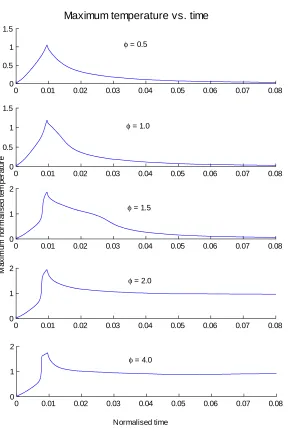
2.1 DNS results for the maximum temperature within the domain for …ve cases of equivalence ratio with droplet diameter constant. . . 27
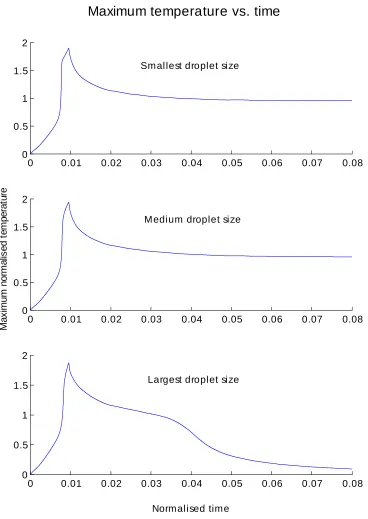
2.2 Maximum temperature across the domain with a constant equivalence ratio and varying droplet diameter. . . 29
2.3 Conditional temperature over the life of the combustion. . . 31
2.4 Conditional mass fraction of fuel, all zones. . . 32
2.5 Conditional mass fraction of oxidiser, all zones. . . 33
2.6 Average mass fraction of fuel and oxidiser with respect to time. . . 35
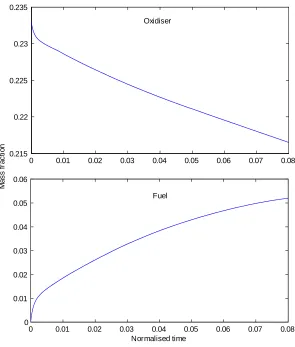
2.7 Conditional variance between the species mass fractions. . . 36
2.8 Mixture fraction pdf, all zones. . . 37
2.9 Conditional scalar dissipation, all zones. . . 38
2.10 Conditional generation due to droplet evaporation, all zones. . . 39
LIST OF FIGURES xi
2.12 Behaviour of the conditional scalar dissipation for each zone. . . 46
2.13 Fit for the conditional scalar dissipation, zone 0. . . 47
2.14 Conditional scalar dissipation, zone 1. Note the transient behaviour. . . 48
2.15 Position of the local maxima with respect to time. . . 49
2.16 Position of the local minima with respect to time. . . 51
2.17 Conditional scalar dissipation, zone 1. Resultant …ts up to the local minima. . . 52
2.18 Resultant …t for the conditional scalar dissipation, zone 1. . . 53
2.19 Conditional scalar dissipation, zone 2. . . 54
2.20 Fit for the zone 2 conditional scalar dissipation until the local minima. . 55
2.21 Fits obtained for the tail of the zone 2 curves. These …ts have not been characterised. . . 55
2.22 Coe¢ cients of the cubic splines shown in …gure 2.21. The …t for coe¢ -cientdis shown as the dashed line. . . 56
2.23 Fit for the tail of the curves using coe¢ cients shown in equation 2.14. Note the inability to accurately predict the location of the minima. . . . 57
2.24 The …nal …t for the conditional scalar dissipation, zone 2, after the cubic splines are forced through the local minima. . . 58
2.25 Fit obtained for the conditional scalar dissipation, zone 3. . . 58
2.26 Conditional generation due to droplet evaporation, all zones. . . 59
2.27 Fit of the conditional generation, zone 0. . . 60
LIST OF FIGURES xii
2.29 Linear coe¢ cients in the form y=M(x c). . . 62
2.30 Fit for the conditional generation, zones 1–3. . . 63
2.31 Favre averaged mixture fraction for each of the zones with their
respec-tive …ts, case 2. . . 65
2.32 Fits for the conditional scalar dissipation, all zones, case 2. Fits for the
tail are omitted. . . 68
2.33 Fit for the conditional generation, zones 1–3, case 2. . . 70
3.1 Flowchart showing the steps taken when calculating the required
quan-tities using the CMC model. . . 74
3.2 Conditional temperature calculated by the …rst order CMC model (dashed
line) versus the the DNS data (solid line) over one quarter of the life of
the simulation. . . 80
3.3 A plot of …gure 3.2, zoomed in. . . 81
3.4 Conditional temperature calculated by the …rst order CMC model versus
the the DNS data over the life of the simulation. . . 82
3.5 Conditional mass fraction of fuel calculated by the …rst order CMC model
versus the the DNS data over one quarter of the life of the simulation. . 83
3.6 Conditional mass fraction of fuel calculated by the …rst order CMC model
versus the the DNS data over the life of the simulation. . . 84
3.7 Conditional mass fraction of oxidiser calculated by the …rst order CMC
model versus the the DNS data over one quarter of the life of the
simu-lation. . . 85
3.8 Conditional mass fraction of oxidiser calculated by the …rst order CMC
LIST OF FIGURES xiii
3.9 Variance of the conditional temperature as calculated from DNS data
and the mean conditional temperature calculated from the CMC model. 87
3.10 Variance of the conditional mass fraction of fuel as calculated from DNS
Chapter 1
Introduction
1.1
Introduction
Increasingly, governments and social pressure have required cars, and therefore engines,
to become more e¢ cient and produce less pollutants. Both Australian and American
governments have pledged to commit to reducing emissions from cars (Gillard (current
August 2010) and Crawley (current May 2010)). Beyond reducing emissions, increased
e¢ ciency of cars also translates to bene…ts for the consumer, with reduced fuel
con-sumption and lower engine noise. For these reasons, both industry and academics have
committed large amounts of resources to increasing the e¢ ciency of cars, and perhaps
of more interest to this thesis, engines.
In the motor industry today, almost all petrol engines have adopted the use of injectors
to supply fuel to the combustion chamber. The use of injectors has allowed a much
greater ability to control the parameters of spark assisted spray ignition than
carbu-rettored engines. Some parameters which may be adjusted are droplet size, droplet
density, spray pattern, spark intensity and duration. The advent of fuel injection has
also meant that the mixing of fuel and oxygen now takes place in the combustion
chamber.
1.1 Introduction 2
For stoichiometric mixing, the air to fuel ratio (mair=mf uel) should be 14:7for octane
fuels. However, traditionally, the mixture has been ‘rich’, or an air to fuel ratio in
the range of 12:5 13:3 to reduce the chance of engine mis…res. This however leads to unwanted pollutants, such as HC, CO and NOx. In order to design engines which
operate as lean as possible, accurate models of combustion are needed. The focus of
this project is to progress the development and implementation of such models.
The modelling of spray combustion is complex and not thoroughly understood.
Mod-elling of gaseous phase combustion is simpler than droplet combustion because the fuel
is already present in the correct phase. In spray combustion, however, the droplets must
…rst be evaporated by an area of localised high temperature (which may be created by
the spark energy or compression of the gas), and must continue to be evaporated by
the ‡ame front in order to continue releasing fuel to the system (Wandel, Chakraborty
& Mastorakos 2009). The e¤ect of the evaporation of the droplets with respect to the
‡ow …eld and temperature must be accounted for when attempting to model two phase
combustion.
Currently, there are four main methods used for modelling turbulent reacting ‡ows,
such as spray combustion. These are numerical modelling (Direct Numerical
Simula-tions (DNS)), large eddy simulation (LES), turbulent combustion models such as the
Conditional Moment Closure (CMC) model and models implemented in
Computa-tional Fluid Dynamics (CFD) software. LES still requires development for gaseous
combustion. The main disadvantage of numerical modelling is that it is
computa-tionally expensive; currently the processing power of computers has not allowed the
modelling of spray ignition for volumes larger than the order of 1cm3. The main
dis-advantage of CFD is that since little is known about the evaporation of droplets in two
phase combustion, models must be developed to incorporate into the CFD software.
The models for incorporation into CFD software could potentially be developed from
use of the CMC model.
There have been numerous studies into combustion using the CMC model, however
most of the studies have relied on numerical data directly obtained from the use of
DNS, rather than prede…ned models. Prede…ned models for use in CMC modelling
1.2 Background and theory 3
in the CMC equation in the presence of evaporation. The current study aims to
reduce the gap in knowledge by analysing 3-D DNS data to generate models for the
key coe¢ cients in the CMC transport equation so that large-scale modelling may be
performed for sprays.
The broad objectives of this project are:
Analyse data from numerical simulations performed by Wandel et al. (2009) to
characterise combustion for a small control volume (approximately1mm3) using the CMC model,
verify the models’accuracy by recreating the data the models were obtained from,
code the models into a CFD package to allow for a much larger scale of modelling
to take place, and
model combustion in a simple combustion chamber to investigate the e¤ects of
changing parameters of spark assisted spray combustion.
1.2
Background and theory
1.2.1 O¤er of the project
This project was o¤ered by the faculty under the guidance of Dr. Andrew Wandel.
Andrew has a keen interest in the use of CMC methods to characterise combustion.
This project is an extension of research conducted by Andrew, from which a large
amount of data has been generated. This data has been used in the published paper
Wandel et al. (2009), but all the necessary quantities needed to solve the CMC model
are also present in the data.
1.2.2 Importance of fuel e¢ ciency and low emissions
In recent years, there has been a widespread political and social push for car
1.2 Background and theory 4
of the speci…c fuel consumption of an automobile per kilometre travelled. Emissions
refer to the production of harmful pollutants, such as HC, CO and NOx. Generally,
fuel e¢ ciency and level of emissions are linked; an increase in fuel e¢ ciency results in
a decrease in the production of pollutants.
Increasing the fuel e¢ ciency of a vehicle has been, and continues to be, the focus
of much research (Taymaz, Cakir & Mimaroglu (2005) and Nabi (2010)). There are
many positives associated with increasing e¢ ciency. Among these are: reduced fuel
consumption (resulting in lower costs of running and longer range of the car), reduced
engine noise, and fewer pollutants. Commercially, the production of e¢ cient cars is of
great importance as the majority of consumers value fuel e¢ ciency when buying a new
car.
There are numerous methods of increasing the brake thermal e¢ ciency of a car. Brake
thermal e¢ ciency is a measure of the output power of a car converted from the energy
stored by the fuel, and takes into account the thermal e¢ ciency of the engine cycle, the
mechanical e¢ ciency and the chemical e¢ ciency. Thermal e¢ ciency may be increased
by increasing the e¢ ciency of the combustion cycles (typically Otto or Diesel cycle)
by increasing compression ratio or decreasing the heat loss from the combustion to the
cooling system. Mechanical e¢ ciency can be increased by reducing any mechanical
losses, such as friction. The chemical e¢ ciency can be increased by ensuring all fuel
that enters the combustion chamber is consumed by the combustion. The …ndings of
this project could lead to an increase in the chemical e¢ ciency of an engine, but the
…ndings could also ‡ow on to reducing mechanical losses.
1.2.3 Background on two phase systems
This project focuses on spark assisted spray combustion, which is found in fuel injected
petrol engines. The presence of two phases (namely fuel in liquid, or droplet form, and
air in gaseous form) presents quite a problem when trying to model combustion. In
fact, the interaction of two phases without combustion is a complex phenomena and
has been the focus of many studies (Bini & Jones (2008) and Lebas, Menard, Beau,
1.2 Background and theory 5
There are many di¢ culties associated with trying to predict the behaviour of two-phase
mixing. Among these are: the e¤ect of turbulence on the mixing rate, the evaporation
of the liquid phase, droplet breakdown and the tendency of the droplets to coalesce.
These phenomena also prove to be computationally complex.
These problems are ampli…ed somewhat with the mixing occurring concurrently with
combustion. For combustion to take place, energy in the form of a spark must be
added to the system. This also has the e¤ect of evaporating fuel droplets and releasing
fuel to the system. The presence of fuel and oxidiser in gaseous phase, along with
heat from the spark, allows a ‡ame kernel to develop. Once the ‡ame kernel has
grown to a su¢ cient size and heat to stabilise, the spark may be removed. The ‡ame
kernel advances throughout the rest of the combustion chamber, …rst evaporating any
droplets nearby, and then consuming them in the combustion. Several factors in‡uence
the ability of the ‡ame kernel to proceed throughout the combustion chamber. If the
droplet size is too big, too little fuel is evaporated to allow combustion to proceed.
Likewise, if the droplet spacing is too big, fuel may become too sparse. If the spark is
removed prematurely, the ‡ame kernel may not be hot enough to become self sustained.
The ability to model two-phase combustion systems would allow the investigation of
the parameters which would encourage the most e¢ cient combustion.
When trying to model two-phase systems, the required outputs are most often the
mass fractions of each species, and temperature across the domain. The mass fractions
of each species are hard to model, because the rate of reaction between the fuel and
the oxidiser are highly non-linear functions of the mass fractions of fuel and oxidiser,
and the local temperature (Klimenko & Bilger 1999). Further complexity arises from
turbulence in the combustion chamber. This causes areas of highly di¤ering rates
of mixing and therefore the spatial location of combustion in the domain is largely
unpredictable. Also contributing to the di¢ culty of modelling spray combustion in
comparison to single phase systems is that some energy (in the form of a spray or
advancing ‡ame front) is needed to evaporate droplets and thus release fuel to the
system.
Due to the complexity of attempting to model two-phase systems, and in particular
1.2 Background and theory 6
approach is performing a DNS.
1.2.4 Direct Numerical Simulation (DNS)
DNS is a method of solving the Navier-Stokes equations numerically to describe ‡uid
‡ow. In a similar fashion to CFD, a given control volume is meshed (divided up into
a number of nodes) and the de…ning equations are solved at these points. However,
given that the Navier-Stokes equations are solved directly and without the use of
pre-de…ned models, the grid size must be much smaller than that used in CFD software.
For example Wandel et al. (2009) performed a DNS with a control volume with 1283
nodes. The control volume was cubic with length1:675mm. This equates to approxi-mately1:31 10 5m between adjacent nodes. The simulation, performed on a recent,
commercially available computer, took a period of days to solve.
The computational time required for DNS is further increased when a chemical reaction
(such as combustion) occurs. While there has been some research into reducing the
computing requirements of the chemical reaction of n-heptane fuels (Lu, Law, Yoo &
Chen 2009), performing DNS on combustion any larger than the order of 1cm3 is too computationally demanding. While there has been widespread use of DNS to model the
behaviour of certain systems (Wang & Rutland (2007) and Sreedhara & Huh (2007)),
and it is a useful tool for verifying the results of other less demanding models, DNS
is of little use when modelling large scale systems, such as spray ignition. Therefore,
other methods of modelling large scale systems are needed. One of these methods is
the CMC model.
One of the advantages of using DNS is the ability to record vast amounts of data relating
to the combustion. This data, if analysed properly, can allow for a very thorough
understanding of the behaviour of the combustion. The data may also used to develop
1.2 Background and theory 7
1.2.5 Conditional Moment Closure model
The CMC model is used for the prediction of turbulent reacting ‡ows. Combustion
may be considered a turbulent reacting ‡ow as the burning of fuel and oxidiser is a
chemical reaction. The main advantage of the CMC model over DNS is that because it
uses prede…ned models, rather than solving the Navier-Stokes equations and reaction
equations directly, it is much less computationally intense and therefore can be used to
model much larger systems.
At the core of the theory behind the CMC model is that fundamental quantities of
combustion, such as species mass fractions, enthalpy and temperature, is conditional
on the mixture fraction (or ‘is a function of’the mixture fraction) (Klimenko & Bilger
1999). The mixture fraction is de…ned as the proportion of the mixture that was
originally fuel. The general form of the …rst order CMC model for homogenous cases
is:
@hY jZi
@t =hNjZi
@2hY jZi
@Z2 +hWjZi+hSjZi (1.1)
where:
The angle brackets denote the quantity to the left of the vertical bar is conditional
upon the quantity to the right (is the average of the left given a particular value
of the right),
Z =mixture fraction, or proportion of the mixture that was originally fuel,
hY jZi = mass fraction of fuel or oxidiser,
hNjZi=conditional scalar dissipation (equivalent to viscosity),
hWjZi=conditional chemical source term (gain/loss due to chemical reactions),
hSjZi=conditional generation due to droplet evaporation.
For stoichiometric combustion of n-heptane (as analysed in this project), the mean
1.2 Background and theory 8
The scalar dissipation, chemical source and generation due to droplet evaporation are
all quantities which must be modelled. The models for these terms may be derived
from DNS data, experimental data or analytical equations. One of the aims of this
project is to develop models for these three terms by analysing DNS data generated as
a by-product of the work undertaken in Wandel et al. (2009).
The CMC model is versatile due to its ability to be used for many di¤erent forms of
combustion, as well as the ability to predict many quantities such as mass fraction of fuel
and oxidiser, temperature and enthalpy. Depending on the nature of the combustion,
the form of the CMC model may change (Klimenko & Bilger 1999).
One of the main advantages of using the CMC model is that the quantities do not
need to be modelled with respect to their spatial coordinates, rather the quantities are
only conditional upon the mixture fraction. By reducing the number of independent
variables, the time necessary to model a system using CMC methods is dramatically
less than if DNS were to be used. For example, in the work performed as part of this
project, the time saved when modelling an equivalent system using CMC over DNS
was an order of magnitude of approximately 17000.
Given that the calculated values, such as mass fractions and temperature, are
condi-tional upon the mixture fraction, the distribution of mixture fraction throughout the
domain needs to be known in order to calculate the average values of those quantities.
The average value of any of the quantities calculated with the CMC model is given by
hY i=
Z 1
0 h
Y jZiP(Z)dZ (1.2)
where P(Z) is the mixture fraction probability density function. Therefore, in order for the CMC model to be useful, and therefore for the ability to verify the CMC model
against other methods, the probability density function must also be known. While
some forms of the mixture fraction probability density function are given in literature
(Sreedhara & Huh 2007), it may also be determined when performing a DNS. Therefore,
as with other terms of the CMC equation such as scalar dissipation, the mixture fraction
1.2 Background and theory 9
1.2.6 Terms of the CMC model
There are three main terms of the CMC model which require modelling. These are
conditional scalar dissipation, conditional chemical source and conditional generation
due to droplet evaporation.
The mathematical equation de…ning the scalar dissipation is:
N =D(rZ rZ) (1.3)
whereD is the di¤usivity and Z is the mixture fraction. The conditional scalar dissi-pation is equivalent to viscosity. Scalar dissidissi-pation is typically high at large values of
mixture fraction, as combustion occurs in rich areas. The combustion releases fuel to
the surrounding air, causing large variations in mixture fraction, and therefore large
gradients of mixture fraction. This in turn causes the scalar dissipation to be large.
The conditional generation due to droplet evaporation is a term which refers to the
contribution of the evaporation of droplets into gaseous phase to the mass fraction
of fuel. As the droplets are evaporated from the high temperature caused by either
the spark or the ‡ame kernel, more fuel is released into the system in gaseous phase.
Therefore, more fuel is present which causes the mass fraction of fuel to increase.
The conditional generation due to droplet evaporation is greater in rich areas where
combustion is more likely to take place.
The chemical source term,hWjZican be approximated by an Arrhenius equation and is a function of the mass fractions of fuel and air, and the temperature. Because the CMC
model solves for the mass fractions as well as temperature, hWjZi can be calculated as the combustion proceeds. The chemical source term used is di¤erent depending on
which quantity is being solved for.
The mixture fraction probability density function may also be determined from DNS
data. Because the mixture fraction can be determined at every node in the DNS, the
relative probability of each value of mixture fraction occurring within the domain can
1.2 Background and theory 10
1.2.7 Limitations and assumptions of the …rst order CMC model
The …rst order CMC model is useful under many circumstances for modelling
combus-tion. The equation presented above (1.1) is a …rst order CMC model because there
is only one conditioning variable, mixture fraction. However, in certain cases, two
conditioning variables may be needed to fully capture the behaviour of the combustion.
One of the assumptions implicit in the use of the …rst order CMC model is that the
conditional species mass fractions are strongly correlated, or
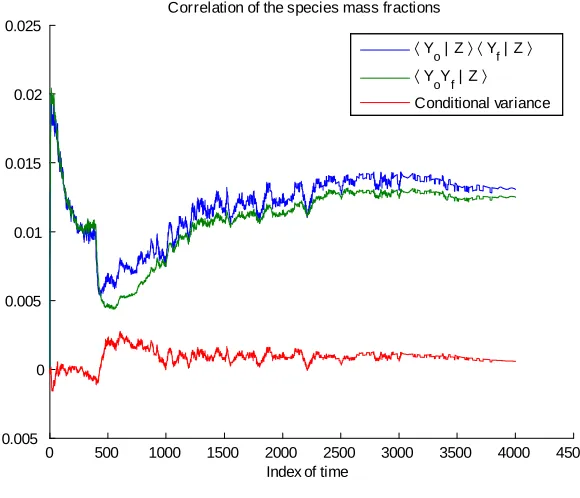
hY Y jZi=hY jZi hY jZi+ Y00Y00jZ (1.4) where the …nal term, DY00Y00jZE or the conditional variance, is assumed to be neg-ligible. If the species mass fractions are strongly correlated, the conditional average
rate of reaction can be predicted using the conditional moments and the …nal term of
equation (1.4) may indeed be considered negligible.
In single phase systems, it has been found that under most circumstances that the
mass fractions of fuel and oxidiser are strongly correlated and as such the …rst order
CMC model accurately predicts the behaviour. In systems where local extinction and
re-ignition occurs, the mass fractions become less correlated and a higher order version
of the CMC equation is required. It is unclear whether the use of the …rst order CMC
model will accurately model two-phase combustion.
Single phase combustion which experiences local extinction and re-ignition has been
suc-cessfully modelled using a doubly-conditioned CMC model (Kronenburg & Papoutsakis
2005). Signi…cant variation in the values of mass fractions conditional upon mixture
fraction was found around the points at which extinction and re-ignition occurred. The
result of the high variance was that the …rst order CMC equation was unable to fully
predict the reaction rate at these critical points. In order to account for the signi…cant
variation about the mean, a second conditioning variable was introduced. This second
conditioning variable was sensible enthalpy.
There are two main factors which may in‡uence the ability of a …rst order CMC model to
accurately predict spark assisted spray combustion. It is unclear whether the presence
1.2 Background and theory 11
doubt that a …rst order CMC model will be able to account for signi…cant variations
in the mean occurring in areas adjacent the spark.
The use of a doubly-conditioned CMC model is beyond the scope of this project, but
the work presented here will be able to ascertain the validity or otherwise of the …rst
order CMC at modelling spark assisted spray combustion.
1.2.8 Objectives relating to DNS and CMC
This project will focus on characterising the terms of the single order CMC equation
presented in (1.1). The mixture fraction probability density function will also be
char-acterised. The data required to successfully create models for the CMC terms has been
recorded as outputs from a DNS performed by Wandel et al. (2009). DNS data is
available for several cases of combustion, which will be used to assess the adaptability
of the models created.
The …rst order CMC equation will then be solved numerically, and with the same
boundary and initial conditions as was used in the DNS. The quantities that will be
solved for are conditional temperature and the conditional mass fractions of fuel and
oxidiser. These values will then be checked against the values computed in the DNS.
The two main conclusions that are hoped to be drawn from this work are:
1. That all conditional quantities present in the single order CMC model can be
modelled accurately over the whole life of the combustion, and that these models
may easily be adapted for di¤erent cases of combustion.
2. To prove or disprove that the …rst order CMC model can be successfully applied
to spark assisted spray combustion.
If both of these objectives can be met, further work may focus on:
1. Using the models to predict the behaviour of much larger systems, either through
1.3 Literature review 12
2. If the …rst order CMC model is not su¢ cient, using the techniques presented in
this thesis to characterise the quantities of the CMC model with respect to two
conditioning variables as per the requirements of the doubly-conditioned CMC
model.
1.2.9 Application of the CMC model to CFD software
The CMC model could potentially be integrated into CFD software in order to model
large, dynamic systems. CFD software has the ability to accurately predict the ‡ow
…eld of a system, however currently the models used may not be suitable for spray
combustion. The ‡ow …eld refers to the velocity and pressure of the system.
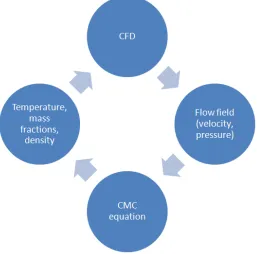
Because the outputs obtained from CFD software (velocity, pressure) are inputs into the
CMC equation, and the outputs obtained from the CMC model (temperature, density)
are inputs into the CFD software, the two could be coupled in order to predict the
behaviour of large, dynamic combustion systems. The coupling of CFD and CMC can
be depicted graphically in …gure 1.1.
Each completion of the cycle is equivalent to one timestep. The integration of CMC
models into CFD software could potentially prove to be very valuable, more so with the
increasing computation power available. It could possibly be used to model combustion
in an engine or other large, complex systems.
1.3
Literature review
Literature published on the modelling of turbulent combustion of two phase systems
has been restricted to the last 15 years as the processing power required to perform
numerical simulations has become available. Most literature concerning DNS and CMC
models for spray combustion is published by two bodies, the Combustion Institute and
Combustion and Flame journal. Currently, there is somewhat of a void in the area of
1.3 Literature review 13
Figure 1.1: Flowchart showing the coupling of CMC and CFD.
The CMC model and its uses
The most de…nitive article on the subject is Klimenko & Bilger (1999), “Conditional
moment closure for turbulent combustion”. This article aims to review all of the
pre-ceding knowledge of the application of the CMC model to “turbulent reacting ‡ows,
with particular emphasis on combustion”.
The article provides a comprehensive overview of the methods of developing
approxi-mations of the mixture fraction probability density function (pdf) for use in the CMC
model. A combination of , and Gaussian functions is used to model the pdf.
How-ever, this information is not needed in this project as data necessary to model the
pdf forms part of the data collected from the DNS simulations and therefore will be
modelled as per the other quantities.
In this article, the proposed CMC equation is
@Q
dt +hvjZi rQ+
div( Zhv”Y”jZiP(Z))
P(Z) Z hNjZi
@2Q
1.3 Literature review 14
where the second and third terms of the left hand side are, for the purposes of this
project, negligible. This equation is largely consistent with that presented in Mortensen
& Bilger (2009).
The work of Klimenko & Bilger (1999) highlights the main void in current literature;
applying models derived from DNS data to the CMC equation.
Mortensen & Bilger (2009) derive equations necessary for CMC modelling for single
phase systems, two phase systems and separated ‡ow systems, with an emphasis on
two phase ‡ows. The article succinctly outlines the di¢ culty of modelling two phase
systems: “Mainstream approaches to modelling gas phase chemistry in sprays usually
assume that it can be treated in much the same way as in single phase systems. Little
attention has been given to the possible e¤ects of strong mixture fraction variations in
the neighbourhood of the evaporating droplets on the chemistry in a turbulent spray
‡ame. Potentially, CMC has the advantage that it can handle complex chemistry and
such e¤ects of the …ne scales of the mixing.”
The CMC equation derived for two phase combustion is
@Q
@t = huijZi @Q
@xi
+hNjZi@
2Q
@Z2 +hW jZi
1
h i Zp
@h i Zphu00iY00jZi @xi
+ Q1; Q (1 Z)
@Q dZ
h jZi
h i
1
h i Zp
@(1 Z) ZphY00 00jZi
@Z (1.6)
where the …rst, fourth and sixth terms on the right hand side can be considered
negligi-ble. HereQ is any conditional quantity such asYf,Yo,T andh(enthalpy) and certain
terms, such ashWjZi;are to be used in their correct form with respect to the quantity being solved for. The article suggests that experimental methods for resolving some of
these terms is likely to be unsuccessful and advocates the use of DNS to fully evaluate
all of the necessary terms.
In addition to the terms shown in the general form of the CMC, equation (1.1), the use
of this form of the CMC model requires the use of the termQ1; : This term relates to
1.3 Literature review 15
if the temperature was being solved for, Q1; is the temperature of the droplets. As
with other terms of the CMC model, this term may be determined from DNS data.
Uses of doubly conditioned CMC modelling
The use of doubly conditioned CMC modelling is becoming better understood as cases
where the assumptions of …rst order CMC modelling is invalid are investigated. One
such case of combustion that is not accurately modelled with the …rst order CMC model
is combustion in which local extinction and reignition occurs. Doubly-conditioned
CMC modelling is more complex than …rst order CMC modelling (as is used in this
thesis) as quantities such as scalar dissipation are conditional upon two variables. Kim,
Huh & Bilger (2002) investigated the application of doubly-conditioned CMC modelling
to combustion with local extinction and reignition.
The main focus of the work in Kim et al. (2002) was to investigate the ability of the
doubly-conditioned CMC model to predict the reaction rates of hydrocarbon fuel. A
very simple two step mechanism was used as an approximation of the reaction of the
fuel and oxidiser. "Two step mechanism" refers to the number of reactions required
for the fuel to fully react with the oxidiser. For example, a two step mechanism results
in one intermediate species, with in turn reacts with the oxidiser to form the products.
The results of the singly and doubly conditioned CMC were compared with DNS results.
The quantities investigated were the species mass fractions (including the intermediate
species) and the reaction rates. It was found that the doubly-conditioned CMC model
accurately predicted the reaction rates and species mass fractions, regardless of the
presence of local extinction and reignition. The …rst order CMC model predicted the
behaviour of some, but not all, quantities.
Kronenburg & Papoutsakis (2005) also investigated the use of doubly-conditioned CMC
modelling to identify localised extinction and reignition of the ‡ame kernel. In this
re-port, the conditioning variables were mixture fraction and sensible enthalpy. Modelling
of local quenching and reignition make investigation of ‡ammability limits, ‡ame
1.3 Literature review 16
A DNS was performed with parameters such that local extinction and reignition would
occur, and in some cases global extinction would occur. Terms such as scalar
dis-sipation, mass fractions, rate of evaporation and temperature from both the
singly-and doubly-conditioned CMC models were compared with the DNS data. In most
circumstances the doubly-conditioned CMC captured the behaviour of extinction and
reignition quite accurately while single order CMC had some trouble predicting
reigni-tion.
This article demonstrates some of the ‡aws associated with …rst order CMC modelling.
If behaviour occurs which causes a signi…cant variation of the singly conditioned
quan-tities about the mean, the addition of another conditioning variable is needed. While
the events which cause this behaviour (extinction and reigntion) are not present in the
DNS data which has been captured for this project, other events such as the addition
and removal of the spark and evaporation of droplets may have a similar e¤ect.
Uses of DNS
Wang & Rutland (2007) used solely DNS to study the ignition of turbulent n-heptane
jets. The a¤ect of changing two parameters, droplet radius and velocity, was
investi-gated. Important …ndings from the article were that evaporative cooling due to the
evaporation of the spray and turbulent mixing are both important phenomena which
a¤ect the ignition of the jet. This research di¤ers from that being investigated in this
project because this project has a focus on combustion chambers rather than jets.
Other types of combustion
Fairweather & Woolley (2004) attempt to verify the results obtained from combustion
of a turbulent, single phase hydrogen jet with experimental results. The form of the
CMC which was used was not disclosed. Two di¤erent turbulence closure methods were
used to determine which would produce the most accurate predictions.
1.3 Literature review 17
CH4-air counter‡ow streams. The form of the CMC model used was
@Q
@t = huijZi @Q
@xi
+hNjZi@
2Q
@Z2 +hW jZi 1
e P(Z)
@ @xi
( u00iY00jZ Pe(Z)) (1.7)
where the …rst and fourth terms of the right hand side are considered negligible. This
is the simplest form of the CMC model advocated in literature and will form the basis
for the preliminary investigation of the accuracy of the models derived from DNS data
in this report.
Some of the quantities that are predicted with the use of the CMC model are the
mean mixture fraction pro…le at several points axially along the jet, the conditional
mass fractions of the fuel and oxidiser, the conditional temperature and the mean
temperature axially along the jet. The model is deemed to be quite accurate in the
prediction of the above quantities, however the authors do have some reservations about
the ability of the model to predict the release of nitrous oxides.
While this article is of little use in the context of this project, it does serve to
demon-strate the ability of the CMC model to predict a variety of reactions. It also highlights
the relative ease of the prediction of single phase systems.
Speci…c terms of the CMC model
Sreedhara & Huh (2007) investigated the conditional statistics of spray combustion for
two dimensional control volumes, with an emphasis on two dimensional turbulence. A
two dimensional control volume of length 2 cm with 1922 grid points was used. The e¤ect of varying the Sauter Mean Radius (SMR), the level of turbulence and droplet
velocity was investigated. A -function pdf was proposed and validated for the mixture
fraction. A linear …t for the conditional evaporation rate was compared against the DNS
data.
While this article aims to demonstrate the e¤ect of di¤erent parameters on the
evapo-ration and combustion within the control volume, the results are of little value to the
current work for a number of reasons. Several source terms were investigated, but were
not conditional upon the mixture fraction as is required for use in the CMC model. The
1.3 Literature review 18
factor which may a¤ect the validity of the results is how turbulence was de…ned within
two dimensions; two dimensional DNS requires the use of arti…cial turbulence whereas
turbulence is a three dimensional phenomenon. Furthermore, the results obtained in
their DNS di¤er from the results studied in this project as they solved an autoignition
problem.
Massebeuf, Bedat, Helie, Lauvergne, Simonin & Poinsot (2006) attempted to quantify
the conditional source term due to droplet evaporation and conditional scalar
dissipa-tion rate which appear in the mixture fracdissipa-tion variance equadissipa-tion (and hence predict
the mixture fraction in a turbulent, two phase combustion). Models were proposed
for these quantities. The work in the article is similar to that of this thesis; deriving
models for CMC quantities.
Coupling of CMC and CFD
The coupling of the CMC model and CFD software has been performed on
compres-sion ignition in diesel engines (Wright (2010) and De Paola, Mastorakos, Wright &
Boulouchos (2008)). There has yet to be an investigation of spark ignition using this
method.
Wright (2010) outlines the basic steps required for the coupling of CMC models and
CFD software, as well as verifying the process against some experimental data. A …rst
order CMC model was used, and the CFD software used was STAR-CD.
The coupling of the CMC model and CFD was similar to that shown in …gure 1.1. The
CFD software, given input parameters such as initial temperature, density, velocity,
mass fractions and velocity, solves for the ‡ow …eld. The CMC model then takes those
outputs (such as turbulence) as input parameters and solves for the conditional species
mass fractions, temperature and enthalpy. A -function approximation for the mixture
fraction pdf is assumed, and is used to return the averages of the calculated values back
to the CFD software. The process is then repeated.
The second part of the article compares the results of the simulation with experimental
1.3 Literature review 19
ignition delay (the time required for the fuel to ignite under compression) and mean
pressure rise were the quantities which were compared. The results showed that the
use of CMC and CFD was able to capture some of the behaviour of the compression
ignition. The accuracy of the results may have been a¤ected by a number of factors.
The use of …rst order CMC may have had some e¤ect on the ability to predict the
spatial location of some of areas of ignition, and on other combustion phenomena such
as behaviour at physical boundaries and local extinction and reignition. Also, the initial
conditions of the system would have been approximated to some extent which may have
led to some error.
The work in De Paola et al. (2008) shows a much more thorough discussion of the results
of coupling CMC and CFD for the simulation of an autoignition system. A heavy duty
diesel engine, for which experimental and numerical analysis has been performed, was
chosen. A …rst order, three dimensional version of the CMC model was used.
Some of the challenges of the modelling of a complex physical system, such as the
combustion chamber of a diesel engine, are discussed. Amongst these di¢ culties are:
accurately predicting the initial ‡ow conditions as the air enters the combustion
cham-ber, and the subsequent injection of fuel through the injector; the e¤ect of turbulence
on combustion; the complex nature of the chemical reactions; and the e¤ects of the
physical boundaries such as the piston crown and cylinder walls. Some discussion of
how to overcome these di¢ culties is present.
Again, the CFD software used was STAR-CD. Due to symmetry, a segment representing
one eighth of the combustion chamber was modelled. The use of the combustion
cham-ber as the control volume led to the volume and shape of the control volume constantly
changing as the piston oscillates between Top Dead Centre and Bottom Dead Centre.
How this change in volume was accounted for by the CFD software was discussed. As
the piston moves to the bottom of the stroke, and the expansion chamber expands,
some of the expansion is accounted for by the expansion of the mesh. However, once
the grid length surpasses a certain pre-de…ned length, another horizontal layer of nodes
is added to the grid. The mesh is then stretched again until another layer of nodes is
needed. The result of this is that at TDC there were 3680 cells and at BDC, 26945
1.4 Consequential E¤ects 20
The grid for the CMC model was di¤erent to that of the CFD grid. A pre-de…ned,
structured physical grid which encompassed the whole of the CFD mesh (the largest
of which occurs at BDC) was overlaid onto the CFD mesh. An algorithm was used to
determine which of the CMC cells were located within the control volume at any time,
and which were located outside of the control volume. The cells outside of the control
volume were discarded. The cells located within the control volume were coupled with
their corresponding CFD cells. The form of the CMC equation which accounts for
physical boundaries was used for cells located on the boundary.
The main method of validating the simulation against experimental data was the mean
pressure versus crank angle. The use of CMC coupled with CFD managed to accurately
predict the peak pressure which occurs slightly after TDC. The increase in pressure is
due to the combustion.
While the focus of the literature presented above is often quite narrow and tends to focus
on speci…c behaviour of di¤erent types of combustion, the methods used to calculate
results is often similar to that which will be used in this report. As the CMC model
lends itself to the simulation of many di¤erent types of combustion, it is envisaged
that the work completed in this report will have broad implications towards further
modelling some of the phenomena described above.
1.4
Consequential E¤ects
It is envisaged that this project will positively impact the engineering community, in
both the academic and industrial …elds. In the academic …eld, it will provide a
pro-gression towards more accurately modelling spray combustion using the CMC model.
In the automotive industry, it may be used as a design tool.
In the academic …eld, there is signi…cant e¤ort currently being put into developing
accu-rate models for spray combustion, as per the articles discussed in the literature review.
The analysis of DNS data to propose models for use in CMC would o¤er researchers
another avenue of predicting the terms of the CMC model, which are currently limited.
1.4 Consequential E¤ects 21
when trying to model certain phenomena or systems.
A greater understanding of spray combustion could lead to the application of the CMC
model to other systems. Some systems that are currently being investigated in literature
are jets, internal combustion engines and the combustion of counter-‡ow streams.
By applying the CMC model to CFD software, it would allow much more large-scale
modelling of real world combustion. This o¤ers the advantage of being able to model
the large scale systems before they are tested experimentally (in a similar fashion to
the modelling of ‡uid ‡ow over a wing before being tested in a wind tunnel).
In relation to industry, it is hoped that this project may prove to be a successful design
tool. The design of injectors could be improved by designing for a spray which gives the
best combustion. Three parameters that could be tweaked using the proposed model
would be droplet size, droplet density and spray pattern. The spark size and location
could also be incorporated.
There are also many articles which focus on improving injector design for the most e¢
-cient design. One article of interest is Reynolds & Evans (2003), “Improving emissions
and performance characteristics of lean burn natural gas engines through partial
strat-i…cation”. The ever increasing research and implementation of strati…ed-charge spark
and compression ignition is of particular signi…cance to the work being undertaken in
this project.
Strati…cation refers to the process of concentrating the injected fuel about the spark
while having the rest of the combustion chamber lean. The resulting air to fuel ratio
averaged over the whole of the chamber is lean, which cannot be achieved with regular
homogenous charge spark ignition. In the process of combustion, the spark ignites the
rich region of air-fuel mixture adjacent to the spark plug, which forms a stable ‡ame
kernel. This then propagates throughout the lean areas of the combustion chamber.
There are two main advantages of using full or partial strati…cation. These are increased
e¢ ciency at light loads and reduced emissions.
The use of strati…cation allows the use of much leaner mixtures than is currently possible
1.4 Consequential E¤ects 22
reducing the fuel injected into the chamber without throttling the air intake. The
pumping losses incurred by having to pump air through a constricted throttle can
a¤ect the e¢ ciency of the engine at low loads quite markedly, therefore varying the
engine output without using a throttle is advantageous.
The test system for the work in Reynolds & Evans (2003) consisted of a single cylinder,
naturally aspirated 4-stroke engine running on natural gas. In order to provide a portion
of the charge as a concentrated rich mass about the spark plug, a custom spark plug
injector was used. About 5 per cent of the mass of fuel was injected this way, giving a
partial strati…ed charge. The other fuel was injected using the existing injection system
and was lean. Using this system, they were about to achieve signi…cant (up to 7%)
reductions in the brake speci…c fuel consumption (a measure of fuel consumed per brake
power output).
The partial strati…cation system also o¤ers reduced levels of emissions, and in
partic-ular, reduced levels of NOx. The production of nitrous oxides is formed in the hot
exhaust gases before they leave the combustion chamber. One method of reducing the
formation of NOx is reducing the temperature of the exhaust gases. This is another
advantage of full or partial strati…cation; the temperature is high in close proximity
to the spark plug, but as the ‡ame front advances to the boundaries of the cylinder it
cools due to the sparse fuel. It was found that an optimum air to fuel ratio could be
found whereby HC and CO emissions were low (due to most of the fuel being burnt)
and NOx emissions were low (due to the cool outer region of the combustion chamber).
Ultimately, it was found that there was a limit to how much the engine output could
be controlled by controlling the air-to-fuel ratio (AFR). The mixture around the spark
had to be su¢ ciently rich to allow a ‡ame kernel to form, and the outer, homogenous
region had to be su¢ ciently rich to sustain the ‡ame kernel as it progressed towards
the cylinder wall. Using a mixture which was too lean would result in mis…res and a
reduction in e¢ ciency and increase in the release of HC and CO. The point at which
this starts occurring is called the ‘lean mis…re limit’.
Using the CMC model with data obtained from DNS would be a very suitable design
1.4 Consequential E¤ects 23
when a ‡ame kernel extinguishes, as well as the temperature in the combustion chamber.
This could lead to the design of more e¢ cient engines, and allow engineers to predict the
Chapter 2
Analysis of the DNS data
2.1
Overview of the DNS data
Wandel et al. (2009) performed DNS on a small, three dimensional control volume in
order to investigate the characteristics (droplet size and spacing) that would lead to full
combustion of a …ne mist of fuel. The fuel investigated was n-heptane. Navier-Stokes
equations were used to determine ‡uid movement. The control volume was a cube,
with 128 nodes along each edge, with the following characteristics:
Boundaries is the y- and z-directions were periodic (droplets which ‡ow out of the boundary re-enter through the opposite boundary).
Boundaries in the x-direction were “partially non-re‡ecting” (gradient at the boundary is zero, droplets do not re-enter).
Droplets were uniformly distributed throughout y and z co-ordinates, and be-tweenL=4 and 3L=4 in thex-direction.
The spark was centred in the control volume, and deposited energy for a
prede-termined period of time.
2.2 Selection of the DNS data 25
the duration of the combustion. This data is the basis for the …rst part of this thesis,
analysis of data to develop models for spray combustion.
There are three main regimes (“zones”) that may be observed in a successful burn when
a spark is turned on, then o¤:
Initial zone (<7 s): Little fuel vapour exists, combustion is almost non-existent, there is a rapid release of fuel to the system as the spark evaporates fuel.
Intermediate zone (7 165 s): The spark is either still on, or there is a strong
residual e¤ect from the spark and the droplet evaporation rate becomes
steady-state.
Final zone (>165 s): No residual e¤ect from the spark exists, droplet evapora-tion is steady-state for the remaining droplets (many are completely evaporated),
‡ame propagation is strong.
For the purposes of fully characterising the data, another stage was introduced. This
stage occurs before the initial stage, and for this very brief period, all quantities
ap-proximate the initial conditions before the spark begins evaporating fuel. This stage
will be referred to as zone 0.
2.2
Selection of the DNS data
There were eleven di¤erent sets of DNS data from which to choose. The combustion
di¤ered in two ways; the overall equivalence ratio and the droplet size. The equivalence
ratio, , is a ratio between the mass fraction of fuel that is supplied to the system
and the mass fraction of fuel required for stoichiometric burning. For example, an
equivalence ratio of two suggests that there is twice the amount of fuel present than is
needed for stoichiometric burning.
For the purposes of modelling the terms of the DNS data, a case in which combustion
2.2 Selection of the DNS data 26
point. In order to determine if the combustion indeed continued for the length of the
simulation, the maximum temperature in the domain was plotted versus time. The
maximum temperature was recorded when the DNS was performed.
2.2.1 The e¤ect of the equivalence ratio on combustion
As mentioned previously, in spark ignition systems, the equivalence ratio of the system
may greatly a¤ect the ability of the spark to form a stable ‡ame kernel. If the mixture
is too lean, not enough fuel will be evaporated for the ‡ame to consume. If the mixture
is too rich, not enough oxidiser may be present. Figure 2.1 shows the maximum
temper-ature in the domain over the length of the simulation for various values of equivalence
ratio. The initial diameter of the droplets is held almost constant in each case.
A normalised temperature equal to one refers to the adiabatic ‡ame temperature, or the
maximum temperature the combustion alone can sustain. The maximum temperature
may be greater than one due to the additional energy from the spark.
The graph for the equivalence ratio of 0.5 shows little or no combustion. The normalised
temperature is initially zero, indicating that no energy has been released to the system
yet. As time progresses, the temperature increases as the spark starts releasing energy.
At the peak of the curve, the spark is removed and the system gradually cools back to
its original state. The graph suggests that little or no combustion occurs, because it
seems that there is no other energy released to the system but the spark (the subsequent
graphs show a deviation upwards from the shape of the graph shown for = 0:5).
The maximum temperature shown in the case of equivalence ratio equal to one again
shows little combustion. There is some suggestion that there are small, localised areas
of burning (as evidenced by the slighter higher peak temperature than = 0:5), but these areas do not get su¢ ciently hot to produce a stable ‡ame kernel.
For the system with an equivalence ratio of = 1:5, a ‡ame kernel is formed and continues to burn until the normalised time is approximately0:275, at which point it extinguishes. This can be seen by the tail of the graph gradually returning to the initial
2.2 Selection of the DNS data 27
0 0.01 0.02 0.03 0.04 0.05 0.06 0.07 0.08 0
1 2
φ = 2.0
0 0.01 0.02 0.03 0.04 0.05 0.06 0.07 0.08 0
0.5 1 1.5
φ = 0.5
0 0.01 0.02 0.03 0.04 0.05 0.06 0.07 0.08 0
0.5 1 1.5
φ = 1.0
0 0.01 0.02 0.03 0.04 0.05 0.06 0.07 0.08 0
1 2
M
a
x
im
um
nor
m
al
is
ed
te
m
per
at
u
re
φ = 1.5
Maximum temperature vs. time
0 0.01 0.02 0.03 0.04 0.05 0.06 0.07 0.08 0
1 2
φ = 4.0
[image:41.612.180.468.182.613.2]Normalised time
Figure 2.1: DNS results for the maximum temperature within the domain for …ve cases of
2.2 Selection of the DNS data 28
The graphs for = 2 and = 4 show that the ‡ame kernel becomes self su¢ cient and
does not extinguish before the end of the simulation. This can be seen by the maximum
temperature becoming steady at approximately 1.0 after the spark has been removed.
These graphs show the impact of the mass fractions of fuel and oxidiser on the
e¤ec-tiveness of the burn. If the system is too lean, the ‡ame is indeed extinguished as not
enough fuel vapour can be supplied. Of particular interest is the behaviour of
equiva-lence ratios1and1:5; while these mixtures were stoichiometric or rich, the combustion was still not e¤ective. This suggests that the droplet size may have been too great.
2.2.2 The e¤ect of droplet size on combustion
Figure 2.2 shows the maximum temperature for combustion with an equivalence ratio
of2 but with di¤ering droplet sizes.
The droplet sizes are:
Small: 2:783 m
Medium: 3:936 m
Large: 4:821 m.
It can be seen that for a given equivalence ratio, the droplet diameter may have an
e¤ect on the ability of combustion to proceed. In the case where = 2, the largest
droplet diameter cannot sustain the ‡ame kernel.
2.2.3 Selection of the DNS data
In order to characterise the terms of the CMC equation, a case of combustion which is
representative of most combustion will be selected. It is hoped that these models will
be readily adaptable to any other combustion, whether the air to fuel ratio, droplet
2.2 Selection of the DNS data 29
0 0.01 0.02 0.03 0.04 0.05 0.06 0.07 0.08 0
0.5 1 1.5 2
M
ax
im
um
norm
a
lis
ed
t
e
m
p
erat
u
re
M edium droplet size
0 0.01 0.02 0.03 0.04 0.05 0.06 0.07 0.08 0
0.5 1 1.5 2
Sm allest droplet size
Maximum temperature vs. time
0 0.01 0.02 0.03 0.04 0.05 0.06 0.07 0.08 0
0.5 1 1.5 2
Largest droplet size
[image:43.612.138.506.150.669.2]Norm alised tim e
Figure 2.2: Maximum temperature across the domain with a constant equivalence ratio
2.3 Overview of important quantities 30
able to predict the behaviour of prematurely ending combustion up until the ‡ame is
extinguished.
The combustion which was chosen for initial analysis in this project is combustion with
an equivalence ratio of two and a droplet diameter of3:936 m:
2.3
Overview of important quantities
The three quantities that will be calculated using the CMC model are conditional
temperature and conditional mass fractions of both the fuel and the oxidiser. The
mixture fraction probability density function may then be used to …nd the mean values
of these quantities at any point in time. The following graphs show the data for each
of these quantities taken from the DNS. They give some insight on how the combustion
behaves.
2.3.1 Conditional temperature
Figure 2.3 shows a plot of the conditional normalised temperature over the life of
the combustion. The conditional temperature highlights the main values of mixture
fraction in which combustion is taking place. The stoichiometric mixture fraction in
this case isZ = 0:062. At low values of mixture fraction (and hence localised lean areas within the mixture), the temperature is low and almost equal to the initial temperature
before the spark was added. However, the temperature increases as the regime becomes
richer, and tends to peak and then plateau at high values of mixture fraction. This
suggests that combustion as expected is occurring in the rich areas while in the lean
areas no combustion occurs. Of particular interest is that combustion seems to occur
only at mixture fractions higher than stoichiometric. This agrees with the data shown
previously which suggested that of all the DNS data produced, only those simulations
with an equivalence ratio of two or higher could sustain combustion for the length of
the simulation. Given that most petrol engines today achieve consistent combustion
with mixture fractions approaching stoichiometric, it would suggest that the droplet
2.3 Overview of important quantities 31
0 0.05 0.1 0.15 0.2 -0.2
0 0.2 0.4 0.6 0.8 1 1.2 1.4 1.6
Z
N
or
m
al
is
e
d T
e
m
p
e
ratur
e, T
Temperature vs. mixture fraction
[image:45.612.164.461.121.355.2]Increasing time
Figure 2.3: Conditional temperature over the life of the combustion.
Recall that the conditional temperature is the mean of all the temperatures within the
domain given a particular value of mixture fraction. It was shown in …gure 2.2 that
the maximum temperature in the domain at all times is approximately equal to one,
which contrasts with the mean temperature shown in …gure 2.3 which is much lower.
This suggests that there is high variability of the conditional temperature.
Counter-intuitively, with increasing time, the conditional temperature decreases.
How-ever, the high temperature of the …rst curve occurs while the spark is still present. When
the spark is removed, the temperature decreases and stabilises. It also seems that as
time progresses, the ability of the combustion to occur in lean regions is reduced. This
is due to the reduced temperature of the ‡ame kernel with respect to the spark; the
high temperature of the spark is able to produce fuel more rapidly and thus in areas of
low droplet density is more likely to burn the fuel. Once the ‡ame kernel stabilises, it
2.3 Overview of important quantities 32
0 0.05 0.1 0.15 0.2 0
0.02 0.04 0.06 0.08 0.1 0.12 0.14 0.16
Z
M
a
s
s
fr
a
c
ti
on
o
f f
u
e
l, Y
f
Mass fraction of fuel vs. mixture fraction
[image:46.612.159.462.120.354.2]Increasing time
Figure 2.4: Conditional mass fraction of fuel, all zones.
2.3.2 Conditional mass fraction of fuel
Figure 2.4 shows the conditional mass fraction of fuel as the combustion proceeds. The
blue dots represent the initial mass fraction of fuel before the spark is added. The
oscillation at high values of Z is due to statistical error inherent in the process used to capture data from the DNS. In many ways, this graph rea¢ rms the inferences that
can be made from the graph of the conditional temperature.
Initially, before combustion occurs, by de…nition the mass fraction of fuel is equal to the
mixture fraction. As combustion proceeds and the fuel is consumed due to it burning
in air, the mass fraction of fuel is reduced. Eventually, it is expected that most of the
fuel has been consumed and the mass fraction of fuel approaches zero.
As can be seen, the fuel is consumed in the rich regions of the domain, while the fuel
present in the lean areas is relatively untouched. This con…rms that combustion only
takes place in rich areas, and in this case the rate of combustio