Rochester Institute of Technology Rochester Institute of Technology
RIT Scholar Works
RIT Scholar Works
Theses
10-2019
Representing Mathematical Concepts Associated With Formulas
Representing Mathematical Concepts Associated With Formulas
Using Math Entity Cards
Using Math Entity Cards
Abishai Dmello
Follow this and additional works at: https://scholarworks.rit.edu/theses
Recommended Citation Recommended Citation
Dmello, Abishai, "Representing Mathematical Concepts Associated With Formulas Using Math Entity Cards" (2019). Thesis. Rochester Institute of Technology. Accessed from
Representing Mathematical Concepts Associated With
Formulas Using Math Entity Cards
by
Abishai Dmello
THESIS
Presented to the Faculty of the Department of Computer Science
Golisano College of Computer and Information Sciences
Rochester Institute of Technology
in Partial Fulfillment
of the Requirements
for the Degree of
Master of Science in Computer Science
Representing Mathematical Concepts Associated With
Formulas Using Math Entity Cards
APPROVED BY
SUPERVISING COMMITTEE:
Dr. Richard Zanibbi, Advisor
Dr. Carlos Rivero, Reader
Acknowledgments
This thesis has been an adventurous experience, one I am very glad I
decided to take up. I would like to thank a lot of people who helped make the
journey memorable.
First, I would like to express my deepest gratitude to my advisor Dr.
Richard Zanibbi for being encouraging and fun to work with. From giving me
the opportunity to work in the DPRL, to believing in my idea and guiding me
throughout the way. Thanks to Dr. Carlos Rivero and Dr. Matthew Fluet for
being on my committee and for their constructive feedback.
Thanks to Prof. Jian Wu, who suggested that we first concern ourselves
with fetching definition as they are and then later focus efforts on improvising
the method with the help of Machine Learning algorithms.
Thanks to Katherine Zanibbi for her review and advice on the
experi-mental design. Prof. Anurag Agarwal for his guidance from a Mathematician
point of view. Dr. C. Lee Giles (The Pennsylvania State University) and
Douglas W. Oard (University of Maryland) for their feedback and support on
Special thanks to Behrooz & Gavin for the creative discussions and
helping put together the entire system. Other members of the DPRL: Jennifer,
Mahshad, Parag, Puneeth and Wei for the productive discussions. Thanks to
Shaurya and Neisarg for their suggestions during our meetings.
Thanks to my brother Zak, family and friends who have checked and
cheered me on. Forever grateful to my parents Daniel and Lydia Dmello, whose
unconditional love and encouragement have shaped me into the person I am
today.
Finally thanks to Smitha, my loving wife for hearing me out time and
Abstract
Representing Mathematical Concepts Associated With
Formulas Using Math Entity Cards
Abishai Dmello, M.S.
Rochester Institute of Technology, 2019
Supervisor: Dr. Richard Zanibbi
We introduce Math Entity Cards, a modified version of existing
En-tity Cards specifically tailored for Math Information Retrieval. Math EnEn-tity
Cards help connect formulas to titles and description and make the
naviga-tion between formulas and text related to formulas, seamless. These cards are
populated from a new knowledge base, created by extracting and combining
formulas, titles and descriptions from three different sources, Wikidata,
Wik-tionary & ProofWiki. We demonstrate a novel approach of using entity cards
for auto-complete by integrating our cards into a Math-Aware Search
Inter-face: MathSeer. This helps create a new ecosystem for consuming information
during formula editing and search. We design and conduct a human
experi-ment, in a math information retrieval setting and find statistical evidence for
Table of Contents
Acknowledgments iii
Abstract v
List of Tables x
List of Figures xii
Chapter 1. Introduction 1
1.1 Mathematical Concepts as Entities . . . 3
1.2 Problem Statement & Contributions . . . 5
1.2.1 Math Entity Card Proposed Use Case by User Search Needs 6 Chapter 2. Related Work 8 2.1 What is an Entity? . . . 10
2.2 What are Entity Cards? How are they created? . . . 11
2.2.1 Entity Card Creation . . . 14
2.3 Math Entity Cards . . . 15
2.3.1 Information Extraction From Surrounding Text . . . 16
2.3.2 Math Entity Linking . . . 22
2.3.3 Mathematical Knowledge Base Creation . . . 24
2.4 Summary . . . 25
Chapter 3. Math Entity Card Design 26 3.1 Formula Description Card Designs . . . 27
3.2 Math Entity Card: Additional Usage Section . . . 29
3.3 Math Entity Cards for Symbols . . . 31
3.4 Alternate Descriptions for a Concept or Formula . . . 33
3.6 Math Entity Cards in a Math Aware Search Interface . . . 37
3.7 Summary . . . 40
Chapter 4. Math Entity Card Creation 41 4.1 Math Entity Card Creation . . . 41
4.1.1 Extracting Formulas & Titles From Structured Data Sources 43 4.1.2 Adding Mathematical Concept Descriptions Using Wikipedia 45 4.1.2.1 Extracting Symbol Content . . . 46
4.1.3 Extracting Formula, Title & Defintions From Wiktionary 46 4.1.3.1 Selecting A Single Math Expression From Wiki-tionary Definition . . . 49
4.1.4 Extracting Formal Mathematical Definitions From ProofWiki 49 4.1.4.1 Selecting A Single Math Expression From ProofWiki Definition . . . 52
4.2 Synthesizing the Data . . . 54
4.2.1 Math Entity Card Prototype & API for Auto-complete . 55 Chapter 5. Human Experiment 60 5.1 Experiment Design . . . 61
5.1.1 Mathematical Entity Selection . . . 64
5.2 Participants . . . 64
5.3 Variables & Confounds . . . 65
5.4 Procedure . . . 66
5.5 Trials . . . 67
5.6 Post-Study Questionnaire . . . 69
5.7 Summary . . . 70
Chapter 6. Results 71 6.1 Demographics . . . 71
6.2 Experiment . . . 75
6.2.1 Usefulness of Card Components . . . 77
6.2.2 Understanding of Content . . . 78
6.2.3 Participant Comments . . . 81
6.2.4.1 Between Familiar & Less Familiar Concepts . . 84
6.2.4.2 Between Symbols, Small and Large Formulas . . 84
6.3 Statistical Testing . . . 84
6.3.1 Usefulness score . . . 85
6.3.2 Response Times . . . 87
6.4 Post Study Questionnaire . . . 88
6.4.1 Participant Comments . . . 90
6.5 Discussion . . . 92
6.6 Summary . . . 95
Chapter 7. Conclusion and Future Work 97 7.1 Contributions . . . 98
7.2 Future Work . . . 99
7.2.1 Data Quality . . . 100
7.2.2 Additional Benefits . . . 101
7.2.2.1 Use of Computer Algebra System . . . 101
7.2.2.2 Tutorial Links & Related Work . . . 101
Appendices 104 Appendix A. Recruiting Email 105 Appendix B. Recruiting Poster 107 Appendix C. Pre-Written Script 108 Appendix D. Card Types in Human Experiment 110 D.1 Symbols . . . 110
D.2 Small Formulas . . . 122
D.3 Large Formulas . . . 131
Appendix E. Mathematical Concepts as per familiarity in Hu-man Experiment 139 E.1 Symbols . . . 139
E.2 Small Formulas . . . 140
Appendix F. Secondary Results 141
List of Tables
2.1 Examples of candidate triples from the selection process . . . 16
2.2 Examples of extracted patterns from candidates after the sur-face level text matching process . . . 18
2.3 Subset of Features used for Machine learning . . . 19
2.4 E.g. of Sentence Patterns . . . 21
2.5 Textual Span Definitions . . . 22
4.1 Distribution of Formulas per Concept . . . 45
4.2 Match percentage between title and strong tag contents in Wik-tionary . . . 48
4.3 Number of Math Per Description Wiktionary Note : Titles are not exclusive, some titles have multiple descriptions . . . 48
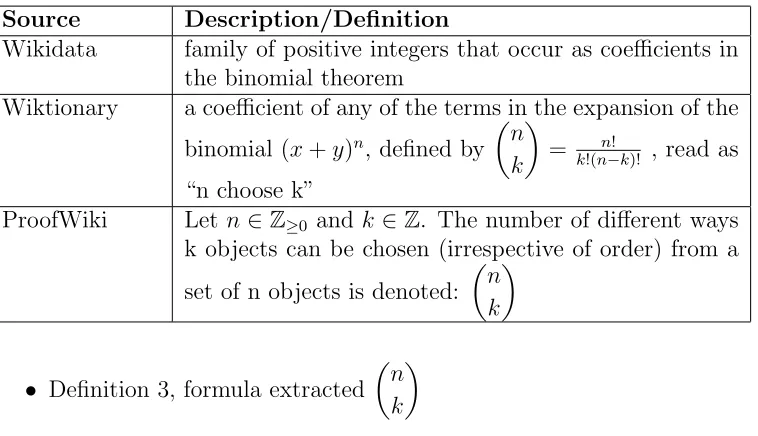
4.4 Multiple Descriptions for the Binomial Coefficent from different data sources. . . 54
5.1 Descriptive Statistics of formulas sizes (without single symbols) in the Wikidata Data set . . . 63
5.2 Counterbalanced order used to present card types to partici-pants (P) for corresponding mathematical entities (E) . . . 65
5.3 Questions from Section 1 of Post Study Questionnaire. . . 69
5.4 Questions from Section 2 of Post Study Questionnaire. . . 70
6.1 Pairwise Wilcoxon Signed Rank Test with Bonferroni Correc-tion for usefulness scores . . . 86
6.2 Observations : Pairwise Wilcoxon Signed Rank Test with Bon-ferroni Correction . . . 86
6.3 Pairwise T-Test with Bonferroni Correction for response times 87 6.4 Observations : Pairwise Wilcoxon Signed Rank Test with Bon-ferroni Correction in Response times . . . 88
E.2 Familiar and Less Familiar, Small Formulas used for Human
Experiment. *Indicates Practice Trials . . . 140
E.3 Familiar and Less Familiar, Large Formulas used for Human
List of Figures
1.1 Example of Search Results as presented by Approach0 - a math
aware search engine . . . 2
1.2 Examples of an entity card on different search engines for a common query : ‘Pythagorean Theorem’ . . . 4
1.3 Math entity card template . . . 5
2.1 Example of entity card displayed on the Google SERP for dif-ferent queries . . . 11
3.1 Similarities & differences in layout between common entity card as described by Balog K. [2] and proposed math entity card. . 27
3.2 Examples of math entity cards with title and formula only. Wikipedia indicates the source URL. . . 27
3.3 Examples of math entity cards with title-formula and descrip-tions/definitions . . . 29
3.4 Examples of math entity cards with title-formula-description and a Usage section . . . 30
3.5 sinθ card with related functions/operations as usage . . . 30
3.6 Math entity cards for mathematical symbols . . . 31
3.7 Faceted Search for Symbol Cards . . . 33
3.8 Binomial Coefficient with multiple formulas and and multiple Descriptions . . . 34
3.9 Stacked Cards with Pop Up . . . 35
3.10 Normal Distribution Card with Aliases . . . 36
3.11 LATEX formula auto-complete as present in Wolfram Alpha . . 38
3.12 Math entity Cards as auto-complete . . . 40
4.1 A section of Pythagorean Theorem from Wikipedia, highlighted are multiple valid definitions. . . 42
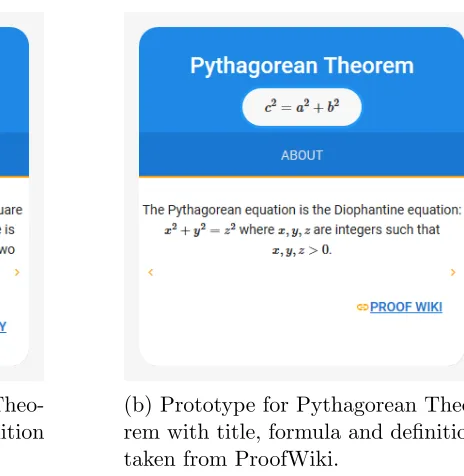
4.3 Prototype of Math Entity Cards . . . 56
4.4 Prototype of math entity cards with Carousel for rotating de-scriptions. . . 57
4.5 A subset of formulas, along with other fields as stored in the database . . . 58
5.1 Different combinations of card components (Title, Formula, De-scription) forming different card types. . . 60
5.2 Card for Addition containing title and description . . . 68
6.1 Age & education of participants . . . 71
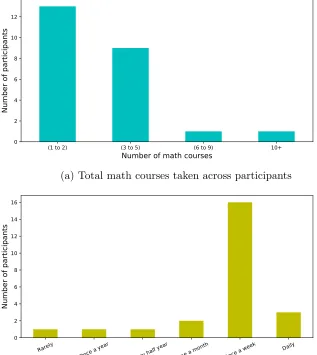
6.2 Bar plot of math courses taken and frequency of looking up mathematical information as reported by participants . . . 73
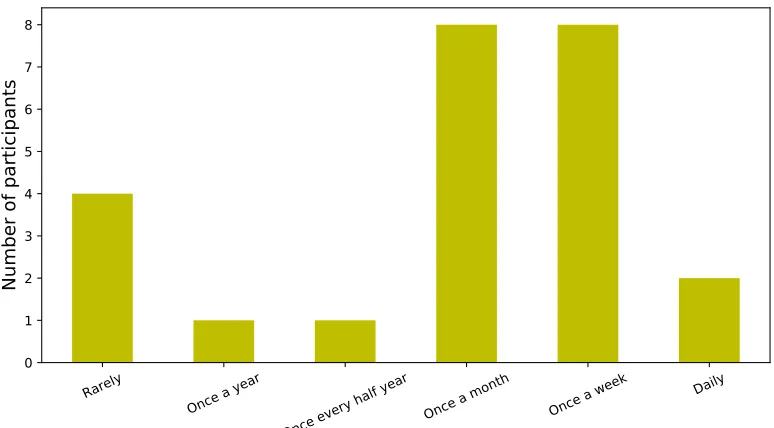
6.3 Frequency with which participants need to express mathemati-cal notation . . . 74
6.4 Box plot of overall and indiviual time taken for section 1 of each trial . . . 75
6.5 Overall Usefulness Scores per Card Type . . . 77
6.6 Card-types contribution to understanding, for familiar concepts 78 6.7 Card-types contribution to understanding, for less familiar con-cepts . . . 80
6.8 Comment Distribution across Groups . . . 81
6.9 Comment Distribution across Card Types . . . 83
6.10 Importance of title, formula and description . . . 89
6.11 Usefulness of related concepts, tutorials and formal description 90 7.1 A complete math entity card design . . . 102
D.1 Card Types for Congruence . . . 110
D.2 Card Types for Inequality . . . 111
D.3 Card Types for Line Integral . . . 111
D.4 Card Types for Complex Conjugate . . . 112
D.5 Card Types for Cross Product . . . 113
D.6 Card Types for Aleph Number . . . 114
D.7 Card Types for Converse Implication . . . 114
D.9 Card Types for Compact Embedding . . . 116
D.10 Card Types for Partial Derivative . . . 116
D.11 Card Types for Plus-Minus . . . 117
D.12 Card Types for Left Open Interval . . . 117
D.13 Card Types for Entailment . . . 118
D.14 Card Types for Beth Number . . . 119
D.15 Card Types for Wreath Product . . . 120
D.16 Card Types for Covering Relation . . . 121
D.17 Card Types for Adsorption . . . 122
D.18 Card Types for Autonomous Consumption . . . 122
D.19 Card Types for Rotating Unbalance . . . 123
D.20 Card Types for Classification Of Electromagnetic Fields . . . . 123
D.21 Card Types for Reality Structure . . . 124
D.22 Card Types for Magnetic Energy . . . 124
D.23 Card Types for Mired . . . 125
D.24 Card Types for Allan Variance . . . 125
D.25 Card Types for Angular Velocity . . . 126
D.26 Card Types for Equianharmonic . . . 126
D.27 Card Types for Huge Cardinal . . . 127
D.28 Card Types for Ratio Test . . . 128
D.29 Card Types for Divisor . . . 129
D.30 Card Types for Solenoid . . . 129
D.31 Card Types for Conformational Isomerism . . . 130
D.32 Card Types for Ch´zy Formula . . . 130
D.33 Card Types for Rayleigh Distribution . . . 131
D.34 Card Types for Bernoulli’s Inequality . . . 131
D.35 Card Types for Lower Hybrid Oscillation . . . 132
D.36 Card Types for Sine . . . 132
D.37 Card Types for Phase Retrieval . . . 133
D.38 Card Types for Electrostatic Force Microscope . . . 133
D.39 Card Types for Integral Equation . . . 134
D.41 Card Types for Oscillatory Integral . . . 135
D.42 Card Types for Gumbel Distribution . . . 135
D.43 Card Types for Klecka’s Tau . . . 136
D.44 Card Types for Epimorphism . . . 136
D.45 Card Types for Optical Transfer Function . . . 137
D.46 Card Types for Lee Distance . . . 137
D.47 Card Types for Parallelogram Law . . . 138
D.48 Card Types for Antenna Gain To Noise Temperature . . . 138
F.1 Distribution of Usefulness Scores across total number of cards for Familiar Concept . . . 141
F.2 Distribution of Usefulness Scores across total number of cards for Less Familiar Concept . . . 142
F.3 Average Usefulness Scores per Card Type for Familiar Concepts 142 F.4 Average Usefulness Scores per Card Type for Less Familiar Con-cepts . . . 143
F.5 Distribution of Usefulness Scores across total number of cards for Symbols . . . 143
F.6 Distribution of Usefulness Scores across total number of cards for Small Formulas . . . 144
Chapter 1
Introduction
Navigating currently between formulas of mathematical concepts and
their associated names or descriptions is a rather long and sometimes tedious
process. Math Entity Cards are designed to help make this transition from
formula to concept as well from concept to formula, simple and
straightfor-ward.
Mathematical formulas are a part of the abstraction process, they have
both syntax and semantics and are widely used to convey some information,
just like text. However, existing text search engines are not built to support
mathematical formulas. They either treat formulas as LATEX strings or assume
meaning based on surrounding text or ignore the math altogether. Thus when
searching for mathematical concepts, this leads to longer search sessions,
in-crease in the number of query reformulations and an overall dein-crease in the
search experience.
Contrary to text search engines that focus primarily on text, math
search engines revolve mainly around formulas as an input while also
support-ing text based search. Existsupport-ing math information retrieval (MIR) systems such
as Approach0 [37], Tangent [26] and WikiMirs [11] display their results in a
Figure 1.1: Example of Search Results as presented by Approach0 - a math aware search engine
and a small snippet of content that has the matched portion of the query
highlighted. While this is beneficial for regular or exploratory search, it does
not help look up factual information. That is to say if a user has entered a
formula that defines or is related to a mathematical concept or theorem, only
highlighting relevant/partial matches might miss out on addressing the search
intent, which is probably to know more about the concept or formula.
A few years ago text-based search engines faced a similar issue, but have
evolved from simple matching of text keywords, to now analyzing queries to
better understand and respond to a user’s information need. One way they do
so, is by supplementing the Search Engine Result Page (SERP) with additional
if we query the phrase “Albert Einstein” on any commercial text-search engine,
the results describe the famous theoretical physicist, by providing information
on who he was and what he accomplished, rather than just sources of text
where the phrase “Albert Einstein” occurs. Balog K. defines this approach of
returning information about entities (real world uniquely identifiable objects)
as Entity Oriented Search [2]. This behavior of search engines hence reflects
an understanding of query terms where information collected about real world
entities is fetched based on relationships between what is being asked, and
what is already known about the entity.
1.1
Mathematical Concepts as Entities
There are certain mathematical equations and concepts that are more
familiar to users than others, e.g. ‘Pythagorean Theorem’ which is usually
represented by the equation
a2+b2 =c2 (1.1)
If we search for the text phrase ‘Pythagorean Theorem’ in a
commer-cial search engine, along with the regular results we are provided with a small
info-box also called an Entity Card. Figure 1.2a and 1.2b, each provide an
ex-ample of the entity card for two common text search engines Google and
Duck-DuckGo. As we see both cards have the same description for the Pythagorean
theorem, a common image and a link to the common source of extraction, i.e.
Wikipeida. This extraction of entity cards for text search engines naturally
(a) Google (b) DuckDuckGo
Figure 1.2: Examples of an entity card on different search engines for a common query : ‘Pythagorean Theorem’
extracting general descriptions from the page. However from a mathematical
search perspective the card does not have either aformula, description of
the formula and its variables, orapplications of the concept, which we
believe is crucial in addressing a user’s math informational need. With a few
more clicks and effort to filter through some more information a user would
possibly find the formula, its description and the corresponding applications.
Math-aware search engines on the other hand, revolve mainly around
formulas as inputs, we hence describe a process of using formulas as starting
point to fetch names (titles) and descriptions of concepts to which these
for-mulas act as attributes. We describe this to be a formula first approach by
working our way from formulas to concepts instead of concepts to formulas,
the latter which as seen before although possible in existing search engines is
Title / Concept
Rendered Formula
Wikipedia
Description / Definition
Usage 1 Usage 2
[image:21.612.236.398.122.302.2]Usage
Figure 1.3: Math entity card template
1.2
Problem Statement & Contributions
This thesis aims to explore the following research questions:
1. If mathematical concepts are entities, can formulas be associated with
them? If yes, can we use entity cards to navigate between formulas and
concepts?
2. Would providing more mathematical information during search be
ben-eficial to users?
In order to address the research questions, the following contributions are made
as part of this thesis:
1. An alternate design of entity cards (Figure 1.3), specifically meant to
address various types of mathematical search needs, that current entity
2. Populating individual components (title, formula and description)
of these cards by compiling data from existing structured and
semi-structured data-sources.
3. A human experiment to study the usefulness of individual card
compo-nents while searching for mathematical content from both a text query
and a LATEX query input.
4. Creation of an index on both titles and formulas, that can be queried
via an API, and demonstrating an alternate use of these cards as a form
of auto-complete.
1.2.1 Math Entity Card Proposed Use Case by User Search Needs
Zhao et al. [36] were the first to categorize math user’s needs into
informational needs: searching for a name/alias, definition, derivation,
ex-planation, application etc. andresource needs: searching for paper, tutorial,
slides etc. However based on a taxonomy of web search goals as created by
Broder [4] there exists a third web-search need that is relevant to math search
as well,a navigational need. The purpose of a navigational need is to re-find
the exact page/document containing the formula, that was previously
encoun-tered.
For a beginner looking for the concept associated to an unknown
for-mula or for an expert looking for a precise technical description of either a
concept or a formula, Math entity cards can help address thisinformational
to a concept of interest or a beginner looking for a tutorial of the existing
concept, Math entity cards could help address this resource need. Math
entity cards in general help provide a two way access of navigating to either
the concept from the formula or the formula from the concept, thus addressing
anavigational need.
We first introduce the existing work on entity cards and their studied
ef-fects in text search engines followed by the work done in extracting descriptions
for mathematical formulas. We then provide our modifications to the existing
designs of entity cards to create math entity cards. Rather than extracting
title, formula and descriptions triples from sentences as done in the previous
work, chapter 4 discusses about methods in which these card components can
be populated by compiling data from existing sources. It also describes how
by creating a dual index on both formulas and titles, these cards are used as
auto-complete in MathSeer. Chapter 5 describes the human experiment
car-ried out to observe the usefulness of individual card components (title, formula
& descriptions), in isolation without any search interface. Chapter 6 describes
our results and observations from the human experiment. Finally we discuss
Chapter 2
Related Work
Zhao et al. [36] propose the notion of ‘Keyword-to-Expression Linking’
i.e. the resolution of expressions to terminology (e.ga2+b2 =c2toPythagorean
theorem) as a means to bridge the gap, between making expression searching
and relevance ranking relevant to users while maintaining the usability of
key-word searches in text-search engines. Sapa et al. [30] in their user study on
information seeking behaviour of mathematicians, scientists and students,
ob-serve that students search more often for reference works (encyclopedias and
dictionaries etc.) and more often use, search engines designed to find specific
objects (e.g. graphics, audio files, multimedia objects). Although this could
be a result of the need of learning or homework activities, they do classify it as
both an informational and resource need. They also found a majority of both
students and scientist starting their math information search from Google, a
text based search engine.
Mansouri et al. [23] were the first to characterize searches for
math-ematical concepts from search engine query logs. Apart from longer search
sessions they found that math queries are considerably longer on average than
typical web queries and have long runs of cut-and-paste text. They also found
any combination) were the most frequently requested content type followed by
PDF and video. Based on the frequency of question type keywords in math
queries they found ‘What’ followed by words such as Formula (60%), Equation
(11%) and Used for (9%) to be occurring in 69.5% of queries. This by Zhao’s
definition demonstrates that a considerable amount of math based
informa-tion needs are informainforma-tional in that, the search is mainly for data that can be
considered as facts related to a mathematical concept.
Long length of math queries, extensive query refinement and longer
search sessions also results in lower satisfaction levels as predicted by
Man-souri et al. [23]. This in some way could be attributed towards search engines
not being able to interpret/understand what exactly is being asked. Text
based search engines do not deal with mathematical expressions as well as
they deal with text queries, the reason for this is firstly, the input to these
en-gines are purely text based, which means users would have to resort to either
entering LATEX for mathematical expressions or using some set of keywords for
mathematical terms. This like Zhao et al. [36] and Wangari et al. [33] studied,
results in an expression gap between users and search systems. Users spend
more time on creating a query and reformulating it in a manner that the search
engines understands and can then return results that are meaningful to the
user.
Search however is only a part of the process, when an information need
arises, it is not the end. Text-based search engines are constantly working on
that are more readily consumable. This chapter describes some of the ways
text-based search engines are doing so and draws connections to previous work
in math information retrieval which when combined could be applied to
im-prove how users search and consume math information.
2.1
What is an Entity?
Balog K. in his book on Entity-Oriented Search [2] defines an entity
to be a uniquely identifiable object or thing, that can be characterized by its
name(s), type(s), attributes, and relationships to other entities. The author
goes onto further classify entities into
• Named Entities: which are entities that can be mapped to a real world
object e.g., Albert Einstein or Golden Gate Bridge.
• Concepts: Abstract objects that map to mathematical, philosophical,
physical, psychological social concepts or sometimes even natural
phe-nomena, e.g., Triangle, Conscience or Earthquake.
The author also mentions that from previous studies on query logs, about
40-70% of queries issued to general text search engines either have an entity
mentioned or target some specific entities. Mansouri et al. [23] had conducted
their study by identifying mathematical entities represented as text keywords
in query logs. They found approximately 400,000 queries out of 27 million
Series’). This supports the idea of “Entity Oriented Search” as coined by
Balog, for math Information Retrieval as well.
2.2
What are Entity Cards? How are they created?
Search engines such as Bing, DuckDuckGo, and Google have started
responding to queries containing identifiable entities such as “Einstein
Educa-tion” or “Albert Einstein Family” with Entity Cards also known as summary
cards (Figure 2.1a & Figure 2.1b). The entity cards appear on top right hand
side of the Search Engine Result Page (SERP) so as to supplement the other
search results (10-blue links) for a query.
(a) Query : ‘Einstein Education’ (b) Query :‘Albert Einstein Family’
Figure 2.1: Example of entity card displayed on the Google SERP for different queries
Entity cards are a concise, independent (from the SERP by appearing
includ-ing a title/name, possibly an image and a summary: a set of facts from an
underlying knowledge base, all that describe the entity [9]. In (Figure 2.1a &
Figure 2.1b) we notice both the queries have ‘Einstein’ in common, which is
considered to be the common entity.
Studies by Bota et al. [3] have attempted to answer questions such as
• How does the card presence and content influence users’ search behaviour
and perceived workload?
• Do card properties, such as card coherence (whether card contents are
coherent and all focus on the same topic of a user’s query) and vertical
diversity (whether cards contain visually salient blocks of elements, such
as Images), have an effect on search behaviour and workload?
By conducting a large scale crowd study they have been able to measure and
analyze the following:
• Card Interactions, which refers to how users engage with entity cards
containing both on topic and off topic content.
• Web Interactions, which focuses on searchers engagement with
non-paid/non-advertised (organic) web results displayed on the SERP.
• Workload, which focuses on the perceived task load as measured by a
Their study find differences in user’s interaction with entity cards and search
results due to on-topic and off-topic card contents. They found searchers
spend less time interacting with organic web results when the entity card is
off topic compared to being on-topic or even absent. Their studies verify a
logical assumption of searchers issuing less modified queries when the entity
card is on-topic as compared to off-topic. With respect to the workload, their
study finds on-topic entity cards do not affect perceived workload as compared
to absence of entity cards, however off topic entity cards could generate more
workload because of the additional information users need to examine.
Entity cards are present not just for regular queries but also for queries
containing health related conditions. Consumer Health Search (CHS) is
de-scribed to be a challenging domain with challenges such as vocabulary
mis-match, and lack of domain expertise which affect both query formulation and
result interpretation. Recent user studies in domain specific entity cards by
Jimmy et al. [14], have found Health Cards being able to help less
knowl-edgeable users search and diagnose health conditions as effectively as more
knowledgeable users. They conclude that Health Cards are best suited for
well-defined health search tasks (e.g.Factual Scenarios) rather than exploratory
tasks. In a follow up study Jimmy et al. [15] investigate the effectiveness of
Health cards to assist in decision making in CHS, where in they propose a
novel multi-card interface. A multi-card interface shows multiple cards all
stack adjacently to allow users to perform comparison based diagnosis
make health decisions such as correct diagnosis and predicting the urgency of
treatment with significantly lesser effort than a single card. The challenges
faced by CHS however is analogous to math information retrieval and many
other domain specific information retrieval scenarios where in users might know
the exact term to query and hence approximate the query by self describing
the situation. This more often than not, results in users modifying the query
and repeating the search to narrow down results. To help with CHS, there is
also the development of tool or info-tip with entity card like functionality by
Lopes et al. [21] to Assist Health Consumers while searching for the web by
providing Medical Annotations. The tool annotates medical concepts present
on a web page and allows access to information such as concept definition,
related concepts and links to external references for these annotated concepts.
2.2.1 Entity Card Creation
Text-based search engines such as Google and Bing make use of their
own proprietary knowledge bases/graphs to generate entity cards. They do so
by fetching the name/title, an image, a description or summary and a set of
facts from this knowledge base, all that describe the entity [12].
In Figure 2.1a and Figure 2.1b the information on the card changes,
with changes in the query, although both queries have the same entity i.e.
‘Einstein’ each entity card differs a bit in content, query for ‘Albert Einstein
Family’ responds with a card containing information about his parents, spouse
is an example of dynamic summarization where in the contents of the card
are query-dependent. Studies by Hasibi et al. [9] were the first to explore
the concept of dynamic summarization for entity cards. They define dynamic
summarization as a two step process comprising of fact ranking and summary
generation. The fact ranking step includes ranking of facts according to
impor-tance and/or relevance to terms in the query. The second step is the rendering
of these facts on the entity card. Their studies find users preferring dynamic
summaries, those that are query-dependent over static summaries that are
query-agnostic.
2.3
Math Entity Cards
Seeing the positive effect entity cards have on text information retrieval,
we assume they would carry forward to math information retrieval and hence
propose the creation of math entity cards. To the best of our knowledge,
this is the first work that introduces and describes the design, creation and
studies the effects of these cards in math information retrieval. As we shall see
there has been prior work addressing challenges in each area of card creation
such Information Extraction (Title, Description/Definition), Entity Linking
and Knowledge Base creation for mathematics in isolation. But the concept
of using creating and using a math entity card for math information retrieval
is new. We suspect this mainly since Entity Cards as a concept for text search
engines themselves are a fairly recent idea and also primarily because formulas
2.3.1 Information Extraction From Surrounding Text
Quoc et al. [28] initiated work around extracting co-reference relations
between formulas and the surrounding text in Wikipedia. They do so by
find-ing textual overlaps between formulas converted to text and text descriptions
around formulas. They call this approach as surface level text matching and
represent it by Equation 2.1. Their work describes the extraction of a Concept,
Description and Formula (CDF) triple, in which a concept is defined to be a
name or a title of a formula. Their extraction process creates a candidate
con-cept for any noun phrase in the title, section headings or text written in bold
or italic in Wikipedia articles. The selection of descriptions is based on the
noun phrases (NP) that occur after variations of the verb ‘to be’. Examples
of the candidate pairs are shown in Table 2.1.
Table 2.1: Examples of candidate triples from the selection process
Concept Description Formula
the sine of an angle
the ratio of the length of the opposite side to the length of the hypotenuse
sin A = hypotenuseopposite = a
h
a quadratic
equation
a polynomial equation of the second degree
ax2+bx+c= 0
Their work starts out by considering only those CDF triple’s that lie in
the same paragraph. After the generation of candidate CDF triples, surface
level text matching is used to classify each candidate as true or not based on
defined as a ratio of overlap between text keywords as follows
sim(F, C, D) = |TF ∩TC|
min{|TC|,|TF|}
+ |TF ∩TD|
min{|TD|,|TF|}
(2.1)
whereTF, TC andTDare sets of words extracted from Formula(F), Concept(C)
and Description(D) respectively. The common math operators are converted
to text, e.g. ‘+’ is converted to ‘plus’ and ‘\frac’ is converted to ‘divide’, this
implies
• Math formulas are converted to a textual representation, which may
cause some loss in the structural and syntactical information they carry.
• The method is not applicable to less common operators, variables and
other identifiers.
Candidates are then classified as ‘True’ if they meet a sim(F, CD) score
no larger than 1/3. Candidates that are not classified as true, are then
re-examined in a second pass by using patterns generated from the Candidates
that are classified as true after the surface level matching step. Table 2.2
shows examples of the extracted patterns. CONC, DESC and FORM are
placeholders for Concept, Description and Formula respectively. The
clas-sified candidates are finally evaluated manually. Their best system had an
Table 2.2: Examples of extracted patterns from candidates after the surface level text matching process
Pattern
CONC is DESC: FORM
CONC is DESC. In our case FORM CONC is DESC. So, ...., FORM CONC FORM
Yokoi et al. [34] improve upon this work by first manually
construct-ing a reference data-set of 100 Japanese Scientific papers. With the help of
pattern matching and machine learning methods they demonstrate the
chal-lenges and feasibility of fetching variable names and function definitions from
surrounding natural language descriptions. Their work focuses mainly on
con-necting elements of mathematical expressions with their names, definitions
and explanations, which they refer as mathematical mentions. For example
given a sentence, “We defined the precision(P) as follows P = WW+Y where
W is the number of extracted correct-labeled pairs and Y is that of extracted
fault-labeled pairs.” The extraction process should result in: P - the precision,
W - the number of extracted correct-labeled pairs and Y that of extracted
fault-labeled pairs. The task is then defined to be automatically
identify-ing such connections and validated them against the hand annotated
data-set. Since this was the first work on linking formulas to descriptions, only
compound nouns (combination of two independent words that has its own
meaning individually) in the same sentence was considered as possible
the mathematical mentions co-occur with the target mathematical expression
within thesame sentence. They also evaluate an SVM-based binary
classifi-cation approach, using a set of eight manually identified patterns. Apart form
the eight pattern features they make use of other linguistic cues to help in the
classification. Table 2.3 shows a subset of the features used for the SVM based
approach.
Table 2.3: Subset of Features used for Machine learning
Features Explanations
Another mathematical expression, comma, or opening or closing brackets
Test existence of another mathematical expression, comma between the target noun and the mathemat-ical expression.
Order Test whether the target noun lies anterior to the
math-ematical expression or not.
Composition If the target noun is a compound noun
Every feature has a binary value of whether or not the feature is present
for a sample. On further analyses of their data-set we discovered a problem of
class imbalance problem where in there are 3,867 positive samples and 53,153
negative samples in training and 1,193 and 16,219 negative instances;
unfor-tunately they do not mention how they handle this situation. They propose
a novel approach for an evaluation criteria: soft and strict matching. Soft
matching, considers the classified result to be true if they partially match
the human annotated ones. Strict matching, as the name suggest considers
the classified result to be true only if they exactly agree with human
an-notated ones. Their overall F-1 score on the test data-set is 89.20 for Soft
looks very promising, however if we consider the initially pointed out
limi-tations of a single compound noun and an imbalanced data-set we quickly
realize that the practical applications of this method are low. To overcome
the first challenge Kristianto et al. [20] propose a design guideline for
an-notating scientific papers for mathematical formula Search. They assume a
single mathematical formula can have multiple descriptions. Each
descrip-tion could be of two types short descripdescrip-tion that specifies the type or
cat-egory of the formula e.g log(x) is a function and long description log(x) is
a function that computes the natural logarithm of the value x. Kristianto et
al. [8] carry forward the same work for the extraction of textual descriptions
from scientific papers. They describe three different approaches for extracting
the definitions of mathematical expressions under the assumption that
defini-tions are usually noun phrases.
• Nearest Neighbor.
• Pattern Matching.
• Machine Learning.
The nearest neighbor method is the baseline method and works under the
as-sumption that the textual definition is a combination of adjectives and nouns
that occur before a mathematical expression. They make use of a part of
speech tagger to obtain the annotation of words (classification of words as
Table 2.4: E.g. of Sentence Patterns
No. Sentence Pattern
1. ... denoted (as | by) MATH DEF
2. (let | set) MATH (denote | denotes| be) DEF
3. MATH (is | are) DEF
approach tries to capture the sentence patterns (as a set of rules) in which
definitions are usually mentioned in Scientific papers. Table 2.4 provides
ex-amples of the sentence patterns used in the pattern matching method. In Table
2.4, MATH and DEF symbols denote the target mathematical expression, its
definition, and other mathematical expressions, respectively. The machine
learning approach uses all the patterns from the pattern matching step along
with some other features such as location, unigram, bigram and trigram scores
etc. For the strict matching criteria they were able to achieve a precision of
73.60, recall of 30.09 and an F-score of 42.46, and for the soft matching criteria
they were able to obtain a precision of 80.08, recall of 40.30 and an F-score
of 53.29, while impressive their data set consists of only 14 scientific papers
and hence might not have the coverage needed to support math information
retrieval at a large scale.
Kristianto et al. [19] improve on their previous description extraction
methods of mathematical expressions and assess the coverage of several types
of textual span: fixed context window, apposition, minimal noun phrase and
all noun phrases. Table 2.5 gives the explanation of each individual textual
Table 2.5: Textual Span Definitions
Textual Span Explanations
Fixed Context Window Ten words before and after the target expression
Apposition A preceding noun phrase that has the same referent
(apposition) relation with the target math expression
Minimal Noun Phrase The first compound noun phrase from a complex noun
phrases that contains prepositions, adverbs or other noun phrases.
All Noun phrase All noun phrases in the target sentence.
Similar to their previous work their evaluation included two methods
soft and strict matching of definitions. Where in a candidate would pass the
strict matching evaluation if its position, in terms of start index and length
is the same as the gold standard. And a candidate would pass soft matching
evaluation if its position contains, is contained in or overlaps with the position
of the gold standard description for the same expression. Their evaluation in
terms of both strict and soft matching of definitions helps conclude
“apposi-tion” gives the highest F1-score, but “minimal noun phrase” and “all noun
phrase” produces the highest recall. They also point out why their previous
methods [25, 20, 8] work only in particular cases e.g. Expecting an expression
to have all its defining terms within a specified context window.
2.3.2 Math Entity Linking
Entity linking can be described as mapping entities in unstructured free
text to known entities in a knowledge base. A variation of entity linking is
wikification, which identifies an entity and locates its corresponding Wikipedia
Kristianto et al. [17]. They formalize the idea as “Given a document d
con-taining a set of math mentions (math expressions/formulas)M ={m1, .., mn}
assign each math mention mi a Wikipedia article ti.” The method used by
Giovanni et al. [17] is not purely formula/expression based, and makes use of
the surrounding text as part of two enrichment steps that are performed. The
enrichment steps are as follows:
• Math Enrichment
• Text Enrichment
The math enrichment step is similar to a query expansion technique where
the entire math expression is split into multiple sub-expressions based on the
top-level (in)equality. This is done to help increase the percentage of partial
match in case there is no exact match of the query. The output of this step is a
set, that includes the original math expression along with sub expressions from
the split. The text enrichment step creates a concatenation of noun phrases
that contain the math expression or a sub-expression along with extracted
textual description of the formula, from the same input document d, based
on approaches used in their earlier work [19]. After the enrichment step a
new queryqi is created which contains both math and text and this is used to
2.3.3 Mathematical Knowledge Base Creation
Math entity cards are expected to function in a similar manner as entity
linking where isolated formulas will be matched to entries in a knowledge base
to fetch known factual information regarding the formula. This subsection
describes work focussed at developing mathematical knowledge bases.
With the rise of XML based languages such as MathML [1],
Open-Math [5] and OMDoc [16], all with a focus of supporting exchange of
math-ematical information over the web, there has been prior attempts to create
knowledge bases that serve as a repository mathematical information although
not mainly for information retrieval, but for automated theorem proving and
finding proven mathematical properties [7]. There has also been attempts to
translate information between different libraries [12] with a goal to make the
information more machine readable.
Today’s machine readable data in knowledge bases [27] are stored in
an inter-operable format such as Resource Description Framework (RDF) also
known as Linked Open Data. RDF use statements to define and capture
relationships between objects. The statements are stored as triples of the
form subject-predicate-object. Nevzorova et al. [24] experimented with
simi-lar methods of proximity based matching of mathematical variables with noun
phrases described earlier, to try and get math data to Linked Open Data.
They were able to get 68% accuracy in picking formulas and their defining
terms on 300 papers. This is a relatively small sample to use as a knowledge
2.4
Summary
As seen, there is a lack of a sufficiently large annotated data-set to train
a machine learning model to identify formulas and their associated definitions
in unstructured data. This could be attributed to the difficulty of
simulta-neously considering the semantics of formulas along with the semantics of
the surrounding text while annotating the data. We make use of the earlier
approaches in annotating candidates but reduce our candidate pool by
con-sidering only structured and semi-structured data known to be concise, thus
reducing the uncertainty of whether the text is a description or not. We make
use of Wikidata (structured), Wiktionary and ProofWiki (semi-structured) to
first identify formulas and then select descriptions and definitions surrounding
the formula. Since these data sources, describe a single concept per page/entry
disambiguation of the title/name of the mathematical concept is relatively
Chapter 3
Math Entity Card Design
The primary focus of math entity cards are to enable users to navigate
seamlessly between formulas and their concepts. By this we mean, allowing
users to enter a name of a concept and find its defining formula, or enter a
formula and find concepts with which this formula is associated. Entity cards
across different commercial text retrieval engines appear to follow a standard
design guideline as shown in Figure 3.1a. Users of these search engines have
overtime learned to consume a variety of information in the same info-box
lay-out. We wish to use, this familiarity with respect to consuming information
in the same layout to our advantage.
In this chapter, we propose our design decisions for math entity cards,
but for the human experiment we make use of the card with only the title,
formula and a single description. We propose the addition of a formula field,
along with multiple descriptions to support understanding of mathematical
concept across different levels of understanding. We also propose the
intro-duction of a usage section that could include examples of the usage or
ap-plication of the mathematical concept or formula. We introduce math entity
cards for symbols, with each card representing a unique concept/functionality
auto-complete where in users could enter either the formula or the title of a
concept and receive a card directly at query time.
(a) Common Entity Card Layout
Mathematical Entity Name
Synonyms or Aliases Name &Alias
Rendered Formula Associated Formula
Description Description of concept
or formula with variables
Source URL Source URL for
description
Usage/Application
Usage 1 Usage 2 Usage 3
Usage/Application areas of concept
(b) Math entity card layout
Figure 3.1: Similarities & differences in layout between common entity card as described by Balog K. [2] and proposed math entity card.
3.1
Formula Description Card Designs
(a) General Template (b) Sigmoid Function (c) Riemann Zeta
Figure 3.2: Examples of math entity cards with title and formula only.
Wikipedia indicates the source URL.
Figure 3.2 shows examples of a basic math entity card. We decide to
the formulas associated with a math entity. The reason for this is we believe
not all mathematical entities can be represented by an image, but they would
most likely have a defining formula. We place the formula field just below
the title to enable a visual connection between the two. This choice is made
keeping in mind that in a math-aware Engine, a user’s search would revolve
more around formulas and it would be beneficial to have the title and formula
as a pair more easily readable. To this basic card design we add a description
section (summary) that includes the description of the mathematical concept.
Wikipedia acts as the source URL and could point to any source from where
the formula/description for the particular mathematical concept is extracted.
For our research we consider three data sources, Wiktionary, Wikipedia and
Proof Wiki in increasing order of formal descriptions. We believe that due to
the complexity of mathematics in general, it is not always feasible to grasp
the meaning from one definition and thus having multiple definitions might
help. This could also help the more experienced users understand the concept
without dilution of information. Also there are some formulas/symbols for
example ‘α0 that are associated with multiple different concepts, in statistics
to denote significance level, in machine learning to denote learning rate or
an-gular acceleration in physics. Hence the more varied sources considered, the
better our chances at covering multiple concepts.
Three different card designs are presented in increasing amount of
in-formation, this is done to analyze how beneficial is mathematical information
design in Figure 3.2 presents only the concept name along with the formula
that relates to this concept. We noticed during extraction, some formulas
have a passing reference of a concept without a description, in such situations
it could be at least helpful to provide the user with a name of the concept.
This minimal design might suffice in some cases. Users could further decide
whether they require additional information and search accordingly with the
help of the name of the concept(Title). Sometimes however a description of
the formula is needed and supplements the understanding further, as shown
in Figure 3.3.
Title / Concept
Rendered Formula
Wikipedia
Description / Definition
(a) General template
Sigmoid Function
S(x) =1 + e1−x
Wikipedia
A sigmoid function is a bounded, differentiable, real function that is defined for all real input values and has a non-negative
derivative at each point.
(b) Sigmoid Function
Reimann Zeta Function
ζ(s) = ∑n=1∞n1s
Wikipedia
The Riemann zeta function is a function of a complex variable s that analytically continues the sum of the Dirichlet series which converges when
the real part of s is greater than 1.
(c) Riemann Zeta
Figure 3.3: Examples of math entity cards with title-formula and descrip-tions/definitions
3.2
Math Entity Card: Additional Usage Section
We propose introducing a “Usage” section to indicate other areas where
a mathematical concept/formula is used, e.g. Figure 3.4b where a Sigmoid
Title / Concept
Rendered Formula
Wikipedia
Description / Definition
Usage 1 Usage 2
Usage
(a) General template
Sigmoid Function
S(x) =1 + e1−x
Wikipedia
A sigmoid function is a bounded, differentiable, real function that is defined for all real input values and has a non-negative
derivative at each point
Artificial Neural
Networks Soil Salinity
Usage
(b) Sigmoid Function
Reimann Zeta Function
ζ(s) = ∑n=1 ∞ 1
ns
Wikipedia
The Riemann zeta function is a function of a complex variable s that analytically continues the sum of the Dirichlet series which converges when
the real part of s is greater than 1.
Zipf's Law Casimir effect
Usage
[image:46.612.237.395.311.447.2](c) Riemann Zeta
Figure 3.4: Examples of math entity cards with title-formula-description and a Usage section
Sine
sin( ) = ( − )2
Wikipedia Reciprocal Inverse Derivative
Usage
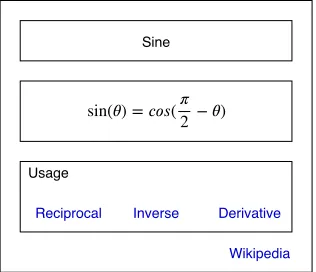
Figure 3.5: sinθ card with related functions/operations as usage
concept to other areas as seen in figure 3.4c. The usage area could alternatively
be used to include a variety of operations that could be applied to the main
function for example Fig. 3.5 where in the user’s input query of ‘sinθ’ results in
an Entity Card of sinθ, instead of the usage however there are three links that
describe mathematical operations or transformations that could be applied to
the input query. Ideally they should have the following functionality:
• Inverse should lead a user to θ = arcsin(hypotenuseopposite )
• Derivative lead a user to cosθ
While beneficial, this would require additional research. We believe one way
this could be achieved is by fetching sub sections from a Wikipedia page, for
example the Wikipedia page for Sine1has ‘Reciprocal’,‘Inverse’ and ‘Calculus’
as sub sections within Identities, with the help of some text processing it might
be possible to fetch meaningful related content. An alternative approach would
be to use a system similar to a computer algebra system that can fetch other
mathematical concepts that have a relationship with Sine.
3.3
Math Entity Cards for Symbols
Factorial
!
In mathematics, the factorial of a positive integer n, denoted by n!, is the product of all positive
integers less than or equal to n: .
! = × ( − 1) × ( − 2). . . 3 × 2 × 1
Wikipedia
(a) Factorial
Logical Negation
!
The statement !A is true if and only if A is false. A slash placed through another operator is the same as "!" placed in front.
Wikipedia
[image:47.612.116.513.360.579.2](b) Logical Negation
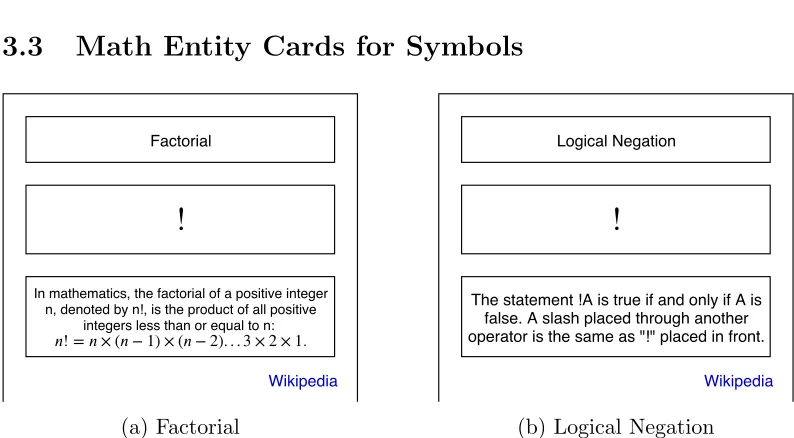
Figure 3.6: Math entity cards for mathematical symbols
Formulas are created by a combination of symbols and variables in a
manner to convey some meaning or represent a relationship between them.
Symbols can hence be considered as independent building blocks of a formula.
The template for a math entity card is designed to accommodate math symbols
information as well. Users can thus obtain a description of what a symbol
represents and know the context in which it is used. This would help reduce
the guess work in searching for a symbol. Some symbols are polysemic in
nature, i.e., they have multiple meanings, depending on the context in which
they are used. For example, ‘!’ can be assumed to be either the ‘factorial’
or ‘logical negation’ depending on whether a user is concerned with the field
of combinatorics or propositional logic. Although the symbol is identical, the
concept is different. Hence, we decide to create a new card for every concept
attached to a symbol, if they are from different mathematical fields. This
opens up the possibility for a search engine to help users narrow down search
results by applying multiple filters based on faceted classification of the items
(faceted search) as seen in Figure 3.7. These categories (facets) are available
Absolute Value
| … |
In mathematics, the absolute value or modulus |x| of a real number x is the
non-negative value of x without regard to its sign. Namely, |x| = x for a positive x, |x| =
−x for a negative x, and |0| = 0.
Wikipedia
Geometry Number Theory
Set Theory Matrix Theory
(a) A card for the symbol |. . .|in Number Theory
Cardinality
| … |
In mathematics, the cardinality of a set is a measure of the "number of elements of the set". For example, the set A = { 2 , 4 , 6 } contains 3 elements, and therefore A has
a cardinality of 3.
Wikipedia
Geometry Number Theory
Set Theory Matrix Theory
(b) Another card for the same symbol|. . .|in Set Theory
Figure 3.7: Faceted Search for Symbol Cards
3.4
Alternate Descriptions for a Concept or Formula
As discussed in the introduction of this chapter, we make use of more
than one source for information extraction, this was primarily to address the
Binomial Coefficient
( ) = !( − )!!
Wikipedia
n choose k because there are ways to choose an (unordered) subset of elements
from a fixed set of n elements. ( )
>
( + ) =∑( )
=0 −
For natural numbers (taken to include 0) n and k, the binomial coefficient can be defined as the coefficient of the monomial
in the expansion of . ( ) (1 + )
Figure 3.8: Binomial Coefficient with multiple formulas and and multiple De-scriptions
same mathematical concept. A single mathematical concept can have more
than one formula by which it can be identified. For example, in Fig. 3.8 we see
the mathematical entity ‘Binomial Coefficient’ to have more than one possible
description. The first describes the way of computing
n k
, whereas the second
describes the occurrence of
n k
as part of a broader concept. Either of the
descriptions could be beneficial to a user depending on the information need.
However each description is closely associated with its individual formula,
we refer to this as a Formula-Description pair. Alternatively we could also
have multiple formulas but just have a single description associated to the
concept in general. To handle multiple formulas with a single description and
multiple formula-description pairs with a common presentation, we propose
• Carousel: A carousel feature would enable users to swipe across
defini-tions and formulas treated as pairs. In instances when a concept being
searched for has more than one formula-description pair associated with
it, the search engine must first display the formula that closely matches
the query and then display the others, associated for the concept. This
would allow users to continue browsing other formulas connected to the
same concept.
Logical Negation
Factorial
In mathematics, the factorial of a positive integer n, denoted by n!, is the product
...
Wikipedia
(a) A set of stacked cards, all related to the same symbol
!
Logical Negation
The statement !A is true if and only if A is false. A slash placed through another operator is the same as "!"
placed in front.
Wikipedia Wikipedia
Factorial
In mathematics, the factorial of a positive integer n, denoted by n!, is the product of all
positive integers less than or equal to n:
! = × ( − 1) × ( − 2). . . 3 × 2 × 1
(b) A Pop up modal interface to view multiple descriptions for symbols.
• Pop up modal: Most often, we might received multiple formulas or
multiple descriptions associated with the concept but not as
Formula-Description pairs. In such situations we would need two independent
carousels one for the formulas and one for the descriptions. A pop up
modal that appears on an action (double-click) instead could help
pro-vide multiple snippets of both formulas and/or descriptions that exists
for the same concept. This approach provides a more focused view of
the mathematical concept being searched for. This approach can also
be used for polysemic symbols where the symbol representation stays
constant but the Title and Description are displayed as individual
com-ponents within the pop up as shown in Figure 3.9
3.5
Concept Titles & Aliases
Normal Distribution
(Also called : Gaussian Distribution, Bell Curve)
( ) = = ( ) , ∈ ℝ
, 2 1
2‾‾‾ √
−( − )2
2 2 1 −
In probability theory, the normal (or Gaussian or Gauss or Laplace– Gauss) distribution is a very common continuous probability distribution. Normal distributions are important in statistics and are often used in the natural and social sciences to represent real-valued
random variables whose distributions are not known
Wikipedia
Figure 3.10: Normal Distribution Card with Aliases
There are instances where concepts have multiple different names but
syn-onyms for the concept. In such situations different users might enter different
concept names not knowing they all refer to the same concept. These extra
synonyms could be used as aliases (alternate names) for the concept. An alias
would allow different users to reach the same concept as well as learn the
al-ternative names by which that particular concept can be called. Aliases (i.e.
also called) are present in Health Cards generated by Google and Bing, as seen
in the study by Jimmy et al. [14]; we propose to make use of the same design
( Figure 3.10) to have aliases for math entity cards as well.
3.6
Math Entity Cards in a Math Aware Search
Inter-face
Text based search engines have entity cards as secondary sources of
information that are displayed along other results on the Search Engine Result
Page (SERP). However for math aware search engines, there is a possibility
of providing cards directly at query time as a form of auto-complete, this not
only helps save search time but also enhance a user’s ability to interact with
the search system.
As seen in Figure 3.11a Wolfram Alpha has multiple suggestions for ‘!’
but all of them are different examples of the same concept of factorial rather
than showing different concepts where in the ‘!’ exists e.g., Factorial and
Logical Negation. This indicates a popularity based ranking, based on past
searches or query logs, which is beneficial but does not provide any conceptual
formulac2 =a2, which again confirms a popularity based suggestion. However
there most likely exists multiple formulas that overlap withc2 =a2. This form
of popularity based auto-complete of only formulas has two limitations; one
it only provides formulas and no other information regarding the formula and
second it could be easily affected, if multiple users query the same formula with
minor changes to either the variables or the order of operations, this makes
searching for new concepts that have an overlap with the formula, difficult for
a user.
(a) Existing auto-complete for factorial with formula only
(b) Existing auto-complete forc2 =a2 with only one match
Math entity cards help provide auto-complete results based on
math-ematical entities to which formulas are associated, this is not affected by a
popularity based search. As shown in Figure 3.12a by providing the title and
the formula when users enter a formula, users are given conceptual feedback
of a formula. This helps a user relate to concepts immediately, we assume
this would be more beneficial as compared to just providing other formulas
that appear similar since text is more prevalent than formulas. By indexing
both the formula and the title, a user could enter either a partial formula or
partial title to browse other math concepts having formulas/titles that overlap
with the input query. This could serve a purpose of comparison based decision
making, similar to the multi-card interface proposed by Jimmy et al. [15]. By
clicking on the card users are able to receive descriptions for concepts, that
provides information directly, this could either satisfy a factual information
need, or help alter a navigational information need.
Given the development of multi-modal canvas based systems such as
min [31] and their demonstrated usefulness in drawing and editing formulas
[33, 35], it would be beneficial for a user to drag the formula from an entity
(a) Math entity card as a form of auto-complete with title & formula only
(b) Math entity card as a form of auto-complete with title-formula & Description
Figure 3.12: Math entity Cards as auto-complete
3.7
Summary
We have seen alternate designs for math entity cards and the design
decisions that make them better suited for math information retrieval. We
have also briefly discussed applications of math entity cards in this chapter.
We will now discuss the extraction methods to populate each section of the
Chapter 4
Math Entity Card Creation
As seen in the related work, extracting descriptions and titles for a
for-mula from unstructured data requires manual annotation and could introduce
a class imbalance problem. Given the presence of massive online open source
knowledge bases such as DBPedia, Wikidata, Wiktionary and ProofWiki we
decide to make use of basic data processing and rule-based information
ex-traction techniques to create math entity cards. We first describe the
cre-ation of math entity cards for the purpose of using them within MathSeer, a
math-aware search interface. These cards have additional features (alternate
descriptions and keyword based search) that are beneficial to have, but do
not yet have any formal experiment to confirm their benefits. Hence for our
human experiment we created cards without the additional features.
4.1
Math Entity Card Creation
In regular Wikipedia or scientific articles, a single page can contain
more than a single formula, this requires us to solve both an Entity
Identi-fication task (which formula amongst the others on the page represents the
for-Figure 4.1: A section of Pythagorean Theorem from Wikipedia, highlighted are multiple valid definitions.
mula and concept). Figure 4.1 is a section of the Wikipedia page for the
Pythagorean Theorem1 and demonstrates an example of the challenges faced
for fetching title