This is a repository copy of Mobile technology in mobile work: contradictions and
congruencies in activity systems.
White Rose Research Online URL for this paper:
http://eprints.whiterose.ac.uk/83461/
Version: Accepted Version
Article:
Karanasios, S and Allen, D (2014) Mobile technology in mobile work: contradictions and
congruencies in activity systems. European Journal of Information Systems, 23 (5). 529 -
542. ISSN 0960-085X
https://doi.org/10.1057/ejis.2014.20
[email protected] https://eprints.whiterose.ac.uk/ Reuse
Unless indicated otherwise, fulltext items are protected by copyright with all rights reserved. The copyright exception in section 29 of the Copyright, Designs and Patents Act 1988 allows the making of a single copy solely for the purpose of non-commercial research or private study within the limits of fair dealing. The publisher or other rights-holder may allow further reproduction and re-use of this version - refer to the White Rose Research Online record for this item. Where records identify the publisher as the copyright holder, users can verify any specific terms of use on the publisher’s website.
Takedown
If you consider content in White Rose Research Online to be in breach of UK law, please notify us by
1
Mobile Technology in Mobile Work: Contradiction and congruencies in activity
systems
Stan Karanasios
AIMTech Research Group, Leeds University Business School, Maurice Keyworth Building, University of Leeds, Leeds LS2 9JT, UK, email: [email protected]
David Allen
AIMTech Research Group, Leeds University Business School, Maurice Keyworth Building, University of Leeds, Leeds LS2 9JT, UK, email: [email protected]
Citation: Karanasios, S., & Allen, D. (2014). Mobile Technology in Mobile Work: Contradictions and Congruencies in Activity Systems. European Journal of Information Systems, 23(5), 529-542. doi: 10.1057/ejis.2014.20
Abstract
Mobile technology and the information and communication services supported by it have become increasingly embedded in, and in some cases transformed, work and social activity and created new challenges for studying information systems. This paper focuses on the experience with mobile technology in an inherently mobile and information intensive work activity - policing. Drawing upon data from this context this paper makes two key sets of contributions. Empirically, we illuminate the congruencies and contradictions between mobile technology and mobile working, and the relationship between the two, revealing a state of change based upon dialectic interaction. We highlight several ways in which mobile technology has changed the nature of mobile work activity. Theoretically we advance the use of activity theory to better understand the changes of mobile technology mediated work. We extend traditional use of activity theory by adopting congruencies as an analytical lens, in addition to the approach of examining contradictions. The findings are applicable to other areas of mobile work and contribute to the body of knowledge concerning mobile technology mediated work.
Keywords: mobile IS, mobile, activity theory, organisation change
Introduction
2 development of mobile technology; however over the last eight years there has been a mounting corpus of research focusing on the social and technical aspects and the business benefit of mobile technology.
One of the major streams of research has focused on the perception, acceptance and adoption of mobile technology. A particular theme relates to the dual function of mobile technology as both serving organisation-sanctioned and personal motives (Wiredu, 2007), with each context leading to different perceptions of user satisfaction (Scheepers et al., 2006). There is also better understanding of how users perceive their mobile devices and the utilitarian and social values patterning the decision to adopt amongst individual users (Kim & Han, 2009). It was noted that the perception of the smartphone changed noticeably over time from a coveted device, to simply a tool of habitual use (Bødker et al., 2014). Similarly, research has shown the value and user-empowerment of mobile devices going beyond the traditional deterministic paradigm (Jung, 2013). For adoption of specific activities such as banking, the perceptions of users vary with risk, opportunism, reputation and assurance being important roles (Srivastava, 2010); while for mobile commerce activities, culture in the form of trust, navigational structure and visual appeal are important influences (Vance et al., 2008). This suggests that it is important to disaggregate activities (banking, commerce, social networking etc.) and contexts (work, personal) as the issues and affordances of mobile technology are varied and each requires a specific line of inquiry. The academic research has also addressed this as an important theme in the context of work-life balance (Duxbury & Smart, 2011), where mobile technology has been shown to allow flexibility, whilst leaving employees feeling bound to work (Middleton & Cukier, 2006).
In terms of mobile workers (people who work on the move), where there is the greatest potential of synergy, there is emerging understanding of how mobile technology transforms how mobile workers communicate and coordinate their activities and the rise of self-organised mobile communities. It has
been found that ‘blue-collar’ workers innovatively and resourcefully use mobile technologies to participate in communities of practice (Kietzmann et al., 2013). Interestingly, employee firms are often unfamiliar with the importance of community participation enabled through mobile technology. This suggests that workers are finding and creating congruencies between the affordances of mobile technology and the nature of their work (Kietzmann et al., 2013). There has also been a stream of research examining mobile technology and organisational fit, typically relying on quantitative approaches, with the findings used to suggest better ways to design mobile information systems (Gebauer et al., 2010).
3 services are looking toward exploratory, non-determinist, or user-driven development methodologies in an effort to cultivate products that consumers will consistently pay for (Wareham et al., 2009).
Outside the work context, studies of individual mobile behaviours have noted emerging patterns, whereby users turn to mobile modes of information access more frequently (Oulasvirta et al., 2012). There is mounting evidence to suggest that information searches are different on mobile devices, and different factors influence information behaviour (Ghose et al., 2013; Nicholas, 2014).
While the breadth of research on mobile technology continues to grow, we note a limitation in understanding how mobile technology leads to new patterns of work, raises new tensions in work activity (Kietzmann et al., 2013) and how it both the technology develops to resolve issues in, and compliment work activity. Furthermore, despite the level of complementarity between mobile work and mobile technology there is little research exploring how the technology supports work, changes work or creates new challenges. Research has highlighted that voice based mobile technology is harmonious with mobile workers (e.g. sales representatives, police officers) (Carlson et al., 1999; Manning, 1996), however there is less knowledge on how data services and applications enabled by mobile technology are harmonious with work activity.
4 This paper is structured as follows. The following section of the paper briefly reviews the literature on contemporary approaches for studying mobile technology in organisations and argues that activity theory is appealing because of its ability to conceptualise the use of technology in its social and cultural-historical context. We generate two activity theoretic research questions concerning the contradictions and congruencies of mobile technology in front-line police activity. We then outline our study methodology and the empirical data that forms the base of this paper. Our analysis focuses on the emergence, implementation and use of mobile technology in front-line police. The paper concludes with a discussion of the practical and theoretical contributions and study limitations.
Literature review
Studying the implementation, adoption and use of mobile technology
The IS field has a history of investigation into the interrelated issues of implementation, adoption and use of technology. Studies have drawn extensively on the technology acceptance model (TAM) (Davis, 1989), Unified Theory of Acceptance and Use of Technology (UTAUT) (Venkatesh et al., 2003) and Task-Technology Fit (TTF) (Goodhue & Thompson, 1995), amongst other approaches which operationalise the factors leading to the acceptance of technology. Use, validation and extension of these approaches have enhanced our understanding on the factors patterning the acceptance of mobile technology (Carlsson et al., 2006; Gebauer et al., 2010).
While these approaches have augmented understanding on the factors that explain technology acceptance and fit, it is beyond their exposition to provide insights on understanding change, social action and deeper issues around the institutionalisation of technology – that is the broader relationship between technology and human activity. Rather, IS scholars have drawn upon contemporary social theories to frame studies examining these broader issues, including: structuration theory, analytical dualism, social construction, institutional theory, actor-network theory (ANT) and activity theory; all which have a tradition in social science, organisation and IS research (Brigham & Hayes, 2012; Chae & Poole, 2005; Engeström, 2000; Walsham, 1997; Zheng et al., 2013).
5 technology adoption and developing stories which explained the take-up. Donner (2007) used adaptive structuration theory to explore the use of mobile phones and meanings behind certain uses. The use of activity theory to frame studies surrounding the patterns of use of mobile technology (Wiredu, 2007; Wiredu & Sørensen, 2006) remains emergent rather than established.
Activity theoretic perspective: mobile technology mediated activity
We draw on activity theory to frame our study of mobile technology and work activity. Rather than provide an argument for activity theory in IS research (Ditsa, 2003), or explicate upon activity theory in light of other theoretical perspectives, in this section we elaborate on the contribution of activity theory in providing insights into technology mediated change, in particular mobile technology and work.
6
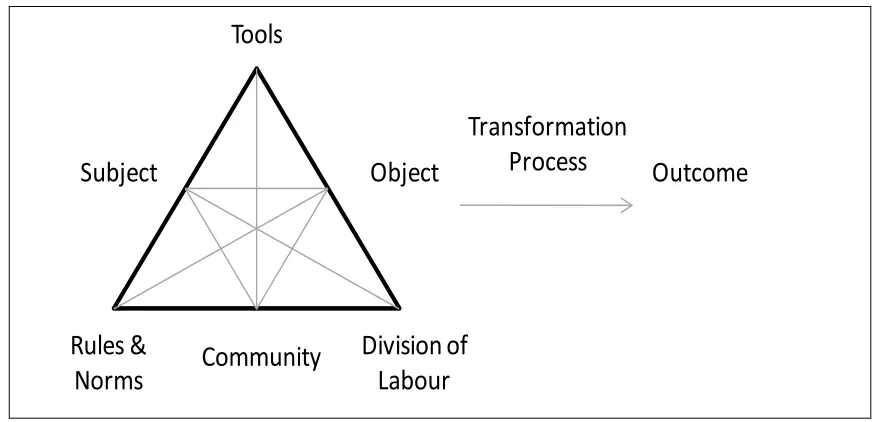
Figure 1: Engeström’s Activity System
While activity theory is an expansive theoretical approach and tradition, we draw upon Engeström’s (1999b) “third generation” activity theory and its related conceptual tools to understand social-action, activity, change and multiple networks of interacting activity systems, and in particular, the use of activity systems, as per our recent work (Allen et al., 2013a; Allen et al., 2013b; Karanasios & Allen 2013). Building on this we incorporate a logic of opposition, focusing on contradictions (Engeström, 1987) and congruencies (Allen et al., 2013). The frame of reference of activity theory employed in this research is set out in the following paragraphs.
The activity system is the site for analysing interaction between actors and collective structures and the use of tools, providing an analytical framework for studying the specific activity and practices at a multilevel, stratified manner, in context (Spasser, 2002). Importantly, bringing these concepts (in particular technology and the social) together into one coherent framework, counters the concern raised by scholars surrounding the absence of the role of technology in organisational life, or privileging the social over the material (Orlikowski, 2005). Rather, it brings the use of technology into the realm of specific human activity, what scholars refer to as “sociomateriality” (Orlikowski & Scott, 2008), or
“intermingling” (Orlikowski, 2005). Bringing these concepts together is different from other approaches,
such as Archer’s analytical dualism where the analytical separation of structure and agency is required to
examine their interplay; a perspective which is discordant with activity theory where they form a single unit of analysis, the activity system (Allen et al., 2013a).
Importantly, activities are woven, combining, merging, interpenetrating, dividing and become more complex over time (Spinuzzi, 2008). The notion of connected, interwoven activities or “weaving” is different to the “spliced” network perspective, which is the understanding used by ANT and concerns
Tools
Subject
Object
Transformation
Process
Outcome
Rules &
Norms
Community
7 political-rhetorical alliances and negotiations (Spinuzzi, 2008) (see Miettinnen [1999] and Spinuzzi [2008]) for comparison with ANT). However, Spinuzzi (2008) acknowledges, as do we, that there is considerable overlap between the two perspectives. This woven understanding suggests that improvements or deterioration of an activity caused by mobile technology will have consequences for other activities. Mobile technology for instance is the result of a social process and previous network of activities, embody cultural characteristics and have become a norm and a means of labour in other activities.
In technology and work studies, difficulties and conflict around the development, use and change of technology typically manifest (Orlikowski & Gash, 1994). A major contribution of activity theory is that it emphasizes contradictions which emerge within an activity as a means of understanding change and action (Engeström, 2001; Ilyenkov, 1974); a concept which is not explicitly available in other contemporary social theories. Contradictions shape an activity and reveal inefficiencies and importantly, opportunities for change (Engeström, 1987), providing important ways for researchers to approach change and problematise mobile technology. We have contended that the resolution of contradictions through technology mediated change may result in several levels of symmetry or congruency, which shape success, normalization and agreement between the use of tools and work activity. These can be immediate areas where things work better in some way (which may in fact be contradictions at a later stage, acting as a form of feedback) or potential areas of longer-term congruencies as the system changes to adapt to the new tool and ways of working which it necessitates (Allen et al., 2013a). This helps to identify areas in which mobile technology has created efficiencies, new ways of working and tensions by becoming the central information tool, and also to identify opportunities for future development and change. Importantly, it does so while considering the work context in which it is employed. In other words, it does not overly emphasize technology or separate it from the work activity.
In line with this, Robey and Boudreau (1999) suggested that in order to theorise organisational change it is necessary to incorporate a logic of opposition into the initial conception of the research and appropriate methods to analyse opposing forces. In a practical sense, in the context of mobile working and mobile technology where the monetised benefits are often contested and equivocal, the identification of patterns of contradictions-congruencies provides an alternative approach to articulating how technology leads to positive change and explaining the evolution in the work activity.
Research questions
8 implementation and use of mobile technology? And (2) What are the major congruencies in the emergence, implementation and use of mobile technology? We blend the three interrelated activities in order to illuminate upon the experience with mobile technology in the police. More importantly answering the research questions generates insight into how mobile technology introduced new ways of working, in one of the quintessential mobile occupations, and how it has led to new efficiencies and challenges. While the research setting is one UK police force the research has broader theoretical implications as it provides a lens which may explicate upon how mobile technology has rapidly grown as an information and communication medium in different settings. In the next section we present some discussion on the literature concerning mobile technology and its implications for police work activity.
Research setting: Mobilising the police
It has been argued that mobile technology has the potential to significantly support front-line police, allowing for greater extension of the police institution to the streets (Sørensen & Pica, 2005), as it is an information intensive (Nunn, 2001) and geographically distributed activity. While the police have not traditionally been the focus of a body of research into technology mediated change there has been academic interest in the use of the mobile technology in the police, largely in Europe and North America. These studies have focused on its early use as a ‘low-tech’ innovation in the 1990’s (Manning, 1996), the acceptance of mobile technology (Bouwman & van de Wijngaert, 2009) and the rhythms of interaction between mobile technology mediated work and physical work (Sørensen & Pica, 2005). One theme extracted from these studies is that the mobility characteristic inscribed in the technology is harmonious in many ways with the activity of front-line police. Despite this level of interest, it is important to note however that the use of mobile devices, of various distinctions such as smartphones and laptops, to access information services is by no means universal and remains fragmented even within police forces.
In the UK, the setting for this paper, the police have been the focus of large-scale investment into mobile technology. The potential to access information on the move directly, transforming the information ecology, aligns well with the issue of “police force visibility” (the amount of time police officers are on
the “beat”, as opposed to in the police station), a major public concern in the UK (House of Commons.,
9 forces (HMIC, 2011). This is problematised by the elusive and difficult to measure notion of the benefit
of “mobility” and “information on the move”. This study therefore presents a lens to study the relationship between technology and mobile-working, by highlighting the areas of problematisation and agreement in the emergence, implementation and use of mobile technology.
Methodology
Study case
The empirical data centres on a case-study of one UK police force. It was selected for several key reasons. First, it was one of the earliest police forces to undergo a mobile technology project (Allen & Karanasios, 2011; Karanasios et al., 2009); providing the potential to identify lessons applicable in subsequent implementations. Second, the technology under investigation was sufficiently technologically and institutionally embedded, allowing investigation from implementation to actual use. Thirdly, access to the necessary actors, a major difficulty in such research settings, was readily available. This included subjects within the police force, as well as external organisations, trade associations and government bodies. The police force under investigation has approximately 1,500 front-line officers and 2,500 employees in total. It services a wide semi-rural and urban geographical and demographic base. At the time of study the implementation of the mobile solution resulted in 1,200 devices rolled out to police officers (which was to be followed by a larger rollout).
10 vehicle was obstructing an area or vandals had been observed; however the captured images were not evidence that was admissible in court. Mapping functions were enabled, but this was used as a standalone feature and was not integrated with crime intelligence, or other applications, at the time. Beyond mapping, broader internet access such as web browsing was limited. As part of the study we also looked at future areas of development.
Conceptual framework, data collection and analysis
The study employed a qualitative research emphasis, using activity theory as a conceptual framework. In particular we used the notion of activity systems to study and analyse the cultural-historical emergence of mobile technology, the interplay between the subject, the technology and the community, their motivations and the contradictions and congruencies that patterned the emergence, implementation and use of the technology in the police force. We focus on three interrelated activity systems (1) the emergence of the mobile technology; (2) the implementation activity; and (3) the mobile technology mediated activity. In examining the emergence and implementation of the mobile technology we concentrate on the aspects that are relevant to the use of the technology and connect to latter congruencies (in the mobile technology mediated activity) and the relationship between them.
We employed several forms of data collection, namely interviews with the project team, high-ranking officials, users and IT suppliers; observations of meetings and of the use of the technology in-situ; and, reviewed documentary and archival material. Such a pluralistic approach has been encouraged in IS research (Trauth & O'Connor, 1991) and used in similar studies (Sørensen & Pica, 2005). Access was made possible through previous engagement with the police force and support from the National Police Improvement Agency (NPIA). The study commenced in 2008 and was completed in 2009. The researchers interacted with members of the police force, the NPIA and external entities using telephone, email and through formal and informal meetings.
11 implementation and the use of the mobile technology. Interviews took place in the police station or in some cases during observations of police officers in action.
Observations involved embedded fieldwork with police officers using the technology, where researchers would shadow police officers, often for the duration of the shift (roughly eight hours). This involved observing the use and non-use of the mobile technology in vehicles, at crimes scenes and during interactions with the public and often lasted the duration of the shift. This illuminated directly on scenarios where the police officers would use or wouldn’t use the mobile technology, a perspective that was not possible from interviews, and provided data triangulation by allowing us to confirm what was derived from interviews with what was observed. The embedded nature of this part of our data collection suggests our approach has some connection with an ethnographic research approach which can provide
“insights into human, social and organisational aspects of information systems development and application” (Harvey & Myers, 2002 p.169). The perspective of individual citizens who were the
“recipient” or “beneficiary” of the technology was captured through second-hand account of police officers or direct observations, rather than through individual questioning of citizens.
All interviews were digitally recorded and transcribed verbatim. In the case of the observations, comprehensive notes and memos were taken and reconstructed shortly after. The data was entered into Nvivo qualitative analysis software and analysed by two members of the research team individually and then compared to verify the analysis (Weber, 1985). Using content analysis we systematically worked through each transcript and assigned codes to the text at the thematic level (Dawson, 2002; Ezzy, 2002), particularly looking for contradictions, which involved examining “tension, contrast, denial, or opposition between two propositions” (2008 p.1063), rather than a general assertion of asymmetric power relations (Engeström, 1999a). In our case it also involved the resolution of these or new and (un)expected ways that the activity worked better as result of the introduction of the tool. While these are coded during the data analysis they were often identified during data collection (Ezzy, 2002).
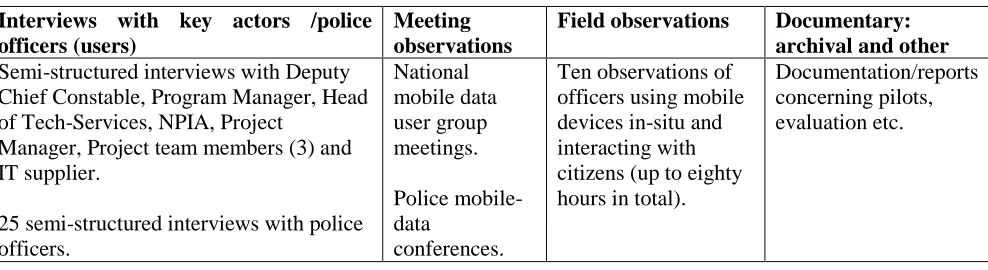
12 subjects. In analysing the data we identified a number of congruencies and contradictions, however, prioritised and judge the significance of issues according to the weight of the data. Where necessary in order to clarify the data gathered and confirm findings, subjects were contacted. Table 1 summarises the data collected.
Table 1: Summary of data collection
Interviews with key actors /police officers (users)
Meeting observations
Field observations Documentary: archival and other
Semi-structured interviews with Deputy Chief Constable, Program Manager, Head of Tech-Services, NPIA, Project
Manager, Project team members (3) and IT supplier.
25 semi-structured interviews with police officers.
National mobile data user group meetings. Police mobile-data
conferences.
Ten observations of officers using mobile devices in-situ and interacting with citizens (up to eighty hours in total).
Documentation/reports concerning pilots, evaluation etc.
Results
In this section we use an activity theoretic perspective to examine the three key interrelated activities (1) the emergence of mobile technology; (2) the implementation activity; and (3) the mobile technology mediated activity. While there is significant overlap between these phases we use the lens of contradictions and congruencies to move between them and illustrate how the notion of providing information services to police officers through mobile technology emerged from cultural-historical contradictions and came to present several levels of congruency.
The emergence of mobile technology
The initial motivation behind the mobile technology was traced to 1993 when the idea existed amongst certain staff (the project members), who explained that they recognised there was some need for mobile working, but acknowledged that technology had not reached an adequate level of functionality.
“As early as 1993-4 (three chief constables ago) it was looked at briefly, however there were so
13 The concept re-manifested itself at the beginning of the decade as the technological capacity advanced and the police force moved forward with the idea of running applications on mobile devices and progressively built the technology, relying on experimentation and piece-meal development. Alongside advances in technology the issue of police returning to the police station rather than remaining visible to the public was a major contradiction that existed in the activity norms. The dominant existing work norms supported behaviours which were drawn from earlier activity systems predicated on working from a police station and completing information tasks in the station. In contrast the emerging political discourse provided an alternative set of norms and values predicated on the need for police to spend more time ‘on
the beat’ and to be visible to the public and to undertake more work out of the station. At the time, “police force visibility” was a major public concern in the UK (House of Commons., 2008). As this contradiction between the existing and new norms emerged over time this primary contradiction became a source of ambiguity and uncertainty about the acceptability of use of mobile technology in police services (Allen & Wilson 2004). There was, however, an expectation that this contradiction could be resolved using mobile technology. Indeed, in the case described in this paper as this contradiction was resolved (with the norms related to police force visibility becoming dominant) we observed an emerging congruency between the new norms, the non-material tools (language) and technology. This provided the project team with a rationale and legitimization for their innovation. This was underscored in official documentation and by the statements by the project team, which revealed that from a cultural-historical perspective the police force was an innovator of the technology rather than just an appropriator of tools.
“The reason we started working in this area of the business was that when you actually look at the amount of time the police officers spend in a police station or is invisible to the public, its roundabout in excess of 50% of their time. Now if the public get reassurance from seeing a policeman out and about, therefore my job is to try and create the capacity where we increase that visibility to some 70% or 80%” (Project Manager; interview)
Implementation activity
Congruencies in aligning the shared object
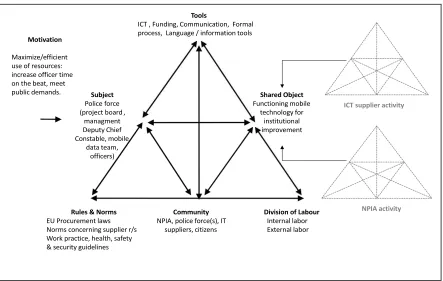
14 contributed to the development of the technology. As we are particularly interested in the police it places the implementation activity at the centre. The Figure shows the motivation for the activity and the tools used in undertaking the activity in order to achieve the object, and shows that IT supplier and the NPIA activities interconnect by contributing towards the same object. The roles are described briefly here. The major congruency in the implementation activity was the alignment between the community and the subject in developing a functioning mobile technology solution. This is represented in Figure 2 by indicating that the three activities shared the same object. Several issues are described as they show that the tool developed as the result of a dialectical social process, embodying multiple motivations and cultural characteristics. This is important as the technology was intended to act as a norm and a tool of labour in the police activity.
Figure 2: Implementation activity system
Suppliers included mobile technology providers, network bearers and firms that developed mobile applications and can be classified as passive (supplying off-the shelf software/hardware) and those that were more instrumental and used the force as a R&D test-bed (technology of this type, in this setting, was still in its infancy). Whilst the motivations of the police force (to improve efficiency) and commercial suppliers (to establish a position in the burgeoning market space) were divergent the common and shared object (of delivering a working mobile technology solution) proved a major congruency.
The rules and norms that governed the implementation activity differed from traditional rules and norms of technology development in the police. For instance, the force-supplier relationship was based on a
Community
NPIA, police force(s), IT suppliers, citizens
Rules & Norms
EU Procurement laws Norms concerning supplier r/s Work practice, health, safety & security guidelines
Division of Labour
Internal labor External labor
Tools
ICT , Funding, Communication, Formal process, Language / information tools
Shared Object Functioning mobile technology for institutional improvement Motivation Maximize/efficient use of resources: increase officer time on the beat, meet
public demands. Subject
Police force (project board ,
15 trade-off of cost and benefit and shifted towards an open-innovation mode (Chesbrough, 2003) of development. The reason for this was that the police force initially had limited funds to deliver a mobile solution and used its position (as a gateway to other police forces and a platform for successful mobile technology) to entice partnerships and develop relationships which would maximise benefit. This relationship breaks the traditional structure of the relationship between the buyers and sellers of technology.
“I think we have saved an awful lot of money because the approach we have taken is that we will
take all the pain of the development, but the benefit for us is the licence...the benefit for you (the
supplier) is you get a product that you can market and....we get reduced prices” (Project
Manager; interview)
Where there are different motivations, especially commercial vs. public sector, contradictions are likely to exist. One instructive example was the contradiction between the supplier and police force vision of mobile technology, which as resolved influenced the direction of the technology, as noted in the statement below:
“We (the police force) started off with 3.5 inch screens and all of a sudden they (suppliers) start
making 3.2 inch screens, then it’s down to 3 inch screens… and you are now talking about going
down to 2.8, you just can’t fit that information on there...We have to say, we want a larger screen,
we want more power or more processing power or more memory. So it’s all these things that you
actually say to them” (Project Manager; interview)
The quote shows that the supplier was moving towards smaller screen sizes, which was problematic for the usability of the device in the policing context. While this is an example of a supplier-buyer contradiction, it was resolved by the attractive position of the force to suppliers and the overarching congruent shared-object leading to some agreement on the physical aspects of the technology, which is important in its later use.
16 and by the then Prime Minister, who in 2007 announced funding for mobile technology (part of £80 million to rollout 10,000 devices to 30,000 officers) in the UK.
The change was supported by high-ranking representatives within the police force who agreed with the vision of using the technology to overcome the contradiction of police officers returning to the police station. That is, the change was aligned with management objectives. Therefore, within the subject (in Figure 2) there was congruency in developing and implementing functional mobile technology. Management support was described as instrumental in persuading the various actors during the implementation activity that the investment was worthwhile. The legitimisation process was important in the context of the public sector, where misused and wasted funding is viewed critically. From the stage of early design or conception the technology needed to be legitimised in order for the police force to progress at minimum to the position of testing.
The legitimisation process involved negotiating for initial funding within the police force. Each progression of the technology was used to legitimise the technology and obtain funding for further development. For instance, after demonstrating that PNC functioned (the ability to check the identity of an individual/vehicle), internal funding was sourced to develop the technology further with more sophisticated applications and information services (e.g. crime reporting). In addition to high-level support the perceptions and sense making of the police officers was understood to be important by management, and was illustrated by the number of pilots, surveys, training sessions, and various avenues for feedback and bonuses for competence. The level of congruency in the development and implementation of the technology helps to explain the level of congruency in the use of the technology described next.
Mobile technology mediated activity
Disruption to work practice
17 tool from the front-line officers. It was observed that as a result of this, on some occasions officers would write notes on the back of their hands as it was quicker than using the mobile device. Therefore, there were several ways in which the technology led to disruption and contradictions, however as we will note below these were short-lived. An important distinction to make is that the mobile device also acts as a method for officer oversight and management as every transaction between the officer and the public or the officer and police IS is recorded.
Functional issue example
There were several ways in which functional contradictions in the use of the mobile technology disrupted work activity and acted as feedback into developing a more effective system. A serious functional issue for police officers (the users) surrounded the limitations of the technology during a pilot, which showed that police officers became frustrated with the mobile technology in areas where there was poor telecommunications signal:
“Our first trial, one of the biggest complaints we had from the officers was that they were using mobile data and they were starting to accrue crime report and then half way through it they
would lose the signal and then they would lose all the information they had started…we had to
find some software whereby what it allows you to write all the information...and once it found the signal it would automatically update all the information...” (Project team staff; interview)
In this example, management understood that the technology would not be used if it did not meet the work demands of the officers. Furthermore, they understood that it needed to work every time:
“If it doesn’t work, the first thing a police officer will do is put it down and walk away from it
because they lose confidence in it” (Head of IT; interview)
18 Congruencies in work activity
After the initial period of adoption, we observed that police officers, including technophobes, on the whole, viewing the technology positively and described several early benefits. These were largely broad brushed benefits such as “checking (work) email” and other ways in which the mobile technology could be used. There was however also clearly articulated ways where there were levels of congruence emerging between the technology and the police activity, which are suggestive of benefit areas:
Efficiency in data entry: The use of mobile technology reduced bureaucracy, paper and especially
duplication of data. For instance, there was no need to capture information on a paper-notepad and then re-enter it once at the police station, leading to changes in the activity rules/norms and tools. In one example technical support staff explained changes in norms surrounding the case of domestic abuse, where police officers previously would return to the police station and update the system then key in the same data on a public protection system. Whereas, on the mobile device officers simply entered the data once, which could be done on the street or in the police vehicle, illustrating how the tool had changed the rules/norms and the labour surrounding it.
Improving communications: The use of the mobile devices to access information reduced the radio
traffic-load between the control-room and officers, which meant that police officers were able to reach the control-room quicker when necessary, especially during peak times. It was explained that previously to reach the control-room during peak times could take up-to 15 minutes to do a person check, as opposed to seconds on a mobile device. This meant that prior to the mobile technology in some instances police officers went without information, whereas mobile technology facilitated faster access to information in some situations. The direct access to information also reduced the effect of “Chinese whispers” between dispatchers and officers, which often led to incorrect locations/addresses being visited in error.
This is an interesting congruency as it shows how congruency in one activity system (front-line police) can have significant impact on other related activities (control-room dispatch and call answering), demonstrating how activities are interwoven.
Efficient policing: Police officers were found to perform up to ten times more person checks increasing
19 were rarely enough computers to update systems and therefore often police officers would use the mobile technology to update systems in whilst at the police station.
Officer safety: The information made available through mobile technology offered a safer working
environment to front-line police officers. For instance, a police officer could pull information en-route to an incident informing him/her of ‘warning markers’ such as individuals at the location that are known to be aggressive. For instance, an individual had a warning marker next to his name which could be viewed on the mobile technology indicating that he had once commented to a dispatcher “if you send cops you better send an army” meaning that the police officers could take extra precaution. During observations it was observed that one of the double-crewed team (the passenger) could pull information about an incident on the device while verbally communicating the information to the driver. At the same time, a contradiction raised was that the mobile device created new concerns around police officer safety. It was argued by some police officers that the use of a mobile device can put them in danger by changing their working norms i.e. looking down at the device rather than up at a person or monitoring the surrounding environment, particularly when working single-crewed. In other words, in this case it led to emergent and unexpected contradictions in the form of mal-adaptive behaviours.
Engaging citizens with mobile technology
20 evade potential arrest as all the information immediately accessible and verifiable. It was observed that individuals trying to evade identification had less scope to do so when confronted with an officer using the technology, particularly those with outstanding warrants. It is possible that they were concerned about privacy issues or were uncertain how information may be used against them; this was not explored.
Discussion
We examined the ways in which congruencies and contradictions materialised in the emergence, implementation and use of mobile technology. In addressing the research questions we showed that the mobile technology was implemented in order to overcome the major contradiction of police officers returning to the police station. The emergence, implementation and use of mobile technology to resolve this contradiction was a relatively diffused and scattered process of contradiction resolution, cumulating in the development of a tool (mobile technology) for use in front-line police activity in order to improve the amount of time officers are on the beat.
The number of congruencies suggests a “fit” and better understanding of the relationship between
mobility, mobile technology solutions and police activity. Congruencies in the use of the technology were varied and included several levels of suggested improved operational efficiencies in the nature of police
work. However, the argument isn’t that the number of congruencies outweighs the contradictions, but rather that congruencies show resolution of contradictions and the dialectical interaction between the congruencies-contradictions is important in explaining the evolution in the activity and the tools used to mediate the activity. We observed this in our study, through the process of contradiction recognition, to resolution of the contradiction through to experiencing intended and unintended congruencies and new contradictions (feedback). Further, actively addressing and resolving contradictions in the implementation activity suggests greater congruencies in the use of the tool during the work activity.
Several functional, use and subject-community contradictions were also identified in the analysis. Some of the contradictions recognized, such as the early perceptions of the public towards the technology, were organically overcome, as socio-cultural perceptions and norms around mobile technology evolved. Only a few years later there is perhaps even greater expectation amongst the public that police adopt more advanced use of mobile computing. There was clear evidence of new contradictions. For instance, the use/non-use of the technology in certain situations because of safety concerns is not resolved, and unlikely to be so through this iteration of technology. The non-use of the technology in certain problematic scenarios is an example of Orlikowski’s (2005) “situated entanglement” or Sørensen and
Pica’s (2005) “rhythms” of use and non-use of technology. Further contradictions are likely to arise as the
individual police officer’s personal device is likely to be more intuitive, easier to use and powerful than
21 mobile technology being developed and employed in this context. However, this points to possible future issues as the level of (re)investment into the technology needs to be sustained in order to maintain currency. At present government assessments argue that there are unresolved issues surrounding the cost-effectiveness of mobile solutions (NAO, 2012), suggesting the process of contradiction-congruency continues. At the same time this also shows a pattern in technology adoption, in which changes in the activity tools do not lead to permanent stabilisation or some end point of efficiency and effectiveness, but rather leads to new ways of mediating an activity and new contradictions (and hence need for change often enabled by advances in technology).
This paper extends theory in several ways. It builds upon the extant use of activity theory to examine the process of development to institutionalisation of IS (Miettinen, 1999) and on the notion of congruency of technology with organisational activity, and is the first to do so in the context of police activity and mobile technology. An understated strength of activity theory is that it provides a lens to understand the context and emergence of technology in a particular setting and allows researchers to consider the cultural-historical influences, providing critical reflection on its emergence and use, rather than a narrow focus on the effects of technology. Such lenses are necessary when dealing with the messiness that is embodied in the change involving the mobile technology described. As argued, bringing technology and actors into one coherent framework overcomes the concern raised by some scholars (Orlikowski, 2005) of the absence of the role of technology in organizational life, or emphasizing the social over the material, or indeed, privileging the technology over its cultural-historical context in which it is being used.
By examining the three interrelated activities we see dialectically how contradictions were resolved and congruency formed. Through the examination of the three activities we have created a different narrative of mobile technology change compared to other scholars who have examined the dialectics of large scale systems implementation (Lyytinen & Newman, 2008; Reimers et al., 2013; Robey et al., 2002). As noted, the lens of congruency-contradiction is useful in understanding the emergence and use of mobile technology in the police, showing how mobile technology can support change of activity, and provides a more complex narrative of the emergence and use of mobile technology in the police. Such a logic of opposition, as noted by Robey and Bourdeau (1999), offers an alternative and unexpected account of the ways in which technology introduces and overcomes contradictions. The blending of contradictions-congruencies gives practical examples of the logic of opposition, as well as the internal dynamics within an activity. It goes further, in that, it suggests the resolution of contradictions is not straight-forward and that technology is likely to introduce new contradictions.
22 technology a period follows characterised by negotiations over meanings among relevant parties and
foreshadows potential changes in power relations “In due course, a reconstitution or redefinition of technology occurs and a new integration of work and authority, now embedding the technology, follows” (Manning, 1996, p. 54). Our argument, builds on this by suggesting that the new technology will lead to temporary congruency and further contradictions. This also overlaps, with Vaast and Walsham’s (2005) notion of consonance and dissonance, which focused on specifics of how practices change at the micro level of inter-individual relation
.
When agents experience dissonance between actions, practices and representations they adapt their practices and representations to re-establish consonance.Complex activities have an increasing number of contradictions causing events to be the cause of more events, thus generating snowballs and arbitrary and unpredictable and positive as well as mal-adaptive changes. This is likely to be true as the digital-information ecology grows, enabled by wireless broadband, growing familiarity with technology and unexpected challenges such as the ability to harness information from social-media and use it to interact with citizens in real-time on the beat, combining to afford a type of real-time intelligence. Recent research points to the convergence of wireless, social, cloud and mobile technology and paints a picture of evolving expectations and use of mobile technology in the police (cf. AIMTech Consulting., 2013).
The study also extends important works on mobile technology in the police, which are relevant to the
evolving nature of mobile work. In the 1990’s Manning (1996) outlined several ways in which mobile technology could lead to organisational transformation based on largely voice communication; our study builds on this by providing a more progressive prospective, demonstrating the evolution of data services (rather than voice) and how it has transformed the policing activity Over time, both studies show that the mobile artifact occupies central position, displacing other material objects in the work environment. Alongside technological changes more importantly the cultural-historical context has evolved with growing expectations by the public and police officers on the use of the latest mobile technology to be used for public safety.
Limitations
23 Further, it was beyond the scope of our research to examine extra-organisational contextual influences (Scheepers et al., 2006). For instance, the role of mobile technology in the police officers’ personal life may have been more sophisticated than in the work activity, meaning that the congruency with work activity may in fact be driven by congruency with the use of the technology in their personal context. This presents an interesting direction for future research, and one that is important when considering mobile technology which has blurred the boundaries between work and non-work (Scheepers et al., 2006).
Conclusion
In this paper we focused on the emergence, implementation and use of mobile technology in an inherently mobile and information intensive work activity. We explicated upon two key sets of contributions. The methodological contribution lies in the utilization of activity theory to understand the phenomena of mobile technology. Activity theory allowed us to illuminate congruencies and contradictions between mobile technology and mobile working, and the relationship between the two revealing a state of change based upon dialectic interaction between emergent contradictions and congruencies.
The identification of contradictions and congruencies in the context of an activity may not satisfy directly policy-maker needs for monetised outputs in today’s economic climate. However, it does present individual concrete areas which can be investigated further. While some of the areas identified lend themselves to monetisation (e.g. safety, in terms of reduced injuries), others remain difficult to monetise (e.g. improved visibility from the citizen perspective, efficiency). It also forces recognition that the introduction of mobile solutions is not the resolution, and that, in fact, it is likely to initiate subsequent disruption and change. In this way, the approach employed cautions against overstated early and often
“rosy” benefits of technology. Nonetheless, the findings and discussion in this paper add to the body of knowledge concerning the nature of mobile technology mediated work.
Acknowledgements
We are grateful to the National Police Improvement Agency (NPIA) for its support in undertaking this research. We are also grateful to the police force investigated for its cooperation. The opinions presented in this paper are those of the authors alone.
References
24 AIMTech Consulting. (2013). The future of the force: Police, technology and serving the public. London:
AIMTech Consulting Ltd, Airwave.
Allen, D., & Karanasios, S. (2011). Critical factors and patterns in the innovation process. Policing (Oxford): a journal of policy and practice, 5(1), 87-97.
Allen, D. K., Brown, A., Karanasios, S., & Norman, A. (2013a). How should technology-mediated organizational change be explained? A comparison of the contributions of critical realism and activity theory. MIS Quarterly, 37(3), 835-854.
Allen, D. K., Karanasios, S., & Norman, A. (2013b). Information sharing and interoperability: the case of major incident management. European Journal of Information Systems.
Basole, R. C. (2009). Visualization of interfirm relations in a converging mobile ecosystem. Journal of Information Technology, 24(2), 144-159.
Bødker, M., Gimpel, G., & Hedman, J. (2014). Time-out/time-in: The dynamics of everyday experiential computing devices. Information Systems Journal, 24(2), 143-166.
Bouwman, H., & van de Wijngaert, L. (2009). Coppers context, and conjoints: a reassessment of TAM. Journal of Information Technology, 24(2), 186-201.
Brigham, M., & Hayes, N. (2012). Hybridity, consulting and e-development in the making: inscribing new practices of impact assessment and value management. Information Technology for Development, 1-21. doi: 10.1080/02681102.2012.690171
Carlson, P. J., Kahn, B. K., & Rowe, F. (1999). Organizational impacts of new communication technology: A comparison of cellular phone adoption in France and the United States. Journal of Global Information Management, 7(3), 19-29.
Carlsson, C., Akademi, Å., Carlsson, J., Hyvonen, K., Puhakainen, J., & Walden, P. (2006). Adoption of Mobile Devices/Services — Searching for Answers with the UTAUT Paper presented at the 39th Annual Hawaii International Conference on System Sciences, Hawaii.
Chae, B., & Poole, M. S. (2005). The surface of emergence in systems development: agency, institutions, and large-scale information systems. European Journal of Information Systems, 14(1), 19. doi:
http://dx.doi.org/10.1057/palgrave.ejis.3000519
Chesbrough, H. W. (2003). Open Innovation: The new imperative for creating and profiting from technology: Boston: Harvard Business School Press.
Davis, F. D. (1989). Perceived usefulness, perceived ease of use, and user acceptance of information technology. MIS Quarterly, 13(3), 319-340.
Dawson, C. (2002). Practical research methods : a user-friendly guide to mastering research techniques and projects. Oxford: How To Books.
Ditsa, G. (2003). Activity theory as a theoretical foundation for information systems research Information management (pp. 192-231): IGI Publishing.
Donner, J. (2007). The Rules of Beeping: Exchanging Messages Via Intentional "Missed Calls" on Mobile Phones Journal of Computer-Mediated Communication, 13(1), article 1.
Duxbury, L., & Smart, R. (2011). The “Myth of Separate Worlds”: An Exploration of How Mobile
Technology has Redefined Work-Life Balance. In S.Kaiser et al. (Ed.), Creating Balance. Berlin: Spinger-Verlag.
Eisenhardt, K. M. (1989). Building Theories From Case Study Research. Academy of Management. The Academy of Management Review, 14(4), 532-550.
Engeström, Y. (1987). Learning by Expanding: An Activity-Theoretical Approach to Developmental Research. Helsinki: Orienta-Konsultit.
Engeström, Y. (1999a). Communication, discourse and activity. The Communication Review, 3(1), 165 - 185.
Engeström, Y. (1999b). Innovative Learning in Work Teams: Analyzing Cycles of Knowledge Creation in Practice. In Y. Engestrom, R. Miettinen & R.-L. Punamaki (Eds.), Perspectives on Activity Theory (pp. 377 - 406). Cambridge: Cambridge University Press.
25 Engeström, Y. (2001). Expansive Learning at Work: Toward an Activity Theoretical Reonceptualization.
Journal of Education and Work, 14(1), 133-156.
Ezzy, D. (2002). Qualitative analysis : practice and innovation. Crows Nest, N.S.W.: Allen & Unwin. Gebauer, J., Shaw, M. J., & Gribbins, M. L. (2010). Task-technology fit for mobile information systems.
Journal of Information Technology, 25(3), 259-272.
Ghose, A., Goldfarb, A., & Han, S. P. (2013). How is the mobile internet different? Search costs and local activities. Information Systems Research, 24(3), 613-631.
Goodhue, D. L., & Thompson, R. L. (1995). Task-technology fit and individual performance. MIS Q., 19(2), 213-236.
Harvey, L. J., & Myers, M. D. (2002). Scholarship and practice: the contribution of ethnographic research methods to bridging the gap. In M. D. Myers & D. E. Avison (Eds.), Qualitative research in information systems: a reader (pp. 169-180). London: Sage Publications.
HMIC. (2011). Adapting to Austerity: A review of police force and authority preparedness for the 2011/12–14/15 CSR period. London: Her Majesty's Inspectorate of Constabulary (HMIC). House of Commons. (2008). Select Committee on Home Affairs Seventh Report Retrieved from
http://www.publications.parliament.uk/pa/cm200708/cmselect/cmhaff/364/36402.htm. Ilyenkov, E. (1974). Dialectical Logic, Essays on its History and Theory: Progress Publishers.
Jarvenpaa, S. L. (1991). Pannnig for Gold in Information Systems Research: 'Second-Hand' Data. In H.-E. Nissen, H. K. Klein & R. Hirschheim (Eds.), Information Systems Research: Contemporary appraoches and emergent traditions (pp. 63-80). Amsterdam: Elsevier.
Jung, Y. (2013). What a smartphone is to me: Understanding user values in using smartphones. Information Systems Journal.
Karanasios, S., Allen, D., & Vardaxoglou, G. (2009, August 6-9). Innovation in UK Law Enforcement: The Emergence of Mobile Data. Paper presented at the Americas Conference on Information Systems San Francisco, USA.
Karanasios, S., & Allen , D. K. (2013). ICT and Development in the Context of Chernobyl Nuclear Power Plant Closure. Information Systems Journal, 23(2).
Kietzmann, J. (2008). Interactive innovation of technology for mobile work. European Journal of Information Systems, 17(3), 305-331.
Kietzmann, J., Plangger, K., Eaton, B., Heilgenberg, K., Pitt, L., & Berthon, P. (2013). Mobility at work: A typology of mobile communities of practice and contextual ambidexterity. Journal of Strategic Information Systems, 22(4), 282-297.
Kim, B., & Han, I. (2009). What drives the adoption of mobile data services An approach from a value perspective. Journal of Information Technology, 24(1), 35-45.
Leont'ev, A. N. (1978). Activity, Consciousness, and Personality: Prentice-Hall.
Levins, R. (1998). Dialectics and Systems Theory. Science and Society, 62(3), 375-399.
Lyytinen, K., & Newman, M. (2008). Explaining information systems change: a punctuated socio-technical change model. European Journal of Information Systems, 17(6), 589-613.
Manning, P. K. (1996). Information technology in the police context: The ''sailor'' phone. Information Systems Research, 7(1), 52-62.
McBride, N. (2003). Actor-Network Theory and the Adoption of Mobile Communications. Geography, 88(4), 266-276.
Middleton, C. A., & Cukier, W. (2006). Is Mobile Email Functional or Dysfunctional? Two Perspectives on Mobile Email Usage. European Journal of Information Systems, 15(3), 252–260.
Miettinen, R. (1999). The riddle of things: Activity Theory and Actor-Network Theory as approaches to studying innovations. Mind, Culture & Activity, 6(3), 170-195.
Murphy, E., & Manzanares, M. A. R. (2008). Contradictions between the virtual and physical high school classroom: A third-generation Activity Theory perspective. British Journal of Educational Technology, 39(6), 1061–1072.
26 Nicholas, D. (2014). The Times They Are a-Changin’ (again!): the second, great digital transition to the
mobile space. http://ciber-research.eu.
Nunn, S. (2001). Police information technology: assessing the effects of computerisation on urban police function. Public Administration Review, 61(2), 221-234.
Orlikowski, W. J. (2005). Material Works: Exploring the Situated Entanglement of Technological Performativity and Human Agency. Scandinavian Journal of Information Systems(17), 1.
Orlikowski, W. J., & Gash, D. C. (1994). Technological Frames: Making Sense of Information Technology in Organizations. ACM Transactions on Information Systems, 12(2), 174-207. Orlikowski, W. J., & Scott, S. V. (2008). Sociomateriality: Challenging the Separation of Technology,
Work and Organization. The Academy of Management Annals, 2(1), 433-474.
Oulasvirta, A., Rattenbury, T., Ma, L., & Raita, E. (2012). Habits make smartphone use more pervasive. Personal and Ubiquitous Computing, 16, 105–114.
PAC. (2012). Public Accounts Committee - Second Report. Mobile Technology in Policing. London: Public Accounts Committee.
Peim, N. (2009). Activity theory and ontology. Education Review, 61(2), 167-180.
Reimers, K., Johnston, R. B., & Klein, S. (2013). An empirical evaluation of existing IS change theories for the case of IOIS evolution. Europena Journal of Information Systems, early view doi: 10.1057/ejis.2013.7.
Robey, D., & Boudreau, M.-C. (1999). Accounting for the Contradictory Organizational Consequences of Information Technology: Theoretical Directions and Methodological Implications Information Systems Research, 10(2), 167-185.
Robey, D., Ross, J. W., & Boudreau, M.-C. (2002). Learning to Implement Enterprise Systems: An Exploratory Study of the Dialectics of Change. J. Manage. Inf. Syst., 19(1), 17-46.
Sawyer, S., Tapia, A., Pesheck, L., & Davenport, J. (2004). Mobility and the first responder. Commun. ACM, 47(3), 62-65. doi: 10.1145/971617.971647
Scheepers, R., Scheepers, H., & Ngwenyama, O. K. (2006). Contextual influences on user satisfaction with mobile computing: findings from two healthcare organizations. European Journal of Information Systems, 15(3), 261–268.
Sørensen, C., & Pica, D. (2005). Tales from the police: Rhythms of interaction with mobile technologies. Information and Organization, 15(2), 125-149.
Spasser, M. A. (2002). Realist Activity Theory for Digital Library Evaluation: Conceptual Framework and Case Study. Computer Supported Cooperative Work, 11, 81-110.
Spinuzzi, C. (2008). Network: Theorizing Knowledge Work in Telecommunications. Cambridge: Cambridge University Press.
Srivastava, N. (2010). Challenges of Next-Generation Wireless Sensor Networks and its impact on Society. Journal of Telecommunications, 1(1), 128-133.
Trauth, E. M., & O'Connor, B. (1991). A study of the interaction between information technology and society: an illulstration of combined qualitative research methods. In H.-E. Nissen, H. K. Klein & R. Hirschheim (Eds.), Information Systems Research: Contemporary approaches and emergent traditions (pp. 131-144). Amsterdam: Elsevier.
Vaast, E., & Walsham, G. (2005). Representations and actions: the transformation of work practices with IT use. Information and Organization, 15(1), 65-89.
Van der Heijden, H., & Junglas, I. (2006). Editorial for the Special Issue on Mobile User Behavior. European Journal of Information Systems, 15, 249-251.
Vance, A., Elie-dit-cosaque, C., & Straub, D. W. (2008). Examining trust in information technology artifacts: The effects of system quality and culture. Journal of Management Information Systems, 24(4), 73-100.
Venkatesh, V., Morris, M., Davis, G., & Davis, F. (2003). User acceptance of Information Technology: Toward a Unified View. MIS Quarterly, 27(3), 425-478.
27 Wareham, J. D., Busquets, X., & Austin, R. D. (2009). Creative, convergent, and social: Prospects for
mobile computing. Journal of Information Technology, 24(2), 139-143. Weber, R. P. (1985). Basic content analysis. Beverly Hills ; London: Sage,.
Wiredu, G. O. (2007). User appropriation of mobile technologies: Motives, conditions and design properties. Information and Organization, 17(2), 110-129.
Wiredu, G. O., & Sørensen, C. (2006). The dynamics of control and mobile computing in distributed activities. European Journal of Information Systems, 15, 307-319.