Population-Level Immune Escape Pathways in HIV-1
Jonathan M. Carlson,aChanson J. Brumme,bEric Martin,cJennifer Listgarten,aMark A. Brockman,b,cAnh Q. Le,cCelia K. S. Chui,b Laura A. Cotton,cDavid J. H. F. Knapp,bSharon A. Riddler,dRichard Haubrich,eGeorge Nelson,fNico Pfeifer,aCharles E. DeZiel,a David Heckerman,aRichard Apps,gMary Carrington,gSimon Mallal,h,iP. Richard Harrigan,bMina John,h,iZabrina L. Brumme,b,c and the International HIV Adaptation Collaborative
Microsoft Research, Los Angeles, California, USAa; British Columbia Centre for Excellence in HIV/AIDS, Vancouver, Canadab; Faculty of Health Sciences, Simon Fraser
University, Burnaby, British Columbia, Canadac; Department of Infectious Diseases and Microbiology, University of Pittsburgh, Pittsburgh, Pennsylvania, USAd; Department
of Medicine, University of California San Diego, San Diego, California, USAe; Basic Research Program, Center for Cancer Research Genetics Core, SAIC-Frederick, Inc.,
Frederick National Laboratory for Cancer Research, Frederick, Maryland, USAf; Cancer and Inflammation Program, Laboratory of Experimental Immunology, SAIC-Frederick,
Inc., Frederick National Laboratory for Cancer Research, Frederick, Maryland, USA, and Ragon Institute of Massachusetts General Hospital, MIT, and Harvard, Charlestown, Massachusetts, USAg; Centre for Clinical Immunology and Biomedical Statistics, Institute for Immunology and Infectious Diseases, Murdoch University, Murdoch, Western
Australia, Australiah; and Department of Clinical Immunology, Royal Perth Hospital, Perth, Western Australia, Australiai
HLA class I-associated polymorphisms identified at the population level mark viral sites under immune pressure by individual
HLA alleles. As such, analysis of their distribution, frequency, location, statistical strength, sequence conservation, and other
properties offers a unique perspective from which to identify correlates of protective cellular immunity. We analyzed
HLA-asso-ciated HIV-1 subtype B polymorphisms in 1,888 treatment-naïve, chronically infected individuals using phylogenetically
in-formed methods and identified characteristics of HLA-associated immune pressures that differentiate protective and
nonprotec-tive alleles. Over 2,100 HLA-associated HIV-1 polymorphisms were identified, approximately one-third of which occurred inside
or within 3 residues of an optimally defined cytotoxic T-lymphocyte (CTL) epitope. Differential CTL escape patterns between
closely related HLA alleles were common and increased with greater evolutionary distance between allele group members.
Among 9-mer epitopes, mutations at HLA-specific anchor residues represented the most frequently detected escape type: these
occurred nearly 2-fold more frequently than expected by chance and were computationally predicted to reduce peptide-HLA
binding nearly 10-fold on average. Characteristics associated with protective HLA alleles (defined using hazard ratios for
pro-gression to AIDS from natural history cohorts) included the potential to mount broad immune selection pressures across all
HIV-1 proteins except Nef, the tendency to drive multisite and/or anchor residue escape mutations within known CTL epitopes,
and the ability to strongly select mutations in conserved regions within HIV’s structural and functional proteins. Thus, the
fac-tors defining protective cellular immune responses may be more complex than simply targeting conserved viral regions. The
results provide new information to guide vaccine design and immunogenicity studies.
H
IV-1 is notorious for its genetic diversity and its ability to
adapt to selection pressures (
44
,
87
,
116
). Despite this,
with-in-host HIV-1 evolution in response to antiretroviral (
61
,
72
),
host cellular immune (
15
,
50
,
71
,
94
,
95
), antibody (
46
), and
vac-cine-induced (
103
) selection pressures occurs along generally
pre-dictable mutational pathways (
3
,
84
). Studying these evolutionary
pathways can offer insight into the immunopathogenesis of
HIV-1 and may help inform the design of immune-based
inter-ventions and vaccines.
Substantial progress has been made in our understanding of
HIV-1’s ability to evade human leukocyte antigen (HLA) class
I-restricted CD8
⫹cytotoxic T-lymphocytes (CTL). In particular,
application of novel statistical methods (
13
,
25
,
84
) to large
pop-ulation-based data sets of linked host and viral genetic
informa-tion has facilitated the systematic identificainforma-tion of HLA-associated
immune escape and covarying mutations in HIV-1 (
19
,
20
,
60
,
81
,
99
,
104
), revealing important insights into HIV-1 adaptation to its
host. We now appreciate that immune selection represents a
ma-jor force shaping HIV-1 diversity (
3
,
80
,
84
) and that HIV-1 escape
pathways are generally predictable in the context of host HLA
allele expression (
3
,
19
,
84
). Immune escape mutations occur
within and outside CTL epitopes (
13
,
20
,
60
,
99
,
104
) and can
compromise peptide-HLA binding (
8
,
65
), disrupt intracellular
antigen processing (
35
,
122
), affect T-cell recognition of the
pep-tide-HLA complex (
23
,
58
,
59
,
96
,
117
), and/or potentially affect
killer immunoglobulin-like receptor (KIR) binding (
16
,
113
).
While some escape pathways are likely to be universal across HLA
alleles and/or HIV-1 subtypes, widespread examples of
differen-tial escape between infected populations (
9
,
60
) and between
closely related HLA class I alleles (
26
,
69
,
86
) have also been
dem-onstrated. Population-level studies have also allowed us to
esti-mate rates (
18
) and clinical implications (
21
,
81
) of immune
es-cape, infer fitness costs of specific mutations (
81
), discover novel
epitopes in conventional (
5
,
13
) and cryptic (
10
,
12
) reading
Received1 August 2012 Accepted2 October 2012
Published ahead of print10 October 2012
Address correspondence to Zabrina L. Brumme, [email protected], or Jonathan M. Carlson, [email protected].
J.M.C., C.J.B., and E.M. contributed equally to this article.
Supplemental material for this article may be found athttp://jvi.asm.org/. Copyright © 2012, American Society for Microbiology. All Rights Reserved.
doi:10.1128/JVI.01998-12
The authors have paid a fee to allow immediate free access to this article.
on November 7, 2019 by guest
http://jvi.asm.org/
frames, and forecast the consequences of continued
immune-me-diated adaptation for the future of the epidemic (
64
,
73
). These
and other findings have led to recommendations that escape
in-formation be incorporated into HIV-1 vaccine strategies, for
ex-ample, via immunogens that incorporate variant sequences (
13
,
100
) and/or that are located in mutationally constrained regions
where viral escape mutations would be anticipated to incur
sub-stantial fitness costs (
7
,
30
,
102
).
Although population-level studies have significantly advanced
our understanding of the specific mutational pathways whereby
HIV-1 escapes from HLA-restricted immune pressures, much
re-mains to be learned. The key to further exploring these data lies in
the recognition that HLA-associated polymorphisms identified at
the population level serve as markers of viral sites under strong
in
vivo
immune pressure by individual HLA alleles—sufficiently
strong that the virus responds by escape. As such, analysis of the
distribution, frequency, location, statistical strength, and
se-quence conservation of HLA-associated polymorphic sites
identi-fied at the population level offers a unique perspective from which
to identify (albeit indirectly) specific features that render certain
immune responses more effective at controlling HIV progression
than others. In other words, systematic analysis of HLA-driven
evolutionary “imprints” on the HIV proteome can help identify
correlates of protective cellular immunity.
In the largest population-level, proteome-wide analysis of
mune escape in HIV-1 undertaken to date, we refine existing
im-mune escape data by reporting HLA-associated polymorphisms at
HLA supertype-, type-, and subtype-level resolutions across the
viral proteome in an HIV-1 subtype B context. We analyze this
well-powered data set to investigate the characteristics of
HLA-driven immune selection on HIV-1 in order to draw inferences
regarding the general mechanisms HIV-1 uses
in vivo
to evade
such pressures. Furthermore, by treating escape mutation
path-ways as evolutionary markers of strong HLA-restricted immune
pressure by CTL, we identify specific features of these responses
that differentiate protective from nonprotective HLA class I
al-leles.
MATERIALS AND METHODS
IHAC.The International HIV Adaptation Collaborative (IHAC) is an open multicenter cohort of chronically infected antiretroviral-naïve indi-viduals from Canada, the United States, and Australia for whom HLA class I and nearly full-genome HIV plasma RNA sequences have been characterized. The present study was restricted to 1,888 HIV-1 subtype B-infected individuals (⬎95% of total cohort), including 1,103 individu-als from the British Columbia HOMER cohort (British Columbia, Can-ada) (19,20), 247 individuals from the Western Australian HIV Cohort Study (WAHCS; Western Australia, Australia) (13,77,84), and 538 U.S. AIDS Clinical Trials Group (ACTG) protocol 5142 participants (4,60) who also provided human DNA under ACTG protocol 5128 (51). This newly expanded cohort is approximately one-third larger than that stud-ied in 2009 (20) and now features full-proteome HIV coverage. Ethical approval was obtained from Providence Health Care/University of British Columbia (HOMER cohort), Royal Perth Hospital Ethics Committee (WAHCS), and the NIH’s National Institute of Allergy and Infectious Diseases (NIAID) Clinical Science Review Committee (CSRC) (ACTG 5142/5128).
HIV-1 sequencing.Nearly full-genome plasma HIV-1 RNA sequenc-ing (all regions except gp120) for the HOMER cohort was performed at the BC Centre for Excellence in HIV/AIDS (BCCfE) as described in ref-erence20. Briefly, HIV RNA was extracted from plasma using standard methods, and regions of interest were amplified by nested reverse
tran-scription-PCR (RT-PCR) using HIV-specific primers. Amplicons were bulk sequenced on an Applied Biosystems 3100, 3700, and/or 3730xl au-tomated DNA sequencer. Data were analyzed using Sequencher software (Genecodes) or the custom software RECall (120). Nucleotide mixtures were called if the secondary peak height exceeded 25% of the dominant peak (Sequencher) or if the secondary peak area exceeded 20% of the dominant peak (RECall). Nearly full-genome HIV-1 sequencing for the WAHCS and ACTG 5142/5128 cohort participants was performed at the Centre for Clinical Immunology and Biological Statistics (CCIBS) laboratory in Perth, Australia, as previously described (20,60). Plasma HIV RNA was extracted using standard methods, and nearly complete viral genomes were amplified using nested RT-PCR. Amplicons were bulk sequenced using an Applied Biosystems 3730xl automated sequencer. Data were analyzed using semiautomated ASSIGN software with a nucle-otide mixture threshold of 15% after consideration of the signal/noise ratio, yielding nearly full-genome sequences. The BCCfE and CCIBS pre-viously undertook blinded interlaboratory genotyping quality control comparisons and observed excellent intersite concordance (20; also un-published data).
Non-subtype B sequences were identified by comparison to subtype references in the Los Alamos HIV Database using the Recombination Identification Program (RIP [http://www.hiv.lanl.gov/content/sequence /RIP/RIP.html]) and removed from the analysis. HIV-1 sequences were aligned to subtype B reference strain HXB2 (GenBank accession number K03455). Final HLA/HIV sequence data set sizes were as follows: Gag, 1,548 sequences; Pol, 1,799 (protease/reverse transcriptase [PR/RT], 1,786; integrase [INT], 1,566); Nef, 1,685; Vif, 1,325; Vpr, 1,310; Vpu, 1,243; gp120, 655; gp41, 1,425; Tat, 1,734; and Rev, 1,731. HIV-1 se-quences from the ACTG, Perth, and HOMER cohorts were previously deposited in GenBank (3,19–21,60). Accession numbers for additional HOMER sequences are JX147023 to JX147784 (gp41), JX147785 to JX148365 (Tat/Rev exon 1 region), JX148366 to JX148914 (Vpu), and JX148915 to JX149509 (Vif). Linked HLA/HIV data sets from the BC HOMER cohort are available for sharing with interested researchers in accordance with UBC/Providence Health Care Research Ethics Board protocols (please contact the corresponding author for information).
HLA class I sequence-based typing and subtype imputations.HLA class I typing for the HOMER cohort was performed at the BCCfE using an in-house sequence-based typing protocol and interpretation algorithm (19,20,32), yielding a mixture of intermediate- and high (subtype-level)-resolution data. High-(subtype-level)-resolution HLA class I typing for the WAHCS and ACTG 5142/5128 cohorts was performed at the CCIBS as previously de-scribed (20,60). Allele interpretation was performed using ASSIGN (60). In previous studies we had addressed the issue of mixed-resolution HLA data by truncating all data to the two-digit (type) level (19–21). However, in the present study we wished to identify HLA-associated poly-morphisms at the supertype and subtype levels, which requires high-res-olution data. Therefore, for all individuals with missing or low- or inter-mediate-level resolution at one or more loci (711 of 1,888; 38%), we employed a machine learning algorithm trained on a data set of complete high-resolution HLA-A, -B, and -C types from⬎13,000 individuals with known ethnicity (75) (available athttp://research.microsoft.com/en-us /projects/bio/mbt.aspx#HLA-Completion) to complete the data to high resolution at all loci. The resulting output lists the inferred possible HLA-A, -B, and -C haplotypes, along with their respective probabilities, for each individual. Rather than assigning individuals their highest-prob-ability HLA haplotypes, downstream analyses incorporate all HLA haplo-types with probabilities of⬎1% as weighted averages for each individual. HLA types could not be imputed when data were missing from two (or more) loci. In such cases, an HLA haplotype containing null values for the missing data and a probability of 1.0 were used.
Identification of HLA-associated polymorphisms.HLA-associated polymorphisms were identified using phylogenetically informed methods as previously described (20,24–26), with some modifications. Briefly, a maximum-likelihood phylogenetic tree is constructed for each gene, and
on November 7, 2019 by guest
http://jvi.asm.org/
a model of conditional adaptation is inferred for each observed amino acid at each codon. In this model, the amino acid is assumed to evolve independently along the phylogeny until it reaches the observed hosts (tree tips). In each host, the selection pressure arising from HLA-medi-ated T-cell responses and amino acid covariation is directly modeled using a weighted logistic regression, in which the individual’s HLA repertoire and covarying amino acids are used as predictors, and the bias is deter-mined by the transmitted sequence (26). Because the transmitted quence is not observed, we average over the possible transmitted se-quences, as inferred from the phylogeny.
We extended this approach to incorporate predicted high-resolution HLA data as follows. For each subject in the cohort, a number of “frac-tional” individuals are generated, representing each possible transmitted polymorphism as well as each possible completed HLA repertoire, with fractional weights representing the probability of observing the given HLA repertoire and transmitted polymorphism, as determined by the HLA completion (see above) and phylogeny, respectively. When the ob-served polymorphism represents a mixture, we extend the weighting scheme to represent all possible mixture outcomes, with relative weights inversely proportional to the number of amino acids in the mixture. Max-imum-likelihood estimation for logistic regression and phylogenetic pa-rameters is jointly estimated using expectation maximization (34).
To identify which factors contribute to the selection pressure, a for-ward selection procedure is employed, in which the most significant as-sociation is iteratively added to the model, withPvalues computed using the likelihood ratio test. To increase our statistical power, each codon is divided into a set of binary variables, one for each observed amino acid. In addition, we consider only HLA alleles and amino acids that are observed in at least 10 individuals in the population or for which at least 10 indi-viduals do not express the HLA or polymorphism. In the case of imputed HLA alleles, we use the expected number of individuals expressing that allele, where expectation is taken with respect to the HLA completion probability. Statistical significance is reported usingqvalues, theP-value analogue of the false-discovery rate (FDR), for eachP-value threshold (114). The FDR is the expected proportion of false positives among results deemed significant at a given threshold; for example, at aqofⱕ0.2, we expect 20% of identified associations to be false positives. We computeq values separately for each protein.
HLA-associated polymorphisms are grouped into two categories: (i) amino acids significantly enriched in the presence of the HLA allele in question (“adapted” forms) and (ii) amino acids significantly enriched in the absence of the HLA allele in question (“nonadapted” forms). To pro-vide an example, the B*27-associated R264K is a well-known escape mu-tation that commonly occurs at position 2 of the KK10 epitope in p24Gag
(65). At this codon, “R” represents the B*27-associated nonadapted form while K represents the B*27-associated adapted form. In general, non-adapted forms correspond to the subtype B consensus sequence while adapted forms correspond to polymorphic variants, but exceptions occur. In addition, we will sometimes differentiate between “direct” and “indi-rect” HLA-associated polymorphisms: the former represent associations that are detected when HIV sequence covariation is considered, and the latter arise only when covarying amino acids are not considered (and thus may include compensatory mutations). Analyses in this paper employ all observed direct and indirect associations.
Verifying the impact of HLA imputation on the ability to identify HLA-associated polymorphisms.As described above, some level of HLA imputation was required for 711 of 1,888 (38%) individuals in the present study. To investigate the impact of HLA imputation on identification of HLA-associated polymorphisms in a “worst-case” scenario, we took the subset of patients for whom full high-resolution data were available (1,177 patients), truncated all HLA types to two-digit resolution, and reimputed them to high resolution. The highest-probability imputed allele matched the original call in 93% of cases. We then identified HLA-associated poly-morphisms from the imputed data set and compared to those obtained from analysis of the same data set at high resolution (data not shown).
When comparing unique HLA (type)-HIV codon pairs, 82% of associa-tions derived from the imputed data set matched those derived from the high-resolution data set, a result that is expected given the false-discovery rate of 0.2 and the expected loss of statistical power when imputed data are analyzed.
Testing for differential escape.The statistical model for differential escape among HLA subtypes belonging to a given allele group (type) was defined as previously described (26). However, whereas the previous study (26) explicitly investigated differential escape within published epitopes, here we tested for differential escape in general across the entire proteome, that is, cases where one subtype selects a given polymorphism and another does not select for that polymorphism or selects for that polymorphism at a lower frequency. As such, differential escape in the present context could be due to less effective (or lack of) responses to specific epitopes. Briefly, the phylogenetically corrected logistic regression model was used to test for evidence that the odds of selection differed between an HLA type and a particular subtype. For example, to test if the probabilityPof escape to 242N (in p24Gag) differed between B*58:01 and
the rest of the B*58 subtypes, we used the phylogenetically corrected lo-gistic regression model defined by the following: ln[P/(1 ⫺ P)] ⫽ a(B58)⫹b(B5801)⫹cT, whereTis a⫺1/1 binary variable representing the transmitted polymorphism, B58 and B5801 are 0/1 binary variables indicating whether the individual has the HLA allele in question, and the parameters (a,b, andc) are chosen to maximize the likelihood of the data. The likelihood ratio was then used to test the null hypothesis thatb⫽0 (i.e., that knowing that an individual expresses B*58:01 confers no addi-tional information beyond knowing that the individual expresses B*58).
To validate the distinction between associations identified at type-versus subtype-level resolution, we applied the above model as follows. For each association originally identified at the subtype level, we tested for differential escape between the identified subtype and the corresponding HLA type. If the resultingqvalue was less than 0.2, we considered the test an instance of true differential escape (differential escape was confirmed in⬎80% of cases where escape was originally defined at the subtype level). For each association originally defined at the type level, we tested for differential escape against all subtypes observed in at least 10 individuals in the subset for whom high-resolution HLA data were available across all loci (1,177 of 1,888 subjects, or 62%). Together, a total of 29 HLA types with at least two subtype members were available for analysis. If theq value of the most significant such test was less than 0.2, we considered the HLA-polymorphism pair to represent a true instance of differential escape (a reclassification that occurred in⬍20% of cases where escape was orig-inally defined at the type level). For both positional analyses and analyses involving the stratification of tests by HLA type, we limited the analysis to the most significant HLA-type/HIV-position pair to avoid double count-ing nonadapted/adapted pairs.
Calculation of median genetic distances among HLA alleles of a given type.To estimate relative protein distances among HLA subtypes included in our differential escape analysis (see above), we retrieved their exon 2 and 3 amino acid sequences fromhttp://hla.alleles.org/data/txt /classi_prot.txt(98) and used the protdist program from the PHYLIP software package (41) to calculate pairwise distances using the Henikoff Tillier probability matrix from blocks (PBM) model of amino acid re-placement (119). For each HLA allele group (type), the median pairwise genetic distance between subtype members (intratype distance) was cal-culated.
Definition of optimally defined CD8ⴙepitopes.The Los Alamos op-timal CD8⫹epitope list comprises all published epitopes defined according to rigorousin vitroepitope fine-mapping and HLA restriction experiments (http://www.hiv.lanl.gov/content/immunology/tables/optimal_ctl _summary.html; 31 August 2009 update) (76). However, optimal epitopes have not necessarily been tested in context of all possible restricting HLA alleles, nor are the alleles defined at the same resolution (i.e., HLA type, sub-type, or serotype) throughout. To address these biases (and in recognition that alleles with shared properties are likely to present similar peptides (111),
on November 7, 2019 by guest
http://jvi.asm.org/
we expanded each optimal epitope to include all members of the HLA type, supertype, or serotype to which the published restricting allele belonged, as described in reference26. Briefly, optimally defined epitopes were retrieved from the Los Alamos Database and hand edited to include recently published epitopes (22,48,55,66,69,74,79,105; also A. Bansal and P. Goepfert, per-sonal communication). For optimal epitopes restricted by HLA alleles de-fined at type- or subtype-level resolution, we expanded to include all subtypes belonging to the supertype to which the restricting allele belonged (111). For example, an epitope originally defined as B*57:01 restricted was assigned to all members of the B58 supertype. For epitopes restricted by alleles defined at the serotype level (n⫽38), we expanded the list to include all HLA alleles belong-ing to that serotype (54), identified supertypes common to a majority of the resulting expansion, and expanded the list to include all subtypes matching those supertypes. If no supertype was defined (as is the case for HLA-C al-leles), we expanded the list to include all HLA subtypes belonging to the HLA type of the original restricting allele. The full list of expanded epitopes (along with their original restrictions) is provided in Table S1 in the supplemental material.
Analysis of population-level immune escape pathways to identify correlates of protective immunity: data definitions.Protective effects of specific HLA class I alleles on HIV progression were defined according to published hazard ratios for progression to AIDS (HR-AIDS), determined for 54 individual class I alleles at type-level (2-digit) resolution in a natural history cohort of 600 Caucasian seroconverters (89). To allow analysis at subtype-level resolution using HLA-associated polymorphisms specific to the population in which HR-AIDS were originally derived, we assigned each HR to the most frequently observed HLA subtype in Caucasians (e.g., A*02 was assigned to A*02:01) and analyzed only HLA-associated poly-morphisms restricted by these subtypes. In both univariate and multivar-iate analyses, HR-AIDS values were log transformed to render their dis-tribution more normal.
HLA-associated polymorphism-related variables that we investigated could be classified into two broad categories: features related to the fre-quency and/or distribution of sites under selection by a given HLA allele (defined as unique HIV codons harboring a polymorphism associated with that HLA allele) and features related to the signal strength of sites under HLA selection and/or to evolutionary constraints on the sites them-selves. The first category contained the following variables: (i) number of sites under HLA selection (computed as the total number of HLA-associ-ated polymorphic sites in HIV-1, both overall and within/near published epitopes only); (ii) proportion (percent) of sites under HLA selection, by protein (computed as the proportion of the total HLA-associated sites occurring within the HIV-1 protein of interest); (iii) number of sites un-der HLA selection occurring at anchor residues (computed as the total number of HLA-associated sites occurring at anchor positions within known epitopes); (iv) proportion (percent) of sites under HLA selection occurring at anchor residues (proportion of total HLA-associated sites inside or within⫾3 amino acids [aa] of an epitope that occurred at an anchor position); (v) number of active epitopes (defined as the number of published epitopes harboring HLA-associated polymorphisms); and (vi) median number of sites under HLA selection per active epitope. The sec-ond category contained the following variables: (vii) median odds ratio (OR) of selection (computed by taking the maximum absolute log odds ratio of all nonadapted and adapted associations per HLA at each unique site, followed by computing the median of all sites per HLA, where the odds ratio for a given HLA-polymorphism pair was computed as the ratio of the odds of observing the polymorphism among individuals expressing the allele to the odds of observing the polymorphism among individuals not expressing the allele); (viii) median conservation of sites under HLA selection (defined as the median sequence conservation of all sites associ-ated with a particular HLA, where conservation was defined to be the proportion of individuals with the consensus sequence among individuals who did not express any HLA alleles associated with that site) (102); and (ix) median number of covarying codons per site (computed by summing the number of unique HIV-1 codons identified as covarying with each site
and computing the median for all sites per HLA). Where appropriate, analyses were undertaken at both the proteome-wide and individual-pro-tein levels (defined as Gag, Pol, Env, Nef, and accessory) to identify loca-tion-specific correlates of protection.
Multivariate analyses were attempted using a small number of distinct variables significant at the univariate level. To maximize the number of HLA alleles included in the multivariate analysis, alleles with “missing” variables (e.g., those excluded from the original univariate analysis of OR of escape in Gag because they possessed no escape sites in that protein) were assigned the mean observed value in the data set. Selected variables were regressed against log-transformed HR-AIDS values by automated forward selection using a stepwise Akaike information criterion (AIC) procedure (2).
RESULTS
Identification of HLA-associated polymorphisms at three levels
of HLA resolution.
HLA-associated polymorphisms were
identi-fied across the entire HIV-1 proteome in an international cohort
of 1,888 treatment-naïve, chronically subtype B-infected
individ-uals using phylogenetically informed methods that incorporated
corrections for HIV codon covariation and HLA linkage
disequi-librium (
20
,
25
,
26
) and used a
q
-value correction for multiple
tests (
114
). Missing or low- or incomplete-resolution HLA data
were imputed to subtype-level resolution using a published
ma-chine learning algorithm (
75
), and associations were computed by
averaging over all possible HLA resolutions (see Materials and
Methods); this represents the first use of HLA completion
algo-rithms in population-level immune escape analyses.
Studies of HLA-associated polymorphisms have generally
fea-tured individual pairwise analyses at the HLA type (i.e., 2-digit)
and/or subtype (i.e., 4-digit) levels (
19
,
20
,
25
,
104
).
Supertype-level analyses have been uncommon even though statistical power
could be enhanced to identify universal escape pathways within
epitopes capable of binding related alleles. We therefore report
HLA-associated polymorphisms at three different levels of
reso-lution: first, at the combined supertype/type/subtype levels;
sec-ond; at the combined type/subtype levels; and third; at the subtype
level only. In the first two analyses, the level of resolution yielding
the lowest
P
value for each HLA-associated polymorphism is
re-ported (that is, if the statistical signal for the association is stronger
at the supertype than at the type or subtype level, then it is
re-ported at the supertype level). A full list of HLA-associated
poly-morphisms identified at all three levels of resolution is provided in
Table S2 in the supplemental material, while a full list of
intrapro-tein codon covariation pathways is provided in Table S3. In
addi-tion, protein-specific immune escape maps for all associations
with a
q
of
ⱕ
0.05 identified at the broadest
(supertype/type/sub-type) resolution level analysis are provided in Fig. S1 in the
sup-plemental material.
At a
q
of
⬍
0.2, over 2,100 unique HLA-associated escape
path-ways (defined as those unique over HLA restriction, HIV codon
coordinate, amino acid, and direction of escape) occurring at over
750 HIV-1 codons were identified (see Table S2). When the
inher-ent sequence conservation of each HIV protein was taken into
consideration, the proportion of sequence variation attributable,
at least in part, to HLA selection pressures (defined as the
propor-tion of sites harboring at least one HLA-associated
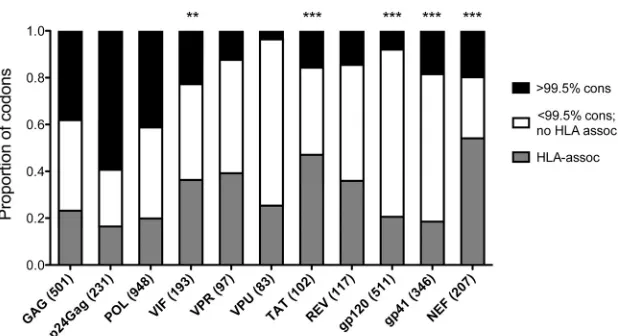
polymor-phism) differed markedly by viral protein (
Fig. 1
). For example,
with 59% of its residues exhibiting
ⱖ
99.5% amino acid
conserva-tion, p24
Gagis the most highly conserved HIV-1 protein, yet HLA
pressures influence sequence variation at 40% of its variable
on November 7, 2019 by guest
http://jvi.asm.org/
codons. HLA-mediated polymorphisms were observed most
fre-quently in the highly immunogenic Nef protein, where 67.4% of
variable codons harbor HLA associations (
P
⫽
1.9
⫻
10
⫺18;
Fish-er’s exact test compared to other proteins). Conversely, the highly
variable Vpu protein exhibited the least evidence of HLA-driven
evolution (26.3% [
P
⫽
0.009]) (
Fig. 1
) (
19
,
52
,
60
). Across the
entire HIV-1 proteome, polymorphisms at 804 of 1,481 (35.2%)
variable sites were associated with at least one HLA allele.
The extent of differential CTL escape between subtype
mem-bers varies markedly by HLA.
Although the HLA-associated
polymorphisms identified at the three different levels of HLA
res-olution are highly concordant (see Table S2 in the supplemental
material), each analysis features relative merits and limitations.
Analysis at broader resolution can enhance statistical signal when
related alleles bind the same epitope and escape along the same
pathway. For example, the Gag-TW10 epitope binds many
mem-bers of the B58 supertype. At Gag codon 242 (position 3 of this
epitope), relative odds of escape are 193:1 for B58 supertype
mem-bers compared to non-B58 supertype memmem-bers (
P
⫽
1.6
⫻
10
⫺117). However, when relative odds are calculated at the type
(e.g., B*57) or subtype (e.g., B*57:01) level, lower odds are
ob-served (128:1,
P
⫽
1.2
⫻
10
⫺87, and 114:1,
P
⫽
5.4
⫻
10
⫺72,
respectively) because persons harboring closely related alleles
(e.g., B*58 and/or B*58:01) are classified as lacking the specific
allele under investigation even though they also select the same
escape mutation. Conversely, when alleles belonging to the
same type or supertype bind different peptides or select
differ-ent escape pathways, analyzing at broader resolution may yield
inappropriate results while still achieving high levels of
statis-tical significance and may mask differential escape (where
sim-ilar HLA alleles bind the same epitope but escape along distinct
pathways) (
26
). For example, despite belonging to the B58
su-pertype, B*58:02 does not select for the T242N escape mutation
(see Table S2).
Notably, even when analyzed at the broadest resolution level,
the majority of HLA-associated polymorphisms (62%) are still
subtype restricted, while only 31% and 7% are type and supertype
restricted, respectively. These distributions were robust to HLA
imputation (see Materials and Methods and Fig. S2 in the
supple-mental material). To characterize the extent of differential escape
between and within HLA types/subtypes across the HIV-1
pro-teome, we applied recently developed techniques (
26
; see also
Ma-terials and Methods) to explicitly test for differential escape
(de-fined here as cases where one subtype selects a polymorphism and
another selects a different— or no—polymorphism at any given
codon). Overall, we estimate that when polymorphisms are
iden-tified at the type level, there is an 81.5% chance that no differential
escape occurs at the subtype level. Conversely, when
polymor-phisms are identified at the subtype level, there is an 81.2% chance
that the subtype of interest indeed displays a significant
differen-tial escape pattern compared to the type as a whole (data not
shown). Given our 20% false-discovery rate significance
thresh-old, results indicate that our method of reporting associations at
the level of resolution yielding the lowest
P
value is broadly
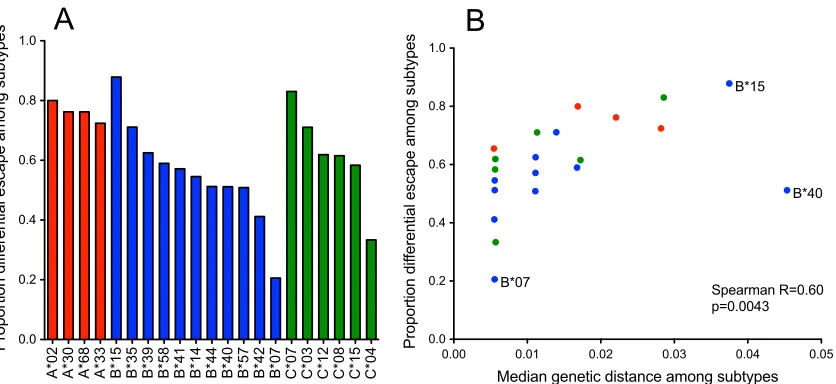
appro-priate. Stratifying analyses by individual HLA alleles revealed that
the heterogeneous B*15 type exhibited the most evidence for
dif-ferential escape (with over 85% of pathways being unique at the
subtype level) while B*07 exhibited the least (with only 20% of
pathways being unique at the subtype level) (
Fig. 2A
). Overall,
differential CTL escape was widespread at the subtype level, with
allele group members exhibiting distinct escape mutations in 58%
of the cases on average (HLA-A, 63%; HLA-B, 55%; HLA-C,
60%).
The underlying mechanisms that drive differential CTL escape
are unclear and may include differences in epitope binding, T-cell
receptor (TCR)-HLA-epitope interactions, TCR repertoire, or
may reflect differences that result from linkage of certain HLA
subtypes to other factors, such as antigenic exposure, antigenic
processing, or linkage with other HLA class I or class II alleles (
26
).
In support of a mechanism that involves properties of the HLA
alleles themselves, we observed a striking positive correlation
be-tween the overall genetic divergence of HLA exons 2 and 3 (the
major genetic determinants of the peptide-HLA binding groove)
between allele group members (see Fig. S3 in the supplemental
material) and the frequency of differential escape between them
(Spearman
R
⫽
0.60;
P
⫽
0.0043) (
Fig. 2B
).
FIG 1The proportion of sequence variation attributable to HLA-associated selection pressures differs markedly by HIV-1 protein. The proportion of codons exhibitingⱖ99.5% amino acid conservation at the population level in our cohort and the proportion of variable codons (those exhibiting⬍99.5% amino acid conservation) harboring no known HLA-associated polymorphisms are indicated, along with the proportion of codons harboring at least one HLA-associated polymorphism. Numbers in parentheses in thex-axis labels indicate the total length in amino acids of each protein (including the stop codon, if present). **,P
⬍0.001; ***,P⬍0.0001 (Fisher’s exact test compared to all other proteins combined).
on November 7, 2019 by guest
http://jvi.asm.org/
[image:5.585.139.448.64.232.2]Enrichment of escape at epitope-HLA anchor residues.
We
next examined the distribution and positioning of
HLA-associ-ated polymorphisms with respect to CTL epitopes (
76
). Our initial
epitope reference list consisted of all optimally described CTL
epitopes restricted by one or more HLA class I alleles. We then
expanded this list by assigning the published epitope to all allele
group members (i.e., subtypes) belonging to the HLA allele group
(i.e., supertype, type, or serotype, depending on the published
restriction) to which the original published epitope belonged (see
Materials and Methods and Table S1 in the supplemental
mate-rial). For example, an epitope originally defined as B*57:01
re-stricted was assigned to all members of the B58 supertype. Since all
epitopes on our expanded list were defined at subtype-level
reso-lution, we utilized the subtype-level HLA-associated
polymor-phism list in the following analysis although sensitivity analyses
confirmed that results were consistent regardless of the
associa-tion list used (data not shown).
Of the 2,161 HLA-restricted viral escape pathways identified at
subtype-level resolution, 29% occurred inside or within
⫾
3
resi-dues of an optimally described CTL epitope. This value was 21.5%
when epitope expansion was not undertaken. In support of
in-cluding flanking regions in the epitope definition, a bootstrap
analysis (100,000 replicates) indicated that escape frequency at
epitope flanking residues was significantly higher than escape
out-side epitopes and their immediate flanking regions for HLA-B
alleles (
P
⫽
0.00012) though this was not significant for HLA-A or
-C alleles. Because the majority of defined epitopes are 9-mers, we
first examined these. Of the 262 unique 9-mer HLA-epitope pairs
(defined as epitopes restricted by the same HLA supertype and
mapping to the same HIV coordinates) for which an
HLA-associ-ated polymorphism was identified, positions 2 and 3 and the C
terminus represented the most frequently escaping sites, while
escape at N-terminal flanking residue
⫺
3 and C-terminal flanking
residue
⫹2 was less frequent than expected under the null
hypoth-esis of equal escape frequency across all sites within/flanking
epitopes (binomial test for departure from expected 1/15
fre-quency, all
P
⬍
0.01) (
Fig. 3A
). Stratification by locus revealed that
HLA-A-restricted epitopes tended to select for escape mutations
at position 3 and the C terminus, HLA-B-restricted epitopes
typ-ically developed escape mutations at position 2, and the limited
number of HLA-C epitopes most often encoded C-terminal
es-cape mutations (see Fig. S4 in the supplemental material).
Classification of escape mutations with respect to their
posi-tion at an anchor residue (defined according to HLA
subtype-specific anchor motifs available at
http://www.hiv.lanl.gov
/content/immunology/motif_scan/motif.html
) (
37
,
78
,
91
,
110
)
revealed that escape occurred at anchor residues 1.8-fold more
frequently than expected under the null hypothesis of equal escape
frequency across all sites within/flanking epitopes (binomial test
for departure from expected 2/15 frequency,
P
⫽
1.0
⫻
10
⫺5) (
Fig.
3B
) and 1.4-fold more frequently than expected across all sites
within the epitope only (binomial test for departure from
ex-pected 2/9 frequency,
P
⫽
0.003) (data not shown). The frequency
of escape at N- and C-terminal epitope flanking residues was
nearly 2-fold lower than that expected under the null hypothesis
of equal escape frequency across all sites within/flanking epitopes
(binomial test for departure from expected 6/15 frequency,
P
⬍
1.0
⫻
10
⫺5) (
Fig. 3B
). Moreover, the average statistical strength of
escape at anchor sites (measured as the maximum absolute
natu-ral-log-transformed odds ratio [lnOR] for each unique HLA-HIV
codon pair) was modestly yet significantly increased compared to
that of nonanchor or flanking sites (median lnOR of 2.15
[inter-quartile range (IQR), 1.15 to 2.58] for anchor sites versus 1.62
[IQR, 0.93 to 2.35] for nonanchor sites versus 1.30 [IQR, 0.81 to
1.98] for flanking regions; Kruskal-Wallis,
P
⫽
0.035) (
Fig. 3C
).
Epitopes of other lengths (8-, 10-, and 11-mer [8/10/11-mer];
n
⫽
201) were also examined. To ensure alignment of anchor
residues, positions were analyzed with respect to their distance
from the N and C termini. Relatively uniform frequency of escape
was observed at epitope positions 1 to 4 and at the penultimate
and C-terminal positions, while escape at position C
⫺
3 (three
positions upstream of the C terminus) was relatively rare (
Fig.
FIG 2Widespread differential escape between HLA allele group members correlates with evolutionary distance between HLA genes. Individual HLA-A, -B, and -C types are indicated. The proportion of differential escape (defined as the proportion of HLA-associated polymorphisms for which the odds of escape differed significantly between at least one HLA subtype and the rest of the group) differs markedly for various common types of the HLA-A, -B, and -C loci (A). HLA types exhibiting the highest level of differential escape were those exhibiting the greatest intratype genetic diversity (B). HLA-B*07 and B*15 (exhibiting the highest and lowest proportion of differential escape, respectively) and B*40 are labeled for special interest.
on November 7, 2019 by guest
http://jvi.asm.org/
[image:6.585.86.504.64.256.2]3D
). When analyzed separately, 10-mers tended to escape more
frequently at position 3 but not the C terminus, while 11-mers
tended to escape more frequently at position 4 (see Fig. S4 in the
supplemental material), an observation that may be due to the
bulging of oversized epitopes and its effect on TCR contacts (
83
).
Overall, a 1.45-fold enrichment of escape mutations at anchor
residues was observed compared to other sites within and flanking
the epitopes (
P
⫽
0.014) (
Fig. 3E
); however, this did not remain
significant when analysis was restricted to within-epitope sites
only (
P
⫽
0.3) (data not shown). The average statistical strength of
escape (lnOR) did not differ significantly between anchor and
nonanchor sites for 8-, 10-, and 11-mer epitopes (median lnOR
was between
⬃
1.4 and 1.5 for all positions;
P
⫽
0.89) (
Fig. 3F
).
Estimating the effect of anchor residue escape on HLA
bind-ing.
Given the enrichment of CTL escape mutations at HLA
an-chor residues, we next estimated the extent to which these
muta-tions were predicted to affect peptide-HLA binding using
NetMHCpan2.4, an artificial neural network-based peptide-HLA
binding prediction tool trained on
⬎
37,000 quantitative binding
data for more than 42 different HLA molecules (
88
). For each
HLA-associated adapted polymorphism that occurred inside an
epitope (147 9-mers and 133 8/10/11-mers), we compared the
predicted HLA binding affinity for the published epitope in its
HLA-restricted nonadapted (i.e., susceptible) versus its
HLA-as-sociated adapted (i.e., escaped) form, using the subtype B
consen-sus for the epitope backbone (in cases where no HLA-restricted
nonadapted residue was identified, the subtype B consensus
resi-due was used). After removing epitopes predicted to bind the
re-stricting HLA with a 50% inhibitory concentration (IC
50) of
⬎1,000 nM in their nonadapted form (representing a 2-fold lower
affinity than NetMHCpan2.4-defined weak binding threshold,
which included 30 9-mers and 38 8/10/11-mers), we calculated
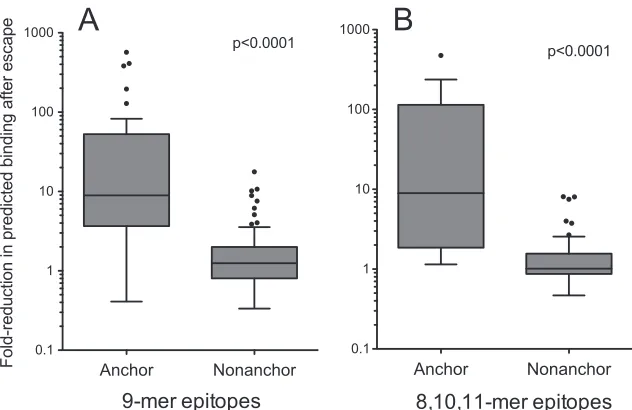
that anchor residue escape in 9-mer epitopes was predicted to
reduce peptide-HLA binding by a median of 8.9-fold (IQR, 3.7- to
52.1-fold) compared to 1.25-fold (IQR, 0.80- to 1.99-fold) at
non-anchor sites (
Fig. 4A
). Among 8/10/11-mer epitopes, anchor
res-idue escape was predicted to reduce peptide binding a median of
8.9-fold (IQR, 1.9- to 114.3-fold) compared to 1.0-fold (IQR,
0.87- to 1.56-fold) at nonanchor sites (
Fig. 4B
). Overall, 36 out of
212 (17%) within-epitope escape mutations were predicted to
“completely” abrogate peptide-HLA binding, defined as epitopes
which bound with an IC
50of
⬍1,000 nM affinity in their
non-adapted form but an IC
50of
⬎
1,000 nM affinity in their escaped
form (data not shown).
FIG 3The distribution and natural log odds ratio of escape within known epitopes is nonuniform and biased toward anchor residues. The distribution and natural log odds ratio of escape mutations within known CD8⫹9-mer epitopes (A, B, and C) and 8-/10-/11-mer epitopes (D, E, and F) are shown. Frequencies of escape by relative position within or occurring at the⫾3 amino acids flanking the epitope N and C termini are depicted as histograms in panels A and D. In panel D, notation of the type C⫺3 on thexaxis indicates the number of positions upstream of the C terminus (in this case, 3). These same data are depicted as fold differences from expected frequency of escape occurring at HLA-specific anchor, nonanchor, and epitope flanking positions (based on the null hypothesis of equal escape probability across all positions) and are shown in panels B and E. *,P⬍0.05; **,P⬍0.001; ***,P⬍0.0001 (binomial test). The natural log of the odds ratio of escape at HLA-specific anchor, nonanchor, and epitope flanking positions are shown as scatter plots (C and F).
on November 7, 2019 by guest
http://jvi.asm.org/
[image:7.585.47.538.63.395.2]Correlates of protective immunity revealed by analysis of
population-level immune escape pathways.
Expression of
spe-cific HLA class I alleles is associated with differential rates of
HIV-1 disease progression (
27
,
62
,
89
), but the precise
mecha-nisms underlying these effects remain incompletely known (
6
,
56
,
70
,
93
). Given that HLA-associated polymorphisms identify viral
sites under strong
in vivo
selection by an HLA allele at the
popu-lation level, analysis of their frequency, distribution, statistical
strength, sequence conservation, and other characteristics allows
us to identify characteristics that discriminate protective HLA
al-lele-associated immune pressures from nonprotective ones. It is
important to emphasize that, although population-level
HLA-as-sociated polymorphisms may allow us to infer specific properties,
tendencies, or attributes that render certain HLA alleles
particu-larly effective at controlling HIV, by no means are we proposing
that selection of escape mutations is beneficial at the individual
patient level.
HLA-associated protective effects were defined according to
published hazard ratios for progression to AIDS (HR-AIDS)
de-rived from a large longitudinal natural history cohort (
89
; see also
Materials and Methods). We investigated 33 interrelated features
of viral sites under HLA-mediated selection as potential correlates
of protective immunity. These 33 features were divided into two
broad categories: those related to their frequency/distribution
(overall, and within known epitopes) and those related to the
sta-tistical strength of selection and/or mutational constraints on the
sites themselves (
Table 1
). Where appropriate, analyses were
un-dertaken at proteome-wide and individual-protein levels.
HLA-associated polymorphisms from the subtype-level analysis were
used.
Of the 33 variables investigated, we identified 12 potential
cor-relates of HLA-mediated protective immunity against disease
pro-gression (
P
⬍
0.05,
q
⬍
0.2) (
Table 1
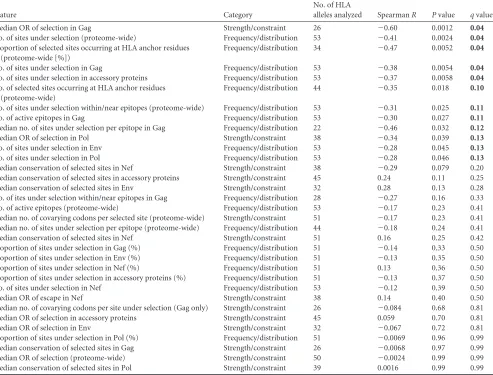
). Among the strongest
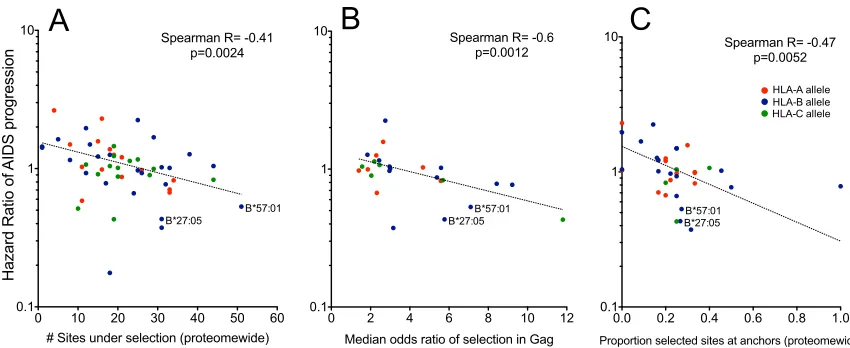
cor-relates of protection was the significant inverse relationship
between total number of sites under selection by a given HLA and
its HR-AIDS (Spearman’s
R
⫽ ⫺0.41;
P
⫽
0.0024) (
Fig. 5A
),
indicating that protective HLA alleles exert substantial
in vivo
pressure on a greater number of sites across the HIV proteome.
This observation was almost exclusively driven by HLA-A and -B
alleles (Spearman’s
R
⫽ ⫺0.48;
P
⫽
0.0016) (data not shown).
When analyzed at the individual protein level, this inverse
rela-tionship was strongest for Gag and remained significant for all
proteins except Nef, where the trend persisted but was not
signif-icant (
Table 1
).
Notably, no significant correlations were observed between
HR-AIDS and median sequence conservation of sites under
selec-tion (where the sequence conservaselec-tion of a given site was defined
as the proportion of the total cohort harboring the consensus
residue at this position [
102
]). This remained true when the bias
induced by HLA-mediated selection on these sites was addressed
by excluding persons expressing these alleles from the calculation
of conservation (
Table 1
). Similarly, no significant correlations
were observed between HR-AIDS and the median number of
co-varying codons per site under selection. However, significant
in-verse relationships were observed between an HLA allele’s
HR-AIDS and the median odds ratio of selection for mutations in Gag
(
R
⫽ ⫺
0.6,
P
⫽
0.0012) (
Fig. 5B
) and, to a lesser extent, in Pol
(
R
⫽ ⫺0.34,
P
⫽
0.039) but not overall or in other HIV-1 proteins.
Another highly significant proteome-wide correlate of
protec-tion was the tendency of protective alleles to select escape
muta-tions at HLA anchor sites within known epitopes (Spearman’s
R
⫽
⫺0.47;
P
⫽
0.0052) (
Fig. 5C
). This effect appeared to be largely
constrained to Pol and Gag (
P
⫽
0.0015 and
P
⫽
0.065,
respec-tively). The median number of sites under selection per epitope in
Gag, but not elsewhere in the viral genome, was also modestly
inversely correlated with HR-AIDS (
Table 1
).
To attempt to identify which of these features represented the
strongest independent correlates of protection, we investigated a
variety of multivariate models incorporating four of our top “hits”
(median OR of selection in Gag, median OR of selection in Pol,
number sites under selection proteome-wide, and percentage of
selected sites occurring at anchor residues). Unfortunately due to
FIG 4Fold changes in predicted peptide-HLA binding affinities following escape at anchor residues. Fold changes in predicted peptide-HLA binding affinities as a consequence of escape at HLA-specific anchor (versus nonanchor) residues within 9-mer (A) and 8-, 10-, and 11-mer (B) epitopes are shown as Tukey box plots.
on November 7, 2019 by guest
http://jvi.asm.org/
[image:8.585.135.451.64.269.2]the strong interdependency of these variables and the fact that not
all variables were available for all HLA alleles, multivariate
analy-ses were not robust to changes in model selection procedures. The
only variable that consistently emerged as a significant
indepen-dent predictor of protection was the number of sites under
selec-tion by a given HLA across the HIV-1 proteome (data not shown).
DISCUSSION
HLA-associated polymorphisms identify HIV-1 sites that are
un-der consistently strong immune pressure
in vivo
and whose
se-quence diversity is largely driven by HLA. As such, the
well-pow-ered nature of this analysis combined with its proteome-wide
focus allowed us to study the frequency, distribution, and
charac-teristics of viral sites under HLA-mediated selection. The
propor-tion of populapropor-tion-level sequence variapropor-tion attributable, at least in
part, to HLA (defined as the proportion of sites in a given protein
harboring at least one HLA-associated polymorphism) differs
markedly by protein and is independent of the protein’s overall
conservation. For example, whereas the majority of variable Nef
codons are attributable, at least in part, to HLA class I-mediated
pressures, this explains only a quarter of Vpu sequence variation,
implying the existence of other host factors in driving evolution of
this viral gene (
40
,
52
,
112
) (to provide context, nearly 40% of
variable sites in the highly conserved p24
Gagprotein are associated
with HLA).
Building on recent advances (
26
,
69
), we demonstrated
signif-icant variation in the proportion of differential escape among
closely related HLA subtypes, implicating differences in TCR
rep-ertoire and/or the interaction between TCR and the epitope-HLA
complex as the underlying mechanisms in at least some cases
(
123
). Widespread differential escape is consistent with reported
differences in HIV-1 disease progression between HLA alleles
dif-fering by as little as 1 amino acid (
43
,
68
,
86
) and also supports the
notion that analysis of HLA-associated polymorphisms provides a
novel perspective from which to discriminate both quantitative
and qualitative differences in HLA-restricted immune responses.
Of interest, HLA allele subtype pairs that exhibit the highest level
of differential escape were those with the greatest intratype
se-quence divergence, raising the intriguing hypothesis that
differen-tial escape may be a consequence of active positive selection at
these loci.
[image:9.585.48.541.80.455.2]Analysis of the distribution of HIV-1 escape mutations within
known CTL epitopes revealed that abrogation of peptide-HLA
TABLE 1 Identifying correlates of HLA allele-associated protective immunity
Feature Category
No. of HLA
alleles analyzed SpearmanR Pvalue qvaluea
Median OR of selection in Gag Strength/constraint 26 ⫺0.60 0.0012 0.04
No. of sites under selection (proteome-wide) Frequency/distribution 53 ⫺0.41 0.0024 0.04
Proportion of selected sites occurring at HLA anchor residues (proteome-wide [%])
Frequency/distribution 34 ⫺0.47 0.0052 0.04
No. of sites under selection in Gag Frequency/distribution 53 ⫺0.38 0.0054 0.04
No. of sites under selection in accessory proteins Frequency/distribution 53 ⫺0.37 0.0058 0.04
No. of selected sites occurring at HLA anchor residues (proteome-wide)
Frequency/distribution 44 ⫺0.35 0.018 0.10
No. of sites under selection within/near epitopes (proteome-wide) Frequency/distribution 53 ⫺0.31 0.025 0.11
No. of active epitopes in Gag Frequency/distribution 53 ⫺0.30 0.027 0.11
Median no. of sites under selection per epitope in Gag Frequency/distribution 22 ⫺0.46 0.032 0.12
Median OR of selection in Pol Strength/constraint 38 ⫺0.34 0.039 0.13
No. of sites under selection in Env Frequency/distribution 53 ⫺0.28 0.045 0.13
No. of sites under selection in Pol Frequency/distribution 53 ⫺0.28 0.046 0.13
Median conservation of selected sites in Nef Strength/constraint 38 ⫺0.29 0.079 0.20
Median conservation of selected sites in accessory proteins Strength/constraint 45 0.24 0.11 0.25
Median conservation of selected sites in Env Strength/constraint 32 0.28 0.13 0.28
No. of ites under selection within/near epitopes in Gag Frequency/distribution 28 ⫺0.27 0.16 0.33
No. of active epitopes (proteome-wide) Frequency/distribution 53 ⫺0.17 0.23 0.41
Median no. of covarying codons per selected site (proteome-wide) Strength/constraint 51 ⫺0.17 0.23 0.41
Median no. of sites under selection per epitope (proteome-wide) Frequency/distribution 44 ⫺0.18 0.24 0.41
Median conservation of selected sites in Nef Strength/constraint 51 0.16 0.25 0.42
Proportion of sites under selection in Gag (%) Frequency/distribution 51 ⫺0.14 0.33 0.50
Proportion of sites under selection in Env (%) Frequency/distribution 51 ⫺0.13 0.35 0.50
Proportion of sites under selection in Nef (%) Frequency/distribution 51 0.13 0.36 0.50
Proportion of sites under selection in accessory proteins (%) Frequency/distribution 51 ⫺0.13 0.37 0.50
No. of sites under selection in Nef Frequency/distribution 53 ⫺0.12 0.39 0.50
Median OR of escape in Nef Strength/constraint 38 0.14 0.40 0.50
Median no. of covarying codons per site under selection (Gag only) Strength/constraint 26 ⫺0.084 0.68 0.81
Median OR of selection in accessory proteins Strength/constraint 45 0.059 0.70 0.81
Median OR of selection in Env Strength/constraint 32 ⫺0.067 0.72 0.81
Proportion of sites under selection in Pol (%) Frequency/distribution 51 ⫺0.0069 0.96 0.99
Median conservation of selected sites in Gag Strength/constraint 26 ⫺0.0068 0.97 0.99
Median OR of selection (proteome-wide) Strength/constraint 50 ⫺0.0024 0.99 0.99
Median conservation of selected sites in Pol Strength/constraint 39 0.0016 0.99 0.99
aShown in boldface areqvalues of⬍0.2, indicating potential correlates of HLA-mediated protective immunity against disease progression.
on November 7, 2019 by guest
http://jvi.asm.org/
binding via anchor residue mutation represented a major escape
mechanism and that such mutations incurred, on average, a
nearly 10-fold reduction in predicted HLA binding affinity.
Among 9-mer epitopes, the statistical strength of escape
muta-tions at anchor residues was higher than for nonanchor residues.
Mutations occurring at nonanchor positions within the epitope
were less frequently detected, and those at residues immediately
flanking the N and C termini of the epitope were less frequent still
(although still significantly higher than in extraepitopic zones, at
least for HLA-B). Although it is tempting to conclude that
abro-gation of peptide-HLA binding represents HIV’s favored escape
mechanism, a potential limitation should be noted. It is possible
that detection of HLA-associated polymorphisms at the
popula-tion level is inherently biased toward detecpopula-tion of
“straightfor-ward” escape mutations such as those directly affecting binding to
HLA, while escape mutations resulting from more complex
and/or “secondary” interactions (e.g., escape from populations of
TCRs capable of interacting with HLA-bound peptide) may be
more challenging to detect. Indeed, numerous examples exist
where an escape variant selected in one individual is highly
recog-nized by another’s immune response (
38
,
47
,
63
,
90
).
Despite these caveats, recent large-scale studies of immune
es-cape indicate that data sets of the present size have sufficient
power to detect even rare escape mutations (
26
), as well as to
detect cases where escape from one HLA allele represents the
sus-ceptible form for another (
19
). The high frequency of anchor
res-idue escape has implications for proposed vaccine strategies
aimed at immunizing with both wild-type and common variants
to channel HIV evolution down unconventional pathways (
7
,
13
,
19
). While still valid, such strategies should consider excluding
epitope variants that are experimentally verified to not bind their
restricting HLA, unless such variants overlap key epitopes
re-stricted by other alleles and/or lead to the creation of novel
epitopes relevant to immune control (
4
).
Analysis of HLA-associated polymorphisms identified at the
population level also provides a unique perspective from which to
identify, albeit indirectly, specific characteristics that differentiate
protective from nonprotective HLA-restricted CTL responses.
Such sequence-based methods offer an alternative perspective to
traditional
in vitro
and/or
ex vivo
assays such as gamma interferon
(IFN-
␥
) enzyme-linked immunosorbent spot (ELISpot) assays
(
115
), where, for a variety of reasons (including use of synthetic
consensus peptides at supraphysiological concentrations that
by-pass antigen-processing machinery, detection of a single cytokine
readout only, inability to detect previous effective responses due
to escape in the autologous virus, and others [
121
]), responses
detected
in vitro
may not accurately discriminate effective
re-sponses occurring
in vivo
. Indeed, a recent large-scale analysis of
⬎
2,000 chronically clade C-infected persons identified
differen-tial immune escape as a better predictor of average per-HLA
plasma viral load than responses measured by IFN-
␥
ELISpot
as-say (
26
).
Importantly, analysis of population-level HLA-associated
polymorphisms as markers of
in vivo
immune pressure by no
means argues that CTL escape is protective at the individual level;
indeed, escape mutations in individuals have been linked to higher
viral load and disease progression (
21
,
26
,
39
,
49
). At the
popula-tion level, HLA-associated polymorphic sites identify
HLA-re-stricted CTL responses that are consistently mounted in a
substan-tial number of individuals expressing that allele—responses that
are strong enough to drive the virus to escape in reproducible
ways. As such, these sites represent the total potential of common
CTL responses restricted by a given HLA allele to effectively target
HIV; analysis of their distribution and characteristics can
there-fore help illuminate correlates of protection. Translation of these
findings to the individual level is more complex. First, not all
individuals expressing a given HLA will mount all possible CTL
responses. Broadly generalizing, from a viral control perspective,
the ideal would be to mount an effective immune response that
the virus is incapable of escaping. Less ideal (but more the norm)
would be to generate an effective response that the virus ultimately
is able to escape (yielding losses of immune control that in some
cases may be offset by viral fitness costs). Least ideal would be the
inability to mount the response in the first place. At the individual
level, therefore, escape mutations can be regarded as genetic relics
of formerly effective CTL responses, where, in general, the
nega-FIG 5Population-level immune escape pathways in HIV-1 reveal correlates of protective immunity: selected results. Individual HLA-A, -B, and -C alleles are as indicated. Significant inverse correlations were observed between the total number of sites under immune selection by a given HLA across the entire HIV-1 proteome (A), the median odds ratio of escape in Gag (B), and the percent escape at HLA anchor residues (C) and published hazard ratios of AIDS progression. HLA-B*57:01 and B*27:05 are labeled for special interest.
on November 7, 2019 by guest
http://jvi.asm.org/
[image:10.585.77.502.64.238.2]tive consequences of escape are still preferable to the inability to
mount responses at all (
26
).
Our proteome-wide and protein-specific analyses shed new
light on the long-standing debate around whether CTL response
breadth is (
31
,
101
) or is not (
1
) a correlate of protection. For
example, the number of Env-specific CD8 T-cell responses in
chronic infection, as measured by IFN-
␥
ELISpot assay, has been
associated with poorer HIV control at the individual level (
57
,
67
),
suggesting that not all CTL responses are equally effective (
29
,
58
,
108
). Our results indicate that protective alleles (most notably
those of the HLA-A and -B loci) have the potential to exert
im-mune pressure on a larger number of sites across the viral
pro-teome and that selection breadth potential is significantly
associ-ated with protection for all proteins except Nef (although a trend
remained for the latter). Furthermore, the number of associated
sites across the proteome per HLA allele was the only variable that
consistently emerged as an independent correlate of protection in
multivariate analyses. Our observations highlight the utility of
us-ing population-level HLA-associated polymorphisms to
preferen-tially discriminate the impact of HLA-restricted immune
re-sponses that are most effective at controlling HIV-1 replication
in
vivo
and suggest that the ability of an HLA allele to mount broad
CTL selection pressures to a wide variety of proteins beyond
Gag—including Env—represents a general correlate of
protec-tion.
The negative results of this study are also illuminating. The lack
of correlation between HR-AIDS and the density of the amino
acid covariation network associated with any given site under
im-mune selection suggests that targeting structural or functional
“network hubs” (i.e., those exhibiting higher-order evolutionary
constraints within a given HIV protein [
33
]) is not independently
protective. Similarly, the lack of correlation between HR-AIDS
and average sequence conservation of sites under HLA selection
indicates that the ability to target constrained sites is not in itself
protective: it may depend on where these sites are in the HIV-1
proteome and how strongly they are targeted. Indeed, analysis at
the individual protein level revealed that the statistical strength of
selection on conserved sites (as measured by the odds ratio of
association) in Gag and, to a lesser extent, Pol but not other viral
proteins was a significant correlate of protection. Since a high
odds ratio reflects both the frequency of selection among persons
expressing the HLA allele and the likelihood of reversion in
per-sons who lack the allele, it may be interpreted as an index of
ex-ceptionally strong selection at mutationally constrained sites. Our
results thus highlight the strength of immune selection on
con-served sites within structural and functional HIV-1 proteins as an
important correlate of protection.
Gag was also confirmed as a particularly effective immune
tar-get. The number of sites under active immune selection in Gag,
the number of active Gag epitopes (i.e., those harboring evidence
of immune selection), and the average number of sites under
se-lection per Gag epitope (a marker of diversity of sese-lection
pres-sures on a given epitope) also represented significant correlates of
protection. Although an HLA allele’s ability to consistently mount
immune pressure on conserved Gag codons may appear an
intui-tive correlate of protection, the factors that constrain the virus to
escape at those specific sites remain unclear. That the median odds
ratio of escape in Gag correlated significantly with both the
num-ber of sites under selection and the proportion of anchor residue
escape in the same protein and that in 9-mers the odds ratio of
escape was significantly higher at anchor sites suggest that a
hall-mark of HLA-associated protection is the ability to consistently
mount intense CTL responses from which the virus is compelled
to escape (hence, the high odds of escape) but can only do so at a
limited number of positions (hence, the position specificity) and
at a biologically relevant fitness cost (hence, sequence
conserva-tion in persons lacking the allele). Furthermore, if the anchor
res-idue is otherwise highly conserved, escape at this position could
indicate that CTL targeting the epitope are highly polyclonal
and/or cross-reactive, thus limiting escape options to those that
abrogate epitope presentation. If so, this supports the clonal
com-position and/or diversity of an epitope-specific CTL repertoire as
a correlate of protection (
28
,
58
) and supports vaccine strategies
seeking to stimulate CTL responses to both wild-type and
com-monly occurring escape variants at nonanchor sites (
11
,
42
,
109
),
most notably in epitopes where escape at anchor residues is likely
to incur a fitness cost. Indeed, a recent analysis limited to Pol
epitopes suggested that mutations which disrupt peptide binding
to protective HLA alleles (particularly HLA-A alleles) may be have
greater fitness cost than escape from nonprotective HLA alleles
(
85
).
Although results provide potentially useful information to
guide future vaccine and immunogenicity studies, some
limita-tions merit mention. We employed bioinformatics and statistical
approaches to infer general mechanisms of immune evasion and
its consequences for epitope presentation
in vivo
, but individual
predictions will require rigorous experimental verification prior
to consideration as potential immunogens. Furthermore,
al-though well-powered analyses of HLA-associated polymorphisms
identify the majority of escape pathways commonly driven by a
given HLA (
26
), they may still underestimate the amount of
im-mune selection imposed on HIV at the population level. For
ex-ample, as our method detects only HIV polymorphisms whose