* E-mail: [email protected]
Introduction
Ocean acidification, caused by the uptake of additional carbon dioxide (CO2) from the atmosphere, is occurring at rate
unprecedented in the recent geological past (Doney et al. 2009). If CO2 emissions continue on the current trajectory, atmospheric
CO2 could exceed 900ppm by year 2100 (Meinshausen et al.
2011), and the associated uptake of CO2 at the ocean surface
would cause a reduction in average ocean pH of 0.3-0.4 units compared to present-day levels (The Royal Society 2005). An ever-increasing number of experimental studies have demonstrated that changes in ocean chemistry associated with CO2 levels predicted for the atmosphere and surface ocean
by the end of the century can have significant effects on the reproduction, growth, development, behaviour and survival of marine organisms (Fabry et al. 2008; Doney et al. 2009). However, a critical unanswered question is the capacity of species to adapt to changes in ocean chemistry (Pandolfi et al. 2011; Sunday et al. 2011). Although rapid by geological standards, ocean acidification will occur over a number of decades, and more importantly, over multiple generations for many marine species. Furthermore, individual variation in the response to elevated CO2 and reduced pH has been observed in many
ocean acidification experiments (e.g. Ries et al. 2009; Munday et al. 2010; Parker et al. 2011; Pistevos et al. 2011; Sunday et al. 2011), with some individuals appearing more tolerant to CO2-induced acidification than others. This suggests there is
Selective mortality associated with variation
in CO
2
tolerance in a marine fish
1ARC Centre of Excellence for Coral Reef Studies, and School of Marine and Tropical Biology, James Cook University, Townsville, QLD 4811, Australia
2Australian Institute of Marine Science, The University of Western Australia, Crawley WA 6009, Australia
3Department of Biology, University of Saskatchewan, SK S7N 5E2, Canada
4Veterinary Biomedical Sciences, University of Saskatchewan, SK S7N 5E2, Canada Philip L. Munday1*,
Mark I. McCormick1, Mark Meekan2, Danielle L. Dixson1,
Sue-Ann Watson1, Douglas P. Chivers3, Maud C.O. Ferrari4
Received 02 May 2012 Accepted 27 August 2012
Abstract
Predicted future CO2 levels can affect reproduction, growth, and behaviour of many marine organisms. However, the capacity of species to adapt to predicted changes in ocean chemistry is largely unknown. We used a
unique field-based experiment to test for differential survival associated with
variation in CO2 tolerance in a wild population of coral-reef fishes. Juvenile damselfish exhibited variation in their response to elevated (700 µatm) CO2 when tested in the laboratory and this influenced their behaviour and risk
of mortality in the wild. Individuals that were sensitive to elevated CO2 were more active and move further from shelter in natural coral reef habitat and,
as a result, mortality from predation was significantly higher compared
with individuals from the same treatment that were tolerant of elevated CO2. If individual variation in CO2 tolerance is heritable, this selection of phenotypes tolerant to elevated CO2 could potentially help mitigate the
effects of ocean acidification.
Keywords
Ocean acidification • Climate change adaptation • Phenotypic selection • Coral reef fish • Behavioural impairment
© Versita Sp. z o.o.
potential for the selection of more CO2 resistant phenotypes over
coming decades. Demonstrating that selection of CO2 resistant
phenotypes occurs in nature would be an important step toward understanding the potential for adaptation to ocean acidification in marine organisms.
Recent studies show that the behaviour and sensory capabilities of juvenile reef fish are seriously impaired by exposure to elevated CO2 during their pelagic larval stage (Munday et al.
2009; Munday et al. 2010; Ferrari et al. 2011; Simpson et al. 2011; Domenici et al. 2012), leading to higher mortality from predators in natural coral-reef habitat (Munday et al. 2010; Ferrari et al. 2011). The cause of these behavioural abnormalities appears to be impaired neurotransmitter function due to fish altering ion concentrations to prevent tissue acidosis when exposed to high CO2 (Nilsson et al. 2012). However, considerable variation
in individual responses has been observed at some CO2 levels.
For example, behavioural responses of larval fish to predator odour and prey alarm cues is highly variable at~700µatm CO2
(Munday et al. 2010; Ferrari et al. 2011). In contrast, behaviour of fish is unaffected at ~550µatm CO2 and behaviour of all fish
is strongly affected at ~850µatm CO2, with little variation among
individuals (Munday et al. 2010; Ferrari et al. 2011). This suggest that selection for CO2 tolerant individuals could be especially
pronounced around 700µatm CO2 The transition of larvae
twice daily with a HQ40d pH meter (Hach, Colorado, USA). Total alkalinity of seawater was estimated by Gran titration from samples taken twice weekly from control and treatment tanks. Alkalinity standardizations achieved accuracy within 1% of certified reference material (Dr. A. Dickson, Scripps Institution of Oceanography). Average seawater pCO2 was calculated in
the program CO2SYS using the constants of Mehrbach et al. (1973) refit by Dickson and Millero (1987). Seawater parameters are shown in Table 1.
Sensitivity to elevated CO2
Following CO2 treatment, the sensitivity of individual damselfish
to elevated CO2 was tested using a two-channel flume chamber
(Munday et al. 2009). Larval and juvenile reef fishes reared at 700µatm CO2 exhibit a bimodal response to predator odour;
some individuals are strongly repelled from the odour, as are control fish, whereas other individuals exhibit a maladaptive attraction to predator odour (Munday et al. 2010). Therefore, testing the response of individuals to predator odour is a simple way to determine their sensitivity to elevated CO2. Flume
trials were conducted using standard protocols (Munday et al. 2009; Munday et al. 2010). Briefly, one channel of the flume chamber received seawater containing the chemical cues of Pseudochromis fuscus, a common predator of newly-settled fish. The other channel received seawater with no additional chemical cues. Fish were released at the downstream end of the flume where they were free to move to either side or swim toward the preferred water source. After a two-minute acclimation period, the position of the fish was recorded at 5-sec intervals for a 2-min period by an observed positioned behind the flume. The water sources were switched and the test repeated. The same observer (DLD) made all observations. At the end of each trial fish were classified as affected or unaffected by elevated CO2
depending on their response to the predator odour. An additional 20 fish were retested after 5h and 10h to confirm that individual responses exhibited in the flume were retained.
Field experiment
Following testing in the flume, fish were released individually onto small coral reefs (18 × 12 × 12 cm) constructed on a shallow sandflat at Lizard Island. A wire cage over the patch allowed fish to adjust to their surroundings while being protected from predators. Cages were removed 30 to 60 min later, between 09:00 and 11:00. Behaviour was assessed for a 3 min period after the cage was removed. Six behaviours were estimated: (1) bite rate, (2) total distance moved, (3) mean distance ventured from shelter, (4) maximum distance ventured from shelter, (5) known to occur at this time (Gagliano et al. 2007). Therefore,
this could be an important period for selection of individuals with greater CO2 tolerance.
The aim of this study was to test if variation in individual sensitivity of juvenile reef fishes to elevated CO2 could lead to
selection of CO2 tolerant phenotypes in nature. We focused on fish
exposed to ~700µatm because this is where the greatest among-individual variation in behavioural responses to elevated CO2 has
been observed, and therefore where the potential for selection for CO2 tolerant individuals should be greatest. First, we exposed
wild-caught larvae of the coral-reef damselfish Pomacentrus wardi to either 425µatm pCO2 (current-day control) or 700µatm pCO2.
The sensitivity of individual damselfish larvae to elevated CO2 was
then evaluated by testing their response to predator odour using a two-channel flume chamber (Munday et al. 2009; Munday et al. 2010). Based on the response exhibited in the flume, fish were assigned to affected and unaffected groups. Individuals from both these groups, and current-day controls, were then placed on natural coral-reef habitat in the field where their behaviour was assessed and mortality rate of the different groups monitored over a 70-hour period. This enabled us to both test for selection of CO2
tolerant phenotypes during a critical life-history transition and to identify the behavioural traits associated with differential mortality.
Methods
Fish collection and maintenance
Settlement-stage Pomacentrus wardi (16-21 days old) larvae were caught overnight in light traps at Lizard Island, Great Barrier Reef, Australia (14°41′S, 145°27′E), during November 2010. Each morning, P. wardi collected in the traps were transferred to replicate 35 l rearing aquariums treated with either control (425µatm) or elevated CO2 (700µatm). Previous experiments have
demonstrated that the behavioural effects of elevated CO2 are
manifest within 4 days of exposure and that longer durations of exposure do not alter behavioural responses (Munday et al. 2010; Ferrari et al. 2011; Simpson et al. 2011; Domenici et al. 2012), therefore larvae were maintained in treatments for four consecutive days. Larvae were fed Artemia nauplii four times daily.
CO2 treatments
Seawater was pumped from the ocean into 60 L sumps where it was diffused with ambient air (control) or CO2. A pH-controller
(Tunze Aquarientechnik, Germany) maintained pH at the desired level. Equilibrated seawater from each sump supplied four replicate 35L aquariums, each housing a small group of larval fishes. Temperature and pHNBS of each aquarium was measured
Table 1. Mean (±SD) seawater parameters in the experimental system.
pHNBS Temp (ºC) Salinity (ppt) TA (μmol.kg-1SW) pCO
2
8.16 (0.04) 27.64 (1.07) 35 2269.66 (15.01) 425.42 (45.28)
Tukey’s HSD post-hoc tests were then used to determine the nature of the significant difference found by MANOVA. Multiple sample survival analysis was used to compare survival rates among treatment groups. A Cox F-test then compared survival between CO2 affected and unaffected fish. Survival trajectories
were displayed with a Kaplan-Meier plot.
Results and discussion
All control larvae (N=58) strongly avoided the predator odour in the flume (<2% time in cue water on average). Approximately half (N = 63) of the 700µatm CO2 treated larvae also exhibited
a strong aversion to the predator odour (i.e. were unaffected by CO2 treatment), whereas the other half (N= 59) exhibited a strong
height above the substratum, and (6) boldness scored on a continuous ranking scale from 0-3 (see Munday et al. 2010, Ferrari et al. 2011 for details). The presence of fish on patch reefs was assessed 2-3 times per day for 70 h. Missing fish were presumed dead as newly recruited juveniles are highly sedentary and previous studies using tagged fish have indicated negligible migration from similar patch reefs (Hoey and McCormick 2004, McCormick 2009). All fieldwork was conducted blind to the CO2 treatment and the assignment of individuals as affected or
unaffected by elevated CO2.
Analysis
The affect of CO2 treatment on behaviour was tested with
[image:3.595.90.471.264.683.2]MANOVA, using log10(x+1) transformed data. ANOVA and
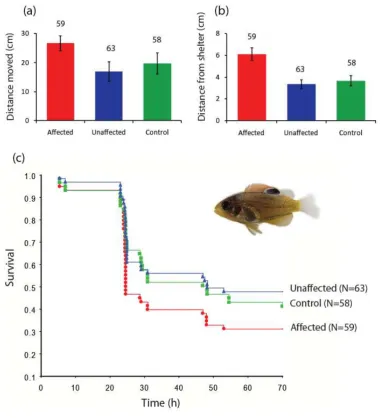
Figure 1.
Selective mortality in coral-reef habitat favours juvenile fish tolerant to elevated CO2. Total distance moved (a), maximum distance ventured
from shelter (b), and survival (c) of juvenile damselfish placed on patch reefs following exposure to elevated (700 µatm) or control (425 µatm) CO2 for 4 days. Fish exposed to elevated CO2 were classified as either affected (red) or unaffected (blue) by high CO2 prior to being placed on
for adaptation to rising CO2 in the ocean. A necessary next step
would be to show that the variation in CO2 sensitivity observed
here in juvenile fish is heritable. The variation in response to elevated CO2 we observed in the flume does appear to have
at least some genetic basis, as full-sibs reared under identical conditions in the laboratory exhibit the same variation in CO2
sensitivity (Munday et al. 2010). Nevertheless, quantitative genetic analyses, such as comparisons of parent-offspring or half-sib variation will be required to estimate heritability (Pandolfi et al. 2011; Sunday et al. 2011). Importantly, we demonstrate that differential mortality associated with CO2 tolerance occurs
at a critical demographic bottleneck for reef fishes, when fewer than 50% of individuals survive for more than 48 hours (Almany and Webster 2006; this study). The correlation of enhanced survivorship of some phenotypes with a strong demographic bottleneck should enhance the establishment of CO2-favourable
individuals in the population, even if heritability for the trait is low. Variation in individual responses to elevated CO2 and
reduced pH has been observed in experiments with other fish species (Munday et al. 2010; Ferrari et al. 2011) and other marine organisms (Ries et al. 2009; Parker et al. 2011; Pistevos et al. 2011; Sunday et al. 2011). Our study shows that this variability provides the raw material for selection to act upon, with the potential to mitigate some biological effects of rapidly rising CO2 levels. However, the heritability
of phenotypic variation in CO2 responses requires testing, and
genetic trade-offs may limit the scope for adaptation, or make species more susceptible to other stresses (Pandolfi et al. 2011). Furthermore, variation in individual response to elevated CO2 declines dramatically at higher CO2 levels (>800 µatm
CO2 ) (Munday et al. 2010; Ferrari et al. 2011), consequently
the strength of selection may also decline markedly at more extreme CO2 levels. Understanding the potential for species
to adapt to rapidly rising CO2 levels is critical for predicting
the biological impacts of ocean acidification and should be a priority area for future research.
attraction to the odour (i.e. were affected by CO2 treatment),
as has been observed previously (Dixson et al. 2010, Munday
et al. 2010). Individual preferences were always retained when larvae were retested 5h and 10h later (N= 20). When placed in natural coral-reef habitat, the behaviour of affected fish differed significantly from unaffected fish (MANOVA: Pillai’s trace =0.22, F10,346=4.37, p<0.001). Affected fish were more active (ANOVA:
F2,176=9.19, p<0.001) and moved a greater distance from shelter
(ANOVA: F2,176=9.86, p<0.001) than non-affected fish (Figure 1a-b).
No other behaviours differed between affected and unaffected fish in the 700µatm CO2 treatment. There were no behavioural
differences between fish unaffected by 700µatm CO2 and control
fish (Figure 1a-b). Mortality in the first 70 hours on the reef was significantly higher in affected fish compared with unaffected fish (Cox-F test: F66,86=1.81, p=0.005). 44% of control and 49%
of unaffected fish survived, whereas only 32% of affected fish survived (Figure 1c). Mortality patterns were established in the first 24hrs and maintained for the duration of the experiment. A suite of resident fishes that prey on newly-recruited juveniles were the agent of mortality.
These results demonstrate that rapid selection of CO2
-tolerant phenotypes can occur in nature. If the individual variation in CO2 tolerance in reef fish observed here, and in previous
studies (Munday et al. 2010; Ferrari et al. 2011), is heritable then we might expect that fish populations will exhibit adaptation to elevated CO2 through time. Like most marine species,
coral-reef fishes are highly fecund, spawn repeatedly, reproduce over many seasons, and only a small fraction of offspring survive to become juveniles. Consequently, there is considerable potential for selection to favour populations dominated by CO2 tolerant
individuals over coming decades. Furthermore, most reef fishes have very large populations, which increases genetic variation and the number of breeding individuals likely to produce favourable genotypes
Establishing that rapid selection for CO2-tolerance occurs in
nature is an important step towards understanding the capacity
References
Almany G.R., Webster M.S., The predation gauntlet: early post-settlement mortality in reef fishes, Coral Reefs, 2006, 25, 19-22
Dickson A.G., Millero F.J., A comparison of the equilibrium constants for the dissociation of carbonic acid in seawater
media, Deep-Sea Res., 1987, 34, 1733-1743
Domenici P., Allan B., McCormick M.I., Munday P.L., Elevated CO2
affects behavioural lateralization in a coral reef fish, Biol. Lett., 2012, 8, 78-81, DOI:10.1098/rsbl.2011.0591
Doney S.C., Fabry V.J., Feely R.A., Kleypas J.A., Ocean
acidification: the other CO2 problem, Annu. Rev. Mar. Sci.,
2009, 1, 169-192
Fabry V.J., Seibel B.A., Feely R.A., Orr J.C., Impacts of ocean
acidification on marine fauna and ecosystem processes,
ICES J. Mar. Sci., 2008, 65, 414–432
Ferrari M.C.O., Dixson D.L., Munday P.L., McCormick M.I., Meekan M.G., Sih A., et al., Intrageneric variation in antipredator
responses of coral reef fishes affected by ocean acidification:
implications for climate change projections on marine
communities, Glob. Change Biol., 2011, 17, 2980-2986
Gagliano M., McCormick M.I., Meekan M.G., Survival against the odds: ontogenetic changes in selective pressure mediate
growth-mortality tradeoffs, Proc. Roy. Soc. Lond. B, 2007,
274, 1575–1582
Hoey A., McCormick M.I., Selective predation for low body
condition at the larval-juvenile transition of a coral reef fish. Oecologia, 2004, 139, 23-29
Parker L.M., Ross P.M., O’Connor W.A., Populations of the Sydney
rock oyster, Saccostrea glomerata, vary in response to
ocean acidification, Mar. Biol., 2011, 158, 689-697
Pistevos J.C.A., Calosi P., Widdicombe, S., Bishop J.D.D., Will
variation among genetic individuals influence species responses to global climate change? Oikos, 2011, 120,
675-689
Ries J.B., Cohen A.L., McCorkle D.C., Marine calcifiers exhibit mixed responses to CO2-induced ocean acidification, Geology, 2009, 37, 1131-1134
Simpson S.D., Munday P.L., Wittenrich M.L., Manassa R., Dixson
D.L., Gagliano M., et al., Ocean acidification erodes crucial auditory behaviour in a marine fish, Biol. Lett., 2011, 7, 917-920, DOI:10.1098/rsbl.2011.0293
Sunday J.M., Crim R.N., Harley C.D.G., Hart M.W., Quantifying rates of evolutionary adaptation in response to ocean
acidification, PLoS ONE, 2011, 6, e22881, DOI:10.1371/
journal.pone.0022881
The Royal Society, Ocean acidification due to increasing atmospheric carbon dioxide, The Royal Society (Policy Document 12/05), London, UK, 2005
Meinshausen M., Smith S., Calvin K., Daniel J., Kainuma M., Lamarque J.F., et al., The RCP greenhouse gas concentrations and their extensions from 1765 to 2300,
Climatic Change, 2011, 109, 213-241
Mehrbach C., Culberson C.H., Hawley J.E, Pytkowicz R. M., Measurements of the apparent dissociation constants of carbonic acid in seawater at atmospheric pressure, Limnol.
Oceanogr., 1973, 1, 897-907
Munday P.L., Dixson D.L., Donelson J.M., Jones G.P., Pratchett
M.S., Devitsina G.V., et al., Ocean acidification impairs olfactory discrimination and homing ability of a marine fish, Proc. Natl. Acad. Sci. USA, 2009, 106, 1848-1852
Munday P.L., Dixson D.L., McCormick M.I., Meekan M., Ferrari
M.C.O., Chivers D.P., Replenishment of fish populations is threatened by ocean acidification, Proc. Natl. Acad. Sci. USA, 2010, 107, 12930-12934
Nilsson G.E, Dixson, D.L., Domenici P., McCormick M.I., Sørensen
C., Watson S-A., Munday P.L., Near-future CO2 levels alter
fish behaviour by interference with neurotransmitter function. Nature Climate Change, 2, 2012, 201-204.
Pandolfi J.M., Connolly S.R., Marshall D.J., Cohen A.L., Projecting
coral reef futures under global warming and ocean