0022-538X/08/$08.00⫹0 doi:10.1128/JVI.02675-07
Copyright © 2008, American Society for Microbiology. All Rights Reserved.
Efficient and Specific Rescue of Human Immunodeficiency Virus
Type 1 Budding Defects by a Nedd4-Like Ubiquitin Ligase
䌤
Yoshiko Usami, Sergei Popov, Elena Popova, and Heinrich G. Go
¨ttlinger*
Program in Gene Function and Expression, Program in Molecular Medicine, University of Massachusetts Medical School, Worcester, Massachusetts 01605
Received 17 December 2007/Accepted 21 February 2008
To exit infected cells, human immunodeficiency virus type 1 (HIV-1) exploits the vacuolar protein-sorting pathway by engaging Tsg101 and ALIX through PTAP and LYPxnL late assembly (L) domains. In contrast,
less-complex retroviruses often use PPxY L domains to recruit Nedd4 family ubiquitin ligases. Although HIV-1 Gag lacks PPxY motifs, we now show that the budding of various HIV-1 L-domain mutants is dramatically enhanced by ectopic Nedd4-2s, a native isoform with a truncated C2 domain. The effect of Nedd4-2s on HIV-1 budding required a catalytically active HECT domain and was specific, since other Nedd4 family proteins showed little activity and an unrelated retrovirus was not rescued. The residual C2 domain of Nedd4-2s was critical for the enhancement of HIV-1 budding and for the association of Nedd4-2s with Gag, as reflected by its incorporation into virus-like particles. Interestingly, the incorporation of Nedd4-2s also depended on its active site, indicating that the ability to form a thioester with ubiquitin was required. These data suggest a novel mechanism by which HIV-1 Gag can connect to cellular budding machinery.
Both the sorting of ubiquitinated cargo into multivesicular bodies (MVBs) and the biogenesis of these endocytic compart-ments depends on a network of class E vacuolar-protein-sort-ing (VPS) proteins (2, 21, 39). MVBs are formed through the inward budding of vesicles from the endosomal membrane, which exhibits the same topology as retroviral budding from the plasma membrane. Indeed, retroviruses exploit the class E VPS protein network to promote their egress from host cells (4, 9, 32).
Most of the class E VPS proteins participate in the forma-tion of three distinct heteromeric endosomal sorting com-plexes required for transport, known as ESCRT-I, -II, and -III (2). These complexes are transiently recruited to or assemble on endosomal membranes during cargo sorting and appear to function in a sequential manner (2). Membrane-associated ESCRT-III components are recognized by the ATPase Vps4, which catalyzes the disassembly of ESCRT-III and may thereby trigger membrane fission (3, 45). Dominant-negative mutants of Vps4 and of various ESCRT-III components strongly inhibit the release of human immunodeficiency virus type 1 (HIV-1) and of other retroviruses, indicating that a functional MVB pathway is required for efficient retroviral budding (13, 31, 43, 49).
Retroviruses access the class E VPS pathway through so-called late assembly (L) domains in Gag, the viral polyprotein that drives viral particle assembly (4). The primary L domain of HIV-1 consists of a highly conserved PT/SAP motif in the C-terminal p6 domain of Gag (20) and engages ESCRT-I by binding to its component Tsg101 (13, 48). Additionally, HIV-1 p6 harbors a binding site for ALIX/AIP1, another class E Vps
protein that also interacts with Tsg101 (43, 49). ALIX binds to L domains of the LYPxnL type and is required for the release
of equine infectious anemia virus, a nonprimate lentivirus (12, 31, 43). In the case of HIV-1, the ALIX binding site in p6 provides an auxiliary L domain that is less critical than the PTAP-type L domain (12, 43). However, we recently observed that ALIX also interacts with the nucleocapsid (NC) domain of HIV-1 Gag, which may contribute to HIV-1 release (36).
Retroviruses that do not belong to the lentivirus genus typ-ically use PPxY-type L domains, which also depend on an intact MVB pathway for function (4, 9, 29, 32). When ap-pended to model Gag constructs, PPxY-type L domains in-duced the formation of Gag-ubiquitin conjugates, indicating that PPxY-type L domains recruit ubiquitin ligase activity (42). The PPxY motif matches the consensus sequence for ligands recognized by WW domains, which are present in E3 ubiquitin ligases of the Nedd4 family (22). This family has nine members in humans and shares a common domain organization, with an N-terminal C2 domain followed by multiple WW domains and a HECT domain. Several lines of evidence indicate that Nedd4 family proteins function in PPxY-mediated budding (6, 17, 27, 53), including the observation that the overexpression of the Nedd4-like protein WWP1, WWP2, or Itch “rescued” release defects caused by PPxY-motif mutations (30). The ability of these E3 ligases to rescue budding depends on the active-site cysteine in the HECT domain, indicating that the ubiquitina-tion of some substrate is required (30). However, how Nedd4 family ubiquitin ligases connect PPxY-type L domains to the MVB pathway is not yet understood.
The release defect of HIV-1 PTAP L-domain mutants can be rescued by increasing the cellular levels of ALIX, and the Tsg101 binding site of ALIX is dispensable for this effect (12, 47). At least in principle, HIV-1 can thus use cellular factors other than Tsg101 for virus release, which may provide an advantage in cells that express only low levels of Tsg101. How-ever, HIV-1 was not expected to be able to use Nedd4
ubiq-* Corresponding author. Mailing address: UMass Medical School, LRB 526, 364 Plantation Street, Worcester, MA 01605. Phone: (508) 856-2843. Fax: (508) 856-4650. E-mail: heinrich.gottlinger@umassmed .edu.
䌤Published ahead of print on 5 March 2008.
4898
on November 8, 2019 by guest
http://jvi.asm.org/
uitin ligases instead of Tsg101, since HIV-1 Gag lacks PPxY-type L domains. In spite of this, we show in the present study that the overexpression of Nedd4-2s but not of other Nedd4 family members potently corrects HIV-1 release defects. Nedd4-2s is a native isoform of Nedd4-2 that lacks an intact C2 domain due to alternative exon usage (23). Surprisingly, the WW domains of Nedd4-2s were not involved in the rescue of HIV-1 budding. In contrast, the severely truncated C2 domain of Nedd4-2s was specifically required for the enhancement of HIV-1 budding and for the incorporation of the E3 ligase into virus-like particles (VLP). Interestingly, the uptake of Nedd4-2s into VLP also depended on the active-site cysteine of the HECT domain, indicating that the formation of a thio-ester with ubiquitin was required.
MATERIALS AND METHODS
Proviral constructs.HXBH10 is avpu-positive version of the infectious HXB2 proviral clone. HXBH10⌬PTAPPis a variant with an in-frame deletion of codons 7 through 11 of p6 (1). The⌬p6 mutant of HXBH10, formerly called the L1/s mutant (14), harbors a premature termination codon in place of the first codon for p6. The⌬p6 truncation was also introduced into the p6-coding region of a protease-defective version of the⌬8-87/⌬126-277 minimal Gag construct (5). ZILp1p6⌬PTAPPis a protease-positive variant of the previously described ZILp6 Gag construct (1) and was obtained by inserting the⌬PTAPP mutation and the coding sequence for the p1 spacer peptide of HIV-1 Gag into ZILp6. The resulting construct is identical to HXBH10⌬PTAPPexcept that the NC coding region is replaced by a sequence providing a heterologous oligomerization do-main. The ZWTvariant of HXBH10 encodes a chimeric Gag precursor that has NCp1p6 replaced by a leucine zipper dimerization domain (1). The pMPMV proviral plasmid is a cytomegalovirus promoter-driven expression construct for wild-type (WT) Mason-Pfizer monkey virus (MPMV), pMPMV/PY(⫺) has the PPPY L domain changed to PGAA, and pMPMV/2x(⫺) additionally has the PSAP L domain changed to AGAP (15).
Expression vectors.Two DNA fragments which together contained the entire coding sequence for the “ancestral” isoform II of Nedd4-2 (11) with an intact N-terminal C2 domain preceded by a FLAG tag were amplified from BC032597 and BC000621 (Open Biosystems), ligated at a common XhoI site, and inserted between the NotI and EcoRI sites of the mammalian expression vector pBJ5. The coding sequences for native Nedd4-2s (residues 122 to 955 of Nedd4-2 isoform II) and for the⌬1-31,⌬1-67,⌬1-103,⌬1-275, or⌬1-432 truncation mutant of Nedd4-2s (residues 153 to 955, 189 to 955, 225 to 955, 397 to 955, or 553 to 955 of Nedd4-2 isoform II) were amplified from BC000621 with or without an N-terminal FLAG tag and inserted into pBJ5. Point mutants of FLAG-Nedd4-2 and FLAG-FLAG-Nedd4-2s were made using the QuickChange mutagenesis strategy (Stratagene). Expression vectors for WT human Nedd4-1, WWP1, WWP2, and Itch/AIP4 have been described (42) and were used as templates to amplify fragments encoding Nedd4-1s (residues 120 to 900 of Nedd4-1) and WWP1s (residues 110 to 922 of WWP1) with an N-terminal FLAG epitope for insertion into pBJ5. The expression vector for monomeric hemagglutinin (HA)-tagged ubiquitin has also been described (44).
Assays for viral particle production and infectious virus release.293T cells (1.2⫻106) were seeded into T25 flasks and were transfected 24 h later using a calcium phosphate precipitation technique. The cultures were transfected with HIV-1 proviral DNA (between 0.5 and 1.5g) together with expression vectors for WT or mutant Nedd4 family proteins (between 1 and 2.5g) and where appropriate for CHMP31-150FLAG (0.5g), HA-ubiquitin (1g), or empty vector. WT and mutant versions of pMPMV were transfected at 2.5g together with 2g of empty pBJ5 or Nedd4-2s expression vector. The total amount of transfected DNA was brought to 8g with carrier DNA (pTZ18U). Culture supernatants were harvested 24 h posttransfection and clarified by low-speed centrifugation and passage through 0.45-m filters. Virions or VLP released into the medium were then pelleted through 20%-sucrose cushions. Pelletable ma-terial and the cell lysates were analyzed by sodium dodecyl sulfate-polyacryl-amide gel electrophoresis and Western blotting as described elsewhere (1), using the anti-HIV CA antibody 183-H12-5C (8) to detect HIV-1 Gag proteins or a goat anti-p27 antiserum to detect MPMV Gag. Epitope-tagged Nedd4 family proteins were detected with anti-FLAG M2 (Sigma), and HA-ubiquitin conju-gates were detected with the anti-HA antibody HA.11 (Covance). Infectious titers of HIV-1 were determined in triplicate by challenging TZM-bl indicator
cells (1⫻105
) seeded into T25 flasks with 1 ml (each) of undiluted 293T-derived supernatant. Saquinavir (2M) was added to the target cells to limit infections to a single cycle. Two days postinfection, the indicator cells were lysed in 400l reporter lysis buffer supplied with a-galactosidase (-Gal) enzyme assay system (Promega), and-Gal activity induced by HIV-1 Tat as a consequence of infec-tion was measured according to the manufacturer’s instrucinfec-tions.
RESULTS
Rescue of a Tsg101-binding-site mutant by an isoform of Nedd4-2.Although HIV-1 Gag lacks PPxY motifs, interactions between Nedd4 and its substrates do not always involve PPxY-mediated mechanisms (33, 51). Since the overexpression of certain Nedd4 family ubiquitin ligases can rescue viral budding in the presence of an attenuated PPxY-type L domain (30), we examined whether members of this family can enhance the budding of HIV-1 L-domain mutants. However, we found no evidence that the overexpression of Nedd4-1, WWP1, WWP2, or Itch/AIP4 significantly affects the release of HXBH10⌬PTAPP (data not shown).
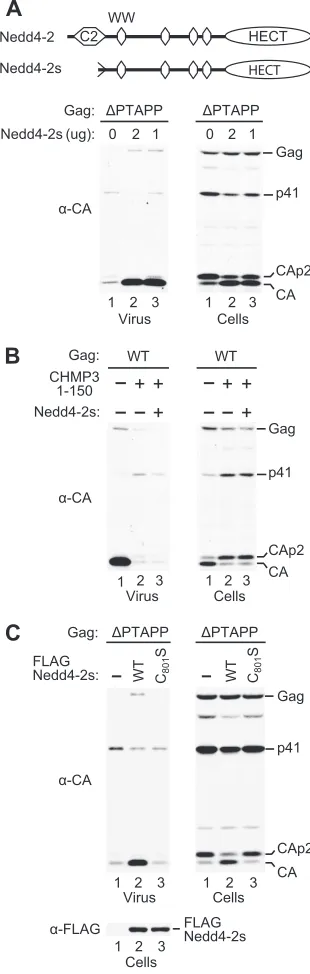
Nedd4-2 (also called Nedd4L) is a homolog of Nedd4-1 that is expressed either with or without an N-terminal C2 domain (Fig. 1A) as a consequence of alternate proximal exon usage (11, 23, 46). Indeed, the majority of cellular transcripts encod-ing human Nedd4-2 are predicted to yield a protein, here called Nedd4-2s, that lacks most of the C2 domain (11). Remarkably, when 293T cells were cotransfected with HXBH10⌬PTAPPand a vector expressing Nedd4-2s, we reproducibly observed a profound increase in viral particle production (Fig. 1A and 2A). Further-more, Nedd4-2s corrected the Gag processing defect of the
⌬PTAPP mutant, which leads to the intracellular accumulation of the Gag cleavage intermediates capsid (CA)-p2 (CAp2) and p41. The ability of Nedd4-2s to alleviate this characteristic cleavage defect of HIV-1 L-domain mutants was highly reproducible and clearly more robust than what we had previously observed for ALIX (47).
Because Nedd4-2s rescued HIV-1 budding in the absence of the primary L domain, we considered the possibility that Nedd4-2s acted independently of the MVB pathway. However, exogenous Nedd4-2s did not suppress the inhibition of HIV-1 budding by CHMP31–150FLAG, a dominant-negative mutant of the ESCRT-III component CHMP3 (54) (Fig. 1B). Further-more, CHMP31–150FLAG blocked the rescue of the⌬PTAPP
mutant by Nedd4-2s, both in terms of particle production and Gag processing (data not shown). Thus, the overexpression of Nedd4-2s did not circumvent the requirement for an intact MVB pathway.
The ability of Nedd4-like ubiquitin ligases to promote PPXY-dependent budding depends on the catalytic cysteine of the HECT domain (30). We therefore mutated the active-site cysteine in the HECT domain of a FLAG-tagged version of Nedd4-2s to serine. While N-terminally tagged WT Nedd4-2s remained active in the⌬PTAPP rescue assay, the C801S mutant showed no activity despite WT expression levels (Fig. 1C). Thus, the catalytic site of Nedd4-2s is essential for its ability to rescue HIV-1 budding.
Nedd4-2s overexpression can rescue HIV-1 release in the absence of all known L domains.In addition to the PTAPP-type L domain, HIV-1 p6 harbors an auxiliary L domain of the LYPxnL type. The LYPxnL motif interacts with the V domain of ALIX and is required for the ability of ALIX to rescue
on November 8, 2019 by guest
http://jvi.asm.org/
Tsg101-binding-site mutants (12, 47). To determine whether the rescue by Nedd4-2s also required the presence of specific p6 sequences, we examined the effect of Nedd4-2s on a proviral mutant (here called⌬p6) that encodes a Gag precursor which
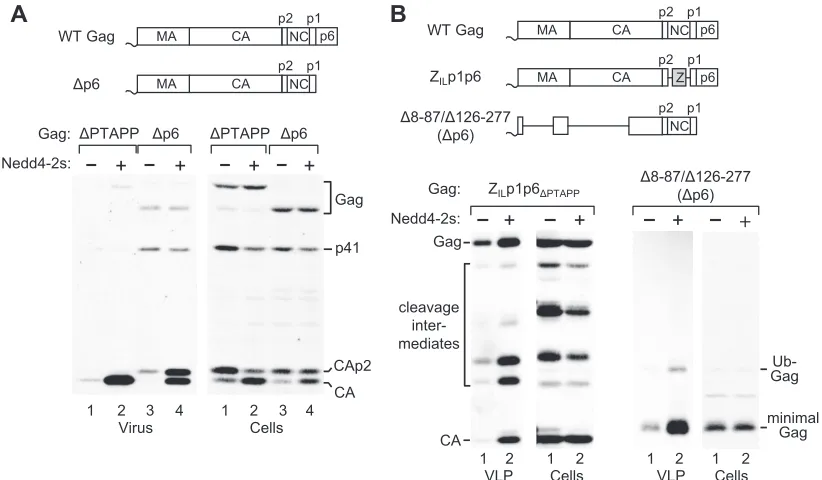
precisely lacks p6 but can express the overlappingpolframe. As shown in Fig. 2A, Nedd4-2s overexpression dramatically increased the release of both CA and CAp2 by the⌬p6 mutant, which released essentially no mature CA and only a trace amount of CAp2 in the absence of exogenous Nedd4-2s. Quan-titation of the CA and CAp2 bands by densitometry indicated that the effect of Nedd4-2s on the⌬p6 mutant was about 75% of that on the⌬PTAPP mutant. Thus, the effect of Nedd4-2s did not critically depend on the ALIX binding site or on any other determinant in p6.
We recently observed that ALIX also binds to the NC do-main of HIV-1 Gag (36). We therefore examined the effect of Nedd4-2s on a Gag construct termed ZILp1p6⌬PTAPP, in which the NC domain is replaced by a variant GCN4 leucine zipper sequence to promote Gag assembly (Fig. 2B). In contrast to the WT GCN4 zipper, the mutant version does not rescue VLP production in the absence of an L domain (1). The overexpres-sion of Nedd4-2s clearly improved VLP production by ZILp1p6⌬PTAPP, demonstrating that the effect of Nedd4-2s was independent of NC (Fig. 2B).
We also examined the effect of Nedd4-2s on a p6-deleted variant of the ⌬8-87/⌬126-277 minimal Gag construct (43). Although the⌬8-87/⌬126-277 mutant lacks both the globular domain of matrix (MA) and the N-terminal domain (NTD) of CA (Fig. 2B), it efficiently forms VLP if p6 is left intact (5). The p6-deleted variant of the⌬8-87/⌬126-277 mutant released only small amounts of VLP, as expected, but VLP production was profoundly increased upon Nedd4-2s overexpression (Fig. 2B). Together, these results indicate that MA, the NTD of CA, NC, and p6 are all dispensable for the ability of Nedd4-2s to stim-ulate VLP production.
Rescue of HIV-1 L-domain mutant infectivity.ALIX over-expression can dramatically increase the yield of infectious virus released by 293T cells transfected with HIV-1⌬PTAP (12). We therefore compared the amount of infectious virus produced by 293T cells cotransfected with ⌬PTAPP or ⌬p6 HIV-1 along with either empty vector or the Nedd4-2s expres-sion vector. Remarkably, Nedd4-2s overexpresexpres-sion increased the release of infectious⌬PTAPP virus 40- to 50-fold but did not significantly enhance the titer obtained with WT virus (Fig. 3; also data not shown). While the total infectivity produced by cells expressing HXBH10⌬PTAPP together with exogenous Nedd4-2s remained about 10-fold lower than the infectivity obtained with WT virus, virus production also remained 2- to 3-fold lower (Fig. 3), indicating that the specific infectivity of
⌬PTAPP virions was at most 5-fold reduced from that of WT virions.
While the⌬p6 mutant by itself yielded no infectivity, a low level of infectivity became detectable upon Nedd4-2s overex-pression (Fig. 3). However, given that Nedd4-2s overexpres-sion largely rescued the release defect of the⌬p6 mutant (Fig. 3), the specific infectivity of⌬p6 virions remained very low.
Nedd4-2s overexpression does not correct the release defect of an unrelated retrovirus lacking L domains.The ability of Nedd4-2s to stimulate budding by a minimal HIV-1 Gag con-struct suggested that no specific HIV-1 sequences may be re-quired for this effect. If so, Nedd4-2s overexpression should also stimulate the budding of unrelated retroviruses with defective L domains. We therefore examined the effect of Nedd4-2s on WT and mutant versions of MPMV, a
betaretro-FIG. 1. “Rescue” of a Tsg101-binding-site mutant by Nedd4-2s. (A) The overexpression of Nedd4-2s profoundly increases HIV-1 re-lease and corrects Gag processing in the absence of the PTAPP L domain. 293T cells were transfected with HXBH10⌬PTAPP(1g) and
either empty pBJ5 or a version expressing Nedd4-2s. Virion produc-tion and Gag expression levels were compared by Western blotting with anti-CA (␣-CA) antibody. (B) Exogenous Nedd4-2s does not overcome the inhibition of WT HIV-1 budding by dominant-negative CHMP3. (C) The catalytic site (Cys-801) in the HECT domain of Nedd4-2s is required to enhance budding and Gag processing by HXBH10⌬PTAPP.␣-FLAG, anti-FLAG.
on November 8, 2019 by guest
http://jvi.asm.org/
[image:3.585.85.240.70.557.2]virus that preassembles immature capsids in the cytoplasm (37). Nevertheless, MPMV budding from the plasma mem-brane depends on the presence of a PPxY-type L domain in Gag (15, 52). MPMV Gag also contains a PSAP motif that has been shown to interact with Tsg101 (15). The PSAP motif acts as an additional L domain that contributes to the release of MPMV but cannot substitute for the PPPY motif (15).
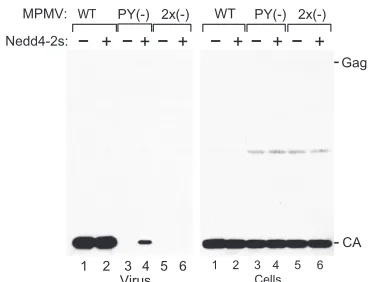
To examine whether Nedd4-2s can rescue MPMV release defects, we used two previously characterized L-domain mu-tants (15). The PY(⫺) mutant has the PPPY motif mutated to PGAA, which is expected to totally abolish WW-domain-me-diated interactions with Nedd4 family ubiquitin ligases (30). The 2x(⫺) mutant additionally has the PSAP motif changed to AGAP and thus lacks a binding site for Tsg101. As previously reported (15), both mutants displayed dramatic defects in viral particle release (Fig. 4). Surprisingly, in contrast to results in previous studies (15, 52), we observed little evidence for an impairment of the intracellular accumulation of mature CA, which may be due to the use of 293T cells in the present study. Also, very little if any unprocessed Gag was detected in the transfected 293T cells, but we cannot exclude that our anti-MPMV CA antiserum recognized the unprocessed Gag pre-cursor only poorly. Interestingly, exogenous Nedd4-2s stimu-lated the release of the PY(⫺) mutant but not of the 2x(⫺) mutant (Fig. 4). Although particle production by the PY(⫺) mutant remained far below WT levels even upon Nedd4-2s overexpression, these data nevertheless indicate that Nedd4-2s can act through Tsg101. Furthermore, the observation that the 2x(⫺) mutant was essentially unresponsive to Nedd4-2s im-plies that the potent effect of the E3 ligase on HIV-1 L-domain mutants is specific.
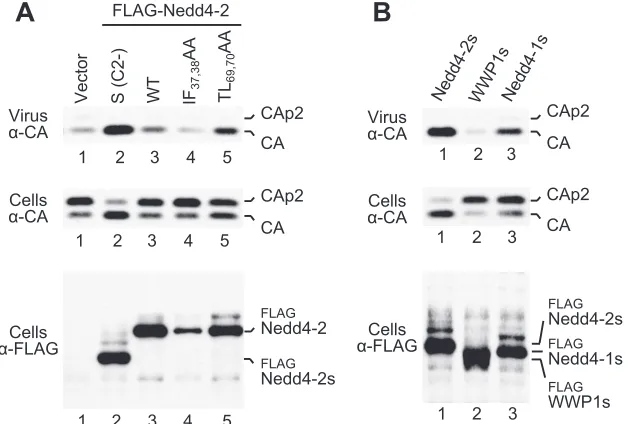
An intact C2 domain interferes with rescue of HIV-1 ⌬PTAPP. A recent study reveals that certain Nedd4 family members, including Smurf2 and Nedd4-1, are autoinhibited through interactions between their C2 and HECT domains (50). Interestingly, full-length Nedd4-2 had a much less robust effect on virus production by HXBH10⌬PTAPPthan Nedd4-2s, even though expression levels were comparable (Fig. 5A, lanes 2 and 3). Furthermore, full-length Nedd4-2 did not at all alle-viate the Gag cleavage defect of the⌬PTAPP mutant, whereas Nedd4-2s largely corrected this defect (Fig. 5A). To explore the possibility that Nedd4-2 is autoinhibited, we introduced two mutations into the C2 domain (IF37,38AA and TL69,70AA) that target conserved residues implicated in intramolecular interactions between the C2 and HECT domains of Smurf2. Equivalent mutations (FF29,30AA and TL56,57AA) have been
shown to relieve the autoinhibition of Smurf2 (50). While the IF37,38AA mutant was poorly expressed, the TL69,70AA mutant
indeed was somewhat more active than WT Nedd4-2 in rescu-ing HXBH10⌬PTAPP(Fig. 5A, lanes 4 and 5). Taken together,
these results are consistent with the notion that the C2 domain of Nedd4-2 confers autoinhibition.
[image:4.585.87.498.68.308.2]Since the presence or absence of an intact C2 domain mark-edly influenced the activity of Nedd4-2 in the⌬PTAPP rescue assay, we also tested the activities of other Nedd4 family mem-bers after deleting the exact portion of the C2 domain that is naturally absent from Nedd4-2s. While WWP1s remained completely inactive in the⌬PTAPP rescue assay (Fig. 5B, lane 2), Nedd4-1s moderately increased particle release but failed to correct Gag processing (lane 3). We thus conclude that the robust activity of Nedd4-2s is a specific property of this partic-ular ubiquitin ligase.
FIG. 2. The effect of Nedd4-2s on HIV-1 budding does not depend on any known L domain. (A) Exogenous Nedd4-2s dramatically enhances the release of mature CA by an HIV-1 mutant lacking all of p6. (B) The effect of Nedd4-2s on VLP release does not depend on NC, MA, or the NTD of CA. ZILp1p6⌬PTAPPis protease positive and encodes a Gag polyprotein identical to WT HIV-1 Gag, except that NC is replaced by a leucine
zipper and the Tsg101 binding site is deleted.⌬8-87/⌬126-277/⌬p6 is protease negative and encodes a minimal assembly-competent Gag molecule that lacks most of MA, all of the NTD, and all of p6.
on November 8, 2019 by guest
http://jvi.asm.org/
Nedd4-2s rescues HIV-1 ⌬PTAPP in the absence of intact WW domains.Nedd4-2 contains four WW domains, which are thought to be responsible for substrate recognition (22). To determine the role of the WW domains in the rescue of HIV-1
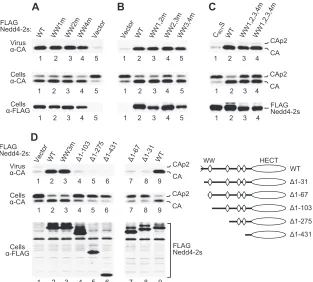
⌬PTAPP, each WW domain of Nedd4-2s was individually dis-rupted by changing a conserved WxxP motif to FxxA. This strategy was based on the observation that these single-amino-acid substitutions are individually sufficient to block ligand binding by the WW domain of Yes-associated protein (7). As shown in Fig. 6A and D, all four WW domains of Nedd4-2s could be individually disrupted without affecting the ability to rescue HXBH10⌬PTAPP. To address the possibility of func-tional redundancy, we also examined the effects of simulta-neously disrupting adjacent WW domains. Again, when the expression levels of the mutants were taken into account, none of the combined mutations tested appeared to affect the activ-ity of Nedd4-2s in the⌬PTAPP assay (Fig. 6B). Therefore, the WxxP-to-FxxA change was introduced into all four WW do-mains simultaneously (WW1,2,3,4m). This led to a slight re-duction in the ability to rescue HXBH10⌬PTAPP, particularly its
Gag cleavage defect (Fig. 6C). However, the WW1,2,3,4m qua-druple mutant was also less well expressed than WT Nedd4-2s. Compared to the C801S active-site mutant (Fig. 6C, lane 1), two independently generated clones of the WW1,2,3,4m qua-druple mutant clearly remained active (lanes 3 and 4). These observations indicate that WW-domain-mediated protein-pro-tein interactions do not play a critical role in the rescue of HIV-1 budding by Nedd4-2s.
Residual C2-domain sequences in Nedd4-2s are essential for the rescue of HIV-1⌬PTAPP.Since all of the WW domains of Nedd4-2s could be altered without eliminating its activity on HIV-1 budding, we examined the effects of N-terminal trun-cations that removed either one (⌬1-103), two (⌬1-275), or all four (⌬1-431) of the WW domains (Fig. 6D). We found that the three truncation mutants were all inactive in the⌬PTAPP rescue assay (Fig. 6D, lanes 4 to 6). Similarly, a less-extensive truncation that removed only residues N-terminal to the first WW domain (⌬1-61) eliminated all activity in this assay (Fig. 6D, lane 7). Thus, the four WW domains together with the HECT domain were not sufficient to induce HIV-1 release. This finding contrasts with the observation that fragments of WWP1 or WWP2 that harbored only the WW and HECT domains retained the ability to induce the release of a murine leukemia virus with an attenuated PPxY-type L domain (30). Although Nedd4-2s lacks an intact C2 domain, it retains the region which forms-strands 7 and 8 of the C2 domain at its very N terminus (50). Interestingly, an N-terminal truncation mutant that lacked only these residues (⌬1-31) showed no ability to induce the budding of HXBH10⌬PTAPP(Fig. 6D, lane 8), indicating that the residual C2 domain sequences in Nedd4-2s are essential for this activity.
Residual C2 domain sequences are required for the associ-ation of Nedd4-2s with VLP.In addition to its function as a phospholipid binding domain, the C2 domain of Nedd4-1 can mediate protein-protein interactions (38). Since our data indi-cated that the effect of Nedd4-2s on budding is specific for HIV-1, we explored the possibility that the residual C2 domain of Nedd4-2s allows the E3 ligase to directly or indirectly
[image:5.585.328.512.66.207.2]asso-FIG. 3. Nedd4-2s overexpression enhances the release of infectious virus by HIV-1 p6 mutants. Infectious virus produced by 293T cells transfected with⌬PTAPP or⌬p6 HIV-1 and empty vector or a vector expressing Nedd4-2s was quantified on TZM-bl indicator cells by mea-suring the induction of-Gal by HIV-1 Tat. Values represent the average from three parallel infections, and error bars correspond to one standard deviation. WT HIV-1 expressed in the absence or pres-ence of exogenous Nedd4-2s yielded 37.7 and 44.3 mU of-Gal ac-tivity, respectively. Virus particle production by the transfected 293T cells was analyzed in parallel by Western blotting.
FIG. 4. Ectopic Nedd4-2s does not rescue particle production by MPMV lacking both PPxY and PSAP L domains. 293T cells were cotransfected with WT or mutant pMPMV and empty vector or the Nedd4-2s expression vector. The PY(⫺) mutant lacks the PPxY motif but retains the PSAP motif, whereas the 2x(⫺) mutant lacks both motifs. Virion- and cell-associated Gag was detected by Western blot-ting with goat anti-p27 serum. The position of CA (p27) and the expected position of uncleaved Gag are indicated.
on November 8, 2019 by guest
http://jvi.asm.org/
[image:5.585.94.226.69.387.2]ciate with HIV-1 Gag. To this end, we used the level of Gag ubiquitination mediated by the ubiquitin ligase as a surrogate marker to assess the extent of contact between Gag and the E3 ligase. Since neither NC nor p6 is required for the stimulation of VLP release by Nedd4-2s, we examined the effect of Nedd4-2s on the ubiquitination of a Gag construct called ZWT, in which NC and p6 are replaced by a heterologous dimeriza-tion domain (1). ZWTGag does not require an L domain (1), and VLP production was thus not expected to be significantly affected by Nedd4-2s, allowing us to compare the effects of active and inactive versions of Nedd4-2s on VLP-associated Gag.
As shown in Fig. 7A, the coexpression of FLAG-Nedd4-2s led to the appearance of a ladder of Gag species in ZWTVLP that migrated slower than the ZWTGag precursor (lane 2). As
expected for Nedd4-2s-induced Gag-ubiquitin conjugates, the additional Gag species were not obtained with the C801S
mu-tant (Fig. 7A, lane 3). Remarkably, the generation of the pu-tative Gag-ubiquitin conjugates was also markedly reduced by the⌬1-61 and⌬1-31 truncations, even though the truncation mutants were well expressed and appeared to remain capable of autoubiquitination (Fig. 7A, lanes 4 and 5; also see Fig. 6D). On the other hand, the WW1,2,3,4m mutant, which remained active in the⌬PTAPP rescue assay, had an effect on the ap-pearance of Gag-ubiquitin conjugates similar to that of WT Nedd4-2s (Fig. 7B).
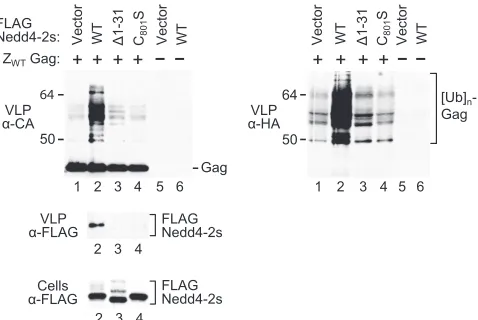
To confirm that the ⌬1-31 truncation interfered with the ubiquitination of ZWT Gag, the ZWT construct was cotrans-fected together with vectors expressing WT or mutant FLAG-Nedd4-2s and HA-ubiquitin. Again, WT but not⌬1-31 FLAG-Nedd4-2s induced the appearance of modified Gag species in ZWTVLP that were recognized by the anti-CA antibody (Fig. 8). These extra Gag species comigrated with ubiquitin
conju-gates detected with the anti-HA antibody, verifying that the Nedd4-2s-induced bands represented Gag-ubiquitin gates (Fig. 8). Importantly, the levels of Gag-ubiquitin conju-gates obtained with the⌬1-31 mutant were only slightly higher than those obtained with the C801S active-site mutant or the
empty vector, confirming that the ⌬1-31 truncation largely prevented the ubiquitination of ZWTGag by Nedd4-2s (Fig. 8).
To obtain more-direct evidence that the removal of residual C2-domain sequences prevented the association of Nedd4-2s with ZWT Gag, we examined the incorporation of FLAG-Nedd4-2s into ZWTVLP. Interestingly, WT FLAG-Nedd4-2s
was readily detectable in VLP, whereas the⌬1-61 and⌬1-31 truncation mutants were not (Fig. 7A and 8). This difference was not attributable to differences in expression, since both truncation mutants were expressed at least as well as WT FLAG-Nedd4-2s (Fig. 7A and 8). Also, the WW1,2,3,4m mu-tation led to higher levels of FLAG-Nedd4-2s in ZWTVLP, in
spite of its negative effect on the expression levels of Nedd4-2s (Fig. 7B). Thus, the incorporation of FLAG-Nedd4-2s required specific determinants in the E3 ligase, pro-viding evidence for a specific association of Nedd4-2s with ZWT
Gag that depends on residual C2-domain sequences but not on intact WW domains.
[image:6.585.137.451.69.281.2]The active-site cysteine of the HECT domain is critical for association of Nedd4-2s with VLP.Recently a novel mode of interaction between Nedd4-1 and a substrate has been de-scribed that does not rely on WW-domain-mediated binding (51). Rather, target recognition is based on an interaction between ubiquitin attached to the E3 ligase and a ubiquitin-binding domain (UBD) of the substrate (51). HIV-1 virions contain substantial amounts of free monoubiquitin, which is unlikely to be derived from Gag-ubiquitin conjugates (34). Thus, it seemed possible that the association of Nedd4-2s with
FIG. 5. Role of the C2 domain in the rescue of HIV-1 budding. (A) Nedd4-2 with an intact C2 domain is poorly active in the⌬PTAPP rescue assay, and activity is moderately enhanced by a mutation designed to relieve an autoinhibitory interaction between the C2 and HECT domains. 293 T cells were cotransfected with HXBH10⌬PTAPPand empty vector (lane 1) or vectors expressing WT Nedd4-2s (lane 2), WT Nedd4-2 (lane
3), IF37,38AA Nedd4-2 (lane 4), or TL69,70AA Nedd4-2 (lane 5).␣-CA, anti-CA;␣-FLAG, anti-FLAG. (B) Nedd4-2s is more active in the⌬PTAPP
rescue assay than equivalent versions of WWP1 or Nedd4-1. 293 T cells were cotransfected with HXBH10⌬PTAPPand Nedd4-2s (lane 1), WWP1s
(lane 2), or Nedd4-1s (lane 3).
on November 8, 2019 by guest
http://jvi.asm.org/
VLP depended on the attachment of ubiquitin to the E3 ligase. In this model, the active-site cysteine of the HECT domain would be expected to be critical for the association, because it is required both for the formation of a thioester bond with ubiquitin and for autoubiquitination. As shown in Fig. 7A and 8, which depict independent experiments, the C801S active-site
mutation inhibited the incorporation of FLAG-Nedd4-2s into ZWTVLP, as predicted by the model.
DISCUSSION
Certain Nedd4 family ubiquitin ligases have previously been implicated in the function of PPxY-type L domains (4). How-ever, HIV-1 release was not expected to be stimulated by any of these ligases, since HIV-1 Gag lacks a PPxY motif. In keeping with this expectation, we find that the overexpression of several Nedd4 family ubiquitin ligases with an intact C2 domain has little or no effect on the processing and release of HIV-1 L-domain mutants. In contrast, as shown here and in the accompanying paper by Sundquist and colleagues (8a), a native isoform of Nedd4-2 that lacks most of the C2 domain largely corrected HIV-1 release defects upon overexpression. The ability of Nedd4-2s to rescue budding by Tsg101-binding-site mutants was comparable to that of ALIX (12, 47), al-though Nedd4-2s was considerably more effective than ALIX in correcting Gag processing defects. Impaired Gag processing is likely to contribute to the several-hundred-fold loss in
infec-FIG. 7. The residual C2 domain and the HECT domain active site but no intact WW domains are required for the association of Nedd4-2s with VLP. (A) N-terminal truncations that remove residual C2-domain sequences or an active-site mutation impair the modifica-tion of an HIV-1 Gag construct by Nedd4-2s and the associamodifica-tion of Nedd4-2s with VLP. 293T cells were cotransfected with the L-domain-independent ZWT Gag construct and WT FLAG-Nedd4-2s or the
indicated mutants. VLP were analyzed by Western blotting with anti-CA (␣-CA) to detect unmodified and modified versions of ZWTGag and
with anti-FLAG (␣-FLAG) to detect VLP-associated Nedd4-2s. The cell lysates were also examined with anti-FLAG. (B) Nedd4-2s retains the ability to modify ZWTGag and to associate with ZWTVLP if all
four WW domains are disrupted.
FIG. 6. The rescue of HIV-1 budding by Nedd4-2s does not require any intact WW domain but depends on residual C2-domain sequences. WW domains can be disrupted individually (A and D) or in pairwise combinations (B) without affecting the activity of Nedd4-2s in the⌬PTAPP rescue assay. (C) The ability of Nedd4-2s to rescue HXBH10⌬PTAPPis only moderately attenuated if all four WW domains are mutated simultaneously.
Two independently generated clones of the quadruple mutant (WW1,2,3,4m) were tested to verify reproducibility. (D) The HECT domain of Nedd4-2s alone (lane 6) or various WW-HECT domain fragments (lanes 4, 5, and 7) are not sufficient for activity in the⌬PTAPP rescue assay, and an N-terminal truncation mutant of Nedd4-2s that lacks only the residual C2 domain is also inactive (lane 8).
on November 8, 2019 by guest
http://jvi.asm.org/
[image:7.585.136.449.67.349.2]tivity caused by the absence of the PTAP L domain, which exceeds the reduction in virus release by at least an order of magnitude.
The effect of ALIX on HIV-1 release requires the presence of the LYPxnL auxiliary L domain in p6 (12, 47). In contrast,
Nedd4-2s proved capable of stimulating HIV-1 budding even in the absence of p6 and thus of all known HIV-1 L domains. Another region of HIV-1 Gag that may function in virus re-lease is the NC domain, because we have recently observed that HIV-1 NC engages the Bro1 domain of ALIX (36). How-ever, Nedd4-2s remained capable of rescuing a PTAPP mutant after the NC domain was replaced by an unrelated oligomer-ization domain. The stimulation of HIV-1 budding by Nedd4-2s also did not depend on the MA domain and NTD of Gag, but we cannot exclude a specific requirement for the C-terminal dimerization domain of CA, which is essential for assembly (5, 10). Indeed, a requirement for a specific determi-nant in HIV-1 is implied by the finding that an MPMV mutant lacking both the PPxY and PSAP L domains was almost com-pletely unresponsive to Nedd4-2s. Interestingly, Nedd4-2s could partially suppress the equally severe budding defect of a mutant that lacked the PPxY L domain but retained the PSAP motif, indicating that Nedd4-2s can potentiate the ability of Tsg101 to function in viral budding. These observations also suggest that Nedd4-2s may act only on Gag proteins that retain at least one auxiliary L domain, which would imply that HIV-1 harbors yet another region involved in virus release that re-mains to be identified.
The ability of Nedd4-2s to correct defects in HIV-1 budding and Gag processing considerably exceeded that of an isoform with an intact C2 domain. Previous studies have shown that the
C2 domain of Nedd4-1 interferes with its ability to downregu-late the epithelial Na⫹channel (24, 40), which suggested that the C2 domain negatively regulates the activity of the ubiquitin ligase. Indeed, it was recently reported that interactions be-tween their C2 and HECT domains autoinhibit C2-WW-HECT-domain E3 ligases, such as Smurf2 and Nedd4-1 (50). However, our data indicate that autoinhibition does not fully explain the relatively low activity of the C2-domain-containing Nedd4-2 isoform in the⌬PTAPP rescue assay.
The Nedd4-2s isoform retains a small portion of the C2 domain at its N terminus, which corresponds to-strands 7 and 8 of the intact domain. This N-terminal region was essential for the rescue of HIV-1 budding by Nedd4-2s, indicating that the C2 domain remnant constitutes a functional domain of the E3 ligase. The C2 domain fragment was also required for the ubiquitination of an HIV-1 Gag construct by Nedd4-2s and for the incorporation of the E3 ligase into VLP. These observa-tions provide evidence for an association with HIV-1 Gag that depends on the residual C2 domain sequences present in the Nedd4-2s isoform. This association does not involve the NC and p6 domains of Gag, because viral particles produced by authentic HIV-1 Gag did not incorporate more Nedd4-2s than VLP formed by a Gag construct that retained only the MA and CAp2 domains (data not shown). Together, our results suggest that the C2 domain remnant was necessary for activity because it was required to bring Nedd4-2s into close contact with Gag. The ability of Nedd4-2s to suppress HIV-1 L-domain defects depends on the active-site cysteine in the HECT domain, in-dicating that the ubiquitination of a substrate protein by the E3 ligase is required. Known substrates for Nedd4 family ubiquitin ligases often contain PPxY motifs, which are recognized by the multiple WW domains of the E3 ligases (22). Alternatively, C2-WW-HECT proteins can employ PPxY-containing adaptor molecules to target substrates that lack interaction sites for their WW domains (22, 26). It has also been suggested that Nedd4-1 WW domains can bind to phosphorylated serine or threonine residues to recognize physiological substrates (28). However, despite the well-documented role of the WW do-mains in substrate recognition, we found that Nedd4-2s re-mains capable of correcting HIV-1 release defects even if all of its four WW domains are disrupted simultaneously.
[image:8.585.45.284.68.228.2]Remarkably, the association of Nedd4-2s with VLP de-pended on the catalytic site in its HECT domain. Since the active-site mutant differed from WT Nedd4-2s merely by the substitution of an oxygen for a sulfur atom, its different behav-ior likely reflects a role for ubiquitin in the incorporation of the E3 ligase. In support of this notion, HIV-1 Gag appears capa-ble of directing the incorporation of ubiquitin, because HIV-1 virions contain free monoubiquitin at about 10% of the amount of Gag (34, 35). Furthermore, although a small amount of Gag becomes monoubiquitinated in the p6 domain, the level of free ubiquitin in virions does not change if the lysines in p6 are mutated (34). The notion of a ubiquitin-mediated interaction with an E3 ligase is not without prece-dent, since it has been demonstrated that ubiquitin attached to Nedd4-1 allows the E3 ligase to functionally interact with the UBD of its substrate, eps15 (51). UBD-ubiquitin interactions are typically of low affinity and transitory (18), which may explain why the UBD-mediated recruitment of Nedd4-1 re-sulted only in the monoubiquitination of eps15 (51). Similarly,
FIG. 8. The removal of residual C2-domain sequences interferes with the ubiquitination of an HIV-1 Gag construct by Nedd4-2s. To detect Gag-ubiquitin conjugates, the ZWTGag construct was
cotrans-fected with an expression vector for HA-tagged ubiquitin (Ub) and empty pBJ5 or the indicated Nedd4-2s expression vectors (lanes 1 to 4). As a negative control, an HIV-1 proviral construct unable to ex-press Gag was cotransfected together with the HA-Ub exex-pression vector and either empty pBJ5 or a version expressing WT Nedd4-2s (lanes 5 and 6, respectively). Two aliquots of each VLP sample were run simultaneously on the same gel and analyzed by Western blotting with either anti-CA (␣-CA) or anti-HA (␣-HA) antibodies. The mi-gration positions of molecular mass markers (in kilodaltons) are indi-cated on the left. The VLP and cell lysates were also analyzed with anti-FLAG antibody to detect Nedd4-2s.
on November 8, 2019 by guest
http://jvi.asm.org/
in the present study the overexpression of Nedd4-2s caused only a limited ubiquitination of Gag.
It remains uncertain whether the ubiquitination of Gag itself plays any role in virus budding. On the one hand, the substi-tution of lysine residues in Gag can have cumulative effects on retrovirus budding, which supports the notion that Gag ubiq-uitination has a function in virus release (16, 41). On the other hand, it has recently been shown that PPxY-type L domains remain functional in the context of a Gag molecule that en-tirely lacks lysine residues or a free N terminus to which ubiq-uitin could be attached (55). An attractive alternative possibil-ity is that the stimulation of HIV-1 budding and Gag processing by Nedd4-2s involves the ubiquitination of a com-ponent of the VPS pathway. For instance, the class E VPS protein Hrs is regulated by monoubiquitination (19), which appears to be mediated by Nedd4-1 (25). Whatever the nature of the target, our results narrow the number of potential can-didates by establishing that WW-domain-mediated interac-tions do not play a role in the activity of Nedd4-2s.
ACKNOWLEDGMENTS
We thank Hans-Georg Kra¨usslich for providing the MPMV expres-sion constructs. The following reagents were obtained through the AIDS Research and Reference Reagent Program, Division of AIDS, NIAID, NIH: saquinavir, HIV-1 p24 monoclonal antibody (183-H12-5C) from Bruce Chesebro and Kathy Wehrly, and TZM-bl from John C. Kappes, Xiaoyun Wu, and Tranzyme Inc.
This work was supported by National Institutes of Health grant AI29873.
REFERENCES
1.Accola, M. A., B. Strack, and H. G. Gottlinger. 2000. Efficient particle production by minimal Gag constructs which retain the carboxy-terminal domain of human immunodeficiency virus type 1 capsid-p2 and a late as-sembly domain. J. Virol.74:5395–5402.
2.Babst, M.2005. A protein’s final ESCRT. Traffic6:2–9.
3.Babst, M., D. J. Katzmann, E. J. Estepa-Sabal, T. Meerloo, and S. D. Emr.
2002. Escrt-III: an endosome-associated heterooligomeric protein complex required for mvb sorting. Dev. Cell3:271–282.
4.Bieniasz, P. D.2006. Late budding domains and host proteins in enveloped virus release. Virology344:55–63.
5.Borsetti, A., A. Ohagen, and H. G. Gottlinger.1998. The C-terminal half of the human immunodeficiency virus type 1 Gag precursor is sufficient for efficient particle assembly. J. Virol.72:9313–9317.
6.Bouamr, F., J. A. Melillo, M. Q. Wang, K. Nagashima, M. de Los Santos, A. Rein, and S. P. Goff.2003. PPPYEPTAP motif is the late domain of human T-cell leukemia virus type 1 Gag and mediates its functional interaction with cellular proteins Nedd4 and Tsg101. J. Virol.77:11882–11895. [Author’s correction,78:4383, 2004.]
7.Chen, H. I., A. Einbond, S. J. Kwak, H. Linn, E. Koepf, S. Peterson, J. W. Kelly, and M. Sudol.1997. Characterization of the WW domain of human yes-associated protein and its polyproline-containing ligands. J. Biol. Chem.
272:17070–17077.
8.Chesebro, B., K. Wehrly, J. Nishio, and S. Perryman.1992. Macrophage-tropic human immunodeficiency virus isolates from different patients exhibit unusual V3 envelope sequence homogeneity in comparison with T-cell-tropic isolates: definition of critical amino acids involved in cell tropism. J. Virol.66:6547–6554.
8a.Chung, H.-Y., E. Morita, U. von Schwedler, B. Mu¨ller, H.-G. Kra¨usslich, and W. I. Sundquist.2008. NEDD4L overexpression rescues the release and infectivity of human immunodeficiency virus type 1 constructs lacking PTAP and YPXL late domains. J. Virol.82:4884–4897.
9.Demirov, D. G., and E. O. Freed.2004. Retrovirus budding. Virus Res.
106:87–102.
10.Dorfman, T., A. Bukovsky, A. Ohagen, S. Hoglund, and H. G. Gottlinger.
1994. Functional domains of the capsid protein of human immunodeficiency virus type 1. J. Virol.68:8180–8187.
11.Dunn, D. M., T. Ishigami, J. Pankow, A. von Niederhausern, J. Alder, S. C. Hunt, M. F. Leppert, J. M. Lalouel, and R. B. Weiss.2002. Common variant of human NEDD4L activates a cryptic splice site to form a frameshifted transcript. J. Hum. Genet.47:665–676.
12.Fisher, R. D., H. Y. Chung, Q. Zhai, H. Robinson, W. I. Sundquist, and C. P.
Hill.2007. Structural and biochemical studies of ALIX/AIP1 and its role in retrovirus budding. Cell128:841–852.
13.Garrus, J. E., U. K. von Schwedler, O. W. Pornillos, S. G. Morham, K. H. Zavitz, H. E. Wang, D. A. Wettstein, K. M. Stray, M. Cote, R. L. Rich, D. G. Myszka, and W. I. Sundquist.2001. Tsg101 and the vacuolar protein sorting pathway are essential for HIV-1 budding. Cell107:55–65.
14.Gottlinger, H. G., T. Dorfman, J. G. Sodroski, and W. A. Haseltine.1991. Effect of mutations affecting the p6 gag protein on human immunodeficiency virus particle release. Proc. Natl. Acad. Sci. USA88:3195–3199.
15.Gottwein, E., J. Bodem, B. Muller, A. Schmechel, H. Zentgraf, and H. G. Krausslich.2003. The Mason-Pfizer monkey virus PPPY and PSAP motifs both contribute to virus release. J. Virol.77:9474–9485.
16.Gottwein, E., S. Jager, A. Habermann, and H. G. Krausslich.2006. Cumu-lative mutations of ubiquitin acceptor sites in human immunodeficiency virus type 1 Gag cause a late budding defect. J. Virol.80:6267–6275.
17.Harty, R. N., M. E. Brown, G. Wang, J. Huibregtse, and F. P. Hayes.2000. A PPxY motif within the VP40 protein of Ebola virus interacts physically and functionally with a ubiquitin ligase: implications for filovirus budding. Proc. Natl. Acad. Sci. USA97:13871–13876.
18.Hicke, L., H. L. Schubert, and C. P. Hill.2005. Ubiquitin-binding domains. Nat. Rev. Mol. Cell Biol.6:610–621.
19.Hoeller, D., N. Crosetto, B. Blagoev, C. Raiborg, R. Tikkanen, S. Wagner, K. Kowanetz, R. Breitling, M. Mann, H. Stenmark, and I. Dikic.2006. Regu-lation of ubiquitin-binding proteins by monoubiquitination. Nat. Cell Biol.
8:163–169.
20.Huang, M., J. M. Orenstein, M. A. Martin, and E. O. Freed.1995. p6Gag is required for particle production from full-length human immunodeficiency virus type 1 molecular clones expressing protease. J. Virol.69:6810–6818. 21.Hurley, J. H., and S. D. Emr.2006. The ESCRT complexes: structure and
mechanism of a membrane-trafficking network. Annu. Rev. Biophys. Bi-omol. Struct.35:277–298.
22.Ingham, R. J., G. Gish, and T. Pawson.2004. The Nedd4 family of E3 ubiquitin ligases: functional diversity within a common modular architecture. Oncogene23:1972–1984.
23.Itani, O. A., J. R. Campbell, J. Herrero, P. M. Snyder, and C. P. Thomas.
2003. Alternate promoters and variable splicing lead to hNedd4-2 isoforms with a C2 domain and varying number of WW domains. Am. J. Physiol. Renal Physiol.285:F916–F929.
24.Kamynina, E., C. Tauxe, and O. Staub.2001. Distinct characteristics of two human Nedd4 proteins with respect to epithelial Na(⫹) channel regulation. Am. J. Physiol. Renal Physiol.281:F469–F477.
25.Katz, M., K. Shtiegman, P. Tal-Or, L. Yakir, Y. Mosesson, D. Harari, Y. Machluf, H. Asao, T. Jovin, K. Sugamura, and Y. Yarden.2002. Ligand-independent degradation of epidermal growth factor receptor involves re-ceptor ubiquitylation and Hgs, an adaptor whose ubiquitin-interacting motif targets ubiquitylation by Nedd4. Traffic3:740–751.
26.Kavsak, P., R. K. Rasmussen, C. G. Causing, S. Bonni, H. Zhu, G. H. Thomsen, and J. L. Wrana.2000. Smad7 binds to Smurf2 to form an E3 ubiquitin ligase that targets the TGF beta receptor for degradation. Mol. Cell6:1365–1375.
27.Kikonyogo, A., F. Bouamr, M. L. Vana, Y. Xiang, A. Aiyar, C. Carter, and J. Leis.2001. Proteins related to the Nedd4 family of ubiquitin protein ligases interact with the L domain of Rous sarcoma virus and are required for gag budding from cells. Proc. Natl. Acad. Sci. USA98:11199–11204. 28.Lu, P. J., X. Z. Zhou, M. Shen, and K. P. Lu.1999. Function of WW domains
as phosphoserine- or phosphothreonine-binding modules. Science283:1325– 1328.
29.Martin-Serrano, J.2007. The role of ubiquitin in retroviral egress. Traffic
8:1297–1303.
30.Martin-Serrano, J., S. W. Eastman, W. Chung, and P. D. Bieniasz.2005. HECT ubiquitin ligases link viral and cellular PPXY motifs to the vacuolar protein-sorting pathway. J. Cell Biol.168:89–101.
31.Martin-Serrano, J., A. Yarovoy, D. Perez-Caballero, and P. D. Bieniasz.
2003. Divergent retroviral late-budding domains recruit vacuolar protein sorting factors by using alternative adaptor proteins. Proc. Natl. Acad. Sci. USA100:12414–12419.
32.Morita, E., and W. I. Sundquist.2004. Retrovirus budding. Annu. Rev. Cell Dev. Biol.20:395–425.
33.Murillas, R., K. S. Simms, S. Hatakeyama, A. M. Weissman, and M. R. Kuehn.2002. Identification of developmentally expressed proteins that func-tionally interact with Nedd4 ubiquitin ligase. J. Biol. Chem.277:2897–2907. 34.Ott, D. E., L. V. Coren, E. N. Chertova, T. D. Gagliardi, and U. Schubert.
2000. Ubiquitination of HIV-1 and MuLV Gag. Virology278:111–121. 35.Ott, D. E., L. V. Coren, T. D. Copeland, B. P. Kane, D. G. Johnson, R. C.
Sowder II, Y. Yoshinaka, S. Oroszlan, L. O. Arthur, and L. E. Henderson.
1998. Ubiquitin is covalently attached to the p6Gagproteins of human im-munodeficiency virus type 1 and simian imim-munodeficiency virus and to the p12Gagprotein of Moloney murine leukemia virus. J. Virol.72:2962–2968. 36.Popov, S., E. Popova, M. Inoue, and H. G. Gottlinger.2008. Human immu-nodeficiency virus type 1 Gag engages the Bro1 domain of ALIX/AIP1 through nucleocapsid. J. Virol.82:1389–1398.
37.Sfakianos, J. N., R. A. LaCasse, and E. Hunter.2003. The M-PMV
on November 8, 2019 by guest
http://jvi.asm.org/
plasmic targeting-retention signal directs nascent Gag polypeptides to a pericentriolar region of the cell. Traffic4:660–670.
38.Shearwin-Whyatt, L., H. E. Dalton, N. Foot, and S. Kumar.2006. Regulation of functional diversity within the Nedd4 family by accessory and adaptor proteins. Bioessays28:617–628.
39.Slagsvold, T., K. Pattni, L. Malerod, and H. Stenmark.2006. Endosomal and non-endosomal functions of ESCRT proteins. Trends Cell Biol.16:317–326. 40.Snyder, P. M., D. R. Olson, F. J. McDonald, and D. B. Bucher.2001. Multiple WW domains, but not the C2 domain, are required for inhibition of the epithelial Na⫹channel by human Nedd4. J. Biol. Chem.276:28321– 28326.
41.Spidel, J. L., R. C. Craven, C. B. Wilson, A. Patnaik, H. Wang, L. M. Mansky, and J. W. Wills.2004. Lysines close to the Rous sarcoma virus late domain critical for budding. J. Virol.78:10606–10616.
42.Strack, B., A. Calistri, M. A. Accola, G. Palu, and H. G. Gottlinger.2000. A role for ubiquitin ligase recruitment in retrovirus release. Proc. Natl. Acad. Sci. USA97:13063–13068.
43.Strack, B., A. Calistri, S. Craig, E. Popova, and H. G. Gottlinger.2003. AIP1/ALIX is a binding partner for HIV-1 p6 and EIAV p9 functioning in virus budding. Cell114:689–699.
44.Strack, B., A. Calistri, and H. G. Gottlinger.2002. Late assembly domain function can exhibit context dependence and involves ubiquitin residues implicated in endocytosis. J. Virol.76:5472–5479.
45.Stuchell-Brereton, M. D., J. J. Skalicky, C. Kieffer, M. A. Karren, S. Ghaf-farian, and W. I. Sundquist. 2007. ESCRT-III recognition by VPS4 ATPases. Nature449:740–744.
46.Umemura, M., T. Ishigami, K. Tamura, M. Sakai, Y. Miyagi, K. Nagahama, I. Aoki, K. Uchino, A. Rohrwasser, J. M. Lalouel, and S. Umemura.2006. Transcriptional diversity and expression of NEDD4L gene in distal nephron. Biochem. Biophys. Res. Commun.339:1129–1137.
47.Usami, Y., S. Popov, and H. G. Gottlinger.2007. Potent rescue of human immunodeficiency virus type 1 late domain mutants by ALIX/AIP1 depends on its CHMP4 binding site. J. Virol.81:6614–6622.
48.VerPlank, L., F. Bouamr, T. J. LaGrassa, B. Agresta, A. Kikonyogo, J. Leis, and C. A. Carter.2001. Tsg101, a homologue of ubiquitin-conjugating (E2) enzymes, binds the L domain in HIV type 1 Pr55(Gag). Proc. Natl. Acad. Sci. USA98:7724–7729.
49.von Schwedler, U. K., M. Stuchell, B. Muller, D. M. Ward, H. Y. Chung, E. Morita, H. E. Wang, T. Davis, G. P. He, D. M. Cimbora, A. Scott, H. G. Krausslich, J. Kaplan, S. G. Morham, and W. I. Sundquist.2003. The protein network of HIV budding. Cell114:701–713.
50.Wiesner, S., A. A. Ogunjimi, H. R. Wang, D. Rotin, F. Sicheri, J. L. Wrana, and J. D. Forman-Kay.2007. Autoinhibition of the HECT-type ubiquitin ligase Smurf2 through its C2 domain. Cell130:651–662.
51.Woelk, T., B. Oldrini, E. Maspero, S. Confalonieri, E. Cavallaro, P. P. Di Fiore, and S. Polo.2006. Molecular mechanisms of coupled monoubiquitin-ation. Nat. Cell Biol.8:1246–1254.
52.Yasuda, J., and E. Hunter.1998. A proline-rich motif (PPPY) in the Gag polyprotein of Mason-Pfizer monkey virus plays a maturation-independent role in virion release. J. Virol.72:4095–4103.
53.Yasuda, J., E. Hunter, M. Nakao, and H. Shida.2002. Functional involve-ment of a novel Nedd4-like ubiquitin ligase on retrovirus budding. EMBO Rep.3:636–640.
54.Zamborlini, A., Y. Usami, S. R. Radoshitzky, E. Popova, G. Palu, and H. Gottlinger.2006. Release of autoinhibition converts ESCRT-III components into potent inhibitors of HIV-1 budding. Proc. Natl. Acad. Sci. USA103:
19140–19145.
55.Zhadina, M., M. O. McClure, M. C. Johnson, and P. D. Bieniasz.2007. Ubiquitin-dependent virus particle budding without viral protein ubiquitin-ation. Proc. Natl. Acad. Sci. USA104:20031–20036.