how big data will
transform higher
education
Emilie Sundorph
William Mosseri-Marlio
Reform
Reform is an independent, non-party think tank whose mission is to set out a better way to deliver public services and economic prosperity. Our aim is to produce research of outstanding quality on the core issues of the economy, health, education, welfare, and criminal justice, and on the right balance between government and the individual. We are determinedly independent and strictly non-party in our approach.
Reform is a registered charity, the Reform Research Trust, charity no.1103739. This publication is the property of the Reform Research Trust.
Acknowledgements
1
The state of higher education
Higher education has expanded at significant speed since the Second World War. In 1950, just 3 per cent of the population went to university – today the figure is approaching 50 per cent.1 With the cap on student numbers removed in 2015, and the Prime Minister
declaring her intention to widen participation further, another bout of expansion is anticipated.2 However, universities face an increasingly challenging climate.
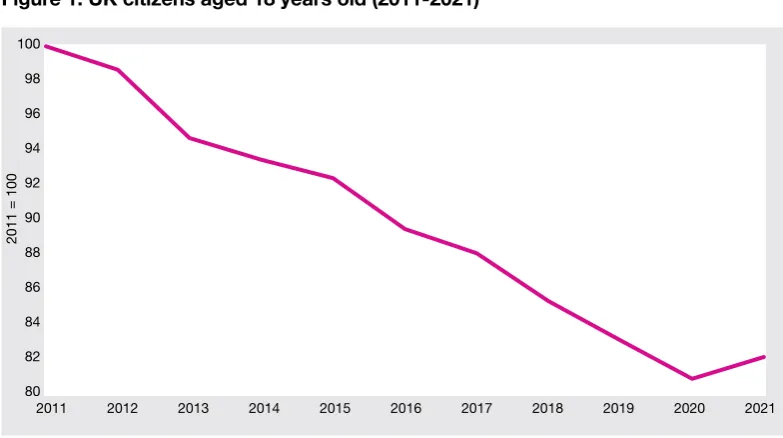
First, higher education institutions are having to fight for a diminishing pool of applicants. Although the proportion of 18-year-olds applying to university is steadily increasing, it is not making up for the narrowing of this age group (see Figure 1).3 Last year, the number of
British university applicants decreased, and a small overall increase in applications was almost exclusively thanks to EU citizens, making the potential consequences of Brexit very tangible.4 Apprenticeships are becoming a more attractive option, with research
suggesting that apprenticeships can lead to higher lifetime earnings than some degrees.5
[image:3.595.175.567.320.539.2]On top of that, university dropout rates have seen their first increase in four years.6
Figure 1: UK citizens aged 18 years old (2011-2021)
2011 = 100
2011 80 82 84 86 88 90 92 94 96 98 100
2012 2013 2014 2015 2016 2017 2018 2019 2020 2021
Source: Office for National Statistics, Population Estimates for UK, England and Wales,
Scotland and Northern Ireland: Mid-2015, 2016
Second, universities are having to work harder to secure their bottom line. With students now paying more for their education, the teaching grant for universities has been cut every year since 2010.7 Meanwhile, the introduction of the Teaching Excellence
Framework (TEF) will ensure that only universities that maintain or improve their outcomes will be able to offset any future grant reductions through higher tuition fees.8 The
Universities Minister Jo Johnson MP has even suggested that poorly performing institutions may have to reduce their fees in the future.9
1 Paul Bolton, Education: Historical Statistics, SN/SG/4252 (House of Commons Library, 2012); Department for Business, Innovation and Skills, Participation Rates in Higher Education: Academic Years 2006 and 2007 to 2013 and 2014
(provisional), 2015.
2 Richard Adams and Sally Weale, ‘Record Number of University Admissions after Cap Lifted’, The Guardian, 13 August 2015; Theresa May, ‘Statement from the New Prime Minister Theresa May’, Speech (13 July 2016).
3 UCAS Analysis and Research, UK Application Rates by the January Deadline, 2016. 4 UCAS, Deadline Applicant Statistics: January, 2016.
5 Philip Kirby, Levels of Success: The Potential of UK Apprenticeships (The Sutton Trust, 2015). 6 Higher Education Statistics Agency, ‘UK Performance Indicators’, Webpage (2016).
7 Higher Education Funding Council for England, ‘Archive of Annual Funding Allocations’, Briefing (2016). 8 House of Commons Business, Innovation and Skills Committee, The Teaching Excellence Framework: Assessing
Quality in Higher Education. Third Report of Session 2015–16, HC 572 (London: The Stationery Office, 2016).
Third, students’ expectations of their university experience are changing. Many students assumed the tripling of tuition fees was a means for universities to supplement, rather than replace, the teaching grant.10 In 2016, only 37 per cent of students agreed that they
were receiving value for money, down from 53 per cent in 2012.11 Globally, students are
also eager for their institutions to adopt a more modern, technological approach – with an underwhelming 13 per cent agreeing they are provided with the appropriate digital tools.12
According to Mike Byrne, Managing Director at Accenture, these challenges constitute “a perfect storm for universities”, and leaves them in need of cost-effective and quality-enhancing innovation.
Analytic teaching
The introduction of new technology in higher education has delivered varying levels of success. A century ago postal courses gave promise of education superior to that offered in “crowded classrooms”, and universities rushed to sign up students.13 Since then, there
has been no lack of ideas, but in many ways universities still function as they did 100 years ago.
Today, reformers see digitisation as the great source of hope. In the private sector,
companies such as Amazon and Netflix have led the way in creating accurate profiles that customise the user’s experience. For universities, a similar opportunity is unfolding. From downloading online resources to entering buildings, students are increasingly leaving a digital footprint that can be accessed by administrators.
Learning analytics matches students’ data trail and background information with their performance.14 At its heart is the desire to comprehend how students interact with
university resources, their learning styles, likely performance, and perhaps most pertinently, how likely they are to complete their studies successfully.15 Students have a
natural interest in course completion, but it is also a top priority for universities – retaining a student demands significantly less resources than recruiting a new one.16
Models identifying students at risk of dropping out with an accuracy of 90 per cent have already been developed, and they are delivering more than just interesting data.17 The
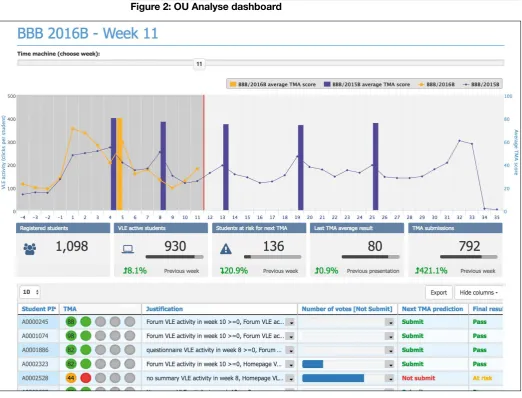
Open University (OU) has piloted a dashboard of indicators to highlight ‘at-risk’ students and overall class engagement (see Figure 2). With access to this information, lecturers can focus their efforts on struggling students and amend course material that has proven ineffective.18 Learning analytics gives them the opportunity to do so in real-time, without
the delay usually associated with student feedback and outcomes.19 A preliminary
evaluation of the pilot has shown retention rates increased by 2.1 per cent on average compared to the previous year.20 Not only will this improve university finances – the higher
retention rates will generate an estimated £1.8 million in additional income for the OU. For students who would have dropped out, a university degree is also likely to mean higher lifetime income and lower unemployment.21
10 House of Commons Business, Innovation and Skills Committee, ‘Oral Evidence: Assessing Quality in Higher Education’, 1 December 2015.
11 Jonathan Neves and Nick Hillman, The 2016 Student Academic Experience Survey (Higher Education Policy Institute and Higher Education Academy, 2016).
12 Accenture, Higher Education Will Never Be the Same! The Digital Demand on Campus - and Beyond, 2015. 13 Nicholas Carr, ‘The Crisis in Higher Education’, MIT Technology Review, 27 September 2012.
14 L. Johnson et al., NMC Horizon Report: 2016 Higher Education Edition (Austin, Texas: The New Media Consortium, 2016).
15 Xanthe Shacklock, From Bricks to Clicks: The Potential of Data and Analytics in Higher Education (Higher Education Committee, 2016).
16 Ibid.
17 Solutionpath, ‘Nottingham Trent University Leads the Way in Learner Analytics’, Case study, 2015; Jakub Kuzilek et al., ‘OU Analyse: Analysing at-Risk Students at The Open University’, Learning Analytics Community Exchange Learning
Analytics Review (March 2015).
18 Bart Rienties et al., ‘Analytics4Action Evaluation Framework: A Review of Evidence-Based Learning Analytics Interventions at the Open University UK’, Journal of Interactive Media in Education, no. 1 (January 2016). 19 Shacklock, From Bricks to Clicks: The Potential of Data and Analytics in Higher Education.
3
Figure 2: OU Analyse dashboard
Source: OU Analyse webpage
With learning analytics also opening up the opportunity to monitor teacher performance, concerns have been voiced over the extent to which faculty will be willing to engage. As John de Pury, Assistant Director of Policy at Universities UK, points out, the successful application of these tools will depend “not only on effective digital leadership, but also on ensuring teaching staff feel part of the development phase.” To reduce this risk, current projects are only looking at student performance, without linking it directly to individual teachers.22 Given the TEF’s explicit emphasis on teaching quality, universities should
eventually seize the opportunity to identify and encourage excellence.
Self-monitoring performance
Other educational institutions have taken the view that students themselves are the best tool for improving performance. Young people entering university now are used to technology tracking most aspects of their lives, from health and sleep quality to moods and spending patterns.23 In light of this ‘datafication’, some universities have created apps
to feed back learning analytics to the learners themselves. A pilot run by Jisc, an
organisation providing digital services to the higher education sector, is being launched in 38 universities by January 2017.24 It includes an app allowing students to set targets,
22 Shacklock, From Bricks to Clicks: The Potential of Data and Analytics in Higher Education.
23 Karen Levy, ‘Intimate Surveillance’, Idaho Law Review 53, no. 3 (2015); Emma Lunn, ‘Take Control of Your Spending with These Budgeting Apps’, The Guardian, 18 June 2016.
compare performance to their cohort and receive alerts if they are displaying ‘at-risk’ behaviour. 25
Although self-monitoring is becoming the norm, providing students with performance data is raising concerns. One American college recognised access to learning analytics may have prompted students to drop out who would not otherwise have failed.26 A study
from the University of Melbourne even suggests that exposing students to their performance data can lead them to lower their ambitions.27
Professor Frank Coton, Vice Principal of Glasgow University, encourages caution in this “land of unintended consequences”, but the combination of student and staff access to performance dashboards has had positive effects. A pilot conducted by Nottingham Trent University found that 27 per cent of students with access to their own dashboard
changed their behaviour – for example, by increasing their attendance – while one third of tutors contacted students as a direct result.28 In a survey of American college students,
just under two thirds of those with access to learning analytics reported that this had either a ‘very positive’ or ‘extremely positive’ impact on their academic performance.29
There are also questions on what data should be used for learning analytics. Some universities exclude demographic information, suggesting students may be demotivated by discovering they are at ‘at-risk’ due to factors beyond their control.30 However, several
institutions have pointed out that learning analytics has helped them identify issues experienced particularly by black and minority ethnic students.31 Leaving out
demographic information may therefore conflict with the Government’s aim to widen participation. The Higher Education Funding Council (HEFCE) has also committed to applying an evidence-based approach to tackle “the key barriers to social mobility in a more targeted way”.32
Niall Sclater, a leading learning analytics consultant, questions decisions to limit the inclusion of information, despite good intentions. “It seems less ethical to me not to include and share all the data available with the student whom it concerns, assuming you want to give that student the best chance of succeeding.”
The future of higher education
Learning analytics has produced promising results, but its application is inconsistent. A survey carried out in 2015 found that 60 per cent of university vice-chancellors rated student data analytics as key to competitiveness, and more than 25 per cent as essential for survival. However, 0 per cent considered the UK a world leader, while 60 per cent recognised important innovations are mainly happening overseas.33
Despite this pessimism, Phil Richards, Chief Innovation Officer at Jisc, thinks widespread application could be close. He compares it to the state of virtual learning environments in the early 2000s, which became the norm “when not implementing them became the risky thing to do.”
25 Niall Sclater, Alice Peasgood, and Joel Mullan, Learning Analytics in Higher Education: A Review of UK and International
Practice (Jisc, 2016)
26 Ibid., 22.
27 Linda Corrin and Paula de Barba, ‘Exploring Students’ Interpretation of Feedback Delivered through Learning Analytics Dashboards’, in Rhetoric and Reality: Critical Perspectives on Educational Technology, Eds. B. Hegarty, J. McDOnald and S. Loke (Dunedin: ascilite proceedings, 2014).
28 Jisc, CASE STUDY I: Predictive Analytics at Nottingham Trent University, 2016.
29 McGraw-Hill Education, ‘Are Learning Analytics the New ‘Likes’? 87% of College Students Perform Better with Access to Personalized Data, New Research Finds’, 28 October 2015.
30 Shacklock, From Bricks to Clicks: The Potential of Data and Analytics in Higher Education; Jisc, CASE STUDY I:
Predictive Analytics at Nottingham Trent University.
31 Shacklock, From Bricks to Clicks: The Potential of Data and Analytics in Higher Education; Sclater, Peasgood, and Mullan, Learning Analytics in Higher Education: A Review of UK and International Practice.
32 Higher Education Funding Council for England, Business Plan 2015-2020, 2015, 5.
5
This moment may be induced by the introduction of the TEF. The proposed metrics (employment/destination, retention and satisfaction) have been criticised for not accurately depicting teaching quality.34 However, an additional learning analytics metric
could be developed.35 This would not only indicate the quality of teaching, but also
universities’ efforts to engage disadvantaged students. The Department for Education should encourage the adaptation of learning analytics by giving universities an appropriate timeframe after which they are required to submit their score on this metric to the TEF. Learning analytics also promises more personalised higher education. The OU is mapping the study and assessment patterns of students to determine which behaviours are more likely to lead to completion.36 In the future, this exercise could support the development of
algorithms that assign resources and tests to students based on their progression to date. These ‘adaptive learning’ techniques have already improved outcomes at American universities. Just two years after implementing adaptive learning software, Arizona State University saw their pass rate for a mathematics readiness course increase from 64 per cent to 75 per cent, while drop-out rates halved.37
Technological innovation will enrich students’ learning experience in other ways. Virtual reality software is enabling more engrossing access to distant places and times, and in healthcare education, robots have been developed to simulate human biology.38
Universities, meanwhile, could use students’ behavioural data to understand when and where resources are most effectively deployed. Mike Byrne predicts that such ‘smart campuses’ can lead to “safer, more cost-effective and more sustainable universities.” A century after postal courses promised to deliver bespoke yet cost-efficient learning, universities are closer to realising this objective than ever before. It is a timely
development, not only because universities need to offer value for money. Today’s students also expect a more personalised learning experience – one that mirrors the service they receive in most other walks of life.
34 House of Commons Business, Innovation and Skills Committee, The Teaching Excellence Framework: Assessing
Quality in Higher Education. Third Report of Session 2015–16.
35 Shacklock, From Bricks to Clicks: The Potential of Data and Analytics in Higher Education.
36 Martin Hlosta et al., ‘Modelling Student Online Behaviour in a Virtual Learning Environment’, Workshop: Machine
Learning and Learning Analytics at Learning Analytics and Knowledge (LAK), 2014.
37 Knewton, ‘Arizona State University’, Webpage (2016).