Abstract: Electric power distribution system plays an vital role in electrical power systems for delivering electricity to end users. Electric Distribution utilities adapted more new techniques in power distribution system to minimize the consumer complaints, outage length and crew response to outages. Traditional fault location detection and isolation methods are time consuming, labour intensive and detrimental to field equipments. The purpose of the automation is to quickly determine the location of faults, isolate them and automatically restore the healthy feeders promptly. Automation of restoration of power supply to healthy network in distribution field allows utilities to implement flexible control of distribution system which can be used to enhance efficiency, reliability and quality of electric service.
I. INTRODUCTION
TANGEDCO (Tamilnadu Generation and Distribution Corporation) is a noteworthy electric Distribution utility serving the Tamilnadu, Southern region of India. TANGEDCO distribute the power supply to Chennai city by more than 100 substations through 1000 nos. of 11 KV feeders. In Chennai city all 11 KV feeders are ring main feeders and if any fault occurs in any one of the location in a feeder, the power supply will be extended to the healthy portion through alternate feeder .This operation is being done manually and it consumes more time to restore supply. Traditional fault location detection and isolation techniques consume more time, labour intensive and detrimental to field equipments. The purpose of the automation is to quickly determine the location of faults, isolate them and automatically restore the healthy feeders promptly. Automation of restoration of power supply to healthy network in distribution field improves the flexibility in distribution system.
This utilizes a rapid fiber-optic communication system to increases its operating speed and fault isolation abilities and also decrease the power restoration time. By utilizing the modern communication technologies permit the UDAS (Underground Distribution Automation System) to acquire the data from distributed Intelligence Electronic Device (IED), process data and enumerate the distribution system with the latest data. This system will do corrective action by sending control signals to operate equipment.
II. SYSTEM DESIGN AND ARCHITECTURE
Existing system blame zone area techniques are monotonous, work heightened, costly, and blocking to deal with equipment. Surprising conditions, for instance, exchanges disillusionments, device definite frustrations, and charge dissatisfactions, are not checked by the present structure which may lead any undesired exercises.
Proposed System completed for speedy blame area, blamed portion separation, and modified organizes reconfiguration to restore organization to non-blamed feeder regions, consequently restricting the amount of affected customers. The proposed structure uses a microcontroller framework to essentially fabricate its working speed and blame isolation limits and also diminish the power recovery time. Making usage of present day trades advancements allows the proposed system to get data from passed on astute electronic contraptions, process data, and separate the most recent state of the flow structure. The proposed structure Artificial Intelligence (AI) settles on all around taught decisions and takes therapeutic exercises by sending control signs to work gear. Prompt Fault Isolation Improved the dependability of their underground dissemination framework. Solid conveyance of electric power for a circled circulation framework with electrically isolated spiral feeders. The framework proficiency is exceedingly enhanced with diminished power interferences and blackout times alongside lower support costs. The contributions of the sensors are given to the microcontroller. The controller investigations the information and act in like manner. The parameters talked about here are voltage and current sensors. In view of the approaching voltage and current the transfers are worked to associate and separate the circuit. The feeder's parameters are constantly checked by the system. The loads are turned ON and OFF dependent on the status of the sensors.
Artificial Intelligent Based Distribution
Automation of Swift Fault Detection Isolation
and Power Restoration for HT Network
Block Diagram
Fig. 1 Block Diagram of the proposed system
Case Study
11KV M.G.R Nagar Feeder
This shows the fault occurred in M.G.R. Nagar feeder. The feeder has the capacity of 11KV. The type of fault occurred and its descriptions are shown below.
Fault type:- insulator flashed/cable
Fault occurred during:-3/07/2018– 13/08/2018 No of times fault occurred - 4
Total time taken to rectify all faults (mts) – 40mints No of consumers - 1500
Total units consumed by consumers- 3000 Average units consumed per minute - 50
Loss occurred for 1 feeder =7000 units*Rs.6.60= Rs.46200 The loss occurred in terms of units was 7000units and cost Rs.46200 per Feeder for 4 Numbers of fault in month. Let us assume Chennai city consists of more than 1000 feeders,
approximately loss due to increased restoration time will be Rs. 4,62,00,000.00/- per hour
11KV Rajakeelpakkam Feeder
This shows the fault occurred in Raja-keelpakkam feeder. The feeder has the capacity of 11KV. The type of fault occurred and its descriptions are shown below.
Fault type - jumper/cable
Fault occurred during - 10/07/2018 – 12/07/2018 No of times fault occurred – 6
Total time taken to rectify all faults (mts) - 241 mints No of consumers –1200
Total units consumed by consumers – 2400 Average units consumed per minute – 40
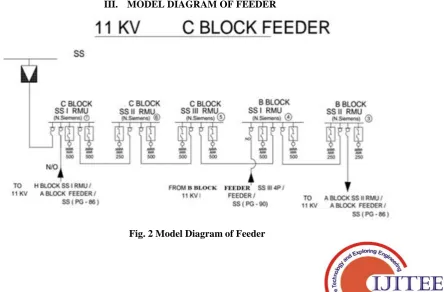
Loss occurred for feeder - 9640 units*Rs.6.60= Rs.63624.00 A model diagram of a 11KV c block feeder is shown below. It displays the outputs to the sub-stations.
[image:2.595.100.545.499.791.2]IV. SIMULATION MODEL
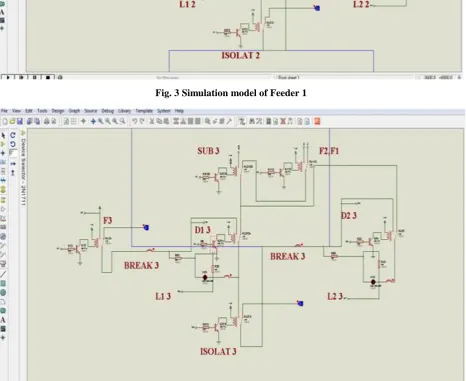
Fig. 3 Simulation model of Feeder 1
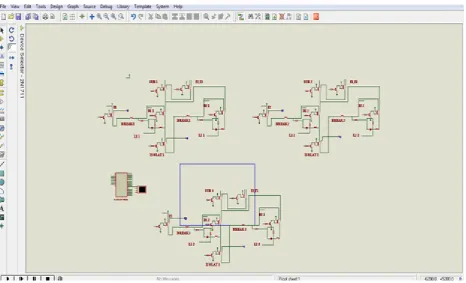
[image:3.595.66.533.250.631.2]Fig. 5 Simulation model Feeders with micro-controller
[image:4.595.68.535.368.651.2]V. SIMULATION RESULTS
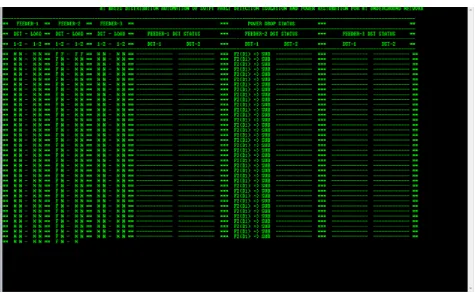
Fig. 7 Simulation Result of the proposed system
[image:5.595.61.537.402.694.2]Hardware Implementation
VI. CONCLUSION
Thus the dark-out conditions occurred due to the entire feeder fault can be overcome by this system. Based on the nature of the loads connected to the feeder, the feeder that attained dark-out condition can be provided a source of the other feeders.
REFERENCES
1. U.S. Department of Energy, “Reliability Improvements From the Application of Distribution Automation Technologies – Initial Results,” December 2012. Available: http://www.smartgrid.gov/library. 2. Dwarakesh.K, A Modified Three Phase Four-Wire Upqc Topology With Reduced Dc-Link Voltage Rating International Journal Of Pure And Applied Mathematics,2018 119 (12), 4365-4379.
3. V Jayalakshmi, Dr.N.O.Gunasekhar “Mitigating voltage SAGS or SWELLS using Z Source AC to AC converter based dynamics voltage restorer,” in International Journal of Applied Engineering Research Volume 9, Number 17 , 2014.
4. S.Prakash & S.Sherine, Improvement of Transient Stability Using AVR, Governor And PSS For A Real Time Industrial System, International Journal of Pure and Applied Mathematics, Volume 116 Issue 18, 2017