Application Web Services
Marlon Pierce, Choonhan Youn, Geoffrey FoxCommunity Grid Labs, Indiana University Bloomington, IN 47404
Introduction
This report gives an overview of web services, with a particular focus on how to deploy and use an application as a web service. This is a work in progress and part of the proposed Application Metadata Working Group [1] and the Grid Computing Environments Research Group [2] of the Global Grid Forum, so revisions and refinement will occur.
An application here means specifically some code developed by the scientific community. Examples would be finite element codes, grid generation codes, and visualization tools. These might be written in Fortran or C, may be parallelized with MPI, and so on. From the point of view of the portal interactions, these details are unimportant in our approach. We will treat all these applications as black boxes and will describe here how to wrap these applications in XML proxies. The wrappers can then be converted into Java data classes for manipulation by services. No modification of the application source code is required. We refer to this as proxy wrapping, as distinguished from the direct service wrapping one might generate with a tool such as SWIG.
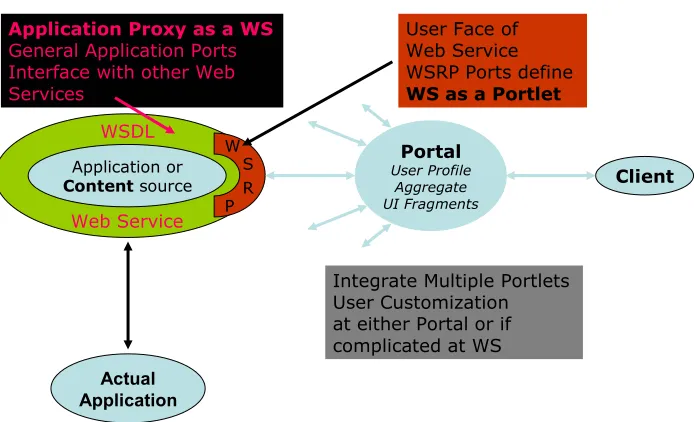
The following figure summarizes our general architecture. An actual application (a scientific code or a database, for example) is wrapped by a Java program. For databases, this is well known: the Java application just makes a JDBC connection to the database and defines and implements an API for clients to interact with the database. Likewise, scientific applications can be wrapped by general purpose Java applications, which can be used to invoke the application, either directly or through submission to a queuing system.
Application or Content source WSDL Web Service S R W P Application Proxy as a WS General Application Ports Interface with other Web Services
User Face of Web Service WSRP Ports define WS as a Portlet
Portal
User Profile Aggregate UI Fragments
Client
Integrate Multiple Portlets User Customization at either Portal or if complicated at WS
[image:2.612.98.445.95.306.2]Actual Application
Figure 1 An overview of the proxy component architecture
Applications services are deployed into a computational web portal, a browser-based system that provides a user interface to applications and various services. A typical web portal allows a user to log in securely to some computing resource, submit jobs, view results, and manage files on the remote resources. The web interface is desirable since it allows the user to potentially log in from anywhere with no software on the client besides the web browser.
We believe the process we introduce here for transforming applications into services is generally applicable to any portal designed to support multiple codes, particularly when the applications to be deployed are not known a priori by the portal developer. To make our arguments concrete, we refer to our computational web portal project, Gateway [3], in many examples.
Message-Based Architectures and Coarse Grained Components
The message-based architecture allows us to incorporate other frameworks, such as security and collaboration, into our architecture. Security is naturally implemented at the message level in a way that can be re-used between multiple web services [5] [6]. Collaboration corresponds to sharing either applications or their state between multiple clients. This again can be largely implemented at message level without detailed application-specific work [7].
Web Service Review
Web services refer to the invocation of remote methods (functions) using an XML-based protocol and method interface definitions. The protocol (usually SOAP [8]) is attached to an HTTP message and contains, for instance, the name of the method and necessary parameters needed to invoke the remote service. The SOAP service is typically deployed as an application in a web server. For example, Apache Axis [9] runs as a Java servlet in an Apache Tomcat server. The method interface (in WSDL [10]) is an agreed-upon set of methods, parameters and return types for a particular service and is implemented in some Web-friendly programming language (such as Java or Python) and can be used as a guideline for writing clients, or it may be used to generate client stubs: classes that can be used locally by a client but that are actually wrappers around SOAP invocation calls to a remote service.
Core Portal Web Services
While it is possible (and in future versions desirable) to write the interface and control portions of an application in a Web-friendly language such as Java or Python, this is typically not the case for most legacy applications. C/C++ and FORTRAN codes can be wrapped inside Python (using SWIG [11]) or Java (using the Java Native Interface, JNI) but this is an invasive procedure that requires access to some application source code, which is often not available.
We therefore do not develop application-specific web services directly with WSDL and SOAP. Instead, we use SOAP and WSDL (along with Java) to develop general purpose core web services that perform the following tasks:
1. Run an arbitrary application on some computer as an external process. Running the application on the same computer as the SOAP server is straightforward. Executing an application on a different machine requires one of the following: a) yet another SOAP server on that second machine, b) some remote shell capability (rsh or ssh), or c) some computational grid technology such as Globus. The latter cases introduce complicated installation and security issues, so for now we will assume that the SOAP service runs on the same machine that will execute the application.
2. Move, copy, rename, delete files on some computer (either directly in Java or else as an external call to Unix commands).
3. Upload, download, or crossload files between computers. Upload/download refers to file transfers between the user’s desktop and some remote destination. Because browsers do not directly support SOAP clients, this is not entirely a web service. Crossload refers to transfers of files between computers using web services. File transfer may be
implemented entirely in Java or may use some external helper application (such as rcp). 4. Generate a batch script request for a particular queuing system, such as PBS.
6. Authenticate and authorize users. This is currently highly dependent on the desired underlying security mechanism (Kerberos or Globus GSI for example).
7. Provide information services. Here the web services are a set of WSDL interfaces that wrap heterogeneous backend information services. These might include general purpose LDAP servers, Globus MDS, XML databases, and UDDI.
To use these services, one needs to develop clients for each service using the WSDL interface. These clients generate SOAP requests to the associated service. A client might typically be a JSP page. SOAP clients and servers can be on the same Tomcat server or on separate servers.
Proxy Service Wrapping versus Direct Service Wrapping
We refer to the above as a proxy wrapper approach. The web service is not actually the application but is instead a proxy that invokes the application. The proxy wrapper is
implemented in a web friendly language that can easily be converted to a web service. We may similarly label the alternate approach of directly interacting with the application as the direct wrapping approach. The advantage of the proxy wrapping approach is that any application or legacy service (such as Kerberos client commands) can be wrapped in this manner. Thus we can define rules (in XML) for describing an arbitrary application. We can then use these rules to define a particular application service, and bind the application service to underlying core portal services. This allows us to build a general purpose framework for working with applications, but sacrifices highly sophisticated interfaces for a particular application.
Alternate Web Service Protocols
“Web Services” are very loosely defined. SOAP services, for example, can be invoked without using WSDL and WSDL method invocations do not need SOAP as the message protocol. There are several instances when the latter is desirable. First, the system might rely on frequent high-performance messaging (relatively small communication-to-execution ratios). This can always be alleviated by increasing the scope of the service to reduce the frequency of communication. Second, the service may only execute infrequently but still be better served by a more appropriate protocol. For example, transferring large datasets requires a service for high-performance file transfer that will need to use some other protocol besides SOAP over HTTP for the actual data transfer, although SOAP may be used for setting up the call to the underlying service (FTP). Thirdly, one may already have a legacy distributed object system that makes use of a protocol such as CORBA’s IIOP. Direct support within WSDL for this protocol is not currently available and would need to be developed. In the interim, protocol bridges between SOAP and IIOP are a relatively simple solution. Finally, one may wish to use a protocol with features not currently found in SOAP. This may include reliable protocols that guarantee once-and-only-once
execution of a service. Again, an interim solution for this is to use SOAP clients and servers to initialize the use of the more feature-rich protocol.
Application Service Lifecycle and XML Descriptors
Applications can exist in four stages, as defined by the Application Metadata Working Group: 1. Application abstraction: a general description of how to run the application (it takes 1
2. Prepared instance: this is a specific instance of the application. A user has provided most or all of the information needed to run an application, but has not yet actually submitted it.
3. Submitted instance: This is job that has been committed to a set of resources (submitted to a queue, for example). Queuing systems represent several additional substates of existence, such as queued, running, sleeping, exiting, and completed.
4. Completed instance: The application has finished and we preserve metadata about it.
The important point here is that all of this can be described by a set of XML descriptions
languages: application descriptions, host descriptions, and queue descriptions. We actually have two sets of XML for each description: one set for stage (1) above, and one set for stages (2)-(4) above. That is, the XML descriptions for (1) describe user options, while the descriptors for (2)-(4) contain a user’s actual choices. We dub the first set of schemas as abstract descriptors and the second set as abstract instances.
The documentation for these schema sets can be found in the appendices. A key feature of our design is to divide things into modular containers. Thus an application descriptor contains one or more host descriptors, which in turn contain queue descriptors. The reason for this is that we want to keep these schemas pluggable. Many groups have developed or are developing extensive schema descriptions of queuing systems, for example, and if we find a better schema then our own, we would like to plug it in. This is straightforward for the queue descriptors, since they don’t contain any other schema, but not straightforward for host descriptors, so in the next iteration we will need to define schema wrappers that encase the external schemas and provide the <anyType> hooks.
Deploying Application Web Services
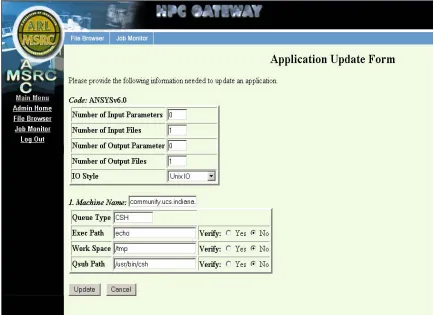
We will first examine the descriptors associated with stage (1). Creating an XML instance of these schemas is done by the person deploying the web service.
Figure 2 HTML forms for deploying an application
The essential idea is that the Application Web Service (AWS) presents an XML interface that can be used to build application clients and is composed of core web service clients. Initially we can think of all of these parts (the XML interface to AWS, the AWS implementation consisting of SOAP clients, the corresponding SOAP services, and the AWS client interface) as all living on a single server, but these pieces can eventually be decoupled and each live on a separate (Tomcat) server.
Initially, portal developers such as the Gateway group develop all parts: the SOAP services and clients, the general Application Web service (consisting of several core web service clients) and the AWS clients in JSP. An application server is then installed on some host resource.
A particular application web service is now ready to be deployed. This amounts to filling in a set of web forms to create an instance of the Application Descriptor XML file (following the schema in Appendix A). The person responsible for making the application into a service just fills in the forms and optionally confirms all of the information. The Application Descriptor is created (or appended to if it already exists) and the service is deployed.
More sophisticated systems can be built. An additional general capability of Web services is that they may be discovered dynamically (through UDDI or similar systems) and may be scripted in a workflow (through WSFL, for example). Thus the next step is that the AWS is initially
decoupled from the specific instances of the core web services that it uses. The AWS is
Using Application Web Services
We described above how to deploy an application web service but not how to use it. A user of an AWS has a separate user interface that is created from the AWS descriptors. These AWS
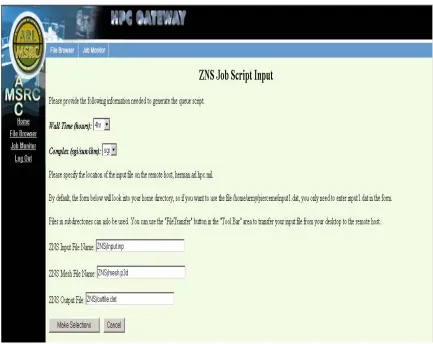
[image:7.612.89.522.201.545.2]descriptors give the user various choices and are used to generate forms needed to collect the information needed to run the code. The user’s particular choices constitute a separate XML document, the Application Instance. This contains all the metadata about a particular invocation of the application (such as the particular input file that was used, the particular set of resources, and so on).
Figure 3 An input form for the application ZNS.
The Application Instance Descriptor (see Appendix D) serves as the guideline for building the user interface. In principal, this can be separated into client and server pieces. The client and server share the Application Instance interface, and the client collects information from the user about the application, which it then passes to the Application Instance server implementation (using SOAP, for example) where the application is invoked. Currently, we do not make this separation: the user interface also handles the application invocation directly.
Portlets and Portals
As we have stated previously, the application web service defines an interface that describes how to create a client for that service. This client may be deployed on the same host computer as the application web service, but this is not required. Instead, the AWS interface definition should be viewed as a way to create clients (and associated user interfaces) on any host computer, just as WSDL defines how to create a client to invoke a remote method.
Previous web portals such as Gateway, as illustrated in Figures 2 and 3, did not distinguish between the code that processes the user interface and code that executes service requests. In the AWS architecture these can be decoupled, with one server responsible for creating and managing the user interface and user interaction. The user interface server implements clients to remote servers, which are invoked through SOAP.
The consequence of this is that user interfaces to both core web services (such as a job monitor or an LDAP browser) and application web services can be developed by a number of different groups, reusing a service deployed on some set of resources. The problem of how to manage all of these interfaces then arises. We believe that the next generation of computational portals will need to aggregate and manage these various user interfaces as components (or “portlets”).
The key idea now is that a computational web portal actually is just a skeleton for holding and managing web interfaces to services, which may be delivered from either local or remote sources. The portal administrator picks the portlets that he or she wishes to make available, and the user customizes his interface to add the selected services. Thus a user may decorate his portal with the user interfaces to the core service “Job Monitoring on Computer A” and to “ANSYS Application Service,” while another user may create a portal out of a completely different set of published user interfaces.
The portlet idea is already being realized by Jetspeed [8], an open source project from Apache. A common Java portlet API is currently being defined by the JSR 168 [9], and WSRP [10] ( Web Services for Remote Portlets) is defining a web services based portlet framework.
References
[1] Application Metadata Working Group Web Site: http://ecs.erc.msstate.edu/AMD-WG/index.jsp.
[2] Grid Computing Environments Working Group Web Site: http://www.computingportals.org/.
[3] Gateway Computational Portal: http://www.gatewayportal.org.
[4] Grid 2002: http://www.grid2002.org
[5] http://www.nwfusion.com/news/2002/0627wssec.html
[6] http://www-106.ibm.com/developerworks/library/ws-secure/
[7] http://www.naradabrokering.org
[9] Apache Axis: http://xml.apache.org/axis/.
[10] Web Service Description Language (WSDL) 1.1: http://www.w3.org/TR/wsdl.
[11] Simple Wrapper Interface Generator (SWIG): http://www.swig.org/
[12] Jetspeed: http://jakarta.apache.org/jetspeed/site/index.html
[13] Portlet API Java Specification Request 168: http://www.jcp.org/jsr/detail/168.jsp
[14] Web Services for Remote Portlets (WSRP): http://www.oasis-open.org/committees/wsrp/
Appendix A: Application Descriptor Schema
Schema Appl.xsd
schema location: C:\castor\ApplDesc\Appl.xsd
targetNamespace: http://grids.ucs.indiana.edu:8005/GCWS/Schema/Appl
Elements Complex types Simple types ApplDesc ApplDescType mechanism
ApplicationType ErrorPortType HostBindingType InputPortType OptionFlagType OutputPortType ParameterType
element ApplDesc
diagram
namespa
ce http://grids.ucs.indiana.edu:8005/GCWS/Schema/Appl type appl:ApplDescType
children Application
complexType ApplDescType
diagram
namespa
ce http://grids.ucs.indiana.edu:8005/GCWS/Schema/Appl children Application
used by element ApplDesc
source
<xsd:complexType name="ApplDescType"> <xsd:sequence>
<xsd:element name="Application" type="appl:ApplicationType" maxOccurs="unbounded"/>
</xsd:sequence> </xsd:complexType>
element ApplDescType/Application
diagram
children ApplicationName Version OptionFlag InputPort OutputPort ErrorPort ApplicationParameter HostBinding
source <maxOccursxsd:element="unbounded"/> name="Application" type="appl:ApplicationType"
complexType ApplicationType
diagram
namespa
ce http://grids.ucs.indiana.edu:8005/GCWS/Schema/Appl
children ApplicationName Version OptionFlag InputPort OutputPort ErrorPort ApplicationParameter HostBinding
used by element ApplDescType/Application
source
<xsd:complexType name="ApplicationType"> <xsd:sequence>
<xsd:element name="ApplicationName" type="xsd:string"/> <xsd:element name="Version" type="xsd:string" minOccurs="0"/>
<xsd:element name="OptionFlag" type="appl:OptionFlagType" minOccurs="0" maxOccurs="unbounded"/>
<xsd:element name="InputPort" type="appl:InputPortType" minOccurs="0" maxOccurs="unbounded"/>
<xsd:element name="OutputPort" type="appl:OutputPortType" minOccurs="0" maxOccurs="unbounded"/>
<xsd:element name="ApplicationParameter" type="appl:ParameterType" minOccurs="0" maxOccurs="unbounded"/>
<xsd:element name="HostBinding" type="appl:HostBindingType"/> </xsd:sequence>
</xsd:complexType>
element ApplicationType/ApplicationName
diagram
type xsd:string
source <xsd:element name="ApplicationName" type="xsd:string"/>
element ApplicationType/Version
diagram
type xsd:string
source <xsd:element name="Version" type="xsd:string" minOccurs="0"/>
element ApplicationType/OptionFlag
diagram
type appl:OptionFlagType children flagName flagValue
element ApplicationType/InputPort
diagram
type appl:InputPortType
children InputHandle InputDescription InputMechanism
source <maxOccursxsd:element="unbounded"/> name="InputPort" type="appl:InputPortType" minOccurs="0"
element ApplicationType/OutputPort
diagram
type appl:OutputPortType
children OutputHandle OutputDescription OutputMechanism
source <maxOccursxsd:element="unbounded"/> name="OutputPort" type="appl:OutputPortType" minOccurs="0"
element ApplicationType/ErrorPort
diagram
children ErrorHandle ErrorDescription ErrorMechanism
source <maxOccursxsd:element="unbounded"/> name="ErrorPort" type="appl:ErrorPortType" minOccurs="0"
element ApplicationType/ApplicationParameter
diagram
type appl:ParameterType children Value
attributes Name Name Type xsd:string Use Default Fixed Annotation
source <minOccursxsd:element="0" name maxOccurs="ApplicationParameter"="unbounded"/> type="appl:ParameterType"
element ApplicationType/HostBinding
diagram
type appl:HostBindingType children HostDesc
source <xsd:element name="HostBinding" type="appl:HostBindingType"/>
complexType ErrorPortType
diagram
namespa
ce http://grids.ucs.indiana.edu:8005/GCWS/Schema/Appl children ErrorHandle ErrorDescription ErrorMechanism
source
<xsd:complexType name="ErrorPortType"> <xsd:sequence>
<xsd:element name="ErrorHandle" type="xsd:string"/> <xsd:element name="ErrorDescription" type="xsd:string"/>
<xsd:element name="ErrorMechanism" type="appl:mechanism"/> </xsd:sequence>
</xsd:complexType>
element ErrorPortType/ErrorHandle
diagram
type xsd:string
source <xsd:element name="ErrorHandle" type="xsd:string"/>
element ErrorPortType/ErrorDescription
diagram
type xsd:string
source <xsd:element name="ErrorDescription" type="xsd:string"/>
element ErrorPortType/ErrorMechanism
diagram
type appl:mechanism
facets enumeration enumeration StandardIO CArgument
source <xsd:element name="ErrorMechanism" type="appl:mechanism"/>
complexType HostBindingType
diagram
namespa
ce http://grids.ucs.indiana.edu:8005/GCWS/Schema/Appl children HostDesc
used by element ApplicationType/HostBinding
<xsd:element name="HostDesc" type="xsd:anyType" maxOccurs="unbounded"/> </xsd:sequence>
</xsd:complexType>
element HostBindingType/HostDesc
diagram
type xsd:anyType
attributes Name Type Use Default Fixed Annotation
source <xsd:element name="HostDesc" type="xsd:anyType" maxOccurs="unbounded"/>
complexType InputPortType
diagram
namespa
ce http://grids.ucs.indiana.edu:8005/GCWS/Schema/Appl children InputHandle InputDescription InputMechanism
used by element ApplicationType/InputPort
source
<xsd:complexType name="InputPortType"> <xsd:sequence>
<xsd:element name="InputHandle" type="xsd:string"/> <xsd:element name="InputDescription" type="xsd:string"/>
<xsd:element name="InputMechanism" type="appl:mechanism"/> </xsd:sequence>
</xsd:complexType>
element InputPortType/InputHandle
diagram
type xsd:string
element InputPortType/InputDescription
diagram
type xsd:string
source <xsd:element name="InputDescription" type="xsd:string"/>
element InputPortType/InputMechanism
diagram
type appl:mechanism
facets enumeration enumeration StandardIO CArgument
source <xsd:element name="InputMechanism" type="appl:mechanism"/>
complexType OptionFlagType
diagram
namespa
ce http://grids.ucs.indiana.edu:8005/GCWS/Schema/Appl children flagName flagValue
used by element ApplicationType/OptionFlag
source
<xsd:complexType name="OptionFlagType"> <xsd:sequence>
<xsd:element name="flagName" type="xsd:string"/>
<xsd:element name="flagValue" type="xsd:boolean" minOccurs="0"/> </xsd:sequence>
</xsd:complexType>
element OptionFlagType/flagName
diagram
type xsd:string
element OptionFlagType/flagValue
diagram
type xsd:boolean
source <xsd:element name="flagValue" type="xsd:boolean" minOccurs="0"/>
complexType OutputPortType
diagram
namespa
ce http://grids.ucs.indiana.edu:8005/GCWS/Schema/Appl children OutputHandle OutputDescription OutputMechanism
used by element ApplicationType/OutputPort
source
<xsd:complexType name="OutputPortType"> <xsd:sequence>
<xsd:element name="OutputHandle" type="xsd:string"/> <xsd:element name="OutputDescription" type="xsd:string"/>
<xsd:element name="OutputMechanism" type="appl:mechanism"/> </xsd:sequence>
</xsd:complexType>
element OutputPortType/OutputHandle
diagram
type xsd:string
source <xsd:element name="OutputHandle" type="xsd:string"/>
element OutputPortType/OutputDescription
diagram
type xsd:string
element OutputPortType/OutputMechanism
diagram
type appl:mechanism
facets enumeration enumeration StandardIO CArgument
source <xsd:element name="OutputMechanism" type="appl:mechanism"/>
complexType ParameterType
diagram
namespa
ce http://grids.ucs.indiana.edu:8005/GCWS/Schema/Appl children Value
used by element ApplicationType/ApplicationParameter
attributes Name Name Type xsd:string Use Default Fixed Annotation
source
<xsd:complexType name="ParameterType"> <xsd:sequence>
<xsd:element name="Value" type="xsd:string"/> </xsd:sequence>
<xsd:attribute name="Name" type="xsd:string"/> </xsd:complexType>
element ParameterType/Value
diagram
type xsd:string
source <xsd:element name="Value" type="xsd:string"/>
simpleType mechanism namespa
ce http://grids.ucs.indiana.edu:8005/GCWS/Schema/Appl type restriction of xsd:string
facets enumeration enumeration StandardIO CArgument
source
<xsd:simpleType name="mechanism"> <xsd:restriction base="xsd:string"> <xsd:enumeration value="StandardIO"/> <xsd:enumeration value="CArgument"/> </xsd:restriction>
</xsd:simpleType>
XML Schema documentation generated with XML Spy Schema Editor www.xmlspy.com
<?xml version="1.0"?>
<!-- edited with XML Spy v4.4 U (http://www.xmlspy.com) by Choonhan Youn (Florida State University) -->
<xsd:schema targetNamespace="http://grids.ucs.indiana.edu:8005/GCWS/Schema/Appl" xmlns:appl="http://grids.ucs.indiana.edu:8005/GCWS/Schema/Appl" xmlns:xsd="http://www.w3.org/2001/XMLSchema"> <xsd:annotation> <xsd:documentation>
This schema is used to describe an application. </xsd:documentation>
</xsd:annotation> <!--
ApplDesc is the root element, with any number of applications. -->
<xsd:element name="ApplDesc" type="appl:ApplDescType"/> <xsd:complexType name="ApplDescType">
<xsd:sequence>
<xsd:element name="Application"
type="appl:ApplicationType" maxOccurs="unbounded"/> </xsd:sequence>
</xsd:complexType> <!--
Each application's info is contained by the tag ApplicationType. Applications have some specific required elements and optionally can be described by additional Parameters. Examples of
parameters would include environmental variables that might need to be set.
-->
<xsd:complexType name="ApplicationType"> <xsd:sequence>
<xsd:element name="ApplicationName"
type="xsd:string"/>
<xsd:element name="Version" type="xsd:string"
minOccurs="0"/>
<xsd:element name="OptionFlag"
type="appl:OptionFlagType" minOccurs="0" maxOccurs="unbounded"/>
<xsd:element name="InputPort"
type="appl:InputPortType" minOccurs="0" maxOccurs="unbounded"/>
<xsd:element name="OutputPort"
<xsd:element name="ErrorPort"
type="appl:ErrorPortType" minOccurs="0" maxOccurs="unbounded"/>
<xsd:element name="ApplicationParameter"
type="appl:ParameterType" minOccurs="0" maxOccurs="unbounded"/>
<xsd:element name="HostBinding"
type="appl:HostBindingType"/> </xsd:sequence> </xsd:complexType> <!--
Code option flags. These might be followed by arguments, depeding on the flag.
-->
<xsd:complexType name="OptionFlagType"> <xsd:sequence>
<xsd:element name="flagName" type="xsd:string"/>
<xsd:element name="flagValue" type="xsd:boolean"
minOccurs="0"/>
</xsd:sequence> </xsd:complexType> <!--
InputPortType is used to describe the input methods (ie a file on local disk).
0 InputHandle is a short name for a particular input type
0 InputDescription is a long description of what type of input is expected (ie an ANSYS Prep7 file). Put instructions to users here.
0 Mechanism is the way that file file takes input (such as by Unix-style standard input with a "<".
-->
<xsd:complexType name="InputPortType"> <xsd:sequence>
<xsd:element name="InputHandle" type="xsd:string"/>
<xsd:element name="InputDescription"
type="xsd:string"/>
<xsd:element name="InputMechanism"
type="appl:mechanism"/>
</xsd:sequence> </xsd:complexType> <!--
OutputPortType is used to describe the output files (ie a file on local disk). You need one of these tags for each
output file the code generates.
0 OutputHandle is a short name for a particular output type
0 OutputDescription is a long description of a particular output file and is application-specific.
-->
<xsd:complexType name="OutputPortType"> <xsd:sequence>
<xsd:element name="OutputHandle" type="xsd:string"/>
<xsd:element name="OutputDescription"
type="xsd:string"/>
<xsd:element name="OutputMechanism"
type="appl:mechanism"/>
</xsd:complexType> <!--
ErrorPortType is used to describe the error files that may be generated.
0 ErrorHandle is a short name for a particular error type
0 ErrorDescription is a long description of what type of error.
-->
<xsd:complexType name="ErrorPortType"> <xsd:sequence>
<xsd:element name="ErrorHandle" type="xsd:string"/>
<xsd:element name="ErrorDescription"
type="xsd:string"/>
<xsd:element name="ErrorMechanism"
type="appl:mechanism"/>
</xsd:sequence> </xsd:complexType>
<xsd:simpleType name="mechanism">
<xsd:restriction base="xsd:string">
<xsd:enumeration value="StandardIO"/>
<xsd:enumeration value="CArgument"/>
</xsd:restriction> </xsd:simpleType>
<!--
ParameterType is used for name/value pairs. -->
<xsd:complexType name="ParameterType"> <xsd:sequence>
<xsd:element name="Value" type="xsd:string"/> </xsd:sequence>
<xsd:attribute name="Name" type="xsd:string"/> </xsd:complexType>
<xsd:complexType name="HostBindingType"> <xsd:sequence>
<xsd:element name="HostDesc" type="xsd:anyType"
maxOccurs="unbounded"/>
</xsd:sequence> </xsd:complexType> </xsd:schema>
Appendix B: Host Descriptor Schema
Schema Host.xsd
schema location: C:\castor\ApplDesc\Host.xsd
targetNamespace: http://grids.ucs.indiana.edu:8005/GCWS/Schema/Host
element HostDesc
diagram
namespa
ce http://grids.ucs.indiana.edu:8005/GCWS/Schema/Host type host:HostDescType
children HostName HostIP WorkDir QueueType QsubPath ExecPath RemoteCopy RemoteExec HostParameter QueueBinding
complexType HostDescType
diagram
namespa
ce http://grids.ucs.indiana.edu:8005/GCWS/Schema/Host
children HostName HostIP WorkDir QueueType QsubPath ExecPath RemoteCopy RemoteExec HostParameter QueueBinding
used by element HostDesc
source
<xsd:complexType name="HostDescType"> <xsd:sequence>
<xsd:element name="HostName" type="xsd:string"/> <xsd:element name="HostIP" type="xsd:string"/> <xsd:element name="WorkDir" type="xsd:string"/> <xsd:element name="QueueType" type="xsd:string"/> <xsd:element name="QsubPath" type="xsd:string"/> <xsd:element name="ExecPath" type="xsd:string"/>
<xsd:element name="RemoteCopy" type="xsd:string" minOccurs="0"/> <xsd:element name="RemoteExec" type="xsd:string" minOccurs="0"/>
<xsd:element name="HostParameter" type="host:ParameterType" minOccurs="0"/> <xsd:element name="QueueBinding" type="host:QueueDescType"/>
element HostDescType/HostName
diagram
type xsd:string
source <xsd:element name="HostName" type="xsd:string"/>
element HostDescType/HostIP
diagram
type xsd:string
source <xsd:element name="HostIP" type="xsd:string"/>
element HostDescType/WorkDir
diagram
type xsd:string
source <xsd:element name="WorkDir" type="xsd:string"/>
element HostDescType/QueueType
diagram
type xsd:string
source <xsd:element name="QueueType" type="xsd:string"/>
element HostDescType/QsubPath
diagram
type xsd:string
source <xsd:element name="QsubPath" type="xsd:string"/>
element HostDescType/ExecPath
diagram
source <xsd:element name="ExecPath" type="xsd:string"/>
element HostDescType/RemoteCopy
diagram
type xsd:string
source <xsd:element name="RemoteCopy" type="xsd:string" minOccurs="0"/>
element HostDescType/RemoteExec
diagram
type xsd:string
source <xsd:element name="RemoteExec" type="xsd:string" minOccurs="0"/>
element HostDescType/HostParameter
diagram
type host:ParameterType children Value
attributes Name Name Type xsd:string Use Default Fixed Annotation
source <xsd:element name="HostParameter" type="host:ParameterType" minOccurs="0"/>
element HostDescType/QueueBinding
diagram
type host:QueueDescType children QueueDesc
complexType ParameterType
diagram
namespa
ce http://grids.ucs.indiana.edu:8005/GCWS/Schema/Host children Value
used by element HostDescType/HostParameter
attributes Name Name Type xsd:string Use Default Fixed Annotation
source
<xsd:complexType name="ParameterType"> <xsd:sequence>
<xsd:element name="Value" type="xsd:string"/> </xsd:sequence>
<xsd:attribute name="Name" type="xsd:string"/> </xsd:complexType>
element ParameterType/Value
diagram
type xsd:string
source <xsd:element name="Value" type="xsd:string"/>
complexType QueueDescType
diagram
namespa
ce http://grids.ucs.indiana.edu:8005/GCWS/Schema/Host children QueueDesc
used by element HostDescType/QueueBinding
source
<xsd:complexType name="QueueDescType"> <xsd:sequence>
<xsd:element name="QueueDesc" type="xsd:anyType" maxOccurs="unbounded"/> </xsd:sequence>
element QueueDescType/QueueDesc
diagram
type xsd:anyType
attributes Name Type Use Default Fixed Annotation
source <xsd:element name="QueueDesc" type="xsd:anyType" maxOccurs="unbounded"/>
XML Schema documentation generated with XML Spy Schema Editor www.xmlspy.com
<?xml version="1.0"?>
<!-- edited with XML Spy v4.4 U (http://www.xmlspy.com) by Choonhan Youn (Florida State University) -->
<xsd:schema
targetNamespace="http://grids.ucs.indiana.edu:8005/GCWS/Schema/Host" xmlns:host="http://grids.ucs.indiana.edu:8005/GCWS/Schema/Host" xmlns:xsd="http://www.w3.org/2001/XMLSchema">
<xsd:annotation>
<xsd:documentation>
This schema describes host machine bindings for applications. </xsd:documentation>
</xsd:annotation> <!--
HostDesc is the root element, with any number of applications. HostDesc contains a description of a host machine. It contains several required fields and can be extended by an arbitrary number of parameters. Optionally, you can provide commands for remote copy and execution (rsh, rcp, globusrun). This must be set up externally.
Hosts also contain one or more bindings for queue execution. This could be a queuing system (PBS, GRD) or it could be
-->
<xsd:element name="HostDesc" type="host:HostDescType"/> <xsd:complexType name="HostDescType">
<xsd:sequence>
<xsd:element name="HostName" type="xsd:string"/> <xsd:element name="HostIP" type="xsd:string"/> <xsd:element name="WorkDir" type="xsd:string"/> <xsd:element name="QueueType" type="xsd:string"/> <xsd:element name="QsubPath" type="xsd:string"/> <xsd:element name="ExecPath" type="xsd:string"/>
<xsd:element name="RemoteCopy" type="xsd:string"
minOccurs="0"/>
<xsd:element name="RemoteExec" type="xsd:string"
<xsd:element name="HostParameter" type="host:ParameterType" minOccurs="0"/>
<xsd:element name="QueueBinding"
type="host:QueueBindingType"/> </xsd:sequence> </xsd:complexType>
<xsd:complexType name="ParameterType"> <xsd:sequence>
<xsd:element name="Value" type="xsd:string"/> </xsd:sequence>
<xsd:attribute name="Name" type="xsd:string"/> </xsd:complexType>
<xsd:complexType name="QueueBindingType"> <xsd:sequence>
<xsd:element name="QueueDesc" type="xsd:anyType"
maxOccurs="unbounded"/>
</xsd:sequence> </xsd:complexType> </xsd:schema>
Appendix C: Queue Descriptor Schema
Schema Queue.xsd
schema location: C:\castor\ApplDesc\Queue.xsd
targetNamespace: http://grids.ucs.indiana.edu:8005/GCWS/Schema/Queue
Elements Complex types QueueDesc EmailOptType
element QueueDesc
diagram
namespa
ce http://grids.ucs.indiana.edu:8005/GCWS/Schema/Queue type queue:QueueDescType
children MemoryOptions JobName NumberOfCPUs Walltime Email QueueOptions AccountOptions QueueParameter
source <xsd:element name="QueueDesc" type="queue:QueueDescType"/>
complexType EmailOptType
diagram
namespa
ce http://grids.ucs.indiana.edu:8005/GCWS/Schema/Queue children JobBeginEmail JobEndEmail JobAbortEmail
used by element QueueDescType/Email
source
<xsd:complexType name="EmailOptType"> <xsd:sequence>
</xsd:sequence> </xsd:complexType>
lement EmailOptType/JobBeginEmail
diagram e
xsd:string type
source <xsd:element name="JobBeginEmail" type="xsd:string" minOccurs="0"/>
lement EmailOptType/JobEndEmail
diagram e
type xsd:string
source <xsd:element name="JobEndEmail" type="xsd:string" minOccurs="0"/>
lement EmailOptType/JobAbortEmail
diagram e
type xsd:string
source <xsd:element name="JobAbortEmail" type="xsd:string" minOccurs="0"/>
omplexType OptionType
diagram c
namespa http://grids.ucs.indiana.edu:8005/GCWS/Schema/Queue
children DirectiveFlag ce
QueueDescType/AccountOption
QueueDescType/MemoryOptions QueueDescType/NumberOfC QueueDescType/QueueOptions QueueDescType/Walltime
xsd:complex
me="DirectiveFlag" type="xsd:string"/> source
< Type name="OptionType"> <xsd:sequence>
<xsd:element na <xsd:choice>
UnspecifiedValue PresetsValue
<xsd:element name="UnspecifiedValue" type="xsd:string"/>
curs="unbounded"/>
>
lement OptionType/DirectiveFlag
diagram
<xsd:element name="PresetsValue" type="xsd:string" maxOc </xsd:choice>
</xsd:sequence> </xsd:complexType
e
type xsd:string
source <xsd:element name="DirectiveFlag" type="xsd:string"/>
lement OptionType/UnspecifiedValue
diagram e
type xsd:string
source <xsd:element name="UnspecifiedValue" type="xsd:string"/>
lement OptionType/PresetsValue
diagram e
type xsd:string
source <xsd:element name="PresetsValue" type="xsd:string" maxOccurs="unbounded"/>
omplexType ParameterType
diagram c
namespa http://grids.ucs.indiana.edu:8005/GCWS/Schema/Queue
children Value ce
er
attributes N ype ng Use Default Fixed Annotation
plexT erType
me="Value" type="xsd:string"/>
e="Name" type="xsd:string"/>
ame T
Name xsd:stri
source
<xsd:com ype name="Paramet "> <xsd:sequence>
<xsd:element na </xsd:sequence> <xsd:attribute nam
</xsd:complexType>
lement ParameterType/Value
diagram e
type xsd:string
source <xsd:element name="Value" type="xsd:string"/>
omplexType QueueDescType
diagram c
namespa http://grids.ucs.indiana.edu:8005/GCWS/Schema/Queue
children MemoryOptions ce
AccountOptions QueueParameter
source <
<xsd:sequence> <xsd:element na
<xsd:element name="JobName" type="queue:OptionType"/> <xsd:element name="NumberOfCPUs" type="queue:OptionTy <xsd:element name="Walltime" type="queue:OptionType"/> <xsd:element name="Email" type="queue:EmailOptType"/> <xsd:element name="QueueOptions" type="queue:OptionTy
<xsd:element name="AccountOptions" type="queue:OptionType" minOccurs="0"/> <xsd:element name="QueueParameter" type="queue:ParameterType"
minOccurs="0"/> </xsd:sequence> </xsd:complexType
JobName NumberOfCPUs Walltime Email QueueOptions
used by element QueueDesc
xsd:complexType name="QueueDescType">
me="MemoryOptions" type="queue:OptionType"/>
pe"/>
pe" minOccurs="0"/>
lement QueueDescType/MemoryOptions
diagram e
dren DirectiveFlag Unspe
source <xsd:element name="MemoryOptions" type="q type queue:OptionType
chil cifiedValue PresetsValue
ueue:OptionType"/>
lement QueueDescType/JobName
diagram e
dren DirectiveFlag Unspe
source <xsd:element name="JobName" type="queue:O type queue:OptionType
chil cifiedValue PresetsValue
ptionType"/>
element QueueDescType/NumberOfCPUs
type queue:OptionType
children DirectiveFlag UnspecifiedValue PresetsValue
source <xsd:element name="NumberOfCPUs" type="queue:OptionType"/>
element QueueDescType/Walltime
diagram
type queue:EmailOptType type queue:OptionType
children DirectiveFlag UnspecifiedValue PresetsValue
source <xsd:element name="Walltime" type="queue:OptionType"/>
element QueueDescType/Email
diagram
children JobBeginEmail JobEndEmail JobAbortEmail
ele
diagram
ment QueueDescType/QueueOptions
urce <xsd:element name
ment QueueDescType/AccountOptions type queue:OptionType
children DirectiveFlag UnspecifiedValue PresetsValue
so ="QueueOptions" type="queue:OptionType" minOccurs="0"/>
ele
diagram
urce <xsd:element name
ment QueueDescType/QueueParameter type queue:OptionType
children DirectiveFlag UnspecifiedValue PresetsValue
so ="AccountOptions" type="queue:OptionType" minOccurs="0"/>
ele
diagram
type
utes
queue:ParameterType children Value
source <mxsd:elements="0" name="QueueParameter" type="queue:ParameterType"
XML Schema documentation generated with XML Spy inOccur />
Schema Editor www.xmlspy.com
?xml version="1.0"?>
!-- edited with XML Spy v4.4 U (http://www.xmlspy.com) by Choonhan
xsd:schema
/grids.ucs.indiana.edu:8005/GCWS/Schema/Queue"
.edu:8005/GCWS/Schema/Queue"> notation>
on a host.
Que ystem
par this schema describes a particular
). Queue systems that need ues not explicitly stated in the
<xsd:element name="MemoryOptions"
"queue:OptionType"/> me="NumberOfCPUs"
ent name="Walltime"
mailOptType"/> ent name="QueueOptions"
ent name="AccountOptions"
>
mory options (ie
xType name="EmailOptType">
:element name="JobBeginEmail" type="xsd:string" s="0"/>
type="xsd:string" <
<
Youn (Florida State University) --> < targetNamespace="http:/ xmlns:xsd="http://www.w3.org/2001/XMLSchema" xmlns:queue="http://grids.ucs.indiana <xsd:an <xsd:documentation>
This schema describes queuing systems </xsd:documentation>
</xsd:annotation> <!--
ueDesc is the root element and describes a queuing s
ameters. An instance of
queuing system (such as PBS additional val
-->
<xsd:element name="QueueDesc" type="queue:QueueDescType"/> <xsd:complexType name="QueueDescType">
<xsd:sequence>
type="queue:OptionType"/>
<xsd:element name="JobName" type=
<xsd:element na
type="queue:OptionType"/> <xsd:elem type="queue:OptionType"/>
<xsd:element name="Email" type="queue:E <xsd:elem
type="queue:OptionType" minOccurs="0"/> <xsd:elem
type="queue:OptionType" minOccurs="0"/>
<xsd:element name="QueueParameter"
type="queue:ParameterType" minOccurs="0"/ </xsd:sequence>
</xsd:complexType> <!--
This allows us to describe the queue's me 1 GB, 4 GB, etc.)
-->
<xsd:comple
<xsd:sequence> <xsd
minOccur
<xsd:element name="JobEndEmail"
<xsd:element name="JobAbortEmail" type="xsd:string" minOccurs="0"/>
</xsd:sequence> </xsd:complexType>
fferent subqueues to be supported (ie default, .
xType name="ParameterType">
Value" type="xsd:string"/> </xsd:sequence> ring"/> ing"/> cifiedValue" d"/> uence> <!--
This allows di
priority, large, medium, small) -->
<xsd:comple
<xsd:sequence>
<xsd:element name="
<xsd:attribute name="Name" type="xsd:st </xsd:complexType>
<xsd:complexType name="OptionType"> <xsd:sequence>
<xsd:element name="DirectiveFlag" type="xsd:str <xsd:choice>
<xsd:element name="Unspe
type="xsd:string"/>
<xsd:element name="PresetsValue"
type="xsd:string" maxOccurs="unbounde </xsd:choice> </xsd:seq
</xsd:complexType> </xsd:schema>
ppendix D: Application Instance Descriptor Schema
chema Applins.xsd
A
S
schema location: C:\castor\ApplDesc\Applins.xsd
targetNamespace: http://grids.ucs.indiana.edu:8005/GCWS/Schema/ApplI
ApplInstance
Elements Complex types Simple types ApplInstanceType mechanism
element ApplInstance
diagram
namespa http://grids.ucs.indiana.edu:8005/GCWS/Schema/ApplI
type appl:ApplInstanceType ce
ApplicationParameter HostBindingInstance
complexType ApplInstanceType
diagram
namespa
ce http://grids.ucs.indiana.edu:8005/GCWS/Schema/ApplI
children ApplicationName Version OptionFlag InputPort OutputPort ErrorPort ApplicationParameter HostBindingInstance
used by element ApplInstance
source
<xsd:complexType name="ApplInstanceType"> <xsd:sequence>
<xsd:element name="ApplicationName" type="xsd:string"/> <xsd:element name="Version" type="xsd:string" minOccurs="0"/>
<xsd:element name="OptionFlag" type="appl:OptionFlagType" minOccurs="0" maxOccurs="unbounded"/>
<xsd:element name="InputPort" type="appl:InputPortType" minOccurs="0" maxOccurs="unbounded"/>
<xsd:element name="OutputPort" type="appl:OutputPortType" minOccurs="0" maxOccurs="unbounded"/>
<xsd:element name="ErrorPort" type="appl:ErrorPortType" minOccurs="0" maxOccurs="unbounded"/>
<xsd:element name="ApplicationParameter" type="appl:ParameterType" minOccurs="0" maxOccurs="unbounded"/>
<xsd:element name="HostBindingInstance" type="appl:HostBindingType"/> </xsd:sequence>
element ApplInstanceType/ApplicationName
diagram
type xsd:string
source <xsd:element name="ApplicationName" type="xsd:string"/>
element ApplInstanceType/Version
diagram
type xsd:string
source <xsd:element name="Version" type="xsd:string" minOccurs="0"/>
element ApplInstanceType/OptionFlag
diagram
type appl:OptionFlagType children flagName flagValue
source <maxOccursxsd:element="unbounded"/> name="OptionFlag" type="appl:OptionFlagType" minOccurs="0"
element ApplInstanceType/InputPort
type appl:InputPortType
children InputHandle InputDescription InputLocation InputMechanism InputServiceBinding
source <maxOccursxsd:element="unbounded"/> name="InputPort" type="appl:InputPortType" minOccurs="0"
element ApplInstanceType/OutputPort
diagram
type appl:OutputPortType
children OutputHandle OutputDescription OutputLocation OutputMechanism OutputServiceBinding
source <maxOccursxsd:element="unbounded"/> name="OutputPort" type="appl:OutputPortType" minOccurs="0"
element ApplInstanceType/ErrorPort
diagram
type appl:ErrorPortType
maxOccurs="unbounded"/>
element ApplInstanceType/ApplicationParameter
diagram
type appl:ParameterType children Value
attributes Name Name Type xsd:string Use Default Fixed Annotation
source <minOccursxsd:element="0" name maxOccurs="ApplicationParameter"="unbounded"/> type="appl:ParameterType"
element ApplInstanceType/HostBindingInstance
diagram
type appl:HostBindingType children HostDescIns
source <xsd:element name="HostBindingInstance" type="appl:HostBindingType"/>
complexType ErrorPortType
diagram
namespa
ce http://grids.ucs.indiana.edu:8005/GCWS/Schema/ApplI
children ErrorHandle ErrorDescription ErrorLocation ErrorMechanism ErrorServiceBinding
source
<xsd:complexType name="ErrorPortType"> <xsd:sequence>
<xsd:element name="ErrorHandle" type="xsd:string"/> <xsd:element name="ErrorDescription" type="xsd:string"/> <xsd:element name="ErrorLocation" type="xsd:anyURI"/>
<xsd:element name="ErrorMechanism" type="appl:mechanism"/>
<xsd:element name="ErrorServiceBinding" type="xsd:string" minOccurs="0"/> </xsd:sequence>
</xsd:complexType>
element ErrorPortType/ErrorHandle
diagram
type xsd:string
source <xsd:element name="ErrorHandle" type="xsd:string"/>
element ErrorPortType/ErrorDescription
diagram
type xsd:string
source <xsd:element name="ErrorDescription" type="xsd:string"/>
element ErrorPortType/ErrorLocation
diagram
type xsd:anyURI
source <xsd:element name="ErrorLocation" type="xsd:anyURI"/>
element ErrorPortType/ErrorMechanism
diagram
type appl:mechanism
facets enumeration enumeration StandardIO CArgument
element ErrorPortType/ErrorServiceBinding
diagram
type xsd:string
source <xsd:element name="ErrorServiceBinding" type="xsd:string" minOccurs="0"/>
complexType HostBindingType
diagram
namespa
ce http://grids.ucs.indiana.edu:8005/GCWS/Schema/ApplI children HostDescIns
used by element ApplInstanceType/HostBindingInstance
source
<xsd:complexType name="HostBindingType"> <xsd:sequence>
<xsd:element name="HostDescIns" type="xsd:anyType"/> </xsd:sequence>
</xsd:complexType>
element HostBindingType/HostDescIns
diagram
type xsd:anyType
attributes Name Type Use Default Fixed Annotation
complexType InputPortType
diagram
namespa
ce http://grids.ucs.indiana.edu:8005/GCWS/Schema/ApplI
children InputHandle InputDescription InputLocation InputMechanism InputServiceBinding
used by element ApplInstanceType/InputPort
source
<xsd:complexType name="InputPortType"> <xsd:sequence>
<xsd:element name="InputHandle" type="xsd:string"/> <xsd:element name="InputDescription" type="xsd:string"/> <xsd:element name="InputLocation" type="xsd:anyURI"/>
<xsd:element name="InputMechanism" type="appl:mechanism"/>
<xsd:element name="InputServiceBinding" type="xsd:string" minOccurs="0"/> </xsd:sequence>
</xsd:complexType>
element InputPortType/InputHandle
diagram
type xsd:string
source <xsd:element name="InputHandle" type="xsd:string"/>
element InputPortType/InputDescription
diagram
type xsd:string
element InputPortType/InputLocation
diagram
type xsd:anyURI
source <xsd:element name="InputLocation" type="xsd:anyURI"/>
element InputPortType/InputMechanism
diagram
type appl:mechanism
facets enumeration enumeration StandardIO CArgument
source <xsd:element name="InputMechanism" type="appl:mechanism"/>
element InputPortType/InputServiceBinding
diagram
type xsd:string
source <xsd:element name="InputServiceBinding" type="xsd:string" minOccurs="0"/>
complexType OptionFlagType
diagram
namespa
ce http://grids.ucs.indiana.edu:8005/GCWS/Schema/ApplI children flagName flagValue
used by element ApplInstanceType/OptionFlag
source
<xsd:complexType name="OptionFlagType"> <xsd:sequence>
<xsd:element name="flagName" type="xsd:string"/>
<xsd:element name="flagValue" type="xsd:string" minOccurs="0"/> </xsd:sequence>
element OptionFlagType/flagName
diagram
type xsd:string
source <xsd:element name="flagName" type="xsd:string"/>
element OptionFlagType/flagValue
diagram
type xsd:string
source <xsd:element name="flagValue" type="xsd:string" minOccurs="0"/>
complexType OutputPortType
diagram
namespa
ce http://grids.ucs.indiana.edu:8005/GCWS/Schema/ApplI
children OutputHandle OutputDescription OutputLocation OutputMechanism OutputServiceBinding
used by element ApplInstanceType/OutputPort
source
<xsd:complexType name="OutputPortType"> <xsd:sequence>
<xsd:element name="OutputHandle" type="xsd:string"/> <xsd:element name="OutputDescription" type="xsd:string"/> <xsd:element name="OutputLocation" type="xsd:anyURI"/>
<xsd:element name="OutputMechanism" type="appl:mechanism"/>
<xsd:element name="OutputServiceBinding" type="xsd:string" minOccurs="0"/> </xsd:sequence>
element OutputPortType/OutputHandle
diagram
type xsd:string
source <xsd:element name="OutputHandle" type="xsd:string"/>
element OutputPortType/OutputDescription
diagram
type xsd:string
source <xsd:element name="OutputDescription" type="xsd:string"/>
element OutputPortType/OutputLocation
diagram
type xsd:anyURI
source <xsd:element name="OutputLocation" type="xsd:anyURI"/>
element OutputPortType/OutputMechanism
diagram
type appl:mechanism
facets enumeration enumeration StandardIO CArgument
source <xsd:element name="OutputMechanism" type="appl:mechanism"/>
element OutputPortType/OutputServiceBinding
diagram
type xsd:string
complexType ParameterType
diagram
namespa
ce http://grids.ucs.indiana.edu:8005/GCWS/Schema/ApplI children Value
used by element ApplInstanceType/ApplicationParameter
attributes Name Name Type xsd:string Use Default Fixed Annotation
source
<xsd:complexType name="ParameterType"> <xsd:sequence>
<xsd:element name="Value" type="xsd:string"/> </xsd:sequence>
<xsd:attribute name="Name" type="xsd:string"/> </xsd:complexType>
element ParameterType/Value
diagram
type xsd:string
source <xsd:element name="Value" type="xsd:string"/>
simpleType mechanism namespa
ce http://grids.ucs.indiana.edu:8005/GCWS/Schema/ApplI type restriction of xsd:string
used by elements ErrorPortType/ErrorMechanism InputPortType/InputMechanism OutputPortType/OutputMechanism facets enumeration enumeration StandardIO CArgument
source
<xsd:simpleType name="mechanism"> <xsd:restriction base="xsd:string"> <xsd:enumeration value="StandardIO"/> <xsd:enumeration value="CArgument"/> </xsd:restriction>
XML Schema documentation generated with XML Spy Schema Editor www.xmlspy.com
<?xml version="1.0"?>
<!-- edited with XML Spy v4.4 U (http://www.xmlspy.com) by Choonhan Youn (Florida State University) -->
<xsd:schema targetNamespace="http://grids.ucs.indiana.edu:8005/GCWS/Schema/ApplI" xmlns:xsd="http://www.w3.org/2001/XMLSchema" xmlns:appl="http://grids.ucs.indiana.edu:8005/GCWS/Schema/ApplI"> <xsd:annotation> <xsd:documentation>
This schema is used to describe an application instance. </xsd:documentation>
</xsd:annotation> <!--
ApplInstance is the root element and describes exactly one application
running on one host. -->
<xsd:element name="ApplInstance" type="appl:ApplInstanceType"/> <!--
Each application's info is contained by the tag ApplicationType. An application instance can have several input and output files, but only binds to one host.
-->
<xsd:complexType name="ApplInstanceType"> <xsd:sequence>
<xsd:element name="ApplicationName"
type="xsd:string"/>
<xsd:element name="Version" type="xsd:string"
minOccurs="0"/>
<xsd:element name="OptionFlag"
type="appl:OptionFlagType" minOccurs="0" maxOccurs="unbounded"/>
<xsd:element name="InputPort"
type="appl:InputPortType" minOccurs="0" maxOccurs="unbounded"/>
<xsd:element name="OutputPort"
type="appl:OutputPortType" minOccurs="0" maxOccurs="unbounded"/>
<xsd:element name="ErrorPort"
type="appl:ErrorPortType" minOccurs="0" maxOccurs="unbounded"/>
<xsd:element name="ApplicationParameter"
type="appl:ParameterType" minOccurs="0" maxOccurs="unbounded"/>
<xsd:element name="HostBindingInstance"
type="appl:HostBindingType"/> </xsd:sequence> </xsd:complexType> <!--
Code option flags. These might be followed by arguments -->
<xsd:complexType name="OptionFlagType"> <xsd:sequence>
<xsd:element name="flagName" type="xsd:string"/>
<xsd:element name="flagValue" type="xsd:string"
</xsd:sequence> </xsd:complexType> <!--
InputPortType is used to describe the input methods (ie a file on local disk).
0 InputHandle is a short name for a particular input type
0 InputInstanceription is a long description of what type of input is expected (ie an ANSYS Prep7 file). Put instructions to users here.
0 InputLocation is a URI that describes where the input file is. If this is other than a local file, you must define
also the service that will perform this function.
0 Input mechanism: this is either Standard Input (with a "<") or
as a C-style command line arguement.
0 InputServiceBinding is a place holder for describing the service you want to use to get the file.
-->
<xsd:complexType name="InputPortType"> <xsd:sequence>
<xsd:element name="InputHandle" type="xsd:string"/>
<xsd:element name="InputDescription"
type="xsd:string"/>
<xsd:element name="InputLocation" type="xsd:anyURI"/>
<xsd:element name="InputMechanism"
type="appl:mechanism"/>
<xsd:element name="InputServiceBinding"
type="xsd:string" minOccurs="0"/> </xsd:sequence> </xsd:complexType> <!--
OutputPortType is used to describe the output files (ie a file on local disk). You need one of these tags for each
output file the code generates.
0 OutputHandle is a short name for a particular output type
0 OutputDescription is a long description of a particular output file and is application-specific.
0 OutputLocation is a URI that describes where the output file is to be written.
0 OutputServiceBinding is a placeholder for the service
you want to move the output files, if other than to local disk.
-->
<xsd:complexType name="OutputPortType"> <xsd:sequence>
<xsd:element name="OutputHandle" type="xsd:string"/>
<xsd:element name="OutputDescription"
type="xsd:string"/>
<xsd:element name="OutputLocation"
type="xsd:anyURI"/>
<xsd:element name="OutputMechanism"
type="appl:mechanism"/>
<xsd:element name="OutputServiceBinding"
type="xsd:string" minOccurs="0"/> </xsd:sequence> </xsd:complexType> <!--