Synergetic openness as a social and technical system
competitiveness parameter
A.N. Danilov1,*, and V.Yu. Stolbov1 1
Perm National Research Polytechnic University, Perm, Russia
Abstract. The article introduces the general system competitiveness function in its business processes. It is assumed that in a small time period competitiveness can be viewed as a scalar function of process parameters that can be represented by system order parameters including its synergetic openness. The general problem of synergetic approach-based system openness management is set, part of which is defining optimum order parameters that improve the system competitiveness with restricted resources available. The article introduces a step-by-step management problem algorithm. Finally, a working example is made of an enterprise planning system openness degree management.
1 Introduction
Let us consider a social and technical systems (STS) class, in which the social component prevails over the technical one and which are managed by various internal and external consumer groups [1,2]. Examples include production, information, and educational systems in which management the human factor is crucial. Defining consumer groups allows aggregation of their interests in solving management problems, e.g. in the form of collective proposals or fuzzy preferences [1, 3].
In the market economy environment, the key STS efficiency criterion is its competitiveness in the commodity and services market, defined by the relation between the quality and the price. Let us assume that a system competitiveness is a function depending on its order parameters. It should be noted that each system is characterized by its set of order parameters in a certain time period. Each order parameter is an aggregating value that defines the desirable system condition or its new system attribute.
We will focus on the order parameters which, in our opinion, are characteristic of any social and technical system. One of those is guaranteed quality, broadly construed within the TQM concept [4] intended to satisfy commodity and service consumers’ requirements satisfaction. Another order parameter is the synergetic openness of a system, understood as the system’s ability to quickly respond to external effects (needs of the society, state, and the market) via innovation organizing and self-organizing mechanisms. Similarly to work [5], we can introduce the system’s synergetic openness degree and denote it by which defines the system’s openness level from 0 to 1. It is to be understood that
effects the system competitiveness non-linearly. In transition to a new social development framework, this
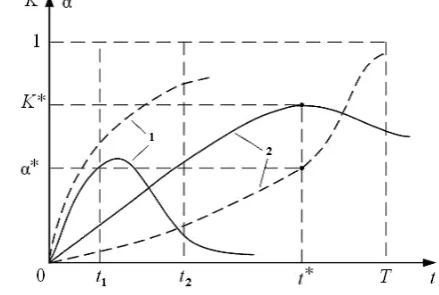
[image:1.595.315.535.543.690.2]non-linearity may be very significant. It seems that the higher is the guaranteed quality and the synergetic openness of a system, the higher is its competitiveness. However, it’s far from always so. For example, as noted in [5, 6], in transition from closed to open system, organization, self-organization, and disorganization processes occur simultaneously. Therefore, if the system openness increases, disorganization process can become predominant, which will result in stability loss and system destruction (pos. 1 in Fig. 1). Alternately, if the synergetic openness grows slowly, the system competitiveness can be dramatically increased by successful structural modernization and adjustment to external effects (pos. 2 in Fig. 1.). In this case, the system acquires new attributes and transits to a new equilibrium state.
Fig. 1.The dependence of system competitiveness (K) and synergetic openness ( – K – .
2 Latest research and publications
overview
Recently, in complex semistructured systems study, the synergetic approach is increasingly widely used, which, unlike the cybernetic approach [7,8], deals with fewer variables known as order parameters. The issue of synergetic approach development is raised in works of I. Prigozhin, I. Stengers, H. Haken, G. Malinetsky, D. Trubetskoy, and other authors [9-12]. In these works, entropy is suggested as a system order strength on the macroscopic modeling level [10]. It is noted that the most challenging issue in using the entropy approach in any STS business process study is the unassessability of a system entropy at different timepoints. However, as shown in V. Shapovalov’s works [5], in open social and technical systems one can measure not the entropy itself, but only a parameter defining the system’s synergetic openness and demonstrating the integrated effect of the environment (entrostat) on the system. Besides, it is shown that at a certain synergetic openness increase rate the system entropy decreases through ordering and self-organization. In other words, it is stated that in a certain probable state range of the system under research its synergetic openness degree can serve as the negentropy measure [13, 14 (including that of information) is useful in terms of the system performance and results in entropy reduction via predominance of self-organization over disorganization processes. Therefore, at certain STS development stages it is reasonable to chose the synergetic openness degree of the system as its order parameter and control its increase rate under reduced system resources allocated to restructuring, reorganization, and the system destruction risks [5,6]. Methods and examples of order parameters management for major production systems with account of human factor are set out in works of Yu. Gorsky [14], issues of education systems mega- and macro-levels modeling are addressed in works of Ye. Solodova, V. Kharitonova et al. [15, 16]. However, these works, from our point of view, are not focused enough on systems openness degree management and the effect of transparency on STS competitiveness in transition to a new social development framework. In view of the aforesaid, this research issue is relevant and requires new efficient algorithms to be developed for solving management problems in social and technical systems in the market economy environment.
3 Management task setting
Let us consider the general task setting for a managing synergetic transparency of a system. The system competitiveness is denoted by K. Then, at the timepoint
t
W , the system competitiveness value within the core activity K(t) can be defined as function F of processes
( )
W as:
K(t) F [ ;t (, t0d dW t], (1)
where ( )W is a business process defining the activity and including the range of key processes (planning, organization, production, marketing, etc.), running in the system during the period concerned.
Constructing certain types of function F for various system types is a complex problem of organizational and technical systems management theory. Therefore, in practice this problem is being simplified in different ways. For example, instead of function (1) functional relation are established between complex factors of competitiveness and key processes parameters.
It is to be noted that in the simplest case, indicators vector values K t( ) at timepoint t is just an analytic
vector function of ( ) process parameters at the same timepoint. Then, it is:
( )
K t f ( ( )). (2)
Let us introduce order parameter vector
1
( ( ),..., n( ))
x x t x t , which in the general case is n-dimensional and describes all processes from the system standpoint during some time period [0, T]. Let us consider that on the given time interval the competitiveness of the system concerned K t( ) is a scalar function as follows:
( ) ( ( ), ( ))
K t f x t x t , where ( )x t dx dt
. (3)
It is evident that each system tends to increase its competitiveness, i. maximum.
However, for a system competitiveness increase resources R are required (material, financial, etc.), which are restricted. Hence, on a certain time period [0, T], each system has to solve the relevant optimization problem with the following mathematical setting:
Find such piecewise continuous functions *
( ) ([0, ]; n)
x KC T R affording a maximum to
competitiveness function
( ( )) max
K K x o (4)
with restricted resources:
* ( ( ))
j j
R x dR , j 1,...,m (5)
and restricted management parameters:
x t( )X , t[0, ]T , (6)
where *
j
R is predefined resource constraints, X is a set of admissible management parameters values.
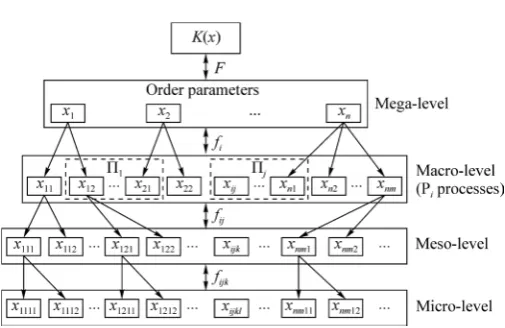
may be very large, which hinders its numerical calculation. Therefore, when using the synergetic modeling methodology for STS development strategy description [15], we distinguish four modeling levels (Fig. 2). The mega-level sets strategic targets for development as a set of system order parameters that define the system development vector according to the global trends in science, education, economy, and the society as a whole under the postnonclassical framework [15].
The system competitiveness may be viewed as some order parameters function. But currently it’s an unsolvable problem to describe this function in an explicit form. At this modeling level, we only can provide a qualitative description to the system progress trends using soft models [17].
For example, such model can be represented by an inequality:
dK
dt >0, t
> @
0,T . (7)This inequality only sets the general trend for the system development. In order to answer the question of how to increase the competitiveness of the system being
studied, we need to know the .
This can be done at the qualitative level by introducing additional hypotheses. Such hypotheses may be as follows:
The given STS order parameters may be introduced on a small time interval [0, T] as scalar continuously differentiable functions of time, which are linearly independent.
1. The system competitiveness may be represented by a function of the form:
0
, , ,
T
K F x f t x t x t§¨ x ·¸dt
© ¹
³
where 1
> @
0, , n
x C T R is an order parameter vector function; f is the prescribed function of 3 arguments.
We can separately study the dependence of the system competitiveness on each order parameter with fixed val
1 , ,ˆ2 ,...,ˆn ,ˆn
K D F D D x x x ,
where F1 is a function defining the system
competitiveness dependence on the synergetic ! " # parameters xˆi, i=2, …, n.
2. There is such a positive increment of a system’s synergetic openness parameter with a restricted increase rate D, with which the system competitiveness
t2 t1 0
D D D
' ! , D t dD t ¬ ¼ªt t1, 2º,
[image:3.595.306.559.102.266.2]that ' K F1
D t2 F1D t1 !0.Fig. 2.Hierarchical levels of social and technical systems modeling.
Using the above hypotheses, we can transit from the soft model (7) to another soft mega-level model as the following inequality set:
> @
0,0, 2, , 0, .
i
d dt dx
i n t T
dt D
!
°° ®
° !
°¯
(8)
The first inequality in the system (8) defines the requirement to the system’s synergetic openness degree increase; other inequalities set the requirements to the non-decrease of the rest system order parameters. The System megamodel in the form of the soft model (8) is the conceptual model of the system progress, that shows its current condition and development trend as strategic goals for a certain time period. The systems management problem solving requires further model detalization and the transition from soft to rigid models at the subsequent modeling levels (Fig. 2).
A social and technical system macro-level model (the level of an industrial enterprise, a major academic institution, a large information system) is to describe order parameters change depending on macroparameters that define the system processes quality. Such parameters may be represented by various aggregated resources (human, material, financial, and others) as well as by different risks (economic, environmental, information, etc.). The key social and technical systems processes may include planning, manufacture, promotion, control, etc.
In setting the macro-level management task, the target functions include order parameters established at the mega-level f modeling, and the management parameters are some macroparameters mainly defining the target functions values. Other macroparameters of the system act as the state parameters or define management tasks.
Find such optimum process
1> @
, 0, , m
T C T R R
u
[ u , in which the function
extremum
20
min
T
J [
³
D u t D dto is attainedunder constraints:
,
t f t u t
D D , t
> @
0,T
t
D dD , t
> @
0,T (9)u t U , t
> @
0,Twhere u are the management parameters
represented by macroparameters x1j, j 1,m; D is the
preset synergetic openness degree value; f is the preset function; Uis the preset range of management parameters values.
The meso-level of an STS behavior modeling considers separate subsystems and processes models with a higher level of state and management parameter detalization. For example, in manufacturing systems such models can be represented by operation planning models, for educational systems – separate program planning and implementation models. The number of state and management parameters in such systems can be hundreds and thousands, which requires development of robust computational methods of such problems solving.
The micro-level of STS modeling considers processes at the level of separate system elements. For example, production planning to the level of setting shift and daily targets to individual worker and loading each piece of equipment, building a model of each subject mastering in course of academic institution activities, etc. it is evident that the number of parameters at this level can reach tens and hundreds million, which makes this problem challenging. Therefore, the synergetic approach normally deals only with macro- and meso-level modeling.
4 Management problem algorithm
As noted above, the main challenge in the proposed management methodology implementation is that the competitiveness function in the system’s synergetic openness is not known explicitly. Therefore, we suggest to decompose the general management problem (4)-(6), # $% parameter at a certain time interval, which are interconnected. In other words, a solution to each of the specific problems should not deteriorate the state parameters of the entire STS at timepoints considered. For example, let us consider the problem of a system’s openness increase at a certain time period. It is obvious that the system’s transparency degree increase at the
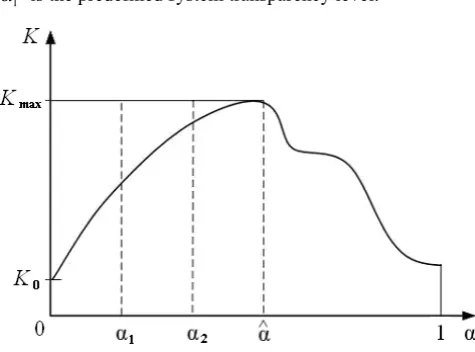
[image:4.595.308.546.495.671.2]However, if the transparency degree increase rate is high enough and the necessary organization and self-organization processes fail to proceed within the system, all product lifecycle processes quality will decrease which will result in the system competitiveness reduction (Fig. 3). Therefore, in case of a system’s transparency degree increase, it is crucial to be able to assess not only its performance indicators, but also evaluate the system quality through the level of key processes organization. As the competitiveness dependence on its transparency degree is not known, we suggest a step-by-step management algorithm. At each step, a certain preset system transparency level is established and the time for reaching this level is defined with account of available enterprise resources and system destruction risks.
Now the general production management process can be converted to the following optimization tasks se-quence.
Find such optimum time *
t , * [0, ]
t T , with which
* min
t o (10)
and the constraints are complied with:
( )t
Dx dDx , t[0, ]T (11)
* ( (.))
j j
R D dR , j 1,...,m (12)
*
0 1
(0) ; ( )t
D D D D . (13)
In this case Dêðèò
x
is the predefined maximum system transparency increase rate; *
j
R is predefined resources;
1
D is the predefined system transparency level.
Fig. 3.The dependence of system competitiveness on its synergetic openness degree.
x choose order parameters x(t) of the system considered and assess them at a certain timepoint which is taken as a start point;
x construct a function describing the system’s synergetic openness degree dependence D on process parameters;
x define necessary resources R*j and synergetic transparency degree increase rate constraint D, which allows changes in the system with through organization and self-organization without the system destruction;
x solve problem (10)-(13) and define time *
t , with which the system’s synergetic openness increased to the preset level;
x assess the system order parameters at *
t .
If other order parameters have not worsened with the new system state defined by the preset degree of its synergetic openness, further transparency increase is possible by solving problem (10)-(13) with a higher predefined D value.
If at least one order parameter has decreased with the new system state defined by the preset degree of its synergetic openness, we need to solve problem (10)–(13) once again with a lower D value or with increased resources for the system upgrade.
5 Working example
Let us consider an example of a problem of synergetic openness management of production planning system of a large-scale manufacturing enterprise working in rapidly changing market conditions and committed to increase its competitiveness.
It is known [18-20] that production planning is a crucial part of production management, in which targets are set and resources are allocated both for the entire production system and for each of its levels (business planning, strategic and tactic planning, operations management). All production planning levels must be consistent with each other. Each level is characterized by a planning horizon Ãi and replanning period Ji (
…4).
Let us introduce a parameter that defines the planning flexibility at each structural level of the production planning system (PPS) [16]:
i
, 1,..., 4
i
i i
Ã
J
E . (14)
A production system functioning quality is deemed to be defined by parameters Ei, = 1,…,4 allocation, which characterize the PPS external effects (consumer requirements) adaptability degree at each hierarchical level.
Note that parameter Ei defines the possible ith production schedule change introduction rate. It is evident that E i [0, 1]. If E i 1, there are no schedule
changes, but if E i 0, the schedule changes nearly #& Ei are to be about equal and consistent with each other (for example,
1 2 3 4
E t E t E t E ); this helps prevent production costs increase as any reduction of parameters Ei results in extra production expenditures.
Any planning system modernization aimed at the system openness increase requires an initial study of the permissible rate of implementation of the process in accordance with available enterprise resources and capabilities of their structural reorganization and self-organization. Therefore, each specific production requires justification of the planning system openness degree by selecting the optimum value D which depends on a large number of parameters that characterize production: the range and scale of production, the type of equipment used, the available production capacity, technology, etc.
To assess the degree of openness D that defines the state of the production system at a given timepoint, the following formula may be suggested:
1 (1 maxi i)
D E E , = 2, 3, 4, (15)
Which shows that the system transparency degree depends on calendar scheduling flexibility in its “narrowest” level. Introduction of factor E1 for business planning level allows taking into account the character of production in assessment of its planning system openness degree.
Given the following initial data defining the studied production system state at a timepoint taken as the start point:
1 3
à years, J 1 1 year, Ã2 1 year, J 2 3 months, Ã3 3 months, J 3 1 week, Ã4 1 week,
4 3
J days.
Using formula (14), we obtain: E1= 1/3; E2= 1/4; E3 = 1/12; E4= 3/7.
Using formula (15), we can assess this PPS openness degree at the timepoint considered: D = 1/3(1–3/7) = 0.19.
It is seen that this PPS, from the system approach standpoint:
1) does not feature parameter consistency (E4 > E3,
4
E > E2), which will inevitably lead to a contradiction between the planning level and its actual implementation, '! # # capacity;
in this case is the bottle-neck of the production management system;
3) the tactic planning system is too flexible, which re-sults in unreasonable material costs.
In order to increase the studied PPS transparency degree to allow a more “flexible” response to customer wishes, let us consider the following problem which is a special case of problem (10)-(13).
Find such optimum planning process
* * 1 4
( ( ), )E T (C [0, ], T R )u R, * [0, ]
T T , in which
*
*
0
min
T
T
³
dto (16)and constraints are complied with: as equality:
1
( ) ( ) (1 max i( ))
i
t t t
D E E , = 2, 3, 4, t[0, ]T (17)
and inequality:
to the synergetic openness degree increase rate
+<?J ( )t
D d D , t[0, ]T , (18)
to resources
* ( ( ))
j j
R D t dR , j 1,...,m, t[0, ]T (19)
and boundary conditions
*
0 1
(0) ; (T )
D D D D
At the start point given some production system characterized by the following PPS parameters: E10= 1/3;
20
E = 1/4; E30= 1/12; E40= 3/7; D0= 0.19.
We need to find the minimum time , sufficient to increase this system transparency degree by 50% with
i
E , i=1,2,3,4 parameters change rate constraintsZ
( ) i, [0, ]
i t t T
x x
E d E , i=1,2,3,4. (20)
Such constraints are related to the enterprise resources, production modernization capacity, etc. Besides, as was noted above, it is desirable that at
parameters Ei, 1, 2, 3, 4 were roughly equal.
Assume that E1( ) (in PPS modernizations targets are not changed). Suppose that the following critical rates of the planning system parameters change are given:
2+<?J 0.028 x
E ; 3+<?J 0.014
x
E ; 4+<?J 0.095
x
E ,
which comply with the enterprise’s capacity in management system modernization by increase of production planning flexibility. In this case, the guaranteed product quality is maintained.
Based on relation (15), the following can be written:
1
( ) max( i( ) ( ( )),i i
x x x
D E E E t[0, ],T i 2, 3, 4
(21)
Supposing the time monotonicity of functions Ei,
2, 3, 4 and taking into consideration constraints (20), from (21) it follows that
+<?J
1
( ) max i ,
i
t
x x
D d E E = 2, 3, 4.
The initial data analysis shows that the maximum
value êðèò
i
x
E is reached with = 4 "
system transparency degree change rate is equal to
1 4êðèò
x x
D E E . Using the initial data, we obtain its value: D 0.031.
Now, entering this value to the expression for the required system transparency parameter value at timepoint T
(D DT ( ) T = 0.19
u
1.5 = 0.285) and using relation0
T T
D D Du , we obtain the minimum time sufficient to increase the system transparency degree to the required value
T
D :
= (0.285 0.19) / 0.031 = 3 (years).
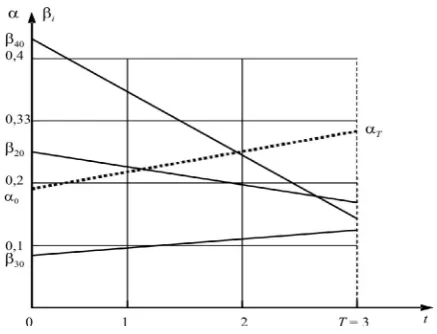
Figure 4 shows the obtained solution to the initial problem. It is seen that in order to obtain the required level of the system transparency parameters E2 and E4
should be reduced and parameter E3 should be increased. Note that with the obtained system openness change rate no destructive processes will occur (owing to compliance with the enterprise resource constraints). In this case, at timepont the PPS parameters will be as follows: E2= 1/6; E3 = 1/8; E4= 1/7, which are close to those approved (Fig. 4).
To reach those parameters, it is enough to reduce J2
to 2 months, value J4 to 1 working day and decrease the planning horizon at tactic level (Ã3) to 2 months.
Note that in this example, upon PPS modernization, the planning “bottle-neck” which previously was at the operations level, is now at the strategic level which defines customer interaction.
produc-changes, and no plan changes will result in stoppage in production or product deterioration.
Fig. 4.A production system transparency degree increase via planning system parameters change.
It should also be noted that the reduction of J4value to 1 business day will require a major restructuring of preproduction and operations management processes. Ensuring planning and production within one working day requires automation of shift-and-day tasks preparation and availability of a modern machine pool with skilled operators. This certainly requires major resource investment in production. However, it ensures dramatic increase in enterprise competitiveness through a more rapid response to the external demands, and the investments made pay off in a relatively short period.
6 Conclusion
Application of the synergetic approach to STS modeling in transition to market relations and rapidly changing external interactions was justified. It was noted that at critical moments of any system it is crucial to be able to predict such situations. This is enabled by synergetics that has given rise to various complex systems non-linear modeling and projection methods. Synergetic modeling is distinguished by the fact that, unlike cybernetic and mathematical models that allow accounting more parameters and effects, synergetic models use one or more so-called system “order parameters” that define its behavior and development. Besides, the idea of model integrity prevails over the idea of its completeness, which simplifies modeling and management of complex systems under consideration.
It was demonstrated that one of the robust STS management mechanisms is increasing its openness through introduction of new external interaction tools, that results in the system’s entropy decrease and its competitiveness improvement. The introduced concept of a system’s synergetic openness allows us to reduce the general open systems management task to managing a specific order parameter; it is demonstrated that increasing this parameter at a certain stage of the system development results in the system ordering, if the increase rate does not exceed a certain critical value that depends on the system’s properties and the nature of its interaction with the environment.
A working example is made to demonstrate synergetic openness management of production planning system of a large-scale manufacturing enterprise with
constraints to resources allocated for production modernization.
References
1. M.B. Gitman, V.Yu. Stolbov, R.L. Gilyazov,
! " #! $%%"&& (LENAND, Moscow, 2011)
2. K.S. Pustovoit, M.B Gitman., V.Yu. Stolbov, J. Actual Problems of Economics, 135, 9, 457-466 (2012)
3. M.V. Gubko,
(LENAND, Moscow, 2006)
4. ^_ ` {| } ~ ^#' _~
Vozhakov,
(The Publishing House of Perm National Research Polytechnic University, Perm, 2011)
5. V.I. Shapovalov,
(Ispo-servis, {!, 2005) 6. _ Danilov, V.Yu. Stolbov, Mechatronics,
Automation, Control, 16, 6, 387-395 (2015)
7. D.A. Novikov,
(LENAND, Moscow, 2016)
8. S. Beer, (The English
University Press, London, 1959)
9. I. Prigozhin, I. Stengers, !
(Librokom Printing House, {!, 2009)
10. H. Haken, " #-$ %
% & # (KomKniga, {scow, 2005)
11. G.G. Malinetsky, '
# (Librokom Printing House, {!, 2009)
12. D.I. Trubetskov, "
({oscow, Editorial URSS, 2004)
13. D.S. Chernavsky, #
( (KomKniga, {!, 2004)
14. { Gorsky, #
(Nauka. Siberian Branch, Novosibirsk, 1988)
15. _ Solodova, )
(Librokom Printing House, {!, 2012)
16. ~_Kharitonova, I.V. Menshikov, ~Sannikova,
(Regular and Chaotic
Dynamics, Izhevsk, 2001)
17. V.I. Arnold, * #
(MCCME, {!, 2000)
18. _Gavrilov, +
MRP-II (SBR, St. Petersburg, 2003) 19. K.S. Pustovoit, M.B. Gitman, V.Yu. Stolbov, J.
Actual Problems of Economics, 8, 440-451 (2012) 20. S.N. Yevstratov, A.V. Vozhakov, V.Yu. Stolbov, J.