International Journal of Innovative Technology and Exploring Engineering (IJITEE) ISSN: 2278-3075,Volume-8 Issue-8S2, June 2019
Published By:
Abstract Background/Objectives: In this paper, we have studied the deep learning channel allocation scheme based on user - patterned big data. It is an adaptive channel capacity management scheme through analysis of user usage pattern, which can allocate the optimal channel compared to existing system. We show that the proposed method can effectively manage users and improve the performance of the whole system. Methods/Statistical analysis: In a typical environment, channels are allocated considering user traffic. However, when a large number of users are gathered, allocation based on the channel capacity is mainly performed without considering the usage pattern of each user. In such a case, traffic usage increases rapidly depending on the usage pattern of the user, causing traffic exceeding the channel capacity, resulting in a problem that the performance of the entire system is greatly degraded. As a solution to this problem, we proposed a deep learning resource allocation scheme that allocates different channels to usage patterns based on user usage pattern big data. Findings: It is confirmed that the network performance degradation due to channel interference does not occur much by allocating a relatively free channel in the channel interference based on the user group information. Also, the proposed system showed relatively uniform network performance compared to the existing system.
Improvements/Applications: The proposed system is applicable to various networks. The number of users per network is rapidly increasing due to the increase of IoT devices, and it is time to manage network resources due to the introduction of many IT convergence technologies. In this environment, we can provide smooth service through the proposed method.
Keywords: Wireless communication, Deep learning, Resource Allocation, Physical Layers, Big data
I. INTRODUCTION
Recently, with the rapid spread of smart devices, IoT devices are also increasing rapidly. Through this fourth industrial revolution, dramatic changes are taking place in our society as a whole. Smart devices and IoT devices are connected to the network anytime, anywhere, and offer numerous services in many areas. The increase in the number of mobile terminals that provide various contents in various fields is an increase in demand for using limited channel resources of the mobile communication network. As the
Revised Manuscript Received on May 23, 2019.
Doohee Han, Department of Electronic Engineering, Kyung Hee University, 1 Seocheon-dong, Giheung-gu, Yongin-si, Gyeonggi-do, 446-701, Republic of Korea
Kyujin Lee, Department of Electronic Engineering, Semyung University, 579, Sinwoul-dong, Jecheon-city,Chungbuk, 390-711, Republic of Korea, * E-mail :[email protected]
number of users on the network grows, various studies are being conducted to efficiently allocate limited channels. When a mobile station requests a call, the exchange assigns a channel to a mobile station belonging to each base station, which is referred to as channel assignment [1]. The channel allocation schemes include a fixed channel allocation scheme, a dynamic channel allocation scheme, and a hybrid channel allocation scheme. The purpose of these channel allocation schemes is to implement a system that can be generally applied regardless of the characteristics of the channel, the characteristics of the base station, the control station, the switching center, and the channel size when the channel is allocated in the general-purpose network[2], [3]. However, existing systems exclude users' traffic priorities, resulting in performance degradation due to packet transmission errors and channel interference. In a typical environment, channels are allocated considering user traffic. However, when a large number of users are gathered, allocation based on the channel capacity is mainly performed without considering the usage pattern of each user. In such a case, traffic usage increases rapidly depending on the usage pattern of the user, causing traffic exceeding the channel capacity, resulting in a problem that the performance of the entire system is greatly degraded [4]. As a solution to this problem, we proposed a deep learning resource allocation scheme that allocates different channels to usage patterns based on user's usage pattern big data. We analyze the usage pattern of users and make big data of them, and set traffic generation group according to usage patterns of users. The group consists of user group 1 that generates the most traffic, user group 2 that causes traffic in the middle level, and user group 3 that causes less traffic. According to the user group, a channel optimized for the entire channel capacity is assigned to the traffic inducing value of each user. It is possible to predict the QoS degradation of the service due to the increase of the traffic of the user after channel allocation by predicting the maximum traffic caused by each user according to the usage pattern. Also, it can provide optimized service to each user based on user big data base. Thus, the efficiency of each channel and the delay due to the channel capacity are minimized, thereby increasing the performance of the system.
II. SYSTEMMODEL
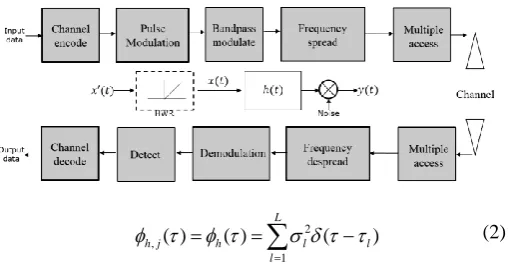
Fig. 1 shows the wireless communication system. The wireless channel model is a
multipath propagation
model. This model features
A Deep Learning Resource Allocation Scheme
for Physical Layers in Communication Systems
changes over time. We also assume a frequency selective fading channel environment. Consider a wideband fixed uncorrelated diffusion channel with L path propagation in a complex equivalent low pass time varying impulse response expressed as:
1 1
1 0
1
( ; ) ( ) ( )
( ) ( ( ))
L
l l
L
l
h t t
t ld
(1)In equation (1), means that stands for the Dirac’s delta
function, 1 denotes the propagation delay. 1( )t has
meaning the path gain or loss factor for the lth path.
1( )t is a Gaussian variable, a mutually independent
complex number with a mean of zero and variance . The delay profile due to the multi-path of the channel is expressed by the following equation (2) [5].
L
l
l l h
j h
1 2
, () () ( )
[image:2.595.37.292.330.470.2] (2)
Fig. 1. System model
A. Fixed Channel Assignment Method
The fixed channel allocation method means that the initially set channel of each interface card does not change according to the network situation. Also, by making the width of the period for allocating the channel large, it means maintaining the allocated channel for a long period of time. The fixed channel allocation scheme can be divided into two more details. The first is the common channel assignment method. That is, the same channel is set in the interface card of each node. For example, if there are two interface cards in each node, then two channels are assigned to the two interface cards. This method has an advantage of solving the problem of inter-node connectivity, which is a problem in the method of assigning a channel to each node by link in the past. On the other hand, it is no different than simply setting up two common multi-hop networks. The second is a method of assigning different channels to each interface card of each node. That is, it refers to a method of allocating different channels according to a link. In this method, since the channel interference between neighboring nodes is reduced, the two nodes can communicate at the same time without being affected by channel interference. However, if the
channel is not properly assigned to the interface card, the network may be disconnected. Since the fixed channel allocation method does not request information transmission between nodes, there is an advantage that overhead between nodes is not generated. On the other hand, since the channel allocation initially used is fixed, channel change according to the state of the network is not performed. This means that a certain portion of the network's link is always overloaded [6], [7].
B. Dynamic Channel Assignment Method
The dynamic channel allocation method is a method of allocating different channels to each node periodically according to the network situation. In order to communicate between two nodes, it is necessary to use the same channel, so a mechanism for adjusting a separate channel is required. The advantage of the flexible channel allocation method is that it is possible to use many channels because it is possible to change the channel in a fluid manner, which has the advantage that the channel having the least interference among neighboring nodes can be changed flexibly. However, since it is necessary to have the same channel for inter-node communication, a channel allocation algorithm for how to assign a channel to each node is an important research field. If a proper channel assignment is not made to a node with a flexible channel assignment algorithm, serious network connectivity problems will arise. Various studies have been conducted to solve these problems.
C. Hybrid Channel Assignment Method
The hybrid channel allocation method is a method of using the above-mentioned fixed channel allocation method and the flow channel allocation method together. It is a method to allocate fixed channel to some interface card of each node and to make flexible channel allocation to other interface card. In the hybrid channel assignment method, the fixed channel assignment has two methods of assigning the common channel allocation mentioned in Section A and the different channels for each node. By assigning a common channel to a fixed channel, it is possible to solve the problem that can not guarantee the connectivity, which was presented as a problem of the conventional flow channel allocation method, and it has an advantage that it can be expressed through a simple algorithm. It is a method to allocate different channels to the fixed channel interface of each node. In this method, when data is transmitted in the order of node C-A-B, node C changes its changeable interface card to a fixed channel of node A, node A receives data from node C, The interface card is changed to a fixed channel of the node B and then the data is transmitted. In this way, the problem caused in the fixed channel allocation method and the flow channel allocation method can be solved. However, since there is no problem in unicast transmission, since the channels of the fixed interface card are different from each other in the broadcast data transmission, the channel change delay time is considerably
International Journal of Innovative Technology and Exploring Engineering (IJITEE) ISSN: 2278-3075,Volume-8 Issue-8S2, June 2019
Published By: III. PROPOSEDSYSTEMMODEL
Fig. 2 shows the channel assignment in a typical system. In a typical environment, channels are allocated considering user traffic. However, when a large number of users are gathered, allocation based on the channel capacity is mainly
performed without considering the usage pattern of each user. In this case, when the traffic usage increases rapidly according to the usage pattern of the user, traffic exceeding the channel capacity is generated as shown in (c). As a solution to this problem, we proposed a deep learning resource allocation scheme that allocates different channels to usage patterns based on user usage pattern big data.
Fig. 2. General system model
A. Deep Learning Resource Allocation Scheme for Physical Layers
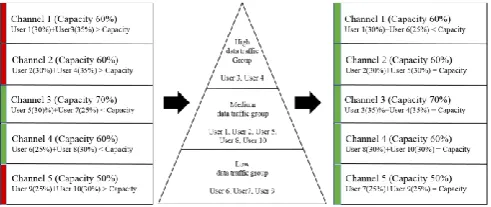
[image:3.595.45.290.122.235.2]The proposed system is shown in Fig. 3. The existing system allocates the channel of the system considering only the current traffic of the user. However, the traffic of the data used by the user changes in real time according to the usage pattern of the user. However, real-time tracking and channel allocation of such traffic changes the complexity of the system, and as the number of users increases, real-time tracking becomes difficult. We analyzed the usage patterns of users and made them big data sets traffic generation group according to usage patterns of users. The group consists of user group 1 that generates the most traffic, user group 2 that causes traffic in the middle level, and user group 3 that causes less traffic. According to the user group, the traffic inducement value of each user is expressed as P% of the total channel capacity. Also, the channel capacity was considered to accommodate N% compared to 100%. If P% > N%, more user traffic occurs than the channel capacity, which degrades the performance of the system. The channel 1 information in Figure 3 shows the channel capacity N% = 60%. However, the maximum usage amount Max P% = 65%, which User 1 and User 3 allocated to channel 1 can cause according to the usage pattern, exceeds the channel capacity of channel 1.
Based on the usage patterns of these users, we created a pyramid-shaped user traffic group according to Max P%. As a result, users are distributed according to the capacity N% of
each channel as shown in the right figure, so that Max P% <N%. Thus, the efficiency of each channel and the delay due to the channel capacity are minimized, thereby increasing the performance of the system.
Fig. 3. Proposed System model
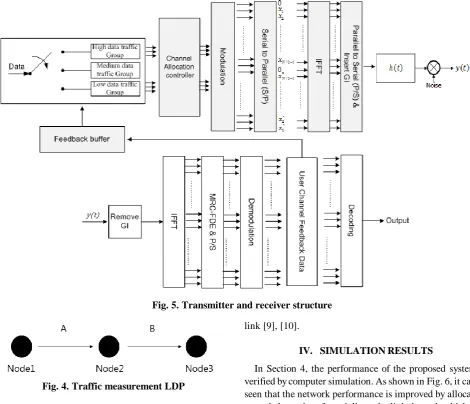
Fig. 5 shows the structure of transmitter and receiver. Analyzes the state of the channel based on the channel feedback data received from the user, and generates big data according to the usage pattern of the user. And based on the maximum traffic generated by the user, each user is assigned to a group classified by traffic incidence. Each user is assigned a channel according to the group to which they belong. We will discuss channel interference model and link traffic measurement for channel assignment in the next session.
B. Channel model
In order to allocate an appropriate channel to the communication nodes of the multi-channel, multi-interface, it is necessary to know the interference value for interference between the channels. In this case, the interference value between channels must be calculated. Interference between channels represents a relatively constant value between the near and far channels. In this paper, we calculate channel interference based on inter-channel spacing without complicated calculation between channels [8].
( , ) max(0, (2 ) )
f a b a b (3)
In order to calculate the channel interference value between the channel a of the node A and the channel b of the node B, the same equation as Equation (3) is used. | a-b | measures the channel spacing of channels a and b. (2 + β) is a non-overlapping interval between channels, and a channel interval value is set from a minimum of 1 to a maximum of 5 according to a link-specific weight β. That is, it indicates the channel interference level that allows the channel interval to be determined by the value of the weight. For detailed numerical information on β, we can calculate link-specific weight β by link traffic measurement in Section C.
C. Method Channel link traffic measurement
[image:3.595.45.291.641.744.2]Fig. 4. Traffic measurement LDP
0 0
t t
curr
curr curr
TDC TDC LDT
(4)
1
( ) (1 )
k k k
LDT LDT LDT (5)
As shown in Equation (4), LDT is measured at a constant
interval. The current LDTcurr can be obtained by measuring
TDC (Traffic Delivery Count) during the unit time τ. The measured LDT is a method of weighting the current data by using Exponentially Weighted Moving Average as shown in Eq. (5). When the value of α is small, the weight of the past data is low, so that the noise cancellation capability is reduced and the time delay is reduced. On the other hand, when the value of α is large, the data weight of the past becomes large, and therefore, the noise cancellation capability is improved and the time delay is increased. The
measured LDTk value is used to determine the priority of the
link [9], [10].
IV. SIMULATIONRESULTS
[image:4.595.318.569.504.658.2]In Section 4, the performance of the proposed system is verified by computer simulation. As shown in Fig. 6, it can be seen that the network performance is improved by allocating a good channel preferentially to the link through which the traffic is transmitted through the differential channel allocation according to the usage pattern of the user through the proposed scheme.
Fig. 6. Performance evaluation of proposed system
In the existing system, since the traffic priorities of users are excluded, performance degradation due to packet transmission error and channel interference occurs. On the other hand, in the case of the proposed system, it can be seen that there is not much
network performance
degradation due to channel
International Journal of Innovative Technology and Exploring Engineering (IJITEE) ISSN: 2278-3075,Volume-8 Issue-8S2, June 2019
Published By: interference by allocating a relatively free channel in the
channel interference based on the user group information in which a lot of traffic is transmitted. As shown in Fig. 6, the proposed system shows relatively uniform network performance compared to the existing system. Interference was not generated due to one-shot data transmission on another link, which was a possible result. In this way, we can confirm that the throughput of the network can be improved by 1Mbps ~ 3.5Mbps through the proposed scheme in the multi-interface, multi-channel wireless communication network environment proposed in this paper.
V. CONCLUSION
In this paper, we have studied the deep learning channel allocation scheme based on user - patterned big data. It is an adaptive channel capacity management scheme through analysis of user usage pattern, which can allocate the optimal channel compared to existing system. We show that the proposed method can effectively manage users and improve the performance of the whole system. The proposed system is applicable to various networks. The number of users per network is rapidly increasing due to the increase of IoT devices, and it is time to manage network resources due to the introduction of many IT convergence technologies. In this environment, we can provide smooth service through the proposed method. In the future, it is necessary to study techniques for regional channel optimization by analyzing the usage patterns of users by region.
ACKNOWLEDGMENT
This work was supported by the National Research Foundation of Korea(NRF) grant funded by the Korea government(MSIT) (No. 2017R1C1B5017812)
REFERENCES
1. Manuel Dinis, Jose Fernandes, “Provision of Sufficient Transmission Capacity for Broadband Mobile Multimedia” A step Toward 4G. IEEE Communications Magazine. 2010, 39(8).
2. Akyildiz, L. F., X. Wang, and W. Wang, “Wireless Mesh Network: survey.” Computer Networks Journal. 2005, pp. 47:445-487.
3. Roberto Battiti, Alan Bertossi, Daniela Cavallaro. “A Randomized Saturation Degree heuristic for Channel Assignment in Cellular Radio Networks.” IEEE Transactions on Vehicular Technology. 2001, pp.5(2): 364-374.
4. U. Datta and S. Kunda, “Performance of multi-hop CDMA wireless sensor networks with correlated interferers using different retransmission strategies and error control schemes.” International Journal of Sensor Networks. 2014, pp.1(1):40-51.
5. S. Hara, and R. Prasad, “Design and performance of multicarrier CDMA system in frequency –selective Rayleigh fading channel.” IEEE Trans. Veh. Technol. 1999, pp.48(4):1584-159.
6. W. Si, S. Selvakennedy, A.Y. Zomaya, “An overview of Channel Assignment methods for multi-radio multi-channel wireless mesh networks.” J. Parallel Distrib.Comput. 2010, pp.70:505-524.
7. P. Kyasanur, N.H. Vaidya, “Routing and link-layer protocols for multi-channel multi interface ad hoc wireless networks.” ACM SIGMOBILE Mobile Computing and Communications Review. 2006, pp.10:31-43.
8. Seo Jung Heo, Dong Cheul Son, Chang Suk Kim, “A Mobile Channel Allocation Scheme for Avoiding Channel Interference.” SCIS, ISIS 2012 proceedings of the 13th Symposium on advanced intelligent systems. 2012, pp.2053-2055.
9. Pedersen, K. I., Mogensen, “P. E. Vector Group wise Interference Cancellation in Multi-Rate DS-CDMA Systems.” IEEE 51st, Vehicular Technology Conference Proceedings. 2000, pp.750-754.
10. R.Draves, J. Padhye, and B. Zill. “Routing in multi-radio, multi-hop wireless meshnetworks.” MobiCom. 2004.
AUTHORSPROFILE
Doohee Han
Doohee Han received M.S. degrees from the Department of Electronics and Radio Engineering at Kyung Hee University, Korea, in 2011 and 2013, respectively. Currently he is a graduate student, studying toward his Ph.D. degree at Kyung Hee University. His research interests include OFDM, MC-CDMA, MIMO, Resource allocation, and Visible Light Communication systems
Kyujin Lee
2007: Master of Science in Radio communication Engineering, Kyung Hee University (Radio Communication Engineering)
2011: Kyung Hee University Electronics and Radio Engineering Department Doctor of Engineering
2012: Professor of Electronics and Radio Engineering, Kyung Hee University
2013 ~: Professor, Dept. of Electronics Engineering, Semyung University Interests: OFDM, MC-CDMA, VLC, MIMO