International Journal of Innovative Technology and Exploring Engineering (IJITEE) ISSN: 2278-3075, Volume-9 Issue-2, December 2019
Abstract: Metabolic changes to the climacteric fruits like Mango during the post-harvest lifecycle has significant impact on the marketability of the fruit. One such change is in the structure of the cuticle layer on the surface of the mango and its composition changes as the fruit matures and expands. By looking at the structure of the cuticle the right maturity stage of the fruit can be determined which can decrease storage costs and increase market outcomes. The objective of this paper is to classify the mango fruit according to its maturity stage by looking at the cuticle structure of the mango fruit images as seen using light microscope under magnification. The data set consists of structural microscopic images of 2 varieties of mango viz. Banganapalli and Kili Mooku/Banglora and the classification is done using Convolutional Neural network (CNN) based on deep learning techniques. The combined results of both varieties yield a classification accuracy of 83% for all maturity stages. With this neural network model one can identify the ripening stage of the mango in a non-destructive manner that can greatly improve the mango harvesting strategies.
Keywords : Climateric, cuticle, deep learning, conventional neural network, fruit maturity, harvest, microscope, classification, magnification, shelf life.
I. INTRODUCTION
Mango (Mangifera indica) is most prominently grown tropical fruit known as the „King of Fruits‟ and most consumed and cherished fruit of India. In Tamil Nadu places like Madurai, Theni, Tiruvallur, Dharmapuri has the maximum production of different varieties of mangoes like Banganapalli, Alphonso, Neelum, Rumani, Mulgoa, Bangalora and Totapuri. Consumers have grown up the value chain and their preferences are driven more by quality of mangoes, freshness and consistency rather than the price of the fruit. Parameters like size, shape, colour, external skin defects like sun burn, blemishes, spots, resin stains and fruit firmness play an important role in consumer preferences. Quality inspection of mangoes and their classification using parameters like size and colour has been done [1]. Also, food wastage primarily fruits and vegetable amount to 40% of the overall produce as per the „committee on doubling farmers income report‟ from the Ministry of Agriculture and the demand for fruits alone is set to increase by 228% by 2050. This necessitates the need for an objective assessment of mango fruit quality by identifying the optimum ripening stage
Revised Manuscript Received on December 05, 2019. * Correspondence Author
Nirmala Gururaj *, Computer Applications Department, Dr .M.G.R Educational & Research Institute, Maduravoyal, Chennai, 600095, India Email: [email protected]
Viji Vinod, Computer Applications Department, Dr .M.G.R Educational & Research Institute, Maduravoyal, Chennai, 600095, India. Email: [email protected]
of the mango for local consumption and the suitability for export purposes.
Mango being a climacteric fruit is highly perishable and has a very limited shelf life. The post-harvest losses of market ready mango are due to improper harvesting, transportation and ripening practices.
Mangoes when plucked immature raw stage do not ripen uniformly, not very sweet and exhibit excessive shrinkage and is of inferior quality. In the case of Banganapalli mangoes, fully developed cheeks with outgrown shoulders and a pit at the end of stalk is an indication of mature raw mango that can be harvested which results in better taste and longer shelf life. Mango fruits harvested beyond the mature raw stage have greater susceptibility to diseases and is highly perishable. There are many methods proposed to classify the mangoes based on appearance and physiological parameters, however most of them are either laborious or involve destructive techniques. Using the texture properties of the mango it is possible to identify the subtle differences in the various ripening stages of the mango with great accuracy. The texture of the mango has a layer of cuticles and wax on the surface of the mango and undergo changes during the development of the fruit. The cuticular waxes has an important implication on fruit quality and postharvest performance [2].
Recently, convolutional neural networks-based approaches have been very successful in such real time applications. Sapientiae, A. U. and Oltean, M. [3] established a fruit recognition system to classify fruits based on images using CNN and deep learning techniques. Yossy, E. H. et al. [4] developed a system based on neural network and computer vision to detect if the mango fruit is ripe or unripe. Zhang, Y. et al. [5] used a novel CNN architecture for subtle classification of various ripening stages of banana. Supriatna, A. D. and Setiawan, R. [6] designed a smart to work on a mobile device to detect four levels of ripeness of tomato and chili fruits. Katarzyna, R. and Paweł, M. [7] proposed vision-based method for fruit classification using deep CNN. Hussain, I., He, Q. and Chen, Z. [8] developed a system using deep convolutional neural network model to extract fruit image features and implement classification. Sriram, R., M, A. T. and Girija, P. J. [9] used ImageNet to retrain the final layer for classification of mangos from images with high accuracy.
In this paper, a convolutional neural network structure is proposed to corelate the ultra-structural texture of the fruit (which is less extensively studied) to the ripening stage of the fruit and determine the right maturity stage of the fruit and its shelf life. The neural network model will use microscopic images of the fruit skin to train the network and using image processing and deep learning techniques classify the fruit according to the various
maturity stages. The
convolutional neural network
Predictive Model for Optimum Fruit Maturity
Grading
model is executed in python v3.0 and TensorFlow. The development of such a model will help farmers, retailers, wholesalers and consumers get an objective quality assessment of the fruits.
II. MODELFORFRUITMATURITYGRADING
The model comprises of an (a) image acquisition kit which has the following: Digital camera for image capture, Camera lens adaptor and a Photo studio light box, (b) Convolutional Neural Network (CNN) Model.
A. Image Acquisition Kit
[image:2.595.304.546.109.327.2]The image acquisition kit has an adjustable stand with a hand operated crank table lift for focusing the digital camera, a microscope clip-on attached to the adjustable stand, a box with marked dimensions to position the object to be within the standard frame, an uniform lighting LED source to ensure no shadow and a clear picture. This kit is designed such that no major adjustments are necessary for image acquisition and all images captured are standardized within the same frame of reference to simplify the image cropping process.
Fig 1. Image Acquisition Kit
For the purpose of this experiment a portable microscope BEILESHI 60X-100X ZOOM Microscope clip-on and an android mobile camera like the Oneplus 5T is used to take the images of the mango skin. The mango is kept in the Photo Studio Light box on the flat surface. The microscope is attached to a stand vertically inside the studio to make object lens face downwards. The magnification (60x -100x) can be adjusted by rotating the focus- adjusting until the image is clear. Images are captured at 100X across all the four stages of the mango using the phone camera.
B. Convolutional Neural Network (CNN) Model
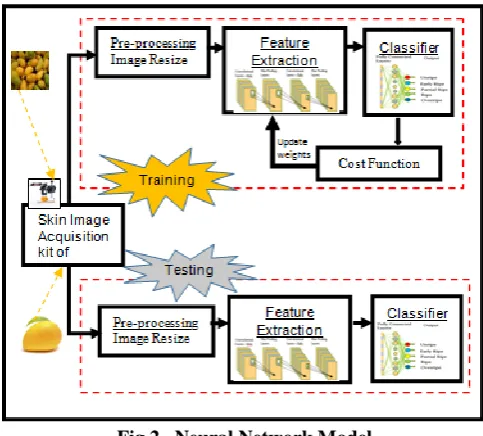
The CNN model has an input layer, multiple hidden layers and an output layer. The input to the model are RGB images which are resized to a fixed resolution and the output of the neural network will be a class label identifying the various ripening stages of the mango. The network has a feature extraction layer with 2 convolutional modules for mango feature extraction and a layer with two fully connected layers for classification. The convolutional module performs 3 operations of convolution, rectified linear unit (ReLU) and max pooling. As part of convolution, filters are applied to the input feature map to produces an output feature map which has new features. Then a function like ReLU is applied to the output feature map to introduce nonlinearity into the model. In the pooling step the dimensionality of the feature map is reduced while preserving the critical features. The classification layer has a fully connected layer and an
algorithm like softmax to classify mango images into the various ripening stages. Sakib, S. and Ashrafi, Z. [10] established a fruit recognition system using a similar CNN model to classify apples.
Fig 2. Neural Network Model
For this experiment an input RGB image, resized to 100*100 resolution and 30,000 (100*100*3) neurons is fed to the neural network. The convolutional layer1 has 32 filters of size 3*3 with stride 2 and is applied to the input image combined with the ReLU activation function followed by a max pooling layer and a batch normalization layer. The ReLU layer and the batch normalization layer increase the performance of the training process and network. The dropout layer is employed to deactivate the least learned features. The second convolutional layer2 is also similar to layer and has 32 filters of size 3 × 3 (with a stride of 2) and is applied to the input mango image, combined with the ReLU and max pooling layer. The features learnt by the convolutional layer and the pooling layers are then classified by using two fully connected layers of size 64 and 4 respectively. The size of the second fully connected layer is equal to the number of classes. It specifies the probability distribution for each class. Adam optimizer algorithm is used to train the proposed CNN model. This neural network model has distinct advantages. The model is able to distinguish the subtle differences in the in-between stages of raw to ripe mango with high degree of accuracy. It is completely data driven and impressively superior to the traditional image processing techniques used for classification. The model is also seen to be robust under different challenging conditions such as complexity of the background, illumination, image size, resolution and orientation.
III. MATERIALSANDMETHODS
A. Mango Sample Data Collection
Climacteric fruits like mango ripen after they are harvested and exhibits a distinct colour and structural change on their skin during the ripening process. The structural image of the fruit skin is analysed for changes in wax layer and the cutin layer along with the colour of the fruit and both these parameters are correlated to the
[image:2.595.114.220.307.451.2]International Journal of Innovative Technology and Exploring Engineering (IJITEE) ISSN: 2278-3075, Volume-9 Issue-2, December 2019
changes for various cultivars of mango was seen during the post-harvest shelf life [11]. Data is collected with the structural features being recorded everyday along with the colour until the fruit reaches the end-of life going through all the four stages from” “Unripe, Early Ripe, Partially Ripe, Ripe”.
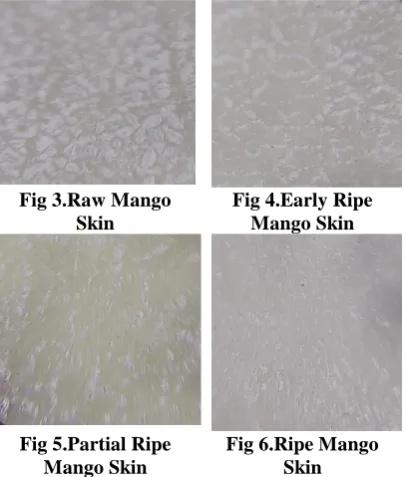
There is a layer of cuticles and wax on the surface of the mango fruits and these form a pattern consisting of wax ridges. This pattern is compact in raw fruits with minimal cracks and scales. As the fruit ripens the cuticular pattern disintegrates and the wax layer becomes smooth and starts disappearing. Studies on SEM Microscopy imaging of the cuticles of mango cultivars has shown cuticular wax consisting of wax ridges with few scales during the ripen stage [12]. The cuticular wax has many functions like limiting water loss and act as a protectant layer against radiation and insects. Raw Mango Skin – Fig 3 represents the surface view of the cuticle in a raw mango skin. The surface shows numerous white irregular patches which are distributed evenly. The cuticle is dense in distribution and each patch of cuticle has central narrow pits. The cuticle occurs in isolation in depression and uniform in distribution. The cuticle layer is also thick and uneven or wavy with prominent cuticular ridges. Under magnification the ridges appear thick with deep furrows.
[image:3.595.70.273.462.701.2]Early Ripe Mango Skin – Fig 4 represents the surface view of the cuticle during the early ripe stage. Here the cuticles form a reticulate pattern of arrangement of individual cuticular white patches. They appear reduced in size due to development of cuticular layer in the concavity of the epidermal cell layer. The reticulate line represents the cuticle aggregation in-between the epidermal cells and the empty space in the cuticle represents the surface layer of the epidermal cell. Under magnification the ridges are not sharp , but the surface is still undulated.
Fig 3.Raw Mango Skin
Fig 4.Early Ripe Mango Skin
Fig 5.Partial Ripe Mango Skin
Fig 6.Ripe Mango Skin
Partial Ripe Mango Skin – Fig 5 represents the surface view of the cuticle during the partial ripe stage. Here the cuticle reticulate pattern is retained but the cuticular line is broken and becomes discontinuous at several places. This change may be due to expansion of epidermal layer leading to discontinuity of the cuticular layer. Under magnification the
cuticular surface becomes even and smooth and no prominent ridges or furrows.
Ripe Mango Skin – Fig 6 represents the surface view of the cuticle during the ripe stage. Here the cuticle reticulate pattern is less distinct and disturbed. The individual particles of cuticle are reduced in number. The individual cuticle becomes wavy with distinct semi-circular or conical ridges and narrow deep furrows.
Mangoes of 2 varieties namely Banganapalli and Killimukku were chosen for the current grading process. They are commonly grown mangoes in the TamilNadu region and hence selected for this experimentation. The fruit images of the above 2 varieties are captured at 4 different stages namely – Unripe, Early Ripe, Partial Ripe, Ripe. These mango samples were sourced from a farm near Tiruvallur in Chennai. In total about 180 samples from each category was selected and kept in ideal same conditions of exposure of sun, humidity and temperature. The results of the mango sorting and grading is verified by pool of expert farmers, retailers and an agriculture domain expert having rich experience of over several decades in their field.
IV. RESULTSANDDISCUSSION
The mango fruit image dataset is split as 60:20:20 with 60% of mango fruit images used for training and 20% of mango fruit images used for validation and 20% of mango fruit images used for testing the output prediction. Altaheri, H. and Alsulaiman, M.[13] used defined rules to divide the dataset into traing training and validation sets to avoid classification bias. Once the neural network is trained with a large number of RGB images of the mango cutin texture patterns, it was able to recognize similarities for any new input mango fruit image data and produce a predicted mango fruit maturity stage as output. The network is trained for 30 epochs and using tensorflow library in python. The testing process was conducted to measure the robustness of the model and its ability to generalize on different sets of data. Table 1 shows how many images are there in a training set and validation and testing set for each variety of mango fruit.
Table 1. Training and Testing data sets
Mango Category
Total
no of
Image s
Training Set- 60%
Validatio n Set-20%
Testin g Set - 20%
Banganapalli Peel Structure
180 120 30 30
Killi Mooku
Peel Structure
180 120 30 30
A. Classifier Performance based on Misclassification
rate across the various maturity stages
The Fruit maturity stage classification performance was measured based on misclassification rates and classification accuracy. Misclassification rate refers to the number of images that were missing from
wrong stage. The classification accuracy which was represented in percentage was calculated based on the number of images that were classified correctly into the specific cluster. After 30 iterations the combined classification accuracy is around 83%. Results in Table 2 present the misclassification rate and classification accuracy produced by the model for the 2 varieties of mangoes.
Table 2. Classification data
Mango Category
Analyzed Stage
Classificat ion Accuracy (%)
Misclassification Rate
Banganapalli
Raw 80% 20%
Early
Ripe 100%
0%
Partial
Ripe 80%
20%
Ripe 100% 0%
Kili Mooku / Banglora
Raw 75% 25%
Early
Ripe 80%
20%
Partial
Ripe 80%
20%
Ripe 66% 34%
Fig 7. Classification Accuracy
B. Classifier Performance based on Accuracy Loss
Curves
Arivazhagan, S. and Ligi, S. V. [14] during their study of leaf diseases identification has seen that as the number of iterations increase, the training progress plot shows increase in training accuracy and decrease in loss during the training and validation process. In this experiment, the classifier model performance based on accuracy and loss values for various epochs across the 4 maturity stages of the mango fruit was computed.
Fig.8. Accuracy Loss curve for Validation data for the 2 varieties of mango
The results indicate that the accuracy of the training data set for Banganapalli Mango has reached a maximum of 83.1% after 27 epochs and the loss value decreased to 0.35 after 30 epochs. Similar results were seen for KiliMooku mango and the result curves are as shown above.
V. CONCLUSIONANDFUTUREDIRECTION
The cutin texture patterns of the mango fruit clearly indicated that it is compact and clear in unripe fruits and become distant and smudged as they ripen. The CNN based classifier model achieved a combined test accuracy of 83% for 21 to 25 epochs and best training accuracy of 99.79%. The low loss indicates the model is trained for better performance to be able to attain better mango fruit maturity stage detection. In the future, our plan is to use different CNN architectures for few other varieties of mango and compare the performance with traditional machine learning algorithms.
ACKNOWLEDGEMENT
[image:4.595.56.283.166.520.2]International Journal of Innovative Technology and Exploring Engineering (IJITEE) ISSN: 2278-3075, Volume-9 Issue-2, December 2019
REFERENCES
1. A.M.Vyas, “Quality Inspection and Classification of Mangoes using Color and Size Features”, vol. 98, no. 1, pp. 1–5, 2014.
2. I.Lara, B.Belge, and L.F.Goulao, “Postharvest Biology and Technology The fruit cuticle as a modulator of postharvest quality”, Postharvest Biology and Technology. Elsevier B.V., 87, pp. 103–112, 2014. doi: 10.1016/j.postharvbio.2013.08.012.
3. S.Yogeshwaran, R.Prabhu, Natrayan.L, Mechanical Properties of Leaf Ashes Reinforced Aluminum Alloy Metal Matrix Composites, International Journal of Applied Engineering Research ISSN 0973-4562 Volume 10, Number 13, 2015.
4. E.H.Yossy, et al. “ScienceDirect ScienceDirect ScienceDirect 2nd International Conference Mango Fruit Sortation System using Neural Network and Computer Mango Fruit Sortation System using Neural Network and Computer Vision Vision”, 00, pp. 2–9, 2017.
5. L.Natrayan, P. Sakthi shunmuga sundaram, J. Elumalai. Analyzing the Uterine physiological With MMG Signals using SVM, International journal of Pharmaceutical research, 2019, 11(2); 165-170.
6. A.D.Supriatna, and R.Setiawan, “Design of Smart System to Detect Ripeness of Tomato and Chili with New Approach in Data Acquisition Design of Smart System to Detect Ripeness of Tomato and Chili with New Approach in Data Acquisition”, 2018 doi: 10.1088/1757-899X/288/1/012018.
7. L.Natrayan, V.Sivaprakash, MS Santhosh, Mechanical, Microstructure and wear behavior of the material AA6061 reinforced SiC with different leaf ashes using advanced stir casting method, International Journal of Engineering and Advanced Technology, 2018,8(2S);366-371.
8. I.Hussain, Q.He, and Z.Chen, “A UTOMATIC F RUIT ECOGNITION B ASED O N”, vol. 8, no. 2, 2018. doi:10.5121/ijcsa.2018.8301.
9. Natrayan, L., M. Senthil Kumar, and Mukesh Chaudhari. "Optimization of Squeeze Casting Process Parameters to Investigate the Mechanical Properties of AA6061/Al2O3/SiC Hybrid Metal Matrix Composites by Taguchi and Anova Approach." Advanced Engineering Optimization Through Intelligent Techniques. Springer, Singapore, 2020. 393-406.
10. S.Sakib, and Z.Ashrafi, “Implementation of Fruits Recognition Classifier using Convolutional Neural Network Algorithm for Observation of Accuracies for Various Hidden Layers”, pp. 3–6, 1980. 11. P.Sakthi Shunmuga Sundaram , N.Hari Basker , L.Natrayan. Smart Clothes with Bio-sensors for ECG Monitoring, International Journal of Innovative Technology and Exploring Engineering, Volume 8, Issue 4, 2019, Pages 298-301.
12. J.C.Tafolla-arellano, et al., “Transcriptome Analysis of Mango (Mangifera indica L .) Fruit Epidermal Peel to Identify Putative Cuticle-Associated Genes”, Nature Publishing Group. Nature Publishing Group, pp. 1–13, 2017. doi: 10.1038/srep46163. 13. Natrayan L, Senthil kumar MS, “Optimization of tribological
behaviour on squeeze cast Al6061/Al2O3/SiC/Gr HMMCs based on taguchi method and artificial neural network,” Journal of Advanced Research in Dynamical and Control Systems,11(7), pp. 493-500. 14. S.Arivazhagan, and S.V.Ligi, “Mango Leaf Diseases Identification
Using Convolutional Neural Network”, vol. 120, no. 6, pp. 11067–11079, 2018.
AUTHORSPROFILE
Nirmala Gururaj has 26 years of Industry Experience in Information Technology encompassing various leadership roles across Client Solutions and Large Program Management. She has completed M.C.A from Madras University , Madras , TamilNadu, in 1991, CISA since 2013 and certified in Machine Learning and Deep Learning , an online non-credit course authorized by Stanford University, USA, offered through Coursera. She is currently pursuing research in the area of Artificial Intelligence in Dr. M.G.R Educational and Research Institute and this research is also supported by Dr. M.G.R DST NewGen IEDC (New Generation Innovation & Entrepreneurship Development Center ).
Dr VijiVinod graduated with a B.Sc Mathematics from Calicut University in 1996 and Masters in Computer Applications from Bharathiar University in 1999.. She had the passion of doing research and reach great heights in academics, influenced her decision to join as the faculty of the Department of Information technology at Dr.MGR Educational & Research Institute, University. She was the first professor in object oriented analysis and design and component based technology at Dr.MGR University in 2004. From 2004 to 2005, she served as an Asst.Professor of Department of Information Technology, from 2006 to 2010, as Asst.Professor of the Department of Computer Applications, and from 2010 to till now, as Professor& Head of Department of Computer Applications, Dr.MGR Educational & Research Institute, University.Professor Viji specializes in areas of information technology management, web technology, cloud computing, and various software engineering issues with the goal of improving both software engineering practices and processes. She has edited one book and published articles and notes in professional journal and conferences.