i
WIRELESS SMOKE DETECTOR USING MICROCONTROLLER
MOHD FIRDAUZ BIN HASAN
This report is submitted in partial fulfillment of the requirements for the award of Bachelor of Electronic Engineering (Telecommunication Electronics) with Honours
Faculty of Electronic and Computer Engineering Universiti Teknikal Malaysia Melaka
ii
UNIVERSTI TEKNIKAL MALAYSIA MELAKA
FAKULTI KEJURUTERAAN ELEKTRONIK DAN KEJURUTERAAN KOMPUTER
BORANG PENGESAHAN STATUS LAPORAN PROJEK SARJANA MUDA II
Tajuk Projek : WIRELESS SMOKE DETECTOR USING MICROCONTROLLER
Sesi
Pengajian : 2009/10
Saya ………....MOHD FIRDAUZ BIN HASAN ………..…….. (HURUF BESAR)
mengaku membenarkan Laporan Projek Sarjana Muda ini disimpan di Perpustakaan dengan syarat-syarat kegunaan seperti berikut:
1. Laporan adalah hakmilik Universiti Teknikal Malaysia Melaka.
2. Perpustakaan dibenarkan membuat salinan untuk tujuan pengajian sahaja.
3. Perpustakaan dibenarkan membuat salinan laporan ini sebagai bahan pertukaran antara institusi pengajian tinggi.
4. Sila tandakan ( √ ) :
SULIT* (Mengandungi maklumat yang berdarjah keselamatan atau kepentingan Malaysia seperti yang termaktub di dalam AKTA RAHSIA RASMI 1972)
TERHAD* (Mengandungi maklumat terhad yang telah ditentukan oleh organisasi/badan di mana penyelidikan dijalankan)
TIDAK TERHAD
Disahkan oleh:
__________________________ ___________________________________
(TANDATANGAN PENULIS) (COP DAN TANDATANGAN PENYELIA)
Alamat : NO 17 BLOK W FELDA PALONG 7 7 73470 GEMAS N.SEMBILAN
iii
“I declared that this thesis is the result of my own work except the ideas and summaries which I have clarified their sources.”
Signature : ………
Writer : MOHD FIRDAUZ BIN HASAN
iv
“I hereby declare that I have read this report and in my opinion this report is sufficient in terms of the scope and quality for the award of Bachelor of Electronic Engineering
(Telecommunication Electronic) With Honours”
Signature : ………
Supervisor’s Name: PUAN JUWITA BINTI MOHD SULTAN
v
DEDICATION
vi
ACKNOWLEDGEMNT
I would like to take this opportunity to express my deepest gratitude to my project supervisor, Puan Juwita Bt Mohd Sultan for her advice and guidance throughout the whole process of my final year project. My utmost thanks also go to my family, especially my father Hasan Bin Othman and my beloved mothers Zainah Bt Sainin to whom I owe my love and gratitude.
vii
ABSTRACT
viii
ABSTRAK
ix
CONTENTS
CHAPTER TOPIC PAGES
TITLE i
DECLARATION ii
DEDICATION v
ACKNOWLEDGEMENT vi
ABSTRACT vii
ABSTRAK vii
CONTENTS ix
LIST OF APPENDICES xii
LIST OF FIGURES xiii
1 INTRODUCTION
1.1 Background of the study 1
1.2 Objective 2
1.3 Problem statement 2
1.4 Scope 3
1.5 Methodology 3
2 LITERATURE REVIEW
2.1 Chapter Overview 6
2.2 Smoke Detector 6
2.2.1 Ionization detector 7 2.2.2 Photoelectric Detectors 8
2.3 Microcontroller 8
2.4 Signal Link 13
2.5 Wireless Communication Principle 13
2.6 Radio Frequency Signal 14
2.7 Remote Control Decoder 15
2.8 Project Circuit 17
2.8.1 Power supply for the circuit 19 2.8.2 Push Button as input for PIC 20
microcontroller
2.8.3 LED as output for PIC 21 microcontroller
2.8.4 Buzzer as output of PIC 22 microcontroller
x
2.9 Transmitter and Receiver 23 2.10 RF-TX-315 and RF-RX-315 23 2.11 Ionization Smoke Detector IC 24
2.12 Antennas 26
3 METHODOLOGY
3.1 Designing Process 28
3.1.1 Find the source about project 31 3.1.2 Construct the Project Circuit 31 3.1.3 Prepare the components 31 3.1.4 Test the circuit on breadboard and 31
simulation.
3.1.5 Testing circuit operation 32 3.1.6 Program PIC circuit 32
3.1.7 Control Program 32
3.1.8 Program PIC16F876A 34 3.1.9 Flow Chart for Project 39
3.2 Block figure 40
3.2.1 Microcontroller 41
3.2.2 Smoke Detector Circuit 41 3.2.3 Transmitter circuit 42
3.2.4 Receiver circuit 43
3.2.5 Buzzer 43
3.2.6 LED 44
4 PROJECT RESULT
4.1 Introduction 45
4.1.1 Power source 45
4.1.2 Output at PIC16F876A 46 4.2 Project result of Wireless Smoke Detector
system
4.3 Decoder and Encoder 48
4.4 Wireless circuit operation 49
5 CONCLUSION AND SUGGESTION
5.1 Conclusion 51
5.2 Suggestion 51
REFERENCES 53
APPENDICES
APPENDIX A 56
APPENDIX B 57
xi
LIST OF FIGURES
FIGURE TITLE PAGE
2.3 Microcontroller 9
2.3.1 Pin Arrangement 12
2.3.2 PIC16F87XA Device Features 12
2.6 Radio frequency spectrum 15
2.7 Remote control decoder PT2272 16
2.8 Typical Applications as Ionization Smoke 17
2.8.1 Main PIC circuit 18
2.8.2 PT2272 circuit and RF Receiver 19
2.8.3 Circuit of power supply 19
2.8.4 Button Circuit 20
2.8.5 LED 21
2.8.6 Buzzer 22
2.8.7 ICSP for programming PIC microcontroller 22
2.10 RF:-RX-315 24
2.11.0 MC145018 24
2.11.1 Pin Assignment 26
2.12 Omni directional antennas 27
3.1 Flow-Chart Project Progress 30
3.1.1 Flow chart programs 31
3.1.8 Output operation system 34
3.1.9 Writing Program 35
3.1.10 Running Program 36
3.1.11 Control Unit circuit on stripboard 37
3.1.12 Smoke detector circuits 37
3.1.13 Flow Chart project 39
3.2 Block of system 40
3.2.1 PIC16F876A 41
3.2.2 Ionization smoke detector 42
3.2.3 Transmitter Tx-315 42
3.2.4 Receiver Rx-315 43
3.2.5 Buzzer 44
3.2.6 LED 44
4.20 Wireless Smoke Detector 47
4.21 Control Unit and sensor 48
4.31 Encoder circuit 49
4.32 Decoder circuit with PT2272 49
1
CHAPTER 1
INTRODUCTION
1.1 Background Study
What are the differences between wireless alarm system and the common hardwired alarm system? Hardwired alarm system usually had to be installed or mounted in the walls of your house before your house is built. This is to hide away the wire connection inside the wall and because of this; hardwired alarm system is difficult to troubleshoot in case there are problems with the system. Basically, the main difference between hardwired and wireless alarm system is the connection link from sensors to the control panel of the alarm system.
2
1.2 Objective
The objective of the project is:-
1. To understand the operation principle of smoke detector, RF amplifier and
PIC16F876A.
2. To understand the operation of each component used in the circuit.
3. To use the most suitable for each circuit to function properly according plan
4. To design the required circuit for sense smoke and beep loudly when it detected
smoke
1.3 Problem Statement
Problem Statement:
1. Installing smoke detector system using cable is difficult and expensive.
2. Smoke detector and the buzzer are combining in one circuit and don’t have the
control unit.
3. Many smoke Detector systems now days still can’t show which one smoke
detector give the warning.
3
5. Besides that, it is too messy, costly and also difficult to troubleshoot. Usually the wire is installed inside the wall and if a problem occur in the system, to repair it user will need to hack the wall to inspect the wiring.
1.4 Scope
1. Use PIC16F876A.
256 bytes of EEPROM data memory.
It is a Universal Asynchronous Receiver Transmitter.
2. Use two smoke detector (Ionization type)
3. This smoke detector is using 9V battery to operate.
4. This project is using an IC remote control (PT2272) to encode data.
1.5 Methodology
First phase: Literature review
Gather the information about the project via Internet, journals, magazines,
published work and reference books
Make research to know more detail about designing all the parameters
4
Second phase: build the component and software
Use software MPLAB Compiler to write a program for the alarm system.
Components and parts identification
Building the Hardware
Third phase: Project tested
Testing of prototype in operation, application and result
Assembly the component on the board and test run the operation. If any
problems occur after testing the circuit, the process of troubleshooting must be held.
Final phase
Presentation on outcome of project
Prepare for final report
1.6 Report Structure
Chapter 1 briefly explains the introduction of the Network wireless smoke
detector using radio frequency (RF). It consist objectives of the project, research or
background study of network wireless smoke detector using radio frequency (RF) that
had been done before, problems statement of the project, the scope and the methodology
of the project.
Chapter 2 will be discussed about general knowledge on literature review of network
5
and approach that had been used in previous research and also explained on the
relationship of the research information and the theory.
Chapter 3 will be discuss on methodology in more detail by using the data
collection method, data process method, analyze the data, and flow chart. All this will
describe the process in detail of each part starting from the scratch until complete.
As for the chapter 4, it will be covered the entire conclusion, finding project
6
CHAPTER 2
LITERATURE REVIEW
2.1 Chapter Overview
Basically, wireless alarm systems consist of a wireless transmitter and receiver, a control panel, sensors or switches and siren or bell. The wireless alarm system project contains all the parts mentioned above.
This wireless alarm system works the same way like the ordinary wireless alarm system where a sensor will act as an input to transmit signal to the compatible receiver when it is triggered. The control panel will automatically trigger all the outputs which are the siren and flashing LED light.
Radio frequency (RF) is used for transmitting signal in this project as it is more practical. Signal can be transmitted up to 20 - 30 meters in range and the receiver is connected to the microcontroller on the control panel.
2.2 Smoke Detector
In home security, there are several type of detector which like flood detector, smoke detector and temperature detector. This project is focus to create a network wireless smoke detector by using RF signal.
7
2.2.1 Ionization Detectors
Ionization detectors have an ionization chamber and a source of ionizing radiation. The source of ionizing radiation is a minute quantity of americium-241 (perhaps 1/5000th of a gram), which is a source of alpha particles (helium nuclei). The ionization chamber consists of two plates separated by about a centimeter. The battery applies a voltage to the plates, charging one plate positive and the other plate negative. Alpha particles constantly released by the americium knock electrons off of the atoms in the air, ionizing the oxygen and nitrogen atoms in the chamber. The positively-charged oxygen and nitrogen atoms are attracted to the negative plate and the electrons are attracted to the positive plate, generating a small, continuous electric current. When smoke enters the ionization chamber, the smoke particles attach to the ions and neutralize them, so they do not reach the plate. The drop in current between the plates triggers the alarm.
2.2.2 Photoelectric Detectors
8
2.2.3 Which type is better?
Both ionization and photoelectric detectors are effective smoke sensors. Both types of smoke detectors must pass the same test to be certified as UL smoke detectors. Ionization detectors respond more quickly to flaming fires with smaller combustion particles; photoelectric detectors respond more quickly to smoldering fires. In either type of detector, steam or high humidity can lead to condensation on the circuit board and sensor, causing the alarm to sound. Ionization detectors are less expensive than photoelectric detectors, but some users purposely disable them because they are more likely to sound an alarm from normal cooking due to their sensitivity to minute smoke particles. However, ionization detectors have a degree of built-in security not inherent to photoelectric detectors. When the battery starts to fail in an ionization detector, the ion current falls and the alarm sounds, warning that it is time to change the battery before the detector becomes ineffective. Back-up batteries may be used for photoelectric detectors.
So in this case, I have choose Ionization type because it more suitable for my project.
2.3 Microcontroller
9
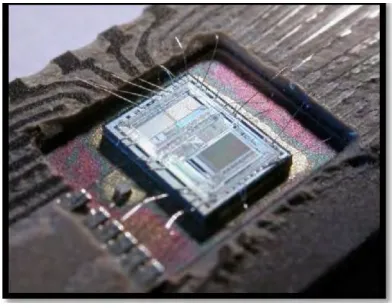
Figure 2.3: Microcontroller
It emphasizes high integration, in contrast to a microprocessor which only contains a CPU (the kind used in a PC). In addition to the usual arithmetic and logic elements of a general purpose microprocessor, the microcontroller integrates additional elements such as read-write memory for data storage, read-only memory for program storage, Flash memory or permanent data storage, peripherals, and input/output interfaces. At clock speeds of as little as 32 KHz, microcontrollers often operate at very low speed compared to microprocessors, but this is adequate for typical applications. They consume relatively little power (milliwatts or even microwatts), and will generally have the ability to retain functionality while waiting for an event such as a button press or interrupt. Power consumption while sleeping (CPU clock and peripherals disabled) may be just nanowatts, making them ideal for low power and long lasting battery applications.
10
the CPU. Using fewer pins, the chip can be placed in a much smaller and cheaper package. Integrating the memory and other peripherals on a single chip and testing them as a unit increases the cost of that chip, but often results in decreased net cost of the embedded system as a whole. Even if the cost of a CPU that has integrated peripherals is slightly more than the cost of a CPU + external peripherals, having fewer chips typically allows a smaller and cheaper circuit board, and reduces the labor required to assemble and test the circuit board.
A microcontroller is a single integrated circuit, commonly with the following features:
• Central processing unit - ranging from small and simple 4-bit processors to complex
32- or 64-bit processors
• Discrete input and output bits, allowing control or detection of the logic state of an individual package pin
• Serial input/output such as serial ports (UARTs)
• Other serial communications interfaces like I²C, Serial Peripheral Interface and Controller Area Network for system interconnect
• Peripherals such as timers, event counters, PWM generators, and watchdog
• Volatile memory (RAM) for data storage
• ROM, EPROM, EEPROM or Flash memory for program and operating
parameter Storage
• Clock generator - often an oscillator for a quartz timing crystal, resonator or RC circuit
• Many include analog-to-digital converters
• In-circuit programming and debugging support
11
several internal peripherals, with the pin function selected by software. This allows a part to be used in a wider variety of applications than if pins had dedicated functions. Microcontrollers have proved to be highly popular in embedded systems since their introduction in the 1970s.
Some microcontrollers use Harvard architecture: separate memory buses for instructions and data, allowing accesses to take place concurrently. Where a Harvard architecture is used, instruction words for the processor may be a different bit size than the length of internal memory and registers; for example: 12-bit instructions used with 8-bit data registers.
The decision of which peripheral to integrate is often difficult. The microcontroller vendors often trade operating frequencies and system design flexibility against time-to-market requirements from their customers and overall lower system cost. Manufacturers have to balance the need to minimize the chip size against additional functionality.
Microcontroller architectures vary widely. Some designs include general-purpose microprocessor cores, with one or more ROM, RAM, or I/O functions integrated onto the package. Other designs are purpose built for control applications. A microcontroller instruction set usually has many instructions intended for bit-wise operations to make control programs more compact. For example, a general purpose processor might require several instructions to test a bit in a register and branch if the bit is set, where a microcontroller could have a single instruction that would provide that commonly-required function.
12
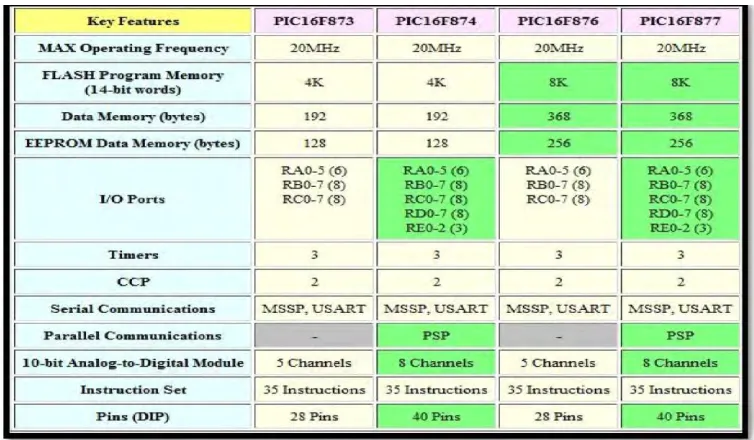
[image:23.612.159.497.197.386.2]The microcontroller that I have chosen is PIC 16F876A.This is because the microcontroller is widely use, easy to get and also it has 28 pins which can be use to add additional application in this alarm system. The Figure 2.3.1 and 2.3.2 show the pin arrangement for PIC 16F876A and PIC16F87XA device features.
13
Figure 2.3.2: PIC16F87XA Device Features
2.4 Signal Link
Communication signal is divided depending on the signal link used, either wire communication or radio communication. In my project, I only focus on radio communication.
2.5 Wireless Communication Principle
Wireless communication is the transfer of information over a distance without the use of electrical conductors or wires. Wireless communications are based on the launch, propagation, and detection of electromagnetic waves emitted primarily at radio or microwave frequencies. The distances involved may be short (a few meters as in television remote control) or very long (thousands or even millions of kilometers for radio communications). Wireless communications is generally considered to be a branch of telecommunications.