Abstract: Presently, we have observed that we are lacking with tools for teaching and assessing Software Project Management. We need to develop some tools to educate capacity of Software Project Management and to allow learners to check their skills and involve the required educational purpose in safe surroundings by using a gamification like methodology. In this paper, an Interactive Gaming System to enrich the fundamentals of Software Project Management using a gamut of techniques & technologies is designed with Gesture Recognition to increase player indulgence in the game. The proposed game also involves multiplayer participation for a common objective over TCP/IP or Internet resulting in increasing team effort. The proposed game is implemented in MATLAB.
Index Terms: game, gesture, simulation, TCP/IP
I. INTRODUCTION
For the reason to train and educate the learners serious games are there in our surroundings. Tools are used for obtaining knowledge and for encouraging the users. Furthermore, the serious games that are based on simulation permit us to include real life situations into the process of learning in a safe environment. [1]
In three ways games can be combined with high education. Firstly, games can be involved where traditional ways are being used for encouraging learners who has to put extra effort for this and the game provides the teachers a chance to observe how the learners can work in real time. Secondly, for enhancing the involvement and encouragement of learners games can be included with the lectures. In this method, the learners and professionals play games that are based on knowledge. Thirdly, by using a game development framework (GDF) the learners should develop game that is a section of their course to learn computer science and software engineering skills. [4]
Some of the games are SESAM, ProDec, The Project Manager Game, SIMSOFT, DELIVER!, etc. We here focus on SimSE game of software engineering education which is an interactive game for simulation. This game is interactive, educational, computer game with graphics which model processes of software engineering and provides training of scenarios to learners so that they can handle and understand issues of software process. This permits learners to work in a real world software engineering process.
A. Objectives
Revised Manuscript Received on August 05, 2019.
Shaily Sharma, M.Tech. Scholar, Computer Science, Govt. Engineering College, Ajmer, India.
Prakriti Trivedi, Associate Professor, Computer Science, Govt. Engineering College, Ajmer, India..
i.Constructing a simulation approach as a game- By providing our simulation approaches a different feel like a game due to the interest of youth in computer games. In our simulation surrounding and its simulation model’s design we generously used interactivity, real life challenges, graphics and other game elements.[6]
ii.Creating our simulation approach with a fully graphical user interface- The main focus point of this graphical user interface is the layout of an office which includes the simulated process with some desk, chair, workspace, computers and employees who communicates with the learners by using bubbles of speech on their above. In addition with the above there are also graphical representation of artifacts, customers, projects and tools along with the status of every object.[6]
iii.Making our simulation approach highly
interactive-The design of this game is in such a way that the learners are able to take decisions and guide the simulation according to it for the whole process of simulation. Our approach functions on the basis of stages and clock tick where with every clock tick the learner has a chance for performing actions affecting the simulation. [6]
iv.Creating a simulation approach with customizable simulation models-By using model builder tool and allied modeling approach which permits instructors to make simulation models and produce customized games on the basis of these models, we can achieve this customization. [6]
v.Creating a new modeling approach for making graphical, interactive, game based software process models- Our approach of simulation must uphold the modeling of game-based, graphical, interactive models that are predictive (predicting and executing the effects of actions of learners) and directive (specifying collection of net steps that the learner can take). [6]
B.Gesture Recognition
Hand Gesture recognition holds broad applications in virtual world of recognizing sign language and computer or video games. For communicating with the virtual surroundings, a new way called hand gesture provides a direct interface. Our approach of hand gesture recognition consists of three steps:
a) Image segmentation
b) Morphological Filtering
c) Cross-Correlation based feature extraction
C.TCP/IP
The TCP/IP client and server block for MATLAB is
Software Project Management Training through
game like simulation and Virtual Reality
used. The client block enables link models to communicate with remote applications and devices over TCP/IP network. The server block enables link to accept network communication from remote applications and devices over TCP/IP network. The communications capabilities considerably extend the functionality of MATLAB.
This paper provides a hypothesis that simulation can bring same benefits for education in software engineering that has brought with variant educational domains. Particularly, we consider that education of software engineering process can be enhanced by using simulation allowing learners to manage different kinds of software engineering processes.
In the next section we shall describe the games proposed by the authors previously and explains about virtual reality. In the section 3, the proposed game with real time gesture recognition is described. In the last section, simulation results and its analysis are done.
II. LITERATURE REVIEW
Presently, we have observed that we are lacking with tools for teaching and assessing Software Project Management in real world. [1] There is a need to develop tools for teaching in the extent of Software Project Management, and to propose a way for learners to test their knowledge with needed educational knowledge in a risk free surrounding by using a serious game. Hence, Alejandro Calderón and Mercedes Ruiz proposed a game called ProDec which is a serious game based on simulation used for teaching and assessing in software project management training. This tool is used to remove the limitations found in similar projects. [1] They have also included the levels of Bloom’s taxonomy with the stages of game lifecycle to represent how this game is able to achieve various levels of educational objectives.
Computer games and video games play a chief role in the life of youth and have become very popular in kids and adults’ life. [18] Now we can play games anywhere in technology enrich surroundings using laptops, smart phones, console games, etc. Bian Wu and Alf Inge Wang provided a guideline to integrate GDF (Game Development Framework) in learning with teaching approach. Game development technology has become advanced and matured therewith an appearance of games in the life of students. [18]. According to the existing game development software, the whole process of game development is divided into several domains and roles like game programmers, 3D model creators, game designers, animators etc. In this context, some of the web resources and game engines can be able to simplify the development process of game.
Globally software engineering is a gradually increasing field for research. For the utilization of talents and skills in the world there is a requirement for developing software at remote sites. This can be beneficial for different organization and companies. Presently, software engineering courses globally started becoming popular in academia for preparing learners or developers so that they can perform tasks professionally. Courses for this are normally included with
are being used. Simulation games can be used for illustrating and experimenting with concepts such as performance, team management and selection of tools. SimSE is an educational simulation tool which provides a graphical environment that helps learners to practice challenges that comes while developing software.
Project management is an important activity for various areas as well as Software Engineering. If we have a good management then we can deliver a project that meets customer expectations within deadline and budget. The importance of managing projects shows that the courses which are related to Information Technology and Computer Science must cover all the project management activities presenting the concepts, techniques and methods to the learners. The main aim of software project management courses is to prepare learners so that they can use their skills for planning, organizing, monitoring and controlling software projects. In short, we can say that software project management focus on problem, process and people. [5]
Simulink is able to communicate with remote sites using its blocks. Client block enables data to be sent from Simulink model to an application using TCP/IP. The server block is able to receive data from network by using TCP/IP protocol. The data over TCP/IP are received at fixed intervals using Simulink schema. This functionality is provided by the TCP/IP block in the Instrument Control Toolbox of MathWorks.
Hand gesture recognition provides an application for computer games and virtual world. The direct interface of this makes a new way for us to communicate with the world. The method to do so includes extraction of hand gesture from main image by using image segmentation and then sending it for feature extraction stage where a cross-correlation coefficient is applied. Image segmentation is a process of converting RGB image or grayscale image to binary image. We can say that for a good segmentation one needs to be assuring that the background doesn’t have any part of hand. For best results, a good threshold value is to be selected. Morphological filtering techniques are capable of removing noise from the image. Cross-correlation coefficient is used to extract feature and matching of images.
III. PROPOSED WORK
(10%). The objective of this game is providing training through real promise data sets which we have taken from NASA datasets for software cost estimation. This game is able to increase team effort and cooperation as it involves multiplayer technique over TCP/IP as well as increasing player involvement in the game by using hand gesture recognition as an input rather than keyboard or mouse (traditional methods). This game uses artificial neural network to predict software cost estimation. When the player starts to play the game an artificial neural network has to be trained before. This is a 2 player game with 7 different tile colors to select which are of 60x60 pixels. The player chooses name and starts to play, if the player wants to take another chance a question arises which asks for software estimation costs with some parameters of COCOMO software cost model. If the player predicts the cost right according to the chosen difficulty level then he/she gets another chance to play the dice. The chance to play another chance or not can be answered using hand gestures which are already recorded previously. The game can also be played on other computers or laptops as it uses TCP/IP.
Fig 1: Proposed Flowchart
IV. RESULTS AND DISCUSSION
[image:3.595.46.285.325.676.2]The proposed game is been implemented in MATLAB by considering the dataset which is taken from NASA’s promise dataset.
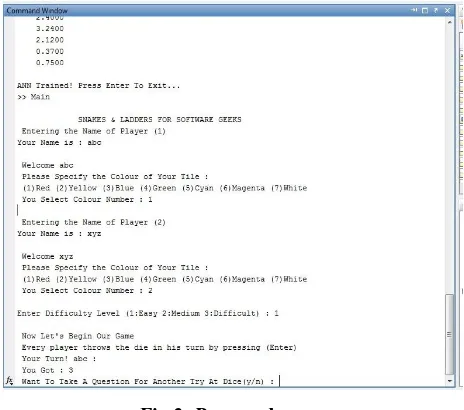
Fig 2: Neural Network Training
As shown in figure 2, neural network training is provided for game to establish a brain to estimate or predict software cost as per the given dataset. Here, a two-layer feedforward network with hidden neurons and linear output neurons is taken.
Fig 3: Proposed game
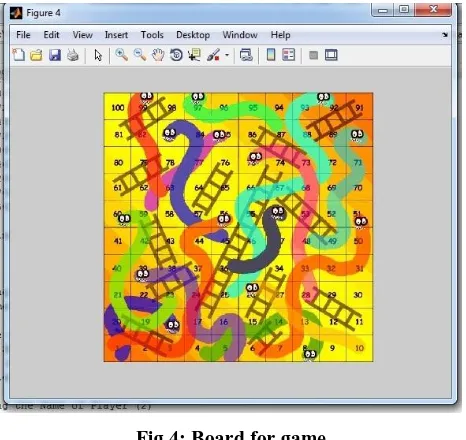
[image:3.595.310.542.373.578.2]Fig 4: Board for game
As shown in figure 4, the board is displayed which we have used in our game.
Fig 5: TCP/IP connection establishment
As shown in figure 5, TCP/IP connection is being established between client and server block. Here, we have given IP address of same PC but we can change it according to the other PC’s IP address.
Fig 6: Training set for hand gesture recognition
As shown in figure 6, training set is already been provided for hand gesture recognition which we have captured earlier.
V. CONCLUSION
In this paper, it is been concluded that our proposed game can be useful for software project management training as the learner can train himself by predicting software estimation cost correctly. This has been more attractive as it uses hand gesture recognition. The use of TCP/IP makes it more realistic as two players can play it on their own personal computers or laptops. It is been proposed in MATLAB. The learner will be more involved in this as it uses gesture recognition which is making it more realistic.
REFERENCES
1. Alejandro Calderon and Mercedes Ruiz. Bringing Real-Life Practice in
Software Project Management Training through a Simulation-based Serious Game. CSEDU 2014 6th International Conference on Computer Supported Education
2. Amir Zeid. Using Simulation Games to teach Global Software
Engineering Courses. IEEE 2015.
3. Carpes Jones. Software Project Management Practices: Failure Versus
Success. The journal of defense software engineering.
4. A. I.Wang and B.Wu, “An application of a game development framework
in higher education,” International Journal of Computer Games Technology, vol. 2009, Article ID 693267, 12 pages, 2009.
5. Jorge Marques Prates. Teaching and Learning Software Project
Management: a hands-on approach. 2015 IEEE Conference Paper.
6. Emily Navarro. SimSE: A Software Engineering Simulation
Environment for Software Process Education. Dissertation Report, University of California, Irvine.
7. Emily Oh, Andre Van Der Hoek. Towards Game based Simulation as a
method of teaching Software Engineering. 32nd IEEE Frontiers in
Education Conference.
8. Alexander Nassal. A General Framework for Software Project
Management Simulation Games. IEEE Conference Paper 2014.
9. M. Prensky, “Digital game-based learning,” Computers in
Entertainment, vol. 1, no. 1, pp. 21–24, 2003.
10. J. Blow, “Game development: harder than you think,” Queue, vol. 1, no. 10, pp. 28–37, 2004.
11. B. A. Foss and T. I. Eikaas, “Game play in engineering
education—concept and experimental results,” International Journal of Engineering Education, vol. 22, no. 5, pp. 1043–1052, 2006. 12. A. I. Wang, T. Øfsdahl, and O. K. Mørch-Storstein, “Lecture quiz—a
mobile game concept for lectures,” in Proceedings of the 11th IASTED International Conference on Software Engineering and Application (SEA ’07), pp. 305–310, 2007.
13. A. I. Wang, T. Øfsdahl, and O. K. Mørch-Storstein-Storstein, “An evaluation of a mobile game concept for lectures,” in Proceedings of the IEEE 21st Conference on Software Engineering Education and Training, pp. 197–204, 2008.
14. M. S. El-Nasr and B. K. Smith, “Learning through game modding,”
Computers in Entertainment, vol. 4, no. 1, pp. 45–64, 2006. 15. J. Kirriemuir and A. McFarlane, “Literature review in games and
learning,” Tech. Rep. 8, 2004.
16. A. Baker, E. O. Navarro, and A. van der Hoek, “Problems and programmers: an educational software engineering card game,” in
Proceedings of the 25th International Conference on Software Engineering, pp. 614–619, May 2003.
17. F. McCown, “Teaching a game programming class for the first time: tutorial presentation,” Journal of Computing Sciences in Colleges, vol. 25, no. 5, pp. 131–132, 2010.
18. Bian Wu and Alf Inge Wang, “A Guideline for Game
[image:4.595.55.280.302.492.2] [image:4.595.65.275.555.740.2]AUTHORS PROFILE
Shaily Sharma has a qualification of Diploma in Computer Science & Engg.-2011 from Government Polytechnic College, Ajmer and B.Tech. in Computer Science & Engg.-2014 from Governemnet Engineering College, Ajmer. She is currently pursuing M.Tech. in Computer Science & Engg. from Government Engineering College, Ajmer. Her research interest includes Software Engineering and Image Processing.
Dr. Prakriti Trivedi has a qualification of B.E. in Computer Science & Engg. from MBM Engineering College Jodhpur, M.E. in Computer Science & Engg. from NITTTR Punjab University Chandigarh and PhD. She is currently working as Associate Professor in
Department of Computer Science Engineering,