Rochester Institute of Technology
RIT Scholar Works
Theses
Thesis/Dissertation Collections
8-1-1987
The Exploration of spatial relationships through a
personal iconography
Sara Koblentz
Follow this and additional works at:
http://scholarworks.rit.edu/theses
This Thesis is brought to you for free and open access by the Thesis/Dissertation Collections at RIT Scholar Works. It has been accepted for inclusion in Theses by an authorized administrator of RIT Scholar Works. For more information, please [email protected].
Recommended Citation
ROCHESTER INSTITUTE OF TECHNOLOGY
A Thesis Submitted to the
Faculty
ofThe College of Fine and Applied Arts
in
Candidacy
for the Degree ofMASTER OF FINE ARTS
THE EXPLORATION OF SPATIAL RELATIONSHIPS
THROUGH A PERSONAL ICONOGRAPHY
By
SARA KOBLENTZ
APPROVALS
Adviser:
_--,R,-="o-",b"",-er,--,t,-,S"",c"-,h",-,m~it",,,z_
Date:----i.l-2_
t....:....-1
~[
_ '"::::"-'/--lr
_ _
Associate Adviser:
_--,L~eo"-,n,,-,a~r-,,,d,-U"='-!.r",,",so,,---_
Associate Adviser: _--'K=.:..r=is'-N"-=e=]s""o""n'--
_
Date:
_
Special Assistant to the
Dean for Graduate Affairs: _-,P,--,h,,-!i,,-,li""p,-B""-,,,-o,-,-n
a"'"'r'-'t-'-"h_~'"______,~~---7"'+---+-"--';L-~'---,L-f---Date
~-
11.
(1
f"1
Dean, College of
Fine & Applied Arts:
~D~r,-.""'R'""o'-"b""'e.!...rt~Jo"-'h"-'n~s'_'t~on~_
Date:
_fI--=--t'I---=1..::=--t-=--=--
_
I
Sara Koblentz
,
prefer to be contacted each time a request for
;r&ti::tion is niade.
I
can be
~ached
at the following address.
TABLE OF CONTENTS
DEDICATION iv
PREFACE v
INTRODUCTION 1
PART I
-MIMBRES
POTTERY,
HISTORICAL REFERENCE 2SPATIAL ANALYSIS 4
INTERPRETATION OF SYMBOLS 5
PART II - MY
WORK,
BLACK BOWL SERIES 9SPATIAL ANALYSIS. 11
INTERPRETATION OF IMAGES 12
A Short Interpretation of the Bowls 14
POEM 16
TECHNICAL INFORMATION 17
PROCESS 17
CLAY AND GLAZE RECIPES 19
CONCLUSION 20
BIBLIOGRAPHY 21
LIST OF PHOTOGRAPHS
Figures
1. Black Bowl
Series,
No. 1 262. Black Bowl
Series,
No. 2 273. Black Bowl
Series,
No. 3 284. Black Bowl
Series,
No. 4 295. Black Bowl
Series,
No. 5 306. Black Bowl
Series,
No. 6 317. Black Bowl
Series,
No. 7 328. Black Bowl
Series,
No. 8 339. Black Bowl
Series,
No. 9 3410. Black Bowl
Series,
No. 10 3511. Black Bowl
Series,
No. 11 3612. Black Bowl
Series,
No. 12 3713. Black Bowl
Series,
No. 15 3814. Celadon Platter No. 1 39
15. Celadon Platter No. 2 40
LIST OF TABLES
1. DIVISIONS OF THE BOWL 10
DEDICATION
In Mimbres culture, bowls with "kill holes" were placed over the head of the
deceased in order to permit the free passage of the spirit out into the Upperworld.
It is a symbol of
death,
emergence and rebirth. In our culture today there areritual and spiritual means of releasing the spirit in this life. Psychology has as its
base the purpose of permitting the psyche to free itself from limitations. A person
overcome with psychological blocks may be
"dead"
to
life,
unable to function.My
thesis has been dedicated to my father who spent his lifehelping
others toreemerge from the black depths of despair to acceptance of themselves and to a
PREFACE
Before coming to graduate school my work in clay had undergone a major
transition. In
Portland,
Oregon I had been a production potter for many years. Ireturned to New York
City
with the intention ofdeveloping
aniconography
ofpersonal images in three dimensions.
My
idea originated through sketches done inwatercolor. The actual transition from production pots to one-of-a-kind pieces was
through a surface motif carved into wet porcelain clay. In New York I used
low-fire clay with bright colored underglazes.
My
development has been an intuitiveprogression, where I am conscious of my states of mind, mood fluctuations and
sometimes paradoxical personality.
I have
long
been interested in various subjects such as psychology,anthropology, mythology, metaphysics and astrology.
They
are all systems forunderstanding man and the human psyche.
My
personaliconography
became asystem for understanding my world and my place in it. The icons were images
which had repeatedly appeared in my life and my work.
They
became referencepoints for me.
A question became paramount. Is this symbology just for me or is there a
need for others to understand what I am doing? I think this question will always
remain with me.
My
art is very personal, my way ofseeing the world. But at thesame time it was not meant to sit in a closet somewhere but to be seen. It is
through its
formality,
subtlety or assertiveness of design and color that I wish toINTRODUCTION
During
my first year of Graduate school I was introduced to Mimbres potteryin a Ceramic
History
course. I felt an immediate connection to the interior spacesof energetic movement and complex designs. The hemispheric bowl form containing
geometric compositions, mythical subject matter and a sense of space and life
within, suggested a context for my own personal mythology.
This written thesis is a discussion of Mimbres painted pottery with a parallel
presentation of the ideas behind my own clay work.
Only
the most relevant aspectsPART I
MIMBRES POTTERY
PART I MIMBRES POTTERY
HISTORICAL REFERENCE
The Mimbres culture existed within a600 hundred year period from AD 550 to
AD 1150 in the southwestern United States near the Mexican border. It was a time
when compared to the rest of the western world life was comparatively
harmonious,
where the "world was viewed as something of an amiable cosmic The
Mimbres pottery painters depicted this world within the interior of small bowls.
Each bowl was a
fantasy
world of intense vitality. I had thought of my originalmotif as a mandala, a symbol of my own ideal world. These too were mandalas. As
Tony
Berlant states in Mimbres Pottery. "A Mimbres bowl reveals the forces ofnature through the vision of the artist and as the paint flowed from her yucca
brush,
she began to create notjust a rabbit or an antelope but a model of theworld."2:13
Mimbres Bowls which range in size from 9"
to 13" in diameter and 3" to 5"
deep
were intended for utilitarian purposes. However a number of factors indicatethis was not always true. J.J.
Body
points out in his description of Mimbres bowlsin Mimbres Pottery how the exterior of the vessel is left rough and undecorated.
The interior on the other hand has been given extreme attention. Here a smooth
layer of white slip covers the entire surface and extraordinary care is given to the
complex brushwork. He states:
*First number refers to the number of the reference in the
Bibliography;
those afterThe careful preparation of the surfaces to be painted and the
standardization of the shape, size, and proportions of these surfaces
suggest that many vessels were considered less as containers than as
surfaces on which to make paintings.2,76
Many
of the bowls were buried with the dead below theliving
quarters oftheir dwellings.
Bowls,
firsthaving
been broken with "killholes,"
were inverted
over the head of the deceased. It is believed this was to enable the emergence of
the spirit to the Upperworld. Bowls with images of ritualistic practices and mythic
heros such as the Hero
Twins,
might have had something to do with the life of thedeceased,
or good luck in thejourney
into the underworld. Other bowls withscenes
depicting
activities ofeveryday life such as planting, weaving, and givingbirth could be events
happening
in the life after death.Figurative images such as these were found on about 1/3 of the bowls found
in burial sites. Figures rarely appeared on sherds of bowls for household use.
Further, a large percentage of burial bowls show no sign of
having
been used.From this perspective we see that not all Mimbres bowls were for mundane use.
Instead,
some were probably made specifically for the ritual burial of the dead andhad a symbolic function.
SPATIAL ANALYSIS
In Mimbres Painted Pottery. J.J.
Brody
creates a careful analysis of Mimbresbowl architecture used
by
the pottery painters. The bowls are organized into amultiple bands were placed just below the rim. The center was emphasized
by
either a
framing
device(band)
or lines converging towards the center. The complexpatterns
defining
the walls further segmented the space. The two, three,four, five,
etc. divisions were integrated through
interlocking
and overlapping images so as tobe read as a unified image.
INTERPRETATION OF SYMBOLS
Form
Through knowledge acquired from contemporary Pueblo society, and
ethnographic analogy, Barbara Moulard has been able to interpret much about early
Mimbres thought. In Within the Underworld Sky she postulates the bowl form itself
was significant. She believes it serves as a "metaphor for the barrier between the
Mimbres Underworld and Upperworld."3:xvm She has observed that there were plain bowls used in burials as well as those with decoration. The creation of the
"kill holes" changed their importance as a useful object to a ceremonial symbol. It
was no longer meant to contain but was now an "open dome enclosure".3:xvni
Line
All Mimbres decoration was composed of
line;
either parallel to the rimresulting in a circle or connecting two points. It is used to fill areas as fine-line
parallel hatching, or as a
framing
device. Line is either thick or thin. Thick lineis often a
framing
line and thin line for hatching. The style ofhatching
(wavy
lines or straight) has been used to place bowls in a particular time frame and
location.
Line also has symbolic value. It may mean either progression or restraint. A
lines perpendicular to a path closes off the path to the dead. A circle, no
beginning
or end is a means to trap the spirits within.3:X1XColor
The use of color is another matter of importance to understand Mimbres
Painted Pottery. The use of a reduction fire (the elimination of oxygen in the
atmosphere) to obtain a contrasting effect ofblack and white had become a prime
objective of the southwestern peoples. There must have been a great deal of
importance given to the resulting effects since it was a difficult technique to
achieve.
Consequently,
according to Moulard, color was of significance. She states:Color use in the art of the contemporary Pueblos is reflective of a
cosmology that divides the world into six directions. Each direction is
associated with a different color: yellow for North . . . ; white for East
. . . red for South . . . ; Blue-green for West . . . ; Black for the Zenith
and all colors, or a combination of black and white, for the Nadir. . . .
Black and white and the combination of the two have definite
associations with the spirit world and the above and below. The color
white is symbolic of an underground waterway at the lower world level
that houses the spirit ofthe dead for the Auni and Acoma. It was to
this place that the first dead went after the emergence of the people
from the Underworld. When black and white combine to form a
checkerboard pattern (which they often do in Mimbres ceramic painting),
they become symbolic of the Milky Way. The night sky and the
Milky
Way
are the home ofthe Pueblo War Gods and the path of warrior spiritsdirections of the Zenith and
Nadir,
but they are associated with specificconcepts and personages relating to death and the Pueblo Underworld
realm of spirits3:xxi
A comparison has been made between art from the Pueblos and the few
polychrome vessels, wood and stone objects found
belonging
to the Mimbres.Similarities have been shown to exist in the color orientation and ceremonial nature
of these. Since black and white have been shown to be of significance to the
Underworld realm painted
by
the Pueblos it has been analogously applied to theMimbres.3:xxu
Both
Brody
and Barbara Moulard believe the geometric compositions of theMimbres and Pueblos are a visual metaphor for a cosomological system as well. The
structure of this includes four horizontal
directions,
the zenith, and Underworld(Nadir). A seventh place, the Middle Place, is thought to be the present home of
the group.2:114
Mimbres geometric compositions with reserved centers and quartered
vessel wall decoration could at once embody notions of the four cardinal
directions,
the center and the vertical lines of the Zenith and Nadir.Likewise,
bisected compositions could symbolize directions in oppositionsuch as the above and below. Divisions of three,
five,
six, seven andmultiples of these also conform to an ordering of the universe into
vertical layers of the Nadir, Center and Zenith and the addition of four
Barbara Moulard goes on to discuss the importance of the center to the
composition and to their cosmology. Most Mimbres bowls contain a pattern which
defines the center.
Further,
the movement of line flows from the rim towards thecenter. The "kill hole"
or point of emergence is placed there. At the same time
the center is the "Middle Place"
PART II
MY WORK
TABLE
1
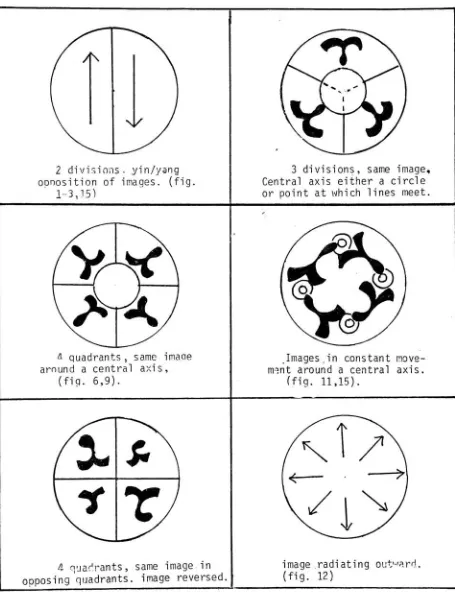
DIVISIONS OF THE BOWL
ADAPTED FROM MIMBRES PAINTED POTTERY BY J.J. BRODY
2 divisions- yin/yang oonosition of images,
(fig.
1-3,15)
3
divisions,
sameimage.
Central axis either a circle
or point at which lines meet.
O- quadrants
, same imaae
around a central axis,
(fig.
6,9).4 quadrants, same image. in opposing quadrants, image reversed.
.Images.in constant move
ment around a central axis.
(fig.
11,15).image radiating outward.
(fig.
12)
[image:18.500.21.476.56.662.2]PART II MY WORK
BLACK BOWL SERIES
The Black Bowl
Series,
small stonyblack,
4" in diameter x 1"deep
grew out ofa state of inner turmoil. Like the person who withdraws into self when confronted
with insurmountable obstacles, I withdrew my images into the interior of a bowl.
The bowl was no longer just a useful object. It became the world, the space and
surface which I would explore. The rim would be the overwhelming obstacle, the
limit which I would have to accept and work with.
SPATIAL ANALYSIS
Previously
I had used asymmetry or a random arrangement of images in mywork. I now began to think in terms of symmetry and balance. In this
imaginary
space there would be order and harmony. The rhythmic movement of a patterning
system was more dynamic. Through repetition, opposition, contrast and a
juxtaposition of
images,
continuous motion and an inner balance could be achieved.Brody's analysis of Mimbres design patterns became the reference for my own
pattern making.
The first series of pieces on which I carved my images were thought of in
terms of a yin/yang opposition. The surface was divided in half with each side
containing the same images but placed in opposing directions. The images covered
the entire space up to the rim. (fig.
15)
A variation on this was to make a broadband extending from the rim with the images placed within the ring. I next worked
with
dividing
the platter into thirds, again without the use ofa rim band. (fig.14)
A later division of fourths took several variations. One variation contained thesame size image used in all four quarters and another in which
diagonally
opposingquadrants had the same size image, (fig.
5,9,13)
The most recent pieces are centeroriented. The central area is a circle or a point at which lines converge, (fig.
4,5)
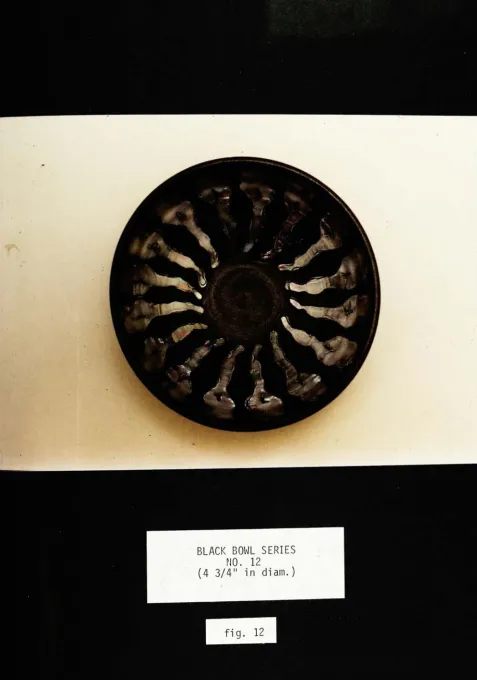
The images radiate outward from the center or inward towards the center, (fig.
6,12)
Although the images are distinct and separate entities, when viewed togetherthey create a unified pattern.
INTERPRETATION OF IMAGES
The Bowl Form
The interior of a bowl form evokes a sense of a place, an interior private
space. It has walls for containment, protection, confinement and limitation.
Metaphorically, it may be a psychological space where we hold our inner thoughts
and feelings or a metaphysical space containing invisible and spiritual phenomena.
Curvilinear Line as opposed to Angles & Edges
Life is full of "hard edges"; the unexpected turn of events which can create
disruption and turmoil. Here I chose to use curvilinear lines. I wish to soften
these events yet move forward despite the circuitous route life often takes. The
refinement, smoothness and consistency ofthe line indicates a personal need to
have control over my destiny.
Color
Within a culture a particular color often evokes a similar response among
people, in a very different culture it may have an altogether different meaning.
My
use of black refers to an unconscious state and paradoxically to black holes of
depression. The cold stony quality may evoke feelings of alienation, and isolation.
In addition to the black surface, a black clay
body
was used. Here it issymbolic of the essence of; a need to understand the intrinsic nature of something;
a need to understand the self.
A pearl luster which reflects all the colors of the rainbow is an indication of
Hope and a
"dawning
reality".Circles and Projections
Circles and projections refer to polarities.
They
are the opposing forceswithin, needing to be integrated to achieve a state of harmony.
The Figure
The figure is myself, since it is my world and my place in it that I am seeking
to understand. It is also an indication ofconscious awareness. The figure is
bare,
unencumbered
by
cultural and societal associations andlimits;
free and open to newinsights in the search for truth.
Division of the Bowl Surface
Dividing
the bowfs surface into segments was a system for creating order andbalance. On a material
level,
it is an organization of the bowl's space,defining
therim, center, and walls. The bowl's natural symmetry and formare indicated.
Metaphorically, it is a means for
defining
a world where all options are possible.The Center
"To leave the circumference for the center is equivalent to moving from the
exterior to the interior - from form
to contemplation, from multiplicity to
unity"10:39
A Short Interpretation of the Bowls
The images contained in the bowls went through several phases, although they
were sometimes done simultaneously. At first they were purely abstractions. Next
the abstractions incorporated the human figure and
lastly
only the human figure ispresent.
In the first phase, complete abstraction was composed of both curvilinear and
geometric forms in a yin/yang duality, (fig.
1,2,3)
It was an exploration of theintegration of opposing forces within the human psyche. However clarity and
knowledge of their existence remains in an unconscious state. The next phase
contains
intertwining
and overlapping curvilinear forms and a repetitiverepresentational image around a central axis. (fig.
7-9,13)
Here I am againconcerned with integration. Conflict exists between the unconscious world and the
physical present. At this point there is the
beginning
of awareness. The center isthe unifying source which keeps these energies in balance. In the last series, a
repetitive representational image either radiates towards the center or away from
the center, (fig.
6,12)
The directional movement of the figure inward towards thecenter is related to the mind turned inwards to thought. In the extreme, the mind
becomes caught within a circle ofthought. Depression or other psychic
disturbances result. The figure pointed outward is moving towards active
participation in life but with the knowledge and guidance
by
a source. Now one isalso
fully
aware and accepting of one's ultimate responsibility.POEM
"Day
is night whenDaddy
comes home."A child's first words,
An observed reality.
Life is night when
Father leaves.
A Daughter's pain,
but,
TECHNICAL INFORMATION
PROCESS
My
work began using porcelain. A smooth textured surface was needed forcarving.
Groggy,
large particled clay would have left pits and destroyed the subtleelegance. A celadon glaze which pooled in the
deep
recesses, created a variation ofcolor
intensity
and a sense of the watery deep. I wanted to instill them with asense of
history
and permanence and again a celadon glaze was part of the ancientChinese tradition.
About midway through the year I realized that celadon was a beautiful but too
easy solution. I wanted to raise the pieces above the everyday realm of experience.
At this juncture I did two things.
(1)
I altered the scale. The 16 inch plattersbecame small
bowls,
4 inches indiameter,
and(2)
I developed a black mediumfiring
range clay
body
in which to carve directly. The surface would not need a glazebut be wrapped in a thin coating of terra sigillata of the same color to impart a
satin sheen. An extreme subtlety ofblack on black was achieved. Here I added a
variation. I accented the figures with a white terra sigillata creating a dramatic
contrast. Next I further played with variations in the surface. First I shifted
back to black on
black,
but this timeburnishing
the areas which were carved away.Here the subtle contrast was between the rough unreflective surface, and the
smoother burnished areas. In my last pieces I again returned to high contrast. I
used a mother of pearl cone 018 luster over a white cone 04 semi opaque white
glaze.
The figurative images which I began to use originated in the figure classes
that I had attended
during
the year. I had the fortune of oftenbeing
the onlystudent at the session. As a result I was able to position the model as I desired.
At first I rendered many female figures within bowls and in a circular format on
paper. However something else was needed. The figures needed to be transformed
from rendering to a more abstracted line drawing. The drawings of Matisse were
my source for this. John Elderfield states that to Matisee the figure is decoration.
Matisse expresses a freedom of
drawing
in his use of the arabesque.12:5 Thearabesque was characteristic of my curvilinear motif, it could be carried through
into my drawings of the figure and create the transition from abstraction to
figurative decoration. A repetitive image was created through the use of a
template. The template was a copy of an original
drawing
which I was then able toreduce or enlarge on the copying machine to create templates at various sizes. An
outline of the template was scratched into the leatherhard clay and the interior
lines were drawn freehand. The figure was integrated with the abstract motif with
fine sgraffito lines. After this, the larger areas were carved away to create a
CLAY AND GLAZE RECIPES
BLACK CLAY BODY RECIPE TERRA SIGILLATA
(from
Judy
Salomon)
Tile #6 Kaolin 35
Om4 15
Custer Feldspar 25
Silica 25
Mason Stain 6616 5%
Add Mason Stain to
dry
mix.Fire to Cone 3
14 Cups Water
3 Lbs.
Grolleg
7.5 Grams Calgon
(Black)
5% 6616Ball mill for 24 Hours.
JADE GREEN CELADON AMBER CELADON
Soda Spar F4 38
Whiting
7Barium Carbonate 14
EPK 11
Flint 27
Red Iron Ox. 3
Custer 36
Whiting
185Neph Sy. 5
Dolomite 2
Ball
Clay
9EPK 2.5
Flint 27
Red Iron Ox. 8
CONCLUSION
I believe the work I have done has successfully fulfilled what I had set out to
accomplish. That
is,
to explore the space of a simple form through the use of apersonal imagery. I have continued the development ofand transformed this
imagery,
touching the past and present with a sense ofthe future.The process has enabled me to see more clearly what has always been most
important to express in my work; to convey a very personal and underlying sense
of the spirit. Changes were made along the way in order to emphasize this
essential.
I conclude my work at a new level of understanding, a point of departure for
further exploration.
BIBLIOGRAPHY
1.
Brody,
J. J. Mimbres Painted Pottery. School of AmericanResearch,
Santa Fe,New Mexico:
University
ofNew MexicoPress,
19772.
Brody,
J.J. et al. Mimbres Pottery: Ancient Art of the American Southwest.New York: Hudson Hill
Press,
1983.3.
Bunzel,
Ruth Leah. The Pueblo Potter: A Study of Creative Imagination inPrimitive Art. New York: Dover Publications, 1972
4. Moulard, Barbara. Within the Underworld Sky. Mimbres Ceramic Art in Context.
Pasadena, California: Twelve Trees
Press,
1984Related Bibliography
5. Arguelles, Jose. Transformative Vison: Reflections on the nature and History of
Human Expression. Colorado: Shambahala Publications
Inc.,
19756. Axsom, Richard H. The Prints of Frank Stella: A Catalogue Raisonne 1967-1982.
New York: Hudson Hills Press, 1983
7. Bachelard, Gaston. The Poetics of Space. Boston: Beacon Press, 1969
8.
Campbell,
Joseph. The Masks of God: Primitive Mythology. New York: PenguinBooks, 1969.
9.
Campbell,
Joseph. The Masks of God: Creative Mythology. New York: PenguinBooks,
1968.10. J.E. Cirlot. Dictionary of Symbols. New York: Philosophical
Library,
196211.
Dobin,
Joel C. Astrological Secrets of the Hebrew Sages: To Rule Both Day &Night. Inner
Tradition,
198312.
Elderfield,
John. The Drawings of Henri Matisse. New York and the ArtsCouncil of Great Britain: Thames and Hudson with the Museum of Modern
Art, 1984-1985
13.
Flam,
Jack D. Matisse on Art. New York: E.P. Dutton, 197814.
Graves,
Robert. The White Goddess. New York: Farrar, Straus &Geroud,
198115.
Harding,
M. Esther. Woman's Mysteries Ancient and Modern. C.G.Jung
Founndation for Analytical Psychology, New York: Harper Colophon
Edition,
197616. Harding, M. Esther. Way of All Women. C. G.
Jung
Foundation for AnalyticalPsychology, New York: Harper Colophon
Edition,
197617.
Jocobi,
Jolande. The Way of Individuation. Translatedby
R.F.C. Hall.New York: New American
Library
MeridianBook,
198318.
Jung,
C.G. Mandala Symbolism.Princeton,
New Jersey: BollingenSeries,
Princeton
University Press,
197319. May, Rollo. The Courage to Create. New York: W.W. Norton &
Company
Inc.Bantom
Book,
198020. Rudhyar, Dane. The Astrology of Transformation. Theosophical Publication
House, Quest Book, 1980
21. Paz, Octavio. Conjunctions, and Disjunctions. Translated
by
Helen K. Lane.New York: Seaver Books, 1982
22. Rawson, Philip. Ceramics. Philadelphia:
University
of Pennsylvania Press, 198423.
Singer,
June. Boundaries of the Soul. New York: Doubleday, 1973BLACK BOWL SERIES
NO. 2 (4"
BLACK BOWL SERIES NO. 3
(4"
BLACK BOWL SERIES MO. 4
(4
1/4"BLACK BOWL SERIES NO. 6
(4
1/4"BLACK BOWL SERIES
NO. 8
(4"
BLACK BOWL SERIES
NO. 9 (4"
BLACK BOWL SERIES NO. 10
(4
1/4"BLACK BOWL SERIES NO. 11
(4
3/8"BLACK BOWL SERIES NO. 12
(4
3/4"in
diam.)
fig. 12
OH
[image:44.500.8.486.9.690.2]CELADON PLATTER NO. 1
(16"
CELADON PLATTER
NO. 2
(16"
tfs*gSsK?i?ft?ft
I
> 'I
BLACK BOWL SERIES
NO. 8