Procedia Computer Science 00 (2010) 1–10
Generative Topographic Mapping by Deterministic Annealing
Jong Youl Choia,b, Judy Qiua, Marlon Piercea, Geoffrey Foxa,b
aPervasive Technology Institute, Indiana University, Bloomington IN, USA bSchool of Informatics and Computing, Indiana University, Bloomington IN, USA
Abstract
Generative Topographic Mapping (GTM) is an important technique for dimension reduction which has been successfully applied to many fields. However the usual Expectation-Maximization (EM) approach to GTM can easily get stuck in local minima and so we introduce a Deterministic Annealing (DA) approach to GTM which is more robust and less sensitive to initial conditions so we do not need to use many initial values to find good solutions. DA has been very successful in clustering, hidden Markov Models and Multidimensional Scaling but typically uses a fixed cooling schemes to control the temperature of the system. We propose a new cooling scheme which can adaptively adjust the choice of temperature in the middle of process to find better solu-tions. Our experimental measurements suggest that deterministic annealing improves the quality of GTM solutions.
Keywords: deterministic annealing, optimization, dimension reduction
1. Introduction
Visualization of high-dimensional data in a low-dimension space is the core of exploratory data analysis in which users seek the most meaningful information hidden under the intrinsic complexity of data mostly due to high dimensionality. Among many tools available thanks to the recent advances in machine learning techniques and statistical analysis, Generative Topographic Mapping (GTM) has been extensively studied and successfully used in many application areas: biology [1, 2], medicine [3, 4], feature selection [5], to name a few.
Generative Topographic Mapping (GTM) [6, 7] is an unsupervised learning method devel-oped for modeling the probability density of data and finding a non-linear mapping of high-dimensional data onto a low-high-dimensional space. Similar algorithms known for dimension re-duction are Principle Component Analysis (PCA), Multidimensional Scaling (MDS) [8], and Self-Organizing Map (SOM) [9]. In contrast to the Self-Organizing Map (SOM) which does
Email addresses:[email protected](Jong Youl Choi),[email protected](Judy Qiu),
not have any density model [7], GTM defines an explicit probability density model based on Gaussian distribution. For this reason, GTM is also known as a principled alternative to SOM.
The problem challenged by the GTM is to find the best set of parameters associated with Gaussian mixtures by using an optimization method, notably the Expectation-Maximization (EM) algorithm [6, 7]. Although the EM algorithm [10] has been widely used in many opti-mization problems, it has been shown a severe limitation, known as a local optima problem [11], in which the EM method can be easily trapped in local optima failing to return global optimum and so the outputs are very sensitive to initial conditions. To overcome such problem occurred in the original GTM [6, 7], we have applied a robust optimization method known as Deterministic Annealing (DA) [12] to seek global solutions, not local optima. Up to our best knowledge, this is the first work to use DA algorithm to solve the GTM problem in the literature.
The DA algorithm [12] has been successfully applied to solve many optimization problems in various machine learning algorithms and applied in many problems, such as clustering [13, 12, 14], visualization [15], protein alignment [16], and so on. The core of the DA algorithm is to seek an global optimal solution in a deterministic way [12], which contrasts to stochastic methods used in the simulated annealing [17], by controlling the level of randomness. This process, adapted from a physical process, is known as annealing in that an optimal solution is gradually revealing
as loweringtemperature which controls randomness. At each level of temperature , the DA
algorithm chooses an optimal solution by using the principle of maximum entropy [18, 19, 20], a rational approach to choose the most unbiased and non-committal answers for given conditions. Regarding the cooling process, which affects the speed of convergency, in general it should be slow enough to get the optimal solutions. Two types of fixed cooling schemes, exponential
cooling schemes in which temperatureT is reduced exponentially such thatT =αT with a
co-efficientα < 1 and linear scheme likeT = T −δfor δ > 0, are commonly used. Choosing the best cooling coefficientαorδis very problem dependent and no common rule has not yet been reported. Beside of those conventional schemes, in this paper we also present a new
cool-ing scheme, namedadaptive cooling schedule, which can improve the performance of DA by
dynamically computing the next temperatures during the annealing process with no use of fixed and predefined ones.
The main contributions of our paper are as follow:
i. Developing the DA-GTM algorithm which uses the DA algorithm to solve GTM problem. Our DA-GTM algorithm can give more robust answers than the original EM-based GTM algorithm, not suffering from the local optima problem (Section 3).
ii. Deriving closed-form equations to predict phase transitions which is a characteristic behav-ior of DA [21]. Our phase transition formula can give a guide to set the initial temperature of the DA-GTM algorithm. (Section 4)
iii. Developing an adaptive cooling schedule scheme, in which the DA-GTM algorithm can automatically adjust the cooling schedule of DA in an on-line manner. With this scheme, users are not required to set parameters related with cooling schedule in DA. (Section 5)
Our experiment results showing the performance of DA-GTM algorithm in real-life applica-tion will be shown in Secapplica-tion 6 followed by our conclusion (Secapplica-tion 7)
2. GTM Reviews
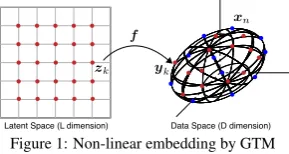
Data Space (D dimension) Latent Space (L dimension)
zk yk
xn
[image:3.595.226.371.149.226.2]f
Figure 1: Non-linear embedding by GTM
space, such thatzk ∈ RL(k = 1, ...,K), which can optimally represent the givenN data points
xn∈RD(n=1, ...,N) in the higherD-dimension space or data space (usuallyLD) (Figure 1).
This is achieved by two steps: First, mapping the latent variables in the latent space to the data
space with respect to a non-linear mapping f : RL 7→ RD. Let us denote the mapped points
in the data space asyk. Secondly, estimating probability density between the mapped pointsyk
and the data points xn by using the Gaussian noise model in which the distribution is defined
as an isotropic Gaussian centered onykhaving varianceβ−1 (βis known as precision). More
specifically, the probability densityp(xn|yk) is defined by the following Gaussian distribution:
N(xn|yk, β) =
β
2π
D/2
exp
−β
2kxn−ykk
2. (1)
The choice of the non-linear mapping f :RL7→RDcan be made from any parametric,
non-linear model. In the original GTM algorithm [6, 7], a generalized non-linear regression model has been used, in which the map is a linear combination of a set of fixedMbasis functions, such that,
yk=φTrkW, (2)
where a column vectorφk = (φk1, ..., φkM) is a mapping of zk by the M basis function φm :
RL7→ Rform=1, ...,M, such thatφkm =φm(zk) andWis aM×Dmatrix containing weight
parameters. ATrrepresents a transpose ofA.
With this model setting, the objective of GTM algorithm corresponds to a Gaussian mixture problem to find an optimal set ofyk’s which maximizes the following log-likelihood:
L(W, β) = argmax
W,β
N
X
n=1 ln
1
K K
X
k=1
p(xn|yk)
(3)
It is the problem that findingK centers for Ndata points, known asK-clustering problem.
SinceK-clustering problem is NP-hard [22], the GTM algorithm uses the EM method which
starts with initial random weight matrixWand iteratively refines it to maximize Eq. (3), which can be easily trapped in local optima. More details can be found in the original GTM paper [6, 7].
3. GTM with Deterministic Annealing (DA-GTM)
Since the use of EM, the original GTM algorithm suffers from the local optima problem in which the GTM map can vary depending on the initial parameters. Instead of using the EM, we have applied the DA approach to find a global optimum solution. With the help of DA algorithm, we can have more robust GTM maps against the random initial value problem.
In fact, the GTM algorithm’s objective function (3) is exactly the same problem, so called
optimal clusters for a given distance or distortion measure by using the deterministic annealing approach . In Rose’s paper, squared Euclidean distance has been used as distortion measurement. However, in the GTM algorithm, distances are measured by the Gaussian probability as defined in (1). Thus, by plugging the Gaussian probability into Rose’s DA method, we can solve the GTM problem with DA algorithm. By using Rose’s equations, we can drive a new objective function, known asfree energy, for the DA-GTM algorithm as follows:
F(W, β,T) = argmin
W,β,T
−T N
X
n=1 ln
1
K
!1T XK
k=1
p(xn|yk)
1 T
(4)
which we want to minimize as lowering temperature such thatT →1.
Notice that the GTM algorithm’s objective function (3) differs only the use of temperatureT
with our functionF(W, σ,T). Especially, atT =1,L(W, β)=−F(W, β,T) and so the original GTM algorithm’s target function can be considered as a special case of the DA-GTM algorithm’s.
To minimize (4), we need to find parameters which make the following derivatives be zeo.
∂F
∂yk = β
N
X
n=1
ρkn(xn−yk) (5)
∂F
∂β =
N
X
n=1
K
X
k=1 ρkn
D
2β−
1
2kxn−ykk 2
!
(6)
whereρknis a property, known asresponsibility, such that,ρkn=p(xn|yk)
1
T/PK
k0=1p(xn|yk0) 1 T.
By using the same matrix notations used in the GTM paper [6, 7], the DA-GTM algorithm can be written as a process to seek an optimal weightsWand precisionβat each temperatureT.
W = (ΦTrG0Φ)−1ΦTrR0X (7)
β = 1
ND N
X
n K
X
k
ρknkxn−ykk
2 (8)
whereXis aN×Ddata matrix,Φis aK×Mbasis matrix,G0is aK×Kdiagonal matrix with elementsg0kk=PN
n(ρkn)
1 T.
4. Phase Transitions of DA-GTM
As a characteristic behavior of the DA algorithm explained by Rose in [12], it undergoes phase transitions as lowering the temperatures. At some temperature, we can not obtain all solu-tions but, instead, we can only obtain effective number of solutions. All solutions will gradually pop out while the annealing process proceeds as with lowering the temperature.
In the DA-GTM algorithm, we can observe the same behavior. As an extreme example, at
very high temperature, the DA-GTM algorithm gives only one effective latent point in which
allyk’s are converged into the same point ¯x which is the center of data points, such that ¯x = PN
n=1xn/N. As lowering the temperature under a certain point,yk’s settled in the same position
In DA, we can define such phase transitions as a moment of loosing stability of the objective function, the free energyF, and turning to be unstable. Mathematically, that moment corresponds to the point in which the Hessian of the object function looses its positive definiteness.
For our DA-GTM algorithm, we can write the following Hessian matrix as a block matrix:
H =
H11 · · · H1K
..
. ...
HK1 · · · HKK
, (9)
where a sub matrixHi jis a second derivative of the free energyFEq. (4). More specifically,Hi j
can be written as follows:
Hkk = ∂
2F ∂yk∂yTr
k
=−
N
X
n
(β2
Tρkn(1−ρkn)(xn−yk)
Tr(x
n−yk)−βρknID
)
,or (10)
Hkk0 =
∂2F
∂yk∂yTr
k0
=
N
X
n
(β2
Tρknρk0n(xn−yk)
Tr(x
n−yk0)
)
(k,k0), (11)
wherek,k0=1, . . . ,K, andI
Dis an identity matrix of sizeD. Note thatHkkandHkk0areD×D matrices and thus,H∈RKD×KD.
With the Hessian matrix above, we can compute the first phase transition point occurred atTc. Assuming that the system hasn’t undergone the first phase transition and the current temperature is high enough, then we will have all yk’s settled in the center of the data point, denoted by
y0=x¯ =PNn=1xn/N, and equal responsibilities as follows:
yk=y0andρkn=1/K (12)
for allk=1, ...,K. Then, the second derivatives can be rewritten by
Hkk=−
β2N
T K2
(
(K−1)Sx|y0−
T K
β ID
)
andHkk0 =
β2N
T K2Sx|y0 (13) whereSx|y0represents a covariance matrix of centered data set such that,
Sx|y0 = 1
N N
X
n=1
(xn−y0) Tr
(xn−y0) (14)
and the Hessian matrix also can be rewritten by
H = −β
2N
T K2
(K−1)Sx|y0 · · · −Sx|y0
..
. ... ...
−Sx|y0 · · · (K−1)Sx|y0
−T K
β IKD
(15)
The first phase transition occurs when the system is getting unstable so that the above Hessian matrix is loosing its positive definiteness. I.e., the first phase transition is the moment when the Hessian matrix becomes singular and so its determinant equals 0(zero), such that det(H)=0 at
T =Tc, which holds the following:
eig
(K−1)Sx|y0 · · · −Sx|y0 ..
. ... ...
−Sx|y0 · · · (K−1)Sx|y0
Iteration
Temp
1 2 3 4 5
200 400 600 800 1000
(a) exponential
Iteration
Temp
2 3 4 5
200 400 600 800 1000
(b) linear
Iteration
Temp
1 2 3 4 5
200 400 600 800 1000 1200
[image:6.595.202.396.150.212.2](c) adaptive
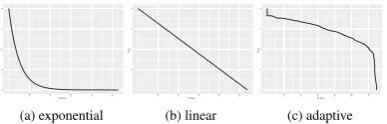
Figure 2: Various cooling schedule schemes. While exponential (a) and linear (b) is fixed and predefined, our new cooling scheme (c) is adaptive that the next temperature is determined in the on-line manner.
where eig(A) is an eigenvalue of A.
We can further simplify the above equation by using the Kronecker product:
eig
K−1 · · · −1
..
. ... ...
−1 · · · K−1
⊗Sx|y0
= eig
K−1 · · · −1
..
. ... ...
−1 · · · K−1
⊗eigSx|y0
(17)
Since the first critical temperature is the most largest one, we can use only the maximum eigenvalue among multiple of them. Thus, the first critical temperature can be obtained by the following equation:
Tc = βλmax (18)
whereλmaxis the largest value of eig(Sx|y0). Computing the subsequent critical temperature will be discuss in the next.
5. Adaptive cooling schedule
The DA algorithm has been applied in many areas and proved its success to find a global optimal solution avoiding local minima. However, up to our knowledge, no literature has been found to research on the cooling schedule of DA. Commonly used cooling schedule is exponen-tial, such asT = αT, or linear, such asT = T −δfor some fixed coefficientαandδ. Those scheduling schemes are fixed in that cooling temperatures are pre-defined and the coefficientα orδwill not be changed during the process, regardless of the complexity of a given problem.
However, as we discussed previously, the DA algorithm undergoes the phase transitions in
which the solution space can change dramatically. One may try to use very smallδnear 0 or
alphanear 1 to make smooth transitions avoiding such drastic changes. However, the procedure can go too long to be used in practice but still there is no guarantee to produce global optimal solutions (You will see an example in our experiment result in the next).
To overcome such problem, we propose an adaptive cooling schedule in which next cooling temperatures are determined dynamically during the annealing process. More specifically, at every iteration of DA algorithm, we predict the next phase transition temperature and move to the point as quickly as possible. Figure 2 shows an example, comparing fixed cooling schedules ((a) and (b)) versus an adaptive cooling schedule.
General approach to find next critical temperaturesTc at any given temperatureT will be
to derive closed-form equations and choose the best solution from multiple candidate answers. This method could not provide an exact solution, compared to the method to solve the problem in a whole set, but rather give us an approximation. However, our experiment has showed that such approximation can be a good solution. Also, another advantage we can expect in using our adaptive cooling schedule is that users has no need to set any coefficient for cooling schedule. Cooling process is automatically adjust to the problem.
At a given state in GTM algorithm, we findKsoft clusters in which each group is represented byyk. Instead of finding a global critical temperature fromKclusters at once, we can find each critical temperature at each group and choose one amongKcandidates which is the most biggest yet lower than current temperature so that it can be used as a next temperature.
The sketch of the algorithm is as follows: i) For eachkcluster (k=1, . . . ,K), find a candidate of next critical temperatureTc,kwhich should satisfy det(Hkk)=0 as defined in (10). ii) Choose
the most biggest yet lower than the currentT among{Tc,k}.
To find det(Hkk)=0, we need to rewrite Eq. (10) as follows:
Hkk =
−β2
T Ux|yk−Vx|yk−
T g0kk
β ID
!
(19)
with the following definition:
Ux|yk =
N
X
n=1
ρkn(xn−yk)
Tr
(xn−yk) (20)
Vx|yk =
N
X
n=1
(ρkn)2(xn−yk)Tr(xn−yk) (21)
andg0kk =PN
n=1ρkn. Then, the condition det(Hkk)=0 atT =Tc,kwill hold the following:
eigUx|yk−Vx|yk
= g
0
kk
β Tc,k (22)
Then, the next critical temperatureTc,kfor the clusterkcan computed by
Tc,k =
β
g0
kk
λmax,k (23)
whereλmax,k is the largest but less than T g0kk/β eigenvalue of the matrix
Ux|yk −Vx|yk
. The overall pseudo code is shown in Algorithm 1 and Algorithm 2.
6. Experiment Results
To compare the performances of our DA-GTM algorithm with the original EM-based GTM (EM-GTM hereafter for short), we have performed a set of experiments by using two datasets:
i) the oil flow data used in the original GTM paper [6, 7] obtained from the GTM website1,
which has 1,000 points having 12 dimensions for 3-phase clusters and ii) chemical compound
Algorithm 1GTM with Deterministic Annealing DA-GTM
1:SetT>Tcby using Eq. (18)
2:Choose randomlyMbasis functionφm(m=1, ...,M) 3:ComputeΦwhose elementφkm=φm(zk) 4:Initialize randomlyW
5:Computeβby Eq. (8) 6:whileT≥1do
7: UpdateWby Eq. (7) 8: Updateβby Eq. (8)
9: T←NextCriticalTemp
10:end while
11:returnΦ,W, β
Algorithm 2Find the next critical temperature
NextCriticalTemp
1:fork=1 toKdo
2: Λk← {∅}
3: foreachλ∈eigUx|yk−Vx|yk
do
4: ifλ <T g0
kk/βthen
5: Λk←Λk∪λ
6: end if
7: end for
8: λmax,k←max(Λk) 9: Tc,k←βλmax,k/g0kk 10:end for
11:returnTc←max({Tc,k})
dataset obtained from PubChem database2, which is a NIH-funded repository for over 60 million chemical molecules and provides their chemical structure fingerprints and biological activities, for the purpose of chemical information mining and exploration. In this paper we have randomly selected 1,000 subset having 166 dimensions.
Maximum Log−Likelihood = 1532.555
Dim1 Dim2 −1.0 −0.5 0.0 0.5 1.0 ● ● ● ● ● ● ● ● ● ● ● ● ● ● ● ● ● ● ● ● ● ● ● ● ● ● ● ● ● ● ● ● ● ●● ● ● ● ● ● ● ● ● ● ● ● ● ● ●● ● ●●● ● ● ● ● ● ● ● ● ● ● ● ● ●● ● ● ● ● ● ● ● ● ●● ● ● ● ● ● ● ● ● ● ● ● ● ● ● ● ● ● ● ● ● ● ● ● ● ● ● ● ● ● ● ● ●● ● ● ● ● ● ● ● ● ● ● ● ● ● ● ● ● ● ● ● ● ● ● ● ● ● ● ● ●● ● ● ● ● ● ● ● ● ● ● ● ●● ● ● ● ● ● ● ● ● ● ● ● ● ● ● ● ● ● ● ● ● ● ● ● ● ● ● ● ● ● ● ● ● ● ● ● ● ● ● ● ● ● ● ● ● ● ● ● ● ● ● ● ● ● ● ● ● ●● ● ● ● ● ● ● ● ● ● ● ● ● ● ● ● ● ● ● ● ● ● ● ● ● ● ● ● ● ● ● ●● ● ● ● ● ● ● ● ● ● ● ● ● ● ● ● ● ● ● ● ● ● ● ● ● ● ● ● ● ● ● ● ● ● ● ● ● ● ● ● ● ● ● ● ● ● ● ● ● ● ●● ● ● ● ● ● ● ● ● ● ● ● ● ● ● ● ● ● ● ● ● ● ● ● ● ● ● ● ● ● ● ● ● ● ● ● ● ● ● ● ● ● ● ● ● ● ● ● ● ● ● ● ● ● ● ● ● ● ● ● ● ● ● ● ● ● ● ● ● ● ● ● ● ● ● ● ● ● ● ● ● ● ● ● ● ● ● ● ● ● ● ● ● ● ● ● ● ● ● ● ● ● ●● ● ● ● ● ● ● ● ● ● ● ● ● ●● ● ● ● ● ● ● ● ● ●● ● ● ● ● ● ● ● ● ● ● ● ● ● ● ● ● ● ● ● ● ● ● ● ● ● ● ● ● ● ● ● ●● ● ● ● ● ● ● ● ● ● ● ● ● ● ● ● ● ● ● ● ● ● ● ● ● ● ● ● ● ● ● ● ● ● ● ● ● ● ● ● ● ● ● ● ● ● ● ● ● ● ● ● ● ● ● ● ● ● ● ● ● ● ● ● ● ● ●● ● ● ● ● ● ● ● ● ● ● ● ● ● ● ● ● ● ● ● ● ● ● ● ● ● ● ● ● ● ● ● ●● ● ● ● ● ● ● ● ● ● ● ● ● ● ● ● ● ● ● ● ● ● ● ● ● ● ● ● ● ● ● ● ● ● ● ● ● ● ● ● ● ● ● ● ● ● ● ● ● ● ● ● ● ● ● ● ● ● ● ● ● ● ● ● ● ● ●● ● ● ● ● ● ● ● ● ● ● ● ● ● ● ● ● ● ● ● ● ● ● ● ● ● ● ● ● ● ● ● ● ● ● ● ● ● ● ● ● ● ● ● ● ● ● ● ● ● ● ● ● ● ● ● ● ● ● ● ● ● ● ● ● ●
−1.0 −0.5 0.0 0.5 1.0
Label ●●1 2
3
(a) EM-GTM
Maximum Log−Likelihood = 1636.235
Dim1 Dim2 −1.0 −0.5 0.0 0.5 1.0 ● ● ● ● ● ● ● ● ● ● ● ● ● ● ● ● ● ● ● ● ● ● ● ● ● ● ● ● ● ● ● ● ● ● ● ● ● ● ● ● ● ● ● ● ● ● ● ● ● ● ● ● ● ● ●● ● ● ● ● ● ● ● ● ● ●● ● ● ● ● ● ● ● ● ● ● ●● ● ● ● ● ● ● ● ● ● ● ● ● ● ● ● ● ● ● ● ● ● ● ● ● ● ● ● ● ● ● ●● ● ● ● ● ● ● ● ● ● ● ● ● ● ● ● ● ● ● ● ● ● ● ● ● ● ● ● ● ● ● ● ● ● ● ● ● ● ● ● ● ● ● ● ● ● ● ● ● ● ● ● ● ● ● ● ● ● ● ● ● ● ● ● ● ● ● ● ● ● ● ● ● ● ●● ● ● ● ● ● ● ● ● ●● ● ● ●● ● ● ● ● ● ● ● ● ● ● ● ● ● ● ● ● ● ● ● ● ● ● ● ● ● ● ● ● ● ● ● ● ● ● ● ● ● ● ● ● ● ● ● ● ● ● ● ● ● ● ● ● ● ● ● ● ● ● ● ● ● ● ● ● ● ● ● ● ● ● ● ● ●● ● ●● ● ● ● ● ● ● ● ● ● ● ● ● ● ● ● ● ●● ● ● ● ● ● ● ● ● ● ● ● ● ● ● ● ● ● ● ● ● ● ● ● ● ●● ● ● ● ● ● ● ● ● ● ● ● ● ●● ● ● ● ● ● ● ● ● ● ● ● ● ● ● ● ● ● ● ● ● ● ● ● ● ● ● ● ● ● ● ● ● ● ● ● ● ● ● ● ● ● ● ● ● ● ● ● ● ● ● ● ● ● ● ● ● ● ● ● ● ●● ● ● ● ● ● ● ● ● ● ● ● ● ● ● ● ● ● ● ● ● ● ● ● ● ● ● ● ● ● ● ● ● ● ● ● ● ● ● ● ● ● ● ● ● ● ● ● ● ● ● ● ● ● ● ● ● ● ● ● ● ● ● ● ● ● ● ● ● ● ● ● ● ● ● ● ● ● ● ● ● ● ● ● ● ● ● ● ● ● ● ● ● ● ● ● ● ● ● ● ● ● ● ● ● ● ● ● ● ● ● ● ● ● ● ● ● ● ● ● ● ● ● ● ● ● ● ● ● ● ● ●● ● ● ● ● ● ● ● ● ●● ● ● ●● ● ● ● ● ● ● ●● ● ● ● ● ● ● ● ● ● ● ● ● ●● ● ● ● ● ● ● ● ● ● ● ● ● ● ● ● ● ● ● ● ● ● ● ● ● ● ● ● ● ● ● ● ● ● ● ● ● ● ● ● ● ● ● ● ● ● ● ● ● ● ●● ● ● ● ● ●● ● ● ● ● ● ● ● ● ● ● ● ●● ● ● ● ● ● ● ● ● ● ● ● ● ● ● ● ● ● ● ● ● ● ● ● ● ● ● ● ● ● ● ● ● ● ● ● ● ● ● ● ● ● ● ● ● ● ● ● ● ● ● ●
−1.0 −0.5 0.0 0.5 1.0
(b) DA-GTM with exp. scheme
Maximum Log−Likelihood = 1721.554
Dim1 Dim2 −1.0 −0.5 0.0 0.5 1.0 ● ● ● ● ● ● ● ● ● ● ● ● ● ● ● ● ● ● ● ● ●● ● ● ● ● ● ● ● ● ● ● ● ● ● ● ● ● ● ● ● ● ● ● ● ● ● ● ● ● ● ● ● ● ● ● ● ● ● ● ● ● ● ● ● ● ● ● ● ● ● ●● ● ● ● ●● ● ● ● ● ● ● ● ● ● ● ● ● ● ● ● ● ● ● ● ● ● ● ● ● ● ● ● ● ● ● ● ● ● ● ●● ● ● ● ● ● ● ● ● ● ● ● ● ● ● ● ● ● ● ● ● ● ● ● ● ● ● ● ● ● ● ● ● ● ● ● ● ● ●● ● ● ● ● ● ● ● ●● ● ● ● ● ● ● ● ● ● ● ● ● ● ● ● ● ● ● ● ● ● ● ● ● ● ● ● ● ● ● ● ● ● ● ● ● ● ● ● ● ● ● ● ● ● ● ● ●● ● ● ● ● ● ● ● ● ● ● ● ● ● ● ● ● ● ● ● ● ● ● ● ● ● ● ● ● ● ● ●● ● ● ● ● ●● ● ● ● ● ● ● ● ● ● ● ● ● ● ● ● ● ● ● ● ● ● ● ● ●● ● ●● ● ● ● ● ● ● ● ● ● ● ● ● ● ● ● ● ● ● ● ● ● ● ● ● ● ● ● ● ●● ● ● ● ● ● ● ● ● ● ● ● ● ●●● ● ● ● ● ● ● ● ● ● ● ● ● ● ● ● ● ● ● ● ● ● ● ● ● ● ● ● ● ● ● ● ● ● ● ● ● ● ● ● ● ● ●● ● ● ● ● ● ● ● ● ● ● ● ● ● ● ● ● ● ● ● ● ● ● ● ● ● ● ● ● ● ● ● ● ● ● ● ● ● ● ● ● ● ● ● ● ● ● ● ● ● ●● ● ● ● ●● ● ● ● ● ● ● ● ● ● ● ● ● ● ● ● ● ● ● ● ● ● ● ● ● ● ● ● ● ● ● ● ● ● ● ● ● ● ● ● ● ● ● ● ● ● ● ● ● ● ● ● ● ● ● ● ● ● ● ● ● ● ● ● ● ● ● ● ● ● ● ● ● ● ●● ● ● ● ● ● ● ● ● ● ● ● ● ● ● ● ● ● ● ● ● ● ● ● ● ● ● ● ● ● ● ● ● ● ● ● ● ● ● ● ● ● ● ● ● ● ● ● ● ● ● ● ● ● ● ● ● ●● ● ● ● ● ● ● ● ● ● ● ● ● ● ● ● ● ● ● ● ● ● ● ● ● ● ● ● ● ● ●● ● ● ● ●● ●● ● ● ● ● ● ● ● ● ● ● ● ● ● ● ● ● ● ● ● ● ● ● ● ● ● ● ●● ● ● ● ● ● ● ● ● ● ● ● ● ● ● ● ● ● ● ● ● ● ● ● ● ● ● ● ● ●● ● ● ● ● ● ● ● ● ● ● ● ● ● ● ● ● ● ● ● ● ● ● ● ● ● ● ● ● ● ● ● ● ● ● ● ●
−1.0 −0.5 0.0 0.5 1.0
(c) DA-GTM with adaptive scheme
Labels
[image:8.595.112.486.337.468.2]A B C
Figure 3: Comparison of (a) EM-GTM, (b) DA-GTM with exponential, and (c) DA-GTM with adaptive cooling scheme for the oil-flow data having 3-phase clusters(A=Homogeneous, B=Annular, and C=Stratified configuration). Plots are drawn by a median result among 10 random-initialized executions for each scheme. As a result, DA-GTM (c) with adaptive cooling scheme has produced the largest maximum log-likelihood and the plot shows better separation of the clusters, while EM-GTM (a) has output the smallest maximum log-likelihood and the plot shows many overlaps.
First we have compared for the oil-flow data maximum log-likelihood produced by EM-GTM, DA-GTM with exponential cooling scheme, and DA-GTM with adaptive cooling scheme and their GTM plots, known as “posterior-mean projection” plot [6, 7], in the latent space. For each algorithm, we have executed 10 runs with random setup, chosen a median result, and drawn a GTM plot as shown in Figure 3. As a result, DA-GTM with adaptive cooling scheme (c) has produced the largest maximum log-likelihood (best performance), while EM-GTM (a) produced the smallest maximum log-likelihood (worst performance). Also, as seen in the figures, a plot with larger maximum log-likelihood shows better separation of the clusters.
In the next, we have compared the performance of EM-GTM and DA-GTM with 3 cooling schedule schemes: i) Adaptive, which we have prosed in this paper, ii) Exponential with cooling coefficientsα =0.95 (denoted Exp-A hereafter), and iii) Exponential with cooling coefficients α=0.99 (denoted Exp-B hereafter). For each DA-GTM setting, we have also applied 3 different
Log−Li k elihood (llh) 0 500 1000 1500 2000 Type EM Adaptive Exp−A Exp−B Starting Temperature Log−Li k elihood (llh) 0 500 1000 1500 2000
N/A 5 7 9
Type
EM
Adaptive
Exp−A Exp−B
Figure 4: Comparison of EM-GTM with DA-GTM in various settings. Average of 50 random initialized runs are measured for EM-GTM, DA-GTM with 3 cooling schemes (adaptive, exponential withα= 0.95 (Exp-A) andα=0.99 (Exp-B).
Iteration Log−Li kelihood value −8000 −6000 −4000 −2000 0 2000
2000 4000 6000 8000
Type Likelihood Everage Log-Likelihood of EM-GTM
(a) Progress of log-likelihood
Iteration Tempe rature 1 2 3 4 5 6 7 ●●●●●●●●
● ● ● ● ● ● ● ● ● ● ● ● ● ● ● ● ● ● ● ● ● ● ● ● ● ● ● ● ● ● ● ●
2000 4000 6000 8000 Type
●Temp Starting Temperature
1st Critical Temperature
(b) Adaptive changes in cooling schedule
Figure 5: A progress of DA-GTM with adaptive cooling schedule. This example show how DA-GTM with adaptive cooling schedule progresses through iterations
starting temperature 5, 6, and 7, which are all bigger than the 1st critical temperature which is about 4.64 computed by Eq. (18). Figure 4 shows the summary of our experiment results in which numbers are estimated by the average of 50 executions with random initialization.
As a result shown in Figure 4, DA-GTM algorithm shows strong robustness against local minima since the mean of log-likelihood from DA-GTM’s outperforms EM-GTM’s by about 11.15% even with smaller deviations. Interestingly, at the starting temperature 7 and 9, the
performance of Exp-B, which used more finer-grain cooling schedule (α = 0.99) than Exp-A
(α=0.95), is lower than Exp-A and even under EM-GTM. This shows that fine-grained cooling
schedule can not guarantee the best solution than corse-grained one in using DA. However, our adaptive cooling scheme mostly outperforms among other cooling schemes. Figure 5 shows an example of execution of DA-GTM algorithm with adaptive cooling schedule.
Maximum Log−Likelihood = −36584.455
Dim1 Dim2 −1.0 −0.5 0.0 0.5 1.0 ● ● ● ● ● ● ● ● ● ● ● ● ● ● ● ● ● ● ● ● ● ● ● ● ● ● ● ● ● ● ● ● ● ● ● ● ● ● ● ● ● ● ● ● ● ● ● ● ● ● ● ● ● ● ● ● ● ● ● ● ● ● ● ● ● ● ● ● ● ● ● ● ● ● ● ● ● ● ● ● ● ● ● ● ● ● ● ● ● ● ● ● ● ● ● ● ● ● ● ● ● ● ● ● ● ● ● ● ● ● ● ● ● ● ● ● ● ● ● ● ● ● ● ● ● ● ● ● ● ● ● ● ● ● ● ● ● ● ● ● ● ● ● ● ● ● ● ● ● ● ● ● ● ● ● ● ● ● ● ● ● ● ● ● ● ● ● ● ● ● ● ● ● ● ● ● ● ● ● ● ● ● ● ● ● ● ● ● ● ● ● ● ● ● ● ●● ● ● ● ● ● ● ● ● ● ● ● ● ● ● ● ● ● ● ● ● ● ● ● ● ● ● ● ● ● ● ● ● ● ● ● ● ● ● ● ● ● ● ● ● ● ● ● ● ● ● ● ● ● ● ● ● ● ● ● ● ● ● ● ● ● ● ● ● ● ● ● ● ● ● ● ● ● ● ● ● ● ● ● ● ● ● ● ● ● ● ● ● ● ● ● ● ● ● ● ● ● ● ● ● ● ● ● ● ● ● ● ● ● ● ● ● ● ● ● ● ● ● ● ● ● ● ● ● ● ● ● ● ● ● ● ● ● ● ● ● ● ● ● ● ● ● ● ● ● ● ● ● ● ● ● ● ● ● ● ● ● ● ● ● ● ● ● ● ● ● ● ● ● ● ● ● ● ● ● ● ● ● ● ● ● ● ● ● ● ● ● ● ● ● ● ● ● ● ● ● ● ● ● ● ● ● ● ● ● ● ● ● ● ● ● ● ● ● ● ● ● ● ● ● ● ● ● ● ● ● ● ● ● ● ● ● ● ● ● ● ● ● ● ● ● ● ● ● ● ● ● ● ● ● ● ● ● ● ● ● ● ● ● ● ● ● ● ● ● ● ● ● ● ● ● ● ● ● ● ● ● ● ● ● ● ● ● ● ● ● ● ● ● ● ● ● ● ● ● ● ● ● ● ● ● ● ● ● ● ● ● ● ● ● ● ● ● ● ●● ● ● ● ● ● ● ● ● ● ● ● ● ● ● ● ● ● ● ● ● ● ● ● ● ● ● ● ● ● ● ● ● ● ● ● ● ● ● ● ● ● ● ● ● ● ● ● ● ● ● ● ● ● ● ● ● ● ● ● ● ● ● ● ● ● ● ● ● ● ● ● ● ● ● ● ● ● ● ● ● ● ● ● ● ● ● ● ● ● ● ● ● ● ● ● ● ● ● ● ● ● ● ● ● ● ● ● ● ● ● ● ● ● ● ● ● ● ● ● ● ● ● ● ● ● ● ● ● ● ● ● ● ● ● ● ● ●● ● ● ● ● ● ● ● ● ● ● ● ● ● ● ● ● ● ● ● ● ● ● ● ● ● ● ● ● ● ● ● ●● ● ● ● ● ● ● ● ● ● ● ● ● ● ● ● ● ● ● ● ● ● ● ● ● ● ● ● ● ● ● ● ● ● ● ● ● ● ● ● ● ● ● ● ● ● ● ● ● ● ● ● ● ● ● ● ● ● ● ● ● ● ● ● ● ● ● ● ● ● ● ● ● ● ● ● ●● ● ● ● ● ● ● ● ● ● ● ● ● ● ● ● ● ● ● ● ● ● ● ● ● ● ● ● ● ● ● ● ● ● ● ● ● ● ● ● ● ● ● ● ● ● ● ● ● ● ● ● ● ● ● ● ● ● ● ● ● ● ● ● ● ● ● ● ● ● ● ● ● ● ● ● ● ● ● ● ● ● ● ● ● ● ● ● ● ● ● ● ● ● ● ● ● ● ● ● ● ● ● ● ● ● ● ● ● ● ● ● ● ● ● ● ● ● ● ● ● ● ● ● ● ● ● ● ● ● ● ● ● ● ● ● ● ● ● ● ● ● ● ● ● ● ● ● ● ● ● ● ● ● ● ● ● ● ● ● ● ● ● ● ● ● ● ● ● ● ● ● ● ● ● ● ● ● ● ● ● ● ● ● ● ● ● ● ● ● ● ● ● ● ● ● ● ● ● ● ● ● ● ● ● ●● ● ● ● ● ● ● ● ● ● ● ● ● ● ● ● ● ● ● ● ● ● ● ● ● ● ● ● ● ● ● ● ● ● ● ● ● ● ● ● ● ● ● ● ● ● ● ● ● ● ● ● ● ● ● ● ● ● ● ● ● ● ● ● ● ● ● ● ● ● ● ● ● ● ● ● ● ● ● ● ● ● ● ● ● ● ● ● ● ● ● ● ● ● ● ● ● ● ● ● ● ● ● ● ● ● ● ● ● ● ● ● ● ● ● ● ● ● ● ● ● ● ● ● ● ● ● ● ● ● ● ● ● ● ● ● ● ● ● ● ● ● ● ● ● ● ● ● ● ● ● ● ● ● ● ● ● ● ● ● ● ● ● ● ● ● ● ● ● ● ● ● ● ● ● ● ● ● ● ● ● ● ● ● ● ● ● ● ● ● ● ● ● ● ● ● ● ● ● ● ● ● ● ● ● ● ● ● ● ● ● ● ● ● ● ● ● ● ● ● ● ● ● ● ● ●● ● ● ● ● ● ● ● ● ● ● ● ● ● ● ● ● ● ● ● ● ● ● ● ● ● ● ● ● ● ● ● ● ● ● ● ● ● ● ● ● ● ● ● ● ● ● ● ● ● ● ● ● ● ● ● ● ● ● ● ● ● ● ● ● ● ● ● ● ● ● ● ● ● ● ● ● ● ● ● ● ● ● ● ● ● ● ● ● ● ● ● ● ● ● ● ● ● ● ● ● ● ● ● ● ● ● ● ● ● ● ● ● ● ● ● ● ● ● ● ● ● ● ● ● ● ● ● ● ● ● ● ● ● ● ● ● ● ● ● ● ● ● ● ● ● ● ● ● ● ● ● ● ● ● ● ● ● ● ● ● ● ● ● ● ● ● ● ● ● ● ● ● ● ● ● ● ● ● ● ● ● ● ● ● ● ● ● ● ● ● ● ● ● ● ● ● ● ● ● ● ● ● ● ● ● ●● ● ● ● ● ● ● ● ● ● ● ● ● ● ● ● ● ● ● ● ● ● ● ● ● ● ● ● ● ● ● ● ● ● ● ● ● ● ● ● ● ● ● ● ● ● ● ● ● ● ● ● ● ● ● ● ● ● ● ● ● ● ● ● ● ● ● ● ● ● ● ● ● ● ● ● ● ● ● ● ● ● ● ● ● ● ● ● ● ● ● ● ● ● ● ● ● ● ● ● ● ● ● ● ● ● ● ● ● ● ● ● ●● ● ● ● ● ● ● ● ● ● ● ● ● ● ● ● ● ● ● ● ● ● ● ● ● ● ● ● ● ● ● ● ● ● ● ● ● ● ● ● ● ● ● ● ● ● ● ● ● ● ● ● ● ● ● ● ● ● ● ● ● ● ● ● ● ● ● ● ● ● ● ● ● ● ● ● ● ● ● ● ● ● ● ● ● ● ● ● ● ● ● ● ● ● ● ● ● ● ● ● ● ● ● ● ● ● ● ● ● ● ● ● ● ● ● ● ● ● ● ● ● ● ● ● ● ● ● ● ● ● ● ● ● ● ● ● ● ●● ● ● ● ● ● ● ● ● ● ● ● ● ● ● ● ● ● ● ● ● ● ● ● ● ● ● ● ● ● ● ● ● ● ● ● ● ● ● ● ● ● ● ● ● ● ● ● ● ● ● ● ● ● ● ● ● ● ● ● ● ● ● ● ● ● ● ● ● ● ● ● ● ● ● ● ● ● ● ● ● ● ● ● ● ● ● ● ● ● ● ● ● ● ● ● ● ● ● ● ● ● ● ● ● ● ● ● ● ●● ● ● ● ● ● ● ● ● ● ● ● ● ● ● ● ● ● ● ● ● ● ● ● ● ● ● ● ● ● ● ● ● ● ● ● ● ● ● ● ● ● ● ● ● ● ● ● ● ● ● ● ● ● ● ● ● ● ● ● ● ● ● ● ● ● ● ● ● ● ● ● ● ● ● ● ● ● ● ● ● ● ● ● ● ● ● ● ● ● ● ● ● ● ● ● ● ● ● ● ● ● ● ● ● ● ● ● ● ● ● ● ● ● ● ● ● ● ● ● ● ● ● ● ● ● ● ● ● ● ● ● ● ● ● ● ● ● ● ● ● ● ● ● ● ● ● ● ● ● ● ● ● ● ● ● ● ● ● ● ● ● ● ● ● ● ● ● ● ● ● ● ● ● ● ● ● ● ● ● ● ● ● ● ● ● ● ● ● ● ● ● ● ● ● ● ● ● ● ● ● ● ● ● ● ●● ● ● ● ● ● ● ● ● ● ● ● ● ● ● ● ● ● ● ● ● ● ● ● ● ● ● ● ● ●
−1.0 −0.5 0.0 0.5 1.0
(a) EM-GTM
Maximum Log−Likelihood = −36456.181
Dim1 Dim2 −1.0 −0.5 0.0 0.5 1.0 ● ● ● ● ● ● ● ● ● ● ● ● ● ● ● ● ● ● ● ● ● ● ● ● ● ● ● ● ● ● ● ● ● ● ● ● ● ● ● ● ● ● ● ● ● ● ● ● ● ● ● ● ● ● ● ● ● ● ● ● ● ● ● ● ● ● ● ● ● ● ● ● ● ● ● ● ● ● ● ● ● ● ● ● ● ● ● ● ● ● ● ● ● ● ● ● ● ● ● ● ● ● ● ● ● ● ● ● ● ● ● ● ● ● ● ● ● ● ● ● ● ● ● ● ● ● ● ● ● ● ● ● ● ● ● ● ● ● ● ● ● ● ● ● ● ● ● ● ● ● ● ● ● ● ● ● ● ● ● ● ● ● ● ● ● ● ● ● ● ● ● ● ● ● ● ● ● ● ● ● ● ● ● ● ● ● ● ● ● ● ● ● ● ● ● ● ● ● ● ● ● ● ● ● ● ● ● ● ● ● ● ● ● ● ● ● ● ● ● ● ● ● ● ● ● ● ● ● ● ● ● ● ● ● ● ● ● ● ● ● ● ● ● ● ● ● ● ● ● ● ● ● ● ● ● ● ● ● ● ● ● ● ● ● ●● ●● ● ● ● ● ● ● ● ● ● ●● ● ● ● ● ● ● ● ● ● ● ● ● ● ● ● ● ● ● ● ● ● ● ● ● ● ● ● ● ● ● ● ● ● ● ● ● ● ● ● ● ● ● ● ● ● ● ● ● ● ● ● ● ● ● ● ● ● ● ● ● ● ● ● ● ● ● ● ● ● ● ● ● ● ● ● ● ● ● ● ● ● ● ● ● ● ● ● ● ● ● ● ● ● ● ● ● ● ● ● ● ● ● ● ● ● ● ● ● ● ● ● ● ● ● ● ● ● ● ● ● ● ● ● ● ●● ● ● ● ● ● ● ● ● ● ● ● ● ● ● ● ● ● ● ● ● ● ● ● ● ● ● ● ● ● ● ● ● ● ● ● ● ● ● ● ● ● ● ● ● ● ● ● ● ● ● ● ● ● ● ● ● ● ● ● ● ● ● ● ● ● ● ● ● ● ● ● ● ● ● ● ● ● ● ● ● ● ● ● ● ● ● ● ● ● ● ● ● ● ● ● ● ● ● ● ● ● ● ● ● ● ● ● ● ● ● ● ● ● ● ● ● ● ● ● ● ● ● ● ● ● ● ● ● ● ● ● ● ● ● ● ● ● ● ● ● ● ● ● ● ● ● ● ● ● ●● ● ● ● ● ● ● ● ● ● ● ● ● ● ● ● ● ● ● ● ● ● ● ● ● ● ● ● ● ● ● ● ● ● ● ● ● ● ● ● ● ● ● ● ● ● ● ● ● ● ● ● ● ● ● ● ● ● ● ● ● ● ● ● ● ● ● ● ● ● ● ● ● ● ● ● ● ● ● ● ● ● ● ● ● ● ● ● ● ● ● ● ● ● ● ● ● ● ● ● ● ● ● ● ● ● ● ● ● ● ● ● ● ●● ● ● ● ● ● ● ● ● ● ● ● ● ● ● ● ● ● ● ● ● ● ● ● ● ● ● ● ● ● ● ● ● ● ● ● ● ● ● ● ●● ● ● ● ● ● ● ● ● ● ● ● ● ● ● ● ● ● ● ● ● ● ● ● ● ● ● ● ● ● ● ● ● ● ● ● ● ● ● ● ● ● ● ● ● ● ● ● ● ● ● ● ● ● ● ● ● ● ● ● ● ● ● ● ● ● ● ● ● ● ● ● ● ● ● ● ● ● ● ● ● ● ● ● ● ● ● ● ● ● ● ● ● ● ● ● ● ● ● ● ● ● ● ● ● ● ● ● ● ● ● ● ● ● ● ● ● ● ● ● ● ● ● ● ● ● ● ● ● ● ● ● ● ● ● ● ● ● ● ● ● ● ● ● ● ● ● ● ● ● ● ● ● ● ● ● ● ● ● ● ● ● ● ● ● ● ● ● ● ● ● ● ● ● ● ● ● ● ● ● ● ● ● ● ● ● ● ● ● ● ● ● ● ● ● ● ● ● ● ● ● ● ● ● ● ● ● ● ● ● ● ● ● ● ● ● ● ● ● ● ● ● ● ● ● ● ● ● ● ● ● ● ● ● ● ● ● ● ● ● ● ● ● ● ● ● ● ● ● ● ● ● ● ● ● ● ● ● ● ● ● ● ● ● ● ● ● ● ● ● ● ● ● ● ● ● ● ● ● ● ● ● ● ● ● ● ● ● ● ● ● ● ● ● ● ● ● ● ● ● ● ● ● ● ● ● ● ● ● ● ● ● ● ● ● ● ● ● ● ● ● ● ● ● ● ● ● ● ● ● ● ● ● ● ● ● ● ● ● ● ● ● ● ● ● ● ● ● ● ● ● ● ● ● ● ● ● ● ● ● ● ● ● ● ● ● ● ● ● ● ● ● ● ● ● ● ● ● ● ● ● ● ● ● ● ● ● ● ● ● ● ● ● ● ● ● ● ● ● ● ● ● ● ● ● ● ● ● ● ● ● ● ● ● ● ● ● ● ● ● ● ● ● ● ● ● ● ● ● ● ● ● ● ● ● ● ● ● ● ● ● ● ● ● ● ● ● ● ● ● ● ● ● ● ● ● ● ● ● ● ● ● ● ● ● ● ● ● ● ● ● ● ● ● ● ● ● ● ● ● ● ● ● ● ● ● ● ● ● ● ● ● ● ● ● ● ● ● ● ● ● ● ● ● ● ● ● ● ● ● ● ● ● ● ● ● ● ● ● ● ● ● ● ● ● ● ● ● ● ● ● ● ● ● ● ● ● ● ● ● ● ● ● ● ● ● ● ● ● ● ● ● ● ● ● ● ● ● ● ● ● ● ● ● ● ● ● ●● ● ● ● ● ● ● ● ● ● ● ● ● ● ● ● ● ● ● ● ● ● ● ● ● ● ● ● ● ● ● ● ● ● ● ● ● ● ● ● ● ● ● ● ● ● ● ● ● ● ● ● ● ● ● ● ● ● ● ● ● ● ● ● ● ● ● ● ● ● ● ● ● ● ● ● ● ● ● ● ● ● ● ● ● ● ● ● ● ● ● ● ● ● ● ● ● ● ● ● ● ● ● ● ● ● ● ● ● ● ● ● ● ● ● ● ● ● ● ● ● ● ● ● ● ● ● ● ● ● ● ● ● ● ● ● ● ● ● ● ● ● ● ● ● ● ● ● ● ● ● ● ● ● ● ● ● ● ● ● ● ● ● ● ● ● ● ● ● ● ● ● ● ● ● ● ● ● ● ● ● ● ● ● ● ● ● ● ● ● ● ● ● ● ● ● ● ● ● ● ● ● ● ● ● ● ● ● ● ● ● ● ● ● ● ● ● ● ● ● ● ● ● ● ● ● ● ● ● ● ● ● ● ● ● ● ● ● ● ● ● ● ● ● ● ● ● ● ● ● ● ● ● ● ● ● ● ● ● ● ● ● ● ● ● ● ● ● ● ● ● ● ● ● ● ● ● ● ● ● ● ● ● ● ● ● ● ● ● ● ● ● ● ● ● ● ● ● ● ● ● ● ● ● ● ● ● ● ● ● ● ● ● ● ● ● ● ● ● ● ● ● ● ● ● ● ● ● ● ● ● ● ● ● ● ● ● ● ● ● ● ● ● ● ● ● ● ● ● ● ● ● ● ● ● ● ● ● ● ● ● ● ● ● ● ● ● ● ● ● ● ● ● ● ● ● ● ● ● ● ● ● ● ● ● ● ● ● ● ● ●● ● ● ● ● ● ● ● ● ● ● ● ● ● ● ● ● ● ● ● ● ● ● ● ● ● ● ● ● ● ● ● ● ● ● ● ● ● ● ● ●● ● ● ● ● ● ● ● ● ● ● ● ● ● ● ● ● ● ● ● ● ● ● ● ● ● ● ● ● ● ● ● ● ● ● ● ● ● ● ● ● ● ● ● ● ● ● ● ● ● ● ● ● ● ● ● ● ● ● ● ● ● ● ● ● ● ● ● ● ● ● ● ● ● ● ● ● ● ● ● ● ● ● ● ● ● ● ● ● ● ● ● ● ● ● ● ● ● ● ● ● ● ● ● ● ● ● ● ● ● ● ● ● ● ● ● ● ● ● ● ● ● ● ● ● ● ● ● ● ● ● ● ● ● ● ● ● ● ● ● ● ● ● ● ● ● ● ● ● ● ● ● ● ● ● ● ● ● ● ● ● ● ● ● ● ● ● ● ● ● ● ● ● ● ● ● ● ● ● ● ● ● ● ● ● ● ● ● ● ● ● ● ● ● ● ● ● ● ● ● ● ● ● ● ● ● ● ● ● ● ● ● ● ● ● ● ● ● ● ● ● ● ● ● ● ● ● ● ● ● ● ● ● ● ● ● ● ● ● ● ● ● ● ● ● ● ● ● ● ● ● ● ● ● ● ● ● ● ● ● ● ● ● ● ● ● ● ● ● ● ● ● ● ● ● ● ● ● ● ● ● ● ● ● ● ● ● ● ● ●
−1.0 −0.5 0.0 0.5 1.0
(b) DA-GTM with exp. scheme
Figure 6: Comparison of (a) EM-GTM and (b) DA-GTM with exponential scheme for 1,000 PubChem dataset having 166 dimensions. Plots are drawn as a median result of 10 randomly initialized executions of EM-GTM and DA-GTM. The average maximum log-likelihood from DA-GTM algorithm (-36,608) is larger than one from EM-GTM (-36,666).
7. Conclusion
We have solved the GTM problem, originally using the EM method, by using the determin-istic annealing (DA) algorithm which is more resilient against the local optima problem and less sensitive to initial conditions, from which the original EM method was suffered. We have also developed a new cooling scheme, calledadaptive cooling schedule. In contrast to the conven-tional cooling schemes such as linear and exponential ones, all of them are pre-defined and fixed, our adaptive cooling scheme can adjust granularity of cooling speed in an on-line manner. In our experiment, our adaptive cooling scheme can outperform other conventional methods.
References
[1] A. Staiano, L. De Vinco, A. Ciaramella, G. Raiconi, R. Tagliaferri, G. Longo, G. Miele, R. Amato, C. Del Mondo, C. Donalek, et al., Probabilistic principal surfaces for yeast gene microarray data-mining, in: Data Mining (ICDM 2004). Proceedings of Fourth IEEE International Conference, 2004, pp. 202–208.
[2] D. D’Alimonte, D. Lowe, I. Nabney, V. Mersinias, C. Smith, MILVA: An interactive tool for the exploration of multidimensional microarray data (2005).
[3] A. Vellido, P. Lisboa, Handling outliers in brain tumour MRS data analysis through robust topographic mapping, Computers in Biology and Medicine 36 (10) (2006) 1049–1063.
[4] D. Maniyar, I. Nabney, Visual data mining using principled projection algorithms and information visualization techniques, in: Proceedings of the 12th ACM SIGKDD international conference on Knowledge discovery and data mining, ACM, 2006, p. 648.
[5] A. Vellido, Assessment of an Unsupervised Feature Selection Method for Generative Topographic Mapping, Lec-ture Notes in Computer Science 4132 (2006) 361.
[6] C. Bishop, M. Svens´en, C. Williams, GTM: The generative topographic mapping, Neural computation 10 (1) (1998) 215–234.
[7] C. Bishop, M. Svens´en, C. Williams, GTM: A principled alternative to the self-organizing map, Advances in neural information processing systems (1997) 354–360.
[8] J. Kruskal, Multidimensional scaling by optimizing goodness of fit to a nonmetric hypothesis, Psychometrika 29 (1) (1964) 1–27.
[9] T. Kohonen, The self-organizing map, Neurocomputing 21 (1-3) (1998) 1–6.
[10] A. Dempster, N. Laird, D. Rubin, Maximum likelihood from incomplete data via the EM algorithm, Journal of the Royal Statistical Society. Series B (Methodological) 39 (1) (1977) 1–38.
[11] N. Ueda, R. Nakano, Deterministic annealing EM algorithm, Neural Networks 11 (2) (1998) 271–282.
[12] K. Rose, Deterministic annealing for clustering, compression, classification, regression, an¿ related optimization problems, Proceedings of the IEEE 86 (11) (1998) 2210–2239.
[13] T. Hofmann, J. Buhmann, Pairwise data clustering by deterministic annealing, IEEE Transactions on Pattern Anal-ysis and Machine Intelligence 19 (1) (1997) 1–14.
[14] X. Yang, Q. Song, Y. Wu, A robust deterministic annealing algorithm for data clustering, Data & Knowledge Engineering 62 (1) (2007) 84–100.
[15] H. Klock, J. Buhmann, Multidimensional scaling by deterministic annealing, Lecture Notes in Computer Science 1223 (1997) 245–260.
[16] L. Chen, T. Zhou, Y. Tang, Protein structure alignment by deterministic annealing, Bioinformatics 21 (1) (2005) 51–62.
[17] S. Kirkpatric, C. Gelatt, M. Vecchi, Optimization by simulated annealing, Science 220 (4598) (1983) 671–680. [18] E. Jaynes, Information theory and statistical methods I, Physics Review 106 (1957) (1957) 620–630. [19] E. Jaynes, Information theory and statistical mechanics. II, Physical review 108 (2) (1957) 171–190. [20] E. Jaynes, On the rationale of maximum-entropy methods, Proceedings of the IEEE 70 (9) (1982) 939–952. [21] K. Rose, E. Gurewitz, G. Fox, Statistical mechanics and phase transitions in clustering, Physical Review Letters
65 (8) (1990) 945–948.
[22] D. Aloise, A. Deshpande, P. Hansen, P. Popat, NP-hardness of Euclidean sum-of-squares clustering, Machine Learning 75 (2) (2009) 245–248.
[23] K. Rose, E. Gurewitz, G. Fox, A deterministic annealing approach to clustering., Pattern Recognition Letters 11 (9) (1990) 589–594.