International Journal of Innovative Technology and Exploring Engineering (IJITEE) ISSN: 2278-3075,Volume-8 Issue-12, October 2019
Abstract: Managing real-time information is an important task for any organization regardless of the size. This is because real-time information is used as the basis for an organization to make decisions that will affect the business if the information obtained is inaccurate, slow and outdated. For SMEs, this is a great challenge as it faces capital constraints and outdated technological applications. Thus, the purpose of this study to examine the challenges faced by SMEs in managing the real-time information to their inventory management and the impact on the overall business performance. A qualitative method was adopted where the in-depth interview was using to extract the information. Based on the saturation principle, the respondent was selected specifically from the SMEs in food manufacturer based in Malacca Halal Hub area. The finding of this study has supported the previous study on the challenges and issue of real-time information facing by the SMEs. A notable finding in this research is that SMEs is employing a skilled worker to manage the absence of an information system to manage real-time information and still capable to generate a profit from the business. This study extended the previous finding and offer an opportunity for further exploration in this area.
Keywords: Supply Chain Management, Inventory management, Real-time information, SMEs.
I. INTRODUCTION
In this new era of the global economy, advancement in information technology will help an organization in obtaining timely information and sustained the businesses to survive in this vicious environment. Information technology encourages organizations to compete with each other's, regardless of whether the business is small or large. The capability of an organization to manage real-time information always been a challenge especially in the inventory management process. The absence of information management system on small businesses, in particular, SMEs on getting real-time information is hugely impacting on business sustainability. This research will focus to investigate the challenges of SMEs in implementing the management of real-time information in the inventory management process.
Revised Manuscript Received on October 05, 2019.
Hairul Rizad Md Sapry, Industrial Logistic, Universiti Kuala Lumpur - Malaysian Institute of Industrial Technology (UniKL MITEC), Johor, Malaysia.
Siti Nur Alfiah Mohamed Yusof Industrial Logistic, Universiti Kuala Lumpur - Malaysian Institute of Industrial Technology (UniKL MITEC), Johor, Malaysia
II. BACKGROUND
SMEs or Small and medium-sized enterprises are non-subsidiary and independent firms which represent 97% of business entity in Malaysia. SMEs contributed 36% to the country’s GDP, 65% of employment and 18% of Malaysia’s export. In term of numbers, SMEs are significant, and they form the backbone of Malaysia’s economy [11].
Despite significant contribution to the nation, SME continuously faces a huge challenge to endure in the rapid of global market inhabit in the higher failure rate of SME which stood at 42% [18]. There is much reason contribute to the SME failure, one of which is the capability of SMEs to adopt the technology in their business process [25]. This weakness contributes to the failure of SMEs in obtaining real-time information, which is a significant element should be a concern in every organization regardless of the size of the business. The absence of real-time information management in SMEs is the concern of this study, in particular, the attention on how SMEs overcome the challenges and keep surviving in this era of the global economy.
III. THECONCEPTOFREAL-TIMEINFORMATION
Timely information is very helpful to every organization in managing its operation. This can be achieved through the application of business intelligence software that provides a solution to the organization in getting a real-time data by collecting, consolidate, analyze and provide access to information in a way that should allow business users to make better business decisions [1]. Business intelligent helps organizations to facilitate the connection, conveying timely data and bolster investigation that can be misused at each even and vertical level inside and outside the firm, [15]. According to [8], the real-time practice involved effective of warehouse data and a receptive part fit for observing the time-basic activity procedures to enable strategic and operational chiefs to tune their activities as per the organization technique.
IV. INVENTORYMANAGEMENTPROCESSINSME
Inventory management is an important element in every business. Inventory management supervises the flow of goods from manufacturers to warehouses and from these facilities to point of sale. Best inventory management practices involve purchasing plans to ensure goods are
The Performance of Challenges Faced by SME
in Managing Real-Time Information in the
Inventory Management Process
Management Process
available when needed without having too many on handfor tracking available inventory [17].
Based on the same study, the researcher state there are two common inventory management strategies, which are just in time method (JIT) and Pull or Push strategy which supported the materials requirement planning (MRP) process.
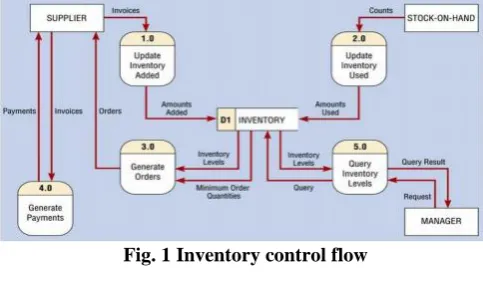
[image:2.595.49.291.245.389.2]An appropriate inventory control system will help the organization in obtaining efficient real-time information. The process flow of inventory management depends on the structure of the organization's information flow. Data Flow Diagram or known as DFD is illustrated how data is processed by a system in terms of inputs and outputs. Its focus is on the flow of information, where data comes from, where it goes and how it gets stored. Figure 1 is an example of a basic data flow structure of the Inventory management process.
Fig. 1 Inventory control flow
V. IMPLICATIONOFREAL-TIMEISSUEIN
INVENTORYMANAGEMENTINSMES
Inaccurate number of inventory
Most of SMEs don't realize what stock that they have, and continually coming up short on the materials and supplies until the point when it requires for the production which leads to the loss of production time and unable to deliver to the customer on time [20]. [20] state that an organization with no ERP implementation have no accountability of how supplies and materials are used and this organization have the inefficient operation that involves in wastes of resources.
Missing of data and Information
An efficient organization required an automated system to store all the business information [23]. However, this is not being practiced in SMEs due to heavily relay on manual practice based on paperwork documentation that is vulnerable to missing and damage. The implementation of ERP will be able to streamline the data collection process and convert all physical paperwork to the digital records and structured reports for analysis. By implemented this technology, SMEs will be in a better position to managing the information data and be able to react much faster in the changes which are the essential element in the SMEs business environment.
Uncompetitive business
SMEs usually are preferred using manual or non-integrated technology to manage their businesses. This due to SME fail to develop skills, knowledge, and competencies among workers in the organizations and fully understand on the changes in the business landscape the require the technology application in the business process to stay competitive in the
market. The lack of understanding of the automated system frameworks and procedures to streamline the business activities, drive efficiency and diminish the edges for error make SMEs left behind as compared to the large organization [19]. According to [21] without the smart and extensive use of technology, it is difficult in achieving strategic business goals and competes to other businesses in term of development and achievement.
VI. CHALLENGESOFMANAGINGREAL-TIME
INFORMATIONINSMES
Outdated and/ or non-integrated technology
The main challenges are outdated and non-integrated technology. [9] state the development of new technology seem not helps so much to SME organization. SME is preferred to using manual and low costing method of gaining information since they are faced with insufficient capital and resources. According to [22], SME faced difficulty in adopting the rapid changes in new technology despite acknowledging the benefit of the technology to the success in their business. Most of SMEs is continuing using the outdated of technology that leads to the decrease of the competitiveness in term of operation cost, quality of products and services, and also unable to meet delivery requirement same as their competitor.
Lack of resources Lack of capital
According to the research study written by [5], SME is constrained in getting economy of scale in purchasing equipment, raw material, financial and consulting services. Hence, it is not worth to SMEs to keep updating to latest equipment since they cannot adapt well to the changes. In the same study, the researcher stated that the SME is left behind in getting better supply chains process due to less investment in technological tools.
In another study, the capital issue is the biggest constraint for SMEs to make innovation [14]. The improvement of SMEs development become slow due to limited resources. This is because most of SMEs capitals come from self-capital or loan from the founder's relative. Lack of capital cause a lack of SMEs investment to business innovation. Stated in [4] studies, lack of cash or capital hinders the expansion of most SMEs. The size of the organization not capable them to convening financial institute to give loan and invest in improvement in the business process.
Lack of expert staff
Shortage of capital causes SMEs unable to hire experts in their organization. [16], stated in his study that the expertise is a strength to every organization to enable businesses to stay competitive in the market.
Expertise helps the organization to decrease the number of error and give accurate information to business purpose.
International Journal of Innovative Technology and Exploring Engineering (IJITEE) ISSN: 2278-3075,Volume-8 Issue-12, October 2019
stated in the same study, SMEs need more expertise to explore the opportunity in improving the management process.
VII. MANAGERHAVELACKKNOWLEDGEAND MANAGERIALSKILL
SMEs are majorly preferred to save cost operation by using the manual method of handling production activities. According to [19], SMEs fail to develop skills, knowledge, and competencies among the manager and workers in the organizations. The lack of a manager's knowledge causes inefficiency management of an organization. Also in [5] research, it is stated beside lack of capital, SME short in management time and managerial skill. The lack of strategy encourages the failure of the organization to manage its operation. Management abilities are the key driver to enhance the entire performance of the company [6]. This is supported by other research, [10], to develop and create the success businesses management, managers must be clear on company vision and mission. According to a study conducted by, [3], the willingness of SME owner or manager to explore and make research will increase the performance of the organization. Unfortunately, SME owner-manager is comfortable in using the existing method due to avoid the investment risk. SMEs need a managerial skilled manager to arrange the operation. In research of [12] revealed that SMEs manager faced the lack of entrepreneurship culture that discourages SMEs to stay competitive and efficient.
VIII. RESULTANDDISCUSSION
Discussion of challenges of managing real-time information
Lack of Capital
From the finding, the majority of SMEs faced a barrier in term of capital. Without enough capital or financial resources, entrepreneurs cannot invest to hire a skilled worker or implement information technology in their organization. The respondents realize that the major challenge in every organization is a capital constraint. Capital or financial resource will help an organization to add value to their management thus make the operation smooth and efficient. As an entrepreneur, they alert that real-time information is important and with the help of the system and manage by skilled workers the entire process becomes easier. Unfortunately, cost constraint makes most of the respondents choose to stick to the manual method.
It coincides to the previous study written by several researchers who argue that capital deficits are a major challenge to the entrepreneur in obtaining real-time information. As claimed by [9], and [2], real-time information and technology system have a strong relationship where it can generate accurate data and on-time information. However for SMEs, it difficult for them to invest in technology development due to limited revenue.
This statement also mentioned by most interviewees which stressed that without sufficient capital, the information system cannot be applied and with no appropriate system timely information difficult to manage. The correlation of the information can be seen by the statement issued by [7], [4] and other previous studies which asserted that capital
constraint is the biggest issue for SMEs. It prevents this industry to make innovation and the improvement of SMEs development slow due to limited resources. After gathering all the information, all the respondents expressed the same opinion where capital is the biggest issue for their organization in implementing better management, especially in inventory management. Lack of cash or capital hinders the expansion of most of SMEs especially in managing the real-time information.
Lack of skilled worker
Most of the respondents agreed that skilled worker is important to generate real-time information even the organization do not implement any appropriate system. Most of the respondent has used at least one time the external expert service to monitor and solve the operation issues. The statement is reinforced by past research which stated that management abilities are the key driver to enhance the entire performance of the company [26]. In lieu of an absence of information system, it is sufficient for having a skilled worker to monitoring the entire process of operation.
Despite various disagreements in previous studies, it can be concluded that lack of skilled workers is also a major challenge in managing timely information in SMEs which supported [6] that suggested the lack of strategy encourage the failure of the organization in managing their operation. It is also noted that SMEs need more expertise to explore the opportunity in improving the management process as suggested by [7].
Absence of Information Technology System
Most of the respondents are stressed that information technology system is very helpful in generating timely information. It is one of the major barriers for SMEs organization in managing real-time data for their organization due to constraint in the capital of investment. There is a similarity of opinion from the previous studies which the business size prevents the SMEs to implement an information system. This coincides with [24] suggestion that it is difficult to SMEs to adopting the rapid changes in new technology, despite the benefit of technology adoption is proven to accelerate the success in the management process.
In this study, most of the respondent is not implementing an information system in their operation activity because of its not practical for their business size. They argue that it a waste of investment since they are capable to handle it by the manual way and still able to generate a profit for the operation sustainability. It is not worth it if they implementing information system even the system is a key for accuracy of business information which most of them are considered.
Discussion on the impact of the absence of the information technology system
Management Process
absence of system such as ERP, CRM, and SCM since thechosen company are practice paper-based method. Based on the interview with the respondent, the following impact was unveiled for further discussion:
Inefficient management
Inefficient management is one of the impacts which was borne by SME company due to failing in obtain real-time information. Majority of the respondents agreed that without an appropriate system the management process will be inefficient. From the interview session, it is revealed that all the respondents are exposed to human error in managing information, especially in the inventory management process. This is because it is managed by manpower where the ability and the efficiency are limited compared to the usage of information system.
Inaccurate number of inventory
Based on the failure that ever faced by the respondents, the researcher can conclude that the inaccurate number of inventory holds or ordered are the issues that always faced by the organization which not implementing an information system. In the previous study had mentioned an organization with improper management don't realize what stock that they have, and continually coming up short on the materials and supplies, [20]. Another study also points out that most small business does not know the accurate volume of their inventory and fails to use resources optimally [13].
Unsold product
Based on the experience of some respondents, they will make mass production to reduce the cost of operation. Unfortunately, this practice leads to inefficient management when the product failed to sold before its expiry date. This is because of they unable to monitor efficiently on the product expiry which leads to loss them.
Information losses and theft
Since the respondents are using the paper-based method, all of them are agreed that they are exposed to information losses or theft. It is revealed that most of the interviewees are not having a backup system for their information. The respondents also admit that they are exposed to information losses and theft either because of their negligence or uncertainty event like a fire or flood. This issue or impact already discussed in the previous study which written by [23], where stressed that lack usage of information system contributed to information losses. [9], also stated in his study that cloud storage could help to prevent the losses of information due to uncertainty events.
From the finding gained, the implementation of the information system can reduce the issues mentioned above. A basic information management system such as ERP or CRM can help an organization in generating more accurate information for their business. It is because the system can customize information gathered from routine users and the interaction of machines into effective data, which in some cases employs decision-makers to form an economic choice. By that, the organization able insights a better way of managing information and real-time data can be achieved.
IX. RECOMMENDATION
Methodology of research
The information gained from the current method which is in-depth interview are less practical since the researcher is interviewed the top managers of the company. The information shared by them can be not too detail for them to protect company confidentiality. For future research, the research methodology can be improved. A mixed-method which is a combination of a qualitative and quantitative method can be used to generate more accurate information. By the apply both methods the generated data will be extensive and more detail. The variety of information leads to improvement to the current study.
Scope of study
For future research, the scope of the study can be expanded as well. The current study is only focused on SMEs in the food industry where the pattern of information will be similar for each case study. By expanded the research scope which not being narrowed to the food industry only, the information gained might be various and the real issue of real-time management of small industry can be exposed. By the obtained data, the solution can be discussed for better improvement.
Respondent selection
Respondent selection is the most important element should be a concern to generate accurate information. Wrongly choosing of respondent leads to inconsistency of data. For future research, the population of the respondent can be expended. For the current study, the researcher focused on top management only which is SMEs owner-manager or operation manager where this selection can be extended to the middle or lower manager to collect more rich information.
X. CONCLUSION
This study has shortlisted the major challenges in obtaining timely information and the impact on the small company. It is confirming the previous study finding that capital is always a constraint for SMEs to invest in the real-time management in SMEs business process. Despite a solution to have a skilled worker to close the gap of unavailability of the technology for managing the real-time information, it cannot be denied that the usage of technology will give better performance with the combination of right skill.
To ensure SMEs organization manage its information well, technology system still needs to be applied despite a capital constraint. Hence, it is urgent for the policymaker to explore the potential of other cheap solution such as I-cloud
International Journal of Innovative Technology and Exploring Engineering (IJITEE) ISSN: 2278-3075,Volume-8 Issue-12, October 2019
Author-1 Photo ACKNOWLEDGMENT
A special thanks to Siti Nur Alfiah Mohamed Yusof for their support and valuable assistance to complete this research.
REFERENCES
1. Adelman, S., Moss, L. and Barbusinski, L., “I found several definitions
of BI”, DM Review, August 17, 2002).
2. Boone, C. A., Craighead, C. W., & Hanna, J. B. (2009). Critical challenges of inventory management in service parts supply: A Delphi study. Operations Management Research, 1(1), 31–39.
3. Centeno, E., Hart, S. & Dinnie, K. (2013). The five phases of SME brand-building. Journal of Brand Management, 20(6), 445-457
4. Choudhary, A.K., Harding, J.A., Tiwari, M.K., Shankar, R., Knowledge
management based collaboration moderator services to support SMEs in
virtual organizations,The Management of Operations, volume 30, 2019.
5. George Abonyi, Integrating SMEs into global and regional value chains:
implications for subregional cooperation in the Greater Mekong Subregion, UNESCAP, Bangkok, November 2005.
6. Gillian Horan, Exploring management perspectives of branding in
service SMEs, Journal of Services Marketing 25/2 (2011) 114–12.
7. Gunasekaran, A., Forker, L., & Kobu, B. (2000). Improving operations
performance in a small company: A case study. International Journal of Operations and Production Management, 20(3), 316–336.
8. Golfareelli, M., Rizzi, S. and Cella, L. (2004), "Beyond data
warehousing: what's next in business intelligence?", Proceedings of DOLAP-04, Washington, DC, USA, available at www.acm. org (accessed May 17, 2006).
9. Hamisi, S. (2011). Challenges and opportunities of Tanzanian SMEs in
adapting supply chain management. African Journal of Business Management, 5(4), 1266–1276.
10. Hanin Khawaja, Brand Management in the small and medium
enterprise: Evidence from Dubai, UAE, Global Journal of Business Research, volume 8, number1, 2014
11. Hafsah Hashim, 2016), worldbank.org
12. Heba El Mehelmi & Heba Sadek, Investigating the usage of social customer relationship management (SCRM) and its impact on firm performance in the mobile telecommunication services: Egypt case, JBRMR, Volume 13 Issue 03, 01 Apr 2019
13. Muhammad Khalique, Abu Hassan Md. Isa and Jamal Abdul Nassir
Shaari, Challenges for Pakistani SMEs in a Knowledge-Based Economy, Indus Journal of Management & Social Sciences, 5(2):74‐80 (Fall 2011)
14. Li, Y. 2006. Review and experience of the mode of SME clusters in Guangdong. Business Economy 7:58-59.
15. Malhotra, Y. (2000), “From information management to knowledge
management: beyond hi-tech hidebound systems”, in Srikantaiah, T.K. and Koenig, M.E.D. (Eds), Knowledge Management, Information Today, Inc., Medford, NJ
16. Naeem Ul Hassan et al, Effects of Working Capital Management on
Firm Performance: An Empirical Study of Non-financial listed Firms in Pakistan, International Journal of Academic Research in Business and Social Sciences June 2014, Vol. 4, No. 6 ISSN: 2222-6990
17. Nicole Pontius (2017 ), Warehouse Operations Best Practices: 55
Awesome Tips and Tactics to Improve Warehouse Management, Organization, and Operations,haccmarketing.blogspot.com.
18. NSDC (2014), www.smecorp.gov.my
19. Omar, S. S., Arokiasamy, L., & Ismail, M. (2009). The background and
challenges faced by small and medium enterprises. Human resources development perspectives. International Journal of Business and Management, 4(10), 95-102.
20. Prasad Mishra R., Anand D., Kodali R.(2006), “Development of a
framework for world-class maintenance systems”, Journal of Advanced Manufacturing Systems, vol. 5, no. 2, pp. 141-165
21. Peter Jones & Peter Robinson, Operation Management, Oxford
University, 2012.
22. Rajarshi Majumder (2004), Productivity Growth in Small Enterprises -
Role of Inputs, Technological Progress and 'Learning By Doing', The Indian Journal of Labour Economics: The Quarterly Journal of the Indian Society of Labour Economics, Volume 47, Issue 4
23. Sharma, M. K., & Bhagwat, R. (2006). The practice of information systems: Evidence from select Indian SMEs. Journal of Manufacturing Technology Management, 17(2), 199–223.
24. Sultan, N. A. (2011). Reaching for the “cloud”: How SMEs can manage.
International Journal of Information Management, 31(3), 272–278. http://doi.org/10.1016/j.ijinfomgt.2010.08.001
25. Suhana Mohezar Ali et al (2017), The impact of internal factors on small
business success: A case of a small enterprise under the Felda scheme, Asian Academy of Management Journal, Vol. 22, No. 1, 27–55, 2017.
26. Sıdıka Başç and Ayşegül Durucan (2017), A Review of Small and
Medium-Sized Enterprises (SMEs) in Turkey, 2nd Annual International Conference on Social Sciences (AICSS), Yıldız Technical University.
AUTHORSPROFILE
Dr. Hairul Rizad Md Sapry is a supply chain practitioner with 17 years of working experience in Shipping, Haulage and Construction Material Industry. He obtained his B.Econ from UKM, MBA, and Ph.D. from UTM. His research interests mainly focus on supply chain management, Strategic Procurement, Planning and Forecasting, Supplier Relationship Management (SRM), Logistics, Branding, Marketing, and SME. He is currently Senior Lecturer at Logistic section at UniKL Mitec