Multiobjective Genetic Programming
.
White Rose Research Online URL for this paper:
http://eprints.whiterose.ac.uk/131886/
Version: Published Version
Article:
Dou, T. and Rockett, P.I. orcid.org/0000-0002-4636-7727 (2018) Comparison of
Semantic-based Local Search Methods for Multiobjective Genetic Programming. Genetic
Programming and Evolvable Machines. ISSN 1389-2576
https://doi.org/10.1007/s10710-018-9325-4
[email protected] https://eprints.whiterose.ac.uk/ Reuse
This article is distributed under the terms of the Creative Commons Attribution (CC BY) licence. This licence allows you to distribute, remix, tweak, and build upon the work, even commercially, as long as you credit the authors for the original work. More information and the full terms of the licence here:
https://creativecommons.org/licenses/
Takedown
If you consider content in White Rose Research Online to be in breach of UK law, please notify us by
Vol.:(0123456789)
Genetic Programming and Evolvable Machines https://doi.org/10.1007/s10710-018-9325-4
1 3
Comparison of semantic‑based local search methods
for multiobjective genetic programming
Tiantian Dou1 · Peter Rockett1
Received: 19 December 2017 / Revised: 1 June 2018 © The Author(s) 2018
Abstract
We report a series of experiments that use semantic-based local search within a multiobjective genetic programming (GP) framework. We compare various ways of selecting target subtrees for local search as well as diferent methods for perform-ing that search; we have also made comparison with the random desired operator of Pawlak et al. using statistical hypothesis testing. We ind that a standard steady state or generational GP followed by a carefully-designed single-objective GP implement-ing semantic-based local search produces models that are mode accurate and with statistically smaller (or equal) tree size than those generated by the corresponding baseline GP algorithms. The depth fair selection strategy of Ito et al. is found to per-form best compared with other subtree selection methods in the model reinement.
Keywords Semantic-based genetic programming · Local search · Multiobjective optimization · Model selection
1 Introduction
It is well established that genetic programming (GP) exhibits good performance on the empirical modeling of complex systems [41]. Nonetheless, traditional GP still has the limitation that since it acts at the syntactic level, a small syntactic modii-cation can produce a dramatic change in program itness, which can harm search eiciency.
To address these issues, the integration of local search into GP has attracted sig-niicant attention [20, 45]. At a wider level, the hybridization of population-based global search with heuristic local search—often termed a memetic algorithm
* Peter Rockett
[email protected] Tiantian Dou
1 Department of Electronic and Electrical Engineering, University of Sheield, Pitt Street,
[35]—has achieved notable successes [37] although remains comparatively little used in GP. Typically, existing GP memetic algorithms may include hill climbing local search over the coeicients or the model structures of the GP solutions.
In GP, semantics usually refers to the vector of output values a program pro-duces over the training data [50] and has been the subject of much recent research. Experimental results to date suggest that awareness of semantics is a great help both in maintaining population diversity and improving search power. Among these approaches, semantic-based local search methods [13, 50] have exhibited promising performance. Based on semantics, Pawlak et al. [40] have implemented a novel ran-dom desired operator (RDO), which decomposes the search task into a series of sub-tasks. By backpropagating the desired semantics to individual subtrees, the itness of a solution can be improved by seeking to replace a selected subtree with a subtree better matching the desired semantics. Since replacement subtrees are selected from a (pre-computed) library, it is unclear whether RDO is a local search method or a (global) crossover method as claimed in [40]; clarifying this question is a part of the motivation for the present paper.
Local search inevitably adds to the computational burden and runtime of GP, which seemingly makes many practitioners wary of local search-based approaches. For this reason, we have restricted the present paper to local search—where employed—for tuning the solutions at the end of a conventional GP run. We believe this approach thus closely its with the conventional memetic algorithm formulation [35] (although some may argue that in a memetic algorithm, the local search would be embedded within the global search). The principal contribution of this paper is an investigation of the performance of GP approaches when supplemented by semanti-cally-aware local search methods. In particular, this paper extends consideration of the efectiveness of local search to a multiobjective (MO) GP framework since this explicitly trades of goodness-of-it against model complexity, a key requirement in the empirical modeling of data [10, 30]. For the reasons stated in the preceding par-agraph, we also make comparison with the RDO approach. We speciically constrain the scope of this work to local search methods that modify the morphologies of the GP trees rather than approaches described in Sect. 2 that ine-tune node functional-ity. Local search methods that change the tree morphologies are comparatively little explored.
2 Related work
2.1 Semantically‑aware methods in GP
1 3
Genetic Programming and Evolvable Machinesphenotypic level. Compared to the ramped half-and-half method, increased semantic diversity seems to have a positive efect on GP search eiciency. Jackson [23], how-ever, pointed out that it is not suicient to ensure semantic diversity only in the ini-tialization stage since a lack of semantic diversity diminishes the exploratory power of GP over the whole run. This author concluded that measures to promote syntactic diversity produced few gains, but those designed to produce semantic diversity gen-erated a noticeable performance improvement. Based on the evaluation of behav-ioral changes caused by structural modiication as a result of mutation, Beadle and Johnson [4] proposed a semantically-driven mutation operator to prevent the crea-tion of new ofspring with equivalent performance to that of their parents.
Locality in GP [15] measures the efect of a genotypical change on the pheno-type, which is a crucial prerequisite to prevent evolutionary algorithms from behav-ing as pure random search. Uy et al. [47] compared the roles of syntactic and semantic localities of crossover in GP, and pointed out that improving syntactic locality reduced tree size and produced a slight improvement in model generaliza-tion. In contrast, improving semantic locality was more efective in reducing tree size and improving model generalization. These authors also proposed a number of semantic-based crossover and mutation operators.
Krawiec et al. [28] proposed the approximately geometric crossover (AGC), which combined a geometric crossover operator with semantic backpropagation. The semantics were used for guiding the crossover operation during evolution; these operators were further generalized in [40]. The recently-proposed RDO and approxi-mately geometric semantic crossover (AGX) operator use semantic backpropagation to identify intermediate subtasks during the evolution process, and then solve these using an exhaustive search method. When compared with other semantic-aware operators and standard genetic operators, RDO and AGX were shown to exhibit improved performance on a series of symbolic regression and boolean benchmark problems. Though generating promising performance, a major weak point of these algorithms is that the child solutions are typically larger than their parents, which may lead to unacceptably slow itness evaluations after a few generations. In this paper, we adopt the semantic backpropagation strategy of [40] for producing the desired output vectors of subtrees to serve as a basis for selecting better-performing replacements.
these questions by using a geometric semantic hill climber to explore the search space.
This work provided a new insight into the relationship between program syntax and semantics, and allows for the principled, formal design of semantic operators for various problems.
2.2 Local search in GP
The combination of local search and evolutionary global search [16, 18] has been widely studied and shown to be a powerful strategy for improving search eiciency although this is less commonly employed in GP. Local hill climbing has been inte-grated into GP either for tuning numerical coeicients [1, 20, 27, 45, 54, 56], or ine-tuning the model structure [2, 13, 19, 26, 29, 31, 53, 55]. Interleaved with global search, the parameters of solutions in each generation have been optimized via: relabeling [20], genetic local search [27], gradient descent [45, 56], and linear scaling [1, 2].
Many hill climbing local search methods have been embedded in standard GP for model structure optimization. Harries and Smith [19] proposed a non-evolu-tionary based GP with several genetic operators to evolve solutions in a hill climb-ing manner. Later, a co-evolvclimb-ing memetic algorithm [26] was introduced to pro-duce solutions for the comparison of protein structures by integrating co-evolving local searches with GP. Wang et al. [53] optimized decision trees using a splitting operator to divide the whole sample space into subspaces, and then conducted a hill-climbing tuning process. Zhang et al. [55] introduced the new crossover opera-tor, called looseness control crossover, to ind good building blocks by continually crossing over selected parents in a hill climbing manner. Looseness values assigned to each link between adjacent nodes prevent disruption of good building blocks in subsequent operations.
As the traditional crossover operator has often been criticized for being less pow-erful in forming good ofspring solutions, Majeed [31] proposed a semantic context-aware crossover operator for breeding better child solutions with high itness gain. This operator identiied the best possible crossover point in each selected subtree by examining all possible contexts in which a subtree can be grafted, inally selecting the site where the highest itness is attained.
Azad and Ryan [2] proposed a method to tune the internal nodes of trees one-at-a-time by trying all possible nodes with the same arity, and retaining the modiica-tion if a change of node improved the itness. Although the method demonstrated performance improvements, this is an extreme form of local hill climbing that is unable to modify the ‘shape’ of a tree.
1 3
Genetic Programming and Evolvable MachinesZ-Flores et al. does not use local search to modify the functional form (‘shape’) of the tree although whether this approach is efective due to also modifying selec-tive pressures within the population is possible but as yet unexplored. The work in [54] was extended in [24] by hybridization with the neuro-evolution of augmenting topologies (NEAT) method.
For combining the exploration ability of semantic genetic programming and the exploitation ability of local search, Castelli et al. [7] integrated semantic mutation operators [34] with a local search method of solving a problem in energy consump-tion forecasting. This case study resulted in good model accuracy with a speeded-up search process. In order to accelerate convergence, Castelli et al. [8] proposed a hybrid algorithm combining GSGP and the above method. The results show this hybrid method allows the search to converge quickly while also exhibiting a note-worthy ability to limit overitting.
Inspired by the RDO algorithm, Ffrancon and Schoenauer [13] proposed a local tree improvement (LTI) operator within a standard local search framework to ind the best possible semantic match between all subtrees in a parent tree and all pro-grams in a pre-constructed library. This semantic-aware method performed well on several boolean benchmark problems.
La Cava et al. [29] claimed that the performance of stack-based GP can be improved by embedding local search using epigenetic instructions to specify active and silent genes. In contrast to tree-based GP, stack-based GP is “syntax-free” and syntactic validity is guaranteed no matter how the epigenetic instructions change.
Very recently, Trujillo et al. [46] have argued that local search is necessary to allow GP to reach its full potential; these authors also note that local search seems comparatively little utilized by the GP community.
3 Experimental methodology
3.1 Evolutionary framework
In the context of empirical modeling using GP, Le et al. [30] have recently reviewed the use of complexity measures, and point out the critical importance of trading of goodness-of-it to the training data against model complexity; see also [36, Chap 7]. To explicitly address this trade-of here, we have used a global multiobjective GP formulation in this work with conventional tree-based individuals where the sin-gle population was sorted according to Pareto dominance. We have employed both the sorting approach and selection method of Fonseca and Fleming [14]. We have employed both generational and steady-state evolutionary strategies for ‘global’ search followed—optionally—by local search over the inal populations; we make detailed comparisons below.
computational burden of evaluating a tree. The imposition of evolutionary pressure to reduce node count is also an efective way of controlling tree bloat.
Using the normal deinition of semantics as the indexed output vector of tree responses over the training data, the semantics of each node within the tree were estimated recursively and stored when it was evaluated for the irst time. The cal-culation of the desired semantics starts from the root node and propagates along all paths to all leaves. Since the desired output of the root node of a tree is known, the desired semantics of each child node in the tree can be calculated assuming that its siblings have the correct structure. If the backpropagation process yields multi-ple possible values, one is chosen arbitrarily; if the value is undeined, it is ignored in the subsequent calculations of semantic distances between subtrees. See Pawlak et al. [40] for further details.
We have considered the basic evolutionary GP algorithm followed by one of a number of diferent local search methods; the aim in each case was to reduce the Euclidean distance between the subtree’s actual and desired outputs. We investigated a number of strategies for selecting subtrees for replacement that we detail below. Local search has been restricted to the inal population in order to keep the computa-tion times within practical limits.1 In addition, we also include results from the basic GP without local search as a baseline case.
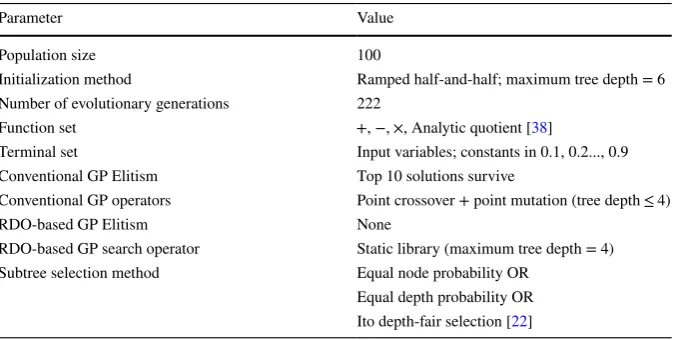
Since it is a prominent example of semantic-based search, we have also included the RDO operator [40] as a comparator. This method uses a library of semantically-unique programs, and when a subtree in a parent is selected during the evolution-ary process, a new ofspring is generated by replacing the selected subtree with the library program exhibiting the closest match to the subtree’s desired semantics. (This Table 1 Evolutionary parameters used in this work
Parameter Value
Population size 100
Initialization method Ramped half-and-half; maximum tree depth = 6 Number of evolutionary generations 222
Function set + , −, × , Analytic quotient [38]
Terminal set Input variables; constants in 0.1, 0.2..., 0.9 Conventional GP Elitism Top 10 solutions survive
Conventional GP operators Point crossover + point mutation (tree depth ≤ 4) RDO-based GP Elitism None
RDO-based GP search operator Static library (maximum tree depth = 4) Subtree selection method Equal node probability OR
Equal depth probability OR Ito depth-fair selection [22]
1 Additionally, we have observed (unpublished) that, apart from signiicantly increasing the
[image:7.439.52.392.67.237.2]1 3
Genetic Programming and Evolvable Machinesstrategy has the disadvantage that growth in the overall size of the parent tree is not explicitly constrained.) We have used only a static library of trees up to a predeined size limit, precomputed before the evolutionary process commences since this has been shown to yield superior performance to the alternative of a dynamic library [40]. Further, we have used more modest library sizes compared to the 100,000 used by Pawlak et al. because we are concerned with the practical application of the method, and therefore its runtime; even with a reduced library size of 1000, the runtime of the RDO-based method was typically 30 times longer than that of the baseline GP approach. Static libraries were generated with a maximum tree depth of 4, and an initial library size of 1000 that was then reduced by removing semantic duplicates; typically 5% of the library individuals were removed at this stage. Within RDO, we have explored a range of subtree selection approaches—see Sect. 3.3 for full details. The algorithm settings are shown in Table 1.
3.2 Local search methods
We have applied one of a number of local search approaches to the inal popula-tion obtained from the baseline GP algorithm. These comprise two key elements: (1) the method for selecting a target subtree upon which local search acts, and (2) the method for generating a (potentially) better subtree. Local search was applied to every individual in the inal population generated by the baseline GP algorithm. Note that we have not selected a inal, single model for evaluation until after local search was applied to the whole population. See Sect. 3.5 below for further details on the numbers of times local search was applied.
3.3 Subtree selection
We have employed three diferent subtree selection methods in this work.
– Equal Node Probability. Selection where each node in the parent tree is chosen with equal probability to be the root of the target subtree; algorithms using this subtree selection method are denoted with a ‘1’.
– Equal Depth Probability where the selection method irst chooses a depth value in the range zero (i.e. the parent’s root node) to the maximum depth of the par-ent tree, with uniform probability. At this point, one of the nodes at the selected depth is chosen with equal probability. Algorithms using this strategy are denoted with a ‘2’.
All three methods of subtree selection embody diferent biases as to how nodes (i.e. target subtrees) are chosen.
3.4 Algorithm comparisons
Clearly a fundamental objective in this work has been to make fair comparisons between some quite diferent algorithms. To compare the baseline generational GP, steady-state GP and RDO global algorithms is fairly straightforward: we allowed each to run for the same number of local search tree evaluations. This allows each algorithm to make the same number of ‘moves’ in its search, leading to a reason-able basis for comparison although we restate that the runtime of the generational RDO algorithm with subtree selection method ‘1’ above (GenRDO-1) was typi-cally 30 times longer than for the baseline generational GP (GenGP). Establish-ing a fair basis for comparison with the various local search algorithms, however, is more problematic. We have addressed this by measuring the process time of the GenRDO-1 algorithm on each benchmark problem, and then limiting the total runt-ime of one of the local search-based algorithms that uses generational global search followed by generational GP local search with Ito depth-fair selection2 to this ig-ure. The total number of tree evaluations in this algorithm was noted and used as a limit for all the other local search methods. Local search was continued by cycling over the population, attempting to improve one subtree in every individual per cycle, until the allowed number of local search tree evaluations was exhausted. Thus all algorithms were compared on the basis of being allowed equal amounts of computa-tional ‘efort’ as gaged by numbers of tree evaluations.
3.5 Subtree generation and replacement
In conjunction with diferent methods of subtree selection, we have used a num-ber of diferent methods to generate candidate subtrees to use as replacements. In all cases, the objective was to generate a replacement subtree with semantics more closely matched to the desired (back-propagated) semantics than those of the origi-nal selected subtree:
– Generational GP to Generate New Subtrees. A single objective generational GP was used to search for a tree better matching the desired semantics; apart from the objective function and restricting the local search GP to 100 generations, the evolutionary parameters were as detailed in Table 1. A hard limit was placed on the number of tree nodes in the local search GP. This limit on replacement sub-tree sizes was set equal to the node count of the original target sub-tree to be replaced in order to prevent code growth in the parent. Candidate replacement subtrees were thus, at worst, the same size as the originals they sought to replace. (This is in quite deliberate contrast to the RDO operator [40], which is ambivalent about
1 3
Genetic Programming and Evolvable Machinescode growth.) If an evolved subtree had a smaller mean squared error (MSE) over the semantic target, it was used to replace the original subtree; otherwise, the parent tree remained unaltered.
– Steady-state GP to Generate New Subtrees. Similarly, a single-objective steady-state GP with hard limit on replacement subtree sizes was applied for tuning sub-trees so as to better approximate the desired semantics.
– Random Generation of New Subtrees. Randomly generating replacement sub-trees of the same or smaller node count than the original target subtree; again, this size restriction was designed to prevent growth of the parent tree. For a given parent tree, one cycle of local search comprised irst selecting a target subtree, and then randomly generating a sequence of candidate replacement subtrees with randomly-generated node counts less than or equal to the node count of the tar-get subtree. If a candidate subtree produced a closer semantic match than the original subtree, it was immediately used for replacement and the random subtree generation sequence terminated. The number of attempts at replacing a given subtree was limited to a maximum of 100, and if no suitable replacement was generated, the subtree was left unchanged. This search procedure was continued by cycling over the population, attempting to improve a single selected subtree in each individual, until the limit on the number of tree evaluations was reached. – Using RDO as local search operator to Generate New Subtrees. We have also
investigated using RDO as a local search method to improve the inal population generated by the baseline global search algorithms—essentially, replacing the local search by random subtree generation with selection of replacements from an RDO-style static library. The RDO operator selects a program that exhibits the closest match to the desired semantics of a selected subtree. We have observed, however, that, when using RDO as a local search method, search over the static library does not necessarily yield a candidate replacement subtree with better
semantics than the original target subtree. Consequently, we have employed two diferent criteria for accepting tree modiication by a subtree identiied from the static library: irstly, we always accept a best-matching candidate subtree (“Best matching subtree”). Second, we only accept a candidate subtree if it both has better-matching semantics to the selected target subtree, and the modiied tree Pareto-dominates the original parent tree, i.e. it achieves a lower MSE and/or lower node count (“Better matching subtree”). As above, local search cycled over the population attempting to improve one subtree at each pass.
In what follows, we adopt the naming convention for describing a particular experimental coniguration of:
– Global multiobjective search paradigm either generational(‘Gen’) or steady-state (‘SS’).
– The global search method, either GP, or RDO.
– Local single-objective search method: generational(‘Gen’) GP, steady-state (‘SS’) GP, random tree generation (‘Ran’), or RDO (‘RDO’).
Thus, “SSGP-GenGP-2” indicates a steady-state global GP followed by genera-tional GP local search using equal depth probability method of subtree selection. “GenGP” and “SSGP” refer to the baseline global searches with no local search. In addition, for the reasons explained above, we have included two diferent acceptance strategies when using RDO as a local search operator: “Best matching subtree” and “Better matching subtree”. These lead to additional variants, labeled ‘4’, ‘5’ and ‘6’ only for global GP followed by RDO-based local search.
Summaries of the experiments conducted are shown in Table 3 for the methods employing generational global search, and in Table 4 for methods using steady-state global search.
3.6 Test functions
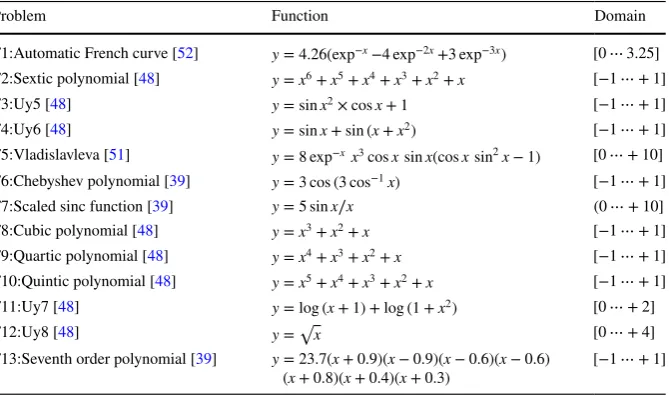
Although the subject of regression test functions for GP has received detailed consid-eration [32], we have employed a series of commonly-used benchmark univariate sym-bolic regression problems—see Table 2-previously used in the GP literature. For each function, we generated 250 independent training sets each containing 20 data uniformly sampled over the domain; the independent test set for each function comprised 10,000 data. The best test mean squared error (MSE) obtained from the inal population (after any local search procedures) was taken as a measure of generalization performance, this being equivalent to the general procedure in single-objective GP.
3.7 Statistical testing
We have made detailed statistical comparisons of the results obtained. Since we cannot make any distributional assumptions about the results, we have used the Table 2 Test functions
Problem Function Domain
F1:Automatic French curve [52] y=4.26(exp−x−4 exp−2x+3 exp−3x) [0 ⋯3.25]
F2:Sextic polynomial [48] y=x6+x5+x4+x3+x2+x [−1⋯+1]
F3:Uy5 [48] y=sinx2×cos
x+1 [−1⋯+1]
F4:Uy6 [48] y=sinx+sin(x+x2) [−1⋯+1]
F5:Vladislavleva [51] y=8 exp−xx3cosxsinx(cosxsin2x−1) [0⋯+10]
F6:Chebyshev polynomial [39] y=3 cos(3 cos−1x) [−1⋯+1]
F7:Scaled sinc function [39] y=5 sinx∕x (0⋯+10]
F8:Cubic polynomial [48] y=x3+x2+x [−1⋯+1]
F9:Quartic polynomial [48] y=x4+x3+x2+x [−1⋯+1]
F10:Quintic polynomial [48] y=x5+x4+x3+x2+x [−1⋯+1]
F11:Uy7 [48] y=log(x+1) +log(1+x2) [0⋯+2]
F12:Uy8 [48] y=√x [0⋯+4]
F13:Seventh order polynomial [39] y=23.7(x+0.9)(x−0.9)(x−0.6)(x−0.6) (x+0.8)(x+0.4)(x+0.3)
[image:11.439.55.390.68.266.2]1 3
G
enetic P
rog
ramming and E
volv
able M
achines
Table 3 Summary of experimental protocols used: generational global search
Genetic search operator Subtree selection method Local search method
Standard xover + muta-tion
RDO static library
Equal node (1) Equal depth (2) Ito depth-fair (3) GenGP SSGP Random generation
RDO
Better match-ing subtree
Best matching subtree
GenGP ✓
GenRDO-1 ✓ ✓
GenRDO-2 ✓ ✓
GenRDO-3 ✓ ✓
GenGP-GenGP-1 ✓ ✓ ✓
GenGP-GenGP-2 ✓ ✓ ✓
GenGP-GenGP-3 ✓ ✓ ✓
GenGP-SSGP-1 ✓ ✓ ✓
GenGP-SSGP-2 ✓ ✓ ✓
GenGP-SSGP-3 ✓ ✓ ✓
GenGP-Ran-1 ✓ ✓ ✓
GenGP-Ran-2 ✓ ✓ ✓
GenGP-Ran-3 ✓ ✓ ✓
GenGP-RDO-1 ✓ ✓ ✓
GenGP-RDO-2 ✓ ✓ ✓
GenGP-RDO-3 ✓ ✓ ✓
GenGP-RDO-4 ✓ ✓ ✓
GenGP-RDO-5 ✓ ✓ ✓
[image:12.439.145.626.57.385.2]G
enetic P
rog
ramming and E
volv
able M
achines
Table 4 Summary of experimental protocols used: steady-state global search
Genetic search operator Subtree selection method Local search method
Standard xover + mutation
RDO static library
Equal node (1) Equal depth (2) Ito depth-fair (3) GenGP SSGP Random generation
RDO
Better match-ing subtree
Best matching subtree
SSGP ✓
SSRDO-1 ✓ ✓
SSRDO-2 ✓ ✓
SSRDO-3 ✓ ✓
SSGP-GenGP-1 ✓ ✓ ✓
SSGP-GenGP-2 ✓ ✓ ✓
SSGP-GenGP-3 ✓ ✓ ✓
SSGP-SSGP-1 ✓ ✓ ✓
SSGP-SSGP-2 ✓ ✓ ✓
SSGP-SSGP-3 ✓ ✓ ✓
SSGP-Ran-1 ✓ ✓ ✓
SSGP-Ran-2 ✓ ✓ ✓
SSGP-Ran-3 ✓ ✓ ✓
SSGP-RDO-1 ✓ ✓ ✓
SSGP-RDO-2 ✓ ✓ ✓
SSGP-RDO-3 ✓ ✓ ✓
SSGP-RDO-4 ✓ ✓ ✓
SSGP-RDO-5 ✓ ✓ ✓
[image:13.439.51.521.67.372.2]1 3
Genetic Programming and Evolvable Machinesnonparametric Friedman test [11] under the null hypothesis that all the ranks of the results are drawn from the same distribution and therefore there is no difer-ence between the varying treatments; we used the signiicance level of P ⩽ 0.05
to reject the null hypothesis. When the null hypothesis of the Friedman test was rejected, we used the Holm–Bonferroni post-hoc correction [11] to the signii-cance level in a Wilcoxon signed ranks test [5, 11] to judge the statistical difer-ences between pairs of results.
4 Results and discussion
Applying all the optimization approaches detailed in Tables 3 and 4 over each of the thirteen benchmark regression problems F1–13 in Table 2, and perform-ing a Friedman test on the ranks of the best MSEs for all algorithms (treatments) and regression problems (subjects) indicated, we reach the conclusion that the null hypothesis—that each of the optimization approaches produces identical results—can be rejected with P values < 0.0001. There is thus strong evidence of diferences between the experimental treatments. For obtaining detailed informa-tion on which algorithms are statistically signiicantly diferent from each other, we have carried out a series of pairwise tests using the Wilcoxon signed ranks test with a Holm–Bonferroni post-hoc analysis to constrain the family-wise error rates for the multiple comparisons [11].
Tables 5 and 6 show the mean ranks of test errors and tree sizes, respectively aggregated over all benchmark problems and treatments.
As a brief introductory overview, from Table 5 it is clear that the best-per-forming algorithm overall is SSGP-SSGP-3 followed by SSGP-GenGP-3. By contrast, the baseline SSGP algorithm ranks 8th overall, and the baseline GenGP algorithm 14th. GenRDO-1 is ranked third along with a number of other algo-rithms of various conigurations. Regarding the signiicance of the gray-shaded cells in this table, there are no statistical diferences between any of the 9th ranked group SSRDO-1 ...GenGP-Ran-3. On the other hand, there is a difer-ence between SSRDO-1 and the 10th ranked GenGP-RDO-1, but no diferdifer-ence between GenGP-RDO-1 and the group SSGP-RDO-1 ...GenGP-Ran-3. We have highlighted this with the gray shading in the 10th column opposite the group SSGP-RDO-1 ...GenGP-Ran-3.
As regards node counts—rankings are shown in Table 6 where smaller rank denotes smaller trees—there is a broad inverse relationship between the rankings on test MSE and tree size. Algorithms involving steady-state approaches tend to be associated with larger trees, but tend to have smaller test MSEs. Again in this table, gray-shaded cells denote, for example, that there is no diference between any of the group SSGP-RDO-4 ...SSGP-SSGP-2, and SSGP-GenGP-1.
(In the more detailed discussion that follows, we use the shorthand terms “larger” and “smaller” in the sense of statistically larger (or smaller) at the 95% conidence level.)
G
enetic P
rog
ramming and E
volv
able M
achines
Table 5 Ranking of the mean squared test errors (MSEs) by algorithm; algorithms listed in the same column display no statistical diference
Overall ranks of MSE values for all the algorithms
Rank ‘1’ Rank ‘2’ Rank ‘3’ Rank ‘4’ Rank ‘5’ Rank ‘6’ Rank ‘7’ Rank ‘8’ Rank ‘9’ Rank ‘10’ Rank ‘11’ Rank ‘12’ Rank ‘13’ Rank ‘14’ Rank ‘15’
SSGP-SSGP-3 5.321
SSGP-GenGP-3 5.807
GenGP-SSGP-3 7.389
GenGP-GenGP-3 7.618
SSGP-SSGP-2 8.567692
SSGP-GenGP-2 8.752308
GenRDO-1 9.851538
GenGP-SSGP-2 11.08538
SSGP-Ran-2 11.63615
SSGP-Ran-1 11.97385
SSGP-Ran-3 13.22385
SSGP-GenGP-1 14.37231
SSGP-SSGP-1 14.62154
GenGP-Ran-1 16.96154
SSGP-RDO-5 17.44308
SSGP-RDO-4 17.46
SSGP-RDO-6 18.29231
GenGP-Ran-2 19.11231
SSGP 19.58538
SSRDO-1 20.47154
SSGP-RDO-1 20.49
GenGP-GenGP-2 20.51615
GenGP-GenGP-1 21.00615
GenGP-SSGP-1 21.56
GenGP-Ran-3 21.62462
GenGP-RDO-1 22.13923
GenGP-RDO-4 25.48154
GenRDO-2 26.14077
GenGP-RDO-5 26.22538 SSRDO-2 27.05846 GenGP-RDO-2 27.47385 SSGP-RDO-2 27.57308 GenGP-RDO-6 28.64077 SSRDO-3 31.67308 GenGP 31.82 GenRDO-3 33.98308 GenGP-RDO-3 34.01308 SSGP-RDO-3 34.03538
[image:15.439.58.628.85.345.2]1 3
G
enetic P
rog
ramming and E
volv
able M
achines
Table 6 Overall ranking of node counts by algorithm; algorithms listed in the same column display no statistical diference
Overall ranks of tree sizes for all algorithms
Rank ‘1’ Rank ‘2’ Rank ‘3’ Rank ‘4’ Rank ‘5’ Rank ‘6’ Rank ‘7’ Rank ‘8’ Rank ‘9’ Rank ‘10’ Rank ‘11’ Rank ‘12’ Rank ‘13’ Rank ‘14’
SSRDO-3 6.314
GenGP-Ran3 8.910
GenRDO-3 8.919
SSRDO-2 9.394
GenGP-Ran-2 9.512
GenGP-RDO-3 9.629
SSGP-RDO-3 9.695
GenGP-Ran-1 12.315
SSRDO-1 14.881
GenGP-RDO-6 15.365
GenGP-RDO-5 15.467
SSGP-Ran-2 15.634
GenGP-RDO-4 15.989
SSGP-Ran-1 16.026
GenRDO-2 16.473
GenGP-RDO-2 17.292
SSGP-RDO-2 17.544
SSGP-Ran-3 18.315
GenGP 19.803
GenGP-GenGP-2 20.369
GenGP-SSGP-1 20.567
GenGP-GenGP-1 21.477
GenGP-SSGP-2 21.741
GenGP-GenGP-3 22.775
GenGP-SSGP-3 22.935
SSGP-RDO-5 23.783
SSGP-RDO-4 24.149
SSGP-GenGP-2 24.863
SSGP-SSGP-2 25.014
SSGP-GenGP-1 25.172
SSGP-RDO-6 25.234
SSGP-GenGP-3 25.363
SSGP-SSGP-3 25.463
SSGP-SSGP-1 25.677
SSGP 28.699
GenRDO-1 31.23692 GenGP-RDO-1 34.411 SSGP-RDO-1 34.595
[image:16.439.57.618.73.356.2]4.1 Comparison of generational and steady‑state global strategies without local search
In the absence of any local search, the global steady-state (SSGP) strategy clearly produces smaller test errors than the corresponding generational strat-egy (GenGP), with mean ranks of 19.585 and 31.820, respectively. The generally superior performance of the steady-state strategy has previously been observed in the context of multiobjective genetic algorithms by Durillo et al. [12]. The aver-age tree size of the models created by SSGP, however, is larger than the averaver-age tree size for GenGP strategy with mean ranks of 28.698 and 19.803, respectively. Since we are generally interested in models with smaller test errors and superior generalization, the results here suggest that, in the absence of local search, the steady-state strategy is better than the much more widely used generational strat-egy, extending the observations in [12] to another MOEA domain.
4.2 Inluence of the global search strategy on the eicacy of a given local search method
Following on from the previous observation, we can examine the inluence of the evolutionary global search strategies on local search methods. It is clear from Table 5 that a given local search algorithm following a steady-state global search performs better than the corresponding algorithm that uses generational GP local search, except for the three pairs: RDO-1 versus GenGP-RDO-1, SSGP-RDO-2 versus GenGP-SSGP-RDO-2, SSGP-RDO-3 versus GenGP-RDO-3, between which no statistically signiicant diferences were detected. (It is noteworthy that all six algorithms in this ‘no diference’ category use RDO as the local search method; we observe below that RDO does not appear to be particularly good as a a local search technique. Thus it seems likely that these six algorithms are not representative results.) Since the starting point for all local search is the inal pop-ulation produced by the global search strategy, there seems strong evidence that the generally superior population produced by the steady-state strategy facilitates more productive local search, regardless of the local search algorithm employed. It seems logical that starting from a ‘better initial position’ will help the subse-quent local search to ind superior solutions.
1 3
Genetic Programming and Evolvable Machines4.3 Comparing RDO in generational and steady‑state global strategies
Algorithms using RDO as the genetic operator exhibit diferent performances when used with generational compared to steady-state evolutionary strategies. Compared to the baseline GenGP, the RDO genetic operator used in a genera-tional strategy yields performances that range from the seventh best performer (GenRDO-1) via a middle-ranking performer (GenRDO-2) to rapid deterioration to one of the worst algorithms (GenRDO-3). GenRDO-3 performs even worse than the baseline GenGP due to the fact that the population in these runs invari-ably collapsed to a single or small number of identical individuals, thereby dra-matically damaging the searching ability of the algorithm due to lack of diversity.
4.3.1 The role of evolutionary strategy with global RDO
The general performance of RDO as a search operator in a steady-state strategy, however, shows a great diference. The average test errors of all the SSRDO algo-rithms are statistically worse than those of the baseline SSGP. The inference is that subtree replacement from the randomly-initialized static library harms the search eiciency of a steady-state GP. A possible reason for this might be that the RDO operator, which replaces selected subtrees with speciic randomly-generated library programs, induces signiicant disruption during a steady-state evolution process. The evolution process of a generational GP is itself highly disruptive since the majority of chromosomes in each new generation are produced through crossover operations; in this circumstance, the RDO operator appears to improve the search eiciency and generates more accurate trees than the baseline GenGP. The steady-state strat-egy, however, relies on a continual advancement towards the Pareto front that RDO seems to repeatedly disrupt leading to poor overall search performance.
4.3.2 The role of subtree selection strategy with global RDO
From the perspective of the subtree selection approach used with RDO, for both generational and steady-state strategies, algorithms selecting subtrees with equal node probability generate more accurate models than those using the equal depth selection method. Ito’s depth fair subtree selection method produces the worst results. This suggests that the performance of the RDO operator is sensitive to the method of selecting subtrees.
4.4 The role of the generational and steady‑state strategies for local search
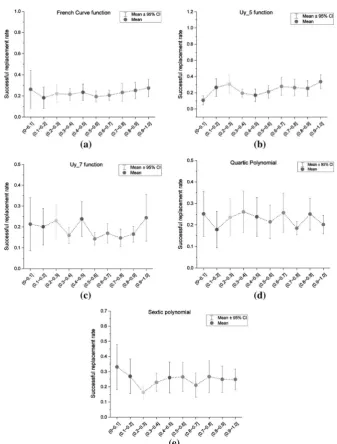
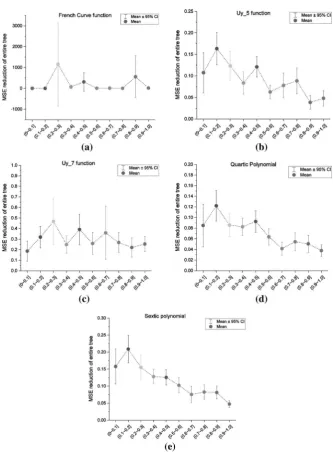
When compared by subtree selection methods, however, algorithms using Ito’s depth fair method produce the most accurate models. Algorithms selecting subtrees with equal node probabilities are ranked lowest among all the GP-based local search algorithms. This suggests that a subtree with a shorter path to the root node of its parent tree is likely to be more inluential on the entire tree in the overall evaluation; this conclusion is consistent with a hypothesis proposed by Igel et al. [21]. To verify this, we investigated the relationships between success rate and MSE reduction with the normalized depth of selected subtrees. The normalized depth of each subtree is calculated by dividing the depth of a selected subtree from the root node by the full depth of the whole tree. All the selected samples were divided into ten groups according to their normalized depth with increments of 0.1. A illustrative group of ive of the above thirteen benchmark functions were used, and the corresponding graphs of the relationships between successful subtree replacement rate (Fig. 1) and MSE reduction (Fig. 2) with normalized depth of selected subtrees.
From the graphs in Fig. 1, the success rates are roughly constant with increasing normalized depth values, which shows that subtrees of diferent normalized depths have almost identical probabilities of being successfully replaced. This suggests that the good performance of algorithms using Ito’s depth fair subtree selection method is not caused by more frequent modiication of subtrees near the root node of a GP tree. From the graphs in Fig. 2, an inverse relationship between the magnitudes of MSE reduction with the normalized depth of selected subtrees can be observed. This implies that a more eicient optimization of GP trees can be achieved by selecting subtrees with shorter path to the root node. In other words, an improvement of sub-trees near the root node is more likely to have a larger beneicial efect on the whole tree. We consider this the main reason that causes good performances of algorithms using Ito’s depth fair selection method.
4.5 Inluence of the number of cycles of local search
Whether it is possible to achieve comparable results with fewer generations of global GP search and/or less efort on the local search is of great practical interest. Taking the best performing SSGP-SSGP-3 algorithm as an example, we conducted an experiment to further explore the balance between these factors. Typically, the CPU runtime of one local search cycle over all the trees in a inal population takes
∼ 12 s (on a given computer), which is far longer than that of the baseline
steady-state global search (SSGP) lasting ∼ 4 s. Thus by far the greatest proportion of the
computational efort is spent on the local search process. The inluence of the num-bers of local search cycles on the model accuracy is presented for ive representative test functions Fig. 3.
1 3
Genetic Programming and Evolvable Machines4.6 Inluence of local search on expected tree sizes
[image:20.439.50.388.49.494.2]corresponding baseline algorithms. Thus, for example, local search following SSGP tends to produce smaller trees than SSGP without local search.
Intriguingly, the observation that local search tends to reduce tree sizes seems counterintuitive given that the local search methods were designed only to prevent code growth, not to produce more parsimonious structures—see Sect. 3.5.
[image:21.439.52.386.49.502.2]1 3
Genetic Programming and Evolvable MachinesFor a given parent tree in the inal population, we observed that local GP search almost invariably reduced the size of the tree—namely, GP local search seems efec-tive at inding smaller trees better matched to the desired backpropagated subtree
(a) (b)
(c) (d)
(e)
[image:22.439.51.387.53.511.2]semantics. Now the inal population generated by the baseline algorithm comprises an (approximation to) the Pareto set of equivalent solutions ranging from underit-ted solutions with high training MSE/few nodes through to overitunderit-ted solutions with small training MSE/large numbers of nodes; as a rough rule, the solution yielding the best test MSE tends to lie around the middle of the Pareto front. Although it tends to shrink the size of the trees, we observe that local GP search rarely improves the test error of the best-performing individual produced by the baseline GP such that it continues to be the best-performing individual after local search terminates. Rather, one of the overitted individuals tends to be modiied in the local search cedure and is promoted to having a better test error than the best individual pro-duced by the global search method. This reinforces the approach of applying local search to the whole of the inal population of the global search algorithm rather then just the best-performing individual produced by the global algorithm. Recently, Tru-jillo et al. [46] have made a similar observation for local search in the context of single-objective GP. More generally, the same sort of phenomenon has been previ-ously seen in decision trees, which are typically trained to overitting and then heu-ristically pruned to improve generalization [42].
4.7 Performance of random subtree generation as a local search operator
The overall performances of the algorithms that use random tree search is variable. The SSGP-Ran-1,2,3 algorithms are all 4th ranked for MSE whereas the perfor-mances of GenGP-Ran-1,2,3 are more varied: the irst two are better than SSGP, the last worse than SSGP but on a par with GenGP-GenGP-1,2 and GenGP-SSGP-1. The superior performance of the random subtree replacement algorithms that use SSGP as a global search algorithm is presumably connected to the general superior-ity of the steady-state strategy in global search.
Supericially, at least, there appears a similarity between local search by ran-domly generating replacement subtrees (the GenGP-Ran-1 ...GenGP-Ran-3 family of algorithms) and the RDO method. RDO constructs a large library of randomly-generated subtrees from which one is chosen to replace a target subtree in the parent. This generation-by-lookup table process could be viewed as an alternative way of randomly generating a subtree. GenRDO-1, however, is statistically better than ran-dom search implying this approach is not equivalent to ranran-dom local search follow-ing global GP; at this point, nonetheless, we sound a note of caution about the size efect observed here. The reason for the apparent superiority of RDO-based methods is not completely clear and will be the subject of future work.
4.8 The performance of RDO as a local search operator
1 3
Genetic Programming and Evolvable Machinesfor local search were overwhelmingly negative with little improvement in the popu-lation generated by the corresponding global SS/GenGP algorithm. We conclude, therefore, that RDO functions poorly as a local search method although clearly per-forms well as a genetic operator (in the generational strategy). Its supericial resem-blance to a random local search operator would thus appear coincidental.
4.9 RDO compared to global GP + GP local search
One of the principal indings of this work is that using GP as a local search proce-dure is able to produce generalization performance that is better than the state-of-the-art GenRDO approach, and does so using trees of signiicantly smaller sizes; this observation applies to all of the thirteen test functions considered. To take a typical example, GenRDO-1 with the French curve function produced best test-error tree sizes in the range 29 to 723 with an average of 196. The SSGP-SSGP-3 algorithm, on the other hand, yielded trees of 23 to 467 nodes with an average of 135. We believe this results from the careful implementation of the GP local search method to avoid code growth—see Sect. 3.5.
The RDO genetic operator exhibits good search ability in a generational strat-egy, but with a steady-state stratstrat-egy, the RDO operator performs even worse than the baseline SSGP algorithm. This implies the RDO search operator is sensitive to the evolutionary strategy. Moreover, the rapid performance deterioration from Gen-RDO-1 to GenRDO-3 indicates the RDO genetic operator is also sensitive to the subtree selection method. This is a disappointing characteristic of RDO since evo-lutionary methods are generally considered to be very robust to sub-optimal choices of parameters, etc. This robustness does not appear to extend to the RDO approach. On the contrary, GP local search appears much less sensitive than RDO to a difer-ent choice of subtree selection method. The use of Ito’s method that prefers selecting target subtrees near the root node seems to encourage model generalization of the entire tree.
4.10 Computational complexity resulting from diferent local search strategies
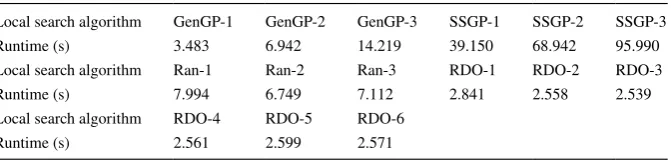
We have also considered the additional computation resulting from various local search methods. Taking the French curve function as as example, and experiments run on a computer with a 3.40 GHz processor. The average CPU runtime for the baseline GenGP is around 0.68 s and for the baseline SSGP around 3.83 s. Table 7
Table 7 CPU runtimes for one cycle of local search on the French curve function
Local search algorithm GenGP-1 GenGP-2 GenGP-3 SSGP-1 SSGP-2 SSGP-3 Runtime (s) 3.483 6.942 14.219 39.150 68.942 95.990 Local search algorithm Ran-1 Ran-2 Ran-3 RDO-1 RDO-2 RDO-3 Runtime (s) 7.994 6.749 7.112 2.841 2.558 2.539 Local search algorithm RDO-4 RDO-5 RDO-6
[image:24.439.54.390.67.147.2]lists the average CPU runtime cost for one cycle of reinement using various local search methods. From this table, it is clear that the most time-consuming local search is SSGP-3 that also produces the most accurate models. Local search algorithms using RDO turn out to be the least time-consuming, but provide minimal improve-ment to (and are sometimes worse than) the corresponding baseline GP. Clearly, the SSGP local search strategies consume more time than their corresponding GenGP methods. For both SSGP and GenGP local search, one cycle of optimization of the inal population using Ito’s depth fair subtree selection method takes longer than the equal-depth selection method, and the equal node subtree selection method the least. Generally, local search using random subtree generation takes about 7 s.
4.11 Future work and overall discussion
The work described in the paper has been deliberately constrained to local search methods that change the ‘shapes’ of GP trees by altering sub-trees. Successful local search has also been reported using methods that introduce additional ‘tuning’ parameters into the tree nodes—for example, [46]. An obvious area for future work is a quantitative comparison between these diferent approaches to local search, or indeed possible hybridization between them.
Although this paper presents a large range of algorithms, methods of local search, and their combinations, much future work remains to be done. In carrying out the work reported here, we have deliberately adopted a ‘breadth irst’ philosophy rather than seeking detailed explanations for every observation. That said, a very clear and fertile area for future work is to revisit the promising research directions that we have identiied to gain a fuller understanding of the phenomena involved; in our experience, such studies tend to be time-consuming hence we have deferred them to future work.
Another area that warrants further study is the extension to more complex, higher dimensional test functions. In the present paper, we have employed the univariate functions that tend to be regarded as “standard” within the GP community. While they represent a valid starting point for a study, these functions have received some criticism and other, more challenging datasets have been proposed in the litera-ture [32]. An important research issue is to establish whether the advantages of local search identiied in the present paper extend to higher dimensions. In addi-tion, explicitly considering real-world datasets—which often present diferent chal-lenges—would be a major extension of this work.
1 3
Genetic Programming and Evolvable Machineslarge numbers of uninformative/redundant features. In the context of such challeng-ing learnchalleng-ing problems, we think there is little reason that local search on its own would have much impact on datasets with these characteristics without also explic-itly addressing the complexity constraint and feature selection challenges.
A further area that might warrant additional investigation is the mechanism of semantic back propagation that is the precursor for local search. In common with other reports, we have adopted the strategy of back propagating errors from the root node of a tree under the assumption that all of a given node’s siblings possess the correct structure. Although a reasonable simpliication, this would seem to signii-cantly constrain the scope of any local search. In this context, we suggest a sensi-tivity-based approach [44] may improve search eiciency, and this too will be the subject of future work.
We have pointed out in Sect. 1 that memetic algorithms combine global explora-tory search with local exploitative search. We believe our work its very much within this paradigm. Since subtrees for replacement by local search are stochastically chosen, it is possible that consecutive passes of local search over a parent tree will select exactly the same target subtree leading to ineicient, duplicated search. Our use of Ito’s selection strategy (‘3’) that tends to prefer subtrees rooted near the top of the parent will exacerbate this efect since there are fewer choices near the tree’s root. We suggest improving the eiciency of our method with a tabu-like approach whereby subtrees that have been subjected to local search are not then immediately re-subjected to it in the next pass of local search. This could easily be implemented by tagging nodes with a timestamp of when they are selected as targets, and exam-ining this timestamp before proceeding with local search; this is an area for future work.
Finally, we note that genetic programming has proved an extremely efective and practical technique for solving the combinatorial optimization problem of searching over a set of possible functions. Local search over the set of possible subtrees in a parent GP tree could thus be viewed as a recursive reduction of the overall problem. In light of this, it is perhaps logical that GP should perform well as a local search strategy.
5 Conclusions
generated by the corresponding baseline algorithms, while at the same time exhibit-ing better prediction performance.
We have also found that the RDO operator was obviously efective when used as a genetic operator within the generational paradigm. The performance of RDO with a steady-state strategy, however, is noticeably worse than with a generational strat-egy. The trees generated by the steady-state variants of RDO are less accurate than even those generated by the baseline SSGP algorithm. We infer that the disruption caused by RDO search counteracts the otherwise good search performance of the steady-state strategy.
Additionally, we observed signiicant efects of the method for selecting the sub-tree for local search. On the basis of the work here, the RDO operator appears sensi-tive to the choice of selection operator, yielding performance that ranges from the seventh best performer (GenRDO-1) via the 12th-ranked performer (GenRDO-2) to population collapse and the lowly-ranked performer (GenRDO-3). GP local search, on the other hand, appears to display far less sensitivity to the choice of subtree selection method. The SSGP-SSGP-3 method ranks top while a less helpful choice of subtree selection method only reduces this form of GP local search to a middling (3rd or 5th ranked) performer rather than a bottom-ranked performer. The reason that the Ito’s depth fair selection method performs best was investigated and it was concluded that the optimization of subtrees closer to the root are more inluential in the improvement of the entire tree. Furthermore, the test error reduces with increas-ing numbers of cycles of local search although the gains appear modest after only two or three cycles of local search.
Open Access This article is distributed under the terms of the Creative Commons Attribution 4.0 Interna-tional License (http://creat iveco mmons .org/licen ses/by/4.0/), which permits unrestricted use, distribution, and reproduction in any medium, provided you give appropriate credit to the original author(s) and the source, provide a link to the Creative Commons license, and indicate if changes were made.
References
1. F. Archetti, S. Lanzeni, E. Messina, L. Vanneschi, Genetic programming for human oral bioavail-ability of drugs, in 8 th Annual Conference on Genetic and Evolutionary Computation (GECCO ’06) (2006), pp. 255–262. https ://doi.org/10.1145/11439 97.11440 42
2. R.M.A. Azad, C. Ryan, A simple approach to lifetime learning in genetic programming-based sym-bolic regression. Evol. Comput. 22(2), 287–317 (2014). https ://doi.org/10.1162/EVCO_a_00111
3. L. Beadle, Semantic and Structural Analysis of Genetic Programming. Ph.D. thesis, University of Kent (2009)
4. L. Beadle, C.G. Johnson, Semantically driven mutation in genetic programming, in 11th Conference on Congress on Evolutionary Computation (CEC’09) (2009), pp. 1336–1342
5. A. Benavoli, G. Corani, F. Mangili, Should we really use post-hoc tests based on mean-ranks? J. Mach. Learn. Res. 17(1), 152–161 (2016)
6. M. Castelli, S. Silva, L. Vanneschi, A C++ framework for geometric semantic genetic programming. Genet. Program. Evol. Mach. 16(1), 73–81 (2015). https ://doi.org/10.1007/s1071 0-014-9218-0
7. M. Castelli, L. Trujillo, L. Vanneschi, Energy consumption forecasting using semantic-based genetic programming with local search optimizer. Intell. Neurosci. 2015, 57:57 (2015). https ://doi.
1 3
Genetic Programming and Evolvable Machines8. M. Castelli, L. Trujillo, L. Vanneschi, S. Silva, E. Z-Flores, P. Legrand, Geometric semantic genetic programming with local search, in Annual Conference on Genetic and Evolutionary Computation (GECCO ’15) (Madrid, 2015), pp. 999–1006. https ://doi.org/10.1145/27394 80.27547 95
9. Q. Chen, M. Zhang, B. Xue, Feature selection to improve generalization of genetic programming for high-dimensional symbolic regression. IEEE Trans. Evol. Comput. 21(5), 792–806 (2017). https ://
doi.org/10.1109/TEVC.2017.26834 89
10. V. Cherkassky, F.M. Mulier, Learning from Data: Concepts, Theory and Methods, 2nd edn. (Wiley-IEEE Press, New York, 2007)
11. J. Demšar, Statistical comparisons of classiiers over multiple data sets. J. Mach. Learn. Res. 7,
1–30 (2006)
12. J.J. Durillo, A.J. Nebro, F. Luna, E. Alba, On the efect of the steady-state selection scheme in multi-objective genetic algorithms, in 5th International Conference Evolutionary Multi-criterion Optimization (EMO 2009) (Nantes, 2009), pp. 183–197. https ://doi.org/10.1007/978-3-642-01020 -0_18
13. R. Ffrancon, M. Schoenauer, Memetic semantic genetic programming, in Conference on Genetic and Evolutionary Computation (GECCO ’15) (2015), pp. 1023–1030. https ://doi. org/10.1145/27394 80.27546 97
14. C.M. Fonseca, P.J. Fleming, Multiobjective optimization and multiple constraint handling with evolutionary algorithms. I. A uniied formulation. IEEE Trans. Syst. Man Cybern. Syst. A 28(1),
26–37 (1998). https ://doi.org/10.1109/3468.65031 9
15. E. Galván-López, M. O’Neill, A. Brabazon, Towards understanding the efects of locality in GP, in 8th Mexican International Conference on Artificial Intelligence (2009), pp. 9–14. https ://doi. org/10.1109/MICAI .2009.17
16. C. Giraud-Carrier, Unifying Learning with Evolution Through Baldwinian Evo-lution and Lamarckism (Springer, Dordrecht, 2002), pp. 159–168. https ://doi. org/10.1007/978-94-010-0324-7_11
17. I. Gonçalves, S. Silva, C.M. Fonseca, M. Castelli, Arbitrarily close alignments in the error space: a geometric semantic genetic programming approach, in Genetic and Evolutionary Computa-tion Conference Companion, GECCO ’16 Companion (Denver, 2016), pp. 99–100. https ://doi. org/10.1145/29089 61.29089 88
18. F. Gruau, D. Whitley, Adding learning to the cellular development of neural networks: evolu-tion and the Baldwin efect. Evol. Comput. 1(3), 213–233 (1993). https ://doi.org/10.1162/
evco.1993.1.3.213
19. K. Harries, P. Smith, Exploring alternative operators and search strategies in genetic program-ming, in 2nd Annual Conference on Genetic Programming (1997), pp. 147–155
20. H. Iba, H. de Garis, T. Sato, Genetic programming with local hill-climbing, in 3rd Conference on Parallel Problem Solving from Nature (PPSN III): International Conference on Evolutionary Computation (1994), pp. 302–311. https ://doi.org/10.1007/3-540-58484 -6_274
21. C. Igel, K. Chellapilla, Investigating the inluence of depth and degree of genotypic change on itness in genetic programming, in 1st Annual Conference on Genetic and Evolutionary Compu-tation (GECCO’99), vol. 2 (1999), pp. 1061–1068
22. T. Ito, H. Iba, S. Sato, Non-destructive depth-dependent crossover for genetic programming, in
1st European Workshop on Genetic Programming (EuroGP ’98) (London, 1998), pp. 71–82 23. D. Jackson, Promoting phenotypic diversity in genetic programming, in 11th International
Con-ference on Parallel Problem Solving from Nature: Part II (PPSN’10) (2010), pp. 472–481 24. P. Juárez-Smith, L. Trujillo, Integrating local search within neat-GP, in Genetic and
Evo-lutionary Computation Conference Companion (Denver, 2016), pp. 993–996. https ://doi. org/10.1145/29089 61.29316 59
25. J.R. Koza, Genetic Programming: On the Programming of Computers by Means of Natural Selection, vol. 1 (MIT Press, Cambridge, 1992)
26. N. Krasnogor, Self generating metaheuristics in bioinformatics: the proteins structure com-parison case. Genet. Program. Evol. Mach. 5(2), 181–201 (2004). https ://doi.org/10.1023/
B:GENP.00000 23687 .41210 .d7
27. K. Krawiec, Genetic programming with local improvement for visual learning from examples, in
28. K. Krawiec, P. Lichocki, Approximating geometric crossover in semantic space, in 11th Annual Conference on Genetic and Evolutionary Computation (GECCO ’09) (2009), pp. 987–994. https ://doi.org/10.1145/15699 01.15700 36
29. W. La Cava, T. Helmuth, L. Spector, K. Danai, Genetic programming with epigenetic local search, in Annual Conference on Genetic and Evolutionary Computation (GECCO ’15) (2015), pp. 1055–1062. https ://doi.org/10.1145/27394 80.27547 63
30. N. Le, H.N. Xuan, A. Brabazon, T.P. Thi, Complexity measures in genetic programming learn-ing: a brief review, in IEEE Congress on Evolutionary Computation (CEC) (2016), pp. 2409– 2416. https ://doi.org/10.1109/CEC.2016.77440 87
31. H. Majeed, The Importance of Semantic Context in Tree Based GP and Its Application in Defin-ing a Less Destructive, Context Aware Crossover for GP. Ph.D. thesis, University of Limerick (2007)
32. J. McDermott, D.R. White, S. Luke, L. Manzoni, M. Castelli, L. Vanneschi, W. Jaskowski, K. Krawiec, R. Harper, K. De Jong, U.M. O’Reilly, Genetic programming needs better benchmarks, in 14th Conference on Genetic and Evolutionary Computation (New York, 2012), pp. 791–798.
https ://doi.org/10.1145/23301 63.23302 73
33. N.F. McPhee, B. Ohs, T. Hutchison, Semantic building blocks in genetic programming, in 11th European Conference on Genetic Programming (EuroGP’08) (2008), pp. 134–145
34. A. Moraglio, K. Krawiec, C.G. Johnson, Geometric semantic genetic programming, in 12th International Conference on Parallel Problem Solving from Nature—Volume Part I (PPSN’12)
(Taormina, 2012), pp. 21–31. https ://doi.org/10.1007/978-3-642-32937 -1_3
35. P. Moscato et al., On evolution, search, optimization, genetic algorithms and martial arts: towards memetic algorithms. Caltech Concurrent Computation Program, C3P. Report 826, 1989
(1989)
36. O. Nelles, Nonlinear System Identification: From Classical Approaches to Neural Networks and Fuzzy Models (Springer, Berlin, 2001)
37. F. Neri, C. Cotta, P. Moscato, Handbook of Memetic Algorithms, vol. 379 (Springer, Berlin, 2012)
38. J. Ni, R.H. Drieberg, P.I. Rockett, The use of an analytic quotient operator in genetic pro-gramming. IEEE Trans. Evol. Comput. 17(1), 146–152 (2013). https ://doi.org/10.1109/
TEVC.2012.21953 19
39. J. Ni, P. Rockett, Tikhonov regularization as a complexity measure in multiobjective genetic pro-gramming. IEEE Trans. Evol. Comput. 19(2), 157–166 (2015)
40. T.P. Pawlak, B. Wieloch, K. Krawiec, Semantic backpropagation for designing search opera-tors in genetic programming. IEEE Trans. Evol. Comput. 19(3), 326–340 (2015). https ://doi.
org/10.1109/TEVC.2014.23212 59
41. R. Poli, W.B. Langdon, N.F. McPhee, A Field Guide to Genetic Programming (Lulu Enterprises, UK Ltd., Morrisville, 2008)
42. J.R. Quinlan, C4.5: Programs for Machine Learning (Morgan Kaufmann Publishers Inc., San Francisco, 1993)
43. S. Ruberto, L. Vanneschi, M. Castelli, S. Silva, ESAGP—a semantic GP framework based on alignment in the error space, in Genetic Programming (Berlin, Heidelberg, 2014), pp. 150–161 44. A. Saltelli, S. Tarantola, F. Campolongo, M. Ratto, Sensitivity Analysis in Practice: A Guide to
Assessing Scientific Models (Wiley, Nrew York, 2004)
45. A. Topchy, W.F. Punch, Faster genetic programming based on local gradient search of numeric leaf values, in 3rd Annual Conference on Genetic and Evolutionary Computation (GECCO’01)
(San Francisco, 2001), pp. 155–162
46. L. Trujillo, E. Z-Flores, P.S. Juarez Smith, P. Legrand, S. Silva, M. Castelli, L. Vanneschi, O. Schütze, L. Munoz, Local search is underused in genetic programming, in Genetic Programming Theory and Practice XIV (Springer, Ann Arbor, 2017)
47. N.Q. Uy, N.X. Hoai, M. O’Neill, B. McKay, The role of syntactic and semantic locality of cross-over in genetic programming. in 11th International Conference on Parallel Problem Solving from Nature: Part II (PPSN’10) (Krakow, 2010), pp. 533–542
1 3
Genetic Programming and Evolvable Machines49. L. Vanneschi, M. Castelli, L. Manzoni, S. Silva, A new implementation of geometric semantic gp and its application to problems in pharmacokinetics, in Genetic Programming (Berlin, Hei-delberg, 2013), pp. 205–216
50. L. Vanneschi, M. Castelli, S. Silva, A survey of semantic methods in genetic programming. Genet. Program. Evol. Mach. 15(2), 195–214 (2014). https ://doi.org/10.1007/s1071 0-013-9210-0
51. E.J. Vladislavleva, G.F. Smits, D. den Hertog, Order of nonlinearity as a complexity measure for models generated by symbolic regression via Pareto genetic programming. IEEE Trans. Evol. Comput. 13(2), 333–349 (2009). https ://doi.org/10.1109/TEVC.2008.92648 6
52. G. Wahba, S. Wold, A completely automatic French curve: itting spline functions by cross vali-dation. Commun. Stat. 4(1), 1–17 (1975). https ://doi.org/10.1080/03610 92750 88272 23
53. P. Wang, K. Tang, E.P.K. Tsang, X. Yao, A memetic genetic programming with decision tree-based local search for classiication problems, in IEEE Congress of Evolutionary Computation (CEC) (2011), pp. 917–924. https ://doi.org/10.1109/CEC.2011.59497 16
54. E. Z-Flores, L. Trujillo, O. Schütze, P. Legrand, Evaluating the efects of local search in genetic programming, in EVOLVE—A Bridge Between Probability, Set Oriented Numerics, and Evolu-tionary Computation V (Cham, 2014), pp. 213–228. https ://doi.org/10.1007/978-3-319-07494 -8_15
55. M. Zhang, X. Gao, W. Lou, A new crossover operator in genetic programming for object classiica-tion. IEEE Trans. Syst. Man Cybern. Syst. B 37(5), 1332–1343 (2007)
56. M. Zhang , W. Smart, Genetic programming with gradient descent search for multiclass object clas-siication, in 7th European Conference on Genetic Programming (EuroGP 2004) (Coimbra, 2004), pp. 399–408. https ://doi.org/10.1007/978-3-540-24650 -3_38