This is a repository copy of
Mobile application user behavior in the developing countries :
a survey in Iran
.
White Rose Research Online URL for this paper:
http://eprints.whiterose.ac.uk/149092/
Version: Accepted Version
Article:
Hajiheydari, N. and Ashkani, M. (2018) Mobile application user behavior in the developing
countries : a survey in Iran. Information Systems, 77. pp. 22-33. ISSN 0306-4379
https://doi.org/10.1016/j.is.2018.05.004
Article available under the terms of the CC-BY-NC-ND licence
(https://creativecommons.org/licenses/by-nc-nd/4.0/).
[email protected]
https://eprints.whiterose.ac.uk/
Reuse
This article is distributed under the terms of the Creative Commons Attribution-NonCommercial-NoDerivs
(CC BY-NC-ND) licence. This licence only allows you to download this work and share it with others as long
as you credit the authors, but you can’t change the article in any way or use it commercially. More
information and the full terms of the licence here: https://creativecommons.org/licenses/
Takedown
If you consider content in White Rose Research Online to be in breach of UK law, please notify us by
1 Introduction
Behavior of technology users is among the major topics Information Systems (IS), which has been widely researched covering a notable number of variables influencing technology acceptance. These influential variables include elements pertaining to information technology (e.g. service quality and output quality), psychology (e.g. technology anxiety and resistance to change), and sociology (e.g. social effects and social states) [115]. Based on various technology acceptance models, different variables may influence the user behavior, such as accepting, using, and recommending the technology.
Technology Acceptance Model (TAM) is broadly used in various technological fields [1,104]. In TAM, user perception includes perceived usefulness and perceived ease of use as two key variables for discovering the user behavior. The theoretical framework of this study is based on TPB (Theory of Perceived Behavior), TAM and some other related behavioral and system theories such as IS Success Model and Social Cognitive Theory. Assessment of factors influencing users’ behavior would shed light on promotion of mobile applications; subsequently, this research concentrates on the factors that directly or indirectly play roles in predicting their behavior when using mobile applications. Generally, these influential factors are of two types: personal assessment of the effectiveness of the presented behaviors, i.e., response efficacy, and the perceived ability for performing the task, self-efficacy. On the other side, system quality, information quality, and service quality will be considered as independent factors influencing the users’ perception. Furthermore, this study intends to propose a comprehensive model for investigating the “adoption intention” of and “intention to recommend” a mobile application by taking into account the following items: attitude, trust, perceived behavioral control, flow and satisfaction.
Although there are various related studies on the adoption intention of technologies, this study aims to investigate all potential factors playing role directly or indirectly in the behavior of mobile application users as an instance
Mobile application user behavior in the developing countries: A survey in Iran
Nastaran Hajiheydaria, b, ⁎ [email protected]
Mahdi Ashkanicb [email protected]
aFaculty of Management, University of Tehran, Tehran, Iran
cbUniversity of Tehran, Tehran, Iran
Abstract
Mobile applications are increasingly presented by service providers to fulfill the users’ tendency for mobility and access to services from anywhere and anytime; thereby, service platforms and a long range of tasks from banking to gaming are enabled by this technology. Although different companies offer a growing number of mobile services for potential users, only a few of them become popular and are perceived to be useful from the users’ viewpoint. The purpose of this research is to investigate the factors, which directly or indirectly influence mobile applications’ adoption by users. In other words, this study investigates the decision making process of users considering different factors such as subjective norms, attitude, perception and quality. Employing analytical approach in the literature review led to the development of a comprehensive model covering influential factors from different theories such as TPB and TAM as well as system quality, information and service quality approach. Incidentally, 39 hypotheses were developed and classified into nine different groups based on the originated theories. The model and hypotheses were tested by a sample of 1348 potential mobile application users in Iran and the data were analyzed through structural equation modeling techniques. Different internal and external variables were investigated, among which the effect of satisfaction on intention to recommend, the trace of trust on subjective norms and the influence of perceived ease of use on perceived behavioral control were more potent. In addition to offering a few suggestions for mobile application providers and marketers, this research proposes an integrated model of influential variables from different perspectives for scholars.
of applied technology, and especially to interrogate whether users in the developing countries perceive and act differently in this regard. In brief, the main contribution of this study is considering effective factors from different perspectives simultaneously. Accordingly, the current survey plans to verify a collection of influential factors related to mobile application user behavior in Iran, as a developing country, where the mobile penetration rate is increasing constantly.
2 Literature review
2.1 Technology acceptance
IT acceptance and its applications are amongst the popular research areas based on their importance in IT success [103]. The literature review on technology acceptance disclosed that TAM, Theory of Programmed Behavior (TPB), Theory of Reasonable Action (TRA), and Unified Theory of Acceptance and Use of Technology (UTAUT) are the models extensively used in this area [115]. Further examination of these models revealed that they have certain common features [58]. Moreover, some previous experimental studies have reported that TAM has a stronger explanatory power than TPB and TRA in predicting the behavioral intentions of potential users [19,37]. TAM not only predicts technology acceptance and perceptions of the users, but also measures the influence of external factors such as perceived usefulness, perceived ease of use, and especially the attitude of users [115].
TRA is a widely used model with respect to technology acceptance. This model claims that both internal attitude toward behavior and understanding of social norms are expected to influence the users’ behavioral intention [5]. A social norm is a personal understanding of whether people (e.g. friends, family, and peers) expect you to perform a certain behavior or not [30]. Davis [23] proposed TAM based on TRA. TRA offers the internal factors of attitude and social norms, while TAM considers those external factors that introduce the effect of intentions and internal beliefs, assuming that the perceived usefulness and perceived ease of use can have an impact on an individual's intention to computer technology acceptance [23]. Perceived usefulness refers to an individual's understanding of whether a new technology can facilitate the objective of an activity. Perceived ease of use is defined as the degree of ease an individual expects from a new technology in order to use it with minimum effort and based on his/her current skills and knowledge. Considering the different capabilities of TAM and TRA in addressing internal and external factors, this study makes use of both of them to synthesize a comprehensive model for predicting mobile application user behavior.
2.2 Theory of programed behavior (TPB)
Theory of Programed Behavior (TPB) has been originated from the Theory of Reasonable Action (TRA) [30]. It has been used successfully for predicting and understanding the users’ acceptance toward different IS in many different cases. According to TPB, it is the individuals’ attitude that determines their interaction with specific behaviors [4]. Attitude is defined as the reason behind behavioral intentions [59]. It is attributed to the general tendency of a person to exhibit certain behavior, originating from personal beliefs about behavior and its consequences, and the importance of such beliefs [42]. IS user's attitude is positively affected by perceived usefulness [66]. The Expectation Confirmation Theory (ECT) also states that perceived usefulness is a significant factor affecting the user's satisfaction [11]. Correspondingly, Zhou [119] reported that perceived usefulness has a positive and significant impact on the user's satisfaction. Carter and Bélanger [16] claimed that behavioral intentions toward using e-government services are influenced by attitude. Perceived usefulness and perceived ease of use, which are themselves under the influence of certain external variables such as system quality, in turn, influence attitude. Meanwhile, some previous studies suggest that there is a relationship among perceived usefulness, attitude and behavioral intentions (e.g. [12,32,50,81]). Ajzen [4] believes that subjective norm, as an external understanding, refers to the pressures and social influences of friends and acquaintances on the behaviors related to using mobile services. Park etal. [81] detected an influential relationship among subjective norm, attitude, and behavioral intentions among students. In a similar way, Hsu etal. [48] discovered that social norm has a direct or indirect impact on the attitude and behavioral intention of IS users. In the light of TPB, Hu and Zhang [50] found that attitude and social norm influence the user behavior. Internal effect implies that perceived usefulness and ease of use are affected by the opinion of the reference group [91,96]. On the other hand, Cauberghe and De Pelsmacker [17] reported that subjective norms have a positive and significant impact on perceived usefulness and ease of use. In this research, we predict that subjective norms of users, which mainly refer to the users’ perception about the expectation of friends and influential people about the use of mobile services, will influence the perceived usefulness and ease of use towards mobile applications.
Based on above-mentionedstudies, the following hypotheses are offered that may paly role in the mobile application user behavior:
H1 Perceived usefulness is associated with the attitude of mobile application users.
H2 Perceived usefulness is associated with the user satisfaction of mobile applications.
H3 Perceived ease of use is associated with the attitude of mobile application users.
H4 Attitude is associated with the adoption intention of mobile application users.
H6 Subjective norms are associated with the adoption intention of mobile application users.
H7 Subjective norms are associated with the perceived usefulness of mobile application users.
H8 Subjective norms are associated with the perceived ease of use of mobile application users.
2.3 Technology acceptance model (TAM)
TAM is used extensively in many technological areas due to its simple structure and ease of explanation [21]. Based on TAM, many researchers have studied the notable effects of perceived ease of use and perceived usefulness on behavioral intention [115]. Perceived usefulness directly influences the acceptance intention, and therefore, functions as a mediator between perceived ease of use and acceptance intention. As mobile applications are emerging technologies, especially in the developing countries, TAM is easily applicable in this filed. In the framework of mobile application services, this idea is well supported by a series of experimental studies. As such, we propose the following hypotheses:
H9 Perceived ease of use is associated with the adoption intention of mobile application users.
H10 Perceived usefulness is associated with mobile application adoption.
2.4 System quality,
i
I
nformation quality and
s
S
ervice quality
Delon and McLean [26,27] proposed a unified viewpoint of the success of an IS through three different but related pillars, including system quality, information quality, and service quality. Users consider these three constructs as the key preliminary incentives for deploying a system. The literature suggests a positive relationship between an IS quality and its use (e.g., [26,27,47,86,87]). Similarly, there is a positive relationship between an IS quality and its user satisfaction (e.g., [54,61,102,67,119]). In addition, in the context of mobile applications, it is likely that an unreliable system and/or one with poor interface design and navigation will be used less often [60].
Based on IS success model, Shen etal. [94] proved that both information quality and system quality are significantly related to the mobile word of mouth system, and have an impact on the users’ acceptance and use intention. In another research conducted by Park and Kim [80] studied the contribution of service and system quality on perceived usefulness, and discovered that perceived usefulness is considerably affected by both system quality and service quality. Moreover, while studying the use intention toward mobile library services, Hu and Zhang [50] showed that system quality, information quality, and service quality have a remarkable impact on perceived usefulness. Guo and Poole [40] identified the effect of perceived complexity on the users’ flow in online shopping. It is expected that if a mobile application is difficult to use, the users will not feel the enjoyment, will not be deeply involved in using the services, or will probably fear of lacking control.
A mobile application's purpose is to provide users with useful, understandable, and timely information needed to perform tasks [33,34,60]. If low-quality information is provided, users will likely use a system less often. Information quality may also affect the users’ flow. Information quality may reduce the users’ effort spent on information scrutinizing and increase their perceived control. This is expected to improve their experience [119]. Jung etal.
[57]have also noted that content quality affects mobile TV users’ flow.
In the framework of mobile application adoption, system quality may be reflected in the form of stability, reliability, response time, and compatibility in mobile phone devices. Information quality is related to correct and timely information, as well as extensive and comprehensive sources. Similarly, the quality of mobile application may include appropriate and accurate functions, in addition to professional and personal services. If the mobile application users perceive high quality from the system, information, and service, then perceived usefulness would be prompted. This will, in turn, lead to the enhancement of their satisfaction. Therefore, it seems that these constructs have significant impacts on perceived usefulness.
According to the above description, the following hypotheses are proposed:
H11 System quality is associated with the perceived usefulness of mobile applications.
H12 Information quality is associated with the perceived usefulness of mobile applications.
H13 Service quality is associated with the perceived usefulness of mobile applications.
H15 System quality is associated with the mobile application user satisfaction.
H16 System quality is associated with the users’ flow in a mobile application.
H17 Information quality is associated with mobile application adoption.
H18 Information quality is associated with the mobile application user satisfaction.
H19 Information quality is associated with the users’ flow in a mobile application.
H20 Service quality is associated with mobile application adoption.
H21 Service quality is associated with the mobile application user satisfaction.
2.5 Trust
Various definitions have been given to trust. In e-commerce, Pavlou [83] defines trust as a belief that customers entrust upon online retailers after careful consideration on the characteristics of retailers. He is on the opinion that trust is the most important belief that incorporates truthfulness, reliability, benevolence, and dependability. In this study, trust is defined as the degree in which one believes that the usage of mobile applications is trustworthy and reliable. Trust provides the guarantee that users will acquire future positive outcomes [36]. In other words, trust enables users to believe that mobile service providers have enough ability and benevolence to provide useful services to them [117]. According to Robles-Gomez etal. [89] perceived trust in a self-evaluation assessment system influences system acceptance and improves learning.
The relationships between perceived ease of use, perceived usefulness, attitude, and trust have been explored previously [36]. Perceived usefulness is positively affected by trust while trust is influenced by perceived ease of use [10,108]. Perceived ease of use is validated to have a positive effect on trust as it can make users feel a favorable impression of e-government [10]. Mou, etal. [73] provided evidence that perceived trust influences perceived usefulness of e-services, and thus affects user acceptance. Nikou and Economides [76] demonstrated that perceived trust influences perceived usefulness of mobile-based assessments. In addition, attitude is predicted by trust [109]. Pavlou [83] has found that trust can significantly affect both perceived usefulness and perceived ease of use. This is due to the fact that a trustworthy IS will be considered by consumers as worry-free and secure. It will also be more effortless as consumers do not have to bother about controlling and monitoring of situations based on the theory that the higher is the degree of trust of a website, the less effort is required to examine the information of the website so as to assess the benevolence of the merchant [68]. For TPB, trust has been examined as a key antecedent in many previous studies [75,84]. Although most studies have only examined trust as an antecedent of attitude [52,53], there are a few studies [82,110] suggesting that trust affects attitude, perceived behavioral control and subjective norm as well. In fact, high trust can increase the level of attitude, perceived behavioral control and social norm in mobile application context. Much research has also shown a positive relationship between trust and the intention to engage in e-commerce purchasing [14,85,62,45,43]. Yet there are several other studies that have demonstrated a positive relationship between trust and the decision to repurchase from an online vendor [95,49]. Hence, the following hypotheses are postulated:
H22 Trust is associated with the perceived usefulness of the mobile application users.
H23 Trust is associated with the perceived ease of use of the mobile application users.
H24 Trust is associated with the perceived behavioral control of the mobile application users.
H25 Trust is associated with the attitude of the mobile application users.
H26 Trust is associated with the subjective norm of the mobile application users.
H27 Trust is associated with the mobile application adoption.
2.6 Self-efficacy and perceived behavioral control
direct and positive influence on the perceived ease of use [51]. Agarwal etal. [2] expanded the concept of “self-efficacy” in the realm of computer software and studied the relationship between users’ self-efficacy of and their perception of using various computer technologies easily. In the above research, self-efficacy was largely supported and played a vital role in shaping the customers’ intention to adopt different kinds of online banking channels [39, 64].
It has become clear that when users encounter a new technology, they figure out whether they have the ability to use it with minimum effort or not. In the framework of this research, the potential users of mobile applications make a fundamental judgment on their ability to use mobile services. Self-efficacy refers to the perceived ability of users to receive the information and services expected from the mobile application [92]. Here, a user with a high sense of self-efficacy obtains more information from a mobile application and will feel free to try and master new technologies. This, in turn, means that his/her perceived ease of use regarding this new technology would increase. Moreover, if a user has a high sense of self-efficacy regarding using mobile application, the positive impact on adoption intention would be reinforced. A user with little trust in the efficacy of using mobile application may end up with perceived uselessness, which results in the lack of adoption intention toward mobile application.
Tang etal. [99] reported that students having high levels of self-efficacy are better in academic performance and express positive attitude about mobile-library applications in comparison to those with low levels of self-efficacy. Some researchers believe that self-efficacy has an important role in improving motivation, attitude and intentions of people [3,46]. Zhang etal. [115] are on of the belief that the self-efficacy of mobile application is associated with the perceived ease of use, attitude and adoption intention of mobile applications. A study examining the adoption of mobile banking conducted by Zhou [118], confirmed the existence of a significant relationship between self-efficacy and customer trust in mobile banking. In this research, we assume that self-efficacy that simply reflects the users’ perception about their ability to use mobile applications efficiently will influence their attitude toward and adoption of mobile applications.
According to the decomposed TPB, self-efficacy and facilitating factors influence perceived behavioral control [100]. Perceived behavioral control is determined by facilitating conditions and self-efficacy [52,97]. There is a positive effect of perceived behavioral control on behavioral intentions [18]. In addition, Pavlou and Fygenson [84] indicated that the perceived ease of use and perceived behavioral control are highly correlated in searching for online information and making an online purchase. Likewise, some other researchers have reported that there is a strong correlation between perceived ease of use and perceived behavioral control (e.g. [18]).
As such, the present authors propose the following hypotheses:
H28 Self-efficacy is associated with the perceived ease of use of mobile applications.
H29 Self-efficacy is associated with the attitude of mobile application users.
H30 Self-efficacy is associated with mobile application adoption.
H31 Self-efficacy is associated with trust on mobile application.
H32 Perceived behavioral control is associated with mobile application adoption.
H33 Perceived ease of use of mobile application is associated with perceived behavioral control.
2.7 Satisfaction
“User Satisfaction” refers to the level of users satisfaction with the results of their use experience; in other words, it refers to the difference between the actual and expected benefits. When the difference is small or the satisfaction exceeds expectations, the user satisfaction increases and positively affects the intention to use and recognition of benefit of applying a technology [20]. With regard to mobile commerce, satisfaction reflects cumulative feelings developed among multiple interactions with a mobile Internet site [119]. Numerous studies have identified the effect of satisfaction on the user behavior [27,54,102,67,70,116]. On the other hand, satisfaction has an influence on user intention to use the system [27,55,98,101,114]. Park and Del Pobil [79] found that service and system satisfaction has a significant effect on the behavioral intention to use mobile communication services. So, users with high level of satisfaction are expected to use the application more often.
Also the review of previous works on Value, Satisfaction, and Loyalty framework (VSL) shows that satisfaction positively influences the customers/users’ intention to recommend products/services [29,63,111,112]. Customer satisfaction is also considered an antecedent of recommendation intention. Indeed, a number of studies have confirmed that there is a positive relationship between satisfaction and intention to recommend [13,105]. Leppäniemi etal.
[69] demonstrated that satisfaction influences recommend intention in a retailing context. Shaikh and Karjaluoto [93] suggested that satisfaction with mobile banking has a positive impact on intention to recommend. Thus, this study supposes the following hypotheses:
H35 User satisfaction with a mobile application is associated with intention to recommend.
2.8 Flow
Flow reflects an optimal experience associated with using an information technology. Users expect to obtain a compelling experience, including perceived enjoyment, concentration, and perceived control when using mobile Internet sites. When this expectation is met, they may feel satisfied. Previous research has identified the effect of flow on the user satisfaction with professional sporting team websites [77], mobile Internet sites [119], and online banking [65].
Flow may also facilitate the user behavior. Compared to perceived usefulness that represents an extrinsic motivation, flow represents an intrinsic motivation. Both extrinsic motivation and intrinsic motivation may affect the user behavior [24]. Recent research has noted the effect of flow on the continuous usage of virtual worlds [38], online shopping websites [44], mobile Internet services [28], and mobile Internet sites [119]. Therefore, the following hypotheses are proposed:
H36 Flow is associated with the mobile application user satisfaction.
H37 Flow is associated with the mobile application adoption.
2.9 Response efficacy and intention to recommend
Response efficacy is derived from the Protection Motivation Theory (PMT) and refers to the degree to which one believes in something's effectiveness in prevention of a health threat [90]. Witte [106] considered response effectiveness as a cognitive process that ranges from the formation of ideas to a user's appraisal of his/her ability to prevent a threat. The positive impact of response efficacy on behavioral intention is supported by the research findings of Johnston and Warkentin [56]. Yoon and Kim [113] suggested that self-efficacy and response efficacy have a positive impact on behavioral intention related to computer security through attitude. In a very recent study, Zhang etal. [115] illustrated that response effectiveness has a remarkable impact on the perceived ease of use of mobile applications. By response efficacy in mobile application context, we mean the belief about the mobile applications’
contribution and effectiveness in their affairs or duties.
H38 Response efficacy is associated with the mobile application perceived ease of use.
As noted earlier, motivated by De Matos and Rossi's [25] meta-analysis of prior WOM (Word of Mouth) literature, this research explores the effect of mobile application adoption on intention to recommend. Intention to recommend is considered as the outcome variable, and researchers examine how the users’ intention to adopt an IT product influences their intention to recommend the technology (e.g. [72]). In this regard, Xu etal. [111] suggest that the continuous usage of an application has a positive impact on intention to recommend. Thus, we suppose that:
H39 Mobile application adoption is associated with intention to recommend.
2.10 Research model and hypotheses
3 Methodology
3.1 Sample description and measures
To achieve the research objectives and verify the proposed hypotheses, an empirical study of the causal relationships was carried out with the gathered data, using a researcher- designed structured questionnaire. The study population consisted of mobile application users in Iran. Data were collected during October-–November 2017 and through the Telegram Farsi channel using an online questionnaire, which resulted in 1348 valid samples. This channel, having more than 2.8 million members, is one of the full member channels in the Telegram messenger in Iran. It is supposed that users of Telegram (as a mobile application) are a valid sample to be investigated in this research, so they were considered as the research population. Participation in the study was voluntary and the respondents received no incentives.
Table 1 shows the socio-demographic profile and the main characteristics of the mobile application users of the sample. The table represents the number of male (61.4%) and female (38.6 %) participants of the sample; almost half of the members of the sample are in the primary and secondary education levels (52.4%), and the majority of them in the age range of 20–-30 years (36.6%). Most of the sample members (30.3 %) have been using smartphone for 2 to –4 years and many of them (33.8 %) have used computer for over 8 years.
Table 1 Characteristics of the sample as mobile application users. alt-text: Table 1
Characteristics % Questions %
Gender
Male 61/4 How long have you been using smartphone?
Female 38/6
Less than 2 year 15
Education level
Between 2 and 4 years 30/3
Primary and secondary education 52/4
Between 4 and 6 years 22/1
Associate degree 16/6
Between 6 and 8 years 11/8
Bachelor 23/1
Over 8 years 22
Master 6/8
Ph.D. 1 How long have you been using Computer?
Age (Year)
Less than 2 year 29/1
Under 20 18/6
Between 2 and 4 years 16
20
–
-30 36/6Between 4 and 6 years 11/9
30
–
-40 28/2Between 6 and 8 years 9/4
40
–
-50 10/2Over 8 years 33/8
Over 50 5/3
Table 2 Reliability and convergent validity of the measurement model. alt-text: Table 2
Factor Item Convergent validity
Loadings (t Bootstrap) Mean loadings Cronbach's
α
CR AVEAdoption intention ai1 0.92 (80.08) 0.92 0.82 0.92 0.85
ai2 0.92 (72.01)
Intention to recommend ire1 0.72 (20.54) 0.84 0.80 0.88 0.72
ire2 0.91 (86.24)
ire3 0.90 (72.87)
Perceived usefulness pu1 0.84 (49.67) 0.83 0.85 0.90 0.70
pu2 0.86 (59.23)
pu3 0.85 (53.59)
pu4 0.79 (33.72)
Perceived ease of use peou1 0.81 (40.19) 0.81 0.83 0.88 0.66
peou2 0.86 (65.98)
peou3 0.77 (27.65)
peou4 0.81 (37.72)
Self-efficacy se1 0.89 (57.11) 0.89 0.73 0.88 0.79
se2 0.89 (77.81)
Response efficacy re1 0.92 (113.78) 0.90 0.79 0.90 0.82
re2 0.89 (52.24)
System quality syq1 0.76 (26.48) 0.80 0.73 0.84 0.64
syq2 0.80 (40.57)
syq3 0.84 (49.97)
iq2 0.85 (51.09)
iq3 0.85 (52.38)
Service quality seq1 0.79 (33.68) 0.82 0.77 0.86 0.68
seq2 0.84 (42.68)
seq3 0.85 (57.34)
Subjective norm sn1 0.86 (52.13) 0.83 0.78 0.87 0.69
sn2 0.86 (54.99)
sn3 0.77 (36.68)
Attitude att1 0.85 (45.80) 0.84 0.80 0.92 0.85
att2 0.86 (47.86)
att3 0.82 (39.18)
Trust tru1 0.86 (55.99) 0.83 0.79 0.87 0.71
tru2 0.88 (71.62)
tru3 0.77 (26.40)
Satisfaction sat1 0.89 (57.34) 0.90 0.76 0.89 0.81
sat2 0.91 (83.92)
Flow fl1 0.82 (36.79) 0.75 0.64 0.80 0.58
fl2 0.59 (10.12)
fl3 0.85 (58.10)
Perceived behavioral control pbc1 0.86 (54.52) 0.86 0.83 0.90 0.75
pbc2 0.85 (48.49)
pbc3 0.88 (65.45)
Notes:Note: CR
=
Composite reliability; AVE
=
Average variance extracted.
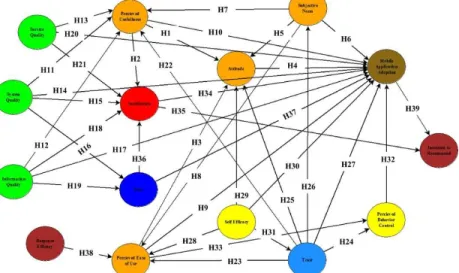
The scales used in the questionnaire to measure the research concepts were chosen from previous studies in the academic literature, all in the form of five-point Likert scales. The questions are focused on the mobile application user behavior and the influencing factors represented in the research conceptual model (Fig.ure 1)
3.2 Psychometric properties of the measurement instrument
The relationships considered in the theoretical model were estimated, using Partial Least Squares (PLS). PLS has been selected mainly since this algorithm enables the models that intervene in the formative constructs to be estimated without the need for additional global indicators to identify the model. This molar theoretical structure was estimated, employing the repeated-indicators approach [71,107]. The parameters were estimated, applying Smart-PLS 2.0 [88], and 1348 samples were bootstrapped to calculate the significance of the parameters.
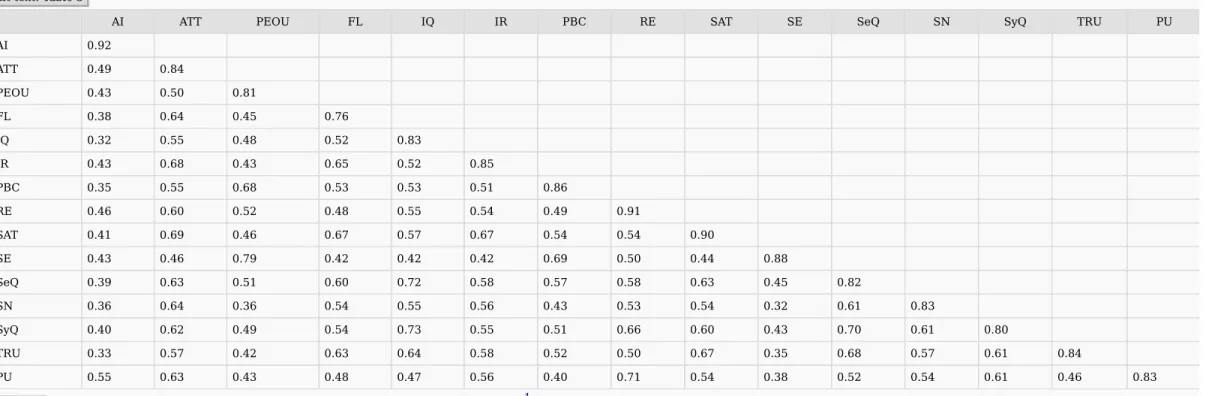
The measurement model was repeatedly checked to confirm its discriminant validity as well. A matrix containing correlations among the constructs was calculated and it was verified that the extracted variance for each construct was higher than the square of the correlation of that construct with any other construct (Table 3).
Table 3 Discriminant validity of the measurement model. alt-text: Table 3
AI ATT PEOU FL IQ IR PBC RE SAT SE SeQ SN SyQ TRU PU
AI 0.92
ATT 0.49 0.84
PEOU 0.43 0.50 0.81
FL 0.38 0.64 0.45 0.76
IQ 0.32 0.55 0.48 0.52 0.83
IR 0.43 0.68 0.43 0.65 0.52 0.85
PBC 0.35 0.55 0.68 0.53 0.53 0.51 0.86
RE 0.46 0.60 0.52 0.48 0.55 0.54 0.49 0.91
SAT 0.41 0.69 0.46 0.67 0.57 0.67 0.54 0.54 0.90
SE 0.43 0.46 0.79 0.42 0.42 0.42 0.69 0.50 0.44 0.88
SeQ 0.39 0.63 0.51 0.60 0.72 0.58 0.57 0.58 0.63 0.45 0.82
SN 0.36 0.64 0.36 0.54 0.55 0.56 0.43 0.53 0.54 0.32 0.61 0.83
SyQ 0.40 0.62 0.49 0.54 0.73 0.55 0.51 0.66 0.60 0.43 0.70 0.61 0.80
TRU 0.33 0.57 0.42 0.63 0.64 0.58 0.52 0.50 0.67 0.35 0.68 0.57 0.61 0.84
PU 0.55 0.63 0.43 0.48 0.47 0.56 0.40 0.71 0.54 0.38 0.52 0.54 0.61 0.46 0.83
NoteNote: Diagonal represents the AVE; squared correlations are reported below the diagonal.1
1AI= Adoption Intention; IR= Intention to Recommend; PU= Perceived Usefulness; PEOU=Perceived Ease of Use; PBC= Perceived Behavioral Control; SE= Self-Efficacy; RE=Response Efficacy; SyQ= System
Quality; IQ= Information Quality; SeQ= Service Quality; SN= Subjective Norm; ATT= Attitude; TRU= Trust; SAT= Satisfaction; FL= Flow
3.3 Research findings
Table 4 shows the values of the standardized coefficients for the structural relations and the respective levels of significance for their associated t statistics. The model estimation results indicated that five out of the eight hypotheses related to classical TPB were accepted. The trace of perceived usefulness on attitude (B = 0.28; pp < 0.01; H1 accepted) and satisfaction (B = B = 0.14; p <p < 0.01; H2 accepted) was confirmed; also the influence of attitude on adoption intention (B = B = 0.14; p <p < 0.01; H4 accepted), subjective norm on attitude (B = B = 0.31; p <p < 0.01; H5 accepted) and subjective norm on perceived usefulness (B = B = 0.22; p <p < 0.01; H7 accepted) was supported. However, the efficacy of perceived ease of use on attitude (B = B = 0.10; p <p < 0.01; H3 rejected) and Subjective Norm on perceived ease of use (B = B= –-0.008; p <p < 0.01; H6 rejected) and adoption intention (B = B = 0.01;
p <p < 0.01; H8 rejected) was not corroborated.
Table 4 Hypothesis testing. alt-text: Table 4
H1 Perceived Usefulness Attitude 0.28 6.43 Accepted
H2 Perceived Usefulness Satisfaction 0.14 3.48 Accepted
H3 Perceived Ease of Use Attitude 0.10 1.87 Rejected
H4 Attitude Adoption Intention 0.14 2.15 Accepted
H5 Subjective Norms Attitude 0.31 6.82 Accepted
H6 Subjective Norms Adoption Intention
–
-0.008 0.15 RejectedH7 Subjective Norms Perceived Usefulness 0.22 4.42 Accepted
H8 Subjective Norms Perceived Ease of Use 0.01 0.28 Rejected
H9 Perceived Ease of Use Adoption Intention 0.09 1.42 Rejected
H10 Perceived Usefulness Adoption Intention 0.36 6.38 Accepted
H11 System Quality Perceived Usefulness 0.41 7.15 Accepted
H12 Information quality Perceived Usefulness
–
-0.05 0.82 RejectedH13 Service Quality Perceived Usefulness 0.09 1.48 Rejected
H14 System Quality Satisfaction 0.12 2.13 Accepted
H15 System Quality Flow 0.34 5.98 Accepted
H16 System Quality Adoption Intention
–
-0.008 0.11 RejectedH17 Information Quality Satisfaction 0.06 1.26 Rejected
H18 Information Quality Flow 0.27 4.86 Accepted
H19 Information Quality Adoption Intention
–
-0.06 1.03 RejectedH20 Service Quality Adoption Intention 0.03 0.51 Rejected
H21 Service Quality Satisfaction 0.19 3.54 Accepted
H22 Trust Perceived Usefulness 0.04 0.85 Rejected
H23 Trust Perceived Ease of Use 0.12 3.11 Accepted
H24 Trust Perceived Behavioral Control 0.23 5.13 Accepted
H26 Trust Attitude 0.18 3.87 Accepted
H27 Trust Adoption Intention 0.004 0.08 Rejected
H28 Self-Efficacy Perceived Ease of Use 0.69 19.23 Accepted
H29 Self-Efficacy Attitude 0.10 1.968 Accepted
H30 Self-Efficacy Adoption Intention 0.21 2.68 Accepted
H31 Self-Efficacy Trust 0.34 7.04 Accepted
H32 Perceived Behavioral Control Adoption Intention
–
-0.10 1.66 RejectedH33 Perceived Ease of Use Perceived Behavioral Control 0.54 14.49 Accepted
H34 Satisfaction Adoption Intention 0.03 0.51 Rejected
H35 Satisfaction Intention to Recommend 0.59 15.63 Accepted
H36 Flow Satisfaction 0.38 8.07 Accepted
H37 Flow Adoption Intention 0.03 0.57 Rejected
H38 Response Efficacy Perceived Ease of Use 0.10 2.53 Accepted
H39 Adoption Intention Intention to Recommend 0.18 4.54 Accepted
One of the two hypotheses related to classical TAM was accepted. The influence of perceived usefulness on adoption intention (B = B = 0.36; p <p < 0.01; H10 accepted) was confirmed, while the effect of perceived ease of use on adoption intention (B = B = 0.09; p <p < 0.01; H9 rejected) was not verified.
Five of the 11 hypotheses related to the roles of system quality, information quality, and service quality in the mobile application user behavior model were approved. The influence of system quality on perceived usefulness (B = B = 0.41; p <p < 0.01; H11 accepted), satisfaction (B = B = 0.12; p <p < 0.01; H14 accepted) and flow (B = B = 0.34; p <p < 0.01; H15 accepted) was confirmed; also the effect of information quality on flow (B = B = 0.27; p <p < 0.01; H18 accepted) and service quality on satisfaction (B = B= 0.19; p <p < 0.01; H21 accepted) was verified. As regards, the effect of information quality on perceived usefulness (B = B = –-0.05; p <p < 0.01; H12 rejected), service quality on perceived usefulness (B = B = 0.09; p <p < 0.01; H13 rejected), system quality on adoption intention (B = B = –-0.008; p <p < 0.01; H16 rejected), information quality on satisfaction (B = B = 0.06; p <p < 0.01; H17 rejected), information quality on adoption intention (B = B = –-0.06; p <p < 0.01; H19 rejected), and service quality on adoption intention (B = B = 0.03; p <p < 0.01; H20 rejected) was not supported.
Four of the six hypotheses related to the role of trust in the mobile application user behavior model were admitted. The influence of trust on perceived ease of use (B = B = 0.12; p <p < 0.01; H23 accepted), perceived behavioral control (B = B = 0.23; p <p < 0.01; H24 accepted), social norm (B = B = 0.57; p <p < 0.01; H25 accepted) and attitude (B = B = 0.18; p <p < 0.01; H26 accepted) was affirmed, but the effect of trust on perceived usefulness (B = B = 0.04;
p <p < 0.01; H22 rejected) and adoption intention (B = B = 0.004; p <p < 0.01; H27 rejected) was not verified.
All four hypotheses related to the role of self-efficacy in the mobile application user behavior model were accepted. The effect of self-efficacy on perceived ease of use (B = B = 0.69; p <p < 0.01; H28 accepted), attitude (B = B = 0.10; p <p < 0.01; H29 accepted), adoption intention (B = B = 0.21; p <p < 0.01; H30 accepted), and on trust (B = B = 0.34; p <p < 0.01; H31 accepted) was proved.
One of the two hypotheses related to the role of perceived behavioral control in the mobile application user behavior model was accepted. The effect of perceived ease of use on perceived behavioral control (B = B= 0.54; p <p < 0.01; H33 accepted) was acknowledged, whereas the trace of it on adoption intention (B = B = –-0.10; p <p < 0.01; H32 rejected) was not supported.
confirmed, though the influence of satisfaction on adoption intention (B =0.03; p <p < 0.01; H34 rejected) was not proved.
One of the two hypotheses related to the role of flow in the mobile application user behavior model was passed. The effect of flow on satisfaction (B = B= 0.38; p <p < 0.01; H36 accepted) was acknowledged; nonetheless the influence of flow on adoption intention (B =0.02; p <p < 0.03; H37 rejected) was not confirmed.
Finally, both of the two hypotheses related to the role of response efficacy and intention to recommend in the mobile application user behavior model were stabled, and therefore, the traces of response efficacy on perceived ease of use (B = B= 0.10; p <p < 0.01; H38 accepted) and adoption intention on intention to recommend (B = B= 0.18; p <p < 0.01; H39 accepted) were admitted.
Based on the above analysis, the final behavior model of the mobile application users in Iran is presented in Fig. 2.
4 Discussion and conclusions
The purpose of this research was to investigate the factors that directly or indirectly contribute to the users’ mobile application adoption behavior in Iran. Since previous studies have just emphasized some effective factors in user behavior (e.g. [81,94,116,32,50,74,78,115,76]), the necessity of providing an encyclopedic model that could take into account most of the factors predicting the mobile application user behavior was felt. Subsequently, this study tried to provide an exhaustive model for the behavior of mobile application users with a reference to the literature review.
Considering the result of data analysis, the effect of perceived usefulness on attitude and satisfaction was confirmed; also the influence of attitude on adoption intention, subjective norm on attitude, and subjective norm on perceived usefulness was supported, which is in line with the findings of similar other studies (e.g. [11,12,16,32,50,81]). In contrary, the effect of perceived ease of use on attitude and subjective norm on perceived ease of use and adoption intention was not verified; this finding challenges the results of Park et al. [81], Cauberghe & De Pelsmacker [18], and Hsu et al. [48]. The impact of perceived usefulness on adoption intention was affirmed, which is similar to the findings of Amoako-Gyampah [7]. The efficacy of perceived ease of use on adoption intention was not validated. This finding contends the assertions of prior research (e.g. [35] and [115]).
Furthermore, the effects of system quality on perceived usefulness, satisfaction, and flow were confirmed, and also the efficacy of information quality on flow and the trace of service quality on satisfaction were verified. This finding is in line with the findings of other studies [33,34,57,60,119]. The effects of information quality on perceived usefulness, service quality on perceived usefulness, system quality on adoption intention, information quality on satisfaction, information quality on adoption intention, and service quality on adoption intention were not supported. This finding refuses the results of relevant preceding studies [54,61,102,67,94,119]. Nevertheless, some results of the current research in this section are associated with parts of some previous research results [40,80,50].
Confirmation of the effects of trust on perceived ease of use, perceived behavioral control, subjective norm, and attitude was achieved, fitting to the relevant research (e.g. [10,82,83,109,110]). The influence of trust on Fig.ure 2Mobile application user behavior model.
perceived usefulness and adoption intention was not proved, in opposition to other researchers’ claims (e.g. [14,43,45,62,73,108,76]). Moreover, the effects of self-efficacy on perceived ease of use, attitude, adoption intention, and trust were confirmed, matching with other studies in this area (e.g. [3,39,46,51,52,64,97,99,100,118,115]). The effect of perceived ease of use on perceived behavioral control was also approved, corresponding to the preceding research results ([18]; Yi et al. 2005). Conversely, the influence of perceived behavioral control on adoption intention was not confirmed, challenging the results of other researchers [18].
This survey revealed the effect of satisfaction on intention to recommend in association with similar investigations [13,29,63,105,111,112,69], whereas the effect of satisfaction on adoption intention was not accepted, in contradiction to the results of former analyses [27,55,98,101,86,20,79,114]. Additionally, the trace of flow on satisfaction was admitted, which is in agreement with the outcome of relevant studies [65,77,119], whereas the effect of flow on adoption intention was not proved, in contradiction to discoveries of Davis et al. [24], Hausman & Siekpe [44], Deng et al. [28], Goel et al. [38] and Zhou [119]. Ultimately, the influence of response efficacy on perceived ease of use and the effect of adoption intention on intention to recommend found to be admissible [56,113,115].
The present research covers both theoretical and empirical sides and presents impressive results in terms of its approach and concentration. First, it is focused on the mobile application user behavior through investigating the perceptions of potential mobile application users. Consequently, it provides a novel insight towards the mobile application adoption intention in Iran as a developing country in order to reflect new and unknown aspect of this important issue. It further tries to test a generic mobile application user behavior model, and eventually, provide a confirmed model for that.
Second, it provides insights about the role of self-efficacy, response-efficacy, attitude, subjective norms, perceived behavioral control, trust, satisfaction, flow, response efficacy and intention to recommend in mobile application user behavior via focusing on TMA and TPB. Furthermore, since this study deals with two other elements, perceived usefulness and perceived ease of use, it provides a better understanding of user behavior by considering various aspects of user perception in confrontation with an emerging applied technology (i.e. mobile application).
Third, this paper examines the factors influencing perceived usefulness, including system quality, information quality, and service quality, stemming from the information system success model. These three factors are important in technology acceptance and have not been investigated in the literature of mobile application. The results of this research can easily help mobile application providers in order to tailor their service design and enhance their users’ experience.
While mobile application becomes more popular and pervasive, much more academic studies would be encouraged to investigate this pervasive technology. This research interrogated the factors influencing the user behavior based on TAM, PBT and information system success model (ISSM), considering several factors by quantitative data. The result shows that the mentioned factors have a significant role in the users’ decision-making process.
With regard to the extension of the model, we will look at parts of the model and the results we obtained. For example, as the effect of perceived usefulness on adoption intention was accepted in this work, the application providers are suggested to focus on the usefulness and ease of use of their applications. It may involve different phases of application development, such as user interface design, user guide, and so on. This study further showed that service quality, information quality, and system quality do not have significant impact on mobile application adoption intention. It might be due to the effect of infrastructure limitation in the population on which this study has been implemented or even due to the specific users’ expectations in the developing countries.
As for the limitations of the study, the speed of change in the study context is very high, which restricts the validity of results to a given period of time and in a certain population in Iran as a representative of the developing countries. A possible line of future research would be required to apply the proposed model to a sample of users from other cultures with different degrees of individualism/collectivism and to compare the findings. As the topic is still new for research, there is more space for doing other surveys by testing the effect of brand awareness, marketing campaigns or marketing related endeavors on mobile application adoption intention. Also users’ specifications including demography and psychology have not been dealt with in this study, so considering these important factors in future studies can develop the research model. Furthermore, this survey has been conducted regardless of application typology; therefore, a comparative study could be planned to understand how service types might influence the user perception and behavior.
References
[1] D.A. Adams, R.R. Nelson and P.A. Todd, Perceived usefulness, ease of use, and usage of information technology: a replication, MIS Quarterly 1992, 227–247.
[2] R. Agarwal, V. Sambamurthy and R.M. Stair, Research report: the evolving relationship between general and specific computer self-efficacy—an empirical assessment, Inf. Syst. Res. 11 (4), 2000, 418–430.
[3] H. Ajjan, R. Hartshorne, Y. Cao and M. Rodriguez, Continuance use intention of enterprise instant messaging: a knowledge management perspective, Behav. Inf. Technol. 33 (7), 2014, 678–692.
[4] I. Ajzen, The theory of planned behavior, Organ. Behav. Hum. Decis. Process. 50 (2), 1991, 179–211.
[6] A.A. Alalwan, Y.K. Dwivedi, N.P. Rana and A.C. Simintiras, Jordanian consumers’ adoption of telebanking: influence of perceived usefulness, trust and Self-Efficacy, Int. J. Bank Marketing 34 (5), 2016, 690–709.
[7] K. Amoako-Gyampah, Perceived usefulness, user involvement and behavioral intention: an empirical study of ERP implementation, Comput. Hum. Behav. 23 (3), 2007, 1232–1248.
[8] A. Bandura, The explanatory and predictive scope of self-efficacy theory, J. Soc. Clin. Psychol. 4 (3), 1986, 359–373.
[9] A. Bandura, Social foundations of thought and action, The Health Psychology Reader, 2002, 94–106.
[10] D. Belanche, L.V. Casaló and C. Flavián, Integrating trust and personal values into the Technology Acceptance Model: the case of e-government services adoption, Cuadernos de Economía y Dirección de la Empresa 15
(4), 2012, 192–204.
[11] A. Bhattacherjee, Understanding information systems continuance: an expectation-confirmation model, MIS Quarterly 2001, 351–370.
[12] L.D. Booker, B. Detlor and A. Serenko, Factors affecting the adoption of online library resources by business students, J. Am. Soc. Inf. Sci. Technol. 63 (12), 2012, 2503–2520.
[13] T.J. Brown, T.E. Barry, P.A. Dacin and R.F. Gunst, Spreading the word: investigating antecedents of consumers’ positive word-of-mouth intentions and behaviors in a retailing context, J. Acad. Marketing Sci. 33 (2), 2005 123–138.
[14] J. Carlos Roca, J. José García and J. José de la Vega, The importance of perceived trust, security and privacy in online trading systems, Inf. Manage. Comput. Secur. 17 (2), 2009, 96–113.
[15] E.G. Carmines and R.A. Zeller, Reliability and Validity Assessment17, 1979, Sage publications.
[16] L. Carter and F. Bélanger, The utilization of e‐government services: citizen trust, innovation and acceptance factors, Inf. Syst. J. 15 (1), 2005, 5–25.
[17] V. Cauberghe and P.D. Pelsmacker, Opportunities and thresholds for advertising on interactive digital TV: a view from advertising professionals, J. Interact. Advertising 7 (1), 2006, 2–23.
[18] V. Cauberghe and P.D. Pelsmacker, Adoption intentions toward interactive digital television among advertising professionals, J. Interact. Advertising 11 (2), 2011, 45–59.
[19] P.Y. Chau and P.J.H. Hu, Information technology acceptance by individual professionals: a model comparison approach, Decis. Sci. 32 (4), 2001, 699–719.
[20] P.S. Chiu, I.C. Chao, C.C. Kao, Y.H. Pu and Y.M. Huang, Implementation and evaluation of mobile e-books in a cloud bookcase using the information system success model, Library Hi Tech. 34 (2), 2016, 207–223.
[21] D.R. Compeau and C.A. Higgins, Computer self-efficacy: development of a measure and initial test, MIS Quarterly 1995, 189–211.
[22] L.J. Cronbach, Coefficient alpha and the internal structure of tests, Psychometrika 16 (3), 1951, 297–334.
[23] F.D. Davis, Perceived usefulness, perceived ease of use, and user acceptance of information technology, MIS Quarterly 1989, 319–340.
[24] F.D. Davis, R.P. Bagozzi and P.R. Warshaw, Extrinsic and intrinsic motivation to use computers in the workplace, J. Appl. Soc. Psychol. 22 (14), 1992, 1111–1132.
[25] C.A. De Matos and C.A.V. Rossi, Word-of-mouth communications in marketing: a meta-analytic review of the antecedents and moderators, J. Acad. Marketing Sci. 36 (4), 2008, 578–596.
[26] W.H. DeLone and E.R. McLean, Information systems success: the quest for the dependent variable, Inf. Syst. Res. 3 (1), 1992, 60–95.
[27] W.H. Delone and E.R. McLean, The DeLone and McLean model of information systems success: a ten-year update, J. Manage. Inf. Syst. 19 (4), 2003, 9–30.
[28] L. Deng, D.E. Turner, R. Gehling and B. Prince, User experience, satisfaction, and continual usage intention of IT, Eur. J. Inf. Syst. 19 (1), 2010, 60–75.
[29] A. Finn, L. Wang and T. Frank, Attribute perceptions, customer satisfaction and intention to recommend e-services, J. Interact. Marketing 23 (3), 2009, 209–220.
[30] M. Fishbein and I. Ajzen, Belief, Attitude, Intention and Behaviour: An Introduction to Theory and Research, 1975, Addison-Wesley, Reading; MA.
[32] C. Gan and C. Song, Empirical analysis on intention to adopt mobile library based on TAM, Doc. Inf. Knowl. 3, 2015, 66–71.
[33] J. Gebauer, User requirements of mobile technology: a summary of research results, Inf. Knowl. Syst. Manage. 7 (1, 2), 2008, 101–119.
[34] J. Gebauer, M.J. Shaw and M.L. Gribbins, Task-technology fit for mobile information systems, J. Inf. Technol. 25 (3), 2010, 259–272.
[35] D. Gefen and D.W. Straub, The relative importance of perceived ease of use in IS adoption: a study of e-commerce adoption, J. Assoc. Inf. Syst. 1 (1), 2000, 8.
[36] D. Gefen, E. Karahanna and D.W. Straub, Trust and TAM in online shopping: an integrated model, MIS Quarterly 27 (1), 2003, 51–90.
[37] L. Gentry and R. Calantone, A comparison of three models to explain shop‐bot use on the web, Psychol. Marketing 19 (11), 2002, 945–956.
[38] L. Goel, N.A. Johnson, I. Junglas and B. Ives, From space to place: predicting users' intentions to return to virtual worlds, MIS Quarterly 35 (3), 2011, 749–772.
[39] J.C. Gu, S.C. Lee and Y.H. Suh, Determinants of behavioral intention to mobile banking, Expert Syst. Appl. 36 (9), 2009, 11605–11616.
[40] Y.M. Guo and M.S. Poole, Antecedents of flow in online shopping: a test of alternative models, Inf. Syst. J. 19 (4), 2009, 369–390.
[41] J.F. Hair, R.E. Anderson, B.J. Babin and W.C. Black, Multivariate Data Analysis: A Global Perspective7, 2010, Pearson; Upper Saddle River, NJ.
[42] N. Hajiheydari, B.H.H. Maskan and M. Ashkani, Factors affecting loyalty of mobile social networks' users, Int. J. E-Bus. Res. (IJEBR) 13 (1), 2017, 66–81.
[43] M.A. Harris, R. Brookshire and A.G. Chin, Identifying factors influencing consumers’ intent to install mobile applications, Int. J. Inf. Manage. 36 (3), 2016, 441–450.
[44] A.V. Hausman and J.S. Siekpe, The effect of web interface features on consumer online purchase intentions, J. Bus. Res. 62 (1), 2009, 5–13.
[45] I.B. Hong and H.S. Cha, The mediating role of consumer trust in an online merchant in predicting purchase intention, Int. J. Inf. Manage. 33 (6), 2013, 927–939.
[46] C.H. Hsiao and K.Y. Tang, Investigating factors affecting the acceptance of self-service technology in libraries: the moderating effect of gender, Library Hi Tech 33 (1), 2015, 114–133.
[47] J.P.A. Hsieh and W. Wang, Explaining employees’ extended use of complex information systems, Eur. J. Inf. Syst. 16 (3), 2007, 216–227.
[48] C.L. Hsu, C.C. Yu and C.C. Wu, Exploring the continuance intention of social networking websites: an empirical research, Inf. Syst. e-Bus. Manage. 12 (2), 2014, 139–163.
[49] M.H. Hsu, C.M. Chang and L.W. Chuang, Understanding the determinants of online repeat purchase intention and moderating role of habit: the case of online group-buying in Taiwan, Int. J. Inf. Manage. 35 (1), 2015, 45–56.
[50] J Hu and Y Zhang, Chinese students’ behavior intention to use mobile library apps and effects of education level and discipline, Library Hi Tech 34 (4), 2016, 639–656.
[51] Y.C. Huang, W.D. Tsay, C.H. Huang, Y.H. Lin and M.C. Lai, The influence factors of electronic bill presentment and payment—a case study of mobile phone bill, In: Artificial Intelligence, Management Science and
Electronic Commerce (AIMSEC), 2011 2nd International Conference on, 2011, August, IEEE, 4844–4847.
[52] S.Y. Hung, C.M. Chang and S.R. Kuo, User acceptance of mobile e-government services: an empirical study, Govern. Inf. Q. 30 (1), 2013, 33–44.
[53] S.Y. Hung, C.M. Chang and T.J. Yu, Determinants of user acceptance of the e-Government services: the case of online tax filing and payment system, Govern. Inf. Q. 23 (1), 2006, 97–122.
[54] J. Iivari, An empirical test of the DeLone-McLean model of information system success, ACM Sigmis Database 36 (2), 2005, 8–27.
[55] B. Ives, M.H. Olson and J.J. Baroudi, The measurement of user information satisfaction, Commun. ACM 26 (10), 1983, 785–793.
[56] A.C. Johnston and M. Warkentin, Fear appeals and information security behaviors: an empirical study, MIS Quarterly 2010, 549–566.
[58]K. Kapoor, Y.,C. Dwivedi, N. Piercy, B. Lal and V. Weerakkody, RFID integrated systems in libraries: extending TAM model for empirically examining the use, J. Enterprise Inf. Manage. 27 (6), 2014, 731–758.
[59]P.J. Kitchen, R. Martin and N. Che-Ha, Long term evolution mobile services and intention to adopt: a Malaysian perspective, J. Strat. Marketing 23 (7), 2015, 643–654.
[60]C. Koo, Y. Wati and N. Chung, A study of mobile and internet banking service: applying for IS success model, Asia Pac. J. Inf. Syst. 23 (1), 2013, 65–86.
[61]U.R. Kulkarni, S. Ravindran and R. Freeze, A knowledge management success model: theoretical development and empirical validation, J. Manage. Inf. Syst. 23 (3), 2007, 309–347.
[62]K. Kwahk, X. Ge and J.H. Park, Investigating the determinants of purchase intention in C2C e-commerce, World Acad. Sci., Eng. Technol. 6 (9), 2012, 487–491.
[63]S.Y. Lam, V. Shankar, M.K. Erramilli and B. Murthy, Customer value, satisfaction, loyalty, and switching costs: an illustration from a business-to-business service context, J. Acad. Marketing Sci. 32 (3), 2004, 293–311.
[64]W.M. Lassar, C. Manolis and S.S. Lassar, The relationship between consumer innovativeness, personal characteristics, and online banking adoption, Int. J. Bank Marketing 23 (2), 2005, 176–199.
[65]K.C. Lee, I. Kang and D.H. McKnight, Transfer from offline trust to key online perceptions: an empirical study, IEEE Trans. Eng. Manage. 54 (4), 2007, 729–741.
[66]M.C. Lee, Explaining and predicting users’ continuance intention toward e-learning: an extension of the expectation–confirmation model, Comput. Edu. 54 (2), 2010, 506–516.
[67]C. Legner, N. Urbach and C. Nolte, Mobile business application for service and maintenance processes: using ex post evaluation by end-users as input for iterative design, Inf. Manage. 53 (6), 2016, 817–831.
[68]L.Y. Leong, T.S. Hew, G.W.H. Tan and K.B. Ooi, Predicting the determinants of the NFC-enabled mobile credit card acceptance: a neural networks approach, Expert Syst. Appl. 40 (14), 2013, 5604–5620.
[69]M. Leppäniemi, H. Karjaluoto and H. Saarijärvi, Customer perceived value, satisfaction, and loyalty: the role of willingness to share information, Int. Rev. Retail, Distrib. Consum. Res. 27 (2), 2017, 164–188.
[70]C.T. Liu, Y.M. Guo and C.H. Lee, The effects of relationship quality and switching barriers on customer loyalty, Int. J. Inf. Manage. 31 (1), 2011, 71–79.
[71]J.B. Lohmöller, Predictive vs. structural modeling: Pls vs. ml, Latent Variable Path Modeling with Partial Least Squares, 1989, Physica; Heidelberg, 199–226.
[72]C.L. Miltgen, A. Popovič and T. Oliveira, Determinants of end-user acceptance of biometrics: integrating the “Big 3” of technology acceptance with privacy context, Decis. Support Syst. 56, 2013, 103–114.
[73]J. Mou, D.H. Shin and J. Cohen, The Role of Trust and Health Belief in the Acceptance of Online Health Services, 2016, IT & People.
[74]S.N. Ng, D. Matanjun, U. D'Souza and R. Alfred, Understanding pharmacists’ intention to use medical apps, Electr. J. Health Inf. 9 (1), 2015, 7.
[75]A.I. Nicolaou, M. Ibrahim and E. van Heck, Information quality, trust, and risk perceptions in electronic data exchanges, Decis. Support Syst. 54 (2), 2013, 986–996.
[76]S.A. Nikou and A.A. Economides, Mobile-based assessment: investigating the factors that influence behavioral intention to use, Comput. Edu. 109, 2017, 56–73.
[77]A. O'Cass and J. Carlson, Examining the effects of website-induced flow in professional sporting team websites, Internet Res. 20 (2), 2010, 115–134.
[78]S. Okazaki, S.S. Blas and J.A. Castañeda, Physicians’ adoption of mobile health monitoring systems in Spain: competing models and impact of prior experience, J. Electr. Commerce Res. 16 (3), 2015, 194.
[79]E. Park and A.P. Del Pobil, Modeling the user acceptance of long-term evolution (LTE) services, Ann. Telecommun. 68 (5-6), 2013, 307–315.
[80]E. Park and K.J. Kim, An integrated adoption model of mobile cloud services: exploration of key determinants and extension of technology acceptance model, Telematics Informatics 31 (3), 2014, 376–385.
[81]S.Y. Park, M.W. Nam and S.B. Cha, University students' behavioral intention to use mobile learning: evaluating the technology acceptance model, Br. J. Educ. Technol. 43 (4), 2012, 592–605.
[82]P.A. Pavlou, What drives electronic commerce? A theory of planned behavior perspective, Acad. Manage. Proc. 2002 (1), 2002, A1–A6.
[83]P.A. Pavlou, Consumer acceptance of electronic commerce: integrating trust and risk with the technology acceptance model, Int. J. Electr. Commer. 7 (3), 2003, 101–134.
[84]P.A. Pavlou and M. Fygenson, Understanding and predicting electronic commerce adoption: an extension of the theory of planned behavior, MIS Quarterly 2006, 115–143.
[86]S. Petter, W. DeLone and E.R. McLean, The past, present, and future of" IS Success", J. Assoc. Inf. Syst. 13 (5), 2012, 341.
[87]A. Rai, S.S. Lang and R.B. Welker, Assessing the validity of IS success models: an empirical test and theoretical analysis, Inf. Syst. Res. 13 (1), 2002, 50–69.
[88]C. Ringle, S. Wende and A. Will, Smart-PLS Version 2.0 M3, 2005, University of Hamburg.
[89]A. Robles-Gómez, S. Ros, R. Hernández, L. Tobarra, A.C. Caminero and J.M. Agudo, User acceptance of a proposed self-evaluation and continuous assessment system, J. Educ. Technol. Soc. 18 (2), 2015, 97.
[90]R.W. Rogers, A protection motivation theory of fear appeals and attitude change1, J. Psychol. 91 (1), 1975, 93–114.
[91]J. Schepers and M. Wetzels, A meta-analysis of the technology acceptance model: investigating subjective norm and moderation effects, Inf. Manage. 44 (1), 2007, 90–103.
[92]R. Schwarzer, A. Antoniuk and M. Gholami, A brief intervention changing oral self‐care, self‐efficacy, and self‐monitoring, Br. J. Health Psychol. 20 (1), 2015, 56–67.
[93]A.A. Shaikh and H. Karjaluoto, The effects of mobile banking application user satisfaction and system usage on bank-customer relationships, In: Proceedings of the 20th International Academic MindTrek Conference,
2016, ACM, 177–183.
[94]X.L. Shen, N. Wang, Y. Sun and L. Xiang, Unleash the power of mobile word-of-mouth: an empirical study of system and information characteristics in ubiquitous decision making, Online Inf. Rev. 37 (1), 2013, 42–60.
[95]D.H. Shin, Towards an understanding of the consumer acceptance of mobile wallet, Comput. Hum. Behav. 25 (6), 2009, 1343–1354.
[96]H. Sun and P. Zhang, The role of moderating factors in user technology acceptance, Int. J. Hum. Comput. Stud. 64 (2), 2006, 53–78.
[97]T.D. Susanto and R. Goodwin, User acceptance of SMS-based e-government services: differences between adopters and non-adopters, Govern. Inf. Q. 30 (4), 2013, 486–497.
[98]L.W. Swanson, The projections of the ventral tegmental area and adjacent regions: a combined fluorescent retrograde tracer and immunofluorescence study in the rat, Brain Res. Bull. 9 (1-6), 1982, 321–353.
[99]J.T.E. Tang, T.I. Tang and C.H. Chiang, Blog learning: effects of users' usefulness and efficiency towards continuance intention, Behav. Inf. Technol. 33 (1), 2014, 36–50.
[100]S. Taylor and P.A. Todd, Understanding information technology usage: a test of competing models, Inf. Syst. Res. 6 (2), 1995, 144–176.
[101]J.Y. Thong and C.S. Yap, Information systems effectiveness: a user satisfaction approach, Inf. Process. Manage. 32 (5), 1996, 601–610.
[102]N. Urbach, S. Smolnik and G. Riempp, Determining the improvement potentials of employee portals using a performance-based analysis, Bus. Process Manage. J. 17 (5), 2011, 829–845.
[103]V. Venkatesh, Determinants of perceived ease of use: integrating control, intrinsic motivation, and emotion into the technology acceptance model, Inf. Syst. Res. 11 (4), 2000, 342–365.
[104]V. Venkatesh, M.G. Morris, G.B. Davis and F.D. Davis, User acceptance of information technology: toward a unified view, MIS Quarterly 2003, 425–478.
[105]F.V. Wangenheim and T. Bayón, Behavioral consequences of overbooking service capacity, J. Marketing 71 (4), 2007, 36–47.
[106]K. Witte, Putting the fear back into fear appeals: the extended parallel process model, Commun. Monographs 59 (4), 1992, 329–349.
[107]H. Wold, Soft modelling: the basic design and some extensions, Systems Under Indirect Observation, Part II, 1982, 36–37.
[108]K. Wu, Y. Zhao, Q. Zhu, X. Tan and H. Zheng, A meta-analysis of the impact of trust on technology acceptance model: investigation of moderating influence of subject and context type, Int. J. Inf. Manage. 31 (6), 2011 572–581.
[109]L. Wu and J.L. Chen, An extension of trust and TAM model with TPB in the initial adoption of on-line tax: an empirical study, Int. J. Hum. Comput. Stud. 62 (6), 2005, 784–808.
[110]Q. Xie, Q. Xie, W. Song, W. Song, X. Peng, X. Peng, ... and M. Shabbir, Predictors for e-government adoption: integrating TAM, TPB, trust and perceived risk, Electron. Library 35 (1), 2017, 2–20.
[112]Z. Yang and R.T. Peterson, Customer perceived value, satisfaction, and loyalty: the role of switching costs, Psychol. Marketing 21 (10), 2004, 799–822.
[113]C. Yoon and H. Kim, Understanding computer security behavioral intention in the workplace: an empirical study of Korean firms, Inf. Technol. People 26 (4), 2013, 401–419.
[114]H.Y. Yoon, User acceptance of mobile library applications in academic libraries: an application of the technology acceptance model, J. Acad. Librarianship 42 (6), 2016, 687–693.
[115]X. Zhang, X. Han, Y. Dang, F. Meng, X. Guo and J. Lin, User acceptance of mobile health services from users’ perspectives: the role of Self-Efficacy and response-efficacy in technology acceptance, Inf. Health Soc. Care 2016, 1–13.
[116]Y. Zhang, Y. Fang, K.K. Wei, E. Ramsey, P. McCole and H. Chen, Repurchase intention in B2C e-commerce—a relationship quality perspective, Inf. Manage. 48 (6), 2011, 192–200.
[117]T. Zhou, An empirical examination of initial trust in mobile banking, Internet Res. 21 (5), 2011, 527–540.
[118]T. Zhou, Understanding users’ initial trust in mobile banking: an elaboration likelihood perspective, Comput. Hum. Behav. 28 (4), 2012, 1518–1525.
[119]T. Zhou, Understanding continuance usage intention of mobile Internet sites, Universal Access Inf. Soc. 13 (3), 2014, 329–337.
Highlights
•An encyclopedic model for the behavior of mobile applications users is presented.
•Satisfaction is the main determinant of intention to recommend a mobile application.
•Subjective norm is considerably affected by users’ trust toward the application.
•Application quality variables are impressive on intermediary influential factors.