Int. J. Electrochem. Sci., 5 (2010) 867 - 879
International Journal of
ELECTROCHEMICAL
SCIENCE
www.electrochemsci.orgExperimental and Computational Study on Electrochemical
Oxidation of Catechols
Davood Nematollahi1,* , Avat (Arman) Taherpour2, Saeed Jameh-Bozorghi2, Ailine Mansouri2, Bita Dadpou2
1
Faculty of Chemistry, Bu-Ali Sina University, Zip Code: 65178-38683, Hamedan, Iran. Tel.: +98 811 8282807, fax: +98 811 8257407. E-mail: [email protected].
2
Chemistry Department, Faculty of Science, Islamic Azad University, Arak Branch, P.O.Box 38135-567, Arak, Irane
*
E-Mail: [email protected]
Received: 26 May 2010 / Accepted: 12 June 2010 / Published: 20 June 2010
In this work, catechol and some of its derivatives have been studied by means of cyclic voltammetry on a glassy carbon electrode in aqueous solution containing phosphate buffer (pH 2.0) as supporting electrolyte. The measurements were done at room temperature. The chemical structure of 16 catechol derivatives has been optimized by using of Gaussian 98 program and Quantum Mechanical Calculation Ab Initio. Optimization was performed at the #B3LYP/6-311+G** level. The half-wave potentials (E1/2), were correlated with the calculated energies of the highest occupied molecular orbital (EHOMO)
and the lowest unoccupied molecular orbital (ELUMO) of the compounds studies. The linear relationship
between E1/2 and EHOMO (or E1/2 and ELUMO), of a series of compounds, demonstrates that they have a
similar mechanism of the electron transfer reaction.
Keywords: catechol, cyclic voltammetry, gaussian 98, HOMO, DFT theory, B3LYP.
1. INTRODUCTION
pharmaceutical industry [1]. In addition, catechol derivatives play an important role in mammalian metabolism, and many compounds of this type are known to be secondary metabolites of higher plants. In addition, many drugs such as doxorubicin, daunorubicin and mitomycin C that are used in cancer chemotherapy contain quinones [2]. Furthermore, catechol derivatives are a promising group of compounds which may lead to the discovery of selective acting, biodegradable agrochemicals having high human, animal and plant compatibility and, thus, worthwhile for further investigation [3].
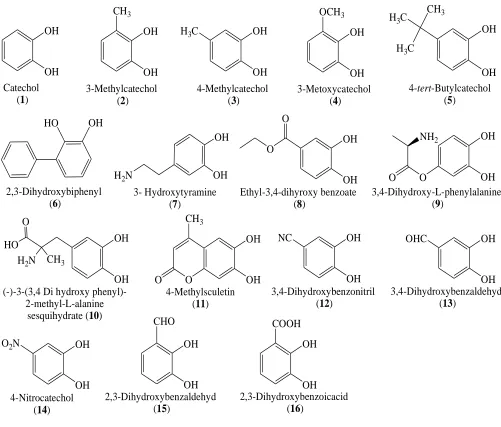
So, in this work, the chemical structure of some catechol derivatives (Fig. 1) has been optimized by using of Gaussian 98 program and Quantum Mechanical Calculation Ab Initio. Optimization was performed at the #B3LYP/6-311+G** level and the half-wave potentials obtained from cyclic voltammograms, were correlated with the calculated energies of the highest occupied molecular orbital (EHOMO) and the lowest unoccupied molecular orbital (ELUMO) of the compounds
studies.
OH
OH Catechol
(1)
OH
OH COOH
2,3-Dihydroxybenzoicacid (16)
OH
OH CH3
3-Methylcatechol (2)
OH
OH OCH3
3-Metoxycatechol (4) OH
OH H3C
4-Methylcatechol (3)
OH
OH 4-tert-Butylcatechol
(5)
OH
OH NC
3,4-Dihydroxybenzonitril (12)
OH
OH OHC
3,4-Dihydroxybenzaldehyd (13)
H2N
OH
OH
3- Hydroxytyramine (7)
OH OH O O NH2 3,4-Dihydroxy-L-phenylalanine (9)
OH OH HO
O
H2N CH3
(-)-3-(3,4 Di hydroxy phenyl)-2-methyl-L-alanine
sesquihydrate (10)
OH OH O O CH3 4-Methylsculetin (11) OH
HO
2,3-Dihydroxybiphenyl (6)
OH
OH O
O
Ethyl-3,4-dihyroxy benzoate (8)
4-Nitrocatechol (14)
H3C H3C CH3
OH
OH
O2N OH
OH 2,3-Dihydroxybenzaldehyd
[image:2.596.52.553.302.729.2](15) CHO
2. EXPERIMENTAL PART
2.1. Apparatus and reagents
Cyclic voltammetry was performed using Sama500 potentiostat/galvanostat. The working electrode used in the voltammetry experiments was a glassy carbon disc (1.8 mm diameter) and platinum wire was used as the counter electrode. The working electrode potentials were measured versus standard calomel electrode (SCE) (all electrodes from AZAR Electrode). All chemicals (catechols and phosphate salts) were reagent-grade materials, from Aldrich and E. Merck, respectively. These chemicals were used without further purification. The half-wave potentials (E1/2) were
calculated as the average of the anodic and cathodic peak potentials of the cyclic voltammograms ((Epa+Epc)/2. All experiments were carried out at room temperature.
2.2. Computational details
DFT (density functional theory) calculations were carried out using #B3LYP/6-311+G** level of theory with the GAUSSIAN 98 package of programs implemented on a Pentium-PC computer with a 2.6 GHz processor. Initial estimation of the structural geometry of the compounds 1-16 was obtained by a molecular mechanic program PCMODEL (88.0) and for further optimization of geometry, we used the PM3 method of the MOPAC 7.0 computer program. The GAUSSIAN 98 package of programs were finally used to perform DFT calculations at the #B3LYP/6-311+G** level. Energy-minimum molecular geometries were located by minimizing energy, with respect to all geometrical coordinates without imposing any symmetrical constraints. The nature of the stationary points for the compounds 1-16 has been fixed by means of the number of imaginary frequencies. For minimum state structure, only real frequency values, and in the transition-state, only single imaginary frequency values were accepted. NBO analysis was then performed at the #B3LYP/6-311+G** level by the NBO 3.1 program included in the GAUSSIAN 98 package of programs.
3. RESULTS AND DISCUSSION
3.1. Voltammetric studies
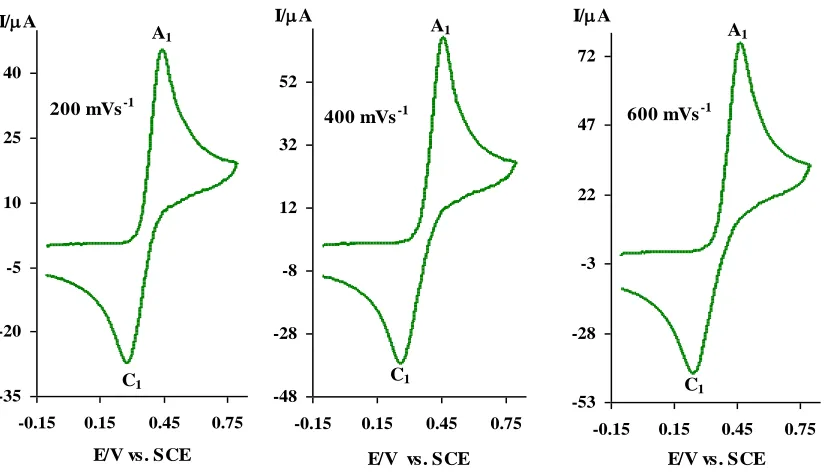
Figure 2, shows the voltammetric curves obtained for the oxidation of catechol (1) (1 mM) in water containing phosphate buffer (c = 0.2 M, pH = 2.0) at various scan rates, at a glassy carbon electrode. In the studied potential range, a well-defined voltammetric curve is obtained that has an anodic (A1) and the corresponding cathodic (C1) peaks. These peaks correspond to the oxidation of
words, any hydroxylation, dimerization or oxidative ring cleavage reactions are too slow to be observed on the time scale of cyclic voltammetry [7-13].
200 mVs-1
-35 -20 -5 10 25 40
-0.15 0.15 0.45 0.75
E/V vs. SCE A1
C1
I/mA
400 mVs-1
-48 -28 -8 12 32 52
-0.15 0.15 0.45 0.75
E/V vs. SCE C1
A1
I/mA
600 mVs-1
-53 -28 -3 22 47 72
-0.15 0.15 0.45 0.75
E/V vs. SCE C1
A1
I/mA
Figure 2. Typical cyclic voltammograms of 1 mM catechol (1) at a glassy carbon electrode, in aqueous solution containing 0.2 M phosphate buffer (pH 2.0). Scan rates are 200, 400, and 600 mV s-1, respectively. t = 25±1 ˚C.
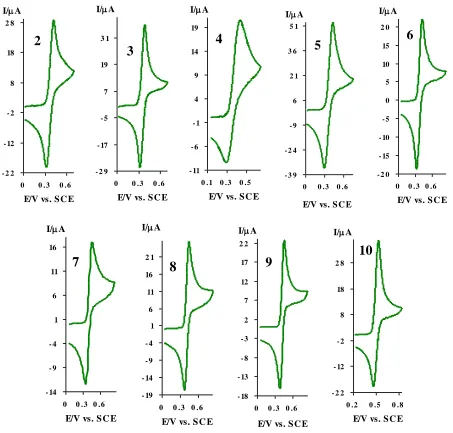
The same results obtained for electrochemical oxidation of other catechols such as: 3-methylcatechol (2), 4-methylcatechol (3), 3-methoxycatechol (4), 4-tert-butylcatechol (5), 2,3-dihydroxybiphenyl (6), 3-hydroxytyramine (7), 3,4-dihydroxy-L-phenylalanine (8), 3-(3,4-dihydroxyphenyl)-2-methyl-L-alanine (9) and 4-methylsculetin (10). Figure 3, shows the cyclic voltammograms of catechols 2-10 (1 mM) in water containing phosphate buffer (c = 0.2 M, pH = 2.0). As can be seen, a well-defined voltammetric curve with an anodic (A1) and the corresponding cathodic
(C1) is obtained in each case. These peaks correspond to the oxidation of catechol 2-10 to
o-benzoquinone 2a-10a and vice versa [4-6].
OH
OH
O
O -2e- -2H+
1-10 1a-10a
R1
R2
R1
R2
R1 = R2 = H (1) R1 = CH3, R2 = H (2)
R1 = H, R2 = CH3 (3) R1 = OCH3, R2 =H (4)
R1 = H, R2 = tert-Butyl (5) R1 = Phenyl, R2 = H (6)
R1 = H, R2 = CH2-CH2-NH2 (7)
R1 = H, R2 = (8) R1 = H, R2 = (CH2-C 9)
CH3
NH2
COOH
-O-C-CH-CH3
NH2 O
O CH3
OH
OH O
(10)
[image:4.596.93.513.135.371.2]
- 2 2 - 12 - 2 8 18 2 8
0 0 .3 0 .6
E/V vs. SC E I/mA
2
- 2 9 - 17 - 5 7 19 3 1
0 0 .3 0 .6
E/V vs. SC E I/mA
3
- 11 - 6 - 1 4 9 14 190 .1 0 .3 0 .5
E/V vs. SC E I/mA
4
- 3 9 - 2 4 - 9 6 2 1 3 6
5 1
0 0 .3 0 .6
E/V vs. SC E I/mA
5
- 2 0 - 15 - 10 - 5 0 5 10 15 2 0
0 0 .3 0 .6
E/V vs. SC E
6
I/mA
- 14 - 9 - 4 1 6 11 16
0 0 .3 0 .6
E/V vs. SC E I/mA
7
- 19 - 14 - 9 - 4 1 6 11 16 2 10 0 .3 0 .6
E/V vs. SC E I/mA
8
- 18 - 13 - 8 - 3 2 7 12 17 2 20 0 .3 0 .6
E/V vs. SC E
9
I/mA
- 2 2 - 12 - 2 8 18 2 8
0 .2 0 .5 0 .8
E/V vs. SC E I/mA
10
Figure 3. Cyclic voltammograms of 1 mM; 3-methylcatechol (2), 4-methylcatechol (3), 3-methoxycatechol (4), 4-tert-butylcatechol (5), 2,3-dihydroxybiphenyl (6), 3-hydroxytyramine (7), 3,4-dihydroxy-L-phenylalanine (8), 3-(3,4-dihydroxyphenyl)-2-methyl-L-alanine (9), 4-methylsculetin (10) at a glassy carbon electrode, in aqueous solution containing 0.2 M phosphate buffer (pH 2.0). Scan rate; 200 mV s-1. t = 25±1 ˚C.
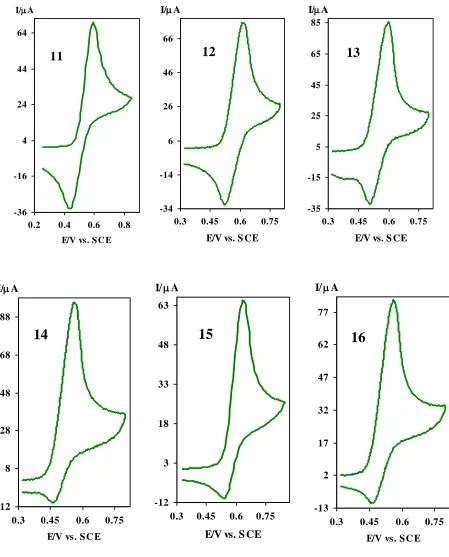
Another type of catechols is catechols with electron-withdrawing groups (Figure 4). These catechols consist of ethyl-3,4-dihydroxybenzoate (11), 3,4-dihydroxybenzonitril (12), 3,4-dihydroxybenzaldehyd (13), 2,3-dihydroxybenzaldehyd (14), 4-nitrocatechol (15) and 2,3-dihydroxybenzoic acid (16). In this type of catechols, the peak current ratio (Ip
C1
/Ip A1
[image:5.596.70.523.73.506.2]
-36 -16 4 24 44 64
0.2 0.4 0.6 0.8
E/V vs. SC E I/mA
11
-34 -14 6 26 46 66
0.3 0.45 0.6 0.75
E/V vs. S CE I/mA
12
-35 -15 5 25 45 65 85
0.3 0.45 0.6 0.75
E/V vs. S CE I/mA
13
-12 8 28 48 68 88
0.3 0.45 0.6 0.75
E/V vs. SC E
I/mA
14
-12 3 18 33 48 63
0.3 0.45 0.6 0.75
E/V vs. S CE
15
I/ mA
-13 2 17 32 47 62 77
0.3 0.45 0.6 0.75
E/V vs. SC E
16
[image:6.596.71.520.90.647.2]I/ mA
OH
OH
O
O -2e- -2H+ 11-16
11a-16a R1
R2
R1
R2
OH
-OH
OH R1
R2
-2e- -2H+ HO
O
OH R1
R2
O
O
-OH R1
R2 -O
-O
R1
R2
Dimer
Polymer -2e- -2H+ +2H2O
COOH COOH R1
R2
R1 = H, R2 = EtOCO (11)
R1 = H, R2 = CN (12)
R1 = H, R2 = CHO (13)
R1 = H, R2 =NO2 (14)
R1 = CHO, R2 = H (15)
R1 = COOH, R2 = H (16)
Scheme 2.
3.2. Computational studies
Here, we wish to present the calculated energies of the HOMO and LUMO of catechol derivatives as shown in Fig. 1. As has been shown earlier, for benzendiol derivatives the prevailing mechanism consists of a formation of a radical cation, as the primary reaction stage [14,15]:
QH2 - e QH2
where QH2 is the substrate, and [QH2] .+
is the radical cation, which has an unpaired spin and a positive charge at the same time. When QH2 is oxidized to form radical cation, [QH2]
.+
, it donates an electron from its highest occupied molecular orbital (HOMO). On the other hand, when [QH2]
Alternatively, in reductions of quinones, the first step is usually a one-electron process that produces a radical anion, Q.-[15,16]:
Q + e Q
.-Following Sasaki et al. [17] and Saeva and Olin [18], the correlation between the calculated energies of the HOMO and LUMO and the electrode potentials of the catechols shown in Fig. 1 (compounds 1-16) have been investigated. The chemical structure of catechols 1-16 has been optimized by using of Gaussian 98 program and Quantum Mechanical Calculation Ab Initio. Optimization was performed at the #B3LYP/6-311+G** level. Simple relations have been found between the potential of anodic peak (Epa) and energy of the HOMO (EHOMO) and half-wave potential
(E1/2) and EHOMO (or ELUMO). These relations are also shown in Figs. 5 and 6. The relation between
half-wave potential, (E1/2) and energy of the lowest unoccupied level of the catechols is also justified
since the molecules 1-16 accepts an electron to be converted to the reduced form [16,18]. Also, the linear relationship between E1/2 and EHOMO (or ELUMO) for a series of compounds, demonstrates that
they have a similar mechanism of the electron transfer reaction. If there is no correlation between the measured potentials (Epa, or E1/2) and the calculated EHOMO or ELUMO, then, it may mean that there is a
change of the mechanism of the electron transfer reaction [19-24].
R2 = 0.8181
0 0.2 0.4 0.6 0.8 1
-0.14 -0.12 -0.1 -0.08 -0.06 -0.04 -0.02 0
ELUMO/eV
E1/
2
/V
vs
. S
C
E
Scan rate : 600 mV/s
R2 = 0.7752
0 0.2 0.4 0.6 0.8 1
-0.14 -0.12 -0.1 -0.08 -0.06 -0.04 -0.02 0
ELUMO/eV
E1/
2
/V
vs
. S
C
E
R2 = 0.6974
0 0.2 0.4 0.6 0.8 1
-0.14 -0.12 -0.1 -0.08 -0.06 -0.04 -0.02 0
ELUMO/eV
E1/
2
/V
vs
. S
C
E
[image:9.596.97.490.84.251.2]Scan rate: 200 mV/s
Figure 5. Half-wave potentials (E1/2) of catechols vs. LUMO energies at scan rates; 600, 400 and 200
mV/s.
R2 = 0.8797
0 0.2 0.4 0.6 0.8 1
-0.14 -0.12 -0.1 -0.08 -0.06 -0.04 -0.02 0
ELUMO/eV
E1/
2
/V
vs
. S
C
E
[image:9.596.102.488.333.499.2]Scan rate: 600 mV/s
Figure 6. Half-wave potentials (E1/2) of catechols vs. LUMO energies at scan rate 600 mV/s,
calculated without 3,4-dihydroxybenzonitril (12).
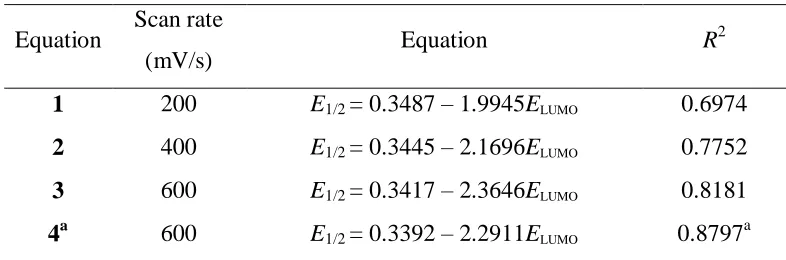
Table 1. The relations between E1/2 of catechols 1-16 and ELUMO in various scan rates.
Equation Scan rate
(mV/s) Equation R
2
1 200 E1/2= 0.3487 – 1.9945ELUMO 0.6974
2 400 E1/2= 0.3445 – 2.1696ELUMO 0.7752
3 600 E1/2= 0.3417 – 2.3646ELUMO 0.8181
4a 600 E1/2= 0.3392 – 2.2911ELUMO 0.8797a
a
[image:9.596.111.504.613.743.2]
As Table 1 shows, the regression coefficient (R2) increases with increasing scan rate. R2 is indicating goodness-of-fit of the regression. This is expected because of the change of E1/2 at different
scan rates when electrode reaction is in accompany with coupled homogeneous chemical reactions [25]. As Scheme 2 shows, electrochemically generated o-benzoquinones 1a-16a, participate in following chemical reactions [4-6]. An important parameter in determining the effect of chemical reaction is the ratio of rate constant of chemical reaction to the potential scan rate, k/v, where k is rate constant of chemical reaction of electrochemically generated o-benzoquinones 1a-16a and v is potential scan rate. Our previous works indicates that the generated o-benzoquinones from catechols with electron-withdrawing groups have great tendency for participation in following chemical reactions [26-30]. In kinetic and partially intermediate conditions (when k is large and/or v is low) E1/2
shifts toward negative potentials [25], and the extent of this shift for various catechols is related to rate constant of chemical reaction, k. The deviation of E1/2 from its reversible (actual) amount in lower scan
rates caused the decreasing of R2. In the case of 3,4-dihydroxybenzonitril (12), because of the higher reactivity of its o-benzoquinone 12a produces a larger error. Therefore, in Table 1, Eq. 4, removing of 3,4-dihydroxybenzonitril (12), caused an increase in the R2.
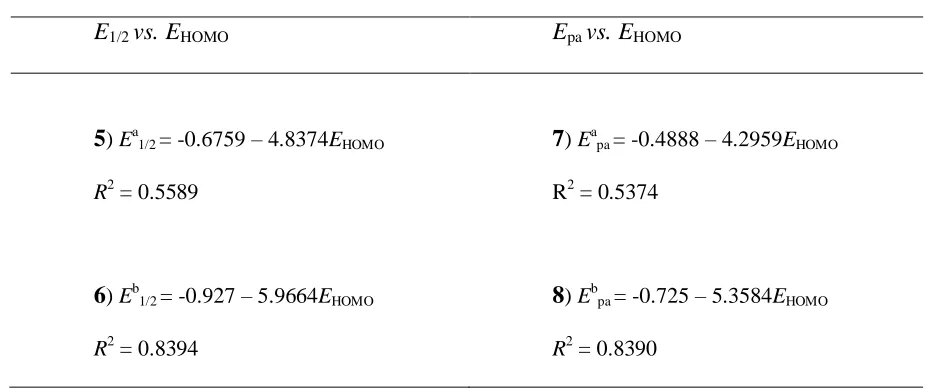
Table 2, shows the relations between E1/2 (or Epa) and EHOMO in v = 600 mV/s. The relation
between half-wave potential (E1/2) or anodic electrode potential (Epa) with energy of the highest
[image:10.596.65.530.512.706.2]occupied molecular level of the molecule (HOMO) is reasonable since the molecule 1-16 has already gained an electron. Comparison of regression coefficient (R2) of Eq. 5 (0.5589) with Eq. 6 (0.8394) (or Eq. 7 with Eq. 8) in Table 2, shows that removing of 4-methylcatechol (3) from list caused a significant improved. This can be related to difference in the pattern of the electrochemical behavior and electron transfer mechanism of 3 with other catechols. This compound during the oxidation can be converted to their tautomeric p-quinone methide (3b) form (Scheme 3) [31].
Table 2. The relations between E1/2 (or Epa) and EHOMO in v = 600 mV/s.
E1/2 vs. EHOMO Epa vs. EHOMO
5) Ea1/2= -0.6759 – 4.8374EHOMO
R2 = 0.5589
7) Eapa= -0.4888 – 4.2959EHOMO
R2 = 0.5374
6) Eb1/2= -0.927 – 5.9664EHOMO
R2 = 0.8394
8) Ebpa= -0.725 – 5.3584EHOMO
R2 = 0.8390
a
All 1-16 compounds.
b
OH
OH
OH
O -2e- -2H+
3 3b
H3C H2C
[image:11.596.156.443.73.152.2]Scheme 3.
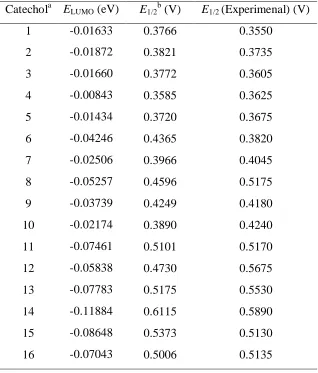
Table 3 presents the calculated half-wave potentials by Eq. 4, in Table 1, in comparison with experimental values. A significant improvement can be seen for all of the catechols and the root-mean-square of errors (calculated without 3,4-dihydroxybenzonitril (12)) is less than 0.027 V.Therefore, if an ELUMO for a new catechol derivative is calculated, the Eq. 4 can help to estimate the E1/2 of this
compound.
Table 3. Half-wave potential of the studied catechols calculated at the level of #B3LYP/6-311+G**, compared with the experimental values.
Catechola ELUMO (eV) E1/2b (V) E1/2(Experimenal) (V)
1 -0.01633 0.3766 0.3550
2 -0.01872 0.3821 0.3735
3 -0.01660 0.3772 0.3605
4 -0.00843 0.3585 0.3625
5 -0.01434 0.3720 0.3675
6 -0.04246 0.4365 0.3820
7 -0.02506 0.3966 0.4045
8 -0.05257 0.4596 0.5175
9 -0.03739 0.4249 0.4180
10 -0.02174 0.3890 0.4240
11 -0.07461 0.5101 0.5170
12 -0.05838 0.4730 0.5675
13 -0.07783 0.5175 0.5530
14 -0.11884 0.6115 0.5890
15 -0.08648 0.5373 0.5130
16 -0.07043 0.5006 0.5135
a
See Fig. 1 for the list of studied catechols.
b
[image:11.596.140.458.350.723.2]
4. CONCLUSION
The chemical structure of 16 catechol derivatives has been optimized by using of Gaussian 98 program and Quantum Mechanical Calculation Ab Initio. Optimization was performed at the #B3LYP/6-311+G** level. The half-wave potential, E1/2, was correlated with the calculated energies of
lowest unoccupied molecular orbital (ELUMO) and highest occupied molecular orbital (EHOMO) of the
compounds studies. The simple linear relationship between E1/2 and EHOMO (or ELUMO) for a series of
compounds, demonstrates that they have a similar mechanism of the electron transfer reaction during electron transfer reaction.Because of the deviation of E1/2 from its reversible (actual) amount in lower
scan rates, the best relationship obtained in higher scan rates. This relation can be used for calculation of E1/2 of new catechol derivatives. In correlations of E1/2 with ELUMO, catechols with
electron-withdrawing groups such as 3,4-dihydroxybenzonitril (12) because of the higher reactivity of related o-benzoquinone and participation in following chemical reactions such as hydroxylation, dimmerization and oxidative ring cleavage reactions are problematical. In addition, in correlations of E1/2 (or Epa)with
EHOMO, 4-methylcatechol (3) has a large error, and its data are deleted. This can be related to different
electro-oxidation behavior of 4-methylcatechol and formation of its tautomeric p-quinone methide. ACKNOWLEDGEMENTS
The authors acknowledge to Bu-Ali Sina University Research Council and Center of Excellence in Development of chemical Methods (CEDCM) for support this work.
References
1. N. Schweigert, A. J. B. Zehnder and R. I. L. Eggen, Environ. Microbiol., 3 (2001) 81. 2. R. H. Blum and S. K. Carter, Ann. Int. Med., 80 (1974) 249.
3. AMICBASE-EssOil, Database on Natural Antimicrobials, Review Science, Germany, 1999-2002. 4. D. Nematollahi, M. Rafiee andL. Fotouhi,J. Iran. Chem. Soc., 6 (2009) 448.
5. J. B. Raoof, R. Ojani, D. Nematollahi and A. Kiani, Int. J. Electrochem. Sci., 4 (2009) 810. 6. D. Nematollahi, E. Tammari and H. Karbasi, Int. J. Electrochem. Sci., 2 (2007) 986. 7. D. Nematollahi, M. Rafiee and A. Samadi-Maybodi, Electrochim. Acta 49 (2004) 2495. 8. M. D. Ryan, A. Yueh and C. Wen-Yu, J. Electrochem. Soc., 127 (1980) 1489.
9. L. Papouchado, G. Petrie and R. N. Adams, J. Electroanal. Chem., 38 (1972) 389.
10.L. Papouchado, G. Petrie, J. H. Sharp and R. N. Adams, J. Am. Chem. Soc., 90 (1968) 5620. 11.T. E. Young, J. R. Griswold and M. H. Hulbert, J. Org. Chem., 39 (1974) 1980.
12.T. R. Demmin, M. D. Swerdloff and M. M. Rogic, J. Am. Chem. Soc., 103 (1981)5795. 13.G. Lin, G. Reid and T. D. H. Bugg, Chem. Commun., (2000) 1119.
14.D. Nematollahi and L. Mohammadi-Behzad, Int. J. Electrochem. Sci., 4 (2009) 1583.
15.K. Izutsu, Electrochemistry in nonaqueous solutions, 1st Ed, Wiley, New York, 2001, p. 257 and 246.
16.J. E. Heffner, C. T. Wigal and O. A. Moe, Electroanalysis9 (1997) 629.
17.K. Sasaki, T. Kashimura, M. Ohura, Y. Ohsaki and N. Qhta, J. Electrochem. Soc., 137 (1990) 2437.
18.F. D. Saeva and G. R. Olin, J. Am. Chem. Soc., 102 (1980) 299.
22.J. E. Heffner, J. C. Raber, O. A. Moe and C. T. Wigal, J.Chem. Ed., 75 (1988) 365.
23.S. Riahi, M. R. Ganjali, A. Bayandori Moghaddam, P. Norouzi and M. Niasari, Theochem., 774 (2006) 107.
24.S. Riahi, M. R. Ganjali, H. Khajehsharifi, P. Norouzi and S. Taghipoor, Int. J. Electrochem. Sci., 4 (2009) 122.
25.J. Bard and L. R. Faulkner, Electrochemical Methods, 2nd Ed, Wiley, New York, 2001, p. 497. 26.D. Nematollahi and H. Shayani-Jam, J. Org. Chem., 73 (2008) 3428.
27.D. Nematollahi, M. Alimoradi and M. Rafiee, J. Phys. Org. Chem., 20 (2007) 49. 28.D. Nematollahi, M. Alimoradi and S. Waqif Husain, Electroanalysis 16 (2004) 1359. 29.D. Nematollahi, A. Ariapad and M. Rafiee, J. Electroanal. Chem., 602 (2007) 37.
30.L. Fotouhi, E. Tammari, S. Asadi, M. M. Heravi and D. Nematollahi, Int. J. Chem. Kinet., 41 (2009) 426.
31.M. Sugumaran and H. Lipke, FEBS Lett., 155 (1983) 65.