S C I E N C E A D V A N C E S
|
R E S E A R C H A R T I C L E
P H Y S I C S
Ultrafast dissolution and creation of bonds in IrTe
2
induced by photodoping
Shin-ichiro Ideta1,2*†, Dongfang Zhang1*‡, Arend G. Dijkstra1,3, Sergey Artyukhin4, Sercan Keskin1§, Roberto Cingolani4, Takahiro Shimojima2, Kyoko Ishizaka2, Hiroyuki Ishii5, Kazutaka Kudo5, Minoru Nohara5, R. J. Dwayne Miller1,6¶
The observation and control of interweaving spin, charge, orbital, and structural degrees of freedom in materials on ultrafast time scales reveal exotic quantum phenomena and enable new active forms of nanotechnology. Bond-ing is the prime example of the relation between electronic and nuclear degrees of freedom. We report direct evi-dence illustrating that photoexcitation can be used for ultrafast control of the breaking and recovery of bonds in solids on unprecedented time scales, near the limit for nuclear motions. We describe experimental and theoretical studies of IrTe2 using femtosecond electron diffraction and density functional theory to investigate bonding in-stability. Ir-Ir dimerization shows an unexpected fast dissociation and recovery due to the filling of the antibonding dxy orbital. Bond length changes of 20% in IrTe2 are achieved by effectively addressing the bonds directly through this relaxation process. These results could pave the way to ultrafast switching between metastable structures by photoinduced manipulation of the relative degree of bonding in this manner.
INTRODUCTION
The study of interactions among different degrees of freedom strongly coupled to the lattice is a crucial key for elucidating and manipulating material properties (1). The mechanism of structural phase transi-tions with the modulation of the electron density and the associated periodic lattice distortions (PLDs) represent an especially challenging issue for elucidating cooperative phenomena (2–5). IrTe2 is of
par-ticular interest to survey the relationship between structural phase transitions and orbital ordering in the presence of strong spin-orbit coupling (6–12). IrTe2 is a quasi–two-dimensional layered system,
which undergoes a first-order structural transition between two crys-talline phases at 260 K (12). The conduction electron density becomes modulated in a complex way, and modifying forces among the ions and generating PLDs with the bond lengths shortened: Ir-Ir and Te-Te bond lengths in the low-temperature (LT) phase decrease by 20 and 10%, respectively, compared with those in the high-temperature (HT) phase (13–17). This is due to bond formations, observed as the for-mation of in-plane Ir dimers and/or polymerization of Te chains (12, 13, 15) and accompanied by orbital/charge ordering observed by core-level photoemission spectroscopy (18, 19).
According to angle-resolved photoemission spectroscopy and den-sity functional theory (DFT) studies (13, 16), the electronic structure of IrTe2 near the Fermi level (EF) shows a multi-orbital system
con-sisting of Ir 5d and Te 5p and preserves its metallic properties in both
LT and HT phases. In the LT phase, the density of states (DOS) at the bottom of the conduction band has a large contribution from Ir t2g
orbitals, and the dxy orbital is expected to play an important role in the
structural phase transition and stabilization of the LT phase (13, 17). Dimerization in IrTe2 is quite a special example among phase
transi-tions exhibited in transition metal dichalcogenides, in contrast to the well-known charge density wave (CDW) type transition, resulting in an energy gap formation at EF in many other transition metal
dichal-cogenides and rare earth tellurides (20–22). Although there is no clear evidence of the CDW gap in IrTe2 below the transition temperature
(10, 15, 16), the suppression of DOS (pseudogap) is observed, similar to that in high-Tc cuprate superconductors (15, 16, 23). The phase
tran-sition toward LT in IrTe2 has been suggested to originate in
intra-layer Ir-Ir dimers, which compete against the interintra-layer Te-Te bonds (9, 12). Besides, strong spin-orbit interactions appear to destabilize Ir dimers and possibly influence the structural phase transition tem-perature in IrTe2 (11, 13, 18). These experimental results suggest that
the orbital and/or charge ordering in IrTe2 is different from that in the
conventional CDW induced by Fermi surface nesting and momentum- dependent electron-phonon coupling (16).
Femtosecond time-resolved techniques “light up” the various ac-tive degrees of freedom by abruptly modulating the electronic dis-tribution while mostly preserving the energy transfer mechanism and coupling strengths among electron, spin, and lattice subsystems (24, 25). While extensive experiments in IrTe2 have been performed (6–19), time-
resolved experiments have not been demonstrated as yet. Here, we investigated the structural dynamics of PLD in 20- to 100-nm-thick, free-standing slices of single-crystal IrTe2 (see the Supplementary
Materials). The present ultrafast pump-probe experiment operates on the natural time scale of strongly coupled electronic and lattice degrees of freedom in IrTe2 and allows an unprecedented insight
into the physics underlying these complex orderings.
RESULTS
We performed femtosecond electron diffraction (FED) experiments in the transmission geometry along the c axis in both HT (300 K) 1Max Planck Institute for the Structure and Dynamics of Matter, and Hamburg Center
for Ultrafast Imaging, Luruper Chaussee 149, 22761 Hamburg, Germany. 2Quantum- Phase Electronics Center, Department of Applied Physics, University of Tokyo, Tokyo 113-8656, Japan. 3School of Chemistry and School of Physics and Astrono-my, University of Leeds, Leeds LS2 9JT, UK. 4Italian Institute of Technology, Via Morego, 30, 16163 Genova, Italy. 5Research Institute for Interdisciplinary Science, Okayama University, Okayama 700-8530, Japan. 6Departments of Chemistry and Physics, 80 St. George Street, University of Toronto, Toronto, Ontario M5S 3H6, Canada.
*These authors contributed equally to this work.
†Present address: Institute for Molecular Science (IMS), Okazaki 444-8585, Japan. ‡Present address: Deutsches Elektronen-Synchrotron DESY, Notkestraße 85, 22607 Hamburg, Germany.
§Present address: INM, Leibniz Institute for New Materials, D-66123 Saarbrücken, Germany. ¶Corresponding author. Email: [email protected]
Copyright © 2018 The Authors, some rights reserved; exclusive licensee American Association for the Advancement of Science. No claim to original U.S. Government Works. Distributed under a Creative Commons Attribution NonCommercial License 4.0 (CC BY-NC).
on October 11, 2019
http://advances.sciencemag.org/
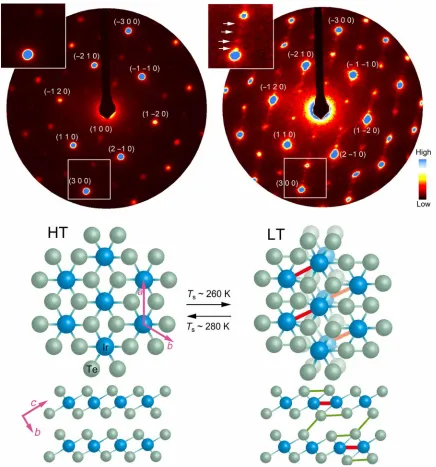
and LT (at ~200 K) phases. Figure 1 shows the background-subtracted electron diffraction pattern on 40-nm-thick IrTe2 in the HT and LT
phases, respectively. In the HT phase, the obvious electron diffraction patterns with the sixfold symmetry of the trigonal structure are observed. In the LT phase, the sequence of four weak superlattice peaks (SLs) highlighted by the arrows is visible between two Bragg peaks (BPs).
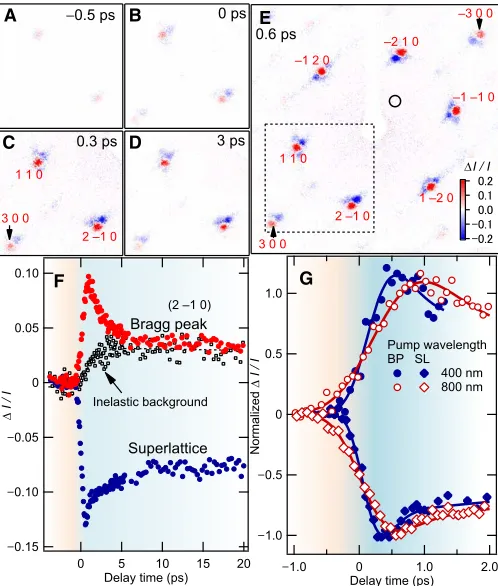
The time evolution of the relative intensity change of the diffrac-tion signal is shown in Fig. 2 in the vicinity of BP and SL following photoexcitation by an optical pump pulse. Relative intensity changes
from a BP and a nearest-neighboring SL are observed, as shown in Fig. 2 (A to D) (see also fig. S3). The corresponding lattice dynamics of the relative change in the Bragg peak (IBragg/IBragg), superlattice peak
(ISL/ISL), and inelastic background (IBG/IBG) are plotted as functions
of optical delay time in Fig. 2F. The intensity of SL is suppressed by ~13% on time scales of ~200 and 300 fs for 400- and 800-nm pump pulses, respectively, where the data are fit by two exponential decays. The decrease of ISL/ISL and the accompanying increase of IBragg/IBragg
[image:2.594.81.517.169.636.2]illustrate a cooperative behavior, indicating that the optically induced
Fig. 1. Static electron diffraction image of IrTe2 obtained by ultrahigh acceleration voltage 128-kV electron pulse. The upper panels are the electron diffraction obtained at 300 K (HT phase) and ~200 K (LT phase). The Miller indices (h k l) are also shown. Magnified view of the diffraction intensity (I) near the bright BP (see the white box in the upper panels) is also shown as an inset. The symmetry breaking, which corresponds to the presence of superlattices, is observed in the LT phase, as shown by arrows, and indicates the existence of a structural phase transition with modulation wave vectors q of (1/5, 0, 1/5) due to Ir-Ir dimerization and Te-Te polymerization (7, 9, 13). The bottom panels are the schematic illustration of IrTe2 layers at the HT and LT phases. The HT phase observed at room temperature is formed by hexagonally arranged iridium (Ir) atoms, sandwiched by two tellurium (Te) layers coordinating the central Ir atom in an octahedral arrangement (7). In the LT phase, the structural change is associated with the phase transition at Ts ~ 260 K in combination with Ir-Ir (red line) and Te-Te (green line) dimerization with cooling from room temperature.
on October 11, 2019
http://advances.sciencemag.org/
redistribution of electron density decreases PLD and optimizes the sym-metry of the crystal structure due to the structural phase transition. The suppression of PLD also increases the scattering of the host lattice into the Bragg reflection, as indicated by the increase (~10%) of IBragg/IBragg.
The electron-electron scattering arises on a much faster time scale compared with the electron-phonon scattering, and the lattice reaches a thermal equilibrium in the longer time scale compared with the electron-electron scattering, which allows one to disentangle different scattering mechanisms. There are two factors contributing to dimer dissolution: the population of the electronic excited state that induces the repulsion between Ir atoms forming the dimer, and the electron- phonon coupling inducing a higher effective lattice temperature that favors increased entropy. In the following, we refer to those contri-butions leading to dimer destabilization as the electronic contribution and thermal contribution, respectively. With further electron-electron and electron- phonon scattering, both the BPs and SLs start to recover,
accompanied by the increase of IBG/IBG estimated from the area
indicated by the black circle in Fig. 2E. PLD recovers because of the formation of the in-plane Ir-Ir displacement with dimerization.
Another noteworthy feature of the data shown in Fig. 2 (F and G) is the apparent faster recovery of ISL/ISL between 0.5 and 1 ps. A
minimum in ISL is the time delay of 500 fs followed by a quick
re-covery on a time scale of 1,FED ~200 fs (400-nm pump) from that point, indicating an extra contribution from the electronic subsystem. This implies that the electrons relevant to the orbital ordering in the LT phase abruptly release their energy to the lattice via phonon emis-sion. We attributed this intriguing phenomenon to the excitation of the dxy antibonding state within a dimer verified by DFT to be
dis-cussed further below. Thus, the dynamical process after photoexci-tation is described by several steps with different characteristic time scales: First, electrons in the bulk are photoexcited to the unoccupied state, especially the dxy antibonding state, covering the characteristic
energy of 0.26 eV above EF as we show later and the dimerization
breaks. Second, the dimerization starts to recover when the occupation of the electron in the dxy antibonding state is reduced with the
ther-malization of hot electrons via electron-electron scattering (1,FED), and their subsequent cooling via the electron-phonon interaction. This leads to the thermal equilibrium of electrons and specific phonons on a time scale of 2,FED ~5 ps.
DISCUSSION
To obtain a better understanding of the process, we have used DFT to calculate the energy difference between the dimerized and nondi-merized states (E = Edimer − Enondimer) for several electronic
equi-librium temperatures. Because of fast electron-electron scattering, the electron system thermalizes rapidly, and we can approximate it with a Fermi-Dirac distribution with a certain elevated temperature from ambient. At LTs (region 1 of Fig. 3A), the system has two energy minima at the Ir-Ir distance of 3.1 and 3.9 Å, reflecting a stable state and a metastable state, respectively. The dimerized state has the low-est total energy (E < 0); therefore, the system stays in the dimerized
state. When the electron temperature exceeds 3 × 10³ K (0.26 eV), E is reversed (E > 0): Only one minimum remains in the potential
energy at an Ir-Ir distance of 3.9 Å, reflecting that the nondimerized state is stable and the dimers break (region 2). Inclusion of spin-orbit coupling makes the dimerized phase slightly less stable (see the Supplementary Materials). Surprisingly, the dimerized state becomes stable again when the electronic temperature is increased further above 2 × 10⁴ K (1.72 eV), which implies the complexity of the occupation of the antibonding orbital and the filling of additional higher lying bonding orbitals in the excited states.
To strengthen this interpretation, we have also calculated the forces applied on the ions with fixed electron occupation. This cal-culation shows that when exciting electrons from the valence to the conduction band by adding 0.61 eV of energy, the Ir-Ir dimerized atoms move in opposite directions (Fig. 3B). This reflects dimer breaking in region 2. When looking at the DOS of those two atoms (see the Supplementary Materials), we observe that these electrons are mainly related to d orbitals that coincide with the above- mentioned dxy antibonding state. This is a rather intriguing result and illustrates
complex light-induced chemistry driven by ultrafast changes in the oc-cupation of antibonding and bonding d orbitals. This electronic tem-perature range (3 × 10³ to 2 × 10⁴ K) also coincides with the width of the dxy antibonding band predicted in (13, 17).
3 ps
D
0.3 ps
C
2 –1 0 1 1 0
3 0 0
E
2 –1 0 –2 1 0
–1 –1 0
1 1 0 –1 2 0
1 –2 0 –3 0 0
3 0 0
0.6 ps
I / I
–0.15 –0.10 –0.05 0 0.05 0.10
I / I
20 15 10 5 0
Delay time (ps)
Superlattice Bragg peak
F
Inelastic background
(2 –1 0) 1.0
0.5
0
–0.5
–1.0
Normalized
I / I
2.0 1.0 0
–1.0
Delay time (ps)
G
Pump wavelength BP SL
400 nm 800 nm
−0.5 ps
[image:3.594.39.288.59.352.2]A B 0 ps
Fig. 2. Photoinduced time-dependent structural changes monitored by ultra-bright FED. (A to D) Differences of the diffraction patterns of the photoinduced
and initial LT phases as a function of the delay time between the optical excitation and electron probe pulses, where the index at the HT phase is assigned. Note that red- and blue-colored scale denotes the increase and decrease of diffraction intensity after photoexcitation, respectively. (E) Wide view of the diffraction pattern subtracting of pump-probe and probe images after photoexcitation (+0.6 ps). (F) Relative in-tensity changes (I/I) for selected BPs and SLs. The intensity of BP from the host
lattice is multiplied by two to see more clearly, and the fast dynamical processes are shown in (G). The excitation fluence was ~0.55 mJ/cm2. The sample was photo-excited by 50-fs, 800-nm optical pulses at a repetition rate of 1 kHz. (G) Fast dynamical processes taken by 400- and 800-nm pump pulses, as indicated. Exponential fitting takes into account the electron and pump pulse duration with an error function as a guide to the eye. For ISL/ISL (IBragg/IBragg), 1,FED ~ 200 fs (230 fs) and 300 fs (500 fs) for 400- and 800-nm pump, respectively.
on October 11, 2019
http://advances.sciencemag.org/
Besides, when the electronic temperature is below 3 × 10³ K, the probability of dimer breaking due to the electronic contribution is rather small, leaving the thermal contribution dominating. In line with the previous discussion of initial excitation, and subsequent elec-tron thermalization and coupling to the lattice, the superlattice demon-strates a two-step recovery process: 1,FED that is mainly due to the electron occupation of the antibonding orbital and 2,FED that mainly
arises from the electron-phonon coupling. However, the fast recovery of the IBragg/IBragg is obscured by the simultaneous reduction of BP
intensity resulting from the Debye-Waller effect at the same time scale of 1,FED. Note that a suppression of ISL/ISL on a long time
scale (>10 ps) mainly comes from the Debye-Waller effect and ther-mally induced structural changes. Another plausible explanation is partial suppression/distortion from homogeneous thermalization of electrons. With the excitation used in the experiment (<1 mJ/cm2), the electron temperature is very low with a homogeneous thermal-ization. The electron temperature cannot reach the dxy antibonding
state, and DFT calculation shows that with such an amount of elec-tron temperature change, it is not enough to bring structural change toward the HT phase, and the forces applied to the dimerized ions are rather complex.
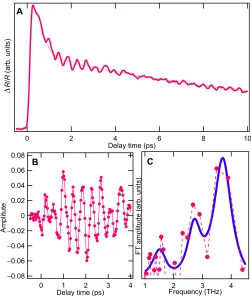
It is informative to compare the structural dynamics with those of the electronic subsystem via optical spectroscopy to elucidate the inter-action between lattices and electrons. We have performed all-optical pump-probe spectroscopy measurements, reflecting the electronic state dynamics sensitive to the orbital occupations and DOS at EF
(26). The photoinduced reflectivity change (Fig. 4A) shows a rapid onset on the 150-fs time scale, followed by a fast recovery with a decay time of 1,opt ~200 fs and subsequent slower decay with a
relax-ation time of 2,opt ~10 ps. The short decay time scale is attributed to the energy transfer, implying that Ir 5d and Te 5p orbital orders (15) are partially dissolved, while the intermediate decay time scale indicates
−0.3
−0.2
−0.1 0 0.1
Edimer
−
Enondimer
(eV)
101 102 103 104 105
Electron temperature (K)
0.001 0.01Electron energy (eV)0.1 1 10
0.07
0
-6
(eV) (eV)
Region 1
Region 1
Region 2
Region 2
B A
)
Å(
Y
X (Å) Ir
Ir
[image:4.594.122.477.62.267.2]E E
Fig. 3. DFT calculation using several temperatures. (A) Ir-Ir dimerization as a function of electronic temperature. Regions 1 and 2 indicate that the dimerized and
non-dimerized phases are stable after the electron-electron interaction. The inset shows the potential energy change corresponding to regions 1 and 2. The shape of the energy surfaces is a cartoon, in particular, the height of the barrier at low electronic temperature was not calculated. (B) Calculated forces on Ir ions after optical excitation at 0.61 eV. The direction of the force is indicated by blue arrows. The representative dimerized structure is shown by circles and a red line, and the nondimerized structure is shown by stars. The result presented here is obtained from DFT calculations using the ideal crystal structure. The calculation using a relaxed structure at a certain electron temperature gives the same result. Calculations shown in the inset of (A) were done for electronic temperatures of 0.001 eV (LT) and 0.68 eV (intermediate temperature) and with DFT, as described in the Supplementary Materials. Both positions of the ion and the unit cell parameters were relaxed in the calculation.
R
/
R
(arb. units)
10 8
6 4
2 0
Delay time (ps) A
−0.08
−0.06
−0.04
−0.02 0 0.02 0.04 0.06 0.08
Amplitute
4 3 2 1 0
Delay time (ps) B
FT amplitude (arb. units)
4 3 2 1
Frequency (THz) C
Fig. 4. Dynamics of the differential reflectivity change. (A) Transient reflectivity:
relative intensity changes from a bulk sample at the LT phase ~200 K recorded at the excitation wavelength (800 nm, 100 fs) and fluence (1 mJ/cm2). (B) Subtraction from the fitting curve to raw data of (A). (C) FTs of the transient reflectivity of (B). Dots are the result, and a curve as a guide to the eye is the fit of Lorentzians.
on October 11, 2019
http://advances.sciencemag.org/
[image:4.594.305.556.357.653.2]that hot electrons release the energy to the lattice via phonon emission and the lattice temperature abruptly increases. Figure 4C shows a Fourier transform (FT) of the oscillation after subtracting the non- oscillating transient spectrum shown in Fig. 4B. Three distinct peaks at 1.5, 2.6, and 3.8 THz seen in the spectrum correspond to wave num-bers of 53, 86, and 126 cm−1, respectively. These frequencies coincide with Raman modes with Ag and Bg symmetry in the LT phase (27)
that can be coherently excited by the pump pulse. The decay 1,opt
matches quite well with the present FED results and indicates that the fast electronic contribution is due to the filling of the dxy
anti-bonding orbital.
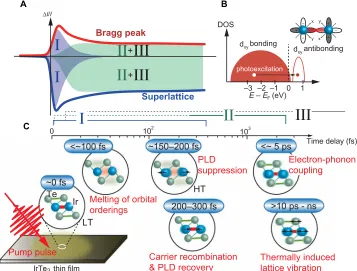
Figure 5 summarizes the transient photo-driven cooperative pro-cesses in IrTe2. The present FED study reveals a dimer dissolution
due to the population of the dxy antibonding state. In IrTe2, hot
elec-trons excited to the dxy antibonding state induce the breakup of Ir-Ir
dimers, which quickly recover because of the reduction of the elec-tron density in the dxy antibonding state as the electrons thermalize
and depopulate the antibonding state. Afterward, the electron-phonon interaction starts to dominate, and the lattice temperature increases near the HT phase. Thereby, the present study indicates that a specific lattice system is strongly coupled with the dxy orbital order. A
re-cently published study using FED and time-resolved angle-resolved photoemission spectroscopy (tr-ARPES) has reported a similar dy-namical process in In-In bonds on the Si surface (25). To further cor-roborate our findings, tr-ARPES would be helpful for understanding the non-equilibrium physics of materials with strong electron- phonon interactions (28).
The combined experimental FED and optical and theoretical DFT studies have uncovered surprising lattice dynamics reflecting nuclear motions strongly coupled with the electronic subsystem. The present work demonstrates that the ultrafast manipulation of orbital orders (namely, ultrafast switching between dimerization and nondimeriza-tion) and electronic control of the specific lattice subsystem are pos-sible. This new insight can be used to control the degree of bonding, not as in the quantum control sense, but by explicit use of the local-ized changes in electron density to affect control over the lattice poten-tial by photoexcitation to manipulate the material properties through change in bond order. It paves the way to the controlled breaking and creation of bonds by the applied pulse sequences. A more con-trolled excitation that can exactly fill in the antibonding orbital will also make the manipulation of the dimers more efficient. Switching between metastable structures with different bonding patterns, such as graphite-diamond, following this approach, would be particularly exciting. This straightforward experimental method will be extended for surveying the mechanism and control of interesting physical properties that holds potential to lead materials science to exploit metastable states as pathways to new material properties.
MATERIALS AND METHODS
Single crystals of IrTe2 were fabricated by the self-flux technique.
IrTe2 thin films (20 to 100 nm in thickness) for FED were obtained
from an IrTe2 bulk sample using a microtome (the thicknesses were
determined by the microtome). The thin films sliced from the bulk Electron-phonon
coupling
>10 ps - ns
Thermally induced lattice vibration
Time delay (fs)
0 10 2
10 3
LT ~0 fs
<~100 fs
Melting of orbital orderings
HT ~150–200 fs
PLD suppression
200–300 fs
Carrier recombination & PLD recovery
<~ 5 ps
Ι
Bragg peakΙΙ
Superlattice ∆I/I
Ι
ΙΙ
ΙΙΙ
IrTe thin film2
Pump pulse
DOS
b
E – E (eV)
0 1 –1 –2 –3
dxybonding d
xyantibonding x y
y x
F photoexcitation
ΙΙΙ
+Ι
ΙΙ
ΙΙΙ
+A B
C
[image:5.594.119.476.60.331.2]Ir Te
Fig. 5. Ultrafast photoinduced transient cooperative processes in IrTe2. (A) Schematic lattice dynamics obtained from the present study. Component of I, II, and III corresponds to the dynamics of electron-electron, electron-lattice, and thermal relaxation. (B) Schematic DOS of the filled dxy bonding and unoccupied antibonding states with photoexcitation process in the LT phase. The antibonding orbital is shown on the right. (C) Emerging time evolution of the real-space structure of the Ir-Te plane of IrTe2 with the multi-orbital ordered state following photoexcitation with an intense optical pulse. For the characteristic time constant indicated by I, II, and III, the dashed and solid lines indicate the major and minor contributions from the interaction, respectively.
on October 11, 2019
http://advances.sciencemag.org/
sample were dropped into distilled water, picked up by a loop, and put onto a Cu mesh for transmission electron microscopy (TEM; see also the Supplementary Materials) to obtain a good thermal contact. The thin films of IrTe2 on the Cu mesh were set on a sample holder
made of oxygen-free Cu for both FED and optical pump-probe ex-periments. For both experiments, a sample temperature of ~200 K was achieved using liquid N2. We measured the sample temperature
using a calibrated temperature sensor. The vacuum pressure was 10−6 Pa.
We performed FED experiments using the fundamental (800 nm, 50 fs) output beam from a commercial Ti:sapphire laser system (Coherent). The fundamental laser pulse was split into two arms with a beam splitter for both pump and probe. A 266-nm laser beam was generated through the third harmonic generation and was directed onto a gold photocathode generating ultrashort electron pulses. Photoelectrons were finally accelerated to 128 kV by a dc electric field between the photocathode and anode plates. Diffracted and directly transmitted electrons were focused with the magnetic lens onto a 1:1 fiber-coupled charge-coupled device camera (Quad-RO 4320, Princeton Instruments) coated with a P20 phosphor scintillator. To investigate the effect of optical excitation on the structural dynamics in IrTe2, we
demon-strated DFT calculation using the projector-augmented wave for-malism for core-valence partitioning, as implemented in the Quantum Espresso code (29). Details of the DFT calculation are given in the Supplementary Materials.
SUPPLEMENTARY MATERIALS
Supplementary material for this article is available at http://advances.sciencemag.org/cgi/ content/full/4/7/eaar3867/DC1
Section S1. Experimental methods Section S2. Sample preparation Section S3. Diffraction pattern of IrTe2
Section S4. Dynamics on the Bragg and superlattice peaks
Section S5. Thickness dependence of lattice dynamics for Bragg and superlattice peaks Section S6. Power dependence of lattice and electron dynamics
Section S7. DFT calculations
Section S8. Lattice temperature increases with the fluence of pump pulse Fig. S1. Schematic diagram of the FED setup.
Fig. S2. Thin films and the TEM image.
Fig. S3. Delay time dependence of diffraction pattern. Fig. S4. Lattice dynamics obtained from several BPs and SLs.
Fig. S5. Relative diffraction intensity change of IrTe2 with different film thicknesses of 20 to 100 nm. Fig. S6. Fluence dependence of FED and optical pump-probe experiments.
Fig. S7. Difference of electronic free energies of dimerized and HT structures as a function of electronic temperature, as calculated using DFT.
Fig. S8. Calculated forces on Ir ions after optical excitation.
Fig. S9. Calculated forces on the Ir ions in the dimerized structure after an instantaneous optical excitation.
Fig. S10. DOS contributions from the Ir ions. References (30–32)
REFERENCES AND NOTES
1. H. Y. Hwang, Y. Iwasa, M. Kawasaki, B. Keimer, N. Nagaosa, Y. Tokura, Emergent phenomena at oxide interfaces. Nat. Mater. 11, 103–113 (2012).
2. P. Beaud, S. L. Johnson, E. Vorobeva, U. Staub, R. A. De Souza, C. J. Milne, Q. X. Jia, G. Ingold, Ultrafast structural phase transition driven by photoinduced melting of charge and orbital order. Phys. Rev. Lett. 103, 155702 (2009).
3. V. R. Morrison, R. P. Chatelain, K. L. Tiwari, A. Hendaoui, A. Bruhács, M. Chaker, B. J. Siwick, A photoinduced metal-like phase of monoclinic VO2 revealed by ultrafast electron diffraction. Science 346, 445–448 (2014).
4. M. Eichberger, H. Schäfer, M. Krumova, M. Beyer, J. Demsar, H. Berger, G. Moriena, G. Sciaini, R. J. D. Miller, Snapshots of cooperative atomic motions in the optical suppression of charge density waves. Nature 468, 799–802 (2010).
5. S. K. Sundaram, E. Mazur, Inducing and probing non-thermal transitions in semiconductors using femtosecond laser pulses. Nat. Mater. 1, 217–224 (2002).
6. H. Cao, B. C. Chakoumakos, X. Chen, J. Yan, M. A. McGuire, H. Yang, R. Custelcean, H. Zhou, D. J. Singh, D. Mandrus, Origin of the phase transition in IrTe2: Structural modulation and local bonding instability. Phys. Rev. B 88, 115122 (2013). 7. S. Pyon, K. Kudo, M. Nohara, Superconductivity induced by bond breaking in the
triangular lattice of IrTe2. J. Phys. Soc. Jpn. 81, 053701 (2012).
8. G. L. Pascut, T. Birol, M. J. Gutmann, J. J. Yang, S.-W. Cheong, K. Haule, V. Kiryukhin, Series of alternating states with unpolarized and spin-polarized bands in dimerized IrTe2. Phys. Rev. B 90, 195122 (2014).
9. J. Dai, K. Haule, J. J. Yang, Y. S. Oh, S.-W. Cheong, W. Wu, Hierarchical stripe phases in IrTe2 driven by competition between Ir dimerization and Te bonding. Phys. Rev. B 90, 235121 (2014).
10. A. F. Fang, G. Xu, T. Dong, P. Zheng, N. L. Wang, Structural phase transition in IrTe2: A combined study of optical spectroscopy and band structure calculations. Sci. Rep.
3, 1153 (2013).
11. J. J. Yang, Y. J. Choi, Y. S. Oh, A. Hogan, Y. Horibe, K. Kim, B. I. Min, S.-W. Cheong, Charge-orbital density wave and superconductivity in the strong spin-orbit coupled IrTe2:Pd. Phys. Rev. Lett. 108, 116402 (2012).
12. Y. S. Oh, J. J. Yang, Y. Horibe, S.-W. Cheong, Anionic depolymerization transition in IrTe2. Phys. Rev. Lett. 110, 127209 (2013).
13. G. L. Pascut, K. Haule, M. J. Gutmann, S. A. Barnett, A. Bombardi, S. Artyukhin, T. Birol, D. Vanderbilt, J. J. Yang, S.-W. Cheong, V. Kiryukhin, Dimerization-induced cross-layer quasi-two-dimensionality in metallic IrTe2. Phys. Rev. Lett. 112, 086402 (2014). 14. T. Toriyama, M. Kobori, T. Konishi, Y. Ohta, K. Sugimoto, J. Kim, A. Fujiwara, S. Pyon,
K. Kudo, M. Nohara, Switching of conducting planes by partial dimer formation in IrTe2. J. Phys. Soc. Jpn. 83, 033701 (2014).
15. Q. Li, W. Lin, J. Yan, X. Chen, A. G. Gianfrancesco, D. J. Singh, D. Mandrus, S. V. Kalinin, M. Pan, Bond competition and phase evolution on the IrTe2 surface. Nat. Commun.
5, 5358 (2014).
16. D. Ootsuki, Y. Wakisaka, S. Pyon, K. Kudo, M. Nohara, M. Arita, H. Anzai, H. Namatame, M. Taniguchi, N. L. Saini, T. Mizokawa, Orbital degeneracy and Peierls instability in the triangular-lattice superconductor Ir1−xPtxTe2. Phys. Rev. B 86, 014519 (2012).
17. D. Mazumdar, K. Haule, J. J. Yang, G. L. Pascut, B. S. Holinsworth, K. R. O’Neal, V. Kiryukhin, S.-W. Cheong, J. L. Musfeldt, Optical evidence for bonding-antibonding splitting in IrTe2. Phys. Rev. B 91, 041105(R) (2015).
18. K.-T. Ko, H.-H. Lee, D.-H. Kim, J.-J. Yang, S.-W. Cheong, M. J. Eom, J. S. Kim, R. Gammag, K.-S. Kim, H.-S. Kim, T.-H. Kim, H.-W. Yeom, T.-Y. Koo, H.-D. Kim, J.-H. Park, Charge-ordering cascade with spin–orbit Mott dimer states in metallic iridium ditelluride. Nat. Commun.
6, 7342 (2015).
19. H. S. Kim, S. Kim, K. Kim, B. I. Min, Y.-H. Cho, L. Wang, S.-W. Cheong, H. W. Yeom, Nanoscale superconducting honeycomb charge order in IrTe2. Nano Lett. 16, 4260–4265 (2016).
20. J. C. Petersen, S. Kaiser, N. Dean, A. Simoncig, H. Y. Liu, A. L. Cavalieri, C. Cacho, I. C. E. Turcu, E. Springate, F. Frassetto, L. Poletto, S. S. Dhesi, H. Berger, A. Cavalleri, Clocking the melting transition of charge and lattice order in 1T−TaS2 with ultrafast extreme-ultraviolet angle-resolved photoemission spectroscopy. Phys. Rev. Lett.
107, 177402 (2011).
21. F. Schmitt, P. S. Kirchmann, U. Bovensiepen, R. G. Moore, L. Rettig, M. Krenz, J.-H. Chu, N. Ru, L. Perfetti, D. H. Lu, M. Wolf, I. R. Fisher, Z.-X. Shen, Transient electronic structure and melting of a charge density wave in TbTe3. Science 321, 1649–1652 (2008). 22. T. Rohwer, S. Hellmann, M. Wiesenmayer, C. Sohrt, A. Stange, B. Slomski, A. Carr, Y. Liu,
L. M. Avila, M. Kalläne, S. Mathias, L. Kipp, K. Rossnagel, M. Bauer, Collapse of long-range charge order tracked by time-resolved photoemission at high momenta. Nature 471, 490–493 (2011).
23. H. Ding, T. Yokoya, J. C. Campuzano, T. Takahashi, M. Randeria, M. R. Norman, T. Mochiku, K. Kadowaki, J. Giapintzakis, Spectroscopic evidence for a pseudogap in the normal state of underdoped high-Tc superconductors. Nature 382, 51–54 (1996).
24. G. Sciaini, R. J. D. Miller, Femtosecond electron diffraction: Heralding the era of atomically resolved dynamics. Rep. Prog. Phys. 74, 096101 (2011).
25. T. Frigge, B. Hafke, T. Witte, B. Krenzer, C. Streubühr, A. Samad Syed, V. Mikšić Trontl, I. Avigo, P. Zhou, M. Ligges, D. von der Linde, U. Bovensiepen, M. Horn-von Hoegen, S. Wippermann, A. Lücke, S. Sanna, U. Gerstmann, W. G. Schmidt, Optically excited structural transition in atomic wires on surfaces at the quantum limit. Nature 544, 207–211 (2017).
26. J. Hohlfeld, S.-S. Wellershoff, J. Güdde, U. Conrad, V. Jähnke, E. Matthias, Electron and lattice dynamics following optical excitation of metals. Chem. Phys. 251, 237–258 (2000).
27. N. Lazarević, E. S. Bozin, M. Šćepanović, M. Opačić, H. Lei, C. Petrovic, Z. V. Popović, Probing IrTe2 crystal symmetry by polarized Raman scattering. Phys. Rev. B
89, 224301 (2014).
28. J. D. Rameau, S. Freutel, A. F. Kemper, M. A. Sentef, J. K. Freericks, I. Avigo, M. Ligges, L. Rettig, Y. Yoshida, H. Eisaki, J. Schneeloch, R. D. Zhong, Z. J. Xu, G. D. Gu, P. D. Johnson,
on October 11, 2019
http://advances.sciencemag.org/
U. Bovensiepen, Energy dissipation from a correlated system driven out of equilibrium. Nat. Commun. 7, 13761 (2016).
29. P. Giannozzi, S. Baroni, N. Bonini, M. Calandra, R. Car, C. Cavazzoni, D. Ceresoli, G. L. Chiarotti, M. Cococcioni, I. Dabo, A. Dal Corso, S. de Gironcoli, S. Fabris, G. Fratesi, R. Gebauer, U. Gerstmann, C. Gougoussis, A. Kokalj, M. Lazzeri, L. Martin-Samos, N. Marzari, F. Mauri, R. Mazzarello, S. Paolini, A. Pasquarello, L. Paulatto, C. Sbraccia, S. Scandolo, G. Sclauzero, A. P. Seitsonen, A. Smogunov, P. Umari, R. M. Wentzcovitch, QUANTUM ESPRESSO: A modular and open-source software project for quantum simulations of materials. J. Phys. Condens. Matter 21, 395502 (2009).
30. K. Kim, S. Kim, K.-T. Ko, H. Lee, J.-H. Park, J. J. Yang, S.-W. Cheong, B. I. Min, Origin of first-order-type electronic and structural transitions in IrTe2. Phys. Rev. Lett.
114, 136401 (2015).
31. A. Dal Corso, Pseudopotentials periodic table: From H to Pu. Comput. Mater. Sci.
95, 337–350 (2014).
32. H. Lei, K. Wang, M. Abeykoon, E. Bozin, J. B. Warren, C. Petrovic, Superconductivity in Ir1−xRhxTe2 (0 ≤ x ≤ 0.3). arXiv:1307.7029v1 (2013).
Acknowledgments: We would like to thank L. S. Cao, Y. Zhong, and A. Marx for fruitful
discussions, and G. Corthey and S. Hayes for their support in various ways. Funding: This work was funded by the Max Planck Society, and A.G.D. was further supported by a Marie Curie International Incoming Fellowship within the Seventh European Community Framework Programme (grant no. 627864). S.-i.I. acknowledged support from Japan Society
for the Promotion of Science Grants-in-Aid for Scientific Research (no. 12J08331) and Grant-in-Aid for Young Scientists (B) (no. 15K17709). Author contributions: R.J.D.M. is the principal investigator of this project and initiated the experimental concept. S.-i.I., D.Z., T.S., and K.I. conceived and coordinated the research. H.I., K.K., and M.N. grew the high-quality single crystal of IrTe2, and S.K. microtomed and characterized the thin film. S.-i.I. and D.Z. performed FED and optical spectroscopy measurements. S.A. and A.G.D. performed DFT calculations. D.Z., S.-i.I., S.A., A.G.D., R.C., and R.J.D.M. interpreted the data. S.-i.I., D.Z., S.A., A.G.D., and R.J.D.M. wrote the manuscript with helpful suggestions from all coauthors.
Competing interests: The authors declare that they have no competing interests. Data and materials availability: All data needed to evaluate the conclusions in the paper are present
in the paper and/or the Supplementary Materials. Additional data related to this paper may be requested from the authors.
Submitted 4 November 2017 Accepted 18 June 2018 Published 27 July 2018 10.1126/sciadv.aar3867
Citation: S.-i. Ideta, D. Zhang, A. G. Dijkstra, S. Artyukhin, S. Keskin, R. Cingolani, T. Shimojima, K. Ishizaka, H. Ishii, K. Kudo, M. Nohara, R. J. D. Miller, Ultrafast dissolution and creation of bonds in IrTe2 induced by photodoping. Sci. Adv. 4, eaar3867 (2018).
on October 11, 2019
http://advances.sciencemag.org/
originally published online July 27, 2018 DOI: 10.1126/sciadv.aar3867
(7), eaar3867. 4
Sci Adv
ARTICLE TOOLS http://advances.sciencemag.org/content/4/7/eaar3867
MATERIALS
SUPPLEMENTARY http://advances.sciencemag.org/content/suppl/2018/07/23/4.7.eaar3867.DC1
REFERENCES
http://advances.sciencemag.org/content/4/7/eaar3867#BIBL This article cites 31 articles, 2 of which you can access for free
PERMISSIONS http://www.sciencemag.org/help/reprints-and-permissions
Terms of Service Use of this article is subject to the
registered trademark of AAAS.
is a
Science Advances
Association for the Advancement of Science. No claim to original U.S. Government Works. The title
York Avenue NW, Washington, DC 20005. 2017 © The Authors, some rights reserved; exclusive licensee American (ISSN 2375-2548) is published by the American Association for the Advancement of Science, 1200 New
Science Advances
on October 11, 2019
http://advances.sciencemag.org/