i
UNIVERSITI TEKNIKAL MALAYSIA MELAKA
OPTIMIZATION OF TENSILE STRENGTH VIA OPTIMAL
PROCESSING PARAMETER FOR HIGH DENSITY
POLYETHYLENE (HDPE) MATERIAL
This report is submitted in accordance with the requirement of the Universiti Teknikal Malaysia Melaka (UTeM) for the Bachelor of Manufacturing Engineering
Technology (Process and Technology) with Honours.
by
MUHAMMAD DANIAL FARHAN BIN MAZALAN B071410457
950611-10-5741
ii
DECLARATION
I hereby, declared this report entitled “Optimization of Tensile Strength Via Optimal Processing Parameter for High Density Polyethylene (HDPE) Plastic
Material” is the results of my own research except as cited in references.
Signature : ……….
Author’s Name : MUHAMMAD DANIAL FARHAN BIN MAZALAN
iii
APPROVAL
This report is submitted to the Faculty of Engineering Technology of UTeM as a partial fulfillment of the requirements for the degree of Bachelor of Manufacturing Engineering Technology (Process & Technology). The member of the supervisory is as follow:
……… EN SALLEH BIN ABOO HASSAN
iv
ABSTRAK
v
ABSTRACT
vi
DEDICATION
vii
ACKNOWLEDGEMENT
viii
TABLE OF CONTENT
Declaration ... ii
Approval ... iii
Abstrak ... iv
Abstract ... v
Dedication ... vi
Acknowledgement ... vii
Table of Content ... viii
List of Tables ... xi
List of Figures ... xii
List of Abbreviations, Symbols and Nomenclature ... xiv
CHAPTER 1 ... 1
INTRODUCTION ... 1
1.0 Introduction ... 1
1.1 Background ... 1
1.2 Problem Statement ... 3
1.3 Objectives ... 4
1.4 Work Scope ... 4
CHAPTER 2 ... 5
LITERATURE REVIEW ... 5
2.0 Introduction ... 5
ix
2.1.1 Introduction ... 5
2.1.2 Definition of Plastic ... 6
2.1.3 Classification of Plastic ... 7
2.1.4 High Density Polyethylene(HDPE) ... 10
2.1.4.1 Introduction of High Density Polyethylene (HDPE)... 10
2.1.4.2 Properties of High Density Polyethylene (HDPE) ... 11
2.2 Machining ... 13
2.3 Injection Molding ... 13
2.3.1 History Injection Molding ... 14
2.4 Dog Bone Specimen ... 16
2.5 Mechanical Testing ... 17
2.5.1 Tensile Strength ... 18
2.6 Taguchi Method ... 19
CHAPTER 3 ... 21
METHODOLOGY ... 21
3.0 Introduction ... 21
3.1 Flow Chart ... 21
3.1.1 Planning of Study ... 23
3.1.2 Experiment Test... 24
3.1.3 Tensile Strength Testing ... 25
3.1.4 Analyze Data using Minitab Software ... 27
CHAPTER 4 ... 30
RESULT & DISCUSSION ... 30
4.0 Introduction ... 30
x
4.1.1 Tensile Strength for Trial 1 ... 31
4.1.2 Tensile Strength for Trial 2 ... 32
4.1.3 Tensile Strength for Trial 3 ... 33
4.1.4 Tensile Strength for Trial 4 ... 34
4.1.5 Tensile Strength for Trial 5 ... 35
4.1.6 Tensile Strength for Trial 6 ... 36
4.1.7 Tensile Strength for Trial 7 ... 37
4.1.8 Tensile Strength for Trial 8 ... 38
4.1.9 Tensile Strength for Trial 9 ... 39
4.2 The Analysis Effects of Injection Molding Processing Parameters ... 40
4.2.1 Analyze Data using Taguchi ... 40
4.2.2 Analysis of Variance (ANOVA) ... 44
4.3 Comparison between Taguchi and Anova Result ... 48
CHAPTER 5 ... 49
CONCLUSION & RECOMENDATION ... 49
5.0 Conclusion... 49
5.1 Recommendation ... 50
REFERENCES ... 51
xi
LIST OF TABLES
Table 2.1: Types of Plastics and Their Properties... 8
Table 2.2: Typical Type of HDPE Properties ... 12
Table 3.1: Processing Parameters and Levels ... 24
Table 3.2: Type of Process Parameters ... 28
Table 3. 3: Processing Parameters and Levels ... 28
Table 3.4: Orthogonal Array for Evaluation Study ... 29
Table 4.2.1.1: Response Table for Signal Noise Ratio ... 41
Table 4.2.1. 2: Response Table for Means ... 41
Table 4.2.1. 3 : Taguchi Predicted Result ... 43
Table 4.2.2.1: Response Table for Signal Noise Ratio ... 45
Table 4.2.2.2: Analysis of Variance for SN Ratios ... 45
Table 4.2.2.3: Response Table for Means ... 46
xii
LIST OF FIGURES
Figure 1.1:Tensile Testing ... 3
Figure 2.1:Examples of HDPE Dog Bone Sample ... 12
Figure 2.2:Injection Molding Parts ... 14
Figure 2.3: Available Injection Molding Machine at FTK ... 15
Figure 2.4: Example of Dog Bone Specimen... 17
Figure 2.5: Tensile Testing Machine ... 18
Figure 3.2: Dog Bone Specimen ... 24
Figure 3.3: Injection Molding Machine ... 25
Figure 3.4: Dimension of Dog Bone Specimen ... 26
Figure 3.5: Universal Tensile Testing Machine ... 27
Figure 3.6: Steps in Designing Orthogonal Array ... 28
Figure 4.1.1: Tensile Strength Testing Data for Trial 1 ... 31
Figure 4.1.2: Tensile Strength Testing Data for Trial 2 ... 32
Figure 4.1.3: Tensile Strength Testing Data for Trial 3 ... 33
Figure 4.1.4:Tensile Strength Testing Data for Trial 4 ... 34
Figure 4.1.5: Tensile Strength Testing Data for Trial 5 ... 35
Figure 4.1.6: Tensile Strength Testing Data for Trial 6 ... 36
Figure 4.1.7: Tensile Strength Testing Data for Trial 7 ... 37
Figure 4.1.8: Tensile Strength Testing Data for Trial 8 ... 38
Figure 4.1.9: Tensile Strength Testing Data for Trial 9 ... 39
Figure 4.2.1.1 Data of Injection Molding Parameter and Tensile Strength Test ... 40
Figure 4.2.1.2: Taguchi Graph for SN Ratio ... 42
Figure 4.2.2.1: Data forTaguchi and Tensile Test Average ... 44
xiv
LIST OF ABBREVIATIONS, SYMBOLS AND
NOMENCLATURE
F - F Test (ANOVA)
HU - Highly Used
IT - Information Technology
LU - Least Used
RM - Malaysian Ringgit
SD - Standard Deviations
U - U Test (Mann Whitney Test) UTS - Ultimate Tensile Strength TS - Tensile Strength
SI - System of Units Pa - Pascal
MPa - Mega Pascal
(N/m^2) - Newton Per Square Metre US - United State
ISO - International Standard Operation
ASTM - American Society for Testing and Materials HDPE - High Density Polyethylene
CNC - Computer Numerical Control
> - More than
σ - Stress
ϵ - Strain
1
CHAPTER 1
INTRODUCTION
1.0 Introduction
In first section of the report, few parts will be described which are background, problem statement, and objectives of the study . Scope will discuss about parts have covered and the limitation of this project.
1.1 Background
Ultimate tensile strength (UTS), regularly shortened to tensile strength (TS) or ultimate strength is the limit of a material or structure to withstand loads having tendency to extend, rather than compressive strength, which withstands loads having tendency to decrease size. Besides that , tensile strength resists tension (being pulled separated), while compressive strength opposes compression (being pushed together). Ultimate tensile strength is measured by the maximum or greatest stress that a material can withstand while being extended or pulled before breaking. In the research of strength of materials, tensile strength, compressive strength, and shear strength can be examined autonomously
2 versus strain. The most astounding purpose of the stress–strain bend is the UTS. It is a focused property; in this manner its regard does not rely upon the measure of the test model. Be that as it may, it is subject to different components, for example, the planning of the model, the nearness or generally of surface deformities, and the temperature of the test condition and material.
Tensile strengths are infrequently used in the intention of ductile adherents, but they are important in brittle adherents. They are arranged for normal materials such as alloys, composite materials, ceramics, plastics, and wood. Tensile strength can be characterized for fluids and solids under specific circumstances. For instance, when a tree draws water from its underlying foundations to its upper leaves by transpiration, the segment of water is pulled upwards from the best by the attachment of the water in the xylem, and this power is transmitted down the segment by its elasticity. Pneumatic force, osmotic weight, and narrow pressure additionally has a little influence in a tree's capacity to draw up water, however this by itself would just be adequate to push the segment of water to a stature of under ten meters, and trees can develop considerably higher than that (more than 100 m).
Tensile strength is characterized as stress, which is measured as power per unit region. For some non-homogeneous materials ( or for collected parts) it can be accounted for similarly as a power or as a power for every unit width. In the International System of Units ( SI ), the unit is the Pascal ( Pa ) (or regularly mega pascals ( MPa ), utilizing the SI prefix mega )bor, comparably to pascals , newtons per square meter ( N/m² ) . A United States standard unit is pounds per square inch ( lb/in² or psi ), or kilo pounds per square inch ( ksi, or in some cases kpsi ), which is equivalent to 1000 psi; kilo-pounds per square inch are normally utilized as a part of one nation ( US ), when measuring rigid qualities.
3 and will impact the outcomes. The closely resembling test to gauge malleable properties in the ISO framework is ‘ISO 527’. The qualities detailed in the ‘ASTM D638’ and ‘ISO 527’ tests all in all don't shift fundamentally and either test will give great outcomes ahead of schedule in the material determination process.
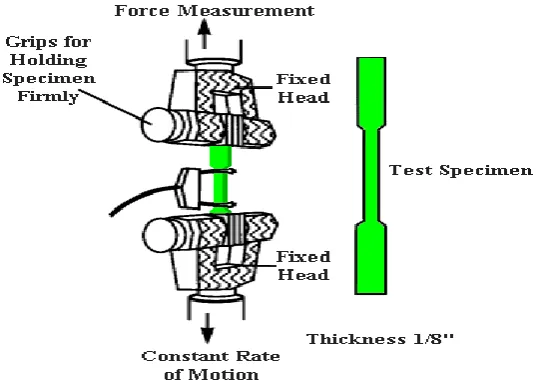
Figure 1.1:Tensile Testing
1.2 Problem Statement
4
1.3 Objectives
The purpose of the study is to optimize the tensile strength for the High Density Polyethylene (HDPE ) plastic material In order to achieve those objective, threre are several study objective need to be conducted :
a) To determine the significant factor affecting the tensile strength of the part b) To optimize the process parameter factors for the HDPE materials.
1.4 Work Scope
The scope is the guidelines for the reader to areas that have or have not been covered. It is impossible to investigate everything in the study and project.Therefore , the study will cover primarily on the scopes are :
a) Material used in this project is High Density Polyethylene (HDPE). b) Plastic injection molding process is focused in this research study.
c) Taguchi and Analysis of Variance (ANOVA) method is used to analyze the data
5
CHAPTER 2
LITERATURE REVIEW
2.0 Introduction
This chapter provides a detailed of tensile strength , High Density Polyethylene (HDPE) materials , process and the material properties . The process factors involve and the materials that used in this project will be included in this chapter . Besides that, this chapter also includes the history and information about Taguchi Design of Experiment method.
2.1 Plastic Materials
2.1.1 Introduction
6
2.1.2 Definition of Plastic
A simplistic meaning of plastic an unpredictable gathering of engineered that is equipped for being shape . Douglas M.Bryce (1997) expressed that , plastic can be as three stage , strong, fluid and something amongst strong and fluid.
Fundamentally expressed, a plastic is a characteristic polymer, open in some sap shape got frame from the basic polymerized tar. These structures can be glue like gums of liquid for inserting, covering, and cement holding, or they can be overlaid, shaped, or framed shapes, including film, sheet, or bigger mass shapes. (Charles et.al, 2003).
Plastic materials include a reliably expanding dissemination of the city and mechanical waste going into the landfill. Inferable from the gigantic measure of plastic squanders and ecological weight, reusing of plastics has transformed into a staggering subject in the present plastics industry.
7
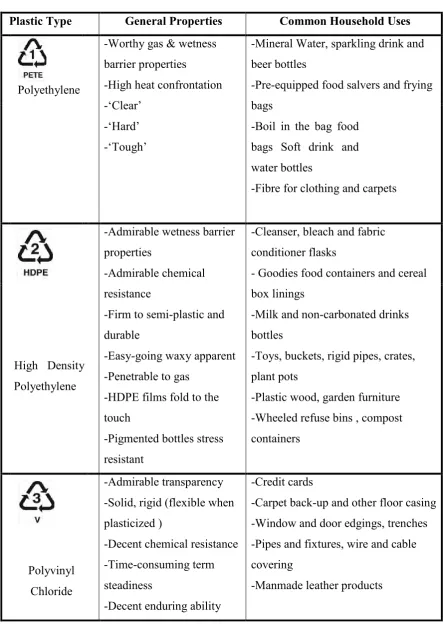
8 Table 2.1: Types of Plastics and Their Properties
Plastic Type General Properties Common Household Uses
Polyethylene
-Worthy gas & wetness barrier properties
-High heat confrontation -‘Clear’
-‘Hard’ -‘Tough’
-Mineral Water, sparkling drink and beer bottles
-Pre-equipped food salvers and frying bags
-Boil in the bag food bags Soft drink and water bottles
-Fibre for clothing and carpets
-Admirable wetness barrier properties
-Admirable chemical resistance
-Firm to semi-plastic and durable
-Easy-going waxy apparent -Penetrable to gas
-HDPE films fold to the touch
-Pigmented bottles stress resistant
-Cleanser, bleach and fabric conditioner flasks
- Goodies food containers and cereal box linings
-Milk and non-carbonated drinks bottles
-Toys, buckets, rigid pipes, crates, plant pots
-Plastic wood, garden furniture -Wheeled refuse bins , compost containers
High Density
Polyethylene
Polyvinyl Chloride
-Admirable transparency -Solid, rigid (flexible when plasticized )
-Decent chemical resistance -Time-consuming term steadiness
-Decent enduring ability
-Credit cards
-Carpet back-up and other floor casing -Window and door edgings, trenches -Pipes and fixtures, wire and cable covering
-Manmade leather products
9 -Steady electrical properties
-Little gas penetrability
Low Density Polyethylene
-Hard and stretchy -Waxy surface
-Soft – abrasions effortlessly -Decent transparency
-Small melting point -Steady electrical assets -Good wetness barrier assets
-Films, fertilizer bags, waste sacks -Wrapping films, bubble
covering Flexible bottles
-Thick spending bags (clothes and produce)
-Wire and cable requests Some bottle tops
Polypropylene
-Admirable chemical resistance
-Great melting point -Solid, but stretchy -Waxy surface -Luminous -Strong
-Most bottle clippings -Ketchup and syrup bottles
-Yoghurt and some margarine ampules -Potato crisp bags, biscuit
packages Crates, plant pots, drinking straws
-Hinged lunch boxes, chilled containers
-Fabric/ carpet fibers, heavy duty bags/tarpaulins
Polystyrene
-Pure to impervious -Shiny surface -Rigid or fizzed -Solid
-Breakable -High clearness
-Yoghurt containers, egg boxes Fast food trays -Video cases
-Marketing cups and
disposable -cutlery Seed trays -Coat pegs
-Low cost breakable toys
10
2.1.4 High Density Polyethylene(HDPE)
2.1.4.1 Introduction of High Density Polyethylene (HDPE)
A few makers are creating wood– thermoplastic composites from reused materials. In just 10 years, the utilization of plastics and fiber– thermoplastic composites for decking has developed to around 6% of the outside decking market (Smith and Carter, 1999). Bigger markets inside the building business could be created, for example, the material market, however absence of toughness execution information and hesitance of home manufacturers to use undemonstrated items have hampered advertise improvement.
Thermoplastics have a few good qualities as segments in composites, including recyclability, malleably high particular quality and modulus, ease, low thickness, and low contact amid grating (Rietveld and Simon, 1992). Wood– polymer composites have magnificent dimensional strength under dampness introduction and better growths and termite protection (Maldas and Kokta, 1991 ; Verhey et al., 2001). Mechanical properties of (HDPE with calcium carbonate, fiber glass and lignocellulose)
There are different polymers that have an extensive variety of employments, especially in building segments. They are related to the number 7 and OTHER (or a triangle with numbers from 7 to 19).
-‘Nylon (PA)’
-‘Acrylonitrile butadiene styrene (ABS)’
-‘Polycarbonate (PC)’