E U R O P E A N
C O M M I S S I O N
SCIENCE
RESEARCH
DEVELOPMENT
R T D
INFO
News Roundup on EC Research and Technological Development Programmes
C O N T E N T S
• Management of Community RTD The search for greater flexibility and efficiency
• 1995 results of the Framework Programme
SMEs account for 58% of industrial participation • RTD Digest
European RTD policy
Results of earlier calls for proposals Guide to upcoming calls
for proposals Calendar of events Publications
• Environment & Climate ·
CaseStudies: 15 Projects for a sustainable development
In brief
The Marie Curie Fellowship
18
MAST III: 19 Exploring the depths of our seas and
oceans
1 Environment - Water
Networks of scientific excellence developed by COST
20
RTD Info is published by the European Commission. DG XII (Science. Research, Development). To obtain this quarterly newsletter free of charge in French, English or German, please fax your name, address and the language version you require to: DG XII Communication Unit Fax + 32-2-295.8220
E-mail [email protected]
P R E L I M I N A R Y G U I D E L I N E S F O R THE 5T H F R A M E W O R K P R O G R A M M E
For European research which
meets citizens' needs
T
he debate on the 5th Framework Programme is open. On 10 July this year, the Commis sion adopted a discussion paper enti tled "Inventing Tomorrow: Europe's research at the service of its people". Drawn up on the initiative of Mrs Edith Cresson, this defines the princi pal guidelines for the 5,h Framework Programme for Research and Tech nological Development (RTD), which takes over from the current 4th Framework Programme in 1999.
The Member States, consultative bodies and principal research or
ganisations are also submitting their recommendations as the Com mission gets down to the task of drafting a more detailed working document. The Commission is ex pected to submit a formal proposal by mid-1997.
One of the key messages in the doc ument1" adopted by the Commission and submitted to the Council and Parliament is that if European re search is to be useful and effective it must better address people's every day concerns, have a positive impact on competitiveness and employment,
and push back the fron tiers of knowledge in a number of kev areas. ►
Mrs Edith Cresson,
member of the Commission respon-sible for research, education and training
"Europe needs research and re-search needs Europe, hut if Euro-pean research is to continue to ex-ist, its objectives must be clearer, its practice mast be simpler, and its re-sults must be of more use to the general public."
(10 July 1996)
P R E L I M I N A R Y G U I D E L I N E S F O R T H E 5T H F R A M E W O R K P R O G R A M M
MEETING THE CHALLENGES OF NEW MARKETS
While stressing the progress made with the 4, h RTD Framework Pro gramme in terms of European research policy, the Commission considers it would be inappropriate simply to ex tend it. The challenges awaiting Eu rope at the dawning of the new millen nium call for innovation and concise ness in the setting of priorities and the organisation of research. If Europe wishes to reverse the unemployment trend on a lasting basis and face up successfully to outside competition, it will have to harness the technologies needed for tomorrow's markets as quickly as possible.
Examples of the areas concerned are biotechnology, where the market is es timated to be worth less than ECU 10 billion in 1996 but is expected to grow to ECU 4080 billion by the year 2000; health care; environmental protection, particularly water management, where the market in Europe will amount to ECU 30 billion in the year 2000; and technologies ensuring greater mobility (the cost of traffic jams, accidents, and damage to health and the environment is put at ECU 250 billion a year in the European Union). But the Commission document makes it quite clear that this does not mean there is no longer any need for socalled "fundamental" re search quite the contrary, in fact.
TACKLING THE MAIN PRIORITIES
The Commission guidelines also ad vocate a greater focusing of research efforts on a deliberately limited set of priorities which address societal prob lems affecting people's everyday lives, namely:
• unlocking the resources of the living world and the ecosystem
• creating a userfriendly information society
• promoting competitive and sustainable growth
• improving human potential
• innovation and participation of SMEs •confirming the international role of
European research.
THE NEED FOR EFFICIENT MANAGEMENT
In implementing these priorities, sub stantial improvements need to be made in the management of research pro grammes (see also the article on p.3). The Commission first of all intends to ensure greater flexibility in carrying out tasks and in the decisionmaking process, entailing a streamlining of procedures.
At the Intergovernmental Confer ence, for example, the Commission will advocate a simplified decision making procedure with qualified ma jority voting for the framework pro gramme and the specific programmes.
It also proposes that the number of programmes and the number of com
mittees which assist it in the imple mentation of the RTD programmes be reduced. In the event of an emergency, as recently with mad cow disease, it has to be possible to adapt programmes to speedily regroup various research projects.
Another stated aim is to reduce the time needed when selecting proposals, concluding contracts and making pay ments to participants a matter of par ticular importance for SMEs and grant aided researchers.
Lastly, the Commission proposes that the existing programmes, which gener ally consist of a succession of projects planned in the medium term, should be supplemented by other more flexible instruments, e.g. strategic projects im plemented through task forces mod elled on the research/industry task forces set up a year ago, or supplemen tary research programmes involving a few Member States interested in a giv en topic, as provided for in Article
130k of the Treaty. Instruments of this kind would ensure greater coordina tion between European and national
research activities. ■
(1 ) Copies of this document may be obtained from DG XII Communication Unit
Fax +322295.8220
The 4
th
Framework Programme at mid-term
The 4lh Framework Programme for RTD covering the period 19941998 has been running for 18 months and is proving extremely popular: in 1995. over 20,000 proposals were re ceived, resulting in just under 3,000 projects involving over 10,000 partic ipants. It is observed that the size of the projects is tending to increase,
with generally more participants from more Member States. The "turnover rate" is also increasing: for 37% of participants it is the first experience of Community RTD, of which 40% are SMEs.
One area of concern is the constant increase in the number of proposals not accepted: typically, only one in six
M A N A G E M E N T OF C O M M U N I T Y R T D
The search
for greater flexibility and efficiency
O
n 25 June 1996, the Commission DirectoratesGeneral re sponsible for implementing research programmes held a work ing seminar attended by representa tives of industry and the scientific community together with Members of the European Parliament. The aim of the meeting was to look at possible ways in which the Commis sion could improve the management of research programmes.
Introducing the discussions, Mrs Edith Cresson, European Commission er responsible for research, stressed the increasing importance of Community
RTD programmes in Europe's scientif ic and industrial life. Of no more than marginal importance 10 years or so ago, research policy is today one of the Union's major policy areas involving tens of thousands of researchers in the
15 Member States and beyond.
THE COMMISSION'S NEW RESPONSIBILITIES
This development has brought with it new responsibilities for the Commis sion, especially as the research world is showing a growing interest in involve ment in Community projects and this success is generating applications which
often far exceed the available funding (the Oversubscription' problem).
Chaired by Professor Routti, Director General of DG XII for Science, Research and Development, the seminar allowed for a particularly open discus sion and produced many interesting ideas. Some of these will be acted upon to bring a number of shortterm im provements whilst others could be im plemented in the 5 th Framework Pro gramme.
The table below summarises the prin cipal difficulties facing the Commis sion in its management of European re search programmes, together with the remedies proposed by this seminar. ■
Possible improvements"
CORRECTING THE PROBLEM OF OVERSUBSCRIPTION
PRESENT SITUATION
In 1995 calls for proposals generated over 20,000 applications involving more than 100,000 partici pants. Typically, less than 20% of these proposals could be selected for funding.
OBJECTIVE
To reduce this level of oversubscription, which re sults in unnecessary effort and frustration on the part of unsuccessful applicants.
MEANS
• Targeting calls for proposals more precisely by concentrating them on clearly defined aspects of the programmes.
• Concentrating the programmes themselves on fewer and/or more focused objectives.
• Providing more information on proposal eligibil ity conditions and evaluation criteria.
• Establishing "preproposal checking" allowing proposers to test the relevance of their response to calls for proposals and the utility of proceed ing with their application.
INCREASING THE TRANSPARENCY OF PROCEDURES
PRESENT SITUATION
Project evaluation and selection procedures, based on objectivity and impartiality, are unknown to most applicants.
OBJECTIVE
To increase the transparency and consistency of procedures as they apply to the various programmes.
MEANS
• Drawing up of guidelines for evaluation based on best practice and the publication of evaluation manuals setting out the principles, the procedure, the role of the Commission's experts, the specific nature of the various programmes, special condi tions for SMEs, etc.
• The participation of independent observers to monitor the evaluation process and increased transparency in the choice of experts one third of whom are replaced annually.
Some of the improvements featured in this table have now been put into practice.
M A N A G E M E N T OF C O M M U N I T Y R T D
Possible improvements
REDUCING THE TIME TAKEN
PRESENT SITUA TION
The average delay between the submission of proposals and the evaluation decision is 4 to 5 months, which seems too long for many applicants, especially SMEs. OBJECTIVE
To achieve an acceptable evaluation time (not more than 4 months and progressively reduced to 3 months for the measures relating specifically to SMEs) while respecting legal procedures and evaluation quality.
PRESENT SITUATION
The duration of contract negotiation and finalisa tion is also deemed too long at between 1 and 4 months (supplementary information, discussions between partners on the terms of the contract, etc.) OBJECTIVE
To reduce the time taken to 2 months, where possible.
MEANS
• Examining the possibility of notifying candi dates whose proposals do not meet certain basic conditions.
MEANS
• Publication of guides on contract negotiation. • Contract negotiation limited in duration. • Rationalisation of internal financial control for
contract finalisation.
STREAMLINING FINANCIAL PROCEDURES
CURRENT SITUATION
As the Commission makes payments to the project coordinator, some partners can experience late payments due to the multiple transfers involved.
OBJECTIVE
To reduce the time taken for payment.
MEANS
• Adopting the system of accelerated payments, particularly for the advance payment on signa ture of contract (processed within 1 to 2 weeks), as a general practice.
• Accelerating intermediary payments and, subse quently, payment within 60 days on receipt of re ports, invoices, etc.
SME-SPECIFIC ASPECTS
CURRENT SITUATION
The lack of information and advice is an obstacle to participation in Community programmes for many SMEs, while specific technology stimulation measures have been introduced especially for them.
OBJECTIVE
To facilitate access to European programmes for SMEs by improving the assistance from national and regional organisations (CRAFT network, Euro Info Centres...).
MEANS
• Inviting Member States to reinforce their sup port for the CRAFT network.
• Closer cooperation between the different Euro pean information networks on RTD activities. • Progressively reducing the time taken to select a
4T H F R A M E W O R K P R O G R A M M E - RESULTS FOR THE 1S T YEAR ( 1 9
SMEs account for
58% of industrial participation
B
etween 1990 and 1994, 6,276participations from SMEs were recorded in RTD projects funded by the 3rd Framework Pro gramme. In 1995 alone there were over 4,500 participations from SMEs.
37% of the partners in research pro jects accepted for funding during the first year of the 4lh Framework Pro
gramme are companies. Among these, three out of five (58%) are SMEs<" -see graph. By comparison, for all pro jects carried out during the 3rd Frame
work Programme this proportion was just one in two.
The level of SME participation is par ticularly high in three specific pro grammes, which account for three-quarters of the 4,625 small and
medium-PARTICIPATION BY TYPE OF PARTNERS IN 1995 ( 1st year of 4th Framework Programme)
<0s 58%
WHVERSmfc'
Table 1
Participation of SMEs
by programme in
7
995
PROGRAMME
INDUSTRIALAND MATERIALS TECHNOLOGIES
EXPLORATORY COOPERATIVE OTHER PROJECTS TOTAL OF THE PHASE AWARDS RESEARCH WITH SHARED PARTICIPA-(%) PARTICIPA-(%) COSTS |%) TIONS
43 29 28 1272
LIFE SCIENCES*
ENVIRONMENT"
32
13
6 62
87
266
151
ENERGY
TRANSPORT
TELEMATICS APPLICATIONS
COMMUNICATION TECHNOLOGIES
5
14
NA
NA
-NA
NA
95
86
100
100
247
310
1201
242
INFORMATION
TECHNOLOGIES 93 936
TOTAL 1995 16,5 8,5 75 4625
NA: not applicable
* Biotechnology, Biomedicine et Health, Agriculture and Fisheries programmes ** hiclitdinx the Marine Science and Technology programme
sized enterprises involved in projects ac cepted in 1995 (see Table 1):
• Industrial and materials technologies (mainly the BRITE-EURAM pro gramme), which attracted 1,272 SMEs, or 28% of the total SME par ticipation (all categories included); • Telematics Applications: 1,201 SMEs
(26%);
• Information Technologies (ESPRIT): 936 SMEs (20%).
TECHNOLOGY STIMULATION MEASURES FOR SMES
In order to facilitate the participation of SMEs in RTD projects, the specific technology stimulation measures first tested within BRITE-EURAM (the CRAFT programme) now also apply in a number of other programmes (Life Sciences, Energy. Transport. Environ ment, Information technologies, etc.)
There are two types of measures, both continuously available with a call for proposals open until the end of
1997 <2>:
• exploratory phase awards, provid ing SMEs with financial support when defining and developing a pro ject (partner search, analysis of mar kets and innovation opportunities,
feasibility studies); ►
(1) The criteria for defining an SME are as follows:
• fewer than 500 employees
• annual turnover of less than ECU 38 mil-lion
• no more than one third of its capital con-trolled by a company which exceeds the above criteria.
(2) A "Focal Points" network operates throughout the European Union in order to inform SMEs about these measures.
4 T H F R A M E W O R K P R O G R A M M E - RESULTS FOR THE 1S T Y E A R ( 1 9 9 5 )
cooperative research, which allows groups of SMEs, with similar needs but little or no research capacity of their own, to commission university
laboratories or research centres to car ry out their RTD activities.
Table 1 shows that, in 1995, 25% of SMEs participating in the 4lh Framework Programme, all programmes included, made use of these stimulation measures (16.5% for the exploratory' phase awards and 8.5% for cooperative research pro jects). An interesting point is that it is
primarily the very small SMEs fewer than 50 employees which benefited most from these two stimulation meas ures, accounting for 63% and 48% re spectively of the projects selected. ■
Contact: DG XII SME Coordination Unit Fax +322295.7110
Email marc.van[email protected]
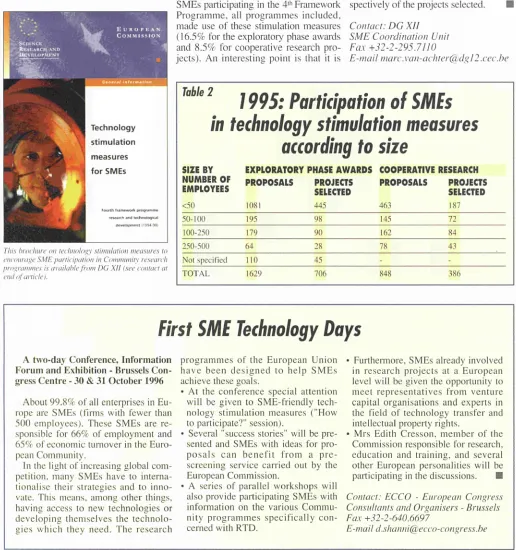
[image:6.567.31.547.157.707.2]This brochure on technology stimulation measures to encourage SME participation in Community research programmes is available from DG XII (see contact at end of article).
Table 2
1995: Participation of SMEs
in technology stimulation measures
according to size
SIZE BY NUMBER OF EMPLOYEES
EXPLORATORY PHASE AWARDS COOPERATIVE RESEARCH PROPOSALS PROJECTS PROPOSALS PROJECTS
SELECTED SELECTED
<50 50100
100250 250500 Not spec tied
1081 195 179 64
110
445 98 90 28 45
463 145 162 78
187 72 84 43
TOTAL 1629 706 848 386
First SME Technology Days
A twoday Conference, Information Forum and Exhibition Brussels Con gress Centre 30 & 31 October 1996
About 99.8% of all enterprises in Eu rope are SMEs (firms with fewer than 500 employees). These SMEs are re sponsible for 66% of employment and 65% of economic turnover in the Euro pean Community.
In the light of increasing global com petition, many SMEs have to interna tionalise their strategies and to inno vate. This means, among other things, having access to new technologies or developing themselves the technolo gies which they need. The research
programmes of the European Union have been designed to help SMEs achieve these goals.
• At the conference special attention will be given to SMEfriendly tech nology stimulation measures ("How to participate?" session).
• Several "success stories" will be pre sented and SMEs with ideas for pro posals can benefit from a pre screening service carried out by the European Commission.
• A series of parallel workshops will also provide participating SMEs with information on the various Commu nity programmes specifically con cerned with RTD.
• Furthermore, SMEs already involved in research projects at a European level will be given the opportunity to meet representatives from venture capital organisations and experts in the field of technology transfer and intellectual property rights.
• Mrs Edith Cresson, member of the Commission responsible for research, education and training, and several other European personalities will be participating in the discussions. ■
Contact: ECCO European Congress Consultants and Organisers Brussels Fax +322640.6697
T H E C U R R E N T E U - R T D A C T I V I T I E S
European RTD Policy Update
S&T Cooperation with the United States
STARTING GLOBAL
NEGOTIATIONS AND RENEWING THE EC-US TASK FORCE ON BIOTECHNOLOGY RESEARCH
Over the past 30 years, EUUS cooperation has considerably expanded under a series of' bilat eral sectoral agreements in re search areas such as nuclear waste, nuclear safeguards, renew able energy sources, the effects of radiation, mineral processing technologies, nuclear fusion, bio technology, etc. Formal and in formal contacts have been main tained between various Commis sion services and U.S. govern ment departments, and networks of individuals, groups and insti tutions of many kinds. On 26 June 1996. for instance. Mrs Edith CRESSON. Commissioner responsible for Research. Educa tion and Training, signed the re newal of the ECUS Task Force on Biotechnology Research, fol lowing the active cooperation de veloped over the previous five years.
To encourage the growth of these various enterprising partnerships, both sides have felt a rising need to give them a more solid and vi able basis and to create a compre hensive legal framework for S&T. The negotiations to reach this general agreement, which will be managed by DG XII, were launched on 11/12 July 1996. They are the direct result of the New Transatlantic Agenda agreed at the EUUS summit in Madrid in December 1995.
Contact: Mr Louis Bellcmin DG XII/B3
Fax: +32.2.29.69824
The High Flux Reactor (HFR) facility at the Institute for Advanced Materials of the Joint Research Centre at Petten (Netherlands)
Multimedia content
THE INFO-2000 PROGRAMME
On 20 May 1996. the EU Council of Ministers agreed on this new 4 year/ECU 65 million initiative which replaces the previous IM PACT Programme. It aims to stimulate the development of the European multimedia content in dustry in the emerging Informa tion Society. Two calls for propo sals were launched in June 1996 and closed in September 1996. Further information can be found on the I'M Europe server. Internet:
http://www2.ecbo.lit/info 20001 infohome.html
JRC
gramme developed by the Institute for Advanced Materials of the Joint Research Centre (JRC) at Petten (Netherlands).
The HFR is one of the few cen tres in the world capable of meas urine the dose of irradiation needed
for the needles used by hospitals in the treatment of cancerous tumours by brachitherapy. It supplies 60% of the radioisotopes needed in Eu rope, thereby contributing to the diagnosis and care of 7 million patients.
The nuclear reactor of Petten is also playing an active part, togeth er with other European partners, in research on Boron Neutron Cap ture Therapy (BNCT). a new and promising way of treating certain cancers, in particular brain tumours called gliomas.
The HFR is a supplementary re search programme funded partly by three Member States, namely France. Germany and in particular the Netherlands (ECU 40 million for 199699). The rest of the re sources (ECU 35 to 40 million) will come from contracts with the radiopharmaceutical industry.
Contact: Mr J.C. Filori Fax: +32.2.29.63000 ■
RENEWAL OF THE HFR RESEARCH PROGRAMME
The Council of Ministers has re newed for the 199699 period the High Flux Reactor (HFR) Pro
ft/// access to the latest European
RTD news on the Web
More detailed data on all information presented in RTDINFO can be easily accessed on the World Wide Web:
■ The DG XII Home Page is now offering both all the basic back ground information on the Framework Programme and a wide range of news on current and future activities related to European RTD (press releases, calls, events, publications, etc.).
Internet: http:lleuropa.eu.intlenlcommldgl2ldgI2tst2.html
■ The RTDNews database developed by CORDIS is now available in three languages English, French and Gemían from the COR DIS home page.
Internet: http://www.cordis.lul
T H E C U R R E N T E U - R T D A C T I V I T I E S
Results of recent calls for proposals
3rd call for proposals*
TELEMATICS APPLICATIONS
67 projects selected for fund ing
The total number of proposals re ceived was 413. The 67 selected proposals will receive EU funding of ECU 64 million. Applications for the disabled and elderly sector represent almost 50%, the other half being equally shared by health care, education & training and language engineering. * launched on 151911995
2nd call for proposals''
BIOTECHNOLOGY
Approval for 152 R&D projects
This call attracted a record num ber of applications: 797, involving over 5,058 participants. Respond ing to health care needs, develop ing new industrial processes and preserving genetic resources are prominent themes among the 152 projects selected for the available funding of ECU 206.6 million. The evaluation was carried out by 360 experts, with 29% from in dustry, distributed among 21 pan els according to the scientific area.
Featuring prominently are ambi tious and innovative projects to develop cell factories, devise nov el vaccines, sequence the ge
nomes of living organisms, and provide animal models for medi cal research or tools to monitor bi odiversity, etc. Industrial partici pants are now found in 65% of projects, comparing favourably to the biotechnology projects funded a decade ago when industrial par ticipation was less than 40%. In particular, the involvement of SMEs (80 participants) has surged. These trends reflect the growing commitment of various economic sectors to incorporate technological progress and con vert scientific advances into new processes and products.
In the vaccines area, 14 projects involving 12 European companies match the priorities identified by the Task Force on Vaccines and Viral Diseases
* launched on 1519195 and closedon 10/1/1996
42 training grants awarded so far in 1996
Following the 1st deadline (1/3/96), 42 grants were awarded following the 84 applications sub mitted. A further 85 received for the 2nd deadline of 1/7/96 are
under evaluation. Next deadline will be on 1/11/96.
2'"' call for proposals*
INDUSTRIAL & MATERIALS TECHNOLOGIES
939 applications were received with requested European Union funding totalling ECU 1,760 million. They are currently being evaluated to select the projects to qualify for
the ECU 400 million available. 84% of the applications concern in dustrial research projects and the in dustrial participation represents 63% of ail the partners.
* deadline: 17/4/96
INCO-COPERN1CUS call for proposals*
INTERNATIONAL COOPERATION
261 projects selected
This INCOCOPERNICUS call for proposals for cooperation with Central European Countries and the New Independent States of the former Soviet Union elicited almost 2000 proposals and has re sulted in the selection of 261 pro jects for a total financing of ECU 68 million.
* deadline 2912196
2nd call for proposals*
FAIR (AGRICULTURE AND FISHERIES)
50 projects to boost European agrifood industry
The 50 projects were adopted from a list of 233 proposals in volving 1,484 participants. Fortyone projects deal directly with the food industry while nine deal with nonfood developments of industrial products from biologi cal raw materials. The total EC contribution to these projects
amounts to almost ECU 50.4 million. Out of 308 partners, 33% are companies; they are taking part in 42 of the projects and putting up a financial contribution of 50% of the total project costs. Industrial partners include both SMEs and major companies from the agri food, paper, chemical, pharmaceu tical, and forest industry sectors.
* launched on 151611995
2nd call for proposals*
NUCLEAR FISSION SAFETY
89 selected proposals
152 proposals were received by the second deadline (28 February 1996). A total of 148 eligible pro posals were evaluated by 7 groups of experts in the period 18 March
18 April 1996 for their scientific, technical and strategic merit. All research areas of the programme were covered, i.e. exploring inno vative approaches (only concerted actions); reactor safety; radwaste management and disposal, and de commissioning; radiological im pact on man and the environment; mastering the events of the past. Contract negotiations are now be ing started for the 89 selected pro posals with a total EC contribution of about ECU 44 million. This concludes the implementation of' the sharedcost actions of the pro gramme, while concerted actions are open up to 1 November 1997. * launched on J 7/1/1995, closed
■M
T H E C U R R E N T E U - R T D A C T I V I T I E S
Ongoing/upcoming calls for proposals
(from October 1996)
'S%
P R O G R A M M E ( + CONTACTS) PUBLICATION DEADLINES AREAS ( + SPECIFIC CONTACTS)
INFORMATION TECHNOLOGIES (ESPRIT)
Fax: +32-2-296.83.88 E-mail: [email protected] Contact: Mrs G. Colling
17.9.96 18.12.96* Research on the following themes: software technology, technological 15.12.96** components & subsystems, multimedia, long-term research, open
!
microprocessor systems initiative, high performance computing &
networking, technology for business processes, integration in manufacturing.
*for one-step evaluation I **for 1st two-step evaluation
15.3.96 (mise à 16/9/96* Continuous submission: IT project traineeships.
jour) 15.3.46 16/9/96* Continuous submission: preparatory, support & transfer activities. * expected to be extended in 9/96
* expected to be extended in 9196
5.3.96 (mise à 16/9/96* Continuous submission: open long-term research, technology transfer
f) actions, SME exploratory awards.
* expected to be extended in 9196
TELEMATICS APPLICATIONS Fax:+32-2-295.23.54
E-mail: [email protected]
15.9.95 Open until 15.6.98 Rolling call: Support actions (awareness, dissemination of results & promotion of telematics, international cooperation, education).
15.12.96* Call for proposals covering all the main sectors of the Telematics Applications Programme.
* Date to be confirmed
INDUSTRIAL & MATERIALS TECHNOLOGIES
Fax: +32-2-296.70.23 +32-2-295.80.46
15.12.94 Open until 17.12.97 Continuous open call for CRAFT & thematic networks: production technology, materials & product innovation, transport.
Open until 20.5.98 Accompanying & support measures (open call).
according to 3rd call for proposals (some areas in coordination with Information areas** Technology, Telematics and Transport programmes).
* date to he confirmed I** tobe specified later
STANDARDS, MEASUREMENT & TESTING
Fax:+32-2-295.80.72 Contact: Mr P. Mériguet
Open until 17.12.97 Thematic networks.
15.11.96
28.11.96
Dedicated call: CEN, ETSI. CENELEC & support to Community policies.
Measurements for quality European products, measurements related to the needs of society, prenormative research & technical support to trade.
15.6.97 13.11.97 Technical support for trade, measurements related to the needs of society.
ENVIRONMENT & CLIMATE Fax: +32-2-296.30.24 E-mail: [email protected]
17.9.96
15.12.95
.... 17.1.95 15.6.95
1.97
20.3.97 20.8.97 20.3.98 20.8.98
1.4.98
Shared Cost Actions: Environment technology (contact: Mr P. Reiniger); research into the natural environment, environment quality & global change (Mr A. Ghazi): space technology applied to environment monitoring & research (Mr M. Paillon); human dimensions of environmental change (Mr A. Sors).
Research training grants: research into the natural environment, environment quality & global change, environment technology, space technology applied to Earth observation & environment research, human dimensions of environment change.
Contact: Mr A. Arribas San Martin / E-mail: [email protected]
Technology stimulation measures for SMEs: cooperative research. Contact: Mr P. Wicks / E-mail: [email protected]
MARINE SCIENCE & TECHNOLOGY 16.4.96 Fax: +32-2-296.30.24
E-mail: [email protected] Contact: Mr J. Boissonnas
15.10.96 Shared cost actions, concerted actions and dissemination-exploitation, including demonstration projects: research on marine systems, extreme marine environments, regional seas research (North-Eastern Atlantic), coastal & shelf seas research, coastal engineering & natural defences, marine generic technology; advanced systems.
ν*
ν
/
T H E C U R R E N T E U - R T D A C T I V I T I E S
PROGRAMME (+ CONTACTS) PUBLICATION DEADLINES AREAS |+ SPECIFIC CONTACTS)
16.4.96
15.3.96
15.1.97 Idem: Structure & dynamics of coastal ecosystems
BIOTECHNOLOGY Fax:+32-2-299.18.60
E-mail: [email protected] Contacts:
R&D: Mr A. Aguilar Demonstration: Mr A. Herrero ELSA - Mr E. Elizalde
27.6.97* Concerted actions* / Preparatory accompanying & support measures**: 12.6.98** Standards for training & work; modelling, ocean-data management &
quality control for research & operational applications; use of heavy experimental equipment, research vessels & their modular equipment, large computing facilities & other technical resources in the European Economic Area; design of components and systems for heavy advanced equipment; calibration techniques & standards for marine instrumentation & observational equipment.
15.6.96 18.10.96 Genome analysis (function search & comparative analyses), plant molecular & cellular biology, somatic gene therapy, immunology & immunotechnology, structure/function relationships, structural biology/electronics, in vitro pharmaco-toxicology, environmental biotechnology, infrastructures, horizontal activities. Demonstration projects: open in all programme areas.
15.6 97 Sept. 97 Cell factories, genome sequencing, animal mapping & selection, animal models, cell communications in neurosciences, transdisease vaccinology, structure/function relationships, biosafety, biodiversity, infrastructures, horizontal activities.
Demonstration projects: open in all programme areas
BIOMEDICINE & HEALTH Fax: +32-2-295.53.65 (contacts:
R&D - Mr A. Vanvossel Demonstration: Mr A. Herrero ELSA - Mr E. Elizalde
17.9.96 17.12.96 Diseases with major socio-economic impact (cancer, cardio-vascular diseases, chronic diseases, ageing & age-related diseases, etc.), public health, biomedical ethics. Ethical, legal & social aspects (ELSA). Demonstration projects in the above areas.
Open call
Open call
31.12.96 Grants in the following areas: diseases with major socio-economic impact, public health research, biomedical ethic - Contact: Mr A. Vanvossel.
31.12.97 Grants in all areas of the programme - Contact: Mr A. Vanvossel.
AGRICULTURE & FISHERIES Fax:+32-2-296.43.22 (contacts
R&D - Mr X. Goenaga Demonstration: Mr A. Herrero ; ELSA-MrE. Elizalde
déc-96 March 97 R&D; integrated production & processing chains, agriculture, forestry, rural development, Fisheries & fish farming, objectives addressed by ethical, legal & social aspects. Demonstration: all the areas.
June 97 Sept. 97 R&D: Generic science & advanced technology for nutritious foods, agriculture, sylviculture, rural development, fisheries & fish farming.
NON-NUCLEAR ENERGY (JOULE Programme) See contacts in column 4
17.9.96 31.1.97 R&D shared-cost actions: selected in energy RTD strategy, rational use of energy, renewable energies, fossil fuels.
Contact: Mr M. Poireau - Fax +32-2-296.6882
15.05.97 R&D shared-cost actions: the areas of this call will be defined later. Contact: Mr M. Poireau - Fax +32-2-296.6882
15.12.94
2.6.95
15.12.94
15.6.96
17.12.97 Continuous open call: preparatory, accompanying and support measures. Contact: Mr P. Fernandez-Candas - Fax +32-2-296.4288
1.6.98 Continuous open call: call for expression of interest. Contact: Mr P. Fernandez-Candas - Fax +32-2-296.4288
17.12.97 Technology stimulation for SMEs (cooperative research projects & exploratory awards) - Contact: Mrs I. Tenten - Fax +32-2-295.0656.
1.7.98 Training grants for young researchers (post-graduate and post-doctoral) in the field of non-nuclear energy
Contact: Mrs I. Tenten - Fax +32-2-295.0656.
NON-NUCLEAR ENERGY (THERMIE PROGRAMME -DEMONSTRATION PROJECTS) Contact: Mr W Folkertsma Fax +32-2-295.0577
T H E C U R R E N T E U - R T D A C T I V I T I E S
4, ^
1;
P R O G R A M M E | + CONTACTS) PUBLICATION DEADLINES AREAS { + SPECIFIC CONTACTS)
17.9.96
Sep 97 31.1.97 Call for targeted demonstration projects - type A (rational use of energy, Jan 98 renewable energies, fossil fuels).
NUCLEAR FISSION SAFETY Fax:+32-2-295.49.91 TRANSPORT Fax: +32-2-296.83.56
17.9.96
17.1.95
15.12.96
31.1.97
1.11.97
15.3.97
Call for targeted demonstration projects (advanced pulverised coal boiler using ultra super-critical steam-water cycle).
Concerted actions & support to thematic networks. Contacts: Mr W. Balz & Mr J. Sinnaeve
Strategic research, rail transport, integrated transport chains, air transport, urban transport, waterway transport, road transport.
Contact: Mr W. Blonk
TARGETED SOCIO-ECONOMIC 17.9.96*
RESEARCH 15.3.97* 15.6.97
Fax: +32-2-296.21.37
Science & technology policy options, research into education & training, research into social integration & exclusion in Europe (only in certain areas). Contact: Mr S. Parker - E-mail: [email protected]
* date to be confirmed - ** date to be specified
INTERNATIONAL COOPERATION
Fax: see column 4 13.2.95 1.3.97 1.3.98 Grants (Japan, Korea). Contact: Mr L. Bellemin - Fax: +32-2-296.98.24
15.3.97
15.3.97
15.9.97
15.6.97
Scientific & technology cooperation with developing countries. Contact: Mr T. Hall - Fax: +32-2-296.62.52
Cooperation with Central & Eastern European countries & the New Independent States of the former Soviet Union.
Contact: Mr M. Genovese - Fax: +32-2-296.33.08.
DISSEMINATION & EXPLOITATION OF RESULTS
Fax: see column 4
15.12.96 16.3.97-18.9.97 European networks & services of technology transfer & innovation support. Contact: Mr R. Miège - Fax: +352-4301-34544
15.12.96 16.3.97 Financial actions (Mr R. Miège).
15.9.96
97 15.12.96 97 Technology transfer & technology validation projects. Contact: Mr J.N. Durvy - Fax: +352-4301-34129
end 96 97 Network of innovation relay centres (complementary action).
Contact: Mr J. Hernandez-Ros - Fax: +352-4301-34129
TRAINING & MOBILITY OF RESEARCHERS
Fax: +32-2-296.90.28 E-mail: [email protected] Contact: Mr A. Mitsos
16.9.96 3.2.97 Research training networks.
E-mail: [email protected]
16.9.96 17.3.97 15.9.97
16.12.96 16.6.97 15.12.97
Research training grants (Marie Curie fellowships). E-mail: [email protected]
16.9.96 16.12.96 Access to large-scale facilities. 17.3.97 17.6.97 E-mail: [email protected] 16.12.96
16.6.97 15.12.97
1.4.97 30.9.97 31.3.98
Euroconferences, summer schools & practical training courses. E-mail: [email protected]
MEASURES FOR SMES
Fax:+32-2-295.71.10
E-mail: [email protected]
15.12.94 Open until
HS2.97 Industrial & material technology; standards, measurements & testing; environment & climate; marine sciences & technology; biotechnology: biomedicine & health: agriculture & fisheries; non-nuclear energy; transport.
Contact: Mr G. Clarotti
GENERAL INFORMATION : Fax : +32-2-295.82.20 · Michel Claessens · E-mail : [email protected] Stephen Gosden - E-mail : [email protected]
T H E C U R R E N T E U - R T D A C T I V I T I E S
Upcoming events
EUROPEAN RTD POLICY
SME Technology Days - Brussels, Belgium, 30-31/10/1996 · See box p. 6
INFORMATION SOCIETY
EITC'96: "Doing Business in the Information Society" Brussels. Belgium - 25-27/11/1996
Organised by DG III (Industry) Contact: Mr. J. Richter Fax+32-2-2966613 E-mail: [email protected]
Internet: http://www.cordis.lu/ esprit/src/eitc96.html
• Focus on electronic commerce, IT applications, enabling technologies and major take-up initiatives.
• A key part of the conference will be "Access to financial markets" with case-studies of successful innovator-investor partnerships, workshops on the many new financial instruments now available, and round tables featuring prominent investors.
• Intensive tutorial for SMEs on "Approaching venture capitalists".
• Exhibition: company-centred stands presenting leading-edge technologies and products stemming from the ESPRIT programme.
Cyberspace: Europe's advantage?" Montpellier, France - 6-8/11/1996
Organised by IDATE (Institute for Audiovisual and Telecommunications in Europe ) with support from DG XII Contact: IDATE Ms. N.Sulmoni
Fax+33-67144400
Internet: http://www.idate.fr/jii/jii_a. html
• The implications of the latest developments and industrial strategies in telecommunications, information technology and audiovisual media.
• Aimed at major industrial group leaders, users, researchers, academics, administrators and politicians in order to forge a better understanding of the future of the information sector.
Multidisciplinar} forum on electronic records Brussels, Belgium, 19-20/12/1996
Jointly hosted by the EU Member States and the European Commission
(Secretariat General and DG XII)
Contact: EC General Secretariat Mrs. Christine Beckers, UnitSGl/AH
Fax +32-2-2961095
E-mail: [email protected]
• Objective: to bring together specialists and executives involved in the management of information flows and electronic records (public administrations, archivists, industry suppliers, researchers) in order to prepare a set of guidelines for best practice and to investigate possibilities for wider
aoperation in the field.
TELEMATICS
TELEWORK'96 - Telework and new ways of working Vienna, Austria, 4-6/11/1996
Organised by the European Community Telework Forum (ECTF), in association with DG XIII
Contact: ECTF Fax+43-1-4067752 E-mail: [email protected]
ssessment of the state of progress in implementing telework across Europe.
With case studies from users and experts illustrating experiences in teleworking. I C J
Two-day Business Partnership meeting for SMEs Berlin, Germany, 25-26/10/1996
Organised by the European network of SMEs in telematics industries (ESMET), in cooperation with the European Community's
INTERPRISE programme
Contact: ESMET - Mr. Andreas Frank Tel. +49-30-39902320
I
T H E C U R R E N T E U - R T D A C T I V I T I E S
4/
Λ
%
fe
INDUSTRIAL TECHNOLOGIES & MATERIALS
International symposium "Modern machining technologies and production techniques in the European sub-contracting industry" Venlo, the Netherlands, 31/10/1996
Contact: Lavell BV Fax+31-46-4515234
• With a view to setting up licence agreements, the symposium will present new products and new production techniques developed for the supplying industry by the largest CRAFT project funded by BRITE/EURAM, which brought together 17 companies in the metal and plastic machining business and research institutes from Germany and the Netherlands.
ENVIRONMENT
Conference on Mediterranean Desertification
Crete, Greece, 29/10-1/11/1996
Organised jointly by DGs VI, XI, XII and XVI Contact; DG XII Mr. P. Balabanis/Mr. D. Peter Fax +32-2-2963024
E-mail: [email protected]
• This international Conference aims to strenghten the visibility of EC policy action and research in the field of Mediterranean desertification, to promote awareness of the extent, nature and urgency of the desertification problem, and to translate scientific research into policy development and practical action.
• Analysis of research results and policy implications in the field. • Round tables subjects: formulating research priorities; cooperation in
combating desertification; Mediterranean land use and sustainability.
AGRO-INDUSTRIAL RESEARCH
Conference on pulp and paper research
Stockholm, Sweden, 9-11/10/1996.
Organised by the Swedish Pulp and Paper Research Institute with support from DG XII/E-2
Contact: SPPR - Mr. Lennart Eriksson Fax+46-8-104009
E-mail: [email protected]
• Presentation of Community-supported research projects in the area of pulp and paper.
• Forum for discussion between representatives from industry, government agencies and the European Commission
NUCLEAR FISSION SAFETY
Management and Storage of Radioactive Waste
Stein-am-Rhein, Switzerland, 28-30 /10/1996 Contact: H. von Maravic DG XII-F-5
Fax +32-2- 296 6883
• 7lh EC-Natural Analogue Working Group Meeting jointly organised by the
European Commission and NAGRA to discuss the applications of Natural Analogues to the safety evaluation of radioactive waste disposal systems,
as well as their potential future application to toxic wastes.
NON-NUCLEAR ENERGY (JOULE COMPONENT)
Attracting Private Investment to Sustainable Energy
Brussels, Belgium, 23-25 /l 0/1996
Organised by Energy 21 (Paris) under the sponsorship ofDGXII-F
Contact: Energy 21 - Mrs. C. Parnière / Mr. E. Blaustein Fax:+33-1-46-04-80-99
DG XII - Mrs. Irmela BRACH Fax +32-2-299-49-91
• Case studies illustrating the financial and investment mechanisms used or under study.
• Presentation of mechanisms from traditional financing to specialised techniques such as security measures, and the importance of structuring packages which marry different finance sources and techniques. • Examples relating to emerging markets and developing countries.
MULTI-SECTORAL AREAS
TEC'96: Fifth European Forum of Competitive Technology
Grenoble, France, on 15-17/10/1996.
Organised by the Grenoble Chamber of' Commerce and Industry with the support of DG XIII and DG XII Contact: TEC'96
Fax +33-76282795 E-mail: [email protected]
• Objective: to bring together 20,000 professional European visitors including: economic actors, research laboratories, major companies, SMEs working in high technology fields, and government bodies.
• Sectors to be covered: new information, and communication technologies; computerisation: information super highway, multimedia, virtual reality, databases; latest advances in micro-electronics; technologies in life sciences; new materials applications; services to assist in the exploitation of new inventions and in technology transfer.
Γ5
s
T H E C U R R E N T E U - R T D A C T I V I T I E S
Recent Publications
EUROPEAN RTD
Euroabstracts: Second 1996 edition EurOP · Fax +352488573
' E U R O S T A T M n P ^ Statistics in focus: Innovation in the European Union Information taken from the
Community Innovation Survey held in 1993 across the then 12 EC Member States and Norway, with some 40,000 enterprises surveyed.
Statistics in focus: Research and development in the EU ■ (expenditure, staff, public funding...) in the Member States. Research and rural regions
An overview of R&D activities EUROSTAT Mr. Pino · Fax +352430134149
"ÈurÖP"·"Fax '+352488573
INFORMATION SOCIETY
Information Europe A new quarterly magazine launched by the European Bureau of Library. Information and Documentation Associations (EBLIDA) in the fields of copyright, culture, education, information technology and opportunities for Central and East European cooperation. Finai' évaluation of the IMPACT ÏÏ Programme (199195)
EBLIDA Ms. Barbara Schleihagen Fax+31703090708
Internet: http://www2.echo.lu/libraries/en/ eblida.htm 'ÏMPACT/ÏNFÖ2ÖÖÖ' Centrai Office'
Fax:+352 430) 32847
TASK FORCE "CAR OF TOMORROW"
New newsletter of the Car of Tomorrow Task Force
Details of recent work undertaken in the Task Force, and advance notice of planned activities.
DG XII Mr. E. Ponthieu · Fax +3222991847 Internet: http://europa.eu.int/en/comm/dg 12/ tfauth.html
ENVIRONMENT & CLIMATE
ECOSYSTEMS Research Reports Series
N°18 Functional Analysis of European Wetland Ecosystems
A new approach to assess and classify wetlands in view of their potential role for society.
DG XII Mr. H. Barth · Fax +322296.3024
BIOTECHNOLOGIES / BIOMEDICINE AND HEALTH
Trends: A new series on advanced research topics of' European interest in life science. DG XII Mr. Sonnino · Fax +3222963261
AGRICULTURE AND FISHERIES
AIR ( 19911994) Catalogue of R&D projects:
An informative picture of 426 projects giving a useful guide to stateoftheart relevant European research activities in the field.
DG XII Mrs N. Bounaga Riveill · Fax + 322296 4322
INTERNATIONAL COOPERATION
Science & Technology for Development (STD3) Agriculture: Projects Summaries
An overview of the objectives, activities and expected outcome or results of the 167 STD3 cooperation projects between partners from EU and Developing Countries in the Agriculture sector.
DG XII Mr Braun · Fax +322296.6252
HUMAN CAPITAL AND MOBILITY PROGRAMME / TRAINING AND MOBILITY OF RESEARCHERS Largescale facilities funded by the Human Capital and Mobility programme
The HCM programme (19901994) has provided funding for access by more than 1,500 researchers to 70 of Europe's largescale facilities.
DG XII TMR Programme · Fax +3222962136 Internet: http://www.cordis.lu/tmr/home.html
Microfabrication with synchrotron radiation Dynamics of membrane protein insertion and folding Magnetic molecular materials
Three booklets outlining the activities and results of research networks funded under the Human Capital and Mobility programme
DG XIIG TMR programme · Fax +322295 6995 Internet: http://www.cordis.lu/tmr/home.html
INNOVATION PROGRAMME
Innovation brochure: Dissemination and optimisation of the results of research activities ■ Published by DG XIII of the EC.
DG XIII/D2 · Fax +352430132084
Innovation across cultural borders
A tool including a book and diskette presenting six cases of critical "intercultural" events which occurred in largescale/multipartner/crossborder projects
Innovation Programme Technology Assistance Unit Fax: +352 433890
COST
Karst Groundwater Protection Guidelines (COST 65). DG XII · Em: [email protected]
JRC / ENVIRONMENT INSTITUTE 1995 Annual Report
'
' W ■
" E N V I R O N M E N T & C L I M A T E " P R O G R A M M E - C A S E S T U D I E S
Projects for
a sustainable development
T
he "Environment & Climate" programme, which accounts for 7% of the budget for the 4lh Framework Programme, covers four main areas of research: climatology and global change, environmental technologies, space technology and socioeconomic effects. The four in itiatives described below demonstrate both the diversity of this research and its relevance to the present concerns of European society.■ Two of these initiatives concern sub jects of common concern to every body living in Southern Europe and the Mediterranean Basin: the pollu tion of the Mediterranean and the fight against forest fires.
■ The other two are of general interest to all European countries and indeed to the whole planet: the safeguarding of cultural heritage and the impact of
human activities on climate change. • Research into the conservation of our
cultural heritage is justified first and fore most because our heritage forms the ba sis of a cultural identity and quality of life to which all European people are deeply attached. Furthermore, it constitutes a source of employment and growing eco nomic activity throughout the continent. • As to the evaluation of mankind's in
fluence on the climate, we are all very much aware of the global chal lenge posed by this issue which calls into question all prospects for human ity's further development.
7.
EROS 2000: shedding
unexpected light on the state
of the Mediterranean
The Mediterranean Sea is much less polluted than we had supposed: ap
proximately 90% of the pollution which the Rhone unloads into the Med iterranean falls to the sea bed, where it forms a relatively limited zone of sedi
mentation which does not reach the waters of the open sea. This surprising discovery, which overturns accepted ideas, is the fruit of research conducted over a number of years by scientists working on the EROS 2000 project (European River Ocean System).
Launched in 1988 by the European Commission, EROS 2000 is a longterm multidisciplinary project aimed at im proving our understanding of the physi cal and biogeochemical processes at work along the European coastline. EROS 2000 is endeavouring to reinforce the scientific knowledge base, which will allow us to reach a realistic compromise between economic development and the protection of the marine environment. ►
Sustainable development,
the basis of European environmental research
The role of European environmental policy has been growing in importance for the last twenty years or more. The need to incorporate all human activities within the framework of a sustainable development which respects the envi ronment is now clearly laid down in the EU Treaty itself.
Environmental research plays a key role in realising this objective, especially in developing clean technologies, as the Commission White Paper on Growth, Competitiveness and Employment stressed in 1993. The RTD programmes in this area, financed by the European Commission since the very first frame work programmes, have progressively made it possible to take up this chal lenge at a coordinated European level.
With a budget of ECU 567 million under the 4th Framework Programme
1994-1998, the "Environment and Cli mate" programme is active in four fields: • research into the natural environment,
the quality of the environment, and global change in order to better understand natural mechanisms; • technologies for the environment in
the field of monitoring, protecting and restoring the environment, and risk evaluation;
• space technology applied to Earth ob servation in order to determine our planet's state of health with the help of satellite data;
• the human dimension of environmen tal changes, by evaluating their caus es and socio-economic effects.
As the key to sustainable develop ment, the results of this research are of crucial importance to Europe's political and economic decision-makers who need to know the environmental con straints to be respected when setting their objectives and making invest ments. But the Union's research activ ities do not only reflect the need for technological and industrial develop ment. They also meet the demands of the citizens, who are growing increas ingly concerned by the quality of the
environment. ■
Contact: Environment & Climate Pro gramme Infodesk
Fax +322 296. 3024
Email environ[email protected]
" E N V I R O N M E N T & C L I M A T E " P R O G R A M M E C A S E S T U D I E S
NORTH -WESTERN MEDITERRANEAN
The work of EROS 2000 has shown that 90% of the pollution discharged into the Mediterranean by the Rhone is deposited in a relatively limited sedimen tation zone.
The data collected should permit a more rational management of Europe's coastal areas.
During the first phase of EROS 2000 (1988-1993), 25 research institutes from 12 countries studied the relative impor tance of different types of pollution likely to contaminate the Mediterrane an. These investigations were initially concentrated in the Gulf of Lions (the Mediterranean Gulf west of the Rhone delta), and later extended to the whole of the western Mediterranean.
Apart from the results concerning coastal pollution (as referred to above), the researchers also established that much of the marine pollution in the Mediteiranean originated in the atmos phere, rather from river discharge. For example, pollutants are carried to the Mediterranean by sand from the Sahara. These results reinforce and clarify the bases of European environmental man agement policy. It is no longer going to be possible to control pollution in the Mediteminean by limiting our efforts to controlling river discharges alone.
THE CASE OF THE BLACK SEA
Since 1994, the EROS 21<» project, the successor to EROS 2000, has been extended to the Black Sea: 20 Commu nity research institutes (from Belgium. France, Germany, the Netherlands, Spain, the United Kingdom and Ireland)
have been working with colleagues from Russia, Ukraine, Rumania and Bulgaria. Together, they are studying the effects of discharge from the Danube on the Black Sea's ecosystem.
They are also trying to quantify the volume of greenhouse gases emitted by the Black Sea. Measurements taken to date suggest a very high concentration of methane in the sea and the impact of these emissions can even be detected in the troposphere. Russian scientists in volved in the project have also identi fied the presence of funnel-shaped cal cium structures on the sea bed which emit methane, which rises to the sur face.
(1) The activities of EROS 21 are coordi nated by Dr Jean-Marie Martin. Director of the Environment Institute at the Joint Re search Centre (JCR) in Ispra (Italy).
2. Techniques for saving
European cultural heritage
European scientists involved in a re cent research project are seeking to im prove the microclimatic conditions in side museums and galleries housing works of art. Their work is designed to
y /
j |
Si
'·
7
ι
„
The use of advanced technologies makes it possible to analyse the causes, consequences and mecha nisms of the deterioration of works of art and to propose suitable means of protection.
limit the risks of deterioration of works of art due to tourist traffic, lighting, heating and air conditioning, while maintaining public comfort and ac cess. It is concentrated at a number of museums in Venice, Vienna and Nor wich, although the results will be of interest to museums throughout Eu rope. This joint Italian-French-British project also receives European Com mission funding and illustrates the kind of Community research activities to protect the cultural heritage which the Commission has supported since 1986 under the "Environment & Cli mate" programme.
Initiatives in this area of research over the past 10 years cover all aspects of the European cultural heritage, not only monuments such as the Acropolis in Athens, Trajan's column in Rome, the cathedrals of Chartres, Seville, and London and other monuments in Vien na, Paris, Venice, etc., but also the problems posed by the conservation of all items of cultural interest, such as paintings, books, metal objects, etc. Having in common the use of high technology to achieve a cultural objec tive, the projects supported in this field focus on a wide variety of problems. These range from an analysis of the causes, effects and mechanisms of de terioration of environmental origin (in cluding effects linked to the abusive use of certain techniques and mass tourism) to research into and the eval uation of protection and conservation methods.
IMPACT ON EMPLOYMENT AND SMES
All these projects provide research ers, restorers, architects and politicians with valuable information on the meas ures required in order to protect our cultural heritage.
E N V I R O N M E N T & C L I M A T E " P R O G R A M M E - C A S E S T U D I E S
3. Satellites
helping the fight against
forest fires
How can the fight against forest fires benefit from real time observations from space? This is the question the FUEGO project, recently selected by the Commission in the framework of "Space technology applied to Earth observation and environmental re search", intends to answer. The Span ish coordinator is linking up with five other partners (three Spanish, one French and one Italian) on this pro ject, which should produce a full defi nition of the technical specifications of onboard satellite equipment (detec tors, processors, etc.).
The scale of forest fires in Europe has caused the Commission to include them among the areas targeted by re search into environmental protection. Every year, an average of 45,000 forest fires break out in Europe, most of them in the Mediterranean region. Between 1989 and 1993, 2.6 million hectares went up in smoke as a result. The cost is enormous: between ECU 1,000 and 5,000 per hectare destroyed, if fighting fires and reforestation is included.
FIGHTING ON ALL FRONTS
While research into spacebased re mote sensing makes a valuable contri bution to the Commission's work in the fight against forest fires, the Com mission also supports research into de veloping and certifying advanced for est fighting technologies. For exam ple, the MEFISTO (Mediterranean Forest Fire Fighting Integrated Strate gic Tools) project bringing together partners from the United Kingdom, Portugal, Greece and Italy has devel oped a forest fire simulator which is able to predict the way a fire is going to spread under real conditions. This tool has been successfully tested on three forest fires in three different countries.
Another project also using data sup plied by satellite has made it possible to develop an operational system to aid
■
M E D I T E R R A N E A N
F O R E S T F I R E F I G H T I N G I N T E G R A T E D
'.
S T R A T E G I C T O O L
jfiL
MEFISTO
The MEFISTO project has developed a forest fire simulator which anticipates how a fire is going to spread in real time.
fire fighters in making crucial deci sions. This project, coordinated by the Ecole des Mines in Paris and bringing together four other European research centres, is able to detect the outbreak of a fire in real time and then provide decisionmaking assistance. When a fire is detected, the map of the area concerned appears on screen, precisely pinpointing the site of the fire. The system then estimates how the fire is going to spread and calculates the time required for the nearest team of fire fighters to reach the blaze.
A further project, which is still run ning, is seeking to develop techniques for the restoration of areas destroyed by fire. Finally, a FrancoGreek team is currently engaged in research to meas ure the relative level of risk of a given region to help the authorities take the appropriate measures. This study is based on evidence that the vegetation's sensitivity to fire is proportional to the emission of essential oils and other chemical and volatile compounds. Sci entists are also developing methods de signed to help the authorities to estab lish sensor networks in order to moni tor risks in a given zone and automati cally update the maps of risk areas.
4.
What is mankind's
influence on global changes
which can be predicted on a
planetary scale ?
An evaluation of the data available at present "suggests that there is now a discernible human influence on the climate". This is one of the main con clusions of a scientific report recently published by the Intergovernmental Panel on Climate Change (IPCC), chaired by Professor Bert Bolin (Swe den). The conclusions of this report based on scientific work funded by the Commission and all questions relat ed to climate change were the subject of a seminar held in Brussels on 13 and 14 May.
Entitled "Climate and ozone", the conference was attended by European climate experts. It highlighted the sci entific breakthroughs achieved in this field thanks to a number of projects funded by the Commission. These pro jects stress the impact of human activ ity on the greenhouse effect. The re sults of one of these projects now al low us to simulate developments in the earth's climate: if present trends con tinue, the average temperature on the earth's surface will have increased by approximately 3°C by the end of the
next century. ►
The measurement campaign carried out in the Arc-tic stratosphere (EASOE) has made it possible to establish models of the distribution of gases influ-encing the ozone layer.