ISSN 1680-225X
G
..:.':. IM O
(Ν
-EU international
transactions
1Ξ-5
S-3b
3-3E
Data 1990-2000
Our mission is to provide the European Union
with a high-quality statistical information service
EurOStat's c o l l e c t i o n s are adapted to the needs of all users. You will find them in each of the nine themes proposed by Eurostat.
55
1 General statisticsand finance
firtéjl 2 Economy
9 I A J 8 3 Population and social conditions 4 Industry, trade and services
5 Agriculture and fisheries
#fB?
6 External trade
¿3L~" 7 Transport
8 Environment and energy
9 Science and technology
C o n t e n t
Press releases: Eurostat publishes around 100 press releases every year in connection with the release of new data. The press releases include the key figures on the EU, the Member States and their partners. They are provided free of charge. They are also available on the Internet as soon as they are published: www.europa.eu.int/comm/eurostat/
F o r m a t Paper Html PDF
Statistics in focus: This collection is published regularly by Eurostat and provides up-to-date summaries of the main results of statistical surveys, studies and analyses. It covers all themes and consists of about four to eight pages per issue. Eurostat issues around 150 Statistics in Focus per year. Available as single copies or on subscription.
Paper PDF
P o c k e t b o o k s : This collection provides the main indicators on a theme or sub-theme in an easy-to-carry booklet of up to 100 pages. Available as single copies or on subscription.
Paper Html
P a n o r a m a of t h e European Union: This collection highlights the features and trends of a multi-sectoral theme or a sectoral sub-theme. The publications consist of around 200 pages and include analysis as well as tables and graphs. Available as single copies or on subscription.
III!
θ
Paper CD-ROM
M e t h o d s a n d nomenclatures are intended for specialists who want to consult the methodologies and nomenclatures used for a theme, a sub-theme or a sector. Available as single copies.
Paper CD-ROM
Detailed tables are intended for specialists. They present part, or all, of the statistical data compiled on a theme, sub-theme or sector. Available as single copies or on subscription.
Ini
CD-ROM PaperStudies a n d research summarise the results of European statistical studies and research and are intended for specialists. Available as single copies or on subscription.
Paper CD-ROM
Catalogues provide rapid access to concise information on Eurostats products and services. They are free of charge and include the Mini guide, a selection of Eurostat products and services, and Statistical references, the quarterly newsletter
ζ
o
o
LU «Ν O
o
(Ν
EU international
transactions
Immediate access to harmonized statistical data
E u r o s t a t D a t a S h o p s : J
A personalised data retrieval service
In order to provide the greatest possible number of people with access to high-quality statistical information, Eurostat has developed an extensive network of Data Shops 0).
Data Shops provide a wide range of tailor-made services:
* immediate information searches undertaken by a team of experts in European statistics;
* rapid and personalised response that takes account of the specified search requirements and intended use;
* a choice of data carrier depending on the type of information required.
Information can be requested by phone, mail, fax or e-mail.
(1) See list of Eurostat Data Shops at the end of the publication.
I n t e r n e t
0
Essentials on Community statistical news
* Euro indicators: more than 100 indicators on the euro-zone; harmonized, comparable, and free of charge;
* About Eurostat: what it does and how it works;
* Products and databases: a detailed description of what Eurostat has to offer; * Indicators on the European Union: convergence criteria; euro yield curve and further
main indicators on the European Union at your disposal; * Press releases: direct access to all Eurostat press releases.
For further information, visit us on the Internet at: WVVW.europa.eU.int/COITirn/eurOStat/
A great deal of additional information on the European Union is available on the Internet. It can be accessed through the Europa server (http://europa.eu.int).
Cataloguing data can be found at the end of this publication.
Luxembourg: Office for Official Publications of the European Communities, 2002
ISBN 92-828-8654-9
© European Communities, 2002
m
EUROSTATL-2920 Luxembourg — Tel. (352) 43 01-1 — Telex COMEUR LU 3423
e u r O S t a t Rue de la Loi 200, B-1049 Bruxelles — Tel. (32-2) 299 11 11
Eurostat is the Statistical Office of the European Communities. Its task is to provide the European Union with statistics at a European level, that allow comparisons to be made between countries and regions. Eurostat consolidates and harmonizes the data collected by the Member States.
To ensure that the vast quantity of accessible data is made widely available, and to help each user make proper use of the information, Eurostat has set up a publications and services programme.
This programme makes a clear distinction between general and specialist users and particular collections have been developed for these different groups. The collections Press
releases, Statistics in focus, Panorama of the European Union, Key indicators and
Catalogues are aimed at general users. They give immediate key information through analyses, tables, graphs and maps.
The collections Methods and nomenclatures, Detailed tables and Studies and research suit the needs of the specialist who is prepared to spend more time analysing and using very detailed information and tables.
All Eurostat products are disseminated through the Data Shop network or the sales agents of the Office for Official Publications of the European Communities. Data Shops are available in 12 of the 15 Member States as well as in Switzerland, Norway and the United States. They provide a wide range of services from simple database extracts to tailor-made investigations. The information is provided on paper and/or in electronic form via e-mail, on diskette or CD-ROM.
As part of the new programme Eurostat has developed its website. It includes a broad range of on-line information on Eurostat products and services, newsletters, catalogues, on-line publications as well as indicators on the euro-zone.
EU INTERNATIONAL TRANSACTIONS
Data 1990-2000
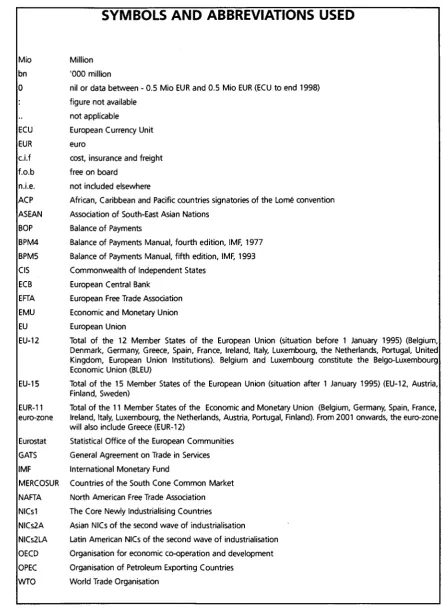
Mio bn
0
ECU EUR c.i.f f.o.b
n.i.e. ACP
ASEAN BOP BPM4 BPM5 CIS ECB EFTA EMU EU EU-12
EU-15
EUR-11 euro-zone
Eurostat GATS IMF MERCOSUR NAFTA NICsl NICs2A NICS2LA OECD
OPEC WTO
SYMBOLS AND ABBREVIATIONS USED
Million '000 million
[image:9.595.53.497.79.691.2]nil or data between - 0.5 Mio EUR and 0.5 Mio EUR (ECU to end 1998) figure not available
not applicable
European Currency Unit
euro
cost, insurance and freight free on board
not included elsewhere
African, Caribbean and Pacific countries signatories of the Lomé convention
Association of South-East Asian Nations Balance of Payments
Balance of Payments Manual, fourth edition, IMF, 1977 Balance of Payments Manual, fifth edition, IMF, 1993 Commonwealth of Independent States
European Central Bank European Free Trade Association Economic and Monetary Union
European Union
Total of the 12 Member States of the European Union (situation before 1 January 1995) (Belgium, Denmark, Germany, Greece, Spain, France, Ireland, Italy, Luxembourg, the Netherlands, Portugal, United Kingdom, European Union Institutions). Belgium and Luxembourg constitute the Belgo-Luxembourg Economic Union (BLEU)
Total of the 15 Member States of the European Union (situation after 1 January 1995) (EU-12, Austria, Finland, Sweden)
Total of the 11 Member States of the Economic and Monetary Union (Belgium, Germany, Spain, France, Ireland, Italy, Luxembourg, the Netherlands, Austria, Portugal, Finland). From 2001 onwards, the euro-zone will also include Greece (EUR-12)
Statistical Office of the European Communities General Agreement on Trade in Services International Monetary Fund
Countries of the South Cone Common Market North American Free Trade Association The Core Newly Industrialising Countries
Asian NICs of the second wave of industrialisation Latin American NICs of the second wave of industrialisation Organisation for economic co-operation and development Organisation of Petroleum Exporting Countries
TABLE OF CONTENTS
IV
ν
Foreword 5
Important information 7
Analytical aspects 9
2000 main features 11
Description of the tables 27
Statistical tables 33
Tables 2.1. 35 Tables 2.2. 37 Tables 2.3. 61
Methodological framework 79
Annexes
Exchange rates
BOP geographical zones BOP economic zones
F O R E W O R D E U I N T E R N A T I O N A L T R A N S A C T I O N S
\^h
FOREWORD
Did you know that in 2000, the European Union's external current deficit expanded markedly in comparison to the previous year?
Did you know that Japan has a steady external current surplus while the USA has a persistent deficit?
Did you know that the USA is the main EU trade partner? Did you know that the EU is a net exporter of services to Japan?
Did you know that the EU is a net importer of Royalties and license fees and Audiovisual services from the USA?
This publication provides you with the most recent and comparable statistics of the EU, the euro-zone, Norway, the USA and Japan on:
· * Annual * r International ( · * Current transactions
Particular emphasis is put on Trade in Services and on the diversity of trading partners. Therefore, these statistics can be used to monitor the external commercial performance of different economies and thus assist trade negotiations in the context of the General Agreement on Trade in Services (GATS).
In the first part of this publication you can find an analysis of 2000 main features through comments, graphs and tables. The second and third parts provide a detailed review of 2000, displaying a complete set of tables for the EU, euro-zone, Norway, the USA and Japan. Finally, the fourth part gives a short description of the methodological framework.
Your needs as a user are our main concern. We can only improve with your help, so please make your comments and suggestions. Contact:
Mr Luis BIEDMA EUROSTAT
Unit B5 - International Trade in Services, Direct Investment, Balance of Payments European Commission
Jean Monnet Building Bech B4/367
Eurostat - L 2920 - Luxembourg Tel.: (+352) 4301 34728 Fax: (+352) 4301 33859 E-mail: [email protected]
F O R E W O R D EU I N T E R N A T I O N A L T R A N S A C T I O N S I =441
i
Important information >
In line with the agreed allocation of responsibility, the European Central Bank is in charge of compiling and disseminating the euro-zone monthly and quarterly balance of payments statistics, whereas the European Commission (Eurostat) focuses on quarterly and annual aggregates of the EU-15.
The data comply with international standards, in particular those set out in the IMF Manual on Balance of Payments Statistics (5th edition).
The EU balance of payments is compiled by Eurostat in accordance with a methodology agreed with the ECB based on extra-EU transactions, i.e. by aggregating cross border transactions of EU residents vis-à-vis non-EU residents as reported by the 15 participating Member States. The balance of payments of the EU institutions is added to the EU aggregate. The .ECB compiles the euro-zone aggregate following the same agreed methodology excluding cross-border transactions within the euro-zone. The EU institutions are treated as non-resident of the euro-zone.
Published data for the euro-zone, which include detail on services only, have been validated by the ECB. In fact, annual detailed breakdowns of the item services for the euro-zone transactions are made available by the Member States only to Eurostat. They do not match up exactly with those released by the ECB because:
- Eurostat and the ECB have different "cut-off" dates for receiving Member States' data for processing. Revisions could take place between these "cut-off" dates;
- some minor methodological differences remain between the data transmitted to Eurostat and the ECB by some Member States.
Eurostat's data for the euro-zone should therefore be regarded as memorandum items, the official data being published by the ECB.
Geographical breakdown of goods imports
This year, most EU Member States supplied imports of goods data allocated geographically according to the "principle of consignment", thus conforming to international standards. This methodology consists of reporting intra-EU imports of goods according to country of consignment (community concept) rather than origin (national concept).
However, all Member States have not implemented this methodological change at the same point in their time series. By way of consequence, a work has been developed by Eurostat in co-operation with the Member States for the calculation of the EU aggregate in order to create one single methodological break in the time series, in 1997.
EU aggregate: implementation of the "consignment principle" in the allocation of intra-EU imports of goods
Methodology up to 1996 from 1997 onwards
Principle of consignment
Germany, Italy, the Netherlands, Austria,
Portugal, Sweden, the United Kingdom BLEU (from 1998 onwards), Denmark, Germany, Spain (from 1998 onwards), France, Italy, the Netherlands, Austria, Portugal, Finland , Sweden, the United Kingdom
Principle of origin Spain, France, Finland, Ireland Ireland Other or uncertain BLEU, Denmark, Greece Greece
Thus, goods data for the EU aggregate from 1997 onwards are comparable with those released for the euro-zone by the ECB.
Methodological difference between Eurostat and the ECB for the compilation of investment income flows
Despite the progresses achieved for the compilation of the "goods" item, the EU-15 current account data are not fully comparable to the euro-zone figures released by the ECB. Indeed, a new methodology has been implemented by the ECB for the geographical allocation of portfolio investment income, which has consequences on investment income, income and the current account. In fact, it has been decided that receipts on portfolio investment income would be allocated geographically according to the residency of the security issuer rather than that of the immediate counterpart. On the basis of intra-EU receipts, payments on portfolio investment income should be allocated consistently between intra and extra-EU according to the residency of the end-investor. Due to a shortage of data, this methodological change could not be implemented for the compilation of the EU-15 aggregate.
I
I. A N A L Y T I C A L A S P E C T S E U I N T E R N A T I O N A L T R A N S A C T I O N S
L ^
2000 main features
In 2000, the extra-EU current accound deficit increased to EUR -65.4 bn, after having sunk into the red in 1999 for first time in seven years. The deficit was equal to 0.8% of the EU GDP.
The volume of EU total external transactions1 recorded an unprecedented annual growth rate of 26%, considerably
higher than previous year's 6%.
The EU balance of goods suffered a sharp drop in 2000, the deficit totalling EUR -53.5 bn.
The EU surplus in services remained stable in 2000, falling by EUR 0.2 bn to EUR 5.6 bn.
The euro-zone's deficit in the balance of services worsened further in 2000 to EUR -13.8 bn, although the drop slackened off in relation to previous years.
EU bilateral current account surplus with the USA rose to EUR 50.5 bn. At the same time, bilateral current transactions swelled to EUR 917.1 bn, which represented 29% of EU total external transactions.
EU deficit with Japan slid down further to EUR -38.8 bn in 2000 while transactions expanded by 24% amounting to EUR 203.9 bn, equal to 6% of EU total external transactions.
The trade balance in Goods, according to the Balance of payments concept includes all movable property whose ownership is transferred from a resident to a non-resident or vice versa. Both, exports and imports are valued free on board (f.o.b.). These figures should be based on customs data, which are imports at ci.f. values (including costs relating to transport and insurance) and exports at f.o.b. values (excluding transport costs). Imports at ci.f. values are corrected to imports at f.o.b. values in order to classify costs relating to transport and insurance as transport services and insurance services. Transactions on goods crossing a border without change of ownership are not regarded as exports, but transactions on goods between residents and non-residents are regarded as exports, even if the goods do not cross a border. This explains why external trade statistics and balance of payments figures for goods are not the same.
NB: Concerning the geographical breakdown of goods' imports, a new methodology has been implemented from 1997 onwards. Please refer to the note page 7.
I . A N A L Y T I C A L A S P E C T S EU I N T E R N A T I O N A L T R A N S A C T I O N S [Æu eurostst
Extra-EU current account deficit worse off in 2000
The EU current account balance with the rest of the world (extra-EU) went down to EUR -65.4 bn in 2000, after having sunk into the red in 1999 for first time in seven years. The worsening of the deficit was principally due to the adverse result attained in the balance of goods1, EUR-53.5 bn, when compared to the EUR 12.9 bn surplus in 1999. In addition,
the surplus in services remained stable at EUR 5.6 bn in 2000. Moreover, the EU structural deficit in current transfers totalled EUR -26.1 bn in 2000, EUR 1.3 bn deeper than the previous year. In contrast, the surplus in income (EUR 8.6 bn) was almost double the 1999 figure.
Balances of the extra-EU current account main items (bn EUR)
20
-20 -40 -60 -80-·
Current account
Goods Services
D1999 12000
Income Current transfers
Extra-EU current account (bn EUR(ECU up to end 1998))
1600
1400
1200
-1000 "
800 " 600 ■
400
200 ■
0 J
X ± X
.-^ ,_
i-"""""
-¿~--—
s
A
-1';,
I
■
- _ * ^
1
n
X
τ
1
n_
I
1
\^—
X
— 1 —
—
—
—\_
— 4 —
- 80
60
■ 40
■ 20
■ 0
■ -20
-40
■ -60
L -80
1992 1993 1994 1995 1996 1997 1998 1999 2000
I =4^/1 E U I N T E R N A T I O N A L T R A N S A C T I O N S I . A N A L Y T I C A L A S P E C T S
Total extra-EU current credits amounted to EUR 1538.2 bn while debits added up to EUR 1603.6 bn in 2000, leaving annual growth rates of 23% and 28%, respectively. This spectacular expansion was supported by a world output growth2 of 4.7%, the highest in over 15 years. Nevertheless, the components of the current account did not all grow
at the same pace. Exports of goods to non-EU-countries went up to EUR 909.0 bn while imports reached EUR 962.6 bn in 2000; these figures were attained due to annual growth rates of 23% and 32%, respectively. EU imports and exports of services both grew by 18% in 2000, the former totalling EUR 292.6 bn whereas the latter added up to EUR 298.2 bn. Income credits swelled by 30% whereas debits rose by 29%, amounting to EUR 297.3 bn and EUR 288.7 bn, respectively. Finally, current transfers credits totalled EUR 33.7 bn while debits went up to EUR 59.7 bn due to annual increases of 2 1 % and 14%, respectively.
Snapshot of the EU current account
A glance at the current account balance of a given economy provides a useful picture of it. Therefore, it is possible to discern how open a country is, its specialised fields, the origin or destination of financial resources, etc. In 2000, total extra-EU current account transactions (credits + debits) added up to EUR 3141.7 bn, 59% of which were due to trade in goods, while transactions in services and income represented 19% each and current transfers the remaining 3%.
Breakdown of total extra-EU current transactions in 2000
Current transfers 3% Income
19%
Services 19%
Goods 59%
Therefore, when the EU current account balance incurs a deficit, a deterioration of the goods balance is likely to be behind the scenes. During the period 1992 to 2000, the EU achieved continuous surpluses in the balance of services
with the rest of the world. However, the balance went down from ECU 13.8 bn in 1992 to EUR 5.6 bn in 2000. At the same time, the EU had a structural deficit in current transfers. Regarding the balance of income, EU receipts exceeded payments typically since 1992, the only exception being 1998. The surplus generated by income transactions amounted to EUR 8.6 bn in 2000, EUR 4.0 bn more than in 1999.
¡ . A N A L Y T I C A L A S P E C T S EU I N T E R N A T I O N A L T R A N S A C T I O N S I =4//1
eurostat
Evolution of the extra-EU current account and main its items' balances (bn EUR(ECU up to end 1998))
Current account
Goods Services Income
Current transfers
1992 -42.5 -34.7 13.8 4.0 -25.6
1993 9.6 11.9 12.9 10.2 -25.5
1994 13.2 21.3 11.9 6.5 -26.4
1995 35.3 28.2 12.0 18.7 -23.6
1996
44.2
43.0 12.8 6.1 -17.8
1997 72.2 70.1 16.2 6.7 -20.8
1998 32.7 45.0 10.2 -3.1 -19.3
1999 -1.5 12.9 5.8 4.6 -24.8
2000 -65.4 -53.5 5.6 8.6 -26.1
EU current account surplus with the USA boosted to EUR 50.5 bn in 2000
EU current transactions with partner USA went strongly up in 2000, with credits growing by 28% and debits increasing by 25%. This resulted in a total volume of transactions of EUR 917.1 bn, which represented 29% of total extra-EU current transactions. These bilateral flows led to a EUR 50.5 bn surplus for the EU, topping that of 1999 by EUR 19.2 bn. Moreover, the surplus could be described as an overall surplus since all the main items' balances of the current account had a plus sign.
Trade in goods resulted in a EUR 38.5 bn surplus, while current transfers credits exceeded debits by only EUR 0.9 bn. This surplus in goods accounted for 76% of the total EU current account surplus with the USA. Regarding services, the surplus added up to EUR 2.0 bn opposed to the EUR -5.9 bn deficit in 1999. This reversal of the services balance was sustained by an increase in the transportation surplus of EUR 3.1 bn, the change of the EUR -1.4 bn travel deficit into a EUR 1.4 bn surplus and the reduction in the other services3 deficit by EUR 2.0 bn.
Balance of the EU current account and its main items with the USA (bn EUR)
60
Current account
Goods Services
D 1999 B2000
Income Current transfers
EU deficit with Japan widened to EUR -38.8 bn in 2000
EU current transactions with Japan expanded by 24% in 2000 and amounted to EUR 203.9 bn, equal to 6% of total extra-EU current transactions. These flows led to a current account deficit with Japan of EUR -38.8 bn, EUR 8.9 bn wider than in 1999. This deficit stemmed mainly from the result recorded in the exchanges of goods, i.e. a EUR -39.2 bn deficit, EUR 5.5 bn larger than in 1999. Trade in goods took up 63% of total bilateral transactions. EU trade in services
with Japan yielded a EUR 8.2 bn surplus in 2000, EUR 1.0 bn greater than that achieved a year earlier. Concerning the
I =4//1 EU I N T E R N A T I O N A L T R A N S A C T I O N S I . A N A L Y T I C A L A S P E C T S
two other main components of the current account, income finished in the red in 2000 at EUR -7.8 bn, whereas flows relating to current transfers were practically balanced.
Looking into the services item, the surplus in transportation more than doubled, reaching EUR 2.3 bn whereas the surplus in travel grew more modestly and stayed at EUR 4.0 bn. However, the surplus in other services contracted by EUR 0.5 bn, influenced by the reduction in the surplus of other business services4 by EUR 0.7 bn.
Balance of the EU current account and its main items with Japan (bn EUR)
20 10
-10 -20 -30 -40 -50
Current account
Goods Services
D 1999 Η2000
Income Current transfers
International economic situation pushed up EU current account deficit
As a general rule, from a geographical perspective, existing EU bilateral deficits became substantially deeper whereas former surpluses expanded slightly during 2000. The downward trend of the EU current account balance, initiated in 1998 after the peak in 1997, continued in 2000. However, this deterioration of the balance is partly attributable to various external shocks. In fact, provisional figures show that this trend could reverse in 2001.
As a result of the 1997 Asian financial crisis, the EU current account balance with Asia worsened remarkably. In 2000, the EU current deficit with Asia expanded to EUR-121.6 bn from EUR-70.9 bn in 1999. This increase of more than EUR 50 bn explains, to a great extent, the total current account deficit accrued during 2000. The EUR -110.2 bn deficit in the balance of goods was the main reason behind this general worsening. In 2000, EU debits with partner Asia rose by 33% whilst credits increased by 23% after two years of negative and low growth (-10% in 1998 and 3% in 1999); thus, the volume of EU total current transactions with Asia reached EUR 809.9 bn in 2000.
Additionally, the supply shock relative to the increase in oil prices5 in 2000 (56.9%, measured in USD) played a key role
in the expansion of the EU deficit. Furthermore, the weakness of the euro during 2000 also had severe repercussions on the balance since it contributed in making EU imports dearer. Subsequently, the EU current balance with OPEC countries plummeted in 2000 by EUR 31.5 bn, driving the deficit to EUR -33.4 bn. EU debits with OPEC6 countries climbed by
63% to EUR 115.3 bn whereas credits increased by 19% up to EUR 81.9 bn. The deficit was worse off in general with all net exporters of primary products like Africa, where the EU balance dropped to EUR -21.6 bn in 2000 from EUR -3.6 bn in 1999. Debits grew by 38% up to EUR 113.8 bn while credits rose by 17%, amounting to EUR 92.1 bn.
4 The item 'other business services' covers merchanting and other trade related services; operational leasing; legal, accounting, management
consultancy and public relations services; advertising, market research and public opinion polling services; research and development services; architectural, engineering and other technical services; agricultural, mining and on-site processing; other; services between affiliated enterprises, n.i.e.
5 Source: IMF. World Economic Outlook, October 2001.
I . A N A L Y T I C A L A S P E C T S EU I N T E R N A T I O N A L T R A N S A C T I O N S I =1^/1
EU current account balance with top EU deficit partners (bn EUR(ECU up to end 1998))
1992 1993 1994 1995 1996 1997 1998 1999 2000
Asia excluding China & Japan
Japan
China
Commonwealth of Independent States
- · — Africa
60
50
40
30
20
10
0
-10
-20
EU current account balance with top EU surplus partners (bn EUR(ECU up to end 1998))
1992 1993 1994 1995 1996 1997 1998 1999 2000
Canada
-*— Mexico
Oceania & Polar regions
Central & Eastern Europe
USA
On the other hand, the variation of the exchange rates of the EU Member States' currencies vis-à-vis those of the main industrialised countries in 2000, made EU products more competitive, consequently pushing up the current account balance with those partners. In 2000, the EU real effective exchange rate7 dropped by 11 % and at the same time, the
surpluses with the USA, Canada, Central and Eastern European Countries, Australia and Mexico increased. The results with OECD countries show that the EU current account surplus stepped up from EUR 85.3 bn in 1999 to EUR 117.8 bn in 2000.
7 Source: European Commission. It is calculated using a trade-weighted basket which contains 24 industrial countries. Real effective series are a
[Mi
E U I N T E R N A T I O N A L T R A N S A C T I O N S I . A N A L Y T I C A L A S P E C T SGeographical breakdown of the EU current account in 2000 (bn EUR)
Current account
Goods Services
Transportation Travel
Other services
Communications services Construction services Insurance services Financial services
Computer and information serv. Royalties and license fees Other business services Personal, cult, and recre. serv. Government services, n.i.e. Services not allocated
Income
Current transfers
Extra EU-15
-65.4
-53.5 5.6 3.0 -3.0 5.6 -0.7 2.6 5.3 9.3 3.1 -7.6 -3.6 -3.3 0.4 0.0 8.6 -26.1
EFTA
-11.6
-7.8 3.5 0.6 5.0 -2.1 0.0 -0.1 0.3 0.7 1.6 -0.6 -3.5 -0.4 -0.1 0.0 -8.9 1.6
"Other european
countries
3.3
21.4 -8.1 -4.2 -5.8 1.9 -0.4 0.3 0.2 1.1 0.5 0.4 0.5 -0.2 -0.4 0.0 -2.8 -7.1
Africa
-21.6
-15.3 -1.3 -1.7 -2.9 3.4 -0.1 1.1 0.2 0.5 0.2 0.3 1.5 -0.1 -0.3 0.0 2.7 7.8
America excluding
USA
25.1
11.8 0.8 0.1 -2.6 3.2 -0.2 0.4 1.2 1.4 0.6 0.4 -0.1 -0.2 -0.3 0.0 15.0 -2.4
USA
50.5
38.5 2.0 7.8 1.4 -7.2 0.2 0.7 2.5 3.4 -0.3 -10.1 -2.1 -2.6 1.1 0.0 9.1 0.9
Asia excluding
Japan
-82.8
-71.0 -0.9 -2.2 -1.7 3.0 -0.2 0.3 0.6 1.0 0.2 1.3 0.1 0.0 -0.3 0.0 -6.1 -4.8
Japan
-38.8
-39.2 8.2 2.3 4.0 1.9 -0.1 0.0 0.2 1.2 0.2 0.2 0.1 0.1 0.0 0.0 -7.8 0.0
Oceania and Polar
regions
12.0
7.2 0.7 0.8 -0.5 0.4 0.0 0.0 0.1 0.1 0.1 0.2 -0.1 0.0 0.0 0.0 4.6 -0.4
Other
-1.6 0.8 0.6 -0.5 0.1 1.0 0.0 0.1 0.0 -0.1 0.0 0.3 -0.1 0.0 0.8 0.0 2.9 -6.0
European countries other than EU and EFTA countries
Key indicators in the worsening of the EU current account
Looking at the major factors that could have led the EU current account to the red, the influence of the domestic demand is noteworthy as it experienced a robust annual growth since 1998. In 2000, the nominal growth rate8 reached
6.8%, pushed by the final consumption of households (6.4%) and the gross capital formation (9.2%). Habitually, such an increase in the domestic demand implies a rise in the level of imports.
The share of imports of goods and services in GDP (average propensity to import) in the EU expanded progressively in the last years, reaching the benchmark of 14.7% in 2000, slightly higher than the 14.6% of USA and significantly above Japan with 9.7%. The analogous indicator for exports also experienced outstanding growth, although it could not catch up with the level of imports to attain 14.2%.
Furthermore, the 8% depreciation of the EU nominal effective exchange rate9 during 2000 increased the price of
imported products. This phenomenon customarily leads to a contraction of imports. Nevertheless, the EU dependency on raw materials on the one hand, and the specialisation of a number of non-EU countries in certain products (mainly labour-intensive ones) on the other, did not allow this kind of substitution. These circumstances, together with the increase in oil prices in the peak of the economic cycle, marked the deterioration of the EU balance of goods.
8 Source: Eurostat.
9 Source: European Commission. It is calculated using a trade-weighted basket which contains 24 industrial countries. A rise in the index means a
I . A N A L Y T I C A L A S P E C T S E U I N T E R N A T I O N A L T R A N S A C T I O N S
~m
Main economic indicators related to the current account results (bn EUR(ECU up to end 1998))
Current Account Balance (CAB)
EU
USA
Japan
CAB as % GDP
EU
USA
Japan
Degree of openness (1)
EU
USA
Japan
Cover ratio (2)
EU
USA
Japan
Imports as a share of GDP
EU
USA
Japan
Exports as a share of GDP
EU
USA
Japan
1992 -42.5 -48.0
!
-0.7% -1.0%
I
19.1% 20.2% 17.8% 96.4% 94.2% 129.0% 9.7% 10.4%
7.8% 9.4% 9.8% 10.1%
1993
9.6
-86.1
;
0.2% -1.5%
;
20.0% 20.4% 16.5% 104.2%
89.9% 131.5%
9.8% 10.8%
7.1% 10.2%
9.7% 9.4%
1994 13.2 -125.2 0.2% -2.1% 20.7% 21.3% 16.5% 105.2% 87.0% 127.3%
10.1% 11.4% 7.3% 10.6% 9.9% 9.2%
1995 35.3 -114.3 84.4 0.5% -2.0%
2.1% 21.3% 22.7% 17.3% 105.9%
88.2% 117.6% 10.3% 12.0% 7.9% 10.9% 10.6% 9.3%
1996 44.2 -101.8 51.8 0.6% -1.7% 1.4% 22.1% 23.1% 19.5% 107.6%
89.1% 104.8% 10.6% 12.2% 9.5% 11.4% 10.9% 10.0%
1997 72.2 -123.9 83.4 1.0% -1.7% 2.2% 24.2% 23.8% 21.1% 110.3% 89.8% 111.1% 11.5% 12.5% 10.0% 12.7% 11.3% 11.1%
1998 32.7 -194.0 107.8 0.4% -2.5% 3.1% 24.3% 23.1% 20.3% 106.1%
84.8% 120.1%
11.8% 12.5% 9.2% 12.5% 10.6% 11.1%
1999 -1.5 -304.4 100.3 0.0% -3.5%
2.4% 24.6% 23.5% 19.0% 101.9%
78.5% 117.5%
12.2% 13.2% 8.8% 12.4% 10.3% 10.3%
2000 -65.4 -482.3 126.4 -0.8% -4.5% 2.5% 28.9% 25.4% 20.8% 96.2% 73.9% 115.0%
14.7% 14.6% 9.7% 14.2% 10.8% 11.1% NB:AII the data used in these calculations are in current prices
(1) Measured as the sum of imports and exports divided by the GDP.
(2) The cover ratio is the result of exports divided by imports. It is expressed in percentage terms.
EU more open than USA and Japan
For the fourth year in a row, the EU economy continued to be more open than those of the USA and Japan in 2000; i.e. the share of EU imports and exports of goods and services in GDP rose to 28.9% against the 25.4% share presented by the USA. The Japanese economy was the least open with a degree of openness equal to 20.8%. In fact, the gap between the EU and its two partners increased further in 2000.
In 2000, both the share of exports and the share of imports of goods and services in GDP increased more rapidly in the EU than in the USA and Japan. Moreover, the share of imports in GDP grew more significantly than the share of exports in these three economies.
The EU current account deficit equalled 0.8% of EU GDP1° after showing a record surplus of 1.0% in 1997. The USA presented a current account deficit of 4.5% of GDP in 2000, whereas Japan showed a surplus of 2.5% of its GDP.
I = V / 1 E U I N T E R N A T I O N A L T R A N S A C T I O N S I . A N A L Y T I C A L A S P E C T S
35% 30% 25% 20% 15% 10% 5% 0%
Degree of openness of the world leading economies
1992 1993 1994 1995
-♦— EU
1996 1997 1998 1999 2000
USA —*— Japan
The EU world's top exporter again in 2000, the USA catching up
Even if the difference in the volume of exports of goods and services between the EU and the USA decreased in 2000, the latter could not replace the EU as the world's top exporter. In 2000, the USA exported 2 9 % more goods and services than in 1999, whereas EU exports increased by 2 1 % . Therefore, total EU exports of goods and services totalled EUR M01.2 bn and total USA exports reached EUR 1155.9 bn. On the imports side, the USA was the world's top importer with EUR 1563.5 bn, EUR 308.3 bn more than the EU.
Geographical breakdown of world current account transactions in 2000 (bn EUR)
Current account Goods
Services Income
Current transfers
EU Credits
1538.2 909.0 298.2 297.3 33.6
Debits 1603.6
962.6 292.6 288.7 59.7
USA
Credits 1549.8 840.5 315.5 382.7 11.1
Debits 2032.1 1328.1 235.4 398.8 69.8
Japan
Credits 805.1 497.9 75.0 224.2
8.0
Debits 678.7 371.6 126.6 161.8 18.6
Rest of World
Credits 4183.0 3078.3 550.6 389.2 164.9
Debits 3968.0 2742.4 608.4 523.2 94.0
World total (1)
Credits 8076.1 5325.7 1239.2 1293.5 217.7
Debits 8282.4 5404.7 1263.0 1372.5 242.2 (1) Source: IMF. Intra-EU transactions are excluded.
I . A N A L Y T I C A L A S P E C T S E U I N T E R N A T I O N A L T R A N S A C T I O N S I =4^/1
B r e a k d o w n o f W o r l d ' s c u r r e n t account credits in 2000
100%
Current Goods Services Income Current
account transfers
■ EU HUSA ■ Japan B Rest of the World
B r e a k d o w n o f W o r l d ' s c u r r e n t account debits in 2000
100%
80%
60%
40% 20%
0%
T
Current account
Goods Services Income Current transfers
EU ■ USA s Japan H Rest of the World
EU trade in services in 2000: almost double 1992 volume
Even though the provision of services beyond the boundaries of an economic territory is severely hampered by a considerable number of obstacles, trade in services has grown markedly since 1992. EU imports and exports of services
rose from ECU 304.5 bn in 1992 to EUR 590.8 bn in 2000. Furthermore, the annual growth rate of trade in services
I = 4// 1 E U I N T E R N A T I O N A L T R A N S A C T I O N S I . A N A L Y T I C A L A S P E C T S
Extra-EU trade in services (bn EUR(ECU up to end 1998))
350 300 250 200 150 100 50
0 OTffl
15
10
1992 1993 1994 1995 1996 1997 1998 1999 2000
Exports Imports — £ — Balance (right-hand scale)
Composition of EU trade in services remained unchanged in 2000
The share of the main categories of services in relation to the total remained practically unchanged in 2000. Three quarters of total transactions in services corresponded to transportation, travel and other business services. Royalties and licence fees represented 6% of total services whilst financial services accounted for 5% after boosting by 32% in 2000.
Computer and information services and construction services cornered 3% of EU total transactions in services each. Finally, insurance services, communications services, personal, cultural and recreational services and government services,n.i.e. presented all a share of 2%.
Breakdown of total extra-EU transactions in services in 2000
Pers., cultural & recreational 2%.
Government services, n.i.e 2%
Other business 25%
Royalties & licence fees 6%
Computer & information 3%
Financial 5%
Transportation 25%
Travel 25%
Insurance 2%
I . A N A L Y T I C A L A S P E C T S E U I N T E R N A T I O N A L T R A N S A C T I O N S I =4^/1
eurostat
EU services in 2000: travel deficit contracts by EUR 2.0 bn and transactions in
transportation services boost by 23%
Air transport presented a EUR 7.6 bn surplus in 2000, which contrasted with the deficits recorded by sea transport and
other transportation, EUR -3.1 bn and EUR -1.5 bn, respectively. Moreover, exports and imports of transportation services increased by 23% and 24%, respectively, together amounting to EUR 149.7 bn, mainly due to the striking rise of sea transport, which saw a 35% growth in 2000. Additionally, the deficit in travel contracted notably in 2000, totalling EUR -3.0 bn. The volume of travel transactions in 2000 was more than double that of 1992.
The customary EU surplus in insurance services rose to EUR 5.3 bn in 2000; however, the main contribution to the EUR 5.6 bn surplus in the balance of services was from financial services, which yielded a EUR 9.3 bn surplus in 2000 (EUR 2.3 bn'more than in 1999). Both exports and imports of financial services rose by 32% in 2000 in relation to 1999, recording an unprecedented growth rate. Hence, exports amounted to EUR 18.7 bn while imports totalled EUR 9.3 bn. Nevertheless, concerning cumulative growth since 1992, the most stunning raise was recorded in computer and information services; these transactions multiplied more than four-fold during this period, passing from ECU 3.7 bn to EUR 15.7 bn. The noteworthy deficit recorded in royalties and licence fees (EUR -7.6 bn), together with the EUR -3.6 bn deficit in other business services, counterbalanced part of the positive results achieved in other items. Regarding royalties and licence fees, the deficit registered by this item has become a structural phenomenon in the EU, predominantly due to the amount of the deficit accrued with the USA, i.e. EUR-10.1 bn in 2000. Nevertheless, the deficit narrowed by EUR 0.9 bn in relation to 1999.
Extra-EU balances by type of services (bn EUR)
Sea transport Air transport Other transportation Travel Communications Construction Insurance Financial Computer and information Royalties and licence fees Other business Pers., cult. & recreational Government, n.i.e.
D1999 12000
The most exceptional variation in terms of net flows concerned other business services, passing from a EUR 1.9 bn surplus in 1999 to a EUR -3.6 bn deficit in 2000. The balances of all its sub-items recorded larger deficits or a less significant surplus than in 1999. Thus, the largest deficit, obtained in merchanting and other trade related services,
passed from EUR -0.2 bn in 1999 to EUR -3.9 bn in 2000. The deficit in operational leasing stood at EUR -0.8 bn in 2000 compared to EUR -0.1 bn in 1999, whereas the surplus in miscellaneous business, professional and technical services
~m
E U I N T E R N A T I O N A L T R A N S A C T I O N S I . A N A L Y T I C A L A S P E C T SEuro-zone's external deficit in the balance of services rose to EUR -13.8 bn
The patterns followed by the euro-zone and the EU concerning the exchange of services with the rest of the world have had much in common in recent years, i.e. the balances have visibly tended to worsen. However, in 2000 the EU saw a EUR 5.6 bn surplus in services with non-EU countries, while the euro-zone registered an external deficit of EUR -13.8 bn. In fact, the euro-zone's ECU 0.7 bn surplus achieved in 1997 turned into a slight deficit of ECU -0.1 bn in 1998. At this point, the balance fell sharply in 1999 down to EUR -10.9 bn and worsened further in 2000 to EUR-13.8 bn, although the drop slackened off in 2000.
Comparison between extra-EU and extra-euro-zone trade in services in 2000 (bn EUR)
Services
Transportation
Sea transport Air transport
Other transportation 7rave/
Other services
Communications services Construction services Insurance services Financial services
Computer and information serv. Royalties and licence fees Other business services
Pers.,cult, and recreational serv. Government services, n.i.e
Services not allocated
Exports
EU
298.2
76.4 32.8 34.6 8.9 74.7 147.2 5.6 9.3 9.1 18.7 9.4 13.3 71.7 3.2 6.9 0.0
EUR-11
276.5
68.3 23.2 33.7 11.4 79.5 128.7 5.8 10.3 4.7 13.6 10.4 8.5 64.5 2.7 8.1 0.0
Imports
EU
292.6
73.3 35.9 27.0 10.4 77.7 141.6 6.3 6.6 3.7 9.3 6.3 20.9 75.3 6.6 6.6 0.0
EUR-11
290.3
69.1 32.6 23.4 13.1 65.0 156.1 6.6 7.6 4.3 12.6 7.7 18.9 85.5 7.8 5.1 0.0
Net
EU
5.6
3.0 -3.1 7.6 -1.5 -3.0 5.6 -0.7 2.6 5.3 9.3 3.1 -7.6 -3.6 -3.3 0.4 0.0
EUR-11
-13.8
-0.8 -9.4 10.3 -1.7 14.5 -27.4 -0.8 2.7 0.4 1.0 2.7 -10.3 -21.0 -5.1 3.0 0.0
The main factors aggravating the euro-zone's deficit in 2000 were, first, the EUR 2.3 bn surplus in transportation in 1999 turned into a EUR -0.8 bn deficit in 2000; the EUR 3.0 bn expansion of sea transport deficit was among the principal triggers. Second, the decline in the construction services surplus to EUR 2.7 bn (EUR 1.6 bn fall). Third, the adverse evolution of the balance of other business services, which plunged to EUR -21.0 bn. This deficit reflected the performance of the balances of merchanting and other trade-related services (EUR -6.0 bn deficit) and miscellaneous business, professional and technical services (EUR -14.6 bn deficit) in 2000. In opposition to this, the travel surplus increased notably in 2000 up to EUR 14.5 bn, EUR 5.6 bn higher than in 1999. Moreover, the EUR -1.0 bn deficit in
insurance services in 1999 turned into a EUR 0.4 bn surplus in 2000.
I . A N A L Y T I C A L A S P E C T S E U I N T E R N A T I O N A L T R A N S A C T I O N S
[Mi
Extra-euro-zone balances by type of services (bn EUR)
Sea transport Air transport Other transportation Travel Communications Construction Insurance Financial Computer and information Royalties and licence fees Other business Pers., cult. & recreational Government, n.i.e.
-25
c '
-20 -15 -10 10 15 20
π 1999 "2000
Euro-zone partners in trade in services
The four EU Member States not in the euro-zone11 in 2000 (Denmark, Greece, Sweden and the United Kingdom)
accounted for nearly one third of total extra-euro-zone exports of services. Similarly, 27% of the total extra-euro-zone imports of services came from these four countries, the United Kingdom being the main exporter.
The USA was the largest recipient of the euro-zone's services outside the EU in 2000; exports to the USA amounted to EUR 71.2 bn (25% more than in 1999). At the same time, it was the leader in the provision of services to the euro-zone; imports of services from the USA went up to EUR 82.4 bn (17% more than in 1999). Thus, the deficit narrowed to EUR -11.2 bn. However, it must be highlighted that there was a gap of EUR 13.2 bn between the euro-zone's balance with the USA and the EU's, since the latter achieved a EUR 2.0 bn surplus with the USA. This was chiefly due to the considerable bilateral surplus attained by the United Kingdom, EUR 10.5 bn.
\m
E U I N T E R N A T I O N A L T R A N S A C T I O N S I . A N A L Y T I C A L A S P E C T SGeographical breakdown of the extra-euro-zone trade in services (bn EUR) Extra-EU R-11
EU without EUR-11 (1) EFTA (2)
Other European Countries (3) Africa
America excluding USA
USA
Asia excluding Japan Japan
Oceania and Polar Regions Other
Exports 1999
238.3 73.4 27.5 17.1 11.1 13.9 56.8 19.6 10.2
2.3 6.4
2000
276.5
86.8 28.1 18.9 12.2 17.2 71.2 20.6 12.1
2.6 6.8
Var.(%)
16% 18%
2%
11% 10% 24% 25%
5%
20% 11%
6%
Imports 1999
249.2
67.5 26.8 20.5 13.2 15.7 70.6 23.2
5.9 2.3 3.5
2000
290.3
77.4 28.9 25.4 15.4 17.9 82.4 28.2
7.0 2.7 5.0
Var.(%)
16% 15%
8%
24% 17% 14% 17% 22% 18% 15% 43%
Net
1999
-10.9
5.9 0.7
-3.4 -2.1 -1.8 -13.8 -3.6
4.3 0.0 2.9
2000
-13.8
9.4
-0.8 -6.5 -3.2 -0.7 -11.2 -7.6
5.1
-0.1
1.8
Diff. -2.9
3.5
-1.5 -3.1 -1.1
1.1 2.6
-4.0
0.8
-0.1 -1.1 (1) EU Member States not in the euro-zone: Denmark, Greece, Sweden and the United Kingdom
Il
I I . D E S C R I P T I O N OF T H E T A B L E S EU I N T E R N A T I O N A L T R A N S A C T I O N S I = 4 ^ 1
_ eurostat
Which table contains the information that you want?
Figures for all the different current international transactions with the
main partners
From tables 2.1.1. and 2.1.2., a user can obtain information
· * on
exports, imports
and
net
flows, expressed in million of
EUR;
«·* for the year
2000;
· *
of the
EU-15
(table 2.1.1) and the
EUR-11
(table 2.1.2);
in relation to
World
(including intra zone flows),
rest of the world
(extra-EU-15/extra-EUR-11),
Canada, USA
and
Japan;
* *
for the
main current account items of the Balance of Payments
and
47 items of
internationally tradable services.
For example:
Ι ^ Ψ / Ι Γ- II I N T E R N A T I O N A L T R A N S A C T I O N S I I . D E S C R Ι Ρ Τ Ι Ο Ν OF T H E T A B L E S
A more precise geographical detail of the main current international
transactions
Each table of this set refers to one item of the current account.
Tables 2.2.1. to 2.2.23. report information
· - on
exports, imports
and
net
flows, expressed in million of
EUR;
· * for the year
2000;
· *
of
23 items of the current account
(goods, services, transportation, travel,
communications services, income...);
m-
of the
EU-15,
the
EUR-11, Norway, USA
and
Japan
(in columns);
m-
in relation to
50 partner countries and zones.
For example:
- From table 2.2.2., in
2000
the
exports
of
services
towards
Africa
were of
EUR 17797
million
for
EU-15
when they were of
EUR 12244 million
for
EUR-11, EUR 1162 million
for
Japan
and
EUR 108 million
for
Norway.
- From table 2.2.13., in
2000
the
EU-15
imported
computer and information services
from
I I . D E S C R I PT Ι O N OF T H E T A B L E S EU I N T E R N A T I O N A L T R A N S A C T I O N S L ä ^ d
Historical series since 1990
Each table of this set reports data of the European Union trade with one partner.
From tables 2.3.1. to 2.3.6., a user can find information
w o n exports, imports
and
net
flows, expressed in million of
EUR
(million of
ECU
to end
1998);
w o f the
EU (EU-12
between 1990 and 1991;
EU-15
from 1992 onwards);
<**in relation to partners
World, intra-EU, extra-EU, Canada, USA
and
Japan;
wfor
the years
1990 to 2000;
'<r
for the
main current account items of the Balance of Payments
and
47 items of
internationally tradable services.
For example:
- From table 2.3.3., in
construction services
the
EU
has been in surplus with the
rest of the
world
from
1990 (ECU 2286 million)
to
2000 (EUR 2646 million).
Ill
I I I S T A T I S T I C A L T A B L E S E U I N T E R N A T I O N A L T R A N S A C T I O N S I =4^/1 ■ ■■"'■ ' ■ ■ — eurostat
2.1.1. Complete EU-15 item breakdown with World, extra-EU-15, Canada, USA, Japan as partners
Year: 2000
Reporter: EU-15
GOODS* SERVICES
Transportation
Sea transport
Passenger transport on sea
Freight transport on sea
Supp., aux and other services Air transport
Passenger transport by air
Freight transport by air Supp., aux and other services
Other transportation Rail transport
Road transport Inland waterway transport
Pipeline transport
Travel Other services
Communications services
Postal and courier services Telecommunication services
Construction services Construction abroad
Constr. in the compiling economy
Insurance services Financial services
Computer and information services Computer services
Information services
Royalties and licence fees Other business services
Merch. & other trade-related serv. Merchanting
Other trade-related services Operational leasing
Misc. business, pro. & tech. serv. Legal, ace, man. cons. & pub. rel
Adv., market research & polling Research and development
Architectural, engin. & other tech
Agrie, mining & on-site process. Other
Serv. between affiliated ent., nie Pers., cultural & recreational serv.
Audio-visual and related serv.
Other pers., cult. & reer. Serv.
Government services, n i e Services not allocated INCOME
Compensation of employees
Investment income
CURRENT TRANSFERS CURRENT ACCOUNT
W o r l d
Credit Debit
2 446 722 2 398 871
666 380 166 956
63 614
2 1 8 8
49 499 11926 60 670 39 230 7 314 14 127 31674
4 519
23 581 627 972 194 931 316 491 14 270
2 097
12172
16 225
14 895
1 329
17 032 42 970 22 605 19 200 3 405 21948
161 421
36 135
15 534
20 599
4 933
120 354 20 032 10 768 15 262 20 655 985 34 440 18 216
7 540
4 414
3 127
11480
2 696 638
24 028
672 511
218 662 667 692 167 063
67 880
1 341
44 496
22 045
52 910
28 794
6 987
17 128
36 274
4 790 25 642
702
1 162
193182 307 346
15 976
2 530
13 447
12 791
9 521
3 270
10 437
23 008
15 560
12 881
2 680
33 781
168 525
34 619
0
34 619
6 992
126 914
24 184
14 256
14 712
19 112
1 317
31488
21 850
13 506
9 161
4 345
13 764 1 716 238 19 301 695 937 256105 4 028 302 4 027 808
Net 47 851 8 788 -1 107 -4 266 847 5 003
-10 119
7 760
10 435 327 -3 001 J» 600 -271 -2 060 -75 -190 1749 8146 -1 706 -433 -1 275
3 434
5 374
-1 941
6 594
19 962
7 045
6 320
725
-11 833
-7 104
1 516
15 534
-14 020
-2 059
-6 560
-4 152
-3 487
551
1 543
-333
2 952
-3 634 -5 966 -4 747 -1217 -2 284 1 -18 700 4 727 -23 426
-37 443
extra-EU-15 Credit 909 026 298196 76 381 32 794 901 26 233 5 660 34 646 22 974 4 823 6 850 8 938 1614 5 607 105 311 74 658 147166
5 571
665 4 908 9 268 8 888 380 9 095 18 692
9 370
7 184
2186
13 269
71 696
12 926
4 938
7 988
2 1 2 7
56 643
9 280
4 172
7 498
10 800
403
17 148
7 343
3 249
1 934
1 316
6 946
0 297 290 10 512 286 778 33 643 Debit 962 567 292 590 73 332 35 902 318 23 332 12 251
27 017
13 404
3 693
9 918
10 415
1 118
6 409 128 534 77 694 141 662 6 260 750 5 510
6 621
5 642
978
3 747
9 349
6 302
5 473 828 20 865 75 262 16 842 0 16 842 2 977 55 445 10844
6 035
5 741 8 969 579 13 240 10 037 6 584 4 933 1650
6 570
1
288 692 6 186
282 504
69 739 494 1 538 157 1 603 587
Net
-63 541
6 606
3 049
-3 107
583
2 901
-6 591
7 629
9 569
1 130
-3 069 -1477 496 -801 -23 -223
-3 036
5 594
-689
-85
-602
2 646
3 246
-599
5 347
9 343
3 068
1 711
1 357
-7 595
-3 566
-3 916
4 938
-8 855
-649
1 198
-1 564
-1 863
1758
1 831
-176
3 908
-2 694 -3 335 -2 999 -335 376 -1
8 599
4 326
4 274
-26 096
-65 431
Canada Credit 19 899 7 427 1930 454 17 355 82 1280 989 120 171 193 41 73 2 1
2 209
3 290
143 18 124 77 74 3 733 423 326 208 118 311 1 149 173 60 112 34 941 195 43 109 209 9 193 183 46 28 17 83 -1
8 116
90
8 024
1 042
36 482 Debit
17 718
6 833
1 655
538 0 302 234 890 491 114 291 125 29 68 3 5
2 423
2 868
235 32 202 65 53 11 79 99 105 88 16 250 1787 286 0 286 40 1 461 263 130 132 417 16 368 134 115 83 32 124 -3
4 873
103
4 770
1 310 30 732 Net 2181 594 376 -84 17 53 -152 390 498 6 -119 67 12 5 -1 -4 -214 432 -93 -14 -79 12 21 -7 653 323 221 120 102 61 -637 -113 60 -175 -6 -520 -68 -87 -23 -208 -7 -175 48 -68 -55 -15 -42 2 3 242 -13 3 254
-268 6 750 USA Credit 228 446 120 699 30133 16 405 261 14 482 1661
11 513
7966
1712
1 836
2 215
314
1 127
24
28
27 444
63 022
2 427 348 2 078 2 071 1932 138 3 650 7 982 3 767 3171 598 6 699 31625
7 123
4 018
3 105
693
23 810
4 214
1 954
4 670 3 623 100 5 656 3 593 1602 1052 550
3 197
1
121 259
2613 118 645 13 539 Debit 189 948 118 656
22 291
12 242
18
6 794
5 430
8 193
3 204
1 507
3 480
1 856
156
778
22
37
26 062 70 204
2 205
203
2 001
1 407
1 118
288
1 131
4544
4 071
3 580
490
16 752
33 767
6 016
0
6 016
1555
26 197
5 548
2 520
3 241
4 002
231
5 807
4 848
4 245
3 597
648
2 081
-1 112149 1 929 110 220
12 648 483 842 433 299
Net
38 498 2044 7 842
4 163
243
7 689
-3 769
3 320
4 762
205 -1644 359 158 349 1 -8 1 382 -7182 223 145 77 664 814 -150
2 519
3 437
-304
-409
108
-10 053
-2 142
1 107
4 018
-2 911
-862
-2 387
-1 334
-565 1 429 -379 -131 -151 -1256 -2 643 -2 545 -98
1 116
2
9 110
684 8 426 891 60 643 (Mie EUR) Japan Credit 44190 18 461 6 888 1467 33
1 134 297
4 158
2 962 703 491 263 27 139 2 2 6150 7 416 69 12 57 121 115 5 391 1953 343 293 50 1 135
3 145
614 145 470 67 2464 452 176 353 684 8 488 301 186 131 53 73 -2 19 023 106 18 919 858 82 523 Debit 83 366 10 218 3 666
2 070
2
1 620
446
1 193
389 232 572 301 35 121 2 6
1 106 5545 137 28 107 109 92 17 191 793 178 160 19 931 3048 630 0 630 166 2 251 308 242 207 345 8 751 388 54 34 21 105 1 26 868 114 26 755 870
121 322
Net
-39176 8 234 2 323 -603 31 ^186 -149 2964
2 573
471 -80 -39 -7 17 0 -3 4044 1 870
-68 -16 -50 12 24 -12 200
1 161
164 133 31 204 97 -16 145 -160 -99 212 143 -66 147 339 0 -263 -87 131 98 32 -32 -3
-7 844
-9
-7 837
-12
-38 799
I =4//| E U I N T E R N A T I O N A L T R A N S A C T I O N S I I I S T A T I S T I C A L T A B L E S
2.1.2. Complete EUR-11 item breakdown with extra-EUR-11, Canada, USA, Japan as partners Year: 2000
Reporter: EUR-11
GOODS SERVICES
Transportation
Sea transport
Passenger transport on sea Freight transport on sea Supp, aux and other services Air transport
Passenger transport by air Freight transport by air Supp., aux and other sen/ices Other transportation
Rail transport Road transport Inland waterway transport Pipeline transport
Travel Other services
Communications services Postal and courier services Telecommunication services Construction services
Construction abroad
Constr. in the compiling economy Insurance services
Financial services
Computer and information services Computer services
Information services Royalties and licence fees Other business services
Merch. & other trade-related serv. Merchanting
Other trade-related services Operational leasing
Misc. business, pro. & tech. serv. Legal, ace, man. cons. & pub. rel Adv., market research & polling
Research and development Architectural, engin. & other tech Agrie, mining & on-site process. Other
Serv. between affiliated ent., nie Pers., cultural & recreational serv.
Audio-visual and related sen/. Other pers., cult & reer. Serv. Government services, n i e
Services not allocated INCOME
Compensation of employees Investment income
CURRENT TRANSFERS CURRENT ACCOUNT
extra-EUR-11 Credit Debit Net
Canada
Credit Debit Net
USA
Credit Debit
276 617 290 289 -13 772 4 600 4 398 103 71166 82 368
68 299 69149 -849 1383 1026 359 14 620 12 291
23 227 32 636 -9 409 285 333 -48 4 804 5 461
728 517 211 1 0 1 27 5
16 457 24 226 -7 769 228 189 39 3 957 3 770 6 042 7 891 -1 849 56 143 -86 820 1 686 33666 23382 10284 937 572 366 7911 5 128 21801 13120 8 681 729 312 417 5 321 2174
4 866 3 633 1 233 99 90 9 1 464 1 327 7 000 6 628 373 110 176 -66 1126 1627 11402 13 132 -1729 158 118 41 1904 1702 1 703 1495 208 18 28 -10 257 154 7 957 8 362 -404 68 66
143 155 -12 247 591 -345
2 1
3
2 1 010 715 1 24 22 5 -4 28 36
79 497 65 015 14 483 1322 1435 -113 17 477 14 805 128 722 156127 -27 405 1796 1941 -145 39 068 55 263
5 787 6 627 -840 75 132 -57 1868 1562
855 946 -91 9 16 7 276 145
4 929 5683 -754 65 115 -50 1593 1418 10 339 7 618 2 721 56 57
9 988 6 449 3 539 56 48 352 1 170 -817
I 1 932 1 324 3 1 832 1 066 J 8 -8 98 257
4 745 4 321 424 333 57 276 341 840
13 608 12 60 1 008 290 77 213 3 572 3 351 10 369 7 683 2 686 297 77 219 2 817 3 333
8 308 6 73 2 062 95
1576 182 67 115 2 317 2 996
1 11 114 9 105 500 337
8 519 18 867 -10 348 135 168 -34 3 654 12 467 64 485 85 450 -20 965 505 1199 -694 21268 27 671 14 320 20 339 -6 019 113 268 -154 6 29 5 746
5 706 0 5 706 48 0 48 3 765 0 8 614 20 339 -11726 65 268 -202 2 525 5 746 2 596 2 974 -378 33 22 12 612 1 442 47 568 62 135 -14 567 357 91" -554 14 367 20 484
8 073 14165 -6 092 55 200 -145 2 372 4 720 4 289 7 428 -3139 18 78 -6
6 76' 5 795 966 30 82 -5
7 362 8 872 -1510 50 171
1 272 1 998 2 767 2 429 -120 2 066 2 790 376 613 -237 4 14 -10 80 197 12 362 12 993 -631 84 266 -182 2 932 4 178
8346 12274 -3 928 116 101 15 2 878 4173 2 749 7 815 -5 066 37 104 -67 917 3 723 1493 5 792 -4 299 24 76
1 254 2 022 -76S 8125 5 14£
-2 -1
2 98C -1
12 2£ 67 6£
-1 -3
-52 600 3185 -17 317 539
-2 2 698 991
2 1 -1
Net
(Mio EUR)
Japan
Credit Debit Net
-11192 12147 6 990 5167
2 329 4 860 2 653 2 207
-656 995 1 478 -483
22 1 2 -1
186 752 1 262 -509 -866 243 214 29 2 782 3 648 887 2 761 3147 2 586 312 2 274
137 668 219 449 -500 393 356 37
202 215 287 -72 103 13 35 -22 295 127 117 11
1 -8
2 2
2 0 3 -3
2 672 3 826 620 3 205
-16196 3 464 3 716 -262
306 49 106 -56 131 12 15 -3 174 39 90 -51 608 107 105 2 767 104 89 15 -159 2 16 -14 -499 155 140 15
221 452 487 -34 -517 249 168 81 -679 244 152 92 163 5 17 -12 -8 812 618 539 79 -6 403 1 663 2 045 -382
545 353 585 -232 3 765 82 0 82
-3 22 27 585 -314
-830 66 165 -99 -6 116 1244 1294 -50 -2 348 248 27
-726 13
-23 196 -64 338 142 164 -21 -724 175 130 45
-117 6 7 - 1
-1 245 282 177 105 -1 295 258 347 -89 -2 806 109 42 67 -2 584 71 22 49
-222 37 21 1 707 61
16 84 -24