Nathan Laird Kilah
BSc(Hons)
Queensland
December 2007
The work described in this thesis is the author’s own unless stated otherwise.
a
/,
v
C'JJ-Nathan L. Kilah December, 2007
First and foremost I would like to thank my supervisor Professor Bruce Wild. Bruce’s great sense of humour and knowledge has made my time in Canberra very rewarding. I have learnt so much about chemistry and also about the wider issues of academia under his guidance. I am also very appreciative of the opportunities he has given me in the preparation of manuscripts and enabling me to attend a number of conferences.
The members of the Wild group have also contributed greatly to the time I have spent in Canberra - Paul Gugger, Heather Kitto, Elizabeth Krenske, Ilham Maulana, Jörg Steinbach, Rebecca Warr, Michelle Weir, Kerri Wells and Xiangting Zhou, you have all helped and motivated me in so many different ways. Special mention must go to Paul for his wonderful technical assistance and sense of humour which is greatly appreciated, Heather and Rebecca for showing me the ways of the RSC upon joining the group and Michelle for our conversations, lunches, excursions to the Union and assistance in proof reading.
Many thanks to Professor Peter Gill and past and present members of his group for their lunch time conversations and Thursday afternoon badminton. A extra big thanks to Andrew Gilbert and Leaf Lin for their friendship, many hours of conversation, our DVD and book exchange program and occasional use of their car!
I am very grateful for the patience and expertise of Dr Tony Willis for the training he provided in the use of the X-ray diffractometer and associated software, especially when the structure solutions turned up more difficult problems. Dr Jörg Wagler also deserves thanks for his enthusiasm and assistance, even when it included mutual bewilderment at why a number of perfectly good looking crystals wouldn’t diffract! The professional technical assistance of the staff of the NMR centre, mass spectrometry centre and microanalysis unit is also greatly appreciated. Thanks to Dr Max Keniry for discussions regarding NMR spectra.
Thanks to all of my friends in Brisbane, Canberra, the RSC and beyond. I have met so many wonderful people in Canberra and it has made my time here so memorable.
I would also like to thank my parents Cynthia and Harold and my sister Brooke for their support and encouragement over the years of my PhD. Thank you for asking how things were going, even when there wasn’t much to report.
The first enantiomerically pure secondary chloro- and iodoarsines based on the 2,2'- bis(methylene)-l,l'-binaphthyl group have been prepared. The seven-membered (aP)-iodoarsepine has been prepared by the disproportionation of the correspond ing enantiomerically pure (aP)-phenylarsepine with one equivalent of triiodoarsine in boiling toluene. The (aP)-chloroarsepine was prepared from the iodoarsepine by halide metathesis with silver chloride in dichloromethane. The isolation of these novel compounds facilitated an investigation of the interactions between an enan tiomerically pure arsenium ion and symmetrical and P-chiral tertiary phosphines.
Phosphine-stabilised arsenium hexafluorophosphates were prepared from the enantiomerically pure (aP)-iodoarsepine by reactions with the phosphine in dichloromethane in the presence of aqueous potassium hexafluorophosphate. The complexes have been characterised by X-ray crystallography and NMR spec troscopy. The crystal structure determinations in each case revealed the signif icant twist in the (aP)-binaphthyl framework of the arsenium ion and the co ordination of the phosphine orthogonal to the trigonal AsC2 plane of the ar
reso-nances for the P Me groups sharpened and the methylene protons appeared as AB and A'B' spin systems with additional phosphorus coupling, which was consistent with an asymmetric molecule. The XH NMR spectrum of the closely related [2- (methoxymethyl)phenyl]dimethylphosphine-arsenium complex in CD2C12 at 25 °C was sharp, in agreement with the additional stabilisation of the complex by coordi nation of the methoxymethyl group.
D e c la r a tio n i
A c k n o w le d g e m e n ts ii
A b s tr a c t iv
A b b r e v ia tio n s ix
1 In tr o d u c tio n 1
1.1 C h irality ... 1
1.2 Tertiary phosphine and arsine inversion barriers ... 3
1.3 Phosphine-stabilised arsenium s a l t s ... 5
1.4 Naked arsenium i o n s ... 10
1.5 Preparation of optically active phosphines and arsin es... 12
1.5.1 Resolution via salt formation ... 12
1.5.2 Resolution by metal complex form ation... 14
1.6 Synthesis of chiral tertiary phosphines and a rs in e s ... 18
1.6.1 Synthesis of chiral tertiary phosphines ... 18
1.6.2 Asymmetric synthesis of tertiary a r s i n e s ...20
1.7 Asymmetric tra n s fo rm a tio n ...24
1.7.1 Examples of asymmetric transformation ...25
1.8 Chemical racemisation of chiral tertiary phosphines and arsines . . . 34
1.8.1 Racemisation of tertiary arsines by haloacids...34
1.8.2 Racemisation of tertiary phosphines by io d o a rs in e s... 35
1.9 Objectives of current w o r k ...39
2 Chiral Haloarsines 40 2.1 Introduction... 40
2.2 Design of a chiral host . ... 41
2.3 Phosphepine s y n th e s is ...46
2.4 Synthesis of (aiü)-39 (X = I ) ...50
2.4.1 Direct addition of haloarsines to ( a P ) - 4 3 ...50
2.4.2 Hydriodic acid ...51
2.4.3 Disproportionation reactio n s... 57
2.5 Preparation of (aP)-39 (X = Cl) ... 63
3 Arsenium Com plexes of Tertiary Phosphines 66 3.1 Phosphine-stabilised arsepinenium s a l ts ... 66
4 Deracem isation of tertiary phosphines 81 4.1 Attempted deracemisation of a P-chiral phosphine...81
4.2 Design of a P-chiral phosphine for deracem isation...84
4.2.1 Synthesis of ( ± ) - 3 5 ...84
4.2.2 Deracemisation of (±)-35 ... 85
4.3 Synthesis of chiral (1- and 2-naphthyl) phosphines (±)-64 and ( ± ) -6 5... 94
4.3.1 Deracemisation of (±)-64 ... 97
4.3.2 Deracemisation of (±)-65 ...100
6 E x p e r im e n ta l 108 6.1 General ... 108 6.2 Preparations... 110
MS
specific ro ta tio n a t T °C, sodium D line 589aq. aqueous
b in a p h th y l 1,1'-b in a p h th y l
B IN O L 1,1 '-bi-2-nap hth ol
bp boiling p o in t
Bu b u ty l
c co n cen tratio n in g ram s p er 100 m L cat. c a ta ly tic am o u n t of
CD circular dichroism
C IP C ahn-Ingold-P relog
dec decom position
6 chem ical shift (p a rts p e r m illion) de diastereom eric excess
d p p p 1,3-bis (dipheny lp h o sp h in o ) p ro p an e
ee enantiom eric excess
E l electro n im p act
ESI electrosp ray io nisation
E t ethyl
equiv equivalents
h hour(s)
HRMS high resolution m ass spectrum
IUPAC International Union of P ure and Applied C hem istry
n J(AB) n-bond coupling betw een nuclei A and B, expressed in Hertz
lit. literature
Me m ethyl
min m inutes
mmHg m illimetres of m ercury
mp m elting point
MS mass spectrum
m /z mass to charge ratio
NMR nuclear m agnetic resonance
O R TEP Oak Ridge Therm al Ellipsoid Plot
O T f- trifhiorom ethanesulfonate (triflate) ion, C F3SO3
P h phenyl
ppm p arts per million
P r propyl
py pyridine
R aryl or alkyl group
i-R iso-R
n- R norm al-R ^ R tertiary -R
THF tetrahydrofuran
1.1 Assignment of R configuration to a tetrahedral stereocentre... 2 1.2 Assignment of aR configuration to chiral biaryl... 3 1.3 Pyramidal inversion of a chiral tertiary phosphine... 4 1.4 Proposed planar transition state for inversion of
(±)-methylphenylpropylphosphine... 5 1.5 (a) Arsinophosphonium iodide; (b) phosphine-stabilised arsenium io
dide... 5 1.6 PMe resonances in CD2C12 at 25 °C for (Rp*,Rp*)-(±)-33 (a) and
(it!p*,Sp*)-33 (c) and spectrum of either solution in the presence of (±)-iodomethylphenylarsine (b)... 38
2.1 Deracemisation of a chiral tertiary phosphine in the environment of an enantiomerically pure arsenium host of R configuration... 40 2.2 Degenerate bimolecular halide exchange between chloroarsines. . . . 41 2.3 Twist-boat conformation of the seven-membered arsepine ring in
(aÄ)-40...45 2.4 Degenerate axial approach of L to (aiü)-40... 45 2.5 ORTEP diagram of the independent molecules of (ai?)-53 with se
lected atoms labelled (30% ellipsoid probability shown). Hydrogen atoms have been omitted for clarity... 54
2.6 XH NMR spectrum of (aA)-39 (X = I) and (aA)-42 arising from reaction of (aR)-53 with boiling hydriodic acid...56 2.7 Methylene region of NMR spectra in CeD6 at 25 °C for synthesis
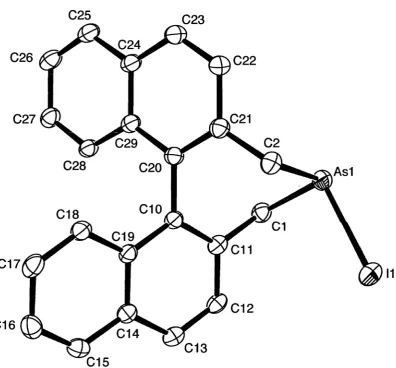
of (aiü)-39 (X = I) from (aR)-53 and triiodoarsine in boiling benzene: (a) (ai?)-53; (b) after 2 h; (c) after 8 h; (d) after 52 h reflux, reaction incomplete; (e) (ai?)-39 (X = I), after an additional 24 h in boiling toluene...59 2.8 ORTEP diagram of (aA)-39 (X = I) with atom labelling (30% el
lipsoid probability shown). Hydrogen atoms have been omitted for clarity...61 2.9 ORTEP diagram of (aR)-39 (X = Cl) with atom labelling (30% el
lipsoid probability shown). Hydrogen atoms have been omitted for clarity...64
3.1 ORTEP diagram of the cation of (aR )-55C 4H80 with selected atoms labelled (30% ellipsoid probability shown). Hydrogen atoms have been omitted for clarity... 68 3.2 ORTEP diagram of the cation of (aA)-55-C4H80 with selected atoms
labelled (30% ellipsoid probability shown). The selected hydrogen atom indicates the direction of the intramolecular aryl-aryl embrace. 71 3.3 Aliphatic regions of the : H NMR spectra of (aR)-58-CH2Cl2 in
CD2C12 at 25 °C (a), -3 0 °C (b), -6 0 °C (c), -9 0 °C (d), and the ^^Hj31 P} NMR spectrum at —90 °C (e)... 73 3.4 ORTEP diagram of the major (a) and the minor (b) conformers of the
cation of (aR)-58 with selected atoms labelled (30% ellipsoid proba bility shown). Hydrogen atoms have been omitted for clarity...76 3.5 Aliphatic regions of : H (a) and ^ { ^ P } (b) NMR spectra of (aA)-58
4.1 Selected region of NMR spectrum (a) and 31P{1H} NMR spectrum (b) of (aR,RP)/(aR,Sp)-59 in CD2C12 at 25 °C... 83 4.2 Aliphatic region of XH NMR spectrum (a) and 31P {1H} NMR spec
trum (b) of (aR,Rp)/(aR,5p)-62 in CD2C12 at 25 °C... 88 4.3 ORTEP diagram of (Rc,Rp)-63 with selected atoms labelled (30%
ellipsoid probability shown). Hydrogen atoms have been omitted for clarity... 90 4.4 31P{1H} NMR spectrum of the unequal mixture of (Rc,Rp)- and
(Rc ,Sp)-63 in CD2C12... 93 4.5 Methylene region of LH NMR spectrum (a) and 31P{1H} NMR spec
trum (b) of (aR,Rp)/(aR,S'p)-72 in CD2C12 at 25 °C. * Impurity. . . 99 4.6 Methylene region of :H NMR spectrum (a) and 31P{1H} NMR spec
trum (b) of (aR,Rp)/(aR,Sp)-73 in CD2C12 at 25 °C. * Impurity. . . 102 4.7 ORTEP diagram of the cation of (aR,Rp)-73-0.5C4H8O with selected
In tr o d u c tio n
1.1
Chirality
The term chirality stems from the Greek word cheir, meaning hand. An object is termed chiral if it is non-superimposable on its mirror image.1 In the absence of an external chiral influence, individual enantiomers (from the Greek enantios
- opposite) display identical physical and chemical properties, the exception being their interaction with plane polarised light, where they display an equal and opposite rotation of the incident beam. The introduction of an external chiral influence leads to distinct differences between the enantiomers of a molecule. An example of this influence is observed in the interaction of the human olfactory receptors with the two enantiomers of limonene; naturally occurring (Ä)-limonene, (R)-1, has the characteristic smell of citrus fruits such as orange and lemon, while the opposite enantiomer (^-limonene has a pine-like smell, similar to other terpenes.
The varied influence of two enantiomers has also been observed in the administra tion of the chiral drug (±)-thalidomide as a racemate. The two enantiomers of this drug interact with the proteins of the target receptor with different physiological efficacies, (S)-thalidomide causing tetratogenic effects on developing fetuses; (R )-thalidomine has a beneficial effect on morning sickness in pregnant women. Thus,
Me
(R )-l
the investigation of the properties of both enantiomers of a chiral chemical is crucial prior to the use of either one in a pharmaceutical application.
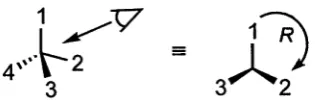
The study of molecules possessing chirality requires the establishment of system atic methods for the description of the enantiomorphic arrangements of atoms. The configuration of a chiral molecule is usually assigned by application of the Cahn- Ingold-Prelog (CIP) sequence rules.2 These rules are commonly applied to organic compounds, where four different groups (ligands) are frequently bound to a tetra hedral carbon stereocentre. The ligands are assigned priorities from one to four (1 > 2 > 3 > 4) in the CIP priority sequence. When the tetrahedral molecule is viewed from the side opposite the ligand of lowest priority (4), the sequential ar rangement of the remaining ligands can be made from the highest priority to the lowest. In Figure 1.1 the sequence 1 > 2 > 3 is clockwise, the molecule is assigned the R (rectus) configuration; the non-superimposable mirror image enantiomer will have an anticlockwise arrangement of these atoms and is assigned the S (sinister) configuration.
Figure 1.1: Assignment of R configuration to a tetrahedral stereocentre.
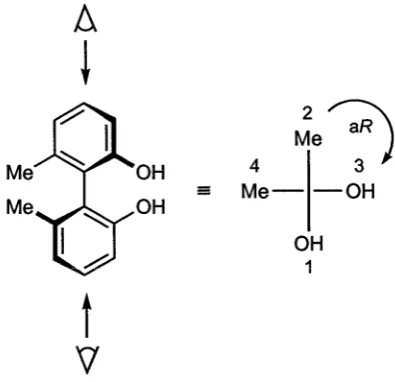
[image:17.521.196.354.593.646.2]the priorities 1 and 2 are given to the nearest pair of substituents; the remote pair is assigned similarly and the chirality descriptor aR or aS is assigned as indicated for the biaryl molecule shown in Figure 1.2.3 Assignment of chiral planes is more difficult because the chirality arises from a plane containing as many atoms of the molecule as possible, with at least one ligand not being within the chiral plane.1.
Figure 1.2: Assignment of aR configuration to chiral biaryl.
1.2
T ertiary p h o sp h in e an d arsin e in version
barriers
[image:18.521.173.371.203.394.2]m any o ptically active arsines can b e d istilled w ith o u t racem isatio n. A clear tre n d
in th e energy b arrie r for p y ram id al inversion of m olecules of th e ty p e (± )-E R,3 is
observed w ithin th e G roup 15 elem ents, w here am ines possess th e lowest b arrier.
T h e increased activ atio n b a rrie rs to p y ram id al inversion for triv alen t derivatives of
th e larger G roup 15 elem ents is b est considered th ro u g h analysis of th e hy b rid ised
o rb itals available. T h e p h o sp h o ru s a to m of a p y ram id al p h o sp h in e possesses four
sp3 h y b rid orb itals, of w hich th re e are engaged in a b o n d s w ith th e s u b stitu e n ts an d th e o th e r contains a lone p a ir of electrons. T h e tra n s itio n s ta te betw een one en an
tio m er an d its n o n -su p erim p o sab le m irro r-im ag e c o u n te rp a rt consists of a trig o n al
p la n a r arran g em en t of th e s u b stitu e n ts , a b o n d ed th ro u g h th re e sp2 (spxpy) h y b rid o rb itals, th e lone p air of electro ns bein g in a pz o rb ita l p erp en d icu lar to th is p lan e (F igure 1.3). T h e b arrie r to inversion can be considered as th e energy difference
betw een th e p yram id al sp3 hy b rid ised ph o sp h in e a n d th e trig o n al p la n a r sp2p hy bridised tra n s itio n s ta te . As th e energy difference for th e te rtia ry arsine [Ar] 4sp3
ground s ta te a n d th e [Ar] 4sp24p tra n s itio n s ta te is larg er th a n th e gap betw een [Ne]
3sp3 an d [Ne] 3sp23p co nfigurations of th e te rtia r y ph o sphine, th e activ atio n energy
increases for th e larger elem ents w ith in th e G roup.
R1
0 r3
Q R2
F ig ure 1.3: P y ra m id a l inversion of a chiral te rtia r y phosphine.
S u p p o rt for a p la n a r in te rm e d ia te in th e racem isatio n of a te rtia ry p ho sph in e
was provided by th e o bserv atio n th a t s u b s titu tio n of th e cyclohexyl s u b stitu e n t in
(± )-cy clo h ex y lm eth y l(n -p ro p y l)p h o sp h in e w ith a p henyl group increased th e r a te of
to occur via conjugation of the phosphorus-centred lone pair of electrons (p orbital) across the delocalised pi system of the phenyl group, as shown in Figure 1.4.
Figure 1.4: Proposed planar transition state for inversion of (±)-methylphenylpropylphosphine.
1.3
P h o s p h in e -sta b ilise d a rsen iu m sa lts
The initial reports of adducts of tertiary phosphines with chloro- and iodoarsines des ignated the reaction products as arsinophosphonium salts,6 the ionic formulation be ing demonstrated by conductometric titration.7 More recent publications have made reference to “stibinostibonium salt” and “trimethylstibine adduct of the dimethyl- stibenium ion” ,8 “phosphinophosphonium salts” ,9 “phosphine-phosphenium coordi nation complexes,” 10 and “phosphine-stabilised arsenium salts” . 11 The two possi ble representations of the core intramolecular interaction in a tertiary phosphine- iodoarsine complex are shown in Figure 1.5.
I
R R
' + / R — P —► As / \
R R
(b) I
Figure 1.5: (a) Arsinophosphonium iodide; (b) phosphine-stabilised arsenium iodide.
Both representations are reasonable, but the chemical properties of known salts support the ligand-stabilised formulation (Figure 1.5(b)). This representation can be considered as a coordination complex, where the phosphine donates a pair of elec trons to the positively charged, two coordinate, six electron arsenium ion (R.2As+).
lone pair of electrons on phosphorus into the vacant p orbital of the sp2 hybridised arsenium centre.
In the initial reports, the compounds [R^PAsRjI were formulated as arsinophos- phonium salts, but the addition of alkoxides to the salts resulted in nucleophilic attack at the arsenic, generating arsinous acid esters (Eq 1.1).7
[Et3PAsMe2]I + NaOMe — ♦ MeAsOMe + P E t3 + Nal (1.1)
This nucleophilic attack at arsenic has recently been used for the synthesis of ter tiary arsines by the addition of carbanionic reagents such as n-butyllithium to a solu tion of an (a-ft)-phosphepine-stabilised methylphenylarsenium hexafluorophosphate, as discussed further in Section 1.6.2.12,13 Crystallographic analysis of the molecular geometry of triphenylphosphine-stabilised methylphenylarsenium hexafluorophos phate, [(Ph3P)AsMePh]PF6, supports the formulation shown in Figure 1.5(b).11 The methyl group, ipso-carbon of the phenyl group, and the lone pair of electrons on the arsenic atom are situated in a trigonal plane. The effect of the lone pair is significant, as the angle between the methyl-carbon atom, arsenic, and ipso-carbon atom of the phenyl group is 101.73(7)°. The triphenylphosphine ligand is coordinated orthogo nal to this plane, with angles of 92.31(8)° for the P-A s-C angle to the methyl group and 97.04(6)° for the P-A s-C angle to the phenyl group. The long P-As distance of 2.3480(5) observed in the complex falls outside the sum of the covalent radii for the two atoms and is consistent with the highly labile nature of the P-As interaction.14 Orthogonal coordination of the phosphine to the arsenium plane has been observed in a number of related complexes, including phosphine-stabilised arsenium ions de rived from 10-chloro-5-hydrophenarsazine15 and tetra(trimethylphosphine-stabilised diphenylstibenium) halide complexes 2 (X = Cl, Br).16
Me M e /.^ M e
Me
M e -P —
►Sbr"--Me Ph' Ph
I Ph Ph Me
X"...—P'—Me
: + x
: Me
Me'" i 'Me Me
3 PF6
2
in CD2CI2 complicates the assignment because the peaks observed at £ +15 and
— 10 ppm for the PPI13 and PPI12 groups, respectively, are similar to those for the
tetraphenylphosphonium ion (Ph4P +) at 6 +20 ppm and tetraphenyldiphosphine
(Pli2PPPh2) at <5 —15 ppm. 9,10 Crystallographic analysis of [(Ph3P)P Ph2]OTf fur
ther supports the view that this compound is a phosphinophosphonium salt because the PPI12 group has a distorted pyramidal geometry, with the P -P -C angles to the
phenyl groups being 100.38(11)° and 100.73(H) 0 . 9 The corresponding arsenium and
stibenium hexafluorophosphates, [(Ph3P)EPh2]PF6 (E = As, Sb), have been pre
pared and a trend is observed where the angles between the phosphorus-arsenic or -antimony bond and the ipso-carbon of the phenyl group decreases from 99.89(6)° and 97.98(6)° in the arsenic compound to 97.61(12)° and 93.70(12)°) in the anti mony compound. 9,17 This trend is also observed in the series of related compounds
[(Me3P)EPh2]PFß (E = As, Sb, Bi) where the orthogonal coordination becomes more
apparent for the heavier elements, the P -E -C angles being 97.33(9)° and 99.60(9)° for As, 90.34(8)° and 100.24(8)° for Sb, 87.030(18)° and 97.51(19)° for Bi. 18 The
G roup 15 is considered to indicate an increasing contribution of the sp2p configura tion on th e geom etry of th e planar E R2 unit.
Although there is crystallographic and solution evidence supporting th e formula
tion of [(R3P )P R 2]X as shown in Figure 1.5(a), th e com pounds undergo rapid phos
phine exchange in solution. 9>10>19>20 This lability of th e P - P bond supports th e formu
lation of the complexes as phosphine-stabilised phosphenium salts. R apid exchange
of the triphenylphosphine is also observed in th e and 31P { 1H} NM R sp ectra of
[(Ph3P)A sM ePh]PF6 a t room tem perature. Cooling of th e solution of th e complex
slows the exchange process, where th e emergence of phosphorus coupling to th e pro
tons of th e As Me group is observed below 8 ° C .n T he lability of th e P -A s bond was further dem onstrated in a crossover experim ent between [(MePh2P)AsM e2]PFg
and [(Ph3P)A sM eP h]PF6; thus, th e mixing together of equim olar CD2C12 solutions
of the two complexes a t 20 °C resulted in an equilibrium m ixture of the startin g
m aterials and th e corresponding crossover complexes [(M ePh2P)AsM ePh]PFg and
[(Ph.3P)A sM e2]P F 6 w ithin th e tim e tak en to prepare th e solution and record th e
spectrum (Eq 1.2).11
[(MePh2P)AsM e2]P F 6 + [(Ph3P)A sM eP h]P F 6
[(M ePh2P )A sM eP h]PF6 + [(Ph3P)AsM e2]P F 6 (1.2)
Phosphine-stabilised arsenium salts are easily prepared by three m ethods. One
convenient m ethod makes use of a two-phase m ixture of a secondary iodoarsine and
a tertiary phosphine in dichlorom ethane and an aqueous solution of am m onium or
potassium hexafluorophosphate. Separation of th e phases, drying of the organic
phase w ith magnesium sulfate, and recrystallisation of th e residue rem aining af
the phosphine-stabilised arsenium hexafluorophosphates.11 Another method makes use of an equimolar solution of a secondary chloroarsine, a tertiary phosphine, and trimethylsilyl trifluoromethanesulfonate in dichloromethane. Removal of the sol vent and the volatile by-product chlorotrimethylsilane in vacuo and recrystallisa tion of the residue from dichloromethane by the addition of diethyl ether furnishes phosphine-stabilised arsenium triflates. 15,21 This method is useful when the products or reagents are moisture sensitive, as is the case for phosphine-stabilised phosphe- nium and arsine-stabilised arsenium salts. A third method involves the addition of excess thallium(I) hexafluorophosphate to a dichloromethane solution of secondary halo-arsine, -stibine, or -bismuthine and tertiary phosphine; the thallium(I) halide precipitates and the complex can be isolated as the hexafluorophosphate after the thallium salts have been filtered off. This is an effective route to the complexes [(Ph3P)E Ph2]PF6 (E = As, Sb or Bi) and [(Ph3P)2EPh2]PF6 (E = Sb or Bi).17 The common thread of the three methods is the abstraction of a halide in the pres ence of a tertiary phosphine and non-nucleophilic counterion to generate the desired complex (Scheme 1.1).
Scheme 1.1: Methods for the synthesis of phosphine-stabilised arsenium, stibenium, and bismuthenium salts
KPF6ih2o
R3P + AsR2I ---► [(R3P)AsR2]PF6 + Kl CH2CI2
Me3SiOTf
R3P + AsR2CI ---► [(R3P)AsR2]OTf + Me3SiCI CH2CI2
tipf6
R3P + ER2X --- ► [(R3P)ER2]PF6 + TIX CH2CI2
1.4
N a k ed a rsen iu m ion s
Arsenium ions are positively charged, six-electron species in which arsenic(III) is surrounded by two substituents and a lone pair of electrons. Thus, arsenium ions are main group analogues of carbenes, and, based on valence-shell electron-pair repulsion (VSEPR) theory, have distorted trigonal planar geometries. Arsenium ions were first observed in the mass spectra of five-membered heterocyclic arsines where the majority of the compounds investigated readily lost their extra-cyclic substituent, generating the corresponding heterocyclic arsenium ion, generally as the base peak (Scheme 1.2).22
Scheme 1.2: Arsenium ions generated by mass spectrometry
c
XNAs — R ✓
Y
R X Y Relative Intensity
Arsenium Ion (%)
Ph
s
S 32Ph 0 0 2
Ph 0
s
50Me2N
s
s
32Me2N 0 0 100
Me2N 0
s
62Me2N NMe 0 100
E t2N S
s
17E t2N 0 0 100
E t2N 0
s
100Et
s
s
100Et 0 0 100
Et 0
s
100Et NMe 0 100
and iodomethylphenylarsine indicated the formation of the methylphenylarsenium ion.23
The attem pted synthesis of naked arsenium ion salts has focused on the stabil isation of the electron deficient arsenium centre by chelation with electronegative elements. Thus, chloride abstraction from a secondary chloroarsine with EC13 (E = Al, Ga, or In) facilitated the synthesis of the four membered arsenium salt 3 .24,25
f-Bu
y N
Me2Si 'As+ ECI4
V
f-Bu
3
The bicyclic salt 4 has been prepared by chloride abstraction from the parent chloroarsine with aluminium (I II) chloride.26,27 Crystallographic data for the salt indicate that the charge on the arsenium ion is delocalised across the conjugated organic framework. The crystallographic analysis revealed the planarity of the core hetereocycle within a mean of 0.0020 Ä. The As-N and As-S bonds in the cation were the shortest known for an arsenic(III) system at the time, and it was suggested that there could be double bond character in these bonds because of aromatisation involving a number of resonance structures. Following the isolation of this arsenium salt, other salts were subsequently isolated, viz. 5, 6 (Y, Z = NMe, NEt, or S and X = AlCty, GaCty, or OTf ) and the acyclic compounds 7 (R = Me, Et, i-Pr, Z = NEt2, Cl and X* = AlCty, O T r ) . 28"31
cv
x-4 5 6 7
Donation of electron density from the heteroatom lone pairs to the arsenium ion in each case is a possible mechanism for the stabilisation of these species. Scheme 1.3 shows some plausible resonance structures for the acyclic species 7 where R = Et and Z = NEt2.
r ~ \ r2n
/ As+ X As+ X“
Z
Scheme 1.3: Resonance stabilisation of an arsenium ion
Et2N*0 E,2ND Et2N ’
As --- ► As --- ► As
Et2NR Et2N Et2N^
1.5
P r e p a r a tio n o f o p tic a lly a c tiv e p h o sp h in es
an d a rsin es
The separation of the enantiomers of a racemate is traditionally achieved by resolu tion. The separation of a racemate with use of a configurationally stable resolving agent is feasible where there is a sufficient difference in solubility (or retention times on a chromatographic column) between two diastereomers. Removal of the resolving agent from a pure diastereomer provides the resolved enantiomer of the racemate in a maximum yield of 50%. The resolutions of chiral phosphines and arsines have been thoroughly reviewed, but some historically significant examples are presented
below.32-36
1 .5 .1 R e s o lu t io n v ia sa lt fo r m a tio n
ring system rather than the presence of a configurationally stable arsenic stereocen tre because of the inability of leading workers in the field at that time to resolve non-cyclic tertiary arsines.36
o As
5 A
Me
HOoC
Although crystalline (—)-strychninium and (—)-quininium salts were prepared from these non-cyclic arsine carboxylates, the rotations for the separated diastere- omers were similar in each case. The work up of the salts, however, involved the use of chloroform which is now known to racemise chiral arsines if it contains a trace of hydrogen chloride. The mechanism of this process will be discussed in Section 1.8.39 Regrettably, much of the work concerning the decomposition of diastereomeric ammonium salts of arsine-carboxylates involved the use of dilute aq. hydrochloric acid. The resolution of the first non-cyclic triarylarsine, (±)-9, was achieved by the fractional crystallisation of the diastereomeric salts derived from (±)-phenyl- (3-carboxyphenyl)-4-biphenylylarsine and (—)-a-phenylethylamine, which resulted in the isolation of the (+) enantiomer of the tertiary arsine.40 It should be noted that the less-soluble diastereomeric salt of (+)-9 was decomposed with dilute sul furic acid. There are available comprehensive reviews concerning the resolution of tertiary arsines.36,41
The first tertiary phosphine oxide to be resolved, (±)-ethylmethylphenylphosphine oxide, was achieved by the fractional crystalli sation of the diastereomers arising from the protonation of the oxide with d-bromocamphorsulfonic acid.42 The first isolation of optically active tertiary phosphines was achieved by the cathodic reduction of resolved phosphonium salts.43 The electrolytic reduction resulted in cleavage of the functional group most stable as an anion, usually the benzyl group, with retention of configuration at phosphorus (Scheme 1.4). This electrochemical method was also applicable to the reduction of optically active benzylarsonium salts.44,45
Scheme 1.4: Electrolytic reduction of a phosphonium salt with retention of config uration at phosphorus
1 .5 .2 R e s o lu tio n b y m e ta l c o m p le x fo r m a tio n
The separation of the neutral diastereomers of dichloroplatinum complexes con taining (+)-deoxyephedrine and (±)-(£-butyl)methylphenylphosphine was achieved by fractional crystallisation, although the phosphine was not liberated from the m etal.46 The resolution and isolation of the individual enantiomers of (±)- ethylmethylphenylarsine was achieved by fractional crystallisation of the salts 10.45 This method was put forward as a general procedure for the resolution of tertiary arsines.
generat-AsEtMePh
ing monopalladium diastereomers that can be separated by fractional crystallisa tion. The addition of chelating ligands such as l,2-bis(diphenylphosphino)ethane or 1,2-diaminoethane displaces the resolved phosphine or arsine with retention of configuration at the donor stereocentre (Scheme 1.5).
Me2 Me2 Me2 Me2
Scheme 1.5: Resolution and recovery of chiral tertiary phosphines
Resolutions of chiral tertiary arsines and phosphines with the enantiomerically pure palladium(II) dimer (Rc,Rq)-12 have been remarkably successful;41 bidentate and multidentate ligands can also be resolved with this reagent, for example, (±)-13 (E = P, As) has been resolved and (Ras;^As)-14 has been obtained by asymmetric
synthesis from the meso macrocycle ( Ra s* , Sa.s* ) - 1 4 and (R c,R c)~1 2 .48,49
The cheaper A, A-dimethyl-a-methylbenzylamine-derived reagent (Rc,Rc)-II is often employed for the resolution of chiral phosphines and arsines because of the high cost of the naphthalenyl reagent. The use of the naphthalenyl complex, however, can be necessary when there are special structural constraints within the diastereomers containing the chiral ligand and the resolving agent. This has been demonstrated by the resolution of the atropisomers of QUINAP, ( ± ) -15. The resolution of this
ligand was undertaken by complexation with (5c,Sc)-12 and fractional crystalli sation of the diastereomers: the (a5,Ac) diastereomer crystallised from chloroform and the (&R,Rc) diastereomer crystallised from 2-butanone upon the addition of diethyl ether.50 In an earlier publication it was stated that use of (5 c ,i? c )-ll in the resolution of (±)-15 resulted in formation of a mixture of diastereomeric complexes, as observed by NMR spectroscopy, but that no separation could be obtained by fractional crystallisation. It was later found that the diastereomers derived from
PPh2
(a$)-15
1.6
S y n th e sis o f chiral te r tia r y p h o sp h in es and
arsin es
1 .6 .1 S y n th e sis o f ch iral te r tia r y p h o sp h in e s
Chiral tertiary phosphines (and to a lesser extent chiral arsines) play an important role in asymmetric synthesis. The field has been dominated by ligands possessing a stereogenic backbone, such as in BINAP, DIOP, Chiraphos and Duphos.52 Far less attention has been applied to the use of P-chiral phosphines (and As-chiral arsines) in asymmetric synthesis although there are examples of syntheses where ligands of this type have out-performed those with stereogenic backbones.53
(Pc,Pc)-DIOP (Pc, R c)-'Chiraphos
(aP)-BINAP (Rc,Rc,Hc,Rc)-Duphos
Scheme 1.6: Synthesis of (.ftp,.Rp)-DIPAMP 0 0 / x o-AnMgBr 11 p ^ o-An”/ \
{ OMen Ph Me
(lfic,2Sb,5Äc,fip)-16 (5p)-17
1. LDA 2. CuCI2
HSiCk 0 0
P« Rp _ ____L
o-An'y \ / V Ph o-A n " /'\p s
c 11 J \ - P h
Ph o-An Ph ^ o-An
(fip,iJP)-DIPAMP (5p,5p)-18
1 .6 .2 A s y m m e tr ic s y n th e s is o f te r tia r y a rsin e s
Recent work within our group has focussed on the asymmetric synthesis of enantiomerically enriched tertiary arsines from phosphine-stabilised arsenium salts containing (aR)-4-[2-(methoxymet hyl)phenyl]-4,5-dihydro-3//-dinaphtho[2,1- cjl'^'-ejphosphepine, (aR)-19.12,13,56 Initial investigations dealt with the (a R)-19-stabilised methylphenylarsenium hexafluorophosphate, (a/2,ÄAs)/(aR,5as)-20, which was synthesised by the two-phase method described in Section 1.3.
(aR)-19
- As - - .
(ai?,i?As)/(aR,5As)-20
of diastereomers to —90 °C increases the diastereomeric excess to 88%. Addition of n-butyllithium to a dichloromethane solution of the equilibrating mixture of di astereomers at —80 °C gave (S)-(n-butyl)methylphenylarsine in 77% ee, as deter mined from the NMR spectrum of the diastereomers formed by bridge splitting of the palladium complex (5c,£c)-12 with the enantiomerically enriched tertiary arsine.12,13 The influence of the phosphine on the approach of the n-butyl ion to the prochiral arsenium ion is shown in Scheme 1.7.
Scheme 1.7: Attack of a prochiral phosphine-stabilised arsenium by the 7>butyl ion
• As
As
n-Bu
- P R3 - P R3
r \ -I— As — Me
n- Bu
s n-Bu
;_ A s / -.ph
Me
trifluoromethanesul-fonate in dichlorom ethane, followed by removal of chlorotrim ethylsilane and the
solvent gave a m ixture of (aJ?,J?As^As,a-ß)/(aJß,S,AS,5'As,a/?)/(aß,i?As,‘5,As1a JR)-23
(Scheme 1.8). Analysis of this equilibrating m ixture of diastereom ers by 31 P j 1 H}
N M R spectroscopy a t low tem p eratu re revealed three overlapping sets of resonances
for th e th ree possible diastereomers.
Scheme 1.8: Synthesis of a bis(phosphepine-stabilised)diarsenium triflate
2 (aA )-19 + ciPhAs^ ^AsPhCI
22
2 Me3SiOTf CH2CI2 - 2 Me3SiCI
R,S ▼+
. A s '
(OTf")2
(a/?,-RAs■>RA sR')/ / (Q’R-iRasi^Asi&'R) 23
T he reaction of the m ixture w ith n-butyllithium a t —78 °C produced
(Ras*,Sas*)/ (Ras,Ras)/ (Sas,Sas)-2I- C om plexation of these stereoisomers w ith the enantiom erically pure platinum (II) ditriflate (i?p,Ä p)-24 gave complexes th a t could
enan-tiomeric excesses of 21 (Scheme 1.9). Spectroscopic analysis of th e p latin u m -
diarsine complexes gave (RAsÄ s,Rp,Rp) /( SasÄ s, #p, #p)/(# As,#As,#p,#p)-25 =
2 9 /9 /6 2 , which corresponded to a de of 42% for th e (RAs*,i?As* )-(± ) diastereom er
of the diarsine, which in tu rn was composed of 87% of th e (SasA s) enantiom er and
13% of th e (Ras,Ras) enantiom er.56
Scheme 1.9: Asym m etric synthesis of a chiral diarsine [(aR )-PR3 = (aR)-19]
(af?)-PR3
+ +,Ph Ph' ^ ^ „ A sR I (OTf )2
(af?)-PR3 (aR, Ras , -^As, ai?)-2 3
(af?)-PR3
CH2C|2 «A+ <aRbPR3 ph"
Kn S ? s (OTf-)2 Ph
(a/ü, Sasi R \s •> &R)-23
c h2ci2
Ph
(aR)-PR3
(af?)-PR3
i
s I (OTD2 Ph
(aR,5As,5As,a.R)-23
n-Bu
1. 2 n-BuLi / CH2CI2, -7 8 °C 2. 2 BH3 SMe2
'A s' + 2 (af?)-PR3 BH3 Bu
Ph r?-Bu Me, r * vPh
: P. 0 As* 17 r\ 2 +x S N
Ph Me, r
R \ .0Tf Pt
OTf Ph'" V
Me
(R p,R p)-24
Ph Ph
Me, r i n-Bu Me,, r Me, r Ph Ph * .,n-Bui
U V V J ,O
PTr" * U v \ J ,O
Tr”* CC . / J IO
T
rfe
Ph"* ' 'n-Bu Me Ph
,'PV As7 Ph" VK/I ^ ' n-Bu
Me ph
p As;
Ph \ . * 'Ph
Me n-Bu
1.7
A s y m m e tr ic tra n sfo r m a tio n
Resolutions typically involve the separation of enantiomers that are not capable of interconversion. Asymmetric transformation refers to a process whereby a mixture of enantiomers or diastereomers (generally 50/50) in solution is transformed into a single stereoisomer (or stereoisomer enriched mixture) by the influence of an external chiral reagent on an equilibrium process.1 Thus, the neutralisation of the configu rationally stable acid (± )-X by the enantiomerically pure base (+)-Y will result in the diastereomeric salts (+ )-X -(+ )-Y and (—)-X -(+)-Y . Separation of the 50/50 mixture of salts by fractional crystallisation amounts to a chemical resolution, where the maximum yield of each diastereomer is 50%. Where the component (±)-X is configurationally labile, however, the two diastereomers will be in equilibrium. If the equilibrium constant K ^ 1, enrichment in one diastereomer has occurred by asymmetric transformation. The first use of the term asymmetric transformation was in relation to the addition of the organic base (—)-brucine to a solution of (±)-2-
the ‘Pfeiffer effect’, owing to the initial observation of the influence of optically active
anions on the proportions of the enantiomers of labile (±)-[Zn(phen)3] 2+ (phen =
1,10-phenanthroline) in water.59 The concepts of resolution and asymmetric trans
formation are summarised in Scheme 1.10.60,61
Scheme 1.10: Overview of asymmetric transformations
(±)-X + (+)-Y
50% 50%
dissolution
separation
(+)_X-(+)-Y + R -X -(+ )-Y --- ► (+)-X-(+)-Y + (-)-X-(+)-Y
50% 50% 50% 50%
equilibrium
asymmetric transformation of the first kind
classical resolution
(+)_X-(+)-Y — ..
(50 + x)%
H -x-(+ )-y
(50 - x)%
fast precipitation
(+)-X-(+)-Y + (-)-X-(+)-Y
(50 + x)% (50 - x)%
slow precipitation
(+)-X-(+)-Y
100%
asymmetric transformation of the second kind
1 .7 .1 E x a m p le s o f a s y m m e tr ic tr a n sfo r m a tio n
a trace of hydrochloric acid and sodium iodide after seeding of the solution with crystals of the (R \s* ,R \s*)-(±) diastereomer (Scheme 1.11).62
Scheme 1.11: Asymmetric transformation of the second kind
Nal, aq. HCI
methanol
(i?As*As*)-26 (i?As*,i?As*)-(±)-26
Two interesting examples of asymmetric transformations have been observed in the synthesis of the AS2S2 macrocycle 27. The dissolution of (R \s* ,R \s*)-(±)-27 in
chloroform to which a trace of aq. hydrochloric acid had been added furnishes spar ingly soluble (£as* A s*)-27 in quantitative yield by an asymmetric transformation
of the second kind (Scheme 1.12).63 The meso diastereomer (Äas*,5'as*)-27, how ever, when complexed to palladium(II) and heated in DMSO at 150 °C furnishes
(J?as*,-^as*)-(±)-27 in quantitative yield in an asymmetric transformation of the first kind (Scheme 1.13).
Scheme 1.12: Asymmetric transformation of the second kind of (i?As*,-^As*)-(i)-27 into (i?As*,SAs*)-27
Scheme 1.13: Asymmetric transformation of the first kind of [P d ^ A s * ,^ * )- 27](C104)2 into [Pd(PAs^ As*)-27](C104)2
150 °C
DMSO
(CI04 )2 (CI04 )2
[Pd(PAs*,5As*)-27](C104)2 [Pd(PAs,P As)-27](C104)2 [Pd(PAs,SAs)-27](C104)2
Scheme 1.14: Asymmetric transformation of the second kind of (lRc,2Sc,5Rc,Rp)-28 into (l/fc,2 5 b ,5 /fc,S > )-2 8
(li?C)2S'c,5i?c,-ßp)-28 (li?c,2S'c,5i?c,iS'p)-28
The asymmetric transformation of tertiary phosphines has also been demon strated for (i?p/S,p)-9-fluorenyl[(li?c;2<S,c,5i?c)inenthyl]phenylphosphine (29), where a 20/1 mixture of (li?c?25c,5i?c,-S'p)/(l-ßc,2S'c,51?c,i?p)-29 was obtained by recrystallisation of a 3/1 mixture in acetonitrile containing 4 mol % iodine (Scheme 1.15).66
Scheme 1.15: Asymmetric transformation of the second kind of (lRc,2Sci5Rc,Rp)~ 29 into (ltfc ,2Sc ,5#c,Sp)-29
(lÄ c,2 5 c,5 Ä c,Ä P)-29 (lÄ c ,2 5 c ,5Ä c,5p)-29
The fluorophosphine (±)-30 (X = F) combines with (Rc,Rc)~I^ in a similar manner to give (Rc,Rp)/(Rc,Sp)-31 (X = F) (Scheme 1.16). Observation of the mixture by 31P {1H} spectroscopy indicated the presence of the two diastereomers in almost equal amounts; upon standing of the solution for 18 h, however, the proportion of one diastereomer increased to 75%. Isolation of the crystalline solid by the addition of diethyl ether to the solution gave the major diastereomer (Rc,Rp)-31 (X = F) in 64% yield by an asymmetric transformation of the second kind.68
Scheme 1.16: Asymmetric transformation of the second kind of coordinated ((±)-30 (where X = F or Cl)
(Äc,Äc)-12
+ 2 (±)-PXPh-/Pr
(± )-3 0
Me2
Mö2
con-figuration at cobalt(III) is stable under these conditions. This procedure was further explored by reactions of a variety of tetraamine-cobalt(III) complexes with a range of amino acids, where diastereomeric ratios of up to 91/9 were observed.70 72 The asymmetric transformations of the first kind were monitored by CD and NMR spec troscopy. 72
The configurations of metal complexes can also been influenced by external com ponents, such as chiral anions and other chiral additives. An interesting asymmetric transformation of the first kind was observed for the addition of (±)-[Fe(bipy)3]2+
Scheme 1.17: Asymmetric transformation of the first kind of a boronic acid-functionalised l,10-phenanthroline-copper(I) complex
Many successful asymmetric transformations have been effected with use of the enantiomers of the (±)-£ns(tetrachlorobenzenediolato)phosphate(V) ion (TRISPHAT), including axially chiral ammonium and diammonium salts,76-78 supramolecular systems,79,80 helicates,81 metallospiranes,82,83 and three-bladed pro peller complexes.84"86 The subject has recently been reviewed.87
Cl
Cl
(A)-TRISPHAT
An asymmetric transformation of the second kind has been demonstrated in our group for a double-stranded, dicopper(I) helicate containing achiral bis(bidentate) Schiff base ligands (Scheme 1.18).88 The diastereomer [{Rcu,Rcu)~
Scheme 1.18: Asymmetric transformation of the second kind for a double-stranded, dicopper (I) helicate
1.8
C h em ica l r a c em isa tio n o f chiral te r tia r y p h o s
p h in es and arsin es
As described in Section 1.2, chiral tertiary phosphines and arsines racemise by uni- molecular pyramidal inversion at elevated temperatures. There are also a number of chemical conditions under which tertiary phosphines and arsines racemise.
1.8.1 R a c e m is a tio n o f te r tia r y a r sin e s b y h a lo a c id s
Tertiary phosphines are strong bases and form stable salts with strong acids. For ex ample (J?p*,Äp*)-l,2-phenylenebis(methylphenylphosphine) ((Äp*,Äp*)-(±)-33) is protonated stereospecincaliy by dilute aqueous tetrafluoroboric acid with retention of configuration at phosphorus; the mono-protonated phosphonium salt is stable to racemisation, as indicated by recovery of the free (Rp* ,Rp*)-(±)-33 by neutrali sation. Indeed, optically pure (Rp,Rp)-33 can be recovered unchanged after three weeks in concentrated hydrochloric acid.89,90
(Rp*,RP*)-33
Scheme 1.19: Racemisation of tertiary arsines by haloacids
• •
HX
H
r3
R1- A s ; R - HX R 3 . A 5 j ^ R2
X R2
1 .8 .2 R a c e m is a tio n o f te r tia r y p h o s p h in e s b y io d o a r sin e s
The asymmetric synthesis of tertiary arsines has been achieved with use of the phosphepine ligand (aR)-19, as outlined in Section 1.6.2. The racemic phosphine- stabilised arsenium salt (Ras*^Rp*)-(E)-34 was prepared to determine the suitability of the ligand for the asymmetric synthesis of tertiary' arsines.12 It was hoped that the enantiomerically pure form of the phosphine would coordinate selectively to one face of the prochiral arsenium cation; subsequent addition of n-butyllithium to the equilibrating mixture of diastereomers of the complex, one diastereomer being in excess, would produce an enantioselectively enriched tertiary arsine by a novel method of asymmetric synthesis.
(RAs*,RP*)-34
In this earlier work, the racemic phosphine (±)-35 and (±)-
phosphine-stabilised arsenium hexafluorophosphate described above was repeated with the optically pure (+)-35, (±)-iodomethylphenylarsine, and aqueous ammo nium hexafluorophosphate. Disappointingly (at the time), the optical activity of the resolved phosphine was lost during the synthesis and workup.12 The racemisation of the phosphine by the iodoarsine was considered to proceed via a five-coordinate intermediate (Scheme 1.20). Psuedorotation of the five coordinate intermediate will result in rapid racemisation of the phosphine by the mechanism proposed for the racemisation of tertiary arsines in the presence of haloacids.
Scheme 1.20: Racemisation of (+)-35 by (±)-iodomethylphenylarsine Me.
p h ; /\s
OMe
o
1 Me. As
Ph"
OMe
<
Me.
\ s OMe
o
+ / — \ P h ' - n / = \ ~ ~ R r / \
P h " j
Me
\\ //
Me*' |\ J
M e' j Ph I
The confirmation of the racemisation of the phosphine by the secondary iodoar sine was made by the addition of a trace of (±)-iodomethylphenylarsine to a dichloromethane solution of (i?.p*,Rp*)-(±)-33.12 EpimerisatioM of (i?p*,Rp*)-(±)- 33 into an equimolar mixture of (Rp*,Rp*)-(±)/(Rp*,5p*)-(±)-33 was observed by NMR spectroscopy to be complete within the time taken to prepare the solutions and record the NMR spectrum. The experiment was repeated with (±)-chloromethylphenylarsine as the possible racemising agent; no racemisation of (Rp*,Rp*)-(±)-33 was observed. I reinvestigated this work by treating a solution of (Rp*,Rp*)-(±)-33 in CD2C12 with 0.2 equiv (±)-iodomethylphenylarsine. The epimerisation occurred, but at a considerably slower rate than originally reported. The addition of 1 equiv of (±)-iodomethylphenylarsine to a CD2C12 solution of (Rp*,Rp*)-(±)-33 resulted in complete epimerisation at phosphorus into the 1/1
(a)
(b)
1.65 1.6 1.55 1.5 1.45 1.4
ppm
(c)
[image:53.521.125.428.119.637.2]1.9
O b je c tiv e s o f cu rren t w ork
Chiral H aloarsines
2.1
In tro d u c tio n
Arsenium ions, AsRj, can be generated from tertiary arsines and secondary haloarsines by ionisation in a mass spectrometer,22,23 can be isolated as ligand- stabilised species by reactions of secondary iodoarsines in the presence of aqueous hexafluorophosphates, or by the addition of trimethylsilyl triflate or thallium(I) salts to a chloroarsine.11,21 The primary aim of this project was the synthesis of an enantiomerically pure haloarsine that could be used for the possible asymmet ric transformation of racemic, P-chiral tertiary phosphines into an enantiomerically enriched tertiary phosphine, as indicated in Figure 2.1 for an arsenium ion of R configuration.
Figure 2.1: Deracemisation of a chiral tertiary phosphine in the environment of an enantiomerically pure arsenium host of R configuration.
A suitable chiral haloarsine was therefore required for the synthesis of appropri ate phosphine-stabilised arsenium salts. Halo-arsines and -phosphines of the type (±)-ERR'X are configurationally labile because of rapid intermolecular halogen ex change (Figure 2.2).68,92 A number of mechanisms have been proposed for degenerate halide exchange in chloroarsines and chlorophosphines, with kinetic investigations indicating bimolecular exchange as the most likely mechanism.93
D R
R R \
R " As1---- CIB > 1- f
CIA As2r CIa- A s2
R v R
R
Figure 2.2: Degenerate bimolecular halide exchange between chloroarsines.
The two-phase method used for the preparation of phosphine-stabilised arse nium salts from iodoarsines and tertiary phosphines in dichloromethane in the presence of aqueous potassium hexafluorophosphate requires stability of the result ing phosphine-stabilised arsenium salt to aqueous hydrolysis; the hydrolysis of a ligand-stabilised arsenium salt was observed in the attempted two-phase synthesis of triphenylarsine-stabilised methylphenylarsenium hexafluorophosphate.21
2.2
D e sig n o f a chiral h o st
Arsenium ions of C2 symmetry were considered attractive possibilities for this in
vestigation because of the degeneracy of the axial sites to coordination above and below the angular AsC2 plane of the arsenium ion. Initial investigations were di
[image:56.521.171.369.234.318.2](Äc,Äc)-36
Me Me
(aÄ)-37
The resolutions of the two parent bis(primary diamines) required for the syn theses of the above compounds are described in the literature.94,95 Mesitylation of each bis(primary amine) was achieved by condensation with two equiv of mesityl aldehyde. Reductions of the resulting Schiff bases with NaBH4 or LiAlH4 fur nished the desired bis(secondary diamines). The synthesis of (aR)-A,A?1-bis(2,4,6- trimethylbenzylidene)-6,6'-dimethyl-l,l,-biphenyl-2,2'-diamine, (aR)-38, is shown in Scheme 2.1.
Scheme 2.1: Synthesis of (aR)-38
MeMe CHO
MeOH
Me Me
UAIH4i THF
Me Me
Arsenium ions derived from haloarsines containing the 2,2'-bis(methylene)-l,l'- binaphthyl group will be configurationally stable because rotation about the 1,1'- bond of the binaphthyl group is prevented by steric hindrance between the methylene groups in the 2,2' positions and the hydrogen atoms in the 9and 9' positions. The ab
straction of a halide ion from (ai?)-39 (X = Cl, I) will generate (ai?)-40 (Scheme 2.2). The axial chirality of (ai?)-40 under normal experimental conditions will be assured because hindered rotation about the C-C bond of the 1,1'-binaphthyl group will lock the seven-membered arsepine ring into a chiral twist-boat conformation. This ring can only be inverted by racemisation of the 1,1'-binaphthyl framework. Fig ure 2.3 shows a representation of the twist-boat conformation of (ai?)-40 when the molecule is viewed down the C<i axis. Locking of the conformation of the arsepine- nium ring by steric resistance ensures that no additional conformers are present for (aiü)-39 (X = I) or (ai?)-40 in solution or in the solid state. Intermolecular halide exchange or pyramidal inversion at arsenic in (ai?)-39 (X = Cl, I) does not result in racemisation because of the C2 symmetry of the rigid 2,2'-bis(methylene)-
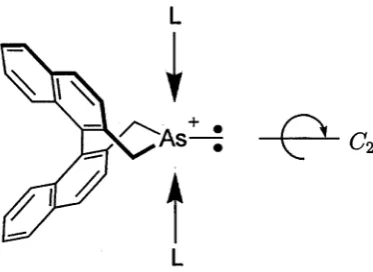
1,1'-binaphthyl framework. The coordination of a phosphine (L) to either face of (aÄ)-40 is degenerate because of its C2 symmetry, but lowers the symmetry of the
resulting phosphine-stabilised arsenium complex to C\ (Figure 2.4).
Scheme 2.2: Formation of (ai?)-40 from (aJ?)-39 (X = Cl, I)
(aÄ)-39 (X = Cl, I) (aÄ)-40
Figure 2.3: Twist-boat conformation of the seven-membered arsepine ring in (a R)-40.
[image:60.521.218.325.152.297.2] [image:60.521.187.374.482.618.2]reactions of phosphine-stabilised arsenium salts. These include attack at arsenic by strong nucleophilic reagents such as n-butyllithium and alkali metal alkoxides.11 The framework in (ai?)-40 is also attractive because of the success of the related phosphepine (&R)-19 in the asymmetric synthesis of enantiomerically enriched ter tiary arsines by the addition of n-butyllithium to appropriate phosphine-stabilised arsenium salts, as discussed in Section 1.6.2.
2.3
P h o sp h e p in e sy n th e sis
Axially dissymmetric phosphepines possessing the 2,2'-bis(methylene)-l,l'- binaphthyl framework have been employed for a number of asymmetric synthe ses, such as the asymmetric hydrogenation of methyl a-acetamidocinnamate with dihydrogen in the presence of [Rh(COD)2]BF4.96 The substrate in this reaction was reduced quantitatively in up to 96% enantiomeric excess (ee). The synthe sis of the phosphepine (±)-41 was achieved by metallation of (±)-2,2'-dimethyl-
ljl'-binaphthyl, (±)-42, with n-butyllithium/potassium i-butoxide/TMEDA in n- hexane, which gave (±)-43; addition of dichlorophenylphosphine to the dilithium complex (±)-43 gave the crude phosphepine (±)-41 (Scheme 2.3). The pure phosphepine was isolated in 30% yield by flash chromatography of the crude mate rial.97
Scheme 2.3: Synthesis of (± )-41
The resolution of (±)-41 was achieved by complexation with the enantiomerically pure palladium complex (Rc,^c)-12; the diastereomer (a5,#c)-44 was the least soluble of the two formed and was isolated in 47% yield by recrystallisation of the 1/1 mixture from dichloromethane/n-hexane (Scheme 2.4).
Scheme 2.4: Synthesis and resolution of (a5)-41
(Äc,Äc)-12 (±)-41
Me2
M©2
The preparation of the enantiomerically pure precursors (aR)-42 and (a5)-42 be gan with the coupling of l-bromo-2-methylnaphthalene to give the racemate (±)-42
(Scheme 2.5). The resolution of (±)-42 was accomplished by cyclisation of the cor responding bis(bromomethyl) derivative (±)-45 with (—)-ephedrine and fractional crystallisation of the diastereomeric azepinium bromides (±)-46 from ethanol. Re ductions of the individual diastereomers (±)-46 with LiAlH4 in the presence of an hydrous nickel(II) chloride as catalyst gave the resolved atropisomers of (± )-42.98
Scheme 2.5: Synthesis and resolution of (±)-42
Me Ph
y_R^
MeHN OH CgHe/MeCN
more soluble
less soluble
( a i ? , S c ^ c ) 4 6
UAIH4 (NiCI2) THF
U A I H 4
(NiCI2) THF
(a5,5c i?c)46 (96%)
CO-
aR ICGr"
(afl)-42
of BINOL, (aR)- and (a£)-47.99 The preparation of the enantiomers of (±)-42 from the enantiomers of BINOL is readily accomplished, as shown in Scheme 2.6. Thus, the diester (ai?)-48, which was prepared and isolated in 99% yield as a crystalline solid, was treated with an excess of methylmagnesium bromide in the presence of the transfer catalyst [Ni(dppp)Cl2] to give (ai?)-42 in a similarly high yield.
Scheme 2.6: Synthesis of (aiü)-42 from (ai?)-47
(aiü)-47
The metallation of (a#)-42 with n-butyllithium in the presence of TMEDA in diethyl ether gives (ai?)-43 as dark red crystals.13,100 Subsequent reactions of sparingly soluble (ai?)-43 suspended in n-hexane with a secondary dihalophos- phine or dihaloarsine furnishes phosphepines and arsepines in modest yields (Scheme
9 7\ 96,97,101
Scheme 2.7: Synthesis of (ai?)-41
pre-cursor to a number of enantiomerically pure tertiary phosphepines by reactions with Grignard reagents.96,102-105 The synthesis of (ai?)-49 has been achieved directly by the reaction of (ai?)-43 with trichlorophosphine,102 and by treatment with (diethy- lamino)dichlorophosphine followed by removal of the amino group from (ai?)-50 with anhydrous hydrogen chloride (Scheme 2.8).96,103-105 It was envisaged that the synthesis of (ai?)-39 (X = Cl, I) could be accomplished by similar routes to those used for the phosphepine analogues.
Scheme 2.8: Synthesis of (a#)-49 from (ai?)-43
cyclohexane
P — Cl
n- hexane
2.4
S y n th e sis o f ( a fi)-3 9 (X = I)
2.4.1
D irect addition o f haloarsines to (ai?)-43
hy-drogen chloride, also appeared promising by El mass spectrometry and NMR spectroscopy, but the pure product could not be isolated from the reaction mixture.
2.4.2
H y d rio d ic acid
A model system for a synthesis of (aR)-39 (X = I) has been demonstrated by the synthesis of 2-iodoisoarsindoline (51) in quantitative yield by the reaction of either 2-phenylisoarsindoline 52 (R = H) or 2-(p-methoxyphenyl)isoarsindoline 52 (R = OMe) with boiling hydriodic acid (57%, constant boiling azeotrope) (Scheme 2.9).106 No further cleavage of the arsenic-carbon bonds by the hydriodic acid was observed in either reaction.
Scheme 2.9: Aryl-arsenic bond cleavage by HI
An examination of the reactivity of anisyl-functionalised tertiary arsines has been undertaken where tris(p-anisyl)arsine was heated with aqueous hydriodic acid, which resulted in complete cleavage of all three As-C bonds in the tertiary arsine with formation of triiodoarsine and 3 equiv of anisole.107 Anhydrous hydriodic acid has also been used for the conversion of arylarsines into iodoarsines in good yields. 108,109 It was envisaged that a reaction similar to the one used for the successful synthesis of 2-iodoisoarsindoline could be used for the synthesis of the iodoarsepine (aR)-39
(X = I), as indicated in Scheme 2.10.
Scheme 2.10: Aryl-arsenic bond cleavage by HI
A s — Ar + ArH
(aiü)-39 (X - I)
undergoes Wittig-type reactions with 4-substituted cyclohexanones to give enan- tiomerically enriched olefins (Scheme 2.11).101
Scheme 2.11: Synthesis of the arsonium bromide (a5)-54 from (aS)-53
The structure of the arsonium salt (a.5)-54 was confirmed by an X-ray crystal structure determination, but the details for the synthesis and characterisation of (aS)-53 were not given. To examine the potential use of (aiü)-53 for the synthesis of (ai?)-39 (X = I) by treatment with aqueous hydriodic acid, (ai?)-53 was pre pared by the reaction of (aiü)-43 with dichlorophenylarsine in n-hexane at 0 °C. Work up of the reaction mixture under Schlenk conditions and crystallisation of the crude product from toluene by the addition of methanol gave pure, crystalline (aiü)-53 in reasonable yield (57%). XH NMR spectroscopy of (ai?)-53 in CDC13 indicated a tertiary arsine of C\ symmetry, where the C2 symmetry of the 2,2'-
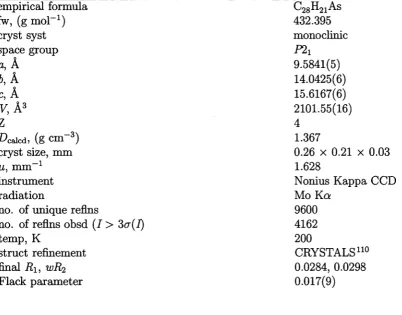
Table 2.1: C rystallographic d a ta and experim ental param eters for X-ray stru c tu ra l analysis of (aR )-53
em pirical form ula fw, (g m ol-1 ) cryst syst space group
а, Ä б, Ä
c, Ä V, Ä3
z
Scaled, (g cm -3 ) cryst size, m m /x, m m -1 instrum ent rad iatio n
no. of unique reflns
no. of reflns obsd ( / > 3cr(7) tem p, K
stru c t refinem ent final R\ , WR2
Flack p aram eter
^ 28^ 21- ^ - S
432.395 monoclinic P2i 9.5841(5) 14.0425(6) 15.6167(6) 2101.55(16) 4 1.367
0.26 x 0.21 x 0.03 1.628
Nonius K appa CCD Mo K a
9600 4162 200
CRYSTALS110 0.0284, 0.0298 0.017(9)
Table 2.2: Selected bond lengths (Ä) and angles (°) in (aiü)-53
As( 1)—C (1 1) 2.011(4) C (ll) -A s ( l)-C (1 3 0 ) 101.11(17) A s(l)-C (1 2 ) 1.982(4) C (1 2 )-A s(l)-C (1 3 0 ) 100.68(18) A s(2)-C (21) 1.994(6) C (2 1 )-As(2)-C (230) 100.3(2) A s(2)-C (22) 1.971(5) C (2 2 )-As(2)-C (230) 100.7(2) A s(l)-C (1 3 0 ) 1.964(4) C ( ll) - A s ( l) - C ( 1 2 ) 96.71(18) A s(2)-C (230) 1.968(5) C (21)-As(2)-C (22) 95.1(2)
C (119)-C (110)-C (120)-C (129) -7 2 .2 (5 ) C (219)-C (210)-C (220)-C (229) -7 1 .4 (6 )
T he a tte m p te d synthesis of th e iodoarsine (aJ7)-39 (X = I) was undertaken by
the add itio n of an excess of freshly distilled aqueous hydriodic acid (57%, constant
boiling azeotrope) to solid (aR )-53 under nitrogen. T he suspension was heated
[image:70.521.76.479.134.449.2]After 2 h, dichloromethane was added to the cooled suspension to extract the sticky orange product. Analysis by XH NMR spectroscopy of the extract indicated the presence of (aR)-39 (X = I) and 2,2'-dimethyl-l,l'-binaphthyl (aR)-42 (Figure 2.6).
[image:71.521.119.423.171.391.2]C H C H C H
Figure 2.6: 1H NMR spectrum of (aR)-39 (X = I) and (aR)-42 arising from reaction of (aR)-53 with boiling hydriodic acid.