Joint Annual Report 2003
Ghana – EU Cooperation
Accra, January 2005
Joint Annual Report 2003
Table of Contents page
1. Executive Summary 1 2. Ghana’s Development Policy Agenda 2 3. Political, Economic and Social Developments in 2003 3 3.1 Progress in Human Development and Poverty Reduction 3 3.2 Political Developments, Human Rights and Governance 5 3.3 Macroeconomic Developments and Public Finance Management 6 3.4 Trade and Regional Integration 8 4. Overview of EU-Ghana Co-operation 9
4.1. Focal sectors 11 4.1.1 Road Infrastructure 11 4.1.2 Rural Development 13 4.1.3 Macro-economic support 16
4.2 Projects and Programmes outside the focal sectors 17 4.2.1 Governance and Institution Building 17 4.2.2 Health 18 4.2.3 Private Sector Development 19 4.2.4 Culture 19 4.2.5 Programme Support 20
4.3 Utilisation of resources for non-State actors 20 4.4 Other Instruments 21
4.4.1 EIB 21
4.4.2 Regional Co-operation 21 4.4.3 Stabex 22 4.4.4 Mining Sector Support (Ex-Sysmin) 22 4.4.5 Private Sector Support Facilities 23 4.4.6 NGO Co-financing 23 4.4.7 Counterpart Funds 23 5. Programming Perspectives 24
5.1 Integration of new EC/EU policy initiatives and commitments 25 5.2 Review of CSP Strategy 26 6. Conclusions 27
List of Annexes
Annex 1 - Updated Intervention Framework Annex 2 - Activity Chronogramme
Annex 3 - Indicative Timetable for Commitments and Disbursements Annex 4 - Donor Matrix
Annex 5 - Country Environmental Profile Annex 6 - Financial Situation for the 6th EDF Annex 7 - Financial Situation for the 7th EDF Annex 8 - Financial Situation for the 8th EDF Annex 9 - Financial Situation for the 9th EDF Annex 10 - Regional Projects
Annex 11 - EIB Projects
Annex 12 - Budgetary Support and Counterpart Funds Annex 13 - Migration Profile
1. Executive Summary
The Ghana Poverty Reduction Strategy (GPRS) contains Ghana’s development policy agenda for 2003-2005 and is centred around five priority areas: (i) infrastructural development; (ii) modernized agriculture centred on rural development; (iii) enhanced social services, with emphasis on health and education, (iv) good governance and (v) private sector development. Though broadly endorsed in 2002, the GPRS was formally finalised and approved in 2003 and presently forms the guiding document for Government’s policies, budgetary processes and donor assistance. Ghana has made steady progress in poverty alleviation in the past two decades, which was underlined by the results of the Core Welfare Indicators Questionnaire survey carried out in 2003. Over the last few years nearly all poverty alleviation indicators -notably in wealth, education, water supply - showed signs of considerable improvement, though the record in health and nutrition appears rather mixed. Nevertheless, poverty remains widespread in the rural parts of North Ghana, while pockets of urban poverty are emerging.
Ghana’s good record in terms of human rights, press freedom and democratic standards was further strengthened in 2003, particularly through the approval of legislation in freedom of information and public finance management. Furthermore, key governance and watchdog agencies received considerable budgetary increases. Ghana volunteered to become the first country to be reviewed under NEPAD’s peer review mechanism, in April 2004. Within the troubled West African Region, Ghana forms a haven of stability and has played an active role in the containment of the crises in Cote d’Ivoire and Liberia. Ghana also continued to be one of the world’s major suppliers of troops for UN peacekeeping missions.
Ghana’s economy grew by 5.2% in 2003. Good world market prices for cocoa and gold contributed to this achievement, which was further underpinned by prudent fiscal and monetary policies. Nearly all Government’s macro-economic and budgetary targets were met in 2003 and programmes with the Bretton Woods Institutions remained firmly on track. For the first time Ghana obtained independent credit ratings, which placed it in Africa’s top group. Ghana’s Stock Exchange was among the world’s best performers in 2003.
EU-Ghana cooperation grew to a record level of intensity in 2003. Total EDF grant disbursements in 2003 were € 63.1 million, which is a further increase to the previous year’s high (€ 46.8 million) and nearly three times the 5-year average of the preceding period (€ 22.3 for the years 1997-2001). Secondary commitments were also at an all-time high at € 101.4 million, providing a solid basis for continued high disbursements in the near future.
cycle (2004/05) has started. During 2003, support to the cocoa sector (mainly disease control and research) continued and was considered highly relevant by outside assessors.
Co-operation in non-focal sectors, including governance, health, private sector development, environment and culture, also showed sustained progress. The € 40 million Mining Sector Support Programme (ex-Sysmin) became operational in 2003 and will form another area of long-term cooperation, aiming to assist revitalising the mining sector in a sustainable manner.
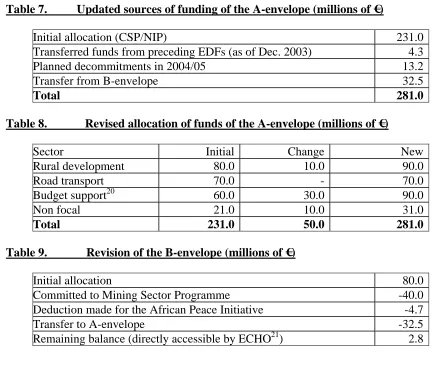
The 9th EDF Country Support Strategy is closely aligned to Government’s policies, as expressed in the GPRS, and remains fully relevant. Based on the assessment of recent trends and developments, the overall country performance and the implementation prospects for the 2004-2007 period, the focal sectors of the country strategy will be maintained. An amount of 32.5 M€ from the B-envelope will be transferred to the programmable resources of the A-envelope, in reinforcing the allocations to rural development and to macro-economic support, and taking into account EPA negotiations, trade facilitation and new EC initiatives under the allocation to non-focal sectors. The MTR also concluded that country offers considerable capacity to absorb additional funds, notably for budget support in the framework of the multi-donor budget support mechanism (MDBS) and in support of the Education for All Fast Track Initiative (FTI).
2. Ghana’s Development Policy Agenda
The Government of Ghana aims at accelerating development through: sound economic management; increased production and promotion of sustainable livelihoods; direct support for human development and provision of basic services; special programmes in support of the vulnerable and excluded; ensuring good governance and increased capacity of the public sector; and the active involvement of the private sector as the main engine of growth in the economy. Its vision has been outlined in the Ghana Poverty Reduction Strategy (GPRS) in five thematic areas:
1. Vigorous infrastructural development in terms of roads, energy, ports and harbours and telecommunication. These are expected to open up the country make it easier to undertake economic activities and support the private sector.
2. Modernized Agriculture centred on rural development to ensure increased production and employment.
3. Enhanced Social Services i.e. increasing funding for Education, Health and Sanitation to ensure that all over the country these services are improved.
4. Good Governance - ensuring the rule of law, respect for human rights and the achievement of social justice and equity.
5. Private Sector Development – supporting the private sector to ensure that it is capable of acting effectively as the engine of growth and poverty reduction.
The GPRS was formally submitted to the IMF and World Bank in February 2003 and has guided Government and Development Partners’ agenda’s since. The GPRS is supplemented by a number of more detailed sector policies and plans in e.g. health, education, agriculture, roads, private sector development and governance. In 2003, the policies and plans for education (including the submission to benefit from the Education Fast Track Initiative) and private sector development were completed, while a set of road sector policies was drafted.
rates, public debt and maintaining stable exchange rates. In pursuance of this objective, Government put in place a fiscal and monetary framework which has been largely successful in placing the economy back on the stability path. Government has placed emphasis on fiscal discipline and monetary prudence, accompanied by crucial structural reforms. Other key mechanisms adopted to pursue the development agenda include the promotion of private sector-led industrial production (particularly non-traditional industries, through a series of Presidential Special Initiatives), the prioritisation of the rehabilitation of the main arterial roads out of Accra; market-conform energy and utility pricing; the introduction of a National Health Insurance Scheme; increased incentives for investments and for the deployment of health and education professionals in disadvantaged areas; and pursuing a policy of accelerated decentralization.
In 2003, the Government exceeded its target Gross Domestic Product (GDP) growth rate of 4.7% by half a percent. In the medium-term Government aims to achieve an average GDP growth rate of 8 % to reach its aspiration of becoming a middle-income country by 2010.
3. Political, Economic and Social Developments in 2003
3.1 Progress in Human Development and Poverty Reduction
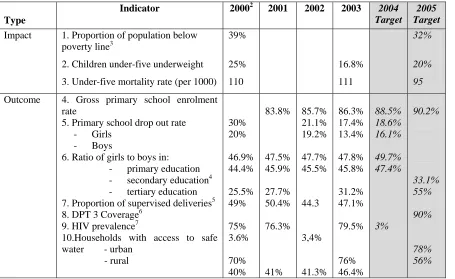
The Ghana Poverty Reduction Strategy (GPRS) was finalised in February 2003 and sets the framework for medium-term poverty reduction and growth in Ghana. It includes a range of indicators with a reference value for the year 2000 (or latest year close to it) and a target for 2005. The indicators in table 1 below are largely derived from the GPRS1. The table indicates a picture of steady progress towards medium-term poverty alleviation targets. In general, clear progress has been made in education and water supply indicators, while the health indicators have seen a rather mixed level of achievement. This picture is reinforced by the results of recent surveys and studies on poverty in Ghana.
In 2003, the Core Welfare Indicators Questionnaire (CWIQ) was conducted, largely on the same basis as the 1997 CWIQ, which makes a comparison over a 6-year period possible. During this period, nearly all indicators showed signs of considerable improvement. Child nutrition, which has worsened, is an exception to the general trend. An increased proportion of households across all regions experienced better water and sanitation facilities, though at the present rate of progress it will still take 17 years for all households to have access to safe water. In 2003, a majority of households (66%) had access to electricity, and considerably more households now owned assets (like iron, TV, radio, bed and watch) than in 1997. Literacy rates also went up: 53% of the adults (over 15) and 69% of youth (15-24) can be considered literate, which is a 5-6% increase since 1997. Moreover, the gender gap in literacy rates is slowly closing. Access to health and education facilities have clearly improved, while satisfaction rates with the services provided increased tremendously. In terms of nutrition, indicators did not improve: wasting among children, an indicator of short-term malnutrition, more than doubled to 15.5%, particularly in urban areas, while there was also an increase in the percentage of stunted children (32.2% versus 29.9% in 1997)..
1
Table 1. Ghana, Poverty Indicators, 2000-2005
Type
Indicator 20002 2001 2002 2003 2004 Target
2005 Target
Impact 1. Proportion of population below poverty line3
2. Children under-five underweight
3. Under-five mortality rate (per 1000) 39% 25% 110 16.8% 111 32% 20% 95
Outcome 4. Gross primary school enrolment rate
5. Primary school drop out rate - Girls
- Boys
6. Ratio of girls to boys in: - primary education - secondary education4 - tertiary education 7. Proportion of supervised deliveries5 8. DPT 3 Coverage6
9. HIV prevalence7
10.Households with access to safe water - urban
- rural 30% 20% 46.9% 44.4% 25.5% 49% 75% 3.6% 70% 40% 83.8% 47.5% 45.9% 27.7% 50.4% 76.3% 41% 85.7% 21.1% 19.2% 47.7% 45.5% 44.3 3,4% 41.3% 86.3% 17.4% 13.4% 47.8% 45.8% 31.2% 47.1% 79.5% 76% 46.4% 88.5% 18.6% 16.1% 49.7% 47.4% 3% 90.2% 33.1% 55% 90% 78% 56%
Sources: GPRS APR 2003, MoEYS Ghana, Education Sector Performance Report 2004,, CHIM, provisional results of CWIQ 2003 and demographic and Health Survey 2003
In general, poverty in Ghana remains a predominantly rural phenomenon, although some pockets of urban poverty are also emerging. In geographical terms it is mainly concentrated in the three northern regions, while in the south the Central Region shows a relatively high rate of poverty. Based on the 1998/99 GLSS and the 2000 Census a poverty map has been compiled, which shows the geographical distribution of poverty in Ghana (see Annex 14).
The Budget Statement for 20048 mentions that in 2003 actual expenditures for basic services and income generating activities for the poor amounted to Cedi 4,464 billion (appr. € 450 million), reflecting 29.24% of total Government Expenditure and very close to the target set in the original 2003 budget. For 2004, this figure would go up to Cedi 5,158 billion, representing 27.3% of total budgeted Government Expenditure, and will be funded from the General Government Budget (77%) and HIPC funds (23%).
2
Or earlier, see notes on the various indicators.
3
The Ghana Living Standards Survey derives a poverty line based on nutritional needs. The poverty line is the consumption expenditure needed to achieve minimum nutritional needs. This line was set at 900,000 cedis per adult per year in the 1998/99 GLSS (appr. € 333 at the time).
4
Junior Secondary Schools (JSS) only
5
The Health Sector Response to the GPRS lists another baseline and target: 44% and 50% for 2000 and 2005.
6
The Health Sector Response to the GPRS gives another baseline: 67% in 2000.
7
Base rate is for 1999.
8
3.2 Political Developments, Human Rights and Governance
The year 2003 saw a gradual increase in political activities in the run-up to the national elections in 2004. Having selected their Presidential candidates in 2002, most of the political parties embarked on organizing primaries to select candidates who would participate in the Parliamentary elections. Both Presidential and Parliamentary elections are scheduled for 7 December 2004. In April, the NPP won another election, its sixth consecutive win in by-elections since it took power in 2001. At the end of 2003, the balance of power in the 200 seat Parliament was as follows: NPP 103, NDC 89, PNC 3, CPP 1 and Independent 4.
Tensions and political challenges posed by the Dagbon crisis gradually eased in 2003. The State of Emergency has remained in place in the area throughout the year, but in early 2004 the curfew was lifted. High profile representatives of both warring ‘gates’ performed the necessary rites for work to begin on the construction of a temporary palace for the Ya-Na in Yendi. District Assembly elections, postponed from 2002, have been held in most affected districts at the end of 2003.
Moves towards devolution of power to the district level received a stimulus by the establishment of a Presidential Advisory Committee on Decentralisation at the highest political level. The advisory committee will advise the President on critical issues affecting the decentralisation process. Moreover, a National Decentralisation Action Plan was submitted to cabinet for endorsement. An inter-sectoral Committee on decentralization has also been established with a mandate to a.o. develop a common understanding on decentralisation policy among Ministries Departments and Agencies (MDAs).
The National Reconciliation Commission (NRC), appointed in 2002 and tasked with the responsibility of investigating human rights abuses during the periods of military rule, began public hearing in 2003. Several high-ranking personalities appeared before the Commission to give evidence. The NRC will complete its hearings in early 2004. The NRC has no power to punish offenders – it can only recommend compensation to victims.
Following the resolution on the legality of the Fast Track High Courts in 2002, proceedings at these courts progressed in 2003. Two former Ministers, a Deputy Minister and a top government official were convicted and jailed various terms of imprisonment for involvement in the Quality Grains corruption scandal. A number of other former officials are still standing trial. In the 2003 Corruption Perception Index conducted by Transparency International, Ghana scored 3.3, down from 3.9 in 2002. This places the country at the 70th position on a table of 133 countries. From among the African countries it scored the sixth best result9. In 2003, the Government appointed a new head of Civil Service who is tasked to make the civil service more efficient and effective. In a step to obtain better insight on the size of the civil service a public sector employee census was undertaken in 2003 with the final report produced in September. The census indicated the size of the Civil Service to be 318,414; the findings will be used in payroll control. Moreover, work started on a comprehensive policy statement on the future direction of public sector reform, to be finalised in early 2004.
In pursuit of the Government’s plans to ensure public access to information on Government business, the Freedom of Information Law was passed in 2003. Moreover, the Financial Administration Act (FAA), the Procurement Act and the Internal Audit Agency Act were all approved by Parliament in 2003, creating a stronger legal framework for improved public finance management. Key agencies involved in good governance, including the Ghana Audit
9
Service (GAS), the Commission for Human Rights and Administrative Justice, and the Serious Fraud Office, received substantial budgetary reinforcement. For the first time the GAS received its full budget submission - another step in assuring its full independence.
In 2002, Ghana officially volunteered to become one of the first countries to be reviewed through the Africa Peer Review Mechanism (APRM) under the New Partnership for Africa’s Development (NEPAD) initiative. The peer review is meant to assess a country’s progress on governance and particularly with respect to economic policy, democracy and the business environment. Ghana’s review is scheduled for April 2004, making it the very first country to be subjected to the APRM.
3.3 Macroeconomic Developments and Public Finance Management
In 2003 an overall GDP growth rate of 5.2% was recored, which was higher than the growth rates in preceding years (4.5% in 2002, 4.2% in 2001). Strong performance was observed in the agricultural sector (6.1.% growth, compared to 4.4% in 2002) and in industry (5.1% in 2002, up from 4.7%), which had a positive influence on the overall growth rate, while the growth rate in the services sector remained stable at 4.7%. The increase in the agricultural growth rate was largely due to substantial growth in the cocoa sub-sector (16.4%), due to a combination of high cocoa prices on the world market and a good harvest, related to mass spraying campaigns. Ghana’s strong economic performance was also illustrated by the sharp increase of the All Share Index on the Ghana Stock Exchange (GSE). The GSE reported an index return of 144% in US dollar terms and 157% in local currency terms, reportedly the best performance on a stock exchange in the world in 2003.
Through a combination of a benign economic environment and largely prudent policies, Government managed to achieve most of its economic policy objectives for 2003, while others were close to target. Government’s key objective of zero net domestic borrowing was surpassed with a net repayment of 0.4% of GDP. The overall budget deficit ended at 3.4% of GDP (against a target of 3.3%), while the domestic primary surplus was 2.5% (target: 3.0%). At the end of the year, gross foreign exchange reserves at the Bank of Ghana were equivalent to 3.9 months of import cover (target 2.3 months), the highest level in well over a decade. Inflation ended the year at 23.6%, after having peaked at 30% in April, but still above the (revised) target of 22.0%. Interest rates assumed a downward trend in the second half of 2003, with the benchmark 91-day Treasury-Bill rate falling from 35.3% in June to 18.7% in December. Throughout the year, the cedi remained rather stable versus the US dollar (loss of 4.7%), but lost considerably against the Euro, Pound and Yen.
The provisional figures show an overall budget deficit of 3.4% of GDP, slightly above the target of 3.3% of GDP, but considerably better than the corresponding 2002 figure (6.3% of GDP). The domestic primary balance recorded a surplus equivalent to 2.5% of GDP, above the target of 2.2%.
As a result of the favourable developments and budgetary policies, the Government could reverse the heavy reliance on domestic financing. Net domestic financing of the budget was actually negative: - Cedi 228.9 billion (approximately € 22 million) compared to a zero target. This repayment has allowed a decline in the domestic debt/GDP ratio from 29% at the end of 2002 to 22.6% by December 2003. At the end of 2003, Ghana’s total medium and long-term external debt stood at US$ 6,447 million, an increase of about 5% to the previous year’s level. Of the total debt stock, about 65% was owed to multilateral institutions, 29% to bilateral creditors and 2% to commercial creditors. In February 2002, Ghana reached HIPC Decision Point and expects to reach Completion Point in the second or third quarter of 2004. In 2003, cedi 850 billion (around € 85 million) was disbursed from the HIPC Account in which a large part of the HIPC savings are lodged. About 17% was used for domestic debt payment, while the remaining 83% was disbursed to Ministries and local authorities, predominantly in areas of poverty reduction and in line with the GPRS10. For 2004, total HIPC relief will be about US 286.2 million, of which US$ 146 million will be lodged in the HIPC account and US 140 million is expected to be cancelled. The European Commission has announced that its debt relief support to Ghana –at Completion Point- will amount to € 15.34 million, while the EIB has joined the initiative and agreed to refund € 2.45 million, being 2002 and 2003 instalments paid by Ghana. The EIB will also cancel € 1.23 million debt service due for 2004.
After the lapse of the previous PRGF in 2002, a new 3-year programme with the IMF was agreed in early 2003 and approved by the IMF Board in May 2003. Programme implementation has been good in 2003 and on 17 December the first PRGF review was successfully completed. All quantitative and structural performance criteria and all prior actions were observed and all but one benchmarks were met. Moreover, in view of the strength in implementation in 2003, the programme for 2004 needed hardly any adjustment. The conclusion of the PRGF also led to a three-year PRSC agreement with the World Bank (2003-2005) with a support value of US$ 125 million per annum.
In 2003, further progress was made in a number of key areas of public finance management. The legal framework has been updated and improved by the Audit Service Act (2000), the Financial Administration Act (2003), the Procurement Act (2003), and the Internal Audit Agency Act (2003). The implementation of this legal framework is expected to improve budget processes, financial control and value for money. Moreover, there has been progress in the quality of budget preparation, commitment and expenditure control, reporting and auditing11. For several years, Government has been addressing the weaknesses in its financial management systems through the Public Finance Management Reform Programme (PUFMARP), which has shown mixed result. Government is re-assessing the focus and direction of its PFM programme. In the meantime, it has developed a Short-Term Action Plan (STAP) which lists and prioritises activities to be completed before the end of 2004.
Ghana has been subjected to two independent credit ratings in the second half of 2003. First, Standard & Poor gave Ghana a B+, thus putting it in the same category as countries like Brazil and Senegal, but above Turkey, which holds a ‘B’. At the beginning of December, Fitch Ratings assigned Ghana long term foreign and local currency credit ratings of ‘B’ with a
10
A full account of use of HIPC funds in 2003 is given in the pages 195-204 of the 2004 Budget Statement.
11
positive outlook. This rating places Ghana in the same group as Cameroon, Mozambique and Turkey, but above countries like Moldova, Uruguay and Venezuela. Both ratings contained a positive outlook, implying that the rating could be upgraded within a few years in case of continuation of trends and policies.
3.4 Trade and Regional Integration
Merchandise exports to the world increased by 19.3% in 2003 compared with 2002. The rise was due to increases in both the volume and value of Ghanaian’s dominant traditional exports (cocoa and processed products from cocoa beans and gold), achieved thanks to a campaign on mass spraying of cocoa farms and increases in productivity for cocoa and increases in real producer prices for gold. Timber and wood products and all other exports declined in value terms, but the loss was more than offset by increases in cocoa and gold export earnings. Imports from the world however increased by 19.4% due to a substantial increase in non-oil imports (21.5% increase). Ghana’s trade deficit deteriorated by almost 20% from US$691.9 million in 2002 to US$828 million in 2003.
Ghana’s trade surplus with Europe decreased by more than 40% from € 106 million in 2002 to € 61 million in 2003. Major exports from Ghana to the EU are predominantly based on a few primary products, notably cocoa, aluminium (not alloyed or wrought), gold and wood. Ghanaian import from the European Union consist of a range of product groups among which motor cars, petroleum products, electrical equipment, clothing, medicines and spare parts form some of the more important items. The EU remains Ghana’s most important trade partner. About 51% of Ghana’s goods exports go to the EU, while 33% of its imports originate from the EU.
Ghana remains a strong advocate of regional cooperation and integration in the framework of ECOWAS. In December 2003 president Kufuor was elected ECOWAS Chairman for a second consecutive year, in recognition of his and Ghana’s positive role in fostering peace, stability and economic cooperation in the region. In particular Ghana’s mediating role in the crises in Cote d’Ivoire and Liberia have led to improved prospects for long-term solutions in both countries. More in general, Ghana has been a major supplier to international peacekeeping operations since the 1960s. The establishment of the Kofi Annan International Peacekeeping Training Centre in 2003, which will serve as a regional expertise centre for peace operations, underlines Ghana’s regional role in conflict prevention and resolution.
Since the 1980s, Ghana has progressively eliminated and reduced its import quotas, tariffs and import licensing requirements. The tariff system has been simplified and harmonised with the UEMOA Common External Tariff of its direct neighbours and has four ad valorem import duties: 0 percent, 5 percent, 10 percent and 20 percent (the standard rate of duty). With the aim of simplifying customs procedures, the WTO and the Customs Excise and Preventive Service (CEPS) signed an agreement on customs procedures and trade facilitation in 2002. Two years earlier, Ghana had transitioned from the use of pre-shipment inspection to the use of a destination inspection scheme. Ghana officially started the negotiations for the upcoming Economic Partnership Agreement (EPA) in October 2003 in the framework of ECOWAS.
4. Overview of EU-Ghana Co-operation in 2003
The Country Support Strategy for Ghana for the period 2002-2007 was signed in 2002 and focuses on three sectors: rural development, road transport, and macro-economic support, while ‘governance’ forms the thematic orientation in the non-focal sectors. In geographical terms, the emphasis in the cooperation programme gradually shifts from Western Ghana (7th/8th EDF) to the Northern part of the country, while continuing to operate in other poverty-stricken areas (e.g. Central Region).
Until the coming into force of the 9th European Development Fund in April 2003, nearly all funds under the various National Indicative Programmes12 for Ghana had been committed for a number of years, allowing for very few new Financing Agreements to be concluded. The 9th EDF made an initial amount of € 231 million (A-envelope) available to Ghana for the implementation of the National Indicative Programme until 2007. With the entry into force of the 9th EDF a mechanism also commenced that automatically adds any de-committed funds from previous EDFs to the balance of the 9th EDF. As a result the programmeable part of the 9th EDF envelope for Ghana had increased to € 235.3 million at the end of 2003, while at the same time the book value of the allocations for the previous EDFs was somewhat reduced.
[image:11.595.72.517.506.594.2]In 2003, the last new agreements under the 7th and 8th EDF were concluded. For the 7th EDF this referred to a road sector design study (€ 0.75 m) and the evaluation of the Woodworking Sector Development Programme (€ 62,000), while under the 8th EDF a special tranche of budget support became available (€ 5 million). Under the 9th EDF five agreements were concluded for a total value of € 5.3 million. At the same time a number of de-commitments and closures took place under the 6th, 7th and 8th EDF, including the closure of an expired structural adjustment operation, which led to the de-commitment of € 10 million. In combination, these operations resulted in a net new level of decisions (Financing Agreements) of € 0.1 million (table 2). At the end of 2003, the cumulative decision level for the operational EDFs stood at 72.5% (see table 3) and a balance of € 230 million remained for new commitments. It is anticipated that projects and programmes for a value of € 180 million will be decided upon in 2004 and the remaining balance will be committed in 2005.
Table 2. New Decisions, Commitments and Disbursements in 2003, all EDF grant resources (in million €)
NIP/EDF Decisions Commitments (Contracts) Disbursements
6 -0.1 - -0.8
7 0.7 5.4 8.1
8 -5.8 95.2 55.8
9 5.3 0.8
-TOTAL 0.1 101.4 63.1
Table 3. Decisions, Commitments and Disbursements, cumulative as of end 2003, all EDF grant resources (in million €)
NIP/EDF Allocation Decisions % Contracts % Disbursements % 6 97.0 97.0 100.0 97.0 100.0 96.0 99.0 7* 256.6 256.6 100.0 246.9 96.2 234.5 91.4
8 248.7 248.7 100.0 172.9 69.5 113.7 45.7
9 235.3 5.3 2.3 0.8 0.3 -
-TOTAL 837.6 607.6 72.5 517.6 61.8 444.2 53.0
* the 7th EDF includes a transfer of funds from the 5th EDF (€ 13.3 million) and Stabex funds (€ 50.6 million)
12
In 2003, new individual commitments (contracts) were made for a total value of € 101.4 million, up from € 30.4 million in 2002. This represents an unprecedented high level of commitments in the history of Ghana-EU cooperation. Most new individual commitments were made under the 8th EDF (€ 92.1 million). In sectoral terms, it concerned operations under macro-economic support (€ 57.5 million), road transport (€ 32.2 million, including two road rehabilitation contracts) and rural development (€ 5.9 million).
EDF disbursements rose to € 63.1 million in 2003, which constitutes the highest level of disbursements in EU-Ghana cooperation ever and continues the upward trend set in the previous year. While the 1997-2002 average disbursement level stood at € 22.3 million, this already increased to € 46.8 million in 2002. The disbursement record of € 63.1 million in 2003 is largely due to the high level of budget support, linked to the concurrent implementation of two macro-economic support programmes (see section 3.3.1 for details), which led to a disbursement level of € 41.3 million. Project support contributed € 21.8 million in disbursements in 2003 and is expected to rise further in 2004 with the full-year implementation of two trunk road rehabilitation projects.
Graph 1 sets the 2003 figures in a 10-year perspective, using decision, commitment and disbursement levels over the period 1994-2003. The graph shows that there are strong fluctuations between decision levels (and to a lesser extent commitment levels) over the years, associated with the 5-6 year cycles of the EDFs. On the other hand, the levels of disbursements fluctuate less and form much more of a trend-line. This makes the 2003 performance even more remarkable and further illustrates the strong cooperation between Ghana and the EU last year.
Graph 1. EDF Commitments and Disbursements, 1994-2003.
0 20 40 60 80 100 120
1994 1995 1996 1997 1998 1999 2000 2001 2002 2003
Years
Mi
ll
ion E
u
ro
4.1. Focal sectors
4.1.1 Road Infrastructure
The main objectives of the sector policy for road transport are: to upgrade the existing road network to a maintainable standard; to strengthen the organizational structure and institutional capacity of the road sector; to achieve higher effectiveness in routine and periodic maintenance; to improve cost recovery to ensure that maintenance can be fully funded on a sustainable basis; to promote greater private sector involvement both in execution of work and financing of transport infrastructure; to achieve sector-wide discipline in expenditure management and prioritization; and to control and enforce axle-weight regulations.
Activities within the sector are closely coordinated with regular meetings between the Ministry of Roads and Transport, the Ghana Highways Authority, the Departments of Urban and Feeder Roads, the Road Fund Board, the National Road Safety Commission and major bilateral and multilateral donors. At annual conferences, partners review progress in improving and maintaining the road network, and establish priorities for the near future. The annual conference planned for November 2003 was postponed and has been re-scheduled for March 2004. It will focus on the implementation of transport policies recently developed by the Ministry of Roads and Transport and centre around the theme ‘transport and poverty reduction’. In August 2003, Cabinet approved three policy papers on Fuel Levy, Axle Load Control and Tolling of Roads. The three policy papers relate to critical issues in the road sector reform program and should be regarded as the first step towards sound and effective implementation plans (action plans) for each policy, bearing in mind that implementation will also require political will and public support. As a step towards implementation, a separate workshop on axle load control was conducted in February 2004
[image:13.595.65.530.552.626.2]In 2003, a further improvement in the road condition mix, the percentage of roads rated in good, fair and poor condition respectively, was recorded13. The condition of trunk roads continued to improve steadily, while the situation for feeder roads improves at a faster pace. The condition mix for urban roads also improved in 2003, after a deterioration in 2002 (see table 4). Road maintenance data for 2003 show an increase in planned, approved and achieved maintenance length (table 5), which raises the expectation that the condition of Ghana’s road network will further improve in the coming years.
Table 4. Road Condition Mix for the Years 2001-2003
2001 2002 2003 Road Agency/Road Type Good Fair Poor Good Fair Poor Good Fair Poor
GHA – Trunk Roads 23 27 50 26 27 47 29 30 41
DFR – Feeder Roads 29 13 58 33 19 48 36 26 38
DUR – Urban Roads 27 19 54 25 18 57 29 17 54
National Summary 27 17 56 30 21 49 34 26 40
Table 5. Road Maintenance Programme for 2001-2003 (in kilometres)
2001 2002 200314
Activity Pl. App. Ach. Pl. App. Ach. Pl. App. Ach.
Routine Maintenance 24,733 23,081 21,615 24,494 24,413 13,981 33,036 33,037 28,185
Periodic Maintenance 4,623 2,525 1,699 4,611 1,477 1,477 5,163 3,784 2,670
13
The road condition mix is established on the basis of surveys conducted after the first quarter of each year.
14
For many years, payment arrears have characterised the lack of commitment and contract management in the road sector. Since 2003, however, road arrears have been cleared, with the exception of disputed cases, which are still subject to further auditing.
The EU-supported Transport Infrastructure Programme (TRIP) continued in 2003 and consisted of TRIP II and TRIP III, approved in 1996 and 1999 respectively. The TRIP II programme, which ended in 2003, had five main components. The largest of these was the reconstruction and enlargement of 117 km of connecting trunk road between Awaso in the Western Region and Gambia No.2 in Brong Ahafo Region, passing through the mining town of Bibiani. The road was completed in the 3rd quarter of 2002 and the costs of the works remained well within the set budget (€38 million). Other completed project components include: a training programme for road sector management staff (€1.5 m); and technical assistance to coordinate the national road programme and donor activities (€0.8 m). The Financing Agreement of TRIP II expired at the end of 2003. During the year, some additional works at the weighbridge stations in Tema and Bogoso (€0.25 m) were completed. The weighbridges will be inaugurated in early 2004 and will become operational in the course of that year. The Technical Assistance to the NAO in the road transport sector (€0.08 m) was terminated in November 2003, and the Evaluation of the TRIP II (€0.22 m) was successfully completed during the 3d quarter of 2003. The main findings of the TRIP II evaluation include the observation that the constructed all-weather roads are of high quality, but that TRIP II did not give sufficient priority to routine and periodic maintenance. Meanwhile, truck overloading practices have been allowed to continue, affecting the newly reconstructed/upgraded roads straightaway. The evaluation recommended to break through this vicious circle by giving the highest priority to the mobilisation of political and stakeholders’ consensus on implementation of the stated Axle Load Control regime. Furthermore, the evaluation recommended road safety audits on the newly constructed roads.
The TRIP III programme provides €56 million for reconstruction and resurfacing of three major trunk road sections totalling 182 km in western Ghana. The three roads are: (i) Axim Junction – Tarkwa (62 km), (ii) Bibiani – Abuakwa (80 km) and (iii) Kumasi – Techiman (40 km)15. During the first half of 2003, tenders were evaluated and contracts awarded for the Axim Junction – Tarkwa Road (€17 m) and for the Bibiani – Abuakwa Road (€14 m). For both roads, works commenced during the third quarter of 2003. The roads are expected to be fully rehabilitated by the summer of 2005. Due to shortfall of funds and increased traffic volumes between Kumasi and Techiman (caused by the crisis in Cote d’Ivoire), the tender dossier for the the Kumasi-Techiman Road (approximately €20 m) had to be revised. The tender will now be launched in January 2004. Works are foreseen to commence in the 2nd half of 2004. Technical Assistance towards the efficient, effective and sustainable management of maintenance in the road sub-sector (€1.15 m) is also funded under TRIP III. This component aims at implementing and reporting all road maintenance activities on the national road system. It is a four year activity that will be completed by mid-2005,
In addition, the EU supports the rehabilitation of rural feeder roads in Ghana’s cocoa growing areas, with Stabex-funds. Following two phases, during which 650 km and 450 km were rehabilitated respectively, an important amount (€11 million) remained in the Stabex 90 – 94 accounts, which will be used for the third phase of feeder road rehabilitation. This third phase will rehabilitate some 600 km of feeder roads in cocoa growing areas in Western, Central, Brong Ahafo and Ashanti Regions. In 2003, the Joint Implementation Memorandum for this
15
phase was signed, while tenders for design and monitoring were prepared and evaluated. Engineering design will start in early 2004 and works will commence at the end of 2004.
4.1.2 Rural Development
In the Ghana Poverty Reduction Strategy (GPRS), the Government of Ghana acknowledges the fact that most poverty in Ghana is found in the rural areas, particularly in the northern part of the country. The Government addresses rural poverty by prioritising on the provision of rural infrastructure (e.g. irrigation facilities, feeder roads), agro-based industrialisation (including the valorisation of export crops like cocoa), and effective decentralisation. At the end of 2002, the Ministry of Food and Agriculture (MOFA) published the Food and Agricultural Sector Development Policy (FASDEP), a holistic policy framework adopting the sector-wide approach to managing agricultural development. In 2003, the Agriculture Strategic Plan for Ghana 2003-2005 was elaborated as the sector plan to implement these policies. In order to further harmonise and improve MOFA-donor coordination in 2003 a specific donor-desk was established in MOFA. The EU support strategy is closely aligned to the Government’s programme (GPRS, FASDEP) and focuses on rural infrastructure provision (small town and rural water supply, electrification, feeder roads, microprojects) and on cocoa production.
The agriculture sector contributes about 36% to the overall GDP and employs over 60% of the active labour force in Ghana of which over 75% reside in rural Ghana. In 2003, the agricultural sector grew by an estimated 6.1% (compared to 4.4% in 2002). The increase in growth is largely attributable to a strong performance of the cocoa sub-sector (16.4% growth), related to favourable world market prices and to mass spraying exercises in previous years. Preliminary results from the 2003 Core Welfare Indicators Questionnaire (CWIQ) also indicate a general improvement in living conditions in rural areas. Increases in access to water and to schooling are particularly noteworthy. The EU-support has significantly contributed to this achievement, e.g. by providing access to safe water for over 600,000 people, by serving nearly 200,000 persons with rural electrification and by increasing access to education for approximately 75,000 children.
towns (as initially planned), spread over two regions. The implementation phase under 9th EDF financing is expected to start in 2006.
Besides the water supply in small towns, there is a major support project for rural communities in three districts of the Northern Region. This project aims at constructing 425 boreholes and 50 wells, equipped with hand-pumps, in the rural areas, while some 25 larger communities will receive small water schemes, supplied by boreholes that are equipped with solar pumps. Overall about 220,000 people will benefit. The project will also include the construction of about 2,000 latrines and a health and sanitation education component. The implementation of the project started in August 2002, but due to (tragic) staffing problems in the last quarter of 2002, project progress was initially slower than anticipated. The main project activities performed since the project’s start include: the purchase of vehicles, the nomination and training of Partner Organisations for some 220 communities (responsible for community mobilisation) by the Small Business Development Organisation (part of the TA), the submission of the first part of a base-line study and the start of a pilot drilling phase (October 2003). In addition, tender documents have been prepared for the supply of 480 handpumps and for the civil works of the main drilling phase, which will commence in the first half of 2004. The overall project duration is planned for 4 years, i.e. up to 2006.
The Rural Electrification programme seeks to connect 110 rural communities in the Western Region with approximately 188,000 beneficiaries to the national grid. The beneficiary communities purchase poles for the scheme, while the project provides transformers, conductors, high and low tension poles, plus the required insulators, ancillary equipment and sub-stations. Implementation started in September 2001 and in 2003 the contractor continued with the supply and erection of the electrification schemes (low and high voltage) in the selected communities. The consultant also embarked on training workshops on the ‘Productive Uses’ of energy in 2003. The objective of the workshops is to promote the use of electricity in the domestic, commercial, industrial and agricultural sectors and to educate customers in the community on the use and economic aspects of electricity. For this purpose demonstration equipment, focusing on activities of small scale enterprises in the communities, has been procured. Examples of the demonstration equipment include a rice mill, corn mill, welding and cutting machinery, and a coconut extractor. The first workshop was held in November 2003 in Takoradi. Project implementation will be completed by mid-2004.
July 2003. This phase targets 524 projects in core districts, plus approximately 100 projects in non-core districts, all to be completed by end 2004 or early 2005. To date the 5th MPP programme has involved the construction of 556 school buildings (1668 classrooms), providing improved schooling facilities to approximately 75,000 school children. Likewise, the programme has provided safe drinking water to more than 30,000 people through the construction of 106 boreholes. In May 2003, the 5th Micro-projects Programme was subjected to an independent Mid-Term Evaluation (MTE). The evaluation underscored the programme relevance and indicated that all targets can be met, provided an extension of 1 year will be allowed. Due to the programme’s approach of using village artisans for the skilled work, the MTE observed certain quality problems, which are currently being assessed in detail by programme management. The active community participation has developed a sense of project ownership among beneficiaries with indications of greater attendance at schools and clinics, and incremental benefits from the use of safe drinking water in rural areas.
EU assistance to agriculture has focused on cocoa, Ghana’s major export commodity. As part of the Stabex funds which became available as a result of the loss of export earnings from cocoa in the period 1990-93, the EU funds the Cocoa Sector Support Programme. Its major component is the Cocoa Swollen Shoot Virus Disease (CSSVD) Control. This programme component compensates farmers for the eradication of infected cocoa trees and assists with replanting. The STABEX financing represents approximately a third of the cost of the Programme. The rest is financed by Government from tax revenues. During 2003, the CSSVD control component supported the removal of 10,052,735 disease affected trees for which an amount of ¢8.3 billion (nearly € 0.8 million) was paid. This represents 6,777 hectare of diseased cocoa farms, which were cleared, while the area that was actually replanted in 2003 was slightly higher at 6,944 ha. In addition to the CSSVD Control, the EU is supporting cocoa research activities. The research includes the development of CSSVD-resistant varieties, development of bio control agents and mechanism for various pests and diseases, as well as the field testing of agronomic practices necessary to promote re-introduction of cocoa in formerly abandoned cocoa areas. Under the programme’s Seed Production (SP) component the installation of an irrigation system for a 17 ha seed garden in Kwadaso began. During 2003, the Seed Production Unit produced approximately 2.4 million hybrid pods for sale to farmers and for seedling production. Some 7.04 million hybrid seedlings were produced by SPU for sale to farmers and CSSVD replanting. In July/August 2003, an independent Mid-Term Evaluation of the Cocoa Sector Support Programme was conducted. The evaluation concluded the programme design to be highly relevant by aiming at improved incomes for smallholder cocoa farmers through increased yields by replanting CSSV diseased farms with disease-tolerant and high-yielding cocoa varieties. By targeting resource-poor smallholders in rural areas, CSSP contributes to Ghana’s poverty reduction effort. Overall programme efficiency suffered an initial setback, which was mainly due to the re-organisation of COCOBOD. At the time of the Mid-Term Evaluation it was too early to expect any measurable impact, because none of the replanted farms have yet reached production stage. CRIG research and CRIG Technical Assistance are expected to reach their initial targets within the remaining programme duration. As the research projects are considered extremely relevant for the future of Ghana’s cocoa industry, the consultants recommended to expand and step-up the research efforts. The other two core components (CSSVD control and SPU) are also recommended to be extended by two years in order to complete outbreak treatment activities as well as replanting.
4.1.3 Macro-economic support
Support to the Government’s macro-economic reform programme forms the third focal area of cooperation between Ghana and the EU. The support strategy has been based on the commitment of the Government of Ghana to put in place, in agreement with the Bretton Woods Institutions, a mix of fiscal and monetary policies aimed at containing public expenditure and enhancing revenue collection in order to limit recourse to domestic financing. Debt reduction, through the HIPC initiative, and divestiture would allow Government to re-direct resources saved in terms of debt servicing to poverty related programmes and would allow a reduction of interest rates favouring private sector investments and growth. While supporting the overall macro-economic reforms, the EC pays special attention to improvements in the social sectors and in public finance management.
In 2003, Ghana showed a strong macro-economic performance (see also section 3.3) and all key economic indicators continued to improve. The GDP growth rate increased to 5.2%, inflation fell after a peak of 30% in April to 23.6% in December, the overall budget deficit was contained at 3.4% of GDP, there was net domestic repayment (rather than borrowing) and at the end of the year interest rates started to decline rapidly. Gross foreign exchange reserves grew to their highest level in over a decade and the cedi remained relatively stable versus the US dollar. Moreover, tax revenues and foreign inflows exceeded expectations, while expenditures were kept within budget ceilings. This created a favourable macro-economic framework, within which additional resources (partly due to the HIPC initiative) allowed for settlement of payment arrears and for increased spending on poverty targets. In May 2003, the IMF Board agreed a new three-year Poverty Reduction and Growth Facility (PRGF) and at the first PRGF review in December 2003, Ghana had met all its performance targets.
In 2003, two Financing Agreements covering budget support to Ghana were under implementation: SASP VII (€ 38.415 million), signed in December 2001, and PRBS2001 (€ 42.8 million), which was signed in April 2002. The fact that two budget support facilities were operational at the same time was related to the delay in macro-economic assistance in 2000/2001, following an audit with some adverse findings in 2000. This created an exceptional situation in 2003 and led to a record level of budget support (€ 41.415 million) that was released in a number of separate tranches:
• With respect to SASPVII, the second tranche (€ 17.25 million) and the regional tranche (€ 3.315 million) were both disbursed in 2003. The Financing Agreement covering SASP VII expired on 30 June 2003 and preparations have started to administratively close the project.
• Two tranches were also disbursed from PRBS2001 in 2003. After Ghana restored a stable relationship with the Bretton Woods institutions and in view of good progress in establishing the framework for Multi-Donor Budget Support, the first general tranche (€ 15.85 million) and the special tranche (€ 5 million) were both released. At the end of the year, one tranche of budget support (second tranche; maximum value of € 15.85 million) was still subject to appraisal.
Management (CHIM), as well as a work programme with CHIM, which was agreed in August 2003. Implementation of these arrangements have allowed CHIM to improve its health sector monitoring activities
In 2003, the European Commission also participated in a number of joint donor missions in the framework of a Multi-Donor Budget Support (MDBS) initiative and was one of the nine signatories to the Memorandum of Understanding on MDBS, signed on June 30. The aim of the MDBS is to facilitate the implementation of the Ghana Poverty Reduction Strategy through support to the consolidated budget, while minimizing transaction costs by creating harmonized procedures. The MDBS mechanism will form the guiding principle for EU macro-economic support to Ghana under the 9th EDF. A Financing Proposal (€ 62 million), covering the period 2004-06, is scheduled for approval in the first half of 2004.
4.2 Projects and Programmes outside the focal sectors
4.2.1 Governance and Institution Building
EU supported activities in Governance and Institution building can broadly be classified into activities aimed at strengthening public finance management and at decentralisation.
The main EU-funded project to strengthen public financial management in Ghana is the support project to the Ghana Audit Service (GAS). It assists GAS in planning and performing more efficient and effective audits and has four main components: financial audit, performance audit, information technology and management & administration. Progress on all four components of the project has generally been very good. All sixteen Modern Audit Techniques (MAT) teams completed their training in financial audits, using the new methodology and all 16 management reports have been formally submitted to clients. A composite report setting out the main findings arising from these audits was submitted to Parliament in November 2003. The financial audit training programme was rolled out to the regions, while the financial audit manual was printed and widely distributed. The Performance Audit Department has been established and all training for performance auditors completed. The first three performance audit reports have been submitted to Parliament in 2003. A Performance Audit Manual has been printed and distributed to key personnel. An IT Department has been established under the supervision of the IT Management Committee. The project received all IT equipment (over 400 PCs and notebooks) and installation in the Accra offices has been completed. Installation in the regions is due to commence in 2004. Software to use Computer Assisted Audit Techniques has been obtained and is being used by the modern audit teams. The Corporate Plan for GAS was finalized in November 2003 and a staff administration handbook has been produced.
Public Finance Management is further supported by implementation of a Matrix of Measures, agreed between the Government of Ghana and the EC in December 2000, funded from Counterpart Funds (see section 4.4.7). Activities covered in 2003 included the completion of an audit of non-road commercial arrears up to the end of 2000, improved record management in key Ministries and Agencies, and a (Ghanaian) review of the entire PUFMARP programme. In general, implementation of the Matrix of Measures continued steadily in 2003 and will further accelerate in 2004 since several Bills (procurement, financial administration, internal audit) were passed by Parliament in 2003, which will lead to training programmes to be conducted in 2004 and beyond.
In 2003, both of the EDF funded projects that support decentralised governance in Ghana came to an end. The first project, called ‘decentralised co-operation’, aimed at capacity building of grassroots non-governmental organizations (NGOs) through technical and financial support towards their activities. Communities in which the 22 activities under this project are carried out are very appreciative of the assistance and those projects that have been implemented have shown good results, particularly in skill development at grass-roots level (including carpentry, sewing, baking, animal husbandry and agro-forestry). The second decentralised governance project, the Human Resource Development Programme, concerned capacity building for District Assemblies. It provided training for up to 1,100 senior District Officials and 8,800 District Assembly Members and opinion leaders in Ghana's 110 Districts. Four distinct training programmes have been delivered on financial management, district planning, project implementation, monitoring and evaluation. In addition, a database on district level training and a training strategy, based on a number of thematic papers on district capacity building, were developed under the project. The project was completed by end-2003 and was subjected to an external evaluation in December 2003. The evaluation report indicated that the training programme has generally been of good quality and that the thousands of trainees had certainly benefited, but that it had not yet translated into improved development planning and administrative processes at local levels. Furthermore, the evaluation noted that local level training remains highly needed and that a properly planned follow-up programme will be most relevant. It is anticipated that, building on the experiences of the HRD programme, a follow-up project will be formulated for 9th EDF financing in 2004.
4.2.2 Health
In 2003, the health sector continued to benefit from EU-assistance mainly through support to the Health Fund, a joint donor account operated in the framework of the Sector-Wide Approach (SWAP). Under the 9th EDF health is not selected as a focal sector and most of the assistance to health will be through general budgetary support, taking advantage of the successful SWAP in which the Ministry of Health and all the cooperating partners in the health sector jointly discuss the main development objectives and related expenditures activities. During the year 2003, the second 5-year PoW for the years 2002-2006 was under implementation. Progress was again assessed by all stakeholders, during two ‘Health Summits’, in June and December.
for ambulances purchase will now be used for an additional contribution to the Health Fund in 2004. As in the framework of the SWAP support from the EU to the Health Sector had been scheduled, an agreement was made to transfer an amount of approximately € 1.5 million to the health fund in late 2003 (see section 4.4.7). The third component (€1.55 million) was set aside for long and short-term technical assistance and contingencies, which is mainly used for technical assistance support to the Centre for Health Information Management (CHIM) where a system for information management has being developed to assist the Ministry of Health’s decision-making process. Financing for this activity has now been taken over by TA funds under budget support operations (see section 3.3 above).
4.2.3 Private Sector Development
In 2003, Private Sector Development in Ghana was assisted by the EU through the European Investment Bank (see section 4.4.1), the all-ACP instruments of CDE and EBAS (see section 4.4.5) and through an EDF funded project: GRATIS.
The Ghana Regional Appropriate Technology Industrial Service (GRATIS) aims at developing both artisanal and business management skills, the focus being on individual, micro- and small-scale businesses. Previous programme phases have concentrated on setting up the Intermediate Technology Industrial Units (ITTUs) through capacity building and strengthening of the organization, and the provision of infrastructure and equipment. The new phase, which began implementation in mid-2000, is directed at intensifying capacity building at the ITTUs; re-structuring of the technical apprentice training programme; expansion of specialized training programmes in textile production and engineering skills, and the establishment of a loan fund available to GRATIS/ITTU registered clients and apprentices. The programme also covers product development. Implementation is governed by a series of annual work programmes. The third of these work programmes ran originally from January to December 2003, but has been extended until April 2004. In addition, the project is subject to regular external monitoring with an aim to strengthen the Monitoring & Evaluation functions of GRATIS Foundation. The external monitoring also allows for regular assessments of project progress. In 2003, progress has been generally satisfactory, with training programmes on schedule, the productivity index improved and the self-sufficiency ratio increased from 70% at the end of 2002 to 98% in 2003. The project is intended to run until mid-2005. GRATIS will be subject to a mid-term review in early 2004 when continued relevance, efficiency, effectiveness and provisional impact will be assessed, as well as the desirability for the scheduled loan fund.
4.2.4 Culture
At the end of 2003, the European Commission signed the Financing Agreement (€ 1.95 million) for a project that aims at enhancing the sustainable use of forts, castles and other heritage sites in Elmina and Old Accra, as a basis for local economic development. The project includes the restoration of essential parts of the castles and other historic buildings in Elmina, as well as the bastion of Ussher Fort (Accra) and will convert the latter into a museum of forts and castles in Ghana. In addition, the project will enhance the capacity of the local population to manage and sustainably use cultural heritage sites and to derive an income from them. This includes the establishment of tourist information and tourist facilities, as well as training (e.g tourist guides, artisans). In both Elmina and Old Accra, the project forms part of an integrated local development approach and supplements activities funded by other donors and agencies.
operational in francophone countries in West Africa since 2000. The Ghana PSIC is expected to be decided in 2004.
4.2.5 Programme Support
In 2003, two projects were operational that provided general support to the implementation of EU-Ghana cooperation, while a third was prepared for decision-making in early 2004.
The first project concerns support to the NAO office (€ 1.885 million), which, although approved in 2002, only became operational in 2003. The purpose of the project is to strengthen the institutional capacity of Ghana’s ACP-EU Unit in the Ministry of Finance to manage and administer EDF funded projects. Project activities entail external technical advice, training in project management procedures, establishing operational systems and manuals, drawing up of job descriptions and performance standards, and purchase of equipment and vehicles for improved administration and monitoring. A first work programme/cost estimate was signed in April 2003 and equipment purchase commenced in the course of the year. Following a restrictive invitation to tender, a TA contract was awarded in April and implementation of the contract started in July 2003.
The second project (€ 1.7 million) concerns the establishment of a mapping and monitoring system for development activities. This project aims to provide a consolidated overview in a Geographic Information System (GIS) of all development activities in Ghana in relation to poverty indicators and to build capacity to actually use that information at central and decentralized levels. As such it is meant to contribute to better informed decision-making and to a more effective implementation of the GPRS. The project will build a GIS system with updated information on development activities (funded by both Government and donors) and on dimensions of poverty and well-being. The system will be established at the Centre for Remote Sensing and Geographical Information Systems (CERSGIS) at the University of Ghana and will have on-line connections with key ministries, the Office of the President and Parliament. Training will also be provided to district-level users of information and capacity will be installed at CERSGIS to produce maps on demand. The Financing Agreement of this project was signed by the European Commission in November 2003. Actual implementation will start in 2004 and have a three years duration.
The third programme-support activity concerns the Technical Cooperation Facility (TCF), which will allow the flexible recruitment of technical expertise for a range of programme supportive studies (feasibility, design, audit, evaluation etc.), as well as workshops and training. The Financing Proposal for the TCF was prepared in 2003 (€ 2 million) and a decision will be taken in early 2004.
4.3 Utilisation of resources for non-State actors
In 2003, non-state actors were able to benefit from a number of resources. This included the main cooperation programme financed from the EDF, particularly communities benefiting from the 5th Microprojects Programme, NGOs from the Decentralised Co-operation project and small entrepreneurs from the GRATIS Programme. In combination, these programmes constituted over 25% of EDF project expenditure in 2003 (and about 8.5% of EDF expenditure if budget support was included). In addition, important support to non-state actors has been provided through loan financing by the EIB, through grant assistance by CDE, and to NGO’s under the NGO co-financing budget line (see sections 4.4.1, 4.4.5 and 4.4.6 below).
million), in the promotion of good governance (capacity building programmes, including civil society organisations; indicatively € 3 million) and in support to research and advocacy organisations as a civil society counter-component to Multi-Donor Budget Support (€ 0.5 million). This will, as in the past be supplemented by support from other sources, particularly through the development of the private sector through the investment facility managed by the EIB, as well as the other private sector support facilities. As the EBAS programme, which had been very successful in Ghana, came to an end in 2003, preparations were made to formulate a private-sector support programme of a similar nature, to be funded from 9th EDF resources (indicative amount € 3 million). In conjunction the programmes funded from the NIP referred to above will cover approximately 13.5% of the 9th EDF A-envelope.
4.4 Other Instruments
4.4.1 EIB
In 2003, the European Investment Bank concentrated on the monitoring and disbursement of the leasing sector global loan, on the follow-up of the energy sector reform and on the identification of new projects. The Bank also informed the government and its existing and potential partners in Ghana of the Investment Facility launched in April 2003. During the year, the EIB approved 17 allocations under the global loan for an amount of approximately € 4.7 million. As a result, at year-end, the leasing sector global loan (a € 9 million facility) had been almost fully disbursed, for leases to small and medium sized enterprises. The facility is key in supporting the development of small and medium sized enterprises that are active in a variety of sectors including manufacturing, agro-industry, mining, construction and services.
The EIB, as major lender to Volta River Authority (VRA), followed-up closely on the reform of the energy sector and will continue to do so during 2004 in order to monitor its portfolio of loans with the VRA (outstanding amount of over € 42 million) and to possibly identify new projects that could be eligible for financing under the terms of the Cotonou Agreement. Simultaneously, the Bank worked on the identification of projects in other focal areas taking into account the orientation of the Cotonou Agreement, which is primarily concerned with private sector development. These focal areas include the financial sector, agro-industry, mining, tourism and commercially managed infrastructure. In the agro-industrial sector in particular, the EIB received requests supported by feasibility studies and started discussions with the promoters to receive complementary information.
4.4.2 Regional Co-operation
In 2003, Ghana benefited from a number of projects financed from the 8th Regional Indicative Programme (RIP) and from All-ACP resources. The most important areas of regional co-operation include livestock (Pan-African Programme for the Control of Epizootics and a livestock research-development programme in West Africa), fisheries (Strengthening Fisheries Products Health Conditions), fruits and vegetables (Pesticides Initiative Programme), reproductive health (with UNFPA) and business education (Junior Achievements). In addition, a study commenced to better identify Ghana’s export opportunities and constraints in the EU market, as an input in the EPA negotiations.
ECOWAS in economic integration and which will include assistance for negotiations on Economic Partnership Agreements (EPAs). € 85 million (or about 36%) has been set aside for the transport sector, both road and air transport. While projects will need to be formulated, it is the intention to use the funds for a.o. facilities like common border posts. Outside the focal sectors there will be support for regional initiatives in health, conflict prevention, and culture. In each Delegation in West Africa focal points have been established for regional cooperation and EPA negotiations, facilitating the respective implementation and negotiation processes.
4.4.3 Stabex
[image:24.595.62.557.377.474.2]Since 1975, Ghana has received more than € 141 million in STABEX transfers to compensate for export earning losses in the cocoa sector and the timber industry. The last transfers were made for losses of export earnings in cocoa during the period 1990-1993 and amounted to a total of € 50.6 million. Implementation of the last Stabex allocations is now well advanced, focusing on support to the cocoa sector (Stabex ‘92) and feeder roads (Stabex ’93), thereby strengthening the focal orientation in the Country Support Strategy on Rural Development and Road Transport. An amount of about € 11 million, partly the result of accrued interest, remained available at the end of 2002 and an agreement has been signed in 2003 to fund a third phase of the Stabex Feeder Road Programme. Focus will again be on the improvement of the access in the cocoa growing areas in the South West of Ghana. The year-end financial overview of the Stabex allocations 1990-93 is provided in table 6 below.
Table 6. Stabex (1990-93) – Situation at 31 December 2003
Programme Transfer Net Interest Total Funds
Commit-ments
Payments Bank Balance
Stabex 90 6,889,065 439,698.54 7,328,763.54 6,889,065 6,889,065 439,698.54
Stabex 91 16,430,110 1,261,658.99 17,691,768.99 16,430,110 16,430,110 1,261,658.99
Stabex 92 4,883,722 1,546,323.72 6,430,045.72 5,818,198.96 5,752,120.73 677,924.99
Stabex 93* 22,378,563 5,570,777.92 27,949,340.99 18,914,452.81 16,437,649.25 11,511,691.74
TOTAL 50,581,460 8,818,459.17 59,399,919.24 48,051,826.77 45,508,944.98 13,890,974.26
* including Stabex balances 1990-94 (€ 5,997,477)
4.4.4 Mining Sector Support (ex-Sysmin)