Rochester Institute of Technology
RIT Scholar Works
Theses
Thesis/Dissertation Collections
2-1-2001
Computational flow analysis of a dual chamber
vortex generator for an absorption refrigeration
system
Amilcar Ramos
Follow this and additional works at:
http://scholarworks.rit.edu/theses
This Thesis is brought to you for free and open access by the Thesis/Dissertation Collections at RIT Scholar Works. It has been accepted for inclusion
in Theses by an authorized administrator of RIT Scholar Works. For more information, please contact
.
Recommended Citation
Computational Flow Analysis of a Dual Chamber Vortex
Generator for an Absorption Refrigeration System
By
AmI1car R. Arvelo Ramos
A Thesis Submitted in Partial Fulfillment of the Requirement for the Degree of
.Master of Science in Mechanical Engineering
Approved by:
Dr. Ali Ogut
Department of Mechanical Engineering.
Dr. Amitabha Ghosh
Department of Mechanical Engineering.
Dr. P. Venkataraman
Department of Mechanical Engineering.
Dr. Edward Hensel
Department Head of Mechanical Engineering.
Thesis Advisor
Department of Mechanical Engineering
College of Engineering
Rochester Institute of Technology
Rochester, New York 14623
PERMISSION TO REPRODUCE THE THESIS
Title of Thesis
Computational Flow Analysis of a Dual Chamber
Vortex Generator for an Absorption Refrigeration System
I, Anu1car
R.
Arvelo Ramos, hereby grant permission to the Wallace Memorial Library of
Rochester Institute of Technology to reproduce my thesis in whole or in part.
Any
reproduction will not be for commercial use of profit.
DEDICATION
I
wouldlike
todedicate
thisworktomy
parents,Rafael Arvelo Medina
andAida Luz Ramos
Arce,
for
alltheirlove
andunderstanding.For
theeducationthey
gaveme, andfor giving
mesupport and
helping
mein
allmy dreams
to cometrue.Thank
youfor
alwaysbeing
presentbesides
throughalltheunforgettableyears andencourage meto strive upwards.Also,
I
wouldlike
todedicate
thiswork tomy devoted
wifeRebecca Ortiz for her
assistance,ACKNOWLEDGMENTS
I
wouldlike
to thank thosepeople who provided assistance and supporttomeoverthecourseofthis project.
First
andforemost,
I
wouldlike
to thankmy
parentsfor giving
methe moralsupporttomake allthispossible.
I
wouldlike
to thankmy
cousinGloribel Arvelo
andher husband Robert Park for
theiravailability in
helping
me whileI
wasdoing
my Master
ofScience
in
Mechanical
Engineering.
I
wouldlike
to thankmy
thesis advisor,Dr. Ali
Ogut,
for his
guidance and support ofthisthesis.
A
special thanks toGod,
for giving
me the strength tonever giveup
and make possiblemy
ABSTRACT
A
significant amount oflow
temperature(between
60C
and99C)
heat is
wastedannually in
industrial
processes.This
wastedheat has
the potential todrive
absorption regrigerationsystems with the
penalty
oflowering
theCOP (Coefficient
ofPerformance)
oftheabsorptionregrigeration system.
An
absorption refrigeration system with avortexgenerator, permitstheuseof
low
temperature wasteheat
as anenergy
source withimproved
generatorcapacity
andCOP.
The
vortex generatoris
adevice
that consists of two chambers(lower
and upperchamber) and
is
usedtoseparatetherefrigerantfrom
theabsorbentin
absorption refrigerationsystem
by
a cavitationprocesscausedby
thestrong swirling flow
withinthechamber.The
scope ofthis projectis
to predict,by
CFD
analysis, thepressuredrop
toward the centerofthechamber, andobserve
how
thefree
surface area generatedby
thestrong
swirling flow
is influenced
by
theinlet velocity
and vortex chamber configuration.Also,
based
on theresults ofthe
investigation,
determine
theoptimizeddesign.
It
canbe
concluded thatthefree
surface area generatedby
theswirling flow increases
whenthe
inlet velocity increases
and when the vortex chamber aspect ratio(diameter/height, D/H)
decreases.
Also,
by
placing
theinlet
ofthe vortex chamber at the mid-height ofthe vortexchamber will
increase
the size of thefree
surface area.The
free
surface area canbe
optimized when the vortex chamber
dimensions
areD
=16.12
cm,
H
=16.12
cm(aspect
ratio=
1),
withinlet
placed atthemid-heightofthechamber.For
optimum results, theinlet
TABLE
OF
CONTENTS
LIST
OF FIGURES
ix
LIST OF
TABLES
xiiLIST
OF
SYMBOLS
xiiiCHAPTER
ONE. INTRODUCTION
1
1.1
Project
Background
1
1.2
Project
Objectives
andGoals
2
1
.3Description
oftheDual
Vortex Chamber Generator
4
1
.4Absorption
RefrigerationCycle
6
1.5
Vortex
Flow
Theory
9
CHAPTER TWO. FLUID FLOW
THEORY16
2.1
The
Mass Conservation Equation
16
2.2
The Momentum Equations
18
2.3
Turbulent
Flow
22
2.4
Free Surface
Theory
24
CHAPTER THREE. Computational Fluid
DynamicsAnalysis
28
3.1
CFD Code
Introduction28
3.2
Model Generation
30
3.3
Initial Conditions
30
3.4
Mode
Meshing
andBoundary
Conditions
33
3.4.1
Meshing
33
3.5
Model
Study
35
3.6
Model
Parameters
37
3.7
Cases Studied
39
3.8
Vortex Reynolds Number
40
3.9
Pressure
Drop
42
3.9.1
Inlet
42
3.9.2
Bottom Outlet
45
3.10
Calculation
ofFree
Surface
Area
46
CHAPTER FOUR.
Results
andDiscussion
48
4. 1
Introduction
48
4.2
Model Mesh
49
4.3
Initial Conditions
52
4.3.1
Initial Fluid Distribution
52
4.3.2
Initial Pressure Distribution
54
4.3.3
Initial
Velocity
Vectors Distribution
57
4.4
Steady
State Solution
58
4.5
Results
ofCases Studied
61
4.5.1
Comparison
ofDifferent Void Pressures
64
4.5.2
Comparison
ofMass Flow
Rates
65
4.5.3
Comparison
ofSurface Area
vs.Inlet
Velocity
66
4.6
Vortex Chamber Pressure Distribution
67
4.6.1
Pressure Distribution
in
theVortex Chamber
67
4.6.3
Pressure
Drop
attheInlet
oftheVortex Chamber
72
4.6.4
Pressure
Drop
attheBottom Outlet
oftheVortex Chamber
73
4.7
Pressure Contour
andVelocity
Vector Plots
74
4.7. 1
Side View
ofPressure
andVelocity
Vector Plots
74
4.7.2
Top
View
ofPressure
andVelocity
Vector Plots
79
4.8
Optimized Vortex Chamber Design
85
4.8. 1
Pressure Distribution for
theOptimized Design
86
4.8.2
Velocity
Magnitude
andVectors
for
theOptimized Design
92
4.8.3
Pressure
andVelocity
Equations
for
theOptimized Vortex Chamber
98
CHAPTER FIVE.
Conclusions
105
CHAPTER SIX. Recommendations
108
REFERENCES
1 1 1
APPENDIXES
114
Appendix A. Example
ofCalculation
for Pressure
Drop
atVortex
Chamber Inlet
115
Appendix B. Example
ofCalculation for Pressure
Drop
atVortex
Chamber Outlet
118
Appendix C. Example Calculation
ofVortex Chamber Surface Area
120
Appendix D. Procedure for Development
ofPressure
andVelocities Equation for
theOptimized Vortex Chamber
122
Appendix E. Equilibrium
chartfor
aqueouslithium
bromide
solutions1 26
Appendix F. Specific
Gravity
ofAqueous Solutions
ofLithium
Bromide
127
Appendix G. Viscosities
ofAqueous Solutions
ofLithium Bromide
128
Appendix H. Specific Heat
ofAqueous Lithium Bromide Solutions
129
Appendix J. The
Moody
Diagram
for
Friction Factor
131
Appendix K. Example
ofFlow 3D Input File
132
Appendix L. Data
usedfor Development
ofPressure
andVelocity
Equations
135
LIST
OF FIGURES
Figure 1.1.
Availability
ofwasteheat for
a range oftemperatures.2
Figure 1.2. Free
surface area generatedby
thehigh
tangentialinlet
velocity.3
Figure 1.3. Schematic
oftheVortex Chamber Generator.
5
Figure
1.4. Typical Absorption Refrigeration System.
7
Figure 1.5. Flow in
a curvedpath.10
Figure
1.6. Force
vortexflow.
1 1
Figure 1.7. Free
vortexflow.
12
Figure
1.8. Pressure
andvelocity distribution in
atypicalvortexflow
application.14
Figure 2.1
Differentialelementfor
massbalance.
16
Figure 2.2. Stresses acting
onarectangularfluid
particle.19
Figure
2.3
Partially
filled
cell.26
Figure
3.1.
Vortex Chamber
schematicwithboundary
conditions symbols.34
Figure 3.2. Lower Chamber Schematic
withboundary
conditions.35
Figure
3.3.
Detail
ofinlet
pipeandfittings.
42
Figure 3.4. Detail
of modifiedinlet.
43
Figure
3.5.
Detail
ofbottom
outlet pipe.45
Figure 4.1
Mesh
examplein
thex-z planefor
theoptimizedchamberdesign.
49
Figure 4.2
Mesh
examplein
they-z planefor
theoptimizedchamberdesign.
5 1
Figure 4.3 Mesh
examplein
thex-y
planefor
theoptimized chamberdesign.
52
Figure 4.4 Initial fluid
contour plotin
x-z plane.53
Figure 4.5
Initial fluid
contour plotin x-y
plane.54
Figure 4.6
Initial
pressuredistribution
contour plotin
x-zplane.55
Figure
4.7 Initial
pressuredistribution
contour plotin x-y
plane.56
Figure 4.8 Initial velocity
distribution
contour plotin x-y
plane.57
Figure 4.9 Volume
of solutionin
thevortex chamberwithtime.59
Figure
4.10 Average
meankinetic
energy
withtime.60
Figure
4.11
Volume flow
ratewithtime.61
Figure 4.12 Relation
ofSurface Area
vs.Inlet
Velocity
withinlet
atthecenterofthevortex chamber.
66
Figure
4.13
Pressure distribution in
thex-zplane.68
Figure
4.14
Pressure distribution in
theaxialdirection,
inlet
atthecenter ofthechamber.69
Figure
4.15
Pressure distribution in
theaxialdirection,
inlet
atthetop
ofthechamber.70
Figure
4.16 Pressure distribution along
thex axisfor different inlet
velocities.70
Figure
4.17 Pressure distribution in
theaxialdirection,
for different inlet
velocities.71
Figure 4.18
Contour Plot in
thex-zplane,AR
=2,
Inlet:
Top,Velocity
=30
m/s.75
Figure
4.19
Contour Plot in
thex-zplane,AR
=2,
Inlet:
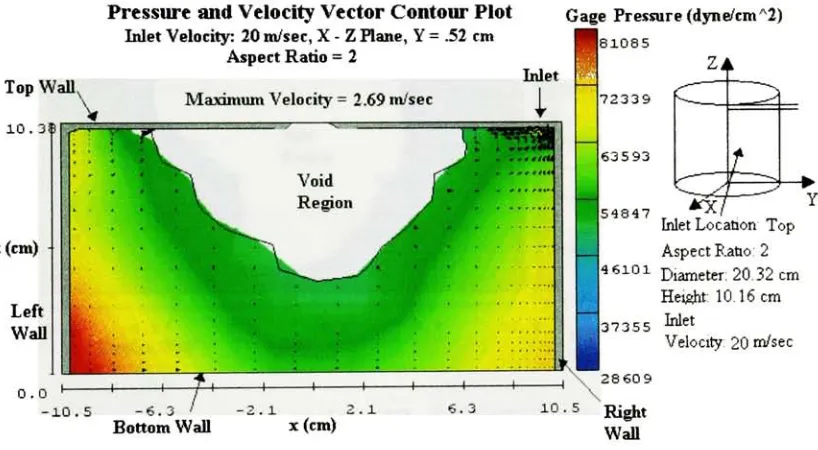
Top,Velocity
=20
m/s.76
Figure 4.20
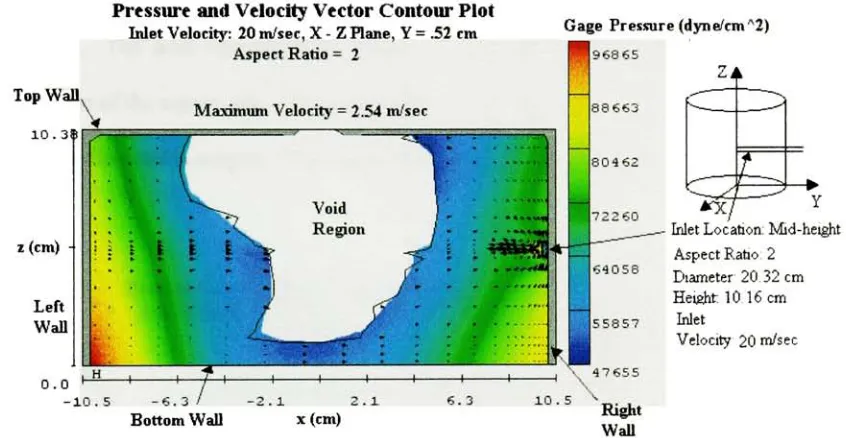
Contour Plot in
thex-zplane,AR=2,
Inlet:Center,
Velocity
=20
m/s.77
Figure
4.21
Contour Plot
in
thex-zplane,AR=1
.5,Inlet:Center,
Velocity
=20
m/s.78
Figure 4.23
Contour Plot in
thex-y
plane,inlet location
at center ofthevortex chamber.82
Figure
4.24
Contour
Plot in
thex-y
plane,top
ofthevortex chamber.83
Figure 4.25 Contour
Plot in
thex-y
plane,detail
oftheinlet
section.84
Figure
4.26
Pressure Contour Plot
for
theoptimizeddesign in
thex-y
plane atthe
bottom location
ofthevortex chamber86
Figure 4.27 Pressure Contour Plot for
theoptimizeddesign in
thex-y
planeatthemid-height elevationofthevortex chamber
88
Figure 4.28 Pressure Contour Plot for
theoptimizeddesign in
thex-y
plane atthe
top
location
ofthevortex chamber89
Figure 4.29 Pressure Contour Plot for
theoptimizeddesign in
thex-y
plane90
Figure
4.30
Velocity
Magnitude
andVectors
plot atbottom
oftheoptimized chamber93
Figure
4.31
Velocity
Magnitude
andVectors
plot oftheoptimized chamberat an elevation of
3.54
cm94
Figure 4.32 Detail
ofthe tangentialveolcity
closeto thewall95
Figure
4.33
Velocity
Magnitude
andVectors
plot at a mid-height elevation96
Figure 4.34 Graph
ofPressure
versusPosition for
theoptimized vortexchamber99
Figure 4.35 Graph
ofTangential
Velocity
vs.Position fortheoptimized vortex chamber101
Figure 4.36
Graph
ofTangential
Velocity
vs.Positionfor
theoptimized vortex chamberfor
the
boundary
layer
region102
Figure
4.37
Graph
ofAxial
Velocity
versusPosition
for
theoptimized vortex chamber104
Figure
G.l
Viscosities
ofAqueous Solutions
ofLithium Bromide
128
Figure H.l
Specific Heat
ofAqueous
Lithium Bromide Solutions
1
29
Figure 1.1
Enthalpy
Diagram
for
Aqueous
Lithium Bromide Solutions
130
Figure J.l The
Moody
Diagram
for Friction Factor
1 3
1
LIST
OF TABLES
Table
3.1.
List
ofCases
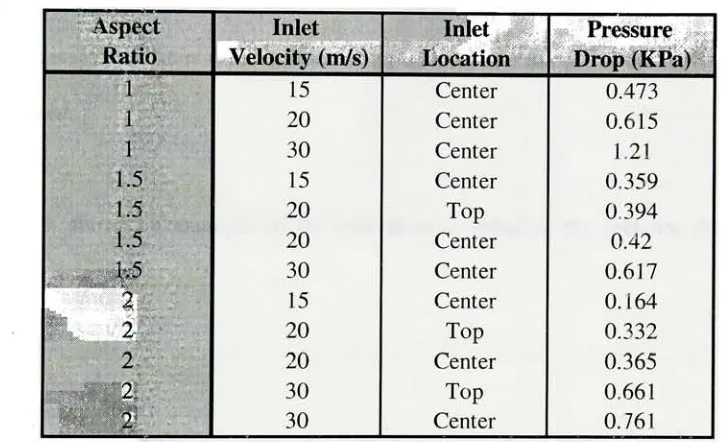
studied.40
Table
4.1. Results
ofthecases studied.62
Table 4.2. Comparison
oftheresultsfor different
void pressures.64
Table
4.3. Comparison
oftheresultsfor different
massflow
ratesand velocities.65
Table 4.4. Comparison
ofFree Surface Area
vs.Inlet
Velocity
withtheinlet
atthecenterofthevortex chamber.
67
Table 4.5. Pressure
drop
attheinlet
ofthevortex chamberfor different
aspect ratios andvelocities.
72
Table
4.6. Pressure
drop
acrossthebottom
outletfor
thecasesstudied.73
Table
4.7.
Table
of powerfor
eachmonomial termandcoefficientsfor
thepressure equationoftheoptimized vortex chamber
98
Table 4.8. Table
ofpowerfor
each monomialtermandcoefficientsfor
the tangentialvelocity
equation oftheoptimized vortex chamber1 00
Table
4.9.
Table
ofpowerfor
eachmonomial termandcoefficientsfor
theaxialvelocity
LIST
OF SYMBOLS
A
Cross
sectional area,areaAx,
Ay,
Az
Area
ofthefractional
open areain
eachdirection
AR
Aspect Ratio
D
Diameter
F
Fraction
offluid
-F
Force
vectorf
Friction
factor
FB
Body
force
Fc
Centrifugal
force
Fs
Surface force
g
Gravity
H
Vortex Chamber height
K
Turbulent kinetic energy
Kc
Contraction
coefficientNozzle
coefficientL
Pipe length
M
Mass
m
Mass flow
rateP
Pressure
q
Mean
component offlow
variableR,
rRadius
Re
Reynolds
numberS
Modulus
of mean rateofstraintensort
Time
t
Solution
temperaturet'
Refrigerant
temperatureu, v,w
Velocity
componentin
aCartesian
systemV
Linear velocity
VF
Fractional
volume opentoflow (open
volume/volumeofcell)Vg
Tangential velocity
X
Mass
fraction
x,
y
, zCartesian
coordinatesGreek Letters
GC/t
Inverse Prandlt
numberfor
turbulentkinetic energy
as
Inverse Prandlt
numberfor
turbulentkinetic energy dissipation
ratee
Turbulent kinetic energy dissipation
rateT
Circulation
p
Density
co
Angular velocity
ju
Absolute
Viscosity
a
Axial
stressCHAPTER
ONE
INTRODUCTION
1.1
PROJECT BACKGROUND
Waste heat
from industrial
processes and power plantsis widely
accepted as a practicalenergy
sourcefor
absorptionheat
pumps(Dorgan,
1995).
Heat
sourcesfrom approximately
99C
and abovehave
proven tobe
practical.However,
a significant amount of thermalresources
in
the range of211
-528
trillionkJ (200
and trillion500
BTU's)
per yearin
theform
oflow
temperature(between
60
and99C)
is known
tobe
wasted(Fineblum,
1996).
Figure
1.1
below
shows the amount ofenergy
source availablefor
a wide range oftemperatures.
Figure 1.1
shows that60%
of theheat energy in
the temperature range ofinterest
is
availablein hot liquids
rather thanin
gas.This
is
an advantagebecause
liquid
sources require smaller and
less
expensiveheat
exchangers.Conventional
absorptionrefrigeration systems can use a
heat
source withlower
temperature(temperatures below
99
C)
in
the generatorbut
with thepenalty
oflowering
both
theCOP (Coefficient Of
Availability
ofWaste Heat
600n
. 500
*S
300200
T 100 H
0
yff.v^";MWi
1
Gaseous
I Liquid
50-59 60-99 100-120 121-148
Temperature
ofWaste Heat(C)
149-203
Figure 1.1.
Availability
ofWaste Heat
for
a range oftemperaturesAn
absorption refrigeration system(shown
in
Figure
1.4)
thatincorporates
thedual
vortexchamber generator
(shown
in
Figure
1.3)
permitsgeneratorsto
operateefficiently
withlower
temperature waste
heat
as anenergy
source withimproved
capacity
andCOP.
For
adescription
of atypical absorptionrefrigeration systemand adual
vortex chambergenerator,
refertosection
1.4
and1.3
respectively.1.2
PROJECT
OBJECTIVES AND
GOALS
The
purpose ofthisinvestigation
is
todetermine
how
thevapor-liquidinterface
areageneratedby
the
strong
swirling
flow is influenced
by
the
LiBr
-Water
refrigerantrich
solutioninlet
10%
by
mass of the refrigerant-rich solutionentering
the vortex chamberin
vapor phase.Due
tolimitations
in
theComputational
Fluid
Dynamics
software use,FLOW-3D,
theamount of vapor generated can not
be
quantified.The
amount of vapor generated andtransferred to the vapor region
is
influenced
by
the vapor-liquidinterface
area generatedby
the
swirling
flow (refer
toFigure
1.2).
Mass
transferis
afunction
of area.This
means thatthegreaterthe surface area generated
by
theswirling
flow,
higher is going
tobe
the amountof vapor generated and transferred to the vapor region.
Also
it is intended
to predict thevelocity
and pressuredistribution
ofthesolutionin
thevortex chamber.Free Surface
areageneratedby
theswirlingflow.
LiBr-Water
Solution
Tangential Inlet
The
size ofthe
surface areais influenced
by
theInletVelocity.
Figure 1.2 Free Surface
area generatedby
thehigh
tangentialinlet
velocity.To
provethis,
FLOW-3D,
Computational
Fluid Dynamics
(CFD)
software was used.Different
cases ofthelower
chamber vortex generator withdifferent
configurations(aspect
ratios and
inlet
locations)
andinlet
velocities were studied.Simulations
were runby
changing
one oftheparameters andkeeping
therest oftheparameters constant with purposeThe
workinvolves
determining
conditionsfor
separation of the refrigerant vaporfrom
therefrigerant-rich solution.
Also,
verify
the pressure gradient at thelower
chamber.From
theresults ofthe
investigation,
it
is hoped
that there willbe
enoughdata
todetermine how
thereplacement of a conventional generator
by
adual
chamber vortex generatormay
affect theefficiency
oftheprocess and whatwillbe
thelimiting
factors.
1.3
DESCRIPTION
OF THE DUAL VORTEX CHAMBER
GENERATOR
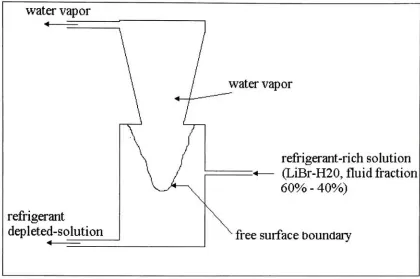
The
schematic ofthe vortex generatoris
shownin Figure 1.3. The
vortex generator consistsoftwo chambers,
lower
chamber andupperchamber.The
lower
chamberis
a cylinderwith atangential
inlet,
atangential outlet atthebottom
ofthechamber anda central outlet atthetop
ofthechamberthatconnects with theupperchamber.
The
upperchamberhas
a centralinlet
atthe
bottom
partand atangential outlet atthetop
part.The heated
refrigerant rich solution(LiBr-
H20,
fluid fraction
60%
-40%
by
weight of solution) enters thelower
chambertangentially
at conditions close to the saturation pressure.Due
to conservation of rotationalmomentum, thepressure
is
reduced towardthe central portion ofthelower
chamber.Close
to the
free
surfaceboundary,
the pressure willdrop
below
the saturation pressure of theLiBr-water
solution.This
will cause cavitation and as a result, theheated
refrigerant-richwater vapor
*
refrigerant
depleted-solution
water vapor
refrigerant-rich solution
:<
(LiBr-H20,
fluid
fraction
60%
-40%)
[image:20.503.42.462.63.342.2]free
surfaceboundary
Figure 1.3. Schematic
oftheVortex Chamber
generator.The
refrigerant vapor willflow
out oftheswirling
mixture toward the center and upward.The
vapor will thenflow
through the central outlet and out of thelower
chamberinto
theupper chamber.
The
upper chamberis designed
as adiffuser
withgradually
increasing
cross-sectional area.
There,
theswirling
vaporis
tangentially
decelerated
as a result ofrotational momentum and the vapor pressure will
increase
prior toleaving
through thetangentialoutlet.
The deceleration
offlow
in
theupper chamberis essentially
similartowhatoccurs
in
thediffuser
ofa compressor(Fineblum,
1996). The
refrigerant-depleted solutionin
It
is intended
toreplacetheconventional generatorin
theAbsorption Refrigeration Cycles
by
the
Vortex Chamber
generator.The
goal oftheVortex Chamber is
to obtain10%
by
weightofthe
incoming
solutionin
refrigerant vapor.The
vortex chamber utilize theenergy
oftheincoming
LiBr-water
solutiontoconvert some oftherefrigerantinto
water vapor.Therefore,
it
will requiredless energy
from
an external source to generate the same amount of vaporthan
in
conventional generators.1.4
ABSORPTION REFRIGERATION
CYCLE
In
the typicalLithium Bromide
-Water
absorption refrigerationcycle, asshownin figure 1
.4,therefrigerant
is
the waterand the absorbentis Lithium Bromide.
The
machine consists offour
components that exchangeenergy
with surroundings, oneinternal heat
exchanger, twoflow
restrictors, and a pump.The
four
components that exchangeenergy
with thesurroundings are the condenser, generator, evaporator and absorber.
The
machine operatesbetween
twoworking
pressures, thehigh
pressureside(typically
6
KPa)
andthelow
pressureside
(typically
1 KPa).
The high-pressure
sideis
at the generator and condenser, and thelow-pressure
sideis
attheabsorber andevaporator.The
pressureis determined
by
thevaporpressure ofthe characteristics of the
working fluids.
In
a60%
-40 % Lithium Bromide
-Water
solutionentering
the condenser, the vapor pressure of the solutionis 5.8 KPa.
This
meansthat thepressureatthe
high
pressuresideis 5.8 KPa.
In
a typicalLithium Bromide
-Water Absorption Refrigeration Cycle (see
figure
1.4 for
reference), the refrigerant-absorbent solution
is
pressurizedby
apump
and conveyed to thegenerator
through
aninternal heat
exchanger.In
the
generatorthe
refrigerantandabsorbentare
partially
separated.Separation in
conventional generatorsis
possible whenheat
is
supplied
by
aheat
source.For
atypical aqueouslithium
bromide
machine,
theGenerator
Condenser
High
Temperature In
Heat
Exchanger
Solutionn
Pump C \
Restrictor
Vapor
Absorber
Heat
Out
T
Heat Out
Restrictor
Evaporator
Low
Teperature In
Figure 1.4. Typical Absorption
Refrigeration
System.
generator
heat
mustbe
supplied above atemperatureofapproximately
90
C
(Herold,
1996).
The increase
in
temperaturein
the
generator converts some of the refrigerantinto
watervapor.
It
is
expectedthat
someLithium
Bromide
saltmoleculesmay
escapefrom
the
liquid
conditions encountered
in
an absorption machine that the vapor above theliquid
solutionis
essentially
pure water vapor.This
fact
canbe
appreciated morefully by
realizing
that theboiling
point of solidlithium
bromide
is 1282 C.
(Herold,
1996).
When heat
is
appliedin
the generator, some ofthe waterbecomes
vapor andflows
to thecondenser.
The
remaining
hot LiBr-Water
solution passes through aheat
exchanger andis
conveyed to the absorber.
The
purpose oftheheat
exchangeris
to reducethe externalheat
applied atthegenerator
by
using
theenergy
availablewithinthesolution.The
hot
refrigerantweaksolution
leaving
thegenerator should contain a substantial amount of refrigeranttokeep
the pure absorbent material
in
adilute
state.This
is very important if
the absorbentis
Lithium Bromide because it
tends toform
solidsif it is
not welldissolved.
To
avoidsolidification of
Lithium Bromide
-Water
solution, the mass
fraction
ofLithium Bromide
should
be kept below 70 %
(ASHRAE,
1994).
The
subcooledliquid
refrigerant thatleaves
thecondenseris
throttled through therestrictortothe
low
pressure side and then conveyedinto
the evaporator, whereit is
evaporated atlow
temperatureandpressure with
heat
ofthecooled space.The low
pressure refrigerant vapor attheevaporator
is
conveyedinto
the absorber while still atlow
pressure.In
the absorber, therefrigerant vapor
is
absorbedby
the refrigerant weak solutioncoming from
the generator.The
absorption takes placebecause
of thehigh affinity between
the absorbent and theWhen
theVortex Chamber
incorporates
to the absorption refrigeration cycle, the system willremainthe same.
The only
difference
is
that the generatorin
conventionalLithium Bromide
-
Water
absorption refrigeration system will
be
replacedby
thedual
vortex chamber.With
thereplacement oftheconventional generator
by
the vortex chamber, someofthevaporwillbe
generateddue
tocavitation.A
strong swirling
flow
will create a pressuredrop
toward thecenter ofthechamber.
At
somepoint, thepressure willdrop
below
thesaturation pressure ofthe solution and will cause cavitation.
To
achieve thedesirable
vapor amount of10%
by
weight ofthe
incoming
solution with anincorporated
vortexchamber, an externalheat
sourcemight
be
needed.But
theamount ofheat
source neededwiththevortexchamberwillbe less
than the amount of
heat
source neededfor
conventional generators to achieve the sameresults.
This
will make the vortex chamber generator more efficient than conventionalgenerators.
1.5
VORTEX
FLOW THEORY
Flow
in
acurvedorcircularpathis
commonin
nature.A
vortexis
astreamlinein
afluid
thatinduces
a circular motionin
thesurrounding fluid. Consider
theflow between
twoconcentricFigure
1.5.
How in
a curved path.The
radius of curvature of the pathis
r, and the tangentiallinear velocity is
Vq.
The
infinitesimal
elementis
ofheight
dr,
and the average areaalong
the curved surfaceis
dA.
The
massfor
thiselementwillbe
dm
=p-dr-dA(1.1)
The
radial accelerationis
defined
asVg/r.
The
centrifugalforce
acting
ontheelementhas
themagnitude of
Fc
=p
dr
dA
(V^/r)
(1.2)
The
pressure variesfrom P
toP
+dP
as theradius variesfrom
r to r +dr.
The
centrifugalforce
onthefluid
elementis
just
balanced
by
theresultantforce
due
to thepressures overthesurfaces.
A
force balance in
theradialdirection
givesdP
=piVj/r)
dr
(1.3)
Equation 1.3
indicates
that the pressureincreases
with radiusin
curvedflow
and thereis
afall in
pressuretoward thecenter of curvature or center ofthevortexchamberby
an amountof
p(y2elr)
dr.
The
pressure gradient willbe dP/dr
=p(Vg/r).The
equation1.3
aboveis
asimplified equation of the
Euler's
equation andis only
applicablefor
situations ofsteady
state and
inviscid
flows.
LiBr-Water
solutionis
avery
viscuosfluid.
Therefore,
the use ofthis equation to calculate thepressure
drop
toward the centerin
the vortex chamber will notgive accurate results.
The CFD
codebeing
usedto simulate thebehavior
oftheLiBr-Water
solution
inside
thevortex chamberincludes
theeffectsof shear stress.Two different
types ofidealized
vortexflows
exist.These
are theforced
vortex andthefree
vortex.
A
forced
vortexis
aline
thatinduces
aflow in
thesurrounding
fluid,
which movesin
cocentric circles about the vortex core and
in
which thefluid
tangentialvelocity
(Ve)
increases
linearly
withradius.Figure 1.6 below illustrates
aforced
vortexflow.
Streamlines
Vortex
coreThe
vortex coreis
perpendicularto the paper,andthefluid
tangentialvelocity is
Vq
=co*rwhere co
is
thefluid
angularvelocity
and ris
theradius.(1.4)
The
secondtypeof vortexflow is
thefree
vortex.A free
vortexis
aline
thatinduces
aflow
in
thesurrounding
fluid,
which movesin
cocentriccircles aboutthevortexcoreandin
whichthe
fluid velocity decreases
inversely
with radius.Figure 1
.7illustrates
afree
vortexflow.
Streamlines
Vortex
coreFigure 1.7. Free
vortexflow.
The
vortexcoreis
perpendicularto the paper, andthefluid velocity is
Ve
=&
d-5)
where
T is
a constant thatis
called the circulation.If
a circular pathis
selected with thevortex core at
its
center, wemay determine
the circulationfor both
vortexflows.
For
ar
= l2Qnco*r(r*
d6)
=2ncor2(1
.6)
For
afree
vortexflow
thecirculationis
constantfor any
pathand canbe
expressedasr
=ff(r*d0)
=2*
=r
(1.7)
In many
applications where afluid is injected
tangentially
into
a chamber, the vortexflow
formed is
a combination of aforced
vortex and afree
vortexflow.
This is
commonin
situations wherethe
fluid is
viscous andcannotbe
approximatedas, anideal flow. When
thefluid viscosity is
considerablehigh,
asin
the case ofthe LiBr-water solution, the nonslip
condition atthewall ofthechamber should
be
met.Therefore,
thevelocity
ofthefluid
atthewall
is
zero m/sec.Figure 1.8
shows pressure andvelocity distributions
of a typical vortexflow.
As
shownin
thisfigure,
theflow
is
aforced
vortexflow
atthe center portion ofthe1>
o *S
V
Free Vortex
Region
Forced
Vortex
Region
1
1
11
1
1
1
Pressure
Free Vortex
Region
Tangential
Velocity
Transition
Radius,
rFigure 1.8. Pressure
andvelocity distribution in
atypical vortexflow
application.In
thevortex chamber, aforced
vortexflow
and afree
vortexflow
arepresent.In
the vortexchamber the
velocity increases
with radiusup
to a critical radius.This
critical radiusis
located very
close to the vortex chamber wall.This is
theforced
vortexflow
region.From
the critical radius
up
to thewall, theflow
is
afree
vortexflow.
This
is
thefree
vortexflow
To
create a vortexflow
in
thevortex chamber,theinlet
needs tobe
placetangentially
to thevortex chamber wall.
The
characteristic oftheinlet velocity
of theincoming
fluid
and thegeometry
of the chamber creates astrong
vortical(swirling)
flow field.
The commonly
accepted tangential
inlet velocity working
range to assure astrong
vortexflow
is from 16
CHAPTER
TWO
FLUID
FLOW
THEORY
2.1
THE
MASS
CONSERVATION EQUATION
Consider
acontrolvolumeofinfinitesimal dimensions
asshownin Figure 2. 1
.A
massbalance
will nowbe
made over the control volume.The
application of theprinciple ofconservationof mass yields
which
is
thecontinuity
equationfor
a two-dimensionalunsteady flow in
rectangularcoordinates.
The
corresponding
three-dimensionalunsteady flow
equation canbe
writtenas
follows
d
t \d
t \d
t \dp
n(2.2)
Once steady
stateis
achieved, thelast
termin
theequation aboveis
eliminated andif
thefluid is
incompressible,
like
theLiBr-Water
solution, equation
2.2
reducetoi(")
+i(v)
+i(w)
=0
(2.3)
When
the vortex chamber starts to operate, thefluid is unsteady
until a nice parabolicshape
is
establishedin
thevoid regionandis
stabilized.The
voidregionis
establisheddue
the
high
tangential velocities.In
theperiodoftimewhere thevoid regionis
notstabilized,the
unsteady
continuity
equation shouldbe
used.Once steady
stateis
achieved, equation2.3
canbe
used.However,
Flow-3D
is
a transient code and always uses theunsteady
continuity
and momentum equations equationin its
algorithm.FLOW-3D
also makes a small changein
thecontinuity
equation.It
incorporates
in
theequation terms that accounts
for fractional
area andfractional
volume area open toflow.
themomentum equations.
The
momentum equation, modified with the extraterms addedby
FLOW-3D
for
incompressible
flows
and with no mass sourcebecomes
i~F%
+~k
("
A*)
+f(v
Ay)
+fz(w
-Ay) =0
(2.4)
where, the
velocity
components(u,
v, w) arein
thecoordinatedirections
(x,
y, z).Axis
thefractional
area open toflow in
thexdirection,
andAy
andAz
are similar areafractions for
flow in
they
andzdirections,
respectively.VF
is
thefractional
volume open toflow. The
fractional
area and thefractional
volume open toflow is
appliedin
cases where the cellis
partially filled.
This apply in
thefree
surface region.A
pictorical representation ofthefractional
areas andfractional
volume opentoflow is
shownin Figure 2.3.
2.2
THE MOMENTUM
EQUATIONS
The
equations of motionfor
realfluid,
which arebased
onNewton's
secondlaw,
permitthe
determination
oftheway
thevelocity
varies with position.It
will thenbe
possible tofind
quantities such as the pressurein
laminar flow.
The
equations, with certainmodifications, can also
be
usedfor
turbulentflows.
For
aninfinitesimal
system of massdm
moving in
avelocity
field,
Newton's
secondlaw
canbe
written(2.5)
DV
d F
=dm
=dm
Dt
dV
dV
dV
dV
u
1-v \-w 1
ox
dy
di
dt
There
are two types offorces
acting
on afluid
element;body
forces
and surfaceforces.
Surface forces include
both
normal and shearforces.
Considering
the stresses that actin
the xdirection
andmaking
reference toFigure
2.2,
toobtain the net surface
force
in
the xdirection,
dFSx,
we must sum theforces in
the xdirection.
&
dy
1IV icy
2
dv
dz
T
"
dz
2
cr +
dcrrr
XXdx
&
2
dt
dz
Tzx+ ~
zx
&
2
X
yx
fcyx
dy
cy
2
-?x
Figure 2.2. Stresses acting
on arectangularfluid
particle.The
results,including
thebody
forces,
yieldstodFr
=dF<
+dFR
=darr
.
drw
_dx
\ pgx+JOL+ 2.+ adx.
dy
dz
J
dxdydz
Similar
expressionsfor
theforce
componentsin
they
and zdirections
canbe
obtainedfollowing
thisprocedure.Once
the expressionsfor
thecomponents(dFx, dFy,
dFz
)
oftheforce,
d F
,acting
on theelement of mass
dm
are obtained, theforce
components are substitutein
equation2.5
toobtainthe
differential
equationsofmotion.For
thexdirection
resultwillbe
PSX
+dx
du
da
da
da
=
p
u hv \-w 1dy
dz
vdx
dy
dz
dt)
d<yrr
dz
dx,
+ y+-(2.7)
Similar
results are obtainfor y
and zdirections.
To
get the equations ofmotion calledNavier-Stokes
equations, the stressesmay be
expressedin
terms ofvelocity
gradients andfluid
properties.(2.8)
xv vx A* xy yx
dv
da
dx
dy
x x =u
vz zv r*
dw
dv
dy
dz)
(2.9)
xz zx "
da
dw
+ \dzdx
(2.10)
2
itda
a =-p--uV-V+2{i y
3
dx
(2.11)
CT^
=VV+2/^
3
dy
(2.12)
zz
=2
-dw
-,-f,V.V+2,-(2.13)
Combining
equations2.7
with equations2.8
-2.13
results
in
theNavier-Stokes
equationfor
thexdirection.
Du
dp
d
p
=-+
Dt
dx
dx
M2|_|v.v
+-
d_
dx
M
dv
da
+ \dxdy.
d_
dz
da
dw
ju\ +dz
dx
(2.14)
Similarly,
theNavier-Stokes
equationsfor
they
and zdirections
andassuming gravity is
present
only in
thezdirection
yieldstoDv
dp
d
p
=-+
Dt
dy
dx
M
ch
da
\dx
dy
+-
d_
dy
<-->
d_
dz
M
d\>
dw
+\dz
dy)
(2.15)
Dw
_
dp
d
PTt=P8z~~dt+~dx
f
dw
da
\dx
dz
+d_
dy
M
'dv
dw
+ \dzdy)
+dz
*2f-fv.V
(2.16)
These
equations are non-linear, there are moredependent
variables thangoverning
equations, and no general method ofsolution exist.
The only
methodto solvethemis
by
CFD
analysis.With
the addition offractional
area open are open toflow,
the momentum equations arerepresented
by
FLOW-3D
asfollows
du
1
.da
,da
,da\
+ <uA, +vA + wA,
dt
V,
dx
dy
zdz
d\>
1
\
.dv
, d\> .
d>\
+ <uAr + vA, + wA,
dt
V,
dx
dy
dz
p dx
pdy
(2.17)
(2.18)
dw
1
i
,dw
dw
,dw\
+
{
uAr +vA + wA,-r-!
dt
Vc
dx
dy
dz
p
dz
In
these equations,(Gx,
Gy,
Gz)
arebody
accelerations and(fx,
fy,
Q
are viscousaccelerations.
The
vicous accelerations are alsofunctions
of thefractional
areas and volume opentoflow.
They
canbe
expressed asfollows
PVPfx
=^-||(A,r)
+|(A,r,)
+|(A,^)j
(2.20)
pVFfz
= wsz-{|(^>+|(v,)+|(v.)}
(2.22)
In
the above expressions the terms wsx,wsy
and wsz are wall shear stresses.The
fractional
areas(Ax, Ay,
Az)
andthevolume opentoflow
(VF)
are appliedin
thecells thatare
partially filled.
2.3
TURBULENT FLOW
The majority
offlows
are turbulentin
nature.The
turbulence model tobe
usedis
theRenormalization
Group
(RNG)
k-e
model.This
modelbelongs
to thek-s
family
ofmodels.
It
falls in
thecategory
of"two-equation"
turbulencemodels
based
on anisotropic
eddy-viscosity
concept.The
majordifferences
between
theRNG
and the standardk-s
models,
stemming from
thefact
that theRNG
model wasderived
using
more rigorous statisticaltechnique,
withmodel constants thatarederived
"analytically". The RNG
modelhas
an additional termin
its
8 equation thatsignificantly improves
theaccuracy for rapidly
strainedflows.
Also
theeffect of swirl onturbulence
is
included
in
theRNG
model,which enhance theaccuracy
ofswirling flows.
Unlike
the standardk-e
model thatis
based
onReynolds
averaging, theRNG-based
k-s
turbulence modelis
derived
from
theinstantaneous
Navier-Stokes
equations,using
rigorous mathematical technique calledRenormalization
Group
(RNG) Methods(Fluent,
1996).
In
Flow-3D,
thefollowing
two transportequations areusedin
theRNG
turbulentmodeldt + vAu
A*dx
+v'Aydy
+w'AzdzJ- vFidAak pAxdx)+
dy(akpAy-Q-)dyV*k P ydy, +i(ak*fAz%)}+CM*rS2-p
(2.23)
and
dt + VF\U
Axdx
+V-Aydy
+W-AzdzJ
-vFidx(.ae p Axdx)+ ^{ae p
Aygy)
+Ua^AA)}
+Cl-Cfi.k.S2-C2eT-R(2-24)
wherea^and aarethe
inverse Prandtl
numbersfor k
and.juejf
is
theeffective viscosity.S
is
themodulus ofthemeanrate-of-strain tensorandR in
thesequationis
givenby
CMPV\\-r,/no)
E2 K~i+^3 k
(2.25)
where
rj
=Sk/s
, r\0=
4.38,
j3
=.012,
Cp
=.0845,Cu
=1.42
andC2fi
2.4
FREE SURFACE THEORY
In
thevortex chamber, thehigh
tangential velocitieswill generate avortexflow. This
willcreate a void region
in
the central portion of the chamber.To
simulate theinterface
between
the void region and theLithium Bromide
-Water
solution,
it is necessary
to turnonthe
free
surface model.An interface between
a gas andliquid is
often referredtoas afree
surface.The
reasonfor
the"free"
designation
arisesfrom
thelarge difference in
thedensities
ofthegas andliquid.
A low
gasdensity
means that thatinertia
cangenerally be ignored
comparedto thatoftheliquid.
The only influence
ofthe gasis
thepressureit
exerts on theliquid
surface.Free
surfaces require the
introduction
of special methods todefine
theirlocation,
theirmovement andtheir
influence
on aflow. Regardless
themethodemployed, therearethreeessential
features
neededto modelfree
surfaces(Flow-3D,
1999):
1
.A
schemeis
neededtodescribe
theshapeandlocation
of asurface,2.
An
algorithmis
requiredtoevolvetheshapeandlocation
withtime,
and3.
Free-surface
boundary
conditions mustbe
applied atthesurface.Flow-3D
uses theVolume-of-Fluid
(VOF)
method to track thefree
surface.The
idea
for
this approach originated as a
way
tohave
the powerfulvolume-tracking
feature
of theIf
the amount offluid
in
each cellis
known,
it is
possible tolocate
surfaces anddetermine
the slopes and surface curvatures.
Surfaces
areeasy
tolocate because
they
lie in
cellspartially
filled
withfluid
orbetween
cellsfull
offluid
and cells thathave
nofluid.
Slopes
and curvatures are computed
by
using
thefluid
volumefraction in neighboring
cells.The
essential element
in
thisprocessis
to rememberthatthe volume shouldbe
astep
function,
example,
having
a value of either one or zero.Knowing
this,
the volumefractions in
neighboring
cells canthenbe
usedtolocate
theposition offluid
withinaparticularcell.Free
surfaceboundary
condition mustbe
applied asin
theMAC
method.Finally,
tocompute the time evolution of surfaces, a technique
is
needed to move volumefractions
through a grid
in
such away
that the step-function nature of thedistribution is
retained.The basic kinematic
equationfor fluid fractions is
similar to thatfor
theheight-function
method,where
F
is
thefraction
offluid function.
dF
dF
dF
dF
n(2.26)
+ + + =
0
dt
dx
dy
dz
The
vortex chamber as shownin Figure 1.2
presents afree
surfacein
theregionbetween
the
Lithium
Bromide-Water solution and the water vapor.The
region occupiedby
thewater vapor
is known
as the void region.For
the simulation ofthelower
chamber, thesoftware
does
not solvethedynamics
ofthe gasin
thevoid region.Instead,
it
treats themas regions of uniform pressure.
This
pressureis
used as aboundary
condition on theLithium Bromide
-Water
/
water vaporinterface.
Since in
this case, the void regionis
adjacent to a pressure
boundary
(the
top
of thelower
chamber), the pressurein
the voidIn
Flow-3D,
thefluid
configurations at the void region volumes andinterfacial
area aredefined
in
terms of a volume offluid
(VOF)
function
ofF(x,y,z,t).
This function
represents the volume of
Lithium Bromide
-Water
per unit volume and satisfies the
equation
dF_
J_
dt
+Vr
d_
dx
d
d
(F-Ax.u)
+^(F.Ay.v)
+^-(F.Az.W)
dy
dz
FDIF
(2.27)
whereFDIF
=V,
d(
AdF\
d
(
dF)
VF'Ax
+ Vr,'Adx
\dx)
dy
V " ydy)
d(
AdF
+
vF
-A,dzV
F zdz
(2.28)
In
thisequation:VF
=thefractional
volumeopentoflow
=open volume
/
volume ofcellAx,
Ay,
Az
= area ofthefractional
open areain
eachdirection
Refer
to thefigure below for better understanding
/-^
4
vF
/
Ax
(
>>./
A
/
y
Ay
w XFigure
2.3.
Partially
filled
cell.The
diffusion
coefficientis defined
asvF=CF
u/p.Where
CFis
a constantwhosereciprocalis
referredtoas aturbulentSchmidt
number.The
interpretation
ofF
depends
onthe typeofproblembeing
solved.F
has
valuesbetween
0
and1. If
noLiBr
-Watersolutionis in
the cell,F
=0. If
thecellis completely filled
withLiBr
CHAPTER
THREE
Computational Fluid Dynamics Analysis
3.1
CFD
Code Introduction
The Computational Fluid Dynamics
(CFD)
software packageFLOW-3D
was usedfor flow
analysis.
This
codeis
a toolfor
theinvestigation
ofthedynamic behavior
ofliquid
andgases.
Because
the softwareis based
on thefundamental laws
of mass, momentum andenergy
conservation,it is
capable ofsimulating
awidevariety
offluid flows. The specialty
ofthispackage
is
thesimulation offree
surfaceflows. FLOW-3D is
atransientCFD
code.This
means that the programhas been
constructedin
such away
that the problems aresolved
in
atimedependent
manner.Steady
state results arecomputed asthelimit
ofatimetransient
(FLOW-3D,
1996).
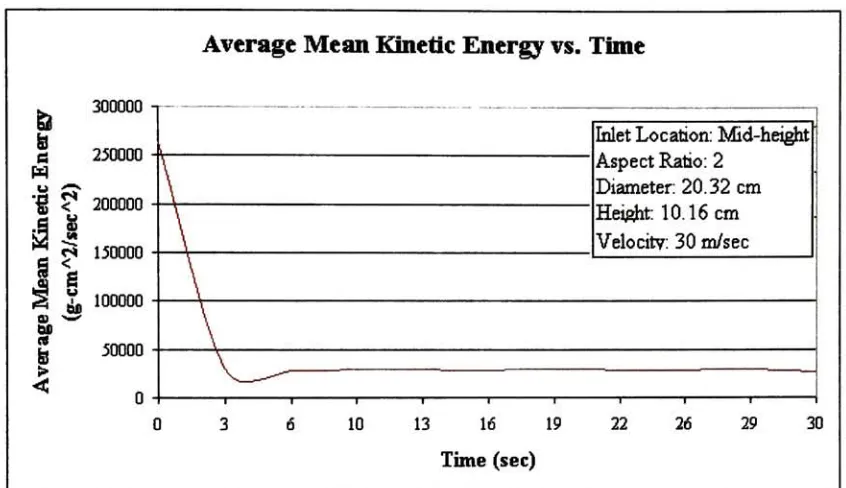
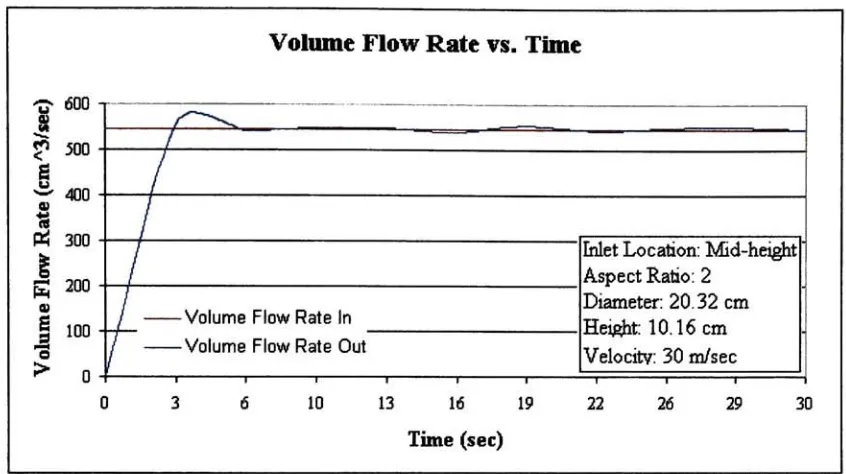
Steady
stateis
achieved when the meankinetic energy
andthevolumeof
fluid
does
not changewithtime.FLOW-3D
differs from
theotherCFD
programsin
several ways.It
uses afixed
(Eulerian)
grid of rectangular control elements
because
these are simpler to generate,increase
theaccuracy in
the results, requiresless memory
and simple numerical approximations.A
special technique called
FAVOR
(Fractional-Area-Volume-Obstacle-Representation)
method
is
used todefine
general geometric regions within the rectangular grid.This
method
has
a great advantage over grid methods thatdeforms
their elements tofit
geometry.
The biggest
advantageis
thatgeometry
and grids arecompletely independent
ofone to another.
This
feature
is
calledFree
Gridding,
andit
eliminates the tedious taskofgenerating
body
fitted
orfinite-elements
grids.FAVOR
method uses partial controlvolumes to give users the advantages of a
body-fitted
gridbut
retains the constructionsimplicity
ofanordinary
rectangular grid.Another feature
thatdiffers FLOW-3D from
otherCFD
codesis
theVolume
ofFluid
(VOF)
technique.This
is
the preferredfeature for many
applications thatinvolve
free
surface
boundaries.
The VOF
method consists of three elements: a volume offluid
function for
defining
surfaces, a special advection methodthatmaintains asharp definition
of surfaces as
they
move anddeform
within a computational grid, and the application ofnormal and tangential stress
boundary
conditions at the surfaces.The VOF
method alsoallows
for
thebreakup
andcoalescence offluid
surfaces.Finally,
relaxation and convergenceparameters that are neededin
allComputational Fluid
Dynamics
programs, aredetermined
by
FLOW
3D
asit is
running.This
allows the3.2
MODEL
GENERATION
Any
problem onCFD
simulation requires a mathematical modelformulation in
ordertobe
run.
A
mathematical model consists oftheboundary
conditions,initial
conditions and thegoverning
equations.The
purpose oftheCFD
simulation ofthe vortex chamberis
tostudy
thebehavior
ofthefluid dynamics (pressure
gradients andvelocity
vectors) oftheLiBr-Water
solution withinthechamber.
In
thisthesis,
amodel willbe
generatedfor
thelower
chamber andonly
theincompressible
region ofit
willbe
study.The
incompressible
regionofthelower
chamberis
theregion occupiedby
theLiBr-Water
solution.Parameters
ofinlet velocity
and aspectratio
(chamber
diameter /
chamberheight)
willbe modify in
the model to obtain theoptimized
design.
3.3
INITIAL CONDITIONS
Initially
thelower
chamberis partially filled. The
chamberhas
onetangentialinlet
andtwooutlets.
One
of the outletsis
at the center of thetop
wall of thelower
chamber andconnectsthe
lower
chamber withtheupper chamber.The
otheroutletis
atangentialoutletlocated
atthebottom
ofchamber. Refrigerant-rich solutionenters thechamberthrough thetangential
inlet,
thedepleted
solutionleaves
thechamberthrough the tangential outlet andvapor
leaves
the chamber through the outlet at the center of upperboundary.
Since
noevaporation takes place
in
the vortex chamber, all theincoming
solution exits the vortexchamberthrough the
bottom
outlet.At
theinlet,
the composition ofthe solutionis
60%
LiBr
and40%
water and the solutiontemperature
is 80C. With
theseconditions, thesaturationvaporpressure oftherefrigerant(vapor)
andtherefrigeranttemperaturecanbe determine. The
vaporsaturation pressurefor
theseconditions
is 5.8 KPa. This is
atypicalvaluein
thehigh-pressure
shell of absorptionrefrigeration cycles.
These
parameters canbe determined
by
using Equilibrium Chart for
Aqueous
Lithium
Bromide
Solution
from ASHRAE
(Appendix
D).
Also
canbe
determined
by
using
thefollowing
formulas
(ASHRAE,
1993):
<=
ToBnXn +
t%AnXn
(3.1)
LogP
=C
+DI (f
'+459.72)
+E I
(f+459.72)2
(3
3)
-2F
-459.72
(3.4)
D
+[D2-4E(C-log
P)]
where:
A0
=-2.00755B0
=321.128
C
=6.21 147
A2
=-3.133336E-3
B2
=0.374382
E
=-337269.46A3
=1
.97668
E-5
B2
=-2.0637E-3
t'
=
Refrigerant
temperature,
C
Range:
0<
t'<
230F
t=
Solution temperature,
C
Range:
40
<t<350F
X
=Percent
ofLiBr,
%
Range:
45
<
X
<70%
P
=vapor saturationpressure,psia
Also from
theinitial
conditions, theproperties ofthesolution suchasdensity
anddynamic
viscosity
canbe determined
by
using ASHRAE
charts(Appendix E
andF).
For
theinlet
conditions ofthesolution,thesaturation pressure oftherefrigerantis 5.8 KPa.
The
pressure at theinlet
shouldbe very
close to saturation pressure.For
this reason thepressure ofthe
liquid
portion ofthepartially filed
chamber was setto6 KPa.
Also
toreducecomputing
timein
thesimulation, aninitial
tangentialvelocity
wasappliedto the solution within the vortex chamber.
The
initial
tangentialvelocity
was set toincrease
linearly
in
theradialdirection
with a maximumvelocity
atthe wall ofthe vortex3.4
MODEL
MESHING
AND
BOUNDARY
CONDITIONS
3.4.1
Meshing
Due
to thegeometry
of the chamber, cylindrical coordinates seems tobe
thebest
coordinate system
for
meshing.But
in Computational Fluid Dynamics
analysis,cylindricalcoordinates are used
only for
axisymmetric or annulardomain
calculations.The Vortex
Chamber
generatoris
not axisymmetric.Therefore,
rectangular coordinates aregoing
tobe
used
for
the meshing.Also,
at theinlet
ofthe chamber,the results ofthe simulation willnot
be
goodif
cylindrical coordinates are used.This
is because
attheinlet,
thediameter is
very
small andit
willbe very difficult
to capture thedetails in
this area with acylindricalmesh.
The
rectangular meshin
theinlet
sectionis going
tobe very dense
to capture thebehavior
ofthefluid dynamics in
thatsection.3.4.2
Boundary
Conditions
Two different
types ofboundary
conditions wereusedin
themodel(velocity
and pressureboundaries).
A velocity
boundary
condition was set at theinlet
ofthe vortex chamber.A
pressure
boundary
was set to thebottom
outlet ofthe vortex chamber.Also
a pressureFigure
3.1
below,
showsthesymbols usedfor
eachboundary
conditions.Inlet
y
WL
WBK
I
i *> ,, V (
1
""Si *
r ^
\
(
)
\
\
v^7^^>
I
mrc 1 h.
Wr
& v* X i
Top
Outlet
.:;:';\i
WR
WF
a-''J-Outlet
_j +Inlet
WBK
Top
View
Outlet
WB
Side View
Figure 3.1. Vortex Chamber
schematic withboundary
conditions symbols.Where:
WB
=boundary
conditiontypeatminimum z side(bottom)
of mesh.WBK
=boundary
conditiontypeatmaximumy
side(back)
of mesh.WF
=boundary
conditiontypeatminimumy
side(front)
ofmesh.WL
=boundary
conditiontypeatminimum x side(left)
of mesh.WR
=boundary
conditiontypeatmaximum xside(right)
of mesh.WT
=boundary
conditiontypeatmaximum zside(top)
of mesh.The boundaries
attheleft
(WL),
right(WR)
andbottom
(WB)
are treatedas rigid walls.No
fluid flow
across theseboundaries.
The back
boundary
(WBK)
is
where thebecause
thefluid
enters the chamber at a specified velocity.The inlet
velocities ofthesolutionto thechamber are
15,
20
and30
m/sec.The
top
(WT)
andfront
(WF)
boundaries
are pressure
boundaries
and were settoa pressure of5 KPa
and4.5 KPa
respectively.The
figure
below
showsthelower
chamber schematicwiththeboundary
conditions.WT Conditions
Pressure=5 KPa
WT
Pressure=4. 5 KPa
WBK Conditions
Solution: 60% LiBr- 40%water
Temperature=80C Pressure =6 KPa
Density
=1670Kg/m3Velocity
=15,20 & 30m/sec
outlet
WB
Front View
Figure 3.2. Lower Chamber Schematic
withboundary
conditions.3.5
MODEL STUDY
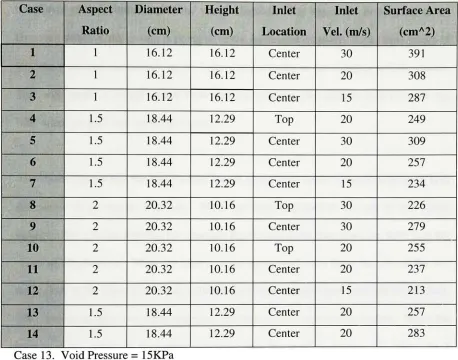
Different Vortex Chamber
configurations andinlet
velocities were studied.Parameters
such asthevortex chamber aspect ratio
(diameter/height),
inlet location
andinlet
velocitieswhere changed
in<