R E S E A R C H
Open Access
Inclusion and definition of acute renal
dysfunction in critically ill patients in
randomized controlled trials: a systematic
review
Rogerio da Hora Passos
1,3*, Joao Gabriel Rosa Ramos
1, André Gobatto
1, Juliana Caldas
1, Etienne Macedo
2and Paulo Benigno Batista
1Abstract
Background:
In evidence-based medicine, multicenter, prospective, randomized controlled trials (RCTs) are the
gold standard for evaluating treatment benefits and ensuring the effectiveness of interventions. Patient-centered
outcomes, such as mortality, are most often the preferred evaluated outcomes. While there is currently agreement
on how to classify renal dysfunction in critically ill patients , the application frequency of this new classification
system in RCTs has not previously been evaluated. In this study, we aim to assess the definition of renal dysfunction
in multicenter RCTs involving critically ill patients that included mortality as a primary endpoint.
Methods:
A comprehensive search was conducted for publications reporting multicenter randomized controlled trials
(RCTs) involving adult patients in intensive care units (ICUs) that included mortality as a primary outcome. MEDLINE and
PUBMED were queried for relevant articles in core clinical journals published between May 2004 and December 2017.
Results:
Of 418 articles reviewed, 46 multicenter RCTs with a primary endpoint related to mortality were included.
Thirty-six (78.3%) of the trial reports provided information on renal function in the participants. Only seven articles (15.2%)
included mean or median serum creatinine levels, mean creatinine clearance or estimated glomerular filtration rates.
Sequential organ failure assessment (SOFA) score was the most commonly used definition of renal dysfunction (20
studies; 43.5%). Risk, Injury, Failure, Loss, End-stage renal disease (RIFLE), Acute Kidney Injury Network (AKIN) and Kidney
Disease Improving Global Outcomes (KDIGO) criteria were used in five (10.9%) trials. In thirteen trials (28.3%), no renal
dysfunction criteria were reported. Only one trial excluded patients with renal dysfunction, and it used urinary output
or need for renal replacement therapy (RRT) as criteria for this diagnosis.
Conclusion:
The presence of renal dysfunction was included as a baseline patient characteristic in most RCTs. The RIFLE,
AKIN and KDIGO classification systems were infrequently used; renal dysfunction was generally defined using the SOFA score.
Keywords:
Acute kidney injury, Critically ill, Intensive care unit, Mortality, Systematic review
* Correspondence:[email protected]
1Critical Care Unit, Hospital São Rafael, Av São Rafael, Salvador 2152, Brazil 3Critical Care Unit, Nephrology Department, Hospital Portugues, Salvador,
Brazil
Full list of author information is available at the end of the article
Background
Acute renal dysfunction affects one in five hospitalized
pa-tients [
1
] and occurs in up to 25% of critically ill
individ-uals [
2
,
3
]. Renal dysfunction is an independent risk factor
for mortality, especially in patients treated with renal
re-placement therapy (RRT) [
4
]. Recent epidemiological
studies have shown that renal dysfunction is associated
with prolonged hospital stay, increased hospitalization
costs, and progression to chronic kidney disease [
2
,
5
].
Since 2004, the severity of kidney injury has been
deter-mined by several new classification systems: Risk, Injury,
Failure, Loss, End-stage renal disease (RIFLE), Acute
Kidney Injury (AKI) Network (AKIN) and Kidney Disease
Improving Global Outcomes (KDIGO) [
6
]. These systems
have provided a standardized assessment of renal
dysfunc-tion severity and consistent estimates of epidemiological
measures [
7
,
8
]. However, there is insufficient evidence to
support their widespread application in critical care [
9
,
10
].
Furthermore, in critically ill patients, renal dysfunction
severity can also be evaluated by combining renal function
with functional parameters of other organs (e.g., the
Sequential Organ Failure Assessment (SOFA) score) [
11
].
In evidence-based medicine, multicenter, prospective,
randomized controlled trials (RCTs) are the gold
stand-ard for evaluating treatment benefits and ensuring the
effectiveness of interventions. Patient-centered
out-comes, such as mortality, are most often the preferred
evaluated outcomes [
12
]. While there is currently
agreement on how to classify renal dysfunction in
crit-ically ill patients [
13
], the application frequency of this
new classification system in RCTs has not previously
been evaluated. In this study, we aim to assess the
def-inition of renal dysfunction in multicenter RCTs
involv-ing critically ill patients that included mortality as a
primary endpoint. In addition, we evaluated the criteria
used to determine the severity and progression of
kidney injury.
Methods
Search strategy and eligibility
A comprehensive search was conducted for publications
reporting multicenter RCTs involving adult patients in
intensive-care units (ICUs), with mortality as a primary
outcome. The search was conducted in the MEDLINE
database via the PubMed interface, including articles in
the core clinical journals subset published May 2004 to
December 2017 (In the list below). MEDLINE offers the
“
Core Clinical Journals
”
filter to limit searches to clinically
useful journals [
14
,
15
]. Eligibility assessment and data
ab-straction were performed independently in a non-blinded,
standardized manner by two reviewers. Inter-rater
reliabil-ity was evaluated using the kappa statistic. Discrepancies
in methodological quality assessment and final
classifica-tion of the RCTs were resolved by consensus among the
authors. Comparison parameters included the definition
and exclusion of patients with renal dysfunction, baseline
serum creatinine levels, proportions of trial participants
with renal dysfunction, and subgroup analyses involving
acute renal dysfunction.
01
“
intensive care
”
[MeSH Terms] OR Intensive
care[Text Word]
02
“
critical care
”
[MeSH Terms] OR critical
care[Text Word]
03 (
“
critical illness
”
[TIAB] NOT Medline[SB]) OR
“
critical illness
”
[MeSH Terms] OR critically ill[Text
Word]
04
“
sepsis
”
[MeSH Terms] OR sepsis[Text Word]
05
“
artificial respiration
”
[Text Word] OR
“
respiration, artificial
”
[MeSH Terms] OR mechanical
ventilation[Text Word]
06
“
adult respiratory distress syndrome
”
[Text Word]
OR
“
respiratory distress syndrome, adult
”
[MeSH
Terms] OR A RDS[Text Word]
07 (#01OR#02OR#03OR#04OR#05OR#06)
08
“
randomized controlled trial
”
[Publication Type]
OR
“
randomized controlled trials
”
[MeSH Terms]
OR
“
randomized controlled trial
”
[Text Word] OR
“
randomised controlled trial
”
[Text Word]
09 #07 AND #08
10 (
“
Multicenter Studies
”
[MeSH] OR
“
Multicenter
Study
”
[Publication Type]) OR multicenter[All Fields]
11. End Point Mortality
12 #09 AND #10
Data extraction
The following data were extracted: (1) subject of study,
(2) number of patients, (3) number of centers, (4)
condi-tions studied, (5) allocation concealment, (6) exclusion
of chronic kidney disease, (7) exclusion of acute renal
dysfunction, (8) chronic kidney disease (CKD) criteria,
(9) baseline acute renal dysfunction criteria, and (10)
acute renal dysfunction as outcome (11) mortality. Two
authors (RHP and PB) evaluated the selected studies for
quality using the Consolidated Standards of Reporting
Trials (CONSORT) checklist.
Statistical analysis
Analyses were performed in SPSS 21.0 (SPSS, Inc.).
Cat-egorical variables are described as number (percentage).
Results
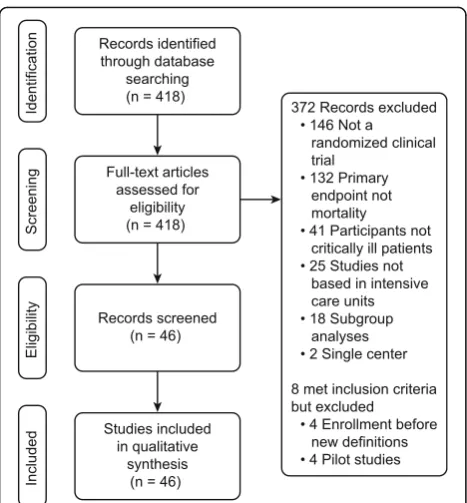
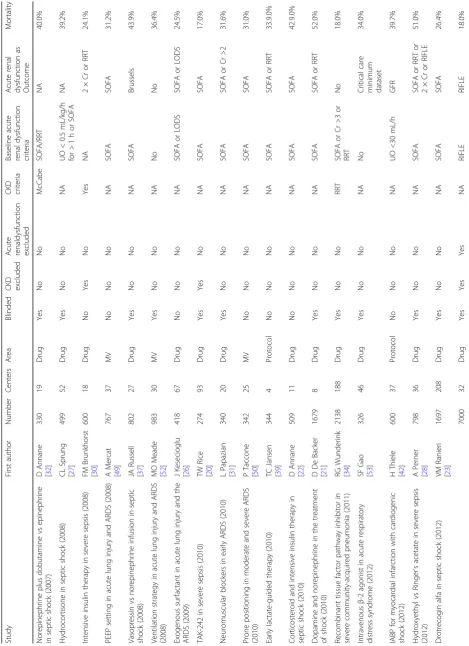
multi-continent settings) with a primary end point related
to mortality were included [
16
–
61
]. Of these, 5 showed a
beneficial effect of the trial intervention on mortality,
whereas 41 demonstrated a neutral effect (Table
1
).
CKD
chronic kidney disease,
PEEP
positive
end-expiratory pressure;
SOFA
sequential organ failure
assess-ment,
MV
mechanical ventilation,
MODS
multiple organ
dysfunction score,
GFR
glomerular filtration rate;
LODS
logistic organ dysfunction score,
UO
urine output,
RRT
renal replacement therapy,
KDIGO
Kidney Disease
Improving Global Outcomes;
RIFLE
Risk, Injury, Failure,
Loss of kidney function, End-stage kidney disease,
TAK-242
a small-molecule inhibitor of Toll-like
receptor-4-mediated,
ARDS
acute respiratory distress syndrome,
IABP
intraaortic balloon pump,
Cr
creatinine
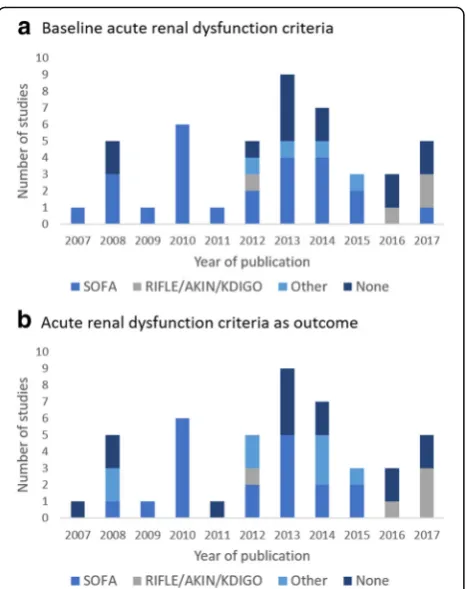
The distribution of the number of studies per year of
publication, stratified by the acute renal dysfunction
cri-teria used as a baseline and outcome measure is described
in Figs.
2a and b
, respectively (Fig.
2
).
Conditions studied
A wide range of conditions in critically ill patients was
studied in the 46 RCTs, including sepsis (13 RCTs),
acute respiratory distress syndrome (11 RCTs), shock (5
RCTs), nutrition (4 RCTs), anemia (5 RCTs), surgery (3
RCTs), respiratory failure (2 RCTs), pneumonia (2
RCTs), renal replacement therapy (1 RCT), and quality
improvement (1 RCT).
Interventions
The RCTs assessed a range of interventions in critically
ill patients (Table
1
), including drug treatment (22
RCTs), nutrition (4 RCTs), hemodynamic optimization
(5 RCTs), transfusion (5 RCTs), mechanical ventilation
(8 RCTs), timing of renal replacement therapy (1 RCT)
and daily round checklist (1 RCT).
Reporting of acute renal dysfunction in cohort
characteristics
Thirty-six trial reports (78.3%) provided information on
acute renal (dys)function in the participants. Only seven
articles (15.2%) contained mean or median serum
creatin-ine levels, mean creatincreatin-ine clearance or estimated
glomeru-lar filtration rates (eGFRs). The SOFA score was the most
commonly used definition of acute renal dysfunction, in 20
studies (43.5%): RIFLE/AKIN/KDIGO criteria were used in
5 trials (10.9%). In thirteen trials (28.3%) no criteria for
defining acute renal dysfunction were reported. Only one
trial (2.2%) excluded patients with acute renal dysfunction,
using urinary output or need for RRT as criteria for this
diagnosis. As shown in Fig.
2
, RIFLE/KDIGO/AKIN criteria
were mostly used in recent years (2016 and 2017).
Reporting of acute renal dysfunction in secondary
outcomes
Most of the trials studied acute renal dysfunction as a
sec-ondary outcome, which was reported in 33 trials (71.7%).
The renal SOFA score was the most commonly used
def-inition, in 19 trials (41.3%), followed by the need for RRT,
used in 10 trials (21.7%) and RIFLE/AKIN/KDIGO criteria
used in 5 trials (10.9%). Only six articles (13.0%) included
serum creatinine levels, mean creatinine clearance, or
GFR (eGFR) values as secondary outcomes.
Five trials (10%) reported progression to more severe
stages of acute renal dysfunction. No trial reported
pro-gression to chronic kidney disease. Thirty-three trials
(71.7%) evaluated organ dysfunction in addition to renal
dysfunction.
Discussion
Our results demonstrated that patients with acute renal
dysfunction were often included in multicenter RCTs
involving critically ill patients that included mortality as a
primary endpoint. However, current classification systems,
such as RIFLE/AKIN/KDIGO, were not frequently used
to define renal dysfunction in the descriptions of patient
baseline characteristics or as secondary outcomes.
Despite the advances from widespread use of new
classi-fication systems and the development of new biomarkers
for early renal dysfunction detection, little progress has
been made in developing evidence-based interventions for
renal dysfunction prevention and treatment [
10
]. For
crit-ically ill patients, the lack of positive results may be related
[image:3.595.57.291.85.337.2]to the parameters used to measure renal function,
primar-ily creatinine concentration and urine output, because
these parameters are frequently influenced by
comorbidi-ties, nutritional status, fluid overload and the overall
sever-ity of critical illness [
62
].
A single definition of acute renal dysfunction would be
useful for clinical practice, research, and public health [
13
].
This definition has been rapidly changing in the literature
since 2004 with the introduction of the RIFLE, AKIN, and
KDIGO classification systems. These classifications were
de-veloped based on both evidence and consensus [
63
].
How-ever, our findings show that with a few exceptions, they
were not applied in RCTs with mortality as a primary
out-come published in the period of this study. Furthermore,
these systems were not widely used for defining or
evaluat-ing renal dysfunction as a secondary endpoint. These
find-ings may raise concerns about the evidence-based use of
these classification systems in the clinical management of
critically ill patients. Nevertheless, it is important to notice
that there was an apparent increase in the utilization of
these scores in recent years (2016 and 2017).
Although the acute renal dysfunction (RIFLE/AKIN/
KDIGO) classification systems have been compared and
validated [
64
], they do have certain limitations. First, the
use of small changes in serum creatinine levels to
diag-nose AKI is limited by the high rates of false-positive
diagnoses caused by the inherent variability of serum
creatinine levels in patients with higher baseline values,
thus potentially misclassifying patients with CKD [
65
].
Second, in contrast to individual measurements, efforts
to determine the trajectory of serum creatinine levels
can identify AKI sub-phenotypes with different mortality
risks, even among patients with AKI of similar severity.
These AKI sub-phenotypes might define patients at risk
of poor outcomes (i.e., those with non-resolving AKI),
who might benefit from novel interventions [
66
]. Third,
renal dysfunction definitions that require a reference
creatinine value to analyze baseline renal function
should utilize a value that reflects steady-state kidney
function prior to an AKI episode. When such reference
values are not available, surrogate estimates are required,
and these can affect the accuracy of the determination
[
67
]. In contrast, the simplicity of the SOFA score and
the objectivity of the variables required for its
calcula-tion make it useful for repeated measurements of the
degree of organ dysfunction or failure [
68
].
The renal SOFA score was the most commonly used
system to quantify renal function at baseline or as a
sec-ondary outcome. It may be more convenient to study
changes in the SOFA score over time. Such changes have
been assessed in critically ill patients over 48 h [
69
] or
during treatment [
70
] and have also been used to evaluate
the degree of organ dysfunction in sepsis [
63
]. In addition
to assessing patient status, renal criteria can be used for
prognosis. An early and sequential evaluation pattern
(using any of the various scoring systems) has been shown
to be a superior approach for prognostic scoring in
critic-ally ill patients who develop renal dysfunction compared
with a single assessment at any time point during an ICU
admission or stay [
71
]. Similarly, in patients with kidney
injury, measuring changes in the SOFA score in the first
24 h of RRT can identify patients at high risk of mortality
[
72
]. In contrast, individual SOFA scores are poor at
pre-dicting early (7 day) mortality in patients with septic AKI
who require continuous RRT [
73
].
In addition to the new definitions of renal dysfunction,
the SOFA score has been validated as a tool for assessing
sequential organ dysfunction and is a good prognostic
indicator. Furthermore, this score is familiar to critical
care physicians and has been used for years in critical care
settings and for different clinical conditions [
69
]. To date,
no study has directly compared SOFA with RIFLE/AKIN/
KDIGO; however, the use of RIFLE criteria improved the
performance of the Acute Physiology and Chronic Health
Evaluation disease classification system II (APACHE II)
score in predicting mortality in critically ill patients [
74
].
The prognostic value of a hypothetical score that
[image:7.595.58.292.85.380.2]combines RIFLE/AKIN/KDIGO criteria with the SOFA
score, perhaps by replacing renal SOFA criteria variables
with KDIGO criteria variables, is a matter of future
research.
To our knowledge, the present manuscript is the first
to describe the characterization of acute renal
dysfunc-tion in RCTs of critically ill patients. We have utilized an
extensive search covering a period of 13 years following
publication of current renal dysfunction definitions.
Nonetheless, our study does have several limitations.
First, we have limited our sample to papers published in
high-impact journals because these are typically multicenter
studies with a better opportunity for impacting clinical
practice [
75
]. We defined high-impact journals as those
in-cluded in the MEDLINE core clinical journals subset [
14
].
The core clinical journals subset is an easy filter to apply.
Using this filter, a MEDLINE search can focus on a set of
journals selected for high quality and clinical utility, which
may aid in the reproducibility of our findings, though we
do recognize that there have been controversies as to the
actual clinical utility of this subset [
15
]. However, because
the new definitions of renal dysfunction are used at similar
frequencies among the major journals, it is reasonable to
assume that the addition of extra journals would not have
meaningfully changed our results. In agreement with our
methodology, other recently published reviews have utilized
similar procedures [
76
,
77
]. Nevertheless, this selection
procedure may result in biases because papers published in
journals with a lower impact factor may characterize renal
dysfunction differently. Another limitation is that because
we relied on published material as the typical information
source for clinicians, we cannot exclude the possibility that
some trials reported characterizations of renal dysfunction
that differed from their original protocols [
78
].
Conclusion
The presence of renal dysfunction was included as a
base-line patient characteristic and as an outcome measure in
most multicenter RCTs involving critically ill patients with
mortality as a primary endpoint that were published in
core clinical journals in the study period. The analyzed
RCTs generally defined acute renal dysfunction using the
SOFA score, with a less frequent utilization of the RIFLE,
AKIN and KDIGO classification systems. There is a need
for further evaluation of the validity and barriers for
utilization of each score to better inform clinical practice.
Abbreviations
AKI:Acute kidney injury; AKIN: Acute Kidney Injury Network; APACHE: Acute Physiology and Chronic Health Evaluation disease classification system; CKD: Chronic kidney disease; eGFR: Estimated glomerular filtration rate; GFR: Glomerular filtration rate; ICUs: Intensive care units; KDIGO: Kidney Disease Improving Global Outcomes; RCTs: Randomized controlled trials; RIFLE: Risk, Injury, Failure, Loss, End-stage renal disease; RRT: Renal replacement therapy; SOFA: Sequential Organ Failure Assessment
Acknowledgements Not applicable.
Funding
This research did not receive any specific grants from funding agencies in the public, commercial, or not-for-profit sectors.
Availability of data and materials
All data generated or analyzed during this study are included in this published article.
Authors’contributions
RHP and PBP contributed to the design, acquisition, analysis, and interpretation of data and drafting and revising the manuscript. JGRR, AG, JC, and EM contributed to interpretation of data and drafting and revising the manuscript. All authors have read and approved the final version of this manuscript.
Authors’information
Not applicable.
Ethics approval and consent to participate Not applicable.
Consent for publication Not applicable.
Competing interests
The authors declare that they have no competing interests.
Publisher
’
s Note
Springer Nature remains neutral with regard to jurisdictional claims in published maps and institutional affiliations.
Author details
1Critical Care Unit, Hospital São Rafael, Av São Rafael, Salvador 2152, Brazil. 2
Department of Medicine, Division of Nephrology, University of California, San Diego, USA.3Critical Care Unit, Nephrology Department, Hospital Portugues, Salvador, Brazil.
Received: 18 October 2017 Accepted: 28 February 2018
References
1. Susantitaphong P, Cruz DN, Cerda J, Abulfaraj M, Alqahtani F, Koulouridis I, Jaber BL. World Incidence of AKI: a Meta-Analysis. Clin J Am Soc Nephrol. 2013;8(9):1482–93.
2. Bouchard J, Acharya A, Cerda J, Maccariello ER, Madarasu RC, Tolwani AJ, Liang X, Fu P, Liu ZH, Mehta RL. A prospective international multicenter study of AKI in the intensive care unit. Clin J Am Soc Nephrol. 2015;10(8):1324–31.
3. Vincent J-L, Marshall JC, Ñamendys-Silva SA, François B, Martin-Loeches I, Lipman J, Reinhart K, Antonelli M, Pickkers P, Njimi H, et al. Assessment of the worldwide burden of critical illness: the Intensive Care Over Nations (ICON) audit. Lancet Respir Med. 2014;2(5):380–6.
4. Cruz DN, Ronco C. Acute kidney injury in the intensive care unit: current trends in incidence and outcome. Crit Care. 2007;11(4):149.
5. Sawhney S, Fraser SD. Epidemiology of AKI: utilizing large databases to determine the burden of AKI. Adv Chronic Kidney Dis. 2017;24(4):194–204. 6. Thomas ME, Blaine C, Dawnay A, Devonald MAJ, Ftouh S, Laing C, Latchem
S, Lewington A, Milford DV, Ostermann M. The definition of acute kidney injury and its use in practice. Kidney Int. 2015;87(1):62–73.
7. Singbartl K, Kellum JA. AKI in the ICU: definition, epidemiology, risk stratification, and outcomes. Kidney Int. 2012;81(9):819–25.
8. Pakula AM, Skinner RA. Acute kidney injury in the critically ill patient. J Intensive Care Med. 2015;31(5):319–24.
9. Palevsky PM, Liu KD, Brophy PD, Chawla LS, Parikh CR, Thakar CV, Tolwani AJ, Waikar SS, Weisbord SD. KDOQI US commentary on the 2012 KDIGO clinical practice guideline for acute kidney injury. Am J Kidney Dis. 2013;61(5):649–72.
11. de Mendonca A, Vincent JL, Suter PM, Moreno R, Dearden NM, Antonelli M, Takala J, Sprung C, Cantraine F. Acute renal failure in the ICU: risk factors and outcome evaluated by the SOFA score. Intensive Care Med. 2000;26(7):915–21.
12. Ospina-Tascón GA, Büchele GL, Vincent J-L. Multicenter, randomized, controlled trials evaluating mortality in intensive care: doomed to fail? Crit Care Med. 2008;36(4):1311–22.
13. Kellum JA, Lameire N. Diagnosis, evaluation, and management of acute kidney injury: a KDIGO summary (Part 1). Crit Care. 2013;17(1):204. 14. New Look to PubMed's Subset Limit Pull-down Menu: Core clinical journals
(used to be "AIM"). NLM Technical Bulletin. 2001;2001(319).
15. Klein-Fedyshin M, Ketchum AM, Arnold RM, Fedyshin PJ. Evaluating the MEDLINE Core Clinical Journals filter: data-driven evidence assessing clinical utility. J Eval Clin Pract. 2014;20(6):837–43.
16. Doig GS, Simpson F, Sweetman EA, Finfer SR, Cooper DJ, Heighes PT, Davies AR, O'Leary M, Solano T, Peake S, et al. Early parenteral nutrition in critically ill patients with short-term relative contraindications to early enteral nutrition: a randomized controlled trial. JAMA. 2013;309(20):2130–8. 17. Arabi YM, Aldawood AS, Haddad SH, Al-Dorzi HM, Tamim HM, Jones G,
Mehta S, McIntyre L, Solaiman O, Sakkijha MH, et al. Permissive underfeeding or standard enteral feeding in critically ill adults. N Engl J Med. 2015;372(25):2398–408.
18. Harvey SE, Parrott F, Harrison DA, Bear DE, Segaran E, Beale R, Bellingan G, Leonard R, Mythen MG, Rowan KM, et al. Trial of the route of early nutritional support in critically ill adults. N Engl J Med. 2014;371(18):1673–84. 19. Caironi P, Tognoni G, Masson S, Fumagalli R, Pesenti A, Romero M, Fanizza
C, Caspani L, Faenza S, Grasselli G, et al. Albumin replacement in patients with severe sepsis or septic shock. N Engl J Med. 2014;370(15):1412–21. 20. Rice TW, Wheeler AP, Bernard GR, Vincent JL, Angus DC, Aikawa N, Demeyer
I, Sainati S, Amlot N, Cao C, et al. A randomized, double-blind, placebo-controlled trial of TAK-242 for the treatment of severe sepsis. Crit Care Med. 2010;38(8):1685–94.
21. De Backer D, Biston P, Devriendt J, Madl C, Chochrad D, Aldecoa C, Brasseur A, Defrance P, Gottignies P, Vincent JL, et al. Comparison of dopamine and norepinephrine in the treatment of shock. N Engl J Med. 2010;362(9):779–89. 22. Investigators CS, Annane D, Cariou A, Maxime V, Azoulay E, D'Honneur G,
Timsit JF, Cohen Y, Wolf M, Fartoukh M, et al. Corticosteroid treatment and intensive insulin therapy for septic shock in adults: a randomized controlled trial. JAMA. 2010;303(4):341–8.
23. Ranieri VM, Thompson BT, Barie PS, Dhainaut JF, Douglas IS, Finfer S, Gardlund B, Marshall JC, Rhodes A, Artigas A, et al. Drotrecogin alfa (activated) in adults with septic shock. N Engl J Med. 2012;366(22):2055–64. 24. Papazian L, Roch A, Charles PE, Penot-Ragon C, Perrin G, Roulier P, Goutorbe
P, Lefrant JY, Wiramus S, Jung B, et al. Effect of statin therapy on mortality in patients with ventilator-associated pneumonia: a randomized clinical trial. JAMA. 2013;310(16):1692–700.
25. Annane D, Siami S, Jaber S, Martin C, Elatrous S, Declere AD, Preiser JC, Outin H, Troche G, Charpentier C, et al. Effects of fluid resuscitation with colloids vs crystalloids on mortality in critically ill patients presenting with hypovolemic shock: the CRISTAL randomized trial. JAMA. 2013;310(17):1809–17.
26. Kesecioglu J, Beale R, Stewart TE, Findlay GP, Rouby JJ, Holzapfel L, Bruins P, Steenken EJ, Jeppesen OK, Lachmann B. Exogenous natural surfactant for treatment of acute lung injury and the acute respiratory distress syndrome. Am J Respir Crit Care Med. 2009;180(10):989–94.
27. Sprung CL, Annane D, Keh D, Moreno R, Singer M, Freivogel K, Weiss YG, Benbenishty J, Kalenka A, Forst H, et al. Hydrocortisone therapy for patients with septic shock. N Engl J Med. 2008;358(2):111–24.
28. Perner A, Haase N, Guttormsen AB, Tenhunen J, Klemenzson G, Aneman A, Madsen KR, Moller MH, Elkjaer JM, Poulsen LM, et al. Hydroxyethyl starch 130/0.42 versus Ringer's acetate in severe sepsis. N Engl J Med. 2012;367(2):124–34.
29. Myburgh JA, Finfer S, Bellomo R, Billot L, Cass A, Gattas D, Glass P, Lipman J, Liu B, McArthur C, et al. Hydroxyethyl starch or saline for fluid resuscitation in intensive care. N Engl J Med. 2012;367(20):1901–11.
30. Brunkhorst FM, Engel C, Bloos F, Meier-Hellmann A, Ragaller M, Weiler N, Moerer O, Gruendling M, Oppert M, Grond S, et al. Intensive insulin therapy and pentastarch resuscitation in severe sepsis. N Engl J Med. 2008;358(2):125–39.
31. Papazian L, Forel JM, Gacouin A, Penot-Ragon C, Perrin G, Loundou A, Jaber S, Arnal JM, Perez D, Seghboyan JM, et al. Neuromuscular blockers in early acute respiratory distress syndrome. N Engl J Med. 2010;363(12):1107–16.
32. Annane D, Vignon P, Renault A, Bollaert PE, Charpentier C, Martin C, Troche G, Ricard JD, Nitenberg G, Papazian L, et al. Norepinephrine plus dobutamine versus epinephrine alone for management of septic shock: a randomised trial. Lancet. 2007;370(9588):676–84.
33. Annane D, Timsit JF, Megarbane B, Martin C, Misset B, Mourvillier B, Siami S, Chagnon JL, Constantin JM, Petitpas F, et al. Recombinant human activated protein C for adults with septic shock: a randomized controlled trial. Am J Respir Crit Care Med. 2013;187(10):1091–7.
34. Wunderink RG, Laterre PF, Francois B, Perrotin D, Artigas A, Vidal LO, Lobo SM, Juan JS, Hwang SC, Dugernier T, et al. Recombinant tissue factor pathway inhibitor in severe community-acquired pneumonia: a randomized trial. Am J Respir Crit Care Med. 2011;183(11):1561–8.
35. National Heart L, Blood Institute ACTN, Truwit JD, Bernard GR, Steingrub J, Matthay MA, Liu KD, Albertson TE, Brower RG, Shanholtz C, et al. Rosuvastatin for sepsis-associated acute respiratory distress syndrome. N Engl J Med. 2014;370(23):2191–200.
36. Asfar P, Meziani F, Hamel JF, Grelon F, Megarbane B, Anguel N, Mira JP, Dequin PF, Gergaud S, Weiss N, et al. High versus low blood-pressure target in patients with septic shock. N Engl J Med. 2014;370(17):1583–93. 37. Russell JA, Walley KR, Singer J, Gordon AC, Hebert PC, Cooper DJ, Holmes CL,
Mehta S, Granton JT, Storms MM, et al. Vasopressin versus norepinephrine infusion in patients with septic shock. N Engl J Med. 2008;358(9):877–87. 38. Heyland D, Muscedere J, Wischmeyer PE, Cook D, Jones G, Albert M, Elke G,
Berger MM, Day AG. Canadian Critical Care Trials G. A randomized trial of glutamine and antioxidants in critically ill patients. N Engl J Med. 2013; 368(16):1489–97.
39. Jansen TC, van Bommel J, Schoonderbeek FJ, Sleeswijk Visser SJ, van der Klooster JM, Lima AP, Willemsen SP, Bakker J. group Ls. Early lactate-guided therapy in intensive care unit patients: a multicenter, open-label, randomized controlled trial. Am J Respir Crit Care Med. 2010;182(6):752–61. 40. Pearse RM, Harrison DA, MacDonald N, Gillies MA, Blunt M, Ackland G,
Grocott MP, Ahern A, Griggs K, Scott R, et al. Effect of a perioperative, cardiac output-guided hemodynamic therapy algorithm on outcomes following major gastrointestinal surgery: a randomized clinical trial and systematic review. JAMA. 2014;311(21):2181–90.
41. Young D, Harrison DA, Cuthbertson BH, Rowan K, TracMan C. Effect of early vs late tracheostomy placement on survival in patients receiving mechanical ventilation: the TracMan randomized trial. JAMA. 2013;309(20):2121–9. 42. Thiele H, Zeymer U, Neumann FJ, Ferenc M, Olbrich HG, Hausleiter J, de
Waha A, Richardt G, Hennersdorf M, Empen K, et al. Intra-aortic balloon counterpulsation in acute myocardial infarction complicated by cardiogenic shock (IABP-SHOCK II): final 12 month results of a randomised, open-label trial. Lancet. 2013;382(9905):1638–45.
43. Pestana D, Espinosa E, Eden A, Najera D, Collar L, Aldecoa C, Higuera E, Escribano S, Bystritski D, Pascual J, et al. Perioperative goal-directed hemodynamic optimization using noninvasive cardiac output monitoring in major abdominal surgery: a prospective, randomized, multicenter, pragmatic trial: POEMAS Study (PeriOperative goal-directed thErapy in Major Abdominal Surgery). Anesth Analg. 2014;119(3):579–87.
44. Lacroix J, Hebert PC, Fergusson DA, Tinmouth A, Cook DJ, Marshall JC, Clayton L, McIntyre L, Callum J, Turgeon AF, et al. Age of transfused blood in critically ill adults. N Engl J Med. 2015;372(15):1410–8.
45. Holst LB, Haase N, Wetterslev J, Wernerman J, Guttormsen AB, Karlsson S, Johansson PI, Aneman A, Vang ML, Winding R, et al. Lower versus higher hemoglobin threshold for transfusion in septic shock. N Engl J Med. 2014; 371(15):1381–91.
46. Lemiale V, Mokart D, Resche-Rigon M, Pene F, Mayaux J, Faucher E, Nyunga M, Girault C, Perez P, Guitton C, et al. Effect of noninvasive ventilation vs oxygen therapy on mortality among
immunocompromised patients with acute respiratory failure: a randomized clinical trial. JAMA. 2015;314(16):1711–9.
47. Young D, Lamb SE, Shah S, MacKenzie I, Tunnicliffe W, Lall R, Rowan K, Cuthbertson BH, Group OS. High-frequency oscillation for acute respiratory distress syndrome. N Engl J Med. 2013;368(9):806–13.
48. Ferguson ND, Cook DJ, Guyatt GH, Mehta S, Hand L, Austin P, Zhou Q, Matte A, Walter SD, Lamontagne F, et al. High-frequency oscillation in early acute respiratory distress syndrome. N Engl J Med. 2013;368(9):795–805. 49. Mercat A, Richard JC, Vielle B, Jaber S, Osman D, Diehl JL, Lefrant JY, Prat G,
50. Taccone P, Pesenti A, Latini R, Polli F, Vagginelli F, Mietto C, Caspani L, Raimondi F, Bordone G, Iapichino G, et al. Prone positioning in patients with moderate and severe acute respiratory distress syndrome: a randomized controlled trial. JAMA. 2009;302(18):1977–84.
51. Guerin C, Reignier J, Richard JC, Beuret P, Gacouin A, Boulain T, Mercier E, Badet M, Mercat A, Baudin O, et al. Prone positioning in severe acute respiratory distress syndrome. N Engl J Med. 2013;368(23):2159–68. 52. Meade MO, Cook DJ, Guyatt GH, Slutsky AS, Arabi YM, Cooper DJ, Davies
AR, Hand LE, Zhou Q, Thabane L, et al. Ventilation strategy using low tidal volumes, recruitment maneuvers, and high positive end-expiratory pressure for acute lung injury and acute respiratory distress syndrome: a randomized controlled trial. JAMA. 2008;299(6):637–45.
53. Gao Smith F, Perkins GD, Gates S, Young D, McAuley DF, Tunnicliffe W, Khan Z, Lamb SE. investigators B-s. Effect of intravenous beta-2 agonist treatment on clinical outcomes in acute respiratory distress syndrome (BALTI-2): a multicentre, randomised controlled trial. Lancet. 2012;379(9812):229–35. 54. Gaudry S, Hajage D, Schortgen F, Martin-Lefevre L, Pons B, Boulet E, Boyer A,
Chevrel G, Lerolle N, Carpentier D, et al. Initiation strategies for renal-replacement therapy in the intensive care unit. N Engl J Med. 2016;375(2):122–33.
55. Bloos F, Trips E, Nierhaus A, Briegel J, Heyland DK, Jaschinski U, Moerer O, Weyland A, Marx G, Grundling M, et al. Effect of sodium selenite administration and procalcitonin-guided therapy on mortality in patients with severe sepsis or septic shock: a randomized clinical trial. JAMA Intern Med. 2016;176(9):1266–76.
56. Writing Group for the C-ICUI, the Brazilian Research in Intensive Care N, Cavalcanti AB, Bozza FA, Machado FR, Salluh JI, Campagnucci VP, Vendramim P, Guimaraes HP, Normilio-Silva K, et al. Effect of a quality improvement intervention with daily round checklists, goal setting, and clinician prompting on mortality of critically ill patients: a randomized clinical trial. JAMA. 2016;315(14):1480–90.
57. Writing Group for the Alveolar Recruitment for Acute Respiratory Distress Syndrome Trial I, Cavalcanti AB, Suzumura EA, Laranjeira LN, Paisani DM, Damiani LP, Guimaraes HP, Romano ER, Regenga MM, Taniguchi LNT, et al. Effect of lung recruitment and titrated positive end-expiratory pressure (PEEP) vs low PEEP on mortality in patients with acute respiratory distress syndrome: a randomized clinical trial. JAMA. 2017;318(14):1335–45. 58. Landoni G, Lomivorotov VV, Alvaro G, Lobreglio R, Pisano A, Guarracino F,
Calabro MG, Grigoryev EV, Likhvantsev VV, Salgado-Filho MF, et al. Levosimendan for hemodynamic support after cardiac surgery. N Engl J Med. 2017;376(21):2021–31.
59. Cooper DJ, McQuilten ZK, Nichol A, Ady B, Aubron C, Bailey M, Bellomo R, Gantner D, Irving DO, Kaukonen KM, et al. Age of red cells for transfusion and outcomes in critically ill adults. N Engl J Med. 2017;377(19):1858–67. 60. Mazer CD, Whitlock RP, Fergusson DA, Hall J, Belley-Cote E, Connolly K,
Khanykin B, Gregory AJ, de Medicis E, McGuinness S, et al. Restrictive or liberal red-cell transfusion for cardiac surgery. N Engl J Med. 2017;377(22):2133–44. 61. Heddle NM, Cook RJ, Arnold DM, Liu Y, Barty R, Crowther MA, Devereaux PJ,
Hirsh J, Warkentin TE, Webert KE, et al. Effect of short-term vs. long-term blood storage on mortality after transfusion. N Engl J Med. 2016;375(20):1937–45. 62. Weisbord SD, Palevsky PM. Design of clinical trials in acute kidney injury:
lessons from the past and future directions. Semin Nephrol. 2016;36(1):42–52. 63. Singer M, Deutschman CS, Seymour CW, Shankar-Hari M, Annane D, Bauer M, Bellomo R, Bernard GR, Chiche J-D, Coopersmith CM, et al. The Third International Consensus Definitions for sepsis and septic shock (Sepsis-3). JAMA. 2016;315(8):801.
64. Fujii T, Uchino S, Takinami M, Bellomo R. Validation of the kidney disease improving global outcomes criteria for AKI and comparison of three criteria in hospitalized patients. Clin J Amer Soc Nephrol. 2014;9(5):848–54. 65. Lin J, Fernandez H, Shashaty MGS, Negoianu D, Testani JM, Berns JS, Parikh
CR, Wilson FP. False-positive rate of AKI using consensus creatinine-based criteria. Clin J Amer Soc Nephrol. 2015;10(10):1723–31.
66. Bhatraju PK, Mukherjee P, Robinson-Cohen C, O'Keefe GE, Frank AJ, Christie JD, Meyer NJ, Liu KD, Matthay MA, Calfee CS, et al. Acute kidney injury subphenotypes based on creatinine trajectory identifies patients at increased risk of death. Crit Care. 2016;20(1):372.
67. Ostermann M, Joannidis M. Acute kidney injury 2016: diagnosis and diagnostic workup. Crit Care. 2016;20(1):299.
68. Arts DG, de Keizer NF, Vroom MB, de Jonge E. Reliability and accuracy of Sequential Organ Failure Assessment (SOFA) scoring. Crit Care Med. 2005; 33(9):1988–93.
69. Ferreira FL. Serial evaluation of the SOFA score to predict outcome in critically ill patients. JAMA. 2001;286(14):1754.
70. de Grooth H-J, Geenen IL, Girbes AR, Vincent J-L, Parienti J-J, Oudemans-van Straaten HM. SOFA and mortality endpoints in randomized controlled trials: a systematic review and meta-regression analysis. Crit Care. 2017;21(1):38. 71. Costa e Silva VT, de Castro I, Liaño F, Muriel A, Rodríguez-Palomares JR, Yu
L. Sequential evaluation of prognostic models in the early diagnosis of acute kidney injury in the intensive care unit. Kidney Int. 2009;75(9):982–6. 72. Cappi SB, Sakr Y, Vincent J-L. Daily evaluation of organ function during renal
replacement therapy in intensive care unit patients with acute renal failure. J Crit Care. 2006;21(2):179–83.
73. da Hora PR, Ramos JGR, Mendonça EJB, Miranda EA, Dutra FRD, Coelho MFR, Pedroza AC, Correia LCL, Batista PBP, Macedo E, et al. A clinical score to predict mortality in septic acute kidney injury patients requiring continuous renal replacement therapy: the HELENICC score. BMC Anesthesiol. 2017;17(1):21.
74. Wahrhaftig KM, Correia LC, Matias D, De Souza CA. Does the RIFLE Classification improve prognostic value of the APACHE II score in critically ill patients? Int J Nephrol. 2013;2013:406165.
75. Gluud LL, Sorensen TI, Gotzsche PC, Gluud C. The journal impact factor as a predictor of trial quality and outcomes: cohort study of hepatobiliary randomized clinical trials. Am J Gastroenterol. 2005;100(11):2431–5. 76. Matino D, Chai-Adisaksopha C, Iorio A. Systematic reviews of prognosis
studies: a critical appraisal of five core clinical journals. Diagn Progn Res. 2017;1(1):9.https://doi.org/10.1186/s41512-017-0008-z.
77. Howard B, Scott JT, Blubaugh M, Roepke B, Scheckel C, Vassar M. Systematic review: outcome reporting bias is a problem in high impact factor neurology journals. PLoS One. 2017;12(7):e0180986.
78. Becker JE, Krumholz HM, Ben-Josef G, Ross JS. Reporting of results in ClinicalTrials.gov and high-impact journals. JAMA. 2014;311(10):1063–5.
• We accept pre-submission inquiries
• Our selector tool helps you to find the most relevant journal
• We provide round the clock customer support
• Convenient online submission
• Thorough peer review
• Inclusion in PubMed and all major indexing services
• Maximum visibility for your research
Submit your manuscript at www.biomedcentral.com/submit