White Rose Research Online URL for this paper: http://eprints.whiterose.ac.uk/85668/
Version: Accepted Version Article:
Gao, F., Earnest, A., Matchar, D.B. et al. (2 more authors) (2015) Sample size calculations for the design of cluster randomized trials: A summary of methodology. Contemporary Clinical Trials, 42. 41 - 50.
https://doi.org/10.1016/j.cct.2015.02.011
Reuse
Unless indicated otherwise, fulltext items are protected by copyright with all rights reserved. The copyright exception in section 29 of the Copyright, Designs and Patents Act 1988 allows the making of a single copy solely for the purpose of non-commercial research or private study within the limits of fair dealing. The publisher or other rights-holder may allow further reproduction and re-use of this version - refer to the White Rose Research Online record for this item. Where records identify the publisher as the copyright holder, users can verify any specific terms of use on the publisher’s website.
Takedown
If you consider content in White Rose Research Online to be in breach of UK law, please notify us by
Sample size calculations for the design of cluster randomized trials: a
summary of current methodology
Fei Gaoa,b, Arul Earnestb, David B Matcharc, Michael J Campbelld and David Machind,e, * a
National Heart Research Institute Singapore, National Heart Centre Singapore, 5
Hospital Drive, Singapore 169609: [email protected] b
Center for Quantitative Medicine, Duke-NUS Graduate Medical School, 8 College
Road, Singapore 169857: [email protected] c
Health Services & Systems Research, Duke-NUS Graduate Medical School, 8 College Road, Singapore 169857: [email protected]
d
Medical Statistics Group, School of Health and Related Research, University of Sheffield, Regents Court, 30 Regent Street, Sheffield S1 4DA, UK: [email protected]
e
Department of Cancer Studies and Molecular Medicine, Clinical Sciences Building, University of Leicester, Leicester Royal Infirmary, Leicester LE2 7LX, UK:
*All Pre-Publication Correspondence to:
David Machin, Poachers Cottage, Southover, Frampton, Dorset DT2 9NQ, UK. [email protected] Telephone: (+44) 1300 321 113.
*All Post-Publication Correspondence to Senior author:
Gao Fei, National Heart Research Institute Singapore, National Heart Centre Singapore, 5 Hospital Drive, Singapore 169609. E-mail: [email protected]; Telephone: (+65) 6704
Abstract
Cluster randomized trial designs are growing in popularity in, for example,
cardiovascular medicine research and other clinical areas and parallel statistical developments concerned with the design and analysis of these trials have been
stimulated. Nevertheless, reviews suggest that design issues associated with cluster randomized trials are often poorly appreciated and there remain inadequacies in, for example, describing how the trial size is determined and the associated results are
presented. In this paper, our aim is to provide pragmatic guidance for researchers on the methods of calculating sample sizes. We focus attention on designs with the primary
purpose of comparing two interventions with respect to continuous, binary, ordered categorical, incidence rate and time-to-event outcome variables. Issues of aggregate and non-aggregate cluster trials, adjustment for variation in cluster size and the effect size are
detailed. The problem of establishing the anticipated magnitude of between- and within-cluster variation to enable planning values of the intra-within-cluster correlation coefficient and
the coefficient of variation are also described. Illustrative examples of calculations of trial sizes for each endpoint type are included. [Word count: 184175]
INTRODUCTION
In contrast to clinical trials in which individual subjects are each randomized to receive
one of the therapeutic options or interventions under test, the distinctive characteristic of a cluster trial is that specific groups or blocks of subjects (the clusters) are first identified
and these units are assigned at random to the interventions. The term “cluster” in this context may be a household, school, clinic, care home or any other relevant grouping of individuals. When comparing the interventions in such cluster randomized trials,
account must always be made of the particular cluster from which the data item is obtained.
A large and ever increasing number of cluster randomized trials have been conducted or are underway covering many aspects of cardiovascular related medicine. These include trials of cardiovascular guidelines [1], prescribing practice [2], community health awareness [3], breast feeding promotion on cardiometabolic risk factors in childhood [4], the effectiveness of a multifactorial intervention to improve both medication adherence
and blood pressure control and to reduce cardiovascular events [5], and improving outcomes in patients with left ventricular systolic dysfunction [6]. In the TEACH trial of local pharmacy support [7], the clusters were the local pharmacists of patients with heart failure (HF) who had been hospitalised and then discharged into the community. The plan was that clusters were each randomized to one of the two interventions on a 1:1
basis: CONTROL or PHARM. Those pharmacists allocated PHARM would give their patients additional educational (motivational) support. Hence, all the patients within a particular cluster received the same intervention. A patient experiencing any one of a
There are numerous publications describing design, analysis and reporting issues concerned with cluster randomized trials, including text books [8-11]. However much of the literature is fragmented and some quite old (though still relevant). Further some of the articles are quite technical in nature so investigators may find it difficult to determine
best practice. A review of cluster trials [12], published subsequent to the 2004 extension of the CONSORT guidelines [13-14], concluded that the methodological quality of cluster trials often remains suboptimal.
To facilitate and improve this situation, we focus on methods of determining the number of subjects (and clusters) required with the aim to provide a compact but
comprehensive reference for those designing cluster trials. [Word count: 390]
GENERAL DESIGN CONSIDERATIONS
Individually randomized trials – continuous outcome measure
At the close of a clinical trial, and once all the data collection is complete, a comparison will be made between the interventions with respect to the primary endpoint. For the
case of two interventions, Standard (S) and Test (T), with nS and nT patients respectively randomized individually to each, the statistical process for a continuous outcome
measure, y, is made by comparing the corresponding means and by use of
Student’s t-test. This tests the null hypothesis that the difference = T – S = 0, where
S and T are the true or population means of interventions S and T. If the null hypothesis is rejected then we conclude S and T differ.
However, prior to this analysis, the trial must first be designed and conducted. In general, critical decisions to be made by the design team are the choice (and number) of
A vital detail is the difference in the outcome (the effect size or Plan) between the randomized interventions which might be anticipated. Such a difference should be one
(if established) of sufficient clinical importance to justify the expense of conducting the planned trial and likely to lead to changes in clinical practice. Also required is the
standard deviation (SD), Plan, of the endpoint variable of concern. A further design option is the choice of the ratio of subjects 1: allocated to S and T respectively (see below).
Once these aspects are provided, the numbers of subjects to be randomized to each intervention for a continuous endpoint is [15]:
, (1)
giving a total N = nS + nT.
Here, is the Type I error which is the required probability of rejecting the null
hypothesis when falsely declaring ‘A difference’ between the interventions and when ‘No
difference’ is present. The Type II error corresponds to the probability of falsely accepting the null hypothesis of ‘No difference’ when the actual size of the difference is
indeed Plan. The quantity 1 is known as the power.
Further, z1-/2 and z1- are values with probabilities of /2 and respectively in the
upper tail of the standard Normal distribution. Typically = 0.05 leading to z1-0.05/2 = z0.975 = 1.9600 while = 0.2 or 0.1 leading to z0.8 = 0.8416 and z0.9 = 1.2816 respectively.
The final term in equation (1) applies only when the sample size is small.
However, when = 0.05 and = 1, this implies adding unit extra
An alternative is first to assume = 1 in (1), to obtain n subjects for each intervention and then calculate the final numbers per intervention using
, . (2)
This increases the initial total number of subjects N from 2n to which, if = 0.5,
implies N = 2.25n. If, as we will be concerned with later, it is the number of clusters that is being calculated then k, kS, kT and K replace the corresponding n’s.
Cluster randomized trials
When the randomised allocation applies to the clusters, the basic principles for sample size calculation still apply although modifications are required. To illustrate these we
first describe the t-test, for comparing two means from a non-cluster design, using linear
regression terminology with intercept S and slope , that is,
yj = S + x + j, (3)
where the subjects concerned are j = 1, 2, ... , N; x = 0 for S and x = 1 for T. Further j is a random variable with mean zero and, within each intervention group, assumed to have
the same variance, 2. If this regression model is fitted to the data then
estimates = T – S and the null hypothesis remains = 0. However the analysis must now take account of the cluster to which an individual subject belongs. When we compare two interventions N (= nS + nT) patients will be recruited who will come from clusters of size m with therefore kS = nS/m, kT = nT/m and K = kS + kT clusters in total.
To allow for the clusters, model (3) is extended to:
. (4)
of zero, with a variance, . Further the ij are also assumed to have mean zero but with variance, and both random variables, and , are assumed to be Normally distributed. The combined sum of the within- and between-cluster variances,
Although the format of the (random-effects) model (4) will change depending on the
outcome measure of concern, all will contain random terms accounting for the cluster design.
The sample size formula (1) is essentially determined as a consequence of model (3)
while the formulae which follow for cluster trials, are based on (4).
CLUSTER DESIGN CONSIDERATIONS
Intra-cluster correlation coefficient (ICC) – continuous outcome
A feature of all cluster trials is that subjects recruited from within the same cluster cannot be regarded as acting independently of each other in terms of their response to the
intervention received. The magnitude of this within-cluster dependence, which ultimately influences the eventual trial size, is quantified by the intra-cluster correlation
coefficient (ICC), , which is interpreted in a similar way to Pearson correlation.
With each subject in every cluster providing an outcome measure, the ICC is the
proportion of the combined sum of the within- and between-cluster variances
Total2accounted for by the between-cluster variation, that is
2 2
-
-2 2 2
-
-Between Cluster Between Cluster
Total Between Cluster Within Cluster
. (5)
Thus, since variances cannot be negative, the ICC cannot be negative. A major
randomization units and outcome measures. The values of arising in a primary care
setting tend to vary from 0.01 to 0.05 with a median value quoted as 0.01 [16]. Larger
ICCs have been reported [17] although for community intervention trials they are typically < 0.01 [8]. Our suggestion is to try different values of the ICC and investigate how sensitive the sample size estimate is to these changes.
The Design Effect (DE)
The impact of the ICC, on the planned trial size, will depend on its magnitude and on the number of subjects recruited per cluster, m, through the so-called design effect (DE),
(5X)
The DE is then multiplied by the sample size obtained from (say) equation (1) to give that
required for a cluster design. In practice there may be substantial variation in m from
cluster to cluster and to allow for such variation DE becomes: [18]
, (6)
where is the anticipated mean cluster size, and the corresponding standard deviation. As the value of DE depends on , whose value may not be firmly established,
our suggestion is to try different values of the ICC and investigate how sensitive the
sample size estimates are to these changes. In all situations, DE will be ≥ 1 since m and
> 1 and ≥ 0.
Another option Van Breukelen and Candel [19] have suggested that if m varies the above approach is conservative and a better method is to adjust the total number of
clusters initially planned, K, to:
2
{1 [ ( )] (1 )}
Adjusted
K K
CV m
where the coefficient of variation,
m m SD m
CV( ) ( ) and
) 1 ( m m
.[19].
However, since 0 1, the maximum possible value of
4 1 ) 1 (
and so the largest
adjustment to K corresponds to 1/{1 – [CV(m)]2/4}. Further since the CV(m) is usually less than 0.7 the inflation of K necessary to allow for varying m is at most about 14%. If CV(m) = 0.35 then the inflation is at most 3%.
In general practice, variation in m results in an increase in total sample size for the trial
and equation (6) tends to overestimate the required sample size . Hence whether to use
equation (6) or (7) requires some judgement. For example, if SD(m) is large it might be
quite difficult to raise the number of subjects recruited in each cluster to ensure is
increased and thereby the requisite (new) total sample size achieved. In which case,
increasing K through equation (7) may be the most practical option. In contrast, In
situations where increasing is feasible, equation (6) may suffice.
Control hypertension and hypercholesterolemia [20]
To illustrate the impact of varying cluster size on the DE, we use the results from STITCH2 trial which includes the precise number of clusters within each intervention and the number of subjects recruited per cluster. Table 1 shows that cluster size varied
considerably from 2 to 47. For both interventions combined, CV(m) = 15.29/26.43 = 0.59 and this magnitude is not atypical.
Table 1. Number of clusters and the corresponding CV(m) of cluster size by care
intervention group of the STITCH2 trial (data from Dresser, et al. (2013) [20])
Guideline 20 2 28.75 47 15.59 0.54
STITCH2 15 2 23.33 45 14.83 0.64
Total 35 2 26.43 47 15.29 0.59
If m = 26 is taken as the anticipated cluster size in a trial, then from equation (5X), DE
= 1 + 25 , whereas if information from Table 1 is used equation (6) gives
= 1 + 34.3 which is clearly larger.
Community Based Exercise Programme [21]
In contrast, a community based exercise programme in over 65 year olds involving K =
12 practices recruited a mean of = 535 individuals from each with SD(m) = 139.9 to
give a much lower figure of CV(m) = 0.26.
When planning a new trial, investigators may be guided by results such as these.
Potential attrition
For many different reasons, the eventual numbers of clusters and/or subjects recruited may be less than that those planned.
Clearly, the loss of all information from a cluster has greater impact than the loss of
(few) patients within a cluster. Thus, as a precaution, the initial number of clusters, K,
indicated by the preliminary sample size calculations may need to be increased. Relevant
may provide guidance on the extent of potential loss. Any change in K may lead the
design team to reconsider m, N or both
So, In anticipation of this possible subject attrition, the initial plan for the trial size, N,
can be inflated by the division of the proportion, , of subjects recruited for whom the
endpoint measure is likely to be recorded. However this tends to overestimate the sample
size required. An alternative is first to modify the DE using m in place of m, obtain the
resulting sample size by the appropriate means, and then divide by again. This process
tends to underestimate the sample size required since it is unlikely that the drop-out rate is equal in each cluster and so the cluster size will vary, which results in loss of power
[11, p67]. Consequently, a compromise sample size mid-way between the two
approaches may be sought. Any change in N may lead the design team to alter reconsider
m, K or both.
The allocation ratio,
Although the majority of clinical trials involve equal allocation to each of the interventions, there may be circumstances in which the proportions may differ. Thus, in
the case of two interventions, nS patients may be allocated to S, while nT ( nS) are
allocated to T. In which that case, the allocation ratio, , is set so nT = nS and N = nS(1+ ) is the planned total trial size. In general, as moves away from unity, the required sample size will increase.
Community Based Exercise Programme [21]
In this trial, 8 clusters for Control and 4 for Test were used for evaluating the programme
“ … the relative costs of including controls were very small … ”. Thus instead of using a
1:1 design, with 4 clusters, per intervention, a 2:1 allocation using 12 clusters enabled a
larger trial with greater power to be conducted without increasing the number of T clusters, kT.
Non-aggregate and Aggregate designs
A ‘non-aggregate’ design uses the individual observations as the unit of analysis and so
the regression models may be extended to account for individual covariate values such as,
for example, subject gender, age, disease severity or a pre-randomisation (baseline)
measure of the chosen endpoint for the trial. T the analysis will be based on an extension of the random effects regression model (4). The objective of the sample size calculation
is to determine the appropriate number of subjects required per intervention, nS and nT and the number of clusters is determined on division by the anticipated number of subjects per cluster.
An ‘aggregate’ or ‘field’ design is one in which a summary measure from each cluster
is obtained. For example with continuous data, and n = mk subjects in each intervention,
the trial will provide k cluster means (each based on m observations) with
the mean of these means for intervention x = 0 compared with those from x = 1. In the situation when k is small, the analysis may use the t-test (rather than the z-test) and so the
sample size calculations will be based on equation (1) but replacing the anticipated SD,
In this situation, m is fixed by the design team and the calculation provides the required number of clusters, K = 2k.
However, although the analysis for both designs appears to be the same the number of degrees of freedom, df, differ. For an aggregate design, with fixed cluster size m,
dfAggregate = {N/m} – 2 while for a non-aggregate design, dfNon-Aggregate = {N/DE} – 2 =
{N/[1+(m 1) ]} 2 which is smaller larger except in the improbable situation of = 1.
This means that correcting for small sample size has a greater effect on aggregate designs since the df will also be smaller.
SAMPLE SIZE FOR CLUSTER TRIALS
Continuous endpoint
Non-aggregate design
For the model of equation (4) the variance for individuals in each cluster within each
intervention group is assumed the same, and of the form:
(8)
If planning values for Between-Cluster and Within-Cluster can be provided by the design team, then the planned values for Total (denoted Plan ) and the ICC can be obtained from equation (5). Alternatively values for the ICC may be obtained from previous experience. In either case, although m needs to be pre-specified, DE can be determined
and equation (1) is modified to become:
, nT = nS. (9)
The total sample size, N = nS + nT = Km and it follows that the required numbers of
clusters are and . Note that the final term of equation (1), , is
Daily exercise and Quality of Life [22]
Suppose a design team is planning a confirmatory non-aggregate cluster randomized trial, based on the one previously published, to see if a daily exercise regime delivered by
personal trainers at the suggestion of their general practitioner for a year (T) would lead to improved quality of life compared to no intervention (S) in older men. The primary
outcome is the Physical Function (PF) score of the SF-36 measure at 1-year. Previous experience from a cross-sectional (non-cluster) study suggests that such men have a mean score of 66.4 units, with PF = 29.5 units and the effect of the daily exercise regime would be considered important if it increased the PF by at least 10 units.
These lead to planning values Plan = 10 and Plan = 29.5. However, due to the high cost of providing personal trainers, the new design team decide on a 3:2 randomization in favour of the S group, that is = 2/3 = 0.6667. This implies that K will have to be a multiple of 5 if the clusters are to be randomized in this ratio. Previous experience
suggests that an achievable cluster size is m = 30 and = 0.01 so that DE = 1 + [(30 1)
0.01] = 1.29. Further the investigators set a two-sided = 0.05, = 0.1, and so the
sample size required from equation (9) is:
= 294.89 or 295 and nT =
0.6667 295 = 196.67 or 197. The planned total sample size is N = 295 + 197 = 492
If the approach of (2) had been used then, for equal allocation n = 236, so that for =
0.6667, = 236 ×1.250 = 295 and = 236 ×0.833 =
197 as previously obtained.
Aggregate design
If an aggregate design is considered, then the summary mean, , calculated from the m
subjects within the cluster i, is the endpoint of concern. In this case,
, (10) which can be alternatively expressed more compactly as
. (11)
The sample size now refers to the number of clusters required. However, equation (9) is still used but with kS, kT and K replacing nS, nT and N. Further, as the resulting number of clusters may be small, the comparison of means between the interventions will be
made using the t-test. In which case, z1 /2 and z1 from the Normal distribution should
be replaced by the corresponding quantities for the t-distribution. However, these values depend on the degrees of freedom (df) which are K – 2. At the preliminary stage we do
not know K. So the process begins by estimating kS (and kT) using equation (9) to obtain
an initial value say K0 for the required total number of clusters, so df0 = K0 2. Tables of
the t-distribution give the values tdf0,1/2 and tdf0,1 which are substituted for z1/2 and
z1 in equation (9) to obtain a revised total number of clusters, K1. If this is different
from K0, the degrees of freedom are recalculated as df1 = K1 2 and the process repeated
In practice in 1:1 ( = 1) randomization designs, if K0 20, the process is unlikely to
be required while if K0 < 20 the refinement generally leads to 2 more clusters being added. Thus, the process of refining the sample size in this way is effectively the same as
the simpler one of including the final term of equation (1), which is .
Daily exercise and Quality of Life [22]
Had the previous example been designed as an aggregate cluster trial, then with the information provided as Total = 29.5 and = 0.01, equation (5) can be used to obtain
2 2
Between Cluster Total
0.01 (29.5)2 = 8.70 and
Within Cluster2
Total2
Between Cluster2 (29.5)2 – 8.70 = 861.6. Hence, if we assume m = 30, equation (10) gives
and, from equation (1) with = 2/3,
9.84 or 10 clusters and kT = kS = 0.6667 10 = 6.7 or 7 clusters giving a
total of K = 17 in all as in the non-aggregate design.
However, as the number of clusters is relatively small, including the final term of
equation (1), adds
2 2
1 / 2 1.96 1.15
2(1 ) 2(1 0.6667) z
or about 1 cluster per intervention
to give K = 19.
If the approach of (2) had been used then, with equal allocation k = 8.82, so that for
= 0.6667, = 11.03 or 12 and = 7.35 or 8 to give
Binary outcome
Non-aggregate design
For a binary outcome the dependent variable yij of equation (4) only takes the values 0 or 1 with the probability i that yij = 1 and which is assumed constant for each subject within a cluster. Such data are analysed using a random effects logistic regression model in which, because of the clusters, is retained but is assumed to come from either a Normal or Beta distribution, while is assumed to come from a Binomial distribution. [23]
In order to calculate a sample size, the anticipated proportions responding in each
intervention group, S and T need to be anticipated, from which Plan = T – S. It is usual to assume that
, (12)
where .
Also required is the intra-class correlation, Binary, for use in the expression DE of equation (5). This can be obtained from
2 2
2
(1 )
Between Cluster Between Cluster Binary
Total
. (13)
Finally the sample size for this situation is calculated from equation (9) but using the
effect size, Plan = T –S, and Plan as specified in equation (12).
Control hypertension and hypercholesterolemia [20]
If a similar non-aggregate trial is planned on the basis of STITCH2, assuming m = 50
these, Plan = 0.52 – 0.40 = 0.12, 0.52 0.40 0.46 2
and =
0.4984. Further assuming Binary = 0.06200.071 (derived from results of the STITCH trial
using equation (14) below) equation (5X) gives DE = [1 + (50 – 1) 0.062] = 4.038.
Finally from equation (9), with two-sided = 0.05 and = 0.2,
= 1212.91093.5 implying N = 24262188 subjects
in total. The corresponding number of clusters K = 24262188/50 = 4944 which may be increased to 50 to allows a 1:1 randomization.
The preliminary estimate of sample size may have to be revised to account for
possible variation in cluster size, non-participation of some of the clusters, and/or reduced numbers of individuals completing the assessments.
Control hypertension and hypercholesterolemia [20]
Thus, as was the case in the original STITCH2, if the number recruited per GP was likely to vary then a conservative application of equation (7) would lead to increasing the
number of GPs by 14%. Hence, the number of clusters becomes K = 4944 1.14 =
55.950.2 or 5652 in practice. The number of patients is thereby increased to N = 5652
50 = 2,8002,600. l
Equally, although 52 GP were identified for STITCH2, as only 44 (85%) eventually participated in the trial this implies that in future trials the initial planning number of
clusters might be increased by 15% suggesting here that to 56 × 1.15 64 to include 52 /
Further, as a precautionary measure to account for potential patient (not cluster) loss, an approximate 15% ( = 0.85) increase in this number may be adopted, in which case N
= 2,800/0.85 3,300 may be targeted., it might be assumed that only 90% of patients will
comply, so a commensurate increase in the number to recruit to N = 3,100/0.90 3,444.4
may be considered.
Alternatively, the DE itself may be adjusted to give a reduced value as
= 3.728 replacing 4.038 of the preliminary calculations.
Thus the revised number of subjects becomes 2,862.0 which is smaller
than the first revised method estimate of 3,444.4. A compromise suggests that about
3,150 patients are required.
Further discussion by the design team may then suggest 52 GPs should be approached,
from which 55 patients would be recruited to the trial.
Should all three possibilities have to be accounted for then the planned trial size may
be designed to recruit up to (say) 4,000 individuals with consequent increases in either, m, K or both.
Aggregate design
In an aggregate design, each cluster within each intervention provides a single proportion,
pxi, calculated from the m patients within that cluster. These proportions correspond to
the of the continuous measure situation albeit now confined to values between 0 and
1.
The corresponding variance of each cluster proportion, pxi, is:
Control hypertension and hypercholesterolemia [20]
The report of the STITCH2 states: “The primary analysis compared the proportion of
participants achieving targets [for example, specified blood pressure levels] between the two treatment groups using a two-sample t-test at the level of the cluster … ”. This
clearly indicates an aggregate design was planned and that the individual cluster proportion is regarded as a continuous outcome. In addition, they specify, Total = 0.15 which is taken as Plan and by including the simple adjustment in equation (1), the
number of clusters required are = 25.49 or 26 per
intervention and K = 52.
Further, using equation (14), this leads to =
0.0200 0.017. Further and from equation (13), Binary = 0.02000.017/(0.46 0.54) =
0.062 0.071 as we had noted earlier. By including the simple adjustment in equation (1),
the number of clusters required are = 25.49 or 26
Ordinal outcome
Non-aggregated design
In some situations a binary outcome may be extended to comprise an ordered categorical variable of G (>2) levels. In which case the two interventions are compared using
ordered logistic regression. Further, only non-aggregate designs are likely as individual cluster summaries (needed for an aggregate design) take the form of a G-level tabulation rather than a single measure.
In principle, if the underlying measure is categorical then any comparisons between groups will be more sensitive than if a binary outcome is chosen. Consequently for given
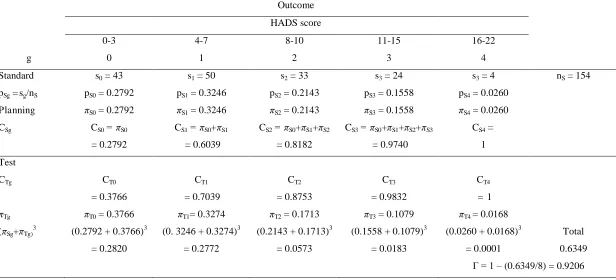
Type I and Type II errors the numbers of patients required will usually be smaller. In practice, there is little statistical benefit to be gained by having more than G = 5 ordered categories [24]. Thus, although there are G = 23 categories in the Hospital Anxiety and Depression Scale (HADS), with a low score as a desirable outcome [25], the data might be reduced to five for planning purposes (Table 2). When considering a new trial that is
aimed at reducing HAD scores, investigators could use these data to provide planning values for S.
Although an ordinal scale outcome is envisaged, at the initial planning stages,
investigators may first think in binary terms and, for example, consider the (cumulative)
proportion with HADS 7 of 60.39% with S might be improved by 10% to 70.39% using
T. This Plan = 0.1 is then expressed as the planning odds ratio of
0.7039 (1 0.7039) 1.56 0.6039 (1 0.6039) Plan
OR
.
The basic assumption when considering the range of categories is that, wherever the
planning OR applies [26]. Thus had the cut been made at HADS 10, then the cumulative proportion with S is 0.8182 would imply that, if the ORPlan = 1.56, this proportion would increase to 0.8753 with T.
The process of calculating the sample size begins by using the observed proportions
for S as the planning values S0, S1, S2, S3, then with the design ORPlan calculate those
anticipated for T as T0, T1, T2, and T3.
In general, if the categories are dichotomized by including the categories 1, 2, …, g, in
one group, and the remainder g + 1, g + 2, … , G categories in the other, then a general expression for the odds ratio is
, g > 0. (15)
where CSg and CTg are the cumulative proportions in the S and T groups respectively. If all the ORg are assumed to be equal to ORPlan then equation (15) can be rearranged to give
. (16)
Once all the CTg are obtained from equation (16), the corresponding Tg are calculated
Table 2 Deriving the anticipated proportions within each category for the Test intervention calculated from that anticipated
for patients in the Standard with an assumed planning odds ratio, ORPlan = 1.56.
Outcome
HADS score
0-3 4-7 8-10 11-15 16-22
g 0 1 2 3 4
Standard s0 = 43 s1 = 50 s2 = 33 s3 = 24 s3 = 4 nS = 154
pSg = sg/nS pS0 = 0.2792 pS1 = 0.3246 pS2 = 0.2143 pS3 = 0.1558 pS4 = 0.0260
Planning S0 = 0.2792 S1 = 0.3246 S2 = 0.2143 S3 = 0.1558 S4 = 0.0260
CSg CS0 = S0
= 0.2792
CS1 = S0+ S1
= 0.6039
CS2 = S0+ S1+ S2
= 0.8182
CS3 = S0+ S1+ S2+ S3
= 0.9740
CS4 =
1
Test
CTg CT0
= 0.3766 CT1 = 0.7039 CT2 = 0.8753 CT3 = 0.9832 CT4
= 1
Tg T0 = 0.3766 T1= 0.3274 T2 = 0.1713 T3 = 0.1079 T4 = 0.0168
( Sg+ Tg)3 (0.2792 + 0.3766)3
= 0.2820
(0. 3246 + 0.3274)3
= 0.2772
(0.2143 + 0.1713)3
= 0.0573
(0.1558 + 0.1079)3
= 0.0183
(0.0260 + 0.0168)3
= 0.0001
Total
0.6349
The expression for calculating sample sizes for comparing two interventions using
1
clusters with individual subject responses from G ordered categories is [24]:
2
, , (17)
3
where
4
. (18)
5
In certain circumstances the calculation for can be simplified. Thus if G > 5, 1,
6
while if all Sg + Tgare approximately equal then 1 1/G2.
7
Improvement in HADS score [25]
8
Assuming investigators plan a cluster trial on the basis of the information of Table 2 with
9
anticipated effect size ORPlan = 1.56, then log ORPlan = 0.4447 and equation (18) gives
10
= 0.9206. Further assuming m = 30 with sd(m) = 0, = 0.001, then DE = 1 + (29
11
0.001)] = 1.029. Finally the investigators set = 1, two-sided = 0.05, = 0. 2 and
12
obtain from equation (17) = 1.029
13
258.68 = 266.17. To be divisible by m = 30 this is rounded to 270 to give N = 2 × 270 =
14
540 subjects and K = 540/30 = 18 clusters with 9 per intervention.
15
16
Incidence Rate outcome
17
Aggregate design
18
In some situations, all the m individuals within each cluster are followed-up for a fixed
19
period (say F years) and the number of occurrences of a specific event is recorded among
20
the individuals within that time. If ri individuals in cluster i experience the event then the
21
event rate per-person-years is estimated by i = ri / (m F). In other situations, each of
the incidence rate for cluster i is , where is the anticipated total
1
follow-up time recorded for the cluster. In practice, the incidence rate may be expressed
2
as per-person, per-100- or per-1000-person days, years or other time frames depending on
3
the context.
4
An aggregate design is the usual option as it is the rate provided from each cluster
5
which will be the unit for analysis. In this case, an alternative to the ICC as a measure of
6
how close individuals responses are within a cluster is the coefficient of variation,
7
cv(Rate) = SD(Cluster Rates within an Intervention)/Mean(Rate for that Intervention),
8
for the aggregated outcome of concern [10]. This should not be confused with CV(m) of
9
the individual cluster sizes defined previously and used in equation (7).
10
In designing a cluster trial, the investigators would need to specify planning values S
11
and T for the mean incidence rates of the interventions, the corresponding cvS and cvT
12
(often assumed equal), as well as the maximum duration of follow-up, F, of the
13
individuals in the clusters. The number of clusters required is: [10, 27]
14
, . (19)
15
The of equation (19) is the adjustment for when the number of clusters is small.
16
If subjects are only followed up to when the event of interest occurs then mF in
17
equation (19) may be replaced by Y, the anticipated cumulative follow-up time that will
18
be recorded in every cluster.
19
Left ventricular systolic dysfunction [6]
20
The results from a trial concerned with attempts to improve outcome for patients with left
21
ventricular systolic dysfunction suggested that Usual care (S) was associated with a 7.2
deaths per 100 years (S = 0.072). It is hoped that Enhanced care (T) might reduce this
1
by 20% (T = 0.0576). A 1:1 cluster trial is planned with two-sided = 0.05, = 0.2, m =
2
12, F = 5 years, and cvS = cvT = 0.1. Use of equation (19) results in kS = kT = 86, so that a
3
total of K = 172 primary care units are required. Had more variation been anticipated,
4
perhaps cvS = cvT = 0.2, then K = 192.
5
6
Time-to-event outcome
7
Non-aggregate design
8
Rather than merely counting the number of events (as for the incidence rate) if the
9
individual times to the event (often termed survival times) are recorded and used in the
10
analysis the usual summary for each intervention is the Kaplan-Meier survival curve.
11
The comparison between interventions is then made using Cox proportional hazards
12
regression model [23] including a random effects term to account for the cluster design.
13
This analysis provides an estimate of the corresponding hazard ratio (HR) which
14
summarises the relative survival difference between the groups. A HR = 1 corresponds to
15
the null hypothesis of no difference.
16
For planning purposes, it is usual to specify S and T which are the anticipated
17
proportions of subjects alive at a fixed time-point beyond the date their cluster was
18
randomised. Once the design team has specified these, then the planning HR can be
19
calculated from
20
(20)
21
The number of subjects required is [28]
to give a total sample size N = nS + nT. The ICC is difficult to estimate for survival data,
1
but one suggestion [11, p64] is to treat the data as binary to get the ICC. In general we
2
would recommend using a range of ICCs as the authors in the following example did.
3
4
Heart dysfunction
5
In the Trial of Education And Compliance in Heart (TEACH) dysfunction trial [7] the
6
investigators anticipated that the 1-year rate of re-hospitalisation following earlier
7
hospital admission for heart problems (S) would be about 75%. It was further anticipated
8
that this could be reduced to 60% using enhanced education on their condition from their
9
home pharmacist (T). Thus, with S = 0.75 and T = 0.60 representing the anticipated
10
proportions re-admitted at 1-year, equation (20) gives . Further,
11
if we take, as the investigators did, m = 2, = 1, = 0.05 and = 0.2 then, for a
non-12
aggregate design, equation (21) becomes
13
= 154.63 × (1 + ).
14
Setting equal to 0.05 and 0.10, as the investigators did, gives the respective values of
15
N = nS + nT = 2 163 = 326 and 342 with the corresponding total number of pharmacies
16
(clusters) required as K = 326/2 = 163 and 171 respectively. To allow a 1:1
17
randomisation, these are then increased to 164 and 172 to give either 82 or 86 pharmacies
18 per intervention. 19 20 Aggregate design 21
For an aggregate design, the endpoint will be the survival rate at a fixed time following
22
randomisation, say at the 1-year follow-up. The planning values for these rates, say S
and T, are then taken as S and T and used in the same way as for sample size
1
calculations of a binary endpoint cluster design.
2
Matched designs
3
In the preceding sections the individual clusters participating in the trial have been
4
identified and then randomised (say) in equal numbers to receive the S or T intervention.
5
However, if the clusters themselves are of variable size, then an alternative method of
6
allocation is first to rank these clusters in terms of their size, and then create cluster pairs
7
of a similar size. Once these ‘matched’ pairs are identified, the allocation of T is made at
8
random to one of the pair and the other is then automatically assigned to S. Options,
9
other than size, may be used to create the matched pairs. The choice being perhaps
10
related to features of the clusters concerned; such as their location in Rural or Urban
11
areas.
12
Once the trial is complete, the difference in summary measure from each matched pair
13
of clusters will be calculated. Thus a matched design implies an aggregate design. Thus,
14
for example, if the endpoint is continuous this measure will be the difference,
15
. for each of the cluster pairs, KPairs. From these values the mean difference is
16
obtained and this estimates the true difference between the interventions, . The paired
t-17
test then tests the null hypothesis = 0.
18
However the values of and from the matched clusters may be themselves
19
associated. If, in a completed trial involving KPairs, the individual values of and
20
are available then their correlation, , may be calculated and used for future planning
21
purposes. It is recommended [10] that, , replaces the ICC, , in the DE of equation (6).
Nevertheless it should be recognised that, unlike for the ICC, we know of no published 1
values of . In this situation, the number of cluster pairs required is:
2
. (22)
3
Here Plan is the anticipated standard deviation of the differences, di, obtained from the
4
cluster pairs. As the number of cluster pairings is likely to be relatively small the
5
correction term is added [10].
6
With little or no prior knowledge of either , Plan or both the design team would need
7
to consider a range of options before deciding on the number of cluster pairs to include.
8
9
Daily exercise and Quality of Life [22]
10
If we suppose this planned trial was to involve communities with very diverse
socio-11
economic characteristics, then the design time might wish to create cluster pairs with
12
similar features. The anticipated improvement in PF with T over S is assumed the same
13
with Plan = 10 units. However the previous trial provided a planning value of 6.12 units
14
whereas for a matched design Plan might be anticipated to be smaller than this to an
15
extent depending on the numbers to be recruited per cluster, m. Thus a range of values
16
for Plan, as well as , are investigated.
17
As a first step, the investigators take = 0.01 and and, from equation
18
(22), with m = 30, two-sided = 0.05 and = 0.1 obtain,
19
= 7.55 or 16 clusters which are then matched in pairs.
20
If = 0.05 then the number of cluster pairs increases to KPairs = 15. A reduced
21
results in KPairs = 4 and 8 for = 0.01 and 0.05respectively.
Conclusion
1
Cluster trials consume considerable logistical and other resources, so a critical factor is to
2
determine the appropriate size for the trial in question. As subjects are not individually
3
randomised to the interventions but are allocated in clusters then this feature needs to be
4
accounted for in both the planning and the statistical analysis. In some instances, the
5
number of clusters available may be fixed, in others the number of subjects per cluster is
6
fixed or possibly both may be open to choice. Although 1:1 allocation of interventions is
7
usual, there is nevertheless a decision to be made with respect to this ratio.
8
As in individually randomized trials, the two-sided test-size ( ) is conventionally set at
9
0.05, whereas the power (1 ) is often set at 0.8 although a higher value (say 0.9) is
10
more desirable. Further each design team will have to decide on the anticipated effect
11
size (the difference between S and T) which will be very context specific but should
12
reflect a realistic and clinically important difference between the groups. However, in the
13
cluster trial situation an ICC (or some other measure of the lack of independence of the
14
subjects within a cluster) will need to be specified. In some situations, cluster trials may
15
have been done in similar circumstances to that in planning, so that the magnitude of such
16
measures may be well documented. However in most situations some (often
17
considerable) judgment is required. In either case the design team will need to consider
18
the impact on sample size of a range of options for this (and other design features) before
19
deciding the final trial size. The investigators too will need to verify what will be
20
required by CONSORT [29] for reporting their trial to ensure all these requirements are
21
in place before the trial commences. Of particular relevance here is the need for a clear
22
but succinct justification of trial size. Thus it is important to retain details of the way in
which, at the planning stage, the eventual trial design and size were determined. Further
1
discussion of recent issues in the design and analysis of cluser trials is given in [30]
2
[Conclusion word count: 340]
3
References
4
[1] Etxeberria A, Pérez I, Alcorta I, Emparanza JI, Ruiz de Velasco E, Iglesias MT,
5
Orozco-Beltrán D, Rotaeche R. The CLUES study: a cluster randomized clinical trial for
6
the evaluation of cardiovascular guideline implementation in primary care. BMC Health
7
Serv Res 2013;13:438.
8
[2] Fretheim A, Oxman AD, Håvelsrud K, Treweek S, Kristoffersen DT, Bjørndal A.
9
Rational prescribing in primary care (RaPP): a cluster randomized trial of a tailored
10
intervention. PLoS Med. 2006;3(6):e134.
11
[3] Kaczorowski J, Chambers LW, Dolovich L, Paterson JM, Karwalajtys T, Gierman T,
12
Farrell B, McDonough B, Thabane L, Tu K, Zagorski B, Goeree R, Levitt CA, Hogg W,
13
Laryea S, Carter MA, Cross D, Sabaldt RJ. Improving cardiovascular health at population
14
level: 39 community cluster randomised trial of Cardiovascular Health Awareness
15
Program (CHAP). BMJ 2011;342:d442.
16
[4] Martin RM, Patel R, Kramer MS, Vilchuck K, Bogdanovich N, Sergeichick N,
17
Gusina N, Foo Y, Palmer T, Thompson J, Gillman MW, Smith GD, Oken E. Effects of
18
promoting longer-term and exclusive breastfeeding on cardiometabolic risk factors at age
19
11.5 years: A cluster-randomized, controlled trial. Circulation. 2014;129:321-9.
20
[5] Pladevall M, Brotons C, Gabriel R, Arnau A, Suarez C, de la Figuera M, Marquez E,
21
Coca A, Sobrino J, Divine G, Heisler M, Williams LK; Writing Committee on behalf of
22
the COM99 Study Group. Multicenter cluster-randomized trial of a multifactorial
intervention to improve antihypertensive medication adherence and blood pressure
1
control among patients at high cardiovascular risk (The COM99 Study). Circulation
2
2010;122:1183-91.
3
[6] Lowrie R, Mair FS, Greenlaw N, Forsyth P, Jhund PS, McConnachie A, Rae B, and
4
McMurray JJV on behalf of the Heart Failure Optimal Outcomes from Pharmacy Study
5
(HOOPS) Investigators. Pharmacist intervention in primary care to improve outcomes in
6
patients with left ventruicular systolic dysfunction. European Heart Journal,
2012;33:314-7
24.
8
[7] Gwadry-Sridhar F, Guyatt G, O’Brien B, Arnold JM, Walter S, Vingilis E and
9
MacKeigan L. TEACH: Trial of Education And Compliance in Heart dysfunction chronic
10
disease and heart failure (HF) as an increasing problem. Contemporary Clinical Trials
11
2008; 29: 905-18.
12
[8] Donner A and Klar N. Design and Analysis of Cluster Randomization Trials in Health
13
Research. London: Arnold; 2000.
14
[9] Eldridge S and Kerry S. A Practical Guide to Cluster Randomised Trials in Health
15
Services Research. Chichester: Wiley-Blackwell; 2012.
16
[10] Hayes RJ and Moulton L. Cluster Randomised Trials. Boca Raton: Chapman and
17
Hall/CRC; 2009.
18
[11] Campbell MJ and Walters SJ. How to design, analyse and report cluster randomized
19
trials in medicine and health related research. Chichester: Wiley-Blackwell; 2014.
20
[12] Ivers NM, Taljaard M, Dixon S, Bennett C, McRae A, Taleban J, Skea Z, Brehaut
21
JC, Boruch RF, Eccles MP, Grimshaw JM, Weijer C, Zwarenstein M and Donner A.
22
Impact of CONSORT extension for cluster randomized trials on quality of reporting and
study methodology: review of random sample of 300 trials, 2000-8. BMJ 2011; 343:
1
d5886.
2
[13] Campbell MK, Elbourne DR and Altman DG. CONSORT statement: extension to
3
cluster randomized trials. BMJ 2004; 328: 702-8.
4
[14] Campbell MJ. Extending CONSORT to include cluster trials. BMJ 2004, 328,
654-5
5.
6
[15] Machin D, Campbell MJ, Tan SB and Tan SH. Sample Size Tables for Clinical
7
Studies. 3 ed. Chichester: Wiley-Blackwell; 2009.
8
[16] Adams G, Gulliford MC, Ukoumunne OC, Eldridge S, Chinn S and Campbell MJ.
9
Patterns of intra-cluster correlation from primary care research to inform study design
10
and analysis. J Clin Epidemiol, 2004; 57: 785-94.
11
[17] Thompson DM, Fernald DH and Mold JW. Intraclass correlation coefficients typical
12
of cluster-randomized studies: estimates from the Robert Wood prescription health
13
projects. Ann Fam Med 2012; 10: 235-40.
14
[18] Batistatou E, Roberts C and Roberts S. Sample size and power calculations for trials
15
and quasi-experimental studies with clustering. The Stata Journal 2014; 14: 159-175.
16
[19] Van Breukelen GJP and Candel MJJM. Comments on “Efficiency loss because of
17
varying cluster size in cluster randomized trials is smaller than literature suggests”. Stat
18
Med 2012; 31: 397-400.
19
[20] Dresser GK, Nelson SA, Mahon JL, Zou G, Vandervoort MK, Wong CJ, Feagan BG
20
and Feldman RD. Simplified therapeutic intervention to control hypertension and
21
hypercholesterolemia: a cluster randomized controlled trial (STITCH2). J Hypertens;
22
2013; 31: 1702-13.
[21] Munro JF, Nicholl JP, Brazier JE, Davey R and Cochrane T. Cost effectiveness of a
1
community based exercise programme in over 65 year olds: cluster randomised trial. J
2
Epid Comm Hlth2004; 58: 1004-10.
3
[22] Walters SJ, Munro JF and Brazier JE. Using the SF-36 with older adults: a
cross-4
sectional community-based survey. Age and Aging 2001; 30, 337-343
5
[23] Tai BC and Machin D. Regression Methods for Medical Research. Chichester:
6
Wiley-Blackwell; 2014.
7
[24] Whitehead J. Sample size calculations for ordered categorical data. Stat Med 1993;
8
12: 2257-72.
9
[25] Fayers PM and Machin D. Quality of life. 3 ed. Chichester: Wiley-Blackwell; 2015.
10
[26] Campbell MJ, Julious SA and Altman DG. Sample size for binary, ordered
11
categorical, and continuous outcomes in two group comparisons. BMJ 1995; 311,
1145-12
8.
13
[27] Hayes RJ and Bennett S. Simple sample size calculations for cluster-randomized
14
trials. Int J Epidemiol 1999; 28: 319-26.
15
[28] Xie T and Waksman J. Design and sample size estimation in clinical trials with
16
clustered survival times as the primary endpoint. Stat Med 2003; 22: 2835-46.
17
[29] Campbell MK, Piaggio G, Elbourne DR and Altman DG. Consort 2010 statement:
18
extension to cluster randomized trials. BMJ 2012; 345: e5661. doi:10.1136/bmj.e5661.
19
[30] Campbell MJ (2014) Challenges of cluster randomised trials Journal of
20
Comparative Effectiveness Research 3(3), 271-281.
21
22
Acknowledgements
This research was funded by the affiliated Institutions of the authors. No specific grants
1
(only core funding) supported this work.