White Rose Research Online URL for this paper: http://eprints.whiterose.ac.uk/92279/
Version: Accepted Version
Article:
Nemeth, C., Fearnhead, P. and Mihaylova, L.S. (Accepted: 2015) Particle Approximations of the Score and Observed Information Matrix for Parameter Estimation in State Space Models With Linear Computational Cost. Journal of Computational and Graphical Statistics. ISSN 1061-8600
https://doi.org/10.1080/10618600.2015.1093492
[email protected] https://eprints.whiterose.ac.uk/
Reuse
Unless indicated otherwise, fulltext items are protected by copyright with all rights reserved. The copyright exception in section 29 of the Copyright, Designs and Patents Act 1988 allows the making of a single copy solely for the purpose of non-commercial research or private study within the limits of fair dealing. The publisher or other rights-holder may allow further reproduction and re-use of this version - refer to the White Rose Research Online record for this item. Where records identify the publisher as the copyright holder, users can verify any specific terms of use on the publisher’s website.
Takedown
If you consider content in White Rose Research Online to be in breach of UK law, please notify us by
Particle Approximations of the Score and Observed
Information Matrix for Parameter Estimation in State
Space Models With Linear Computational Cost
Christopher Nemeth, Paul Fearnhead and Lyudmila Mihaylova
Abstract
Poyiadjis et al. (2011) show how particle methods can be used to estimate both the score
and the observed information matrix for state space models. These methods either suffer from
a computational cost that is quadratic in the number of particles, or produce estimates whose
variance increases quadratically with the amount of data. This paper introduces an alternative
approach for estimating these terms at a computational cost that is linear in the number of
parti-cles. The method is derived using a combination of kernel density estimation, to avoid the
par-ticle degeneracy that causes the quadratically increasing variance, and Rao-Blackwellisation.
Crucially, we show the method is robust to the choice of bandwidth within the kernel density
estimation, as it has good asymptotic properties regardless of this choice. Our estimates of the
score and observed information matrix can be used within both online and batch procedures
for estimating parameters for state space models. Empirical results show improved parameter
estimates compared to existing methods at a significantly reduced computational cost.
Supple-mentary materials including code are available.
Keywords. Gradient ascent algorithm; Maximum likelihood parameter estimation; Particle
filter-ing; Sequential Monte Carlo; Stochastic approximation
Christopher Nemeth, Department of Mathematics and Statistics, Lancaster University, Lancaster LA1 4YF, UK (Email: [email protected]). Paul Fearnhead, Department of Mathematics and Statistics, Lancaster University, Lancaster LA1 4YF, UK (Email: [email protected]). Lyudmila Mihaylova, Department of Automatic Con-trol and Systems Engineering, University of Sheffield, Sheffield S1 3JD, UK (Email: l.s.mihaylova@sheffield.ac.uk).
1
Introduction
State space models have become a popular framework to model nonlinear time series problems
in engineering, econometrics and statistics (Capp´e et al., 2005; Durbin and Koopman, 2001). In
this paper we consider the problem of maximum likelihood estimation of the model parameters,θ,
for nonlinear, non-Gaussian state space models, where there is no closed form expression for the
marginal likelihood, p(y1:T|θ), for data y1:T = {y1,y2, . . . ,yT}.
Using sequential Monte Carlo (SMC) methods, also known as particle filters, we propose an
efficient method to create particle approximations of the score vector∇log p(y1:T|θ), which can be
used within a gradient ascent algorithm to estimateθby indirectly maximising the likelihood
func-tion. We show that our proposed algorithm can be applied offline, to estimate theθfrom batches of
data, or recursively, to updateθwhen new observations ytare received. Previous work by Poyiadjis
et al. (2011), has provided two approaches for estimating the score vector and observed
informa-tion matrix. The first has a computainforma-tional complexity that is linear in the number of particles, but
it has the drawback that the variance of the estimates increases quadratically through time. The
second method produces estimates whose variance increases linearly with time, but at the expense
of a computational cost that is quadratic in the number of particles. The increased computational
complexity of this algorithm limits its use for online applications.
We propose a new method for estimating the score vector and observed information matrix
using a novel implementation of a kernel density estimation technique (Liu and West, 2001), with
Rao-Blackwellisation to reduce the Monte Carlo error of our estimates. The result is a linear-time
algorithm which has substantially smaller Monte Carlo variance than the linear-time algorithm of
Poyiadjis et al. (2011) and notable improvements over the fixed-lag smoother (Olsson et al., 2008)
– with empirical results showing the Monte Carlo variance of the estimate of the score vector
increases only linearly with time. Furthermore, unlike standard uses of kernel density estimation,
we derive results showing that our method is robust to the choice of bandwidth. For any fixed
bandwidth our approach can consistently estimate the parameters as both the number of
time-points and the number of particles go to infinity.
Our final algorithm has similarities with the fixed-lag smoother of Dahlin et al. (2014), in terms
of reducing the Monte Carlo error in the score and observed information estimates. However, one
of the key advantages of our approach using Rao-Blackwellisation and kernel density estimation is
that we are able to better approximate the observed information matrix, which in turn leads to faster
and more accurate parameter estimation. A recently proposed linear time algorithm by Westerborn
and Olsson (2014), supported by theoretical results (Olsson and Westerborn, 2014), could be also
be used, but is not tested here. Finally, compared to competing methods, empirical results on a
challenging eight parameter nonlinear model show that our algorithm produces more consistent
parameter estimates, with an order of magnitude improvement in the rate of convergence.
2
Inference for state space models
2.1
State space models
Consider the general state space model where {Xt; 1 ≤ t ≤ T}represents a latent Markov process
that takes values on X ⊆ Rnx. The process is fully characterised by its initial density p(x
1|θ) =
μθ(x1) and transition probability density
p(xt|x1:t−1, θ)= p(xt|xt−1, θ)= fθ(xt|xt−1), (1)
whereθ ∈ Θrepresents a vector of model parameters. For an arbitrary sequence{zi}the notation
zi: jcorresponds to (zi,zi+1, . . . ,zj) for i≤ j.
We assume that the process {Xt} is not directly observable, but partial observations can be
made via a second process {Yt; 1 ≤ t ≤ T} ⊆ Y ⊆ Rny. The observations {Yt} are conditionally
independent given{Xt}and are defined by the probability density
p(yt|y1:t−1,x1:t, θ)= p(yt|xt, θ)=gθ(yt|xt). (2)
In the standard Bayesian context the latent process{X1:T}is estimated conditional on a sequence
of observations y1:T, for T ≥1. If the parameter vectorθis known then the conditional distribution
p(x1:T|y1:T, θ)∝ p(x1:T,y1:T, θ) can be evaluated where
p(x1:T,y1:T, θ)= μθ(x1)
T Y
t=2
fθ(xt|xt−1)
T Y
t=1
gθ(yt|xt). (3)
For nonlinear, non-Gaussian state space models it is not possible to evaluate the posterior
den-sity p(θ,x1:T|y1:T) in closed form. A popular approach for approximating these densities is to use a
sequential Monte Carlo algorithm.
2.2
Sequential Monte Carlo algorithm
SMC algorithms allow for the sequential approximation of the conditional density of the latent
state given a sequence of observations, y1:t, for a fixed θ, which in this section we assume are
known model parameters. For simplicity we shall focus on methods aimed at approximating the
conditional density for the current state, Xt, but the ideas can be extended to learning about the full
path of the process, X1:t. Approximations of the density p(xt|y1:t, θ) can be calculated recursively
by first approximating p(x1|y1, θ), then p(x2|y1:2, θ) and so forth. Each conditional density can be
approximated by a set of N weighted random samples, called particles, where
ˆp(dxt|y1:t, θ)=
N X
i=1
w(i)t δX(i)
t (dxt), ∀i w
(i)
t ≥0, N X
i=1
w(i)t =1 (4)
is an approximation for the conditional distribution and δx0(dx) is a Dirac delta mass function
located at x0. The set of particles{Xt(i)}Ni=1and their corresponding weights{w
(i)
t }iN=1 provide an
em-pirical measure that approximates the probability density function p(xt|y1:t, θ), where the accuracy
of the approximation increases as N → ∞(Crisan and Doucet, 2002).
We can recursively update our approximation using the following filtering recursion,
p(xt|y1:t, θ)∝ gθ(yt|xt) Z
fθ(xt|xt−1)p(xt−1|y1:t−1, θ)dxt−1, (5)
where if we assume that at time t −1 we have a set of particles {Xt(i)−1}N
i=1, and weights {w
(i)
t−1}
N i=1,
which produce a discrete approximation to p(xt−1|y1:t−1, θ), we can then create a Monte Carlo
ap-proximation for (5) as
p(xt|y1:t, θ)≈ cgθ(yt|xt) N X
i=1
w(i)t−1fθ(xt|x
(i)
t−1), (6)
where c is a normalising constant. Particle approximations as given above can be updated
recur-sively by propagating and updating the particle set using importance sampling techniques. There
is now an extensive literature on particle filtering algorithms, see for example, Doucet et al. (2000)
and Capp´e et al. (2007).
In this paper the particle approximations of the latent process are created with the auxiliary
particle filter of Pitt and Shephard (1999). This filter has a general form, and simpler filters can
be derived as special cases (Fearnhead, 2007). The idea is to approximate cw(i)t−1gθ(yt|xt) fθ(xt|x
(i)
t−1)
withξ(i)t q(xt|x(i)t−1,yt, θ), for a set of probabilitiesξt(i)and proposal densities q(xt|x(i)t−1,yt, θ). We
simu-late particles at time t by first choosing a particle at time t −1, with particle x(i)t−1 being chosen with probability ξt(i). We then propagate this to time t by sampling our particle at time t, xt,
from q(xt|x(i)t−1,yt, θ). The importance sampling weight assigned to our new particle x(i)t is then w(i)t−1gθ(yt|xt) fθ(xt|xt−(i)1)/ξ(i)t q(xt|x(i)t−1,yt, θ). Details are summarised in Algorithm 1.
Algorithm 1 Auxiliary Particle Filter Step 1: iteration t= 1.
Sample{x(i)1 }from the prior p(x1|θ), set and normalise weights w(i)1 = gθ(y1|x(i)1 ).
Step 2: iteration t= 2, . . . ,T .
Assume a set of particles{x(i)t−1}N
i=1and associated weights{w
(i)
t−1}
N
i=1that approximate p(xt−1|y1:t−1, θ)
and user-defined set of proposal weights{ξt(i)}Ni=1and family of proposal densities q(∙|xt−1,yt, θ).
(a) Sample indices{k1,k2, . . . ,kN}from{1, . . . ,N}with probabilitiesξ(i)t .
(b) Propagate particles x(i)t ∼q(∙|x(ki)
t−1,yt, θ).
(c) Weight each particle w(i)t ∝ w(ki)t−1gθ(yt|x (i)
t ) fθ(x(i)t |x(ki)t−1)
ξ(ki)t q(x(i)t |x(ki)t−1,yt,θ) and normalise the weights.
3
Parameter estimation for state space models
3.1
Maximum likelihood estimation
The maximum likelihood approach to parameter estimation is based on solving
ˆ
θ= arg max
θ∈Θ log p(y1:T|θ)
= arg max
θ∈Θ
T X
t=1
log p(yt|y1:t−1, θ),
where,
p(yt|y1:t−1, θ)=
Z
gθ(yt|xt) Z
fθ(xt|xt−1)p(xt−1|y1:t−1, θ)dxt−1
!
dxt.
Aside from a few simple cases, it is not possible to calculate the log-likelihood in closed form.
Pointwise estimates of the log-likelihood can be obtained using SMC approximations (H¨urzeler
and K¨unsch, 2001) for a fixed value θ. If the parameter spaceΘis discrete and low dimensional,
then it is relatively straightforward to find theθwhich maximises log p(y1:T|θ). For problems where
the parameter space is continuous, finding the maximum likelihood estimate (MLE) can be more
difficult. One option is to evaluate the likelihood over a grid ofθvalues, but this is computationally
inefficient when the model dimension is large.
The gradient based method for parameter estimation, also known as the steepest ascent
al-gorithm, maximises the log-likelihood function by evaluating the score vector (gradient of the
log-likelihood) at the current parameters and then moving them in the direction of the gradient.
For a given batch of data y1:T, the unknown parameter θcan be estimated by choosing an initial
estimateθ0, and then recursively solving
θk = θk−1+γk∇log p(y1:T|θ)|θ=θk−1 (7)
until convergence. Here γk is a sequence of decreasing step sizes which satisfies the conditions
P
kγk = ∞andPkγ2k <∞. One common choice isγk =k−
α,where 0.5< α <1. The conditions on
γk are necessary to ensure convergence to a value ˆθfor which∇log p(y1:T|θˆ)= 0. A key ingredient
to good statistical properties of the resulting estimator ofθ, such as consistency (Crowder, 1986),
is that if the data are generated from p(y1:T|θ∗), then
E
∇log p(Y1:T|θ∗)=
Z
p(y1:T|θ∗)∇log p(y1:T|θ∗)dy1:T =0.
That is, the expected value of∇log p(y1:T|θ), with expectation taken with respect to the data, is 0
whenθis the true parameter value.
The rate of convergence of (7) can be improved if we are able to calculate the observed
in-formation matrix, which provides a measure of the curvature of the log-likelihood. When this is
possible the Newton-Raphson method can be used and the step size parameterγk is replaced with
−γk{∇2log p(y1:T|θ)}−1.
3.2
Estimation of the score and observed information matrix
For nonlinear and non-Gaussian state space models it is impossible to derive the score and observed
information exactly. In such cases, SMC can be used to produce particle approximations in their
place (Poyiadjis et al., 2011). If we assume that it is possible to obtain a particle approximation of
the latent process p(x1:T|y1:T, θ), then this approximation can be used to estimate the score vector
∇log p(y1:T|θ) using Fisher’s identity (Capp´e et al., 2005)
∇log p(y1:T|θ)=
Z
∇log p(x1:T,y1:T|θ)p(x1:T|y1:T, θ)dx1:T. (8)
A similar identity for the observed information matrix is given by Louis (1982)
−∇2log p(y1:T|θ)=∇log p(y1:T|θ)∇log p(y1:T|θ)⊤− ∇ 2p(y
1:T|θ)
p(y1:T|θ)
, (9)
where,
∇2p(y 1:T|θ)
p(y1:T|θ)
=
Z
∇log p(x1:T,y1:T|θ)∇log p(x1:T,y1:T|θ)⊤p(x1:T|y1:T, θ)dx1:T (10)
+
Z
∇2log p(x1:T,y1:T|θ)p(x1:T|y1:T, θ)dx1:T.
See Capp´e et al. (2005) for further details of both identities.
If we assume that the conditional densities (1) and (2) are twice continuously di erentiable,
then from the joint density (3) we get
∇log p(x1:T,y1:T|θ)=
T X
t=1
∇log gθ(yt|xt)+∇log fθ(xt|xt−1) , (11)
where we introduce the notation fθ(x1|x0) = μθ(x1) to give a simpler form and similarly for the
second derivative we have
∇2log p(x
1:T,y1:T|θ)=
T X
t=1 n
∇2log g
θ(yt|xt)+∇2log fθ(xt|xt−1)
o
. (12)
In the next section we shall introduce a sequential Monte Carlo algorithm which creates
approxi-mations of these terms.
4
Particle approximations of the score vector and observed
in-formation matrix
4.1
Kernel density methods to overcome particle degeneracy
In this section we focus on applying our method to the score vector ∇log p(y1:t|θ) and note that
extending these results to the observed information matrix is straightforward and not given
ex-plicitly (see Algorithm 2 for implementation details). Using a particle filter (Alg. 1) we can
sample x(i)t and let x(i)1:tdenote the path associated with that particle. At time t particle i stores value
α(i)t = ∇log p(x(i)
1:t,y1:t|θ), which depends on the history of the particle, x (i)
1:t. The estimate forαt is
then updated recursively, where at iteration t we have particles x(i)t with associated weights w(i)t . If we assume that particle i is descended from particle ki at time t−1, then (11) can be given as
α(i)t =α(ki)
t−1+∇log gθ(yt|x (i)
t )+∇log fθ(xt(i)|x
(ki)
t−1). (13)
The score vector St =∇log p(y1:t|θ) at time t is then approximated as
St = N X
i=1
w(i)t α(i)t .
Estimation of the score vector in this fashion does not require that we store the entire path of the
latent process{X(i)1:T}Ni=1. However, theα
(i)
t s that are stored for each particle depend on the complete
path-history of the associated particle. Particle approximations of this form are known to be poor
due to inherent particle degeneracy over time (Andrieu et al., 2005). Poyiadjis et al. (2011) prove
that the asymptotic variance of the estimate of the score vector increases at least quadratically with
time. This can be attributed to the standard problem of particle degeneracy in particle filters when
approximating the conditional distribution of the complete path of the latent state p(x1:t|y1:t). One
approach to reduce this degeneracy is to use kernel density methods, such as the Liu and West
(2001) algorithm, which we apply here to theα(i)t s.
The idea of Liu and West (2001) is to combine shrinkage of the α(i)t s towards their mean, together with adding noise. The latter is necessary for overcoming particle degeneracy, but the
former is required to avoid the increasing variance of theα(i)t s. Implementing this strategy we start by replacingα(ki)
t−1with a draw from a Gaussian kernel, where kiis drawn from a discrete distribution
with probabilitiesξt(i), and where the mean and variance ofα(ki)
t−1are
St−1 =
N X
i=1
w(i)t−1α(i)t−1 and Σα
t−1 =
N X
i=1
w(i)t−1(α(i)t−1−St−1)⊤(α(i)t−1−St−1).
If we let 0 < λ < 1 be a shrinkage parameter, which is a fixed constant, and choose a density
bandwidth h> 0, we can replaceα(ki)
t−1 in (13) with
λα(ki)
t−1+(1−λ)St−1+ǫ (i)
t , (14)
whereǫt(i) is a realisation of a Gaussian distributionN(0,h2Σα
t−1). By choosingλand h such that
λ2 + h2 = 1 (Liu and West, 2001), it is then straightforward to show that this kernel density
approximation preserves the mean and variance of theα(i)t s.
4.2
Rao-Blackwellisation
The storedα(i)t values do not have any effect on the dynamics of the state. Furthermore, we have
a stochastic update for these terms which, when we use the kernel density approach, results in
a linear-Gaussian update. This means that we can use the idea of Rao-Blackwellisation (Doucet
et al., 2000) to reduce the variance in our estimates of the score vector and observed information
matrix. In practice this means replacing the α(i)t values by an appropriate distribution which is sequentially updated. Therefore we do not need to add noise to the approximation at each time
step as we do with the standard kernel density approach. Instead we can recursively update the
mean and variance of the distribution representingα(i)t and estimate the score vector St.
For t ≥2, assume that at time t−1 eachα( j)t−1is represented by a Gaussian distribution,
α( j)t−1 ∼ N(m( j)t−1,h2Vt−1).
Then from (13) and (14) we have that
α(i)t ∼ N(m(i)t ,h2Vt), (15)
where,
m(i)t =λm(ki)
t−1+(1−λ)St−1+∇log gθ(yt|x (i)
t )+∇log fθ(x(i)t |x
(ki)
t−1),
and
Vt = Vt−1+ Σαt−1 = Vt−1+
N X
i=1
w(i)t−1(m(i)t−1−St−1)⊤(m(i)t−1−St−1).
The estimated score vector at each iteration is a weighted average of the α(i)t s, so we can esti-mate the score by
St = N X
i=1
w(i)t m(i)t . (16)
If we only want to estimate the score vector, then this shows that we only need to calculate the
expected value of theα(i)t s. However, if we wish to calculate the observed information matrix It,
then from (10), a standard particle approximation would give
It =StS⊤t − N X
i=1
w(i)t nα(i)t α(i)t ⊤ +β(i)
t o
,
where we define β(i)t = ∇2log p(x(i)
1:t,y1:t|θ). Taking the same approach for β (i)
t as we did for α
(i)
t ,
we define a Gaussian distribution forβ(i)t and update its mean and covariance in the same way as was shown above forαt. In practice we only need to calculate the mean, which we will denote as
n(i)t . Using Rao-Blackwellisation, and the assumed distributions forα(i)t andβ(i)t , gives the following estimate of the observed information matrix
It =StS⊤t − N X
i=1
wt(i)nm(i)t mt(i)⊤+h2Vt +n(i)
t o
.
Note the inclusion of h2V
tin this estimate. This term is important as it corrects for the fact that
shrinking the values of αt towards St at each iteration will reduce the variability in these values.
Without this correction the observed information would be overestimated. Details of this approach
are summarised in Algorithm 2.
Algorithm 2 Rao-Blackwellised Score and Observed Information Matrix
Initialise: set m(i)0 =0 and n(i)
0 =0 for i= 1. . . ,N, S0 = 0 and B0 =0.
At iteration t=1, . . . ,T ,
(a) Apply Algorithm 1 to obtain{x(i)t }N i=1,{ki}
N
i=1and{w
(i)
t }Ni=1
(b) Update the mean of the approximations forαt andβt
m(i)t = λm(ki)
t−1+(1−λ)St−1+∇log gθ(yt|x (i)
t )+∇log fθ(x(i)t |x
(ki)
t−1)
n(i)t = λn(ki)
t−1+(1−λ)Bt−1+∇ 2log g
θ(yt|x
(i)
t )+∇2log fθ(x
(i)
t |x
(ki)
t−1)
(b) Update the score vector and observed information matrix
St = N X
i=1
w(i)t m(i)t and It =StSt⊤− N X
i=1
w(i)t (m(i)t m(i)t ⊤ +n(i)
t )−h
2V
t
where Vt =Vt−1+PNi=1w
(i)
t−1(m (i)
t−1−St−1)⊤(m (i)
t−1−St−1) and Bt =
PN i=1w
(i)
t n
(i)
t .
Our new O(N) algorithm can be viewed as a generalisation of the Poyiadjis et al. (2011)
al-gorithm. Setting λ = 1 in Algorithm 2 gives the Poyiadjis algorithm. However, this algorithm,
as illustrated in Section 6 and proved by Poyiadjis et al. (2011), has a quadratically increasing
variance in t. As a result, Poyiadjis et al. (2011) introduce an alternative algorithm whose
compu-tational cost is quadratic in the number of particles, but which has better Monte Carlo properties.
Del Moral et al. (2010) and Douc et al. (2011) show that this alternative approach, under standard
mixing assumptions, produces estimates of the score with an asymptotic variance that increases
only linearly with time.
5
Theoretical justification
5.1
Monte Carlo accuracy
We have motivated the use of both the kernel density approximation and Rao-Blackwellisation as
a means to reduce the impact of particle degeneracy on theO(N) algorithm for estimating the score
vector and observed information matrix. However, what can we say about the resulting algorithm?
It is possible to implement Algorithm 2 so as to store the whole history of the state x1:t,
rather than just the current value, xt. This just involves extra storage, with our particles being
x(i)1:t = (x(i)
t ,x
(ki)
1:t−1). Whilst unnecessary in practice, thinking about such an algorithm helps with
understanding the algorithms properties.
One can fixθ, the parameter value used when running the particle filter algorithm, and the data
y1:t. For convenience we drop the dependence onθfrom notation in the following. The m(i)t values
calculated by the algorithm are just functions of the history of the state and the past estimated score
values. We can define a set of functionsφs(x1:t),
φs(x1:t)= ∇log gθ(ys|xs)+∇log fθ(xs|xs−1),
where t ≥ s > 0 and functions, ms(x1:t), which depend on ms−1(x1:t) and the estimated score
functions at previous time-steps, S0:s−1, through
ms(x1:t)= λms−1(x1:t)+(1−λ)Ss−1+φs(x1:t), (17)
with m0(x1:t) = 0. We then have that in Algorithm 2, m(i)t = mt(x(i)1:t), is the value of this function
evaluated for the state history associated with the ith particle at time t.
Note that it is possible to iteratively solve the recursion (17) to get
ms(x1:t)=
s X
u=1
λs−uφu(x1:t)+(1−λ)
s X
u=1
λs−uSu−1 (18)
where 0< λ < 1 is the shrinkage parameter.
If we set λ= 1, then Algorithm 2 reverts to the PoyiadjisO(N) algorithm and (18) simplifies
to a sum of additive functionalsφu(x1:t). The poor Monte Carlo properties of this algorithm stem
from the fact that the Monte Carlo variance of SMC estimates ofφu(x1:t) increase at least linearly
with s−u. And hence the Monte Carlo variance of the SMC estimate ofPs
u=1φu(x1:t), increases at
least quadratically with s.
In terms of the Monte Carlo accuracy of Algorithm 2, the key is that in (18) we exponentially
down-weight the contribution ofφu(x1:t) as s−u increases. Under quite weak assumptions, such
as the Monte Carlo variance of the estimate ofφu(x1:t) being bounded by a polynomial in s−u, we
will have that the Monte Carlo variance of estimates ofPs
u=1λs−uφu(x1:t) will now be bounded in s.
For λ < 1, we introduce the additional second term in (18), without which there would be a
substantial bias in the score estimate that would grow with t. Estimating this term is less
problem-atic as the Monte Carlo variance of each Su−1 will depend only on u, and will not increase as s
increases. Empirically, the resulting Monte Carlo variance of our estimates of the score increase
only linearly with s for a wide-range of models.
5.2
E
ff
ect on parameter inference
Now consider the value of St in the limit as the number of particles goes to infinity, N → ∞. We
assume that standard conditions on the particle filter for the law of large numbers (Chopin, 2004)
hold. Then we have that
St →Eθmt(X1:t)|y1:t=
Z
mt(x1:t)p(x1:t|y1:t, θ)dx1:t.
For t =1, . . . ,T , where we fix the data y1:T, define ¯St =Eθ
mt(X1:t)|y1:tto be the large N limit
of the estimate of the score at time t. The following lemma expresses ¯St in terms of expectations
of theφs(∙) functions. Proofs from this section can be found in the supplementary material.
Lemma 5.1. Fix y1:T. Then ¯S1 =Eθφ1(X1:t)|y1and for 2≤t≤ T
¯
St = t X
u=1
λt−uEθ
φu(X1:t)|y1:t+(1−λ)
t−1
X
u=1 t−1
X
s=u
λs−uEθ
φu(X1:t)|y1:s,
where the expectations are taken with respect to the conditional distribution of X1:t given y1:u:
Eθ
φs(X1:t)|y1:u=
Z
φs(x1:t)p(x1:t|y1:u, θ)dx1:t.
We now consider taking expectation of ¯ST with respect to the data. We write ¯ST(y1:T;θ) to
denote the dependence on the data y1:T and the choice of parameter θ when implementing the
particle filter algorithm. A direct consequence of Lemma 1 is the following theorem.
Theorem 5.2. Let θ∗ be the true parameter value, and T a positive integer. Assume regularity
conditions exist so that for all t≤ T ,
Eθ∗∇log p(X1:t,Y1:t|θ∗)= 0, (19)
where expectation is taken with respect to p(X1:T,Y1:T|θ∗). Then
Eθ∗hS¯T(Y1:T;θ∗)i= 0,
where expectation is taken with respect to p(Y1:T|θ∗).
The theorem shows that for any 0< λ < 1, the expectation of ¯ST(y1:T;θ∗) at the true parameter
θ∗ is zero, and hence ¯ST(y1:T;θ) = 0 are a set of unbiased estimating equations for θ. Using our
estimates of the score function within the steepest gradient ascent algorithm is thus using Monte
Carlo estimates to approximately solve this set of unbiased estimating equations.
The accuracy of the final estimate ofθwill depend both on the amount of Monte Carlo error,
and also the accuracy of the estimator based on solving the underlying estimating equation. Note
that the statistical efficiency of the estimator obtained by solving ¯ST(y1:T;θ)= 0 may be different,
and lower, than that of solving ∇log p(y1:T|θ) = 0. However in practice we would expect this
to be more than compensated by the reduction in Monte Carlo error we get. We investigate this
empirically in the following sections.
6
Comparison of approaches
In this section we shall evaluate our algorithm and compare existing approaches for estimating the
score vector. Most importantly, we will investigate how the performance of our method depends on
the choice of shrinkage parameter, λ. For comparison, we consider a linear-Gaussian state space
model, where it is possible to analytically calculate the score vector and observed information
matrix using a Kalman filter (Kalman, 1960).
Consider a first order autoregressive model AR(1) observed with Gaussian noise:
Yt|Xt = xt ∼ N(xt, τ2), Xt|Xt−1 = xt−1 ∼ N(φxt−1, σ2), X1 ∼ N 0,
σ2
1−φ2
!
, (20)
where we can derive the optimal proposal distribution for the particle filter
q(xt|x(i)t−1,yt)=N xt
φx(i)t−1τ2+ytσ2 σ2+τ2 ,
σ2τ2 σ2+τ2
, ξ
(i)
t ∝w
(i)
t−1N(yt|φx (i)
t−1, σ 2+
τ2).
We shall compare our algorithm (Alg. 2) against theO(N) andO(N2) algorithms of Poyiadjis
et al. (2011), and also the fixed-lag smoother of Kitagawa and Sato (2001).
The fixed-lag smoother is based on approximating p(x1:t|y1:T, θ) with p(x1:t|y1:min{t+L,T}, θ), where L is some pre-specified lag. The posterior, p(x1:t|y1:min{t+L,T}, θ), can then be estimated using an
O(N) algorithm. This method reduces the Monte Carlo variance at the cost of introducing a bias.
Theoretical results given by Olsson et al. (2008) show that as T increases the optimal choice of L,
in terms of a bias-variance trade-off, is O(log(T )).
We perform a comparison on a data set of length T = 20,000 simulated from the
autoregres-sive model (20) with parameters θ∗ = (φ, σ, τ)⊤ = (0.8,0.5,1)⊤. Our method and the Poyiadjis
O(N) have the same computational cost and are implemented with N = 50,000. The Poyiadjis
O(N2) algorithm, which has a quadratic computational cost, is implemented with N = 500. The
comparisons were run on a Dell Latitude laptop with a 1.6GHz processor, where each iteration of
theO(N) algorithms takes approximately 1 minute for N = 50,000. TheO(N2) takes 5.1 minutes
for N 500. This corresponds to a CPU cost that is approximately 5 times greater than theO(N)
methods.
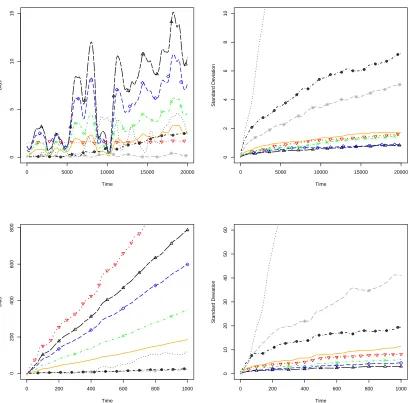
The results given in Figure 1 show that for all but the Poyiadjis O(N) algorithm the standard
deviation of the score estimate is increasing at a rate of T−1/2, giving a variance that is increasing
approximately linearly with time. For the PoyiadjisO(N), the variance is increasing quadratically
(standard deviation is increasing linearly) in line with the established theoretical results. As for the
O(N2) algorithm, the variance increases only linearly, as expected, but at an increased computa-tional cost compared to theO(N) algorithms. The variance could be further reduced by increasing
the number of particles, but this will lead to a further increase in the computational cost. While
the variance of theO(N2) is only linearly increasing, it is worth noting that it is larger than what is
given by our algorithm for all values ofλ.
For estimating the score, the fixed-lag smoother performs well in terms of both bias and
vari-ance, and we note that, while not shown in Figure 1, varying the lag about log(T ) does not
dramat-ically change the outcome, but L= 10 seems to give the best result. However, while the fixed-lag
smoother appears to work well when estimating the score, it struggles to accurately estimate the
observed information, with a large bias for a range of lags (1 ≤ L ≤ 100). This is because the
fixed-lag approach reduces the variability in the estimates of ∇log p(x1:t,y1:t|θ) associated with
each particle, which means that it under-estimates the first term in Louis’s identity (9). Whilst our
approach also reduces the variability in the estimates of ∇log p(x1:t,y1:t|θ) associated with each
particle, we are able to correct for this within the Rao-Blackwellisation scheme (see Section 4.2
for details). This drawback is further explored in Section 7.1.
For our algorithm, we notice that the bias and variance of both the score estimate, and observed
information matrix, vary according toλ. Reducingλhas the effect of increasing the bias, but at
the same time, reducing the Monte Carlo variance of the estimates. The figures show that if we
wish to minimise both bias and variance, then setting λ ≈ 0.95 will produce an estimate for the
score and observed information which exhibit only linearly increasing variance, with minimal bias
introduced as a result. In fact, the results suggest that setting 0.9 ≤ λ ≤ 0.99 will produce the
best overall results. However, ultimately interest lies in estimating the model parameters, and in
Section 7 we will see that our algorithm produces reliable estimates of the model parameters for
all values ofλ.
7
Parameter estimation
OurO(N) algorithm, as described in Section 4, can be used to estimate the score vector and
ob-served information matrix. These estimates can then be used within the steepest ascent algorithm
(7) to obtain the MLE forθ.
The steepest ascent algorithm (7) performs offline maximum likelihood estimation using batches
of data y1:T, which can be useful when dealing with small data sets. Alternatively, we could
im-plement recursive parameter estimation, where estimates of the parametersθt are updated as new
observations are made available. Ideally this would be achieved by using the gradient of the
pre-dictive log-likelihood,
θt = θt−1+γt∇log p(yt|y1:t−1, θt), (21)
where,
∇log p(yt|y1:t−1, θt)=∇log p(y1:t|θt)− ∇log p(y1:t−1|θt−1).
However, getting Monte Carlo estimates of ∇log p(yt|y1:t−1, θt) is difficult due to using different
values of θ at each iteration of the sequential Monte Carlo algorithm. Thus, following LeGland
and Mevel (1997) and Poyiadjis et al. (2011), we make a further approximation, and ignore the
fact thatθchanges with t. Instead we updateθt at each iteration using the following approximation
to this gradient:
∇log ˆp(yt|y1:t−1, θt)=St−St−1.
7.1
Autoregressive model
We compare the accuracy and efficiency of estimating the parameters of the AR(1) model (20)
using the various algorithms given in Section 6 in both an offline and online setting. Starting
with the batch case (offline), we simulated 1,000 observations from the model with parameters
θ∗ = (φ, σ, τ)⊤ = (0.9,0.7,1)⊤ and estimated the score vector and observed information
ma-trix using our O(N) algorithm, the fixed-lag smoother, and the O(N) and O(N2) algorithms of
Poyiadjis. The estimates of the score vector and observed information matrix were used within
the Newton-Raphson algorithm (7) to estimate θ. The starting parameters for the algorithm are
θ0 = (φ, σ, τ)⊤ = (0.6,1,0.7)⊤. The AR(1) model is linear-Gaussian, and therefore allows for a
direct comparison against the Kalman filter, where the score and observed information matrix can
be calculated analytically.
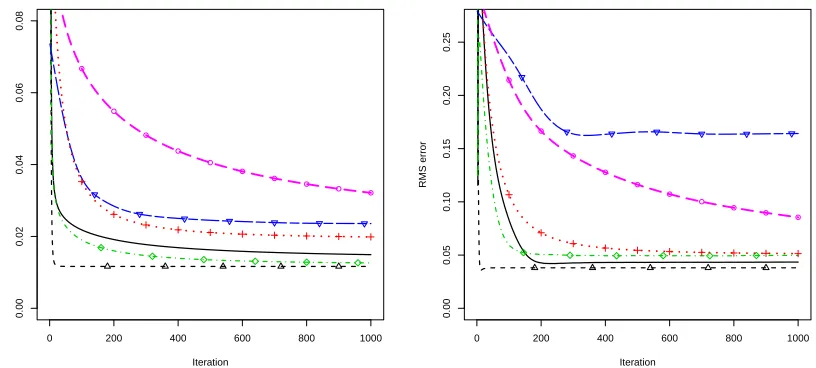
Figure 2 gives the RMS error of the parameters estimated using the Newton-Raphson algorithm
(7) averaged over 20 Monte Carlo simulations. Our algorithm, the fixed-lag smoother and the
O(N) algorithm of Poyiadjis were implemented with 50,000 particles and the O(N2) algorithm was implemented with 1,000 particles. For our algorithm we set λ = 0.95 and for the fixed-lag
smoother L = 7. In terms of computational cost, given the number of particles, our algorithm
has more than a 10 fold computational time saving compared to theO(N2) algorithm. The
fixed-lag smoother was implemented with and without the observed information matrix applied in the
gradient ascent algorithm.
The RMS error of the O(N2) algorithm given in Figure 2 is comparable to the error given by
ourO(N) algorithm, however, it is important to remember that this is achieved with a significant
computational saving. Compared to the Poyiadjis O(N) algorithm, our O(N) algorithm and the
fixed-lag smoother (using only the score estimate) produce lower RMS error. Using a fixed-lag
smoother estimate of the observed information matrix in the Newton-Raphson algorithm leads
to higher RMS error than when only the score is used. The poor performance of the fixed-lag
approach was discussed in Section 6 and is attributed to the error in estimating the observed
infor-mation matrix.
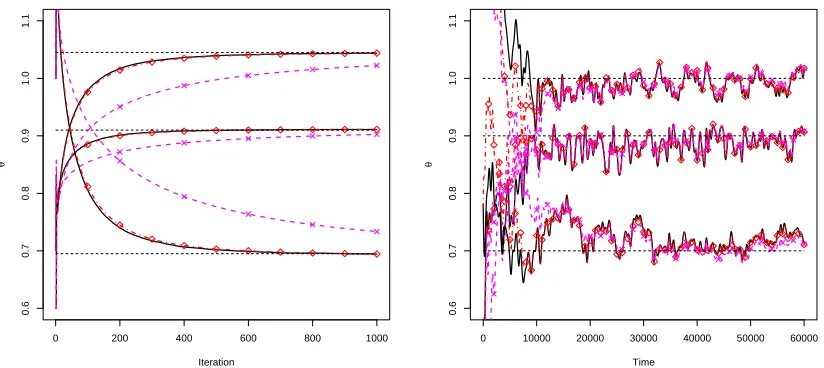
Illustrating the robustness ofλin ourO(N) algorithm, Figure 3 gives estimates forθusing the
offline (7) and online (21) gradient ascent algorithms for varying values ofλ(for the online case
we simulated 60,000 observations). We see that there is little difference betweenλ = 0.99 and
λ = 0.95, but more importantly, forλ = 0.5 the parameters are converging to the MLEs, only at
a slower rate. This was also the case for much lower choices ofλ(e.g. λ = 0.1), which are not
shown here, but for which the parameters converged to the MLE at an even slowly rate.
Using the recursive gradient ascent scheme (21) we can compare our method against the online
Bayesian particle learning algorithm (Carvalho et al., 2010). Particle learning uses MCMC moves
to sequentially update the parameters within an SMC algorithm. A prior distribution is selected for
each of the parameters which is updated at each time point via a set of low-dimensional sufficient
statistics (see the supplementary materials for implementation details).
We generated 40,000 observations from the AR(1) model and considered three different sets of
true parameter values, chosen to represent different degrees of dependence within the underlying
state process: φ = 0.9, 0.99 and 0.999. We setσ2 = 1−φ2 so that the marginal variance of the
state is 1 and fixedτ = 1. We maintain the same initial parametersθ0 for the gradient scheme as
was used for the batch analysis.
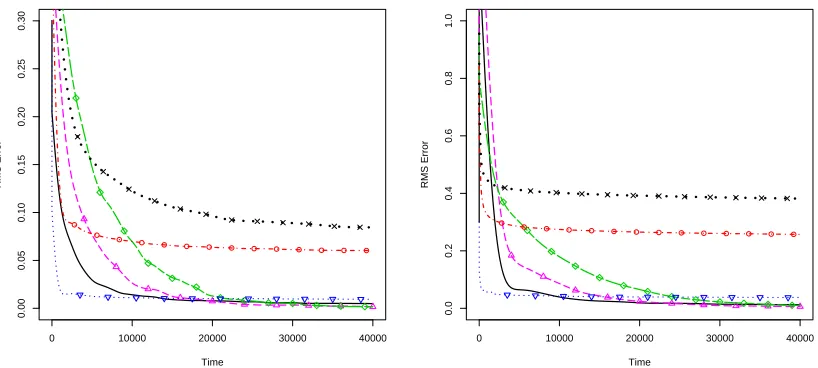
Figure 4 shows the RMS error of our O(N) algorithm applied to estimate the parameters θt,
against the particle learning filter over 100 data sets. The results show that the particle learning
filter produces a lower RMS error than our algorithm for the first few thousand observations, but
that it degenerates over very long time-series, particularly in the case of strong dependence (φ =
0.99 and 0.999). This is due to degeneracy in the sufficient statistics that occurs as a result of
their dependence on the complete latent process, and the fact that the Monte Carlo approximation
to p(x1:T|y1:T, θ) degrades as T increases (Andrieu et al., 2005). This degeneracy is particularly
pronounced for largeφ, as this corresponds to cases where the underlying MCMC moves used to
update the parameters mix poorly.
Over longer data sets, applying gradient ascent with ourO(N) algorithm, outperforms particle
learning. Asφapproaches 1, the long term state dependence is increased, as is the distance between
the true parameter values and the fixed starting values used to initiate the gradient scheme. Our
method appears to take longer to converge in this setting, but compared to particle learning, our
method appears to be more robust to the choice of φ, and for this reason, maximum likelihood
methods are preferred over particle learning when estimating parameters from long time series.
See Chopin et al. (2011) for a further discussion on the implementation challenges of particle
learning.
7.2
Nonlinear seasonal Poisson model
In this section we demonstrate our methodology on a nonlinear state space model, where we
es-timate the parameters from a real data set and show that these eses-timates are in agreement with
previous studies.
We consider a time series of monthly counts of poliomyelitis in the United States from January
1970 to December 1983. This time series was introduced by Zeger (1988) and has since been
analysed by Chan and Ledolter (1995), who used a Monte Carlo EM algorithm, and Davis and
Rodriguez-Yam (2005) and Langrock (2011) who both estimated the parameters using an
approx-imate likelihood approach. The proposed model accounts for the observed seasonality of polio
outbreaks and also contains a trend component which is the main interest in determining whether
or not there is a decreasing trend:
Yt|Xt = xt,zt ∼ Nt[0,xtexp(zt)], Xt|Xt−1= xt−1∼ N(φxt−1, σ2) (22)
log(zt)= μ1+μ2
t
1000 +μ3cos 2πt
12
!
+μ4sin 2πt
12
!
+μ5cos 2πt
12
!
+μ6sin 2πt
12
!
,
where Nt[a,b] denotes the number of events in time interval (a,b].
The model parametersθ=(μ1, μ2, μ3, μ4, μ5, μ6, φ, σ2)⊤are estimated using the gradient ascent
algorithm, where the score vector is estimated using our proposed method (Alg. 2) withλ= 0.95
and 0.7. We compare our method against the fixed-lag smoother and the PoyiadjisO(N) andO(N2) algorithms. Each method was implemented with N = 1,000 particles, except the PoyiadjisO(N2)
algorithm, which was implemented with N =33≈ √1,000 . The fixed-lag smoother was run with
lag L=5 and 20.
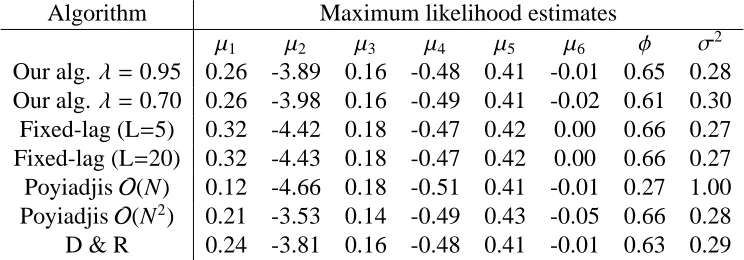
Parameter estimates for the seasonal Poisson model are given in Table 1, where the batch
implementation of the gradient ascent algorithm was executed for 2,000 iterations. Given the
short data set (T=168), we do not consider recursive parameter estimation.
We give the results from using our method with λ = 0.95 and λ = 0.7, and note that almost
identical parameter estimates were obtained forλ ∈ [0.5,0.99]. We can see that for our method,
the parameter estimates are consistent with the results presented by Davis and Rodriguez-Yam
(2005) and Langrock (2011). To understand the performance of the methods we re-ran each of
them 20 times to see the Monte Carlo variability in the parameter estimates. For our method, the
fixed-lag smoother and the O(N2) method, we obtained almost identical estimates for each run.
However the O(N) method of Poyiadjis et al. showed increased variation in the estimates (for
example the range of the estimates forμ2 was [-4.76, -4.53]). The fixed-lag smoothers performed
equally well for L= 5 and 20 with little difference between the two implementations. Most of the
parameters are estimated well using the fixed-lag smoother, but the bias of the score estimates does
lead to poor estimation of μ1 andμ2. All of the algorithms, except the PoyiadjisO(N) andO(N2)
algorithms converged after approximately 500 iterations (figures available in the supplementary
material). This is due to the Monte Carlo variation in the score estimates which directly impacts
the parameter estimates. In the case of the O(N2) algorithm, this variation could be reduced by
increasing the number of particles, but at a significantly increased computational cost compared to
our method.
8
Discussion
In this paper we have presented a novel sequential Monte Carlo method for estimating the score
vector and observed information matrix for nonlinear, non-Gaussian state space models. Previous
approaches have produced estimates with quadratically increasing variance at a computational
cost that is linear in the number of particles, or achieved linearly increasing variance at a quadratic
computational cost.
The algorithm we have developed combines techniques from kernel density estimation and
Rao-Blackwellisation to yield estimates of both the score vector and the observed information
matrix which display only linearly increasing variance, which is achieved at a linear
computa-tional cost. Importantly, we have shown that this approximate score vector, at the true parameter
value, has expectation zero when taken with respect to the data. Thus, the resulting gradient
as-cent scheme uses Monte Carlo methods to approximately find the solution to a set of unbiased
estimating equations.
The estimates of the score and observed information given by our O(N) algorithm can be
ap-plied to the gradient ascent and Newton-Raphson algorithms to obtain maximum likelihood
esti-mates of the model parameters. This can be achieved either offline or online, where the parameters
are estimated from a batch of observations, or recursively from observations received sequentially.
Furthermore, we have shown that in terms of parameter estimation, our algorithm is relatively
in-sensitive the the choice of λ. However we do note that setting 0.90 < λ < 0.99 produces low
variance estimates of the score with minimal bias, which also results in faster parameter
conver-gence.
For a significant reduction in computational time we can achieve improved parameter
estima-tion over competing methods in terms of minimising root mean squared error. We also compared
our algorithm to the particle learning filter for online estimation. The particle learning filter
per-forms well initially but degenerates over time, whereas our algorithm is more accurate over longer
time series. Our method also appears to be robust to the choice of model parameters compared
to the particle learning filter which struggles to estimate the parameters when the states are highly
dependent.
Supplementary Materials
Appendices: Proofs for Lemma 1 and Theorem 1. Also, a derivation of the particle learning
updates and a plot for the nonseasonal Poisson model example. (pdf)
R code: R code for the examples in Section 7. (Rcode.zip, zip file)
References
Andrieu, C., Doucet, A., and Tadic, V. B. (2005). On-line parameter estimation in general
state-space models. In IEEE Conference on Decision and Control, pages 332–337.
Capp´e, O., Godsill, S., and Moulines, E. (2007). An Overview of Existing Methods and Recent
Advances in Sequential Monte Carlo. Proceedings of the IEEE, 95(5):899–924.
Capp´e, O., Moulines, E., and Ryden, T. (2005). Inference in Hidden Markov Models. Springer
Series in Statistics. Springer.
Carvalho, C. M., Johannes, M., Lopes, H., and Polson, N. G. (2010). Particle Learning and
Smoothing. Statistical Science, 25(1):88–106.
Chan, K. and Ledolter, J. (1995). Monte Carlo EM estimation for time series models involving
counts. Journal of the American Statistical Association, 90(429):242–252.
Chopin, N. (2004). Central limit theorem for sequential Monte Carlo methods and its application
to Bayesian inference. The Annals of Statistics, 32(6):2385–2411.
Chopin, N., Iacobucci, A., Marin, J., Mengersen, K., Robert, C., Ryder, R., and Sh afer, C. (2011).
On particle learning. In Bernardo, J., Bayarri, M., Berger, J., Dawid, A., D.Heckerman, Smith,
A., and West, M., editors, Bayesian Statistics 9, pages 317–360. Oxford University Press.
Crisan, D. and Doucet, A. (2002). A survey of convergence results on particle filtering methods
for practitioners. IEEE Transactions on Signal Processing, 50(3):736–746.
Crowder, M. (1986). On consistency and inconsistency of estimating equations. Econometric
Theory, 2(3):305–330.
Dahlin, J., Lindsten, F., and Sch¨on, T. B. (2014). Second-order Particle MCMC for Bayesian
Parameter Inference. In Proceedings of the 19th World Congress of the International Federation
of Automatic Control (IFAC).
Davis, R. and Rodriguez-Yam, G. (2005). Estimation for state-space models based on a likelihood
approximation. Statistica Sinica, 15:381–406.
Del Moral, P., Doucet, A., and Singh, S. S. (2010). A backward particle interpretation of
Feynman-Kac formulae. ESAIM: Mathematical Modelling and Numerical Analysis, 44(5):947–975.
Douc, R., Garivier, A., Moulines, E., and Olsson, J. (2011). Sequential monte carlo smoothing
for general state space hidden markov models. The Annals of Applied Probability, 21(6):2109–
2145.
Doucet, A., Godsill, S., and Andrieu, C. (2000). On sequential Monte Carlo sampling methods for
Bayesian filtering. Statistics and computing, 10(3):197–208.
Durbin, J. and Koopman, S. (2001). Time Series Analysis by State Space Methods. Oxford
Statis-tical Science Series. Oxford University Press.
Fearnhead, P. (2007). Computational methods for complex stochastic systems: a review of some
alternatives to MCMC. Statistics and Computing, 18(2):151–171.
H¨urzeler, M. and K¨unsch, H. R. (2001). Approximating and maximising the likelihood for a
general state-space model. In Doucet, A., de Freitas, N., and Gordon, N., editors, Sequential
Monte Carlo Methods in Practice, pages 197–223. Springer-Verlag, New York.
Kalman, R. E. (1960). A New Approach to Linear Filtering and Prediction Problems. Transactions
of the ASME, Journal of Basic Engineering, 82(Series D):35–45.
Kitagawa, G. and Sato, S. (2001). Monte carlo smoothing and self-organising state-space model.
In Doucet, A., de Freitas, N., and Gordon, N., editors, Sequential Monte Carlo Methods in
Practice, pages 178–195. Springer-Verlag, New York.
Langrock, R. (2011). Some applications of nonlinear and non-Gaussian statespace modelling by
means of hidden Markov models. Journal of Applied Statistics, 38(12):2955–2970.
LeGland, F. and Mevel, L. (1997). Recursive estimation in hidden Markov models. In 36th IEEE
Conference on Decision and Control, pages 3468–3473, San Diego, CA. Institute of Electronics
and Electrical Engineering.
Liu, J. and West, M. (2001). Combined parameter and state estimation in simulation-based
filter-ing. In Doucet, A., de Freitas, N., and Gordon, N., editors, Sequential Monte Carlo Methods in
Practice, pages 197–223. Springer-Verlag, New York.
Louis, T. (1982). Finding the observed information matrix when using the EM algorithm. Journal
of the Royal Statistical Society. Series B, 44(2):226–233.
Olsson, J., Capp´e, O., Douc, R., and Moulines, E. (2008). Sequential Monte Carlo smoothing with
application to parameter estimation in nonlinear state space models. Bernoulli, 14(1):155–179.
Olsson, J. and Westerborn, J. (2014). Efficient particle-based online smoothing in general hidden
Markov models: the PaRIS algorithm. arXiv preprint arXiv:1412.7550.
Pitt, M. K. and Shephard, N. (1999). Filtering via Simulation: Auxiliary Particle Filters. Journal
of the American Statistical Association, 94(446):590–599.
Poyiadjis, G., Doucet, A., and Singh, S. S. (2011). Particle approximations of the score and
observed information matrix in state space models with application to parameter estimation.
Biometrika, 98(1):65–80.
Westerborn, J. and Olsson, J. (2014). Efficient particle based online smoothing in general
hid-den markov models. In International Conference on Acoustics, Speech and Signal Processing
(ICASSP).
Zeger, S. (1988). A regression model for time series of counts. Biometrika, 75(4):621–629.
0 5000 10000 15000 20000
0
5
10
15
Time
Bias
0 5000 10000 15000 20000
0
2
4
6
8
10
Time
Standard De
viation
0 200 400 600 800 1000
0
200
400
600
800
Time
Bias
0 200 400 600 800 1000
0
10
20
30
40
50
60
Time
Standard De
[image:28.612.98.508.157.560.2]viation
Figure 1: Absolute bias (left column) and standard deviation (right column) of score estimates for
τ(top row) and observed information matrix for theφcomponent (bottom row) from the autore-gressive model using ourO(N) algorithm withλ= 0.99 ( ∗ ∗ ),λ = 0.95 ( ),λ = 0.9
(−∙ ×−∙ ×−),λ=0.8 ( ^ ^ ),λ=0.7 ( △ △ ), Fixed-lag smoother L =10 (∙▽∙ ∙▽∙ ∙▽∙
), and the PoyiadjisO(N) algorithm (· · · · ··) andO(N2) with N =500 (−∙ ⊗−∙ ⊗−).
0 200 400 600 800 1000
0.00
0.02
0.04
0.06
0.08
Iteration
RMS error
0 200 400 600 800 1000
0.00
0.05
0.10
0.15
0.20
0.25
Iteration
[image:29.612.100.508.110.294.2]RMS error
Figure 2: Root mean squared error of parameter estimatesφ(left panel) and σ(right panel) aver-aged over 20 Monte Carlo simulations from our O(N) algorithm withλ = 0.95 ( ), Poyiadjis
O(N) ( ▽ ▽ ), PoyiadjisO(N2) (−∙^−∙−^), Fixed-lag smoother ( ◦ ◦ ), Fixed-lag
smoother (· ·+· ·+·) with score only and the Kalman filter estimate ( △ △ ).
0 200 400 600 800 1000
0.6
0.7
0.8
0.9
1.0
1.1
Iteration
θ
0 10000 20000 30000 40000 50000 60000
0.6
0.7
0.8
0.9
1.0
1.1
Time
[image:30.612.97.509.110.294.2]θ
Figure 3: Batch (left panel) and recursive (right panel) parameter estimation forλ = 0.99 ( ), λ=0.95 (−∙^−∙−^) andλ= 0.5 ( × × ).
0 10000 20000 30000 40000
0.00
0.05
0.10
0.15
0.20
0.25
0.30
Time
RMS Error
0 10000 20000 30000 40000
0.0
0.2
0.4
0.6
0.8
1.0
Time
[image:31.612.99.508.110.294.2]RMS Error
Figure 4: Root mean squared error of parameter estimates φ (left panel) and σ(right panel) av-eraged over 100 Monte Carlo simulations from our algorithm withλ = 0.95 andφ = 0.9 ( ), φ=0.99 ( △ △ ),φ= 0.999 ( ^ ^ ) and the particle learning algorithm withφ= 0.9
(∙▽∙ ∙▽∙ ∙∙),φ=0.99 (−◦ ∙−◦ ∙−),φ= 0.999 (··×··×··).
Table 1: Results of batch parameter estimation for competing models using the gradient ascent algorithm (7) initialised at θ0 = (0.4,−3,0.3,−0.3,0.65,−0.2,0.4,0.4). Results given by Davis
and Rodriguez-Yam (2005) are quoted as D&R.
Algorithm Maximum likelihood estimates
μ1 μ2 μ3 μ4 μ5 μ6 φ σ2
Our alg.λ= 0.95 0.26 -3.89 0.16 -0.48 0.41 -0.01 0.65 0.28
Our alg.λ= 0.70 0.26 -3.98 0.16 -0.49 0.41 -0.02 0.61 0.30
Fixed-lag (L=5) 0.32 -4.42 0.18 -0.47 0.42 0.00 0.66 0.27
Fixed-lag (L=20) 0.32 -4.43 0.18 -0.47 0.42 0.00 0.66 0.27
PoyiadjisO(N) 0.12 -4.66 0.18 -0.51 0.41 -0.01 0.27 1.00 PoyiadjisO(N2) 0.21 -3.53 0.14 -0.49 0.43 -0.05 0.66 0.28
D & R 0.24 -3.81 0.16 -0.48 0.41 -0.01 0.63 0.29