This is a repository copy of
Supporting the routine collection of patient reported outcome
measures in the National Clinical Audits for assessing cost-effectiveness. Work Package
1. What patient reported outcome measures should be used in the 2013/14 National
Clinical Audit Programme. Appendix G - Head and Neck Cancer.
.
White Rose Research Online URL for this paper:
http://eprints.whiterose.ac.uk/106562/
Version: Published Version
Monograph:
Ara, R., Duarte, A., Harnan, S. et al. (4 more authors) (2015) Supporting the routine
collection of patient reported outcome measures in the National Clinical Audits for
assessing cost-effectiveness. Work Package 1. What patient reported outcome measures
should be used in the 2013/14 National Clinical Audit Programme. Appendix G - Head and
Neck Cancer. Report. Policy Research Unit in Economic Evaluation of Health and Care
Interventions (EEPRU) . Policy Research Unit in Economic Evaluation of Health and Care
Interventions
[email protected] https://eprints.whiterose.ac.uk/ Reuse
Unless indicated otherwise, fulltext items are protected by copyright with all rights reserved. The copyright exception in section 29 of the Copyright, Designs and Patents Act 1988 allows the making of a single copy solely for the purpose of non-commercial research or private study within the limits of fair dealing. The publisher or other rights-holder may allow further reproduction and re-use of this version - refer to the White Rose Research Online record for this item. Where records identify the publisher as the copyright holder, users can verify any specific terms of use on the publisher’s website.
Takedown
If you consider content in White Rose Research Online to be in breach of UK law, please notify us by
Economic Evaluation of Health
and Social Care Interventions
Policy Research Unit
RESEARCH REPORT
Supporting the routine collection of patient reported
outcome measures
in the National Clinical Audits for assessing
cost-effectiveness
Work Package 1
What patient reported outcome measures should be used
in the 13 health conditions specified in the 2013/14
National Clinical Audit programme?
APPENDIX G, HEAD AND NECK CANCER
Authors: Roberta Ara, Ana Duarte, Sue Harnan, Jo
Leaviss, Steve Palmer, Mark Sculpher, John Brazier
Correspondence to:
Roberta Ara
, HEDS, ScHARR,
University of Sheffield, Regent Court, 30 Regent Street,
Sheffield, S1 4DA
. Email: [email protected]
RR003
4
2
The Policy Research Unit in Economic Evaluation of Health and Care interventions is funded by the Department of Health Policy Research Programme. It is a collaboration between researchers from the University of Sheffield and the University of York.
The Department of Health's Policy Research Unit in Economic Evaluation of Health and Care Interventions is a 7 year programme of work that started in January 2011. The unit is led by Professor John Brazier (Director, University of Sheffield) and Professor Mark Sculpher (Deputy Director, University of York) with the aim of assisting policy makers in the Department of Health to improve the allocation of resources in health and social care.
3 INDEX
1 BACKGROUND
2 OVERVIEW
3 METHOD
3.1 Psychometric properties (WP1.1) 3.2 Alternative measures (WP1.2)
3.3 Evidence required for economic evaluations (WP1.3)
4 RESULTS FOR HEAD AND NECK CANCER
4.1 Evidence of appropriateness of EQ-5D in head and neck cancer 4.2 Alternative measures in head and neck cancer
4.3 Evidence for economic evaluations in head and neck cancer 4.4 Recommendations for head and neck cancer
5 SUMMARY
6 REFERENCES
7 APPENDIX
TABLES
Table 1 Summary of existing models used in head and neck cancer TAs
Table 2 Recommendations and associated future research for head and neck cancer
Table 3 Summary of evidence currently available for recommended measure
FIGURES
Figure 1 Modelling approach used in head and neck cancer HTAs
4
Acronym Definition
AE BAHNO
Adverse events
British Association of Head and Neck Oncologists DH Department of Health
EORTC-QLQ FACT
European organisation for research and treatment of cancer core quality of life questionnaire
Functional assessment of cancer therapy EQ-5D EuroQol 5 dimensions
FR Future research
HRQoL Health related quality of life HS Health states
HTA Health technology assessment MDT Multi-disciplinary team NCA National Clinical Audit NHS National Health Service
NICE National Institute for Health and Care Excellence OS Overall survival
PFS Progression free survival PR Potential recommendations
PROM(s) Patient reported outcome measure(s) QALY Quality adjusted life year
R&D Research and development RCT Randomised controlled trial STA Single technology assessment TA Technology Appraisal
UK UW-QOL
United Kingdom
University of Washington quality of life questionnaire
5 1. BACKGROUND
EEPRU was approached by Jason Cox (R&D Division) to prepare a programme of research to support
the appropriateness of, and use of, patient reported outcome measures (PROMs) collected for the
National Clinical Audit (NCA). The EEPRU programme was informed by a Research aand
Development (R&D) template prepared by Simon Bennett, Steve Fairman and Keith Willett at NHS
England.
The purpose of introducing PROMs into the NCA programme is to be able to 1) compare
performance between providers and commissioners in the National Health Service (NHS), 2)
compare the cost-effectiveness of alternative providers in delivering the specific services (i.e. linking
outcomes and resource use), and 3) assess the cost-effectiveness of alternative interventions and
other changes in the NHS. The intention is to introduce PROMs across a range of conditions over the
next 3 years commencing with 13 conditions in the 2014/15 NCA programme.
The agreed research programme consists of 3 concurrent work packages (WP) as described in the
document submitted to the DH (8th November 2013). The current document provides details on the
objectives, methodology and results for Work Package 1 (WP1): to determine what PROMS should
be used in the 13 health conditions specified in the 2014/15 NCA programme.
2. OVERVIEW
WP1 is split into three separate components consisting of:
WP1.1 To examine whether the Euro-QoL 5 dimensions (EQ-5D) is appropriate in the 13 health
conditions specified in the 2013/14 NCA programme.
WP1.2 To identify what measure could be used when the EQ-5D is not appropriate in the 13 health
conditions, taking into account that the proposed measure would be used to generate
preference-based utility measures (either directly through existing preference-based weights,
or indirectly through existing mapping functions suitable for the proposed measure).
WP1.3 To identify the evidence required to address questions of cost-effectiveness using the NCA
data.
Each component consists of a series of reviews of the literature.
This Appendix provides the detailed results for the condition head and neck cancer and should be
6 3. METHOD
The full detailed methodology used is provided in Appendix A, including the search strategy,
selection criteria for studies included, and data extraction etc. In summary, a review of the literature
was undertaken to assess the appropriateness of the EQ-5D in terms of classic psychometric criteria
(WP1.1); where the EQ-5D was not considered appropriate, additional searches were undertaken to
identify alternative measures (WP1.2); and finally, existing health technology appriasials (HTA) were
reviewed and data requirements were compared with variables currently collected in the head and
neck cancer audit (WP1.3).
3.1 Psychometric properties (WP1.1)
Assessments reported in the included studies were categorised according to the following
definitions:
Acceptability
Data relating to how acceptable the measure was to the person completing it, expressed as the
proportion of completed surveys, or the proportion of missing data.
Reliability
There are two main definitions for reliability, a) the degree to which a measure reproduces the same
results in an unchanged population and b) the degree to which a measure reproduces the same
results when completed by different assessors (e.g. patient and proxy report). In both cases,
reliability can be assessed by re-testing, and calculating the correlations or difference between tests.
In case a) the comparison may be between the same populations separated by time, where no
change in health state was observed (as compared to an alternative condition specific or generic
I
behalf and their responses compared with those of the patient. Where the outcome measure is
specifically designed for self-report by patients, this test of reliability may be expected to produce
less agreement.
Construct validity
This is an assessment of how well an instrument measures what it intends to measure. Two main
7
a) Known group validity, where estimates for groups that are known to differ in a concept of interest are compared either qualitatively or statistically. The known groups may be defined using other
measures, according to clinical categorisation.
b) Convergent validity assesses the extent to which a measure correlates with other measures of the same or similar concepts. Correlation coefficients were considered low if <0.3, moderate if between
0.3 and 0.5, and strong when >0.5.
Responsiveness
a) Change over time. This is an assessment of whether measurements using the instrument can detect a change over time, where a change is expected. This may be before and after an
intervention, or through progression of a disease. Evidence was considered to be good where a
t-test was significant, though weaker evidence to support responsiveness was considered where there
was a change in the expected direction, but was not statistically significant or not tested. Effect size
(ES) and standardised response mean (SRM) were also acceptable assessments of responsiveness.
b) Ceiling and floor effects were also considered to be indicators of responsiveness. Assessments of ceiling effects include the proportion of patients who score full health within a group of patients
with known health detriments. A ceiling or floor effect can affect the sensitivity of the measure in
detecting changes over time in patients at the extremes of the measure (for example those with
severe disease activity and those with just minor symptoms of the condition).
3.2.1 Alternative measures (WP1.2)
Where evidence suggested the EQ-5D was not appropriate, or where no evidence was identified,
alternative measures were reviewed.
3.3 Evidence required for economic evaluations (WP1.3)
The existing HTAs were reviewed alongside the variables currently collected in the NCA to determine
if clinical or PROM data routinely collected in the NCAs would suffice to address questions of
cost-effectiveness, and to identify any gaps in the evidence that would be required to compare providers,
8
4. RESULTS FOR HEAD AND NECK CANCER
4.1 Evidence of appropriateness of EQ-5D in head and neck cancer (WP1.1)
One review was identified through experts which covered all cancers.(1) No studies for head and
neck cancer were found by this review. Searches were conducted in August 2010 in Longworth et
al.(1) and an update was conducted by EEPRU in May 2014. The update searches retrieved 32
citations. None of these studies met the inclusion criteria of WP1.1. While two studies were
identified in patients with brain cancer, this condition is excluded from the head and neck cancer
NCA hence the studies are not reviewed here.
As such, there does not appear to be any evidence relating to the appropriateness of the EQ-5D in
head and neck cancer.
4.2 Alternative measures in head and neck cancer (WP1.2)
Given the lack of evidence relating to the EQ-5D in patients with head and neck cancer, searches
were conducted to identify what other generic or condition-specific measures could be used.
Seven documents were retrieved by the searches. Of these, only two related documents were
relevant to WP1.2, both from the British Association of Head and Neck Oncologists (BAHNO).(2;3)
Four of the remaining five were clinical guidelines and did not discuss PROMS,(4-7) and one was a
report of a survey of patient experience, which did not include health related quality of life (HRQoL)
outcomes.(8)
The two related documents from BAHNO comprise a multidisciplinary management guideline with a
section on quality of life,(3) and a related document which discussed briefly quality of life
questionnaire options, and described a recommended measure, the University of Washington
quality of life questionnaire (UW-QOL v4).(2) There is, however, no mention of the measure in the
. Lowe &
Rogers give no detail or background to their document, but it would appear that it is published by
BAHNO, and can therefore assume endorsement.(2)
Lowe & Rogers state that there will be no perfect head and neck questionnaire, and cite a 2001
structured review of quality of life measures in head and neck cancer patients.(9) They also state
9
(Functional Assessment of Cancer Therapy) and UW-QOL as the most commonly used measures, but
prefer the UW-QOL v4 for its brevity and suitability for routine clinical practice.
Whilst the recommendation comes from a recognised professional body, there is no description of
how the decision was reached, and no psychometric evaluation is in evidence. The document is also
now somewhat out of date, having been published in 2008, and being largely based on a structured
review conducted in 1999. Notably, a module specific to head and neck cancer (quality of life
questionnaire head and neck 35 (QLQ-H&N35)) was developed to be used in conjunction with the
EORTC QLQ-C30 at around the same time.(11) A brief search identified a systematic review of the
psychometric properties of the QLQ-H&N35, published in 2013,(12) and which reported that
construct validity and responsiveness had been rarely formally investigated, but that other
psychometric properties were robust. They also reported that there was some room for
improvement of the instrument in terms of methodological issues such as low internal consistency
of some multi-item scales, and poor compliance of investigators in administering or reporting all
scales within the tool.
Based on the limited evidence that was identified on alternative measures, in keeping with the
recommendations for the bowel cancer audit, it is recommended that the EQ-5D and the EORTC
QLQ-C30 (plus the QLQ-H&N35 module) are collected in the NCA with a view to assessing the
psychometric properties of the measures using the NCA data (see Section 4.4).
4.3 Evidence for economic evaluations in head and neckcancer (WP1.3)
4.3.1 Cost-effectiveness modelling approach used in recent HTAs in head and neck cancer
Two single technology appraisals (STAs) relating to head and neck cancer were identified from the
searches.(13;14) Both technology appraisals (TAs) examined the clinical and cost-effectiveness of a
pharmaceutical intervention plus radiotherapy compared to radiotherapy alone in patients with
recurrent and/or metastatic head and neck cancer,(14) or patients with locally advanced squamous
cell carcinoma of the head and neck.(13)
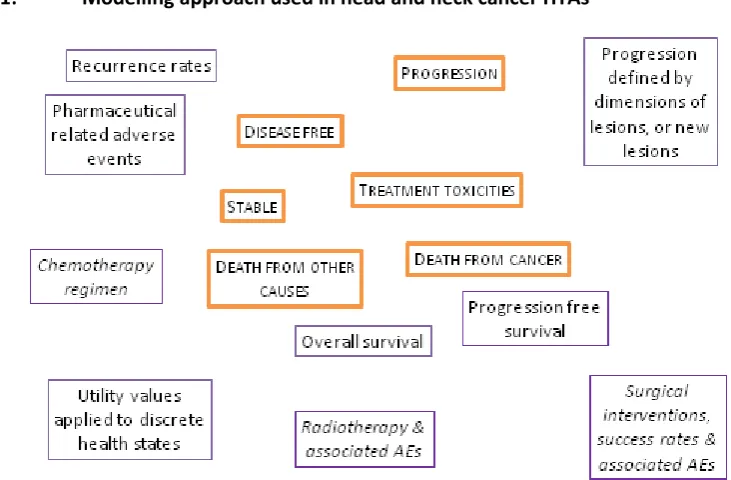
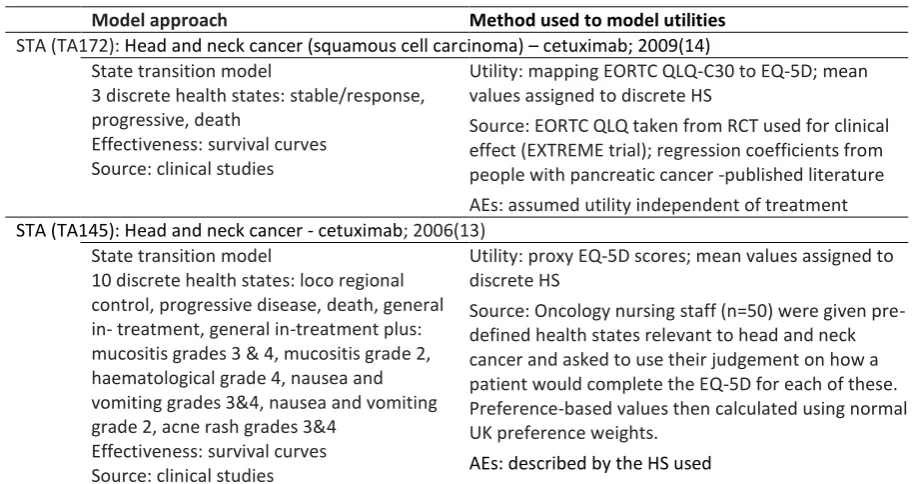
State transition models were used to examine the cost-effectiveness of the interventions under
appraisal. Both models consisted of discrete health states which represented the clinical pathway
for people with head and neck cancer at the point of the intervention (Table 1). One STA restricted
10
or more increase in the sum of the perpendicular dimensions of the index lesions compared to the
smallest recorded in the study period, or the appearance of one or more new lesions, or uniquovocal
progression of existing non-index lesions.(14) The second STA included additional health states for
treatment toxicities (Table 1, Figure 1).(13) Progression and death were modelled using survival
[image:11.595.103.469.201.441.2]curves derived from RCTs (see Figure 2 for exemplar).
Figure 1: Modelling approach used in head and neck cancer HTAs
11
Figure 2: Exemplar survival curves used to model interventions in cancer
PFS=Progression free survival
Both studies quality adjusted survival by assigning mean utility values to the discrete health states.
Presumably due to the lack of more appropriate evidence, neither study used preference-based
utility values obtained from patients with head and neck cancer. In the first study, proxy EQ-5D
scores were obtained from a group of oncology nurses who were asked to judge how a patient with
head and neck cancer would complete the EQ-5D questionnaire if they were experiencing particular
sets of symptoms which included treatment toxicities such as grade 3 or 4 nausea and vomiting.(13)
The second study used a published relationship to map from the European organisation for research
and treatment of cancer core quality of life questionnaire (QLQ) to the EQ-5D, using
EORTC-QLQ data collected in the study used to describe the clinical effect of the intervention.(14) However,
it must be noted that this was far from ideal as the data used to determine the relationship was
12
Table 1: Summary of existing models used in head and neck cancer TAs
Model approach Method used to model utilities
STA (TA172): Head and neck cancer (squamous cell carcinoma) cetuximab; 2009(14)
State transition model
3 discrete health states: stable/response, progressive, death
Effectiveness: survival curves Source: clinical studies
Utility: mapping EORTC QLQ-C30 to EQ-5D; mean values assigned to discrete HS
Source: EORTC QLQ taken from RCT used for clinical effect (EXTREME trial); regression coefficients from people with pancreatic cancer -published literature
AEs: assumed utility independent of treatment
STA (TA145): Head and neck cancer - cetuximab; 2006(13) State transition model
10 discrete health states: loco regional control, progressive disease, death, general in- treatment, general in-treatment plus: mucositis grades 3 & 4, mucositis grade 2, haematological grade 4, nausea and vomiting grades 3&4, nausea and vomiting grade 2, acne rash grades 3&4
Effectiveness: survival curves Source: clinical studies
Utility: proxy EQ-5D scores; mean values assigned to discrete HS
Source: Oncology nursing staff (n=50) were given pre-defined health states relevant to head and neck cancer and asked to use their judgement on how a patient would complete the EQ-5D for each of these. Preference-based values then calculated using normal UK preference weights.
AEs: described by the HS used
HS: health states; AE: Adverse Events; STA: Single Technology Appraisal; TA: Technology Appraisal; RCT: randomised controlled trial; EORTC QLQ: European organisation for research and treatment of cancer core quality of life questionnaire.
In summary, the following evidence would be required to compare providers or the
cost-effectiveness of interventions for head and neck cancer:
Condition severity
Pharmaceutical interventions (type of intervention, concomitant medications, remission
rates, relapse rates, adverse events)
Progression measured using lesion(s) location and sizes Utility values
Death with cause
The majority of this evidence would need to be linked through timings of collection.
4.3.2 Fields collected in the head and neck cancer NCA
The head and neck cancer audit collects data from hospitals in eligible trusts which diagnose and
treat patients with cancer of the larynx and oral cavity (excludes tumours of the brain and thyroid
13
spreadsheet completed by NHS staff. It is not clear which fields (if any) are mandatory (Appendix).
The data collected relate to the first round of treatment during the clinical audit period, although
additional multi-disciplinary team (MDT) records are included for each primary tumour. The fields
provide information on patient characteristics (date of birth, name, postcode, gender, date of
death); MDT discussion (clinical history, tests and results, tumour site, agreed care plan, recurrence
indicator and date), surgery (provider, procedure code group and date, discharge date or death
before discharge, pathological tumour site category, unscheduled return to surgery for same
primary operation), non-surgical intervention (provider, date, type, radiotherapy, chemotherapy),
palliative and nursing care, referral to speech and language therapists (SaLT), clinical status (primary
tumour, nodes, metastasises), and nutrition.
4.3.3 Comparing fields in head and neck cancer NCA with variables used in existing HTAs
The existing models in head and neck cancer use survival curves for progression free survival and
overall survival (OS). The information on clinical interventions (tumour, treatment, follow-up,
Appendix) collected in the NCA would provide some of the information required to compare
alternative treatments. The mortality data could be used to model overall mortality, and there may
be sufficient detail to extract survival curves for progression and recurrence. It may also be possible
Side-effects and adverse events due to chemotherapy,
radiotherapy and surgery are prevalent. While there is some information on unscheduled return to
surgery for the primary operation, there do not appear to be any fields relating to toxicity from
chemotherapy or adverse effects of radiotherapy.
Patient related outcome measures are not currently collected in the head and neck cancer NCA. The
inclusion of a preference-based HRQoL questionnaire such as the EQ-5D (alongside a condition
specific measure such as the EORTC), would be useful for future economic evaluations, particularly
as the existing HTAs do not in general use preference-based data to weight survival due to a dearth
of evidence in patients with head and neck cancer. There are no variables collected in the audit
which could be used to generate proxy HRQoL values through an established relationship due to the
paucity of evidence on HRQoL in this population.
Assuming the fields have relatively high completion rates, with the exception of HRQoL, and
toxicity/side effects of interventions, the information currently collected in the existing NCA may
14
policies in head and neck cancer. As previously noted, there is a dearth of preference-based HRQoL
evidence in head and neck cancer, and the collection of a preference-based measure within the NCA
would be recommended as an important and valuable consideration. It is understood that a
feasibility study is scheduled sometime during the next couple of years, and it is possible that the
new contract will include the collection of PROMs when the head and neck cancer NCA undergoes a
retendering process later this year (2014).[personal communication, Eleanor Bunn, Audit
Coordinator, 13th May 2014; personal communication, Julie, DAHNO Health And Social Care
Information Centre, 10th July 2014]
4.4 Recommendations for head and neck cancer
The searches conducted to identify evidence on the appropriateness of the EQ-5D found no relevant
studies. Although relatively old (2006 and 2009), the two TAs in head and neck cancer
demonstrated that there were substantial gaps in the evidence base used to assign HRQoL scores
along the clinical pathway for patients with head and neck cancer. The data used in these TAs do
not satisfy the requirements of a submission to the NICE. The estimated, assumed, and predicted
proxy utility scores increase the uncertainty in results generated from models. While it is likely that
with exceptions, the current head and neck cancer audit collects much of the evidence needed to
perform economic evaluations, this is far from clear. In addition, the head and neck audit is
completed by clinicians/NHS staff and does not currently include a patient completed component.
Potential recommendations (PR) and areas for future research (FR) are discussed below. All
suggested future research areas are indicative and would require a discussion and detailed proposal
if required.
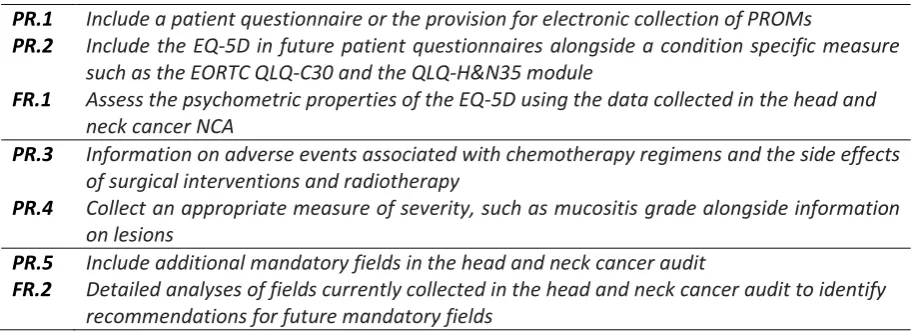
It is clear that this is an area where research is required to inform the most appropriate PROM. The
primary recommendation would be to consider collecting PROMs in this population, either through a
postal questionnaire or electronically at strategic points in the care pathway (PR.1). It is
recommended that the EQ-5D is considered for inclusion in the first instance to enable the evidence
to be used to generate quality adjusted life years (QALYs) in economic evaluations. However,
research would be required to determine the appropriateness of the EQ-5D in this population (FR.1),
and it is recommended that a condition specific measure (such as the EORTC QLQ-C30 together with
15
Adverse events and side-effects of chemotherapy and surgical/radiotherapy interventions are
prevalent and are key variables when assessing the benefits of interventions and procedures used in
in cancer. It is recommended that these are included as mandatory variables in future audits (PR.3).
It is also recommended that an appropriate measure of severity (such as mucositis grade) is
[image:16.595.66.524.211.379.2]collected alongside changes in lesions (PR.4).
Table 2: Recommendations and associated future research for head and neck cancer
PR.1 Include a patient questionnaire or the provision for electronic collection of PROMs
PR.2 Include the EQ-5D in future patient questionnaires alongside a condition specific measure
such as the EORTC QLQ-C30 and the QLQ-H&N35 module
FR.1 Assess the psychometric properties of the EQ-5D using the data collected in the head and
neck cancer NCA
PR.3 Information on adverse events associated with chemotherapy regimens and the side effects
of surgical interventions and radiotherapy
PR.4 Collect an appropriate measure of severity, such as mucositis grade alongside information
on lesions
PR.5 Include additional mandatory fields in the head and neck cancer audit
FR.2 Detailed analyses of fields currently collected in the head and neck cancer audit to identify
recommendations for future mandatory fields
5. SUMMARY
5.1 Summary of evidence used to inform the conclusions for WP1.1 and WP1.2
One review was identified and an update search conducted. No primary research studies relating to
the psychometric properties of the EQ-5D in head and neck cancer were identified. Searches
identified seven published clinical or research guidelines relating to other measures, but none of
these were based on up to date evidence. Given the limited evidence available, it is recommended
that the EQ-5D is used alongside the EORTC C30 and head and neck specific module, the
16
Table 3: Summary of evidence currently available for recommended measure(s)
Condition N Acceptability Reliability Construct Responsiveness Overall KGV Convergent Change
over time
Ceiling Effect
EQ-5D 0 NE NE NE NE NE NE No evidence Head and
Neck Cancer
EORTC QLQ-C30 EORTC QLQ-H&N35
The psychometric properties of these measures have not been reviewed in the current report
N= number of studies used to inform conclusions, KGV: known group validity; NE, no evidence was identified
5.2 Summary of evidence required for use in economic evaluations (WP1.3)
The head and neck cancer audit does not include a patient questionnaire thus PROMs are not
currently collected and there does not appear to be an alternative field which could be used to
predict the required preference-based utility values. Assuming there is a relatively high completion
rate, it is thought that this audit collects much of the information required to derive survival curves
for progression and recurrence of the disease but again key information may be missing such as
condition severity (measured using information of lesions and required to case-mix when comparing
providers), current pharmaceutical interventions (type of intervention, concomitant medications,
17 APPENDIX: HEAD AND NECK CANCER
The tables in this Appendix provide additional information for the reviews (WP1.1, 1.2 and 1.3) conducted for head and neck cancer. There are no tables for WP1.1 as no evidence was identified.
Table A1: Mandatory fields collected in the head and neck cancer NCA
PATIENT
Date of birth, Postcode, Gender, Date of death MDT DISCUSSION
Has patient had a pre treatment nutrition assessment, Year symptoms first noted, Chest XR performed prior to treatment, CT chest performed prior to treatment, , CT Primary / Neck performed prior to treatment, MRI primary performed prior to treatment, PET CT scan performed prior to treatment, Orthopantomogram (OPG) performed prior to treatment, Ultrasound performed prior to treatment, Biopsy procedure date, Date pathology report, Tumour laterality, Date of diagnosis, Primary site group, Primary site, Basis of diagnosis, Histological diagnosis at biopsy, First diagnosis organisation, Has HPV Status testing been done, HPV Test, HPV status, MDT organisation, Referral for cancer decision date, Has patient been discussed at MDT, MDT discussion date, Comorbidity index, Performance status, Care plan agreed date, Cancer care plan intent, Planned cancer treatment type 1, Planned cancer treatment type 2, Planned cancer treatment type 3, Planned cancer treatment type 4, Final Pre-treatment tumour site T Category, Final pre-treatment tumour site N Category, Final pre-treatment tumour site M Category, Has patient had a pre treatment nutrition assessment, Has patient had a pre treatment dental assessment, Recurrence indicator, Date of recurrence
SURGERY
Surgery provider organisation, Cancer treatment intent, Procedure date, Procedure code group 1, Procedure code 1, GMC 1, Procedure code group 2, Procedure code 2, GMC 2, Procedure code group 3, Procedure code 3, GMC 3, Procedure code group 1, Procedure code 4, GMC 4, Procedure code group 5, Procedure code 5, GMC 5, Procedure code group 6, Procedure code 6, GMC 6, "Did the patient die prior to discharge?", Discharge date, Date of post-resective pathology report, Post-resective histological diagnosis, Pathological tumour site T category, Pathological tumour site N category, Pathological tumour site M category, Was resective pathology discussed at MDT, Was there an unplanned return to theatre during the same admission for same primary operation?
NON SURGICAL
Treatment provider organisation, Treatment start date, Treatment type, Cancer treatment intent, Radiotherapy treatment to, Chemotherapy drug type
PALLIATIVE, NURSING AND SaLT
Palliative care organisation, Palliative care start date,
Nursing care organisation, First CNS contact date, CNS present when patient advised of diagnosis, Has a patient concerns inventory been carried out?
SaLT care organisation, First SaLT date, Was this patient assessed post treatment, Normalcy of diet (pre-treatment), Normalcy of diet at 3 months, Normalcy of diet at 12 months, Laryngectomy proposed method of post operative communication, Laryngectomy communication method (3 months post op), Laryngectomy communication method (12 months post op)
STATUS
Status recording organisation, Clinical status assessment date, Primary tumour status, Nodal status, Metastatic status
NUTRITION
18 Reference List
(1) Longworth L, Yang Y, Young T, Mulhern B, Hernandez AM, Mukuria C, et al. Use of generic and condition-specific measures of health-related quality of life in NICE decision-making: A systematic review, statistical modelling and survey. Health Technol Assess 201418(9):1-224. Available from: URL:
http://www.journalslibrary.nihr.ac.uk/__data/assets/pdf_file/0008/108368/FullReport-hta18090.pdf
(2) Lowe D, Rogers S. University of Washington Quality of Life Questionnaire Guidance for Scoring and Presentation. 2008.
(3) Roland N, Paleri V. Head and Neck Cancer Multidisciplinary Management Guidelines. 2011.
(4) NCCN Clinical Practice. Head and Neck Cancers. 2013.
(5) Pfister DG, Ang KK, Brizel DM, Burtness BA, Cmelak AJ, Colevas AD, et al. Head and neck cancers. J Natl Compr Canc Netw 2011 Jun 1;9(6):596-650.
(6) North Trent Cancer Network. Referral and Management Guidelines for Head and Neck Cancers within North Trent. 2012.
(7) Sussex Cancer Network. Collated Clinical Head, Neck and Thyroid Guidelines. 2012.
(8) Emsden G. Head and Neck Cancer Patient Experience Survey. 2012.
(9) Ringash J, Bezjak A. A structured review of quality of life instruments for head and neck cancer patients. Head Neck 2001 Mar;23(3):201-13.
(10) Rogers SN, Fisher SE, Woolgar JA. A review of quality of life assessment in oral cancer. Int J Oral Maxillofac Surg 1999 Apr;28(2):99-117.
(11) Bjordal K, de GA, Fayers PM, Hammerlid E, van PC, Curran D, et al. A 12 country field study of the EORTC QLQ-C30 (version 3.0) and the head and neck cancer specific module (EORTC QLQ-H&N35) in head and neck patients. EORTC Quality of Life Group. Eur J Cancer 2000 Sep;36(14):1796-807.
(12) Singer S, Arraras JI, Chie WC, Fisher SE, Galalae R, Hammerlid E, et al. Performance of the EORTC questionnaire for the assessment of quality of life in head and neck cancer patients EORTC QLQ-H&N35: a methodological review. Qual Life Res 2013 Oct;22(8):1927-41.
(13) Griffin S, Walker S, Sculpher M, White S, ErhornS, Brent S, et al. Cetuximab plus radiotherapy for the treatment of locally advanced squamous cell carcinoma of the head and neck TA145. 2008.