White Rose Research Online URL for this paper: http://eprints.whiterose.ac.uk/90718/
Version: Accepted Version
Article:
Judge, S., Hawley, M.S., Cunningham, S. et al. (1 more author) (2015) What is the potential for context aware communication aids? Journal of Medical Engineering & Technology, 39 (7). pp. 448-453. ISSN 0309-1902
https://doi.org/10.3109/03091902.2015.1088091
[email protected] https://eprints.whiterose.ac.uk/ Reuse
Unless indicated otherwise, fulltext items are protected by copyright with all rights reserved. The copyright exception in section 29 of the Copyright, Designs and Patents Act 1988 allows the making of a single copy solely for the purpose of non-commercial research or private study within the limits of fair dealing. The publisher or other rights-holder may allow further reproduction and re-use of this version - refer to the White Rose Research Online record for this item. Where records identify the publisher as the copyright holder, users can verify any specific terms of use on the publisher’s website.
Takedown
If you consider content in White Rose Research Online to be in breach of UK law, please notify us by
What is the Potential for Context Aware Communication Aids?
Simon Judge 1,2,3, Mark S Hawley1,2,3, Stuart Cunningham1,4, Andrea Kirton2
1. University of Sheffield, Centre for Assistive Technology and Connected Healthcare and
School of Health and Related Research
2. Barnsley Hospital, Assistive Technology Team
3. NIHR Devices for Dignity Healthcare Technology Co-operative
4. University of Sheffield, Department of Human Communication Sciences
Author Note
Correspondence Address: School of Health and Related Research (ScHARR), University
of Sheffield, Regent Court, 30 Regent Street, Sheffield, S1 4DA
0114 222 0682
[email protected] ; [email protected] ; [email protected] ;
Declaration of interests: None.
This is an Accepted Manuscript of an article published by Taylor & Francis in JMET on
Abstract
Use of voice output communication aids (VOCAs) can be a very effective strategy to
assist people with speech impairments in communicating. Despite this, people who use
communication aids often express frustration with VOCAs – desiring devices that are simpler,
quicker and more effective to use.
Whilst it is not possible to resolve all these issues with technology, we argue that
significant progress can be made. The use of contextual information is one development that
could improve the simplicity and effectiveness of communication aid design.
Improving the effectiveness of communication aids, including through the use of context
support, is a goal of the NIHR Devices for Dignity Assistive Technology Theme. This discussion
paper examines the potential for creating ‘context aware’ communication aids. Three projects in
which the authors have been involved are described to illustrate different approaches to the use
of contextual information.
What is the Potential for Context Aware Communication Aids?
Augmentative and Alternative Communication (AAC) refers to a range of strategies,
techniques and devices that can support the communication of individuals with speech, language
and communication impairments. Voice output communication aids (VOCAs) are one AAC
strategy often used by individuals to support their communication. VOCAs are devices which
take an input from the user and output synthesised (or recorded) speech. Here we are
considering the use of AAC for expressive communication (as defined by Tetzchner &
Martinsen1), although AAC and VOCAs can also be used to support language development.
It can be argued that VOCAs to date have been designed predominately for individuals
with no functional speech2, but they are also used by those whose speech intelligibility is
variable or understandable only to people who know them well (e.g. when used by individuals
with severe or moderate dysarthria). VOCAs are used rarely as the only mode of communication
of an individual, but tend to be used as part of an overall set of communication strategies3.
VOCAs may use text or graphic symbols to represent language on the device and as an
input method for the user4. Depending on the type of AAC being used, items that can be selected
by the user may be letters (or other graphemes), whole words or phrases, or may be other graphic
symbols representing words, concepts or utterances.
Individuals using a VOCA also face constraints related to the selection of these items.
Those using text representation will need to select around 27-40 items (unless using an
ambiguous keyboard5), whereas those using graphic symbols may need to select from as many as
either as a coded sequence (e.g. navigation through pages) or with an explicit code (e.g. Morse or
quartering6).
Individuals use a range of strategies to select items on a VOCA - some may be able to
press directly onto a screen or keyboard (known as direct access), whereas others may have
difficulties with co-ordination or control and require alternative access devices. These devices
can include alternative keyboards (for example those with key ‘guards’), alternative mice (for
example, eye gaze or head movement selection), or other controls such as switches. Switches are
binary (non-latched) ‘buttons’ that come in a range of types - with varying size, shape, activation
force or method. When using a switch, the user will either press it to select the desired item from
a list of items through which the computer is scrolling, or use multiple switches to manually
‘move’ through the possible selections and then select the desired item7.
There are few studies measuring actual input or output (speaking) rates of VOCA users,
however for text production an output (measured in words per minute - wpm) of less than 5 wpm
for switch access8, or less than or around 10 wpm for AAC users using any mode 9,10 has been
suggested. This can be compared to studies of typing on ‘soft’ keyboards that suggest rates of
between 8-20wpm11. As the speaking rate of a typical speaker during conversation may be
between 100 and 200 wpm12,13 it can be seen that current AAC output is in the region of an order
of magnitude slower than spoken speech.
People who use AAC and VOCAs often cite challenges and frustrations related to the
speed of communication using these systems and also in their simplicity of use14,15. This has
been a focus of prior work carried out as part of the NIHR Devices for Dignity (D4D) Healthcare
Technology Co-operative14,16. From this and other work, it is clear that an individual’s personal
communicate effectively. In addition there is an expectation from people who use AAC that
devices will become more able to support more responsive, fluent and natural conversations17.
A range of different approaches have previously been discussed in the literature or
implemented in practice as ‘rate enhancement’ techniques. Techniques related to text input
include word prediction and completion18, abbreviation expansion – a coded input to a phrase
bank19, and the use of other coding systems such as Morse code10. Word completion refers to
when a device suggests words based on the input of the initial letters of the word. Word
prediction refers to the process when a device actually predicts which word (or words) may
follow the current word in a message. Word completion and prediction makes use of a statistical
model of language. The model is designed to estimate the distribution of words in a language and
is used to predict which word is most likely follow on from the current word or words in a
message, given the linguistic context. Garay-Vitoria & Abascal20 provide a review of text
prediction methods.
The selection and output of whole utterances (phrases) has been proposed as a potential
method for speeding up communication. However, the use of whole utterances highlights the
complexity in the interpretation of the desire for ‘speed’. Although identified by communication
aid users as an aspiration, communicative speed is not the only measure of effectiveness in AAC.
Words per minute is a throughput measure and is likely to be a poor measure of communicative
effectiveness with respect to interpersonal communication and AAC21. Light22, introduces the
concept of communicative competence and breaks this into operational, linguistic, social
competence and psychosocial factors. Experimental evidence suggests that a quickly produced
communication aid23. McCoy23 et. al. describe the challenge as being to enable “users to quickly
and easily retrieve relevant pre-stored messages”.
A wide range of outcomes, from frequency of initiation to quality of life, have been
discussed as pertinent to augmentative communication24,25 and although it is beyond the scope of
this paper to discuss these, it should be noted that there is not one clear objective related to
improving the design of VOCAs. The aims of interpersonal communication also vary greatly
and can be characterised variously as: a process of information transmission, as represented by
Information Theory26; as self/shared expression involving expression of humour, intimacy or an
emotional state27; and as the sharing of personal narratives (story telling)28,29 . In addition,
Blackstone30 suggests that communication aims, modes and methods can vary greatly between
different communication groups or ‘circles’ of communication partners.
1. Context
Communication through spoken conversations has context and this can be conceptualised
in a number of ways. A simple model of context would distinguish between external
(environmental) context and internal (personal or psychosocial) context. An example of
external context may be an individuals’ location or whom they are speaking to; an example of
internal context being the intention of the communicative act or the individuals’ emotional state.
The context of conversations can effect every aspect of the conversation including the content,
use of language, style, tone of voice, intonation, volume, use of slang (colloquialisms) and
accent. This effect could be described as the individual’s revealed contextual preferences.
The processing of (revealed) contextual information using algorithms and machine
engines, such as Google31or iOS 8’s Spotlight32 use contextual information, such as where the
user is, to inform their search algorithm to influence search results and advertising33. Word
prediction engines on smart phones and other devices are also becoming ‘context aware’ – for
example, the iOS8 word prediction keyboard claims to take into account “ your text messaging
style”, “who you’re writing to”, “what the conversation is about” and “how you email”34 .
1.1.The Use of Context for Augmentative Communication
People who use AAC may be able to process and use the context of a conversation
receptively in the same way as any other individual. However, their operational use of this
contextual information is much more limited as their language generation is mediated by use of
their communication aid.
An individual using a communication aid may choose to adapt their communication
based on the context of a conversation, however this is likely to be in a much more limited way
than that of someone using natural speech. An individual using a communication aid that has a
fixed set of words (vocabulary) may not have access to the very personalised, low-frequency, or
context-specific words required to adapt their communication 35. For those using alphabetic
typing, non-adaptive word prediction may result in a more static use of language and may poorly
predict fringe vocabulary36. Finally, in all cases, constructing a message using a communication
aid is slow and this is likely to mean that the utterances are shorter (or telegrammatic) and that
the message is thus less likely to be adapted to the context of the conversation.
Many of the other expressive changes that context may affect are not available to an
individual using a VOCA. Pullin and Cook37,38discuss the challenges of tone of voice when using
of tone of voice and four different perspectives of tone of voice: emotional state; conversational
intent; social context; and vocal qualities. Tone of voice within VOCAs is currently limited to
either a rising or falling intonation.
Presently there is little incorporation of contextual information in the operation of
communication aids. Current aids can be characterised as being equivalent to a physical
keyboard - in that they process a sequence of inputs to produce a sequence of words - that can
then be displayed or spoken using a speech synthesiser.
Within current VOCA software, the possible approaches to dealing with contextual
information can be characterised as:
1. Opening (pages of) pre-programmed content: this is relatively easy to achieve with
existing VOCA software architectures. Some examples of the use of location data can be
found in commercially available systems – possibly because of the easy availability of
location data in mobile computing platforms. For example, Talk Rocket GoTM and
ChatableTM use GPS location to load up specific, pre-prepared, vocabulary pages that
have been previously linked by the user to that location.
2. Switching topic or vocabulary lists: Some VOCA software include topic or vocabulary
lists that can be either pre-programmed or manually stored by the user. These could
potentially be loaded based on knowledge of the speaker or other context, yet the current
software architectures do not easily support this.
3. Switching language models: Storing and loading alternative language models or ‘user
dictionaries’ would be possible within existing VOCA software, though again the current
1.2.Incorporating Context Support in Communication Aids
Much of the previous research relating to context support within VOCAs has related to
the potential uses of Natural Language Processing (NLP) and Generation (NLG).
The use of adapted language models is an example of NLP technology and of
incorporating context into a message generation system. For instance, the claims made for the
iOS prediction keyboard (described earlier) are likely facilitated by the use of different language
models adapting to the user’s text messaging and email style meaning that the abbreviations and
colloquialisms that might be appropriate to use in SMS text messages are not suggested when
writing an email.
Adapted language models based on contextual information such as with whom the user is
conversing, where the user is, or perhaps even the aim or tone of the conversation offer one way
for VOCAs to take advantage of contextual information. As an example, an adaptive system
should make different predictions when the user is sitting in a bar with their friends compared to
when they are meeting their manager while at work. A model of contextual information for NLP
that encompasses location, time, language, communication partner, and (partner’s) conversation
content has been presented39,40.
NLG is a method for creating natural utterances based on small amounts of input data and
is sometimes described as ‘data to text’. These data, much of which could be considered to be
contextual data, could be generated by algorithms, gathered from sensors or input by the user. A
number of prototype/research NLG systems have been built that use contextual information in
varying ways. In some cases this contextual information has been automatically generated41 and
in some it has been input manually by the user42. For example, in their prototype system Black
log who they were with; Wisenburn and Higginbotham41 used speech recognition to attempt to
recognise the content of communication partners’ speech – i.e. attempting to use a topic as
context; while Netzer and Elhadad44 created a system using the Bliss symbolic language as the
input and used NLG to produce natural sounding spoken sentences.
2. Alternative Approaches to Context Support in Communication Aids
Contextual information can be applied within AAC-mediated interactions in a number of
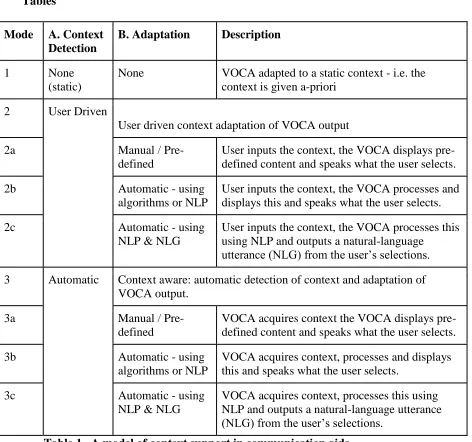
ways. We propose the model described in Table 1 where context support is broken down into
two factors - detection and adaptation:
A. Firstly, the device may (or may not) detect the contextual information
automatically (e.g. with sensors such as GPS) or it may be manually entered by
the user;
B. Secondly, the device may (or may not) adapt to the contextual information in a
number of ways - either by presenting the information to the user to evaluate and
use, by processing the context in some way and changing the interface to present
different opportunities to the user, or by processing the context and using natural
language generation. Looking at Table 1, it is clear that current research has
concentrated on the use of NLG (modes 2c and 3c). The following section
provides examples of projects with which the authors have been involved where
contextual information has been used. These example projects highlight a range of
different ways of using contextual information to support the use of AAC.
2.1.Example 1: Static context - Intensive Care Units
Context can be situational and fixed (mode 1) – an example of this is a project currently
being undertaken related to the use of AAC within Intensive Care Units (ICU). Patients within
these units are within a very specific context: they are temporarily unable to communicate
because of intubation; are likely to recover speech (when the tube in their airway is removed);
have no experience of use of AAC; are in highly stressful environments; and are likely to be in
extreme psychological states.
Within this project we are examining the specific contextual factors that influence the use
of AAC in this extreme communication environment using a number of methods: a systematic
review45; qualitative interview study of ex ICU patients and current ICU staff; and observational
data gathered by a designer embedded for a period in an ICU unit. Results to date have
suggested a range of specific requirements associated with this context, and this has translated
into content requirements - for example in identifying possible topics of conversation to be
included in a possible solution - and environmental considerations such as staff training and a
design sympathetic to both the ICU patient and staff. Others46 have previously demonstrated the
challenges of implementing an AAC device in the ICU context.
The outcome of this work will be the design of a new, relatively ‘frugal’ AAC device
which will be used within a large scale study to further examine the needs, requirements and
barriers to use of these technologies in ICU to inform future technology adoption by the NHS.
2.2.Example 2: Providing Context as Communication Support - VIVOCA
We have carried out research with individuals who have dysarthric speech which is hard
demonstrated an overwhelming desire to rely on natural speech as the primary form of
communication - no matter how hard this is for others to understand2,47. This research also
suggested that the same desire to use all other methods (such as gesture) before ‘resorting’ to a
VOCA was also present in expert communication aid users who had no functional speech.
This reliance upon the use of natural speech leads to frequent breakdowns in
conversations. Using conversation analysis, Bloch & Wilkinson48 have studied the conversation
of dyads, in which one of the participants has dysarthria, and identified sources of breakdown
and the challenge in repairing these conversations. As one of the participants in our research
said, it can be ‘like a car crash’ once a conversation has broken down and many participants
described situations when they had chosen not to attempt to repair the conversation.
Our research, and the work of Bloch and Wilkinson, highlights another potential role for
context - that of establishing the key contextual information within a conversation as a way of
improving understanding (of the communication partner) and assisting in the repair of
conversations.
We have designed an alternative approach to communication which allows the person
with dysarthria to provide contextual information, using a VOCA, to support a conversation that
is predominately spoken (mode 2a or 2b). The VOCA displays a hierarchy of contextual
information that the individual with dysarthria can navigate. As the individual navigates the
hierarchy, at each stage the communication aid provides information in the form of spoken
phrases which incrementally narrow down the context. For example as part of a conversation
which has broken down an individual may navigate through the hierarchy and the VOCA would
say: ‘I am talking about a place’ then ‘I am talking about a shop’ and finally ‘I am talking about
This approach allows the individual with dysarthria to provide key utterances to add the
required context into a conversation. It provides many opportunities for conversational repair
and supports the communication partner (listener) to understand the context and thus improve
their understanding. This approach shifts the onus from the person with dysarthria being ‘at
fault’ to giving the communication partner responsibility for repairing the conversation and
maintaining their attention on the individual’s speech. This approach will be further explored in
future work by the authors.
2.3.Example 3: Adding Specific Contextual Information - SpeakerID
A simple analysis of the external contextual factors relevant in a conversation suggests
that the communication partner (speaker) is highly relevant.
We are carrying out a small proof of concept project to attempt to use simple speech
technology techniques to identify the communication partner within a conversation. We intend
to create prototype ‘SpeakerID’ software that will detect to whom the person using the
communication aid is speaking to and to link this into existing VOCA software (modes 3a or 3b).
The SpeakerID software uses speaker-specific information such as the long-term
spectrum and fundamental frequency. Each speaker is introduced to the system with a short
segment of speech, which is analysed and the characteristics of the speaker are stored for later
reference. The software then processes an incoming speech signal to determine to which of the
known speakers the signal is most similar too. Proposing a SpeakerID system presents a number
of considerations.
Privacy and data protection questions are raised when considering the use of this data:
is processed (e.g. if it is linked to other data such as name, place etc.) and how it is used (e.g. if
the VOCA software identifies prior topics of conversation that may be unwanted or negative).
Dealing with errors, and with measures of confidence in the results is also likely to be a
key challenge in the integration of this data into a VOCA interface. It is likely, in parallel with
other speech technology, that the system would have less than 100% reliability in terms of
correct identification. Errors have been identified in other studies49 as a key issue in the
effectiveness of use of speech recognition.
A further question relates to ‘what should, or could, be done with this information?’ A
‘full NLG’ approach of generating a whole utterance based on knowledge of the speaker could
be envisaged, nevertheless, without additional contextual information (e.g. place, time, aim or
style of the conversation) it is likely these utterances would be perceived as having low
competence. This additional information could be added by the user, although several other
‘context-influenced’ approaches may also be considered:
1. Style - changing the style of utterance based on the person or category of person (e.g. if
they are known or unknown). For example: known person = informal style - “alright
Frank”, unknown person = formal style - “Hello, I am Joe, nice to meet you”.
2. Content - changing content based on person, or category of person.
a. Personal knowledge: For example: family member or carer - “Can I have a
drink”, unknown person - “Can I have a cup of tea, with milk, not too hot, and
could you hold it up so I can drink it with a straw”.
b. Conversational topic: For example: known person - “Nightmare lectures today”,
unknown person - “I go to Sheffield University and am studying Design, how
3. Topic generation - knowledge of past/common topics for each speaker would allow a
system to suggest topic dictionaries or vocabularies based on prior use with that person.
For example: “Hi James, is your motorbike fixed yet?”
4. Narrative generation - providing access to story-telling, based on previous topics and
stories, for example by simply re-offering prior utterances, or stories. For example: “The
other week Jack dressed up for charity? They raised lots of money...”
SpeakerID will be used as a critical artefact50 - a physical object that rather than solving
a problem aims to stimulate users and industry to examine the potential role and requirements of
context support within VOCAs.
3. Conclusions
This paper has attempted to extend the consideration of the potential role of the use of
contextual information for support within the design of communication aids. Examples of
different approaches to contextual information have been provided: designing a communication
aid to deal with the constraints of a specific context; an alternative approach to communication
support for individuals with dysarthria where contextual information is presented to the
communication partner in order to assist with repair of the (spoken) conversation; and an
example of adapting the interface or interaction based on the knowledge of (only the)
communication partner.
There are few examples of context support within existing communication aids and the
limited research in this area has concentrated on the use of contextual information as an input to
natural language generation. We propose that the role of contextual information should be
1. What element(s) of context is (are) most important to consider in relation to
improving communication;
2. How contextual information can be used to create more intuitive and simpler
interfaces;
3. How context can be used best within communication aids to maximise an
individual’s communication (over the most relevant measure for that individual);
4. How communication aid users feel about the use of this information, and,
5. How the possible benefits, risks or disadvantages are perceived by
Tables
Mode A. Context Detection
B. Adaptation Description
1 None
(static)
None VOCA adapted to a static context - i.e. the
context is given a-priori
2 User Driven
User driven context adaptation of VOCA output
2a Manual /
Pre-defined
User inputs the context, the VOCA displays pre-defined content and speaks what the user selects.
2b Automatic - using
algorithms or NLP
User inputs the context, the VOCA processes and displays this and speaks what the user selects.
2c Automatic - using
NLP & NLG
User inputs the context, the VOCA processes this using NLP and outputs a natural-language
utterance (NLG) from the user’s selections.
3 Automatic Context aware: automatic detection of context and adaptation of VOCA output.
3a Manual /
Pre-defined
VOCA acquires context the VOCA displays pre-defined content and speaks what the user selects.
3b Automatic - using
algorithms or NLP
VOCA acquires context, processes and displays this and speaks what the user selects.
3c Automatic - using
NLP & NLG
VOCA acquires context, processes this using NLP and outputs a natural-language utterance
[image:18.612.68.540.106.548.2](NLG) from the user’s selections.
4. References
1. Tetzchner S, Martinsen H. Introduction to augmentative and alternative communication : sign teaching and the use of communication aids for children, adolescents, and adults with
developmental disorders. Whurr; 2000.
2. Palmer R, Enderby P, Hawley M. A voice input voice output communication aid: what do users and therapists require? Journal of Assistive Technologies. 2010;4(2):4–14.
3. Smith MM, Connolly I. Roles of aided communication: perspectives of adults who use AAC. Disability and rehabilitation. Assistive technology. 2008;3(5):260–73.
4. Murray J, Goldbart J. Augmentative and alternative communication: a review of current issues. Paediatrics and Child Health. 2009;19(10):464–468.
5. Judge S, Friday M. Ambiguous keyboards for AAC. Journal of Assistive Technologies. 2011;5(4):249–256.
6. Baird E, Mays J. ” P is a Palindrome”: Case Study Comparing Quadrant Reduction Onscreen
Keyboard and Morse Code. In: ISAAC Biennial Conference Proceedings. ; 2014.
7. Judge S, Colven D. Switch access to technology - A comprehensive Guide. 2006:1–56.
8. Higginbotham DJ, Shane H, Russell S, Caves K. Access to AAC: Present, past, and future. Augmentative and Alternative Communication. 2007;23(3):243–257.
9. Higginbotham DJ, Lesher G, Moulton B. Evaluating and Enhancing Communication Rate,Efficiency and Effectiveness.
10. Levine S, Gauger J, Bowers L, Khan K. A comparison of Mouthstick and Morse code text inputs. Augmentative and Alternative Communication. 1986;2(2):51–55.
11. Mackenzie I, Zhang S, Soukoreff R. Text entry using soft keyboards. Behaviour and Information Technology. 1999:235 – 244.
12. Krause JC, Braida LD. Investigating alternative forms of clear speech: The effects of speaking rate and speaking mode on intelligibility. The Journal of the Acoustical Society of America. 2002;112(5):2165.
14. Judge S, Townend G. Perceptions of the design of communication aids. International Journal of Language & Communication Disorders. 2013;48(4):366–381.
15. McCall F, Marková I, Murphy J, Moodie E, Collins S. Perspectives on AAC systems by the users and by their communication partners. Int J Lang Commun Disord. 1997;32(s1):235–256.
16. Judge S, Townend G. Users’ Perceptions of Communication Aid Design - D4D Project Report. Sheffield; 2010. 113 p.
17. O’Keefe BM, Kozak NB, Schuller R. Research priorities in augmentative and alternative
communication as identified by people who use AAC and their facilitators. Augmentative and
alternative communication (Baltimore, Md. : 1985). 2007;23(1):89–96.
18. Trnka K, Yarrington D, McCaw J, McCoy KF, Pennington C. The effects of word prediction on communication rate for AAC. 2007 Apr 22:173–176.
19. Gregory E, Soderman M, Ward C, Beukelman DR, Hux K. AAC menu interface: effectiveness of active versus passive learning to master abbreviation-expansion codes.
Augmentative and alternative communication (Baltimore, Md. : 1985). 2006;22(2):77–84.
20. Garay-Vitoria N, Abascal J. Text prediction systems: a survey. Universal Access in the Information Society. 2006;4(3):188–203.
21. Hill K, Romich B. A Rate Index for Augmentative and Alternative Communication. International Journal of Speech Technology. 2002;5(1):57–64.
22. Light J, McNaughton D. Communicative Competence for Individuals who require Augmentative and Alternative Communication: A New Definition for a New Era of Communication? 2014.
23. Hoag LA, Bedrosian JL, McCoy KF, Johnson DE. Trade-Offs Between Informativeness and Speed of Message Delivery in Augmentative and Alternative Communication. Journal of Speech Language and Hearing Research. 2004;47(6):1270.
24. Baxter S, Enderby P, Evans P, Judge S. Interventions Using High-Technology Communication Devices: A State of the Art Review. Folia Phoniatrica et Logopaedica. 2012;64(3):137–144.
25. Enderby P. Introducing the therapy outcome measure for AAC services in the context of a review of other measures. Disability and rehabilitation. Assistive technology. 2014;9(1):33–40.
26. Shannon CE. A Mathematical Theory of Communication. Bell System Technical Journal. 1948 [accessed 2014 Nov 1];27(3):379–423.
27. Clarke M, Kirton A. Patterns of interaction between children with physical disabilities using augmentative and alternative communication systems and their peers. Child Language Teaching and Therapy. 2003;19(2):135–151.
28. Grove N. Using Storytelling to Support Children and Adults with Special Needs: Transforming Lives Through Telling Tales. Routledge; 2013. 136 p.
http://books.google.com/books?hl=en&lr=&id=5c8UVjU6uosC&pgis=1
29. O’Mara DA. Developing personal identity through story telling. In: IEE Seminar on Speech
and Language Processing for Disabled and Elderly People. Vol. 2000. IEE; 2000. p. 9–9. http://digital-library.theiet.org/content/conferences/10.1049/ic_20000139
30. Blackstone SW, Berg MH. Social Networks: A Communication Inventory for Individuals with Complex Communication Needs and their Communication Partners. In: Augmentative Communication Inc; 2004.
31. Algorithms – Inside Search – Google. [accessed 2015 Mar 20]. http://www.google.co.uk/insidesearch/howsearchworks/algorithms.html
32. Apple - iOS 8 - Spotlight. [accessed 2015 Mar 20]. https://www.apple.com/ios/whats-new/spotlight/
33. Contextual targeting – Google Display Network. [accessed 2015 Mar 20].
http://www.google.co.uk/ads/displaynetwork/find-your-audience/contextual-targeting.html
34. Apple (United Kingdom) - iOS 8 - QuickType. [accessed 2015 Mar 20]. https://www.apple.com/uk/ios/whats-new/quicktype/
35. Yorkston K, Dowden P, Honsinger M, Marriner N, Smith K. A comparison of standard and user vocabulary lists. Augmentative and Alternative Communication. 1988;4(4):189–210.
36. Trnka K, Yarrington D, McCoy K, Pennington C. Topic modeling in fringe word prediction for AAC. In: Proceedings of the 11th international conference on Intelligent user interfaces - IUI
’06. New York, New York, USA: ACM Press; 2006. p. 276.
37. Pullin G. Design Meets Disability. MIT Press; 2009. 341 p.
http://books.google.com/books?hl=en&lr=&id=_IKkv7afYmQC&pgis=1
38. Pullin G, Cook A. The value of visualizing tone of voice. Logopedics, phoniatrics, vocology. 2013 [accessed 2015 Mar 20];38(3):105–14. http://www.ncbi.nlm.nih.gov/pubmed/23855927
39. Higginbotham DJ, Lesher GW, Moulton BJ, Roark B. The Application of Natural Language Processing to Augmentative and Alternative Communication. Assistive Technology.
40. Arnott JL, Alm N. Towards the improvement of Augmentative and Alternative Communication through the modelling of conversation. Computer Speech & Language. 2013;27(6):1194–1211.
41. Wisenburn B, Higginbotham DJ. An AAC Application Using Speaking Partner Speech Recognition to Automatically Produce Contextually Relevant Utterances: Objective Results. Augmentative and Alternative Communication. 2008;24(2):100–109.
42. Dempster M, Alm N, Reiter E. Automatic generation of conversational utterances and narrative for augmentative and alternative communication: a prototype system. In: Los Angeles, California: Association for Computational Linguistics; 2010. p. 10–18. (SLPAT ’10).
43. Black R, Waller A, Turner R, Reiter E. Supporting Personal Narrative for Children with Complex Communication Needs. ACM Transactions on Computer-Human Interaction. 2012;19(2):1–35.
44. Netzer Y, Elhadad M. Using semantic authoring for Blissymbols communication boards. 2006:105 – 108.
45. Mobasheri M, Judge S, King D. The use of communication aids by intubated patients on intensive care units – A narrative synthesis of a systematic review. In Preparation.
46. MacAulay F, Shearer AJ, Gordon B, Judson A, Etchels M, Ashraf S, Ricketts IW, Waller A, Brodie JK, Alm N, et al. ICU-Talk, a communication aid for intubated intensive care patients. In: Proceedings of the fifth international ACM conference on Assistive technologies - Assets ’02. New York, New York, USA: ACM Press; 2002. p. 226.
http://dl.acm.org/citation.cfm?id=638249.638290
47. Judge S, Clarke Z, Toogood J, Hawley MS. The use of communication aids by people with dysarthria. In Preparation.
48. Bloch S, Wilkinson R. Acquired dysarthria in conversation: Methods of resolving
understandability problems. International Journal of Language & Communication Disorders. 2011;46(5):510–523.
49. Hawley M, Cunningham S, Green P, Enderby P, Palmer R, Sehgal S, O’Neill P. A Voice -Input Voice-Output Communication Aid for People With Severe Speech Impairment. IEEE Transactions on Neural Systems and Rehabilitation Engineering. 2012;PP(99):1–1.