A Modelling Notation for Grid Computing
Yih-Jiun Lee
DSSE research group
Electronics and Computer Science
University of Southampton, UK
[email protected]
Peter Henderson
DSSE research group
Electronics and Computer Science
University of Southampton, UK
[email protected]
Abstract
Script is a modelling language designed for Grid com-puting. This modelling language can be used to model and check the correctness of global-size grid-based applica-tions. Script models the abstract of applicaapplica-tions. It provides simple structure to define the model and basic reductions to describe the actions. It uses assertions for the initial state and conditions, and intends to achieve the final state defined as goal(s), so the user can check the correctness. A graphic based model checker is also provided for Script to animate, check and verify the models. In this paper, the structure of Script model is introduced and scenarios will be modelled to show how Script models are used.
1. Introduction
Script is a modelling language designed for grid comput-ing. The aim of Script is to model the abstract of grid appli-cations. In addition, Script would like to be used for mod-elling how a grid-based application functions rather than how a single process performs. More specifically, a user of Script would like to understand and check the correctness of a grid application by modelling the work-flows which happen within the whole environment.
This paper is organized as follows. Section 2 briefs the structure of a Script model and the statements (assertions and reductions) used in Script. Section 3 provides several grid based applications and framework to show the capa-bility of Script and how it can be used in the simple and complicated scenarios. Section 4 introduces the verification tool. Finally, the last section will conclude the Script.
2. Script Notation
Considering the following scenario, Alice is a scientist working in a virtual domain which contains five different
servers. With the valid authorization, Alice has the right to access these five servers, but she usually keeps her files on server1 and the dataset is located on server2. When Al-ice needs to run an executable process which needs dataset as an input parameter, Alice needs to send the process to server2 as submitting a job. This job needs to be executed on her behalf, so that the process can be authorized to ac-cess the dataset on server2. It is a significant case in grid. In most situations, the tasks that a user is used to do are moving files around and executing jobs on servers.
Therefor, files in grid system can be sorted into three groups: data file, process and script. A data file is the file which only contains data and is not executable or at least not executable in the model. A process is a pre-defined and exe-cutable file which might need some data files as input(s) and might generate another file as an output. The existence of the input file(s) is the executing precondition of the process and the existence of the output file is the post-condition. A script is an executable and customize-able file in the system. The scripts are also the skeleton of the model. It defines the movement and operation of every object in the model. It is usually considered as a workflow definition.
2.1. Model Assertion
When a script model is built, the first part is a set of as-sertions. Three kinds of assertions might be defined: initial state assertion, precondition assertion and post-condition assertion. Firstly, an initial state instruction defines the ini-tial state of the model, such as the location of files. For instance, file1 on server1 can be written as “assert file1 on server1” to indicate the initial location of file1.
file will be used during the process execution. Therefore, the “reads” assertion of one process might take place many times and the relationship between those assertions is an “AND”.
Conversely, the post-condition is defined by“writes”. Statement “assert process1 writes file2” defines that a new file “file2” will be generated by process1. A process might produce either file1 or file2, so the “writes” assert might also appear twice or more. But, eventually only one file can be created. This design is especially for the case of verifi-cation, so that a verifier can output the message regarding the acceptance or refusal. Hence, the relation between the “writes” assertions of one process is an “OR”.
For instance, an authentication process might take a per-sonal credential and a request as input parameters and gen-erate one message: accept or refusal. It can be written in the following:
assert authentication reads credential assert authentication reads request assert authentication writes accept assert authentication writes reject
The file location assertion is only used for the files not shown in the model. It means that all the files except scripts have to be defined in the assertions. Scripts have to be de-fined inside the server in the model. Other relative reduc-tions are discussed later.
2.2. Model Final State Assertion
Final state assertions are also goals assertions, which are the appearance of file on a particular location, written as “final file1 on server1”. Only one goal can be reached in a model. In the earlier authentication, the goal can be “final accept on Server1”. If there are more than one goal defined in a model, only one of them can be achieved. Hence, the relation is an “OR”.
2.3. Reductions
Script provides operational reductions and supplement reductions. Operational reductions are used to define the fundamental functionality of the model and supplement re-ductions complete the complicated situation for the users.
2.3.1 Operational Reductions
Script provides two groups of basic statements. The first one is the transportation group, which is used for describing the movement of the objects. Only one reduction in the transportation group is push. It takes two parameters which are a file name and a server name, such as “push file1 to server1”. Considering the shared directory might be used,
“push alias/file1 to server2” can be used to replace. It is used to model the movement of the objects.
The operation group commands the execution of objects. When a script file is used as a job describer or controller, an-other script or process might be activated/enabled by the use of reduction “exec .. on ..”. This reduction is to activate a name-given process on a particular location. To specify the detail location of the process, “exec Alice/file1 on server1” can also be used. However, a process might not be able to execute straightforward. To control the execution condi-tion, a process can only be executed if its precondition(s) can be satisfied. They are defined in the “assert.. reads..” assertions. Conversely, an output file may be generated by the process as a post-condition, defined in the assertion of “assert..writes..”.
“Wait” is a temporary blocking reduction in Script. It can be used when a script cannot process its next statement until the previous process has finished. The evidence of the finish might be an appearance of a file. For instance, the following script s1 shows the push statement cannot be pro-cessed unless file1 appears. Without the “wait” command, file1 might be tried to send before it has been generated.
Script s1{ . . .; wait file1;
push file1 to server2; . . .
Another usage of “wait” is as a precondition of a script, such as Script s2. “File1” is seen as the precondition of script s2. Hence, in the model, s2 should be blocked until file1 shows up.
Script s2{ wait file1; [..Block A..] }
2.3.2 Supplemental Statement
supplemental statements are used for more complicated sit-uations., including a naming method and a conditional state-ment.
if file1 is on the server. “Me” is also the name for renam-ing. Suppose, the current server is Server1, and then “push file1 to Server2 as me/file1” will copy file1 from Server1 to Server2 and rename it to “Server1/file1”. This design is especially for the shared memory in Grid computing.
The conditional statement is “choice”, including internal choice and external choice. An internal choice is similar to “if .. else ..” or “if .. else if.. else if... else”. It is shown earlier that a process might generate one file from several possibilities. Hence, it is also possible that with different outputs, different processes should be invoked. This choice is made referring to the existence of a specific file in the sys-tem, called internal choice. The option in internal choice usually begins with “wait”. For instance, in the following scenario: if file1 shows up, blockA performs; if file 2 ap-pears, blockB should execute. However, only one process block chosen is depending on which file shows up.
Choice {
{wait file1; {block-A}} {wait file2; {block-B}} }
[image:3.612.312.541.93.470.2]2.4. The BNF of Script
Table 1. shows the structure of a Script model. The ex-clamation mark “!” indicates the following content is re-peated. For instance, “! ServerSet” in Table 1. means Ser-verSet can be constructed by different repeated SerSer-verSet. One thing to mention is all servers are at the same level of execution. So are the scripts. The concurrent execution is implicit. However, the reductions separated by “;” have to be run in sequence.
3. Script Model
This section shows the use of Script in grid applications to show that Script is not only designed for grid applica-tions, but also suitable for security framework of Grid.
3.1. A Workflow Submission Model
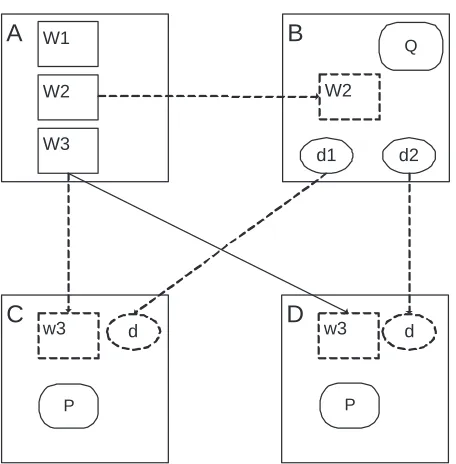
A workflow contains the information to execute a task. Moreover, a workflow can also define the information to enable other workflows. In this scenario, we would like to show a more complicated model, shown in Fig 1. The “dash” block means the block is moved following the “dash” arrow.
[image:3.612.310.464.558.714.2]Supposed w1, w2, w3 are workflows, which have to be defined as script in the model, on server A. There are two data files, d1 and d2, on server B. Process P, which might be a service or a function provided on server C and server D, will need to consume a data file d and then generate a
Table 1. The BNF of Script model
Container := Contents
Model := AssertSet
Final-Assert ServerSet end AssertSet := ! AssertSet
|assert file on servername; |assert file reads a-file; |assert file writes a-file; |nil
Final-Assert := final file on servername ServerSet := ! ServerSet
|Server servername{
!ScriptSet }
ScriptSet := !ScriptSet
|Script scriptname{
!Statement; }
|nil Statement := ! Statement
|nil
|push file to servername; |push file to servername as alias; |exec file on servername; |wait file;
|ChoiceSet ChoiceSet := Choice{
!{option} }
option := Statement
new file r. Q is another process on server B. The objective of Q is taking two data files, C.r and D.r and combing them into one file r. Finally, the goal of the model is to prove that file r is on server A.
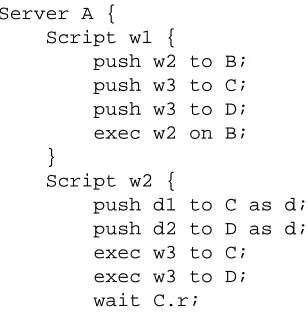
The main portion of model is defined as follows:
Server A { Script w1 {
push w2 to B; push w3 to C; push w3 to D; exec w2 on B; }
Script w2 {
A
W1B
W2
W3
W2
C
w3
D
w3d1 d2
d d
Q
[image:4.612.55.283.66.298.2]P P
Figure 1. Initial state of Workflows submis-sion model
wait D.r; exec Q on me; wait r;
push r to A; }
Script w3{ wait d;
exec P on me; wait r;
push r to B as me.r; }
}
Because “exec Q on me” is executed after w2 has been moved to B, “me” will represent server B. However, w3 was sent to server C and server D, so the “push r to B as me.r” causes the new name of r will depend on which server the file source is. By this naming method, the model can distin-guish the ambiguous files. The final state is shown in Fig 2. The bolder arrow shows the flow that the data files are con-sumed by the processes, shown in rounded rectangle, or the data files are generated by the processes.
3.2. A CAS of Globus Project Model
This section shows the Script model of the Community Authorization Service (CAS) [5, 2]. CAS is a virtual or-ganization (VO) solution for grid, developed by the Globus project. The main object of CAS is providing an authoriza-tion framework.
A
B
W1 W2
C
D
w3
C.r D.r
r r
Q
P
r r
w3
[image:4.612.308.538.67.299.2]P
Figure 2. Final state of Workflows submission model
The use of CAS the be described as follows [1]. Three roles in the system are requester who is a resource requester and a member in the virtual organization who has a CAS server enabled, a resource or a group of resources, which also belong to the VO, a CAS server which is responsible for the VO and trusted by both the resource requesters and providers. However, the resource requester and resource provider might not know each other or their access rights. In order to request a resource, the user must start from acquiring a certificate containing the allowance from the CAS server. Firstly, he passes his X.509 certificate which might be a newly generated proxy certificate to the CAS server. The CAS server verifies the received certificate and establishes the authorization and resource by referring to the local policies which might be delegated by different resources [4]. A new restricted proxy certificate with the information of the authorization, the requester and the is-suer will be created by the CAS server and sent to the user. Therefor, the user can then use the new proxy certificate to access the account of the VO but his access is restricted based on the statement on the certificate.
“wait” statements (line.3 and 4) in script “CapReq” ensure the script is blocked until those two files show up. However, CapGen cannot be executed without them, because the pre-conditions are defined in the assertions. They can be omit-ted.
assert token on User; assert request on User; assert CapGen on CAS; assert CapGen reads token; assert CapGen reads request; assert CapGen writes capresult; Server User {
Script main{
1. push token to CAS; 2. push request to CAS;
} }
Server CAS { Script CapReq{ 3. wait token; 4. wait request; 5. exec CapGen on me; 6. wait capresult;
7. push capresult to User as CAS.capresult; }
}
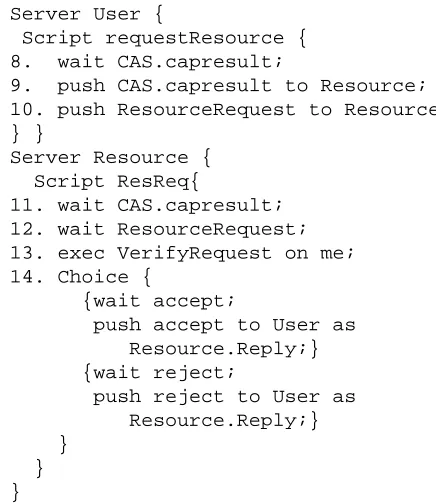
When “capresult” is returned to the user, it is renamed to “CAS.capresult” to represent its issuer. Then script “re-questResource” can be unblocked (at line 8). It is sent to the resource along with an access request (ResourceRequest). Same to “CapReq”, the wait in line 11 can be omitted. “Ver-ifyRequest”, a process on the resource, needs the certificate and request to make an authorization decision, either accept or reject. Both of them will be sent back to the user as “Re-source.Reply”, which is the goal to achieve.
However, two different files might be generated and which one to generate is an implicit external decision made by the operator. But the corresponding operations are cho-sen by the system as an internal choice, defined in the “Choice” statement at line 14. This internal choice is made according to which file (accept or reject) is generated. If “accept” shows up, it has to be returned to the user and re-named. Same happens if “reject” is generated.
assert ResourceRequest on User; assert VerifyRequest on Resource; assert VerifyRequest
reads ResourceRequest; assert VerifyRequest
reads CAS.capresult; assert VerifyRequest
writes accept; assert VerifyRequest
writes reject;
final Resource.Reply on User;
Server User {
Script requestResource { 8. wait CAS.capresult;
9. push CAS.capresult to Resource; 10. push ResourceRequest to Resource; } }
Server Resource { Script ResReq{
11. wait CAS.capresult; 12. wait ResourceRequest; 13. exec VerifyRequest on me; 14. Choice {
{wait accept;
push accept to User as Resource.Reply;} {wait reject;
push reject to User as Resource.Reply;} }
} }
4. The Verification Tool
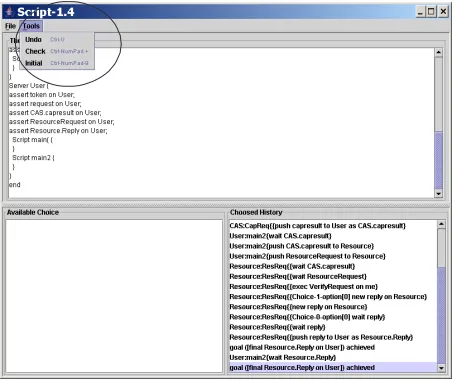
[image:5.612.310.528.144.396.2]The verification tool of Script provides a user friendly model checker. A user starts the tool by loading a text-based model. Once loaded, the user has to verify the lay-out of model by “checking”, shown in the dashed ellipse in Figure 3. It is because a text-format model is difficult to be correct formatted. “Checking” the format earlier can reduce the cost of error generation. If an error has been found, an error log will be generated. Otherwise, the user clicks “ini-tial”, under “check” to generate the initial state.
The column-“available choices” is a list of current avail-able activities. Because the servers and scripts are designed to run concurrently, the sequence of the execution is arti-ficially decided. When an activity is chosen from the left column, the system moves to the next state according to the execution of the activity, which is also appended at the end of the “history” column on the right side. In the meantime, the previous state is also “pushed” into a state for stepping back in case.
Figure 3. Verification tools:load a model
two or more activities are enabled at the same time, the user should try different sequences of execution in order to find out the potential error(s). A correct model should end with an empty “available choices” column and a line showing “goal achieved..” at the end of “history” column. If either is missing, the model is incorrect.
5. Future Plan and Conclusions
The future focus of Script is considering Script as a workflow language. Script-i [3] is a web-services based grid middleware having similar syntax of Script.Hence, the user can easily transform a script in a model into a Script-i pro-gram manually.
Meanwhile,as other modelling languages, Script models can be verified by its verification tool. It provides the func-tionalities of checking layout, initiating the model, and ex-ecuting the model step by step. It is also possible to step back the state of execution if an error is found or different combination of executions has to be examined. Thus, the correctness of models can be verified and provide a better usage of Script.
Script is a modelling language for grid computing. It is designed to model grid applications and related secu-rity frameworks. Firstly, by using the simple reductions, a Script model can successfully simulate the actions hap-pening in the system. A Script model is easily composed of assertions, servers and scripts. The preconditions and post conditions are clear and understandable. Secondly, Script is also suitable to model the security solutions of grid com-puting. This is particular important because modelling se-curity model is often difficult to get right. Finally, Script has proved that it can be used to model different grid
com-puting applications and the models are legible and tiny. It is a good choice for a new grid user getting to know the grid operations.
References
[1] S. Canon, S. Chan, D. Olson, C. Tull, and V. Welch. Using cas to manage role-based vo sub-groups. In Computing in High Energy and Nuclear Physics, CHEP03, CA, USA, Apr. 2003. [2] I. Foster, C. Kesselman, L. Pearlman, S. Tuecke, and V. Welch. The community authorization service: Status and future. In Computing in High Energy and Nuclear Physics, CHEP03, CA, USA, Apr. 2003.
[3] Y. Lee. A security solution for web-services based vir-tual organizations. In Proceedings of the Information Re-sources Management Association International Conference (IRMA 2005): Managing Modern Organizations with Infor-mation Technology, San Diego, USA, May 2005.
[4] M. Lorch, B. Cowles, R. Baker, and L. Gommans. Autho-rizaiton framework document, Mar. 2004.