BLADE PARAMETERS ANALYSIS ON THE PERFORMANCE OF WIND TURBINE
MUHAMMAD FARHAN BIN ABDUL KAPOR
BLADE PARAMETERS ANALYSIS ON THE PERFORMANCE OF WIND TURBINE
MUHAMMAD FARHAN BIN ABDUL KAPOR
This report is submitted
in fulfillment of the requirement for the degree of Bachelor of Mechanical Engineering (Design and Innovation)
Faculty of Mechanical Engineering
UNIVERSITI TEKNIKAL MALAYSIA MELAKA
ii
DECLARATION
I declare that this project report entitled “Blade Parameters Analysis on the Performance of Wind Turbine” is the result of my own work except as cited
in the references.
Signature : ...
Name : Muhammad Farhan Bin Abdul Kapor
iii APPROVAL
I hereby declare that I have read this project report and in my opinion this report is
sufficient in terms of scope and quality for the award of the degree of Bachelor of
Mechanical Engineering (Design and Innovation).
Signature :. ...
Name of Supervisor : Masjuri Bin Musa
iv
DEDICATION
v
ABSTRACT
vi ABSTRAK
vii
ACKNOWLEDGEMENT
First and foremost, I would like to express my gratitude to my supervisor Mr. Masjuri bin Musa for giving me this opportunity to complete my final year project under his supervision. I am extremely thankful for his patience and advice while leading me in this project. Furthermore, I would like to show appreciation to Mr. Masjuri for being extremely patient with me throughout the extent of this project.
Besides that, I would like to thank all my lecturers who have showered me with their knowledge and broadened my understanding in the field of engineering. I would like to especially thank my lecturers who taught me Computer Aided Drawing and Fluid Mechanics, Mr. Nazim and Dr. Cheng See Yuan respectively, which really helped me complete my final year project.
viii CONTENT
CHAPTER CONTENT PAGE
INDIVIDUAL DECLARATION ii
SUPERVISORS APPROVAL iii
DEDICATION iv
ABSTRACT v
ACKNOWLEDGEMENT vii
TABLE OF CONTENT viii
CHAPTER 1 INTRODUCTION 1
1.1 Background 1
1.2 Problem Statement 2
1.3 Objective 3
1.4 Scope Of Project 3
CHAPTER 2 LITERATURE REVIEW 4
2.1 Introduction 4
2.2 Wind Turbine 4
2.3 Wind Farm 4
2.4 Type of Wind Turbine
2.4.1 Vertical-Axis Wind Turbine 2.4.2 Horizontal-Axis Wind Turbine 2.4.2.1 The Base
2.4.2.2 The Tower 2.4.2.3 The Nacelle 2.4.2.4 The Rotor
ix Blade
2.5.1 Pitch Angle and Chord Length 2.5.2 Blade Shape
2.5.3 Number of Blades 2.5.4 Length of Blades
11 12 13 14 2.6 Performance of Wind Turbine
2.6.1 Power Contained in Wind 2.6.2 Betz Limit
2.6.3 Tip Speed Ratio 2.6.4 Power Output
2.7 An Overview of Previous Researches 2.8 Summary
15 15 16 16 18 18 20
CHAPTER 3 METHODOLOGY 21
3.1 Research Methodology 21
3.1.1 Literature Review 21
3.1.2 Calculation and Parameters Selection 3.1.3 3D Modelling
3.1.4 Analysis
3.1.5 Report Writing 3.2 Design Process
3.2.1 Morphological Method 3.2.2 Mathematical Calculation 3.2.2.1 Blade Length
3.2.2.2 Chord Length and Pitch Angle
3.3 CFD Analysis
3.3.1 ANSYS Fluent
3.3.1.1 Importing Geometry 3.3.1.2 Meshing
3.3.1.3 Setup and Solution 3.3.1.4 Results
x
CHAPTER 4 RESULTS AND DISCUSSION 4.1 Introduction
4.2 Wind Turbine Design 4.2.1 Blade Design
4.2.2 Wind Turbine Model 4.3 Data and Analysis
4.3.1 Streamline Analysis
4.3.2 Evaluation of Power Output
4.3.3 Power Coefficient of Wind Turbine 4.4 Discussion
27 27 27 27 29 33 33 38 38 40
CHAPTER 5 CONCLUSION AND RECOMMENDATION 5.1 Conclusion
5.2 Recommendation
REFERENCE
41 41 41
xi
LIST OF FIGURES
FIGURE TITLE PAGE
2.1 Gansu Wind Farm in China 5
2.2 Vertical-axis Wind Turbine 6
2.3 Horizontal-axis Wind Turbine 6
2.4 Various Design of VAWT 7
2.5 Various Design of HAWT 8
2.6 Main Part of HAWT 9
2.7 The Twist Angle and Chord Length 11
2.8 Common HAWT airfoil 13
2.9 Graph of Cp vs TSR 37
3.1 Project Methodology Flow Chart 38
4.1 27 Meters Wind Turbine Blade 39
xii
LIST OF TABLES
TABLE TITLE PAGE
1.1 Optimized Pitch Angle and Chord Length 5
3.1 Morphological Chart 6
3.2 Selected Parameters for Wind Turbine 9
3.3 Pitch angle and Chord Length Distribution 24
4.1 Wind Turbine Rotor Design 25
4.2 Torque and Power Output 27
4.3 Power Contained in Wind 29
xiii
LIST OF ABBEREVATIONS
CFD Computational Fluid Dynamics
CATIA Computer Aided Three-Dimensional Interactive Application
HAWT Horizontal-Axis Wind Turbine
VAWT Vertical-Axis Wind Turbine
TSR Tip-Speed Ratio
NREL National Renewable Energy Laboratory
SERI Solar Energy Research Institute
xiv
LIST OF SYMBOL
E = Kinetic Energy
r = Radius of Wind Turbine Cp = Power Coefficient ρ = Density of Air ω = Angular Velocity
τ = Torque
1
CHAPTER 1
INTRODUCTION
1.1 BACKGROUND
Wind energy utilisation is not a new technology as it has been used for a long time. It is hard to tell the date of origin the first windmill was built to do works. Some claim that the Egyptian was the first to invent windmill but there is no evidence to proof that. The earliest known windmill was invented by the Persians around 500 to 900 A.D., and was used to grind grain and pump water. The windmill technology then spread to Europe in early 12th Century.
The turning point of historical windmill which was used to do works to modern wind turbine which generates electricity marks by the name of Poul La Cour. Poul La Cour was an inventor and also an educator is Denmark. In 1891, La Cour built and wind turbine that drives a dynamo for experimental purpose. He also built the first wind tunnel for the purpose to identify the best shape of wind turbine. Larger wind turbine with higher efficiency was built during the first half of 20th Century in United States. However, the interest in wind turbine came to its dawn after World War II as the price of other energy resource such as fossil fuel cost cheaper and easier to get. The interest in development of wind turbine then renewed after the oil embargo of 1973. The concern about limited source of fossil fuel and also the
2
Wind turbine is a machine that converts kinetic energy from wind into electrical energy. Wind turbine basically is made up of four main components which is the rotor, the nacelle, the tower and base. The rotating part of a wind turbine, the rotor, is made up of a hub and a few blades. A wind turbine blade which has an aerofoil shape rotates the rotor creating mechanical energy as the wind passes over it. The aerofoil shape of wind turbine blades causes a difference of wind speed passing over the blades. This difference of speed produced high and low pressure system which creates lift force that rotates the blade about the rotor axis. The spinning of the
rotor turn the generator inside the wind turbine thus converts the energy into electrical energy. Wind turbine has many different sizes with different capabilities to generate power. Small scale wind turbine with power output lower than 40kW is used to supply power to boat, caravan, and telecommunication tower. Large scale wind turbine can produce power output from 1MW up to 5MW. A wind turbine with power rating between 40kW and 999kW are considered as medium wind turbine.
Generally, wind turbine can be classified into two types which are horizontal-axis wind turbine and vertical-horizontal-axis wind turbine. A horizontal-horizontal-axis wind turbine (HAWT) is a common type of wind turbine which is adapted from the design of the windmill. Tall tower base is the main advantage of HAWT which allows the rotor to access stronger wind flow. Other than that, HAWT has high power generating capacity and higher efficiency compared to vertical-axis wind turbine (VAWT). The performance of wind turbine mostly depends on the blade parameters. To optimize the performance of wind turbine, blade parameters such as, blade shape, number of blades, hub to tip ratio, weight and materials must be taken into consideration when designing and developing a wind turbine.
1.2 PROBLEM STATEMENT
As mention earlier, number of blades and hub to tip ratio of the wind turbine
3
better. The hub to tip ratio of the wind turbine is determine by the length of its blades. Longer blade will increase the swept area of the wind turbine, thus catching more wind which means more power will be generated. But, increasing blade length will also increase the deflection of blade due to axial wind force. This might leads to a collision between blade and tower or blade failure. Furthermore, if the length of the blades was increased, the height of the tower needs to be increased as well to make sure the swept area is in strong wind region. To harness wind energy to its optimum point, the suitable parameters for the blades of wind turbine need to be determined.
1.3 OBJECTIVE
The objectives of this project are as follows:
i. To determine the influence of number of blades and length of the blades on the performance of wind turbine.
ii. To identify the suitable number of blades and length of wind turbine blades for the optimum performance.
1.4 SCOPE OF PROJECT
The scopes of this project are:
i. To design and develop a 3D solid modelling of wind turbine by using CAD software such as Solidworks, CATIA, Inventor.
ii. To optimize the blades of wind turbine system in order to gain most optimum performance.
iii. To analyse the stream velocity of the related blades parameters by using CFD software.
4
CHAPTER 2
LITERATURE REVIEW
2.1 INTRODUCTION
This chapter will discuss about the general information of wind turbine and comes to detail information on horizontal-axis wind turbine. This chapter will also review several previous studies.
2.2 WIND TURBINE
A wind turbine is a machine that coverts kinetics energy contains in a moving air into electrical energy, Hau E. (2013). The wind flow passing through the rotor of a wind turbine causes the rotor to spin and rotates the shaft. The shaft is connected to the gearbox and generator which convert the mechanical energy into electricity. The electricity produced by wind turbine will ultimately be used to supply electricity for homes, communities and business. Wind turbines are becoming one of the most important sources of renewable energy and they are being used widely all around the world.
2.3 WIND FARM
5
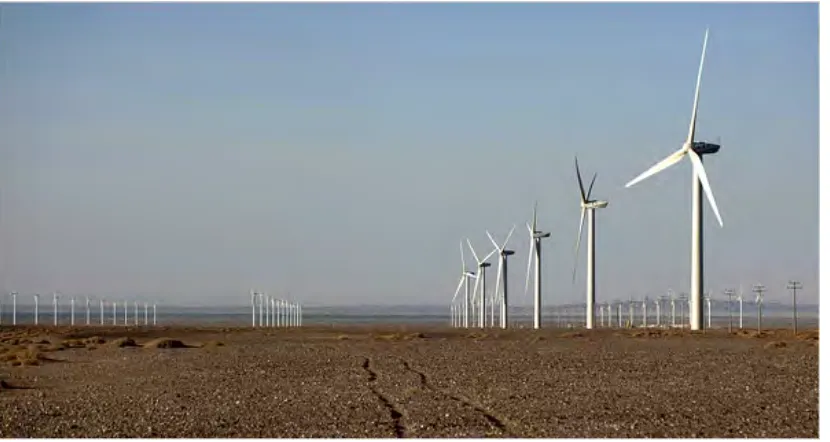
[image:20.595.116.531.153.374.2]China, Germany and United States of America. The largest wind farm in the world is Gansu Wind Farm located in China with a capacity over 7100 MW of power. Figure 2.1 below shows a part of biggest wind farm in China.
6
2.4 TYPES OF WIND TURBINES
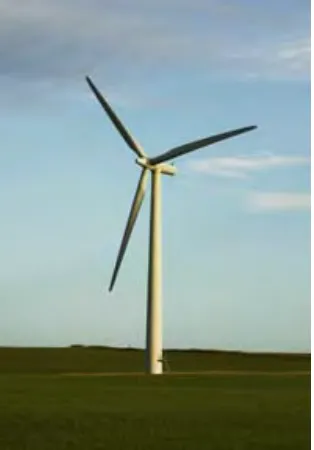
[image:21.595.232.407.197.429.2]Generally, there are two main types of wind turbine which are horizontal-axis wind turbine (HAWT) and vertical-axis wind turbine (VAWT). A review from www.eia.gov shows the differences of these two types of wind turbines.
Figure 2.2: Vertical-axis Wind Turbine (www.eia.gov, 2015)
[image:21.595.242.399.500.725.2]7
2.4.1 Vertical-Axis Wind Turbine (VAWT)
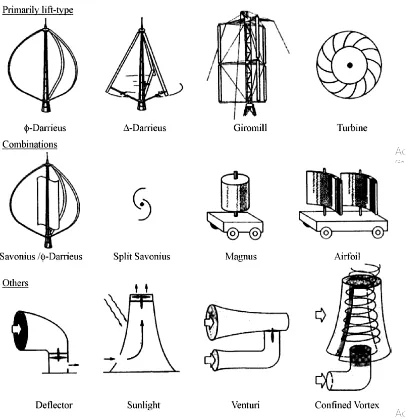
[image:22.595.120.526.257.676.2]A VAWT has a vertical axis of rotation. Manwell et al (2009) mentioned that VAWT is a drag machine which work on drag principle. A VAWT needs to be located on the ground which means it cannot access high speed wind flow. This is the main reason why this type of wind turbine performance is much lower than HAWT. The common type of VAWT was patented by Georges Darrieus in 1931 and named after himself.
8
2.4.2 Horizontal-Axis Wind Turbine (HAWT)
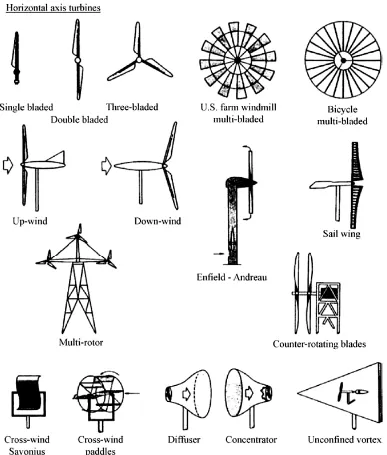
[image:23.595.129.516.262.717.2]This type of wind turbine is the common type of wind turbine which is also the primary focus of this report. The horizontal-axis means the rotation axis of the wind turbine is parallel to the ground. HAWT works on the principle of lift just like the aeroplane wings. When the wind flows through the blades, the aerofoil shape of the blade creates pressure differences on the upper and lower side of the blade. This pressure difference creates lift force that rotates the blades.
9
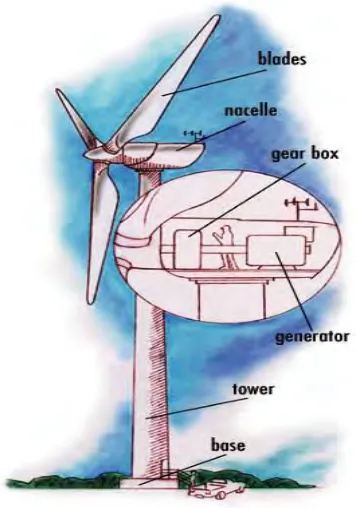
[image:24.595.229.407.198.452.2]Generally, a horizontal axis wind turbine consists of four main parts which is the base, tower, nacelle and blades. The parts of horizontal axis wind turbine are shown in Figure 2.6 below.
Figure 2.6: Main Parts of Horizontal-Axis Wind Turbine (www.ecw.org)
2.4.2.1 The Base
The base of the wind turbine is made of concrete strengthen by steel bars. The base is located on the ground to support the tower.
2.4.2.2 The Tower.
Referring to the wind gradient, the speed of wind increase with height which