An effective high-order point-collocation numerical
approach based on integrated approximants for
elliptic differential equations
N. Mai-Duy and T. Tran-Cong
∗Computational Engineering and Science Research Centre (CESRC)
Faculty of Engineering and Surveying
The University of Southern Queensland, Toowoomba, QLD 4350, Australia
Submitted to
Applied Mathematical Modeling Research Trends,
04-Jun-2007
∗Corresponding author: E-mail [email protected], Telephone +61 7 4631 2539, Fax +61 7
Abstract: This chapter presents the basic features of high-order integral collocation
techniques and demonstrates their application to engineering problems. Emphasis is
placed on the advantage of the integral collocation approach over the conventional
differential approach in the treatment of multiple boundary conditions, complex
geometries and domain decompositions.
Keywords: Radial basis functions, Chebyshev polynomials, Integral collocation
for-mulation, Multiple boundary conditions, Complex geometries, Domain
decomposi-tions.
1
Introduction
Physical phenomena are usually modelled in terms of ordinary differential
equa-tions/partial differential equations (ODEs/PDEs). The DE can only rarely be solved
in an exact manner. As a result, one must resort to numerical techniques to
ob-tain approximate solutions of the DE. The aim of numerical techniques is to reduce
the differential system to an equivalent set of algebraic equations where a solution
becomes obtainable. To achieve that, the field variable and the DE need to be
discretized, relying on the assumption that any continuous quantity can be
approx-imated by a set of continuous functions.
The governing equation can be represented in a strong, weak or inverse form. The
strong form, which is associated with point-collocation techniques such as
finite-difference [1] and pseudospectral [2] methods, does not require the integration of
the DE. The continuous domain is simply replaced by a set of discrete points. The
point-based solution is found using the concept of zero-value of error at certain points
over the domain. On the hand, the weak and inverse forms, which are associated
methods, involve volume and boundary integrals, respectively. The problem domain
or its boundary is divided into a set of small elements. The element-based solution
is determined using the concept of distribution of error within the domain or along
the boundary. Each form has some advantages over the others for certain classes
of problems. The weak and inverse forms possess a smoothing capability, while the
strong form features a mesh-free property.
In a “differential” numerical technique, the field variable approximation is based on
a set of known basis functions with corresponding unknown coefficients.
Expres-sions for its derivatives are then obtained through differentiation. Approximation
schemes can be classified into two categories: low order and high order. Each
cat-egory has its own strengths and weaknesses. The former is straightforward to use.
However, its relative low accuracy requires a very fine structure, which could lead
to numerical difficulty, to represent accurately the complex solution. For the latter,
coarse meshes/grids are usually sufficient for most accuracy requirements. However,
high-order approximation schemes should be used with great care. For instant, the
use of Lagrange polynomials of high order has a tendency to give results that are
oscillatory between data values. Any small level of noise in the interpolating
func-tion will be badly magnified through differentiafunc-tion, causing much larger errors for
its derivative representations.
This chapter reviews a high-order point-collocation numerical approach for elliptic
DEs based on integrated approximants, and associated results recently discussed
in several works, including for example [5-32]. In contrast with the differential
approach described above, Mai-Duy and Tran-Cong [5,8] proposed an integral
pro-cedure, where the starting points of the approximation process are the highest
deriv-atives of the field variable in the given DE. Lower derivderiv-atives, and eventually the
variable itself, are symbolically obtained by integration. These integration processes
therefore facilitate the employment of some extra equations. It is shown that this
feature provides an effective way to handle well-known difficult issues associated
with the differential collocation approach such as [14,15,20,21,27,28,30-32]
• the implementation of multiple boundary conditions,
• the description of non-rectangular boundaries in a Cartesian grid, and
• the imposition of higher-order continuity of the approximate solution across subdomain interfaces.
In addition, the use of integration also improves the quality of the approximation
of derivative functions as well as the stability of a numerical solution owing to its
smoothness property [5-13,16-19,22-26,29].
In this chapter, the integral collocation approach is implemented with radial basis
functions and Chebyshev polynomials. It is noted that other types of basis
func-tions can also be applied. For example, an integrated Sinc function approximation
method has recently been reported by Li and Wu [24]. An attractive feature of
the present high-order integral collocation techniques is that the preprocessing is
simple. The problem domain of regular/irregular shape is discretized by using a
uniform Cartesian grid for radial basis functions and a tensor product grid formed
by Gauss-Lobatto points for Chebyshev polynomials. The approximate expressions
representing the field variable and its derivatives over the domain are constructed
through one-dimensional integrated approximants along grid lines. Superior
accu-racy and convergence of integral collocation techniques over differential collocation
techniques are demonstrated with the solution of differential problems governed
by second- and fourth-order elliptic equations and defined in rectangular and
The remainder of the chapter is organized as follows. Sections 2 and 3 give brief
reviews of high-order approximants and collocation methods, respectively.
Advan-tages of the integral collocation approach are presented in Section 4. Section 5
demonstrates its application to engineering problems including structural analysis
and fluid flow problems. Section 6 concludes the chapter.
2
High-order approximants
2.1
Radial basis function networks (RBFNs)
RBFNs are known as a universal approximator. The RBFN allows the conversion
of a function to be approximated from a low-dimension space to a high-dimension
space in which the function is expressed as a weighted linear combination of RBFs
[33]
f(x) =
m
X
i=1
wigi(x), (1)
where{gi(x)}mi=1 the set of RBFs, and {wi}mi=1 the set of weights to be found.
According to Micchelli’s theorem, there is a large class of RBFs, e.g., multiquadrics,
inverse multiquadrics and Gaussian functions, whose interpolation matrices obtained
from (1) are always invertible provided that the data points are distinct. This is all
that is required for non-singularity of interpolation matrices, whatever the number of
data points and the dimension of problem [34]. It has been proved that RBFNs are
capable of representing any continuous function to a prescribed degree of accuracy
in theLp norm,p∈[1,∞] [35]. On the other hand, according to the Cover theorem,
the higher the number of RBFs used, the more accurate the approximation will be
[36], indicating the property of “mesh convergence” of RBFNs. These important
of ODEs/PDEs.
It has generally been accepted that, among RBFNs, the multiquadric (MQ) scheme
tends to result in the most accurate approximation. The present integral approach
implements the MQ function whose form is
gi(x) =
q
(x−ci)2+a2i, (2)
where ci and ai are the centre and the width of the ith basis function. The RBF
widths are known to strongly affect the performance of RBFNs. However, there
is still a lack of mathematical theories for specifying their optimal values. For
all numerical examples taken here, the RBF widths are simply chosen as the grid
spacing.
2.2
Truncated Chebyshev series expansions (CSEs)
An approximate function f is sought in the truncated Chebyshev series form [2]
f(x) =
N
X
k=0
akTk(x), (3)
where {ak}Nk=0 the set of expansion coefficients and {Tk}Nk=0 the set of Chebyshev polynomials of the first kind that are defined by
in which−1≤x≤1. The polynomial Tk(x) can be expanded in power series as
T0(x) = 1 (5)
Tk(x) =
k 2
[Xk/2]
m=0
(−1)m2
k−2m(k−m−1)!
m!(k−2m)! x
k−2m, k > 0 (6)
where [k/2] is the integer part ofk/2.
The Chebyshev polynomials are orthogonal
Z 1
−1
Tk(x)Tl(x)w(x)dx=
π
2ckδkl, (7)
where w(x) = √1−x2 is the Chebyshev weight function, c
k = 1 for k ≥ 1 and
ck = 2 for k = 0, and δkl the Kronecker delta.
At the Gauss-Lobatto points xi = cosiπ/N, i = 0, .., N, which are widely used in
collocation methods, the coefficients ak are obtained in an explicit form
ak =
2 N¯ck
N
X
i=0
Tk(xi)
¯ ci
ui, k = 0,1,· · · , N, (8)
where ¯ck = 1 for 1≤k ≤N −1 and ¯ck = 2 for k ={0, N}.
For smooth problems, the Chebyshev approximation scheme exhibits an exponential
3
Methods of collocation
Let Ω be a bounded region and ∂Ω be the boundary of Ω. Consider the differential
problem that consists of an elliptic DE
Lu=b, (9)
and a set of prescribed values along ∂Ω, where L is some differential operator, b a given function andu the field variable.
Collocation methods are seen to be the simplest way to discretize the DE. It consists
of two main steps. First, the solution u and its derivatives are approximated by
fi-nite sums of smooth functions that are linearly independent. Then, the coefficients
associated with the basis functions are determined by forcing the approximate
so-lution to satisfy the DE and the boundary conditions at certain points (collocation
points). The choice of functions and distribution of collocation points strongly affect
the accuracy of the solution.
This chapter is concerned with two types of very smooth basis functions, namely
radial basis functions (ϕ ≡ g) and Chebyshev polynomials (ϕ ≡ T), that are de-scribed above. In the remainder of the chapter, for consistency of notation between
3.1
Conventional differential formulation
RBFNs/CSEs are employed to represent the variableu, followed by successive
dif-ferentiations to obtain approximate expressions for its derivatives
u(x) =
m
X
i=1
αiϕi(x) = m
X
i=1
αiDi(0)(x), (10)
du(x) dx =
m
X
k=1
αiDi(1)(x), (11)
· · · ·
dpu(x)
dxp = m
X
k=1
αiDi(p)(x), (12)
whereD(1)i (x) = dDi(0)(x)/dx,· · · , Di(p)(x) =dD(ip−1)(x)dx.
It has been proved that there is a reduction in convergence rate for derivative
func-tions and this reduction is an increasing function of derivative order [37,38].
3.2
Present integral formulation
RBFNs/CSEs are employed to represent the highest-order derivatives of the
expressions for its lower-order derivatives and the variable itself
dpu(x)
dxp = m
X
i=1
αiϕi(x) = m
X
i=1
αiIi(p)(x), (13)
dp−1u(x) dxp−1 =
m
X
k=1
αiIi(p−1)(x) +c1, (14)
dp−2u(x) dxp−2 =
m
X
k=1 αiI(p
−2)
i (x) +c1x+c2, (15)
· · · · du(x) dx = m X k=1
αiIi(1)(x) +c1
xp−2
(p−2)! +c2 xp−3
(p−3)! +· · ·+cp−2x+cp−1, (16)
u(x) =
m
X
k=1
αiIi(0)(x) +c1
xp−1
(p−1)! +c2 xp−2
(p−2)! +· · ·+cp−1x+cp, (17)
where Ii(p−1)(x) = R Ii(p)(x)dx, Ii(p−2)(x) = R Ii(p−1)(x)dx,· · · , Ii(0)(x) = R Ii(1)(x)dx, and c1, c2,· · · , cp are integration constants. The integral approximation scheme is
said to be ofpth-order, denoted by ICSE-por IRBFN-p, if thepth-order derivative is
taken as the staring point. The differential approximation scheme can be considered
as a special case of the integral approximation scheme by setting the value of p to
zero.
The evaluation of (13)-(17) at a set of collocation points {xi}mi=1 leads to
d
dpu
dxp =Ib
(p)
[p]bs, (18)
d
dp−1u dxp−1 =Ib
(p−1)
[p] bs, (19)
· · · ·
c
du dx =Ib
(1)
[p]bs, (20)
u=Ib[(0)p]bs, (21)
and derivative function, respectively,
b
s= (α1, α2,· · · , αm, c1, c2,· · · , cp)T ,
b
I[(pp])=
I1(p)(x1), I (p)
2 (x1), · · · , I (p)
m (x1), 0, 0, · · · , 0, 0
I1(p)(x2), I2(p)(x2), · · · , Im(p)(x2), 0, 0, · · · , 0, 0
· · · ·
I1(p)(xm), I2(p)(xm), · · · , Im(p)(xm), 0, 0, · · · , 0, 0
, b
I[(pp]−1) =
I1(p−1)(x1), I (p−1)
2 (x1), · · · , I (p−1)
m (x1), 1, 0, · · · , 0, 0
I1(p−1)(x2), I(p
−1)
2 (x2), · · · , I(p
−1)
m (x2), 1, 0, · · · , 0, 0
· · · ·
I1(p−1)(xm), I2(p−1)(xm), · · · , Im(p−1)(xm), 1, 0, · · · , 0, 0
,
· · · ·, and
b
I[(0)p] =
I1(0)(x1), I2(0)(x1), · · · , Im(0)(x1), x
p−1 1
(p−1)!,
xp1−2
(p−2)!, · · · , x1, 1 I1(0)(x2), I
(0)
2 (x2), · · · , I (0)
m (x2), x
p−1 2
(p−1)!,
xp2−2
(p−2)!, · · · , x2, 1
· · · ·
I1(0)(xm), I2(0)(xm), · · · , Im(0)(xm), x
p−1
m (p−1)!,
xpm−2
(p−2)!, · · · , xm, 1
.
The use of integrated basis functions is expected to overcome the problem of
reduc-tion of convergence rate caused by differentiareduc-tion. Numerical studies on second-order
differential problems [5,18,19,29] have indicated that the integral approach produces
more accurate results than the differential one. This has recently been theoretically
examined with RBFs by Sarra [22], which show the superiority in accuracy of the
antiderivative approach.
Another important point here is that additional coefficients (integration constants)
can be utilized to handle “extra constraints” related to boundary conditions and
4
Advantages of the integral collocation approach
4.1
Treatment of multiple boundary conditions
For simplicity, consider the approximation of the solution of the biharmonic equation
∂4u ∂x4 + 2
∂4u ∂x2∂y2 +
∂4u
∂y4 =b(x, y), (22)
in a rectangular domain with double boundary conditionsu and ∂u/∂n.
For the differential collocation approach, there is normally one equation employed at
a point. Boundary conditions for second-order equations (single boundary values)
can thus be accommodated in a straightforward manner. However, for higher-order
equations, the solution is required to satisfy more than one prescribed value at a
boundary point. A number of techniques have been developed for handling
multi-ple boundary conditions, including (i) the node-reduction technique (reducing the
number of collocation points used for collocating the governing equation), (ii) the
fictitious-point technique (using fictitious points as additional unknowns), and (iii)
the imposed-kernel technique (modifying the basis functions to incorporate
bound-ary conditions). In contrast, the integral collocation approach has the ability to
deal with multiple boundary conditions in a natural way. The presence of
integra-tion constants allows the use of more than one equaintegra-tion at certain points. Such
extra equations can be utilized for the purpose of imposing the value of the normal
derivative and the governing equation at boundary points.
In currently used notations, b and e denote vectors/matrices that are associated with a grid line (one-dimensional domain) and the whole set of grid lines
The integral collocation schemes of fourth order are employed here to discretize
derivative terms in the biharmonic equation. It is more convenient to work in the
physical space than in the spectral space. Consider a horizontal grid line. The
presence of four integration constants in the integral formulation allows one to add
four extra equations to the conversion system. These equations can be chosen to
represent the value of the normal derivative and the governing equation at both ends
of the line. The conversion process of the spectral space into the physical space is
constructed by
bu
b v = Ib
(0) [4] b B αb
b
c
=Cb
αb
b
c
, (23)
whereIb[4](0) is defined as before,
b α= α1 α2 · · ·
αnx
, bc=
c1 c2 c3 c4
, bu=
u1 u2 · · ·
unx
, b v = ∂u ∂x(x1) ∂u ∂x(xnx) b(x1)−2∂x∂42uy2(x1)−
∂4u
∂y4(x1)
b(xnx)−2
∂4u
∂x2y2(xnx)−
∂4u
∂y4(xnx)
, b B=
I1(1)(x1) · · · In(1)x(x1) x 2
1/2 x1 1 0 I1(1)(xnx) · · · I
(1)
nx(xnx) x 2
nx/2 xnx 1 0 I1(4)(x1) · · · In(4)x(x1) 0 0 0 0 I1(4)(xnx) · · · I
(4)
nx(xnx) 0 0 0 0
[4] ,
Solving (23) yields
αb
bc
=Cb−1
ub
b
v
. (24)
Taking (24) into account, the values of derivatives of the variable u at a point on
the line are computed by
∂4u(x) ∂x4 =
I1(4)(x), I2(4)(x),· · · , In(4)x(x),0,0,0,0Cb−1
ub
b
v
, (25)
∂3u(x) ∂x3 =
I1(3)(x), I2(3)(x),· · · , In(3)x(x),1,0,0,0Cb−1
ub
b
v
, (26)
∂2u(x) ∂x2 =
I1(2)(x), I2(2)(x),· · · , In(2)x(x), x,1,0,0Cb−1
ub
b
v
, (27)
∂u(x) ∂x =
I1(1)(x), I2(1)(x),· · · , In(1)x(x),x 2
2, x,1,0
b
C−1
ub
b
v
. (28)
The evaluation of (25)-(28) at the grid points leads to
d∂iu
∂xi =Dbix
bu
b
v
, i={1,2,3,4}, (29)
where c∂∂xiui =
∂iu
1
∂xi ,
∂iu
2
∂xi ,· · · ,
∂iu nx
∂xi
T
and Dbix is the nx×(nx+ 4) matrix of known
quantities related to geometry and discretization.
Expression (29) can be rewritten as c∂∂xiui = Db
†
ixub+Db
‡
ixbv, where Db
†
ix and Db
‡
ix are
matrices that are formed by the first nx columns and the last four columns of the
matrix Dbix, respectively. The extra information vector bv (components v3 and v4)
contains some unknown values—the mixed partial derivative∂4u/∂x2∂y2 at the two
combinations of nodal values of the variableu(the detailed expression of∂4u/∂x2∂y2
will be given later on). As a result, one can express (29) in terms of nodal variable
values only. The values of the ith-order derivative of u with respect to y at the
collocation points along a vertical line will be obtained in the same way.
The approximations for derivatives over 2D grids can be conveniently constructed by
means of Kronecker tensor products. Assuming that the grid points are numbered
from bottom to top and from left to right, the values of derivatives of u at the grid
points are computed by
g
∂iu
∂xi =
b
Dix⊗Iby
e
u+ekix,
g∂iu
∂yi =
b
Ix⊗Dbiy
e
u+ekiy, (30)
where⊗is the Kronecker tensor product,IbxandIby are the identity matrices of sizes
nx ×nx and ny ×ny, respectively, ekix and ekiy are the vectors of known quantities
related to boundary conditions, and eu= u1, u2,· · · , unxny
T
.
The integral collocation approach employs the following relation to calculate the
mixed fourth-order derivative
∂4u ∂2x∂2y =
1 2
∂2 ∂x2
∂2u ∂y2
+ ∂ 2
∂y2
∂2u ∂x2
. (31)
This expression reduces the computation of fourth-order mixed derivatives to that
of second-order pure derivatives for which IRBFNs/ICSEs involve integration with
respect toxoryonly. Integral schemes of second order are used here to approximate
these second-order derivatives with the extra information being the values of the
corresponding first-order derivatives at the boundary points.
It can be seen that the integrated approximants contain information about boundary
conditions. As a result, it remains only to force these approximations to satisfy the
determinate system of algebraic equations for the unknown vector of nodal interior
values of the variableu.
The integral and differential collocation approaches are applied to solve the following
test problem
b(x, y) = 4 sin(πx) sin(πy), (32)
ue =
1
π4 sin(πx) sin(πy), (33) Ω≡[−1,−1]×[1,1], (34)
whereue denotes the exact solution of the problem.
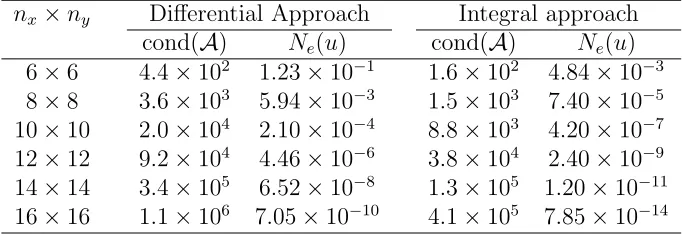
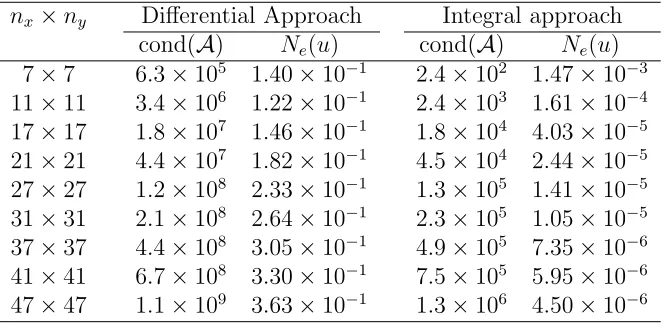
Results concerning the discrete relative L2 error of the solution u, Ne(u), and the
condition number of the system matrix, cond(A), obtained by the two approaches are presented in Tables 1 and 2 for CSEs and RBFNs, respectively. For the
differ-ential approach, double boundary conditions are implemented here using the
node-reduction technique. The PDE is collocated at the (nx−4)(ny −4) interior points
(xi, yj), i = (3,4,· · · , nx −2), j = (3,4,· · ·, ny −2). Along the two vertical lines,
boundary conditions ∂u/∂nare imposed at the 2(ny−2) nodal points; while along
the two horizontal lines, they are imposed at the 2(nx−4) nodal points. The
dis-cretized boundaries do not include the four corners of the domain. This leads to a
square set of algebraic equations. Like conventional RBF techniques, the present
differential RBF collocation technique approximates a solution in terms of network
weights. For both cases (RBFNs and CSEs), the performance of the integral
4.2
Description of non-rectangular boundaries in a
Carte-sian grid
The application of finite-difference and pseudospectral methods to irregularly-shaped
domains requires coordinate transformations. First, a physical domain of complex
geometry is converted into a computational domain of regular geometry. Then, an
equivalent problem is derived by transforming the governing equation into the
com-putational coordinate system. The relationships between the two coordinates
sys-tems are usually given in the form of PDEs. Such a procedure is quite cumbersome.
In contrast, the complicated coordinate transformations are avoided in
Cartesian-grid methods, which are the concern of this section. They are implemented with
ICSEs and IRBFNs. The incorporation of prescribed values on immersed
bound-aries are conducted in a way that does not adversely affect the accuracy of the
numerical method. There are some differences in boundary treatment between the
two present approximation schemes, which are presented through the second-order
Dirichlet differential problem governed by
∂2u ∂x2 +
∂2u
∂y2 =b(x, y), (35)
in a circular domain Ω with a unit radius.
4.2.1 ICSEs
Figure 1 shows an extension of Ω to the reference square that is discretized using
a tensor product grid formed by Gauss-Lobatto points. It can be seen that the
grid points do not generally lie on the boundary of the domain. Integration
con-stants are utilized here to include information on the boundary in the Chebyshev
Lines aa′ and bb′ in Figure 1 present typical cases for the approximation of ∂u/∂x
and ∂2u/∂x2.
4.2.2 Case 1 - Line aa′:
Along this line, there are two boundary points xb1 and xb2. Assume that they are
not grid points. The ICSE-2 scheme can be employed to impose the two boundary
conditions. The conversion of the spectral space into the physical space is based on
the following system
b u
ub1
ub2
= Ib
(0) [2] b B b α c1 c2 = b C b α c1 c2
, (36)
whereIb[2](0) is as before,
b
α= (α1, α2,· · · , αnx)T , (37)
b
u= (u1, u2,· · · , unx)
T , (38) b B= I (0)
1 (xb1), I2(0)(xb1), · · ·, In(0)x(xb1), xb1, 1 I1(0)(xb2), I2(0)(xb2), · · ·, In(0)x(xb2), xb2, 1
[2] ,
and nx is the number of collocation points on the grid line.
Solving (36) yields
b α c1 c2 = b
C−1
b u
ub1
ub2
The values of∂u/∂x and ∂2u/∂x2 at the grid points are then computed by
c
∂u ∂x =Ib
(1) [2]Cb
−1 b u
ub1
ub2
, (40)
d
∂2u ∂x2 =Ib
(2) [2]Cb
−1 b u
ub1
ub2
. (41)
4.2.3 Case 2 - Line bb′:
A number of schemes can be applied here. In the following, two typical schemes are
presented.
If the contact pointxb is not a grid node, one can use ICSE-1
ub
ub = Ib
(0) [1] b B αb
c1
, (42)
where
b
B=
I1(0)(xb), I2(0)(xb), · · ·, In(0)x(xb), 1
[1] .
If the contact point is also a grid node, one can employ ICSE-0 or ICSE-2. For the
latter, the conversion system is given by
b u ∂ub ∂x
∂2u
b ∂x2 = b
I[2](0)
b B b α c1 c2
where
b
B =
I
(1)
1 (xb), I2(1)(xb), · · · , In(1)x(xb), 1, 0 I1(2)(xb), I2(2)(xb), · · · , In(2)x(xb), 0, 0
[2] .
In (43),∂ub/∂xand∂2ub/∂x2are known values, which are derived from using
bound-ary conditions.
The remaining steps for obtaining the Chebyshev approximations of ∂u/∂x and
∂2u/∂x2 are similar to Case 1 and therefore omitted here for brevity.
The values of ∂u/∂y and ∂2u/∂y2 at the grid points along vertical lines can be
computed in a similar fashion.
The Chebyshev approximations of derivatives at a grid point are expressed in terms
of the nodal values ofualong the grid lines that goes through that point. It should
be emphasized that they already contain information about the boundary of Ω
(i.e. locations and boundary values). As with finite-difference, finite-element and
boundary-element techniques, one will gather these approximations together to form
the global matrices for the discretization of the PDE. This task is relatively simple
since the grid used here is regular. By collocating the governing equation at the grid
points and then deleting rows corresponding to points that lie on the boundary, a
square system of algebraic equations is obtained, which is solved for the approximate
solution.
4.2.4 IRBFNs
Unlike ICSEs, IRBFNs have the capability to handle unstructured points with
ac-curacy. The problem domain is embedded in a Cartesian grid with a grid spacing
h. Grid points outside the domain (external points) together with internal points
remaining grid points are taken to be the interior nodes (Figure 2). The boundary
nodes consists of the grid points that lie on the boundaries, and points that are
generated by the intersection of the grid lines with the boundaries.
The one-dimensional IRBFN schemes are employed to discretize the solution and
its relevant derivatives along grid lines. As presented earlier, an IRBFN-p scheme
permits the approximation of a function and its derivatives of orders up to p. To
use integrated basis functions only, one needs to employ IRBFNs of at least second
order. A line in the grid contains two sets of points (Figure 3). The first set consists
of the interior points that are also the grid nodes (regular nodes). The values of
the variable u at the interior points are unknown. The second set is formed from
the boundary nodes that do not generally coincide with the grid nodes (irregular
nodes). At the boundary nodes, the values of the variableuare given. Unlike
finite-difference and pseudospectral methods, the involvement of irregular points here does
not adversely affect the accuracy of the IRBFN scheme.
Consider a horizontal grid line (Figure 3). An important feature of the present
IRBFN technique is that, along the grid line, both interior points{xi}qi=1 and
bound-ary points {xbi}2i=1 are taken to be the centres of the network. This work employs
IRBFN-2s to discretize the field variable. The conversion system is constructed as
follows b u
ub1
ub2
= b
I[2](0)
b B b α c1 c2 = b C b α c1 c2
whereIb[2](0) is defined as before,
b
u= (u1, u2,· · · , uq)T ,
b
α = (α1, α2,· · · , αm)T ,
b B = I (0)
1 (xb1) · · · Im(0)(xb1) xb1 1 I1(0)(xb2) · · · Im(0)(xb2) xb2 1
[2] ,
and m=q+ 2.
The obtained system (44) for the unknown vector of network weights can be solved
using the singular value decomposition technique
b α c1 c2 = b
C−1
b u
ub1
ub2
. (45)
The values of the first and second derivatives ofuat the interior points are computed
as follows ∂u1 ∂x ∂u2 ∂x ... ∂uq ∂x =
I1(1)(x1) · · · Im(1)(x1) 1 0
I1(1)(x2) · · · I (1)
m (x2) 1 0
· · · ·
I1(1)(xq) · · · Im(1)(xq) 1 0
[2] b
C−1
b u
ub1
ub2
, (46)
and
∂2u 1
∂x2
∂2u 2
∂x2
...
∂2uq
∂x2 =
I1(2)(x1) · · · Im(2)(x1) 0 0
I1(2)(x2) · · · Im(2)(x2) 0 0
· · · ·
I1(2)(xq) · · · Im(2)(xq) 0 0
[2] b
C−1
b u
ub1
ub2
or in compact forms
c
∂u
∂x =Db1xub+bk1x, (48) and
d
∂2u
∂x2 =Db2xbu+bk2x, (49) wherebk1xandbk2xare the vectors of known quantities related to boundary conditions.
It can be seen from (48) and (49) that the IRBFN approximations of ∂u/∂x and
∂2u/∂x2 at the interior points include information about the boundary (locations
and boundary values).
The incorporation of the boundary points into the set of centres has several
advan-tages:
• It allows the two sets of centres and collocation points to be the same, i.e.
{ci}mi=1 ≡
{xi}qi=1∪ {xbi}2i=1 . Numerical investigations have indicated that when these two sets coincide, the RBF approximation scheme tends to result
in the most accurate numerical solution [5,6].
• It allows the use of IRBFNs with a fixed order (IRBFN-2), regardless of the shape of the domain. In contrast, the order of the ICSE scheme depends on
the number of intersections between a grid line and the boundaries.
In the same manner, one can obtain the IRBF expressions for∂u/∂y and ∂2u/∂y2
at the interior points along a vertical line.
The “local” IRBF approximations along grid lines will be assembled to build the
discrete representation of the PDE. Collocating the governing equation at the
inte-rior points results in a square system of algebraic equations, which is solved for the
Numerical studies are conducted for the following driving and exact functions
b(x, y) = −2 sin(πx) sin(πy), (50) ue(x, y) =
1
π2 sin(πx) sin(πy). (51)
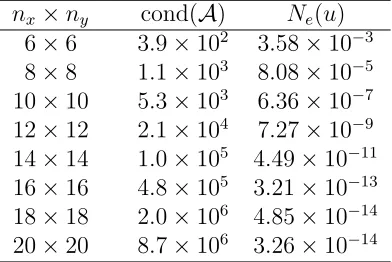
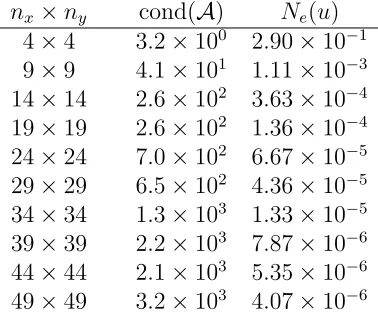
Condition numbers of the system matrix and relative L2 errors of the solution u
are shown in Tables 3 and 4 for ICSEs and IRBFNs, respectively. Results indicate
that the two techniques preserve their fast rates of convergence with grid refinement.
The process of handling irregular geometries here is much simpler than that using
coordinate transformations.
4.3
Improvement of continuity order across subdomain
in-terfaces
The use of domain decompositions (DDs) is necessary to handle large-scale domains
and complex geometries. The problem domain is partitioned into a set of
subdo-mains that can be overlapped or non-overlapped. An important feature of DDs is
that the size of the matrices involved is much smaller than that associated with a
single domain. With the recent emergence of parallel computers, the DD methods
have become more attractive because they allow the parallel implementation of
dis-cretization schemes. However, the main drawback of the DD methods is that they
provide a less smooth solution than a single-domain method. Let p be the order
of the governing equation. Conventional DD techniques are only able to impose a
C(p−1) solution across subdomain interfaces, a situation we seek to improve here.
This chapter is concerned with non-overlapping domain decompositions. It is shown
that the integral collocation approach has the capability to force the Cp, instead
interfaces.
For the sake of simplicity, the basic features of the present DD scheme are described
through the following second-order ODE
κd 2u
dx2 +β du
dx +γu=b(x), (52)
defined on the domain a≤ x≤b and subject to the Dirichlet boundary conditions at both ends: ¯ua and ¯ub.
A substructuring method [39] is applied here, which involves two main steps: (i)
To find the values of the variableuat the interface points/interior-boundary-points
(the interface solution) and (ii) To find the values of the variable u at the interior
points in subdomains (the subdomain solution). The present substructuring
tech-nique is based on the use of integrated approximants (ICSEs/IRBFNs) to represent
approximate solutions in subdomains.
4.3.1 The interface solution
The domain of interest is divided intoM subdomains. Each subdomain is discretized
using a set of n Gauss-Lobatto points via the following coordinate transformation
x[j] = x [j]
r −x[lj]
2 ξ+
x[rj]+x[lj]
2 = L[j]
2 ξ+
x[rj]+x[lj]
2 , (53)
in which x[lj] and x[rj] are the coordinates of the boundary points of a subdomain j,
L[j]=x[j]
The continuity of the solution and its flux leads to the following constraint equations
u[nj] = u[1j+1], (54)
du dx
[j]
n
=
du dx
[j+1] 1
, (55)
wherej ={1,2,· · · , M −1}.
The present scheme requires the solutionu to be continuous, i.e.
u[nj] =u[1j+1]= ¯uj, j ={1,2,· · · , M−1}, (56)
and its derivatives to be matched at the interfaces. This approach allows an easy
implementation (automation) of the computer code.
Consider a subdomainj. Using integrated approximations (13)-(17) withp= 2, the
governing equation (52) and the boundary conditions can be transformed into
4κ L[j]2
n
X
k=1
α[kj]Ik(2)(ξ) + 2β L[j]
n
X
k=1
α[kj]Ik(1)(ξ) +c[1j]
!
+γ
n
X
k=1
αk[j]Ik(0)(ξ) +c1[j]ξ+c[2j]
!
=b(x[j](ξ)), (57)
n
X
k=1
αk[j]Ik(0)(−1)−c1[j]+c[2j]= ¯uj−1, (58)
n
X
k=1
αk[j]Ik(0)(+1) +c1[j]+c[2j]= ¯uj, (59)
where ¯uj−1 = ¯ua for j = 1, ¯uj = ¯ub for j = M, and the unknowns are the set of
expansion coefficients and integration constants.
form
A[j]
α[1j]
α[2j]
· · ·
α[nj]
c[1j]
c[2j]
=
b[1j]
b[2j]
· · ·
b[nj]
¯ uj−1
¯ uj , (60) or
A[j]bs[j] =
bb[j] ¯ uj−1
¯ uj
, (61)
whereA[j]is the known matrix of dimension (n+ 2)×(n+ 2). Unlike conventional differential formulations, the governing equation (52) is forced to be satisfied at the
two boundary points exactly in (61) (the first andnth rows)
κ
d2u dx2
[j] 1
+β
du dx
[j] 1
+γu[1j] = b[1j], (62)
κ
d2u dx2
[j]
n
+β
du dx
[j]
n
+γu[j]
n = b[nj]. (63)
Solving (61) yields
b
s[j]= A[j]−1
bb[j] ¯ uj−1
¯ uj
. (64)
As mentioned earlier, the interface unknown vector, namely (¯u1,u2,¯ · · · ,u¯M−1)T, are
the interfaces du dx [1] n = du dx [2] 1 , (65) du dx [2] n = du dx [3] 1 , (66) · · · · du dx
[M−1]
n
=
du dx
[M] 1
, (67)
where
du[j](x(ξ))
dx =
2 L[j]
n
X
k=1
αk[j]Ik(1)(ξ) +c[1j]+ 0
!
= 2 L[j]
h
I1(1), I2(1),· · · , In(1),1,0ibs[j]. (68)
Substituting (64) into (65)-(67) and then imposing the prescribed boundary
condi-tions ¯ua and ¯ub yield the following square system of equations
Af ¯ u1 ¯ u2 · · · ¯ uM−1
=bg, (69)
whereAf is the known interface matrix of dimension (M−1)×(M−1), andbg the
vector of known quantities related tob(x), ¯ua and ¯ub.
imposed at an interfacej
u[nj]=u[1j+1], (70)
du dx
[j]
n
=
du dx
[j+1] 1
, (71)
κ
d2u dx2
[j]
n
+β
du dx
[j]
n
+γu[nj]=b[nj], (72)
κ
d2u dx2
[j+1] 1
+β
du dx
[j+1] 1
+γu[1j+1]=b[1j+1]. (73)
Sinceb[nj]=b[1j+1], (70)-(73) lead to
d2u dx2
[j]
n
=
d2u dx2
[j+1] 1
. (74)
Thus,Cp continuity (p= 2 in this example) is automatically satisfied in general.
4.3.2 The subdomain solution
Substitutions of the interface values obtained from solving (69) into (64) yield the
sets of expansion coefficients and integration constants for subdomains, and hence
the solution to the original problem is obtained. It is noted that each subdomain
can be analyzed separately, offering an opportunity for parallelization.
Numerical results are presented for the following data
κ = 1, β = 0, γ = 0, (75)
b =−sin(πx), (76) ue =
1
π2 sin(πx), (77)
The problem domain is decomposed into 5 subdomains of equal length. Each
sub-domain is discretized using different sets of collocation points. The accuracy of a
numerical technique is presented in the form of the relativeL2norm of the solutionu
calculated at a test set of 201 uniformly distributed points. Both CSEs and RBFNs
are applied here. Parameters used in the differential and integral approaches are
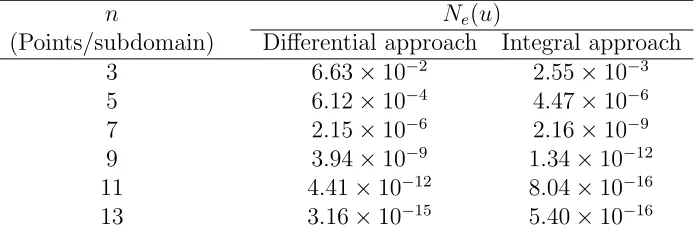
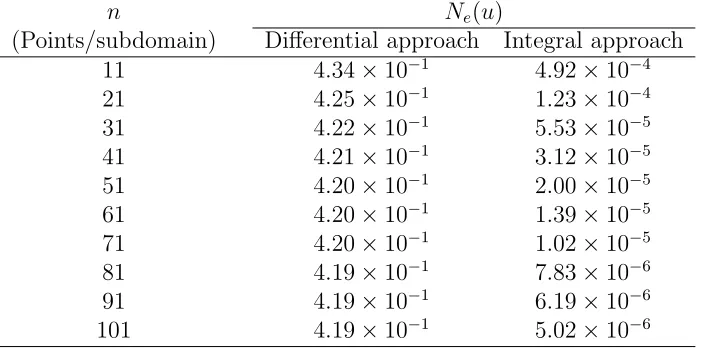
exactly the same (e.g. RBF widths are all chosen as grid spacing). Tables 5 and 6
indicate that the DD scheme based on integration performs much better than that
based on differentiation.
The present numerical schemes can be extended to solve higher-dimensional
prob-lems and higher-order DEs. Similarly, the Cp continuity of the solution over
con-tiguous regions is achieved owing to the satisfaction of the governing equation at the
boundary points in each subdomain. The boundary conditions at the interfaces can
be chosen to be{u, du/dn, ..., dp/2−1u/dnp/2−1}, and these unknown values are then determined by the imposition of continuity in the (p/2),(p/2+1),· · · ,(p−1)th-order normal derivatives across the interfaces.
5
Some applications of the integral collocation
approach
This section presents several applications of the integral collocation approach in
the simulation of engineering problems. The first two problems are concerned with
5.1
Free vibration of ring-like structures
The structural element is a ring of rectangular cross-section of constant width and
thickness that varies parabolically according to the relation (Figure 4):
h(¯θ) = h(0)
− 4
π2(r−1)¯θ 2+ 4
π(r−1)¯θ+ 1
=h(0)f(¯θ), (79)
where r = h(π/2)/h(0). The case of normal, in-plane modes of vibration is
con-sidered here, where only flexural effects are taken into account and one disregards
stretching in the axial direction. Its vibrational behaviour can be modelled by a
sixth-order ODE. The problem is simulated with ICSEs. The obtained results are
compared with those of the optimized Rayleigh-Ritz method [40] and the differential
quadrature technique [41].
5.1.1 A circular ring with supports
Since the structure is symmetric, only half of the domain is considered.
Introduc-ing the dimensionless variable θ = ¯θ/π, the governing differential equation can be
expressed in the form
β1v[6]+β2v[5] +β3v[4] +β4v′′′ +β5v′′+β6v′ −Ω2f v′′+f′v′ −π2f v= 0, (80)
with boundary conditions
where v[q] = dqv/dθq, v is the tangential displacement, θ is the dimensionless
vari-able, Ω is the dimensionless frequency, and
0≤θ≤1,
β1 =φ/π4, β2 = 3φ′/π4, β3 = (2φ/π2) + (3φ′′/π4),
β4 = (4φ′/π2) + (φ′′′/π4), β5 =φ+ (3φ′′/π2), β6 =φ′ + (φ′′′/π2),
φ= [f(θ)]3, f(θ) = −4(r−1)θ2+ 4(r−1)θ+ 1.
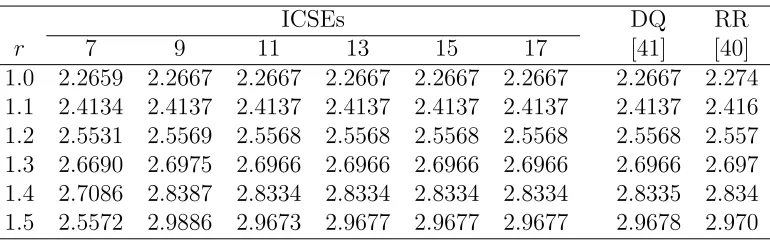
The variable coefficients in (80) involve sixth-order polynomials in θ. Six data
sets, {7,9,· · · ,17} Gauss-Lobatto points, are employed to study the convergence behaviour of the present method. Results concerning the fundamental frequency
coefficient are shown in Table 7. They are compared well with those of [40] and [41].
It can be seen that the present method achieves a high level of accuracy using only
a few grid points. For r = 1.5, at least 4 significant digits remain constant when
n≥13.
5.1.2 A completely-free ring
In this case, a quarter of the ring structure is considered. It is convenient to introduce
the dimensionless variable θ = ¯θ/(π/2) here and the governing equation can be
written as
β1v[6]+β2v[5]+β3v[4]+β4v′′′+β5v′′+β6v′−Ω2f v′′+f′v′−π2f v/4= 0, (81)
with boundary conditions
where
0≤θ≤1,
β1 = 16φ/π4, β2 = 48φ′/π4, β3 = (8φ/π2) + (48φ′′/π4),
β4 = (16φ′/π2) + (16φ′′′/π4), β5 =φ+ (12φ′′/π2), β6 =φ′ + (4φ′′′/π2),
φ= [f(θ)]3, f(θ) = −(r−1)θ2+ 2(r−1)θ+ 1.
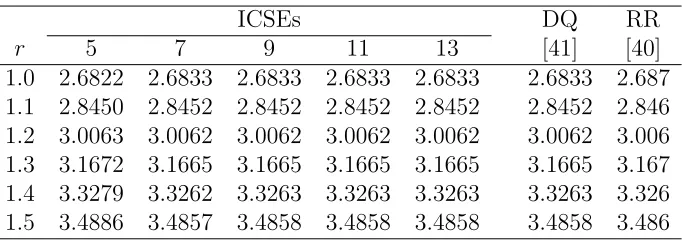
Convergence studies are conducted using five data sets of {5,7,· · · ,13} Gauss-Lobatto points. Table 8 shows the fundamental frequencies obtained by the present
method together with those of [40] and [41]. It can be seen that they are in good
agreement. Highly accurate results are obtained with the present technique. For
r= 1.5, at least 4 significant digits remain constant when n≥9.
5.2
Laminated composite plate
Laminated fibre composite plates have been extensively used in many fields of
en-gineering such as aeronautics and space industries. Much research effort has been
dedicated to improve the ability to predict the behaviour of these structures.
Using the first-order shear deformation theory, the equilibrium equations for
moderately-thick laminated composite plates without membrane action can be written in the
form [42]
A45 ∂ 2w
∂x∂y − ∂ψy
∂x
+A55 ∂ 2w
∂x2 + ∂ψx
∂x
+A44 ∂ 2w
∂y2 − ∂ψy
∂y
+A45 ∂ 2w
∂x∂y + ∂ψx
∂y
D16 −∂ 2ψ
x
∂x2
+D26 − ∂ 2ψ
y
∂x∂y
+D66 ∂ 2ψ
x
∂x∂y − ∂2ψ
y
∂x2
+
D12 − ∂ 2ψ
x
∂x∂y
+D22 − ∂ 2ψ
y
∂y2
+D26 ∂ 2ψ
x
∂y2 − ∂2ψ
y
∂x∂y
=A44 ∂w ∂y −ψy
+A45 ∂w ∂x +ψx
, (83)
D16 − ∂ 2ψ
x
∂x∂y
+D26 − ∂ 2ψ
y
∂y2
+D66 ∂ 2ψ
x
∂y2 − ∂2ψ
y
∂x∂y
+
D11 − ∂ 2ψ
x
∂x2
+D12 − ∂ 2ψ
y
∂y∂x
+D16 ∂ 2ψ
x
∂y∂x− ∂2ψ
y
∂x2
=A45 ∂w ∂y −ψy
+A55 ∂w ∂x +ψx
, (84)
wherew is the transverse displacement of a point situated in the middle plane, the
xy plane; ψx and ψy are respectively the rotations of the transverse normal, i.e. in
the z direction, with respect to the y and x axes;q(x, y) is the transverse load; and
Dij =
1 3
n
X
k=1
(h3k−h3k−1)(Qij)(k) i, j = 1,2,6, (85)
Aij =κ n
X
k=1
(hk−hk−1)(Cij)(k), (86)
in whichκ= 5/6 is a shear correction factor, his the thickness of the laminate, and
Qij andCij represent the stiffness constants of a unidirectional orthotropic composite
making an angleθ with the principal material x-axis. Equations (82)-(84) involve a
large number of derivative terms, some of which are mixed partial derivatives.
The IRBFN method is applied to the static analysis of the bending behaviour of
a simply-supported cross-ply laminate a×a with a cut-out concentric square hole a/2×a/2. The composite plate consists of four layers 00/900/900/00 under a uniform pressureq0. The material properties are chosen to be
E1 = 25E2, ν12 = 0.25,
Different grids are employed for the study of grid convergence. A typical grid is
plotted in Figure 5. Results are presented in dimensionless forms according to the
following relations
w→ 100E2h 3
q0a4 w, (87)
{σxx, σyy, τxy} →
h2 q0a2{
σxx, σyy, τxy}, (88)
{τyz, τxz} →
h
q0a{τyz, τxz}. (89)
Good convergence is achieved as shown in Table 9. Figure 6 shows distributions of
the displacement and in-plane stresses calculated atz =h/2.
5.3
Driven-cavity viscous flow
This problem is usually used as a model for the understanding of physical flows and
for the testing of new numerical schemes in CFD. The lid-driven cavity flow possesses
physically unrealistic characteristics (discontinuous velocity) at the edges of the lid.
This leads to a rapid change in stress near those points, thereby making the
nu-merical simulation difficult. In the context of Newtonian-fluid flow, Ghia, Ghia and
Shin [43] have reported accurate solutions for a wide range of the Reynolds number
using a multigrid finite-difference scheme with very dense grids. These results have
often been cited in the literature for comparison purposes. Recently, by using the
Chebyshev collocation technique, which exhibits exponential convergence/spectral
accuracy, for the calculation of a regular part of the solution, and by using analytical
formulae to obtain the singular part, Botella and Peyret [44] have provided
bench-mark spectral results on the flow at Re = 1000. It will be shown that the IRBFN
results are in closer agreement with the spectral solutions than the finite-difference
The lid velocity (U) and the side length of the cavity (L) are used as reference
quantities. The dimensionless governing equations for unsteady two-dimensional
incompressible flow of a Newtonian fluid in terms of stream functionψ and vorticity
ω can be written as follows
∂ω ∂t +
∂ψ ∂y
∂ω ∂x −
∂ψ ∂x
∂ω ∂y
= 1 Re
∂2ω ∂x2 +
∂2ω ∂y2
, (90)
∂2ψ ∂x2 +
∂2ψ
∂y2 =−ω, (91)
whereRe=U L/νis the Reynolds number(ν: the kinematic viscosity). The vorticity
and stream function are defined by
ω = ∂v ∂x −
∂u
∂y, (92)
∂ψ
∂x =−v, ∂ψ
∂y =u, (93)
whereuandvare two components of the velocity vector in thex−andy−directions, respectively.
The lid slides toward the right at unit velocity, while the other walls remain
station-ary:
ψ = 0, ∂ψ
∂x = 0, on x= 0 andx= 1, (94) ψ = 0, ∂ψ
∂y = 0, on y= 0, (95)
ψ = 0, ∂ψ
∂y = 1, on y= 1. (96)
The boundary condition ψ = 0 along the boundaries can be used directly to solve
(91) for the velocity field, while one needs to derive computational boundary
con-ditions for the vorticity transport equation (90). Using (91) and the boundary
ω =−∂2ψ/∂n2 (n: the local coordinate normal to the wall). After expressing this normal second-order derivative as a linear combination of nodal first-order
deriva-tive values, imposition of the required boundary conditions ∂ψ/∂n is carried out.
Finally, the remaining first derivative values are written in terms of nodal stream
function values.
The stability of the lid-driven cavity flow was investigated by Poliashenko and Aidun
[45]. For the case of a square cavity, it was reported that the point of bifurcation is
Re = 7763, where the primary steady state becomes unstable. A range of the Re
number, {0,100,400,1000,3200,5000}, is considered here. The computed solution at the lower and nearest value ofRe is taken to be the initial solution. The special
case of Re= 0 starts from a fluid at rest. Ten uniform grids, namely 11×11,21× 21,· · · ,101×101, are employed to study the convergence behaviour of the method. Time steps used are in the range of 0.005−0.5. Steady-state solutions are presented in detail here, and they are compared with available data in the literature.
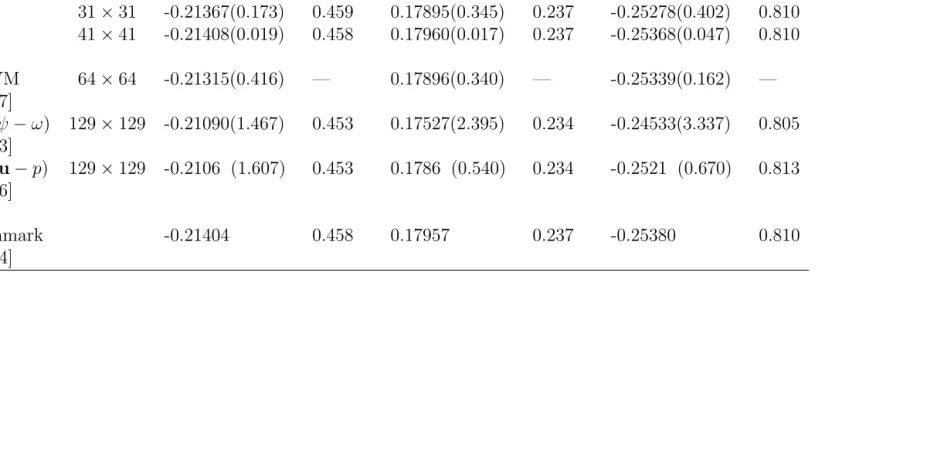
Results concerning the extrema of the velocity profiles along the vertical and
hori-zontal centrelines (Re= 100 and Re= 1000) are summarized in Tables 10–11. The
corresponding results obtained by the pseudospectral method [44], finite-difference
method [43,46] and finite-volume method [47] are included for comparison. The
IRBFN results are in better agreement with the spectral solutions than those
pre-dicted by the finite-difference and finite-volume methods.
Iso-vorticity lines of the flow for various Re numbers are shown in Figure 7. The
vorticity-contour values chosen here are the same as those in [43,44], i.e. {-5, -4,-3,-2,-1,-0.5,0,0.5,1,2,3}. The plots look reasonable when compared to those of [43] and [44].
not require any special treatment for the singularity at the two corners. In contrast,
when using the spectral collocation method, it is necessary to employ a subtraction
technique to remove the leading part of the singularity.
6
Conclusion
In the present chapter, an overview of high-order integral collocation techniques
using radial basis functions and Chebyshev polynomials is given. Three
impor-tant features of these techniques are: (i) Using Cartesian grids to discretize the
physical domain, (ii) Using point collocation to discretize the governing differential
equation, and (iii) Employing high-order integrated approximants to represent the
field variable, which result in effective numerical treatment schemes, particularly
for handling irregular boundaries, high-order differential equations and large-scale
domains. Several applications presented in this review illustrate the ability of the
integral collocation approach to solve complicated engineering problems.
Acknowledgement
This work is supported by the Australian Research Council.
References
1. Roache, P.J. Computational Fluid Dynamics. Hermosa Publishers:
Albu-querque, 1980.
2. Peyret, R.Spectral Methods for Incompressible Viscous Flow; Springer-Verlag:
New York, 2002.
3. Zienkiewicz, O.C.; Taylor, R.L. The Finite Element Method; McGraw-Hill:
4. Brebbia, C.A.; Dominguez, J. Boundary Elements An Introductory Course;
Computational Mechanics Publications: Southampton, 1992.
5. Mai-Duy, N.; Tran-Cong, T. Numerical solution of differential equations using
multiquadric radial basis function networks. Neural Networks. 2001, 14, 185–
199.
6. Mai-Duy, N.; Tran-Cong, T. Numerical solution of Navier-Stokes equations
using multiquadric radial basis function networks. International Journal for
Numerical Methods in Fluids. 2001, 37, 65–86.
7. Mai-Duy, N.; Tran-Cong, T. Mesh-free radial basis function network methods
with domain decomposition for approximation of functions and numerical
so-lution of Poisson’s equations. Engineering Analysis with Boundary Elements.
2002, 26, 133–156.
8. Mai-Duy, N.; Tran-Cong, T. Approximation of function and its derivatives
using radial basis function networks. Applied Mathematical Modelling. 2003,
27, 197–220.
9. Mai-Duy, N.; Tran-Cong, T. Indirect RBFN method with thin plate splines
for numerical solution of differential equations. Computer Modeling in
Engi-neering & Sciences. 2003, 4, 85–102.
10. Kansa, E.J.; Power, H.; Fasshauer, G.E.; Ling, L. A volumetric integral radial
basis function method for time-dependent partial differential equations: I.
Formulation. Engineering Analysis with Boundary Elements. 2004, 28, 1191–
1206.
11. Ling, L.; Trummer, M.R. Multiquadric collocation method with integral
for-mulation for boundary layer problems. Computers & Mathematics with
12. Mai-Duy, N. Indirect RBFN method with scattered points for numerical
so-lution of PDEs. Computer Modeling in Engineering & Sciences. 2004, 6,
209–226.
13. Mai-Cao, L.; Tran-Cong, T. A meshless IRBFN-based method for transient
problems. Computer Modeling in Engineering & Sciences. 2005, 7(2), 149–
171.
14. Mai-Duy, N. Solving high order ordinary differential equations with radial
basis function networks. International Journal for Numerical Methods in
En-gineering. 2005, 62, 824–852.
15. Mai-Duy, N.; Tanner, R.I. Solving high order partial differential equations with
radial basis function networks. International Journal for Numerical Methods
in Engineering. 2005, 63, 1636–1654.
16. Mai-Duy, N.; Tanner, R.I. Computing non-Newtonian fluid flow with radial
basis function networks. International Journal for Numerical Methods in
Flu-ids. 2005, 48, 1309–1336.
17. Mai-Duy, N.; Tran-Cong, T. An efficient indirect RBFN-based method for
nu-merical solution of PDEs. Numerical Methods for Partial Differential
Equa-tions. 2005, 21, 770–790.
18. Deng, J. Structural reliability analysis for implicit performance function using
radial basis function network. International Journal of Solids and Structures.
2006, 43(11–12), 3255–3291.
19. Ling, L.; Trummer, M.R. Adaptive multiquadric collocation for boundary layer
problems. Journal of Computational and Applied Mathematics. 2006, 188(2),
20. Mai-Duy, N. An effective spectral collocation method for the direct solution
of high-order ODEs. Communications in Numerical Methods in Engineering.
2006, 22(6), 627–642.
21. Mai-Duy, N.; Tran-Cong, T. Solving biharmonic problems with
scattered-point discretisation using indirect radial-basis-function networks. Engineering
Analysis with Boundary Elements. 2006, 30(2), 77–87.
22. Sarra, S.A. Integrated multiquadric radial basis function approximation
meth-ods. Computers & Mathematics with Applications. 2006, 51(8), 1283–1296.
23. Le, P.; Mai-Duy, N.; Tran-Cong, T,; Baker, G. A numerical study of strain
localization in elasto-thermo-viscoplastic materials using radial basis function
networks. Computers, Materials & Continua. 2007, 5(2), 129–150.
24. Li, C.; Wu, X. Numerical solution of differential equations using Sinc method
based on the interpolation of the highest derivatives. Applied Mathematical
Modelling. 2007, 31(1), 1–9.
25. Mai-Duy, N.; Khennane, A.; Tran-Cong, T. Computation of laminated
com-posite plates using integrated radial basis function networks. Computers,
Ma-terials & Continua. 2007, 5(1), 63–77.
26. Mai-Duy, N.; Mai-Cao, L.; Tran-Cong, T. Computation of transient viscous
flows using indirect radial basis function networks. Computer Modeling in
Engineering & Sciences. 2007, 18(1), 59–77.
27. Mai-Duy, N.; Tanner, R.I. A collocation method based on one-dimensional
RBF interpolation scheme for solving PDEs. International Journal of
Numer-ical Methods for Heat & Fluid Flow. 2007, 17(2), 165–186.
28. Mai-Duy, N.; Tanner, R.I. A spectral collocation method based on integrated
Computational and Applied Mathematics. 2007, 201(1), 30–47.
29. Shu, C.; Wu, Y.L. Integrated radial basis functions-based differential
quadra-ture method and its performance. International Journal for Numerical
Meth-ods in Fluids. 2007, 53(6), 969–984.
30. Mai-Duy, N.; Tran-Cong, T. An efficient domain-decomposition pseudo-spectral
method for solving elliptic differential equations. Communications in
Numer-ical Methods in Engineering, in press
31. Mai-Duy, N.; Tran-Cong, T. A Cartesian-grid collocation method based on
radial-basis-function networks for solving PDEs in irregular domains.
Numer-ical Methods for Partial Differential Equations, in press
32. Mai-Duy, N.; See, H.; Tran-Cong, T. An integral-collocation-based fictitious
domain technique for solving elliptic problems. Submitted.
33. Haykin, S. Neural Networks: A Comprehensive Foundation; Prentice-Hall:
New Jersey, 1999.
34. Micchelli, C.A. Interpolation of scattered data: distance matrices and
con-ditionally positive definite functions. Constructive Approximation. 1986, 2,
11–22.
35. Park, J.; Sandberg, I.W. Universal approximation using radial basis function
networks. Neural Computation. 1991, 3, 246–257.
36. Cover, T.M. Geometrical and statistical properties of systems of linear
in-equalities with applications in pattern recognition. IEEE Transactions on
Electronic Computers. 1965, EC-14, 326–334.
37. Madych, W.R.; Nelson, S.A. Multivariate interpolation and conditionally
pos-itive definite functions. Approximation Theory and its Applications. 1988, 4,
38. Madych, W.R.; Nelson, S.A. Multivariate interpolation and conditionally
pos-itive definite functions, II. Mathematics of Computation. 1990, 54(189),
211-230.
39. Smith, B.F.; Bjorstad, P.E; Gropp, W.D.Domain Decomposition Parallel
Mul-tilevel Methods for Elliptic Partial Differential Equations; Cambridge
Univer-sity Press: New York, 1996.
40. Gutierrez, R.H.; Laura, P.A.A. Vibrations of non-uniform rings studied by
means of the differential quadrature method. Journal of Sound and Vibration.
1995, 185(3), 507–513.
41. Wu, T.Y.; Liu, G.R. Application of generalized differential quadrature rule to
sixth-order differential equations. Communications in Numerical Methods in
Engineering. 2000, 16, 777–784.
42. Reddy, J.N. Mechanics of laminated composite plates and shells. Theory and
analysis; CRC Press: Florida, 2004.
43. Ghia, U.; Ghia, K.N.; Shin, C.T. High-Re solutions for incompressible flow
using the Navier-Stokes equations and a multigrid method. Journal of
Com-putational Physics. 1982, 48, 387–411.
44. Botella, O.; Peyret, R. Benchmark spectral results on the lid-driven cavity
flow. Computers & Fluids. 1998, 27(4), 421–433.
45. Poliashenko, M.; Aidun, C.K. A direct method for computation of simple
bifurcations. Journal of Computational Physics. 1995, 121(2), 246–260.
46. Bruneau, C.-H.; Jouron, C. An efficient scheme for solving steady
incompress-ible Navier-Stokes equations. Journal of Computational Physics. 1990, 89(2),
47. Deng, G.B.; Piquet, J.; Queutey, P.; Visonneau, M. Incompressible flow
calcu-lations with a consistent physical interpolation finite volume approach.
Table 1: Multiple boundary conditions: Condition numbers and errors by CSEs
nx×ny Differential Approach Integral approach
cond(A) Ne(u) cond(A) Ne(u)
6×6 4.4×10² 1.23×10⁻¹ 1.6×10² 4.84×10⁻³ 8×8 3.6×10³ 5.94×10⁻³ 1.5×10³ 7.40×10⁻⁵ 10×10 2.0×10⁴ 2.10×10⁻⁴ 8.8
×103 4.20×10⁻⁷ 12×12 9.2×10⁴ 4.46×10⁻⁶ 3.8×10⁴ 2.40×10⁻⁹ 14×14 3.4×10⁵ 6.52×10⁻⁸ 1.3×10⁵ 1.20×10⁻¹¹ 16×16 1.1×10⁶ 7.05×10⁻¹⁰ 4.1
Table 2: Multiple boundary conditions: Condition numbers and errors by RBFNs
nx×ny Differential Approach Integral approach
cond(A) Ne(u) cond(A) Ne(u)
7×7 6.3×10⁵ 1.40×10⁻¹ 2.4×10² 1.47×10⁻³ 11×11 3.4×10⁶ 1.22×10⁻¹ 2.4×10³ 1.61×10⁻⁴ 17×17 1.8×10⁷ 1.46×10⁻¹ 1.8
×104 4.03×10⁻⁵ 21×21 4.4×10⁷ 1.82×10⁻¹ 4.5×10⁴ 2.44×10⁻⁵ 27×27 1.2×10⁸ 2.33×10⁻¹ 1.3×10⁵ 1.41×10⁻⁵ 31×31 2.1×10⁸ 2.64×10⁻¹ 2.3
×105 1.05×10⁻⁵ 37×37 4.4×10⁸ 3.05×10⁻¹ 4.9×10⁵ 7.35×10⁻⁶ 41×41 6.7×10⁸ 3.30×10⁻¹ 7.5×10⁵ 5.95×10⁻⁶ 47×47 1.1×10⁹ 3.63×10⁻¹ 1.3
Table 3: Non-rectangular boundaries: Condition numbers and errors by ICSEs
nx×ny cond(A) Ne(u)
Table 4: Non-rectangular boundaries: Condition numbers and errors by IRBFNs
nx×ny cond(A) Ne(u)