Rochester Institute of Technology
RIT Scholar Works
Theses Thesis/Dissertation Collections
12-2016
E-Government in Amarah: Challenges and
Recommendations for Future Implementation
Reem Jabbar AbdulbaqiFollow this and additional works at:http://scholarworks.rit.edu/theses
This Thesis is brought to you for free and open access by the Thesis/Dissertation Collections at RIT Scholar Works. It has been accepted for inclusion in Theses by an authorized administrator of RIT Scholar Works. For more information, please [email protected].
Recommended Citation
E-Government in Amarah: Challenges and Recommendations
for Future Implementation
By
Reem Jabbar Abdulbaqi
Thesis Submitted in Partial Fulfillment of the Requirements for the
Degree of Master of Science in
Networking and System Administration
Rochester Institute of Technology
B. Thomas Golisano College of
Computing and Information Sciences
Rochester Institute of Technology
B. Thomas Golisano College
of
Computing and Information Sciences
Master of Science in Networking and System Administration
Student Name: Reem J. Abdulbaqi
Project Title: E-Government in Amarah: Challenges and Recommendations for Future Implementation
Project Area(s): Application Dev. Database Website Dev.
( primary area) Game Design HCI eLearning
Networking Project Mngt. Software Dev.
Multimedia System Admin. Informatics
Geospatial Other
~ MS Thesis Committee ~
Name
Signature Date
Prof. Charles Border
_
Chair
Prof. Sylvia Perez-Hardy
Committee Member
DEDICATION
This thesis work is dedicated to my parents and my brother Mohamed who have always loved me
unconditionally.
Also, this work is dedicated to my little brother Munaf who has gone forever away from our life
ACKNOWLEDGEMENT
I am very fortunate and grateful to the Ministry of Oil and ExxonMobil for giving me this
scholarship to finish my Master’s at R.I.T. Also, I want to thank the IIE for their support
throughout the entire process.
I would like to express my sincere gratitude to my thesis committee: Prof. Charles Border, Prof.
Sylvia Perez-Hardy, and Prof. Daniel Kennedy for their support, encouragement, patience, and
motivation.
To Jill, without your help and support, I would never get to this point. Also, I would like to express
my gratitude and appreciation to all R.I.T. staff and all my professors for their encouragement to
ABSTRACT
The growth and changes in the 21st century in the sectors of economics, politics, and
technology mean that governments must provide all the services that can serve the demands of
their citizens. One way for governments to facilitate this is by implementing e-government.
E-government migrates services previously implemented by government employees to
internet connected systems accessible by citizens from wherever they are at whatever time
they are needed. This system can connect citizens to the government ministries via rule-based
systems. Amarah, a city in the south of Iraq, started to integrate electronic systems into the
facilities of the city in 2005. In 2012, the Amarah Provisional Council began the first step to
build the e-government for the city by working with the UN, but the e-government systems
still have not been built because the Council of Amarah is trying not to fall into the same
mistakes of other e-government projects in the country. The purpose of this study is to cover
some of the challenges that face governments in implementing e-government in developing
countries. Another goal is to provide a comparative study to analyze the successful
implementations of e-government in such places as South Korea, Bahrain, and Australia.
Moreover, this thesis presents a workable framework to implement an e-government system
TABLE OF CONTENTS
Chapter 1: Introduction...1
1.1 Introduction ... 11
1.2 Background of Iraq ... 3
1.2.1 Iraq Profile.. ... 3
1.2.2 History and Politics ...4
1.2.3 Economy ... 5
1.2.4 ICT Infrastructure ... 6
1.2.5 E-government in Iraq ... 7
1.3 Background of Amarah...8
1.3.1 Amarah Profile ... 8
1.3.2 E-government in Amarah ... 9
1.4 Thesis Objectives ... 10
Chapter 2: Literature Review ... 11
2.1 Definition of e-government... 11
2.2 Stages of e-government...12
2.3 Layers of e-government...15
2.4 Classifications of E-government ... 19
2.4.1 Government-to-Citizen (G2C) ... 19
2.4.2 Government-to-Government (G2G) ... 19
2.4.3 Government-to-Business (G2B) ... 20
2.5 e-Readiness ... 20
2.5.1 Computer Systems Policy Project (CSPP)...22
2.5.2 Center for International Development (CID) ... 22
2.5.3 Asian Pacific Economic Cooperation (APEC) ... 23
2.5.4 McConnell International’s Risk E-Business ... 24
2.5.5 Network Readiness Index (NRI) ... 24
2.6 E-government Benefits ... 24
2.7 E-government Challenges ... 27
2.7.1 Technical Issues ... 27
2.7.2 Social Issues ... 28
2.7.3 Finanical Issues ... 28
2.7.4 Resource Issues ... 28
2.7.5 Organizational Issues ... 29
Chapter 3: Case Studies ... 30
3.1 Australia ... 30
3.2 South Korea ... 35
3.3 Bahrain ... 44
4.1.3 Social Factor ... 63
4.1.4 Technological Factor ... 64
4.2 Interoperability Framework (IF) ... 65
4.2.1 Introduction ... 65
4.2.2 Adopt the e-Government Interoperability Framework (e-GIF) ... 67
4.2.3 Suggestion to implement e-Government Interoperability Framework for Amarah ... 67
Chapter 5 : Recommendations and Conclusion ... 75
5.1 Recommendations ... 75
5.2 Conclusion ... 77
LIST OF TABLES
Table 1. The 3 Stages of E-government...………...13
Table 2. The 4 Stages of E-government...…….….………....13
Table 3. The 5 Stages of E-government...……….………….14
Table 4. The 6 Stages of E-government...….…..….…………...………….15
Table 5. E-readiness of Australia...…....………..32
Table 6. E-readiness of South Korea....………...…...37
Table 7. E-readiness of Bahrain...………...45
Table 8. E-readiness of The UAE...……….…….…………...50
LIST OF FIGURES
Figure 1. Map of Iraq……….3
Figure 2. Map of Iraq (Amarah Location)……….9
Figure 3. The layered framework for Pune City…………...………16
Figure 4 The proposed layered framework………. 18
Figure 5. The Australia strategy of 2012-2015.………...33
Figure 6. Australian interoperability framework……….………….34
Figure 7. E-Government in Kim administration……….………. 39
Figure 8. The 31 initiatives in Roh Moo-Hyun’s administration……….40
Figure 9. South Korea EA framework and its components……….………….…42
Figure 10. The development methodology of the UAE e-government………….………...51
Figure 11. The strategic, goals, and work themes……….………...52
Figure 12. The initiatives of the UAE e-government………..……….53
Figure 13. Mobile penetration in GCC……….……….….…………..55
Chapter 1: Introduction
1.1 Introduction
Many governments seek to offer the most effective ways to provide services to their citizens.
One of these ways is implementing e-government. E-government seeks a new solution to
problems in information technology and providing services. “The major aim of
[e-government] is to break the man-made boundaries of time and location by applying
information technology to achieve the informational transition of the government faculty, to
enable people to acquire information from different sources and enjoy the service,” (Zhu,
2009). In other words, implementing e-government for cities that face many challenges with
such things as unemployment, crime, health care, and education. All of this can serve both
citizens (rich and poor) and government ("Why is e-Government Important?", 2015).
After 2003, Iraq began working to rebuild the country in all aspects of life, especially in
technology. Building e-government for a country like Iraq is not easy for many reasons
because oflack of security (computer hacking and terrorist attacks), lack of human resources,
The implementation of E-government in Iraq differs from one city to another. Each city has
different policies, challenges, requirements, and needs for people to interact with technology.
Amarah is a city in the province of Maysan on the Tigris River in the south central part of Iraq.
Since 2011, the Amarah Provisional Council suggested to begin thenext step to improve the
ICT sector of the city by implementing e-government. Until this year, there is no physical
implementation of the project. The Council is still searching and preparing a team that can
manage and build e-government. The goal of this project is to facilitate the processes for
Amarah citizens, save the city the time and the money to process services, and to eliminate the
corruption.
The problem for some countries in the developing world is that following the same strategies
that have worked for other countries to implement an e-government project can be less
successful because ofthe differences between the countries. Some of the issues that can cause
problems include: cultural, financial, political, environmental situations, and involve ICT
infrastructure and ICT literacy. For this reason, this thesis aims to determine the expected
challenges for future implementation, which can be done by using PEST analysis. Also, even
though there are many successful implementations, Amarah should be careful and not follow
the other exact implements; for that, my thesis covers some of these successful projects and
focuses on strategies that can help Amarah Council. Moreover, this research suggests an
1.2 Background of Iraq
1.2.1 Iraq Profile
The Republic of Iraq is a country located in Western Asia. Iraq is bordered from the North by
Turkey, East by Iran, South by Saudi Arabia, West by Syria, Southeast by Kuwait, and
Southwest by Jordan. Iraq has 18 governorates (provinces), and the capital of Iraq is the
[image:14.612.112.481.239.569.2]Iraq is a very diverse country with many ethnic groups including Arabs, Armenians, Assyrians,
Chaldeans, Circassians, Kurds, Mandaens, Shabakis, Turkomen and Yazidis ("Ethnic and
Religious Groups In Iraq - US - Iraq War - ProCon.org", 2009).
Also, Iraq has many religions followed by its peoples. The major religion in Iraq is Islam,
followed by Christianity, Yezidism, Shabak, and Mandeanism (Kjeilen, n.d.). Iraq has two
official languages: Arabic and Kurdish. Other languages include Turkmen, Syriac and
Armenian (Ahmad, Norouzi, Schmelling, & Taenner, 2015). The population of the country is
37,976,697, based on the latest United Nations estimates.
1.2.2 History and Politics
In reference (COUNTRY PROFILE: IRAQ, 2006), Iraq is a rich country with many natural
resources and situated between two rivers, the Tigris and Euphrates. Iraq was created as a
country around 10,000 BC from a region that historically has been called Mesopotamia. The
history of what would later come to be called Iraq began before 6000 B.C. when Sumerians
settled in Sumer (currently southern Iraq). In the 18th century B.C., the Babylonian kingdom
was founded in modern-day Babylon. In 16th century B.C., the king Mursili, was the king of
the Hittites at that period, destroyed the Babylonians. In 9th century B.C., Semitic Assyrians,
which originated in northern Mesopotamia and their capital Nineveh, Nineveh Governorate
was on the Tigris River. In 539 B.C., Mesopotamia became part of the Persian Empire under
the control of Cyrus the Great. During this period, there were many inventions and
developments such as the wheel, astronomy, writing, chariot, sailboat, mathematics and
irrigation.
From 1534 to 1918, Iraq was under the control of the Ottoman Empire. In 1917, the British
defeated the Ottomans and occupied Iraq. British rule did not last uncontested very long and
the Iraqi tribes began their revolution in 1920, gaining independence from the British in 1932.
However, the conflicts between Shia-Sunni and the ambitions of others such as Kurds and
Assyrians to gain power, lead the British to reoccupy Iraq again in 1941. In 1958,
Abd-al-Karim Qasim and Abd-al-Salam Muhammad Arif ended the monarchy in Iraq.
Abd-al-Salam Muhammad Arif became president in 1963 until 1966, then Ahmad Hasan
al-Bakr from 1968 till 1979. From 1979 till 9 April 2003, Saddam Hussein was the president
of Iraq ("Iraq profile - timeline - BBC News", 2016).
The US invasion began on March 19th 2003. After the war ended the terrorists tookcontrol all
over Iraq, especially after 2005. Their target was to destroy the infrastructure of the country by
bombing the ministries, schools, and historical and holy places to increase the conflicts
between the Iraqi people. Also, their target was killing and kidnapping many doctors,
engineers, and professors. In reference (Fortin, 2013), from 2003 to 2006, 40% of Iraqi professionals left the country. In 2016, the war is stillnot ended. Iraqi people have to fight the
terrorists around the country and especially the ISIS in the north of Iraq, and fight the
All these have affected the ability of the country to develop in many different sectors such as
health, education, and technology. Iraq hopes that increasing oil prices and providing a secure
environment by ending the conflict with ISIS will improve the Iraqi economy ("The World
Factbook — Central Intelligence Agency", n.d.).
Another negative force impacting the governance of Iraq is the Corruption that has become
endemic to the government and has had a direct negative effect on the Iraqi economy.
According to the Transparency International in its Corruption Perception Index (CPI), Iraq
ranks 161 out of 168 countries ("Corruption", n.d.). In reference (Mamouri, 2016), in 2014 the
World Bank statistics stated that only 11% of Iraqis have a bank account because of the
poverty and the high percentage of unemployment. Also, the banking system in Iraq is very
bureaucratic, taking a long process to open a bank account or to process a simple service.
Moreover, due to governmental instability, Iraqi banks are not allowed to provide credit or
debit cards, which has a negative impact people’s ability to access their funds through an
ATM.
1.2.4 ICT Infrastructure
Because of the war situation begun in 2003 and the following political and economic
instability, the ICT infrastructure for the country has never really developed. Now, Iraq is
trying to rebuild the country again regardless of politics, economics, and corruption problems.
The Minister of Communication of Iraq is responsible for building the ICT infrastructure for
internet. After 2007, the ministry laid out 12,000 km of fiber optics cables with Dense
Wavelength Division Multiplexing (DWDM) technology that would cover up to 20,000
square km in 2012. Also, theyinstalled two microwave routers, one from the north to the south,
and the another one from the middle to the west. Moreover, the other plan of the ministry was
to setup submarine cables to connect Iraq with its neighbors, Syria, Jordan, Saudi Arabia,
Kuwait, Iran and Turkey.
1.2.5 E-government in Iraq
After 2003, one of the Iraq plans was to improve the ICT infrastructure of the country and to
increase the ICT literacy by enhancing the government’s implementation of e-government.
However, because of the political and financial issues, lack of experiences in this field and
lack of ICT knowledge, Iraq was unable to implement it. For that, the Iraqi government had to
ask for help from the UN.
In 2004, the UN asked their members to provide a support for Iraqi government. The Italian
Ministry of Innovation and Technology worked with the Iraqi Ministry of Science of
Technology to implement the e-government project by signing a Memorandum of
infrastructure is still weak and could not manage and control a project such as the
e-government project. Also, the ICT literacy is slow because of the expense of owning a
computer and internet connection. Moreover, the resistance from the employees to implement
the project was difficult because of political, security or ethnic reasons (Al-Taie & Kadry,
2013). In reference (Ibrahim, 2014), the Iraqi portal launched in 2010 contains only
information and few forms to download, such as for passports and driver licenses. There were
few initiatives from some ministries to move their traditional system to the electronic system.
The Ministry of Health, for example, tried to create a database for the patients. Also, some
ministries tried to provide online services to facilitate the process for other services
1.3 Background of Amarah
1.3.1 Amarah Profile
Amarah is the administrative center of the Maysan province located in the South-Eastern of
Iraq, close to the Tigris River. It shares a border with Iran. The majority of people are Shia
Muslim, and the ethnic groups are Arabs and Mandaens. The population in 2012 was 511,542.
The official language is Arabic ("Amarah", n.d.). Figure 2shows the location of Amarah in the
Figure 2. Map of Iraq (Amarah Location) Reprinted from Al-Amarah In Encyclopaedia Britannica, by The Editors of Encyclopædia Britannica, 11-28-2011, Retrieved September 23, 1016, from https://www.britannica.com/place/Al-Amarah. Copyright 2011 by
Encyclopaedia Britannica. Reprinted with permission.
1.3.2 E-government in Amarah
department hired many people in various majors who have experience in this field because the
reason that many e-government projects failed in some cities is lack of the right people in the
right position.
1.4 Thesis Objectives
This thesis aims to point out on some of the challenges that Amarah must face during their
process to build the e-government. It aims to show that following the same steps of other
success implementations can end with a disaster for Amarah in general because of the
Chapter 2: Literature Review
2.1 Definition of e-government
There is no global definition of e-government. Researchers and scholars have several
arguments about the standard for the definition of e-government. For that, they have defined
e-government in many different ways; some of them see e-government as a goal and others see
it as a tool to achieve goals (Yildiz, 2007).
In reference (Mofleh, 2008), Mofleh mentioned that there are many reasons why the
differences in e-government definitions as the following:
Each country defines e-government differently from other countries relating to their
political systems.
Defining e-government from technical, culture, and managerial perspectives.
Defining e-government depending on the stockholders in businesses.
Some researchers define e-government regarding to its function, such as e-services,
e-democracy, and e-governance.
Also, the use of ICT can enhance the public sector agencies, which lead to increasing the
efficiency and effectiveness of the public sector processes (Heeks, 2003). For the researcher
Bhatnagar and his colleagues (Bhatnagar, 2002), e-government is a way to share information
and deliver services, and the result of using e-government is to reduce corruption, cost and
time, and to increase transparency and revenue. In reference (Hahamis, Iles, & Healy, 2005),
the author Hahamis and his colleagues defined e-government from the governmental
perspective, which is a way to deliver government services to improve the administrative
efficiency. In reference (Gichoya, 2005), Gichoya was trying to define e-government from the
citizens’ perspective. He said that e-government is a way to facilitate the access of citizens to
the government information and services online at any time and from anywhere.
2.2 Stages of e-government
The implementation of e-government from the point of view some researchers can be a linear
progression, following steps in order to complete the implementation (Soliman, 2007). In
reference (Promoting e-government applications towards an Information Society in ESCWA
member countries, 2003), this reference mentioned that there are many researchers think that
it not necessary to follow the steps in order. Moreover, there is no fixed number of stages to
implement e-government due to many factors such as cultural, economic, technology, and
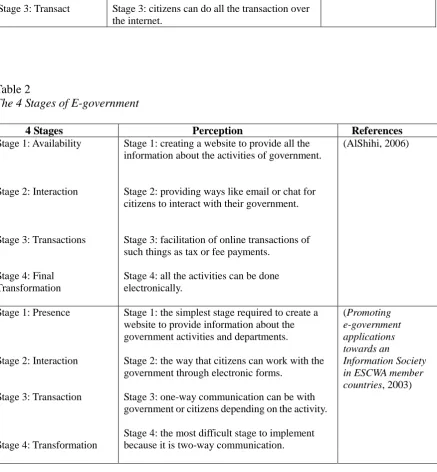
Table 1
[image:24.612.77.515.197.670.2]The 3 Stages of E-government
Table 2
The 4 Stages of E-government
3 Stages Perception References
Stage 1: Publish
Stage 2: Interact
Stage 3: Transact
Stage 1: publish the information about the government online.
Stage 2: interaction the citizens with their government online.
Stage 3: citizens can do all the transaction over the internet.
(Al-Shafi, 2009; Attohoun et al., 2002)
4 Stages Perception References
Stage 1: Availability
Stage 2: Interaction
Stage 3: Transactions
Stage 4: Final Transformation
Stage 1: creating a website to provide all the information about the activities of government.
Stage 2: providing ways like email or chat for citizens to interact with their government.
Stage 3: facilitation of online transactions of such things as tax or fee payments.
Stage 4: all the activities can be done electronically.
(AlShihi, 2006)
Stage 1: Presence
Stage 2: Interaction
Stage 1: the simplest stage required to create a website to provide information about the government activities and departments.
Stage 2: the way that citizens can work with the
(Promoting e-government applications towards an
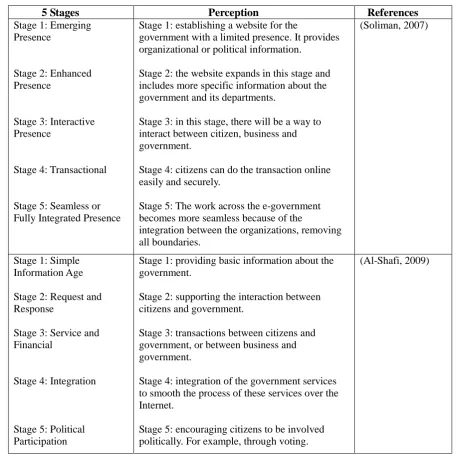
Table 3
The 5 Stages of E-government
5 Stages Perception References
Stage 1: Emerging Presence
Stage 2: Enhanced Presence
Stage 3: Interactive Presence
Stage 4: Transactional
Stage 5: Seamless or Fully Integrated Presence
Stage 1: establishing a website for the
government with a limited presence. It provides organizational or political information.
Stage 2: the website expands in this stage and includes more specific information about the government and its departments.
Stage 3: in this stage, there will be a way to interact between citizen, business and government.
Stage 4: citizens can do the transaction online easily and securely.
Stage 5: The work across the e-government becomes more seamless because of the
integration between the organizations, removing all boundaries.
(Soliman, 2007)
Stage 1: Simple Information Age
Stage 2: Request and Response
Stage 3: Service and Financial
Stage 4: Integration
Stage 5: Political Participation
Stage 1: providing basic information about the government.
Stage 2: supporting the interaction between citizens and government.
Stage 3: transactions between citizens and government, or between business and government.
Stage 4: integration of the government services to smooth the process of these services over the Internet.
Stage 5: encouraging citizens to be involved politically. For example, through voting.
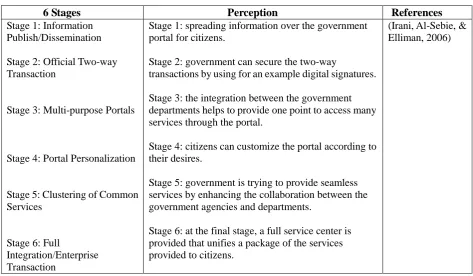
Table 4
The 6 Stages of E-government
6 Stages Perception References
Stage 1: Information Publish/Dissemination
Stage 2: Official Two-way Transaction
Stage 3: Multi-purpose Portals
Stage 4: Portal Personalization
Stage 5: Clustering of Common Services
Stage 6: Full
Integration/Enterprise Transaction
Stage 1: spreading information over the government portal for citizens.
Stage 2: government can secure the two-way
transactions by using for an example digital signatures.
Stage 3: the integration between the government departments helps to provide one point to access many services through the portal.
Stage 4: citizens can customize the portal according to their desires.
Stage 5: government is trying to provide seamless services by enhancing the collaboration between the government agencies and departments.
Stage 6: at the final stage, a full service center is provided that unifies a package of the services provided to citizens.
(Irani, Al-Sebie, & Elliman, 2006)
2.3 Layers of e-government
Designing e-government layers depends on all the aspects to implement a successful
framework. There are many different ways to design the layers depending on different aspects,
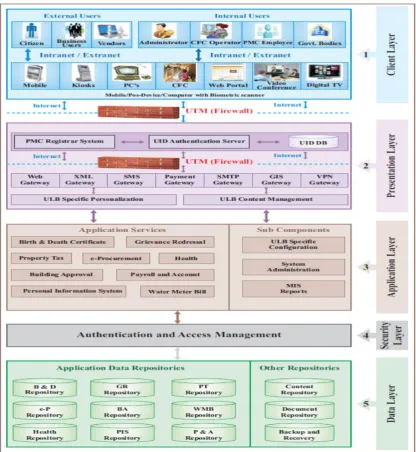
such as priorities, technology, and other reasons. The following figure is the layered
Figure 3. The layered framework for Pune City. Reprinted from ”A critical study of implication of e-governance services for effective communication with special reference to Citizens in Pune City,” by M. A. Kumbhar, 2012, Reprinted with permission.
As shown in the figure 3 there are five layers. The first layer is called Client Layer. This layer
includes the delivery channels of different e-government applications with the users. The
delivery channels can be mobiles, kiosks, personal computers, and other ways to access the
citizens, vendors, and business users, and the internal users refer to government employees.
The second layer is the presentation layer, which is used to manage the interface to connect
citizens with the government portal. The third layer is the application layer that includes
services such as birth and death registration, assessment and payment of tax, and building
approval. The fourth layer is the security layer. This is used to authenticate access for the
authorized users and to identity management, which is crucial to provide reliable delivery of
the government services over the Internet. The fifth layer is the data layer. It is a database, such
as application data repositories. For Pune City, according to the author Kumbhar, cloud
computing has been used for implementation because of the cost.
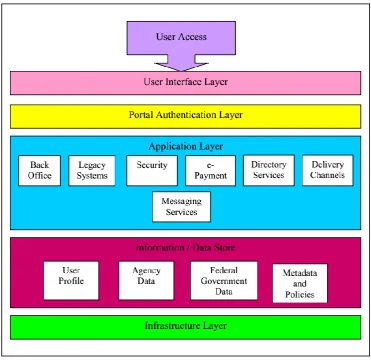
There is another approach to design the layered framework for an e-government, such as in
reference (Kaur, 2006), the proposed layered framework contained six layers which are: User
Access, User Interface, Portal Authentication, Application, Information / Data Store, and an
Figure 4. The proposed layered framework. Reprinted from Malaysian e-Government Implementation Framework (p. 88), by R. Kaur, 2006. Reprinted with permission.
The first layer, User Access layer, refers to the access way through a browser such as Mozilla
Firefox. The second layer is User Interface layer, which refers to the services that are available
on the portal like eCitizen, eBusiness, eEmployee, eGovernment, and visitors. The third layer
is Portal Authentication Layer, which is the way a citizen can access the applications after
getting the authentication. The fourth layer is the Application layer that contains both the
legacy and the new system. The fifth layer is the Information / Data Store layer, which refers
some information about what the best technology can be used in the infrastructure layer. For
example, the Apache can be a good choice as an application server because it is more
accessible and more convenient. For running the servers, IBM pSeries can be a better choice,
and for the DataBase, it could be a MySQL, an open source database management.
2.4 Classifications of E-government
Government provides services to different customers such as citizen, business, and
government employees. Each service is different from another due to the customer’s needs.
There are four types of e-government as the following:
2.4.1 Government-to-Citizen (G2C)
The aim of this type is to allow the government to interact with citizens through a
portal which provides all the services and information that citizens need. Before
the online services, citizens took a long time to process a service because of the
time, paperwork, and difficult approvals from different department. Now, G2C
provides services online over 24/7 and which reduces the cost and the time to
process a service. Moreover, according to Cook and other authors (Cook et al.,
e-government because according to Ebrahim, “No structuring can exist without
sharing, and no organisational intelligence will be created without structuring,”
(p. 36).
2.4.3 Government-to-Business (G2B)
In reference (Forman, 2002), G2B is the service that can facilitate the
communication between government and business agencies. The connection
between the government and the business companies can be vital for both of them.
For government, it reduces the redundancy about the business agencies. For
business companies, it reduces the time and the cost to process a certain service,
which can effect on the revenue, making it easier to view all the updates of the
government policies and laws. Downloading application forms, getting new or
renewing licenses are examples for the kind of the services that G2B can provide.
2.4.4 Government-to-Employee (G2E)
G2E provides services specifically to the employees which can help them to
understand the government laws and regulations; moreover, providing this kind
of service can enhance the administrative process, reduce time to complete a
certain service, and decrease the number of the employees to work on a specific
process (Ebrahim, 2005).
2.5 e-Readiness
Before working on the implementation of e-government projects, a government should work
on the e-readiness first. This is a part of e-government strategy because it is crucial to
reference (Alshehri, 2012), Alshehri stated a definition of e-readiness that is a measurement
for a country to get the benefits from the its digital economy.
In reference (Peters, 2005), e-readiness assessment is a tool that is used by a government to
help make their decision about the readiness of a government for moving to an electronic
system. E-readiness assessment consists of four steps which are determining the targets of the
project and trying to choose a proper assessment tool, conducting the e-readiness assessment,
establishing a comprehensive action plan, and implementing the plan.
Moreover, on reference (Verma, Mohan Das, & Kalra, 2005), the e-readiness assessment tools
deal with one or more of the following topics:
Physical Infrastructure: this tool covers all the telecommunications’ infrastructure,
such as Internet access, pricing, and bandwidth. It also includes Hardware, National
and State Level Data Centers, Security Infrastructure, and Service Gateways/Payment
Gateways.
Human Capacity: this tool deals with human aspects such as literacy and ICT literacy.
Policy Environment: it is about the laws, rules, and regulatory environment, such as
Furthermore, there are many tools that are used for e-readiness assessment. Each one has its
goals because a government needs to determine its aims before choosing a tool. In the
following some of these tools that were developed by different international bodies:
2.5.1 Computer Systems Policy Project (CSPP)
In reference (Verma et al., 2005), the CSPP developed a guide which is used to determine the
Networked Readiness for a country, and published in 1998. CSPP has five categories that are
linked to each other. Each category has a different question as the following:
1- The network (Infrastructure): the backbone technologies that connect to the network,
availability, pricing, quality of ICT, also services and equipment.
2- Networked Places (Access): where are the places to connect to the Internet and when?
3- Networked Applications and Services: this sector is about how to make the
connection meaningful.
4- Networked Economy: the relation between the network and economy, and the role
of the technology in driving the economy.
5- Networked World Enablers: is about the the levers expediting the Networked World.
2.5.2 Center for International Development (CID)
In reference (Sachs, n.d.), the CID guide was developed at Harvard University in 2000, this
guide helps the developing countries to distinguish their networked readiness. It includes five
categories which are linked to each other. Each one links to the next category, and the result
will determine the readiness for the government. The categories are the following:
1- Network Access: asking about the availability, services, cost, and equipment of ICT
networks
e-literacy. Also, see if there are programs to train the citizens and prepare them for
the new technology for success with the project in the future.
3- Network Society: is about how the people are using it in their lives and work?
4- Network Economy: check how government and business are using the technologies
to interact with the public sector and with each other.
5- Network Policy: to see how the policy environment can support or hinder the
growth or the ICT.
2.5.3 Asian Pacific Economic Cooperation (APEC)
In reference ("Hong Kong E-commerce Readiness", n.d.), the APEC and the Electronic
Commerce Steering Group developed this guide. The goal of this guide is to enhance the
e-commerce environment. It consists of six indicators as the following:
1- Telecommunication Infrastructure and Technology Base: this is about the speed,
market competition, pricing, foreign investment, and industry standards.
2- Access and Supporting services: includes the bandwidth, credit card regulation, and
experts controls.
3- Level and Type of Use of the Internet: about the number of the Internet users in
2.5.4 McConnell International’s Risk E-Business
In reference (Verma et al., 2005), McConnell International with a collaboration of the World
Information Technology and Services Alliance (WITSA) prepare a guide of a national
economy’s e-readiness, it released at 2000. This model measures five areas which are:
1- Connectivity (infrastructure, access, and pricing).
2- Information Security (privacy, electronic signatures, and intellectual property).
3- Human Capital (ICT education, available skilled workforce).
4- E-leadership (government policies and regulations).
5- E-business (Competition, foreign investment, and finical infrastructure).
2.5.5 Network Readiness Index (NRI)
In reference (Verma et al., 2005),the Network Readiness Index has been developed jointly by
the World Economic Forum, Infodev, and INSEAD. The goal of NRI is to understand the
impact of ICT on the competitiveness of nations. The model consists of three components
which are:
1- ICT environment (market, political, regulatory, and infrastructure environment).
2- Readiness of the community’s key stakeholders to use the ICT.
3- The usage of ICT among the stakeholders.
2.6 E-government Benefits
Moving from the legacy system to the electronic system brings many benefits to all the
stockholders, which are government, citizens, and businesses. Many researchers are using
In reference (Ebrahim, 2005), Ebrahim mentioned some of the benefits for e-government
which can be classified in four categories such as the following:
● Internal:
● Improving the government efficiency by involving the citizens in the Democratic
process and decision-making.
● Improving the transparency of the government departments which improves the
quality of data and services
● Improving the management process to organize and decrease the complexity of the
workflows for the government and business.
● External:
● Increasing the response for the citizens’ need and private sector.
● Increasing the collaboration between the government and private sector
(businesses).
● Improving the transactions process over the Internet by digitising procurement and
which required a better government management and collaboration with the private
sector.
● Reducing time to process certain services.
● Reducing the cost of spending to process a service for citizens and businesses.
● Technical:
● Improving the connection between the government bodies by sharing the data.
● Improving the ICT for government agencies.
● Reducing the redundancy of data and processes.
In reference (Kanaan, 2009), Kanaan classified the benefits in different perspectives,
Government and Citizens, as the following:
● Government:
● Improving the quality of the services.
● Reducing the time and the money that can spend to complete a certain task. Also,
improving the efficiency of the government work by providing services at anytime
and anywhere, and reducing the bureaucracy.
● Decreasing the duplication between the departments in data and applications.
● Reducing the error rates that can be caused by the employees in the traditional way.
● Reducing Corruption.
● Citizens and business customers:
● Accessing any service 24/7.
● Increasing their participation in the decision-making and democratic activities.
● Increasing Transparency.
● Decreasing the digital divide by providing places to put computers, so citizens who
2.7 E-government Challenges
E-government project is like any other projects that face obstacles and challenges to
implement it successfully. Many studies and research have been uncovering many of these
barriers to avoid them during the implementation as the following:
2.7.1 Technical Issues
● ICT Infrastructure: implementing e-government can be costly because it needs
advanced systems, for that the government should behave wisely and get technical
expertise to upgrade the system at a low cost. Also, governments should link
between the government departments to easily share the information and avoid the
redundancy in data and applications, which could be difficult because some
departments refuse to share their data because of privacy or political reasons
(Almarabeh & AbuAli, 2010).
● Providing access to Information: government, especially the new one to the project,
needs to solve the problem of converting all the paper documents into digital form,
providing a huge database that needs a professional staff to manage and maintain the
data.
2.7.2 Social Issues
● Resistance: Citizens or government employees can hesitate to transfer to the new
technology for different reasons, such as fear of losing their jobs, and mistrust of
their government, or cultural reasons such as religion, beliefs, or values.
● Digital Divide: Digital Divide refers to the gap between people who have access to
the Internet and people who have no access and are unable to get the benefits of the
e-government services (OECD JOURNAL ON BUDGETING, 2003). This issue
considers one of the challenges for the developing countries because many people
still have financial problems and cannot afford a computer or Internet access .
2.7.3 Financial Issues
● Budget: implementing e-government is expensive and needs a high support from the
government to implement it successfully. The spending needs are for hardware and
software, training the staff, maintenance the systems and upgrade them, places,
electricity, and cooling systems.
2.7.4 Resource Issues
● Staff: staff who are responsible of e-government need to have a knowledge in the
field to manage and control all the equipment and the applications, otherwise it will
lead to failure of the project.
● Equipment: this kind of project needs more complex equipment (Computers,
Servers etc), so a government needs to upgrade its legacy system which could be
2.7.5 Organizational Issues
● Policy and regulation: the implementation of e-government needs rules, policies,
and laws to control, manage, secure the online services and gain the citizen’s trust
with rules and laws for transaction, computer crime, and other activities (Almarabeh
& AbuAli, 2010).
● Leaders Support: to bring success to the e-government project, it needs support from
the top to support and encourage the implementation of the project (Hussein,
Mohamed, Abdul Karim, & Ahlam, 2007). The support can be financial by
providing a reasonable budget to upgrade the ICT infrastructure, or it could bring
moral support by encouraging the staff to get training to manage such as a project,
and to encourage people to use the services by showing their support to the project.
The reason that some government leaders resist the new project is because they see
it as a threat to their power or position (Sanchez, Koh, Kappelman, & Prybutok,
Chapter 3: Case Studies
There are many successful e-government projects around the world, and there are many
reasons that make them successful to serve their communities and satisfy their citizens.
However, using the same plan and strategy, one of these successful projects can cause a
disaster to other countries. The process of copy and paste cannot work in this kind of project.
In order to help Amarah to build their e-government, there should be a study to the existing
successful projects that can be used as a guide in their plan phase to choose a suitable
framework for Amarah. Most of the chosen countries took time to build their ICT
infrastructure, increasing the awareness and increasing the rate of e-literacy, and then began
the process to build their e-government.
The process of case studies in this chapter is similar to the process that had been done in
(Sekkai, 2011). This chapter includes a literature review for some successful implementations
of e-government according to their IT profile, e-readiness, e-government statues, and their
interoperability framework. Five countries have been selected for the case study: Australia,
South Korea, Bahrain, UAE, and Kuwait.
3.1 Australia
Country Profile
Australia is an island continent, lying between the Indian and Pacific Oceans, and it is the
world’s sixth largest country. The capital is Canberra. The population at the time of March 31,
2016 was 24,261,127 people according to the Australian Bureau of Statistics (ABS). The
ICT Profile
The ICT sector in Australia is considered one of the strongest sectors in the country, it
increases 10% by a year ("SEEK Employment Trends: spotlight on the information and
communication technology industry - SEEK Insights & Resources AU", 2016). Also, it is
ranked the 4th largest in Asia-Pacific and the 11th largest in the world ("The Information
Communication Technology (ICT) Sector | Exportia", n.d.). Moreover, Australia comparing
with other countries, such as USA, Germany, Japan, and South Korea, has a higher percent of
experts in the ICT sector (WHY AUSTRALIA BENCHMARK REPORT 2016, 2016).
Because of having this strong base of ICT, Australia becomes a spot for many ICT activities of
Global companies. Canon and IBM built their product development (R&D) facilities there;
Cisco runs operations of advanced technical assistance centers from Australia; and Google
Maps developed profitable international digital content for business from their bases in
Australia ("Information Communications Technology (ICT) - Austrade's industry capability
information - Austrade", n.d.).
E-government Readiness
According to the UN e-government Survey for the years (United Nations e-government survey
index values of Australia.
Table 5
E-readiness of Australia
Measurement Component 2012 2014 2016
Online Service Index 0.8627 0.9291 0.9783
Telecommunication Infrastructure Index 0.6543 0.8041 0.7646
Human Capital Index 1.0000 0.9978 1.0000
Ranking 12 2 2
E-government Interoperability Framework
In(Responsive Government - A New Service Agenda, 2016), the strategy of Australia for
e-government began in 2002. Since then the Australian government began putting the
outlines for the e-government vision and strategy to follow their goal, known as “Better
services for Better government” (p. 2). The Australian government released a document
in 2004 which was Australia’s Strategies Framework for the Information Economy
2004-2006. The outlines for this document contained the whole information about the
government approach to providing services through the ICT.
In reference (Australian Public Service Information and Communications Technology
Strategy 2012 - 2015, 2012), the strategy of 2012-2015 witnessed a development in the
ICT infrastructure by getting the benefits of the new technologies. Also, their goals were
to facilitate the usage of the services by the citizens. The figure below shows the full
Figure 5. The Australia strategy of 2012-2015. Reprinted from Australian Public Service Information and Communications Technology Strategy 2012 - 2015 (p. 7). 2012. Copyright Australian Government 2012. Reprinted with permission.
The Australian government made a lot of efforts to createsuccess in the project by using
The Australian Government Architecture (AGA) is based on the Federal Enterprise
Architecture (FEA) framework that wasdeveloped by the USA in 2002 (Sekkai, 2011). In
reference (e-Government Update Australian Government Architecture, 2007), the AGA
developed with the support of many cross-agency forums which are:
The Australian Government Services Architecture Working Group (AGSAWG).
The Chief Information Officer Committee (CIOC).
The Business Process Interoperability Framework Reference Group (BPIFRG).
The Business Process Transformation Committee (BPTC).
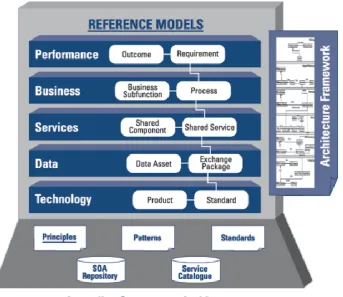
[image:45.612.130.474.352.649.2]The figure below presents the architecture of the Australian interoperability framework.
The architecture consists of a set of reference models that were designed to identify the
duplicate investments, gaps, and opportunities for collaboration within or across agencies. The
models are Performance Reference Model (PRM), Business Reference Model (BRM), Service
Reference Model (SRM), Data Reference Model (DRM), and Technical Reference Model
(TRM) (Australian Government Architecture Reference Models, 2013).
Also, the AGA contains Metamodel. The Metamodel is vital because it helps the agencies to
identify the architecture components, and reinforces the alignment between the agency
architecture and the AGA Reference Models (Australian Government Architecture Reference
Models How to Use Guide Version 1.0, n.d.).
The architecture principles are considered as a guide for agencies to establish policies between
the agencies, and provide a basis for architectural decision-making. Patterns and standards are
to support the re-usability of the proven designs. SOA repository and service catalogue are to
help agencies in their discovering for sharing and re-use (e-Government Update Australian
ICT Profile
According to the International Telecommunication Union (ITU), South Korea ranks the top in
the global list ranking countries on the level of ICT access, skills, and use (Phneah, 2012).
South Korea has the fastest Internet connection, which is 29.0 Mbps with the cheapest price
compared with other countries ("South Korea boasts world's fastest internet speed", 2016).
Moreover, South Korea is the first country that used FTTH/B (Fiber to The House / Building)
connection in houses, which lead to providing the high speed Internet connection. The
encouragement from the Korean government makes the country on the top. South Korea
began building their ICT infrastructure from mid-1990. The following are some of what the
government did to enhance the ICT sector. In 1999 the government established the Korean
Information Infrastructure (KII) to improve the country’s IT infrastructure; the government
established Framework Act on Infrastructure Promotion to enhance the quality of life of the
community; and established Cyber Korea 21 to accelerate the development in the IT sector
(Vesikula, 2013).
E-government Readiness
According to the UN e-government Survey for the years (United Nations e-government survey
2012, 2012; United Nations e-government survey 2014, 2014; E-government Survey 2016
e-government in Support of Sustainable Development, 2016) which presented the
e-government readiness indexes for South Korea. From the numbers of all the years, there is a
decrease in the Online Service Index. The Telecommunication Infrastructure Index increased
decreases in the index values caused the falling from the first place into third place in 2016.
The Humane Capital Index decreased because there were decreases in the college entrance
rates, since people have changed their thoughts about college and employment. They think
that their careers should be based on their interests and experiences only ("South Korea Misses
First Place in UN e-Government Rankings", 2016). The table below shows the readiness index
values for South Korea.
Table 6
E-readiness of South Korea
Measurement Component 2012 2014 2016
Online Service Index 1.0000 0.9764 0.9420
Telecommunication Infrastructure Index 0.8356 0.9350 0.8530
Human Capital Index 0.9494 0.9273 0.8795
Ranking 1 1 3
E-government Interoperability Framework
In reference (Almunawar, Low, & Rahman, 2012), the development of ICT sector in
South Korea began since the early 1980s, and even when there was an economic crisis in
1. 1993-1997 during the Young-Sam’s administration: in this period, there
were strategies for developing the infrastructure. System automation and the
creation of a legal framework for national informatization were some of the
innovations that were done in this period.
2. 1998-2002 during the Kim Dae-Jung’s administration: it is the improvement
infrastructure period. The goal was to create ICT broadband network and
Internet. Examples for some innovations that were done in this period
include providing high speed internet and overcoming the financial crisis of
the 1997 by improving the ICT industry. Also, there were eleven
e-government initiatives established during the Dae-Jung’s administration.
The figure below shows the projects that have been established in the Kim’s
period.
Figure 8. The 31 initiatives in Roh Moo-Hyun’s administration. Reprinted from 2005 Annual Report for E -Government (p. 14), by Y. K. Oh, 2005, Ministry of Government Administration and Home
4. 2008-2012 during the Lim Myung-Bak’s administration: more improvement
has been done on e-government project in this period. The target was the
integration of all the e-government systems. For that, there were some actions
that were done to ensure the seamless delivery of the e-government services,
such as enhancement of the public participation, Intelligent administrative
services, real-time public safety information network, and improvement of
privacy and security.
5. From 2013 to the present during the Park Geun-Hye’s administration: in this
period, the Korean e-government was on the top according to the UN survey of
2012. However, the government agenda had a plan to enhance the
performance of e-government and revitalize the economy. Also, the priority
was to implement Government 3.0 (WHY AUSTRALIA BENCHMARK
REPORT 2016, 2016).
According to Sekkai (2011), “The interoperability framework adopted by Korea is a
combination of Federal Enterprise Architecture (FEA) and e-Government Interoperability
Framework (e-GIF), the Korean government wanted through this fusion to create a hybrid
1. Preparation (2003 - June 2006):
The goal of this stage was to establish laws and guidelines to provide the basis for EA
framework implementation, and to implement four pilot projects. Also, the EA was one of the
31 e-government projects. Moreover, the aims of this stage from the technical aspects were to
secure the interoperability. The components of the EA frameworks were meta model,
reference model, and maturity model. The figure below presents the South Korea EA
framework and its components.
Figure 9. South Korea EA framework and its components. Reprinted from “Dynamics of Enterprise Architecture in the Korean Public Sector: Transformational Change vs. Transactional Change,” by K. Nam, 2016, Sustainability. Copyright 2016 by the authors. Reprinted with permission.
In this project, there were three agencies who worked together to implement e-government
projects successfully. The primary agency was the Ministry of Information and
Communication (MIC), the supporting agency was the Ministry of Government
Administration and Home Affairs (MOGAHA), and the execution agency was the National
[image:53.612.120.464.274.484.2]2. Foundation (July 2006 - May 2009):
In this stage, other required laws and guidelines for EA implementation were established, such
as laws and guidelines to implement and operate of IS for the agencies that would adopt the
EA framework. For that, each agency had to follow a meta model guideline for EA. The
National Information society Agency (NIA) provided a Government IT Architecture
Management System (GITAMS), which was a standard for EA management systems that were
adopted by all the agencies, such as Korean Postal Service and Ministry of Land, and
Transport and Maritime Affairs. These agencies were the best to deal with the duplication
system issues. The results from this stage were adoption of the EA framework from many
agencies, and completion ofthe laws and guidelines for the EA.
3. Utilization (2009 - Present):
In this stage, all the laws and guidelines of EA were integrated into the Electronic Government
Act to work as a legal framework for e-government laws and regulations. Also, the role of the
agencies, NIA and MOGAHA, changed for management only at a Government-Wide level
because in this stage the individual agencies were able to manage and control their deliverable.
The NIA became an agency that can provide a professional knowledge for implementation.
3.3 Bahrain
Country Profile
Bahrain or the Kingdom of Bahrain consists of 33 islands that are located in the Arabian Gulf
between Qatar and the Saudi Arabia. The capital is Manama. The population on November 13,
2016 was 1,404,233 according to the latest United Nation estimates. The official language for
the country is Arabic.
ICT Profile
Bahrain is different from any other country in the MENA region, especially in the ICT sector.
Bahrain was the first country in the MENA region that installed a mainframe computer in 1962.
In 2013, Bahrain Launched the 4G network which speeds download up to 100 Mbps.
Moreover, Bahrain provides Internet service for low prices because of having satellite links
and undersea cables. Also, Bahrain was ranked in the top thirty countries for five years
consecutively, and for the number of Internet users was in the tenth place. All these
developments in the ICT sector and for other features that Bahrain provides, such as no
taxation, no free zone restriction, low cost of living and operation, and 100% of foreign
ownership, encourage the most important companies in the world to choose Bahrain as the
base for their business in the country, such as Cisco, Microsoft, and Huawei (ICT 2015 -
Economic Development Board, 2015).
E-government Readiness
According to the UN e-government Survey for the years (United Nations e-government survey
e-government in Support of Sustainable Development, 2016), table 7 shows the e-government
readiness index values for the Kingdom of Bahrain. There is a noticeable increase in the
Telecommunication Infrastructure Index. However, the other indexes dropped down which
affected its rank. Especially after a great level in 2014, the rank moved from 18 to 24 in 2016.
The Information & eGovernment Authority CE Mr. Mohammed Ali AlQaed stated that one of
the reasons was, "the standards that have been added to this report’s edition comprising the
measurement of Smart Cities which require massive budgets for their establishments,”
("Kingdom of Bahrain - eGovernment Portal", 2016).
Table 7
E-readiness of Bahrain
Measurement Component 2012 2014 2016
Online Service Index 0.8627 0.9370 0.8261
Telecommunication Infrastructure Index 0.4183 0.7055 0.7762
Human Capital Index 0.8028 0.7840 0.7178
Ranking 36 18 24
E-government Interoperability Framework
There were two strategies for Bahrain which are:
The first strategy (2007-2010)
In reference (eGovernment Strategy Summary 2007 - 2010, 2007), the goal in this
strategy was to provide services to all the customers which could be citizens, residents, or
businesses. There were two concepts for this strategy:
1. Customers have choices and demand services
Customers have different needs and types of services that the government
can provide. Also, some of the expectations of the customers from the online
services are quality, availability, and the time to process a service. For that,
the government should provide what the customers want and not what the
government desires, so the e-government can serve its goals. One of them is
to facilitate the customer’s processes in government agencies.
2. They demand value for money
From the customer’s perspective, they have no need to pay for a certain
service that is part of the government responsibilities. The customers can pay,
in return the government should increase the effectiveness of the services.
Also, government needs to reach the aim of the e-government project by
providing services with low cost.
The second strategy (2011-2016)
In reference (Ahmed, 2013), the objective of this strategy was increasing the customer’s
and efficient government, providing protection for the customer’s information, providing
smart phone apps and increasing the customer’s awareness, improving the e-literacy and
IT skills for employees, and improving the customer’s experience and e-government
channels.
In 2010, the e-Government Authority (eGA) of Bahrain established the National
Enterprise Architecture Framework (NEAF) which consists of models, Meta-model,
technology standards, governance, and guidelines to support, develop, deploy, and be as
a guide to design and implement EA in other agencies across the Kingdom of Bahrain.
One of its dynamic features says that any change in the future can be done smoothly
without any complexity (AlSoufi, 2014).
In 2013, the eGA declared that there would be radical changes in the e-government portal
(Bahrain.bh), provide training for almost 4300 citizens to deal with computers and the
new e-government portal, and provide training for 132 government employees.
Moreover, eGA established seven training centers across the Kingdom to increase the
literacy in IT, and to increase the citizens’ awareness in the e-government ("Bahrain's
3.4 United Arab Emirates (UAE)
Country Profile
UAE borders from the East with Oman, the South with Saudi Arabia, the North with Iran, and
maritime border with Qatar. UAE has seven emirates which are Abu
Dhabi, Ajman, Dubai, Fujairah, Ras al-Khaimah, Sharjah and Umm al-Quwain. The capital is
Abu Dhabi. According to the latest United Nations estimates, the population of Emirates is
9,308,861. The official language for the country is Arabic ("United Arab Emirates", n.d.).
ICT Profile
The ICT sector in UAE considers the best in the MENA region, and in the Network Readiness
Index in 2016, UAE ranked first among Arab states and 26th worldwide (Baller, Dutta, &
Lanvin, 2016).
In reference (NATIONAL PROFILE OF THE INFORMATION SOCIETY IN THE UNITED
ARAB EMIRATES, 2007), the government established Telecommunications Regulatory
Authority (TRA) in 2003. The goals to establish TRA are some of the following:
Making sure that the telecommunication services are available all over the UAE.
Improving the services (the quality).
Increasing awareness about the IT services.
Promoting interaction with the telecommunications by providing training.
Solving any conflicts between the licensed operators.
Also, in 2010, TRA launched the first non-English domain in the Arab world, which is
pronounced as (dot emarat). The UAE has two fixed networks and mobile operators, which
are Etisalat and Emirates Integrated Telecommunications Company that branded as “du”. In
2011, Etisalat had the 16th largest number of mobile operators in the world.Also, it has
business outside the UAE in places such as Iran, Egypt, Saudi Arabia, Sudan, India, and
Indonesia. Also, it provides Internet services to users, such as 3G Mobile Internet access and
broadband internet services ("Telecommunication in the united arab emirates", 2013).
E-government Readiness
According to the UN e-government Survey for the years (United Nations e-government survey
2012, 2012; United Nations e-government survey 2014, 2014; E-government Survey 2016
e-government in Support of Sustainable Development, 2016), table 8 shows the e-government
readiness index for the UAE. From the numbers over the years, there is an enhancement in
Online Service Index and Telecommunication Infrastructure Index since 2012.
The rank of the country dropped from 28 to 32 in 2014 because according to Mr Kerby, senior
inter-regional adviser on eGovernment services to the UN Department of Economic and
Table 8
E-readiness of The UAE
Measurement Component 2012 2014 2016
Online Service Index 0.8627 0.8819 0.8913
Telecommunication Infrastructure Index 0.5568 0.5932 0.6881
Human Capital Index 0.7837 0.6657 0.6752
Ranking 28 32 29
E-government Interoperability Framework
In 1997, His Highness Sheikh Hamdan Bin Rashid Al Maktom suggested to begin
working on the e-government project (NATIONAL PROFILE OF THE INFORMATION
SOCIETY IN THE UNITED ARAB EMIRATES, 2007). The first initiative, eDirham,
began in 2001 at the federal level; the purpose was to collect fees for the government
services. Now, the UAE e-government is considered one of the best implementation of
e-government, especially in the MENA region ("EGovernment - uaepedia", 2016).
In reference (Al-Khouri, 2012), the methodology to implement 2012-2014 strategy
Figure 10. The development methodology of the UAE e-government. Reprinted from “eGovernment Strategies the Case of the United Arab Emirates (UAE)”, by A. Al-Khouri, 2012, European Journal Of Epractice, 17. p. 12. Reprinted by permission.
The benchmarks: which contained some of the best implementation of e-government
around the world in places like Canada, USA, South Korea, EU, Singapore, and the Gulf
Cooperation Council (GCC).
Vision and Mission: the 2012-2014 strategy was developed by TRA. The aim for this
growth in the country. The readiness dimension which measures the readiness of the
country to deal with the project can help the federal agencies to improve the
governance, and build a solid infrastructure. The usage dimension is about federal
agencies providing services to different customers (citizens, employees, and
business) through different channels. In