
The discursive construction of literacy in a disadvantaged school
14
0
0
Full text
(2) The discursive construction of literacy in a disadvantaged school. Thesis submitted by Barbara Maria COMBER (BA (Adelaide), Grad Dip Teach (Adelaide TC), Grad Dip in Reading Ed (Adelaide CAE), MEd Hons (Uni ofWoliongong) in March 1996. for the degree of Doctor of Philosophy. in the Deprutment of Education James Cook University of North Queensland.
(3) STATEMENT OF ACCESS. I, the undersigned, the author of this thesis, understand that James Cook University of North Queensland will make it available for use within the University Library and, by microfilm or other means, allow access to users in other approved libraries. All users. consulting this thesis will have to sign the following statement: In consulting this thesis I agree not to copy or closely paraphrase it in whole or in part without the written consent of the author; and to make proper public written acknowledgment for any assistance which I have obtained from it. Beyond this. I do not wish to place any restriction on access to thi s thesis .. ... I'!/O!"~ ............. . (Date).
(4) Acknowledgements. This study documents the teaching of literacy in a small parochial school in Adelaide. I a m indebted to the principal, teachers, school secretary, parents and chi ldren for welcoming me so warmly into their community. Havi ng me participate in their schoo l day probably made their demanding work that much harder, yet they displayed unfailing. energy, hu mour and patience. Next I want to thank my supervisor Professor Allan Luke, who has supported me throughout this project, helping me to confront the limits and the possibilities of my own work. in ways which exemplify the criti cal1iteracies , conti nue to exp lore. He has been extraordinarily generous in the time, resources and inte llectual capital he made available to me as a student and is an inspiring and collegial sc holar and teacher. I began thi s study with an intense curiosity and an ongoing commitmenl to exploring how literacy education might work for social justice. As I finish thi s document I realise it is but a small beginning. But 1 fi nis h with my curiosity and commitment enhanced and for this l owe much to Allan 's supervision.. I have also enjoyed the unqualified support and direct help of all my coll eagues in the language and literacy research centre at the Unive rsity of South Australia. In particular I am grateful to Phil Connack, Helen Nixon, Jennifer O ' Brien, Anne Simpson, Sue Van Every, Je nny Barnett and George Craker who contributed their time, profess ional knowledge, honest responses and friendship throughout the four years of this project. I also wish to thank Lyn Wilkinson from Flinders University and my brother Kevin Comber who kindly provided useful feedback. Overseas literacy educators and friends, Anne Haas Dyson, Hilary l anks and Andy Manning have offered conti nual reassurance and advice.. I am particularly thankfu l to my fami ly and friends, for having fai th that my work was worthwhile and helping me make the space and time to do it, especiall y to John , Tom and Laura Zed and to Joan and Tom Comber.. ii.
(5) Abstract This study explores the discursive construction of literacy in a disadvantaged primary school. The researcher acted as a participant observer during literacy lessons over a two. year period, 1992-1993, in four different classrooms. School archival records such as policy statements, newsletters and student report cards were also collected. Data, including transcripts of lessons and interviews and a large corpus of school and. classroom artefacts, was treated as text and a poststrucruralis[ discourse anaJytic approach, following Foucault, was employed in theorising and interpreting the problem. In addition an analysis was made of the constructs - 'literacy', 'pedagogy' and 'disadvantage' - in media, policy and academic sites. The researcher took a feminist standpoint in foregrounding literacy pedagogy both as contested telTain and as a patl of teachers' work. The study aimed to consider how competing discourses constitute literacy and the literate subject in a disadvantaged school context. Discourse analysis of the public texts and the school generated texts indicated a multiplicity of fOimations of the literate subject at this time. Consistent across all sites was the belief that literacy could be empowering for disadvantaged groups in the commu nity. In government policy, literacy was cons(nIcted as an essential functional skill which would contribute to a 'clever country ' and to a globally competitive economy. In the popular press, literacy was portrayed as a problem. Poor childre n were also typically constmcted as a problem, either as threats to nonnal society or as victims of abusive parents. At the same time headlines regulat'ly attested to evidence of declin ing standards of literacy and public schooling generally. A review of contemporary educational research indicated that children from socioeconomically disadvantaged communities are likely to perfonn below the nonTIS on mainstream measures of assessment of literacy. Historically, educational theorists have understood the problems experienced by disadvantaged children as being related to 'deficit', 'difference', 'resistance' and 'structural inequalities'. Each of these exp lanations is still eviden t in contemporary educational discourses. Literacy pedagogies often make claims for their efficacy and particular appropriateness for disadvantaged students. In the period of the present study the major debate was constituted as a binary opposition between whole and genre pedagogies, although the emergence of critical literacy in primary school education was also in evidence. Analysis of these public discourses provides a macro context in which to consider the construction of literacy in the school site.. iii.
(6) In the school site teachers drew on a multiplicity of discourses in order to assemble a pedagogy for literacy. They deployed a number of nonnalising techniques to discipline the students to be made literate, including frequent 'pep talks', individualised student monitoring or 'patrols' and continual runn ing commentaries or 'voice-over'. The ideal literate smdent was constituted as an ethical subject: as a self-regulating, productive and socially responsible worker. The literacy cun'iculum emphasised the quality of students' work and literacy as information production, and there was a notable absence of story writing and student generated projects. Teachers stressed the productive use of time and were highly concerned about rai sing the standards of students' work. To these ends students were trained in technologies of the se lf, 'self-assessments' where they regularly accounted for themselves in writing across a number of pre-specified domains. There was also evidence, however, that both teachers and students contested the regime of discipline to which they were subjected, by intellupting the literacy lessons through the use of humour and overt resistance. In addition students' responsiveness to one teacher's 'c ritical li teracy' suggested the potential for literacy lessons to become sites of talk, reading and writing about social justice. It is argued that the discourses available in the public sphere are recontextualised in this local site as teachers deal with institutional priorities. The study suggests that theories of literacy curriculum and pedagogy need to be reconsidered from a broader sociological perspective which takes into account postmodem condi tions, diverse student populations and teaching as an insti tutionalised labour process. The researcher takes the position that university based literacy educators, researchers and theoreticians need to examine our ow n discursive practices and their effects in local sites. Finally it is suggested that a positive and productive way forward is for school and university based educators to work together theorising and taking action in local communities.. iv.
(7) Table of Contents. Chapter 1 The promise of literacy in poor communities: An autobiographical introduction to the research problem .. . ...........•. .... ... , ....... 1 1.1 Introduction .. ... .. .... .. . .. ........ . .... . ......................................... . . 1 1.1.1 literacy and 'these kids' ......................... .............................................. 2 1.1.2 Th e vocabulary of disadvantage: Classifying the population 10 be educated .......... .... .......................... ,................................. ...... ................ 3 1.1.3 literacy pedagogy and teachers' work .... .... ........................................... 4 1.2 Hi s tory of the research . ... ... .. ............ .. ........ ............................ 6 1.2.1 Growing up in a working class community ............................................... 6 1.2.2 Catholic school days ............. ............................................................... 7 1.2.3 Middle class literacy teacher in a disadvantaged school ................... ........ 9 1.2.4 Whole language to critical literacy: looking for the 'truth' ..................... ... 1 0 i .2.5 Coming to the problem: The discursive construction of literacy in a disadvantaged school ... ........................... ........ ........................................ 12 1.3 Standpoint. .. ........ . .... . ..... ... ... . .. ... . ... .. ................ . . .. ....... .. ... . 13 1.3.1 Gender divisions in the production and use of pedagogical theories ..................................................................................................... 1 4 1.3.2 Thesis writing as a dividing practice ..................................................... 16 1.3.3 The role of the intellectual .................................................................. 17 1.3.4 Criticalliteracies and the missing teacher allies ..................................... 18 1.3.5 Literacy pedagogy as teachers' work ........... ....... ........................ ......... 19 1.4 Thesis overview ....... .. ........... . ... ...... ............ ... .. . ....... .... ....... 21. Chapter 2 Literacy. Pedagogy and Disadvantage : A Foucauldian Analysis ...... . .. . .. .. .... .. .. ... .. . ..... . .. . .. . .. . .. .. .. . .. . ..................... .. .. .. .• ......... 22 2 .1 Introduction ............ .. ......... ... . .... ...... .. .... ... .. ............... .... .... 22 2.2 Significance of Foucault for socia l sc ience .. . ............................ 23 2.3 Use of Foucault in educational studies .......... . ......................... 26 2.4 The use of Foucault in studies of literacy education ........ .. .... ..... 3 0 2.5 Fou ca uldian constructs: Tools for analysis .................... ........ ... 35 2.5.1 Power/Knowledge ............................................................................. 36 2.5.2 Discourse/Subjectivity ....................................................................... 37 2.5.3 Discipline/Surveillance ............................... ........................................ 39 2.5.4 Using Foucault: Possibilities and cautions ........................................... 41 2.6 Using Fouc ault i n this project . .................... . .. ...... .................. 44 2.6.1 The 'truth' about literacy and disadvantage? ......................................... 45 2.6.2 Producing literate citizens: Managing diverse populations? ................. .45 2.6.3 The pedagogical subjects: Literacy teacher and literate student. ........... 46 Chapter 3 Research as discursive practice: Whose stories to tell? .... .... ...... 49 3.1. Introduction . .. .. . . .. .. ... ...... .. .. .. .. . ............... . ... .... ................... 49. 3.2 The research problem - Continued? ...................... .... ...... ...... .. 50. v.
(8) 3.3 Constructing principled research practices: A poststructuralist study in a local site ...................... ................... .... 5 3 3.3.1 Qualitative case study ............. ... ......... .............................. .... ..... ........ 53 3.3.2 Poststructuralist challenges to ethnograph ic reality .............................. 55 3.3.3 Research and social justice ........................... .. ... .... ... .. .... .................... 57 3.4 Research in practice ....... . . ...... . ... ... ........ . ... ............... ........... 60 3.4.1 Choosing the site ... ............................ ........ ... ................... ....... .. .. ... ... 60 3.4.2 Relationship with school· based educators ...................... ............. .. ..... . 62 3.4.3 Scope and design of the project .............. .. ...... .... .. ........ .. ................... 64 3.4.4 Data collection and selection ........................................... ...... ............. 66 3.5 Discourse analysis .... ........................ ... ......................... .. ..... 7 3 3.6 Doubts and dilemmas ....................... ...... . ............... . ..... ........ 76 Chapter 4 Putting literacy, pedagog y and disadvantage together: Discursive constructions of problems and so lutions ...... ... .. .... ...... .... ........ 7 9 4.1 . Introduction .. ..... .................................................... ..... . ..... 79 4.2. Literacy , di sadvantage and pedagogy: Policy and media constructions ................ ........................................................... 81 4.2.1 'Young people are a problem': Australia's major resource 'at risk' ............ 82 4.2.2. 'Literacy standards are declining': Constructions of crises .................... 86 4.2.3 The quality of public schooling is declining': Questions of teacher competence .................... ..... ..... .. .............. ......... ....... ..... ........... ... 92 4.2.4 Better teaching would produce more literate students who would become better citizens in a more competitive Australian economy ............................... ............... ... .......... . ..... ...... ...... .. .... .... ...... .. 105 4.3 School literacies as a problem for disadvantaged students: Explan ations from educational research .......... .. ......... .. ..... ... ....... 1 08 4.3.1. The 'deficit' explanation ...... .... .. ... .... .. ... ... ..... .. ... ...... .. ........ ..... ..... ... . 111 4.3.2. The 'difference' explanation ............................................................ 11 9 4.3.3. The 'structural inequality' explanation ........... ...... ........ ....... .. .... ..... .... 126 4.3.4. The 'resistance' explanation ............. ........ ...... .... ........... ........... ...... . 132 4.3.5 Literacy as a social construction: The importance of locality ................ 134 4.4. Debates about literacy pedagogy : Theoretica l solutions for the disadvantaged child? ....... ............................. ... . .......... .... ... 1 36 4.4.1 Whole Language: Contribution and Critique ..................................... 138 4.4.2. Genre pedagogy: Contribution and Critique ............................. ........ 144 4.4. 3. The emergence of critical [iteracies in primary school education .......... 152 4.5 Contradiction and (un)certainty: the dilemmas facing literacy teachers in disadvantaged settings ................... . ... ... .... .. ..... .. ..... 157 Chapter 5 Locating the study : The disadvantaged school as a heteroglossic site ......... .. .............. .... .. ... .... .. .. .......................... ... ..... 159 5.1. Introduction ...... . ................... ........ . .................................. 159. 5.2 Banfield - School and Community ............................. .... .. ... ... 160 5.2.1 School location and environment ... .. .... .. ... ... ...... .. ............................. 160 5.2.2 The school population ... .... .. ... ......................................................... 164 5.3 School ethos an d history ........................................... . . ... .... 167 5.3.1 A Catholic School? ............ .... .. ................................................... ...... 167 5.3.2 Recent history: Schools as sites of discursive change ........................ 173 5.4 Selling the school: The marketisation of education in the local community ...... .. .................................................. . ........ ... 177. vi.
(9) 5.5 The disadvantaged school as a heteroglossic site: Competing official discourses ............................................ . ...... 1 80 Chapter 6 The re~construction of the disadvantaged Child at school: Teachers ' work ................................................................................ 182. 6.1. Introduction .... ... ................. . ... .. . ...... . .. ......................... ... . 1 82. 6.2 'These kids': The discursive construction of the disadvantaged child ......... ......... . .................. .. .. .. ... . ....... .. ........ 1 83 6.2.1 Knowing our clients : The epidemiology of the family .......................... 1 84 6.2.2 'These kids' are different ......................... ................................. .. ...... 191 6.2.3 'Th ese kids' and knowledge ... ................ .. ....................................... . 1 95 6.2.4 'These kids' and appropriateness ... .. .. .. ...... .. .... ... .. ............................ 1 99 6.2.5 'These kids' as unique individuals ..................................................... 202 6.2.6 Summary.. ....... .................................................. .. ...... .... ... ......... 204 6.3 'The literacy fix ': Competing discourses in the construction of the literate student .................. ... ..................... .... ..... ... ... ..... 206 6.3.1 Literacy and empowerment ............... ........ ..... ... ..... .......................... 206 6.3.2 Literacy as skill .... .......................................... ....... .......... .. .... ............ 208 6.3.3 literacy and Quality ...................................................... ...... ..... ... .. .... 212 6.3.4 Solving the problems: Setting the standards ..................................... 217. 6.4 Teachers ' struggles: Wanting to do the right thing by 'these kids' ................................ . ............. . .... ...... . ... . ........ . .... . ......... 220 Chapter 7 Making Time for Literacy Lessons: On Task and Socially Responsible .... .................... , ....... ....... .. ............•.................... ... ..... . 224 7.1. Introduction ...... ........ ......................... . .................. ..... . . . ... 224. 7.2 Teachers ' work in literacy lessons: the complexity of making space . .. .. ... ....... . .................... ......... .. .. .. ..... ...... .. ... ... .. .... .... ... 226 7.2.1 Caring, managing and teaching in the early literacy classroom ........ ..... 226 7.2.2 What do teachers do in literacy lessons and what are the effects of what they do? .... .. ........................... ..... ................... .... ..... ..... ... ... ..... ... . 234 7.3 The other side of the literacy event: Normalising practices ........ 236 7.3.1 Voice-over: A reminder of what you should be (doing) ........................ 237 7.3.2 Voice-over: The construction of student workers ............................... 243 7.3.3 Pep talks: A reminder of who you should be ...................................... 248 7.3.4 On patrol: Surveillance of the individual ... .. ........................................ 26 4 7.4 Contesting subjectivities ... .. .. ..... . ....... .. ... . ... .................. .. ... 273 7.4.1. Having a laugh on the literacy lesson: Teacher's humour at work ...................... .... .......... ..... .. ........ .......... ..... ...... ...... .... ..... ..... ........ ... . 273 7.4.2. Students fight back .... ... .................................................................. 281 7.4.3 Disrupting the discipline ............... .................... ....... .... ..... .... ... .. .. .... 286 7.5 The Banfield student - Self·regulating, on task and socially responsible ................................... ...... ..... ...... ....................... 286 Chapter 8 Constructing school literacies : Quality , information and social critique ........................ ........ ................................................. 291 8.1. Introduction . .. .. .. .......... .. ..... . .. .. .. .. .. ..... ... .. ... .. .. ................. 291. 8.2 Language work: a profile of the literacies in four classrooms ...... 292 8.2 .1 Classroom Literacies .......... ..... ..... ... ............ ................................... .. 299 8.3 Raising the standards: 'Focus on quality ' ...... ... .. .................... 303 8.3.1 Peer evaluation: 'Not a judgement'? .................................................. 304 8.3.2 Aiming for quality: Setting achievable goals .................. ... ..... ..... ........ 312. vii.
(10) 8.3.3 Touch and read ...................................................... .............. ........... 317 8.3.4 Me as a learner........................................................ ... .... ............. ..... 321 8.3.5 Summary .. ........................................................... .. ... .............. ... ..... . 324 8.4 Literacy as information production ................ .. .. . . .... . ... .......... 325 8.4.1 Information as neutral commodity ................ ....... .... .... ... .................... 326 8.4.2 Information as ordered and quantitative ................ .. ........................... 331 8.4.3 Autobiography as information ..................... ....... ....... ........................ 336 8.4.4 Summary: Literacy as information production ........................... ... .... .. . 342 8 .5. Teac her ex plorations in social critique ..... .............................. 343 8.5.1 Contesting gendered subjects in children's picture books .................. 344 8.5.2 The risks of talking about racism ........................... .... ......................... 353. 8.6. Assembling. a. pedagogy. for. literacy .. .. . ............ ................ ...... 360. Chapter 9 The production of the literate subject: What co unts as literacy in a disadvantaged school? ... .............................................. . .. 362 9.1. Introduction . .. ..........•.............. ... .. .. ... ...... ..... .... .. ...... ..... ... 362. 9.2 Produ cing report cards for multiple audiences and fun c tions .... .. .. .. .. .... .. .. ... .. . ....... . ......... .. .. . ............................. . 363 9.3 Report writing as nor malising practice: formations of studentship .. . .... .. ... .. ... .........................•........••.................... .. 369 9.3.1 The ideal Banfield student: Transformations and Reformations ........... 371 9.3.2 Successful students: Joel and Tatiana .............................................. 376 9.3.3 Problematic students: Mark, Julia and Carlo ....... .. .... ...... .. ... .. .... .. .. ... .. 379 9.3.4 An absence of literacy? .................................................................... 386 9.4 The construction of the literate subject across a school career ........................•......... .... ... ...... ... . . .• •. •......••. . .••...•. ........ 388 9.4.1 What counts as literacy in the late eighties and early nineties? Looking through Carlo's reports .. .... ...... .... ................ ........ .. .... ............... .. . 393 9.4.2 Discourses of development: talking positive ...................................... 398 9.4.3 Spelling: Developmental site or moral responsibility? .......................... 400 9.4.4 Carlo: Primary school graduate? .... ......... .. ....... ....... ... .. .... .... ... ..... .... .. 403 9.5 The self-assessing student ....................................... . ......... 406 9.6. Summary ............ .... .. ... .. . .. .. ..... . ....... ... . . ............................ 412. Chapter 10 The Assem bl age of Literacy Pedagogie s in Local Sites: Teachers ' Work ... .. .... ...................... ... . . ... . ... .... . .. .. ... ........................ 41 4 1 0 .1. Introduction ........ ............................................................ 41 4. 10.2 Curriculum solutions for the 'disa dvan taged ' .............. .. ... ..... . 416 10 .3. Local assemblage of literate ped agog ies .............................. 41 9 10.3.1 Recontextualising pedagogy as teachers' work ............ ... .. ..... ... .... ... 420 10.3.2 Teachers' lifeworlds and the mediation of educational discourse ........... ... ................................................................................... 423. 10.4 Making space for differe nce, action and contestation ............. 427 10.4.1 Abandoning totalising solutions ........................... .... ........ .. ..... ........ 428 10.4.2 Theorising the subjectivities of the literacy educator ..................... ... . 428 10.4.3 University discursive practices: What do they produce? ............ .. ... .. 429 10.4.4 Local alliances for social justice .............. ... ... ..... ..... ....... ... ............... 430 10.4.5 Literate practices, identity formation and life trajectories .................... 432 10.4.6 Making space: Reasons for hope and action ............... ... .................. 434 List of Reference s ... .. ..... .......... .... . ................ . .............. ..... .............. 439. viii.
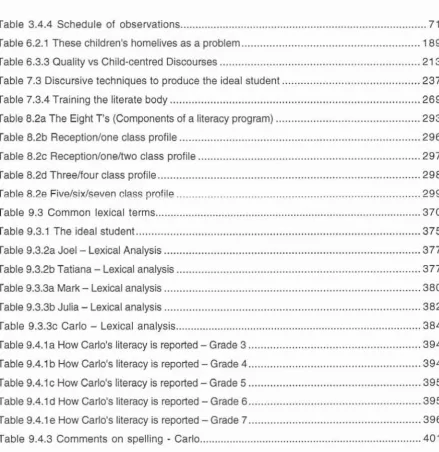
(11) List of Tables. Table 3.4.4 Schedule of observations ................................................................................. 71 Table 6.2.1 These children's homelives as a problem ......................................................... 189 Table 6.3.3 Quality vs Child-centred Discourses ................... .... ........................................ . 213 Table 7 .3 Discu rsive techniques to produce the ideal student ............................................ 237 Table 7.3.4 Training the literate body ..................................... ........................................... 269 Table 8.2a The Eight T's (Components of a literacy program) ....................................... ....... 293 Table 8.2b Reception/one class profile ............................................................................. 296 Table 8.2c Reception/oneltwo class profile ....................................................................... 297 Table 8.2d T hree/four class profile .................................................................................... 298 Table 8.29 Five/six/seven class profile ........................ .... ............................ .... ............. ..... 299 Table 9.3 Common lexical te rms ............................................. .. ... ... .. ................................. 370 Table 9.3.1 The ideal student ..... .......................................................... ,........ ,., ...... ,......... 375 Table 9.3.2a Joel- Lexical Analysis .................................................................................. 377 Table 9.3.2b Tatiana - Lexical analysis .............................................................................. 377 Table 9.3.3a Mark - Lexical analysis .................................................................................. 380 Table 9.3.3b Julia - Lexical analysis ..................................... .................................... ... ..... . 382 Table 9.3.3c Carlo - Lexical analysis ................................. ... .. ... ... ... .... ............................... 384 Table 9.4.1a How Carlo's literacy is reported - Grade 3 ...................... ................................. 394 Table 9.4.1b How Carlo's literacy is reported - Grade 4 ..................................... ,., .. ,............ 394 Table 9.4.1c How Carlo's literacy is reported - Grade 5 ....................................................... 395 Table 9.4.1d How Car1o's literacy is reported - Grade 6 ....................................................... 395 Table 9.4.1 e How Carlo's literacy is reported - Grade 7 ....................................................... 396 Table 9.4.3 Comments on spelling - Carlo ............................. .. .................................. .... .. ... 401. ix.
(12) List of Figures. Figure 3.4.4 Letter to teachers ..... ...... .............. ..... ... ...... ... ... .................. .......... .................. 67 Figure 4.2.3a The Advertiser article: 'School under siege' ........ ............ ...... ........................ . 99 Figure 4.2.3b T he Advertiser article: 'School under siege as teachers "crack'" ..................... 100 Figure 4.2.3c The Advertiser article: 'Schools crisis: teachers to raUy' ................................... 102 Figure 4.2.3d Photograph from 'Schools crisis: teachers to rally' ......................................... 104 Figure 5 Advertisement for Banfield in local newspaper 1992 ........................ .. ... .... ............ 159 Figure 5.3.1a Punctuation Chart .................... ........... .......... ....... ...................................... 168 Figure 5.3.1 b Banfield Vision Statement ........ ......... .......................................................... 1 69 Figure 5.4a Article on Banfield written by principal ....... ...... ....... .................... ...................... 178 Figure 5.4b Advertisement for Banfield ......................................................... .. ............. ..... 179 Figu re 6.2.4 Appropriate and inappropriate talk. ..... .... ..................... 200. Fi gure 6 .3 .4 Guide lines for workbooks ............. .. ............ ............ .... 217. Figure 8.3.2 Self evaluation sheet for projects ........................... ... ...... ..... ......... .... ..... .... ... . 315 Figure 8.3.4 Four posters about good students .... ....... .. .......... .......................................... 321 Figure 8.4.2 Project work ... ... ... ... .... ............................................................ .. .................. 331 Figure 8 .5.1 Letter to Rod Clement... ... .... ....... ............................ ...................................... 352 Figure 9.3.1 a Joel's report ............ ........................... ...... ... .. ............ ............ .... ................. 372 Figure 9.3.1 b Tatiana's report .................... ...... ...... .................. ......... ....... ........................ 372 Figure 9.3.1c Mark's report ............................ .... ............................................................... 373 Figure 9.3.1d Julia's report ....................................................................................... .. ...... 373 Figure 9.3.1 e Carlo's report ............ ................... .. ............................................................. 374 Figure 9.4a Carlo Grade 3 First report early 89 (First term} .................................................... 390 Figure 9.4b Carlo Grade 3 Second report 26/6/89 .............................................................. 390 Figure 9.4c Carlo Grade 3 Third report 4/12189 ..................................................... ............. 390 Figure 9.4d Carlo Grade 4 First report 21/3/90 .................................................. ...... ........... 390 Figure 9.4e Carlo Grade 4 Second report 3/8/90 ................................................................ 391 Figure 9.4f Carlo Grade 4 Third report 8/12190 ......... .................... ...... ............ ...... .............. 391 Figure 9.4g Carlo Grade 5 First report 11/9/91 ................................................................... 391 Figure 9.4h Carlo Grade 5 Second report 9/12/91 ............................ .................... ...... ... ... .. 391 Figure 9.4i Carlo Grade 6 First report April 1992 ................................................................. 392 Figure 9.4j Carlo Grade 6 Second report 15/9/92 ...................... ......... ..... .... ......... .. ... ......... 392 Figure 9.4k Carlo Grade 6 Third report December 1992 ...................................................... 392 Figure 9.41 Carlo Grade 7 First report April/May 1993 .......................... ..... ... ............. ........... 392 Figure 9.4.4a Carlo's English as a Second Language Report (undated) ......................... ... .. . 403. x.
(13) Figure 9.4.4b Carlo's Application for Special Entry to Winefield High School ................. .. ... .. 404 Figure 9.4.4c A statement from Carlo in the 'evaluation book' .................................. ....... ..... 405 Figure 9.5a Goals written by a grade six male student ......................................................... 408 Figure 9.5b Self-assessment by a grade six male student.. ............................ ..................... 409 Figure 9.5c Self-assessment of weekly goals ........................................................... ......... . 41 0. xi.
(14) STATEMENT ON SOURCES DECLARATION. I declare that th is thesis is my own work and has not been submitted in any form for. another degree or diploma at any university or other institution of tertiary education. Information derived from the published or unpublished work of others has been. acknowledged in the text and a list of references is given.. ...... ......................... .. . .. . . . ./e . . ... If 0/" (Date). xii. C;. ......................... ..
(15)
Figure

Related documents