Copyright © 2003, American Society for Microbiology. All Rights Reserved.
Drug Resistance Patterns of Recombinant Herpes Simplex Virus
DNA Polymerase Mutants Generated with a Set of
Overlapping Cosmids and Plasmids
Julie Bestman-Smith and Guy Boivin*
Centre de Recherche en Infectiologie of the Centre Hospitalier Universitaire de Que´bec (Pavillon CHUL) and Universite´ Laval, Que´bec, Canada
Received 9 January 2003/Accepted 25 April 2003
Herpes simplex virus (HSV) DNA polymerase (Pol) mutations can confer resistance to all currently available antiherpetic drugs. However, discrimination between mutations responsible for drug resistance and those that are part of viral polymorphism can be difficult with current methodologies. A new system is reported for rapid generation of recombinant HSV type 1 (HSV-1) DNA Pol mutants based on transfection of a set of overlapping viral cosmids and plasmids. With this approach, twenty HSV-1 recombinants with single or dual mutations
within the DNApolgene were successfully generated and subsequently evaluated for their susceptibilities to
acyclovir (ACV), foscarnet (FOS), cidofovir (CDV), and adefovir (ADV). Mutations within DNA Pol conserved regions II (A719T and S724N), VI (L778M, D780N, and L782I), and I (F891C) were shown to induce cross-resistance to ACV, FOS, and ADV, with two of these mutations (S724N and L778M) also conferring significant reduction in CDV susceptibility. Mutant F891C was associated with the highest levels of resistance towards ACV and FOS and was strongly impaired in its replication capacity. One mutation (D907V) lying outside of the conserved regions was also associated with this ACV-, FOS-, and ADV-resistant phenotype. Some
mutations (K522E and Y577H) within the␦-region C were lethal, whereas others (P561S and V573M) induced
no resistance to any of the drugs tested. Recombinants harboring mutations within conserved regions V (N961K) and VII (Y941H) were resistant to ACV but susceptible to FOS. Finally, mutations within conserved region III were associated with various susceptibility profiles. This new system allows a rapid and accurate evaluation of the functional role of various DNA Pol mutations, which should translate into improved management of drug-resistant HSV infections.
Two categories of antivirals are available for the manage-ment of herpes simplex virus (HSV) infections. The first class of agents includes molecules that, following viral and/or cellu-lar phosphorylation, compete with natural deoxynucleoside triphosphates for incorporation into the elongating viral DNA chain. Acyclovir (ACV) and penciclovir with their respective prodrugs, valacyclovir and famciclovir, are agents representa-tive of this class and are considered the standard therapy for HSV infections. Although not indicated for the treatment of HSV infections, cidofovir [(S)-1-(3-hydroxy-2-phosphonylme-thoxypropyl)cytosine; CDV] and adefovir [9-(2-phosphonyl-methoxyethyl)adenine; ADV] are acyclic nucleoside phospho-nate derivatives that, once activated, are also alternative substrates for the viral DNA polymerase (Pol). The other class of HSV inhibitors consists of pyrophosphate analogues such as foscarnet (FOS). These agents are direct noncompetitive in-hibitors of the viral DNA Pol. A single DNA Pol mutation could thus confer resistance to more than one antiviral de-pending on the specific drug binding site on the enzyme.
Resistance to ACV, the most widely used anti-HSV agent, is due mainly to mutations in the viral thymidine kinase (TK) gene which impair the initial drug phosphorylation (23).
Al-though less frequently encountered, ACV- and/or FOS-resis-tant clinical isolates containing DNA Pol mutations have been reported following prolonged therapy with these agents (9, 15, 39, 41, 43). HSV DNA Pol mutations leading to CDV resis-tance have also been found in laboratory-derived strains (1, 2), although they have not yet been identified in clinical isolates from patients failing therapy. Moreover, our group has previ-ously reported the emergence of HSV DNA Pol mutations associated with a reduction in both FOS and ADV suscepti-bility in patients receiving FOS therapy (6).
The putative catalytic domain of the HSV DNA Pol enzyme
contains eight conserved regions designated I to VII and␦
-re-gion C (8, 27, 47). These re-re-gions share significant amino acid sequence homology with all other herpesvirus DNA Pol en-zymes. Drug resistance mutations have been found mainly
within such conserved regions of the HSV DNApolgene, with
regions II and III containing the greatest clusters of mutations
(reviewed in reference 23). The␦-region C, which is common
to cellular DNA Pols␦(47), is part of the 3⬘-5⬘ exonuclease
editing domain of the enzyme. When not lethal, some muta-tions within this region have been shown to confer resistance to pyrophosphate analogues (22, 29, 33, 34). Only a few drug-resistant mutations have been described within the other con-served regions or outside such regions (1, 6, 18, 22, 27, 36, 43). Because of the reported viral polymorphism (11, 32), the role of any DNA Pol mutation must be carefully assessed. Marker transfer experiments, in which a specific mutation is trans-ferred to a wild-type (wt) virus background by homologous * Corresponding author. Mailing address: Centre de Recherche en
Infectiologie, Centre Hospitalier Universitaire de Que´bec, Pavillon CHUL, 2705 Blvd Laurier, Ste-Foy, QC, Canada G1V 4G2. Phone: (418) 654-2705. Fax: (418) 654-2715. E-mail: [email protected] .ca.
7820
on November 8, 2019 by guest
http://jvi.asm.org/
recombination, have been used to generate recombinant HSV DNA Pol mutants (10, 27, 28, 35, 36, 39). In addition to being fastidious and inefficient, such methods rely on selection of recombinant mutants through drug pressure which may fre-quently lead to additional undesired mutations.
Cihlar et al. have elegantly demonstrated the possibility of using a system of overlapping cosmids and plasmids to gener-ate recombinant human cytomegalovirus (HCMV) strains with specific DNA Pol mutations (12). Although not specifically designed for site-directed mutagenesis experiments with the
DNApolgene, a similar system has been reported for HSV-1
by Cunningham and Davison (16). Herein, we report a modi-fication of the previous cosmid-based recombination system aimed at generating specific HSV-1 DNA Pol mutants. Such an
approach was used to evaluate the drug susceptibility pheno-types and replicative capacities of several HSV-1 DNA Pol mutants.
MATERIALS AND METHODS
Cells and viruses.Vero cells were maintained in Eagle’s minimum essential medium supplemented with 10% fetal calf serum and antibiotics. HSV-1 labo-ratory strain 17 and all recombinant viruses were propagated in Vero cells.
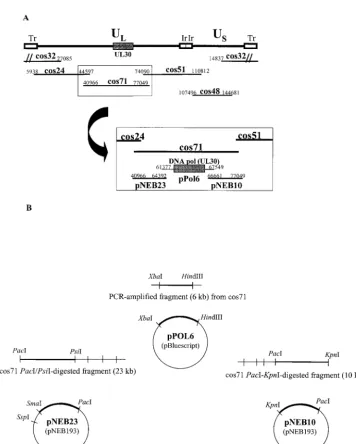
[image:2.603.120.476.60.504.2]DNA constructs.The set of five overlapping DNA cosmids containing the entire genome of strain 17 was kindly donated by Charles Cunningham, MRC Virology Unit, Glasgow, United Kingdom (16). The original viral fragment of cosmid 71, corresponding to nucleotides (nt) 40966 to 77049, was replaced by three viral plasmids (pNEB23, pPol6, and pNEB10) as shown in Fig. 1A. Briefly, a viral fragment corresponding to nt 61377 to 67549 and encompassing the entire HSV DNApolgene (UL30; nt 62807 to 66514) was cloned into the pBluescript
FIG. 1. Schematic representation of viral cosmids and plasmids used to generate HSV-1 recombinants. (A) Inserts of the five cosmids (24, 32, 48, 51, and 71) covering the complete genome of the HSV-1 strain 17 (16), along with the three plasmids (pNEB23, pPol6, and pNEB10) designed to replace cos71. Tr, terminal repeat; UL, unique long; US, unique short; Ir, internal repeat. (B) Construction of the pNEB23, pPol6, and pNEB10
plasmids. The nucleotide positions of inserts in the HSV strain 17 genome are indicated.
on November 8, 2019 by guest
http://jvi.asm.org/
II vector (Stratagene) to generate pPol6. This DNA fragment was amplified from cosmid 71 by using primers 5⬘-CAATCTAGAGGTAAATTTCTCCCCGA-3⬘
(forward) and 5⬘-CAAAAGCTTTGGCCTGCGGGAACGAGTT-3⬘(reverse), containing, respectively, anXbaI and aHindIII restriction site (underlined). The purifiedXbaI-HindIII-digested PCR product was then cloned into theXba I-HindIII site of the pBluescript vector as illustrated in Fig. 1B, and the exact sequence of the catalytic domain of the DNApolgene was verified. Plasmids pNEB23 and pNEB10 were generated by cloning DNA fragments (nt 40966 to 64392 and nt 66661 to 77049, respectively) from PacI-PsiI- andPacI-Kpn I-digested cosmid 71 products into thePacI-SmaI andPacI-KpnI sites of pNEB193 (New England Biolabs) (Fig. 1B).
Site-directed mutagenesis of the DNApolgene.Mutagenesis was performed by using the QuickChange site-directed mutagenesis kit (Stratagene) according to the manufacturer’s instructions. Plasmid pPol6 was used as a template for all mutagenesis experiments. Each mutation was introduced by using a specific pair of mutagenic primers ranging in length from 28 to 40 bp. The correct nucleotide sequence of the catalytic domain of the DNApolgene from each mutated plasmid was verified by sequence analysis and compared to that from reference strain 17.
Generation of DNA Pol mutants.Inserts from cosmids 24, 32, 48, and 51 were released by digestion withPacI (16). Inserts from plasmids pPol6, pNEB23, and pNEB10 were released by digestion with XbaI-HindIII, PacI-SspI, and Pac I-KpnI, respectively. All enzymes were inactivated, and the seven overlapping DNA fragments were cotransfected into Vero cells in 6-well plates by using Lipofectamine 2000 (Life Technologies) according to the manufacturer’s instruc-tions. Viral cytopathic effects were usually observed within a 3-day incubation period. The catalytic domain of the DNApolgene from each recombinant was amplified and verified by DNA sequencing.
Structural analysis of viral genomes.Extracellular virions were collected from 18 ml of culture medium by centrifugation at 100,000⫻gfor 120 min. The virus pellets were resuspended in 0.5 ml of TNE-sodium dodecyl sulfate buffer (10 mM Tris-HCl [pH 8.0], 100 mM NaCl, 25 mM EDTA, 0.5% sodium dodecyl sulfate) and incubated overnight with 0.2 mg of proteinase K at 56°C with moderate agitation. DNA was extracted twice with phenol-chloroform-isoamyl alcohol (25:24:1) and once with chloroform-isoamyl alcohol (24:1), precipitated with ethanol, and resuspended in H2O. The genomic structure of recombinant HSV-1 strains was determined by digestion of purified extracellular recombinant virus
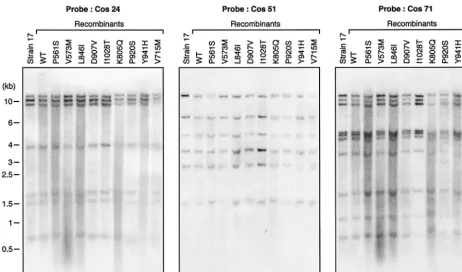
withKpnI and separation on a 0.5% agarose gel. Viral DNA was then transferred onto Hybond-N⫹membranes (Amersham) and probed with the various cosmids labeled by the ECL direct nucleic acid labeling system (Amersham) according to the manufacturer’s instructions.
Antiviral susceptibility assays.Susceptibility to ACV, FOS, CDV (gift from Gilead), and ADV (gift from Gilead) was determined by a plaque reduction assay with Vero cells (41). The mean 50% inhibitory concentration (IC50) for each mutant virus was determined by testing in duplicate each of two indepen-dently generated recombinants. A twofold difference in IC50s between the mu-tant virus and the wt recombinant virus was considered significant, as previously reported (12). In the case of ACV, this difference is about the same as the one between the established cutoff value for resistance (2g/ml) and the mean IC50 for susceptible clinical isolates (40, 41).
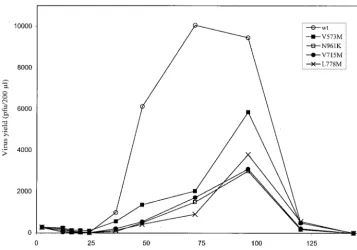
In vitro single-cycle replication experiments.The replication capacities of selected DNA Pol mutants were compared to that of the wt recombinant virus by assessing the yield of extracellular virus production after infection of Vero cells at a high multiplicity of infection (MOI) (19, 28). On the day of infection, cells were infected with each recombinant at a MOI of 5, and then 200l of super-natant was collected at specific times postinfection, ranging from 2 to 144 h. Supernatants were stored at⫺80°C before titration in 24-well plates.
RESULTS
Efficiency of DNA recombination between cosmid and
plas-mid inserts.Cotransfection into Vero cells of digested cosmids
and plasmids generated infectious recombinant viruses, with typical cytopathic effects usually observed within 3 days. The genomic structures of the recombinant viruses were verified by
performing Southern blot analysis of KpnI-digested purified
[image:3.603.61.524.71.343.2]genomes with independent cosmids as hybridization probes. Figure 2 shows representative results with three different probes. Overall, Southern blot analysis of the recombinants revealed no structural differences between the genomes of the recombinant viruses and that of the parental HSV-1 strain 17. FIG. 2. Southern blot analysis of some recombinant HSV-1 wt and mutant viruses along with the parental laboratory strain HSV 17 by using some of the viral cosmids (cos 24, 51, and 71) as probes. Numbers on the left indicate molecular sizes in kilobase pairs.
on November 8, 2019 by guest
http://jvi.asm.org/
Susceptibility of HSV recombinants to antivirals.A total of 20 DNA Pol mutants were evaluated in this study by generat-ing two independent recombinants for each specific mutation. Those mutations were selected on the basis of their presence within previously reported clinical HSV isolates (6, 27, 43) or within laboratory-derived HSV strains (1, 22, 28, 29, 32, 34, 36). Furthermore, a few HSV-1 DNA Pol mutants were gen-erated based on the presence of similar mutations within the
HCMV DNApolgene (4, 5, 12, 31, 44). Each recombinant was
tested at least twice for its susceptibility to four antivirals (ACV, FOS, CDV, and ADV) by using the plaque reduction
assay (Table 1). On all occasions, the IC50s of all antivirals
were similar for the two generated recombinant viruses har-boring the same mutation.
Effects of specific mutations within conserved regions of the
viral DNA polgene.When not lethal, some of the previously
reported HSV mutations in␦-region C have been associated
with resistance to pyrophosphate analogues (22, 29, 33), whereas other mutations within the same region of the HCMV
DNApolgene have been associated with resistance to
ganci-clovir (GCV) and CDV (12, 20, 30, 44). In this study, we were able to evaluate two recombinants with mutations (P561S and V573M) within this region, whereas mutants K552E and Y577H could not be generated. The former mutants were
susceptible to all antivirals, although a slight increase in IC50s
of ACV compared to that for the wt was observed for mutant V573M (mean increase, 1.90-fold). Recombinant P561S dem-onstrated a marked increase in ADV susceptibility compared
to that of the wt virus (mean decrease in IC50, 4.76-fold).
Mutations located in conserved region II of the HSV DNA
polgene are frequently associated with resistance to ACV and
pyrophosphate analogues (1, 22, 34, 42). Two (A719T and S724N) of the four mutations located within this region con-ferred similar phenotypes and were also associated with ADV resistance. In addition, a significant decrease in CDV suscep-tibility was noted for these mutants. Mutation V715M led to significant and almost significant (1.8-fold) decreases in levels of susceptibility to ACV and ADV, respectively, whereas it was associated with susceptibility to FOS and hypersusceptibility to
CDV (mean decrease in IC50, 2.86-fold). The mutant R700M
remained susceptible to ACV and ADV and even
hypersus-ceptible to FOS (mean decrease in IC50, 7.14-fold), although it
exhibited a significant level of resistance to CDV (mean
in-crease in IC50, 3.67-fold).
Only a few mutations in conserved region VI of the DNApol
gene of HSV (6, 43) or HCMV (4, 12, 44, 46) have been described, and all were identified in clinical isolates. We gen-erated three corresponding HSV-1 DNA Pol mutants (L778M, D780N, and L782I) and found that all three recombinants induced resistance to ACV, FOS, and ADV. Moreover, mu-tants L778M and L782I showed some reduction in CDV
sus-ceptibilities (mean increases in IC50, 2.04- and 1.76-fold,
re-spectively). The three recombinants containing mutations within conserved region III were associated with variable levels of resistance or hypersusceptibility towards the different anti-viral agents. One mutant (T821M) had a phenotype of resis-tance to ACV, CDV, and ADV, whereas the other two (K805Q and L846I) were susceptible or hypersusceptible to the various drugs.
Region I is one of the most conserved regions among␣-like
DNA Pols. Mutation F891C within this region was associated with the highest levels of resistance towards ACV and FOS
(mean increases in IC50, 34.99- and 3.91-fold, respectively),
with significant levels of resistance to ADV (mean increase in
IC50, 7.00-fold). In contrast to previous results (27, 39), the
mutant Y941H (region VII) was not associated with a
signifi-cant increase in IC50s of FOS, although a marked decrease in
ACV susceptibility (mean increase in IC50, 9.39-fold) was
noted as previously reported. Furthermore, this amino acid substitution was associated with a significant level of resistance to ADV but induced hypersusceptibility to CDV. Mutation N961K within conserved region V conferred resistance only to ACV, as previously reported for laboratory-derived HSV-1 strains (22).
Effects of mutations outside conserved regions of the viral
DNA pol gene. Only a few mutations located between
con-served regions of the HSV DNA pol gene in drug-resistant
viruses have been reported (1, 6, 22, 43). Mutation D907V was identified in a clinical HSV-2 isolate that also contained a TK mutation (43). Our results confirm the role of this DNA Pol mutation in conferring resistance to ACV, FOS, and ADV. Mutation P920S was also found in combination with mutation S724N (region II) in three clinical HSV-1 isolates from a hu-man immunodeficiency virus-infected patient (6, 43). The role of these two mutations was studied by generating three
differ-ent recombinant viruses. IC50s for the mutant P920S were
similar to those reported for the wt recombinant, while mu-tants S724N and S724N/P920S were associated with compara-ble multidrug resistance phenotypes. Two mutations in the
C-terminal part of the HSV DNA pol gene have been
described in laboratory-derived strains selected with HPMP (S-1-3-hydroxy-2-phosphonylmethoxypropyl) derivatives (1). When generated in our system, mutation L1007M conferred an
almost significant increase in IC50s of ACV (mean increase in
IC50, 1.84-fold) but conferred susceptibility to CDV, in
con-trast to previous data. On the other hand, mutant I1028T exhibited the same phenotype as previously reported, i.e., re-sistance to CDV only (1).
Replicative capacities of selected recombinant viruses.The
DNApolgene encodes one of the pivotal proteins involved in
viral replication. Mutations within this gene can thus alter the replicative capacities of herpesviruses (5, 13, 24, 28, 33, 36). For instance, we were unable, despite many attempts, to gen-erate two recombinants with mutations (K552E and Y577H)
located within␦-region C. The codon corresponding to Y577 is
part of the exoIII motif involved in the 3⬘-5⬘exonuclease
ac-tivity of the enzyme (28, 29, 33). Although codon 552 is not part of the critical exo motifs, the Lys at the corresponding position in the protein is highly conserved among all herpes-viruses.
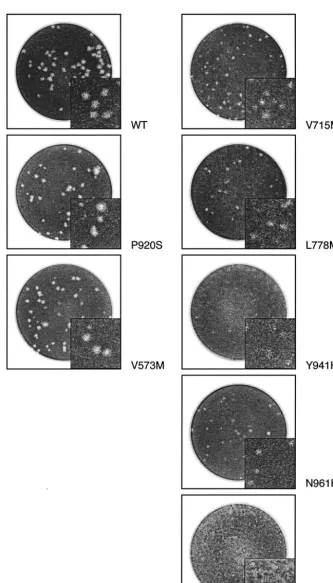
The indicated mutants were selected for evaluation of their replication kinetics based on several factors, such as (i) an obvious growth delay and/or smaller plaques when evaluated in cell culture (V715M, L778M, and N961K) (Fig. 3), (ii) a
spe-cific location within the 3⬘-5⬘exonuclease motif (V573M), and
(iii) the absence of a phenotype of resistance to all tested drugs (P920S). Mutants F891C and Y941H were so severely im-paired in their ability to propagate in cell culture that sufficient titers could not be obtained to perform replication kinetic experiments (Fig. 3). The extracellular yields of the other
on November 8, 2019 by guest
http://jvi.asm.org/
TABLE 1. Genotypic and phenotypic characterization of recombinant HSV-1 awith regard to antivirals Conserved region(s) Nucleotide change(s) Amino acid change(s) Reference(s) d IC50 ( g/ml) of ACV for: SD f Ratio g IC50 ( g/ml) of FOS SD Ratio IC50 (
g/ml) of CDV
SD
Ratio
IC50
(
g/ml) of ADV
SD Ratio Mutant 1 Mutant 2 wt wt 0.0057 0.0064 ⫾ 0.0012 1.00 15.0275 ⫾ 1.61 1.00 0.1605 ⫾ 0.0377 1.00 0.8475 ⫾ 0.05 1.00 ␦ -C A1654G K552E b 12, 44 (K513E c) ␦ -C C1681T P561S 12, 30, 46 (P522S c) 0.0054 0.0054 ⫾ 0.0007 0.85 13.6725 ⫾ 1.91 0.91 0.2383 ⫾ 0.0414 1.48 0.1800 ⫾ 0.07 0.21 ␦ -C (exoIII) G1717A V573M 1 0.0122 0.0120 ⫾ 0.0030 1.90 13.0340 ⫾ 3.95 0.87 0.1861 ⫾ 0.0530 1.16 1.1108 ⫾ 0.42 1.31 ␦ -C (exoIII) T1729C Y577H b 28, 29 II G2099T R700M 1 0.0044 0.0062 ⫾ 0.0021 0.98 2.0350 ⫾ 0.52 0.14 0.5886 ⫾ 0.0385 3.67 0.4449 ⫾ 0.01 0.52 II G2143A V715M c 4, 5, 12, 46 0.0198 0.0182 ⫾ 0.0045 2.86 12.1932 ⫾ 2.76 0.81 0.0561 ⫾ 0.0151 0.35 1.5076 ⫾ 0.50 1.78 II G2155A A719T 6, 43 (A724T e) 0.0373 0.0377 ⫾ 0.0043 5.94 32.6985 ⫾ 2.57 2.18 0.2965 ⫾ 0.0345 1.85 3.1958 ⫾ 0.64 3.77 II G2171A S724N 1, 22, 34, 6, 43 (S729N e) 0.0633 0.0627 ⫾ 0.0253 9.87 40.4150 ⫾ 2.96 2.69 0.3284 ⫾ 0.0235 2.05 4.6750 ⫾ 1.31 5.52 VI C2332A L778M 6, 43 (D783M e) 0.0300 0.0351 ⫾ 0.0106 5.53 30.5800 ⫾ 6.52 2.03 0.3281 ⫾ 0.0561 2.04 2.7312 ⫾ 1.70 3.22 VI G2338A D780N 6, 43 (D785N e) 0.0445 0.0388 ⫾ 0.0097 6.10 32.6100 ⫾ 5.06 2.17 0.1937 ⫾ 0.0387 1.21 2.3979 ⫾ 0.31 2.83 VI C2344A L782I 4, 12, 46 (V781I c) 0.0373 0.0408 ⫾ 0.0086 6.43 34.3525 ⫾ 4.60 2.29 0.2825 ⫾ 0.0658 1.76 3.1875 ⫾ 0.40 3.76 III A2413C K805Q c 12, 44 0.0032 0.0041 ⫾ 0.0012 0.64 5.0978 ⫾ 0.25 0.34 0.2914 ⫾ 0.0660 1.82 0.2523 ⫾ 0.06 0.30 III C2462T T821M 32 0.0294 0.0397 ⫾ 0.0136 6.25 22.1939 ⫾ 2.90 1.48 0.3392 ⫾ 0.0364 2.11 2.3464 ⫾ 0.53 2.77 III C2536A L846I 6, 43 (L850I e) 0.0094 0.0096 ⫾ 0.0013 1.52 10.5263 ⫾ 2.26 0.70 0.2015 ⫾ 0.0332 1.26 0.3913 ⫾ 0.11 0.46 I T2672G F891C 26, 36 0.2222 0.2222 ⫾ 0.0196 34.99 58.7450 ⫾ 15.15 3.91 0.2795 ⫾ 0.0542 1.74 5.9300 ⫾ 0.08 7.00 I– VII A2720T D907V 6, 43 (D912V e) 0.0280 0.0240 ⫾ 0.0070 3.78 34.1425 ⫾ 4.76 2.27 0.2555 ⫾ 0.0594 1.59 2.1440 ⫾ 0.68 2.53 I– VII C2758T P920S 6, 43 0.0051 0.0067 ⫾ 0.0023 1.05 10.9750 ⫾ 2.88 0.73 0.1037 ⫾ 0.0130 0.65 0.8275 ⫾ 0.09 0.98 VII T2821C Y941H 27 0.0555 0.0596 ⫾ 0.0228 9.39 20.7158 ⫾ 3.77 1.38 0.0629 ⫾ 0.0164 0.39 4.8400 ⫾ 1.31 5.71 V C2883G N961K 22 0.0369 0.0339 ⫾ 0.008 5.34 12.4200 ⫾ 2.12 0.83 0.2261 ⫾ 0.1141 1.41 0.9250 ⫾ 0.27 1.09 After V C3019A L1007M 1 0.0118 0.0117 ⫾ 0.0012 1.84 8.8320 ⫾ 1.20 0.59 0.1955 ⫾ 0.0305 1.22 0.3050 ⫾ 0.15 0.36 After V T3083C I1028T 1 0.0112 0.0111 ⫾ 0.0023 1.74 8.6550 ⫾ 2.15 0.58 0.3658 ⫾ 0.0070 2.28 0.5373 ⫾ 0.16 0.63 II and I– VII G2171A and C2758T S724N and P920S 6, 43 0.0811 0.0737 ⫾ 0.0142 11.61 38.0000 ⫾ 2.44 2.53 0.3819 ⫾ 0.1218 2.38 6.5873 ⫾ 1.59 7.77 aTwo independently generated recombinant viruses were tested for each mutation. IC50 s are averages from at least two determinations for each of the recombinant viruses. Bold numbers indicate signi ficant (i.e., at least twofold) changes in HSV drug susceptibility. bThis mutation could not be generated. cMutation originally described in the HCMV DNA pol (UL54) gene. dMutations shown in parentheses are those speci fically described by the references. eMutation originally described in the HSV-2 DNA pol gene. fSD, standard deviation. gRatios of IC50 s for HSV recombinant mutants to that for parental wt recombinant.
on November 8, 2019 by guest
http://jvi.asm.org/
FIG. 3. Plaque morphologies of some recombinant HSV-1 wt and mutant viruses in 24-well plates containing Vero cells. At 96 h postinfection, cells were fixed and stained. Note that viral inoculums were not necessarily the same for each recombinant virus.
on November 8, 2019 by guest
http://jvi.asm.org/
combinant mutants were determined over a period of 144 h postinfection and compared to that of the wt (Fig. 4). At most time points where measurement of virion production was pos-sible (i.e., between 24 and 120 h postinfection), the yields of extracellular viruses were reduced from 5- to 15-fold for mu-tants V573M, V715M, L778M, and N961K compared to that of the wt. The susceptible mutant P920S had replication kinetics similar to those of the wt (data not shown).
DISCUSSION
Although HSV resistance to ACV is mostly due to alter-ations within the TK gene (23), mutalter-ations within the viral
DNA pol gene can be more problematic as the latter gene
encodes the protein that is the target of all antiherpetic agents. In this study, we designed a novel approach to elucidate the role of specific DNA Pol mutations by using a set of overlap-ping viral plasmids and cosmids. Twenty DNA Pol recombi-nant mutants were generated and tested for their drug suscep-tibility patterns. Our results have revealed that alterations in a specific conserved region are not necessarily associated with uniform drug resistance patterns. Furthermore, we showed the importance of the central part of the enzyme’s catalytic domain (regions II and VI) as a multidrug recognition site.
The main advantage of our method is the lack of a drug selection step, since only homogenous progeny of mutant virus is generated from the overlapping viral fragments. Although we could not exclude the emergence of mutations at the dif-ferent recombination sites, we believe that such events were
unlikely due to the following observations: (i) IC50s for both
independently generated recombinants containing the same
DNA Pol mutation were virtually identical, and (ii) no major genomic rearrangements occurred during recombination, as assessed by Southern blot hybridization. The HSV DNA Pol is a multifunctional enzyme that shows several similarities with
␣-like DNA Pols (8). Although no direct crystallographic data
are available to place specific HSV DNA Pol mutations in a three-dimensional context, the structural significance of some mutations may be deduced based on similarity with Pol regions from other members of this family (21, 26, 45).
Our results demonstrate that mutations in all conserved regions of the enzyme could be associated with ACV resis-tance. Although the chosen resistance definition for our
re-combinants was somewhat arbitrary (twofold increase in IC50
over that for the wt), we were able to corroborate most previ-ously reported ACV resistance phenotypes associated with DNA Pol mutations in laboratory-derived (1, 22, 32, 34, 36) and clinical (27, 39) HSV isolates. Of interest, mutation F891C, within conserved region I, was shown to confer the highest level of resistance to ACV in our study. It has been previously suggested that this mutation could alter the confor-mation of this highly conserved region so that the Pol is less able to incorporate ACV triphosphate (26). Of note, we found a significant level of ACV resistance for DNA Pol mutants previously reported to be susceptible based on an ACV
resis-tance cutoff of 2g/ml (6, 43). This fact illustrates the difficulty
of relying on a specific IC50 for defining resistance in the
absence of a pretherapy isolate. Our system was also useful for sorting out the role of dual DNA Pol and/or TK mutations previously reported in two clinical isolates (6, 43). In the first case, we were able to confirm the role of mutation D907V FIG. 4. Influence of DNA Pol mutations on HSV replication capacities in single-step growth kinetics. On the day of infection, confluent Vero cells in 24-well plates were infected with either wt virus or different recombinant mutants (V573M, N961K, V715M, and L778M) at a MOI of 5. Extracellular viruses were collected at different times (up to 144 h postinfection) and titrated. Curves are representative of results from two independent experiments.
on November 8, 2019 by guest
http://jvi.asm.org/
[image:7.603.114.472.71.321.2]located outside conserved regions in the phenotype of resis-tance to ACV. This finding, combined with previous confirma-tion of the role of a TK mutaconfirma-tion in the same clinical isolate (7), establishes the additive effect of mutations in two genes with respect to the final ACV resistance phenotype (6, 42). In the second case, our data now support a role for the S724N (region II) mutation but not for a concomitant DNA Pol mu-tation (P920S) located outside a conserved region in the ACV resistance phenotype.
Mutations associated with FOS resistance were found to be located mostly within conserved regions II, VI, and I. Mutation D907V, which is located in a nonconserved region, was also associated with resistance to FOS. While some mutations that are part of conserved region III have been associated with resistance to pyrophosphate analogues (6, 22, 25, 43), the three mutants tested in this study remained susceptible to FOS. Our results confirm the role of most DNA Pol mutations (A719T, S724N, L778M, D780N, and D907V) present in previously reported FOS-resistant clinical isolates (6, 43). The mutation L846I (region III) generated in this study was not associated with FOS resistance. This mutation was located next to the previously reported corresponding HSV-1 mutation (L845I) (6, 43). Thus, the role of newly observed mutations in drug resistance must be adequately confirmed even when the mu-tations are located close to a known mutation associated with a specific drug phenotype. Most notably, our recombinant Y941H mutant was susceptible to FOS despite the fact that this exact mutation was found in a FOS-resistant HSV-1 clinical isolate (27, 39). It is possible that additional DNA Pol muta-tions (not part of the sequenced region) could have been present in the previous isolate. Alternatively, differences in the genetic backgrounds of the two HSV-1 strains could also pos-sibly explain the discrepant phenotypes. Of note, the acute HSV infection associated with this clinical DNA Pol mutant was successfully managed with intravenous FOS therapy (39). Our results expand on the limited information regarding HSV resistance to CDV. We found that a few DNA Pol mu-tants with mutations in regions II, VI, and III exhibited de-creased susceptibility towards this antiviral. We were able to confirm a role in the CDV resistance phenotype for some (R700M and I1028T) but not all (V573M and L1007M) mu-tations previously reported in laboratory-derived strains se-lected with HPMP derivatives (1). As the authors of the pre-vious study did not sequence the entire DNA Pols of those laboratory-derived strains, it is possible that additional muta-tions could be responsible for the CDV-resistant phenotype. Finally, we confirmed the role of the unique mutant (L778M) reported to be CDV resistant in our previous study (6). We also found the same phenotype for the mutant S724N, other-wise reported to be susceptible to CDV (6). However, the use of a few wt isolates (not obtained from the same patients) to
compare CDV IC50s may explain such discrepancy.
Impor-tantly, we did not find a correlation between ACV and CDV resistance in HSV mutants as reported between GCV and CDV resistance in HCMV DNA Pol mutants, suggesting that the binding sites of ACV and GCV may differ (3, 14) or that those sites may vary according to the virus.
ADV resistance was associated with several DNA Pol mu-tations, mainly in regions II, VI, I, and VII, as previously reported for laboratory-derived (1) and clinical (6) HSV
iso-lates. Moreover, consistent with the results of the previous HSV studies (1, 6) and with those of studies of HCMV recom-binants (12), an almost perfect cross-resistance pattern be-tween FOS and ADV was seen with our HSV recombinants. Furthermore, all of those FOS- and ADV-resistant recombi-nants were also resistant to ACV in our study, with two of these (S724N and L778M) also exhibiting a notable decrease in CDV susceptibility. These results suggest the possibility that a unique DNA Pol mutation can confer resistance to all avail-able antiherpetic agents. Importantly, it was previously re-ported that such mutations can be selected in vivo in patients who sequentially receive ACV and FOS therapy only (6, 43). However, there were two notable exceptions (mutants T821M and Y941H) which did not share this typical FOS and ADV resistance profile. This unusual phenotype has also been re-ported occasionally for other clinical DNA Pol mutants (L850I and N815S) (6; G. Andrei, P. Fiten, P. Goubau, H. Van Land-uyt, B. Gordts, D. Selleslag, E. De Clercq, and R. Snoeck, Abstr. 42nd Intersci. Conf. Antimicrob. Agents Chemother., abstr. V-921, p. 436, 2002), suggesting that subtle differences do exist in the interactions of the two drugs with the enzyme. The viral Pol is an essential enzyme, part of a complex of seven proteins involved in the viral DNA replication cycle. As such, it is not unexpected that some DNA Pol mutations could affect the efficiency of viral growth (5, 13, 24, 28, 33, 36). Indeed, we were unable to generate two recombinants with
mutations (K552E and Y577H) located in␦-region C. Hwang
et al. (28, 29) have found a drastic increase in the mutational rate of recombinant Y577H (exoIII motif) generated in a com-plementary cell line expressing a wt HSV-1 DNA Pol (28). Also, a K513N HCMV DNA Pol mutant (with a substitution corresponding to the K552 amino acid in HSV-1) had severely impaired replication kinetics in vitro (13). Along the same line, our V715M HSV-1 mutant had decreased replication capacity, as reported for the corresponding HCMV mutant (5). Inter-estingly, we were successful in generating mutant V573M, which involves a nonconserved residue in the exoIII motif. However, this mutant had some impairment in replication as previously reported and was also shown to be less neuroviru-lent in mice (1). The recombinant with mutation F891C, which lies two amino acids away from the invariant YGDTDS motif of conserved region I (36), could also be generated in our study, albeit with severe impairment in replication capacities. Previous investigators have shown that most mutations in this highly conserved motif inactivate Pol elongation activity, with a few notable exceptions, such as the S889A mutation (17, 18). We were able to generate three HSV-1 recombinants (P561S, V715M, and K805Q) containing amino acid changes previously reported in drug-resistant HCMV strains (4, 5, 12, 30, 44). Only one of these HSV-1 mutants (K805Q) had the same drug resistance phenotype as that described for HCMV (12). Some differences in drug susceptibilities were found for the other two recombinants. Thus, despite structural
similari-ties among␣-like DNA Pols, functional differences regarding
interactions with antivirals can be present among distinct viral members (38). Such differences in drug interactions could be explained by slight variance in the conserved regions of the different viruses combined with distinct conformations created by the diversity of nonconserved domains (37). Indeed, inter-action of an antiviral with the Pol requires the folding of
on November 8, 2019 by guest
http://jvi.asm.org/
several noncontiguous regions within the protein (26, 37). Fur-ther experiments, such as structural and conformational anal-yses of the different DNA Pol proteins, are therefore needed to clarify these observations.
In summary, we showed that the structure-function relation-ship of the HSV DNA Pol catalytic domain was more complex than what could be assumed based on HCMV recombinant studies (12). Also, our results confirm that resistance to a single drug such as ACV can be mapped to numerous conserved regions as well as nonconserved regions of the DNA Pol, which will limit rapid genotyping analysis based on discriminative PCR or restriction fragment length polymorphism analysis. Importantly, we found that some HSV DNA Pol mutations (including ones previously reported in clinical isolates) are associated with a phenotype of resistance to all currently avail-able antiherpetic agents, emphasizing the need to develop new drugs with different mechanisms of action. The development of efficient methods like the one reported here to generate re-combinant viruses should facilitate the understanding of drug resistance mechanisms and the assessment of various viral gene functions.
ACKNOWLEDGMENTS
We thank Dominic Gagne´ for technical support and helpful discus-sions.
This work was supported by a grant (no. MT-13924) from the Ca-nadian Institutes of Health Research to G.B. J.B.-S. holds a student fellowship award from the Canadian Institutes of Health Research.
REFERENCES
1. Andrei, G., R. Snoeck, E. De Clercq, R. Esnouf, P. Fiten, and G. Opdenak-ker.2000. Resistance of herpes simplex virus type 1 against different phos-phonylmethoxyalkyl derivatives of purines and pyrimidines due to specific mutations in the viral DNA polymerase gene. J. Gen. Virol.81:639–648. 2. Andrei, G., R. Snoeck, and E. De Clercq.1997. Differential susceptibility of
several drug-resistant strains of herpes simplex virus type 2 to various anti-viral compounds. Antivir. Chem. Chemother.8:457–461.
3. Andrei, G., R. Snoeck, J. Neyts, M. L. Sandvold, F. Myhren, and E. De Clercq.2000. Antiviral activity of ganciclovir elaidic acid ester against her-pesviruses. Antivir. Res.45:157–167.
4. Baldanti, F., A. Sarasini, E. Silini, M. Barbi, A. Lazzarin, K. K. Biron, and G. Gerna.1995. Four dually resistant human cytomegalovirus strains from AIDS patients: single mutations in UL97 and UL54 open reading frames are responsible for ganciclovir- and foscarnet-specific resistance, respectively. Scand. J. Infect. Dis. Suppl.99:103–104.
5. Baldanti, F., M. R. Underwood, S. C. Stanat, K. K. Biron, S. Chou, A. Sarasini, E. Silini, and G. Gerna.1996. Single amino acid changes in the DNA polymerase confer foscarnet resistance and slow-growth phenotype, while mutations in the UL97-encoded phosphotransferase confer ganciclovir resistance in three double-resistant human cytomegalovirus strains recov-ered from patients with AIDS. J. Virol.70:1390–1395.
6. Bestman-Smith, J., and G. Boivin.2002. Herpes simplex virus isolates with reduced adefovir susceptibility selected in vivo by foscarnet therapy. J. Med. Virol.67:88–91.
7. Bestman-Smith, J., I. Schmit, B. Papadopoulou, and G. Boivin.2001. Highly reliable heterologous system for evaluating resistance of clinical herpes sim-plex virus isolates to nucleoside analogues. J. Virol.75:3105–3110. 8. Blanco, L., A. Bernad, M. A. Blasco, and M. Salas.1991. A general structure
for DNA-dependent DNA polymerases. Gene100:27–38.
9. Chibo, D., A. Mijch, R. Doherty, and C. Birch.2002. Novel mutations in the thymidine kinase and DNA polymerase genes of acyclovir and foscarnet resistant herpes simplex viruses infecting an immunocompromised patient. J. Clin. Virol.25:165–170.
10. Chiou, H. C., D. Kumura, A. Hu, K. M. Kerns, and D. M. Coen.1995. Penciclovir-resistance mutations in the herpes simplex virus DNA polymer-ase gene. Antivir. Chem. Chemother.6:281–288.
11. Chou, S., N. S. Lurain, A. Weinberg, G. Y. Cai, P. L. Sharma, and C. S. Crumpacker.1999. Interstrain variation in the human cytomegalovirus DNA polymerase sequence and its effect on genotypic diagnosis of antiviral drug resistance. Antimicrob. Agents Chemother.43:1500–1502.
12. Cihlar, T., M. Fuller, and J. Cherrington.1998. Characterization of drug resistance-associated mutations in the human cytomegalovirus DNA
poly-merase gene by using recombinant mutant viruses generated from overlap-ping DNA fragments. J. Virol.72:5927–5936.
13. Cihlar, T., M. D. Fuller, A. S. Mulato, and J. M. Cherrington.1998. A point mutation in the human cytomegalovirus DNA polymerase gene selected in vitro by cidofovir confers a slow replication phenotype in cell culture. Virol-ogy248:382–393.
14. Coen, D. M.1996. Nucleosides and foscarnet mechanisms, p. 81–102.In D. D. Richman (ed.), Antiviral drug resistance. John Wiley & Sons Ltd., New York, N.Y.
15. Collins, P., B. A. Larder, N. M. Oliver, S. Kemp, I. W. Smith, and G. Darby. 1989. Characterization of a DNA polymerase mutant of herpes simplex virus from a severely immunocompromised patient receiving acyclovir. J. Gen. Virol.70:375–382.
16. Cunningham, C., and A. J. Davison.1993. A cosmid-based system for con-structing mutants of herpes simplex virus type 1. Virology197:116–124. 17. Dorsky, D. I., and C. S. Crumpacker.1990. Site-specific mutagenesis of a
highly conserved region of the herpes simplex virus type 1 DNA polymerase gene. J. Virol.64:1394–1397.
18. Dorsky, D. I., and C. Plourde.1993. Resistance to antiviral inhibitors caused by the mutation S889A in the highly-conserved 885-GDTDS motif of the herpes simplex virus type 1 DNA polymerase. Virology195:831–835. 19. Duffy, K. E., M. R. Quail, T. T. Nguyen, R. J. Wittrock, J. O. Bartus, W. M.
Halsey, J. J. Leary, T. H. Bacon, and R. T. Sarisky.7 May 2002, posting date. Assessing the contribution of the herpes simplex virus DNA polymerase to spontaneous mutations. BMC Infect. Dis. 2:7. [Online.] http://www .biomedcentral.com/bmcinfectdis.
20. Eckle, T., L. Prix, G. Jahn, T. Klingebiel, R. Handgretinger, B. Selle, and K. Hamprecht.2000. Drug-resistant human cytomegalovirus infection in chil-dren after allogeneic stem cell transplantation may have different clinical outcomes. Blood96:3286–3289.
21. Franklin, M. C., J. Wang, and T. A. Steitz.2001. Structure of the replicating complex of a pol alpha family DNA polymerase. Cell105:657–667. 22. Gibbs, J. S., H. C. Chiou, K. F. Bastow, Y. C. Cheng, and D. M. Coen.1988.
Identification of amino acids in herpes simplex virus DNA polymerase in-volved in substrate and drug recognition. Proc. Natl. Acad. Sci. USA85: 6672–6676.
23. Gilbert, C., J. Bestman-Smith, and G. Boivin.2002. Resistance of herpesvi-ruses to antiviral drugs: clinical impacts and molecular mechanisms. Drug Resist. Updates5:88–114.
24. Hall, J. D., K. L. Orth, K. L. Sander, B. M. Swihart, and R. A. Senese.1995. Mutations within conserved motifs in the 3⬘-5⬘exonuclease domain of herpes simplex virus DNA polymerase. J. Gen. Virol.76:2999–3008.
25. Hall, J. D., Y. S. Wang, J. Pierpont, M. S. Berlin, S. E. Rundlett, and S. Woodward.1989. Aphidicolin resistance in herpes simplex virus type I re-veals features of the DNA polymerase dNTP binding site. Nucleic Acids Res. 17:9231–9244.
26. Huang, L., K. K. Ishii, H. Zuccola, A. M. Gehring, C. B. Hwang, J. Hogle, and D. M. Coen.1999. The enzymological basis for resistance of herpesvirus DNA polymerase mutants to acyclovir: relationship to the structure of alpha-like DNA polymerases. Proc. Natl. Acad. Sci. USA96:447–452.
27. Hwang, C. B., K. L. Ruffner, and D. M. Coen.1992. A point mutation within a distinct conserved region of the herpes simplex virus DNA polymerase gene confers drug resistance. J. Virol.66:1774–1776.
28. Hwang, Y. T., B. Y. Liu, D. M. Coen, and C. B. C. Hwang.1997. Effects of mutations in the Exo III motif of the herpes simplex virus DNA polymerase gene on enzyme activities, viral replication, and replication fidelity. J. Virol. 71:7791–7798.
29. Hwang, Y. T., J. F. Smith, L. Gao, and C. B. Hwang.1998. Mutations in the Exo III motif of the herpes simplex virus DNA polymerase gene can confer altered drug sensitivities. Virology246:298–305.
30. Jabs, D. A., B. K. Martin, M. S. Forman, J. P. Dunn, J. L. Davis, D. V. Weinberg, K. K. Biron, and F. Baldanti.2001. Mutations conferring ganci-clovir resistance in a cohort of patients with acquired immunodeficiency syndrome and cytomegalovirus retinitis. J. Infect. Dis.183:333–337. 31. Jabs, D. A., C. L. Meinert, and J. P. Lalezari.1997. Cidofovir for
cytomeg-alovirus retinitis—response. Ann. Intern. Med.127:490–491.
32. Knopf, C. W., and K. Weisshart.1988. The herpes simplex virus DNA polymerase: analysis of the functional domains. Biochim. Biophys. Acta 951:298–314.
33. Kuhn, F. J., and C. W. Knopf.1996. Herpes simplex virus type 1 DNA polymerase. Mutational analysis of the 3⬘-5⬘-exonuclease domain. J. Biol. Chem.271:29245–29254.
34. Larder, B. A., S. D. Kemp, and G. Darby.1987. Related functional domains in virus DNA polymerases. EMBO J.6:169–175.
35. Larder, B. A., J. J. Lisle, and G. Darby.1986. Restoration of wild-type pathogenicity to an attenuated DNA polymerase mutant of herpes simplex virus type 1. J. Gen. Virol.67:2501–2506.
36. Marcy, A. I., C. B. Hwang, K. L. Ruffner, and D. M. Coen.1990. Engineered herpes simplex virus DNA polymerase point mutants: the most highly con-served region shared among␣-like DNA polymerases is involved in substrate recognition. J. Virol.64:5883–5890.
37. Matthews, J. T., B. J. Terry, and A. K. Field.1993. The structure and
on November 8, 2019 by guest
http://jvi.asm.org/
function of the HSV DNA replication proteins: defining novel antiviral targets. Antivir. Res.20:89–114.
38. Reha-Krantz, L. J., R. L. Nonay, and S. Stocki.1993. Bacteriophage T4 DNA polymerase mutations that confer sensitivity to the PPi analog phos-phonoacetic acid. J. Virol.67:60–66.
39. Sacks, S. L., R. J. Wanklin, D. E. Reece, K. A. Hicks, K. L. Tyler, and D. M. Coen.1989. Progressive esophagitis from acyclovir-resistant herpes simplex. Clinical roles for DNA polymerase mutants and viral heterogeneity? Ann. Intern. Med.111:893–899.
40. Safrin, S., C. Crumpacker, P. Chatis, R. Davis, R. Hafner, J. Rush, H. A. Kessler, B. Landry, and J. Mills.1991. A controlled trial comparing foscar-net with vidarabine for acyclovir-resistant mucocutaneous herpes simplex in the acquired immunodeficiency syndrome. N. Engl. J. Med.325:551–555. 41. Safrin, S., S. Kemmerly, B. Plotkin, T. Smith, N. Weissbach, D. De Veranez,
L. D. Phan, and D. Cohn.1994. Foscarnet-resistant herpes simplex virus infection in patients with AIDS. J. Infect. Dis.169:193–196.
42. Saijo, M., Y. Yasuda, H. Yabe, S. Kato, T. Suzutani, E. De Clercq, M. Niikura, A. Maeda, I. Kurane, and S. Morikawa.2002. Bone marrow trans-plantation in a child with Wiskott-Aldrich syndrome latently infected with acyclovir-resistant (ACVr) herpes simplex virus type 1: emergence of
fos-carnet-resistant virus originating from the ACVr virus. J. Med. Virol.68:99– 104.
43. Schmit, I., and G. Boivin.1999. Characterization of the DNA polymerase and thymidine kinase genes of herpes simplex virus isolates from AIDS patients in whom acyclovir and foscarnet therapy sequentially failed. J. In-fect. Dis.180:487–490.
44. Smith, I. L., J. M. Cherrington, R. E. Jiles, M. D. Fuller, W. R. Freeman, and S. A. Spector.1997. High-level resistance of cytomegalovirus to ganciclovir is associated with alterations in both the UL97 and DNA polymerase genes. J. Infect. Dis.176:69–77.
45. Wang, J., A. K. Sattar, C. C. Wang, J. D. Karam, W. H. Konigsberg, and T. A. Steitz.1997. Crystal structure of a pol alpha family replication DNA poly-merase from bacteriophage RB69. Cell89:1087–1099.
46. Weinberg, A., D. A. Jabs, S. Chou, B. K. Martin, N. S. Lurain, M. S. Forman, and C. Crumpacker.2003. Mutations conferring foscarnet resistance in a cohort of patients with acquired immunodeficiency syndrome and cytomeg-alovirus retinitis. J. Infect. Dis.187:777–784.
47. Zhang, J., D. W. Chung, C. K. Tan, K. M. Downey, E. W. Davie, and A. G. So.1991. Primary structure of the catalytic subunit of calf thymus DNA polymerase delta: sequence similarities with other DNA polymerases. Bio-chemistry30:11742–11750.