A STUDY OF PATTERN OF SECRETION OF
MELATONIN IN SALIVA AND SLEEP PARAMETERS
IN SHIFT WORKERS
Dissertation submitted to
The Tamil Nadu Dr. MGR Medical University
In partial fulfillment of the regulations
For the award of the degree of
M.D. PHYSIOLOGY
Branch V
INSTITUTE OF PHYSIOLOGY & EXPERIMENTAL MEDICINE
Government Madras Medical College and Hospital CHENNAI –600003
THE TAMIL NADU DR. MGR MEDICAL UNIVERSITY CHENNAI –600032
CERTIFICATE
This is to certify that the dissertation entitled “Study of pattern of
secretion of Melatonin in saliva and sleep parameters in shift
workers” by the candidate Dr.N.S.SASIKUMAR,for M.D Physiology is
a bonafide record of the research done by her during the period of study
(2012 –2015) in the Institute of Physiology and Experimental Medicine,
Madras Medical College, Chennai –600003.
DEAN
Madras Medical College
Chennai-600 003.
DIRECTOR AND PROFESSOR Institute Of Physiology And
Experimental Medicine Madras Medical College
ACKNOWLEDGEMENT
There is hardly any task than acknowledging my gratitude to all
those who have helped me in so many ways during my course.
I gratefully and sincerely thank Dr. R. VIMALA, M.D., the Dean
of Government Madras Medical College and Hospital, Chennai for
granting me permission to carry out the study at the Institute of
Physiology and Experimental Medicine, Madras Medical College and
Hospital.
I will forever be thankful to PROF. Dr. K. PADMA, M.D., the
Director and Head of Department of Physiology, Madras Medical
College, Chennai for providing insightful discussions about the research
and giving me the opportunity to develop my own individuality and
allowing me to work with such independence.
I am extremely grateful to PROF. Dr. B. VISHWANATHA
RAO, M.D., Professor of Physiology, Institute of Physiology and
Experimental Medicine, Madras Medical College, Chennai for his
guidance, thoughtful criticisms and support.
I thank PROF. Dr. R. VIJAYALAKSHMI, M.D., for her
suggestions.
I thank PROF. Dr. C. THIRUPATHI, M.D., for his support
during the study.
I am grateful to PROF. Dr. P. SATHYA, M.D., for her
I sincerely thank Dr. RATNA MANJUSHREE JAYARAMAN,
M.D., Dr. KANMANI KARTHIKEYAN, M.D., Dr. JANET SUGANTHA, M.D., Dr. T.N. VIJAYALAKSHMI, M.D., AND Dr. SHANTHIMALAR, M.D., Assistant Professors, Institute of Physiology
and Experimental Medicine, Madras Medical College, Chennai for their
advice, time and attention.
I would especially like to thank Dr. KAVITHA, M.D., Assistant
Professor, Institute of Physiology and Experimental Medicine, Madras
Medical College, Chennai for her unconditional help and guidance
throughout my course.
I am very much thankful to Dr. ANANDHASUBRAMANIAM,
M.D., Assistant Professor, Institute of Physiology and Experimental
Medicine, Madras Medical College, Chennai for his timely support
during the study period.
I immensely thank Dr. G. SATHYANARAYANAN, M.Sc., for
his ready help, guidance and support during this study.
I sincerely thank Vice Chancellor of the Tamilnadu Dr. MGR
medical university for permitting and Dr.Minijacob Professor &HOD of
Department of Experimental Medicine for allowing me to do lab tests in
their department for the study.
I thank Department of Biochemistry Madras Medical College for
their laboratory and technical support.
I thank Dr.Balaji Department of community medicine for his help
I thank all the staff members and technicians, Department of
Physiology, Madras Medical College, Chennai for their support and
cooperation throughout this study.
I thank Emergency Medical Research Institute (EMRI) for
permitting me to recruit the subjects, and all my subjects for being an
essential part of this research and making it a success.
I feel immensely grateful to all my friends and colleagues who
have been with me from the start of this course for the support.
I thank all my family for the unconditional love and care.
CONTENTS
LIST OF TABLES
LIST OF PHOTOGRAPHS AND FIGURES
LIST OF GRAPHS
ABBREVIATIONS
Chapter No. Title Page No.
1. INTRODUCTION 1
2. REVIEW OF LITERATURE 20
3. AIM AND OBJECTIVES 54
4. MATERIALS AND METHODS 55
5. RESULTS 95
6. DISCUSSION 110
7. CONCLUSION 119
8. SUMMARY 122
BIBLIOGRAPHY ANNEXURES
(i) ETHICAL COMMITTEE
APPROVAL
(ii) CONSENT FORM
(iii) PROFORMA
LIST OF TABLES
Table No. Title Page No.
1. Comparison of biophysical parameters
between Day worker and Shift worker 95
2. Comparison of Sleep Efficiency
between Day worker and Shift worker 95
3. Comparison of Sleep Stage I between
Day worker and Shift worker 97
4. Comparison of Sleep Stage II between
Day worker and Shift worker 97
5. Comparison of Sleep Stage III
between Day worker and Shift worker 99
6. Comparison of Sleep Stage IV
between Day worker and Shift worker 99
7. Comparison of REM Sleep Stage
between Day worker and Shift worker 101
8. Comparison of NAP onset latency
between Day worker and Shift worker 101
9. Comparison of Sleep Stage Percentage
between Day worker and Shift worker 103
10. Comparison of NAP time between
Day worker and Shift worker 106
11. Comparison of subjective sleep scores
between Day worker and Shift worker 106
12.
Comparison of salivary melatonin level (pg/ml) between Day worker and Shift worker
LIST OF PHOTOGRAPH
Photo
No. Title
Page No.
1. Sleep study polysomnography
Instruments 64
2. A shift worker undergoing sleep
study in Sleep Study lab 65
3. Saliva Collection Kit 91
4. Storage of Samples 92
5. ELISA KIT for human salivary
LIST OF FIGURES
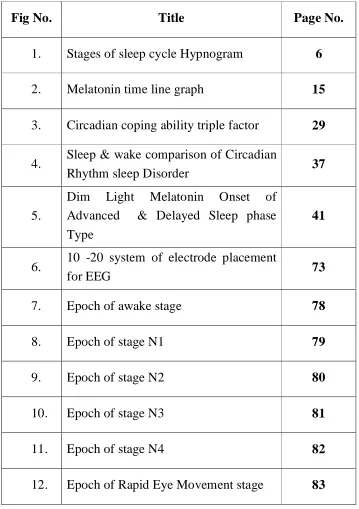
Fig No. Title Page No.
1. Stages of sleep cycle Hypnogram 6
2. Melatonin time line graph 15
3. Circadian coping ability triple factor 29
4. Sleep & wake comparison of Circadian
Rhythm sleep Disorder 37
5.
Dim Light Melatonin Onset of
Advanced & Delayed Sleep phase Type
41
6. 10 -20 system of electrode placement
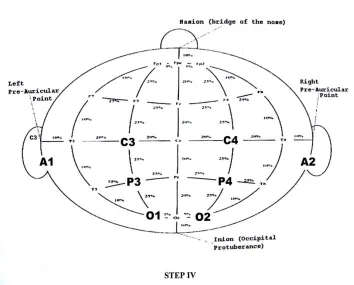
for EEG 73
7. Epoch of awake stage 78
8. Epoch of stage N1 79
9. Epoch of stage N2 80
10. Epoch of stage N3 81
11. Epoch of stage N4 82
LIST OF GRAPHS
Graph No. Title Page No.
1. Comparison of parameters between Day
worker and Shift worker 96
2. Comparison of Sleep Efficiency
between Day worker and Shift worker 96
3. Comparison of Sleep Stage I between
Day worker and Shift worker 98
4. Comparison of Sleep Stage II between
Day worker and Shift worker 98
5. Comparison of Sleep Stage III between
Day worker and Shift worker 100
6. Comparison of Sleep Stage IV between
Day worker and Shift worker 100
7. Comparison of REM Sleep Stage
between Day worker and Shift worker 102
8. Comparison of NAP onset latency
between Day worker and Shift worker 102
9. Comparison of Sleep Stage Percentage
between Day worker and Shift worker 104
10. Comparison of Sleep Stage Percentage
in Day worker - PIE Chart view 105
11. Comparison of Sleep Stage Percentage
in Shift worker - PIE Chart view 105
12. Comparison of NAP time between Day
worker and Shift worker 107
13. Comparison of subjective sleep scores
between Day worker and Shift worker 107
14.
Comparison of salivary melatonin level (pg/ml) between Day worker and Shift worker – bar chart
109
15.
Comparison of salivary melatonin level (pg/ml) between Day worker and Shift worker – stacked line chart
ABBREVIATION
S.NO ABBREVIATION EXPANSION
1. AASM American Academy of Sleep Medicine
2. AHI Apnea-Hypopnoea Index
3. BMI Body mass Index
4. CSA Central sleep Apnea
5. DI Desaturation Index
6. ECG Electrocardiogram
7. EEG Electroencephalogram
8. EMG Electromyogram
9. EOG Electro-oculogram
10. LSAT Lowest saturation of oxygen in blood
11. NREM Non rapid eye movement
12. REM Rapid Eye Movement
13. PSG Polysomnography
14. R&K Criteria Rechtschaffen and A.Kales
15. RDI Respiratory disturbance Index
16. REM Rapid eye movement
17. RERA Respiratory effort related Arousal
18. SDB Sleep disordered breathing
19. SWS Slow wave sleep
20. TRT Total recording time
21. TST Total sleep time
22. WASO Wake after sleep onset
ABSTRACT
A STUDY OF PATTERN OF SECRETION OF MELATONIN IN
SALIVA AND SLEEP PARAMETERS IN SHIFT WORKERS
Degree for which submitted : Doctor of Medicine(MD) in Physiology Supervisor and guide : Prof.Dr.K.Padma
Director and Head of the Department Department : Institute of Physiology and Experimental
Medicine
College : Madras Medical College Chennai-600003.
University : The Tamilnadu Dr.M.G.R.Medical University,Chennai-600032
Year : 2013 – 2014
Back ground:
Globalization and industrialization has lead the shift workers vulnerable for circadian rhythm sleep disorders
Aim & Objective:
Materials &Method:
The study included 30 age matched male shift workers (mean [SD] age: 21.33 [0.48] years) and 30 healthy day workers (mean [SD] age: 24.97 [2.55] years). Polysomnography was performed along with self rated subjective sleep scoring questionnaires. Three Saliva samples for the measurement of melatonin were collected from participants resting in dim light at 2 hr min intervals between 20:00 and 00:00 hr.
Result
Total sleep time, Sleep Efficiency, and duration of rapid-eye-movement sleep showed a significant reduction while Slow-wave sleep (stages 3+4) doesn’t show a significant reduction in shift workers as compared with day workers. A significant decrease in time line trend of salivary secretion of melatonin was observed in shift workers. Subjective sleep scores were significantly more towards inadequate sleep for shift workers.
Conclusion:
The circadian phase is altered in shift workers as compared to day workers proved using salivary melatonin concentration as a marker of the same. This study showed shift workers are more prone for sleep disorders, affecting one’s health and productivity in society. Early diagnosis, behavioral and life style modification, health education and medication, may alleviate such problems.
STUDY OF PATTERN OF SECRETION OF
MELATONIN IN SALIVA AND SLEEP PARAMETERS
IN SHIFT WORKERS
Introduction:
Until the mid 20
thcentury, sleep was considered as a passive
happening, dormant phase of everyday life. Common thought of sleep is
that “it is a passive, inactive part of our daily lives”. Recent studies
revealed that “during sleep our brains are very active”. In addition, sleep
affects mental and physical wellbeing and hence our daily life in many
ways that we are just beginning to recognize.
Sleep is essential for survival and good wellbeing, but necessary of
sleep and what sleep does to our wellbeing is not fully known. Sleeping
hours for an individual may vary widely, usually from 6 to 10 hours a
day. Nearly all people sleep at night. Yet, many individuals ought to sleep
during the time of the day to become accustomed to working schedules—
a condition that is followed by sleep disorders.
Hours of sleep against age
of five REM sleep component declines nearly more than two hours. 10 to
11 hours of sleep is required for school children as evidenced by studies
1.
Age and condition
Sleep Needs
Newborns (0–2 months)
12 to 18 hours
Infants (3–11 months)
14 to 15 hours
Toddlers (1–3 years)
12 to 14 hours
Preschoolers (3–5 years)
11 to 13 hours
School-age children (5–10 years)
10 to 11 hours
Adolescents
(10–17 years)
8.5 to 9.25 hours
Adults, including elderly
7 to 9 hours
1.1 Physiology of Sleep:
This is widely divided into two following Phases of Sleep
according to the multiple electrophysiological recording parameters as
Rapid Eye Movement (REM) and Non-Rapid Eye Movement (NREM)
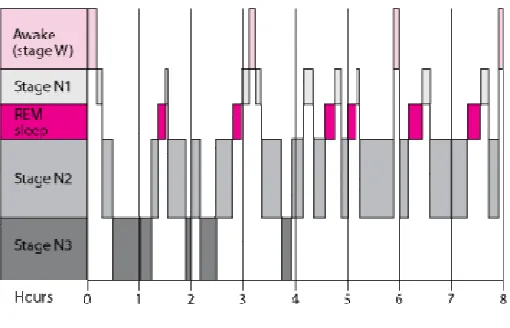
1.2 Stages of Sleep Cycles:
The EEG pattern recorded during sleep varies in a cyclic fashion,
which repeats in about every 90 minutes. There are about four cycles in
normal 6 to 8 hours of sleep. In normal individuals, sleep cycle begins
with wave sleep or Non-REM sleep. There are four stages of
slow-wave sleep: stages 1 to 4.
A person when falls asleep, passes sequentially through these four
stages of increasingly deep sleep. After that, the sleep lightens and he
enters into REM period. With completion of REM phase, sleep cycle
completes. The REM phase is followed by the next new cycle, i.e. with
stage 1 of non-REM sleep.
Thus, the cycle repeats in every 70 to 90 minutes. Throughout the
night, people wake up briefly (called stage W) but are typically unaware
of being awake. There are differences in the proportion of time spent in
individual has his or her own characteristic pattern. Usually, there is a
predominance of deep slow wave sleep during the early part of the night,
and the first REM sleep may occur after an hour.
REM stage becomes prevalent during the later part of the night. In
general, REM sleep occupies about 25 per cent of total sleep period. The
duration of REM sleep and stage 4 sleep decrease gradually with
advancing age. Newborns and infants sleep about 18 hours a day of
which 50% is spent in REM sleep.
1.3 EEG Features of Sleep
In 1953, Aserinsky, Dement and Kleitman through EEG and
polygraphic analysis described different phases of normal sleep
characterized by EEG, autonomic and endocrine changes.
During wakefulness, EEG usually shows desynchronized,
high-frequency, low amplitude known as beta waves in the range of 14 – 30
Hz.
During quiet rest with eyes closed, waves range from 8 to 12 Hz,
1.4 Architecture
Non-REM sleep:
Stage 1 : Alpha rhythm is replaced by high frequency low
amplitude EEG waves.
Stage 2 : Appearance of sleep spindles and K complexes.
Stage 3 & 4 : Delta waves (slow wave)
(Commonly called as deep sleep)
- Delta waves in EEG reflect synchronized oscillations of
thalamocortical circuit activity.
REM sleep:
- High frequency, low amplitude activity with PGO spikes
REM is characterized by rapid eye ball movement and profound
atonia of other limb muscles (except for extraocular, inner ear and
respiratory muscles).
Among these stage 2 sleep occupies50 percent of our total sleep
Infants sleep on the other hand, occupies 50% of their sleep time in REM
sleep.
Recent evidences show that “theta oscillations during REM are
driven by neurons in the proceruleus area in pons and atonia is caused
neurons in the adjacent sublaterodorsal area. (Lu et al, 2006).These ‘REM
on’ zones are inhibited by nearby ‘REM off’ area including ventrolateral
PAG and lateral pontine tegmentum. ‘REM on’ area can also inhibit
‘REM off’ area. Mutual inhibitions between these areas produce ‘flip-flop
switch’ that ensures sharp and complete transition between REM and
NREM sleep”.
REM switch is influenced by:
- Cholinergic neurons that promote REM sleep
[image:21.612.190.445.511.675.2]- Noradrenergic and serotonergic neurons that inhibit REM sleep.
NREM Sleep-changes in EEG and consciousness (which is
primarily a cerebral function) are classified into four stages respective to
increasing depth of consciousness. Depth of unconsciousness will
become more for as sleep progresses from stage 1 to 4. EEG shows a
progressively slower in frequency and higher-voltage pattern
(furthermore called slow wave, delta wave)
NREM-Thinking and Body Activities:
Thinking in NREM is short, rudimentary and not able to recollect,
Muscle tone is present, and Deep Tendon Reflex can be elicited. Chin and
limb muscles exhibit EMG activities.
NREM sleep-autonomic changes:
Widespread decrease in autonomic activities, hypotension and
decreased heart rate, and decreased generalized cellular metabolism are
noted.
NREM sleep-Hormonal changes:
Growth Hormone, Cortisol and Prolactin secretion occurs mostly in
NREM sleep. GH is secreted in 30 to 60 minutes after the beginning of
Biochemical changes like increased serotonin activity is noted in NREM
sleep.
Function of NREM sleep:
Main characteristics of NREM sleep are slow wave in EEG,
decreased generalized metabolic activities and deep unconsciousness help
revitalize the body
Hence, early night time period is occupied by NREM or slow wave
sleep predominantly, while late night phase is occupied by REM which is
lighter and dream filled.
EEG/EMG characteristics of REM sleep:
EEG is more active than NREM. Low voltage fast with ocular
movement artifact is noted in EEG. EMG is relatively reflecting atonia in
REM sleep related to flaccid muscles. While other body activities are as
active as like that of awake state.
LATENCIES:
“Sleep latency is defined as the interval to fall asleep after retiring.
“REM latency is defined as once asleep, the interval from falling
asleep to the first REM sleep is called REM latency”. It may last for
90-120 minutes within one cycle. Variations of above two latencies are
useful in diagnosing many sleep disorders. Some disorders may affect
one of the two latency and they are distinct to each other.
1.5 Hormone of sleep - Melatonin
An endocrine hormone related to sleep which was thought to
maintain biological clock in human being is melatonin. The pineal gland
situated in the posterior end of epithalamus predominantly secretes
melatonin. The melatonin signal form contribution of circadian cycle. Its
biological activities include causing drowsiness. But the daily cycle is
controlled by central nervous system by means of the endocrine and
paracrine systems considerably than the melatonin signal alone.
Melatonin (5-methoxy-N-acetyltryptamine,)
Melatonin is a hormone present in all living beings from algae to
humans. Chemically it is N-acetyl-5-methoxytryptamine. It exhibits
diurnal variation that varies with the time of the day. Melatonin act on
melatonin receptors to exert its organic effects. Melatonin also protects
Production
In higher animals, apart from pinealocytes in the pineal gland the
retina, lens and GI tract are also tend to produce melatonin. Tryptophan
an essential aminoacid forms the precursor for synthesis of melatonin by
the enzyme 5-hydroxyindole-O-methyltransferase. Production of
melatonin by the pineal gland is under the control of the suprachiasmatic
nucleus (SCN) of the hypothalamus. Retina is the one that mediates
information about the environmental light pattern daily.
A small group of inner retinal ganglion cells senses the light by
special receptors and conveys light/dark information towards SCN. These
cells represent 2% of retinal ganglion cells in humans and have the
photopigment melanopsin not involved in vision. The sensitivity of
melanopsin is with peak sensitivity at 484 nm (blue light). This
photoperiod signal entrains the circadian rhythm, thereby subsequent
neural and endocrine signals regulates behavioral and physiological
circadian rhythms.
Distribution
Melatonin produced and released into the blood like that as an
endocrine hormone. While melatonin produced by the retina and the
‘Production of melatonin by the pineal gland is inhibited by light
and permitted by darkness as shown in above flow chart. It has been
called "the hormone of darkness" and its onset each evening is called the
Dim-Light Melatonin Onset (DLMO)’. Secretion of melatonin, and its
level in the blood, peaks in the middle of the night, and gradually falls
during the latter half of the night, with normal variations in timing
according to an individual's daily life sleeping habits.
Until recent century, humans in temperate zones were exposed to
up to 18 hours of darkness in the winter. In the current world, electricity
reduces this to on average eight hours or less per day all year round. Low
light levels can eb sufficient to inhibit melatonin production to some
level. However bright light can reduce melatonin production to greater
extent.
“Reduced melatonin production has been proposed as a likely
factor in the significantly higher cancer rates in night workers, and the
effect of modern lighting practice on endogenous melatonin has been
proposed as a contributory factor to the larger overall incidence of some
Antioxidant
Apart from its chief function as synchronizer of the biological
circadian clock, anti-oxidant activity of melatonin is also a notable one.
In many lower life forms, melatonin functions for only this purpose.
‘Melatonin is able to cross cell membranes and the blood-brain barrier’.
Contrasting to other antioxidants, redox cycling is not evidenced in
melatonin. Redox cycling is the property of a compound to undergo
reduction and oxidation repeatedly.
Therefore, it has been referred to as a ‘terminal (or suicidal) antioxidant’.
Immune system
While it is clear that melatonin interacts with the immune system,
the details of those interactions are unclear. There have been few trials
Most existing data are based on small, incomplete, clinical trials. Any
positive immunological effect is thought to result from melatonin acting
on high affinity receptors (MT1 and MT2) expressed in
immunocompetent cells. The increased immune system activity may
aggravate autoimmune disorders. In rheumatoid arthritis patients,
melatonin production has been found increased when compared to
age-matched healthy controls.
Dreaming
Many supplemental melatonin users have reported an increase in
the vividness or frequency of dreams. Extremely high doses of melatonin
(50mg) dramatically increased REM sleep time and dream activity in
both narcoleptics and those without narcolepsy.
Melatonin level
Melatonin level in plasma is found to be in range from 30 to 250
pg/ml according to the decreasing age. Melatonin level progressively
declines as the age advances as shown in the table. This hormone also
Figure 2 Plasma and Salivary Melatonin versus Time
Light inhibits the production of melatonin by the pineal gland and
darkness favors its production. For this purpose melatonin has been called
“Dim-Light Melatonin Onset” (DLMO). Dim light favors increased
production of hormone. In early hours of the night the hormonal level
raises maximum in blood. This is due to increased secretion in initial
night hours and gradually falls during the next half of the night (fig: 2).
this may vary in timing according to one’s chronotype.
1.6 Physiologic Effects of Sleep:
Nervous system and other functional systems in the body are the
two major aspects on which sleep exerts its physiological effects. The
effects on nervous system are the more important because any person
who has a transected spinal cord in the neck shows no harmful effects in
the body beneath the level of transection that can be attributed directly to
a sleep wakefulness cycle. Deprivation of sleep has an effect on the
normal activity of the central nervous system.
Prolonged wakefulness is usually coupled with progressive
malfunction of the thought processes and at times causes abnormal
behavioral actions. We are all well-known with the increased
sluggishness of thought that occurs after a extended awake period. But as
well, a person can become short-tempered or even psychotic after forced
wakefulness. Thus, sleep in several ways brings back normal levels of
central nervous system. Since overuse of some brain areas during
wakefulness could easily throw these areas out of balance with the
remainder of the nervous system. We might postulate that the principal
value of sleep is to restore natural balances among the neuronal centers.
The specific physiologic functions of sleep remain a mystery, and they
are the subject of much research2 .
1.7 Shift work and Sleep
With the dawn of publicly available electric light in the late part of
19th century, mankind came out of the natural day–night (circadian) cycle.
Economic and social requirements are now forcing the construction of a
24-hour society coupled with both economic profit and possible risk of
health. A study in the United States, reveals that “more than 15 million
people (16.8%) of the full-time workers work on alternate shifts3(beers
TM et al 2000)”, that is working hours are during periods other than 6
AM to 6 PM. Major health troubles among shift workers include sleep
disorders4 (Akerstedt T et al 1982), gastrointestinal disorder, increased
incidence of cardiovascular disease, and possible increased incidence of
type II diabetes mellitus5 (Rajaratnam SM,et al 2001).
“Shift work is highly prevalent in mechanized societies. An
the daytime and work to the night time will impede with the circadian and
homeostatic control of sleep. American Academy of Sleep Medicine
states that Shift-work sleep disorder consists of insomnia or excessive
sleepiness that occurs as transitory phenomena related to work hours that
are programmed during the usual sleep period. Shift work with deviant
sleep schedule imposes a stress on the regular circadian rhythm and the
exact margin between a normal response and a pathological response to
this circadian stress remains unclear.
Shift work sleep disorder (SWSD) is a type of circadian rhythm
sleep disorder in which the endogenous circadian sleep wake cycle is
normal and the disturbance arises from controversy between the pattern
of sleep and wakefulness generated by the circadian system and the
preferred pattern of sleep and wakefulness required by shift work.
Long duration shifts greater than 12 hours and individual
susceptibility for phase intolerance may lead to a diagnosis of shift work
disorder i.e., those workers on shift time schedule with the greatest
sleepiness and performance impairment during the biological night and
insomnia during the biological day. Most of the medical disability due to
A shift worker trying to sleep in the day time in general sleeps 1.5
to 2 hours less than their night sleeping counterpart. They tend to miss out
a major portion of REM sleep and the quantity of stage 2 sleep is not as
much of a normal person. This results in "fragmented sleep." Less
daytime sleep is a result of the altered sleep/wake cycle as well as
concerned with external daytime sound stimuli such as calls, machineries
and dogs. It has been revealed that noise stimuli, even if it does not wake
one from sleep, has an impression on one's sleep cycles.
The night shift worker while working on nights have got to deal
with sleep deprivation in addition to the effect of the trough of the
circadian rhythm. Due to this it is difficult for a shift worker to keep from
feeling tired.
The objective of this present study is to find the prevalence of Shift
Work Sleep Disorder, distribution of their stages of sleep, detectable
abnormalities in sleep study and their trough value, amplitude of pattern
of melatonin secretion in saliva during onset of night hours, widely
known as Dim Light Melatonin Onset in rotational shift workers and
REVIEW OF LITERATURE
2.1 .1 Regulation of sleep:
Different factors are involved in regulation of sleep. The main
focus has been on the interaction between the homeostatic and the
endogenous circadian processes6(Dijk DJ, et al 1995). The homeostatic
process accumulates as a function of prior wakefulness, i.e., there is more
homeostatic factor the longer you are awake7(Dijk DJ, et al1990). If one
is awake for long time, he will get the sleep deeper (increased slow wave
activity). The circadian factor on the other hand plays an important role in
sleep quantity; that is, sleep duration is for the most part determined by
when you go to bed. In other words, sleep length is not dependent on the
sleep homeostatic factor, but largely dependent on when you go to sleep
according to your own circadian rhythm.
Night workers have experienced this as their sleep duration is
usually shorter (often less than 6 h) than normal when going to bed in the
morning, even though they often have been awake for more hours before
going to bed than daytime workers8 (Akerstedt T. et al 2003). From a
practical point of view, this interaction between the homeostatic and
substantial amount of time to get sleep of high quality, and to have
regular bed and rise times in order to have stable sleep duration.
Also habits and behavioral factors have large influences on sleep.
We all go to bed at regular hours, not necessarily because we are very
sleepy/ tired, but because we know we need to do so, to get enough sleep.
Many people experience a high level of sleepiness early in the
evening/afternoon, but avoid going to bed knowing that it is not time for
bed yet. Behavioral factors can override both the homeostatic and
circadian factors. For instance, a night worker is able to stay awake even
though both the homeostatic and the circadian factors favor sleep in the
middle of the night.
In these instances behavioral factors, like talking to someone,
walking around, drinking coffee, increasing illumination, etc., help the
night workers to stay awake. Similarly, many teachers have experienced
students falling asleep at 9 a.m., even though both the homeostatic and
circadian factors favor wakefulness. In this instance, lack of stimulation
may be a behavioral factor explaining the increase in sleepiness and risk
of falling asleep; that is, a boring lecture, sitting in a dark room, lack of
2.1.2 Effect of sleep deprivation
A study done at Research Laboratory “Sports Performance
Optimization” National Center of Medicine and Science in Sports
(CNMSS), Tunis, Tun isia, evaluated the effect of partial sleep
deprivation on the diurnal variations of cognitive performance of
handball goalkeepers. 3 cognitive tasks by the use of the reaction time
(RT), the stroop, and the barrage tests (to evaluate the RT, the selective
and supported attention respectively) following 2 situations of sleep
deprivation. The results showed an increased RT and a fall of the level of
the attention after the partial sleep deprivation in the afternoon hours. It
concluded that partial sleep deprivation affects the diurnal variation of
cognitive performance by increasing the RT and reducing the attentional
capacities in the afternoon hours9 (Mohamed Jarraya et al 2013).
“A survey of sleep deprivation patterns and their effects on
cognitive functions of residents and interns in Korea revealed severe
sleep deprivation was associated with higher level of stress, more
frequent attention deficit, and difficulty in learning (P < 0.05), but not
2.1.3 Sleep and memory consolidation:
There is now a large body of literature supporting the notion that
sleep plays a major role in memory consolidation. The most prominent
theory regarding the mechanism is that recently acquired representations
are preferentially reactivated during sleep. In the context of declarative
memories, this involves reactivations of memories in the MTLs during
slow wave sleep1011
( Peigneux, P., et al. 2004 ; Wilson, M. A., &
McNaughton, B. L. 1994), which strengthen and stabilize the memories,
making them more resistant to interference12( Diekelmann, S., et al2011)
and more likely to be retained1314
( Rasch, B., et al. 2007; Rudoy, J. D., et
al 2009).
2.1.4 Sleep - necessary for survival:
Even though we don’t know exactly why sleep is needed by
people, there are evidences of animal studies that have proved the
necessity of sleep for survival. For example, life time of rat is normally
two to three years. But the survival time of rat becomes lesser for the
REM deprived rats as 5 weeks and as 3 weeks for the rats which are
deprived of all stages of sleep. Body temperatures fell abnormally low
The etiology of sores was found to be compromise in rats' immune
system.
Normal functioning of nervous system requires proper sleep. This
is obvious in our day to day life, where in sleep deprivation for one day
may lead to drowsiness and impaired concentration in memory and deter
our physical performance. Hallucinations and mood swings have been
reported in prolonged sleep deprivation. Sleep deprivation may lead to
break down of neurons due to depletion of energy and accumulation of
metabolites of normal cellular activities. Sleep also may give the brain a
chance to exercise .Important neuronal connections which are required
for prevention of damage from lack of activity and sleep helps in this
process.
Deep sleep coincides with the release of growth hormone in
children and young adults. Many of the body's cells also show increased
production and reduced breakdown of proteins during deep sleep. Since
proteins are the building blocks needed for cell growth and for repair of
damage from factors like stress and ultraviolet rays, deep sleep may truly
be "beauty sleep." Activity in parts of the brain that control emotions,
decision-making processes, and social interactions is drastically reduced
maintain optimal emotional and social functioning while they are awake.
A study in rats also showed that certain nerve-signaling patterns which
the rats generated during the day were repeated during deep sleep. This
pattern repetition may help encode memories and improve learning.
2.1.5 Sleep disorders
A sleep disorder is a physical and psychological condition or
disturbance of sleep and wakefulness caused by abnormalities that occur
during sleep or by abnormalities of specific sleep mechanisms. Although
the sleep disorder exists during sleep, recognizable symptoms manifest
themselves during the day. Accurate diagnosis requires a
polysomnogram, widely known as a "sleep test”.
Sleep disorders involve disturbances in the ability to fall asleep,
stay asleep, or stay awake or unusual behaviors during sleep, such as
sleepwalking. Sleep can be disturbed by many factors, including irregular
bedtimes, activities before bed, stress, diet, disorders, and drugs.
The most common symptoms of sleep disorders are insomnia and
excessive sleepiness during the day. People with insomnia have difficulty
falling and staying asleep and wake up feeling unrefreshed. Lack of sleep
makes people feel sleepy, tired, and irritable during the day. People with
hours. Some sleep disorders make people unable to resist falling asleep
during the day.
Some sleep disorders involve involuntary movements of the limbs
or other unusual behaviors (such as nightmares, night terrors, or
sleepwalking) during sleep. Other symptoms may include problems with
memory, coordination, and emotions. People may perform less well in
school or at their jobs. The risk of having a motor vehicle accident or
developing a heart disorder is increased. A detailed description of the
problem, sometimes with information from a sleep log, usually indicates
the diagnosis, but sometimes testing in a sleep laboratory is needed”. This
testing includes polysomnography.
2.2 Shift work:
The term “shift work” refers to regular employment outside of the
normal “day work” hours. “Human beings are diurnal creatures for whom
it is biologically unnatural to work at night, thus leading to the potential
for impairments in work alertness and interference with day time sleep.
Society expects evenings and weekends to be free for social, religious and
recreational activities, thus placing shift workers at a disadvantage, when
they are required to be at work during evenings, overnight, or on
Approximately one fifth of all employees are engaged in some
form of work that requires their presence outside of the “standard” 7am to
6pm working day on a regular basis, and can thus be regarded as “shift
workers”. “This figure is expected to rise to rise as second jobbing and
mandatory overtime increase 15
(U.S.Congress, office of technology
Assessment: Biological Rhythms: Implications for the Worker
(OTA-BA-463). Washington, DC, U.S. Government printing office.1991).
The fastest –growing sector of most western economies is the
service sector, and people are increasingly demanding and receiving
around the clock availability of such services. This leads to extended
works week and fewer different work teams covering each 24-hour day.
Physicians are thus increasingly confronted with patients whose
conditions may be exacerbated by a failure to cope with the repeated
changes in schedule that shift work requires. Some people cope well with
shift work, others poorly. At the extreme , moore-ede16
( Moore-Ede MC
et al 1986) and others have referred to a shift work maladaptation
syndrome in those failing to cope. The international classification of sleep
disorders 17
(ICSD 1990) formally lists shift work sleep disorder as one of
the circadian rhythm sleep disorders. The diagnostic and statistical
manual of mental disorders 18
(American psychiatric association; 1994)
Although listed within circadian rhythm-related sleep disorders, shift
work intolerance is a problem that should not be regarded as solely a
circadian rhythm (biological clock) issue, or asleep disorder issue, or a
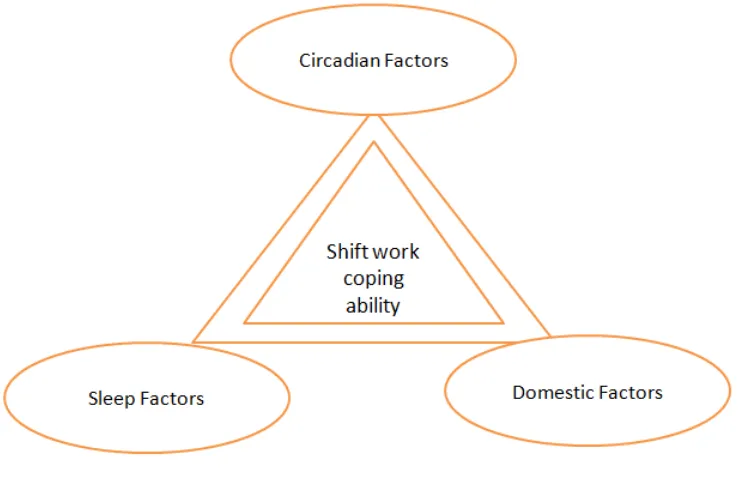
social and domestic issue19(Knauth P, et al 2003). Rather, it is a complex
interaction of these three factors, with each factor influencing both of the
other factors and the final outcome of shift work tolerance 20 (Monk TH:
Figure 3 Circadian Rhythm coping ability- Triple Factors
2.2.1 CIRCADIAN FACTORS
“Unfortunately, it is quite clear that, like it or not, HOMO
SAPIENS are a diurnal species, biologically hard-wired to be active
during the day and sleepy at night. Working at night must therefore be
regarded as an inherently unnatural act.
The prime negative influence of the circadian system stems from
its inability to adjust instantaneously to the changes in routine that shift
work schedules require 2122 (Aschoff J, Hoffmn K, pohl H, et al: 1975;
Roach GF, Burgess H, Lamond N, et al: 2001 ). Figure illustrates the
circadian temperature rhythm) in two young volunteers who worked 21
consecutive night shifts23
(Monk TH, Knauth P, folkard D, et al: 1978).
Thus 5 or 6 days were needed before the melatonin onset achieved
its desired timing, just prior to the (day) sleep episode. In most work
situations, however, this would bring the individual to an off-duty break
when a reversion to a diurnal pattern would likely ensue.
As with other investigations, however 24
(Czeisler CA, et al: 1990),
these studies indicated that darkness during the sleep period was an
important as the light during the awake period. Thus, complete bedroom
light proofing was required, and (more problematically), Eastman and
colleagues25 (Eastman CI et al 1994) showed convincingly that dark
sunglasses or welder's goggles usually needed to be worn during the
morning commute home from night work for the required circadian
system phase delay to be accomplished, a procedure that might
sometimes compromise traffic safety.
Another way of enhancing circadian adjustment is by taking
melatonin pills - a strategy used by many night workers following the
attention given to that hormone in the popular press. Whereas there is
some laboratory evidence for the effectiveness of melatonin as a
chronobiotic26
compared to those of daylight and are likely to be washed out for many
shift workers. Slightly different is the concept of using melatonin pills to
facilitate daytime sleep (without necessarily changing the timing of the
circadian pacemaker). However, although there is good laboratory
evidence for such facilitation, double-blind studies of melatonin's effects
in actual shift workers have resulted in few definitive improvements in
the quality or duration of daytime sleep2728
( Jorgensen KM et al 1998;
James M et al 1998).
In Europe, many companies are switching to rapidly rotating
systems in which only one or two shifts are worked at a time, before a
different one is worked29 (Knauth P, et al 1980). Thus, for example, on
the continental rotation, employees work two morning shifts, two evening
shifts, and two night shifts, followed by two days off. Most European
experts favour such systems because they allow the circadian to retain its
diurnal orientation, thus eliminating problems of desynchronosis.
Because only one or two night shifts are worked before time off is given,
sleep loss and fatigue are minimized. The drawbacks of rapid rotation are
2.2.2 SLEEP FACTORS
“Sleep is the major preoccupation of most shift workers. In both
Europe30
(Knauth P et al 1980) and the United states31
(Tasto DL et al
1978), surveys have indicated that night workers get about 10 hours less
sleep per week than their day-working counterparts. Thus, People who
happen to need 9 hours of sleep per 24 hours in order to feel well rested
very often find shift work extremely difficult to cope with. In his survey
of field and laboratory shift work sleep studies, Akerstedt3233
(Akerstedt T
et al 1985; Akerstedt T et al 2005) concluded that the shortening in a
night worker's day sleep comes primarily from a reduction in stage 2 and
rapid eye movement (REM) sleep, with slow wave sleep relatively
unaffected. Not surprisingly, given the prolonged levels of partial sleep
deprivation involved, sleep latency can be somewhat reduced in night
workers, and some studies have found shorter REM latencies to occur.
Essentially, the problem is usually one of sleep-maintenance insomnia
rather than sleep onset insomnia.
In this closely protected environment, there was a highly
significant difference in duration between the day sleep of night workers
and the night sleep of day workers (306 minutes versus 401 minutes,
polysomnographic characteristics of the sleep, with a smaller amount of
REM sleep and a greater proportion of slow wave sleep for the night
workers. Thus, even if it were economically feasible, the complete
soundproofing and light proofing all shift workers bedrooms would not
eradicate the problem of sleep for shift workers.
Unless the shift worker is in a well-adjusted household, his or
(more especially) her sleep is liable to be truncated by the demands of
childcare, shopping and household management. In viewing the sleep of
shift workers, one must therefore consider both endogenous and
exogenous factors that are going to limit sleep time.
The use of hypnotics as done in a study of rotating shift workers,
Walsh and colleagues34 (Walsh JK et al 1984) found that 0.5mg triazolam
could improve the quality and duration of day sleep. However the study
was also important in demonstrating that the drug had no significant
phase-resetting effects”.
2.2.3 Domestic factors
Certainly, if a shift worker’s domestic and social life is
unsatisfactory, then the individual will not be coping satisfactorily,
however well adjusted the sleep and circadian rhythm may be. The
household management. Another aspect of domestic disruption concerns
the role of the male shift worker as husband and parent. The factor may
increase the risk of divorce by
57%
35 (White L et al 1990) in alongitudinal follow up study. Shift worker often suffers from social
isolation from day working friends and from religious community
organizations.
2.2.4 Coping strategies:
“Employee education programs should emphasize the way
circadian, sleep and domestic factors can influence the shift work coping
ability. Workers should be taught good sleep hygiene practice and
advised how they can manipulate zeitgebers to their advantage, enhancing
those that are acting in their favour and attenuating those acting against
them. They should also be taught the benefit of prophylactic naps. In
some cases family counseling may be indicated to discuss solutions to
some of the social and domestic problems. The creation of self help
networks can often be of benefit, lessening some of the social and
community isolation that many shift workers feel. When educational
strategies fail and shift schedule cannot be changed, the patient may
Management education include convincing the managers first for
realizing the potential of problem, and making the wide range of different
shift systems that are available, including the rapidly rotating systems so
popular in Europe. Recognition of factors such as type of job, nature of
workforce, average commuting time, male female ratio, and
preponderance of moonlighting that should influence the selection of
optimal schedule for that work group in that situation.
Although some people cope well with shift work, many others have
significant problems that can adversely affect their health and well being.
These problems can become a shift work sleep disorder, which can be
quite debilitating to the patient. Shift work problems can be usually
understood with a multifactored approach that recognizes the interaction
of circadian rhythms, sleep and social and domestic factors in
determining shift work coping ability”.
2.2.5 Alertness Strategies:
A variety of strategies have been empirically studied and shown to
increase alertness in performance. These strategies include planned naps,
caffeine, good sleep habits, managing the sleep environment, exercise,
stimulant medication and sleep
scheduling
363738(
Howard SK et al2002; Rosekind MR et al 2002; Rosekind MR et al 1999
)
.Scheduling:
An individual worker can seek every opportunity to increase work hours
and income, and an organization or corporation can limit these
opportunities in order to reduce potential health and safety risks.
Healthy Sleep:
It is critical that individuals learn about potential sleep disorders that may
affect them and seek help from accredited sleep medicine professionals to
identify and treat underlying cause of sleepiness.
Conclusion – Managing work schedules:
“Modern work schedules have evolved dramatically from their
roots as traditional shift work to meet historical manufacturing and line
operations. Effective clinical interventions may involve actions focused
on each of these areas for optimal outcomes.
Shift work sleep disorder is otherwise known as circadian rhythm sleep
disorder. Its diagnostic criteria are published in the international
Delayed sleep phase type (DSPT) and advanced sleep phase type (ASPT)
are the two types of circadian rhythm sleep disorder and the former is the
most commonly encountered in clinical practice”.
Clinical Feature – DSPT:
“It is characterized by sleep onset and wake times that are usually
delayed 3 to 6 hours relative to conventional sleep wake times (see
figure).
Figure 4 schematic representation of the temporal distribution of sleep
and wake in patients with circadian rhythm sleep disorder
Patient typically finds it difficult to initial sleep before sometime between
2 and 6am and when free of social constraints prefers a wake time that is
between 10am to 1pm3940 (Weitzman E et al 1979; Weitzman ED et al
1981). The clinical picture may be similar to sleep onset insomnia.
Enforced conventional wake times may result in chronically insufficient
sleep and excessive day time sleepiness. In adolescent the syndrome may
where as in adulthood the symptoms are impaired job performance41
(Thorpy MJ et al 1988) and associated financial difficulty as well as
marital problems42 (Alvarez B et al 1992).
Although actual prevalence in general population is unknown it is more
common in adolescent and young adults with a reported prevalence of
7%43(Pelayo R et al 1988).In middle aged adults the prevalence may be
nearly 0.7%44(Ando K et al 1995). In sleep disorder clinics,
6.7%45(Weitzman ED et al 1981) to 16%46 (Regestein QR et al 1995)
patients with primary complaint of insomnia were determined to have
DSPT.”
2.2.6 Etiopathogenesis:
The tendency for late sleeping is not simply a function of
interaction between circadian drive for wakefulness and sleep homeostat
but is analogous to other physiological behaviors but overlaid by varying
individual emotional social and medical states47( Regestein QR et al
1995). “Late wake times will delay exposure to light in the morning and
may prevent active advancement of the circadian clock allowing it to drift
to a new phase relation with the external clock time. There is also
evidence for genetic basis to DSPT. In some cases it is familiar with
Ancoli-israel S et al 2001). Polymorphisms in circadian gene such as
hPer3, arylalkylamine N-accetyltransferase gene, HLA genes and
Clock50515253 (Archer SN et al 2003; Hohjoh H et al 2003; Iwase T et al
2002; Takahashi Y et al 2000)support the genetic basis”.
2.2.7 Diagnosis:
The diagnosis of DSPT is usually made on the basis of the patient’s
history of chronic or recurrent complaints of symptoms of insomnia
resulting from a stable delay in the timing of the major sleep and wake
periods5455(American academy of sleep medicine,2005; American
psychiatric association 2000). Sleep log or actigraphy monitoring should
be performed for at least 7 days to demonstrate a stable delay in the
timing of the habitual sleep period. A morningness-eveningness scale,
such as provided by the Horne-Ostberg questionnaire, is also useful to
gauge the patients best time of performance. To make the diagnosis,
medical, mental or sleep disorders that may cause alterations in the
sleep-wake cycle, insomnia or excessive sleepiness should be excluded or
adequately treated. Nocturnal polysomnography is sometimes necessary
to exclude other sleep-disrupting pathology. When performed during
conventional sleep laboratory hours, PSG often shows prolonged sleep
this many times, in conjunction with an antecedent sleep log, be a clue to
the diagnosis.
The use of other physiologic markers of circadian timing, such as a
continuous recording of body temperature56 (Czeisker CA et al 1980) or
dim light (plasma) melatonin onset (DLMO) 57(Shibui K et al 1999), may
also aid in determining the phase relationship between circadian and
terrestrial time, although routine clinical availability remains limited.
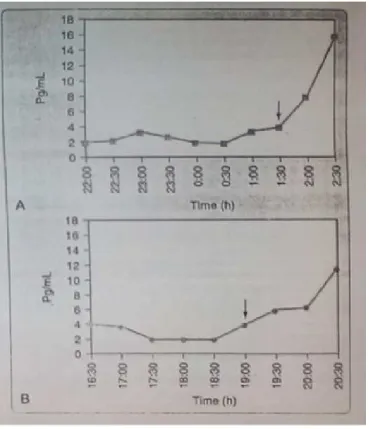
DLMO is probably the most useful marker for circadian pacemaker
output5859(Lewy AJ et al 1989; Lewy AJ et al 1999). In individuals with
DSPT, the DLMO times usually occur after 10PM60 (Shibui K et al
1999)(See figure). Determination of DLMO can be made by
measurements of melatonin from plasma or saliva. Commercially
available salivary determination of DLMO for clinical use may be
Figure 5 Dim light profiles of individual with Advanced Sleep Phase Type DLMO at 7 pm (top); Delayed Sleep Phase Type with DLMO at
1.30 pm (Bottom) the arrows indicate that the DLMO calculated as two standard deviation above the baselines
2.2.8 Treatment:
The use of chronotheraphy has been successful in small group of
requires a successive delay of sleep times by 3 hours daily over a 5 to 6
day period until a desired sleep time is achieved.
This shift is followed by rigid adherence to a set sleep-wake
schedule and good sleep hygiene practice. Therapy with bright light in the
morning should advance the phase of circadian rhythms in DSPT and
may be more practical than chronotherapy6263(Lewy AJ et al 1985;Lewy
AJ et al 1985). Clinical application of bright light therapy remains
empiric and there are no standard criteria for its use in DSPT.
Administration of exogenous melatonin also shifts the phase of
endogenous circadian clock. It should be noted that the Phase Response
Curve (PRC) for melatonin is nearly opposite to the PRC for light
exposure. Melatonin delays circadian rhythms when administered in the
morning and advances them when administered in the afternoon or early
evening64(Lewy AJ et al 1992s). The relatively small number of clinical
studies and variability in dose and time of administration have been
limiting factors in the development of a standardized approach for
treatment with melatonin. The combination of morning bright light and
early evening melatonin may be even more efficacious in creating a phase
advance, although clinical data are lacking. In summary the clinical
circadian sleep phase by sleep diary or actigraphy measures for a period
of at least 7 days. Behavioral interventions such as a structured sleep
wake schedule, good sleep hygiene practices and avoidance of exposure
to bright light in the evening should be prescribed for all patients. In
addition exposure to bright light in the morning (1 to 2 hours shortly after
awakening) or administration of melatonin in the evening (5 to 6 hours
before habitual sleep time) can advance the timing of the sleep wake
cycle, although melatonin has not been approved for this indication.
2.2.9 Shift work- a health risk:
Shift work, and night work in particular, is associated with
negative effects, such as shortened and disturbed sleep, fatigue, decreased
alertness, cognitive decrements, increased injuries and accidents,
reproductive problems and risks to cardiovascular and gastrointestinal
disease6566
(Akerstedt T et al 1990; Boivin DB et al 2007). These
symptoms are experienced because shift workers rarely shift their
endogenous circadian rhythms to align with the sleep wake schedule
demanded by their occupations”. Night workers are therefore often in a
constant state of circadian misalignment, and both work and sleep at the
‘‘wrong’’ circadian phase. The symptoms due to circadian misalignment
established. The magnitude of phase shift is positively related to the
extent of improved performance and alertness during the night, and better
daytime sleep at home(Burgess HJ et al 2002)67
.
In 2001, two studies were published suggesting that disruption of
the day–night cycle by exposure to light-at-night, especially through
nighttime shift work, may be associated with increased incidence of
breast cancer (Davis S et al 2001; Schernhammer ES et al 2004)6869
.
Davis et al70
reported on a case– control study among women who worked
the night or “graveyard” shift, showing a greater risk of breast cancer
associated with greater frequency and longer duration of night shift work.
Graveyard shift work was associated with an odds ratio of 1.6 (95%
confidence interval _ 1.0– 2.5). In the Nurses’ Health Study cohort,
Schernhammer et al 71 examined 2441 incident breast-cancer cases and
reported a trend of increasing breast cancer risk with increasing duration
on the night shift. They conclude that women who work on rotating night
shifts with at least three nights per month have a moderately increased
risk of breast cancer after extended periods of rotating shift work. A third
study on shift work and risk of breast cancer reported increasing risk by
“A 2003 study suggested an association between shift work and
risk of colorectal cancer (Schernhammer ES et al 2003)73
. Exposure to
light at- night may increase risk of cancer by suppressing endogenous
production of the neurohormone melatonin (Schernhammer ES et al
2004; Stevens RG et al 2005; Schernhammer E et al 2004)747576
which has
been observed to have potentially beneficial oncostatic, antioxidant,
antiadduct, anti estrogenic, and immune modulation activities (Brzezinski
A et al 1997; Reiter RJ et al 2004)7778. The antiestrogenic activities of
melatonin are highly relevant to breast cancer risk and include
interference with the estrogen receptor, reduction of estrogen production,
and reduction of circulating estrogen79
(Sanchez-Barcelo EJ et al 2005)”.
The primary function of melatonin is to convey information on
night length to physiologic systems to organize circadian functions such
as core body temperature 8081(Claustrat B et al 2005; Scheer FA et al
2005) as well as seasonal physiology in other mammalian species82
(Arendt J et al 2003). Serum and saliva melatonin levels are normally
very low during the day and the levels rise after dark, peaking in the
middle of the night. Exposure to light during the dark cycle inhibits
melatonin secretion in a dose-dependent manner, with a threshold of 200–
400 lux (lumens per square meter) and maximum inhibition after 600 lux
approximately 446–477 nm8384(Lockley SW et al 2003; Brainard GC et al
2001).
Future analytic studies of light-at night and cancer would benefit
from surrogate measures to estimate lifetime exposure. Occupation, in
particular shift work, may be correlated with important patterns of light
exposure, but few direct measurements of light exposure in the workplace
have yet been published8586
(Koller M et al 1994; Dumont M et al 2001),
and none have reported measurements for periods longer than 56 hours
outside the laboratory. Longer measurement periods would allow
comparison of rest days with workdays on different shifts or rotation
patterns.
The high subjective self rated sleep scores during waking and
working hours are consistent with reported fatigue and lack of alertness in
shift workers, a major concern in occupational health and safety as with
the study done by Borges FN et al 2003 and Mistlberger RE et al
20038788( Borges FN et al 2003; Mistlberger RE et al 2004).
Measurement of melatonin has been performed primarily in the
laboratory as well, using multiple samples of serum, or an overnight urine
sample, although one study used salivary melatonin samples (5 per day) 1
or 2 days per week over a period of 4 weeks89
Serum and urine sampling methods have drawbacks, which our
three-sample saliva protocol avoided, including the logistics of drawing
multiple blood samples, and the lack of information on 24-hour variation
available from an overnight urine sample. Research into light-at-night as
a cancer risk factor is at a very early stage and measurement is a critical
area. This study addressed the feasibility and acceptability of 24-hour
exposure measurement for an extended time period to include both
workdays and days off in natural residential and occupational settings,
and looked at whether years of shift work can be used as a surrogate for
exposure to light-at-night.
A study conducted in telecom female workers in New Delhi on
various shifts revealed that in case of the rotating shift, the increased
demand in the perceptual and motor and the motivational aspects of work
caused greater negative influence on physical health symptoms, and
social and domestic disruption. The somatic anxiety was greater among
women in night work. Findings of the multiple aspects of supported that
the behavioral response to the work stressors, and health and well being
dimensions did vary with shift schedules. The job design interventions
tailoring to the type of work and work place ergonomics might improve
the work stressors. The overlapping schedules of the rotating shift,
shift for the operators in the rotating shift and adjustment of shift length
based on the work and climatic load (e.g : reduced work hours in the
evening shift to avoid peak workload, extend work hours in the day shift
during the extremely hot summer months) might alleviate work stresses
and enhance health and well being90
(A.Nag et al 2004).
2.3.1 Marker of circadian rhythm - Melatonin
For the treatment of Circadian rhythm sleep disorders, an
understanding of the circadian timing system is of crucial importance.
Sleep usually takes place when the melatonin level is high, and
wakefulness normally coexists with low plasma melatonin levels. Based
on the close correspondence between sleep/wakefuln