___________________________________________
Received 28 August 2010; accepted 14 January 2011
SPIKE PRODUCTIVITY IN RELATION TO YIELD AS A CRITERION
FOR EMMER WHEAT BREEDING
Petr Konvalina1, Ivana Capouchová2, Zdeněk Stehno3, Jan Moudrý jr.1, Jan Moudrý1
1 University of South Bohemia, Faculty of Agriculture, Department of Crop Production and Agroecology,
370 05 České Budějovice, Czech Republic. E-mail: [email protected]
2 Czech University of Life Sciences, Faculty of Agrobiology, Food and Natural Resources, Department of Crop
Production, 165 21 Prague 6, Czech Republic. E-mail: [email protected]
3 Crop Research Institute, 161 06 Prague 6, Czech Republic. E-mail: [email protected]
ABSTRACT
Landraces, which are unbred cereal species, and include in particular the tetraploid emmer wheat, have become an important focus for the activities of local or organic farmers, processors and consumers of organic products. This study is based on analyses of the spike productivity, harvest index and grain yield of six emmer wheat landraces. It aims to find suitable criteria for the selection of cultivars and varieties which may contribute to the increase in the productivity of the emmer wheat. The cultivars and varieties most commonly used have short dense spikes which have a negative effect on the grain yield, as the spike density is negatively correlated with the weight of thousand grains (TGW), the weight of the grains in the spikes, the number of grains in spikelets and the proportion of hulls to the weight of the grains. Therefore, the selection of cultivars and varieties should focus on material having long lax spikes, and a high TGW, both of which would have a positive effect on the harvest index.
Key words: emmer, low-input and organic farming, spike productivity.
INTRODUCTION
lthough older wheat genetic resources do not usually achieve the productivity of modern bred cultivars (Ehdaie et al., 1988; Ehdaie et al., 1991), they are becoming more interesting to functional food producers (Dotlačil, 2002). Such crops are less demand-ing and more adaptable to less favourable en-vironmental conditions (Dengcai et al., 2003; Kotschi, 2006) and are therefore, suitable for low-input farming systems. They provide a lower but more stable yield, when grown in marginal areas (Collins and Hawtin, 1999).
The tetraploid emmer wheat - Triticum dicoccum (Schrank) Schuebl - is one of the crops considered suitable for low-input and organic farming systems. It is one of the hulled wheat species which have been grown and used as a part of the human diet for a very long time (Marconi and Cubadda, 2005). It has been domesticated more than once (Brown, 1999). It originates from the Levant region where its wild predecessor [Triticum dicoccoides (Koern. ex Aschers. et. Graeb.)
Schweinf.] may still be found (Dotlačil, 2002). Nowdays, it is grown in extreme mon-tane conditions in the Pyrenees and Alps (Bareš et al., 2002), Italy, Spain, and partly in the Balkans, Turkey, Caucasus, India and Ethiopia (Reddy et al., 1998). As people are paying more attention to the diversity and good quality of food products, they have become more interested in this cereal species (Hammer and Perinno, 1995; Olsen, 1998; Nielsen and Mortensen, 1998). Countries with intensive well-developed farming methods are likely to be more interested in this wheat spe-cies, whereas the total surface of emmer wheat has been reducing in those developing coun-tries characterised also by a developing farm-ing sector (Marconi and Cubadda, 2005). It plays an important role in the organic farming system, where it may develop potential as a less demanding crop, able to serve as a source of economic profit and material for high quality food products (Konvalina et al., 2008). Emmer wheat has never been bred; only landraces and the wild form of the emmer wheat are available at the moment.
The emmer wheat landraces have a number of advantages which assure them an important place in the interest of farmers and consumers: they are resistant (tolerant) to drought (Davood et al., 2004); the root system is able to better absorb nitrogen (Trčková et al., 2005); the genetic resources of the wild emmer wheat may be used as a source of mycorrhizal dependency in wheat breeding (Yücel et al., 2009), and their resistance (tolerance) to wheat diseases is also often mentioned (Herrera-Foessel et al., 2005; Oliver et al., 2007). The emmer wheat is a suitable alternative crop to the durum wheat, which has similar characteristics and are also suitable for low-input farming systems (Akçura, 2009).
This paper presents the results of a study of emmer wheat genetic resources grown in low input, practically not certified organic
farming conditions. It aims to emphasize the advantages of this unbred cereal species, to find the weaknesses of the emmer wheat varieties connected with yield formation and yield level, and to propose criteria for selection, based on the relation between the spike productivity and yield.
MATERIAL AND METHODS
Studied varieties
[image:2.595.56.537.391.543.2]The genetic resources of emmer wheat and modern control bread wheat seeds (Table 1) were provided by the Research Institute of Plant Production in Prague-Ruzyne (Prague). Exact small-parcel experiments were established at two localities (in 2007-2008): Prague (research area of gene bank) and in České Budějovice (research area of University of South Bohemia).
Table 1. List of the genetic resources/cultivars
Identificator Taxonomic code Name Origin Botanical variety
Triticum dicoccum (Schrank) Schuebl
01C0200117 412064 Horny Tisovnik (D1) CZ var. rufum Schuebl
01C0200947 412048 Ruzyne (D2) - var. rufum Schuebl
01C0201262 412051 Tapioszele 1 (D3) - var. serbicum A. Schulz 01C0201282 412017 Tapioszele 2 (D4) - var. rufum Schuebl 01C0203989 412013 Kahler Emmer (D7) D var. dicoccum
01C0204501 412013 No. 8909 (D10) - var. dicoccum
Triticum aestivum L.
01C0204800 635090 Vánek (M6) D var. lutescens Mansf. 01C0204877 635000 SW Kadrilj (M10) S var. lutescens Mansf.
The soil and climatic characteristics
Station 1: Prague - at an altitude of 340 metres above sea level; with mean annual temperature of 7.9°C; and a mean annual precipitation rate of 472 mm. The proportion of mineral nitrogen was sufficient (1.8 mg. kg-1N-NH4 and22.0mg.kg-1N-NO3), phospho-rus (77 mg.kg-1) and magnesium (152 mg.kg-1)
in the soil were satisfactory; pH was alkaline (7.3), and the proportion of potassium was good (191 mg.kg-1). Station 2: JU ZF in České Budějovice (CB), altitude of 388 metres above the sea level; mean annual temperature of 8.2°C, and mean annual precipitation rate of 620 mm. The proportion of mineral nitrogen was low (2.3 mg.kg-1N-NH4 and10.2mg.kg-1
N-NO3), the pH was slightly acidic (6.3), and the proportions of phosphorus (108 mg.kg-1),
magnesium (138 mg.kg-1) and potassium (125 mg.kg-1) were satisfactory. The
tempe-rature variation was characterised by an increased mean annual temperature and mean temperature in the growing season. A dry spring in 2007 caused a serious reduction in the field emergence.
Evaluation of experiments
FOR EMMER WHEAT BREEDING
spike density, TGW, number of grains in spike, number of spikelets in spike, number of grains in spikelet, proportion of grains in hulled spike and harvest index. The yield was recalculated to a humidity of 14%.
Statistical data processing
The statistical data processing was carried out by the basic analysis and analysis of variance, including the assessment of effect of each factor (ANOVA), with the Statistica 9.1 program. The regression and correlation analyses were also applied (for the assessment
of interdependence). The homogenous groups of cultivars were evaluated by the LSD test.
RESULTS
The emmer wheat had short spikes (4.61-5.78 cm), less variable than those of the mod-ern control cultivars' (7.04-7.30 cm) (Table 2). The emmer wheat cultivars compensated for their short spikes by the density of their spikes; the spikes were by one third denser than those of the control common wheat culti-vars (28.00-30.75 spikelets 10 cm-1 spike's length).
Table 2. Mean values of the evaluated characteristics and statistically
homogenous groups of cultivars (LSD test)
Cultivar Spike's length (cm) Spike's density (pc.10cm-1) TGW (g)
Weight of grain in spike
(g)
Number of grains in spike
D1 4.6±0.32b 28.8±1.04ab 33.6±2.67b 0.6±0.09b 17.8±1.91c D2 5.3±0.31a 29.0±1.41abc 29.6±5.28a 0.8±0.22ac 25.1±4.61b D3 4.9±0.30b 28.0±1.07a 32.7±1.53ab 0.7±0.12bc 19.3±2.19c D4 5.3±0.37a 30.0±1.31cd 31.6±1.47ab 0.8±0.08a 26.6±2.01ab D7 5.8±0.25c 29.5±1.20bc 30.8±2.80ab 0.8±0.17a 26.9±4.16ab D10 5.4±0.21ac 30.8±0.71d 30.7±3.85ab 0.9±0.13a 29.0±3.24a
M6 7.3±0.60d 20.9±0.99e 44.1±5.02d 1.3±0.15d 28.6±3.10a M10 7.0±0.57d 22.6±0.74f 40.7±2.15c 1.1± 0.11d 28.0±2.69ab
Cultivar Number of spikelets in spike Number of grains in spikelet
Share of grains to hulls
(%)
Harvest index (t.haYield -1)
D1 11.0±1.06d 1.6±0.14a 78.8±3.66c 0.35±0.04c 3.24±1.30ab D2 15.3±1.64ab 1.6±0.15a 72.6±4.87a 0.29±0.07ab 2.06±1.05a D3 11.8±1.17d 1.6±0.09a 78.3±2.61c 0.38±0.02c 3.20±1.16ab D4 15.5±1.27ac 1.7±0.08a 73.5±4.11ab 0.29±0.03a 2.69±1.44ab D7 15.8±1.68ac 1.7±0.12a 74.1±4.12ab 0.31±0.04ab 2.52±1.45a D10 16.7±1.48c 1.7±0.09a 76.1±2.30bc 0.34±0.06bc 2.83±1.54ab
M6 14.0±0.94b 2.0±0.20b - 0.45±0.03d 4.30±2.53b
M10 14.5±0.62ab 1.9±0.19b - 0.46±0.03d 4.40±2.62b
Difference between values followed by the same letter are not statistically significant at p < 0.05
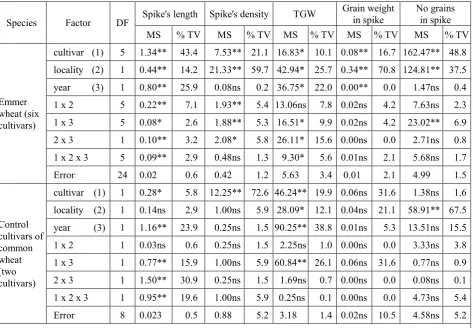
The emmer wheat cultivars and the control cultivars could be divided into a number homogenous groups according to their similarity in respect of the two characteristics studied and evaluated. The emmer wheat spike length was statistically and obviously (p
< 0.01) influenced by the cultivar (43.4%), whereas the emmer wheat spike's density was mostly influenced by the locality (59.7%) (Table 3).
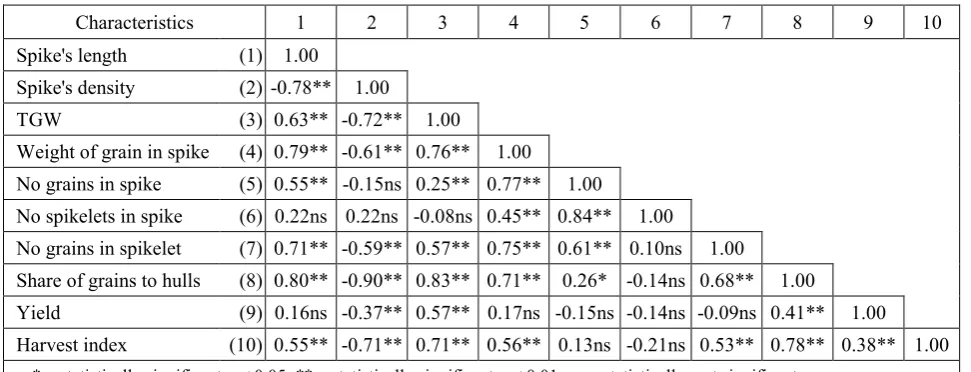
that of the control cultivars (Table 2) and it was positively correlated (r = 0.76) to the weight of grain in the spike (Table 5). The TGW was influenced by all the factors studied and evaluated (cultivar, locality, year) (p < 0.05) and the interaction of the factors (Table 3). The weight of grain in the spike of the emmer wheat cultivar was lower (0.60-0.86 g) than that of the control cultivars (1.14-1.26 g).
The number of grains and spikelets in the spikes of the emmer wheat cultivars was vari-able and statistically and obviously (p < 0.01) influenced by the cultivar (48.8%, resp. 60.6%) (Table 3). The number of grains in the spikes of Tapioszele 2, Kahler Emmer and No.8909 cultivars belong to the same homogenous group (p = 0.05) as the control cultivars (Table 2).
The cultivars were also divided into homogenous groups according to the number of spikelets in the spikes (Ruzyne and Vanek, SW Kadrilj resp. Tapioszele 2, Kahler Emmer
and SW Kadrilj). Two of the studied characteristics form a high positive correlation one to each other (r = 0.84) (Table 5).
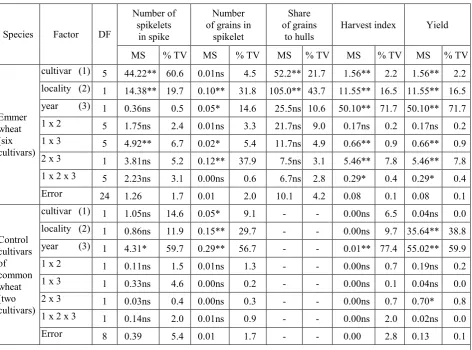
The number of grains in the emmer wheat two-flower spikelets was 1.63 to 1.72, being less variable than in the control cultivars (Vanek and SW Kadrilj), where the number of grains in the spikelets was highly influenced by the locality (29.7%) and year (56.7%) (Table 2).
[image:4.595.60.534.435.763.2]The share of grains to hulls varied between 72.63% and 78.75% in the case of the emmer wheat landraces. The cultivars are divided into three groups (p < 0.05): the influence of a factor achieves 21.7%. The locality (in particular the nutritive value of the soil) had the most important effect on the proportion of grain (43.7%), which showed a positive correlation (p < 0.05) to the spike's length (0.80), TGW (0.83) and the weight of grain in the spike (0.71). On the other hand, it was strongly negatively correlated to the spike density (r = -0.90).
Table 3. Influence of factors (cultivar, locality, year) on the spike productivity parameters by ANOVA
Species Factor DF Spike's length Spike's density TGW
Grain weight in spike
No grains in spike MS % TV MS % TV MS % TV MS % TV MS % TV
Emmer wheat (six cultivars)
cultivar (1) 5 1.34** 43.4 7.53** 21.1 16.83* 10.1 0.08** 16.7 162.47** 48.8 locality (2) 1 0.44** 14.2 21.33** 59.7 42.94* 25.7 0.34** 70.8 124.81** 37.5 year (3) 1 0.80** 25.9 0.08ns 0.2 36.75* 22.0 0.00** 0.0 1.47ns 0.4 1 x 2 5 0.22** 7.1 1.93** 5.4 13.06ns 7.8 0.02ns 4.2 7.63ns 2.3 1 x 3 5 0.08* 2.6 1.88** 5.3 16.51* 9.9 0.02ns 4.2 23.02** 6.9 2 x 3 1 0.10** 3.2 2.08* 5.8 26.11* 15.6 0.00ns 0.0 2.71ns 0.8 1 x 2 x 3 5 0.09** 2.9 0.48ns 1.3 9.30* 5.6 0.01ns 2.1 5.68ns 1.7 Error 24 0.02 0.6 0.42 1.2 5.63 3.4 0.01 2.1 4.99 1.5
Control cultivars of common wheat (two cultivars)
cultivar (1) 1 0.28* 5.8 12.25** 72.6 46.24** 19.9 0.06ns 31.6 1.38ns 1.6 locality (2) 1 0.14ns 2.9 1.00ns 5.9 28.09* 12.1 0.04ns 21.1 58.91** 67.5 year (3) 1 1.16** 23.9 0.25ns 1.5 90.25** 38.8 0.01ns 5.3 13.51ns 15.5 1 x 2 1 0.03ns 0.6 0.25ns 1.5 2.25ns 1.0 0.00ns 0.0 3.33ns 3.8 1 x 3 1 0.77** 15.9 1.00ns 5.9 60.84** 26.1 0.06ns 31.6 0.77ns 0.9 2 x 3 1 1.50** 30.9 0.25ns 1.5 1.69ns 0.7 0.00ns 0.0 0.08ns 0.1 1 x 2 x 3 1 0.95** 19.6 1.00ns 5.9 0.25ns 0.1 0.00ns 0.0 4.73ns 5.4 Error 8 0.023 0.5 0.88 5.2 3.18 1.4 0.02ns 10.5 4.58ns 5.2
FOR EMMER WHEAT BREEDING
The emmer wheat cultivars' harvest index was lower than that of the control cultivar. The cultivars studied are divided into four homogenous groups according to the LSD test results (p < 0.05) (Table 2): Tapioszele 2 (0.29), Horny Tisovnik (0.35) and Tapioszele 1 (0.38) belong to separate groups; the control cultivars Vanek (0.45) and SW Kadrilj (0.46) belong to the same group. The harvest index of each group was influenced by the year (in emmer wheat cultivars - 71.7%; in common wheat cultivars - 77.4%). The higher harvest index level was connected with the higher grain proportion in hulled spikelets (r = 0.78) (Table 5) and had a negative correlation with spike density (r = -0.71).
The yield level of emmer wheat landraces was lower (2.06-3.24 t.ha-1) than that of the control cultivars (4.30-4.40 t.ha-1). The LSD test results show that the emmer wheat
cultivars (a - Ruzyne and Kahler Emmer) are divided into different homogenous groups according to the influence of cultivar, locality and year factors, the same as the control cultivars (b). Four emmer wheat cultivars (Horny Tisovnik, Tapioszele 1, Tapioszele 2 and No. 8909) are represented in two homogenous groups (Table 2). The yield level was tested by analysis of variance
(ANOVA); it is statistically influenced (at p < 0.01) by the year (emmer wheat -
71.7%; common wheat - 77.4%). The influence and interaction of the other factors was negligible.
[image:5.595.66.539.414.764.2]The total grain yield of the emmer wheat cultivars showed a positive correlation to the proportion of grain (r = 0.78), TGW (r = 0.71) and spike's length (r = 0.55). The spike density was negatively correlated (r = -0.71) with grain yield (Table 5).
Table 4. Influence of factors (cultivar, locality, year) on the spike productivity's parameters,
harvest index and yield by ANOVA
Species Factor DF
Number of spikelets
in spike
Number of grains in
spikelet
Share of grains
to hulls
Harvest index Yield
MS % TV MS % TV MS % TV MS % TV MS % TV
Emmer wheat (six cultivars)
cultivar (1) 5 44.22** 60.6 0.01ns 4.5 52.2** 21.7 1.56** 2.2 1.56** 2.2 locality (2) 1 14.38** 19.7 0.10** 31.8 105.0** 43.7 11.55** 16.5 11.55** 16.5 year (3) 1 0.36ns 0.5 0.05* 14.6 25.5ns 10.6 50.10** 71.7 50.10** 71.7 1 x 2 5 1.75ns 2.4 0.01ns 3.3 21.7ns 9.0 0.17ns 0.2 0.17ns 0.2 1 x 3 5 4.92** 6.7 0.02* 5.4 11.7ns 4.9 0.66** 0.9 0.66** 0.9 2 x 3 1 3.81ns 5.2 0.12** 37.9 7.5ns 3.1 5.46** 7.8 5.46** 7.8 1 x 2 x 3 5 2.23ns 3.1 0.00ns 0.6 6.7ns 2.8 0.29* 0.4 0.29* 0.4 Error 24 1.26 1.7 0.01 2.0 10.1 4.2 0.08 0.1 0.08 0.1
Control cultivars of common wheat (two cultivars)
cultivar (1) 1 1.05ns 14.6 0.05* 9.1 - - 0.00ns 6.5 0.04ns 0.0 locality (2) 1 0.86ns 11.9 0.15** 29.7 - - 0.00ns 9.7 35.64** 38.8 year (3) 1 4.31* 59.7 0.29** 56.7 - - 0.01** 77.4 55.02** 59.9 1 x 2 1 0.11ns 1.5 0.01ns 1.3 - - 0.00ns 0.7 0.19ns 0.2 1 x 3 1 0.33ns 4.6 0.00ns 0.2 - - 0.00ns 0.1 0.04ns 0.0 2 x 3 1 0.03ns 0.4 0.00ns 0.3 - - 0.00ns 0.7 0.70* 0.8 1 x 2 x 3 1 0.14ns 2.0 0.01ns 0.9 - - 0.00ns 2.0 0.02ns 0.0 Error 8 0.39 5.4 0.01 1.7 - - 0.00 2.8 0.13 0.1
Table 5. Correlation analysis of the evaluated characteristics (6 emmer wheat cultivars)
Characteristics 1 2 3 4 5 6 7 8 9 10
Spike's length (1) 1.00
Spike's density (2) -0.78** 1.00
TGW (3) 0.63** -0.72** 1.00
Weight of grain in spike (4) 0.79** -0.61** 0.76** 1.00
No grains in spike (5) 0.55** -0.15ns 0.25** 0.77** 1.00
No spikelets in spike (6) 0.22ns 0.22ns -0.08ns 0.45** 0.84** 1.00
No grains in spikelet (7) 0.71** -0.59** 0.57** 0.75** 0.61** 0.10ns 1.00
Share of grains to hulls (8) 0.80** -0.90** 0.83** 0.71** 0.26* -0.14ns 0.68** 1.00
Yield (9) 0.16ns -0.37** 0.57** 0.17ns -0.15ns -0.14ns -0.09ns 0.41** 1.00 Harvest index (10) 0.55** -0.71** 0.71** 0.56** 0.13ns -0.21ns 0.53** 0.78** 0.38** 1.00
* = statistically significant p < 0.05; ** = statistically significant p < 0.01; ns = statistically not significant.
DISCUSSION
In relation to spike productivity, the emmer wheat cultivars are characterised by a lower number of grains in the spike and lower weight of spike than the modern common wheat cultivars (Konvalina, 2009). Their spikes are dense and short; the lower grain's weight in spike is partially compensated for by a higher number of productive stalks per area unit (Stehno et al., 2008). The positive correlation between the number of grains in the spike and the spike weight may contribute to an enhancement of spike productivity. The TGW is influenced by the interaction of the genotype and the environment (Petr, 1980). The TGW of the emmer wheat cultivar is lower than that of the modern common and durum wheat cultivar (Marconi and Cubadda, 2005); the common wheat TGW increased from 31-38 g to 42-47 g during the breeding process (Lekeš, 1997). An increase in TGW is desirable and favourable, as it is positively correlated to other spike productivity characteristics and to the total yield level.
The number of spikelets in the spike of the emmer wheat cultivar varied from 11.0 to 16.7, whereas the number of grains varied from 1.6 to 1.7 grains/two-flower spikelet. The number of spikelets in the spike of the control soft wheat cultivar was low; the same as the number of grains in the three-flower spikelet - SW Kadrilj (1.9) and Vanek (2.0).
The spike productivity of modern cultivars was reduced, as it responded to the nutritive conditions of the plots (Krejčířová et al., 2006; Capouchová et al., 2008; Krejčířová et al., 2008). The station with more nutritive soil was characterised by a higher number of grains in the spikelets in the growing season, but a lower number of grains in spikelets in the post-flowering period. This is confirmed by Petr (1980). The emmer wheat landraces proved to be better able to express their yield potential in the low-input farming systems.
The emmer wheat cultivars had a relatively high harvest index level (0.29-0.38 on average), but not at the level of the bred common (Sehnalová, 1990) or durum (Marconi and Cubbada, 2005) wheat cultivars. The harvest index level of control cultivars (0.45, resp. 0.46) was reduced by the lack of nutrients in the period of grain filling (Baresel, 2006, in Wolfe et al., 2008) and a lower efficiency of root system (Trčková et al., 2005). Therefore, the emmer wheat could be a suitable crop for marginal areas and low-input farming systems (Castagna et al., 1996; Merezhko et al., 1997; Marconi and Cubadda, 2005).
CONCLUSIONS
FOR EMMER WHEAT BREEDING
dense spikes; this is important, as it is negatively correlated to the grain yield. An examination of the correlations shows that the more dense the spike is, the more the TGW, the weight of grain in spike, the number of grains in spikelet, and the share of grains to hulls are reduced. It also has an important effect on the reduction of the yield level. Therefore, the breeding of cultivars should focus on the selection of material having long lax spikes and a higher TGW.
The yield level was seriously reduced by a lower ability to use the assimilates for the growth of generative organs, which is reflected by the lower harvest index. Our research shows the selection of the cultivars having long lax spikes, high TGW, high weight of grain in spike and high number of grains in spike could have a positive effect on the harvest index level.
Acknowledgement
The study has been supported by the grant of the National Agency for the Agricultural Research of the Ministry of Agriculture of the Czech Republic (QH 82272) and the Research project of the Ministry of Education, Youth and Sports of the Czech Republic (MSM 6007665806).
REFERENCES
Akçura, M., 2009. Genetic variability and interrela-tionship among grain yield and some quality traits
in Turkish winter durum wheat landraces. Turk
J. Agric For., 33: 547-556.
Bareš, I., Vlasák, M., Stehno, Z., Dotlačil, L., Faberová, I., Bartoš, P., 2002. 50 let studia genofondu pšenice (rodu Triticum L.) ve Výzkumném ústavu rostlinné výroby v Praze-Ruzyni (The 50th years of study of Triticum L. in
Crop Research Institute in Prague – In Czech).
Genetické zdroje, 86: 43-57.
Brown, T.A., 1999. How ancient DNA may help in understanding the origin and spread of
agriculture. Philosophical Transaction of the Royal
Society of London, 354: 89-98.
Capouchová, I., Bicanová, E., Petr, J., Krejčířová, L., Faměra, O., 2008. Effects of organic wheat cultivation in wider rows on grain yield and
quality. Scientia Agriculturae Bohemica, 39: 1-5.
Castagna, R., Minoia, C., Porfiri, O., Rocchetti, G., 1996. Nitrogen level and seeding rate effect on the
performance of hulled wheats (Triticum
monococcum L., T. dicoccum Schubler and T.
spelta L.) evaluated in agronomic environments. J.
Agron. Crop Sci., 176: 173-181.
Collins, W.W., Hawtin, G.C., 1999. Conserving and using crop plant biodiversity in agroecosystems.
In: Collins, W.W., Qualset, C.O. (Eds.) Biodiversity in agroecosystems. CRC Press, Boca Raton, Florida: 267-282.
Davood, A., Ashkboos, A., Mohammad, F., Dayorsh, S., Bahram, N., 2004. Evaluation of Salinity Tolerance in Landrace Wheat Germplasms of
Cereals Research Collection Department. Isfahan
Agricultural and Natural Resources Research Center Publisher.
Dengcai, L., Youliang, Z., Xiujin, L., 2003. Utilization
of wheat landrace Chinese Spring in breeding.
Scientia Agricultura Sinica, 36: 1383-1389. Dotlačil, L., 2002. Genetické zdroje a jejich význam
pro šlechtění rostlin a setrvalý rozvoj zemědělství (Genetic resources and their use in breeding and
sustainable farming – In Czech). Genetické zdroje,
87: 5-1.
Ehdaie, B., Hall, A. E., Farquhar, G.D., Nguyen, H.T., Waines, J.G., 1991. Water-use efficiency and
carbon isotope discrimination in wheat. Crop Sci.,
31: 1282-1288.
Ehdaie, B., Waines, J.G., Hall, A.E. 1988. Differential responses of landrace and improved spring wheat
genotypes to stress environments. Crop Sci., 28:
838-842.
Hammer, K., Perinno, P., 1995. Plant genetic resources in South Italy and Sicily: studies towards in situ
and on farm conservation. Plant Genetic Resources
Newsletter, 103: 19-23.
Herrera-Foessel, S.A., Singh, R.P., Huerta-Espino, J., Yuen, J., Djurle, A. 2005. New Genes for Leaf
Rust Resistance in CIMMYT Durum Wheats. Plant
Disease, 89: 809-814.
Konvalina, P., 2009. Vhodnost jarních pšenic Triticum dicoccum (Schrank) Schuebl a Triticum aestivum L. pro low input a ekologické systémy hospodaření.
Disertační práce. Jihočeská univerzita v Českých
Budějovicích, Zemědělská fakulta, České Budějovice, p. 171.
Konvalina, P., Moudrý, J. jr., Moudrý, J., 2008. Quality
parametres of emmer wheat landraces. Journal of
Central European Agriculture, 9: 539-545.
Kotschi, J., 2006. Agrobiodiversity vital in adapting to
climate change. Appropriate Technology, 33:
63-66.
Krejčířová, L., Capouchová, I., Bicanová, E., Faměra, O., 2008. Storage protein composition of winter
wheat from organic farming. Scientia Agriculturae
Bohemica, 39: 6-11.
Krejčířová, L., Capouchová, I., Petr, J., Bicanová, E., Kvapil, R., 2006. Protein composition and quality of winter wheat from organic and conventional
Lekeš, J., 1997. Šlechtění obilovin na území
Československa. Brázda, Praha.
Marconi, M., Cubadda, R., 2005. Emmer wheat. In: Abdel-Aal, E-S. M., Wood, P. (Eds.), Speciality grains for food and feed American Association of Cereal Chemists, Inc. St. Paul, Minesota: 63-108. Merezhko, A.F., Filatenko, A. A., Funtov, K.A., 1997.
The diversity of Triticum dicoccum. Schuebl. for
use in cool, wet regions of Europe. In: Proocedings
of COST 814 Workshop on Small Grain Cereals and Pseudo-Cereals: 38-51.
Nielsen, A.F., Mortensen, J.V., 1998. Ŕkologisk dyrkning af emmer og kćmpedurum (Ecological
cultivation of Emmer and Giant Durum - In
Danish). Gron Viden Markbrug, 195: 197-199. Oliver, R.E., Stack, R.W., Miller, J.D., Cai, X., 2007.
Reaction of wild emmer wheat accessions to
fusarium head blight. Crop Sci., 47: 893-899.
Olsen, C.C., 1998. Gample kornarten – dyrkning af emmer og durumhvede unden pesticider (Old cereal species - growing emmer and durum wheat
withou pesticides - In Danish). Gron Viden
Markbrug, 194: 194-196.
Petr, J., 1980. Tvorba výnosu hlavních polních plodin
(Yield formation of the main crops – In Czech).
SZN, Praha.
Reddy, M.M., Yenagi, N.B., Rao, M., Srinivasan, C.N., Hanchinal, R.R., 1998. Grain and gluten quality of some cultivars of wheats species and their suitability for preparation of traditional South
Iindian sweet products. Food Sci. Technol., 35:
441-444.
Sehnalová, J., 1990. Evaluation of significant biological features in the genetic resources of cultivated emmer wheat (Triticum dicoccum
Schrank). Polnohospodárstvo, 36: 777-785.
Stehno, Z., Konvalina, P., Dotlačil, L., 2008. Metodika pěstování pšenice dvouzrnky (Emmer wheat
growing – In Czech). VÚRV, Praha.
Trčková, M., Raimanová, I., Stehno, Z., 2005.
Differences Among Triticum dicoccum, T. monococcum and T. spelta in Rate of Nitrate
Uptake. Czech J. Genet Plant Breed., 41: 322-324.
Wolfe, M.S., Baresel, J.P., Deslaux, D., Goldringer, I., Hoad, S., Kovacs, G., Löschenberger, F., Miedaner, T., Ostergard, H., Lammerts van Bueren, E.T., 2008. Developments in breeding cereals for
organic agriculture. Euphytica, 163: 323-346.
Yücel, C., Özkan, H., Ortaş, I., Yağbasanlar, T., 2009.
Screening of wild emmer wheat accessions (Triti-cum turgidum subsp. dicoccoides) for mycorrhizal