The Logic of Divinatory Reasoning
MSc Thesis
(Afstudeerscriptie)
written byAafke de Vos
(born 02-09-1989 in Oud-Beijerland, The Netherlands)
under the supervision of Prof. Dr. Michiel van Lambalgen and Prof. Dr. Martin Stokhof, and submitted to the Board of Examiners in partial
fulfillment of the requirements for the degree of
MSc in Logic
at the Universiteit van Amsterdam.
Date of the public defense: Members of the Thesis Committee: June 9, 2017 Prof. Dr. Michiel van Lambalgen
Prof. Dr. Martin Stokhof Prof. Dr. Jeroen Groenendijk Dr. Maria Aloni
Abstract
Acknowledgements
First of all, I am very grateful to my supervisors Michiel van Lambalgen and Martin Stokhof. Michiel’s passionate teaching of the course ‘Rational-ity, Cognition and Reasoning’ triggered my interest in human reasoning. I remember that during our first appointment, I told Michiel about my wish to contribute to the field. He provided me an, yet unpublished, article of Keith Stenning and Thomas Widlok and this is where my investigation of divinatory reasoning began. Although writing this thesis has not been easy, Michiel always kept believing in me and helped me by sharing his interesting insights. Furthermore, he offered me the opportunity to travel to Oxford to meet David Zeitlyn, which has been a breakthrough for my research. I cannot express how grateful I am for getting this opportunity. Martin has been an excellent academic mentor during my Master of Logic and I was very happy that he wanted to co-supervise my thesis project. His calmth and constructive feedback have been of great help.
Secondly, I wish to express my deep gratitude to David Zeitlyn, who introduced me to the fascinating world of anthropology and taught me a lot about the Mambila and their divination practice. Since my number one problem was a ‘lack of data’, David’s offer to collect extra data for me in Somi´e was a very welcome surprise. When I visited him at Oxford University, David emptied almost his whole agenda for four days and together we worked through the videos and recordings of Mambila spider divination. During the process, which I truly enjoyed, I got an impression of what antropological fieldwork involves. It made me respect David’s work even more. David has been a great inspiration to me.
I would like to thank Tanja Kassenaar for helping me during difficult times in the research process, and Keith Stenning for the discussion we had in Michiel’s office.
Contents
1 Introduction 5
2 Studies of reasoning among illiterates 7
2.1 The studies of Luria and Scribner . . . 7
2.2 The work of Counihan . . . 9
2.3 Reasoning with contradictions in primitive cultures . . . 15
3 Inferential Erotetic Logic 16 3.1 The syntax of IEL . . . 16
3.2 The semantics of IEL . . . 20
4 The modelling language L∗ 26 5 Divinatory practice in the laboratory 28 5.1 The experiment of McHugh . . . 28
5.2 Formalization of Dialogue A . . . 29
5.3 Formalization of Dialogue B . . . 31
5.4 Formalization of Dialogue C . . . 33
6 Divinatory practice in the wild 36 6.1 Mambila spider divination . . . 36
6.2 Divining about illness . . . 38
6.3 Formalization of Dialogue D . . . 40
6.4 Formalization of Dialogue E . . . 46
7 Divinatory reasoning in the laboratory and in the wild 53 7.1 A conceptual comparison . . . 53
7.1.1 Divination as dialogue . . . 53
7.1.2 The authority of the oracle . . . 53
7.1.3 Different types of questions . . . 54
7.1.4 Dealing with contradictions . . . 56
7.2 Analyzing the formalizations . . . 70
7.2.1 The value of formalizing . . . 70
7.2.2 Analyzing the formalizations with IEL . . . 71
8 Conclusion and further research 76 8.1 Conclusion . . . 76 8.2 Further research . . . 77
1
Introduction
Many studies of reasoning in illiterate subject populations that have focussed on syllogistic-style tasks, provide a negative account of reasoning. For ex-ample, Alexander Luria [7] concludes that illiterate subjects do not grasp “the logic of the syllogism”. Marian Counihan [2] provides a more positive account of reasoning, by arguing that logical aspects of illiterate reasoning performance have been neglected. “The logic of the syllogism” does not ex-ist, since the logic of a task is always relative to an interpretation of the premises. She agrees with Stenning and Van Lambalgen [11] that logical form is not given but, instead, the result of an interpretative process. In this light, differences in reasoning performance can be explained by differences in interpretation. The fact that syllogistic premises usually do not resemble nat-urally occurring discourse explains why illiterates have difficulties in drawing conclusions in syllogistic-style tasks. Interestingly, Counihan [2] shows that in another reasoning task, the suppression-effect task, illiterate subjects and literate subjects behave surprisingly similar. These similarities and differ-ences in reasoning performance between illiterate and literate subjects form the starting point of my research.
Although the research on performance in reasoning tasks is useful, in my view it is important to study illiterate reasoning performance in natural practices as well. Solving reasoning tasks may be very unnatural for illit-erate subjects, because reasoning is essentially goal-oriented and illitillit-erates have never learned to reason with the goal of solving exercises an sich. Lu-cien L´evy-Bruhl [6] studied data of reasoning performance in “the wild”. He concluded that the primitive mind does not address contradictions and is in a pre-logical stage of thinking. However, I believe that L´evy-Bruhl’s focus on classical logic caused him to overlook the reality of natural practice as well as the stage of “reasoning to an interpretation”. By studying and modelling a reasoning practice in a primitive society, using the multiple logics program of Stenning and Van Lambalgen [11], my aim is to gain new insights into the interpretive processes. I have chosen to focus on Mambila spider divina-tion. According to Zeitlyn [16–21], who obtained field data of this type of divination, it is deeply embedded in the illiterate1 Mambila community.
1The Mambila community is not strictly illiterate. Nowadays, most children and young
A Mambila diviner consults a spider by asking a binary question in a particular setting. Subsequently, the movements of the spider result in a pattern of leaves which determines the answer to the question. Zeitlyn has recorded several divination sessions, which consist of many questions and answers. By analyzing the field data both conceptually and formally, my aim is to investigate the reasoning of the Mambila diviners. Typical of this type of divination is that a question can be regarded as the conclusion of a reasoning process. For, the diviner reasons to a new question by taking into account the answers to earlier questions and other knowledge. Therefore, I will formalize the data with Inferential Erotetic Logic, a logic developed by Andrzej Wi´sniewski [14, 15] that regards inferences in which questions can be seen as conclusions.
Sometimes several different spiders are consulted simultaneously, which allows for a consistency check by asking the same question to different spi-ders. In some cases such a consistency check leads to a contradiction. Since classical logic rejects the acceptance of a contradiction, I will particularly study the diviners’ “reasoning to an interpretation” in these cases.
Interestingly, Zeitlyn [17] uses an American laboratory experiment per-formed by McHugh [8] and reanalyzed by Garfinkel [4] to study and explain divination from a cultural more familiar point of view. The experiment re-sembles the process of Mambila spider divination, and therefore it is valuable for studying the similarities and differences between the reasoning perfor-mance of subjects with different literacy levels. I will investigate the logical aspects of divinatory reasoning, by analyzing and comparing the data of the experiment and the data of Mambila spider divination. This analysis will be both conceptual and formal. Furthermore, special attention will be given to the responses to contradiction.
2
Studies of reasoning among illiterates
In this chapter, I will discuss several studies that have been conducted on the reasoning of illiterate people.
2.1
The studies of Luria and Scribner
Together with his colleagues the Soviet psychologist Luria collected his ob-servational data in 1931 and 1932, during the Soviet Union’s most radical restructuring [7, p.v]. In those days, schools for adults were introduced in remote regions of Uzbekistan and Kirghizia in order to eliminate illiteracy, to create a collectivist economy and readjust the daily life to new socialist prin-ciples. Luria made two expeditions to these regions to investigate in what way the radical changes, among others the elimination of illiteracy, would influence the cognitive activity of individuals. The fifty-five subjects that participated in the experiment were all adults. Of them, twenty-six were illiterate. Ten subjects had very little education and could barely read and write. Seven subjects were young students, and twelve students were also young but had attended school for just one or two years before they started working. Luria tested his subjects on different cognitive activities, including the cognitive activity of reasoning. Within reasoning, Luria’s experimen-tal material consisted of mainly syllogistic-style tasks with a quantified or generalised major premise and a particular statement as the minor premise, followed by a question. An example is given below.
In the Far North, where there is snow, all bears are white. Novaya Zemlya is in the Far North and there is always snow there. What color are the bears there? [7, p.108]
After his expeditions, Luria went back to Moscow where he made some public descriptions of his findings. However, due to their politically sensitive nature these were not well received. Therefore he did not publish them until much later, namely in 1974 [7, p.xiv]2.
Scribner investigated the performance in reasoning tasks of the Kpelle and Vai peoples in the 1970s and 1980s. The seventy-two Kpelle subjects that participated in her first study were all adults. Half of them were illiterate and
2Note that the publication of 1974 was in Russian. For this study the English
the other half were young adults attending a junior high school. Comparable problems were presented to young adults living in New York. All of the forty-eight Vai subjects that participated in her second study were illiterate adults. Scribner’s experimental material within reasoning also consisted of mainly syllogistic-style tasks. Most of the syllogisms were of the same form as those of Luria. One of Scribner’s tasks, which she used to test the Kpelle people, is quoted below as an example.
All houses in Kpelleland are made of iron. My friend’s house is in Kpelleland. Is it made of iron? [10, p.110]
Luria classifies the responses of illiterate subjects to the syllogistic-style reasoning problem into two categories. This classification has been confirmed by Scribner. The first category of responses involves a denial to answer the question due to the lack of personal knowledge of the premises. For example, let us consider the following task Scribner used to test the Kpelle people.
All Kpelle men are rice farmers. Mr. Smith is not a rice farmer. Is he a Kpelle man? [10, p.110]
One subject (S) responded in the following way to the experimenter (E).
S: I don’t know the man in person. I have not laid eyes on the man himself.
E: Just think about the statement.
S: If I know him in person, I can answer that question, but since I do not know him in person I cannot answer that question. E: Try and answer from your Kpelle sense.
S: If you know a person, if a question comes up about him you are able to answer. But if you do not know the person, if a question comes up about him, it’s hard for you to answer it. [10, p.133]
Both Luria and Scribner report this response as most common. The second category involves a specific formulation of the premises in order to align them with personal knowledge or conventional wisdom [2, p.36]. This response seems to arise only after repeated questioning by the experimenter, which we can see in the example below.
One subject (S) responded in the following way to the experimenter (E).
S: I don’t know. E: Think about it.
S: I’ve only been in the Kashgar country; I don’t know beyond that...
E: But on the basis of what I said to you, can cotton grow there? S: If the land is good, cotton will grow there, but if it is damp and poor, it won’t grow. If it’s like the Kashgar country, it will grow there too. If the soil is loose, it can grow there too, of course. [7, p.108]
From the response patterns Luria draws the conclusion that illiterate reason-ers are unable to think logically; they simply deny the formal information in the syllogism. Since the reasoning of schooled subjects, even those with a very minimal education, does reflect the logical structure of the syllogisms, he concludes that literacy has a deep impact on human reasoning. Scribner, on the other hand, draws a less black-and-white conclusion. She notes that al-though some illiterate subjects handle the syllogistic problems “empirically” and others handle them “theoretically”, most subjects have a “mixed strat-egy”; they sometimes rely on the formal information in the syllogism and sometimes on experience [10, p.134]. She suggests that “the factual status of the information supplied in the premises” influences in what way subjects handle the syllogism, but does not specify this relation further.
2.2
The work of Counihan
Counihan doubts whether Luria’s and Scribner’s response profiles truly rep-resent the (un)ability of illiterate people to reason logically. She suggests that the peculiarities of the particular tasks could have led to a particular in-terpretation of the premises that is not necessarily connected with illiteracy. Before I will explain Counihan’s research, I will shortly describe the view of Stenning and Van Lambalgen [11], since this plays an important role.
normative, they believe that logic does not provide absolutely valid norms. Instead, logical norms relate to particular domains. There is not one true logic; we need multiple logics to model reasoning processes [11, pp.25-41]. Examples are classical propositional logic, fuzzy logic, intuitionistic logic, probability theory, deontic logic and Logic Programming. This latter logic, which is also called “planning logic”, is nonmonotonic in the sense that infer-ences that were valid in one state, can become invalid when new information becomes available. It is the most prominent logic for Stenning and Van Lambalgen, who believe that reasoning developed out of planning.
Inspired by Stenning and Van Lambalgen, Counihan wants to investigate under what conditions the illiterate subjects adopt one or other interpreta-tion of the premises [2, p.37]. Counihan performed a new experiment with, among others, syllogistic-type tasks in order to compare the results with those gathered by Luria and Scribner. The subjects were residents of a small town on the coast of South Africa’s Eastern Cape. Of the twenty-nine sub-jects, six were illiterate, thirteen had less than ten years of education, and had been out of the education system for more than ten years, and ten had completed high school within the last twenty years. Note that in terms of literacy levels, the subjects are comparable to those of Luria and Scribner. The syllogistic-style materials of Counihan were comparable as well.
Although the illiterate South African subjects had a lifestyle very different from those of the subjects of Luria and Scribner, the data on syllogisms are strikingly comparable. Counihan’s data show responses that would be identified by Luria as typically illiterate, albeit on a lesser scale [2, p.73]. However, Counihan questions the categories of response identified by Luria and confirmed by Scribner. With respect to the first category, the ‘denial to answer the question’, she wants to know why the subjects refuse to reason with the given premises, and if this reaction is only observed in illiterate subjects. She wonders whether the refusal to reason with the premises is related to particular materials and inferences. With respect to the second category, the ‘specific formulation of premises’, Counihan wonders what the interpretation is of the quantified statement assumed by the subject. She is curious if the interpretation of the quantifier varies across materials, and if so, if it does so consistently across subjects and/or groups [2, p.44].
structure for the intended, “logical” interpretation with normal question-answer structure. She notes that in daily life there is epistemic asymmetry involved in the asking of a question: by asking a question, the questioner indicates that he does not know the answer but expects the addressee to know the answer. In a syllogistic-style task the subject is expected to answer on the basis of information that is given by the questioner himself, hence the epistemic asymmetry does not hold. This confuses subjects who have not received schooling [2, p.54]. In the light of this confusion, differences in performance between schooled and unschooled subjects might say something about the influence of schooling on the broadening of interpretations. A sub-ject who does not have school-trained eyes might interpret the question in a normal (namely epistemically asymmetric) way, meaning that the experi-menter wants information from him that he does not have himself. And what else than the subject’s own knowledge can help him to provide the requested information? If the experimenter would have had the information himself, he would not have had to ask the question at all.
accep-Inference type First set Second set Third set
Modus Ponens (MP) 96% 96% 38%
Modus Tollens (MT) 92% 96% 33%
Denial of the antecedent (DA) 46% 4% 63%
[image:13.612.113.481.125.199.2]Affirmation of the consequent (AC) 71% 13% 54%
Table 1: Rates of inference in the suppression effect task [1]
tance percentage of MP in the group which gets the simple set of materials equals that of the group which gets the alternative condition but is much higher than that of in the group with the additional condition. A similar pattern can be seen regarding MT. The acceptance percentages of DA and AC, on the other hand, are much lower in the group that gets the alternative condition than in the other two groups. Hence the presence of certain ex-tra conditional premises decreases the rates of inference. This phenomenon is called the “suppression effect”. The suppression effect was considered by Byrne as evidence that subjects do not use logical rules in drawing inferences. However, according to Counihan we should beware of drawing conclusions from the patterns in the rates of inference, since it has been shown that the combined premises in the suppression task lead to a wide range of responses that are far from ‘correct’ or uniform. Because the existing data have been collected only in schooled population, she extends her study of reasoning performance of unschooled subjects with suppression task materials. This examination is merely exploratory, since the suppression task elicits neither ‘correct’ nor uniform responses from schooled subjects and a comparison of the data across groups would therefore be difficult [2, p.61].
In comparison to the syllogistic-style materials, the suppression-effect task results show a more similar response between schooled and unschooled sub-jects [2, p.73]. Less subsub-jects from the unschooled group reacted on the sup-pression task in a way that Luria would call ‘denial to answer the question’ or ‘specific formulation of premises’. Such response was even relatively more common among the schooled subjects.
If A, and nothing abnormal is the case, then B, [2, p.74]
where what is abnormal is provided by the context” [11, p.163]. For example, let us consider the following task Counihan used in her investigation.
If Ntombi wants to see her boyfriend, then she goes to East Lon-don. And she does want to see her friend. Will she go to East London? [2, p.67]
The initial response of one subject was as follows:
S: How will I know? I Don’t know.
This type of response makes sense when the conditional “If Ntombi wants to see her boyfriend, then she goes to East London” is understood as a more generic habitual relationship, allowing for exceptions, in other words something like: “If Ntombi wants to see her boyfriend and nothing else is going on, then she goes to East London” [2, p.65]. Counihan argues that there is much evidence that subjects interpreted the conditional as abnormality-sensitive. Other subjects that seem to ‘deny’ to answer the question can be seen to interpret the conditional as including a (necessary) precondition.
Looking at those subjects of which Luria would say that they adopt a ‘specific formulation of premises’, Counihan argues that they seem to inter-pret conditional premises as being temporally-bound. For example, let us consider the following task Counihan used in her investigation.
If Thembi has to fetch water then she goes down to the river. She has to fetch water. Where will you look for her?
The subject (S) responded in the following way to the experimenter (E):
S: If at home they said she’s not there, I’ll go to the river. E: Where will you look for her? Where do you think she is? S: Sometimes, she has to go to the river to fetch water. Thembi sometimes goes to the river, maybe in the afternoon or the morn-ing. When I see her going to the river, maybe in the morning, I’ll go to her then and see her.
According to Counihan, the abnormality-sensitive and temporally-bound nature of natural language conditionals strongly undermine Luria’s conclu-sions that subjects rejected or ignored the given premises or their logical structure [2, p.74]. Furthermore, focusing on syllogistic-type tasks leads to overestimation of the differences in reasoning behavior between literates and illiterates. Counihan argues that the first response of all subjects, regardless of their literacy level, to task material is not acceptation or rejection but in-terpretation. It seems to depend on the task material whether or not literacy level influences the reasoning to an interpretation.
Counihan’s investigation has made clear that the difficulties that less schooled subjects experience in reasoning tasks like the syllogistic-style task originate from interpretation problems. She performs a semantic analysis of the syllogistic-style task and concludes that “the difference between subject groups can be explained in terms of their ease in ignoring certain parameters of ‘normal’ interpretation, such domain specification precedingall-usage” [2, p.135]. According to Counihan, this indicates that logical aspects of illiterate performance have been overlooked because of the lack of attention to the semantic structure of reasoning tasks. Literacy might be “a broadening of ways of interpreting linguistic materials” [2, p.135].
2.3
Reasoning with contradictions in primitive cultures
Since in Mambila spider divination the obtainment of contradictory answers is not uncommon, I will shortly discuss the traditional literature about rea-soning with contradictions in primitive cultures.
In the early twentieth century, anthropologist L´evy-Bruhl argued that primitive cultures have a different way of thinking: the “primitive mind”. In his workHow Natives Think, L´evy-Bruhl [5] presented the “law of participa-tion”. According to this theory, in the mind of primitive people, one thing may at the same time be something else. His idea was based on a finding of anthropologist Karl Von den Steinen, who reported that the members of a Brazilian tribe, the Borono, claimed to be araras (a type of parrot) as well as humans. L´evy-Bruhl concluded that the primitive mind does not address contradictions. Primitive cultures do not subscribe to universal laws of logic, including the principle of non-contradiction, and are in a pre-logical stage of thinking [6]. In his book Primitive Mentality, L´evy-Bruhl writes:
“To primitive mentality the law of contradiction does not exercise the same influence on the connection of ideas as it does on ours.” [6, p.101]
3
Inferential Erotetic Logic
Before we can study the data of spider divination in the Mambila commu-nity as well as the data of McHugh’s experiment, we have to find a logic that is suitable for formalizing it. Both practices involve the asking of bi-nary questions by an operator and the receiving of answers which provide the operator ‘knowledge’. The operator uses earlier gained knowledge to reason and finally arrive at a new question. It is this process of ‘reasoning to a question’ or ‘arriving at a question’ that is of interest in this study, since I want to reveal the reasoning that is going on in the divinatory practices. The ‘arriving at a question’ can be seen as ‘arriving at a conclusion’: based on a set of premises, the questioner performs some thought processes and ar-rives at a question. Wi´sniewski [14, 15] developed Inferential Erotetic Logic (IEL) to study inferences in which questions perform the role of conclusions. He defines an erotetic inference as “a thought process in which we arrive at a question on the basis of some previously accepted declarative sentences and/or a previously posed question” [15, p.3]. Since IEL gives us the oppor-tunity to study how diviners ‘reason to’ a question (how they use answers to previous questions as well as the rules from their knowledgebase) it is a promising candidate for modelling divinatory practice. In this section, I will elaborate on the syntax and semantics of IEL.
3.1
The syntax of IEL
First of all, I will introduce the basic terminology and notation according to Wi´sniewski [14, pp.34-37]. Let J be an arbitrary fixed first-order language with identity. Let N be the set of positive integers. The vocabulary of the language J contains the logical constants: ¬ (negation), → (implication), ∨
(disjunction), ∧ (conjunction), ≡ (equivalence), ∀ (universal quantifier), ∃
(existential quantifier), and the identity symbol =. Furthermore the vocabu-lary of J contains an infinite list of individual variables x1, x2, ..., an infinite
list of individual constants a1, a2, ...and for eachn∈N, an infinite list ofn
-place predicate symbols P1n, P2n...and an infinite list of n-argument function symbols F1n, F2n.... In addition, the vocabulary of J contains the auxiliary symbols (, ) (parentheses) and , (comma). Now we have presented the basic vocabulary, several basic syntactic concepts need to be introduced:
• The set ofterms of the languageJ is the smallest set which contains all the individual variables of J together with all the individual constants of J and fulfills the following condition: ift1, ..., tnare terms ofJ, then
an expression of the form Fn
i (t1, ..., tn), where Fin is a function symbol
of J, is also a term of J.
• A closed term, or name, is a term with no individual variables.
• Atomic formulas of J are expressions of J of the form t1 = t2 and of
the form Pin(t1, ..., tn) wheret1, t2..., tn are terms.
• The set ΓJ ofdeclarative well-formed formulas (d-wffs) of the language
J is the smallest set containing all the atomic formulas of J and having the following properties: (a) if Ais in ΓJ, then expressions of the form
¬A, ∀xiA, ∃xiA are also in ΓJ; (b) if A,B are in ΓJ, then expressions
of the form (A→B), (A∨B), (A∧B), (A≡B) are also in ΓJ.
• The d-wffs not containing free variables are called sentences.
• The d-wffs containing free variables are called sentential functions.
Each subset of the vocabulary of the language J which contains the connec-tives ¬ and →, the universal quantifier ∀, both parentheses, all individual variables, at least one predicate symbol, the identity symbol = and possible some other signs, such as other predicate symbol(s), the connectives ∨, ∧,
≡, the quantifier∃, individual constant(s), function symbol(s) or the comma will be called here afirst-order language with identity. The concepts of term, closed term, atomic formula, declarative well-formed formula, sentence and sentential function, as well as the remaining syntactic concepts are defined for J in the same way as for any first-order language with identity.
Before we can define questions in IEL in syntactic terms, we need to add some signs to the vocabulary according to Wi´sniewski [14, p.71]. Amongst them are theerotetic constants: the symbols ?,{}, S, O, U, W, T. Other signs we need to add are the technical signs: | (stroke) and ,(comma). We will define the concept of question for some class of formalized languages, namely the class consisting of:
(b) first-order languages with identity whose vocabularies contain infinitely many closed terms3, enriched with: the erotetic constants ? and {}, at least one of the following constants: S, O, U, W, T, and, if necessary, the technical sign | (stroke);
(c) first-order languages with identity whose vocabularies contain at least two closed terms and some unary predicate symbols which perform the role of category qualifiers, enriched with: the erotetic constants ? and{}, at least one of the following erotetic constants: S, O, U, and the technical signs [, ] (square brackets), /(slash).
Let L be an arbitrary but fixed language for which we want to define here the concept of question, that is, an arbitrary but fixed language which fulfills at least one of the conditions (a), (b) and (c) above.
Aquestion of the first kind of the languageL is an expression of the form ?{A1, ..., An}where n >1 andA1, ..., An are syntactically distinct sentences
of L [14, p. 72]. If ?{A1, ..., An} is a question of the first kind, then the
sentencesA1, ..., Anare calleddirect answers to the question. Note that each
question of the first kind has at least two direct answers, because n > 1. The set of all direct answers to a question Q is denoted by dQ [14, p.101]. The following question is an example of a question of the first kind: “Is it raining, is it snowing or is it dry outside?”. Using a propositional language and interpreting the disjunction as an exclusive one, this can be modelled as ?{r, s, d}wherer:=it is raining outside, s:=it is snowing outside and d:=it is dry outside. Note that the three direct answers to the question are r, s
and d.
Since the rules of Mambila spider divination and the rules in McHugh’s experiment only allow for questions with two direct answers, my study will be restricted to questions of the form ?{A1, A2}. A commonly used type of
question of this form is a “yes-no question”. There are several different types of such “yes-no questions” [14, pp.73-74]:
• Simple yes-no questions, which are of the form ?{A,¬A}, where A is a sentence. This can be read “Is it the case that A?”. An example is the question “Do all polar bears live in the North Pole region?”. Using a first-order predicate language, this question can be modelled as
3This means that among the signs of the language there are: (a) infinitely
?{∀x(P(x)→N(x)),¬∀x(P(x)→N(x))} where P(x) :=x is a polar bear and N(x) :=x lives in the North Pole region.
• Focussed yes-no questions, of the form ?{A(xi/u),∃xi(Axi∧xi 6=u)},
where Axi is a sentential function with xi as the only free variable
and u is a closed term. This can be read “Is it u that fulfills the conditionAxi?”. An example of a focussed yes-no question is “Is it Luc
that has sent me this Valentine’s card?” Using a first-order predicate language, this question could be modelled as ?{V(l),∃x(V(x)∧x6=l}
whereV(x) :=xhas sent me this Valentine’s card andlis the constant that represents Luc. Note that both the way a question is asked and the context can influence whether a question is interpreted as a simple yes-no question or as a focussed yes-no question. The interpretation of the example above is straightforward, but the question “Has Luc sent me this Valentine’s card?” can be interpreted in different ways. When the question is uttered in spoken language, the intonation “Has
Luc sent me this Valentine’s card?” gives the same interpretation as the example above, whereas “Has Luc sent me this Valentine’s card?” is interpreted as the focussed yes-no question “Is it this Valentine’s card that has been sent by Luc?”. Since the divinatory data of the experiment is written, I do not know the intonation of the questions of the students.4 However, a lot of contextual information is provided, which helps us interpreting the questions. Suppose that some student participating in the experiment of McHugh tells the student counsellor that his problem is that he has so many girlfriends and that he needs to choose between them. He has received just one Valentine’s card and he wants to know who has sent this to him, since this knowledge could affect his decision. In the light of this information “Has Amy sent me this valentine’s card?” is interpreted as “Is it Amy that has sent me this valentine’s card?”.
• Conditional yes-no questions, which are of the form ?{A∧B, A∧ ¬B}, where A and B are sentences. This can be read “Given that it is the case that A, is it also the case that B?”. An example of a conditional yes-no question is “Given that it is snowing outside, is the outside temperature
4The problem of ‘not knowing the intonation’ does not hold for the data on Mambila
below zero?”. Using a propositional language, this can be modelled as ?{s∧b, s∧ ¬b} where s := it is snowing outside and b := the outside temperature is below zero. In this example, the conditional aspect is very clear. However, there are other examples where the conditionality is “hidden”. Take for example the question “Has it stopped raining?”, where the possible answers are “It has been raining and it has stopped” and “It has been raining and it has not stopped”. Another example is the question “Will the polar bear population continue to exist although the ice caps are melting?”, where the possible answers are “The ice caps are melting and the polar bear population will continue to exist” and “The ice caps are melting and the polar bear population will not continue to exist”.
3.2
The semantics of IEL
First, the basic semantic concepts of IEL will be introduced as they are written by Wi´sniewski [14, pp.102-104]. Then, I will present the semantic concepts of IEL that concern binary questions5. The semantic concepts
de-fined in this paragraph concern any of the formalized languages for which in the previous chapter the concept of question is defined.
Definition 3.1. An interpretation of the language L is an ordered pair
hM, fiwhere M is a non-empty set and f is a function defined on the set of non-logical constants of L which fulfills the following conditions:
• for each individual constant ai, f(ai)∈M,
• for each function symbol Fin, f(Fin) is a n-argument function defined on the set M and whose values belong to the setM,
• for each predicate symbol Pin, f(Pin) is a n-ary relation inM.
If hM, fi is an interpretation, the set M is called the domain of this inter-pretation, whereas the function f is called the interpretation function. For interpretations the symbols I, I0 are used.
Let I = hM, fi be an arbitrary but fixed interpretation of L. A I -valuation is a denumerable sequence of elements of the domain of the inter-pretation I. Let s be an arbitrary but fixedI-valuation. Let us designate
5Note that we only need to study this restricted part of the semantics of IEL, because
by si the ith element of sequence s. The concept of value of a term t in the
interpretation I with respect to the I-valuation s (in symbols: tI[s]) is defined by:
Definition 3.2.
• for each i∈N, xIi [s] =si.
• for each individual constant ai, aIi [s] =f(ai).
• for each function symbol Fin, for any termst1, ...tn,Fin(t1, ..., tn)I[s] =
f(Fn
i )(tI1 [s], ..., tIn[s]
The concept of satisfaction of a d-wff A in the interpretation I by the I -valuation s (symbolically: I |=A[s]) is defined as follows.
Definition 3.3.
• If A is of the formPn
i (t1, ..., tn), then: I |=Pin(t1, ..., tn)[s] iff
f(Pin)(tI1 , ...tIn).
• If A is of the formt1 =t2, then: I |=t1 =t2[s] iff tI1 [s] =tI2 [s].
• If A is of the form¬B, then I |=¬B[s] iff not I |=B[s].
• If Ais of the form (B →C), then: I |= (B →C) iffI |=C[s] or not
I |=B[s].
• If A is of the form (B ∨C), then: I |= (B ∨C)[s] iff I |= B[s] or
I |=C[s].
• If A is of the form (B∧C), then: I |= (B∧C)[s] iff I |= B[s] and
I |=C[s].
• If A is of the form (B ≡ C), then: I |= (B ≡ C)[s] iff I |= B[s] if, and only if, I |=C[s].
• If A is of the form ∃xiB, then: I |= ∃xiB[s] iff there exists a I
-valuation s0 that differs from s in at most its ith element such that
I |=B[s0].
• If A is of the form ∀xiB, then: I |=∀xiB[s] iff for each I-valuation
Given this concept of satisfaction, we can define the concept of truth of a d-wff in a given interpretation of the language as follows.
Definition 3.4. A d-wff A is true in an interpretation I iff for each I -valuation s, I |=A[s].
If a d-wff Ais true inI, we write I |=A. If a d-wff A is not true in I, we write Inon|=A.
By a model of a set of d-wffsXwe mean any interpretation of the language in which all the d-wffs in X are true. If an interpretation I is a model of a set of d-wffs X, we write I |=X. If an interpretation I is not a model of a set of d-wffs X, we writeInon|=X.
So far I have reproduced the basic semantic concepts of IEL as written by Wi´sniewski. Before we continue with the semantic concepts of IEL that concern (yes-no) questions, it must be noted that Wi´sniewski distuinguishes normal interpretations from the remaining ones. He writes: “It seems natural to call normal interpretations only those interpretations in which each ele-ment of the domain has a name: by doing so we can avoid the situation that there are objects which satisfy the appropriate sentential function(s), but nevertheless the analyzed questions have no true direct answers” [14, p.105]. Wi´sniewski does not define the general concept of “normallness” of inter-pretation, since this concept varies from language to language. However, he assumes that concerning language L the class of normal interpretations exists and is non-empty [14, p.105].
Wi´sniewski works with the concept of entailment in a language, that he defines as follows.
Definition 3.5. A set of declarative well-formed formulas (d-wffs) X of L
entails in L a d-wffA ofL iffA is true in each normal interpretation ofL in which all the d-wffs in X are true. [14, p.106]
We will use the symbol |= for entailment in a language. As a generalization of this concept of entailment, Wi´sniewski introduces the concept of multiple-conclusion entailment or, simply, mc-entailment. The definition of this con-cept is quoted below.
For multiple-conclusion entailment we will use the symbol ||=.
IEL does not assign truth and falsity to questions. Instead, the more neutral semantic concept ofsoundness of a question in a given interpretation of a language is used. Below I will quote Wi´sniewski’s definition of this concept.
Definition 3.7. A question Q of L is sound in an interpretation I of the language L iff at least one direct answer to Q is true in I [14, p.113]
Simple yes-no questions, of the form ?{A,¬A}, are always sound. We can even say something stronger, namely that they are alwayssafe: a simple yes-no question of some language is sound in each normal interpretation of the language [14, p.113]. For, in any interpretation, according to the law of the excluded middle either A is the case or ¬A is the case. If we take the example “Do all polar bears live in the North Pole region?” either all polar bears live in the North Pole region or not. Focussed yes-no questions, of the form ?{A(xi/u),∃xi(Axi∧xi 6=u)}, are not always safe. For example, the
Another important concept is that ofpresupposition of a question, whose truth is necessary for the soundness of the question. The definition is quoted below.
Definition 3.8. A d-wff A of L is a presupposition of a question Q of L iff A is entailed in L by each direct answer to Q. [14, p.115]
For example, “John had dinner today” is a presupposition of the question “Did John eat chicken or pork for dinner today?” since the truth of “John had dinner today” is necessary for the existence of a true direct answer to the question. If John did not have dinner, he certainly did not have chicken or pork for dinner. The set of presuppositions of a question Q is denoted by P resQ. When the truth of some presupposition is not only a necessary, but also a sufficient condition for the soundness of the question, we speak of a prospective presupposition. Wi´sniewski provides us with the following definition.
Definition 3.9. A presupposition A of a question Q of L is a prospective presupposition ofQiff Amc-entails inL the set of direct answers toQ. [14, p.115]
For example, “Mary has been to the dentist” is a prospective presupposition of the question “Will Mary return to the dentist?” since the truth of the former statement is not only necessary but also sufficient for the existence of a true direct answer to the question. If Mary has been to the dentist, she either will return or she will not. Note that this example is a conditional yes-no question, just like the question “Has it stopped raining?” that I have used as an example earlier. It holds that for any conditional yes-no question, of the form ?{A∧B, A∧ ¬B},Ais a prospective presupposition. The truth ofAis necessary and sufficient for the existence of a true direct answer to the question. The set of prospective presuppositions of a question Q is denoted by P P resQ.
the former concept is of importance, since the operators of divination reason to questions on the basis of answers that have been given before by the oracle as well as on the basis of their own knowledge. Therefore I will present the definitions of this concept below.
Definition 3.10. A question Q is evoked by a set of d-wffs X, or E(X, Q), iff
i X ||=dQ and
ii for eachA ∈dQ, X non||=A. [14, p.127]
By using definition 3.5, we know that condition (i) is fulfilled if and only ifQ
is sound in each normal interpretation of the language in which all the d-wffs in X are true. Condition (ii) is fulfilled if and only if no direct answer to Q
is entailed by X [14, p.128]. If E(X, Q) then we call X the evoking set and
Q the evoked question.
What does it mean for a question to be evoked? The first condition states that there is no other possible direct answer to the question. For example the question “Will Federer win Wimbledon 2017, will Nadal win Wimbledon 2017 or will Djokovic win Wimbledon 2017?”6 does not satisfy the first clause for Murray could also win. If, however, we already know that Federer and Nadal are in the final, than this question does contain all possible answers and satisfies the first clause. The second condition states that the truth of no direct answer could already be deducted from the knowledgebase. In the example above it is given that Djokovic is not in the final (because we know that Federer and Nadal are in the final) so we already know that this direct answer is false, hence the question does not satisfy the second clause. However, if this question was asked without the knowledge that Federer and Nadal are in the final, then it would satisfy the second clause. One could say that an evoked question is a question that can always be answered correctly and has no redundant answers.
6Note that this question would be written down in Erotetic Logic as follows: ?{Federer
4
The modelling language
L
∗
We are now in the position to choose an appropriate language for modelling divination, taking into regard that IEL works with all first-order languages with identity and the erotetic constants ? and {}.
The language we will use for modelling divination, from now onL∗, is a modified first-order version of the situation calculus of Reiter [9] with iden-tity and first-order yes-no questions. The alphabet consists of the standard alphabet of logical symbols and the following alphabet of situation calculus, which is a modified version of the alphabet presented by Reiter [9, pp.47-48]:
• Constant symbols of sort object, for example f which stands for “fa-ther”.
• A constant symbol of sort context, namelyc0, denoting the initial
con-text.
• Countably infinitely many individual variable symbols. We will use c
and a for variables of sortcontext andactiontype, respectively. Letters
x, y and z are used for variables of sort object.
• A binary function symbol do : actiontype×context → actiontoken. which is interpreted as follows:
Definition 4.1. do(a, c) := the performance of actiona in context c.
• A predicate symbol DO which takes the do-function as its argument and which is interpreted as follows:
Definition 4.2. DO(do(a, c)) := perform action a in context c.
• A binary predicate symbol result : actiontype×context of which the interpretation is:
Definition 4.3. result(do(a, c), c0) := the context after performance of action a in context cis c0.
• For eachn > 0, countably infinitely many context-dependent predicate symbols with arity n. These do have cas a parameter. An example is
unhap(x, c) which stands for “x is unhappy in context c”.
• For each n > 0, countably infinitely many actiontypes with arity n, which appear as arguments in thedo-function and whose instantiations (actiontokens) are the output of the do-function. An example is P(x) which stands for “x pays interest”.
• A binary predicate symbol∇:context×context, representing a partial ordering relation on contexts.
• The erotetic constants ? and {} which have been introduced earlier in this chapter.
Given the above defined modelling language, we can use Definition 3.10 to create a new theorem regarding evocation of a question in our languageL∗. I will use the symbol EL∗ for evocation in L∗, and the symbols |=L∗ and
||=L∗ for entailment and mc-entailment in L∗. Since we only deal with
binary questions, the following theorem holds:
Theorem 4.1. EL∗(X,?{A1, A2}) iff
i X |=L∗ A1 ∨A2, and
ii X non|=L∗ A1 ∧ X non|=L∗ A2
The proof is a specific case of Wi´sniewski’s proof of his “theorem 5.30” [14, p.141].
5
Divinatory practice in the laboratory
Before we can use Theorem 4.1 in order to check whether some specific yes-no question of a divinatory client is evoked according to IEL, the divinatory data need to be formalized. In this section I will consider the data of an experiment reported by McHugh (1968) [8] and Garfinkel (1984) [4] that are quoted in Appendix I. However, first of all I will provide a brief explanation of this experiment.
5.1
The experiment of McHugh
The subjects of McHugh’s experiment are university students who are asked to test a method of “giving persons advice about their personal problems” that is less complicated and time-consuming than psychotherapy. Each sub-ject is told to first provide background information about the problem on which he or she would like advice, and then ask about ten questions that can be answered only “yes” or “no”. The experimenter, who is presented as “a student counsellor in training”, answers the questions from another room through an intercom. The subject does not know that these answers are predetermined and would be the same regardless of the question asked. Af-ter receiving an answer, the subject shuts off the inAf-tercom and explains how he or she understands the answer without the experimenter hearing these comments. When the subject wants to ask another question, he or she puts the intercom on again. After ten questions have been asked and answered, the subject summarizes what he or she has learned from the session [8, p.66, p.78] [4, pp.79-80].
McHugh performs the experiment on thirty subjects and the different subjects receive answers according to a different table of random numbers, with different proportions of yeses and noes. Some subjects get fifty-fifty splits and others get only yeses or only noes. When new responses contradict answers given earlier in the experiment, the subject may wonder about the legitimacy of the experimenter and/or the experiment. Doubts about the legitimacy of the experimenter and/or the experiment may not only be caused by contradictory responses, but also by disproportionate yeses and noes [8, p.68].
5.2
Formalization of Dialogue A
The subject (S) of dialogue A is a student who needs money in order to finance certain investments in stocks, insurance, a loan and a car. He asks the counsellor, who is in fact the experimenter (E), ten questions. A specific part of the dialogue, consisting of three questions and answers, is shown below.
S:I can do a lot of things: loans, installments, that sort of thing. What should I do?
Do you think a bank loan is a wise course of action? E: No.
S:I assume you’re opposed to debt or loaning money from banks. I might assume you’re opposed to my loaning from a bank. Banks really collect the interest, and they make money on you. I agree with that; by the time the interest is paid off, you’ve spent a lot of money. It’s a good idea to be leery of banks. Get somebody else’s opinion but watch out for banks. But where to get the money? It has to come from somewhere. Maybe the insurance companies.
What about an insurance company? Would that be wise? E: No.
S: Hmm. Not an insurance company, huh? Well, I don’t know what to say. No bank, no insurance company. What’s the reason-ing here? He says no bank loan and then doesn’t think insurance companies are good either. Maybe he’s the kind of person who doesn’t believe in loans. Loans aren’t too smart sometimes, since no matter where you get the money there’s going to be interest. Unless a friend gives it to you without asking for any extra. If I could get that kind of bargain—maybe from my father.
Do you think I should approach my father about the loan? E: Yes.
Before I will formalize the student’s questions and the counsellor’s answers, I will formalize the information that must be in the student’s knowledgebase for him to reason. That information consists of the following knowledgebase rules:
KA1a: If someone needs money, he should get a loan.
∀x(needmoney(x)→ ∃y(DO(do(l(x, y), c)))) where
needmoney(x) :=x needs money,
l(x, y) :=x loans fromy.
KA1b: Someone should not loan from more than one unique financial inter-mediary
∀x (DO(do(l(x, y), c))∧DO(do(l(x, z), c))∧y6=z)→ ⊥
KA1c: The student needs money.
needmoney(S) whereS:= the student
I will now rephrase and formalize the questions (QA1, QA2, QA3) and an-swers (AA1, AA2, AA3) of the dialogue. Note that, at several points in the dialogue, the subject adds rules (respectively KA2, KA3 and KA4) to his knowledgebase7, which he immediately uses to reason further.
QA1: Should I loan money from a bank?
?{DO(do(l(S,B), c)),¬DO(do(l(S,B), c))}where:
B := the bank,
AA1: No. ¬DO(do(l(S,B), c))
KA2: As a result of loaning from a bank, one has to pay interest.
∀x(result(do(l(x,B), c))→ ∀c0∇cDO(do(P(x), c0))) where
P(x) :=x pays interest.
QA2. Should I loan money from an insurance company? ?{DO(do(l(S,I), c)),¬DO(do(l(S,I), c))} where:
I:= the insurance company,
AA2: No. ¬DO(do(l(S,I), c))
KA3: As a result of loaning from an insurance company, one has to pay
7We could argue that the student does not add these rules to his knowledgebase, but
interest.
∀x(result(do(l(x,I), c))→ ∀c0∇c DO(do(P(x), c0)))
KA4: As a result of loaning from a friend or family member, one does not have to pay interest.
∀x∀y (result(do(l(x, y), c))∧F(x, y))→ ∀c0∇c ¬DO(do(P(x), c0)) where,
F(x, y) :=y is a friend or family member of x
QA3. Should I loan money from my father?
?{DO(do(l(S,fof(S)), c)),∃x(DO(do(l(S, x), c))∧F(S, x)∧x6=fof(S))}where
fof(x) := the father ofx.
AA3: Yes. DO(do(l(S,fof(S)), c))
5.3
Formalization of Dialogue B
The subject (S) of dialogue B is a Jewish student who has been dating a Gentile girl for several months. Although his father has never said directly that he is opposed to his son dating a Gentile girl, the subject feels that father is not very pleased with the situation. He asks the counsellor, or experimenter (E), ten questions about the situation. The first two questions and answers are presented below.
S: My question is, do you feel under the present circumstances that I should continue or stop dating this girl? Let me put that in a positive way. Do you feel that I should continue dating this girl?
E: My answer is no.
S: No. Well, that is kind of interesting. I kinda feel that there is really no great animosity between Dad and I but, well, perhaps he feels that greater dislike will grow out of this. I suppose or maybe it is easier for an outsider to see certain things that I am blind to at this moment.
I would like to ask my second question now. E: Okay.
S: Do you feel that I should have a further discussion with Dad about this situation or not? Should I have further discussion with Dad over this subject about dating the Gentile girl?
E: My answer is yes.
say to him. I mean he seems to be not really too understanding. In other words he seems to be afraid really to discuss the situation. I mean at least it appears that way to me so far. But I guess if it is worthwhile to me, if I really want to continue to date her that I will go on and have this discussion with Dad. I really don’t know what to say because I mean I am dating her. I am not in love with her or anything but I really never know what is going to come out. I guess we should have a discussion based on what the future possibilities might be and how he would feel about that. He may not be too strongly opposed now because we are only dating, but perhaps he sees future complications that he would really like to get off his chest at the moment.
Like in the previous dialogue I will first formalize the knowledgebase infor-mation:
KB1a. If some Jewish boy dates a Gentile girl, his father is unhappy about it.
∀x∀y(jewboy(x)∧gengirl(y)∧DO(do(date(x, y), c))→ ∀c0∇cunhap(fof(x), c0)) where
jewboy(x) :=x is a Jewish boy,
gengirl(x) := x is a Gentile girl,
date(x, y) :=x dates with y,
unhap(x, c) :=x is unhappy under circumstances c.
KB1b. The Jewish student is dating with a Gentile girl.
jewboy(S)∧gengirl(G)∧DO(do(date(S, G), c)) where
G:= the girl whom the student is dating with.
As a result from KB1a. and KB1b. the father of S is unhappy.
KB1c. DO(do(date(S, G), c))→ ∀c0∇c unhap(fof(S, c0))
Next, I will rephrase and formalize the questions (QB1, QB2) and answers (AB1, AB2) of the dialogue, as well as a rule and an abnormality added to the knowledgebase during the conversation (respectively KB2 and KB3).
QB1: Given that father is unhappy about the girl I am dating with, should I continue dating her?
?{unhap(fof(x), c0)∧DO(do(contdate(S, G), c0)),
unhap(fof(x), c0)∧ ¬DO(do(contdate(S, G), c0))} where
AB1: No. unhap(fof(x), c0)∧ ¬DO(do(contdate(S, G), c0))
KB2. If some boy dates a girl and his father is unhappy about it, and nothing is abnormal, he should not continue dating her.
∀x∀y (DO(do(date(x, y), c))∧ ∀c0∇cunhap(fof(x), c0)∧ ¬ab)→ ¬DO(do(contdate(x, y), c0))
QB2. Should I have a discussion with my father about dating the Gen-tile girl?
?{ DO(do(D(S,fof(S), G), c))∧DO(do(contdate(x, y), c)),
¬ DO(do(D(S,fof(S), G), c))∧DO(do(contdate(x, y), c))} where
D(x, y, z) := xand y have a discussion aboutG.
AB2: Yes. DO(do(D(S,fof(S), G), c))∧DO(do(contdate(x, y), c))
KB3. Abnormality for KB2: the boy has no future plans with the girl.
ab=¬fp(S, G) where
fp(x, y) :=x has no future plans withy.
Note that this transforms rule KB2. into:
∀x∀y (DO(do(date(x, y), c))∧ ∀c0∇cunhap(fof(x), c0)∧fp(x, y))→ ¬DO(do(contdate(x, y), c0))
5.4
Formalization of Dialogue C
The subject (S) of dialogue C is a physics student who has to make up a deficit in grade points in order to get his degree. He asks the counsellor, or the experimenter (E), twelve questions. Two parts of the dialogue are shown below. The first part consists of three questions and answers, the second part consists of two questions and answers.
S: Do you think I could get a degree in physics on the basis of this knowledge that I must take Physics 124?
E: My answer is yes.
S: He says yes. I don’t see how I can. I am not that good of a theorist. My study habits are horrible. My reading speed is bad, and I don’t spend enough time in studying.
S: He says that I can successfully improve my study habits. I have been preached to all along on how to study properly, but I don’t study properly. I don’t have sufficient incentive to go through physics or do I?
Do you think I have sufficient incentive to get a degree in physics? E: My answer is yes.
...
S: Do you think I can develop sufficiently good study habits and incentive to actually achieve developing those habits such that I wouldn’t have to stay up late at night and not get the work done in the first place?
E: My answer is no.
S: He says no. I can’t develop the study habits properly to be able to pull myself through. If you don’t think that I can develop the proper study habits and carry them through to reach my goal do you on the basis of this still believe that I can get a degree in physics?
E: My answer is no.
Again, I will first formalize the knowledgebase information:
KC1. If someone is a student with a deficit in grade points but with suffi-cient incentive and the ability to improve his study habits, and nothing is abnormal, he could get a degree.
∀x(def(x)∧si(x)∧ ∃c DO(do(ish(x), c))∧ ¬ab→ ∃c0∇c deg(x, c0)) where def(x) := xhas a deficit in grade points,
si(x) :=x has sufficient incentive,
ish(x) :=x sufficiently improves his study habits,
deg(x, c) :=x has a degree under circumstances c.
KC2. In order to get a degree in physics, one has to pass Physics 124.
¬p124(x, c)→ ¬deg(x, c)
where p124(x) :=x passes Physics 124.
I will now rephrase and formalize the questions (QC1, QC2, QC3, QC4, QC5) and answers (AC1, AC2, AC3, AC4, AC5) of the dialogue, as well as an abnormality added to the knowledgebase during the conversation (KC3).
de-gree in physics?
?{DO(do(p124(S), c))∧ ∃c0∇cdeg(S, c0),
¬ DO(do(p124(S), c))∧ ∃c0∇cdeg(S, c0)}
AC1: Yes. DO(do(p124(S), c))∧ ∃c0∇cdeg(S, c0)
QC2. Could I successfully improve my study habits? ?{∃cDO(do(ish(S), c)),¬∃cDO(do(ish(S), c))}
AC2: Yes. ∃cDO(do(ish(S), c))
QC3. Do I have sufficient incentive to get a degree in physics? ?{si(S),¬si(S)}
AQ3: Yes. si(S) ...
QC4. Could I develop sufficiently good study habits such that I wouldn’t have to stay up late at night for studying?
?{∃cDO(do(ish(S), c))∧ ¬DO(do(sul(S), c)),
∃c DO(do(ish(S), c))∧DO(do(sul(S), c))}
where sul(x) :=x has to stay up late.
AQ4: No. ∃cDO(do(ish(S), c))∧DO(do(sul(S), c))
QC5. Given that I cannot develop the proper study habits and carry them through to reach my goal, could I still get a degree in physics?
?{∃cDO(do(ish(S), c))∧ ¬DO(do(sul(S), c))∧deg(S, c),
∃c DO(do(ish(S), c))∧ ¬DO(do(sul(S), c))∧ ¬deg(S, c)}
AQ5: No. ∃cDO(do(ish(S), c))∧ ¬DO(do(sul(S), c))∧ ¬deg(S, c)
KC3. Abnormality for KC1: if the student has a family life but should stay up late at night for studying, he cannot get a degree.
ab=fl(x) where
fl(x) := x has a family life.
6
Divinatory practice in the wild
In the experiment of McHugh, the students are uncertain about what to do in some situation. By answering their yes-no questions, the ‘student counsellor’ provides them with knowledge they use to make up their minds. This practice resembles divination, which according to Zeitlyn “may be defined loosely as any means by which people gain occult knowledge, which is: knowledge not available from everyday, practical activity and more or less esoteric in object.” [20, p.83] The student counsellor can be seen as an oracle by which the students gain such occult knowledge. Of course, the American students participating in the experiment are not familiar with this divinatory practice, like people who practice divination in “the wild”. For the adult men of the Mambila community, divination is part of life: they use it to choose new chiefs, as evidence in court, to decide how to cure illness, to choose their wives and to decide whether it is the right moment to undertake a certain journey [20, p.66]. The biggest part of the Mambila community lives in Nigeria (where the spelling “Mambilla” is used). However, I will study Zeitlyn’s fieldwork regarding the Mambila in southern Cameroon, more specific regarding the Mambila of the village of Somi´e on the Tikar Plain. Zeitlyn documented useful data of Mambila spider divination, the type of divination that is seen by the Mambila people as the most reliable of all types of divination. In this section I will explain how Mambila spider divination works and I will formalize parts of Zeitlyn’s data.
6.1
Mambila spider divination
In Mambila ηgam is the general term for divination, and spider divination is called ηgam d`u (literally: “divination from the ground”). This type of divination is either performed by spiders or by land crabs, which are referred to by the same name. In what follows, “spider” therefore refers to either spider or crab. Mambila spider divination is, like all types of divination in the Mambila society, exclusively performed by adult men. Women do not have access to divination, they are not even allowed to witness it.
spider by asking a binary question and placing several markers, a stick and a stone, together with a set of leaf cards in the pot. The markers are associated by the diviner with alternatives posed in the question. I will quote Zeitlyn’s translation of the general form of the question below.
“My divination, you shape-changer, you witch, if XXXXX then take the stick, my divination.
No, it is not that, not-XXXXX / YYYYY / divine further, then take/bite the stone, my divination.” [20, p.115]
It is up to the diviner whether he wants to associate the answer “no” with either the negation of XXXX, which makes it a straightforward yes-no ques-tion, or with an element from its contrast set (YYYY), which may be more or less precisely specified [20, p.115], or with the alternative “divine fur-ther”. This last alternative implicitly means that something evil is involved. The leaf cards usually represent individuals involved. However, according to Zeitlyn, the meanings of these cards are rarely referred to in Mambila div-ination [20, p.116]. When the spider emerges, it disturbs the markers and the cards, and the resulting pattern determines the spider’s answer to the question. It does so in an entirely mechanical way [18, pp.225-229].
In the Mambila society, the results of spider divination are considered as authoritative evidence. Therefore, they are important for the detection of witches. Mambila spider divination is the only type of divination whose results can be used in court, provided that it is carried out by two respected diviners who are not personally involved. Most of the adult men know the principles of interpretation of spider divination, but it takes a long way to gain respect. To become a respected diviner, a beginning diviner has to prac-tice with experienced diviners, who judge the beginner’s interpretations by, among others, checking the (non-)occurence of predicted events [18, pp.227]. Even though a respected diviner, outside of the court, usually performs spider divination alone, he cannot easily manipulate the process, since the truthful-ness of any particular divination result may be questioned by the participants. In other types of Mambila divination, it is much easier to ‘cheat’.
is “yes” is not recognized by the Mambila as a fallacy [18, p.230]. If such an answer occurs, the spider is simply not used for divination that day. Third, a question can be repeated by using another divination pot at the same time, or by repeating the question several times. If such a “consistency check” leads to a contradiction, Zeitlyn notes, the contradictory result is either taken to be “criticising the question” or explained away [18, p.230]. By using such techniques, and by using inductive tests, diviners check the truthfulness of a spider. Non-truthful spiders are abandoned for a day.
6.2
Divining about illness
For the Mambila, illness is either caused by nature, more precisely by the “supreme god”Ch´aη[20, p.63], or by witches. Most illnesses are regarded as caused by nature, or natural, which for the Mambila means that they must be accepted and dealt with. However, when an illness is severe or persistent, divination is consulted in order to find its cause and choose the right course of action. The right course of action depends on whether divination de-tects witchcraft, and when witchcraft is detected it also depends on whether divination identifies the witch or witches or not.
There are several possible ways to stop witchcraft. Among those are many different treatments, a public declaration and different oaths [20, p.64]. Most important is thesua-oath, that is used when divination identifies a person or several persons that could have caused the trouble by witchcraft. Actually, the term “sua-oath” is a bit misleading, since it covers a range of related rites. The most important type of sua is that performed at the Chief’s Palace at the conclusion of the public hearing of the person or persons that has or have been identified as witch by divination. It is this oath which I will refer to with the term “sua-oath” or simply with “sua”. The person that officiates a sua-oath, or the sacrificer, needs to meet some requirements [20, p.177]. The oath includes a set of addresses to a bundle of leaves and to a chicken which is placed over them. The addresses consist of paragraphs, which begin with “formulaic paragraph introductions” and end by “clearly defined refrains” [20, p.175], on which Zeitlyn comments as follows.
All persons involved in the dispute at issue can make an address during sua, except for women.8 During the final refrain the chicken is beheaded by the sacrificer, and subsequently several ritual actions are performed to conclude
sua [20, pp.176-177]. As we can see from the form of the refrain, sua is a “conditional curse”. It is believed that if the accused person has done or will do evil, he or she will be killed by sua. However, as soon as the oath has been taken, nothing more is said about the possible witches at issue. The audience is not interested in what happens to the possible witches. As Zeitlyn quotes, “It is too late to say anything more. The affair is no longer in our hands, it is up to sua.” [20, p.79] Another oath, sua kare, is preferred if divination detects witchcraft but does not identify the witch or witches. It is taken at home to protect the household against witchcraft [20, p.72]. I will not consider other types of sua and other oaths, since they are not relevant for my investigation.
The Mambila believe that witches are able tobury substances of witchcraft medicine, that will continue to do harm unless they are removed. In the com-munity, some people are well-known for being successful in removing buried medicine. Often, if divination says that “something is buried”, Mambila diviners divine further to determine who is the right person to remove the buried substance.
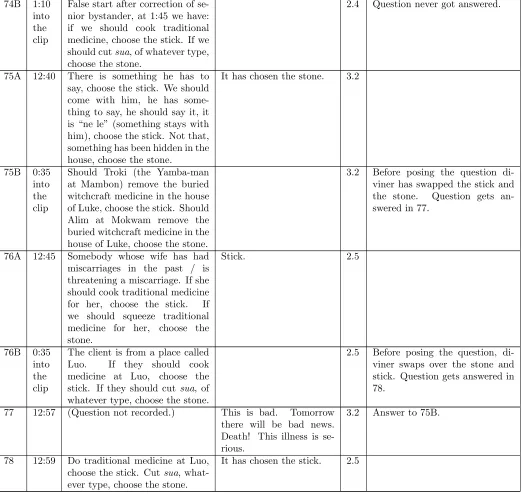
In the rest of this section, I will formalize fragments of two divination sessions about illness. The first fragment can be found in a more schematic way in Table 3 of Appendix II. It results from a divination session in 1987 and is documented by Zeitlyn. The second part is a cut of a long divination session that is shown in Table 4 of Appendix II. This session has been conducted and documented by Zeitlyn in September 2016, together with seven other sessions.9 Zeitlyn and I have made the table based on the ‘rough data’ (videos and recordings). However, it is not as ‘polished’ as the data from 1987; several gaps can be noticed. In the following two paragraphs, I will formalize both the old and the recent fragment using IEL and the language
L∗.
8Women are not even allowed to witness the procedure. This holds for any kind of
oath in the Mambila community, as well as for any kind of divination that is performed by men.
9Four sessions of Mbollo Pierre, two sessions of Suop Sylvestre, one session of Jieh from
6.3
Formalization of Dialogue D
The fragment that I will study in this paragraph results from a six-hour divination session that was held on the 30th of January 1987 in the presence of Zeitlyn. The session was held in the house of Wajiri Bi, who is a respected diviner living in an outlying hamlet of Somi´e. When the session starts, Bi and Zeitlyn are the only persons present, and Bi asks some divinatory questions about a money issue concerning Zeitlyn. Shortly after the start of the session, a man called Wong Israel enters Bi’s house and together they divine about the main problem at issue: the illness of Wong’s daughter. She has malaria and the diviners want to know whether this can be blamed on witchcraft. Furthermore they want to know whether asua oath will protect the girl from further attack. Both Bi and Wong are illiterate.
The set of data that I will study is shown in Table 3 of Appendix II. Of the forty-two questions that are asked during the session, question number thirty-three up to and including question number thirty-eight are presented in the table. These are all questions asked to either pot 1 or pot 2, as is shown in the table. The table also shows the interpreted answers of divination. Be-low I will repeat the questions and answers in a somewhat different form and I will include useful background information provided by Zeitlyn [17] as well as my first interpretations.
QD1 (pot 1).Will sua end the problem or not? This simple yes-no question is asked to pot 1.
QD2 (pot 2). Will sua end the problem or do we have to divine further? / Will sua end the problem or do we have to cut sua kare?10
At the time the diviners ask this question to pot 2, they haven’t yet obtained an answer to questionQD1 from pot 1. The first posing of QD2 is a simple yes-no question. Even though it is formulated a bit differently, the diviners
10At first, this question was formulated as “Will sua end the problem or do we have
![Table 1: Rates of inference in the suppression effect task [1]](https://thumb-us.123doks.com/thumbv2/123dok_us/8382951.321078/13.612.113.481.125.199/table-rates-inference-suppression-eect-task.webp)
![Table 3: Dialogue D, fragment of a session of Mambila spider divination,diviners Wajiri Bi and Wong Israel, January 1987 [17, p.661]](https://thumb-us.123doks.com/thumbv2/123dok_us/8382951.321078/93.612.38.566.391.600/dialogue-fragment-session-mambila-divination-diviners-wajiri-january.webp)